Chapter 6
Accounting information for pricing decisions
TABLE OF CONTENTS
• Summary
• Discuss the three major influences on pricing.
• Distinguish between short-run and long-run pricing decisions.
• Price products using the target-costing approach.
• Price products using the cost-plus approach.
• Use life-cycle budgeting and costing when making Pricing
decision
• Describe two pricing practices in which non-cost factors are
important when setting prices.
• Explain the effects of antitrust laws on pricing.
SUMMARY
SUMMARY
The major influences are customers, competitors, and costs.
Customers : Managers must always examine pricing problems
through the eyes of their customers. A price increase may cause
customers to reject a company's product and choose a
competing or substitute product. Customer- Influences price
through their effect on the demand for a product or service,
based on factors such as the features of a product and its
quality. Competitors- Companies must always be aware of the
actions of their competitors. Competitors—influence price
through their pricing schemes, product features, and production
volume and Costs influence prices because they affect supply.
The lower the cost of producing a product, the greater the
quantity of product the company is willing to supply.
SUMMARY
Costs that are often irrelevant for short-run policy decisions,
such as fixed costs that cannot be changed, are generally
relevant in the long run because costs can be altered in the long
run. Profit margins in long-run pricing decisions are often set to
earn a reasonable return on investment—prices are decreased
when demand is weak and increased when demand is strong.
Short-run implication- Have a time horizon of less than one year
and include decisions such as pricing a one-time-only special
order with no long-run implications. Adjusting product mix and
output volume in a competitive market. Long-run implication-
Have a time horizon of one year or longer and include decisions
such as: Pricing a product in a major market where there is
some leeway in setting price.
SUMMARY
Target costing is a system under which a company plans in
advance for the price points, product costs, and margins that it
wants to achieve for a new product. If it cannot manufacture a
product at these planned levels, then it cancels the design
project entirely. With target costing, a management team has a
powerful tool for continually monitoring products from the
moment they enter the design phase and onward throughout
their product life cycles. It is considered one of the most
important tools for achieving consistent profitability in a
manufacturing environment.
SUMMARY
Cost plus pricing involves adding a markup to the cost of goods
and services to arrive at a selling price. Under this approach, you
add together the direct material cost, direct labor cost, and
overhead costs for a product, and add to it a markup percentage
in order to derive the price of the product. Cost plus pricing can
also be used within a customer contract, where the customer
reimburses the seller for all costs incurred and also pays a
negotiated profit in addition to the costs incurred.
SUMMARY
A life-cycle budget is an estimate of the total amount of sales
and profits to be garnered from a product over its estimated life
span. This estimate includes the costs to develop, market, and
service a product. Thus, the time span covered is from the
initiation of a product as a design concept through its estimated
withdrawal from the market. Life-cycle budgets are useful for
estimating the profits and cash flows associated with a project,
and can be used in the decision of whether to invest in a
product. A crucial element in this analysis is the estimation of
the lifespan of a product, since managers tend to be overly
optimistic and estimate a longer lifespan than is really the case,
resulting in overestimated sales.
SUMMARY
Life cycle costing is the process of compiling all costs that the
owner or producer of an asset will incur over its lifespan. The
concept applies to several decision areas. In capital budgeting,
the total cost of ownership is compiled and then reduced to its
present value in order to determine the expected return on
investment (ROI) and net cash flows. This information is a key
part of the decision to acquire an asset.
SUMMARY
• Price discrimination is a pricing policy where companies
charge each customer different prices for the same goods or
services based on how much the customer is willing and able
to pay. Typically, the customer does not know this is
happening.
• Peak pricing is a form of congestion pricing where customers
pay an additional fee during periods of high demand. Peak
pricing is most frequently implemented by utility companies,
who charge higher rates during times of the year when
demand is the highest. The purpose of peak pricing is to
regulate demand so that it stays within a manageable level of
what can be supplied.
SUMMARY
• Antitrust laws, also referred to as "competition laws," are statutes
developed by the U.S. Government to protect consumers from
predatory business practices by ensuring that fair competition exists
in an open-market economy. These laws have evolved along with the
market, vigilantly guarding against would-be monopolies and
disruptions to the productive ebb and flow of competition. Under
the Robinson-Patman Act should be evaluated consistent with
broader antitrust policies. In practice, Robinson-Patman claims must
meet several specific legal tests:
• The Act applies to commodities, but not to services, and to
purchases, but not to leases.
• The goods must be of "like grade and quality."
• There must be likely injury to competition (that is, a private plaintiff
must also show actual harm to his or her business).
• Normally, the sales must be "in" interstate commerce (that is, the
sale must be across a state line).
DISCUSS THE THREE MAJOR INFLUENCES ON PRICING.
Section 1
MAJOR INFLUENCES ON PRICING DECISIONS
• Customers influence price
through their effect on the
demand for a product or
service, based on factors
such as the features of a
product and its quality
Customers influence
prices through their
effect on demand.
Competitors
influence prices
through their actions.
Costs influence prices
because they affect
supply.
MAJOR INFLUENCES ON PRICING DECISIONS
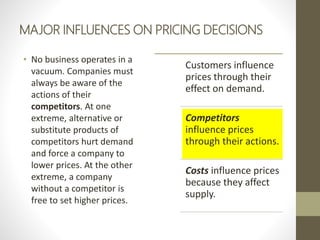
• No business operates in a
vacuum. Companies must
always be aware of the
actions of their
competitors. At one
extreme, alternative or
substitute products of
competitors hurt demand
and force a company to
lower prices. At the other
extreme, a company
without a competitor is
free to set higher prices.
Customers influence
prices through their
effect on demand.
Competitors
influence prices
through their actions.
Costs influence prices
because they affect
supply.
MAJOR INFLUENCES ON PRICING DECISIONS
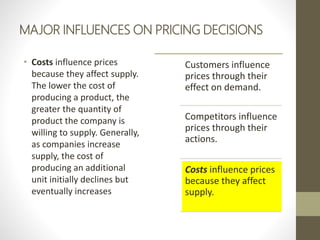
• Costs influence prices
because they affect supply.
The lower the cost of
producing a product, the
greater the quantity of
product the company is
willing to supply. Generally,
as companies increase
supply, the cost of
producing an additional
unit initially declines but
eventually increases
Customers influence
prices through their
effect on demand.
Competitors influence
prices through their
actions.
Costs influence prices
because they affect
supply.
DISTINGUISH BETWEEN SHORT-RUN AND LONG-RUN PRICING DECISIONS.
Section 2
TIME HORIZON OF PRICING DECISIONS
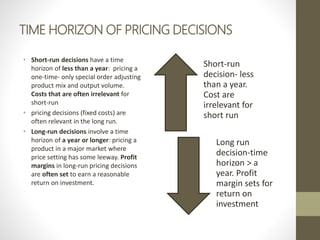
• Short-run decisions have a time
horizon of less than a year: pricing a
one-time- only special order adjusting
product mix and output volume.
Costs that are often irrelevant for
short-run
• pricing decisions (fixed costs) are
often relevant in the long run.
• Long-run decisions involve a time
horizon of a year or longer: pricing a
product in a major market where
price setting has some leeway. Profit
margins in long-run pricing decisions
are often set to earn a reasonable
return on investment.
Short-run
decision- less
than a year.
Cost are
irrelevant for
short run
Long run
decision-time
horizon > a
year. Profit
margin sets for
return on
investment
COSTING AND PRICING FOR THE SHORT RUN –
EXAMPLE
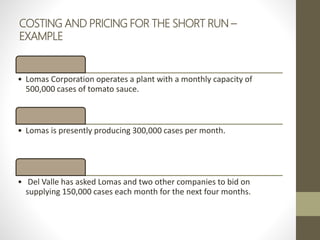
• Lomas Corporation operates a plant with a monthly capacity of
500,000 cases of tomato sauce.
• Lomas is presently producing 300,000 cases per month.
• Del Valle has asked Lomas and two other companies to bid on
supplying 150,000 cases each month for the next four months.
COSTING AND PRICING FOR THE SHORT RUN –
EXAMPLE
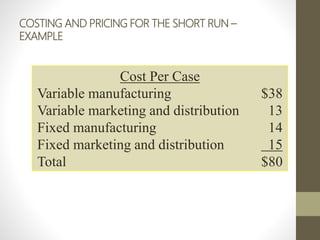
Cost Per Case
Variable manufacturing $38
Variable marketing and distribution 13
Fixed manufacturing 14
Fixed marketing and distribution 15
Total $80
COSTING AND PRICING FOR THE SHORT RUN –
EXAMPLE
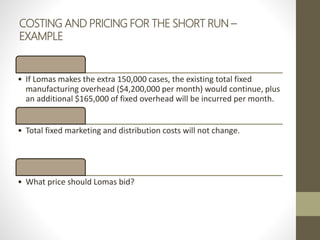
• If Lomas makes the extra 150,000 cases, the existing total fixed
manufacturing overhead ($4,200,000 per month) would continue, plus
an additional $165,000 of fixed overhead will be incurred per month.
• Total fixed marketing and distribution costs will not change.
• What price should Lomas bid?
COSTING AND PRICING FOR THE SHORT RUN –
EXAMPLE
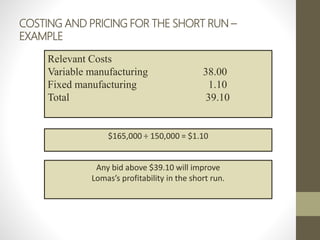
Relevant Costs
Variable manufacturing 38.00
Fixed manufacturing 1.10
Total 39.10
$165,000 ÷ 150,000 = $1.10
Any bid above $39.10 will improve
Lomas’s profitability in the short run.
COSTING AND PRICING FOR THE SHORT RUN –
EXAMPLE
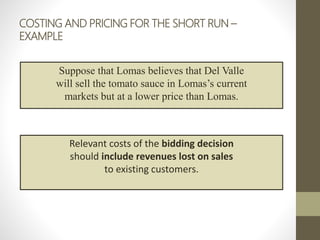
Suppose that Lomas believes that Del Valle
will sell the tomato sauce in Lomas’s current
markets but at a lower price than Lomas.
Relevant costs of the bidding decision
should include revenues lost on sales
to existing customers.
COSTING AND PRICING FOR THE LONG RUN – EXAMPLE
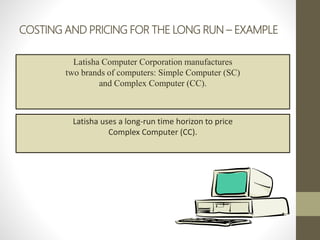
Latisha Computer Corporation manufactures
two brands of computers: Simple Computer (SC)
and Complex Computer (CC).
Latisha uses a long-run time horizon to price
Complex Computer (CC).
COSTING AND PRICING FOR THE LONG RUN – EXAMPLE
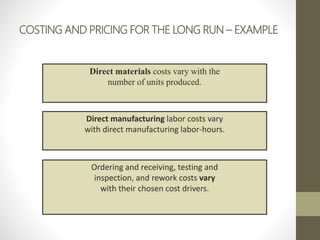
Direct materials costs vary with the
number of units produced.
Direct manufacturing labor costs vary
with direct manufacturing labor-hours.
Ordering and receiving, testing and
inspection, and rework costs vary
with their chosen cost drivers.
COSTING AND PRICING FOR THE LONG RUN – EXAMPLE
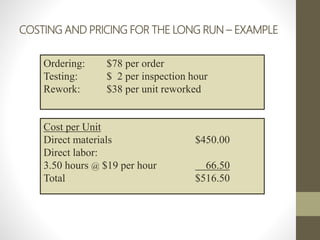
Ordering: $78 per order
Testing: $ 2 per inspection hour
Rework: $38 per unit reworked
Cost per Unit
Direct materials $450.00
Direct labor:
3.50 hours @ $19 per hour 66.50
Total $516.50
COSTING AND PRICING FOR THE LONG RUN – EXAMPLE
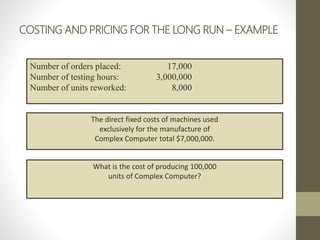
Number of orders placed: 17,000
Number of testing hours: 3,000,000
Number of units reworked: 8,000
The direct fixed costs of machines used
exclusively for the manufacture of
Complex Computer total $7,000,000.
What is the cost of producing 100,000
units of Complex Computer?
COSTING AND PRICING FOR THE LONG RUN – EXAMPLE
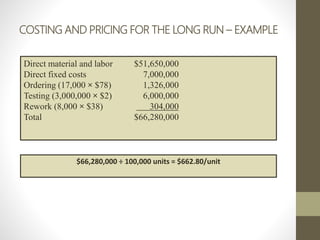
Direct material and labor $51,650,000
Direct fixed costs 7,000,000
Ordering (17,000 × $78) 1,326,000
Testing (3,000,000 × $2) 6,000,000
Rework (8,000 × $38) 304,000
Total $66,280,000
$66,280,000 ÷ 100,000 units = $662.80/unit
ALTERNATIVE LONG-RUN PRICING APPROACHES
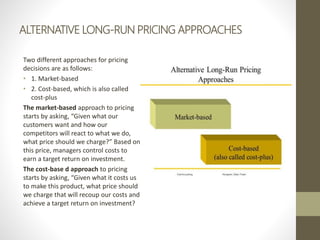
Two different approaches for pricing
decisions are as follows:
• 1. Market-based
• 2. Cost-based, which is also called
cost-plus
The market-based approach to pricing
starts by asking, “Given what our
customers want and how our
competitors will react to what we do,
what price should we charge?” Based on
this price, managers control costs to
earn a target return on investment.
The cost-base d approach to pricing
starts by asking, “Given what it costs us
to make this product, what price should
we charge that will recoup our costs and
achieve a target return on investment?
PRICE PRODUCTS USING THE TARGET-COSTING APPROACH.
Section 3
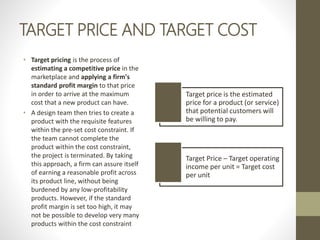
TARGET PRICE AND TARGET COST
• Target pricing is the process of
estimating a competitive price in the
marketplace and applying a firm's
standard profit margin to that price
in order to arrive at the maximum
cost that a new product can have.
• A design team then tries to create a
product with the requisite features
within the pre-set cost constraint. If
the team cannot complete the
product within the cost constraint,
the project is terminated. By taking
this approach, a firm can assure itself
of earning a reasonable profit across
its product line, without being
burdened by any low-profitability
products. However, if the standard
profit margin is set too high, it may
not be possible to develop very many
products within the cost constraint
Target price is the estimated
price for a product (or service)
that potential customers will
be willing to pay.
Target Price – Target operating
income per unit = Target cost
per unit
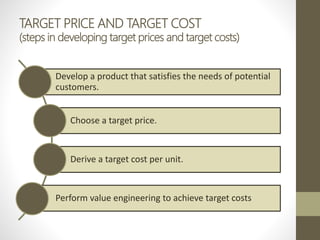
TARGET PRICE AND TARGET COST
(steps in developing target prices and target costs)
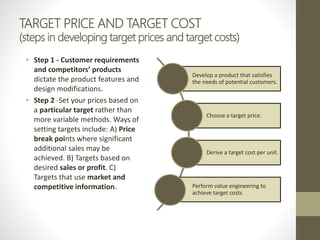
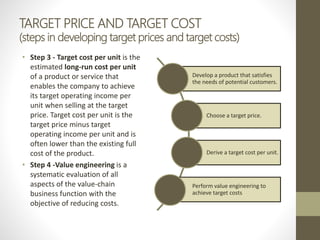
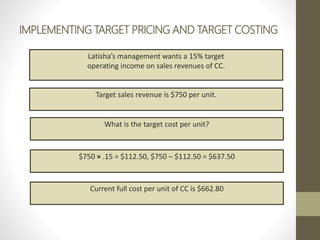
Develop a product that satisfies the needs of potential
customers.
Choose a target price.
Derive a target cost per unit.
Perform value engineering to achieve target costs
TARGET PRICE AND TARGET COST
(steps in developing target prices and target costs)
• Step 1 - Customer requirements
and competitors’ products
dictate the product features and
design modifications.
• Step 2 -Set your prices based on
a particular target rather than
more variable methods. Ways of
setting targets include: A) Price
break points where significant
additional sales may be
achieved. B) Targets based on
desired sales or profit. C)
Targets that use market and
competitive information.
Develop a product that satisfies
the needs of potential customers.
Choose a target price.
Derive a target cost per unit.
Perform value engineering to
achieve target costs
TARGET PRICE AND TARGET COST
(steps in developing target prices and target costs)
• Step 3 - Target cost per unit is the
estimated long-run cost per unit
of a product or service that
enables the company to achieve
its target operating income per
unit when selling at the target
price. Target cost per unit is the
target price minus target
operating income per unit and is
often lower than the existing full
cost of the product.
• Step 4 -Value engineering is a
systematic evaluation of all
aspects of the value-chain
business function with the
objective of reducing costs.
Develop a product that satisfies
the needs of potential customers.
Choose a target price.
Derive a target cost per unit.
Perform value engineering to
achieve target costs
IMPLEMENTING TARGET PRICING AND TARGET COSTING
Latisha’s management wants a 15% target
operating income on sales revenues of CC.
Target sales revenue is $750 per unit.
What is the target cost per unit?
$750 × .15 = $112.50, $750 – $112.50 = $637.50
Current full cost per unit of CC is $662.80
VALUE-ADDED COSTS
• A value-added cost is a cost
that customers perceive as
adding value, or utility, to a
product or service:
• Adequate memory
• Pre-loaded software
• Reliability
• Easy-to-use keyboards
NON VALUE-ADDED COSTS
• A nonvalue-added cost is a cost
that customers do not perceive
as adding value, or utility, to a
product or service i.e. cost of
expediting, rework and repair
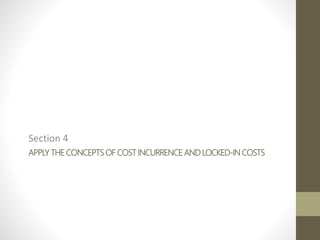
APPLY THE CONCEPTS OF COST INCURRENCE AND LOCKED-IN COSTS
Section 4
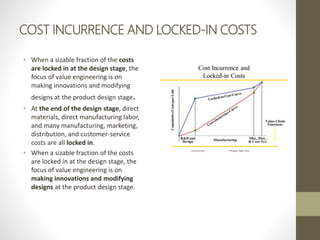
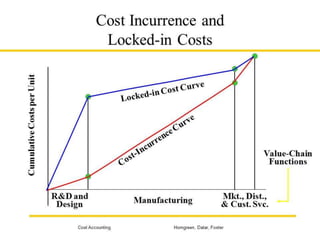
COST INCURRENCE AND LOCKED-IN COSTS
• Cost incurrence- This describes
when a resource is sacrificed or
forgone to meet a specific
objective. Costing systems
measure cost incurrence example
research and development,
design, manufacturing,
marketing, distribution and
customer support.
• Locked-in costs- These are those
costs that have not yet been
incurred but which, based on
decisions that have already been
made, will be incurred in the
future (designed-in costs). It is
difficult to alter or reduce costs
that are already locked in.
COST INCURRENCE AND LOCKED-IN COSTS
• When a sizable fraction of the costs
are locked in at the design stage, the
focus of value engineering is on
making innovations and modifying
designs at the product design stage.
• At the end of the design stage, direct
materials, direct manufacturing labor,
and many manufacturing, marketing,
distribution, and customer-service
costs are all locked in.
• When a sizable fraction of the costs
are locked in at the design stage, the
focus of value engineering is on
making innovations and modifying
designs at the product design stage.
PRICE PRODUCTS USING THE COST-PLUS APPROACH.
Section 5
COST-PLUS PRICING
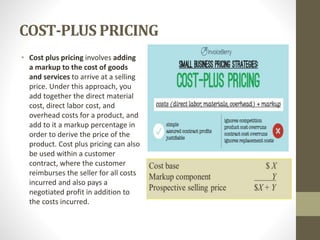
• Cost plus pricing involves adding
a markup to the cost of goods
and services to arrive at a selling
price. Under this approach, you
add together the direct material
cost, direct labor cost, and
overhead costs for a product, and
add to it a markup percentage in
order to derive the price of the
product. Cost plus pricing can also
be used within a customer
contract, where the customer
reimburses the seller for all costs
incurred and also pays a
negotiated profit in addition to
the costs incurred.
COST-PLUS PRICING
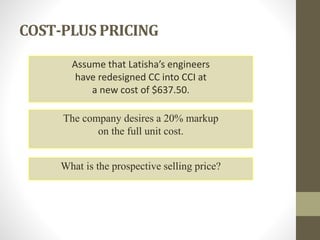
Assume that Latisha’s engineers
have redesigned CC into CCI at
a new cost of $637.50.
The company desires a 20% markup
on the full unit cost.
What is the prospective selling price?
COST-PLUS PRICING
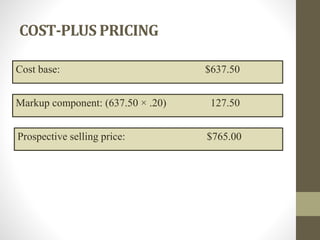
Cost base: $637.50
Markup component: (637.50 × .20) 127.50
Prospective selling price: $765.00
COST-PLUS PRICING
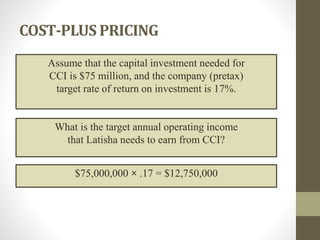
Assume that the capital investment needed for
CCI is $75 million, and the company (pretax)
target rate of return on investment is 17%.
What is the target annual operating income
that Latisha needs to earn from CCI?
$75,000,000 × .17 = $12,750,000
COST-PLUS PRICING
What is the target operating income per unit?
$12,750,000 ÷ 100,000 units = $127.50/unit
COST-PLUS PRICING
The 17% target rate of return on investment
expresses the company’s expected annual
operating income as a percentage of investment.
The 20% markup expresses operating
income per unit as a percentage of the
full product cost per unit.
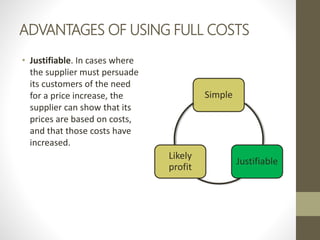
ADVANTAGES OF USING FULL COSTS
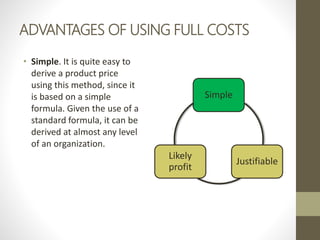
• Simple. It is quite easy to
derive a product price
using this method, since it
is based on a simple
formula. Given the use of a
standard formula, it can be
derived at almost any level
of an organization.
Simple
Justifiable
Likely
profit
ADVANTAGES OF USING FULL COSTS
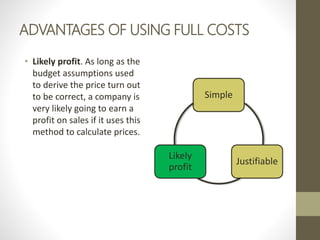
• Likely profit. As long as the
budget assumptions used
to derive the price turn out
to be correct, a company is
very likely going to earn a
profit on sales if it uses this
method to calculate prices.
Simple
Justifiable
Likely
profit
ADVANTAGES OF USING FULL COSTS
• Justifiable. In cases where
the supplier must persuade
its customers of the need
for a price increase, the
supplier can show that its
prices are based on costs,
and that those costs have
increased.
Simple
Justifiable
Likely
profit
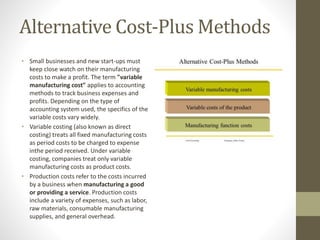
Alternative Cost-Plus Methods
• Small businesses and new start-ups must
keep close watch on their manufacturing
costs to make a profit. The term "variable
manufacturing cost" applies to accounting
methods to track business expenses and
profits. Depending on the type of
accounting system used, the specifics of the
variable costs vary widely.
• Variable costing (also known as direct
costing) treats all fixed manufacturing costs
as period costs to be charged to expense
inthe period received. Under variable
costing, companies treat only variable
manufacturing costs as product costs.
• Production costs refer to the costs incurred
by a business when manufacturing a good
or providing a service. Production costs
include a variety of expenses, such as labor,
raw materials, consumable manufacturing
supplies, and general overhead.
USE LIFE-CYCLEBUDGETINGAND COSTINGWHEN MAKINGPRICING DECISION
Section 6
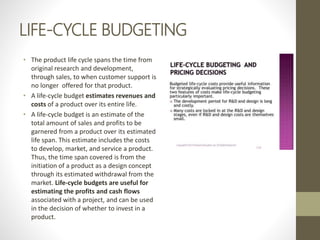
LIFE-CYCLE BUDGETING
• The product life cycle spans the time from
original research and development,
through sales, to when customer support is
no longer offered for that product.
• A life-cycle budget estimates revenues and
costs of a product over its entire life.
• A life-cycle budget is an estimate of the
total amount of sales and profits to be
garnered from a product over its estimated
life span. This estimate includes the costs
to develop, market, and service a product.
Thus, the time span covered is from the
initiation of a product as a design concept
through its estimated withdrawal from the
market. Life-cycle budgets are useful for
estimating the profits and cash flows
associated with a project, and can be used
in the decision of whether to invest in a
product.
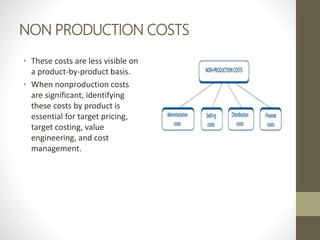
NON PRODUCTION COSTS
• These costs are less visible on
a product-by-product basis.
• When nonproduction costs
are significant, identifying
these costs by product is
essential for target pricing,
target costing, value
engineering, and cost
management.
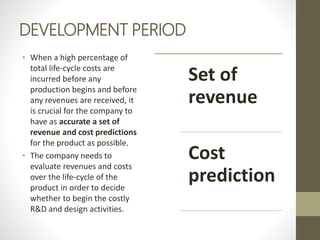
DEVELOPMENT PERIOD
• When a high percentage of
total life-cycle costs are
incurred before any
production begins and before
any revenues are received, it
is crucial for the company to
have as accurate a set of
revenue and cost predictions
for the product as possible.
• The company needs to
evaluate revenues and costs
over the life-cycle of the
product in order to decide
whether to begin the costly
R&D and design activities.
Set of
revenue
Cost
prediction
PREDICTED COSTS
• Many of the production,
marketing, distribution and
customer service costs are
locked in during the R&D and
design stage.
• Life-cycle budgeting facilitates
value engineering at the
design stage before costs are
locked in
Marketing, distribution
and customer service
are locked in R&D
Life-cycle budgeting
value engineering
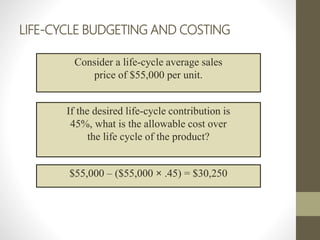
LIFE-CYCLE BUDGETING AND COSTING
Consider a life-cycle average sales
price of $55,000 per unit.
If the desired life-cycle contribution is
45%, what is the allowable cost over
the life cycle of the product?
$55,000 – ($55,000 × .45) = $30,250
DESCRIBETWO PRICING PRACTICES IN WHICH NON-COST FACTORSARE IMPORTANT
WHEN SETTING PRICES.
Section 7
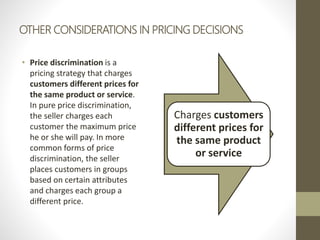
OTHER CONSIDERATIONS IN PRICING DECISIONS
• Price discrimination is a
pricing strategy that charges
customers different prices for
the same product or service.
In pure price discrimination,
the seller charges each
customer the maximum price
he or she will pay. In more
common forms of price
discrimination, the seller
places customers in groups
based on certain attributes
and charges each group a
different price.
Charges customers
different prices for
the same product
or service
OTHER CONSIDERATIONS IN PRICING DECISIONS
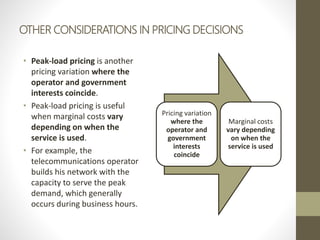
• Peak-load pricing is another
pricing variation where the
operator and government
interests coincide.
• Peak-load pricing is useful
when marginal costs vary
depending on when the
service is used.
• For example, the
telecommunications operator
builds his network with the
capacity to serve the peak
demand, which generally
occurs during business hours.
Pricing variation
where the
operator and
government
interests
coincide
Marginal costs
vary depending
on when the
service is used
EXPLAIN THE EFFECTS OF ANTITRUST LAWS ON PRICING.
Section8
PRICE DISCRIMINATION LAWS
• Under the U.S. Robinson-
Patman Act, a manufacturer
cannot price-discriminate
between two customers if
the intent is to lessen or
prevent competition for
customers.
• They apply to manufacturers,
not service providers.
• Price discrimination is
permissible if differences in
prices can be justified by
differences in costs.
PRICE DISCRIMINATION LAWS
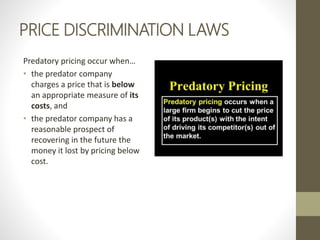
Predatory pricing occur when…
• the predator company
charges a price that is below
an appropriate measure of its
costs, and
• the predator company has a
reasonable prospect of
recovering in the future the
money it lost by pricing below
cost.
PRICE DISCRIMINATION LAWS
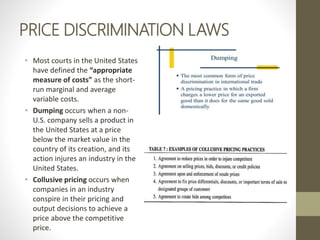
• Most courts in the United States
have defined the “appropriate
measure of costs” as the short-
run marginal and average
variable costs.
• Dumping occurs when a non-
U.S. company sells a product in
the United States at a price
below the market value in the
country of its creation, and its
action injures an industry in the
United States.
• Collusive pricing occurs when
companies in an industry
conspire in their pricing and
output decisions to achieve a
price above the competitive
price.
Mgmt acc chap 6 : Pricing Decisions

  • 1.
    Chapter 6 Accounting informationfor pricing decisions
  • 2.
    TABLE OF CONTENTS •Summary • Discuss the three major influences on pricing. • Distinguish between short-run and long-run pricing decisions. • Price products using the target-costing approach. • Price products using the cost-plus approach. • Use life-cycle budgeting and costing when making Pricing decision • Describe two pricing practices in which non-cost factors are important when setting prices. • Explain the effects of antitrust laws on pricing.
  • 3.
  • 4.
    SUMMARY The major influencesare customers, competitors, and costs. Customers : Managers must always examine pricing problems through the eyes of their customers. A price increase may cause customers to reject a company's product and choose a competing or substitute product. Customer- Influences price through their effect on the demand for a product or service, based on factors such as the features of a product and its quality. Competitors- Companies must always be aware of the actions of their competitors. Competitors—influence price through their pricing schemes, product features, and production volume and Costs influence prices because they affect supply. The lower the cost of producing a product, the greater the quantity of product the company is willing to supply.
  • 5.
    SUMMARY Costs that areoften irrelevant for short-run policy decisions, such as fixed costs that cannot be changed, are generally relevant in the long run because costs can be altered in the long run. Profit margins in long-run pricing decisions are often set to earn a reasonable return on investment—prices are decreased when demand is weak and increased when demand is strong. Short-run implication- Have a time horizon of less than one year and include decisions such as pricing a one-time-only special order with no long-run implications. Adjusting product mix and output volume in a competitive market. Long-run implication- Have a time horizon of one year or longer and include decisions such as: Pricing a product in a major market where there is some leeway in setting price.
  • 6.
    SUMMARY Target costing isa system under which a company plans in advance for the price points, product costs, and margins that it wants to achieve for a new product. If it cannot manufacture a product at these planned levels, then it cancels the design project entirely. With target costing, a management team has a powerful tool for continually monitoring products from the moment they enter the design phase and onward throughout their product life cycles. It is considered one of the most important tools for achieving consistent profitability in a manufacturing environment.
  • 7.
    SUMMARY Cost plus pricinginvolves adding a markup to the cost of goods and services to arrive at a selling price. Under this approach, you add together the direct material cost, direct labor cost, and overhead costs for a product, and add to it a markup percentage in order to derive the price of the product. Cost plus pricing can also be used within a customer contract, where the customer reimburses the seller for all costs incurred and also pays a negotiated profit in addition to the costs incurred.
  • 8.
    SUMMARY A life-cycle budgetis an estimate of the total amount of sales and profits to be garnered from a product over its estimated life span. This estimate includes the costs to develop, market, and service a product. Thus, the time span covered is from the initiation of a product as a design concept through its estimated withdrawal from the market. Life-cycle budgets are useful for estimating the profits and cash flows associated with a project, and can be used in the decision of whether to invest in a product. A crucial element in this analysis is the estimation of the lifespan of a product, since managers tend to be overly optimistic and estimate a longer lifespan than is really the case, resulting in overestimated sales.
  • 9.
    SUMMARY Life cycle costingis the process of compiling all costs that the owner or producer of an asset will incur over its lifespan. The concept applies to several decision areas. In capital budgeting, the total cost of ownership is compiled and then reduced to its present value in order to determine the expected return on investment (ROI) and net cash flows. This information is a key part of the decision to acquire an asset.
  • 10.
    SUMMARY • Price discriminationis a pricing policy where companies charge each customer different prices for the same goods or services based on how much the customer is willing and able to pay. Typically, the customer does not know this is happening. • Peak pricing is a form of congestion pricing where customers pay an additional fee during periods of high demand. Peak pricing is most frequently implemented by utility companies, who charge higher rates during times of the year when demand is the highest. The purpose of peak pricing is to regulate demand so that it stays within a manageable level of what can be supplied.
  • 11.
    SUMMARY • Antitrust laws,also referred to as "competition laws," are statutes developed by the U.S. Government to protect consumers from predatory business practices by ensuring that fair competition exists in an open-market economy. These laws have evolved along with the market, vigilantly guarding against would-be monopolies and disruptions to the productive ebb and flow of competition. Under the Robinson-Patman Act should be evaluated consistent with broader antitrust policies. In practice, Robinson-Patman claims must meet several specific legal tests: • The Act applies to commodities, but not to services, and to purchases, but not to leases. • The goods must be of "like grade and quality." • There must be likely injury to competition (that is, a private plaintiff must also show actual harm to his or her business). • Normally, the sales must be "in" interstate commerce (that is, the sale must be across a state line).
  • 12.
    DISCUSS THE THREEMAJOR INFLUENCES ON PRICING. Section 1
  • 13.
    MAJOR INFLUENCES ONPRICING DECISIONS • Customers influence price through their effect on the demand for a product or service, based on factors such as the features of a product and its quality Customers influence prices through their effect on demand. Competitors influence prices through their actions. Costs influence prices because they affect supply.
  • 14.
    MAJOR INFLUENCES ONPRICING DECISIONS • No business operates in a vacuum. Companies must always be aware of the actions of their competitors. At one extreme, alternative or substitute products of competitors hurt demand and force a company to lower prices. At the other extreme, a company without a competitor is free to set higher prices. Customers influence prices through their effect on demand. Competitors influence prices through their actions. Costs influence prices because they affect supply.
  • 15.
    MAJOR INFLUENCES ONPRICING DECISIONS • Costs influence prices because they affect supply. The lower the cost of producing a product, the greater the quantity of product the company is willing to supply. Generally, as companies increase supply, the cost of producing an additional unit initially declines but eventually increases Customers influence prices through their effect on demand. Competitors influence prices through their actions. Costs influence prices because they affect supply.
  • 16.
    DISTINGUISH BETWEEN SHORT-RUNAND LONG-RUN PRICING DECISIONS. Section 2
  • 17.
    TIME HORIZON OFPRICING DECISIONS • Short-run decisions have a time horizon of less than a year: pricing a one-time- only special order adjusting product mix and output volume. Costs that are often irrelevant for short-run • pricing decisions (fixed costs) are often relevant in the long run. • Long-run decisions involve a time horizon of a year or longer: pricing a product in a major market where price setting has some leeway. Profit margins in long-run pricing decisions are often set to earn a reasonable return on investment. Short-run decision- less than a year. Cost are irrelevant for short run Long run decision-time horizon > a year. Profit margin sets for return on investment
  • 18.
    COSTING AND PRICINGFOR THE SHORT RUN – EXAMPLE • Lomas Corporation operates a plant with a monthly capacity of 500,000 cases of tomato sauce. • Lomas is presently producing 300,000 cases per month. • Del Valle has asked Lomas and two other companies to bid on supplying 150,000 cases each month for the next four months.
  • 19.
    COSTING AND PRICINGFOR THE SHORT RUN – EXAMPLE Cost Per Case Variable manufacturing $38 Variable marketing and distribution 13 Fixed manufacturing 14 Fixed marketing and distribution 15 Total $80
  • 20.
    COSTING AND PRICINGFOR THE SHORT RUN – EXAMPLE • If Lomas makes the extra 150,000 cases, the existing total fixed manufacturing overhead ($4,200,000 per month) would continue, plus an additional $165,000 of fixed overhead will be incurred per month. • Total fixed marketing and distribution costs will not change. • What price should Lomas bid?
  • 21.
    COSTING AND PRICINGFOR THE SHORT RUN – EXAMPLE Relevant Costs Variable manufacturing 38.00 Fixed manufacturing 1.10 Total 39.10 $165,000 ÷ 150,000 = $1.10 Any bid above $39.10 will improve Lomas’s profitability in the short run.
  • 22.
    COSTING AND PRICINGFOR THE SHORT RUN – EXAMPLE Suppose that Lomas believes that Del Valle will sell the tomato sauce in Lomas’s current markets but at a lower price than Lomas. Relevant costs of the bidding decision should include revenues lost on sales to existing customers.
  • 23.
    COSTING AND PRICINGFOR THE LONG RUN – EXAMPLE Latisha Computer Corporation manufactures two brands of computers: Simple Computer (SC) and Complex Computer (CC). Latisha uses a long-run time horizon to price Complex Computer (CC).
  • 24.
    COSTING AND PRICINGFOR THE LONG RUN – EXAMPLE Direct materials costs vary with the number of units produced. Direct manufacturing labor costs vary with direct manufacturing labor-hours. Ordering and receiving, testing and inspection, and rework costs vary with their chosen cost drivers.
  • 25.
    COSTING AND PRICINGFOR THE LONG RUN – EXAMPLE Ordering: $78 per order Testing: $ 2 per inspection hour Rework: $38 per unit reworked Cost per Unit Direct materials $450.00 Direct labor: 3.50 hours @ $19 per hour 66.50 Total $516.50
  • 26.
    COSTING AND PRICINGFOR THE LONG RUN – EXAMPLE Number of orders placed: 17,000 Number of testing hours: 3,000,000 Number of units reworked: 8,000 The direct fixed costs of machines used exclusively for the manufacture of Complex Computer total $7,000,000. What is the cost of producing 100,000 units of Complex Computer?
  • 27.
    COSTING AND PRICINGFOR THE LONG RUN – EXAMPLE Direct material and labor $51,650,000 Direct fixed costs 7,000,000 Ordering (17,000 × $78) 1,326,000 Testing (3,000,000 × $2) 6,000,000 Rework (8,000 × $38) 304,000 Total $66,280,000 $66,280,000 ÷ 100,000 units = $662.80/unit
  • 28.
    ALTERNATIVE LONG-RUN PRICINGAPPROACHES Two different approaches for pricing decisions are as follows: • 1. Market-based • 2. Cost-based, which is also called cost-plus The market-based approach to pricing starts by asking, “Given what our customers want and how our competitors will react to what we do, what price should we charge?” Based on this price, managers control costs to earn a target return on investment. The cost-base d approach to pricing starts by asking, “Given what it costs us to make this product, what price should we charge that will recoup our costs and achieve a target return on investment?
  • 29.
    PRICE PRODUCTS USINGTHE TARGET-COSTING APPROACH. Section 3
  • 30.
    TARGET PRICE ANDTARGET COST • Target pricing is the process of estimating a competitive price in the marketplace and applying a firm's standard profit margin to that price in order to arrive at the maximum cost that a new product can have. • A design team then tries to create a product with the requisite features within the pre-set cost constraint. If the team cannot complete the product within the cost constraint, the project is terminated. By taking this approach, a firm can assure itself of earning a reasonable profit across its product line, without being burdened by any low-profitability products. However, if the standard profit margin is set too high, it may not be possible to develop very many products within the cost constraint Target price is the estimated price for a product (or service) that potential customers will be willing to pay. Target Price – Target operating income per unit = Target cost per unit
  • 31.
    TARGET PRICE ANDTARGET COST (steps in developing target prices and target costs) Develop a product that satisfies the needs of potential customers. Choose a target price. Derive a target cost per unit. Perform value engineering to achieve target costs
  • 32.
    TARGET PRICE ANDTARGET COST (steps in developing target prices and target costs) • Step 1 - Customer requirements and competitors’ products dictate the product features and design modifications. • Step 2 -Set your prices based on a particular target rather than more variable methods. Ways of setting targets include: A) Price break points where significant additional sales may be achieved. B) Targets based on desired sales or profit. C) Targets that use market and competitive information. Develop a product that satisfies the needs of potential customers. Choose a target price. Derive a target cost per unit. Perform value engineering to achieve target costs
  • 33.
    TARGET PRICE ANDTARGET COST (steps in developing target prices and target costs) • Step 3 - Target cost per unit is the estimated long-run cost per unit of a product or service that enables the company to achieve its target operating income per unit when selling at the target price. Target cost per unit is the target price minus target operating income per unit and is often lower than the existing full cost of the product. • Step 4 -Value engineering is a systematic evaluation of all aspects of the value-chain business function with the objective of reducing costs. Develop a product that satisfies the needs of potential customers. Choose a target price. Derive a target cost per unit. Perform value engineering to achieve target costs
  • 34.
    IMPLEMENTING TARGET PRICINGAND TARGET COSTING Latisha’s management wants a 15% target operating income on sales revenues of CC. Target sales revenue is $750 per unit. What is the target cost per unit? $750 × .15 = $112.50, $750 – $112.50 = $637.50 Current full cost per unit of CC is $662.80
  • 35.
    VALUE-ADDED COSTS • Avalue-added cost is a cost that customers perceive as adding value, or utility, to a product or service: • Adequate memory • Pre-loaded software • Reliability • Easy-to-use keyboards
  • 36.
    NON VALUE-ADDED COSTS •A nonvalue-added cost is a cost that customers do not perceive as adding value, or utility, to a product or service i.e. cost of expediting, rework and repair
  • 37.
    APPLY THE CONCEPTSOF COST INCURRENCE AND LOCKED-IN COSTS Section 4
  • 38.
    COST INCURRENCE ANDLOCKED-IN COSTS • Cost incurrence- This describes when a resource is sacrificed or forgone to meet a specific objective. Costing systems measure cost incurrence example research and development, design, manufacturing, marketing, distribution and customer support. • Locked-in costs- These are those costs that have not yet been incurred but which, based on decisions that have already been made, will be incurred in the future (designed-in costs). It is difficult to alter or reduce costs that are already locked in.
  • 40.
    COST INCURRENCE ANDLOCKED-IN COSTS • When a sizable fraction of the costs are locked in at the design stage, the focus of value engineering is on making innovations and modifying designs at the product design stage. • At the end of the design stage, direct materials, direct manufacturing labor, and many manufacturing, marketing, distribution, and customer-service costs are all locked in. • When a sizable fraction of the costs are locked in at the design stage, the focus of value engineering is on making innovations and modifying designs at the product design stage.
  • 41.
    PRICE PRODUCTS USINGTHE COST-PLUS APPROACH. Section 5
  • 42.
    COST-PLUS PRICING • Costplus pricing involves adding a markup to the cost of goods and services to arrive at a selling price. Under this approach, you add together the direct material cost, direct labor cost, and overhead costs for a product, and add to it a markup percentage in order to derive the price of the product. Cost plus pricing can also be used within a customer contract, where the customer reimburses the seller for all costs incurred and also pays a negotiated profit in addition to the costs incurred.
  • 43.
    COST-PLUS PRICING Assume thatLatisha’s engineers have redesigned CC into CCI at a new cost of $637.50. The company desires a 20% markup on the full unit cost. What is the prospective selling price?
  • 44.
    COST-PLUS PRICING Cost base:$637.50 Markup component: (637.50 × .20) 127.50 Prospective selling price: $765.00
  • 45.
    COST-PLUS PRICING Assume thatthe capital investment needed for CCI is $75 million, and the company (pretax) target rate of return on investment is 17%. What is the target annual operating income that Latisha needs to earn from CCI? $75,000,000 × .17 = $12,750,000
  • 46.
    COST-PLUS PRICING What isthe target operating income per unit? $12,750,000 ÷ 100,000 units = $127.50/unit
  • 47.
    COST-PLUS PRICING The 17%target rate of return on investment expresses the company’s expected annual operating income as a percentage of investment. The 20% markup expresses operating income per unit as a percentage of the full product cost per unit.
  • 48.
    ADVANTAGES OF USINGFULL COSTS • Simple. It is quite easy to derive a product price using this method, since it is based on a simple formula. Given the use of a standard formula, it can be derived at almost any level of an organization. Simple Justifiable Likely profit
  • 49.
    ADVANTAGES OF USINGFULL COSTS • Likely profit. As long as the budget assumptions used to derive the price turn out to be correct, a company is very likely going to earn a profit on sales if it uses this method to calculate prices. Simple Justifiable Likely profit
  • 50.
    ADVANTAGES OF USINGFULL COSTS • Justifiable. In cases where the supplier must persuade its customers of the need for a price increase, the supplier can show that its prices are based on costs, and that those costs have increased. Simple Justifiable Likely profit
  • 51.
    Alternative Cost-Plus Methods •Small businesses and new start-ups must keep close watch on their manufacturing costs to make a profit. The term "variable manufacturing cost" applies to accounting methods to track business expenses and profits. Depending on the type of accounting system used, the specifics of the variable costs vary widely. • Variable costing (also known as direct costing) treats all fixed manufacturing costs as period costs to be charged to expense inthe period received. Under variable costing, companies treat only variable manufacturing costs as product costs. • Production costs refer to the costs incurred by a business when manufacturing a good or providing a service. Production costs include a variety of expenses, such as labor, raw materials, consumable manufacturing supplies, and general overhead.
  • 52.
    USE LIFE-CYCLEBUDGETINGAND COSTINGWHENMAKINGPRICING DECISION Section 6
  • 53.
    LIFE-CYCLE BUDGETING • Theproduct life cycle spans the time from original research and development, through sales, to when customer support is no longer offered for that product. • A life-cycle budget estimates revenues and costs of a product over its entire life. • A life-cycle budget is an estimate of the total amount of sales and profits to be garnered from a product over its estimated life span. This estimate includes the costs to develop, market, and service a product. Thus, the time span covered is from the initiation of a product as a design concept through its estimated withdrawal from the market. Life-cycle budgets are useful for estimating the profits and cash flows associated with a project, and can be used in the decision of whether to invest in a product.
  • 54.
    NON PRODUCTION COSTS •These costs are less visible on a product-by-product basis. • When nonproduction costs are significant, identifying these costs by product is essential for target pricing, target costing, value engineering, and cost management.
  • 55.
    DEVELOPMENT PERIOD • Whena high percentage of total life-cycle costs are incurred before any production begins and before any revenues are received, it is crucial for the company to have as accurate a set of revenue and cost predictions for the product as possible. • The company needs to evaluate revenues and costs over the life-cycle of the product in order to decide whether to begin the costly R&D and design activities. Set of revenue Cost prediction
  • 56.
    PREDICTED COSTS • Manyof the production, marketing, distribution and customer service costs are locked in during the R&D and design stage. • Life-cycle budgeting facilitates value engineering at the design stage before costs are locked in Marketing, distribution and customer service are locked in R&D Life-cycle budgeting value engineering
  • 57.
    LIFE-CYCLE BUDGETING ANDCOSTING Consider a life-cycle average sales price of $55,000 per unit. If the desired life-cycle contribution is 45%, what is the allowable cost over the life cycle of the product? $55,000 – ($55,000 × .45) = $30,250
  • 58.
    DESCRIBETWO PRICING PRACTICESIN WHICH NON-COST FACTORSARE IMPORTANT WHEN SETTING PRICES. Section 7
  • 59.
    OTHER CONSIDERATIONS INPRICING DECISIONS • Price discrimination is a pricing strategy that charges customers different prices for the same product or service. In pure price discrimination, the seller charges each customer the maximum price he or she will pay. In more common forms of price discrimination, the seller places customers in groups based on certain attributes and charges each group a different price. Charges customers different prices for the same product or service
  • 60.
    OTHER CONSIDERATIONS INPRICING DECISIONS • Peak-load pricing is another pricing variation where the operator and government interests coincide. • Peak-load pricing is useful when marginal costs vary depending on when the service is used. • For example, the telecommunications operator builds his network with the capacity to serve the peak demand, which generally occurs during business hours. Pricing variation where the operator and government interests coincide Marginal costs vary depending on when the service is used
  • 61.
    EXPLAIN THE EFFECTSOF ANTITRUST LAWS ON PRICING. Section8
  • 62.
    PRICE DISCRIMINATION LAWS •Under the U.S. Robinson- Patman Act, a manufacturer cannot price-discriminate between two customers if the intent is to lessen or prevent competition for customers. • They apply to manufacturers, not service providers. • Price discrimination is permissible if differences in prices can be justified by differences in costs.
  • 63.
    PRICE DISCRIMINATION LAWS Predatorypricing occur when… • the predator company charges a price that is below an appropriate measure of its costs, and • the predator company has a reasonable prospect of recovering in the future the money it lost by pricing below cost.
  • 64.
    PRICE DISCRIMINATION LAWS •Most courts in the United States have defined the “appropriate measure of costs” as the short- run marginal and average variable costs. • Dumping occurs when a non- U.S. company sells a product in the United States at a price below the market value in the country of its creation, and its action injures an industry in the United States. • Collusive pricing occurs when companies in an industry conspire in their pricing and output decisions to achieve a price above the competitive price.