1
An-Najah NationalUniversity
College ofGraduate Studies
Masterof accounting program
Empirical Tests of Measures of Reporting
Quality
By:
Ro’ya Abd El-hafez
2
Table of Content
Introduction:...........................................................................................3
Factors affecting the quality of the financial report:...............................4
Researches that examined different measures of report quality .............5
Classifications of reporting Quality Measures ......................................17
References.............................................................................................26
3
Introduction:
The financial collapse of companies and banks that occurred in
developed countries is considered one of the most important reasons for the
weak confidence of investors in financial reports, which called for the
importance of searching for how to adjust, achieve and measure the quality of
financial reports to restore confidence and credibility, especially among
investors. Countries increase the demand for high-quality financial reports
and information that is transparent between investors, stakeholders, and
society in general. (AIFUWA et al, 2018) defined Reporting quality as the
faithfulness of information conveyed in both financial and non-financial
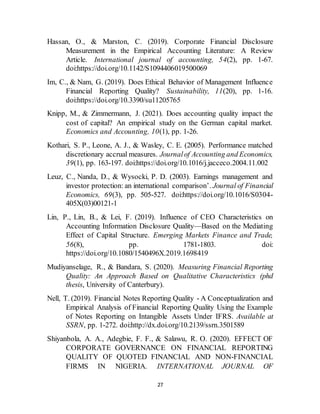
reporting process. Financial statements of firms at the end of a financial year
should have someelement of truth in it. This is termed “quality”, itis therefore
crucial that the financial reports of firms should have high quality so as to
increase the confidence of users.
Financial reporting quality can be thought of as spanning a continuum
from the highest (containing information that is relevant, correct, complete,
and unbiased) to the lowest (containing information that is not just biased or
incomplete but possibly pure fabrication). (CFA Institute, 2022)
However, no measurement method for quality has been universally
provided and arbitrary techniques have been used by researchers in the
evaluation of quality of financial reporting. Researchers have generally
applied accrual method, conservatism, value relevance and qualitative
characteristics of financial statement. Financial reporting quality aims at
transparency promotion, thereby presenting high-quality financial report.
Several empirical evidence use influences on financial reporting as a measure
of financial reporting quality, also indicating quality of financial report
associating with various influences. (Shiyanbola et al , 2020)
For many years, international financial reporting has been criticized in
practice and academia for failing to provideinformation that is appropriate for
its intended users. This criticism points to deficits with regard to the content
and presentation and, thus, to the overall quality reporting. However, this
criticism is predominantly anecdotal in nature as there is, as yet, scarcely any
valid scientific evidence that supports these claims (Nell, 2019). This work
addresses this research gap by elaborating what reporting quality is, What are
4
the factors that affect the quality of the report? , What are the methods for
measuring reportquality? and how they are empirically manifested (empirical
evidence).
Factors affecting the quality of the financial report:
1. Information factors: The quality of the financial report is affected by
the availability of a number of characteristics and qualities that govern
a useful decision-making. (Anisa, 2019)
2. Management motives: The management bears the primary
responsibility for preparing fair and accurate financial reports. It is
known that making management judgments is necessary when
determining the numbers in the financial statements. (Anisa, 2019)
3. Financial reporting standards: The preparation of high-quality
financial reports depends primarily on the quality of the applied
accounting standards, and the quality of accounting standards means
their ability to producerelevance and reliable financial information for
making economic decisions. (Anisa, 2019)
4. Corporate Governance Practices: The quality of reports is closely
related to the quality of the governance procedures in companies, that
is, the application of accounting standards can be necessary but not
sufficient to increase transparency and comparability. (Anisa, 2019)
5. Audit Committees: The Audit Committee has an important role in
increasing the reliability and credibility of the information contained in
the announced financial reports through its supervisory and control
functions over the company’s activities related to financial reporting
procedures. (Anisa, 2019)
6. Quality of External Audit: Some studies have indicated that high
audit quality is associated with a low level of information asymmetry
and a low level of uncertainty regarding the implementation of
contractual obligations, objectivity of financial reports and increases
their quality. (Anisa, 2019)
7. Business Ethics: adherence to business ethics is necessary for
companies and has a direct impact on the quality of financial reports.
(Anisa, 2019)
8. The Securities Commission: The Securities Commission plays an
effective role in controlling the quality of financial reports by verifying
5
that the financial reports of companies conform to legal requirements,
including accounting standards. It also imposes many penalties against
companies as a result of their accounting violations. These violations
range from misinterpretation Standard on Accounting Fraud. (Anisa,
2019)
Researches that examined different measures of report quality
Studies have revealed that over the years, organizations with supposedly
good financial standing are seen to have problems as a result of their financial
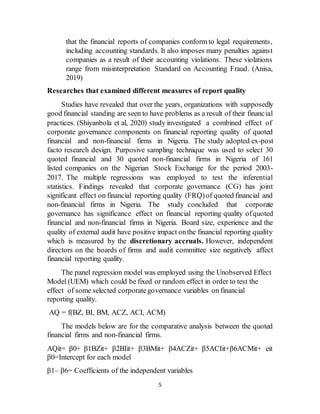
practices. (Shiyanbola et al, 2020) study investigated a combined effect of
corporate governance components on financial reporting quality of quoted
financial and non-financial firms in Nigeria. The study adopted ex-post
facto research design. Purposive sampling technique was used to select 30
quoted financial and 30 quoted non-financial firms in Nigeria of 161
listed companies on the Nigerian Stock Exchange for the period 2003-
2017. The multiple regressions was employed to test the inferential
statistics. Findings revealed that corporate governance (CG) has joint
significant effect on financial reporting quality (FRQ)of quoted financial and
non-financial firms in Nigeria. The study concluded that corporate
governance has significance effect on financial reporting quality ofquoted
financial and non-financial firms in Nigeria. Board size, experience and the
quality of external audit have positive impact onthe financial reporting quality
which is measured by the discretionary accruals. However, independent
directors on the boards of firms and audit committee size negatively affect
financial reporting quality.
The panel regression model was employed using the Unobserved Effect
Model (UEM) which could be fixed or random effect in order to test the
effect of some selected corporategovernance variables on financial
reporting quality.
AQ = f(BZ, BI, BM, ACZ, ACI, ACM)
The models below are for the comparative analysis between the quoted
financial firms and non-financial firms.
AQit= β0+ β1BZit+ β2BIit+ β3BMit+ β4ACZit+ β5ACIit+β6ACMit+ eit
β0=Intercept for each model
β1– β6= Coefficients of the independent variables
6
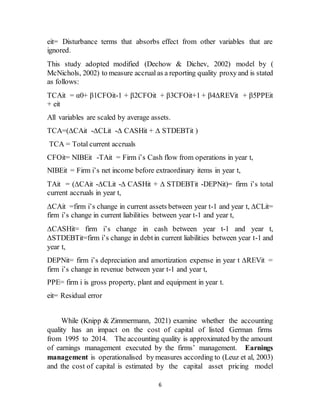
eit= Disturbance terms that absorbs effect from other variables that are
ignored.
This study adopted modified (Dechow & Dichev, 2002) model by (
McNichols, 2002) to measure accrual as a reporting quality proxyand is stated
as follows:
TCAit = α0+ β1CFOit-1 + β2CFOit + β3CFOit+1 + β4∆REVit + β5PPEit
+ eit
All variables are scaled by average assets.
TCA=(∆CAit -∆CLit -∆ CASHit + ∆ STDEBTit )
TCA = Total current accruals
CFOit= NIBEit -TAit = Firm i’s Cash flow from operations in year t,
NIBEit = Firm i’s net income before extraordinary items in year t,
TAit = (∆CAit -∆CLit -∆ CASHit + ∆ STDEBTit -DEPNit)= firm i’s total
current accruals in year t,
∆CAit =firm i’s change in current assets between year t-1 and year t, ∆CLit=
firm i’s change in current liabilities between year t-1 and year t,
∆CASHit= firm i’s change in cash between year t-1 and year t,
∆STDEBTit=firm i’s change in debtin current liabilities between year t-1 and
year t,
DEPNit= firm i’s depreciation and amortization expense in year t ∆REVit =
firm i’s change in revenue between year t-1 and year t,
PPE= firm i is gross property, plant and equipment in year t.
eit= Residual error
While (Knipp & Zimmermann, 2021) examine whether the accounting
quality has an impact on the cost of capital of listed German firms
from 1995 to 2014. The accounting quality is approximated by the amount
of earnings management executed by the firms’ management. Earnings
management is operationalised by measures according to (Leuz et al, 2003)
and the cost of capital is estimated by the capital asset pricing model
7
(CAPM). By using fixed-effects regressions and variance analyses on
portfolios referring the research area of accounting quality and the costof
capital, (Knipp & Zimmermann, 2021) find that firms with high accounting
quality and a low level of earnings management have averagely significant
lower costof capital than firms with low accounting quality and a high
level of earnings management.
(Knipp & Zimmermann, 2021) Use earnings management as a proxyfor
accounting quality. For operationalizing earnings management, (Knipp &
Zimmermann, 2021) use an income smoothing measure according to
(Leuz et al, 2003). Consequently, the amount of earnings management
executed by a firm serves as an indicator for accounting quality . Earnings
management serves as a useful indicator for the accounting quality
because it is known that a high level of earnings management negatively
affects the quality of financial reporting information provided for
potential investors.
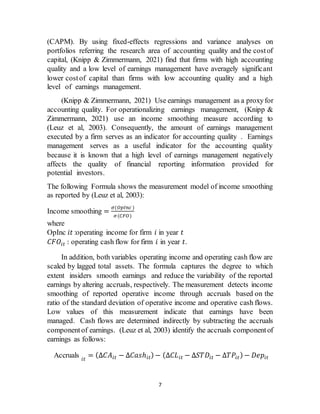
The following Formula shows the measurement model of income smoothing
as reported by (Leuz et al, 2003):
Income smoothing =
𝜎(𝑂𝑝𝐼𝑛𝑐 )
𝜎(𝐶𝐹𝑂)
where
OpInc 𝑖𝑡 :operating income for firm 𝑖 in year 𝑡
𝐶𝐹𝑂𝑖𝑡 : operating cash flow for firm 𝑖 in year 𝑡.
In addition, both variables operating income and operating cash flow are
scaled by lagged total assets. The formula captures the degree to which
extent insiders smooth earnings and reduce the variability of the reported
earnings by altering accruals, respectively. The measurement detects income
smoothing of reported operative income through accruals based on the
ratio of the standard deviation of operative income and operative cash flows.
Low values of this measurement indicate that earnings have been
managed. Cash flows are determined indirectly by subtracting the accruals
componentof earnings. (Leuz et al, 2003) identify the accruals componentof
earnings as follows:
Accruals 𝑖𝑡
= (Δ𝐶𝐴𝑖𝑡 − Δ𝐶𝑎𝑠ℎ𝑖𝑡) − (Δ𝐶𝐿𝑖𝑡 − Δ𝑆𝑇𝐷𝑖𝑡 − Δ𝑇𝑃𝑖𝑡) − 𝐷𝑒𝑝𝑖𝑡
8
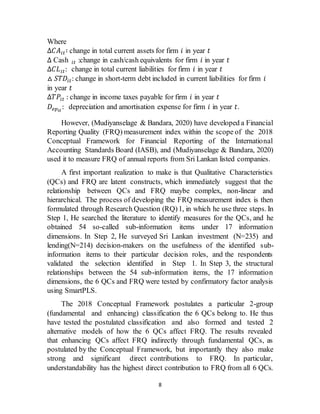
Where
Δ𝐶𝐴𝑖𝑡∶ change in total current assets for firm 𝑖 in year 𝑡
Δ Cash 𝑖𝑡 :change in cash/cash equivalents for firm 𝑖 in year 𝑡
Δ𝐶𝐿𝑖𝑡: change in total current liabilities for firm 𝑖 in year 𝑡
△ 𝑆𝑇𝐷𝑖𝑡: change in short-term debt included in current liabilities for firm 𝑖
in year 𝑡
Δ𝑇𝑃𝑖𝑡 : change in income taxes payable for firm 𝑖 in year 𝑡
𝐷𝑒𝑝𝑖𝑡
: depreciation and amortisation expense for firm 𝑖 in year 𝑡.
However, (Mudiyanselage & Bandara, 2020) have developed a Financial
Reporting Quality (FRQ) measurement index within the scope of the 2018
Conceptual Framework for Financial Reporting of the International
Accounting Standards Board (IASB), and (Mudiyanselage & Bandara, 2020)
used it to measure FRQ of annual reports from Sri Lankan listed companies.
A first important realization to make is that Qualitative Characteristics
(QCs) and FRQ are latent constructs, which immediately suggest that the
relationship between QCs and FRQ maybe complex, non-linear and
hierarchical. The process of developing the FRQ measurement index is then
formulated through Research Question (RQ)1, in which he use three steps. In
Step 1, He searched the literature to identify measures for the QCs, and he
obtained 54 so-called sub-information items under 17 information
dimensions. In Step 2, He surveyed Sri Lankan investment (N=235) and
lending(N=214) decision-makers on the usefulness of the identified sub-
information items to their particular decision roles, and the respondents
validated the selection identified in Step 1. In Step 3, the structural
relationships between the 54 sub-information items, the 17 information
dimensions, the 6 QCs and FRQ were tested by confirmatory factor analysis
using SmartPLS.
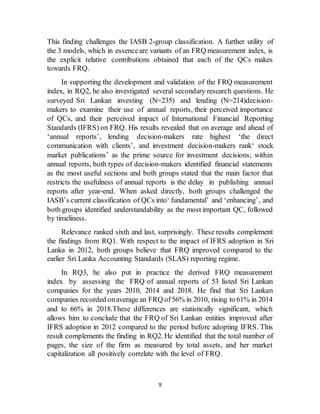
The 2018 Conceptual Framework postulates a particular 2-group
(fundamental and enhancing) classification the 6 QCs belong to. He thus
have tested the postulated classification and also formed and tested 2
alternative models of how the 6 QCs affect FRQ. The results revealed
that enhancing QCs affect FRQ indirectly through fundamental QCs, as
postulated by the Conceptual Framework, but importantly they also make
strong and significant direct contributions to FRQ. In particular,
understandability has the highest direct contribution to FRQ from all 6 QCs.
9
This finding challenges the IASB 2-group classification. A further utility of
the 3 models, which in essenceare variants of an FRQ measurement index, is
the explicit relative contributions obtained that each of the QCs makes
towards FRQ.
In supporting the development and validation of the FRQ measurement
index, in RQ2, he also investigated several secondary research questions. He
surveyed Sri Lankan investing (N=235) and lending (N=214)decision-
makers to examine their use of annual reports, their perceived importance
of QCs, and their perceived impact of International Financial Reporting
Standards (IFRS) on FRQ. His results revealed that on average and ahead of
‘annual reports’, lending decision-makers rate highest ‘the direct
communication with clients’, and investment decision-makers rank‘ stock
market publications’ as the prime source for investment decisions; within
annual reports, both types of decision-makers identified financial statements
as the most useful sections and both groups stated that the main factor that
restricts the usefulness of annual reports is the delay in publishing annual
reports after year-end. When asked directly, both groups challenged the
IASB’s current classification of QCs into‘ fundamental’ and ‘enhancing’, and
both groups identified understandability as the most important QC, followed
by timeliness.
Relevance ranked sixth and last, surprisingly. These results complement
the findings from RQ1. With respect to the impact of IFRS adoption in Sri
Lanka in 2012, both groups believe that FRQ improved compared to the
earlier Sri Lanka Accounting Standards (SLAS) reporting regime.
In RQ3, he also put in practice the derived FRQ measurement
index by assessing the FRQ of annual reports of 53 listed Sri Lankan
companies for the years 2010, 2014 and 2018. He find that Sri Lankan
companies recorded onaverage an FRQ of56% in 2010, rising to 61% in 2014
and to 66% in 2018.These differences are statistically significant, which
allows him to conclude that the FRQ of Sri Lankan entities improved after
IFRS adoption in 2012 compared to the period before adopting IFRS. This
result complements the finding in RQ2. He identified that the total number of
pages, the size of the firm as measured by total assets, and her market
capitalization all positively correlate with the level of FRQ.
10
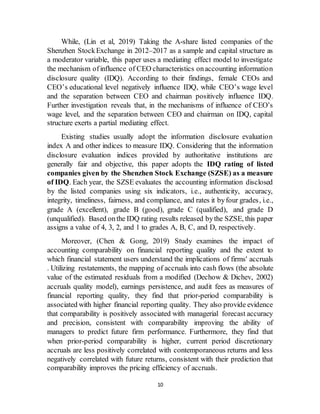
While, (Lin et al, 2019) Taking the A-share listed companies of the
Shenzhen StockExchange in 2012–2017 as a sample and capital structure as
a moderator variable, this paper uses a mediating effect model to investigate
the mechanism ofinfluence of CEO characteristics onaccounting information
disclosure quality (IDQ). According to their findings, female CEOs and
CEO’s educational level negatively influence IDQ, while CEO’s wage level
and the separation between CEO and chairman positively influence IDQ.
Further investigation reveals that, in the mechanisms of influence of CEO’s
wage level, and the separation between CEO and chairman on IDQ, capital
structure exerts a partial mediating effect.
Existing studies usually adopt the information disclosure evaluation
index A and other indices to measure IDQ. Considering that the information
disclosure evaluation indices provided by authoritative institutions are
generally fair and objective, this paper adopts the IDQ rating of listed
companies given by the Shenzhen Stock Exchange (SZSE) as a measure
of IDQ. Each year, the SZSE evaluates the accounting information disclosed
by the listed companies using six indicators, i.e., authenticity, accuracy,
integrity, timeliness, fairness, and compliance, and rates it byfour grades, i.e.,
grade A (excellent), grade B (good), grade C (qualified), and grade D
(unqualified). Based onthe IDQ rating results released bythe SZSE, this paper
assigns a value of 4, 3, 2, and 1 to grades A, B, C, and D, respectively.
Moreover, (Chen & Gong, 2019) Study examines the impact of
accounting comparability on financial reporting quality and the extent to
which financial statement users understand the implications of firms' accruals
. Utilizing restatements, the mapping of accruals into cash flows (the absolute
value of the estimated residuals from a modified (Dechow & Dichev, 2002)
accruals quality model), earnings persistence, and audit fees as measures of
financial reporting quality, they find that prior-period comparability is
associated with higher financial reporting quality. They also provide evidence
that comparability is positively associated with managerial forecast accuracy
and precision, consistent with comparability improving the ability of
managers to predict future firm performance. Furthermore, they find that
when prior-period comparability is higher, current period discretionary
accruals are less positively correlated with contemporaneous returns and less
negatively correlated with future returns, consistent with their prediction that
comparability improves the pricing efficiency of accruals.
11
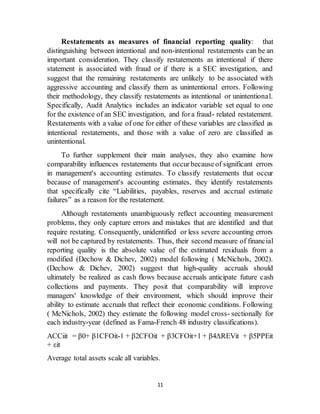
Restatements as measures of financial reporting quality: that
distinguishing between intentional and non-intentional restatements can be an
important consideration. They classify restatements as intentional if there
statement is associated with fraud or if there is a SEC investigation, and
suggest that the remaining restatements are unlikely to be associated with
aggressive accounting and classify them as unintentional errors. Following
their methodology, they classify restatements as intentional or unintentional.
Specifically, Audit Analytics includes an indicator variable set equal to one
for the existence of an SEC investigation, and fora fraud- related restatement.
Restatements with a value of one for either of these variables are classified as
intentional restatements, and those with a value of zero are classified as
unintentional.
To further supplement their main analyses, they also examine how
comparability influences restatements that occurbecauseof significant errors
in management's accounting estimates. To classify restatements that occur
because of management's accounting estimates, they identify restatements
that specifically cite “Liabilities, payables, reserves and accrual estimate
failures” as a reason for the restatement.
Although restatements unambiguously reflect accounting measurement
problems, they only capture errors and mistakes that are identified and that
require restating. Consequently, unidentified or less severe accounting errors
will not be captured by restatements. Thus, their second measure of financial
reporting quality is the absolute value of the estimated residuals from a
modified (Dechow & Dichev, 2002) model following ( McNichols, 2002).
(Dechow & Dichev, 2002) suggest that high-quality accruals should
ultimately be realized as cash flows because accruals anticipate future cash
collections and payments. They posit that comparability will improve
managers' knowledge of their environment, which should improve their
ability to estimate accruals that reflect their economic conditions. Following
( McNichols, 2002) they estimate the following model cross- sectionally for
each industry-year (defined as Fama-French 48 industry classifications).
ACCiit = β0+ β1CFOit-1 + β2CFOit + β3CFOit+1 + β4∆REVit + β5PPEit
+ εit
Average total assets scale all variables.
12
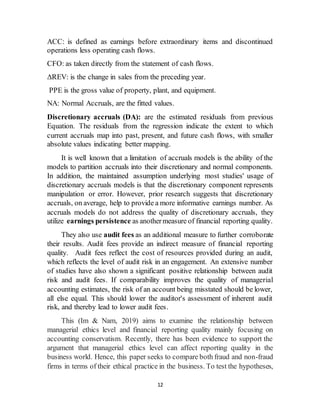
ACC: is defined as earnings before extraordinary items and discontinued
operations less operating cash flows.
CFO: as taken directly from the statement of cash flows.
ΔREV: is the change in sales from the preceding year.
PPE is the gross value of property, plant, and equipment.
NA: Normal Accruals, are the fitted values.
Discretionary accruals (DA): are the estimated residuals from previous
Equation. The residuals from the regression indicate the extent to which
current accruals map into past, present, and future cash flows, with smaller
absolute values indicating better mapping.
It is well known that a limitation of accruals models is the ability of the
models to partition accruals into their discretionary and normal components.
In addition, the maintained assumption underlying most studies' usage of
discretionary accruals models is that the discretionary component represents
manipulation or error. However, prior research suggests that discretionary
accruals, on average, help to provide a more informative earnings number. As
accruals models do not address the quality of discretionary accruals, they
utilize earnings persistence as anothermeasure of financial reporting quality.
They also use audit fees as an additional measure to further corroborate
their results. Audit fees provide an indirect measure of financial reporting
quality. Audit fees reflect the cost of resources provided during an audit,
which reflects the level of audit risk in an engagement. An extensive number
of studies have also shown a significant positive relationship between audit
risk and audit fees. If comparability improves the quality of managerial
accounting estimates, the risk of an account being misstated should be lower,
all else equal. This should lower the auditor's assessment of inherent audit
risk, and thereby lead to lower audit fees.
This (Im & Nam, 2019) aims to examine the relationship between
managerial ethics level and financial reporting quality mainly focusing on
accounting conservatism. Recently, there has been evidence to support the
argument that managerial ethics level can affect reporting quality in the
business world. Hence, this paper seeks to compare both fraud and non-fraud
firms in terms of their ethical practice in the business. To test the hypotheses,
13
they chose243 fraud firms and compared them with the same number of non-
fraud firms listed in the KOSPI and KOSDAQ from 2005 to 2012. The
analysis using two groups across the time horizon reveals that the measured
values of accounting conservatism do not show any meaningful difference
between fraud and non-fraud firms. Additionally, fraud firms have greater
absolute discretionary accruals than their counterparts. This result suggests
that fraud firms are more likely to manipulate their earnings than the non-
fraud firms. Also, accruals quality of fraud firms is lower than that of non-
fraud firms.
Proxies for Financial Reporting Quality
This study adopt accounting conservatism (CSCORE), discretionary
accruals (DA) and accruals quality (AQ) as proxies for financial reporting
quality.
Accounting Conservatism (CSCORE)
They use (Basu, 1977) model, which measures asymmetric timeliness in
terms of earnings recognition, thereby representing the level of accounting
conservatism. They have derived the coefficient values for each firm and year.
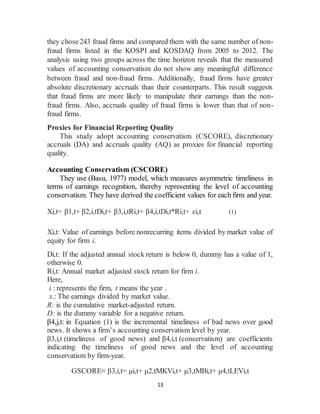
Xi,t= β1,t+ β2,i,tDi,t+ β3,i,tRi,t+ β4,i,tDi,t*Ri,t+ εi,t (1)
Xi,t: Value of earnings before nonrecurring items divided by market value of
equity for firm i.
Di,t: If the adjusted annual stock return is below 0, dummy has a value of 1,
otherwise 0.
Ri,t: Annual market adjusted stock return for firm i.
Here,
i : represents the firm, t means the year .
x.: The earnings divided by market value.
R: is the cumulative market-adjusted return.
D: is the dummy variable for a negative return.
β4,j,t: in Equation (1) is the incremental timeliness of bad news over good
news. It shows a firm’s accounting conservatism level by year.
β3,i,t (timeliness of good news) and β4,i,t (conservatism) are coefficients
indicating the timeliness of good news and the level of accounting
conservatism by firm-year.
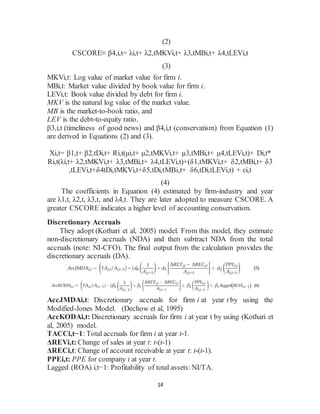
GSCORE≡ β3,i,t= μi,t+ μ2,tMKVi,t+ μ3,tMBi,t+ μ4,tLEVi,t
14
(2)
CSCORE≡ β4,i,t= λi,t+ λ2,tMKVi,t+ λ3,tMBi,t+ λ4,tLEVi,t
(3)
MKVi,t: Log value of market value for firm i.
MBi,t: Market value divided by book value for firm i.
LEVi,t: Book value divided by debt for firm i.
MKV is the natural log value of the market value.
MB is the market-to-book ratio, and
LEV is the debt-to-equity ratio.
β3,i,t (timeliness of good news) and β4,i,t (conservatism) from Equation (1)
are derived in Equations (2) and (3).
Xi,t= β1,t+ β2,tDi,t+ Ri,t(μi,t+ μ2,tMKVi,t+ μ3,tMBi,t+ μ4,tLEVi,t)+ Di,t*
Ri,t(λi,t+ λ2,tMKVi,t+ λ3,tMBi,t+ λ4,tLEVi,t)+(δ1,tMKVi,t+ δ2,tMBi,t+ δ3
,tLEVi,t+δ4tDi,tMKVi,t+δ5,tDi,tMBi,t+ δ6,tDi,tLEVi,t) + εi,t
(4)
The coefficients in Equation (4) estimated by firm-industry and year
are λ1,t, λ2,t, λ3,t, and λ4,t. They are later adopted to measure CSCORE. A
greater CSCORE indicates a higher level of accounting conservatism.
Discretionary Accruals
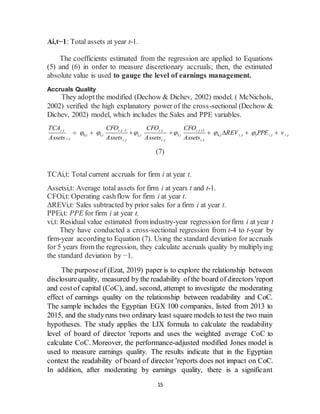
They adopt (Kothari et al, 2005) model. From this model, they estimate
non-discretionary accruals (NDA) and then subtract NDA from the total
accruals (note: NI-CFO). The final output from the calculation provides the
discretionary accruals (DA).
AccJMDAi,t: Discretionary accruals for firm i at year t by using the
Modified-Jones Model. (Dechow et al, 1995)
AccKODAi,t: Discretionary accruals for firm i at year t by using (Kothari et
al, 2005) model.
TACCi,t−1: Total accruals for firm i at year t-1.
ΔREVi,t: Change of sales at year t: t-(t-1)
ΔRECi,t: Change of account receivable at year t: t-(t-1).
PPEi,t: PPE for company i at year t.
Lagged (ROA) i,t−1: Profitability of total assets: NI/TA.
15
Ai,t−1: Total assets at year t-1.
The coefficients estimated from the regression are applied to Equations
(5) and (6) in order to measure discretionary accruals; then, the estimated
absolute value is used to gauge the level of earnings management.
Accruals Quality
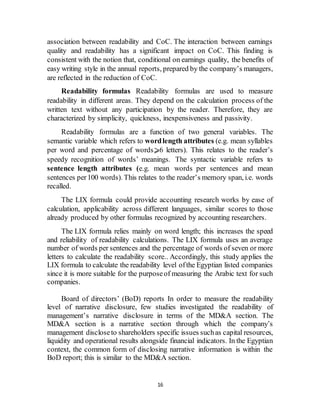
They adoptthe modified (Dechow & Dichev, 2002) model. ( McNichols,
2002) verified the high explanatory power of the cross-sectional (Dechow &
Dichev, 2002) model, which includes the Sales and PPE variables.
, , 1 , , 1
0, 1, 2, 3, 4, , 5 , ,
, , , ,
i t i t i t i t
i i i i i i t i t i t
i t i t i t i t
TCA CFO CFO CFO
REV PPE v
Assets Assets Assets Assets
     
 
       
(7)
TCAi,t: Total current accruals for firm i at year t.
Assetsi,t: Average total assets for firm i at years t and t-1.
CFOi,t: Operating cashflow for firm i at year t.
ΔREVi,t: Sales subtracted by prior sales for a firm i at year t.
PPEi,t: PPE for firm i at year t.
vi,t: Residual value estimated fromindustry-year regression forfirm i at year t
They have conducted a cross-sectional regression from t-4 to t-year by
firm-year accordingto Equation (7). Using the standard deviation for accruals
for 5 years from the regression, they calculate accruals quality by multiplying
the standard deviation by −1.
The purposeof (Ezat, 2019) paper is to explore the relationship between
disclosurequality, measured by the readability ofthe board of directors 'report
and costof capital (CoC), and, second, attempt to investigate the moderating
effect of earnings quality on the relationship between readability and CoC.
The sample includes the Egyptian EGX 100 companies, listed from 2013 to
2015, and the studyruns two ordinary least square models to test the two main
hypotheses. The study applies the LIX formula to calculate the readability
level of board of director 'reports and uses the weighted average CoC to
calculate CoC. Moreover, the performance-adjusted modified Jones model is
used to measure earnings quality. The results indicate that in the Egyptian
context the readability of board of director 'reports does not impact on CoC.
In addition, after moderating by earnings quality, there is a significant
16
association between readability and CoC. The interaction between earnings
quality and readability has a significant impact on CoC. This finding is
consistent with the notion that, conditional on earnings quality, the benefits of
easy writing style in the annual reports, prepared by the company’s managers,
are reflected in the reduction of CoC.
Readability formulas Readability formulas are used to measure
readability in different areas. They depend on the calculation process of the
written text without any participation by the reader. Therefore, they are
characterized by simplicity, quickness, inexpensiveness and passivity.
Readability formulas are a function of two general variables. The
semantic variable which refers to wordlength attributes (e.g. mean syllables
per word and percentage of words⩾6 letters). This relates to the reader’s
speedy recognition of words’ meanings. The syntactic variable refers to
sentence length attributes (e.g. mean words per sentences and mean
sentences per100 words). This relates to the reader’s memory span, i.e. words
recalled.
The LIX formula could provide accounting research works by ease of
calculation, applicability across different languages, similar scores to those
already produced by other formulas recognized by accounting researchers.
The LIX formula relies mainly on word length; this increases the speed
and reliability of readability calculations. The LIX formula uses an average
number of words per sentences and the percentage of words of seven or more
letters to calculate the readability score.. Accordingly, this study applies the
LIX formula to calculate the readability level ofthe Egyptian listed companies
since it is more suitable for the purposeof measuring the Arabic text for such
companies.
Board of directors’ (BoD) reports In order to measure the readability
level of narrative disclosure, few studies investigated the readability of
management’s narrative disclosure in terms of the MD&A section. The
MD&A section is a narrative section through which the company’s
management discloseto shareholders specific issues suchas capital resources,
liquidity and operational results alongside financial indicators. In the Egyptian
context, the common form of disclosing narrative information is within the
BoD report; this is similar to the MD&A section.
17
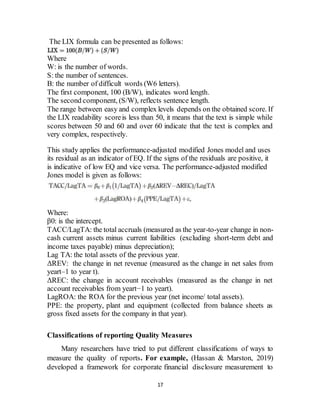
The LIX formula can be presented as follows:
Where
W: is the number of words.
S: the number of sentences.
B: the number of difficult words (W6 letters).
The first component, 100 (B/W), indicates word length.
The second component, (S/W), reflects sentence length.
The range between easy and complex levels depends on the obtained score. If
the LIX readability scoreis less than 50, it means that the text is simple while
scores between 50 and 60 and over 60 indicate that the text is complex and
very complex, respectively.
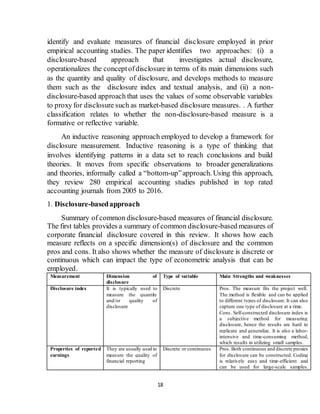
This study applies the performance-adjusted modified Jones model and uses
its residual as an indicator of EQ. If the signs of the residuals are positive, it
is indicative of low EQ and vice versa. The performance-adjusted modified
Jones model is given as follows:
Where:
β0: is the intercept.
TACC/LagTA: the total accruals (measured as the year-to-year change in non-
cash current assets minus current liabilities (excluding short-term debt and
income taxes payable) minus depreciation);
Lag TA: the total assets of the previous year.
ΔREV: the change in net revenue (measured as the change in net sales from
yeart–1 to year t).
ΔREC: the change in account receivables (measured as the change in net
account receivables from yeart−1 to yeart).
LagROA: the ROA for the previous year (net income/ total assets).
PPE: the property, plant and equipment (collected from balance sheets as
gross fixed assets for the company in that year).
Classifications of reporting Quality Measures
Many researchers have tried to put different classifications of ways to
measure the quality of reports. For example, (Hassan & Marston, 2019)
developed a framework for corporate financial disclosure measurement to
18
identify and evaluate measures of financial disclosure employed in prior
empirical accounting studies. The paper identifies two approaches: (i) a
disclosure-based approach that investigates actual disclosure,
operationalizes the conceptofdisclosure in terms of its main dimensions such
as the quantity and quality of disclosure, and develops methods to measure
them such as the disclosure index and textual analysis, and (ii) a non-
disclosure-based approach that uses the values of some observable variables
to proxy for disclosure such as market-based disclosure measures. . A further
classification relates to whether the non-disclosure-based measure is a
formative or reflective variable.
An inductive reasoning approach employed to develop a framework for
disclosure measurement. Inductive reasoning is a type of thinking that
involves identifying patterns in a data set to reach conclusions and build
theories. It moves from specific observations to broader generalizations
and theories, informally called a “bottom-up”approach. Using this approach,
they review 280 empirical accounting studies published in top rated
accounting journals from 2005 to 2016.
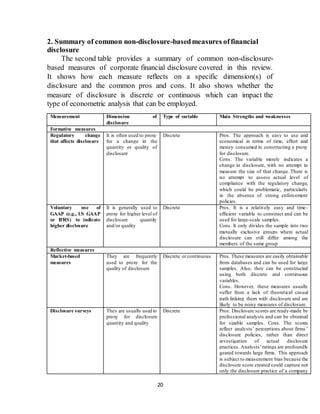
1. Disclosure-basedapproach
Summary of common disclosure-based measures of financial disclosure.
The first tables provides a summary of common disclosure-based measures of
corporate financial disclosure covered in this review. It shows how each
measure reflects on a specific dimension(s) of disclosure and the common
pros and cons. It also shows whether the measure of disclosure is discrete or
continuous which can impact the type of econometric analysis that can be
employed.
Measurement Dimension of
disclosure
Type of variable Main Strengths and weaknesses
Disclosure index It is typically used to
measure the quantity
and/or quality of
disclosure
Discrete Pros. The measure fits the project well.
The method is flexible and can be applied
to different types of disclosure. It can also
capture one type of disclosure at a time.
Cons. Self-constructed disclosure index is
a subjective method for measuring
disclosure, hence the results are hard to
replicate and generalize. It is also a labor-
intensive and time-consuming method,
which results in utilizing small samples.
Properties of reported
earnings
They are usually used to
measure the quality of
financial reporting
Discrete or continuous Pros. Both continuous and discrete proxies
for disclosure can be constructed. Coding
is relatively easy and time-efficient and
can be used for large-scale samples.
19
Measures can facilitate consistent
measurement across firms.
Cons. The quality of financial reporting is
not limited to accounting quality only.
Different properties of reported earnings
may capture different dimensions of
quality. Other disclosure activities that
could serve as a substitute or a
complement.
Textual analysis It is frequently used to
measure the quantity
and quality ofdisclosure
Discrete Pros. The approach is flexible and can be
applied to different types of disclosure.
Automated textual analysis is particularly
easy and economical to use in terms of the
time, effort and money consumed,and can
be applied to large samples.
Cons. The use of key words does not
provide a sound unit of analysis. Using
inappropriate or insufficient key words
could lead to over- or underestimation of
disclosure level. In addition, coding based
on a pre-defined list of words that is
developed in isolation of actual disclosure
texts may not be able to fully capture the
construct under investigation, which limits
the validity of the constructed measure of
disclosure
Attributes of
management forecasts
They are traditionally
used to measure the
quantity and quality of
voluntary disclosure for
the US market
Discrete or continuous Pros. Both continuous and discrete
measures for disclosure can be
constructed. Coding is relatively easy and
time-efficient and can be used for large-
scale samples.
Cons. Management forecasts are relatively
less comprehensive measures of disclosure
and they could be subject to earnings
management, which would affect the
quality of these forecasts as measures of
disclosure
20
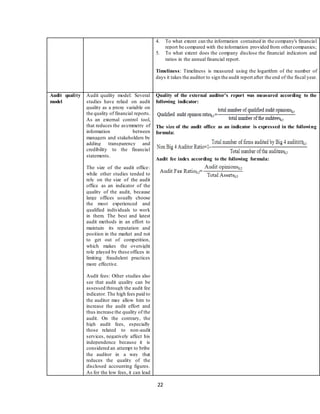
2. Summary of common non-disclosure-basedmeasures offinancial
disclosure
The second table provides a summary of common non-disclosure-
based measures of corporate financial disclosure covered in this review.
It shows how each measure reflects on a specific dimension(s) of
disclosure and the common pros and cons. It also shows whether the
measure of disclosure is discrete or continuous which can impact the
type of econometric analysis that can be employed.
Measurement Dimension of
disclosure
Type of variable Main Strengths and weaknesses
Formative measures
Regulatory change
that affects disclosure
It is often used to proxy
for a change in the
quantity or quality of
disclosure
Discrete Pros. The approach is easy to use and
economical in terms of time, effort and
money consumed in constructing a proxy
for disclosure.
Cons. The variable merely indicates a
change in disclosure, with no attempt to
measure the size of that change. There is
no attempt to assess actual level of
compliance with the regulatory change,
which could be problematic, particularly
in the absence of strong enforcement
policies.
Voluntary use of
GAAP (e.g., US GAAP
or IFRS) to indicate
higher disclosure
It is generally used to
proxy for higher level of
disclosure quantity
and/or quality
Discrete Pros. It is a relatively easy and time-
efficient variable to construct and can be
used for large-scale samples.
Cons. It only divides the sample into two
mutually exclusive groups where actual
disclosure can still differ among the
members of the same group
Reflective measures
Market-based
measures
They are frequently
used to proxy for the
quality of disclosure
Discrete or continuous Pros. These measures are easily obtainable
from databases and can be used for large
samples. Also, they can be constructed
using both discrete and continuous
variables.
Cons. However, these measures usually
suffer from a lack of theoretical casual
path linking them with disclosure and are
likely to be noisy measures of disclosure.
Disclosure surveys They are usually used to
proxy for disclosure
quantity and quality
Discrete Pros: Disclosure scores are ready-made by
professional analysts and can be obtained
for sizable samples. Cons. The scores
reflect analysts’ perceptions about firms’
disclosure policies, rather than direct
investigation of actual disclosure
practices. Analysts’ratings are profoundly
geared towards large firms. This approach
is subject to measurement bias because the
disclosure score created could capture not
only the disclosure practice of a company
21
but also its fundamental characteristics and
performance
Source: (Hassan & Marston, 2019)
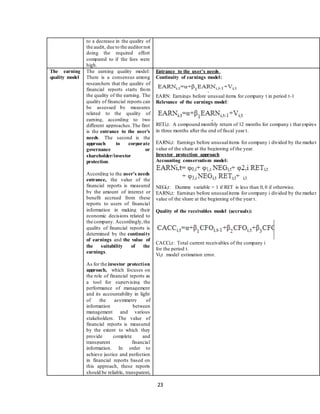
Moreover, (Anisa, 2019) showed a different classification from the (Hassan
& Marston, 2019) classification based on the idea of theoretical alternatives
to assess the quality of financial reports. The alternatives considered by
(Anisa, 2019) are summarized in Table 3
Measurement Measurement Explanation Measurement Model
Accounting
Information
Quality
Model
According to this model, a
questionnaire is prepared for
internal and external users. It
includes a set of axes where
each axis relates to a
characteristic of properties.
Where a standard score
ranging between 1 and 5 is
given for each of the items by
which each characteristic is
measured. And then the final
score for each characteristic
and the level of quality of the
reports as a whole is reached.
The qualitative characteristics of accounting information were measured
according to this model as follows:
Relevance: It is measured by the predictive ability of information through
three items:
1. The extent to which the company's financial report provides predictive
information that helps in forming forecasts regarding the company's
future;
2. The extent to which the financial report provides non-financial
information in addition to financial information;
3. To what extent does the company use fair value in valuing assets
* Reliability: This characteristic is measured by the following items:
1. The extent to which the financial report provides clear explanations about
the assumptions and estimates in the financial statements;
2. The extent to which the financial report provides clarifications about the
methods that have been selected fromthe used accounting principles
3. The extent to which the financial report presents the positive and negative
events in a balanced manner:
4. The extent to which the financial report provides information on
corporate governance rules;
5. Availability of the financial report on an unqualified auditor’s report:
Understandability: This characteristic is measured through the following
items
1. The extent to which the information in the financial report is well
organized and tabulated:
2. Availability of sufficient clarifications on the information related to the
balance sheet and income statement:
3. The availability of the financial report on graphs and illustrative tables;
4. The availability of the financial report on words and sentences that are
easy to understand:
5. The level of awareness of the users of financial reports.
Comparability: It is measured through the following items:
1. To what extent the financial report provides explanations for changes in
the accounting policies used and the effects of these changes;
2. To what extent has the company adjusted the numbers of previous
accounting periods as a result of the change in accounting policies or
accounting estimates;
3. to what extent the results of the current accounting periods can be
compared with previous accounting periods;
22
4. To what extent can the information contained in the company's financial
report be compared with the information provided from othercompanies;
5. To what extent does the company disclose the financial indicators and
ratios in the annual financial report.
Timeliness: Timeliness is measured using the logarithm of the number of
days it takes the auditor to sign the audit report after the end of the fiscal year.
Audit quality
model
Audit quality model: Several
studies have relied on audit
quality as a proxy variable on
the quality of financial reports.
As an external control tool,
that reduces the asymmetry of
information between
managers and stakeholders by
adding transparency and
credibility to the financial
statements.
The size of the audit office:
while other studies tended to
rely on the size of the audit
office as an indicator of the
quality of the audit, because
large offices usually choose
the most experienced and
qualified individuals to work
in them. The best and latest
audit methods in an effort to
maintain its reputation and
position in the market and not
to get out of competition,
which makes the oversight
role played by these offices in
limiting fraudulent practices
more effective.
Audit fees: Other studies also
see that audit quality can be
assessed through the audit fee
indicator. The high fees paid to
the auditor may allow him to
increase the audit effort and
thus increase the quality of the
audit. On the contrary, the
high audit fees, especially
those related to non-audit
services, negatively affect his
independence because it is
considered an attempt to bribe
the auditor in a way that
reduces the quality of the
disclosed accounting figures.
As for the low fees, it can lead
Quality of the external auditor's report was measured according to the
following indicator:
The size of the audit office as an indicator is expressed in the following
formula:
Audit fee index according to the following formula:
23
to a decrease in the quality of
the audit, due to the auditornot
doing the required effort
compared to if the fees were
high.
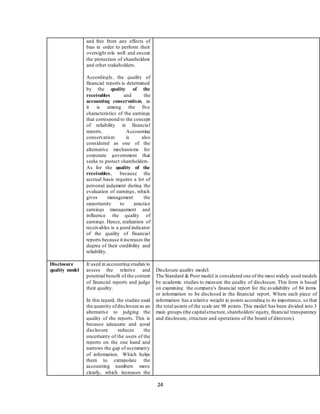
The earning
quality model
The earning quality model:
There is a consensus among
researchers that the quality of
financial reports starts from
the quality of the earning. The
quality of financial reports can
be assessed by measures
related to the quality of
earning, according to two
different approaches.The first
is the entrance to the user's
needs. The second is the
approach to corporate
governance or
shareholder/investor
protection.
According to the user's needs
entrance, the value of the
financial reports is measured
by the amount of interest or
benefit accrued from these
reports to users of financial
information in making their
economic decisions related to
the company. Accordingly,the
quality of financial reports is
determined by the continuity
of earnings and the value of
the suitability of the
earnings.
As for the investor protection
approach, which focuses on
the role of financial reports as
a tool for supervising the
performance of management
and its accountability in light
of the asymmetry of
information between
management and various
stakeholders. The value of
financial reports is measured
by the extent to which they
provide complete and
transparent financial
information. In order to
achieve justice and perfection
in financial reports based on
this approach, these reports
should be reliable, transparent,
Entrance to the user's needs.
Continuity of earnings model:
EARN: Earnings before unusual items for company t in period t-1
Relevance of the earnings model:
RETi,t: A compound monthly return of 12 months for company i that expires
in three months after the end of fiscal year t.
EARNi,t: Earnings before unusualitems for company i divided by the market
value of the share at the beginning of the year.
Investor protection approach
Accounting conservatism model:
NEGi,t: Dummy variable = 1 if RET is less than 0, 0 if otherwise.
EARNi,t: Earnings before unusualitems for company i divided by the market
value of the share at the beginning of the year t.
Quality of the receivables model (accruals):
CACCi,t: Total current receivables of the company i
for the period t.
Vi,t :model estimation error.
24
and free from any effects of
bias in order to perform their
oversight role well and ensure
the protection of shareholders
and other stakeholders.
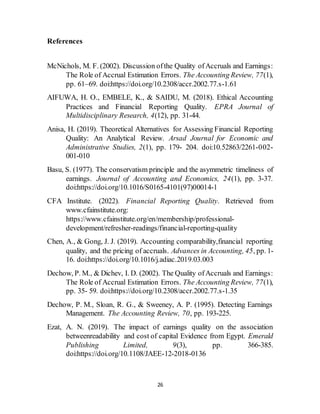
Accordingly, the quality of
financial reports is determined
by the quality of the
receivables and the
accounting conservatism, as
it is among the five
characteristics of the earnings
that correspond to the concept
of reliability in financial
reports. Accounting
conservatism is also
considered as one of the
alternative mechanisms for
corporate government that
seeks to protect shareholders.
As for the quality of the
receivables, because the
accrual basis requires a lot of
personal judgment during the
evaluation of earnings, which
gives management the
opportunity to practice
earnings management and
influence the quality of
earnings. Hence, realization of
receivables is a good indicator
of the quality of financial
reports because it increases the
degree of their credibility and
reliability.
Disclosure
quality model
It used in accounting studies to
assess the relative and
potential benefit of the content
of financial reports and judge
their quality.
In this regard, the studies used
the quantity ofdisclosure as an
alternative to judging the
quality of the reports. This is
because adequate and good
disclosure reduces the
uncertainty of the users of the
reports on the one hand and
narrows the gap of asymmetry
of information. Which helps
them to extrapolate the
accounting numbers more
clearly, which increases the
Disclosure quality model:
The Standard & Poor model is considered one of the most widely used models
by academic studies to measure the quality of disclosure. This form is based
on examining the company's financial report for the availability of 84 items
or information to be disclosed in the financial report. Where each piece of
information has a relative weight in points according to its importance, so that
the total points of the scale are 98 points.This model has been divided into 3
main groups (the capitalstructure,shareholders'equity,financial transparency
and disclosure, structure and operations of the board of directors).
25
quality of the information
disclosed.
Source:(Anisa, 2019)
26
References
McNichols, M. F. (2002). Discussion ofthe Quality ofAccruals and Earnings:
The Role of Accrual Estimation Errors. The Accounting Review, 77(1),
pp. 61–69. doi:https://doi.org/10.2308/accr.2002.77.s-1.61
AIFUWA, H. O., EMBELE, K., & SAIDU, M. (2018). Ethical Accounting
Practices and Financial Reporting Quality. EPRA Journal of
Multidisciplinary Research, 4(12), pp. 31-44.
Anisa, H. (2019). Theoretical Alternatives for Assessing Financial Reporting
Quality: An Analytical Review. Arsad Journal for Economic and
Administrative Studies, 2(1), pp. 179- 204. doi:10.52863/2261-002-
001-010
Basu, S. (1977). The conservatism principle and the asymmetric timeliness of
earnings. Journal of Accounting and Economics, 24(1), pp. 3-37.
doi:https://doi.org/10.1016/S0165-4101(97)00014-1
CFA Institute. (2022). Financial Reporting Quality. Retrieved from
www.cfainstitute.org:
https://www.cfainstitute.org/en/membership/professional-
development/refresher-readings/financial-reporting-quality
Chen, A., & Gong, J. J. (2019). Accounting comparability,financial reporting
quality, and the pricing of accruals. Advances in Accounting, 45, pp. 1-
16. doi:https://doi.org/10.1016/j.adiac.2019.03.003
Dechow, P. M., & Dichev, I. D. (2002). The Quality ofAccruals and Earnings:
The Role of Accrual Estimation Errors. The Accounting Review, 77(1),
pp. 35- 59. doi:https://doi.org/10.2308/accr.2002.77.s-1.35
Dechow, P. M., Sloan, R. G., & Sweeney, A. P. (1995). Detecting Earnings
Management. The Accounting Review, 70, pp. 193-225.
Ezat, A. N. (2019). The impact of earnings quality on the association
betweenreadability and cost of capital Evidence from Egypt. Emerald
Publishing Limited, 9(3), pp. 366-385.
doi:https://doi.org/10.1108/JAEE-12-2018-0136
27
Hassan, O., & Marston, C. (2019). Corporate Financial Disclosure
Measurement in the Empirical Accounting Literature: A Review
Article. International journal of accounting, 54(2), pp. 1-67.
doi:https://doi.org/10.1142/S1094406019500069
Im, C., & Nam, G. (2019). Does Ethical Behavior of Management Influence
Financial Reporting Quality? Sustainability, 11(20), pp. 1-16.
doi:https://doi.org/10.3390/su11205765
Knipp, M., & Zimmermann, J. (2021). Does accounting quality impact the
cost of capital? An empirical study on the German capital market.
Economics and Accounting, 10(1), pp. 1-26.
Kothari, S. P., Leone, A. J., & Wasley, C. E. (2005). Performance matched
discretionary accrual measures. Journalof Accounting and Economics,
39(1), pp. 163-197. doi:https://doi.org/10.1016/j.jacceco.2004.11.002
Leuz, C., Nanda, D., & Wysocki, P. D. (2003). Earnings management and
investor protection: an international comparison’. Journal of Financial
Economics, 69(3), pp. 505-527. doi:https://doi.org/10.1016/S0304-
405X(03)00121-1
Lin, P., Lin, B., & Lei, F. (2019). Influence of CEO Characteristics on
Accounting Information Disclosure Quality—Based on the Mediating
Effect of Capital Structure. Emerging Markets Finance and Trade,
56(8), pp. 1781-1803. doi:
https://doi.org/10.1080/1540496X.2019.1698419
Mudiyanselage, R., & Bandara, S. (2020). Measuring Financial Reporting
Quality: An Approach Based on Qualitative Characteristics (phd
thesis, University of Canterbury).
Nell, T. (2019). Financial Notes Reporting Quality - A Conceptualization and
Empirical Analysis of Financial Reporting Quality Using the Example
of Notes Reporting on Intangible Assets Under IFRS. Available at
SSRN, pp. 1-272. doi:http://dx.doi.org/10.2139/ssrn.3501589
Shiyanbola, A. A., Adegbie, F. F., & Salawu, R. O. (2020). EFFECT OF
CORPORATE GOVERNANCE ON FINANCIAL REPORTING
QUALITY OF QUOTED FINANCIAL AND NON-FINANCIAL
FIRMS IN NIGERIA. INTERNATIONAL JOURNAL OF
28
MANAGEMENT, SOCIAL SCIENCES, PEACE AND CONFLICT
STUDIES, 2, pp. 327-345.

Measures of Reporting Quality

  • 1.
    1 An-Najah NationalUniversity College ofGraduateStudies Masterof accounting program Empirical Tests of Measures of Reporting Quality By: Ro’ya Abd El-hafez
  • 2.
    2 Table of Content Introduction:...........................................................................................3 Factorsaffecting the quality of the financial report:...............................4 Researches that examined different measures of report quality .............5 Classifications of reporting Quality Measures ......................................17 References.............................................................................................26
  • 3.
    3 Introduction: The financial collapseof companies and banks that occurred in developed countries is considered one of the most important reasons for the weak confidence of investors in financial reports, which called for the importance of searching for how to adjust, achieve and measure the quality of financial reports to restore confidence and credibility, especially among investors. Countries increase the demand for high-quality financial reports and information that is transparent between investors, stakeholders, and society in general. (AIFUWA et al, 2018) defined Reporting quality as the faithfulness of information conveyed in both financial and non-financial reporting process. Financial statements of firms at the end of a financial year should have someelement of truth in it. This is termed “quality”, itis therefore crucial that the financial reports of firms should have high quality so as to increase the confidence of users. Financial reporting quality can be thought of as spanning a continuum from the highest (containing information that is relevant, correct, complete, and unbiased) to the lowest (containing information that is not just biased or incomplete but possibly pure fabrication). (CFA Institute, 2022) However, no measurement method for quality has been universally provided and arbitrary techniques have been used by researchers in the evaluation of quality of financial reporting. Researchers have generally applied accrual method, conservatism, value relevance and qualitative characteristics of financial statement. Financial reporting quality aims at transparency promotion, thereby presenting high-quality financial report. Several empirical evidence use influences on financial reporting as a measure of financial reporting quality, also indicating quality of financial report associating with various influences. (Shiyanbola et al , 2020) For many years, international financial reporting has been criticized in practice and academia for failing to provideinformation that is appropriate for its intended users. This criticism points to deficits with regard to the content and presentation and, thus, to the overall quality reporting. However, this criticism is predominantly anecdotal in nature as there is, as yet, scarcely any valid scientific evidence that supports these claims (Nell, 2019). This work addresses this research gap by elaborating what reporting quality is, What are
  • 4.
    4 the factors thataffect the quality of the report? , What are the methods for measuring reportquality? and how they are empirically manifested (empirical evidence). Factors affecting the quality of the financial report: 1. Information factors: The quality of the financial report is affected by the availability of a number of characteristics and qualities that govern a useful decision-making. (Anisa, 2019) 2. Management motives: The management bears the primary responsibility for preparing fair and accurate financial reports. It is known that making management judgments is necessary when determining the numbers in the financial statements. (Anisa, 2019) 3. Financial reporting standards: The preparation of high-quality financial reports depends primarily on the quality of the applied accounting standards, and the quality of accounting standards means their ability to producerelevance and reliable financial information for making economic decisions. (Anisa, 2019) 4. Corporate Governance Practices: The quality of reports is closely related to the quality of the governance procedures in companies, that is, the application of accounting standards can be necessary but not sufficient to increase transparency and comparability. (Anisa, 2019) 5. Audit Committees: The Audit Committee has an important role in increasing the reliability and credibility of the information contained in the announced financial reports through its supervisory and control functions over the company’s activities related to financial reporting procedures. (Anisa, 2019) 6. Quality of External Audit: Some studies have indicated that high audit quality is associated with a low level of information asymmetry and a low level of uncertainty regarding the implementation of contractual obligations, objectivity of financial reports and increases their quality. (Anisa, 2019) 7. Business Ethics: adherence to business ethics is necessary for companies and has a direct impact on the quality of financial reports. (Anisa, 2019) 8. The Securities Commission: The Securities Commission plays an effective role in controlling the quality of financial reports by verifying
  • 5.
    5 that the financialreports of companies conform to legal requirements, including accounting standards. It also imposes many penalties against companies as a result of their accounting violations. These violations range from misinterpretation Standard on Accounting Fraud. (Anisa, 2019) Researches that examined different measures of report quality Studies have revealed that over the years, organizations with supposedly good financial standing are seen to have problems as a result of their financial practices. (Shiyanbola et al, 2020) study investigated a combined effect of corporate governance components on financial reporting quality of quoted financial and non-financial firms in Nigeria. The study adopted ex-post facto research design. Purposive sampling technique was used to select 30 quoted financial and 30 quoted non-financial firms in Nigeria of 161 listed companies on the Nigerian Stock Exchange for the period 2003- 2017. The multiple regressions was employed to test the inferential statistics. Findings revealed that corporate governance (CG) has joint significant effect on financial reporting quality (FRQ)of quoted financial and non-financial firms in Nigeria. The study concluded that corporate governance has significance effect on financial reporting quality ofquoted financial and non-financial firms in Nigeria. Board size, experience and the quality of external audit have positive impact onthe financial reporting quality which is measured by the discretionary accruals. However, independent directors on the boards of firms and audit committee size negatively affect financial reporting quality. The panel regression model was employed using the Unobserved Effect Model (UEM) which could be fixed or random effect in order to test the effect of some selected corporategovernance variables on financial reporting quality. AQ = f(BZ, BI, BM, ACZ, ACI, ACM) The models below are for the comparative analysis between the quoted financial firms and non-financial firms. AQit= β0+ β1BZit+ β2BIit+ β3BMit+ β4ACZit+ β5ACIit+β6ACMit+ eit β0=Intercept for each model β1– β6= Coefficients of the independent variables
  • 6.
    6 eit= Disturbance termsthat absorbs effect from other variables that are ignored. This study adopted modified (Dechow & Dichev, 2002) model by ( McNichols, 2002) to measure accrual as a reporting quality proxyand is stated as follows: TCAit = α0+ β1CFOit-1 + β2CFOit + β3CFOit+1 + β4∆REVit + β5PPEit + eit All variables are scaled by average assets. TCA=(∆CAit -∆CLit -∆ CASHit + ∆ STDEBTit ) TCA = Total current accruals CFOit= NIBEit -TAit = Firm i’s Cash flow from operations in year t, NIBEit = Firm i’s net income before extraordinary items in year t, TAit = (∆CAit -∆CLit -∆ CASHit + ∆ STDEBTit -DEPNit)= firm i’s total current accruals in year t, ∆CAit =firm i’s change in current assets between year t-1 and year t, ∆CLit= firm i’s change in current liabilities between year t-1 and year t, ∆CASHit= firm i’s change in cash between year t-1 and year t, ∆STDEBTit=firm i’s change in debtin current liabilities between year t-1 and year t, DEPNit= firm i’s depreciation and amortization expense in year t ∆REVit = firm i’s change in revenue between year t-1 and year t, PPE= firm i is gross property, plant and equipment in year t. eit= Residual error While (Knipp & Zimmermann, 2021) examine whether the accounting quality has an impact on the cost of capital of listed German firms from 1995 to 2014. The accounting quality is approximated by the amount of earnings management executed by the firms’ management. Earnings management is operationalised by measures according to (Leuz et al, 2003) and the cost of capital is estimated by the capital asset pricing model
  • 7.
    7 (CAPM). By usingfixed-effects regressions and variance analyses on portfolios referring the research area of accounting quality and the costof capital, (Knipp & Zimmermann, 2021) find that firms with high accounting quality and a low level of earnings management have averagely significant lower costof capital than firms with low accounting quality and a high level of earnings management. (Knipp & Zimmermann, 2021) Use earnings management as a proxyfor accounting quality. For operationalizing earnings management, (Knipp & Zimmermann, 2021) use an income smoothing measure according to (Leuz et al, 2003). Consequently, the amount of earnings management executed by a firm serves as an indicator for accounting quality . Earnings management serves as a useful indicator for the accounting quality because it is known that a high level of earnings management negatively affects the quality of financial reporting information provided for potential investors. The following Formula shows the measurement model of income smoothing as reported by (Leuz et al, 2003): Income smoothing = 𝜎(𝑂𝑝𝐼𝑛𝑐 ) 𝜎(𝐶𝐹𝑂) where OpInc 𝑖𝑡 :operating income for firm 𝑖 in year 𝑡 𝐶𝐹𝑂𝑖𝑡 : operating cash flow for firm 𝑖 in year 𝑡. In addition, both variables operating income and operating cash flow are scaled by lagged total assets. The formula captures the degree to which extent insiders smooth earnings and reduce the variability of the reported earnings by altering accruals, respectively. The measurement detects income smoothing of reported operative income through accruals based on the ratio of the standard deviation of operative income and operative cash flows. Low values of this measurement indicate that earnings have been managed. Cash flows are determined indirectly by subtracting the accruals componentof earnings. (Leuz et al, 2003) identify the accruals componentof earnings as follows: Accruals 𝑖𝑡 = (Δ𝐶𝐴𝑖𝑡 − Δ𝐶𝑎𝑠ℎ𝑖𝑡) − (Δ𝐶𝐿𝑖𝑡 − Δ𝑆𝑇𝐷𝑖𝑡 − Δ𝑇𝑃𝑖𝑡) − 𝐷𝑒𝑝𝑖𝑡
  • 8.
    8 Where Δ𝐶𝐴𝑖𝑡∶ change intotal current assets for firm 𝑖 in year 𝑡 Δ Cash 𝑖𝑡 :change in cash/cash equivalents for firm 𝑖 in year 𝑡 Δ𝐶𝐿𝑖𝑡: change in total current liabilities for firm 𝑖 in year 𝑡 △ 𝑆𝑇𝐷𝑖𝑡: change in short-term debt included in current liabilities for firm 𝑖 in year 𝑡 Δ𝑇𝑃𝑖𝑡 : change in income taxes payable for firm 𝑖 in year 𝑡 𝐷𝑒𝑝𝑖𝑡 : depreciation and amortisation expense for firm 𝑖 in year 𝑡. However, (Mudiyanselage & Bandara, 2020) have developed a Financial Reporting Quality (FRQ) measurement index within the scope of the 2018 Conceptual Framework for Financial Reporting of the International Accounting Standards Board (IASB), and (Mudiyanselage & Bandara, 2020) used it to measure FRQ of annual reports from Sri Lankan listed companies. A first important realization to make is that Qualitative Characteristics (QCs) and FRQ are latent constructs, which immediately suggest that the relationship between QCs and FRQ maybe complex, non-linear and hierarchical. The process of developing the FRQ measurement index is then formulated through Research Question (RQ)1, in which he use three steps. In Step 1, He searched the literature to identify measures for the QCs, and he obtained 54 so-called sub-information items under 17 information dimensions. In Step 2, He surveyed Sri Lankan investment (N=235) and lending(N=214) decision-makers on the usefulness of the identified sub- information items to their particular decision roles, and the respondents validated the selection identified in Step 1. In Step 3, the structural relationships between the 54 sub-information items, the 17 information dimensions, the 6 QCs and FRQ were tested by confirmatory factor analysis using SmartPLS. The 2018 Conceptual Framework postulates a particular 2-group (fundamental and enhancing) classification the 6 QCs belong to. He thus have tested the postulated classification and also formed and tested 2 alternative models of how the 6 QCs affect FRQ. The results revealed that enhancing QCs affect FRQ indirectly through fundamental QCs, as postulated by the Conceptual Framework, but importantly they also make strong and significant direct contributions to FRQ. In particular, understandability has the highest direct contribution to FRQ from all 6 QCs.
  • 9.
    9 This finding challengesthe IASB 2-group classification. A further utility of the 3 models, which in essenceare variants of an FRQ measurement index, is the explicit relative contributions obtained that each of the QCs makes towards FRQ. In supporting the development and validation of the FRQ measurement index, in RQ2, he also investigated several secondary research questions. He surveyed Sri Lankan investing (N=235) and lending (N=214)decision- makers to examine their use of annual reports, their perceived importance of QCs, and their perceived impact of International Financial Reporting Standards (IFRS) on FRQ. His results revealed that on average and ahead of ‘annual reports’, lending decision-makers rate highest ‘the direct communication with clients’, and investment decision-makers rank‘ stock market publications’ as the prime source for investment decisions; within annual reports, both types of decision-makers identified financial statements as the most useful sections and both groups stated that the main factor that restricts the usefulness of annual reports is the delay in publishing annual reports after year-end. When asked directly, both groups challenged the IASB’s current classification of QCs into‘ fundamental’ and ‘enhancing’, and both groups identified understandability as the most important QC, followed by timeliness. Relevance ranked sixth and last, surprisingly. These results complement the findings from RQ1. With respect to the impact of IFRS adoption in Sri Lanka in 2012, both groups believe that FRQ improved compared to the earlier Sri Lanka Accounting Standards (SLAS) reporting regime. In RQ3, he also put in practice the derived FRQ measurement index by assessing the FRQ of annual reports of 53 listed Sri Lankan companies for the years 2010, 2014 and 2018. He find that Sri Lankan companies recorded onaverage an FRQ of56% in 2010, rising to 61% in 2014 and to 66% in 2018.These differences are statistically significant, which allows him to conclude that the FRQ of Sri Lankan entities improved after IFRS adoption in 2012 compared to the period before adopting IFRS. This result complements the finding in RQ2. He identified that the total number of pages, the size of the firm as measured by total assets, and her market capitalization all positively correlate with the level of FRQ.
  • 10.
    10 While, (Lin etal, 2019) Taking the A-share listed companies of the Shenzhen StockExchange in 2012–2017 as a sample and capital structure as a moderator variable, this paper uses a mediating effect model to investigate the mechanism ofinfluence of CEO characteristics onaccounting information disclosure quality (IDQ). According to their findings, female CEOs and CEO’s educational level negatively influence IDQ, while CEO’s wage level and the separation between CEO and chairman positively influence IDQ. Further investigation reveals that, in the mechanisms of influence of CEO’s wage level, and the separation between CEO and chairman on IDQ, capital structure exerts a partial mediating effect. Existing studies usually adopt the information disclosure evaluation index A and other indices to measure IDQ. Considering that the information disclosure evaluation indices provided by authoritative institutions are generally fair and objective, this paper adopts the IDQ rating of listed companies given by the Shenzhen Stock Exchange (SZSE) as a measure of IDQ. Each year, the SZSE evaluates the accounting information disclosed by the listed companies using six indicators, i.e., authenticity, accuracy, integrity, timeliness, fairness, and compliance, and rates it byfour grades, i.e., grade A (excellent), grade B (good), grade C (qualified), and grade D (unqualified). Based onthe IDQ rating results released bythe SZSE, this paper assigns a value of 4, 3, 2, and 1 to grades A, B, C, and D, respectively. Moreover, (Chen & Gong, 2019) Study examines the impact of accounting comparability on financial reporting quality and the extent to which financial statement users understand the implications of firms' accruals . Utilizing restatements, the mapping of accruals into cash flows (the absolute value of the estimated residuals from a modified (Dechow & Dichev, 2002) accruals quality model), earnings persistence, and audit fees as measures of financial reporting quality, they find that prior-period comparability is associated with higher financial reporting quality. They also provide evidence that comparability is positively associated with managerial forecast accuracy and precision, consistent with comparability improving the ability of managers to predict future firm performance. Furthermore, they find that when prior-period comparability is higher, current period discretionary accruals are less positively correlated with contemporaneous returns and less negatively correlated with future returns, consistent with their prediction that comparability improves the pricing efficiency of accruals.
  • 11.
    11 Restatements as measuresof financial reporting quality: that distinguishing between intentional and non-intentional restatements can be an important consideration. They classify restatements as intentional if there statement is associated with fraud or if there is a SEC investigation, and suggest that the remaining restatements are unlikely to be associated with aggressive accounting and classify them as unintentional errors. Following their methodology, they classify restatements as intentional or unintentional. Specifically, Audit Analytics includes an indicator variable set equal to one for the existence of an SEC investigation, and fora fraud- related restatement. Restatements with a value of one for either of these variables are classified as intentional restatements, and those with a value of zero are classified as unintentional. To further supplement their main analyses, they also examine how comparability influences restatements that occurbecauseof significant errors in management's accounting estimates. To classify restatements that occur because of management's accounting estimates, they identify restatements that specifically cite “Liabilities, payables, reserves and accrual estimate failures” as a reason for the restatement. Although restatements unambiguously reflect accounting measurement problems, they only capture errors and mistakes that are identified and that require restating. Consequently, unidentified or less severe accounting errors will not be captured by restatements. Thus, their second measure of financial reporting quality is the absolute value of the estimated residuals from a modified (Dechow & Dichev, 2002) model following ( McNichols, 2002). (Dechow & Dichev, 2002) suggest that high-quality accruals should ultimately be realized as cash flows because accruals anticipate future cash collections and payments. They posit that comparability will improve managers' knowledge of their environment, which should improve their ability to estimate accruals that reflect their economic conditions. Following ( McNichols, 2002) they estimate the following model cross- sectionally for each industry-year (defined as Fama-French 48 industry classifications). ACCiit = β0+ β1CFOit-1 + β2CFOit + β3CFOit+1 + β4∆REVit + β5PPEit + εit Average total assets scale all variables.
  • 12.
    12 ACC: is definedas earnings before extraordinary items and discontinued operations less operating cash flows. CFO: as taken directly from the statement of cash flows. ΔREV: is the change in sales from the preceding year. PPE is the gross value of property, plant, and equipment. NA: Normal Accruals, are the fitted values. Discretionary accruals (DA): are the estimated residuals from previous Equation. The residuals from the regression indicate the extent to which current accruals map into past, present, and future cash flows, with smaller absolute values indicating better mapping. It is well known that a limitation of accruals models is the ability of the models to partition accruals into their discretionary and normal components. In addition, the maintained assumption underlying most studies' usage of discretionary accruals models is that the discretionary component represents manipulation or error. However, prior research suggests that discretionary accruals, on average, help to provide a more informative earnings number. As accruals models do not address the quality of discretionary accruals, they utilize earnings persistence as anothermeasure of financial reporting quality. They also use audit fees as an additional measure to further corroborate their results. Audit fees provide an indirect measure of financial reporting quality. Audit fees reflect the cost of resources provided during an audit, which reflects the level of audit risk in an engagement. An extensive number of studies have also shown a significant positive relationship between audit risk and audit fees. If comparability improves the quality of managerial accounting estimates, the risk of an account being misstated should be lower, all else equal. This should lower the auditor's assessment of inherent audit risk, and thereby lead to lower audit fees. This (Im & Nam, 2019) aims to examine the relationship between managerial ethics level and financial reporting quality mainly focusing on accounting conservatism. Recently, there has been evidence to support the argument that managerial ethics level can affect reporting quality in the business world. Hence, this paper seeks to compare both fraud and non-fraud firms in terms of their ethical practice in the business. To test the hypotheses,
  • 13.
    13 they chose243 fraudfirms and compared them with the same number of non- fraud firms listed in the KOSPI and KOSDAQ from 2005 to 2012. The analysis using two groups across the time horizon reveals that the measured values of accounting conservatism do not show any meaningful difference between fraud and non-fraud firms. Additionally, fraud firms have greater absolute discretionary accruals than their counterparts. This result suggests that fraud firms are more likely to manipulate their earnings than the non- fraud firms. Also, accruals quality of fraud firms is lower than that of non- fraud firms. Proxies for Financial Reporting Quality This study adopt accounting conservatism (CSCORE), discretionary accruals (DA) and accruals quality (AQ) as proxies for financial reporting quality. Accounting Conservatism (CSCORE) They use (Basu, 1977) model, which measures asymmetric timeliness in terms of earnings recognition, thereby representing the level of accounting conservatism. They have derived the coefficient values for each firm and year. Xi,t= β1,t+ β2,i,tDi,t+ β3,i,tRi,t+ β4,i,tDi,t*Ri,t+ εi,t (1) Xi,t: Value of earnings before nonrecurring items divided by market value of equity for firm i. Di,t: If the adjusted annual stock return is below 0, dummy has a value of 1, otherwise 0. Ri,t: Annual market adjusted stock return for firm i. Here, i : represents the firm, t means the year . x.: The earnings divided by market value. R: is the cumulative market-adjusted return. D: is the dummy variable for a negative return. β4,j,t: in Equation (1) is the incremental timeliness of bad news over good news. It shows a firm’s accounting conservatism level by year. β3,i,t (timeliness of good news) and β4,i,t (conservatism) are coefficients indicating the timeliness of good news and the level of accounting conservatism by firm-year. GSCORE≡ β3,i,t= μi,t+ μ2,tMKVi,t+ μ3,tMBi,t+ μ4,tLEVi,t
  • 14.
    14 (2) CSCORE≡ β4,i,t= λi,t+λ2,tMKVi,t+ λ3,tMBi,t+ λ4,tLEVi,t (3) MKVi,t: Log value of market value for firm i. MBi,t: Market value divided by book value for firm i. LEVi,t: Book value divided by debt for firm i. MKV is the natural log value of the market value. MB is the market-to-book ratio, and LEV is the debt-to-equity ratio. β3,i,t (timeliness of good news) and β4,i,t (conservatism) from Equation (1) are derived in Equations (2) and (3). Xi,t= β1,t+ β2,tDi,t+ Ri,t(μi,t+ μ2,tMKVi,t+ μ3,tMBi,t+ μ4,tLEVi,t)+ Di,t* Ri,t(λi,t+ λ2,tMKVi,t+ λ3,tMBi,t+ λ4,tLEVi,t)+(δ1,tMKVi,t+ δ2,tMBi,t+ δ3 ,tLEVi,t+δ4tDi,tMKVi,t+δ5,tDi,tMBi,t+ δ6,tDi,tLEVi,t) + εi,t (4) The coefficients in Equation (4) estimated by firm-industry and year are λ1,t, λ2,t, λ3,t, and λ4,t. They are later adopted to measure CSCORE. A greater CSCORE indicates a higher level of accounting conservatism. Discretionary Accruals They adopt (Kothari et al, 2005) model. From this model, they estimate non-discretionary accruals (NDA) and then subtract NDA from the total accruals (note: NI-CFO). The final output from the calculation provides the discretionary accruals (DA). AccJMDAi,t: Discretionary accruals for firm i at year t by using the Modified-Jones Model. (Dechow et al, 1995) AccKODAi,t: Discretionary accruals for firm i at year t by using (Kothari et al, 2005) model. TACCi,t−1: Total accruals for firm i at year t-1. ΔREVi,t: Change of sales at year t: t-(t-1) ΔRECi,t: Change of account receivable at year t: t-(t-1). PPEi,t: PPE for company i at year t. Lagged (ROA) i,t−1: Profitability of total assets: NI/TA.
  • 15.
    15 Ai,t−1: Total assetsat year t-1. The coefficients estimated from the regression are applied to Equations (5) and (6) in order to measure discretionary accruals; then, the estimated absolute value is used to gauge the level of earnings management. Accruals Quality They adoptthe modified (Dechow & Dichev, 2002) model. ( McNichols, 2002) verified the high explanatory power of the cross-sectional (Dechow & Dichev, 2002) model, which includes the Sales and PPE variables. , , 1 , , 1 0, 1, 2, 3, 4, , 5 , , , , , , i t i t i t i t i i i i i i t i t i t i t i t i t i t TCA CFO CFO CFO REV PPE v Assets Assets Assets Assets                 (7) TCAi,t: Total current accruals for firm i at year t. Assetsi,t: Average total assets for firm i at years t and t-1. CFOi,t: Operating cashflow for firm i at year t. ΔREVi,t: Sales subtracted by prior sales for a firm i at year t. PPEi,t: PPE for firm i at year t. vi,t: Residual value estimated fromindustry-year regression forfirm i at year t They have conducted a cross-sectional regression from t-4 to t-year by firm-year accordingto Equation (7). Using the standard deviation for accruals for 5 years from the regression, they calculate accruals quality by multiplying the standard deviation by −1. The purposeof (Ezat, 2019) paper is to explore the relationship between disclosurequality, measured by the readability ofthe board of directors 'report and costof capital (CoC), and, second, attempt to investigate the moderating effect of earnings quality on the relationship between readability and CoC. The sample includes the Egyptian EGX 100 companies, listed from 2013 to 2015, and the studyruns two ordinary least square models to test the two main hypotheses. The study applies the LIX formula to calculate the readability level of board of director 'reports and uses the weighted average CoC to calculate CoC. Moreover, the performance-adjusted modified Jones model is used to measure earnings quality. The results indicate that in the Egyptian context the readability of board of director 'reports does not impact on CoC. In addition, after moderating by earnings quality, there is a significant
  • 16.
    16 association between readabilityand CoC. The interaction between earnings quality and readability has a significant impact on CoC. This finding is consistent with the notion that, conditional on earnings quality, the benefits of easy writing style in the annual reports, prepared by the company’s managers, are reflected in the reduction of CoC. Readability formulas Readability formulas are used to measure readability in different areas. They depend on the calculation process of the written text without any participation by the reader. Therefore, they are characterized by simplicity, quickness, inexpensiveness and passivity. Readability formulas are a function of two general variables. The semantic variable which refers to wordlength attributes (e.g. mean syllables per word and percentage of words⩾6 letters). This relates to the reader’s speedy recognition of words’ meanings. The syntactic variable refers to sentence length attributes (e.g. mean words per sentences and mean sentences per100 words). This relates to the reader’s memory span, i.e. words recalled. The LIX formula could provide accounting research works by ease of calculation, applicability across different languages, similar scores to those already produced by other formulas recognized by accounting researchers. The LIX formula relies mainly on word length; this increases the speed and reliability of readability calculations. The LIX formula uses an average number of words per sentences and the percentage of words of seven or more letters to calculate the readability score.. Accordingly, this study applies the LIX formula to calculate the readability level ofthe Egyptian listed companies since it is more suitable for the purposeof measuring the Arabic text for such companies. Board of directors’ (BoD) reports In order to measure the readability level of narrative disclosure, few studies investigated the readability of management’s narrative disclosure in terms of the MD&A section. The MD&A section is a narrative section through which the company’s management discloseto shareholders specific issues suchas capital resources, liquidity and operational results alongside financial indicators. In the Egyptian context, the common form of disclosing narrative information is within the BoD report; this is similar to the MD&A section.
  • 17.
    17 The LIX formulacan be presented as follows: Where W: is the number of words. S: the number of sentences. B: the number of difficult words (W6 letters). The first component, 100 (B/W), indicates word length. The second component, (S/W), reflects sentence length. The range between easy and complex levels depends on the obtained score. If the LIX readability scoreis less than 50, it means that the text is simple while scores between 50 and 60 and over 60 indicate that the text is complex and very complex, respectively. This study applies the performance-adjusted modified Jones model and uses its residual as an indicator of EQ. If the signs of the residuals are positive, it is indicative of low EQ and vice versa. The performance-adjusted modified Jones model is given as follows: Where: β0: is the intercept. TACC/LagTA: the total accruals (measured as the year-to-year change in non- cash current assets minus current liabilities (excluding short-term debt and income taxes payable) minus depreciation); Lag TA: the total assets of the previous year. ΔREV: the change in net revenue (measured as the change in net sales from yeart–1 to year t). ΔREC: the change in account receivables (measured as the change in net account receivables from yeart−1 to yeart). LagROA: the ROA for the previous year (net income/ total assets). PPE: the property, plant and equipment (collected from balance sheets as gross fixed assets for the company in that year). Classifications of reporting Quality Measures Many researchers have tried to put different classifications of ways to measure the quality of reports. For example, (Hassan & Marston, 2019) developed a framework for corporate financial disclosure measurement to
  • 18.
    18 identify and evaluatemeasures of financial disclosure employed in prior empirical accounting studies. The paper identifies two approaches: (i) a disclosure-based approach that investigates actual disclosure, operationalizes the conceptofdisclosure in terms of its main dimensions such as the quantity and quality of disclosure, and develops methods to measure them such as the disclosure index and textual analysis, and (ii) a non- disclosure-based approach that uses the values of some observable variables to proxy for disclosure such as market-based disclosure measures. . A further classification relates to whether the non-disclosure-based measure is a formative or reflective variable. An inductive reasoning approach employed to develop a framework for disclosure measurement. Inductive reasoning is a type of thinking that involves identifying patterns in a data set to reach conclusions and build theories. It moves from specific observations to broader generalizations and theories, informally called a “bottom-up”approach. Using this approach, they review 280 empirical accounting studies published in top rated accounting journals from 2005 to 2016. 1. Disclosure-basedapproach Summary of common disclosure-based measures of financial disclosure. The first tables provides a summary of common disclosure-based measures of corporate financial disclosure covered in this review. It shows how each measure reflects on a specific dimension(s) of disclosure and the common pros and cons. It also shows whether the measure of disclosure is discrete or continuous which can impact the type of econometric analysis that can be employed. Measurement Dimension of disclosure Type of variable Main Strengths and weaknesses Disclosure index It is typically used to measure the quantity and/or quality of disclosure Discrete Pros. The measure fits the project well. The method is flexible and can be applied to different types of disclosure. It can also capture one type of disclosure at a time. Cons. Self-constructed disclosure index is a subjective method for measuring disclosure, hence the results are hard to replicate and generalize. It is also a labor- intensive and time-consuming method, which results in utilizing small samples. Properties of reported earnings They are usually used to measure the quality of financial reporting Discrete or continuous Pros. Both continuous and discrete proxies for disclosure can be constructed. Coding is relatively easy and time-efficient and can be used for large-scale samples.
  • 19.
    19 Measures can facilitateconsistent measurement across firms. Cons. The quality of financial reporting is not limited to accounting quality only. Different properties of reported earnings may capture different dimensions of quality. Other disclosure activities that could serve as a substitute or a complement. Textual analysis It is frequently used to measure the quantity and quality ofdisclosure Discrete Pros. The approach is flexible and can be applied to different types of disclosure. Automated textual analysis is particularly easy and economical to use in terms of the time, effort and money consumed,and can be applied to large samples. Cons. The use of key words does not provide a sound unit of analysis. Using inappropriate or insufficient key words could lead to over- or underestimation of disclosure level. In addition, coding based on a pre-defined list of words that is developed in isolation of actual disclosure texts may not be able to fully capture the construct under investigation, which limits the validity of the constructed measure of disclosure Attributes of management forecasts They are traditionally used to measure the quantity and quality of voluntary disclosure for the US market Discrete or continuous Pros. Both continuous and discrete measures for disclosure can be constructed. Coding is relatively easy and time-efficient and can be used for large- scale samples. Cons. Management forecasts are relatively less comprehensive measures of disclosure and they could be subject to earnings management, which would affect the quality of these forecasts as measures of disclosure
  • 20.
    20 2. Summary ofcommon non-disclosure-basedmeasures offinancial disclosure The second table provides a summary of common non-disclosure- based measures of corporate financial disclosure covered in this review. It shows how each measure reflects on a specific dimension(s) of disclosure and the common pros and cons. It also shows whether the measure of disclosure is discrete or continuous which can impact the type of econometric analysis that can be employed. Measurement Dimension of disclosure Type of variable Main Strengths and weaknesses Formative measures Regulatory change that affects disclosure It is often used to proxy for a change in the quantity or quality of disclosure Discrete Pros. The approach is easy to use and economical in terms of time, effort and money consumed in constructing a proxy for disclosure. Cons. The variable merely indicates a change in disclosure, with no attempt to measure the size of that change. There is no attempt to assess actual level of compliance with the regulatory change, which could be problematic, particularly in the absence of strong enforcement policies. Voluntary use of GAAP (e.g., US GAAP or IFRS) to indicate higher disclosure It is generally used to proxy for higher level of disclosure quantity and/or quality Discrete Pros. It is a relatively easy and time- efficient variable to construct and can be used for large-scale samples. Cons. It only divides the sample into two mutually exclusive groups where actual disclosure can still differ among the members of the same group Reflective measures Market-based measures They are frequently used to proxy for the quality of disclosure Discrete or continuous Pros. These measures are easily obtainable from databases and can be used for large samples. Also, they can be constructed using both discrete and continuous variables. Cons. However, these measures usually suffer from a lack of theoretical casual path linking them with disclosure and are likely to be noisy measures of disclosure. Disclosure surveys They are usually used to proxy for disclosure quantity and quality Discrete Pros: Disclosure scores are ready-made by professional analysts and can be obtained for sizable samples. Cons. The scores reflect analysts’ perceptions about firms’ disclosure policies, rather than direct investigation of actual disclosure practices. Analysts’ratings are profoundly geared towards large firms. This approach is subject to measurement bias because the disclosure score created could capture not only the disclosure practice of a company
  • 21.
    21 but also itsfundamental characteristics and performance Source: (Hassan & Marston, 2019) Moreover, (Anisa, 2019) showed a different classification from the (Hassan & Marston, 2019) classification based on the idea of theoretical alternatives to assess the quality of financial reports. The alternatives considered by (Anisa, 2019) are summarized in Table 3 Measurement Measurement Explanation Measurement Model Accounting Information Quality Model According to this model, a questionnaire is prepared for internal and external users. It includes a set of axes where each axis relates to a characteristic of properties. Where a standard score ranging between 1 and 5 is given for each of the items by which each characteristic is measured. And then the final score for each characteristic and the level of quality of the reports as a whole is reached. The qualitative characteristics of accounting information were measured according to this model as follows: Relevance: It is measured by the predictive ability of information through three items: 1. The extent to which the company's financial report provides predictive information that helps in forming forecasts regarding the company's future; 2. The extent to which the financial report provides non-financial information in addition to financial information; 3. To what extent does the company use fair value in valuing assets * Reliability: This characteristic is measured by the following items: 1. The extent to which the financial report provides clear explanations about the assumptions and estimates in the financial statements; 2. The extent to which the financial report provides clarifications about the methods that have been selected fromthe used accounting principles 3. The extent to which the financial report presents the positive and negative events in a balanced manner: 4. The extent to which the financial report provides information on corporate governance rules; 5. Availability of the financial report on an unqualified auditor’s report: Understandability: This characteristic is measured through the following items 1. The extent to which the information in the financial report is well organized and tabulated: 2. Availability of sufficient clarifications on the information related to the balance sheet and income statement: 3. The availability of the financial report on graphs and illustrative tables; 4. The availability of the financial report on words and sentences that are easy to understand: 5. The level of awareness of the users of financial reports. Comparability: It is measured through the following items: 1. To what extent the financial report provides explanations for changes in the accounting policies used and the effects of these changes; 2. To what extent has the company adjusted the numbers of previous accounting periods as a result of the change in accounting policies or accounting estimates; 3. to what extent the results of the current accounting periods can be compared with previous accounting periods;
  • 22.
    22 4. To whatextent can the information contained in the company's financial report be compared with the information provided from othercompanies; 5. To what extent does the company disclose the financial indicators and ratios in the annual financial report. Timeliness: Timeliness is measured using the logarithm of the number of days it takes the auditor to sign the audit report after the end of the fiscal year. Audit quality model Audit quality model: Several studies have relied on audit quality as a proxy variable on the quality of financial reports. As an external control tool, that reduces the asymmetry of information between managers and stakeholders by adding transparency and credibility to the financial statements. The size of the audit office: while other studies tended to rely on the size of the audit office as an indicator of the quality of the audit, because large offices usually choose the most experienced and qualified individuals to work in them. The best and latest audit methods in an effort to maintain its reputation and position in the market and not to get out of competition, which makes the oversight role played by these offices in limiting fraudulent practices more effective. Audit fees: Other studies also see that audit quality can be assessed through the audit fee indicator. The high fees paid to the auditor may allow him to increase the audit effort and thus increase the quality of the audit. On the contrary, the high audit fees, especially those related to non-audit services, negatively affect his independence because it is considered an attempt to bribe the auditor in a way that reduces the quality of the disclosed accounting figures. As for the low fees, it can lead Quality of the external auditor's report was measured according to the following indicator: The size of the audit office as an indicator is expressed in the following formula: Audit fee index according to the following formula:
  • 23.
    23 to a decreasein the quality of the audit, due to the auditornot doing the required effort compared to if the fees were high. The earning quality model The earning quality model: There is a consensus among researchers that the quality of financial reports starts from the quality of the earning. The quality of financial reports can be assessed by measures related to the quality of earning, according to two different approaches.The first is the entrance to the user's needs. The second is the approach to corporate governance or shareholder/investor protection. According to the user's needs entrance, the value of the financial reports is measured by the amount of interest or benefit accrued from these reports to users of financial information in making their economic decisions related to the company. Accordingly,the quality of financial reports is determined by the continuity of earnings and the value of the suitability of the earnings. As for the investor protection approach, which focuses on the role of financial reports as a tool for supervising the performance of management and its accountability in light of the asymmetry of information between management and various stakeholders. The value of financial reports is measured by the extent to which they provide complete and transparent financial information. In order to achieve justice and perfection in financial reports based on this approach, these reports should be reliable, transparent, Entrance to the user's needs. Continuity of earnings model: EARN: Earnings before unusual items for company t in period t-1 Relevance of the earnings model: RETi,t: A compound monthly return of 12 months for company i that expires in three months after the end of fiscal year t. EARNi,t: Earnings before unusualitems for company i divided by the market value of the share at the beginning of the year. Investor protection approach Accounting conservatism model: NEGi,t: Dummy variable = 1 if RET is less than 0, 0 if otherwise. EARNi,t: Earnings before unusualitems for company i divided by the market value of the share at the beginning of the year t. Quality of the receivables model (accruals): CACCi,t: Total current receivables of the company i for the period t. Vi,t :model estimation error.
  • 24.
    24 and free fromany effects of bias in order to perform their oversight role well and ensure the protection of shareholders and other stakeholders. Accordingly, the quality of financial reports is determined by the quality of the receivables and the accounting conservatism, as it is among the five characteristics of the earnings that correspond to the concept of reliability in financial reports. Accounting conservatism is also considered as one of the alternative mechanisms for corporate government that seeks to protect shareholders. As for the quality of the receivables, because the accrual basis requires a lot of personal judgment during the evaluation of earnings, which gives management the opportunity to practice earnings management and influence the quality of earnings. Hence, realization of receivables is a good indicator of the quality of financial reports because it increases the degree of their credibility and reliability. Disclosure quality model It used in accounting studies to assess the relative and potential benefit of the content of financial reports and judge their quality. In this regard, the studies used the quantity ofdisclosure as an alternative to judging the quality of the reports. This is because adequate and good disclosure reduces the uncertainty of the users of the reports on the one hand and narrows the gap of asymmetry of information. Which helps them to extrapolate the accounting numbers more clearly, which increases the Disclosure quality model: The Standard & Poor model is considered one of the most widely used models by academic studies to measure the quality of disclosure. This form is based on examining the company's financial report for the availability of 84 items or information to be disclosed in the financial report. Where each piece of information has a relative weight in points according to its importance, so that the total points of the scale are 98 points.This model has been divided into 3 main groups (the capitalstructure,shareholders'equity,financial transparency and disclosure, structure and operations of the board of directors).
  • 25.
    25 quality of theinformation disclosed. Source:(Anisa, 2019)
  • 26.
    26 References McNichols, M. F.(2002). Discussion ofthe Quality ofAccruals and Earnings: The Role of Accrual Estimation Errors. The Accounting Review, 77(1), pp. 61–69. doi:https://doi.org/10.2308/accr.2002.77.s-1.61 AIFUWA, H. O., EMBELE, K., & SAIDU, M. (2018). Ethical Accounting Practices and Financial Reporting Quality. EPRA Journal of Multidisciplinary Research, 4(12), pp. 31-44. Anisa, H. (2019). Theoretical Alternatives for Assessing Financial Reporting Quality: An Analytical Review. Arsad Journal for Economic and Administrative Studies, 2(1), pp. 179- 204. doi:10.52863/2261-002- 001-010 Basu, S. (1977). The conservatism principle and the asymmetric timeliness of earnings. Journal of Accounting and Economics, 24(1), pp. 3-37. doi:https://doi.org/10.1016/S0165-4101(97)00014-1 CFA Institute. (2022). Financial Reporting Quality. Retrieved from www.cfainstitute.org: https://www.cfainstitute.org/en/membership/professional- development/refresher-readings/financial-reporting-quality Chen, A., & Gong, J. J. (2019). Accounting comparability,financial reporting quality, and the pricing of accruals. Advances in Accounting, 45, pp. 1- 16. doi:https://doi.org/10.1016/j.adiac.2019.03.003 Dechow, P. M., & Dichev, I. D. (2002). The Quality ofAccruals and Earnings: The Role of Accrual Estimation Errors. The Accounting Review, 77(1), pp. 35- 59. doi:https://doi.org/10.2308/accr.2002.77.s-1.35 Dechow, P. M., Sloan, R. G., & Sweeney, A. P. (1995). Detecting Earnings Management. The Accounting Review, 70, pp. 193-225. Ezat, A. N. (2019). The impact of earnings quality on the association betweenreadability and cost of capital Evidence from Egypt. Emerald Publishing Limited, 9(3), pp. 366-385. doi:https://doi.org/10.1108/JAEE-12-2018-0136
  • 27.
    27 Hassan, O., &Marston, C. (2019). Corporate Financial Disclosure Measurement in the Empirical Accounting Literature: A Review Article. International journal of accounting, 54(2), pp. 1-67. doi:https://doi.org/10.1142/S1094406019500069 Im, C., & Nam, G. (2019). Does Ethical Behavior of Management Influence Financial Reporting Quality? Sustainability, 11(20), pp. 1-16. doi:https://doi.org/10.3390/su11205765 Knipp, M., & Zimmermann, J. (2021). Does accounting quality impact the cost of capital? An empirical study on the German capital market. Economics and Accounting, 10(1), pp. 1-26. Kothari, S. P., Leone, A. J., & Wasley, C. E. (2005). Performance matched discretionary accrual measures. Journalof Accounting and Economics, 39(1), pp. 163-197. doi:https://doi.org/10.1016/j.jacceco.2004.11.002 Leuz, C., Nanda, D., & Wysocki, P. D. (2003). Earnings management and investor protection: an international comparison’. Journal of Financial Economics, 69(3), pp. 505-527. doi:https://doi.org/10.1016/S0304- 405X(03)00121-1 Lin, P., Lin, B., & Lei, F. (2019). Influence of CEO Characteristics on Accounting Information Disclosure Quality—Based on the Mediating Effect of Capital Structure. Emerging Markets Finance and Trade, 56(8), pp. 1781-1803. doi: https://doi.org/10.1080/1540496X.2019.1698419 Mudiyanselage, R., & Bandara, S. (2020). Measuring Financial Reporting Quality: An Approach Based on Qualitative Characteristics (phd thesis, University of Canterbury). Nell, T. (2019). Financial Notes Reporting Quality - A Conceptualization and Empirical Analysis of Financial Reporting Quality Using the Example of Notes Reporting on Intangible Assets Under IFRS. Available at SSRN, pp. 1-272. doi:http://dx.doi.org/10.2139/ssrn.3501589 Shiyanbola, A. A., Adegbie, F. F., & Salawu, R. O. (2020). EFFECT OF CORPORATE GOVERNANCE ON FINANCIAL REPORTING QUALITY OF QUOTED FINANCIAL AND NON-FINANCIAL FIRMS IN NIGERIA. INTERNATIONAL JOURNAL OF
  • 28.
    28 MANAGEMENT, SOCIAL SCIENCES,PEACE AND CONFLICT STUDIES, 2, pp. 327-345.