SUSTAINABLE MANUFACTURING (CDC10503)
SEMESTER 2 2014/2015
LIFE CYCLE ASSESSEMENT OF
PERSONAL COMPUTER
NAME MATRIX
MASNADIA BT MASHURI HD140060
MOHAMED ABDIRAHMAN IBRAHIM HD140076
MUHAMMAD ZULHILMI BIN HASHIM HD140045
SHAMY NAZREIN BIN MD YAHAYA HD140066
LECTURER’S NAME : ENCIKYUSSNI BIN HASHIM
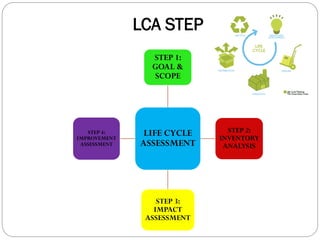
LCA STEP
LIFE CYCLE
ASSESSMENT
STEP 1:
GOAL &
SCOPE
STEP 2:
INVENTORY
ANALYSIS
STEP 3:
IMPACT
ASSESSMENT
STEP 4:
IMPROVEMENT
ASSESSMENT
INTRODUCTION
STEP 1 GOAL &
SCOPE
STEP 1 : GOAL & SCOPE
 GOAL/PURPOSE :
The main purpose of this project is to investigate the life cycle
environmental impact of PCs and to determine the desirable or
feasible recycle rate of an end-of-life PC.
 SCOPE :
Defined by the system boundaries, the functional unit and and
input/output product (PC).
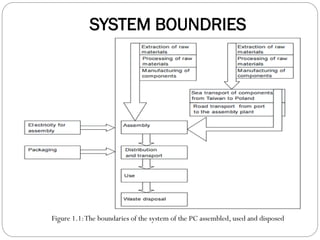
SYSTEM BOUNDRIES
Figure 1.1:The boundaries of the system of the PC assembled, used and disposed
FUNCTIONAL UNIT
The functional unit of the PC is defined as follows:
 Spatial context: a personal computer made, used, and
disposed of in Korea.
 Temporal context: the life span of a PC, as suggested by
authorities 2, is assumed to be four years.
 Technology: a desktop personal computer with Intel Pentium
IV 1.7 GHz, 128MB RAM, hard disk drive (HDD), CD-
ROM drive,2 GB hard disk, power supply, 3.5” floppy disk
drive (FDD), modem, and keyboard manufactured in Korea
in 2001.
INPUT & OUTPUT
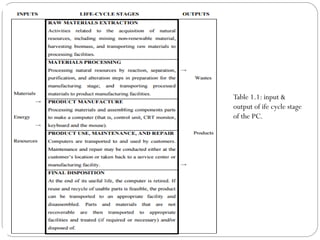
 Table 1.1 briefly describes each of the stages for a computer
product system.The inputs (e.g., resources and energy) and
outputs (e.g., product and waste within each life cycle stage,
as well as the interaction between each stage (e.g.,
transportation) are evaluated to determine the environmental
impacts.
Table 1.1: input &
output of ife cycle stage
of the PC.
STEP 2 INVENTORY
ANALYSIS
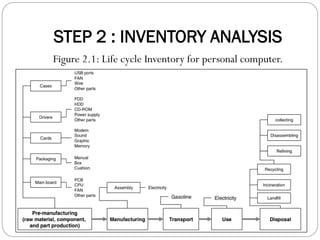
STEP 2 : INVENTORY ANALYSIS
Figure 2.1: Life cycle Inventory for personal computer.
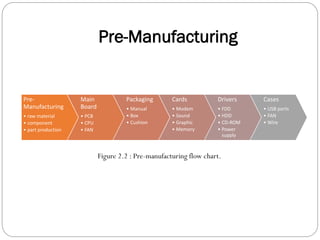
Pre-Manufacturing
Pre-
Manufacturing
• raw material
• component
• part production
Main
Board
• PCB
• CPU
• FAN
Packaging
• Manual
• Box
• Cushion
Cards
• Modem
• Sound
• Graphic
• Memory
Drivers
• FDD
• HDD
• CD-ROM
• Power
supply
Cases
• USB ports
• FAN
• Wire
Figure 2.2 : Pre-manufacturing flow chart.
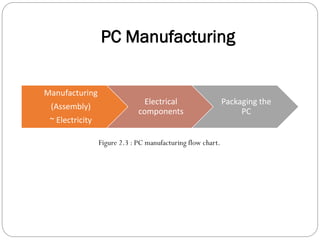
PC Manufacturing
Manufacturing
(Assembly)
~ Electricity
Electrical
components
Packaging the
PC
Figure 2.3 : PC manufacturing flow chart.
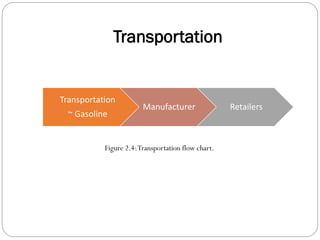
Transportation
Transportation
~ Gasoline
Manufacturer Retailers
Figure 2.4:Transportation flow chart.
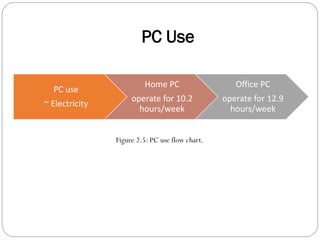
PC Use
PC use
~ Electricity
Home PC
operate for 10.2
hours/week
Office PC
operate for 12.9
hours/week
Figure 2.5: PC use flow chart.
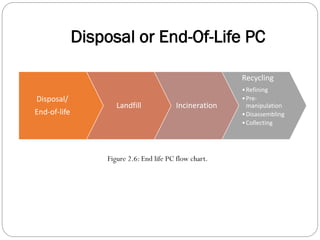
Disposal or End-Of-Life PC
Disposal/
End-of-life
Landfill Incineration
Recycling
•Refining
•Pre-
manipulation
•Disassembling
•Collecting
Figure 2.6: End life PC flow chart.
ASSUMPTIONS AND LIMITATIONS
 When site-specific data of sub-components or parts was not available,
we adopted other similar databases from SimaPro4.0 and the Korean
national databases.
 All data on electricity was obtained from the Korean national database.
 This study did not consider yield and scraps that may have emerged from
electrical parts and PC manufacturing.
 Assumed that components and parts as an elementary flow, where data
on the input and output of materials was inaccessible.
 Assumption of current recycling rate of waste PCs was estimated based
on the recent study.
 All the components and parts were included in this study except a CPU
(central processing unit) embedded in the main board. Material data of
small electrical parts are included, however process data of parts on the
printed circuit boards such as resistors and capacitors were excluded
due to inaccessibility to the data.
STEP 3 IMPACT
ASSESSMENT
STEP 3 : IMPACT ASSESSMENT
 The impact assessment focuses on characterizing the
type and severity of environmental impact more
specifically.
 Classification and characterization following ISO14042
guidelines were applied to analyze the potential
environmental impact of input and output from the LCI.
ISO 14042
 IS0 (the International Organization for Standardization)
is a worldwide federation of national standards bodies (IS0
member bodies).
 The work of preparing International Standards is normally
carried out through IS0 technical committees.
 International organizations, governmental and non-
governmental. in liaison with ISO, also take part in the
work.
 IS0 collaborates closely with the International
Electrotechnical Commission (IEC) on all matters of
electrotechnical standardization.
 International Standard IS0 14042 was prepared byTechnical
Committee lSO/TC 207. Environmental management,
Subcommittee SC 5, Life cycle assessment.
Impact Categories for Personal
Computer
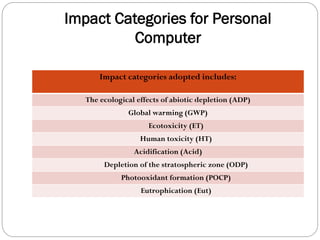
Impact categories adopted includes:
The ecological effects of abiotic depletion (ADP)
Global warming (GWP)
Ecotoxicity (ET)
Human toxicity (HT)
Acidification (Acid)
Depletion of the stratospheric zone (ODP)
Photooxidant formation (POCP)
Eutrophication (Eut)
Environmental Impact Assessment for
Personal Computer
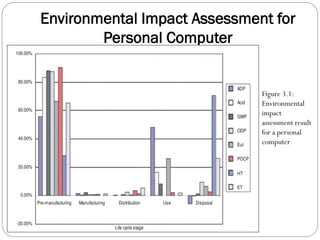
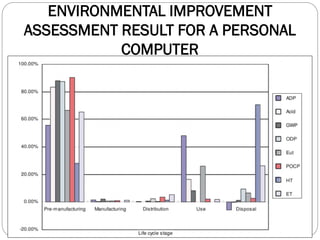
Figure 3.1:
Environmental
impact
assessment result
for a personal
computer
1) Pre-manufacturing Stage
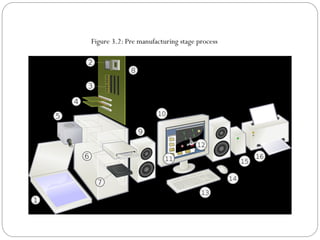
 This stage was found be the largest contributor to all
environmental impact categories, except for human
toxicity potential.
 The manufacturing of small electric parts and several
electronic components during this stage requires a
substantial amount of materials and energy, and emits
substantial quantities of air pollution, waste water, and solid
wastes.
Figure 3.2: Pre manufacturing stage process
2) Manufacturing and Distribution
stages
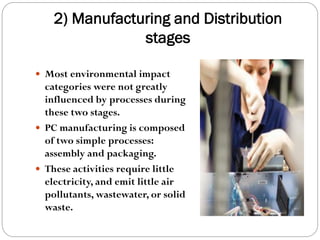
 Most environmental impact
categories were not greatly
influenced by processes during
these two stages.
 PC manufacturing is composed
of two simple processes:
assembly and packaging.
 These activities require little
electricity, and emit little air
pollutants, wastewater, or solid
waste.
3) Use Stage
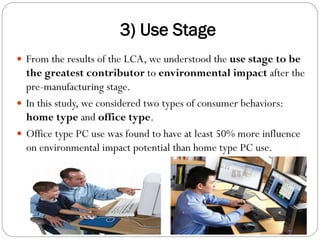
 From the results of the LCA, we understood the use stage to be
the greatest contributor to environmental impact after the
pre-manufacturing stage.
 In this study, we considered two types of consumer behaviors:
home type and office type.
 Office type PC use was found to have at least 50% more influence
on environmental impact potential than home type PC use.
4) Disposal Stage
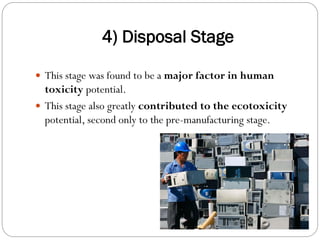
 This stage was found to be a major factor in human
toxicity potential.
 This stage also greatly contributed to the ecotoxicity
potential, second only to the pre-manufacturing stage.
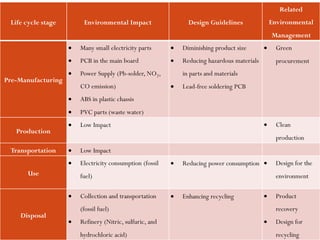
Life cycle stage Environmental Impact Design Guidelines
Related
Environmental
Management
Pre-Manufacturing
 Many small electricity parts
 PCB in the main board
 Power Supply (Pb-solder, NO2,
CO emission)
 ABS in plastic chassis
 PVC parts (waste water)
 Diminishing product size
 Reducing hazardous materials
in parts and materials
 Lead-free soldering PCB
 Green
procurement
Production
 Low Impact  Clean
production
Transportation  Low Impact
Use
 Electricity consumption (fossil
fuel)
 Reducing power consumption  Design for the
environment
Disposal
 Collection and transportation
(fossil fuel)
 Refinery (Nitric, sulfuric, and
hydrochloric acid)
 Enhancing recycling  Product
recovery
 Design for
recycling
STEP 4 IMPROVEMENT
ANALYSIS
STEP 4 : IMPROVEMENT ASSESSMENT
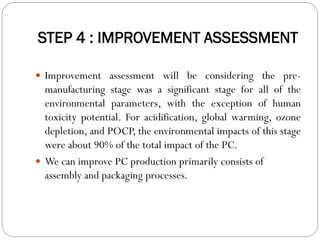
 Improvement assessment will be considering the pre-
manufacturing stage was a significant stage for all of the
environmental parameters, with the exception of human
toxicity potential. For acidification, global warming, ozone
depletion, and POCP, the environmental impacts of this stage
were about 90% of the total impact of the PC.
 We can improve PC production primarily consists of
assembly and packaging processes.
 Based on the results of the LCA for a personal computer, we
can improve the several methods were found to reduce the
environmental burden of PC products.Although there are
several guidelines pertaining to life cycle stages, PC
manufacturers might not, for commercial reasons, be able to
consider all the recommendations.
 With these techniques and the active participation of process
technologists and designers, LCA might become an analytic
tool for eco-design supporting a continuous environmental
improvement of products.
ENVIRONMENTAL IMPROVEMENT
ASSESSMENT RESULT FOR A PERSONAL
COMPUTER
LCA RESULTS OF IMPROVEMENT
ASSESSMENT
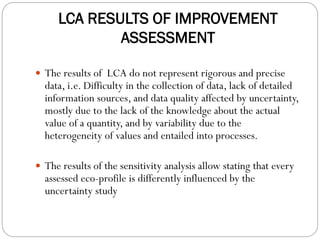
 The results of LCA do not represent rigorous and precise
data, i.e. Difficulty in the collection of data, lack of detailed
information sources, and data quality affected by uncertainty,
mostly due to the lack of the knowledge about the actual
value of a quantity, and by variability due to the
heterogeneity of values and entailed into processes.
 The results of the sensitivity analysis allow stating that every
assessed eco-profile is differently influenced by the
uncertainty study
CONCLUSION
 The findings from this research have indicated that the energy used
for powering the PC contributed significantly to the examined
impact categories, followed by the manufacturing of that product.
 Most of that burden is observed in three impact categories: fossil
fuels, respiratory inorganics and climate change, that could be
attributed to the coal, lignite and natural gas extraction and then
their combustion to produce electricity.
 Therefore, the energy efficiency of the PC (which depends on the
manufacturer), adoption of a responsible attitude of the PC user
(application of energy saving mode) and heading for more
renewable sources in electricity production should be highly
promoted.
REFERENCES
 The Korean Ministry of Environment (MOE) (2002): Life cycle
inventory of products –Water, industrial water, raw materials and
chemical components: Domestic area
 KoreaAccreditation Board and the Korean Ministry of Commerce,
Industry and Energy (2003): Environmental National Standard
Database
 Korea National Statistical Office (2001):A research on the actual
information condition in Korea
 KoreanAssociation of Electrical and Electronics Industry for the
Environment (2001):A study on the recovery and recycling of
waste of electrical and electronic equipment (in Korean)
 Pre (1999): SIMAPRO 4.0. Pre Consultants B.V. Plotterweg 12,
3821 BBAmersfoort,The Netherlands

Life Cycle Assessment on Personal Computer

  • 1.
    SUSTAINABLE MANUFACTURING (CDC10503) SEMESTER2 2014/2015 LIFE CYCLE ASSESSEMENT OF PERSONAL COMPUTER NAME MATRIX MASNADIA BT MASHURI HD140060 MOHAMED ABDIRAHMAN IBRAHIM HD140076 MUHAMMAD ZULHILMI BIN HASHIM HD140045 SHAMY NAZREIN BIN MD YAHAYA HD140066 LECTURER’S NAME : ENCIKYUSSNI BIN HASHIM
  • 2.
    LCA STEP LIFE CYCLE ASSESSMENT STEP1: GOAL & SCOPE STEP 2: INVENTORY ANALYSIS STEP 3: IMPACT ASSESSMENT STEP 4: IMPROVEMENT ASSESSMENT
  • 3.
  • 4.
    STEP 1 GOAL& SCOPE
  • 5.
    STEP 1 :GOAL & SCOPE  GOAL/PURPOSE : The main purpose of this project is to investigate the life cycle environmental impact of PCs and to determine the desirable or feasible recycle rate of an end-of-life PC.  SCOPE : Defined by the system boundaries, the functional unit and and input/output product (PC).
  • 6.
    SYSTEM BOUNDRIES Figure 1.1:Theboundaries of the system of the PC assembled, used and disposed
  • 7.
    FUNCTIONAL UNIT The functionalunit of the PC is defined as follows:  Spatial context: a personal computer made, used, and disposed of in Korea.  Temporal context: the life span of a PC, as suggested by authorities 2, is assumed to be four years.  Technology: a desktop personal computer with Intel Pentium IV 1.7 GHz, 128MB RAM, hard disk drive (HDD), CD- ROM drive,2 GB hard disk, power supply, 3.5” floppy disk drive (FDD), modem, and keyboard manufactured in Korea in 2001.
  • 8.
    INPUT & OUTPUT Table 1.1 briefly describes each of the stages for a computer product system.The inputs (e.g., resources and energy) and outputs (e.g., product and waste within each life cycle stage, as well as the interaction between each stage (e.g., transportation) are evaluated to determine the environmental impacts.
  • 9.
    Table 1.1: input& output of ife cycle stage of the PC.
  • 10.
  • 11.
    STEP 2 :INVENTORY ANALYSIS Figure 2.1: Life cycle Inventory for personal computer.
  • 12.
    Pre-Manufacturing Pre- Manufacturing • raw material •component • part production Main Board • PCB • CPU • FAN Packaging • Manual • Box • Cushion Cards • Modem • Sound • Graphic • Memory Drivers • FDD • HDD • CD-ROM • Power supply Cases • USB ports • FAN • Wire Figure 2.2 : Pre-manufacturing flow chart.
  • 13.
  • 14.
  • 15.
    PC Use PC use ~Electricity Home PC operate for 10.2 hours/week Office PC operate for 12.9 hours/week Figure 2.5: PC use flow chart.
  • 16.
    Disposal or End-Of-LifePC Disposal/ End-of-life Landfill Incineration Recycling •Refining •Pre- manipulation •Disassembling •Collecting Figure 2.6: End life PC flow chart.
  • 17.
    ASSUMPTIONS AND LIMITATIONS When site-specific data of sub-components or parts was not available, we adopted other similar databases from SimaPro4.0 and the Korean national databases.  All data on electricity was obtained from the Korean national database.  This study did not consider yield and scraps that may have emerged from electrical parts and PC manufacturing.  Assumed that components and parts as an elementary flow, where data on the input and output of materials was inaccessible.  Assumption of current recycling rate of waste PCs was estimated based on the recent study.  All the components and parts were included in this study except a CPU (central processing unit) embedded in the main board. Material data of small electrical parts are included, however process data of parts on the printed circuit boards such as resistors and capacitors were excluded due to inaccessibility to the data.
  • 18.
  • 19.
    STEP 3 :IMPACT ASSESSMENT  The impact assessment focuses on characterizing the type and severity of environmental impact more specifically.  Classification and characterization following ISO14042 guidelines were applied to analyze the potential environmental impact of input and output from the LCI.
  • 20.
    ISO 14042  IS0(the International Organization for Standardization) is a worldwide federation of national standards bodies (IS0 member bodies).  The work of preparing International Standards is normally carried out through IS0 technical committees.  International organizations, governmental and non- governmental. in liaison with ISO, also take part in the work.  IS0 collaborates closely with the International Electrotechnical Commission (IEC) on all matters of electrotechnical standardization.  International Standard IS0 14042 was prepared byTechnical Committee lSO/TC 207. Environmental management, Subcommittee SC 5, Life cycle assessment.
  • 21.
    Impact Categories forPersonal Computer Impact categories adopted includes: The ecological effects of abiotic depletion (ADP) Global warming (GWP) Ecotoxicity (ET) Human toxicity (HT) Acidification (Acid) Depletion of the stratospheric zone (ODP) Photooxidant formation (POCP) Eutrophication (Eut)
  • 22.
    Environmental Impact Assessmentfor Personal Computer Figure 3.1: Environmental impact assessment result for a personal computer
  • 23.
    1) Pre-manufacturing Stage This stage was found be the largest contributor to all environmental impact categories, except for human toxicity potential.  The manufacturing of small electric parts and several electronic components during this stage requires a substantial amount of materials and energy, and emits substantial quantities of air pollution, waste water, and solid wastes.
  • 24.
    Figure 3.2: Premanufacturing stage process
  • 25.
    2) Manufacturing andDistribution stages  Most environmental impact categories were not greatly influenced by processes during these two stages.  PC manufacturing is composed of two simple processes: assembly and packaging.  These activities require little electricity, and emit little air pollutants, wastewater, or solid waste.
  • 26.
    3) Use Stage From the results of the LCA, we understood the use stage to be the greatest contributor to environmental impact after the pre-manufacturing stage.  In this study, we considered two types of consumer behaviors: home type and office type.  Office type PC use was found to have at least 50% more influence on environmental impact potential than home type PC use.
  • 27.
    4) Disposal Stage This stage was found to be a major factor in human toxicity potential.  This stage also greatly contributed to the ecotoxicity potential, second only to the pre-manufacturing stage.
  • 28.
    Life cycle stageEnvironmental Impact Design Guidelines Related Environmental Management Pre-Manufacturing  Many small electricity parts  PCB in the main board  Power Supply (Pb-solder, NO2, CO emission)  ABS in plastic chassis  PVC parts (waste water)  Diminishing product size  Reducing hazardous materials in parts and materials  Lead-free soldering PCB  Green procurement Production  Low Impact  Clean production Transportation  Low Impact Use  Electricity consumption (fossil fuel)  Reducing power consumption  Design for the environment Disposal  Collection and transportation (fossil fuel)  Refinery (Nitric, sulfuric, and hydrochloric acid)  Enhancing recycling  Product recovery  Design for recycling
  • 29.
  • 30.
    STEP 4 :IMPROVEMENT ASSESSMENT  Improvement assessment will be considering the pre- manufacturing stage was a significant stage for all of the environmental parameters, with the exception of human toxicity potential. For acidification, global warming, ozone depletion, and POCP, the environmental impacts of this stage were about 90% of the total impact of the PC.  We can improve PC production primarily consists of assembly and packaging processes.
  • 31.
     Based onthe results of the LCA for a personal computer, we can improve the several methods were found to reduce the environmental burden of PC products.Although there are several guidelines pertaining to life cycle stages, PC manufacturers might not, for commercial reasons, be able to consider all the recommendations.  With these techniques and the active participation of process technologists and designers, LCA might become an analytic tool for eco-design supporting a continuous environmental improvement of products.
  • 32.
  • 33.
    LCA RESULTS OFIMPROVEMENT ASSESSMENT  The results of LCA do not represent rigorous and precise data, i.e. Difficulty in the collection of data, lack of detailed information sources, and data quality affected by uncertainty, mostly due to the lack of the knowledge about the actual value of a quantity, and by variability due to the heterogeneity of values and entailed into processes.  The results of the sensitivity analysis allow stating that every assessed eco-profile is differently influenced by the uncertainty study
  • 34.
    CONCLUSION  The findingsfrom this research have indicated that the energy used for powering the PC contributed significantly to the examined impact categories, followed by the manufacturing of that product.  Most of that burden is observed in three impact categories: fossil fuels, respiratory inorganics and climate change, that could be attributed to the coal, lignite and natural gas extraction and then their combustion to produce electricity.  Therefore, the energy efficiency of the PC (which depends on the manufacturer), adoption of a responsible attitude of the PC user (application of energy saving mode) and heading for more renewable sources in electricity production should be highly promoted.
  • 35.
    REFERENCES  The KoreanMinistry of Environment (MOE) (2002): Life cycle inventory of products –Water, industrial water, raw materials and chemical components: Domestic area  KoreaAccreditation Board and the Korean Ministry of Commerce, Industry and Energy (2003): Environmental National Standard Database  Korea National Statistical Office (2001):A research on the actual information condition in Korea  KoreanAssociation of Electrical and Electronics Industry for the Environment (2001):A study on the recovery and recycling of waste of electrical and electronic equipment (in Korean)  Pre (1999): SIMAPRO 4.0. Pre Consultants B.V. Plotterweg 12, 3821 BBAmersfoort,The Netherlands