LIFE CYCLE
ASSESSMENT (LCA)
LIFE CYCLE ASSESSMENT (LCA)
Basically, a tool to
assess the upstream &
downstream
consequences of a
product or service to
the environment
To assess the
consequences of
cradle to grave impact
in the environment
PRIME OBJECTIVES OF LCA
As complete picture as possible of interaction of a
system/product/service with the environment
Understanding the overall and interdependent nature of
environmental consequences of human activities
To provide decision makers with information
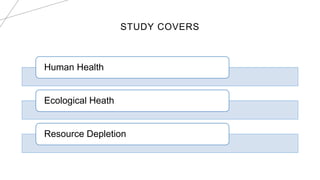
STUDY COVERS
Human Health
Ecological Heath
Resource Depletion
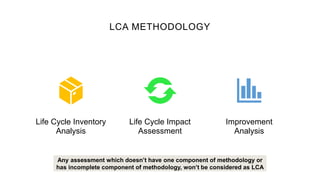
LCA METHODOLOGY
Life Cycle Inventory
Analysis
Life Cycle Impact
Assessment
Improvement
Analysis
Any assessment which doesn’t have one component of methodology or
has incomplete component of methodology, won’t be considered as LCA
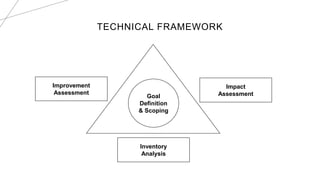
TECHNICAL FRAMEWORK
Goal
Definition
& Scoping
Improvement
Assessment
Impact
Assessment
Inventory
Analysis
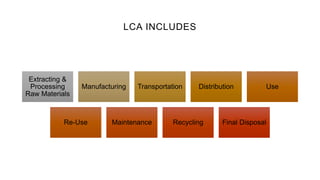
LCA INCLUDES
Extracting &
Processing
Raw Materials
Manufacturing Transportation Distribution Use
Re-Use Maintenance Recycling Final Disposal
SYSTEM
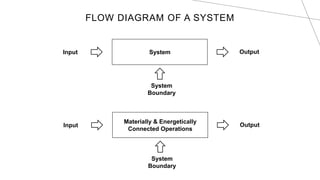
A system is a collection of materially and
energetically connected operations which
perform some defined functions. A system is
separated from its surroundings by a system
boundary.
FLOW DIAGRAM OF A SYSTEM
System
Input Output
System
Boundary
Materially & Energetically
Connected Operations
Input Output
System
Boundary
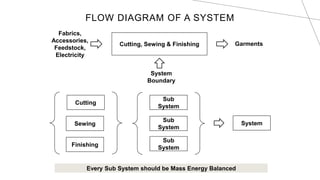
FLOW DIAGRAM OF A SYSTEM
Cutting, Sewing & Finishing
Fabrics,
Accessories,
Feedstock,
Electricity
Garments
System
Boundary
Cutting
Sewing
Finishing
Sub
System
Sub
System
Sub
System
System
Every Sub System should be Mass Energy Balanced
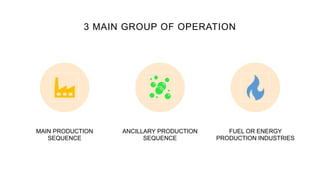
3 MAIN GROUP OF OPERATION
MAIN PRODUCTION
SEQUENCE
ANCILLARY PRODUCTION
SEQUENCE
FUEL OR ENERGY
PRODUCTION INDUSTRIES
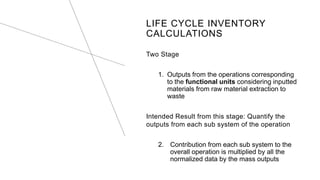
LIFE CYCLE INVENTORY
CALCULATIONS
Two Stage
1. Outputs from the operations corresponding
to the functional units considering inputted
materials from raw material extraction to
waste
Intended Result from this stage: Quantify the
outputs from each sub system of the operation
2. Contribution from each sub system to the
overall operation is multiplied by all the
normalized data by the mass outputs
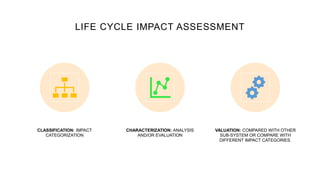
LIFE CYCLE IMPACT ASSESSMENT
CLASSIFICATION: IMPACT
CATEGORIZATION
CHARACTERIZATION: ANALYSIS
AND/OR EVALUATION
VALUATION: COMPARED WITH OTHER
SUB-SYSTEM OR COMPARE WITH
DIFFERENT IMPACT CATEGORIES.
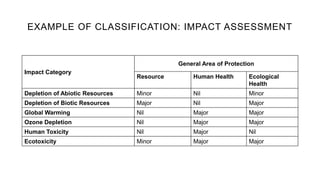
EXAMPLE OF CLASSIFICATION: IMPACT ASSESSMENT
Impact Category
General Area of Protection
Resource Human Health Ecological
Health
Depletion of Abiotic Resources Minor Nil Minor
Depletion of Biotic Resources Major Nil Major
Global Warming Nil Major Major
Ozone Depletion Nil Major Major
Human Toxicity Nil Major Nil
Ecotoxicity Minor Major Major
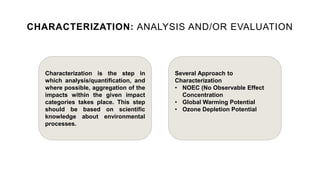
CHARACTERIZATION: ANALYSIS AND/OR EVALUATION
Characterization is the step in
which analysis/quantification, and
where possible, aggregation of the
impacts within the given impact
categories takes place. This step
should be based on scientific
knowledge about environmental
processes.
Several Approach to
Characterization
• NOEC (No Observable Effect
Concentration
• Global Warming Potential
• Ozone Depletion Potential
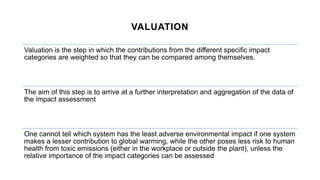
VALUATION
Valuation is the step in which the contributions from the different specific impact
categories are weighted so that they can be compared among themselves.
The aim of this step is to arrive at a further interpretation and aggregation of the data of
the impact assessment
One cannot tell which system has the least adverse environmental impact if one system
makes a lesser contribution to global warming, while the other poses less risk to human
health from toxic emissions (either in the workplace or outside the plant), unless the
relative importance of the impact categories can be assessed
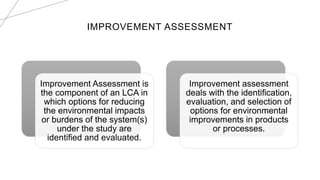
IMPROVEMENT ASSESSMENT
Improvement Assessment is
the component of an LCA in
which options for reducing
the environmental impacts
or burdens of the system(s)
under the study are
identified and evaluated.
Improvement assessment
deals with the identification,
evaluation, and selection of
options for environmental
improvements in products
or processes.
DATA
PRIMARY DATA SECONDARY DATA
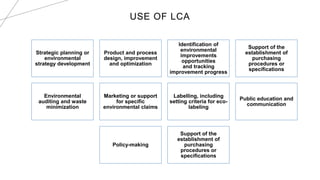
USE OF LCA
Strategic planning or
environmental
strategy development
Product and process
design, improvement
and optimization
Identification of
environmental
improvements
opportunities
and tracking
improvement progress
Support of the
establishment of
purchasing
procedures or
specifications
Environmental
auditing and waste
minimization
Marketing or support
for specific
environmental claims
Labelling, including
setting criteria for eco-
labeling
Public education and
communication
Policy-making
Support of the
establishment of
purchasing
procedures or
specifications
BOOK REFERENCE
Guidelines for Life-Cycle Assessment: A "Code of Practice“ by Society of Environmental
Toxicology and Chemistry (SETAC)

Life cycle Assessment (LCA).pptx

  • 1.
  • 2.
    LIFE CYCLE ASSESSMENT(LCA) Basically, a tool to assess the upstream & downstream consequences of a product or service to the environment To assess the consequences of cradle to grave impact in the environment
  • 3.
    PRIME OBJECTIVES OFLCA As complete picture as possible of interaction of a system/product/service with the environment Understanding the overall and interdependent nature of environmental consequences of human activities To provide decision makers with information
  • 4.
    STUDY COVERS Human Health EcologicalHeath Resource Depletion
  • 5.
    LCA METHODOLOGY Life CycleInventory Analysis Life Cycle Impact Assessment Improvement Analysis Any assessment which doesn’t have one component of methodology or has incomplete component of methodology, won’t be considered as LCA
  • 6.
  • 7.
    LCA INCLUDES Extracting & Processing RawMaterials Manufacturing Transportation Distribution Use Re-Use Maintenance Recycling Final Disposal
  • 8.
    SYSTEM A system isa collection of materially and energetically connected operations which perform some defined functions. A system is separated from its surroundings by a system boundary.
  • 9.
    FLOW DIAGRAM OFA SYSTEM System Input Output System Boundary Materially & Energetically Connected Operations Input Output System Boundary
  • 10.
    FLOW DIAGRAM OFA SYSTEM Cutting, Sewing & Finishing Fabrics, Accessories, Feedstock, Electricity Garments System Boundary Cutting Sewing Finishing Sub System Sub System Sub System System Every Sub System should be Mass Energy Balanced
  • 11.
    3 MAIN GROUPOF OPERATION MAIN PRODUCTION SEQUENCE ANCILLARY PRODUCTION SEQUENCE FUEL OR ENERGY PRODUCTION INDUSTRIES
  • 12.
    LIFE CYCLE INVENTORY CALCULATIONS TwoStage 1. Outputs from the operations corresponding to the functional units considering inputted materials from raw material extraction to waste Intended Result from this stage: Quantify the outputs from each sub system of the operation 2. Contribution from each sub system to the overall operation is multiplied by all the normalized data by the mass outputs
  • 13.
    LIFE CYCLE IMPACTASSESSMENT CLASSIFICATION: IMPACT CATEGORIZATION CHARACTERIZATION: ANALYSIS AND/OR EVALUATION VALUATION: COMPARED WITH OTHER SUB-SYSTEM OR COMPARE WITH DIFFERENT IMPACT CATEGORIES.
  • 14.
    EXAMPLE OF CLASSIFICATION:IMPACT ASSESSMENT Impact Category General Area of Protection Resource Human Health Ecological Health Depletion of Abiotic Resources Minor Nil Minor Depletion of Biotic Resources Major Nil Major Global Warming Nil Major Major Ozone Depletion Nil Major Major Human Toxicity Nil Major Nil Ecotoxicity Minor Major Major
  • 15.
    CHARACTERIZATION: ANALYSIS AND/OREVALUATION Characterization is the step in which analysis/quantification, and where possible, aggregation of the impacts within the given impact categories takes place. This step should be based on scientific knowledge about environmental processes. Several Approach to Characterization • NOEC (No Observable Effect Concentration • Global Warming Potential • Ozone Depletion Potential
  • 16.
    VALUATION Valuation is thestep in which the contributions from the different specific impact categories are weighted so that they can be compared among themselves. The aim of this step is to arrive at a further interpretation and aggregation of the data of the impact assessment One cannot tell which system has the least adverse environmental impact if one system makes a lesser contribution to global warming, while the other poses less risk to human health from toxic emissions (either in the workplace or outside the plant), unless the relative importance of the impact categories can be assessed
  • 17.
    IMPROVEMENT ASSESSMENT Improvement Assessmentis the component of an LCA in which options for reducing the environmental impacts or burdens of the system(s) under the study are identified and evaluated. Improvement assessment deals with the identification, evaluation, and selection of options for environmental improvements in products or processes.
  • 18.
  • 19.
    USE OF LCA Strategicplanning or environmental strategy development Product and process design, improvement and optimization Identification of environmental improvements opportunities and tracking improvement progress Support of the establishment of purchasing procedures or specifications Environmental auditing and waste minimization Marketing or support for specific environmental claims Labelling, including setting criteria for eco- labeling Public education and communication Policy-making Support of the establishment of purchasing procedures or specifications
  • 20.
    BOOK REFERENCE Guidelines forLife-Cycle Assessment: A "Code of Practice“ by Society of Environmental Toxicology and Chemistry (SETAC)