Environmental Impact Assessment
Report Preparation and its Challenges
Presenter
Amit Chaudhary
Faculty, of Forestry, AFU
14 Dec. 2022
Outline of Presentation
• Introduction
• Objective
• Methodology
• EIA Process
• Challenges
• Conclusion and Recommendations
• References
Introduction
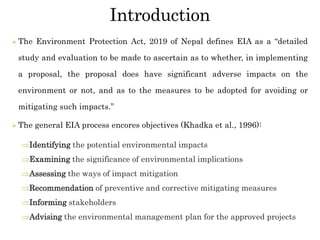
 The Environment Protection Act, 2019 of Nepal defines EIA as a ā€œdetailed
study and evaluation to be made to ascertain as to whether, in implementing
a proposal, the proposal does have significant adverse impacts on the
environment or not, and as to the measures to be adopted for avoiding or
mitigating such impacts.ā€
 The general EIA process encores objectives (Khadka et al., 1996):
ļƒžIdentifying the potential environmental impacts
ļƒžExamining the significance of environmental implications
ļƒžAssessing the ways of impact mitigation
ļƒžRecommendation of preventive and corrective mitigating measures
ļƒžInforming stakeholders
ļƒžAdvising the environmental management plan for the approved projects
Introduction
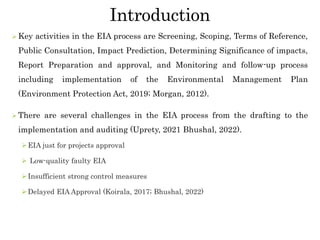
 Key activities in the EIA process are Screening, Scoping, Terms of Reference,
Public Consultation, Impact Prediction, Determining Significance of impacts,
Report Preparation and approval, and Monitoring and follow-up process
including implementation of the Environmental Management Plan
(Environment Protection Act, 2019; Morgan, 2012).
 There are several challenges in the EIA process from the drafting to the
implementation and auditing (Uprety, 2021 Bhushal, 2022).
EIA just for projects approval
 Low-quality faulty EIA
Insufficient strong control measures
Delayed EIA Approval (Koirala, 2017; Bhushal, 2022)
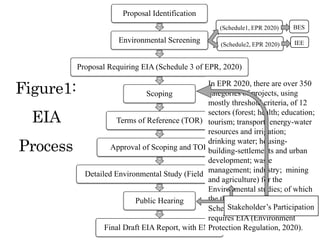
The proponent then prepares
the Scoping report in the format
given in Schedule-5.
Scoping Report helps in
developing and selecting
alternatives to the proposed
action. Scoping helps in
identifying issues to be
considered in the EIA through
public consultations. It helps in
identifying the stakeholders and
their affected interests by the
proposed action. For this notice
has to be sent in accordance to
Schedule 4.
(Schedule2, EPR 2020)
(Schedule1, EPR 2020)
Proposal Identification
Environmental Screening
Proposal Requiring EIA (Schedule 3 of EPR, 2020)
Scoping
Terms of Reference (TOR)
Approval of Scoping and TOR
Detailed Environmental Study (Field and Lab)
Public Hearing
Final Draft EIA Report, with EMP
Figure1:
EIA
Process
BES
IEE
In EPR 2020, there are over 350
categories of projects, using
mostly threshold criteria, of 12
sectors (forest; health; education;
tourism; transport; energy-water
resources and irrigation;
drinking water; housing-
building-settlements and urban
development; waste
management; industry; mining
and agriculture) for the
Environmental studies; of which
the thresholds are set up in the
Schedule 3 of the EPR, 2020 that
requires EIA (Environment
Protection Regulation, 2020).
Stakeholder’s Participation
Submission for Approval
Reviewed by the committee
Opened for Public Review
Final EIA Report
EIA report Approved
Project Implementation
Monitoring
Environmental Auditing
Restriction/ Feedback
People’s Participation
Figure1:
EIA
Process
Adapted from: (Roy, 2002)
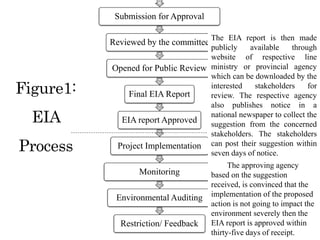
The EIA report is then made
publicly available through
website of respective line
ministry or provincial agency
which can be downloaded by the
interested stakeholders for
review. The respective agency
also publishes notice in a
national newspaper to collect the
suggestion from the concerned
stakeholders. The stakeholders
can post their suggestion within
seven days of notice.
The approving agency
based on the suggestion
received, is convinced that the
implementation of the proposed
action is not going to impact the
environment severely then the
EIA report is approved within
thirty-five days of receipt.
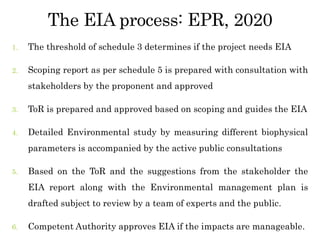
The EIA process: EPR, 2020
1. The threshold of schedule 3 determines if the project needs EIA
2. Scoping report as per schedule 5 is prepared with consultation with
stakeholders by the proponent and approved
3. ToR is prepared and approved based on scoping and guides the EIA
4. Detailed Environmental study by measuring different biophysical
parameters is accompanied by the active public consultations
5. Based on the ToR and the suggestions from the stakeholder the
EIA report along with the Environmental management plan is
drafted subject to review by a team of experts and the public.
6. Competent Authority approves EIA if the impacts are manageable.
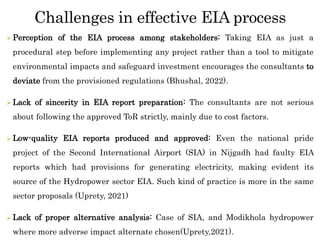
Challenges in effective EIA process
 Perception of the EIA process among stakeholders: Taking EIA as just a
procedural step before implementing any project rather than a tool to mitigate
environmental impacts and safeguard investment encourages the consultants to
deviate from the provisioned regulations (Bhushal, 2022).
 Lack of sincerity in EIA report preparation: The consultants are not serious
about following the approved ToR strictly, mainly due to cost factors.
 Low-quality EIA reports produced and approved: Even the national pride
project of the Second International Airport (SIA) in Nijgadh had faulty EIA
reports which had provisions for generating electricity, making evident its
source of the Hydropower sector EIA. Such kind of practice is more in the same
sector proposals (Uprety, 2021)
 Lack of proper alternative analysis: Case of SIA, and Modikhola hydropower
where more adverse impact alternate chosen(Uprety,2021).
Challenges in effective EIA process
 EIA process to fulfill the individual objective: Liability of the Private
consulting firms, Proponents, and the Government is assumed different due
to the lack of stringent law enforcement.
 Participation: The duration of the collection of the suggestion has been
reduced to seven days only while the notification to the concerned authority
may not be effective or the time is not sufficient to review the bulky technical
document in such a short period.
 Lack of effective implementation of the EMP: Impractical rules in mitigating
the environmental impacts based on a whim than in science, as for the rule
of compensation plantation implies 10 trees must be planted which was
previously 25 trees but the aftercare and implementation are not properly
addressed (Bhushal, 2022). It is more important in climate change.
 Delayed Approval: Lack of adequate technical human resources.
Conclusion and Recommendations
The EIA ensures environmental considerations through the process of research
suggestion collection, and public hearings organized with the concerned
stakeholders. The core objective is to bring the impacts to an acceptable level.
Inadequate human resources hampers the review and approval, and the effective
implementation of EIA-identified alternatives is the most challenging.
The implementation experience of EIA in Nepal urges the multi-stakeholders
should collaborate to make the EIA reports specific to the designated project and
follow the standards as required for its effectiveness.
References
Bhatt, R. P., & Khanal, S. N. (2009). Environmental impact assessment system in
Nepal – an overview of policy, legal instruments, and process. 5(ii), 160–
170.
Bhushal, R. (2022, November 15). ā€˜ A waste of time and money ’: Why are
environmental assessments so ineffective in Nepal ? The Third Pole, 1–12.
https://www.thethirdpole.net/en/nature/why-are-eias-so-ineffective-nepal/
Khadka, R. B., Bisset, R., & Neame, P. A. (1996). EIA Training Manual for
Professionals and Managers (pp. 1–192). IUCN.
Environment Protection Act, (2019). lawcommission.gov.np
Environment Protection Regulation, (2020).
Environment Protection Act, (1997).
Morgan, R. K. (2012). Environmental impact assessment: The state of the art.
Impact Assessment and Project Appraisal, 30(1), 5–14.
https://doi.org/10.1080/14615517.2012.661557
Thank You!
for your attention
Any Queries are duly welcome


EIA Report Preparation and its Challenges.pptx

  • 1.
    Environmental Impact Assessment ReportPreparation and its Challenges Presenter Amit Chaudhary Faculty, of Forestry, AFU 14 Dec. 2022
  • 2.
    Outline of Presentation •Introduction • Objective • Methodology • EIA Process • Challenges • Conclusion and Recommendations • References
  • 3.
    Introduction  The EnvironmentProtection Act, 2019 of Nepal defines EIA as a ā€œdetailed study and evaluation to be made to ascertain as to whether, in implementing a proposal, the proposal does have significant adverse impacts on the environment or not, and as to the measures to be adopted for avoiding or mitigating such impacts.ā€  The general EIA process encores objectives (Khadka et al., 1996): ļƒžIdentifying the potential environmental impacts ļƒžExamining the significance of environmental implications ļƒžAssessing the ways of impact mitigation ļƒžRecommendation of preventive and corrective mitigating measures ļƒžInforming stakeholders ļƒžAdvising the environmental management plan for the approved projects
  • 4.
    Introduction  Key activitiesin the EIA process are Screening, Scoping, Terms of Reference, Public Consultation, Impact Prediction, Determining Significance of impacts, Report Preparation and approval, and Monitoring and follow-up process including implementation of the Environmental Management Plan (Environment Protection Act, 2019; Morgan, 2012).  There are several challenges in the EIA process from the drafting to the implementation and auditing (Uprety, 2021 Bhushal, 2022). EIA just for projects approval  Low-quality faulty EIA Insufficient strong control measures Delayed EIA Approval (Koirala, 2017; Bhushal, 2022)
  • 5.
    The proponent thenprepares the Scoping report in the format given in Schedule-5. Scoping Report helps in developing and selecting alternatives to the proposed action. Scoping helps in identifying issues to be considered in the EIA through public consultations. It helps in identifying the stakeholders and their affected interests by the proposed action. For this notice has to be sent in accordance to Schedule 4. (Schedule2, EPR 2020) (Schedule1, EPR 2020) Proposal Identification Environmental Screening Proposal Requiring EIA (Schedule 3 of EPR, 2020) Scoping Terms of Reference (TOR) Approval of Scoping and TOR Detailed Environmental Study (Field and Lab) Public Hearing Final Draft EIA Report, with EMP Figure1: EIA Process BES IEE In EPR 2020, there are over 350 categories of projects, using mostly threshold criteria, of 12 sectors (forest; health; education; tourism; transport; energy-water resources and irrigation; drinking water; housing- building-settlements and urban development; waste management; industry; mining and agriculture) for the Environmental studies; of which the thresholds are set up in the Schedule 3 of the EPR, 2020 that requires EIA (Environment Protection Regulation, 2020). Stakeholder’s Participation
  • 6.
    Submission for Approval Reviewedby the committee Opened for Public Review Final EIA Report EIA report Approved Project Implementation Monitoring Environmental Auditing Restriction/ Feedback People’s Participation Figure1: EIA Process Adapted from: (Roy, 2002) The EIA report is then made publicly available through website of respective line ministry or provincial agency which can be downloaded by the interested stakeholders for review. The respective agency also publishes notice in a national newspaper to collect the suggestion from the concerned stakeholders. The stakeholders can post their suggestion within seven days of notice. The approving agency based on the suggestion received, is convinced that the implementation of the proposed action is not going to impact the environment severely then the EIA report is approved within thirty-five days of receipt.
  • 7.
    The EIA process:EPR, 2020 1. The threshold of schedule 3 determines if the project needs EIA 2. Scoping report as per schedule 5 is prepared with consultation with stakeholders by the proponent and approved 3. ToR is prepared and approved based on scoping and guides the EIA 4. Detailed Environmental study by measuring different biophysical parameters is accompanied by the active public consultations 5. Based on the ToR and the suggestions from the stakeholder the EIA report along with the Environmental management plan is drafted subject to review by a team of experts and the public. 6. Competent Authority approves EIA if the impacts are manageable.
  • 8.
    Challenges in effectiveEIA process  Perception of the EIA process among stakeholders: Taking EIA as just a procedural step before implementing any project rather than a tool to mitigate environmental impacts and safeguard investment encourages the consultants to deviate from the provisioned regulations (Bhushal, 2022).  Lack of sincerity in EIA report preparation: The consultants are not serious about following the approved ToR strictly, mainly due to cost factors.  Low-quality EIA reports produced and approved: Even the national pride project of the Second International Airport (SIA) in Nijgadh had faulty EIA reports which had provisions for generating electricity, making evident its source of the Hydropower sector EIA. Such kind of practice is more in the same sector proposals (Uprety, 2021)  Lack of proper alternative analysis: Case of SIA, and Modikhola hydropower where more adverse impact alternate chosen(Uprety,2021).
  • 9.
    Challenges in effectiveEIA process  EIA process to fulfill the individual objective: Liability of the Private consulting firms, Proponents, and the Government is assumed different due to the lack of stringent law enforcement.  Participation: The duration of the collection of the suggestion has been reduced to seven days only while the notification to the concerned authority may not be effective or the time is not sufficient to review the bulky technical document in such a short period.  Lack of effective implementation of the EMP: Impractical rules in mitigating the environmental impacts based on a whim than in science, as for the rule of compensation plantation implies 10 trees must be planted which was previously 25 trees but the aftercare and implementation are not properly addressed (Bhushal, 2022). It is more important in climate change.  Delayed Approval: Lack of adequate technical human resources.
  • 10.
    Conclusion and Recommendations TheEIA ensures environmental considerations through the process of research suggestion collection, and public hearings organized with the concerned stakeholders. The core objective is to bring the impacts to an acceptable level. Inadequate human resources hampers the review and approval, and the effective implementation of EIA-identified alternatives is the most challenging. The implementation experience of EIA in Nepal urges the multi-stakeholders should collaborate to make the EIA reports specific to the designated project and follow the standards as required for its effectiveness.
  • 11.
    References Bhatt, R. P.,& Khanal, S. N. (2009). Environmental impact assessment system in Nepal – an overview of policy, legal instruments, and process. 5(ii), 160– 170. Bhushal, R. (2022, November 15). ā€˜ A waste of time and money ’: Why are environmental assessments so ineffective in Nepal ? The Third Pole, 1–12. https://www.thethirdpole.net/en/nature/why-are-eias-so-ineffective-nepal/ Khadka, R. B., Bisset, R., & Neame, P. A. (1996). EIA Training Manual for Professionals and Managers (pp. 1–192). IUCN. Environment Protection Act, (2019). lawcommission.gov.np Environment Protection Regulation, (2020). Environment Protection Act, (1997). Morgan, R. K. (2012). Environmental impact assessment: The state of the art. Impact Assessment and Project Appraisal, 30(1), 5–14. https://doi.org/10.1080/14615517.2012.661557
  • 12.
    Thank You! for yourattention Any Queries are duly welcome 