A Lifecycle Assessment of the Supply Chain and Evaluation of End-of-Life Management Options Wednesday, April 2, 2008
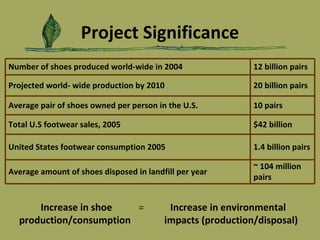
Project Significance Increase in shoe  =   Increase in environmental production/consumption  impacts (production/disposal) Number of shoes produced world-wide in 2004 12 billion pairs Projected world- wide production by 2010 20 billion pairs Average pair of shoes owned per person in the U.S. 10 pairs Total U.S footwear sales, 2005  $42 billion United States footwear consumption 2005 1.4 billion pairs Average amount of shoes disposed in landfill per year  ~ 104 million pairs
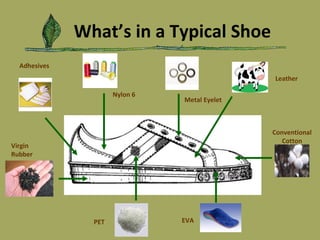
What’s in a Typical Shoe PET EVA Adhesives Nylon 6 Virgin Rubber Conventional Cotton Metal Eyelet Leather
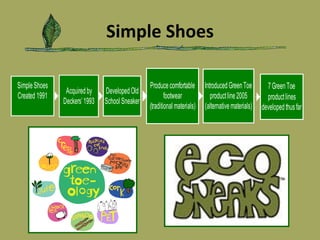
Simple Shoes
The $64,000 Question Is a green toe shoe “ simply ”  better in terms of environmental performance than their other footwear products?
Project Objectives Quantify and Compare the environmental impacts   of the four shoes selected: shoes 1, shoe 2, shoe 3, shoe 4 2)   Assess supply chain   via a life cycle approach for opportunities to improve environmental performance and increase efficiency   3)   Generate End-of-Life Management options   that are feasible and environmentally beneficial.  4)   Present a final recommendation  to Simple Shoes based on LCA and environmental and economic analysis
Methodology and Approach Literature Review Data Collection   material composition and weight manufacturing process cost & energy information distribution networks discussions with client Analysis Perform LCA for four shoes Determine phases and materials responsible for environmental impacts  Evaluate Supply Chain based on LCA results Focused analysis on End-of-Life options Provide recommendations to Simple Shoes
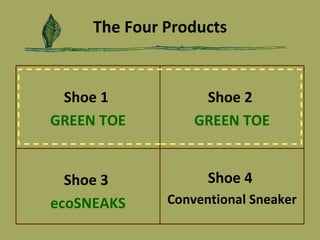
The Four Products Shoe 1  GREEN TOE Shoe 2  GREEN TOE Shoe 3  ecoSNEAKS Shoe 4   Conventional Sneaker
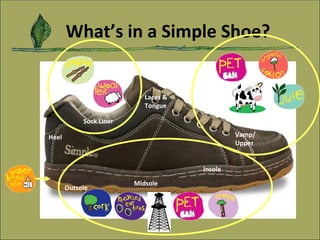
What’s in a Simple Shoe? Vamp/ Upper Laces &  Tongue Sock Liner Heel Outsole Midsole Insole
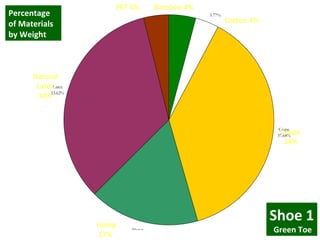
Natural Latex 34% Crepe 38% PET 4%  Bamboo 4% Cotton 4% Hemp 17% Percentage of Materials  by Weight Shoe 1 Green Toe
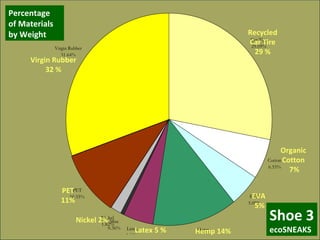
Virgin Rubber 32 % Recycled Car Tire 29 % Organic  Cotton 7% EVA 5% PET 11% Nickel 2% Latex 5 % Hemp 14% Shoe 3 ecoSNEAKS Percentage  of Materials  by Weight
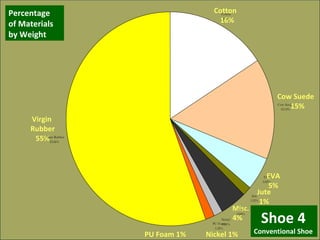
Cotton  16% Cow Suede 15% EVA 5% Jute 1% Virgin  Rubber 55% Misc. 4% Nickel 1% PU Foam 1% Percentage  of Materials  by Weight Shoe 4 Conventional Shoe
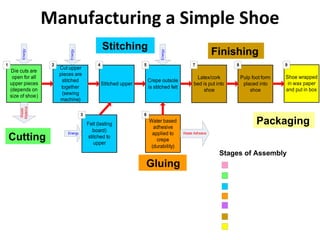
Manufacturing a Simple Shoe Cutting Stitching Gluing Finishing Packaging Stages of Assembly
 
Why Life Cycle Assessment? LCA is a systematic approach to measuring the  environmental performance   of products LCA compiles and evaluates the  inputs and outputs   of a product across its life cycle LCA  creates added value   through product “ecolabeling”, marketing initiatives, and product comparisons Software Package: GaBi 4.0, PE International
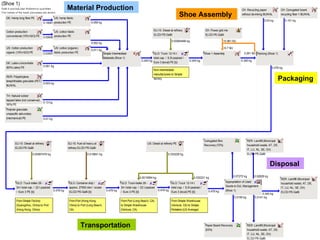
Building our LCA Goal  Compare the environmental performance of four of Simple’s shoes Scope Functional unit :  The amount of material  required to cover and protect two sample sized feet Men = US Size 9 Women = US Size 7 Reference flows:  Amount of materials for one pair of shoes System Boundaries  Assumptions & Limitations Materials, End-of-Life, Transportation, and Packaging
Shoe Assembly Material Production Packaging Transportation Disposal
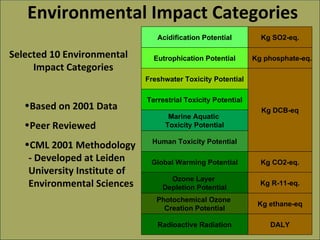
Environmental Impact Categories Selected 10 Environmental  Impact Categories Based on 2001 Data Peer Reviewed CML 2001 Methodology - Developed at Leiden  University Institute of Environmental Sciences Radioactive Radiation Ozone Layer  Depletion Potential Photochemical Ozone  Creation Potential Global Warming Potential Human Toxicity Potential Freshwater Toxicity Potential Terrestrial Toxicity Potential Eutrophication Potential Marine Aquatic  Toxicity Potential Acidification Potential DALY Kg ethane-eq Kg DCB-eq Kg CO2-eq. Kg R-11-eq. Kg SO2-eq. Kg phosphate-eq.
 
 
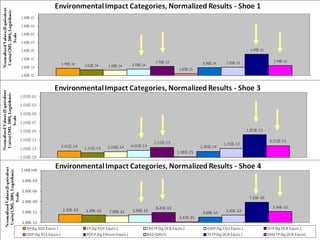
Life Cycle Assessment Interpretation Environmental Impact Categories Shoe Styles AP [kg SO2-Equiv.] EP [kg P-Equiv] FAETP [kg DCB-Equiv.] GWP [kg CO2-Equiv.] HTP [kg DCB-Equiv.] Shoe 1 0.0171 0.0033 0.0402 1.672 8.482 Shoe 3 0.0092 0.0015 0.0414 1.808 10.469 Shoe 4 0.0695 0.0179 0.1623 7.51 41.03   Shoe Styles ODP [kg R11-Equiv.] POCP [kg Ethene-Equiv.] RAD [DALY] TEPT [kg DCB-Equiv.] MAETP [kg DCB-Equiv.]  Shoe 1 1.48E-06 3.99E-03 1.40E-08 39.42 140.25 Shoe 3 7.10E-07 1.12E-0 3 1.54E-08 48.51 266.61 Shoe 4 7.59E-07 1.68E-03 1.95E-08 190.96 796.12
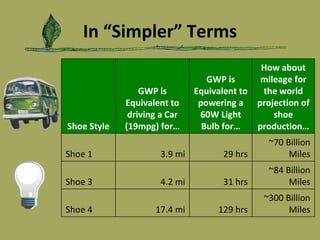
In “Simpler” Terms Shoe Style GWP is Equivalent to driving a Car (19mpg) for… GWP is Equivalent to powering a 60W Light Bulb for… How about mileage for the world projection of shoe production… Shoe 1 3.9 mi 29 hrs ~70 Billion Miles Shoe 3 4.2 mi 31 hrs ~84 Billion Miles Shoe 4 17.4 mi 129 hrs ~300 Billion Miles
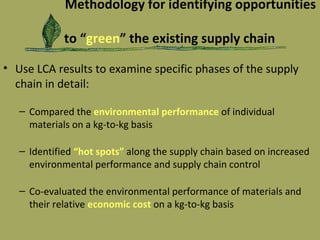
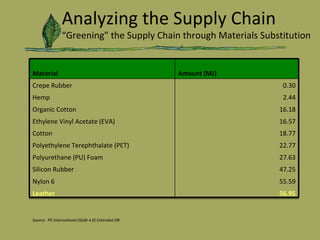
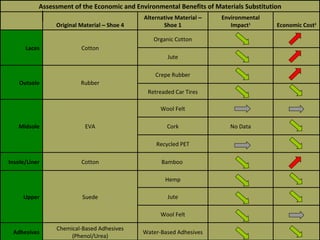
Methodology for identifying opportunities    to “ green ” the existing supply chain  Use LCA results to examine specific phases of the supply chain in detail: Compared the  environmental performance   of individual materials on a kg-to-kg basis  Identified  “hot spots”   along the supply chain based on increased environmental performance and supply chain control Co-evaluated the environmental performance of materials and their relative  economic cost   on a kg-to-kg basis
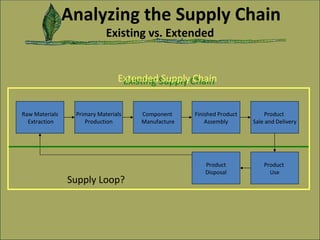
Analyzing the Supply Chain  Existing vs. Extended Raw Materials Extraction Primary Materials Production Component Manufacture Finished Product Assembly Product  Sale and Delivery Product  Use Product Disposal Supply Loop? Existing Supply Chain Extended Supply Chain
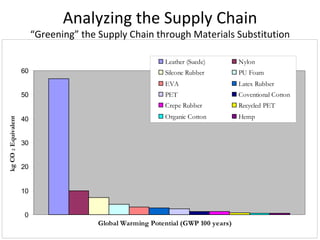
Analyzing the Supply Chain “Greening” the Supply Chain through Materials Substitution
Analyzing the Supply Chain “Greening” the Supply Chain through Materials Substitution Material Amount (MJ) Crepe Rubber 0.30 Hemp 2.44 Organic Cotton 16.18 Ethylene Vinyl Acetate (EVA) 16.57 Cotton 18.77 Polyethylene Terephthalate (PET) 22.77 Polyurethane (PU) Foam 27.63 Silicon Rubber 47.25 Nylon 6 55.59 Leather 56.95 Source:  PE International (GaBi 4.0) Extended DB
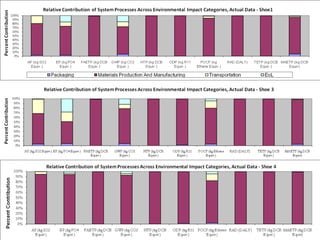
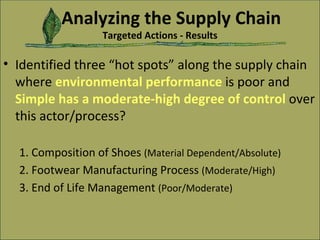
Analyzing the Supply Chain   Targeted Actions - Results Identified three “hot spots” along the supply chain where  environmental performance   is poor and  Simple has a moderate-high degree of control   over this actor/process? 1. Composition of Shoes  (Material Dependent/Absolute) 2. Footwear Manufacturing Process  (Moderate/High) 3. End of Life Management  (Poor/Moderate)
Assessment of the Economic and Environmental Benefits of Materials Substitution Original Material  –  Shoe 4 Alternative Material  –  Shoe 1 Environmental Impact 1 Economic Cost 2 Laces Cotton Organic Cotton Jute Outsole Rubber Crepe Rubber Retreaded Car Tires Midsole EVA Wool Felt Cork No Data Recycled PET Insole/Liner Cotton Bamboo  Upper Suede Hemp Jute Wool Felt Adhesives Chemical-Based Adhesives (Phenol/Urea) Water-Based Adhesives
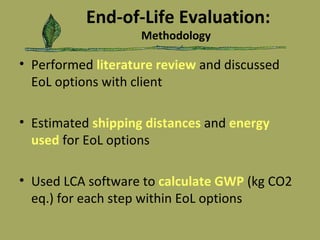
End-of-Life Evaluation: Methodology Performed  literature review   and discussed EoL options with client  Estimated  shipping distances   and  energy used   for EoL options Used LCA software to  calculate GWP   (kg CO2 eq.) for each step within EoL options
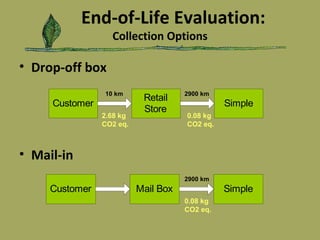
End-of-Life Evaluation: Collection Options Drop-off box Mail-in 2900 km 2900 km 10 km 2.68 kg CO2 eq. 0.08 kg CO2 eq. 0.08 kg CO2 eq.
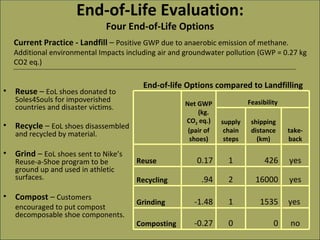
End-of-Life Evaluation: Four End-of-Life Options Reuse  –  EoL shoes donated to Soles4Souls for impoverished countries and disaster victims .  Recycle  –  EoL shoes disassembled and recycled by material. Grind  –  EoL shoes sent to Nike’s Reuse-a-Shoe program to be ground up and used in athletic surfaces. Compost  –  Customers  encouraged to put compost decomposable shoe components. End-of-life Options compared to Landfilling Current Practice - Landfill  –  Positive GWP due to anaerobic emission of methane. Additional environmental Impacts including air and groundwater pollution (GWP = 0.27 kg CO2 eq.)   Net GWP  (kg. CO 2  eq.) (pair of shoes) Feasibility supply chain steps shipping distance (km) take-back Reuse 0.17 1 426 yes Recycling .94 2 16000 yes Grinding  -1.48 1 1535 yes  Composting -0.27 0 0 no
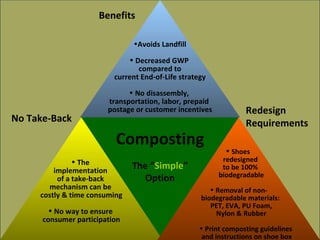
Composting The “ Simple ” Option Avoids Landfill Decreased GWP  compared to current End-of-Life strategy No disassembly,  transportation, labor, prepaid  postage or customer incentives The  implementation  of a take-back  mechanism can be  costly & time consuming No way to ensure  consumer participation Shoes  redesigned  to be 100%  biodegradable Removal of non- biodegradable materials: PET, EVA, PU Foam,  Nylon & Rubber Print composting guidelines  and instructions on shoe box Benefits No Take-Back Redesign  Requirements
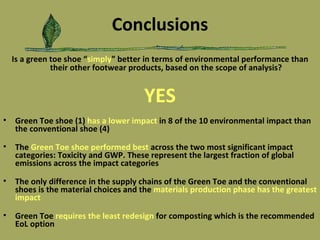
Conclusions Is a green toe shoe “ simply ” better in terms of environmental performance than their other footwear products, based on the scope of analysis? YES Green Toe shoe (1)  has a lower impact  in 8 of the 10 environmental impact than the conventional shoe (4) The  Green Toe shoe performed best  across the two most significant impact categories: Toxicity and GWP. These represent the largest fraction of global emissions across the impact categories The only difference in the supply chains of the Green Toe and the conventional shoes is the material choices and the  materials production phase has the greatest impact Green Toe  requires the least redesign   for composting which is the recommended EoL option
Acknowledgements John Melack, Bren School Patricia Holden, Bren School Roland Geyer, Bren School Vered Doctori Blass, Bren School Monica DeVreese, Simple Shoes, Inc. Greg Nielsen, Simple Shoes, Inc. Michael Brown, Brown & Associates Marc Binder, PE International
Questions?

Life Cycle Assessment of Footwear for Simple Shoes

  • 1.
    A Lifecycle Assessmentof the Supply Chain and Evaluation of End-of-Life Management Options Wednesday, April 2, 2008
  • 2.
    Project Significance Increasein shoe = Increase in environmental production/consumption impacts (production/disposal) Number of shoes produced world-wide in 2004 12 billion pairs Projected world- wide production by 2010 20 billion pairs Average pair of shoes owned per person in the U.S. 10 pairs Total U.S footwear sales, 2005 $42 billion United States footwear consumption 2005 1.4 billion pairs Average amount of shoes disposed in landfill per year ~ 104 million pairs
  • 3.
    What’s in aTypical Shoe PET EVA Adhesives Nylon 6 Virgin Rubber Conventional Cotton Metal Eyelet Leather
  • 4.
  • 5.
    The $64,000 QuestionIs a green toe shoe “ simply ” better in terms of environmental performance than their other footwear products?
  • 6.
    Project Objectives Quantifyand Compare the environmental impacts of the four shoes selected: shoes 1, shoe 2, shoe 3, shoe 4 2) Assess supply chain via a life cycle approach for opportunities to improve environmental performance and increase efficiency 3) Generate End-of-Life Management options that are feasible and environmentally beneficial. 4) Present a final recommendation to Simple Shoes based on LCA and environmental and economic analysis
  • 7.
    Methodology and ApproachLiterature Review Data Collection material composition and weight manufacturing process cost & energy information distribution networks discussions with client Analysis Perform LCA for four shoes Determine phases and materials responsible for environmental impacts Evaluate Supply Chain based on LCA results Focused analysis on End-of-Life options Provide recommendations to Simple Shoes
  • 8.
    The Four ProductsShoe 1 GREEN TOE Shoe 2 GREEN TOE Shoe 3 ecoSNEAKS Shoe 4 Conventional Sneaker
  • 9.
    What’s in aSimple Shoe? Vamp/ Upper Laces & Tongue Sock Liner Heel Outsole Midsole Insole
  • 10.
    Natural Latex 34%Crepe 38% PET 4% Bamboo 4% Cotton 4% Hemp 17% Percentage of Materials by Weight Shoe 1 Green Toe
  • 11.
    Virgin Rubber 32% Recycled Car Tire 29 % Organic Cotton 7% EVA 5% PET 11% Nickel 2% Latex 5 % Hemp 14% Shoe 3 ecoSNEAKS Percentage of Materials by Weight
  • 12.
    Cotton 16%Cow Suede 15% EVA 5% Jute 1% Virgin Rubber 55% Misc. 4% Nickel 1% PU Foam 1% Percentage of Materials by Weight Shoe 4 Conventional Shoe
  • 13.
    Manufacturing a SimpleShoe Cutting Stitching Gluing Finishing Packaging Stages of Assembly
  • 14.
  • 15.
    Why Life CycleAssessment? LCA is a systematic approach to measuring the environmental performance of products LCA compiles and evaluates the inputs and outputs of a product across its life cycle LCA creates added value through product “ecolabeling”, marketing initiatives, and product comparisons Software Package: GaBi 4.0, PE International
  • 16.
    Building our LCAGoal Compare the environmental performance of four of Simple’s shoes Scope Functional unit : The amount of material required to cover and protect two sample sized feet Men = US Size 9 Women = US Size 7 Reference flows: Amount of materials for one pair of shoes System Boundaries Assumptions & Limitations Materials, End-of-Life, Transportation, and Packaging
  • 17.
    Shoe Assembly MaterialProduction Packaging Transportation Disposal
  • 18.
    Environmental Impact CategoriesSelected 10 Environmental Impact Categories Based on 2001 Data Peer Reviewed CML 2001 Methodology - Developed at Leiden University Institute of Environmental Sciences Radioactive Radiation Ozone Layer Depletion Potential Photochemical Ozone Creation Potential Global Warming Potential Human Toxicity Potential Freshwater Toxicity Potential Terrestrial Toxicity Potential Eutrophication Potential Marine Aquatic Toxicity Potential Acidification Potential DALY Kg ethane-eq Kg DCB-eq Kg CO2-eq. Kg R-11-eq. Kg SO2-eq. Kg phosphate-eq.
  • 19.
  • 20.
  • 21.
    Life Cycle AssessmentInterpretation Environmental Impact Categories Shoe Styles AP [kg SO2-Equiv.] EP [kg P-Equiv] FAETP [kg DCB-Equiv.] GWP [kg CO2-Equiv.] HTP [kg DCB-Equiv.] Shoe 1 0.0171 0.0033 0.0402 1.672 8.482 Shoe 3 0.0092 0.0015 0.0414 1.808 10.469 Shoe 4 0.0695 0.0179 0.1623 7.51 41.03   Shoe Styles ODP [kg R11-Equiv.] POCP [kg Ethene-Equiv.] RAD [DALY] TEPT [kg DCB-Equiv.] MAETP [kg DCB-Equiv.] Shoe 1 1.48E-06 3.99E-03 1.40E-08 39.42 140.25 Shoe 3 7.10E-07 1.12E-0 3 1.54E-08 48.51 266.61 Shoe 4 7.59E-07 1.68E-03 1.95E-08 190.96 796.12
  • 22.
    In “Simpler” TermsShoe Style GWP is Equivalent to driving a Car (19mpg) for… GWP is Equivalent to powering a 60W Light Bulb for… How about mileage for the world projection of shoe production… Shoe 1 3.9 mi 29 hrs ~70 Billion Miles Shoe 3 4.2 mi 31 hrs ~84 Billion Miles Shoe 4 17.4 mi 129 hrs ~300 Billion Miles
  • 23.
    Methodology for identifyingopportunities to “ green ” the existing supply chain Use LCA results to examine specific phases of the supply chain in detail: Compared the environmental performance of individual materials on a kg-to-kg basis Identified “hot spots” along the supply chain based on increased environmental performance and supply chain control Co-evaluated the environmental performance of materials and their relative economic cost on a kg-to-kg basis
  • 24.
    Analyzing the SupplyChain Existing vs. Extended Raw Materials Extraction Primary Materials Production Component Manufacture Finished Product Assembly Product Sale and Delivery Product Use Product Disposal Supply Loop? Existing Supply Chain Extended Supply Chain
  • 25.
    Analyzing the SupplyChain “Greening” the Supply Chain through Materials Substitution
  • 26.
    Analyzing the SupplyChain “Greening” the Supply Chain through Materials Substitution Material Amount (MJ) Crepe Rubber 0.30 Hemp 2.44 Organic Cotton 16.18 Ethylene Vinyl Acetate (EVA) 16.57 Cotton 18.77 Polyethylene Terephthalate (PET) 22.77 Polyurethane (PU) Foam 27.63 Silicon Rubber 47.25 Nylon 6 55.59 Leather 56.95 Source: PE International (GaBi 4.0) Extended DB
  • 27.
    Analyzing the SupplyChain Targeted Actions - Results Identified three “hot spots” along the supply chain where environmental performance is poor and Simple has a moderate-high degree of control over this actor/process? 1. Composition of Shoes (Material Dependent/Absolute) 2. Footwear Manufacturing Process (Moderate/High) 3. End of Life Management (Poor/Moderate)
  • 28.
    Assessment of theEconomic and Environmental Benefits of Materials Substitution Original Material – Shoe 4 Alternative Material – Shoe 1 Environmental Impact 1 Economic Cost 2 Laces Cotton Organic Cotton Jute Outsole Rubber Crepe Rubber Retreaded Car Tires Midsole EVA Wool Felt Cork No Data Recycled PET Insole/Liner Cotton Bamboo Upper Suede Hemp Jute Wool Felt Adhesives Chemical-Based Adhesives (Phenol/Urea) Water-Based Adhesives
  • 29.
    End-of-Life Evaluation: MethodologyPerformed literature review and discussed EoL options with client Estimated shipping distances and energy used for EoL options Used LCA software to calculate GWP (kg CO2 eq.) for each step within EoL options
  • 30.
    End-of-Life Evaluation: CollectionOptions Drop-off box Mail-in 2900 km 2900 km 10 km 2.68 kg CO2 eq. 0.08 kg CO2 eq. 0.08 kg CO2 eq.
  • 31.
    End-of-Life Evaluation: FourEnd-of-Life Options Reuse – EoL shoes donated to Soles4Souls for impoverished countries and disaster victims . Recycle – EoL shoes disassembled and recycled by material. Grind – EoL shoes sent to Nike’s Reuse-a-Shoe program to be ground up and used in athletic surfaces. Compost – Customers encouraged to put compost decomposable shoe components. End-of-life Options compared to Landfilling Current Practice - Landfill – Positive GWP due to anaerobic emission of methane. Additional environmental Impacts including air and groundwater pollution (GWP = 0.27 kg CO2 eq.)   Net GWP (kg. CO 2 eq.) (pair of shoes) Feasibility supply chain steps shipping distance (km) take-back Reuse 0.17 1 426 yes Recycling .94 2 16000 yes Grinding -1.48 1 1535 yes Composting -0.27 0 0 no
  • 32.
    Composting The “Simple ” Option Avoids Landfill Decreased GWP compared to current End-of-Life strategy No disassembly, transportation, labor, prepaid postage or customer incentives The implementation of a take-back mechanism can be costly & time consuming No way to ensure consumer participation Shoes redesigned to be 100% biodegradable Removal of non- biodegradable materials: PET, EVA, PU Foam, Nylon & Rubber Print composting guidelines and instructions on shoe box Benefits No Take-Back Redesign Requirements
  • 33.
    Conclusions Is agreen toe shoe “ simply ” better in terms of environmental performance than their other footwear products, based on the scope of analysis? YES Green Toe shoe (1) has a lower impact in 8 of the 10 environmental impact than the conventional shoe (4) The Green Toe shoe performed best across the two most significant impact categories: Toxicity and GWP. These represent the largest fraction of global emissions across the impact categories The only difference in the supply chains of the Green Toe and the conventional shoes is the material choices and the materials production phase has the greatest impact Green Toe requires the least redesign for composting which is the recommended EoL option
  • 34.
    Acknowledgements John Melack,Bren School Patricia Holden, Bren School Roland Geyer, Bren School Vered Doctori Blass, Bren School Monica DeVreese, Simple Shoes, Inc. Greg Nielsen, Simple Shoes, Inc. Michael Brown, Brown & Associates Marc Binder, PE International
  • 35.