Life Cycle Assessment is potentially the most important method for assessing
the overall environmental impact of products, processes or services. It is also
sometimes referred to as Life Cycle Analysis or LCA
Life Cycle Assessment (LCA) is a tool for assessing the environmental impacts of
a product, process or service from design to disposal i.e. across its entire
lifecycle, a so called cradle to grave approach. The impacts may be beneficial or
adverse. These impacts are sometimes referred to as the “environmental
footprint” of a product or service.
LCA involves the collection and evaluation of quantitative data on the inputs
and outputs of material, energy and waste flows associated with a product over
its entire life cycle so that the environmental impacts can be determined.
Why to do an LCA?
• LCA can help to identify ways to reduce environmental impacts and make
cost savings
• To assess compliance with environmental legislation
• Improving systems for assessing many types of risk
• To limit pollution and the drain on natural resources
One approach to reducing the environmental impacts of purchased goods
is to award "badges of acceptance" to items that are made, and operate
in, an environmentally sound manner.
In the European Union the 'badge of acceptance' is called an “Eco-Label”
and LCA provides the basis for deciding whether a product should be
awarded an “Eco-Label”
In order to carry out an LCA it is necessary to:
• Compile an inventory of relevant inputs and outputs;
• Evaluate their potential environmental impacts;
• Interpret the results of the inventory and impacts in relation to the
specific objectives of the study.
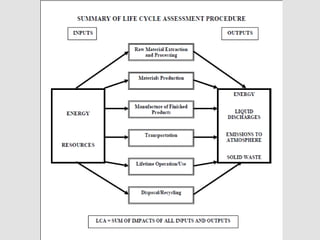
The LCA for a product is a summation of the impacts of:
• Extraction of the relevant raw materials
• Refinement and conversion to process materials
• Manufacturing and packaging processes
• Transportation and distribution at each stage
• Operation or use during its lifetime
• At the end of its useful life, final transportation, waste treatment and
disposal.
Any recycling or recovery operations built into the life cycle should lead to a
proportionate reduction in the adverse environmental impact.
• Sufficient data available on the various phases of any given product,
process or service
• Possible to define the LCA fairly precisely for a given location
• Comparing the life cycles of alternative processes designed to achieve
similar objectives in order to discover which of them is the most
environmentally sound
• Since individual resources can have greater or less importance for political
or geographical reasons, the resultant LCAs can lead to different
conclusions
Life Cycle Thinking (LCT)
LCT also considers a product’s life-cycle and aims for a reduction of its
cumulative environmental impacts.
• This approach is more qualitative and does not require the thorough data
analysis that full scale LCA relies on.
HOW DO WE CARRY OUT A LIFE CYCLE ASSESSMENT?
• In general, if a comparative system is to have any credibility, the product
ideally must use some sort of numerical score.
• For energy, water and resource consumption, scoring is a fairly
straightforward exercise, but allocating numerical values to pollutant effects is
far from straightforward. Therefore at some stage in reviewing the results of
the LCA it becomes necessary to make value judgements, as for example,
which of two disparate adverse impacts is the more “acceptable” or where the
reduction of one impact may increase another or even generate another.
• LCA is not a purely objective process. It involves value judgments.
Examples might be deciding which is more acceptable:
• an acidic emission or a particular toxic emission
• greater energy demand or greater water consumption
• using a well managed landfill site or incineration
• heavy metal discharges or using chlorinated organic solvents
A decision as to whether something is acceptable may well depend upon the
aims and objectives of the person or persons concerned.
“Acceptability” may vary from place to place and from time to time and person
to person based on the aims and objectives
For example an LCA for a process in one part of the world may reach different
conclusions to that for a virtually identical process elsewhere depending on
the perceived or actual environmental threats in each area.
The great value of LCA lies in the fact that any value judgments involved are
clearly identified and transparent. It demands the examination of each and
every phase in the "life" of the product, process or service under
investigation.
• There must be no preconceptions if the exercise is to provide a realistic
assessment.
• Selective or abbreviated LCAs can be devised to evaluate specific components
of a product or process but these can be misused to reach pre-determined
conclusions, e.g. in support of spurious "green" claims for advertising
purposes.
• British Standards Institution, in collaboration with the International Standards
Organization, has published an LCA standard.
• United Nations Environment Programme and the Society for Environmental
Toxicology and Chemistry (SETAC) have introduced the Life Cycle Assessment
Initiative with the dual aim of putting life cycle thinking into practice and
improving the supporting tools through better data and indicators
• Energy and resource balances are well defined and scored
accordingly; emissions and discharges can be measured and both
monetary and environmental costs of elimination and abatement
more easily assessed.
• Irrespective of the application however, the results of LCAs will
only be as effective in protecting the environment as the
accuracy of the data with which they have been compiled.
• This means that the exercises must be reviewed at periodic
intervals as new data becomes available to ensure that the
decisions retain their validity.
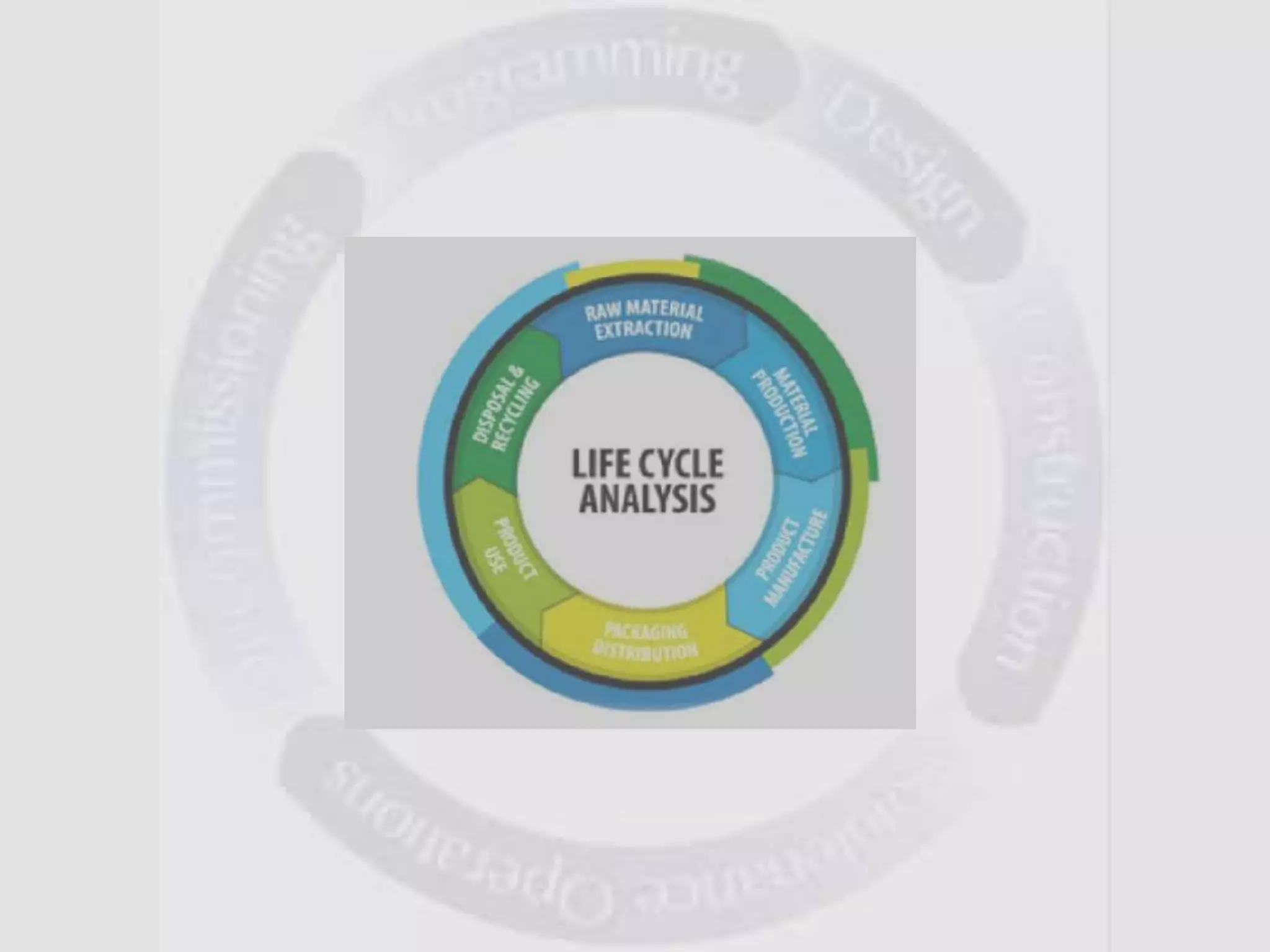
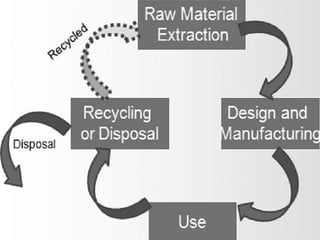
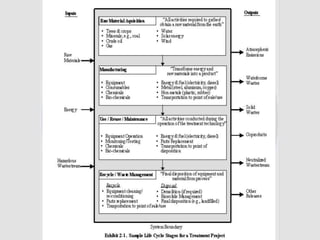
LCA includes all four stages of a product or process life cycle:
• Raw material acquisition
• Manufacturing
• Use/reuse/maintenance
• Recycle/waste management
• Raw Materials Acquisition
The life cycle of a product begins with the removal of raw materials and
energy sources from the earth.
For instance, the harvesting of trees or the mining of nonrenewable
materials would be considered raw materials acquisition.
Transportation of these materials from the point of acquisition to the
point of processing is also included in this stage.
Manufacturing
• Raw materials are transformed into a product or package.
• The product or package is then delivered to the consumer.
The manufacturing stage consists of three steps: materials manufacture, product
fabrication, and filling/packaging/distribution.
Materials Manufacture –
• The materials manufacture step involves the activities that convert raw
materials into a form that can be used to fabricate a finished product.
• Product Fabrication - The product fabrication step takes the manufactured
material and processes it into a product that is ready to be filled or packaged.
• Filling/Packaging/Distribution - This step finalizes the products and prepares
them for shipment. It includes all of the manufacturing and transportation
activities that are necessary to fill, package, and distribute a finished product.
Products are transported either to retail outlets or directly to the consumer.
This stage accounts for the environmental effects caused by the mode of
transportation, such as trucking and shipping
Use/Reuse/Maintenance
• This stage involves the consumer’s actual use, reuse, and maintenance of
the product. Once the product is distributed to the consumer, all activities
associated with the useful life of the product are included in this stage.
• This includes energy demands and environmental wastes from both
product storage and consumption.
• The product or material may need to be reconditioned, repaired or
serviced so that it will maintain its performance.
• When the consumer no longer needs the product, the product will be
recycled or disposed.
Recycle/Waste Management
• The recycle/waste management stage includes the energy requirements
and environmental wastes associated with disposition of the product or
material.
LCA.ppt
LCA.ppt

LCA.ppt

  • 3.
    Life Cycle Assessmentis potentially the most important method for assessing the overall environmental impact of products, processes or services. It is also sometimes referred to as Life Cycle Analysis or LCA Life Cycle Assessment (LCA) is a tool for assessing the environmental impacts of a product, process or service from design to disposal i.e. across its entire lifecycle, a so called cradle to grave approach. The impacts may be beneficial or adverse. These impacts are sometimes referred to as the “environmental footprint” of a product or service. LCA involves the collection and evaluation of quantitative data on the inputs and outputs of material, energy and waste flows associated with a product over its entire life cycle so that the environmental impacts can be determined.
  • 4.
    Why to doan LCA? • LCA can help to identify ways to reduce environmental impacts and make cost savings • To assess compliance with environmental legislation • Improving systems for assessing many types of risk • To limit pollution and the drain on natural resources One approach to reducing the environmental impacts of purchased goods is to award "badges of acceptance" to items that are made, and operate in, an environmentally sound manner. In the European Union the 'badge of acceptance' is called an “Eco-Label” and LCA provides the basis for deciding whether a product should be awarded an “Eco-Label”
  • 6.
    In order tocarry out an LCA it is necessary to: • Compile an inventory of relevant inputs and outputs; • Evaluate their potential environmental impacts; • Interpret the results of the inventory and impacts in relation to the specific objectives of the study. The LCA for a product is a summation of the impacts of: • Extraction of the relevant raw materials • Refinement and conversion to process materials • Manufacturing and packaging processes • Transportation and distribution at each stage • Operation or use during its lifetime • At the end of its useful life, final transportation, waste treatment and disposal.
  • 7.
    Any recycling orrecovery operations built into the life cycle should lead to a proportionate reduction in the adverse environmental impact. • Sufficient data available on the various phases of any given product, process or service • Possible to define the LCA fairly precisely for a given location • Comparing the life cycles of alternative processes designed to achieve similar objectives in order to discover which of them is the most environmentally sound • Since individual resources can have greater or less importance for political or geographical reasons, the resultant LCAs can lead to different conclusions
  • 9.
    Life Cycle Thinking(LCT) LCT also considers a product’s life-cycle and aims for a reduction of its cumulative environmental impacts. • This approach is more qualitative and does not require the thorough data analysis that full scale LCA relies on. HOW DO WE CARRY OUT A LIFE CYCLE ASSESSMENT? • In general, if a comparative system is to have any credibility, the product ideally must use some sort of numerical score. • For energy, water and resource consumption, scoring is a fairly straightforward exercise, but allocating numerical values to pollutant effects is far from straightforward. Therefore at some stage in reviewing the results of the LCA it becomes necessary to make value judgements, as for example, which of two disparate adverse impacts is the more “acceptable” or where the reduction of one impact may increase another or even generate another.
  • 10.
    • LCA isnot a purely objective process. It involves value judgments. Examples might be deciding which is more acceptable: • an acidic emission or a particular toxic emission • greater energy demand or greater water consumption • using a well managed landfill site or incineration • heavy metal discharges or using chlorinated organic solvents A decision as to whether something is acceptable may well depend upon the aims and objectives of the person or persons concerned. “Acceptability” may vary from place to place and from time to time and person to person based on the aims and objectives For example an LCA for a process in one part of the world may reach different conclusions to that for a virtually identical process elsewhere depending on the perceived or actual environmental threats in each area.
  • 11.
    The great valueof LCA lies in the fact that any value judgments involved are clearly identified and transparent. It demands the examination of each and every phase in the "life" of the product, process or service under investigation. • There must be no preconceptions if the exercise is to provide a realistic assessment. • Selective or abbreviated LCAs can be devised to evaluate specific components of a product or process but these can be misused to reach pre-determined conclusions, e.g. in support of spurious "green" claims for advertising purposes. • British Standards Institution, in collaboration with the International Standards Organization, has published an LCA standard. • United Nations Environment Programme and the Society for Environmental Toxicology and Chemistry (SETAC) have introduced the Life Cycle Assessment Initiative with the dual aim of putting life cycle thinking into practice and improving the supporting tools through better data and indicators
  • 13.
    • Energy andresource balances are well defined and scored accordingly; emissions and discharges can be measured and both monetary and environmental costs of elimination and abatement more easily assessed. • Irrespective of the application however, the results of LCAs will only be as effective in protecting the environment as the accuracy of the data with which they have been compiled. • This means that the exercises must be reviewed at periodic intervals as new data becomes available to ensure that the decisions retain their validity.
  • 14.
    LCA includes allfour stages of a product or process life cycle: • Raw material acquisition • Manufacturing • Use/reuse/maintenance • Recycle/waste management • Raw Materials Acquisition The life cycle of a product begins with the removal of raw materials and energy sources from the earth. For instance, the harvesting of trees or the mining of nonrenewable materials would be considered raw materials acquisition. Transportation of these materials from the point of acquisition to the point of processing is also included in this stage.
  • 15.
    Manufacturing • Raw materialsare transformed into a product or package. • The product or package is then delivered to the consumer. The manufacturing stage consists of three steps: materials manufacture, product fabrication, and filling/packaging/distribution. Materials Manufacture – • The materials manufacture step involves the activities that convert raw materials into a form that can be used to fabricate a finished product. • Product Fabrication - The product fabrication step takes the manufactured material and processes it into a product that is ready to be filled or packaged. • Filling/Packaging/Distribution - This step finalizes the products and prepares them for shipment. It includes all of the manufacturing and transportation activities that are necessary to fill, package, and distribute a finished product. Products are transported either to retail outlets or directly to the consumer. This stage accounts for the environmental effects caused by the mode of transportation, such as trucking and shipping
  • 16.
    Use/Reuse/Maintenance • This stageinvolves the consumer’s actual use, reuse, and maintenance of the product. Once the product is distributed to the consumer, all activities associated with the useful life of the product are included in this stage. • This includes energy demands and environmental wastes from both product storage and consumption. • The product or material may need to be reconditioned, repaired or serviced so that it will maintain its performance. • When the consumer no longer needs the product, the product will be recycled or disposed. Recycle/Waste Management • The recycle/waste management stage includes the energy requirements and environmental wastes associated with disposition of the product or material.