Environmental Issues Series
A guide to approaches, experiences
and information sources
Life Cycle Assessment
no. 6
(LCA)
Authors
Allan Astrup Jensen
Leif Hoffman
Birgitte T. Møller
Anders Schmidt
dk-TEKNIK Energy &
Environment,
Denmark
Kim Christiansen
Sophus Berendsen A/S
Denmark
John Elkington
Franceska van Dijk
SustainAbility ,
United Kingdom
August 1997
Cover and layout:
Folkmann Design &
Promotion
Note
The designations
employed and the
presentation of material
in this publication do not
imply the expression of
any opinion whatsoever
on the part of the
European Commission or
the European
Environment Agency
concerning the legal
status of any country or
territory, and the
boundaries shown on
maps do not imply
official endorsement or
acceptance.
Preface
Life-cycle assessment (LCA) – a guide to approaches, experiences and information sources
There are great expectations for LCA.
At the European level, the Parliament has suggested that the Commission develop a frame-
work for an integrated life-cycle-oriented product policy. In the work for the next framework
research programme, LCA also has a prominent role in promoting competitive and sustain-
able growth.
The design and production of new products and materials should be based on a life-cycle
assessment concept. LCA is also a necessary basis for eco-labelling requested by consumers,
NGOs and international and national authorities. Business and industry sectors are aware of
the requests from customers, and recognise the possibilities for LCA in saving natural re-
sources and energy and in minimising pollution and waste. LCA is not only a tool to improve
the environment, but also an instrument for industry implying cost-savings and competitive
advantages.
In addition, the interest in developing environmental management systems and tools as a
basis for decision making is expressed in the work with Agenda 21 and ISO 14 000.
The European Environment Agency (EEA) has the mandate ‘to provide the Community and
the Member States with objective, reliable and comparable information at the European
level’. Among its goals, the EEA shall provide information for environmental policy develop-
ment and implementation and ensure broad dissemination and accessibility. Important
principles in this context are pooling existing information and know-how and facilitating
data harmonisation.
The main advantage of LCAs is in supporting decision making with scientific data and
competence, and thereby in distinguishing between scientific facts (as far as possible) and
sets of values. In this context, its ambition is very close to the mandate of the EEA.
By balancing science and simplicity, LCA implies that there can be many limitations that
should be addressed in LCA studies and development work, for example:
• the type of information provided, especially by life-cycle impact assessment, is merely an
indicator;
• LCA should not be misunderstood as a comprehensive or a complete assessment;
• LCA is different and distinct in approach from other management tools;
• LCA uses subjective judgement extensively, and the lack of scientific or technical data is
sometimes obvious.
It is also a challenge to take the step from LCA as a communication tool to an operational
tool in environmental management. LCA-based environmental management should become
part of good business management heading towards the eco-efficiency concept ‘producing
more quality with less resources’.
LCA should be used together with other established techniques, such as environmental
impact assessment and environmental risk assessment. These approaches complement each
other, but are not interchangeable and cannot be substituted for each other.
Creating this publication the Agency hopes to guide the readers through this information
and provide links to external sources. The Internet version and the supplementary data-
base have been developed as complementing products to give greater access to the infor-
mation.
The production has involved many contributors other than the authors. The report has
been reviewed by the Scientific Committee of the EEA and the National Focal Points, for
which EEA is grateful. The Society for Promotion of Life Cycle Development (SPOLD) has
contributed to the project with advice and constructive criticism. A critical review of the draft
publication was made by Dr Dennis Postlethwaite, UK, past-Chairman of the SETAC-Europe
LCA Steering Committee and member of the UK Delegation to ISO/TC207/SC5 on Life
Cycle Assessment.
The EEA hopes that this publication together with the prepared meta-database containing
information sources will prove valuable to its readers. We have tried to target different parts
of the publication to different users. It is our intention to continue our efforts to make these
tools operational.
Domingo Jiménez-Beltrán
Executive Director
European Environment Agency
ABOUT THIS GUIDE TO LCA ....................................................... 9
1. A BRIEF HISTORY OF LCA ................................................ 13
1.1 The Early Years .................................................................... 13
1.2 Rapid Growth and Adolescence ......................................... 13
1.3 Towards Maturity ................................................................ 13
1.4 Stakeholder Views .............................................................. 14
Appendix 1.1: A Spectrum of Stakeholder Views .............. 16
2. WHAT ROLE FOR LCA IN
SUSTAINABLE DEVELOPMENT? ...................................... 21
2.1 Life Cycle Thinking and Sustainability ................................ 21
2.2 Some Ground-Rules for a Credible LCA ............................ 21
2.2.1 Dialogue ............................................................................. 22
2.2.2 Verification .......................................................................... 22
2.2.3 Benchmarking ..................................................................... 23
2.2.4 From Management Systems to Strategy ............................ 25
2.2.5 Impacts and Outcomes....................................................... 25
2.2.6 Standards ............................................................................ 26
2.2.7 Corporate Governance ....................................................... 26
2.2.8 Will LCA become Mandatory?............................................ 27
2.2.9 Setting LCA Boundaries ..................................................... 27
2.2.10 The Triple Bottom Line ....................................................... 28
2.3 The Next Five Years ............................................................ 28
3. APPLICATIONS OF LCA .................................................... 29
3.1 Levels of sophistication in LCA for different applications .. 29
3.1.1 Conceptual LCA - Life Cycle Thinking ................................ 30
3.1.2 Simplified LCA .................................................................... 30
3.2 Private sector applications.................................................. 32
3.2.1 Product development ......................................................... 33
3.2.2 Marketing............................................................................ 36
3.2.3 Strategic planning............................................................... 38
3.2.4 Conceptually related programmes ..................................... 39
3.3 Public policy making ........................................................... 42
3.3.1 Environmental labelling ...................................................... 43
Content
3.3.2 Green procurement ............................................................ 44
3.3.3 Other governmental applications....................................... 45
3.4 Future applications ............................................................. 46
Appendix 3.1: Environmental labelling .............................. 48
4. METHODOLOGICAL FRAMEWORK ................................. 51
4.1 Introduction ........................................................................ 51
4.2 Technical introduction......................................................... 52
4.2.1 Definitions ........................................................................... 52
4.3 Goal and scope definition .................................................. 53
4.3.1 Goal .................................................................................... 54
4.3.2 Scope .................................................................................. 54
4.3.3 Functional unit .................................................................... 55
4.3.4 System boundaries ............................................................. 56
4.3.5 Data quality......................................................................... 56
4.3.6 Critical review process ........................................................ 57
4.4 Inventory analysis................................................................ 58
4.4.1 Data collection .................................................................... 59
4.4.2 Refining system boundaries................................................ 61
4.4.3 Calculation procedures ....................................................... 61
4.4.4 Validation of data................................................................ 61
4.4.5 Relating data....................................................................... 62
4.4.6 Allocation and recycling ..................................................... 62
4.5 Impact assessment.............................................................. 64
4.5.1 Category definition............................................................. 65
4.5.2 Classification ....................................................................... 65
4.5.3 Characterisation .................................................................. 67
4.5.4 Valuation/Weighting ........................................................... 67
4.6 Interpretation ...................................................................... 68
4.6.1 Identification of significant environmental issues ............... 70
4.6.2 Evaluation ........................................................................... 70
4.6.3 Conclusions and recommendations.................................... 71
4.7 References (chapter 3 and 4) .............................................. 72
Appendix 4.1: Terminology ................................................ 78
Appendix 4.2: Impact categories ....................................... 81
5. LCA INFORMATION SOURCES......................................... 95
5.1 Newsletters and Journals with LCA Content ..................... 95
5.1.1 Newsletters ......................................................................... 95
5.1.2 Journals............................................................................... 96
5.2 Books, Reports, Conference Proceedings, etc................... 97
5.2.1 Methodology issues............................................................ 97
5.2.2 Databases (paper) ............................................................... 99
5.2.3 Standards .......................................................................... 100
5.2.4 Applications of LCA .......................................................... 100
5.3 LCA Software .................................................................... 102
5.4 Internet addresses ............................................................ 102
Appendix 5.1: Database on LCA applications ................. 105
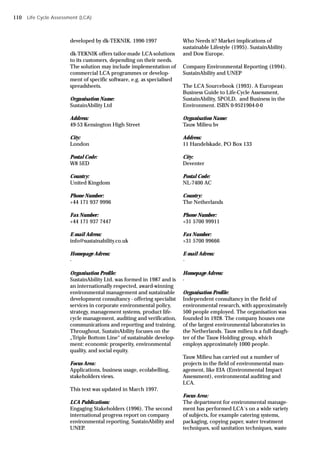
Appendix 5.1.1: Screen prints from the database ........... 106
Appendix 5.1.2: Print examples on organisations............ 108
Appendix 5.1.3: Total list of organisations
in the database version 1.0 .............................................. 113
Acknowledgement..................................................................... 119
About this guide to LCA
What is LCA?
Life cycle assessment (LCA) involves the
evaluation of some aspects - often the en-
vironmental aspects - of a product system
through all stages of its life cycle. Sometimes
also called “life cycle analysis”, “life cycle
approach”, “cradle to grave analysis” or
“Ecobalance”, it represents a rapidly emerg-
ing family of tools and techniques designed
to help in environmental management and,
longer term, in sustainable development.
This publication, developed for the Euro-
pean Environment Agency (EEA), aims to
help business and other readers to find their
way through the LCA maze to the right tools
for the application they have in mind. The
early chapters are written in such a way as to
be easily accessible to environmental manag-
ers in companies and other similar profes-
sionals, whereas the methodology sections
may require some LCA background of the
reader.
Where did LCA come from?
Like all good ideas, LCA probably started in
a number of different places, in a variety of
different ways. We provide a brief history of
LCA in chapter 1.
Concept or tool?
Some people find LCA useful as a concep-
tual framework, others as a set of practical
tools: both views are correct, depending on
the context. Even scientists and engineers
can find “life cycle thinking”, a tremendous
spur to their creativity and ability to see the
wider dimensions of a problem. An explana-
tion of the different levels or styles of LCA
can be found in chapter 3.1.
A growing need
Sustainable development is now on the na-
tional and international agendas. It requires
many things, but above all it requires rapid
improvements in eco-efficiency, or in the
efficiency with which we use energy and a
wide range of materials taken from nature,
and how we minimise waste. This builds on
the long-running international interest in so-
called “cleaner technology”. Even more
demanding, however, sustainable develop-
ment calls for eco-efficient improvements
throughout the life cycle of a given product
or system. This challenge is further des-
cribed in chapter 2.
What is a product’s life cycle?
Simply stated, the life cycle of a product
embraces all of the activities that go into
making, transporting, using and disposing of
that product. The typical life cycle consists of
a series of stages running from extraction of
raw materials, through design and formula-
tion, processing, manufacturing, packaging,
distribution, use, re-use, recycling and,
ultimately, waste disposal. Further informa-
tion on this aspect of the debate can be
found in chapter 4.4.
The producer’s responsibility
Once, a manufacturer simply handed a
product over to a distributor or customer,
and that was the end of the story. No longer.
These days it is widely recognised that any
producer works with “chains” of suppliers
“upstream”, and chains of customers “down-
stream”. The producer’s responsibility no
longer ends - if it ever did - at the factory
gate. Increasingly, industry accepts that
product stewardship is the way forward.
Governments, too, are beginning to impose
“take back” requirements, to make produ-
cers take their wastes back and reprocess at
least a proportion. These responsibilities are
described in more detail in chapter 2.
Life cycle management
Among the newer concepts in LCA is “Life
cycle management” (LCM), which is an
integrated approach to minimising environ-
mental burdens throughout the life cycle of
a product, system or service. In some forms,
LCM can provide a simplified set of LCA
procedures suitable for small- and medium-
sized enterprises (SMEs). LCM is further
explained in chapter 3.2.4
9
The LCA tool
A typical LCA-study consists of the following
stages:
1. Goal and scope definition.
2. A detailed life cycle inventory (LCI)
analysis, with compilation of data both
about energy and resource use and on
emissions to the environment, through
out the life cycle.
3. An assessment of the potential impacts
associated with the identified forms of
resource use and environmental emis-
sions.
4. The interpretation of the results from
the previous phases of the study in
relation to the objectives of the study.
An account of the relevant LCA methodo-
logical framework based on the ISO 14040
standard can be found in Chapter 4.
Energy and resources
Many different forms of resources, renew-
able or non-renewable, mineral, water, land,
plant or animal may need to be included in
an LCA study. So, for example, energy may
include process energy, heat or electricity
produced from such energy sources as fossil
fuels (e.g. coal, oil, natural gas), nuclear
power, or a range of renewable sources,
among them biofuels (e.g. wood, straw,
waste), and solar, wind or water power. All of
these energy sources have different environ-
mental characteristics, bringing with the
different benefits - and very different prob-
lems. These issues are further explored in
appendix 4.2.
Environmental emissions
If we take the entire product life cycle as our
focus, it is clear that it is very likely to be a
complicated picture - with environmentally
significant inputs and outputs to air, water
and soil at every life cycle stage; see also
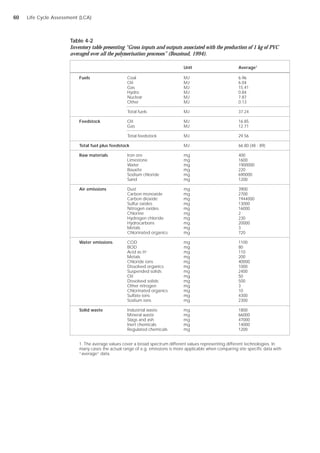
chapter 4.4, table 4-2. Some unexpected
impacts - or benefits - may turn out to be
associated with some of the co-products or
by-products which are produced by a given
process. These will need to be tracked
through. And of course there is always at
least a chance that some new form of pollu-
tion will suddenly be discovered, such as by
endocrine disrupters. See also appendix 4.2
for further description of impact categories.
Can computers help?
Computers, as in every area of life, can make
things much better - or, if mismanaged,
much worse. We can be helped to cut
through the data to the real issues, or we can
be drowned in data. Where computers help
to turn data into information and informa-
tion into knowledge, as they often do, they
are a hugely valuable part of the LCA pro-
cess. A range of PC-based software pro-
grammes, often linked to large databases,
have been developed and are now coming
into the market. This software is of variable
quality, but is rapidly improving. Further
details may be found in chapter 5.3.
Is LCA expensive?
A full LCA will normally require a great deal
of data, and as a result will be time-consum-
ing and expensive. In extreme cases a study
can take several years and cost millions of
ECU. Full LCA studies give the best back-
ground for decisions, but they are often only
relevant for important intermediates and
other large-selling products - which are not
often changed. In practice, a simplified form
of LCA is often used, tailored to the product
and the purpose. In such cases the time and
cost may be much lower, from about 10,000
ECU. Further development of LCA software
may help to further cut costs. More informa-
tion on this area can be found in chapter
5.3.
What can LCA do for my business?
LCA is a decision support tool. Used in the
right way, it can help to ensure that a compa-
ny’s choices are environmentally sound,
whether in the design, manufacture or use of
a product or system. On the financial side,
experience shows that companies using LCA
can discover important product improve-
ments, new approaches to process optimisa-
tion and even, in some cases, radically new
ways of meeting the same need - but with a
new product, or with a service. You may not
want to hear about new ways of doing what
your business does, but it may be less painful
than, if your competitors find out first. See
also chapter 3.2.1..
Life Cycle Assessment (LCA)
10
Suppliers will have to report
Even the largest companies cannot drive
their industries or market towards sustain-
able development targets without the sup-
port of their value chain. As a result, we are
seeing major companies beginning to
challenge their suppliers on their environ-
mental targets and performance. In some
cases, proper systems and targets may even
be a condition of supply. A growing numbers
of companies start to produce their own
LCAs, their suppliers will be called upon to
provide much of the data needed. This trend
is explained in chapter 3.2.2.
Can LCA help in product comparisons?
LCA cannot - or at least should not - be used
to claim that a particular product is environ-
mentally friendly. At best it is only possible to
say, using a specified set of criteria, that one
product is better than another in certain
aspects of its performance.
Such data, however, may legitimately be used
in comparative product marketing - even if
experience shows that many manufacturers
or retailers are tempted to over-claim. This
problem, coupled with biased information
and lack of quality control, can do more
than anything else to undermine the author-
ity of LCA methods. These issues are dis-
cussed in chapter 4.3.
Is LCA mandatory?
In a word, no. LCA is currently an option for
companies, but it is an option which growing
numbers of customer companies are begin-
ning to encourage their suppliers and part-
ners to at least think about. In some coun-
tries, for example Denmark, new environ-
mental accounting and reporting require-
ments are likely to encourage the further
spread of LCA thinking, if not always of LCA
tools. The links to other environmental
management tools are explored in chapter
3.2.
Green procurement
No longer it is simply a question of a few
green-minded companies insisting on green
specifications, where suppliers could meet
them at little or no additional cost. Increas-
ingly, too, we see local and national govern-
ment agencies beginning to develop product
policies and to explore ways in which they
can use their procurements systems to help
drive eco-efficiency through the economy.
Life cycle thinking is essential in developing
the criteria for green procurement. The
trend is discussed in chapter 3.3.2.
Ecolabelling
For some product categories the products
with the best environmental performance
may get a ecolabel. The use of environment-
al labelling has proceeded less fast in many
parts of the European Union than was
originally expected, but where it has been
used there has been an almost automatic
requirement for LCA inputs. In the EU
ecolabel regulation LCA is required for the
development of ecolabel criteria. For obtain-
ing the label, only some selected LCA-data
may be required.
Ecolabelling has been hugely controversial
in some countries, and in relation to some
products in particular, but the ecolabelling
challenge is not going to go away. Moreover,
it is likely to spread into new areas, among
them electric power supply. More informa-
tion can be found in chapter 3.3.1.
Environmental declarations
Environmental declarations may not have
the same ring as “eco-labelling”, but this
special kind of environmental labelling
(approved by ISO as type III labelling) may
prove rather more popular in some quarters,
since it includes more information and all
products can get the label. The output tends
to be a selection of LCA data printed out as a
set of columns or profile. See chapter 3.2.2.
Stakeholder views
In the end, however, how much we do to
make LCA useful, it will not really help
unless the world believes that it is useful.
SustainAbility surveyed a range of external
stakeholders during the project to find out
what they thought of LCA. Highlights of the
results can be found in chapter 1.4.
Where can I get more information?
This is getting easier all the time. A new LCA
journal has appeared, and many scientific
papers and reports on LCA have been
About this guide to LCA 11
published in recent years. In addition, a
growing number of Internet homepages on
LCA can be found on the World Wide Web.
A selection of this information sources is
presented in chapter 5.
Who’s Who in LCA?
A growing numbers of institutes, universities,
governmental agencies, industries, trade
associations and consultants are involved in
LCA as experts or users. The main players in
Europe are included in the database avail-
able on http://www.eea.eu.int
What will happens next?
Forecasting, they say, is always hard - but
particularly when you are thinking about the
future! To give a small taste, however, we
look at some possible trends in LCA, based
on nine major transitions towards sustain-
ability, in chapter 2.3.
Life Cycle Assessment (LCA)
12
1. A Brief History of LCA
1.1 The Early Years
The first studies to look at life cycle aspects
of products and materials date from the late
sixties and early seventies, and focused on
issues such as energy efficiency, the con-
sumption of raw materials and, to some
extent, waste disposal. In 1969, for example,
the Coca Cola Company funded a study to
compare resource consumption and environ-
mental releases associated with beverage
containers. Meanwhile, in Europe, a similar
inventory approach was being developed,
later known as the ‘Ecobalance’. In 1972, in
the UK, Ian Boustead1
calculated the total
energy used in the production of various
types of beverage containers, including glass,
plastic, steel, and aluminium. Over the next
few years, Boustead consolidated his method-
ology to make it applicable to a variety of
materials, and in 1979, published the Hand-
book of Industrial Energy Analysis.
Initially, energy use was considered a higher
priority than waste and outputs. Because of
this, there was little distinction, at the time,
between inventory development (resources
going into a product) and the interpretation
of total associated impacts. But after the oil
crisis subsided, energy issues declined in
prominence. While interest in LCA contin-
ued, , thinking progressed a bit more slowly.
It was not until the mid eighties and early
nineties that a real wave of interest in LCA
swept over a much broader range of indus-
tries, design establishments and retailers -
taking many of them by surprise.
1.2 Rapid Growth and Adolescence
Despite almost three decades of develop-
ment, one practitioner in our survey (see
Appendix 1.1) said: “LCA is still a young
tool.” The rapid surge of interest in ‘cradle
to grave’ assessments of materials and
products through the late 1980s and early
1990s meant that by the 1992 UN Earth
Summit there was a ground-swell of opinion
that life-cycle assessment methodologies
were among the most promising new tools
for a wide range of environmental manage-
ment tasks.
The most comprehensive international
survey of LCA activity to date, The LCA
Sourcebook, was published in 19932
. At the
time, LCA was of limited interest “outside a
very small community of scientists, mostly
based in Europe or North America. But
then,” the Sourcebook noted, “their work
escaped from the laboratory and into the
real world.”
Some countries took an early lead. “In the
UK,” said David Cockburn of PIRA, “it has
been surprisingly fast. Ten years ago there
was only one main practitioner [in the UK],
Ian Boustead. Now there are many more
academics, consultancies and companies
with an in-house capability.”
While the field continued to progress, the
pace has been sporadic. According to a
recent report by IMSA and SPOLD3
, the
chief barriers to greater progress in the LCA
field have been a low level of experience
with LCA, coupled with undue expectations
and “over-advertisement”. This led to a
period of disillusionment with LCA, aggrava-
ted by a strong sense that many of those
using LCA were simply doing so to buttress
existing positions, rather than to fully under-
stand and respond to the real issues.
1.3 Towards Maturity
So, where are we now? Although the pace of
development is slowing, the methodology is
beginning to consolidate - moving the field
toward a long-awaited maturity. Yet the
usefulness of the technique to practitioners
is still very much in debate. In the past
couple of years, however, there has been a
growing confidence in the LCA community
that the emerging tools have a real future.
For example, Procter & Gamble’s Peter
Hindle sees “enormous progress” and is
optimistic about the future for life-cycle
inventories (LCIs) and about the take-up of
life-cycle thinking by management generally.
Others take a very different view. “LCA is a
million miles away from the man in the
street,” said Dr Mike Jeffs of ICI Polyur-
ethanes. Part of the difficulty in making the
technique more accessible comes down to
the competing needs of simplicity (or at least
clarity) to aid practitioners and credibility, to
A Brief History of LCA
1
LCA - How it Came
About, The Beginning in
the UK, Ian Boustead in
the International Journal
of Life cycle Assessment
1 (3) 1996
2
The LCA Sourcebook: A
European Guide to Life
Cycle Assessment,
SustainAbility, SPOLD
and Business in the
Environment, 1993
3
Synthesis Report on the
Social Value of LCA
carried out by IMSA on
behalf of the Society for
the Promotion of LCA
Development (SPOLD),
1995.
13
enable decision-makers to have faith in the
robustness of the results. As Mariane Hou-
num of the Danish Environmental Protect-
ion Agency put it: “We need to find a simple
way of communicating the results of LCA,
because most people have neither the time
nor the interest to read entire documents.
But if the answers are simple, then again the
question of credibility arises - because there
is no way for [stakeholders] to check the
validity of the results.”
Back in 1992-1993, SustainAbility coined the
term ‘laptop LCA’, pointing out that until
LCA as a tool becomes truly user-friendly
and accessible, it is unlikely to take off in a
comprehensive way. Over the years, software
designers have been responding to the
challenge, and as the final section of this
Guide demonstrates, there has been a
proliferation of LCA software on the market.
These should be carefully checked before
use, however, since this field is still in its
infancy - and the available products are of
variable quality. One of the key concerns is
that it is often very hard indeed to verify the
quality of the data used.
Overall, the LCA community is now able to
offer a growing range of useful management
tools. But it continues to struggle a number
of key issues, some of which are strongly
linked to the nature of the discipline itself.
These include:
• the complexity of many of the method-
ologies and processes;
• the high cost and long time-scales,
although much progress has been made
in this area;
• the necessity of making value judgments
in the course of the work, judgments
which are not always identified in the
final report;
• the lack of accepted international
standards (although the SPOLD LCA
format initiative has been useful, and an
ISO standard is under way);
• the continuing invisibility of much LCA
work, compounded by the above factors.
But the lack of a real market pull for LCA
data is perhaps the most important factor.
Companies have simply not, by and large,
felt the need for LCA in their regular deci-
sion-making.
That said, however, and given the cooling of
public opinion on most environmental issues
through the mid-1990s during the second
great environmental downwave, it is astonish-
ing how much interest there has been in
some sectors of industry. LCA results have
played a key role in procurement decisions,
for example, as companies have sought to
assess the relative performance of competing
suppliers. This activity, in many cases, has
been driven by a recognition that while
public opinion may move in great surge-
tides, the underlying trend on most environ-
mental issues is still moving steadily upwards.
A series of issues in 1995 and 1996, most
particularly the controversy surrounding the
planned disposal of the Brent Spar oil buoy
and the massive economic and social disloca-
tions caused by public reactions to ‘mad cow’
disease or BSE, helped to re-ignite interest in
life-cycle thinking, if not necessarily always in
LCA methodologies proper.
The Brent Spar debate highlighted the need
to use LCA not only to fast moving consumer
goods like detergents, or consumer durables
like washing machines, but also to major
structures and installations. Although Shell
has conducted work on the ‘shadow pricing’
of the disposal options, many observers
wondered why life cycle thinking had not
been built into the design and operation at a
much earlier stage. The BSE controversy, in
turn, raised the life-cycle issue for a wide
range of industries and for consumers, by
illustrating how vulnerable agricultural and
food chains are to new forms of contamina-
tion.
1.4 Stakeholder Views
LCA has traditionally been written about and
discussed by experts behind closed doors, or
in the R&D laboratory, with little in the way
of public communication, let alone consulta-
tion. But as practitioners see the need for
increased credibility of the tool and greater
acceptance by the public, the mood is
changing. As a result, there is now a greater
curiosity about what other people think
about the discipline, and about the implica-
tions for the future.
In order to develop an introduction which
was topical and well-founded, SustainAbility
conducted a sample survey of industry
practitioners, standard setting organisations,
ecolabelling boards, industry associations,
research institutes, consultants, non-govern-
Life Cycle Assessment (LCA)
14
mental organisations (NGOs), students, the
environmental media and financial institu-
tions. Their views inform the sections which
follow.
The sample was in no sense statistically valid,
but the conclusions drawn and the recom-
mendations made by the different stake-
holders fall into a very clear pattern. A list of
the respondents in the EEA/SustainAbility
survey can be found in Appendix 1.1. We
have also drawn on the conclusions of the
IMSA study, Synthesis Report on the Social Value
of LCA.
The findings of the survey can be summa-
rised as follows:
• LCA, in its various forms, is now seen by
all stakeholders as a necessary, integral
part of the environmental management
tool-kit;
• Practitioners see value in using this
family of tools not only for established
areas like new product development but
also, increasingly, in the process of
corporate strategy formulation;
• Although the period of “maximum hype”
is over, LCA remains in the early stages of
development, with a good deal of further
development needed;
• The level of knowledge of LCA remains
worryingly low in the public domain;
• Among those who are aware of LCA,
there is still a clear divide between those
who focus on LCA as a set of tools and
those who consider LCA thinking as a
paradigm through which to think and
prioritise;
• The level of progress differs between
countries, but overall the pace of devel-
opment in the LCA field is slowing as
consolidation of methodologies begins;
• The credibility of the tools - and of the
users of LCA data - is critical if the LCA
community is to gain sufficient authority
and LCA is to be useful in the long term;
• A major concern - expressed by a high
proportion of practitioners - is that
quality control mechanisms remain
relatively weak;
• The involvement of external
stakeholders in defining study bounda-
ries and stimulating ‘out-of-the-box’
thinking is seen to be increasingly
important.
A Brief History of LCA 15
LCA has traditionally been written about and
discussed by experts behind closed doors or
in the laboratory, without much in the way of
public consultation. But as practitioners see
the need for increased credibility of the tool
and greater acceptance by the public, the
mood is changing. As a result, there is now a
greater curiosity about what other people
think about the discipline, and about the
implications for the future.
In order to develop a Guide which was topical
and well-founded, SustainAbility conducted a
sample survey of industry practitioners,
standard setting organisations, ecolabelling
boards, industry associations, research insti-
tutes, consultants, non-governmental organi-
sations (NGOs), students, the environmental
media and financial institutions. Their views
have inform earlier sections of the Guide.
What follows is a brief summary of findings.
Major Findings
The sample was in no sense statistically valid,
but the conclusions drawn and the recom-
mendations made by the different stake-
holders fall into a very clear pattern. We have
also drawn on the conclusions of the IMSA
study Synthesis Report on the Social Value of
LCA. The findings of the survey can be
summarised as follows:
• LCA, in its various forms, is now seen by
all stakeholders as a necessary, integral
part of the environmental management
took-kit;
• Practitioners see value in using this
family of tools not only for established
areas like new product development but
also, increasingly, in the process of
corporate strategy formulation;
• Although the period of “maximum hype”
is over, LCA remains in the early stages of
development, with a good deal of further
development needed;
• The level of knowledge of LCA remains
worryingly low in the public domain;
• Among those who are aware of LCA,
there is still a clear divide between those
Appendix 1.1:
A Spectrum of Stakeholder Views
who focus on LCA as a set of tools and
those who consider LCA thinking as a
paradigm through which to think and
prioritise;
• The level of progress differs between
countries, but overall the pace of devel-
opment in the LCA field is slowing as
consolidation of methodologies begins;
• The credibility of the tools - and of the
users of LCA data - is critical if the LCA
community is to gain sufficient authority
and LCA is to be useful in the long term;
• A major concern - expressed by a high
proportion of practitioners - is that
quality control mechanisms remain
relatively weak;
• The involvement of external stake-
holders in defining study boundaries and
stimulating ‘out-of-the-box’ thinking is
seen to be increasingly important.
Some Stakeholder Perspectives
Consultants
Among the practitioners, the consultants
were probably the most optimistic about the
future for LCA. Nick Turner of ERM noted
that “the number of practitioners has grown,
the use of LCA has changed [towards more
practical applications such as ecolabelling],
the number of actively involved research
groups is increasing (e.g. SPOLD, ISO, CEN
and SETAC) and LCA has also gained a
more important role in education. Ten years
ago, LCA wasn’t taught; now it is a much
more focused part of courses and students
are aware of it.”
It is probably worth noting, however, that
this was the most positive assessment pro-
vided by any of our respondents. Our Bat-
telle Europe respondent, M. Porta, noted
that the interest in LCA has been very
mixed. One factor at work here is that the
potential benefits of LCA vary considerably
between industry sectors, markets and
countries. But all the consultants agreed that
a key challenge for the future is to enhance
the credibility of LCA.
Life Cycle Assessment (LCA)
16
Consumer Associations
Consumers often have the ultimate say in
which products survive and which do not.
Some respondents were optimistic that
consumers would play an increasingly
important role in this area. “We should not
underestimate the ability of consumers to
make environmental choices even in the
absence of ecolabels,” as David Monsma of
the US Council on Economic Priorities
(CEP) put it.
To date, however, most consumer associa-
tions and campaigners have paid little
attention to LCA. Many have also paid
surprisingly little attention to ecolabelling.
But at least one of the national ecolabelling
bodies felt that their role could grow, indeed
would need to grow. “I see the role of con-
sumer associations evolving,” said Ing.
Raffaele Scialdoni of Italy’s Angenzia Na-
zionale Per L’Ambiente (ANPA). “This is
particularly likely as more final consumer
goods are affected.”
Ecolabelling Boards
The link between ecolabelling and LCA is
often assumed to be close and automatic.
The response from leading individuals in the
field, however, suggests that the links are
much looser - and that ecolabelling is very
unlikely to drive the LCA debate - or im-
prove LCA credibility - in most countries.
There was widespread scepticism among
most respondents about the progress to date
- and value - of ecolabelling. Many saw the
link between ecolabelling and LCA as weak.
And some argued that this was appropriate.
“I think that ecolabelling should not be
based on a full LCA,” argued Paolo Frankl of
Istituto Ambiente Italia. But there was a
sense that if ecolabelling could be made to
work, LCA would inevitably benefit.
“There is a lot of scepticism about ecolabels,”
was the way Martin Wright of Tomorrow
Magazine summed up the challenge, but
added: “if people come to accept the eco-
labelling approach, then it is likely that they
will accept LCA too.” Among the optimists,
on the other hand, was Professor Roland
Clift of the University of Surrey and the UK
Ecolabelling Board. He said that “ecolabel-
ling could be useful in improving the cred-
ibility of LCA,” but he also accepted that
“there are still problems in its implementa-
tion.”
Financial institutions
A key problem in LCA, as Anne-Maree
O’Connor of the National Provident Institu-
tion (NPI) put it, is that “the leaders have
been ahead of consumer demand, and
haven’t had the response in the market place
which they might have hoped for.” On the
other hand, Sarita Bartlett of Norway’s
Storebrand commented that her impression
is that “the use of LCA has spread to more
industries and applications - and will con-
tinue to do so.”
Ideally, the financial institutions and analysts
would like to be able to compare and bench-
mark. That is a key feature of their business.
In the USA, for example, Kristin Haldeman
of the Investor Responsibility Research
Center (IRRC) stressed that “comparability
would be very useful when making evalua-
tions” for investment purposes, but Anne-
Maree O’Connor accepted that such com-
parisons would be difficult for the foresee-
able future.
The analysts agreed that raw data were
generally not helpful in their work. What was
needed was processed data, as long as the
assumptions and methodologies were trans-
parent, intelligible and credible. They also
inclined to the view that guidelines for LCA
were essential and that, on the credibility
front, verification would be helpful. “We
definitely need verification,” said Anne
Marie O’Connor, “to prevent dubious claims
- and prevent them from undermining the
credibility of the whole LCA process.”
As far as ecolabelling is concerned, they felt
that it could be useful “if all the wrangling
ever settles down”, but Sarita Bartlett noted
that ecolabels only meet the needs of certain
stakeholders - and certainly not of financial
analysts or the insurance industry.
Governments
Through regulations and ecolabelling
initiatives, governments clearly have an
important role to play. Increasingly, too,
some government agencies will require LCA
data in support of their decision-making
processes. But, while the Danish EPA felt it
could handle LCA processes competently
without external verification, there were
some reservations about government’s
overall capacity to do LCAs in-house.
So how do people who tackle LCA on a pan-
European basis feel about the usefulness of
LCA in policy decisions? “Government is not
expert enough - and regional situations vary
too much - for it to be sensible to base pan-
European policy on LCA,” argued Nancy
A Spectrum of Stakeholder Views 17
Russotto of APME. There were also reserva-
tions about LCA as a policy-making tool:
“LCA is not yet water-tight enough to be
used as a policy making tool,” said Gareth
Rice of the University of Surrey. On the
other hand, Anne-Maree O’Connor of NPI
argued that governments can play a useful
role by providing financial incentives for
LCA and by improving access to data on
public registers of emissions, so that emis-
sions and impacts can be linked back to
companies and their products. In short,
although it is still easier to see LCA as a tool
for assessing products, it is very likely that it
will be used for government and industry
policy making.
Industry Associations
Surprisingly, some industry LCA practition-
ers were highly sceptical about the contribu-
tion of industry associations to the debate.
One even went so far as to say that “they will
continue to protect their corporate members
from calls to divulge real information which
might be useful to customers and consum-
ers.”
More positively, most respondents felt that
industry associations would “come up the
curve”, playing an increasingly important
role with respect to the provision of sectoral
data. Several industry association respond-
ents forecast that there would be growing
pressures for benchmarking against industry
averages. Many companies are much happier
to supply data when they know they will be
aggregated, and industry associations will
increasingly be required to supply aggre-
gated data - both to member companies and
to client industries and regulators.
Overall, the associations were expected to
play a central role. “Industry associations will
help industry to understand the true value of
LCA,” was the way Anders Linde of
EUROPEN put it. Some of the respondents
also felt that such associations will have an
important role to play in assisting small and
medium-sized enterprises (SMEs).
NGOs
Although, perhaps not surprisingly, there
were reservations (“NGOs are not objective;
they support political or other lobbying
agendas”), most practitioners saw non-
governmental organisations (NGOs) as
potentially having a critical role in relation
to LCA. “NGOs have credibility,” was the way
Anders Linde of EUROPEN summed it up.
Most respondents saw the NGOs as playing
more of a representative, challenging role
than a direct contribution to such areas as
the formulation of corporate strategy. But
even this position may well change as some
of the transitions outlined in the latter part
of this introduction take hold.
Among the benefits the involvement of
NGOs can bring are the following:
• Greater corporate transparency through
demanding more data;
• Making LCA practitioners think again by
challenging the assumptions of those
commissioning and carrying out LCA
work;
• Adding weight to the public acceptability
of the results of LCA work.
But there were concerns that many NGOs
would decide not to play the game, either
because of political differences or because
they lacked the necessary skills and other
resources. One respondent noted that NGOs
typically fall into two categories: (1) those
that understand the complexity of environ-
mental issues and trade-offs, who will work in
LCA processes; and (2) those who are single
issue campaigners, and cannot afford to
admit complexity - who will usually turn
down invitations to participate.
In the US, Kate Victory of Business and En-
vironment noted, “if NGOs are at all wise, they
will become involved. Not, perhaps, with the
methodology, but helping technical experts to
understand and communicate that technical
analysis will not answer all questions. And
NGOs can help with value judgements.”
Among the consultants, Nick Turner of ERM
argued that the role of NGOs could go in a
number of directions. “I can’t see them
commissioning LCAs,” he said, “but could see
them involved in peer review. NGOs are
listened to and have weight in society.”
The NGO respondents themselves displayed
an interesting mixture of scepticism and
hope. “This is still not something that the
average man in the street knows anything
about,” said Sally Nicholson of WWF. Rick
Heede and Chris Lotspeath at the US Rocky
Mountain Institute agreed: “There has been
slow take-up in the context of little or no
public awareness,” they reported. And some
NGO respondents were more critical. “LCA
has been a justification for products, rather
than an objective analysis,” argued Tim
Jenkins of Friends of the Earth (FoE).
Life Cycle Assessment (LCA)
18
More hopefully, Ann Link of the Women’s
Environment Network (WEN) noted: “Some
environmental groups have started to take
LCA seriously, not just as an industry green-
wash, which maybe it was at the beginning. I
suppose (and hope) that LCA will become a
more involving and accessible tool in the
future.” Several NGOs saw LCA and ecolabel-
ling playing a potentially important role in
public education on key issues and the
options for action.
This group of respondents were most wary
about the misuses of LCA. “LCA should not
be used as the basis of green labelling or eco-
marketing claims,” said one, arguing that this
would be “a complete bastardisation of
LCA.” To be useful, all NGO respondents
agreed, LCA projects would need to afford
greater transparency and result in data that
are both comparable and benchmarkable.
“This is a set of tools for continuous improve-
ment,” said one NGO, “not for selling
products.”
Research Institutes and Universities
Overall, this category of respondents was
fairly upbeat about the future prospects for
LCA. “We see an accelerating take-up of
LCA,” reported Dan Francis of Brunel
University.
An interesting distinction made by a number
of respondents was between LCA tools and
life-cycle thinking. As Professor Roland Clift
of the University of Surrey put it, “life cycle
thinking has been fairly widely adopted
across industry and government bodies,
while LCA proper has had a more limited
take-up, due to time and money require-
ments. Interest in LCA is gaining ground,”
he said, “but in practice it is still difficult to
persuade designers and engineers to use
even abridged forms of LCA.”
A Spectrum of Stakeholder Views 19
2.1 Life Cycle Thinking and Sustainability
Sustainable development is now on the
political and business agendas. In Germany,
Professor Schmidt Bleek of the Wuppertal
Institute expressed forceful views about the
significance of LCA in sustainable develop-
ment. He argued that LCA would be essen-
tial in the transition to more sustainable
lifestyles and products - and noted: “Firms
that are not well on the way to developing
and selling sustainable products will be cut
out of the market over the next 10 to 20
years.”
When companies and practitioners were
asked about the most important applications
for LCA, the most popular response in the
SustainAbility survey was new product develop-
ment. “New product development is the
ultimate goal,” as Rolf Bretz of Ciba put it.
The second most important area for the
business respondents was corporate strategy.
This was explained on the basis that LCA
introduces the notion of a corporation’s
responsibility for the whole life cycle, en-
couraging and assisting the process of
strategy review. Supporting this view, practi-
tioners and researchers alike agreed that the
future of life cycle thinking is bright.
2. What Role for LCA
in Sustainable Development?
In the UK, Professor Roland Clift argued
that “it is key that life-cycle thinking be
fostered throughout organisations, and be
adopted as part and parcel of the organisa-
tion’s philosophy, mission and day-to-day
operations. This makes it essential that life-
cycle thinking also be applied to corporate
educational processes.”
2.2 Some Ground-Rules for a Credible LCA
There have been a number of key shifts in
the business and environment debate since
The LCA Sourcebook was published. Some of
these are specific to the LCA field, others
related to much wider changes in the fields
of environmental strategy, management and
communication.
In order to explain some of the challenges
that now face LCA practitioners - and users
of LCA data - it is worth looking at some of
the wider changes now impacting related
areas of business- stakeholder relations.
Late in 1996, SustainAbility completed a
major survey of corporate environmental
reporting, alongside the United Nations
Environment Programme (UNEP) and 16
international companies. The 2-volume
ESTABLISHED FOCUS ON EMERGING FOCUS ON
1. One-way, passive communication Ü Multi-way, active dialogue
2. Verification as option Ü Verification as standard
3. Single company progress reporting Ü Benchmarkability
4. Management systems Ü Life-cycles, business design, strategy
5. Inputs and outputs Ü Impacts and outcomes
6. Ad-hoc operating standards Ü Global operating standards
7. Public relations Ü Corporate governance
8. Voluntary reporting Ü Mandatory reporting
9. Company determines reporting Ü Boundaries set through stakeholder
boundaries dialogue
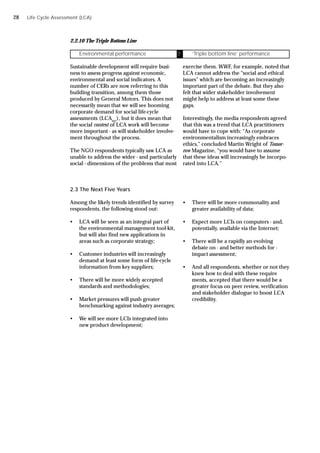
10. Environmental performance Ü ‘Triple bottom line’ performance
Table 2-1
Engaging stakeholders: 10 transititions.
21
report, Engaging Stakeholders, focuses both on
the thinking of reporting companies and of
the growing number of users of reported
data and information. Ten transitions were
identified for the reporting community (see
Table 2-1).
The focus on openness, credibility and
dialogue can also be seen to apply directly to
rising trends in LCA. Below we consider
some of the implications for LCA, taking
each of these transitions in turn.
2.2.1 Dialogue
There is worrying evidence of a growing
‘credibility gap’, and in some cases of a
‘credibility crisis’, both in the field of cor-
porate environmental reporting and in
relation to LCA, because some stakeholders
feel that the tool has lost much of its accept-
ability through occasional misuse in the past.
A few companies have experimented with a
degree of stakeholder dialogue around the
issues related to LCA, Dow Chemical and
Novo Nordisk among them, but these
interactive processes remain the exception.
In the meantime, the main issue which
seems to be creating the current ‘credibility
crisis’ in relation to reporting revolves
around the fact that currently most compa-
nies decide how they should prepare their
LCAs. They also define the boundaries of the
exercise (see under Transition 9, below).
In effect, companies undertaking LCA
control both the content of the communica-
tion and the communication channels. By
contrast, there is a growing expectation that
stakeholders should be involved much
earlier in the process. Only if this happens
will the next generation of LCA projects be
credible and, ultimately, useful.
But it is worth asking to what extent the
value of LCA depends on its public credi-
bility? The consensus among practitioners
was that, although much depends on the
context and application, credibility is “criti-
cal”. Some practitioners, among them Mike
Richards of Tioxide, subscribed to the view
that some people working on LCA “live in
the belief that it is much more credible than
it actually is.” But all concerned warned that
gaining the backing of the scientific commu-
nity is the first priority, with public credibility
coming later in the process. Some practition-
ers, including Giorgio Rowinski of Fiat, even
questioned the value of LCA when used in
public communication - arguing that the
public is too easily influenced, constantly
shifting its opinion on key issues.
When we asked practitioners to comment on
the best ways of building and maintaining
public confidence in LCA, they mentioned
the following:
• The professionalism and training of
those undertaking LCA work;
• Accepted standards and methodologies;
• Internal sensitivity analysis and data
checks;
• Peer or critical review, including public
questioning at seminars and confe-
rences;
• Transparent reporting of processes and
outcomes;
• Stakeholder dialogue;
• Verification.
Life Cycle Assessment (LCA)
2.2.2 Verification
The verification of LCAs has not, to date,
been a requirement. But NGO respondents
were unanimous in calling for the external
verification of LCAs. “External verification
would help people to overcome the suspi-
cions that inevitably arise when LCAs are
carried out by companies with a vested
interest in the outcome,” as Sally Nicholson
of WWF put it. Four out of five NGO respon-
dents were unaware of the existence or
One-way, passive communication Ü Multi-way, active dialogue
Verification as option Ü Verification as standard
22
nature of existing LCA quality control
mechanisms. It is also interesting that both
the environmental media respondents
“passed” on this issue, implying that they
were equally confused about quality control
mechanisms.
The LCA practitioners surveyed felt that
there are currently few quality checks in
place in the LCA field. Responses ranged
from “not a lot” to “am not aware of any
quality checks in particular”. One practi-
tioner explained, “I lack quality control
myself when doing LCAs. The problem is
that LCAs are very data-intensive. It is very
easy to make a mistake - and much harder to
find it.” If this is more generally the case, this
is an issue which should be addressed by the
LCA community.
In this context, it is interesting to hear some
practitioners - among them Dr Hans-Jurgen
Klüppel of Henkel - saying that LCAs should
never be published, or perhaps even made
public, without a peer review. Asked whether
there is a need for external verification, most
practitioners agreed that, where the LCA
data are for external consumption, verifica-
tion by a third party can be a good idea.
However, a proportion of these said that the
distinction between peer review and verifica-
tion is artificial. The key difference may
simply be whether the external party or
parties is/are paid for the work and formally
sign off on it.
All the consultants surveyed mentioned peer
review, or some form of external verification,
as important. Marcel Bovy of IMSA added
that his experience suggests that “peer
reviews almost always result in major error
corrections.” Among the research institute
respondents, all favoured some form of
verification, with Paolo Frankl of the Istituto
Ambiente Italia summarising the task as one
of avoiding “mistakes and misuse”. Several
respondents said it was good practice,
whether the data were for internal or exter-
nal use, to adopt peer review techniques.
“Perhaps data should be checked by a peer
in a company even if it’s only for internal
use,” as Dan Francis of Brunel University put
it.
According to Kim Christiansen, who was
involved in developing ISO 14040, the
international LCA standard, verification is
one of the themes which was discussed at
some length by the ISO committee. It proved
difficult to agree on how to verify whether or
not an LCA study follows the text of the
standard. Should the accredited certifier
make judge the LCA study undertaken, the
practitioner responsible or the organisation
with which a practitioner works? Ultimately,
it was agreed that if the results of an LCA are
to be used externally, particularly if they are
to be used to make a comparative assertion
with another product, an external ‘critical
review’ is necessary, whereby a more formal
review process takes place than the usual
journal review.
The key thing, as Martin Wright of Tomorrow
Magazine noted, is that “independent third
party verification is available, which doesn’t
mean that it has to be used every time.”
Among the practitioners, David Russell of
Dow Europe argued that it could well be
time to begin thinking about a body respon-
sible for accrediting LCA practitioners and
verifiers as a first step towards making LCAs
more comparable.
2.2.3 Benchmarking
One key contributor to the ‘credibility gap’ is
the ‘comparability paradox’. This runs as
follows: to make Corporate Environmental
Reports - or LCIs and LCAs - more useful to
stakeholders, they need to be comparable; to
be comparable they need to be developed
within some sort of framework and with
generally accepted indicators that make
comparisons possible; and yet companies have
so far largely resisted attempts to introduce
common indicators, frameworks and bench-
marks. Without common benchmarks and
shared indicators, each company - whether it
is producing a CER or an LCI on a product or
material - ends up in a class of its own.
“It is very difficult indeed to make sensible
comparisons between different business
sectors,” said Martin Wright of Tomorrow
magazine. With companies choosing their
own metrics and environmental perform-
ance indicators, benchmarking is more of a
hope than a reality. This represents a major
problem for stakeholders wishing to com-
What Role for LCA in Sustainable Development?
Single company progress reporting Ü Benchmarkability
23
pare one LCA with another in order to
establish and stimulate best practice.
When asked whether the benchmarkability
of LCA data was a key issue, some survey
respondents were adamant that comparabil-
ity was not an issue or even a requirement.
David Cockburn of PIRA and Anders Linde
of EUROPEN agreed (in Cockburn’s words)
that “there is absolutely no requirement that
LCAs are benchmarkable, because each
study sets its own scope, objectives and
boundaries. However,” he noted, “that
doesn’t mean that transparency is not impor-
tant.” The purpose, said Linde, “is not to
have major comparability, but to better
understand systems and to improve their
performance.”
In stark contrast, a few respondents argued
forcefully for benchmarking and bench-
markability. “This is a question that can make
or break an ecological free market.” said
Professor Schmidt Bleek of Germany’s
Wuppertal Institute.
Most respondents noted that it all depends
of whether the data and findings are being
used internally or externally. A typical reply:
“If the results of an LCA enter the public
domain, comparability and benchmarkability
become much more important.” Compara-
bility, concluded Rolf Bretz of Ciba, is
“indispensable”: if we fail to achieve com-
parability and benchmarkability in the LCA
field, we cannot expect LCA to survive for
long in the commercial world.
In terms of making comparisons possible, a
number of necessary and desirable steps
were suggested. These included:
• The development of a common LCA
framework or methodology;
• Improved, explicit definitions of meth-
ods, indicators, scope and boundaries
in LCA projects;
• The provision of better quality data -
which should be more widely accessible;
• The construction of standard data sets;
• Greater transparency for LCI and LCA
processes;
• Further work on commonly accepted
approaches to impacts and how to assess
them.
One idea that came up repeatedly as an aid
to benchmarking was that of creating a
unified LCA database. A number of respond-
ents supported this idea strongly, particularly
those associated with SPOLD. David Cock-
burn of PIRA felt that a good database in a
common format could be “very useful”.
Some, among them Dennis Postlethwaite of
Unilever, see the growing calls for databases
as a reaction to concerns that some compa-
nies are “switching off” in the LCA field and
may in future refuse to disclose potentially
sensitive data.
But there were also sceptics: David Chesneau
of BP Chemicals noted that databases are
useful in theory, but warned that “Free data
can be pretty worthless unless the way in
which they are derived, and their limitations,
are understood.” Anders Linde of EURO-
PEN reported that “EUROPEN feels that
databases are not very useful in practice, as
they use industry averages and provide
diluted information, which lowers the quality
of the LCA.” Clearly the usefulness of
databases will depend upon the applications
for which they are envisaged, the nature of
the data collected and the ease with which
different styles of analysis can be supported.
More specifically, the following criteria
apply:
• The data should be updated regularly;
• Ranges of uncertainty should be indica-
ted;
• The date and source of any data should
be clearly identified;
• Formats should be harmonised, wherever
possible;
• Particular attention should be paid to
gathering essential infrastructure data
relating, for example, to energy, trans-
port and solid waste management.
Life Cycle Assessment (LCA)
24
2.2.4 From Management Systems to Strategy
In environmental management, it is possible
to point to a number of instances where
management systems were set up in a
vacuum. Sometimes, neither the data deliv-
ery systems which allow the system to operate
effectively, nor the feedback loops indicating
where change should take place, were in
place. And, to a degree, the same problems
can apply to LCA.
Many early LCA projects ran ahead of any
commercial desire to apply life cycle think-
ing: a case of the cart being put ahead of the
horse. But we now see a growing number of
companies reporting on their LCA work and
also beginning to apply life-cycle thinking to
such areas as business design and strategy.
Whatever happens, however, there was
general consensus amongst those who we
interviewed that the LCA process needs to be
speeded up if it is to be properly integrated
into business design and strategy. Said
Professor Schmidt Bleek of the Wuppertal
Institute: “A system must be found that is
sufficiently simple, safe and cost-effective so
that a million products can be assessed
quickly and repeatedly.” Among our student
respondents, there was strong agreement
from Gareth Rice of the University of Surrey:
“Anything that reduces the time element in
conducting an LCA has to be a good thing”
he said.
To ease the burden on industry and particu-
larly on SMEs, there was strong support for
government incentives and for Multi-client
studies. The availability of suitable databases,
said Federica Ranghieri of Italy’s
Fondazzione Mattei, would be critical in
helping SMEs to weather the transition.
2.2.5 Impacts and Outcomes
Data on industry’s inputs and outputs are
obviously welcome, but they are only useful if
they can be linked to potential real-world
environmental impacts - and to programmes
for reducing and making good those im-
pacts.
The issue of impacts is one of the thorniest
which face LCA practitioners, and remains a
sticking point - so much so that some people,
such as Peter Hindle of Procter & Gamble,
consider full blown LCAs to be an all but
impossible dream. He places much more
faith in LCIs (life cycle inventories).
But, as in the field of corporate environmen-
tal reporting, the demand for information
on impacts and outcomes will inevitably
drive the future evolution of LCA. The
necessary shifts here are from data to infor-
mation and knowledge, and from under-
standing to action. In short, what do all the
emissions and waste data produced for LCA
projects and published in CERs actually mean
in terms of environmental decline or pro-
gress, let alone of longer term sustainability?
To make this happen, more work is needed
in the area of building state-of-the-environ-
ment databases - and of better integrating
technology, project and product impact
assessments with these larger sets of data on
environmental trends.
What Role for LCA in Sustainable Development?
Inputs and outputs Ü Impacts and outcomes
Management systems Ü Life-cycles, business design, strategy
25
Life Cycle Assessment (LCA)
2.2.6 Standards
In a globalising economy, the challenges
facing business are becoming increasingly
complex. Companies often complain that
they operate in markets where the “playing
field is uneven”, but the evidence suggests
that they are often comfortable applying
different standards in different parts of the
world. Whatever the facts of the matter, one
message has emerged clearly from recent
controversies: companies operating interna-
tionally will find it increasingly difficult to
apply different standards - whether in rela-
tion to site management, reporting or LCA -
in different worlds regions and countries.
Many practitioners see the work of the
International Standards Organisation (ISO),
and particularly its work on ISO 14040, as
pivotal. The standards setting bodies noted
that ISO 14040 and ISO 14041 should be
Ad-hoc operating standards Ü Global operating standards
ready by 1997. That does not mean that they
all support it whole-heartedly, however. But
even they accepted, as Christina Senabulya
of the British Standards Institution (BSI) put
it, that “the acceptability of this family of
standards will be decided in the market-
place.”
Most practitioners and standard-setters saw
significant value in the harmonisation of
national standards - as long as they could be
harmonised at the right level. Although ISO
and national standards bodies were most
often mentioned in this context, at least one
NGO saw the European Environment
Agency (EEA) itself as having an important
potential role to play in helping to ensure
appropriate levels of standardisation and the
build the associated credibility for the tools
and their users.
2.2.7 Corporate Governance
Most report-makers find other companies’
LCAs and CERs useful, when they can get
access to them, but even some report-makers
now take their fellow report-makers to task
for producing LCA-related documentation
and CERs which are “largely PR”. The shift
to a more governance-focused approach to
reporting is signalled by the views of the
financial institutions. This trend is likely to
affect the financial markets in waves, the first
hitting insurers, the second hitting the banks
and the third, eventually, hitting the equity
markets.
The insurers have had plenty of warning,
with some 20% of Lloyd’s losses associated
with environmental liabilities in the United
States. As a result, some insurance compa-
nies are taking a much greater interest in
major issues like global warming and climate
change.
The fact that a growing number of banks is
beginning the process of environmental
reporting suggests that the environmental
aspects of corporate governance will also be
moving sharply up the agenda over the next
decade.
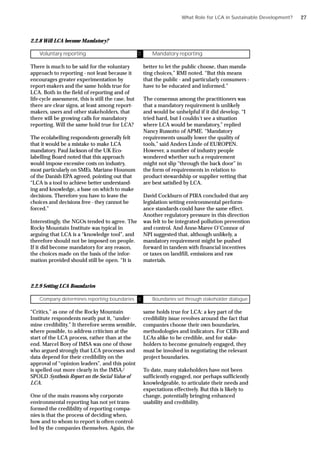
Public relations Ü Corporate governance
For the equity and other fast-paced financial
markets, environmental issues may be
shadowed by the scale of the problems that
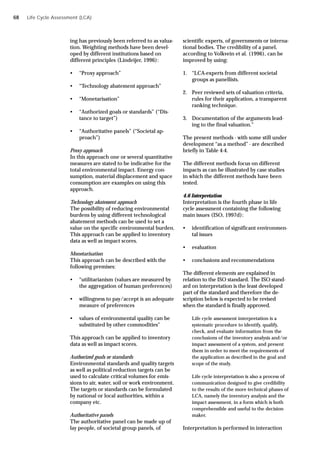
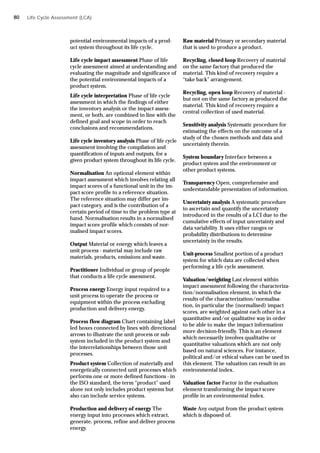
have rocked institutions like Barings, Daiwa,
Sumitomo and Morgan Grenfell/Deutsche
Bank, but sustainable development is going
to depend on the capacity of financial
analysts to think longer term than they
currently find possible. Working out how this
transition can be driven forward is perhaps
the biggest challenge now facing the sustain-
able development community world-wide.
Among the financial sector respondents,
there was a strong feeling that some form of
verification would be needed if they were to
use LCA data. Sarita Bartlett of Storebrand
felt that a company’s commitment to LCA
could become an important indicator for
whether or not it is taking its environmental
management responsibilities seriously. Anne-
Maree O’Connor at NPI, meanwhile, felt
that companies are only likely to undertake
LCAs (and consequently divulge useful
information about them) if encouraged to
do so through incentives or, conversely,
taxes. Corporate governance is, in other
words, seen to need a helping hand.
26
2.2.8 Will LCA become Mandatory?
There is much to be said for the voluntary
approach to reporting - not least because it
encourages greater experimentation by
report-makers and the same holds true for
LCA. Both in the field of reporting and of
life-cycle assessment, this is still the case, but
there are clear signs, at least among report-
makers, users and other stakeholders, that
there will be growing calls for mandatory
reporting. Will the same hold true for LCA?
The ecolabelling respondents generally felt
that it would be a mistake to make LCA
mandatory. Paul Jackson of the UK Eco-
labelling Board noted that this approach
would impose excessive costs on industry,
most particularly on SMEs. Mariane Hounum
of the Danish EPA agreed, pointing out that
“LCA is a tool to achieve better understand-
ing and knowledge, a base on which to make
decisions. Therefore you have to leave the
choices and decisions free - they cannot be
forced.”
Interestingly, the NGOs tended to agree. The
Rocky Mountain Institute was typical in
arguing that LCA is a “knowledge tool”, and
therefore should not be imposed on people.
If it did become mandatory for any reason,
the choices made on the basis of the infor-
mation provided should still be open. “It is
Voluntary reporting Ü Mandatory reporting
better to let the public choose, than manda-
ting choices,” RMI noted. “But this means
that the public - and particularly consumers -
have to be educated and informed.”
The consensus among the practitioners was
that a mandatory requirement is unlikely
and would be unhelpful if it did develop. “I
tried hard, but I couldn’t see a situation
where LCA would be mandatory,” replied
Nancy Russotto of APME. “Mandatory
requirements usually lower the quality of
tools,” said Anders Linde of EUROPEN.
However, a number of industry people
wondered whether such a requirement
might not slip “through the back door” in
the form of requirements in relation to
product stewardship or supplier vetting that
are best satisfied by LCA.
David Cockburn of PIRA concluded that any
legislation setting environmental perform-
ance standards could have the same effect.
Another regulatory pressure in this direction
was felt to be integrated pollution prevention
and control. And Anne-Maree O’Connor of
NPI suggested that, although unlikely, a
mandatory requirement might be pushed
forward in tandem with financial incentives
or taxes on landfill, emissions and raw
materials.
2.2.9 Setting LCA Boundaries
“Critics,” as one of the Rocky Mountain
Institute respondents neatly put it, “under-
mine credibility.” It therefore seems sensible,
where possible, to address criticism at the
start of the LCA process, rather than at the
end. Marcel Bovy of IMSA was one of those
who argued strongly that LCA processes and
data depend for their credibility on the
approval of “opinion leaders”, and this point
is spelled out more clearly in the IMSA/
SPOLD Synthesis Report on the Social Value of
LCA.
One of the main reasons why corporate
environmental reporting has not yet trans-
formed the credibility of reporting compa-
nies is that the process of deciding when,
how and to whom to report is often control-
led by the companies themselves. Again, the
Company determines reporting boundaries Ü Boundaries set through stakeholder dialogue
same holds true for LCA: a key part of the
credibility issue revolves around the fact that
companies choose their own boundaries,
methodologies and indicators. For CERs and
LCAs alike to be credible, and for stake-
holders to become genuinely engaged, they
must be involved in negotiating the relevant
project boundaries.
To date, many stakeholders have not been
sufficiently engaged, nor perhaps sufficiently
knowledgeable, to articulate their needs and
expectations effectively. But this is likely to
change, potentially bringing enhanced
usability and credibility.
What Role for LCA in Sustainable Development? 27
2.2.10 The Triple Bottom Line
Sustainable development will require busi-
ness to assess progress against economic,
environmental and social indicators. A
number of CERs are now referring to this
building transition, among them those
produced by General Motors. This does not
necessarily mean that we will see booming
corporate demand for social life-cycle
assessments (LCAsoc
), but it does mean that
the social context of LCA work will become
more important - as will stakeholder involve-
ment throughout the process.
The NGO respondents typically saw LCA as
unable to address the wider - and particularly
social - dimensions of the problems that most
Environmental performance Ü ‘Triple bottom line’ performance
exercise them. WWF, for example, noted that
LCA cannot address the “social and ethical
issues” which are becoming an increasingly
important part of the debate. But they also
felt that wider stakeholder involvement
might help to address at least some these
gaps.
Interestingly, the media respondents agreed
that this was a trend that LCA practitioners
would have to cope with: “As corporate
environmentalism increasingly embraces
ethics,” concluded Martin Wright of Tomor-
row Magazine, “you would have to assume
that these ideas will increasingly be incorpo-
rated into LCA.”
2.3 The Next Five Years
Among the likely trends identified by survey
respondents, the following stood out:
• LCA will be seen as an integral part of
the environmental management tool-kit,
but will also find new applications in
areas such as corporate strategy;
• Customer industries will increasingly
demand at least some form of life-cycle
information from key suppliers;
• There will be more widely accepted
standards and methodologies;
• Market pressures will push greater
benchmarking against industry averages;
• We will see more LCIs integrated into
new product development;
• There will be more commonality and
greater availability of data;
• Expect more LCIs on computers - and,
potentially, available via the Internet;
• There will be a rapidly an evolving
debate on - and better methods for -
impact assessment;
• And all respondents, whether or not they
knew how to deal with these require
ments, accepted that there would be a
greater focus on peer review, verification
and stakeholder dialogue to boost LCA
credibility.
Life Cycle Assessment (LCA)
28
3. Applications of LCA
The target group for this chapter is the
environmental manager (or the person
responsible for environmental activities) in
small and medium sized enterprises. The
chapter outlines areas of use in LCA in both
the private and the public sectors, and gives
references to programmes and projects
where LCA plays an integral part. The
chapter also gives a brief introduction to
some conceptually related programmes, e.g.
concepts and tools which use similar kinds of
data and which can be used to support
decision making in related areas of environ-
mental management.
LCA methodologies were originally devel-
oped to create decision support tools for
distinguishing between products, product
systems, or services on environmental
grounds (Throughout the chapter, the term
“product” is used as a synonym for both
products, product systems, and services).
During the evolution of LCA, a number of
related applications emerged, of which we
give some examples below:
• Internal industrial use in product devel-
opment and improvement
• Internal strategic planning and policy
decision support in industry,
• External industrial use for marketing
purposes, and
• Governmental policy making in the areas
of ecolabelling, green procurement and
waste management opportunities.
The list is not exhaustive, but indicates that
there is a wide variation of applications. This
variation is also reflected in the level of
sophistication and to some extent also in the
choice of methodology.
A critical remark on the use of LCA
The use of LCA for strategic decisions, e.g.
in choosing between different systems
delivering a common function, has often
been associated with disputes about the
validity of such assessments. These disputes -
or “LCA-wars” - have, however, proven to be
of great value in the development of a
proper LCA-methodology and data as they
ensure that boundary and functionality
definitions are adequately covered and are
transparent. Accordingly, one of the essential
requirements in the Draft International
Standard ISO 14040 (ISO 1997a) is the
following demands for external communica-
tion of LCA:
The results of the LCA shall be fairly and
accurately reported to the intended
audience. The type and format of the
report shall be defined in the scope
phase of the study.
The results, data, methods, assumptions
and limitations shall be transparent and
presented in sufficient detail to allow the
reader to comprehend the complexities
and trade-offs inherent in the LCA study.
The report shall also allow the results
and interpretation to be used in a
manner consistent with the goals of the
study.
(....)
In comparative studies, the equivalence
of the systems being compared shall be
evaluated before interpreting the results.
Systems shall be compared using the
same functional unit and equivalent
methodological considerations such as
performance, system boundaries, data
quality, allocation procedures, decision
rules on evaluating inputs and outputs
and impact assessment. Any differences
between systems regarding these para-
meters shall be identified and reported.
In the case of comparative assertions
disclosed to the public, this evaluation
shall be conducted in accordance with
the critical review process. Another
requirement for comparative assertions
disclosed to the public is that an impact
assessment shall be performed.
(....)
3.1 Levels of sophistication in LCA for
different applications
Most of the efforts in the development and
standardisation of LCA have been directed
towards a detailed LCA, and this type of LCA
is accordingly the focus of the chapter on
29
Life Cycle Assessment (LCA)
LCA methodology. In practice, however, very
few detailed LCAs, which are based on a
coherent methodology, have been published.
The first part of the present chapter there-
fore includes a brief description of two other
levels of LCA, i.e. the conceptual and the
simplified levels. It should be noted that at
present it is not possible to make a distinc-
tion between conceptual and simplified
LCAs or between simplified and detailed
LCAs. Rather, the three levels should be
regarded as a continuum with an increasing
level of detail, suitable for decision making
in different applications.
In the subsequent descriptions of LCA
applications, a reference is given to the level
of LCA used in the different applications,
although it is not possible to describe the
methodologies in detail. During the develop-
ment of LCA methodology, many synonyms
for less detailed LCAs have been suggested.
This is also reflected in the present review as
the authors refer to the actual terminology
used in the report (streamlined LCA, partial
LCA, screening LCA, Life cycle review,
simplified LCA, Life cycle thinking, LCA
concept, LCA tool, etc.)
When reading the following it should be
borne in mind that irrespective of the
terminology used, an LCA should always be
based on a holistic approach, i.e. at some
point of the study it must include the full life
cycle of the product and examine all inputs
and outputs.
3.1.1 Conceptual LCA - Life Cycle Thinking
The conceptual LCA is the first and simplest
level of LCA. At this level the life cycle ap-
proach is used to make an assessment of
environmental aspects based on a limited and
usually qualitative inventory. A conceptual
LCA can often answer basic questions like “Is
there a basis for pursuing a green marketing
strategy?”, “Is the product significantly differ-
ent from competing products?” or “Does the
product have some clear unequivocal benefits
or shortcomings for selected environmental
issues?”. Key decisions about green marketing
and new product development do not neces-
sarily need a highly quantitative analysis, but
rather an understanding of the relative
advantages, disadvantages and uncertainties
for an existing or new product (Hirschhorn,
1993).
The results of a conceptual LCA can for
instance be presented using qualitative
statements or simple scoring systems, indicat-
ing which components or materials have the
largest environmental impacts - and why.
Limitations in the inventory can occur in the
form of omissions of one or more of the
phases in the life cycle, e.g. those phases for
which the decision-maker does not have any
improvement options. Another possibility is
to reduce the number of examined param-
eters, e.g. by investigating the energy con-
sumption in the life cycle, but not the
related emissions and their contribution to
different environmental impacts.
It is obvious from the requirements of the
ISO standard that conceptual LCAs are not
suitable for marketing purposes or other
public dissemination of the results. However,
a conceptual LCA may help the decision
maker identify which products have a com-
petitive advantage in terms of reduced
environmental impacts. Subsequent simpli-
fied or detailed LCAs fulfilling the require-
ments of a standard can be established and
used for public information.
Instead of “Conceptual LCA”, the SETAC
EUROPE LCA Screening and Streamlining
Working Group uses the term “Life Cycle
Thinking” (Christiansen et al., 1997):
Life Cycle Thinking is a mostly qualita-
tive discussion to identify stages of the
life cycle and/or the potential environ-
mental impacts of greatest significance
e.g. for use in a design brief or in an
introductory discussion of policy mea-
sures. The greatest benefit is that it helps
focus consideration of the full life cycle
of the product or system; data are typi-
cally qualitative (statements) or very
general and available-by-heart quantita-
tive data.
3.1.2 Simplified LCA
The SETAC EUROPE LCA Screening and
Streamlining Working Group defines simpli-
fied LCA as (Christiansen et al., 1997):
Simplified LCA is an application of the
LCA methodology for a comprehensive
screening assessment i.e. covering the
whole life cycle but superficial e.g. using
generic data (qualitative and/or quanti-
tative), standard modules for transporta-
tion or energy production, followed by a
simplified assessment i.e. focusing on the
most important environmental aspects
and/or potential environmental impacts
and/or stages of the life cycle and/or
phases of the LCA and a thorough
assessment of the reliability of the results.
30
The aim of simplifying LCA is to provide
essentially the same results as a detailed LCA,
but with a significant reduction in expenses
and time used. Simplification presents a
dilemma, however, since it is likely to affect
the accuracy and reliability of the results of
the LCA. Thus, the primary object of simpli-
fication is to identify the areas within the
LCA which can be omitted or simplified
without significantly compromising the
overall result.
Simplification of LCA consists of three stages
which are iteratively interlinked:
• Screening: Identifying those parts of the
system (life cycle) or of the elementary
flows that are either important or have
data gaps
• Simplifying: Using the findings of the
screening in order to focus further work
on the important parts of the system or
the elementary flows.
• Assessing reliability: Checking that
simplifying does not significantly reduce
the reliability of the overall result.
The terms “Screening LCA” and “Stream-
lined LCA” are often used as synonyms for a
simplified LCA. However, a clear distinction
should be made. Screening as a part of the
simplification procedure can help to identify
the parts (or life cycle stages) of a product
system that can be left out in a simplified
LCA. In principle, a screening LCA which
already has certain parts missing would not
be capable of identifying all key issues, as it
does not cover the full life cycle or all en-
vironmentally important aspects. In other
words, the screening step in simplified LCA
should be comprehensive in coverage, but
may be superficial in detail.
Screening LCA is for instance used in
environmental labelling to identify the
environmental “hot spots”, i.e. the areas
where labelling criteria are assumed to have
the greatest effects. Another use of screening
LCAs is to identify the processes where
emissions of particular interest occur in the
life cycle. This procedure may be followed by
application of other environmental manage-
ment tools, e.g. risk assessment, to assess
whether unwanted effects actually will occur.
Depending on the application, the data can
be quantitative (site specific/generic) or
qualitative. Screening indicators such as
energy demand, MIPS (material intensity per
service unit) and key substances (substances
Level of detail in LCA
Application Conceptual Simplified Detailed Comments
Design for Environment x x No formal links to LCA
Product development x x x Large variation in sophistication
Product improvement x Often based on already existing
products
Environmental claims x Seldom based on LCA
(ISO type II-labelling)
Ecolabelling x Only criteria development requires an LCA
(ISO type I-labelling)
Environmental declaration x Inventory and/or impact assessment
(ISO type III-labelling)
Organisation marketing x x Inclusion of LCA in environmental reporting
Strategic planning x x Gradual development of LCA knowledge
Green procurement x x LCA not as detailed as in ecolabelling
Deposit/refund schemes x Reduced number of parameters in the LCA is
often sufficient
Environmental x Reduced number of parameters in the LCA is
(“green”) taxes often sufficient
Choice between x x Detailed inventory, Scope disputed LCA
packaging systems results not the only information
Applications of LCA
Table 3-1
Level of detail in some applications of LCA. “x” in bold indicates the most frequently used level.
31
with a known contribution to one or more
environmental impacts) can be used to
identify the hot spots in the life cycle. Using
combinations of several indicators may
increase the reliability of the screening.
Indicators which only relate to one phase of
the life cycle, e.g. recyclability and degrad-
ability of products, should only be used in
combination with other indicators.
Simplified LCAs may be used externally if
reported in accordance with the require-
ments in the ISO standard (ISO 14040).
However, most simplified LCAs are used for
internal purposes without formal require-
ments for reporting. To avoid misinterpreta-
tion of the results, the user of the LCA
should be made explicitly aware of the
limitations of the study, e.g. by stating all
simplifying methods applied in the LCA as
recommended in the SETAC report
(Christiansen (ed), 1997).
The level of detail in some of the applica-
tions is shown in Table 3-1. The contents of
each of the applications is described in more
detail in the following sections.
3.2 Private sector applications
The use of LCA in the private sector varies
greatly. This differentiation depends to a
large extent on where a given company is
situated in the product chain and on the key
driver for the LCA activity, e.g. legislation or
market competition. For business teams, the
LCA tool should be used to understand the
environmental issues associated with up-
stream and downstream processes as well as
on-site processes. This understanding can be
used for continuous improvement in reduc-
ing the impacts throughout the supply chain.
Commodity producers (chemicals, plastics,
metals) most often perform life cycle invento-
ries to be used in comparative assertions or
for assessing waste management and recycling
options. Producers of intermediates and
components provide data for their customers,
and producers of final goods combine the
knowledge from upstream and downstream
processes to design and manufacture prod-
ucts with the least environmental impact.
Time in this context, is an important factor in
LCA. For companies producing final goods in
Important issues in Design for Environment (WICE, 1994)
 Materials selection
• Minimise toxic chemical content
• Incorporate recycled and recyclable materials
• Use more durable materials
• Reduce materials use
 Production impacts
• Reduce process waste
• Reduce energy consumption
• Reduce use of toxic chemicals
 Product use
• Energy efficiency
• Reduce product emissions and waste
• Minimise packaging
 Design for recycling and reuse
• Incorporate recyclable materials
• Ensure easy disassembly
• Reduce materials diversity
• Label parts
• Simplify products (e.g. number of parts)
• Standardise material types
 Extending the useful life of products and components
• Design for remanufacture
• Design for upgrades
• Make parts accessible to facilitate maintenance and repairs
• Incorporate reconditioned parts or subassemblies
 Design for end of life
• Safe disposal
Life Cycle Assessment (LCA)
32
a competitive market, the product develop-
ment cycles are short and accordingly, com-
prehensive LCAs are not feasible with the
presently available data bases because the
analysis are time consuming.
The following sections give a short introduc-
tion to some of the concepts and tools in
which LCA is an integral part, and to some
of the concepts with a close relation to LCA
and life cycle approaches.
3.2.1 Product development
Design for the Environment (DfE)
Design for the environment is a general term
for a number of methods for incorporating
environmental factors into the design pro-
cess. The concept of DfE has been developed
without formal links to LCA, but as can be
seen from the following paragraphs the two
approaches are very similar and may not be
distinguishable from each other in many
cases.
Specific principles for DfE differ from
company to company, but some common
themes have been described by the World
Industry Council for the Environment
(WICE, 1994) (see Box page 28). DfE seeks
to optimize the environmental performance
of a product throughout its life cycle. and
integrates concepts of pollution prevention
in manufacturing and concerns about
energy efficiency of products. Another major
objective of DfE among manufacturers is to
design products with the goal of minimizing
after-life impacts and costs.
DfE thus conceptually addresses the same
problem areas as LCA. Dedicated LCA tools
were not an integral part of early DfE initia-
tives, but as is shown in the next section, the
development of LCA has now to a large
degree been connected to product develop-
ment and - accordingly - to DfE as a concept.
LCA and Product development
and improvement - introduction
Using LCA in product development is an
obvious choice as a large part of the future
environmental impacts of a product (system)
is determined by the design and construc-
tion phase. By incorporating LCA in the
design phase, companies have the possibility
of avoiding or minimizing foreseeable
impacts without compromising the overall
quality of the product.
Figure 3-1
Relationship between the designers’ degree of freedom and the level of information.
Applications of LCA 33
Product development may follow different
concepts and routes. Some common phases
of most development methodologies are
given below in Figure 3-1, along with an
illustration of the relationship between the
designer’s degree of freedom and the
available information during the product
development process.
In the idea-phase there is almost an un-
limited number of possibilities with respect
to design, choice of materials, function etc.
The number of options decreases with the
development process, and changes to the
final product and of the necessary produc-
tion tools often require a whole new develop-
ment process.
It is therefore necessary that relevant envi-
ronmental tools are available and used as
early as possible in the development process.
For simple products, e.g. packaging, it is
possible to apply a detailed and quantitative
LCA since information on most of the
commonly used materials is now available.
For more complicated products the number
of possibilities is very high, and as the data-
base on “exotic” materials is limited, the
application of quantitative and detailed
LCAs to such products may prove to be very
resource demanding and at the same time
not very precise. Conceptual or simplified
LCAs may in these cases be of more help in
the early stages of product development,
possibly in the form of life cycle based design
tools (e.g. design rules and checklists).
When improving already existing products,
the use of LCA may become easier (a simpli-
fied LCA), simply because it is possible to
make a LCA of the old (“reference”) product
with a well-known life cycle and use the
results to identify where the environmental
“hot spots” are. In this case data collection
and interpretation are generally far less
resource intensive, and the results can be
communicated to the customers in terms of
absolute environmental improvements.
Several research programs on how to incor-
porate environmental issues in product
development have been conducted. The list
below is not intended to give an exhaustive
overview, but merely mentions some pro-
grams already completed. Information on
other programs can be found in reports
from industry sector conferences (e.g. the
packaging, automotive and electromechani-
cal industries) and from meetings in LCA-
orientated societies (e.g. SETAC’s annual
meetings and symposia for case studies). A
broad list of references on Life Cycle Design
and related approaches can be found in
Keoleian & Menerey (1994) and in Ryding
(1995).
The Product Ecology Project (Sweden)
The Product Ecology Project in Sweden was
launched in 1992 as an initiative by the
Federation of Swedish Industries. The core
idea of the project was to develop an LCA-
based calculation system to help product
developers, purchasers and other decision-
makers in taking environmental impacts
from processes and products into account.
The results from the study are published in
Ryding (1995). Furthermore, a PC-based
software version of the Environmental
Priority System (EPS) to be used as an in-
company tool has been developed, and an
education package on environmentally
sound product development is available.
The NEP project (Scandinavia)
The Nordic project on Environmentally
Sound Product development (NEP) includes
most Nordic countries (S, N, SF) and con-
sists of two parts, namely development of a
common structure for a LCA database, and a
number of case studies, primarily performed
by Swedish and Norwegian companies. In
the project, LCA was integrated with system-
atic product development tools like Quality
Function Deployment (QFD) and Life Cycle
Cost Analysis (LCCA) (Hanssen, 1994,
Hanssen, 1995, Hanssen et al., 1995). The
industrial members of the project group
were apparently satisfied with the integrated
concept, but it was also a common experi-
ence that there was a lack of information
concerning environmental performance,
customer requirements valuation and life
cycle economy.
The Eco-Design programme (The Netherlands)
The Dutch Eco-Design programme was an
experimental project in which eight compa-
nies tried to incorporate environmental
aspects in order arrive at improved products.
One of the basic ideas in the project was to
establish a team consisting of product
developers from inside a company together
with environmental experts. Both quantita-
tive LCAs and a more conceptual life cycle
approach were used in the project, which is
only documented to a limited extent, e.g.
Zweers et al. (1992).
The Milion and the Promise programmes (The
Netherlands)
The Dutch Milion programme has been
somewhat similar in set-up and has been
Life Cycle Assessment (LCA)
34
Applications of LCA
demonstrated for 6 products. It appears that
substantial improvements have been imple-
mented, but for reasons of confidentiality, no
detailed reports have been published
(Christiansen et al., 1995).
The Promise programme was formulated in
the Netherlands with the experiences from
the Eco-design and the Milion project as a
background. The main results are a manual
for environmental product development
(Brezet et al., 1994) and a report for the
parliament on how to stimulate environmen-
tal product development and improvement.
The manual is described as a framework for
product development rather than an opera-
tional methodology (Christiansen et al.,
1995).
The Eco-Indicator Programme (The Netherlands)
The Eco-Indicator programme has resulted
in a screening LCA procedure for design
purposes. The idea is to have a single
number for each unit process and material,
reflecting the cradle to grave impacts. In
having single numbers for each unit process,
it is not necessary to establish process trees,
collect emission data and agree on allocation
rules. The LCA-work is thereby simplified
significantly, but the methodology gives no
freedom to work with other data sets, e.g. on
different technologies. The results of the
programme and the methodology has been
published by Goedkoep et al. (1996) and is
continuously being updated.
The Materials Technology Programme (Denmark)
In the Danish Materials Technology Pro-
gramme a methodology for screening
potential life cycle impacts during the
development of materials and products was
developed (Schmidt et al. (eds.), 1994). The
methodology and the accompanying paper
database can be used for preliminary calcula-
tions of the contribution to global and
environmental impacts as well as qualitative
screening of potential health and ecological
impacts and waste management options. The
methodology pinpoints potential hot-spots in
the life cycle and gives the basis for compari-
sons with existing technologies.
The EDIP project (Denmark)
The Danish EDIP-project from 1991-1996
involved five Danish companies in collabora-
tion with the Institute for Product Develop-
ment at the Technical University of Denmark
and other centres of knowledge. The aim of
the project was to give the design team at the
companies access to methods and tools
supporting the introduction of environmen-
tal criteria in product development. The
tools are based on state-of-the-art LCA
methodology and supposed to be used
interactively between a product developer
and an environmental specialist. Detailed
criteria and methods for assessment of
environmental impacts have been extensively
reported (e.g. Wenzel et al., 1996 and 1997),
and a supporting database has been released
by the Danish Environmental Protection
Agency.
Quality Function Deployment (Denmark)
The Danish QFD-project (Olesen, Schmidt
and Petersen, 1997).) demonstrates how
both customer and environmental require-
ments can be integrated in product develop-
ment using the Quality Function Deploy-
ment methodology. Important quality and
functional aspects are identified via inter-
views with stakeholders, while the most
important environmental aspects are identi-
fied using simplified LCA. All aspects are
subsequently related to the technical proper-
ties of the components in the product, and
options for improvements can be analysed
taking both environmental and market
considerations into account.
The Life Cycle Design Project (U.S.A.)
The Life Cycle Design Project in the USA
resulted in a Life Cycle Design Guidance
Manual (Keoleian and Menerey, 1993). The
core of the project is the framework of
formulating 5 conceptual requirement
matrices on environmental, performance,
cost, legal and cultural aspects of the design
process in relation to the whole life cycle.
The formulation, identification and weight-
ing of various design requirements are
highlighted as crucial points in a successful
project, in conjunction with a well organized
environmental management system. The
second phase of the project is a number of
demonstration projects, the results of which
are currently being reported. Further infor-
mation can be obtained from the U.S. EPA.
Strategies for Industrial Production in the 21st
Century (Germany)
As a part of the German research pro-
gramme “Strategies for Industrial Production
in the 21st Century” an iterative screening
LCA methodology has been developed and
used in product development (Fleischer &
Schmidt, 1997). The aim of the methodology
is to produce results in time to be useful
during product development and to facili-
tate the communication between the LCA
practitioner and the product design team.
The starting point is qualitative (or semi-
35
quantitative) information on key issues and
subsequent iterations may include selected
data or even all data. The system boundaries
are enlarged step by step in parallel with the
product development, but the level of detail
is only increased if it delivers valuable
information for the decision making process.
The method is also described in Christiansen
(1997).
3.2.2 Marketing
Marketing is the traditional way of communi-
cating product properties and capabilities
which are consistent with the consumer’s
expectations and demands. As the level of
environmental consciousness is increasing,
more attention is being paid by the con-
sumer to the environmental properties of
goods and services. This is being used (and
misused) by many companies to attempt to
increase their market share, and develop-
ment of criteria and guidelines for environ-
mental marketing has a high priority.
At least four different kinds of environmen-
tal marketing can be distinguished:
• Environmental labelling
• Environmental claims
• Environmental declarations
• Organization marketing
Environmental labelling (ISO Type I-labelling)
Discussed in the section Public Policy Mak-
ing.
Environmental claims (ISO Type II-labelling)
An environmental claim is presently defined
by ISO (ISO/DIS 14021 and ISO/CD 14022)
as a
label or declaration that indicates the
environmental aspects of a product or
service that may take the form of statements,
symbols or graphics on product or packaging
labels, product literature, technical bulletins,
advertising, publicity or similar applications.
Environmental claims are often uni-dimen-
sional and related to the “Environmental
issue of the year or month”, e.g. “Lead-free
gasoline”, “Phosphate-free detergent”, “CFC-
free hair spray” etc. Very few of such environ-
mental claims are based on a LCA, and in
many cases the claim focuses on irrelevant
issues, while failing to address those issues
which are important in a life cycle perspec-
tive.
Life Cycle Assessment (LCA)
The use of environmental claims will prob-
ably decrease along with increasing con-
sumer environmental awareness of the
consumer and the introduction of formal-
ized methods for marketing environmentally
preferable products.
Environmental declarations (ISO Type III-
labelling)
The most recent ISO-proposal for a defini-
tion of environmental label or declaration is
(ISO 1997e)
communication of a product environmental
claim that may take the form of statements,
symbols, or graphics on product or package
labels, product literature, technical bulletins,
advertising, publicity, etc.
Environmental declarations may be a tool in
eco-marketing to transfer the results from a
life cycle investigation of a product (either as
a life cycle inventory or a life cycle assess-
ment) to the individual decision-making
process of a consumer. The concept is in
principle similar to that of declaration on
food products, but is not yet fully developed.
If a similar concept is developed, the defini-
tion of environmental declarations could be
“Quantified product information labels in
which the findings of an LCA are reported
under a set of pre-established indices”.
The general idea is to give a (graphic)
presentation of a pre-set number of environ-
mental impacts, e.g. by using a bar diagram.
The main difference in relation to ecolabels
is that environmental declarations are
neutral, i.e. they contain no information on
whether the product is worse or better than
other products fulfilling the same service.
Two (or more) environmental declarations
can on the other hand illustrate the actual
difference between products, and for en-
vironmentally conscious consumers this can
be a valuable supplement to just choosing
between labelled products. A graphical
presentation can be very suitable for this
purpose, but great care must be taken to
avoid the possibility of misinterpretation,
especially when the consumer is comparing
different products.
The use of LCA is thus a prerequisite for
environmental declarations. Standardisation
efforts have been initiated by ISO (ISO T
207/SC3/WG 1) and include requirements
on methodology, transparency, external
review, comparative assertions, labelling
components, administrative guidelines, and
procedures governing the accreditation and
36
conduct of Type III labelling practitioners.
A main obstacle to the success of environ-
mental declarations may be that huge
amounts of information, e.g. a whole LCA, is
to be conveyed in just one picture, under-
standable by the consumer. Firstly, a large
amount of work is necessary to establish life
cycle assessments of a wide range of con-
sumer products from several suppliers.
Secondly, it will most probably require a
highly informed consumer to fully under-
stand and use the environmental declara-
tion, and the success of environmental
declarations thus depends on educational
efforts as well as the actual environmental
documentation.
Table 3-2 presents some of the main differ-
ences between environmental labels and
environmental declarations.
Organisation marketing
The classical marketing of environmental
performance has mainly been orientated
towards products as described above. How-
ever, with the increasing number of compa-
nies being certified according to ISO 14001,
EMAS or BS 7750, some marketing initiatives
are being directed towards the environmen-
tal capabilities of the company per se. It
should be noted that the BS 7750 has been
superseded by EMAS and that the ISO 14001
standard may supersede the EMAS in the
future.
As organizations implement the necessary
policies for certification they are also encour-
aged to formalize the implementation of
LCA procedures and life cycle thinking
through the environmental management
system.
The EU Environmental Management and
Auditing Scheme (EMAS) (Council Regula-
tion (EEC) No 1836/93 of 29 June 1993)
states in Annex I.D. “Good management
practices” that
(....)
2. The environmental impacts of all new
activities, products and processes shall be
assessed in advance.
(.....)
The ISO 14001 states in section A4.2.1
“Environmental aspects” that
The process is intended to identify signific-
ant environmental activities associated with
activities, products and services, and is not
intended to require a detailed life cycle
assessment. Organisations do not have to
evaluate each product, component or raw
material input. They may select categories,
products or services to identify those aspects
most likely to have a significant impact.
(.....)
Applications of LCA
Parameter Environmental declaration Environmental labelling
Type of LCA Detailed inventory and impact assessment LCA used to pinpoint key
- or simplified LCA? features
Type of assessment Neutral Positive (evaluation by experts)
Number of products with All (in principle) Only the best 10-30% of the
declaration or label product group
Target group Wholesale dealers Professional buyers Consumers in general
Environmentally conscious consumers
Information level Complex Simple
Information content Bar diagram and/or numbers suggested Label
Comparative assertion possible Yes, with two or more declarations available No
Updating With product changes Variable, but the criteria are renewed every
three years in many schemes
Table 3-2
Differences between environmental declarations and ecolabels.
37
EMAS makes no explicit links to LCA and
there are some very basic differences: EMAS
is a management system and site-based, while
LCA is product-oriented. EMAS also focuses
on continuous environmental improvement,
not on actual or potential impacts. There is,
however, an implicit link between EMAS and
LCA in that participating sites are encour-
aged to think holistically about their activ-
ities - but no guidelines are given as to which
time or spatial dimensions are appropriate
from the point of view of product steward-
ship. A thorough introduction to EMAS has
been developed by SustainAbility for EPE
(European Partners for the Environment).
This introduction can be found at EPE’s
homepage (http://www.epe.be/epe/emas/
new/emashome.html).
How LCA will be implemented in environ-
mental management is thus not clear. One
obvious choice would be to make a LCA of a
typical product in the company’s product
range and use this as a starting point for
discussions with suppliers and for informa-
tion to the customers. Both issues are readily
documented in an environmental report as
outlined in the EMAS.
3.2.3 Strategic planning
Integration of environmental aspects in
strategic business planning is becoming a
common feature in many companies. The
handling of environmental concerns is often
formalised in an environmental manage-
ment scheme like EMAS (Environmental
Management and Auditing scheme) or the
ISO 14001 Standard, but many companies
still handle the issues on a case-to-case basis.
A recent publication from the European
Environment Agency (CCEM: Environmen-
tal Management Tools for SMEs: A Hand-
book (1997)) gives an overview of the
following tools:
• Environmental policies
• Environmental management systems
• Environmental auditing
• Environmental performance indicators
• Ecobalances
• Life cycle assessment
• Environmental labelling
• Environmental reporting
Life Cycle Assessment (LCA)
• Environmental charters
The handbook thus addresses some of the
same concepts as discussed in this chapter.
However, the level of detail is significantly
higher, and the handbook may be very useful
for many SMEs wanting to integrate environ-
mental issues in their work.
There are several motivating factors behind
the decision to integrate environmental
issues, many of which are interrelated, e.g.:
• Consumer demands
• Compliance with legislation
• Community needs for environmental
improvement
• Security of supply
• Product and market opportunities
The environmental performance is thus
changing from being a mandatory property
of many products (all regulatory require-
ments shall be fulfilled) to being a strong
positioning property on the market. LCA -
or, perhaps, rather the Life Cycle Approach -
is in this context a very important tool. It can
be used both in relation to existing products
(do they fulfil current and near-future
environmental demands from the consum-
ers?) and to identify market segments to be
opened for environmentally benign prod-
ucts. Some basic product strategies in rela-
tion to environmental performance and
market potentials (Hanssen, 1995) can be
seen in Figure 3-2.
LCA information can provide decision-
makers with an understanding of the envi-
ronmental pros and cons of their products
and services. The challenge for both exter-
nal and internal LCA-practitioners in a
company is to present the results of a LCA
study in a way that can be fully understood
by the top management. Many business
managers are not educated in environmental
issues like ecology and environmental
modelling, and educational programs should
therefore include the top management as
well as other employees at all levels.
To achieve maximum confidence in the
strategies derived from using LCA, fine
detail in approach is preferable. However,
many business decisions cannot wait, and
simplified LCAs with an emphasis on prob-
lem identification and differences between
38
Applications of LCA
Figure 3-2
Basic product strategies in relation to environmental performance and market potentials.
products on the market will in many cases be
sufficient. In the longer term, more system-
atic LCA-activities within a company will help
in building up a database of information,
suitable for decisions on all levels of activi-
ties.
3.2.4 Conceptually related programmes
LCA cannot be used as the only decision
support tool in environmental management.
The term Conceptually Related Programmes
(CRP) has been used by SETAC to describe a
wide range of approaches to environmental
management used to support environmental
decision making.
Most CRPs are not very accurately defined.
The SETAC workgroup on Conceptually
Related Programmes has divided them into
two groups, i.e. Environmental Management
Tools and Environmental Management
Concepts (de Smet et al., 1996). The Envir-
onmental Management Concepts have been
defined as “ideas for achieving sustainability
originating in specific professional discip-
lines” while the Environmental Management
Tools have been defined as “measuring
techniques with systematic step-by-step
procedures and/or computational algo-
rithm; often used to support a concept”.
Many of the programmes are thus inter-
related and cannot be easily distinguished
from each other. Also, many companies are
combining several concepts and tools in
order to meet their goals for improvement of
environmental performance.
Life cycle management
The concept of Life cycle management has
recently been described (Environment
Canada, 1997). The basic idea in Life cycle
management is to establish a thorough
knowledge of the environmental burdens of
the products manufactured by the company
and use this for improvement actions. The
process includes employees at most levels of
the company and starts with an identification
of all unit processes at the production site
and an analysis of the related in- and out-
puts. In the next step up- and downstream
processes are examined. The results from
the process can be used to establish an LCA,
but it is more important that the results are
used to minimize the environmental bur-
39
dens. This is done by using a set of tools
tailored to meet the needs of a given com-
pany, e.g. design for the environment,
pollution prevention strategies, waste audits,
green procurement etc.
Product Stewardship
Product Stewardship is defined as “the
responsible and ethical management of a
product during its progress from inception
to ultimate use and beyond”. The purpose of
Product Stewardship is to make health, safety
and environmental protection an integral
part of designing, manufacturing, marketing,
distributing, using, recycling and disposing
of products. The concept was developed by
the chemical industry in 1987 in order to
reduce the risks associated with chemical
products at all stages of the life cycle, but
today Product Stewardship is also applied to
complex products and services. The relation-
ship to LCA is obvious, a major difference
being that the environmental impacts are
not aggregated over the whole life cycle
(http://www.py.iup.edu/college/chemistry/
chem-course/TOC1.html#CMA’s).
Cleaner Production
Cleaner production is defined by UNEP
(United Nations Environmental Pro-
gramme) as the continuous application of an
integrated preventive environmental strategy
to processes and products to reduce risks to
humans and the environment. For produc-
tion processes, Cleaner Production includes
conserving raw materials, and reducing the
quantity and toxicity of all emissions and
wastes before they leave a process. For
products the strategy focuses on reducing
impacts along the entire life cycle of the
product, from raw material extraction to the
ultimate disposal of the product.
A Cleaner Production Programme (CPP) was
established in 1989 by UNEP (United Na-
tions Environmental Programme) (http://
www.unepie.org/cp/home.html) to increase
world-wide awareness of the cleaner produc-
tion concept, help industry and governments
develop cleaner production programs, foster
the adoption of cleaner production and
facilitate the transfer of cleaner production
technologies. The Programme works with
experts world-wide, transfers information,
holds training sessions, publishes technical
reports and supports demonstration projects.
LCA is not a formal demand in the UNEP
programme, but an Expert Seminar was held
in Amsterdam in 1993 to facilitate the
integration of LCA and Cleaner Production.
Life Cycle Assessment (LCA)
In relation to LCA, dissemination of the
results from cleaner production programmes
may prove to be a valuable source of infor-
mation with regard to both specific processes
and products.
Industrial ecology
Industrial ecology can be defined as the
network of industrial processes as they may
interact with each other and live with each
other, not only in the economic sense but
also in the sense of direct use of each others
material and energy wastes (Ausubel (1992),
quoted from de Smet et al., 1996).
Industrial ecology is concerned with the
evolution of technology and economic
systems such that human activities mimic
mature biological systems as regards being
self-contained in their material and resource
use (Allanby (1994), quoted from de Smet et
al., 1996). Its object of analysis is industrial
processes rather than products and it empha-
sises the need for greater synergy, i.e. the
potential for reduction in environmental
impacts by linking different manufacturing
process via their waste streams and encourag-
ing cyclic flows of materials.
Programmes where industrial ecology has
been implemented tend not to have a direct
relation to LCA. However, companies enter-
ing industrial ecology programmes should
expect an improved environmental profile of
their products as they are reflected in an
LCA. This requires that the allocation
procedures used in LCA are developed
further in order to handle the complex waste
streams between several industries in a
sensible manner.
Evaluation of Environmental Performance
The concept of environmental performance
evaluation is being developed for use in an
Environmental Management System to
quantify, understand and track the relevant
environmental aspects of a system. The basic
idea is to identify indicators (environmental,
operational and management) which can be
measured and tracked to facilitate continu-
ous improvements. ISO (ISO/TC 207 /SC4
/WGs 1-2) is currently developing a standard
(ISO 14031 Evaluation of Environmental
Performance) to be published mid 1998.
Technology assessment
Technology assessment (TA) can be defined
as the assessment of the impacts of introduc-
tion of new technologies. The major differ-
ence between TA and LCA is that in technol-
ogy assessment a wide range of economic,
40
social and environmental aspects is taken
into account, whereas in LCA only environ-
mental issues are addressed. LCA can thus be
regarded as an integral part of technology
assessment.
Overall Business Impact Assessment
A new concept, Overall Business Impact
Assessment (OBIA), was introduced by
Unilever at the SETAC Case Study Sympos-
ium in 1996 (Taylor & Postlethwaite, 1996).
Instead of focusing on single products or
product systems, the OBIA assesses the
totality of the effects of all the individual
products produced by a business on an
annual basis, as measured by LCA, together
with the effects associated with factory and
office operations, as deducted from conven-
tional environmental audits. The proposed
OBIA-methodology permits the screening of
several “what if” scenarios, i.e. investigating
the environmental effect of changing critical
parameters and variables in the system.
Environmental impact assessment (EIA)
EIA is an activity directed at the identifica-
tion and quantification of the impacts of
people’s actions on human health and well-
being and at the interpretation and commu-
nication of information about these impacts.
EIA is generally used during the planning
phase to investigate changes to the environ-
ment at a specific site caused, for instance, by
construction projects. The level of detail in
an EIA is often higher than in LCA because
aspects like concentration of emitted pollu-
tants and duration of exposure are taken
into account. EIAs can thus be used to
supply precise data to site-specific LCAs and
as control reference in generic LCAs.
Risk Assessment (RA)
RA is not one unique tool but rather a
number of tools developed to investigate the
potential risk to human health or the en-
vironment from specific situations like
transport of dangerous goods or the use of
specific substances. In all cases, RA includes
at least two steps which also are used in many
LCAs, namely hazard identification and
exposure assessment. The exposure assess-
ment may yield valuable information on
emissions from a given activity and the
hazard identification may be of help in the
impact assessment, depending on the meth-
odology used (http://intwww.eea.eu.int/
frproj.htm).
Substance flow analysis (SFA)
The objective of SFA is to make an inflow
and outflow balance of one particular
substance (or group of substances) through
the material economy, giving the opportu-
nity of identifying environmental improve-
ments related to the substance. The model-
ling and data collection approach is in many
cases quite similar to that used in LCA,
except that the substance flow is not being
related to a functional unit. SFA may thus be
a useful data source for LCA (and vice versa)
but its main application is to identify envi-
ronmental policy options, e.g. by showing
which flows might be restricted in order to
reduce the emissions of a substance or a
material. Most SFAs are limited to specific
geographic boundaries, e.g. the national
level.
Energy and material analysis (EMA)
Energy and materials analysis is to a large
extent similar to the inventory phase in a
LCA since it quantifies all materials and
energy that enter or exit the system under
study. One major difference is that EMA
does not necessarily involve the whole life
cycle of a product or a service, instead
focusing on one specific phase or produc-
tion process. Another difference is that the
results from an EMA is not explicitly trans-
lated into potential environmental impacts.
Integrated substance chain management (ISCM)
Integrated substance chain management is a
decision support tool in which the life cycle
approach is combined with economic
considerations in order to analyse and
reduce the overall environmental impacts of
substance chains (VNCI, 1991). The method-
ology focuses on (potential) actions and
questions like “What is the total effect of
substance A on the environment?” are not
answered within the framework. Instead the
80/20 rule is applied (“what 20 percent of
elements account for 80 percent of the
total?”) in order to answer action-orientated
questions like “What would be the environ-
mental and economic impact of installing a
recycling system for substance A?”. The
environmental part of the methodology is
thus conceptually very similar to a simplified
LCA. According to VNCI, the methodology
can also be used for products, services,
companies, regions, etc.
MFA refers to accounts in physical units, e.g.
in terms of tonnes, comprising the extrac-
tion, production, transformation, consump-
tion, recycling and disposal of materials,
broadly defined. The concept is thus similar
to or combines other CRPs like substance
flow analysis, integrated substance chain
management and energy and materials
Applications of LCA 41
analysis (http://oasis.leidenuniv.nl/
interfac/cml/conaccou).
Hybrid models
Many LCAs published today must be consid-
ered as hybrid models since they not only
make use of the LCA framework but also
take into account one or more issues from
conceptually related programmes. Such
hybrid models may prove to be of great value
because they make it possible to address ad
hoc-problems in the context of a life cycle
approach. One such example is the Danish
report “Development of environmentally
friendly cookers and stoves” (see Box)
(Schmidt et al. (1996)), where an LCA is
made along with elements from material
flow analysis (MFA), technology assessment
(TA) and risk assessment (RA). The govern-
ment sponsored study was primarily directed
towards the cooker industry, but the results
can also be used in green procurement.
3.3 Public policy making
Sustainable development has been included
as a major item on most governmental
agendas since the 1992 Rio summit. Al-
though a precise definition of sustainable
Environmentally friendly cookers and stoves
The Danish EPA initiated in 1995 a study assessing which cooking technology (gas/electricity, glass
ceramics/induction) had the least environmental impacts. The study used a cooker with glass ceramic top
plate as the reference product and investigated the outcome of possible changes in technology.
Some of the results are of a general character for an energy consuming device operating in Denmark:
• The energy consumption in the use phase constituted more than 95% of the total energy consumption
during the usable life,
• Almost all global and regional impacts were related to the energy consumption, while the local impacts
were related to the production of raw materials,
• Gas technology was less demanding than electricity in terms of consumption of primary energy, but gas
had a greater impact on indoor climate and human health. Gas burning will generate concentrations of
nitrogen dioxide in kitchens of a magnitude similar to that causing an increased incidence of respiratory
diseases in children and asthmatics. Therefore, gas technology with less emissions of NO2
and no
increase in CO-emissions should be developed,
• Better measurement standards for cooking efficiency were necessary in order to compare different
technologies,
• Most materials in a conventional cooker are recycled in Denmark today. Glass ceramics are not recycled,
and future development should focus on recycling technologies or development of new materials for
cook tops.
The finding, that gas technology may have a greater impact on human health, would not have appeared, if
the assessment has been based on “conventional” LCA-methodology, e.g. by using equivalence factors for
impacts on human health in stead of a specific toxicological assessment. This stresses the need for more
flexible approaches, in which expert judgement may play an important role in LCA.
development has not been given, it is ob-
vious that LCA or a life cycle approach must
be used to ensure that actions towards a
more sustainable future will have the desired
effect. LCA as a specific tool can ensure this
in some cases, while LCA as an approach or
as a strategic tool can give directions but not
the whole answer, and must therefore be
applied along with other tools such as risk
assessment, environmental impacts assess-
ment, cost-benefit analysis and others.
The main governmental applications are
• Product-oriented policy
• Deposit-refund schemes, including waste
management policies
• Subsidies and taxation, and
• General (process-oriented) policies
The government’s role in product publicity
is mainly to facilitate and support, and this
can be done by increasing the available
information to both individual consumers
and institutional and governmental buyers.
The present chapter focuses on the product-
Life Cycle Assessment (LCA)
42
Applications of LCA
oriented policy as this is the most promising
area in relation to LCA and the life cycle
approach. A broader survey of life cycle
based government policies can be found in
Curran (1997).
3.3.1 Environmental labelling
An environmental label (“ecolabel”) can be
seen as a “seal of approval” for environmen-
tally benign products and can therefore be
attractive for marketing purposes. Ecolabels
at the same time convey information to the
consumer in a simple but yet objective way,
enabling individuals to include environmen-
tal concerns in their own decisions along
with considerations on e.g. economy and
quality.
The general objective of national and supra-
national ecolabelling schemes is to make
products with less environmental impacts
visible to the consumer. The success of an
ecolabelling scheme is thus to some extent
dependent on the number of product
groups with an ecolabel (see appendix 3.1
for details).
The EU Ecolabel (“The Flower”)
The EU Regulation (Commission Regulation
No 882/92) seeks to:
• Promote the design, production, market-
ing and use of products which have a
reduced environmental impact during
their entire life cycle
• Provide consumers with better informa-
tion on the environmental impacts of
products, without, however, compromis-
ing product or workers safety and signifi-
cantly affecting the properties which
make a product fit for use
The EU labelling scheme has undertaken a
large amount of work in establishing a
common framework for criteria development
as well as in the development itself.
The EU ecolabelling scheme has so far
resulted in criteria for 12 product groups:
EU-ecolabelling criteria have been devel-
oped for
• Washing machines
• Soil improvers
• Kitchen towels
• Laundry detergents
• T-shirts and bed linen
• Paints and varnishes
• Dishwashers
• Toilet paper
• Double-ended light bulbs
• Single ended light bulbs
• Copying paper
• Refrigerators
Examples of ecolabels in individual countries and in supranational institutions
http://www.interchg.ubc.ca/ecolabel/gen.html
Germany: The Blue Angel The Netherlands: Stichting Milieukehr
Spain: AENOR Greece: ASAOS
France: AFNOR Luxembourg: Ministere de l’Environment
Israel: Green Label Program Brasil: Departemento de Certificacao Gerente
U.S.A.: Green Seal Canada: Environmental Choice Program
Japan: Ecomark Taiwan (ROC): Green Mark Program
Sweden, Norway, Finland, Denmark and Iceland: Nordic ecolabelling scheme (“The Swan”)
http://www.sis.se/Miljo/Ecolabel.htm
All EU-countries: European Union Ecolabel Award Scheme (“The Flower”)
43
Life Cycle Assessment (LCA)
Other ecolabelling schemes
A number of official and private ecolabelling
schemes are in evidence all over the world
today (see box). The nature of and criteria
for private labelling schemes is often ob-
scure, while official schemes like the Nordic
“Swan”, the EU “Flower” and the German
“Blue angel” explicitly demand that the
award of the label is based on the life cycle
approach (Type I labelling).
The German ecolabelling scheme “The Blue
Angel” released the first set of criteria in
1978 and in 1997, criteria had been devel-
oped for about 88 product groups. The
Nordic ecolabel scheme (“The Swan”) has so
far developed criteria for about 43 product
groups, the Canadian scheme covers 47
product groups, the Japanese 68 product
groups and the Taiwanese 26 product groups
(http://www.interchg.ubc.ca/ecolabel).
The relationship between LCA and ecolabelling
Some industries have pointed out that LCA
cannot be used as a scientific methodology
to integrate the inherently diverse and
complex trade-offs of environmental product
issues; or the often conflicting judgements of
criteria-setting stakeholders. However, in
many labelling schemes, all important
stakeholders are members of the working
group for each product, ensuring that all
relevant issues are raised and discussed in
detail. Furthermore, the criteria for a given
product group are revised on a regular basis,
giving the possibility of using updated LCA-
information in the new criteria. The iterative
procedure also gives the possibility of chang-
ing scoring systems or qualitative criteria into
hurdles as the level of information increases.
As far as industry is concerned, the proc-
edure of achieving an ecolabel does not
include actually performing an LCA of a
product. Instead, the overall environmental
performance of the company and its sup-
pliers should be of such quality that the cri-
teria for achieving the ecolabel can be met.
ISO is developing a standard for Type I
labelling (ISO 14020 Environmental Labels
and declarations - General Principles). The
work is expected to result in a committee
draft in mid 1998, but it is already clear that
a description of the LCA methodology to be
used will be an important part of the stand-
ard.
3.3.2 Green procurement
Taking environmental aspects into considera-
tion in public and institutional procurement
is becoming common practice in many
countries. Public procurement accounts for
a large share of the overall market and can
thus be an important factor in the develop-
ment and marketing of environmentally
friendly products.
Both national and supranational organisa-
tions have formulated policies on green
procurement. OECD have issued “Council
Recommendations on Improving the Envir-
onmental Performance of Government”
(C(96)39/FINAL), which advocates that
Member Countries should
... “identify goals and set targets and time
frames for optimising the use of energy,
water and materials in day-to-day operations,
in particular through reduction, re-use,
recycling and recovery measures” and
... “establish and implement policies for the
procurement of environmentally sound
products and services within governments”...
The Danish Environmental Protection
Agency has formulated the following objec-
tives for the public “green” procurement in
Denmark (Miljøstyrelsen, 1996):
To decrease the environmental impacts,
including energy related impacts, from
public production and consumption, and
To urge all other parts of the society also to
use resource and environmentally friendly
products and production methods.
Other nations have published objectives of a
similar nature.
In those cases where an official ecolabel
exists for the product in question the obvi-
ous choice is to demand products fulfilling
the criteria for the ecolabel. Public procure-
ment organizations can then make their
choice without time-consuming evaluations
and comparisons of all incoming offers.
However, as criteria for ecolabels have only
been developed for relatively few product
groups, it is often necessary to choose
another methodology if new product groups
shall be included in programs for green
procurement. The major problem in this
context is to develop criteria which ensure
that the products have a good environmental
performance, and at the same time give the
responsible persons a tool which enables
them to choose between a number of prod-
ucts with different environmental features.
44
Applications of LCA
In Denmark, this is done through a steering
committee of some of the major
stakeholders, i.e. industry, relevant govern-
mental agencies, and the big institutional
consumers. A simplified LCA is performed
on the product group and the key features
are pinpointed and ranked according to
their estimated importance. The result is an
environmental guide containing brief
background information on the environ-
mental impacts of the products in questions
and a page with the 5-10 most important
questions to be answered by the supplier. For
some product groups the guide only consid-
ers qualitative aspects, e.g. product/technol-
ogy characteristics or aspects relating to the
environmental policy of the possible suppli-
ers, while for other product groups quantita-
tive information on e.g. energy consumption
is also requested from suppliers. The project
organization ensures that quick updates are
possible whenever new and relevant informa-
tion is available.
In other procurement organizations the
number of environmental questions is
considerably higher. The Swedish NUTEK-
agency (http://www.nutek.se/home_page_-
eng.html) have for example developed
detailed questions on the environmental
performance of office supplies. The criteria
are based on national and international eco-
and energy labels as far as possible, but the
final interpretation and ranking of more
than 100 questions about environmental
performance lies with one or a few persons
in a procurement department who do not
necessarily have an adequate environmental
education.
3.3.3 Other governmental applications
LCA can give valuable information in the
development of general (product) policy
strategies. Examples are choice of fuels for
electricity generation, assessment of bulk
transport by train, ship or road, and assess-
ment of waste management options, e.g. best
environmental treatment of specific types of
waste, environmental impacts of new recy-
cling techniques for plastics.
Waste management
Using LCA-methodology in waste manage-
ment is an obvious choice for both govern-
ments and industries. It can be argued that
examination of one phase of the life cycle
may lead to wrong conclusions, but waste
handling can actually be seen as a produc-
tion process in which discarded products are
used as raw material for production of new
materials or energy. LCA can in this connec-
tion be used to prioritise actions (which
areas constitute the largest problem) and
also to choose the best option(s) from an
environmental point of view. The latter has
been the focus of many published LCAs
especially on paper and plastics. Detailed
assessments can be found in Dalager et al.
(1995) and Finnveden et a.l (1994), and a
number of case studies have been published
in Finnveden & Huppes (eds.), 1995.
The treatment of waste management in LCA
poses some of the same problems as for
other phases of the life cycle, e.g. with
respect to allocation principles and time
frame. The main reason for this is that
several kinds of waste will be mixed before
the waste handling process starts. Character-
isation of waste thus becomes an important
issue when establishing an inventory. A more
serious problem is that the fate of different
waste fractions in a landfill is unknown at the
moment, and therefore this management
option cannot be analysed in detail. A
number of theoretical problems and their
possible solution is addressed in Finnveden
& Huppes (eds.), 1995.
Packaging policies
The most prominent governmental use of
LCA has been in the field of packaging. LCAs
on milk packaging (cartons, glass or plastic
bottles), beer bottles and beer cans, impact of
PVC from packaging etc. have in many
countries been used as a decision support in
the political arena, although the LCAs have
seldom given an unequivocal answer as to
which system is environmentally preferable.
The situation becomes even more compli-
cated when comparing LCAs of similar
product systems functioning in different
countries (see for example Christensen,
1992). Differences in the outcome can be
caused by differences in geographic bounda-
ries and conditions, data quality and assess-
ment methodology. Opposing claims in
earlier LCA studies have, however, been
healthy for the development of LCA in
helping to ensure that LCAs are properly
undertaken through the use of recognised/
accepted methodologies and data, and that
they are properly interpreted and reported.
LCAs of packaging options almost always
initiates a debate on the objectivity of LCA
when published. The main reason is that the
packaging industry has strong vested eco-
nomic interests, and a change in a packaging
concept, e.g. from glass bottles to aluminium
cans may cause several companies to signifi-
45
cantly slow down their activities whereas
other companies will expand. Other partici-
pants in the debate can be supranational
bodies (e.g. the EU Commission and the
World Trading Organisation) and NGO’s
pursuing environmental goals without
economic considerations. Two examples on
this kind of application is the Danish study
on beer and soft drink packaging (see Box)
(Pommer & Wesnæs, 1995) and the German
study “Eco-balance for drink packaging”
(Schmitz et al., 1996).
Given the weaknesses of LCA, e.g. that the
valuation phase can never be 100% objec-
tive, it is not surprising that such debates
often occur. The recommendation from the
Nordic LCA-project (Lindfors et al., 1995) is
that several assessment methodologies
should be used in the LCA, thereby improv-
ing the necessary decision support. Future
refinement of the database and standardisa-
tion of LCA-methodology will decrease the
uncertainty and thereby improve the validity
of the results. However, it should be remem-
bered that LCA is only one of several deci-
sion support tools and that aspects which are
not included in a LCA may be of equally
great importance.
Other areas for decision support
Other areas where LCA has been used as a
Environmental evaluation of packaging options for beer and soft drinks
The Danish system for beer and soft drink packaging is traditionally based on reusable glass bottles with a
return rate of about 95%. Earlier investigations have shown that this kind of system may be environmentally
superior to other systems - e.g. aluminium cans. In 1992 the Danish EPA initiated a new LCA study on beer
packaging, because the EU packaging directive required that LCA was used to assess which packaging
options is environmentally most sound in order to promote or restrict.
The new study was barely a Life Cycle Inventory of glass bottles aluminium cans and steel cans. The results
were accordingly not appropriate to pinpoint the best alternative from an environmental point of view. It
was, however, possible to use the survey to determine where in the life cycle of the different systems the
largest contributions to essential environmental parameters were expected, and then use this information as
a decision support. The uncertainty of the data is considerable, e.g. for energy consumption the uncertainty
has been estimated to 30% plus differences in the outcome of possible allocation principles.
The results show that the different options (e.g. glass bottles (reusable, one-way), aluminium cans and steel
cans with aluminium lid) behave very differently with respect to environmental aspects. Thus, the discussion
about which system to prefer must take at least three weak points of the study into account:
1. No assessment methodology has been used - only an inventory has been established
2. The inventory is associated with large uncertainties for essential environmental parameters
3. Each packaging option has its good and bad sides in comparison with the others.
There is no doubt that better data and a sound assessment methodology would enhance the use of the
results. However, due to the inherent differences of the system options, subjective weighting of the
environmental aspects in the evaluation phase will always have a large impact on the final decision.
decision support tool are environmental
taxes, integrated life cycle management and
deposit/refund schemes. An LCA can in
these cases be used to analyse the environ-
mental consequences of a change in human
behaviour, and the efforts can be directed
towards the most favourable solutions.
3.4 Future applications
It is anticipated that LCA or the life cycle
approach can and will be integrated with
other decision support tools in almost all
areas where environmental issues are impor-
tant. The amount of LCA-relevant informa-
tion is increasing, giving the possibility of
extending LCA into new production areas as
well as all the application areas mentioned in
this chapter. With the increasing amount of
information, the applications of LCA will
become more varied and the results will be
more precise. But it is worth remembering
that there are only few situations where LCA
can be used as the only decision support
tool.
LCA should also be an integral part in the
development of extended producer responsi-
bility (EPR) as suggested by OECD. EPR can
for instance be employed by governments as
a strategy to transfer the costs of municipal
Life Cycle Assessment (LCA)
46
waste management from local authorities to
those actors most able to influence the
characteristics of products which can be-
come problematic at the post-consumer
stage. Design for Environment, Risk Assess-
ment and LCA can give input from different
angles to the decision makers, ensuring that
sub-optimal solutions are not implemented.
Finally, the integration of life cycle ap-
proaches and environmental management
systems is seen as a potentially key area for
further development: Environmental man-
agement schemes require that indirect
environmental aspects are considered and
that requirements are communicated in the
product chain i.e. to suppliers and custom-
ers. Life Cycle Assessment and other life
cycle approaches and tools will require more
Applications of LCA
systematic data collection and maintenance
if they are to survive as a quantification tool
for assessing the direct and indirect environ-
mental aspects and potential impacts
throughout the life cycle of a product.
The ability to apply and use LCA in the
future is critically dependent upon the
ability to actually do authentic LCAs. This
requires that the necessary facilities, i.e.
agreed methodologies and, especially, data,
are available. As is shown in the following
chapters, both methodologies and data are
becoming more precise and better docu-
mented. This, together with the develop-
ment of the ISO LCA-standards, warrants
that the future use of LCA will be even more
beneficial than the current experience
shows.
47
Appendix 3.1:
Environmental labelling
Concepts for the development of cleaner
products are described elsewhere (LCA and
product development) along with an intro-
duction to governmental strategies (primarily
ecolabelling) used to promote the most
environmental benign products (Public
sector applications). Ecolabels can be seen as
a means of conveying information to the
consumer in a simple yet objective way,
enabling individuals to include environmen-
tal concerns in their own decisions along with
considerations on e.g. economy and quality.
Environmental labelling schemes have been
initiated in many individual countries and as
international activities in the Nordic coun-
tries and in the EU. The framework and
procedure for criteria development differ
from scheme to scheme, and the criteria for
the product groups are accordingly widely
differentiated.
The two ecolabelling schemes described in
the following section are rather similar in
organization and procedures. However, it is
remarkable that the EU ecolabelling scheme
has only produced criteria for eight product
groups while the Nordic ecolabelling scheme
has produced criteria for 43 product groups
during the same period.
Like all other “serious” ecolabels both
schemes feature LCA as a very important
element in the setting of environmental
criteria. The difference in the number of
developed criteria can perhaps be attributed
to differences in the complexity of the LCA
methodology applied. Another possible
explanation is that the perception of the
Nordic ecolabelling scheme by the Nordic
industry and consumers has been more
favourable than the EU ecolabelling scheme.
A market success for a labelled product will
be quickly reflected in the wish for
ecolabelling of more product groups.
The EU ecolabelling scheme was initiated in
1992 by Council Regulation EEC No
880/92.
The procedural guidelines for the establish-
ment of product groups and ecological
criteria are set out in the Commission
information on ecolabelling (No 6, 1994).
The formal framework is described in 11
points, identifying the role of national and
EU bodies participating in the procedure.
This framework will not be described in
detail, while the six phases in criteria devel-
opment is described below:
Phase One (preliminary study) has the objec-
tive of allowing the Commission, the Com-
petent Bodies and the Consultation Forum
to consider the feasibility of establishing the
product group and ecological criteria,
including an indication of what is available,
the nature of the market, including indus-
trial and economic interests and structures,
the perceived environmental issues, what
needs to be done, the advantages of the
product group being labelled and some of
the problem areas.
Phase Two (market study) has the purpose of
assembling information on the nature of the
market in more detail, including the distri-
bution of different types and sub-types of
product, the market shares held by manufac-
turers and by main brands on an European
Union and Member State basis, and imports
to the Community.
Phases Three and Four (inventory; impact
assessment) have the aim of carrying out an
inventory and then an assessment of the
impacts on the environment, using interna-
tionally recognized methods, in an objective,
qualified and representative manner, on a
“cradle-to-grave” basis.
Phase Five (setting of criteria). The main
elements of this phase are to determine the:
• most important environmental impacts,
based on results of phases three and
four, and identify the accessible areas of
economic and technical development
which are the most relevant to the
environmental impacts;
• applicable criteria and define the level
required for each criterion with refer
ence to the Policy Principles document;
• necessary test methods and certification
procedures and consider solutions for
qualitative and other related issues.
Consideration should also be given to how
the visibility and effectiveness of the criteria
can be evaluated.
48
Phase Six (presentation of a draft proposal
for a Commission decision). The Lead
Competent Body will present the final report
to the Commission which will then put into
operation the formal procedures required by
the Regulation:
• Internal Commission procedures
• Presentation of the draft decision on the
establishment of a product group and
ecological criteria to the Consultation
Forum and Regulatory Committee
• Formal procedure for a Commission
decision.
Guidelines for the application of life cycle
assessment in the EU ecolabelling Pro-
gramme were issued by the Groupe des
Sages in 1994 (de Haes et al., 1994). The
objectives of the guidelines are to support
the Member States in establishing
ecolabelling criteria which are based on a
methodology that is both scientifically sound
and workable in practice, and to improve
uniformity in the methods applied in differ-
ent Member States. The key conclusions and
recommendations from the Groupe des
Sages are:
• Life cycle assessment can make a signifi-
cant contribution in providing a scien-
tific, unifying and transparent basis for
the EU Ecolabelling Programme.
• It is central to this Programme because it
compares different products on the basis
of their common function.
• It relates environmental impacts, at all
stages from cradle to grave, to both
market changes and technological
improvements.
• It is a methodology still in the process of
development, requiring additional
research and systematic data collection.
• Therefore policy makers, competent
bodies and practitioners must remain
aware of the current capabilities and
limitations of LCA and should support its
continuous development.
• It should be clear, however, that LCA is
only a decision support tool; it cannot
replace actual decision making.
In the report from the second phase of the
work in the Groupe des Sages (de Haes et al.,
1995), the following recommendations on
the setting of criteria are given:
Ecolabelling criteria can be derived from
different parts of the LCA-process:
• Product or technology characteristics
• Hurdle criteria: results of inventory
analysis and results of classification/
characterisation
• Scoring systems: results of a structured
valuation step
Hurdle criteria are in general to be prefer-
red because they are transparent and give a
clear guide for product improvement.
Product or technology characteristics can
only be used as criteria if they are validated
carefully in order to confirm whether they
correspond to substantiated environmental
impacts without impacts elsewhere or inhibit-
ing development towards future cleaner
technology. Scoring systems can only be used
if other types of criteria appear to be technic-
ally impossible or undesirable, and weighting
factors in a scoring system should be deter-
mined by an authorized body, not by the
LCA-practitioners themselves. The criteria
should be validated on their comprehensibil-
ity for all parties involved.
The Nordic ecolabelling scheme (“The
Nordic Swan”) was initiated by the Nordic
Council of Ministers and is common to
Sweden, Norway, Finland and Iceland (and
in the near future also Denmark). The work
in the various countries is co-ordinated
through the Nordic co-ordination body
which decides on a set of common rules for
Nordic Environmental Labelling (http://
www.sis.se/Miljo/Ecolabel.htm).
The objective of the Nordic Ecolabelling
scheme is to promote development, produc-
tion and marketing of products with a
reduced environmental impact in its entire
life cycle. The objective is also to improve
the flow of information to the customers on
the environmental impacts of products.
The co-ordinating body determines matters
such as the product groups and the criteria
that shall apply to environmental labelling.
The decisions taken in the co-ordinating
body must be unanimous. Draft criteria are
drawn up by inter-Nordic expert groups with
a balanced composition of experts from
environmental authorities and organisations,
commerce and industry etc. The criteria
Environmental labelling 49
work can also be carried out nationally. The
secretariat which is responsible for the work
then decides how the work should be carried
out. The other countries shall be kept
informed of the work, e.g. by receiving
preliminary criteria drafts. The other coun-
tries also have the right to appoint their own
experts as observers.
The General Agreement for Nordic Eco-
labelling states the following conditions for
criteria development:
1. Relativity. The label shall be awarded after
a comparative evaluation. On the basis of the
comparison, a level is defined for criteria,
and the products that exceed this level will
be awarded the label.
2. Standards shall be set high, in any case
higher than the strictest official rules in one
of the Nordic countries. Criteria should also
be made so strict that no product is awarded
the label at the moment if it is known that
product development could make products
satisfy the criteria within a short time.
3. Life cycle. The whole product’s life cycle
(procurement of raw materials, manufactu-
ring process, use, refuse) shall serve as the
basis for comparison.
4. Environmental aspects. Attention shall be
paid to environmental problems throughout
the product’s life cycle that shall form the
basis of the choice of a limited number of
aspects on which environmental labelling is
based. These important aspects include the
use of energy and resources, discharges into
the air, water and soil, noise and odor
pollution; and refuse/recycling. In order to
correctly formulate criteria, attention must
also be paid to the total market share of the
products expected to fulfill the criteria.
5. Criteria are laid down within “a product
group”. This is defined, as appropriate, in
relation to the system’s objectives. In general,
products with the same range of use form a
group, regardless of type. This is the case
when it is considered desirable to reduce the
use of one type of product in favour of
another of identical/similar utility for the
consumer. An example is the choice between
plastic and paper as a raw material for a
product.
In some cases it would be more practical to
label products within the same product type.
This could be done when a majority of
products of a certain type need to be im
proved with a view to the environment.
6. Criteria are laid down so that the greatest
benefit is achieved in relation to the objec
tives. Priority is thus given to:
a. The product’s effects on the environment,
qualitatively and quantitatively.
b. The consumer’s need for information.
c. The potential for bringing about changes
in the market.
The criteria proposal is circulated for com-
ment before being finalized by the Nordic
co-operating body. The consultation time is
usually 4-6 weeks. When the criteria have
been authorized, companies may apply for
licences within the group. Licence applica-
tions and licence issuing is handled by the
secretariats of the various countries.
Life Cycle Assessment (LCA)
50
4. Methodological framework
Figure 4-1
Life cycle assessment framework - phases of an LCA (ISO, 1997a).
This chapter describes the methodological
framework for life cycle assessment. The
target audience includes LCA practitioners,
and other environmental professionals with a
strong interest in environmental assessment.
Figure 4-1 show the different phases of an
LCA. The whole life cycle assessment also
interacts with the direct applications.
As shown in Figure 4-1 the life cycle assess-
ment framework is described by four phases:
• goal and scope definitions
• inventory analysis
• impact assessment
• interpretation
The double arrows between the phases
indicate the interactive nature of LCA as
illustrated by the following examples: when
doing the impact assessment it can become
clear that certain information is missing
which means that the inventory analysis must
be improved, or the interpretation of the
results might be insufficient to fulfil the
needs required by the actual application
which means that the goal and scope defini-
tion must be revised.
4.1 Introduction
The principles, procedures and methods of
LCA are presented based on the terminology
and structure of the ISO Environmental
Management Systems, tools and standards on
LCA:
• FDIS/ISO 14 040: Environmental mana-
gement - Life cycle assessment - Princi-
ples and framework ISO (1997a).
51
Life Cycle Assessment (LCA)
• DIS/ISO 14 041.2: Environmental
management - Life cycle assessment -
Goal and scope definition and inventory
analysis. ISO (1997b).
• CD/ISO 14 042.1: Environmental
management - Life cycle assessment -
Life cycle impact assessment. ISO
(1997c).
• CD/ISO 14 043.1B: Environmental
management - Life cycle assessment -
Life cycle interpretation. ISO (1997d).
Selected parts of the standard have been
included where appropriate. Please note that
the standards on impact assessment and
interpretation are still under development
and discussion i.e. the quotations shall be
regarded as preliminary statements as
consensus in ISO has not been reached yet.
The quotations from the standards are
supplemented by other literature references
on LCA, such as:
• Nordic Guidelines on Life-cycle Assess-
ment and Technical Reports (Lindfors et
al., 1995a;b;c);
• Report from Hankø, Norway on LCA in:
Strategic management, Product develop-
ment and improvement, Marketing and
Ecolabelling, and Government Policies
(Christiansen et al., 1995);
• SETAC Working Group Reports 1996-97:
Simplifying LCA, Enhancing inventory
methodology, Impact assessment, Case
studies, and Conceptually related pro-
grammes;
• LCANET workshop background and
summary papers 1996 on: Positioning
and application of LCA, Goal and scope
definition and inventory analysis, Impact
assessment and interpretation, and
Databases and software.
Below we present a methodological frame-
work for a detailed life cycle assessment. This
can be considered as a tool box from which
individual components can be selected,
depending on the particular application.
In summary, there is no one way to life cycle
assessment. The technique can be applied
with different levels of sophistication, as long
as the life cycle approach to assessing choices
is retained. Life cycle thinking is the key
issue. Irrespective the chosen level of sophis-
tication there is some basic requirements to
the LCA i.e. clear and explicit statement of
study purpose and goal, reference to the
methodology used (e.g. definition of the
functional unit, the system boundaries, and
the allocation criteria etc.). These require-
ments can be summarised as a need for
transparency in the study i.e. the above-
mentioned conditions shall be clear to the
readers of the LCA report.
4.2 Technical introduction
Over the past 20-30 years, life cycle assess-
ment has been used by many organisations
and companies throughout the last 20 - 30
years either for internal or external use. For
the most part, however, the lack of interna-
tional consensus or standards on environ-
mental assessment or life cycle assessment,
has rendered the results non-comparable
and variable. Beginning in 1990, several
organisations - including SETAC (Society of
Environmental Toxicology and Chemistry)
and from 1993 ISO (International Standards
Organisation) - began striving to develop
consistency in approach to the emerging
field. These efforts produced a number of
guidelines and draft standards on different
aspects of life cycle assessment, with varying
degrees of success. The development of LCA
methodology in Europe has been further
promoted and supported by, among others,
SPOLD (Society for the Promotion of LCA
Development).
Figure 4-2 illustrates the technical framework
for life cycle assessment developed by SETAC
in 1993 (Consoli et al., 1993). This terminol-
ogy presented has been developed further
since then, as reflected in the list of defini-
tions given below and throughout the
following text.
4.2.1 Definitions
During the work funded by the Nordic
Council of Ministers to prepare a Nordic
guideline for life cycle assessment, the
SETAC definition of LCA (Consoli et al.,
1993) was modified (Lindfors et al., 1995c):
“A process to evaluate the environmental
burdens associated with a product system, or
activity by identifying and quantitatively
describing the energy and materials used,
and wastes released to the environment, and
to assess the impacts of those energy and
material uses and releases to the environ-
ment. The assessment includes the entire life
cycle of the product or activity, encompassing
extracting and processing raw materials;
52
Methodological framework
Figure 4-2
Technical framework for life cycle assessment (Consoli et al., 1993).
manufacturing; distribution; use; re-use;
maintenance; recycling and final disposal;
and all transportation involved. LCA ad-
dresses environmental impacts of the system
under study in the areas of ecological
systems, human health and resource dep-
letion. It does not address economic or social
effects”.
The ISO/FDIS standard in Life Cycle Assess-
ment (1997a) gives the following definition:
LCA is a technique for assessing the environmen-
tal aspects and potential impacts associated with a
product, by
• compiling an inventory of relevant inputs
and outputs of a system;
• evaluating the potential environmental
impacts associated with those inputs and
outputs;
• interpreting the results of the inventory
and impact phases in relation to the objec-
tives of the study
LCA studies the environmental aspects and
potential impacts throughout a product’s life
(i.e. cradle-to-grave) from raw material
acquisition through production, use and
disposal. The general categories of environ-
mental impacts needing consideration
include resource use, human health, and
ecological consequences.
The ISO terminology will, whenever possi-
ble, be used in this guide. The terminology is
presented in appendix 4.1.
4.3 Goal and scope definition
Goal and scope definition is the first phase
in a life cycle assessment containing the
following main issues:
• goal
• scope
• functional unit
• system boundaries
• data quality
53
• critical review process
The definition of the goal and scope is the
critical parts of an LCA due to the strong
influence on the result of the LCA. In the
Nordic guidelines on life cycle assessment
the following minimum decisions and
definitions that need to be made are listed
(Lindfors et al., 1995c):
• the purpose and intended application
• the function of the studied systems(s)
and a defined functional unit
• the studied product group and chosen
alternatives, if relevant
• the system boundaries applied
• the data quality needed
• the validation or critical review process
needed
The different needs are described in detail
below.
4.3.1 Goal
The definition of the purpose of the life
cycle assessment is an important part of the
goal definition.
The goal of an LCA study shall unambigu-
ously state the intended application, inclu-
ding the reasons for carrying out the study
and the intended audience, i.e. to whom the
results of the study are intended to be
communicated.
The goal definition also has to define the
intended use of the results and users of the
result. The practitioner, who has to reach the
goal, needs to understand the detailed
purpose of the study in order to make proper
decisions throughout the study. Examples of
goals of a life cycle assessment are:
• to compare two or more different pro
ducts fulfilling the same function with
the purpose of using the information in
marketing of the products or regulating
the use of the products
• to identify improvement possibilities in
further development of existing products
or in innovation and design of new
products
• to identify areas, steps etc. in the life
cycle of a product where criteria can be
Life Cycle Assessment (LCA)
set up as part of the ecolabelling criteria
to be used by e.g. the ecolabelling board
The goal definition determine the level of
sophistication of the study and the require-
ments to reporting. Transparency is essential
for all kind of LCA studies. The target group
of the LCA study is also important to have in
mind in the choice of reporting method.
The goal can be redefined as a result of the
findings throughout the study e.g. as a part
of the interpretation.
4.3.2 Scope
The definition of the scope of the life cycle
assessment sets the borders of the assessment
- what is included in the system and what
detailed assessment methods are to be used.
In defining the scope of an LCA study, the
following items shall be considered and
clearly described:
• the functions of the system, or in the case
of comparative studies, systems;
• the functional unit;
• the system to be studied;
• the system boundaries;
• allocation procedures;
• the types of impact and the methodology
of impact assessment and subsequent
interpretation to be used;
• data requirement;
• assumptions;
• limitations;
• the initial data quality requirements;
• the type of critical review, if any;
• the type and format of the report required
for the study
The scope should be sufficiently well defined
to ensure that the breadth, the depth and
the detail of the study are compatible and
sufficient to address the stated goal.
LCA is an iterative technique. Therefore, the
scope of the study may need to be modified
while the study is being conducted as
additional information is collected.
54
Methodological framework
Lindfors et al. (1995c) summarises the single
points mentioned in the ISO standard in the
following issues to be used in the scoping
procedure:
• product group
• studied alternatives
• system boundaries
• impact assessment boundaries
• data quality goals
The product or product group in focus has
to be described in detail in order to identify
alternatives to be included in the study. The
alternative products or product groups have
to be described in detail too, in order to be
able to define the system(s) boundaries. The
definition of the system(s) boundaries are
important in the data collection phase
because the system(s) boundaries determine
the amount of the work to be done. Impact
assessment include a number of different
impact categories and impact assessment
methods. The impact categories have to be
chosen from a default list of categories
described in the chapter on Category defini-
tion. The impact assessment boundaries limit
the number of impact categories to be
considered. If necessary, the scope can be
revised during the study to include new or
exclude some of the already chosen impact
categories. The data quality goals depend on
the overall goal of the study, and include
assessment of the level of:
• accuracy, precision and representative
ness of individual data sets (e.g. site-
specific or average, measured or esti-
mated data, acceptable age of data etc.)
• specific data dependent on the included
impact categories
The data quality goals can be changed
during the study e.g. in the interpretation
phase.
4.3.3 Functional unit
Definition of the functional unit or perform-
ance characteristics is the foundation of an
LCA because the functional unit sets the
scale for comparison of two or more prod-
ucts including improvement to one product
(system). All data collected in the inventory
phase will be related to the functional unit.
When comparing different products fulfill-
ing the same function, definition of the
functional unit is of particular importance.
One of the main purposes for a functional
unit is to provide a reference to which the
input and output data are normalised. A
functional unit of the system shall be clearly
defined and measurable. The result of the
measurement of the performance is the
reference flow.
Comparisons between systems shall be done
on the basis of the same function, measured
by the same functional unit in the form of
equivalent reference flows.
Three aspects have to be taken into account
when defining the functional unit (Lindfors
et al., 1995c):
• the efficiency of the product
Waste treatment Treatment of municipal household waste with or without biological treatment of the
organic fraction can be considered as a service system. The system treats waste and produces biological
fertilizer (compost from aerobic or anaerobic degradation of organic material) and energy (biogas from
anaerobic degradation). Different systems can be compared by including “avoided” emissions from
producing energy and fertilizers in the scenarios including biological waste treatment. As an alternative the
system boundaries for the basic scenario as well as the alternative scenarios including biological waste
treatment can be expanded so that they all produce the same amount of energy and fertilizer. In this case
calculation with “avoided” emissions is of no current interest.
Table 4-1
Definition of the functional unit and expanding system boundaries.
55
Life Cycle Assessment (LCA)
• the durability of the product
• the performance quality standard
When performing an assessment of more
complicated systems e.g. multi-functional
systems special attention has to be paid to by-
products.
If additional functions of one or other of the
systems are not taken into account in the
comparison of functional units then these
omissions shall be documented. For examp-
le, systems A and B perform functions x and
y which are represented by the selected
functional unit, but system A also performs
function z which is not represented in the
functional unit. As an alternative, systems
associated with the delivery of function z may
be added to the boundary of system B to
make the systems more comparable. In these
cases, the selected processes shall be docu-
mented and justified.
Waste treatment systems are an example of
processes with different outputs (e.g. energy
and fertilizer). When comparing different
systems, inclusion of the produced amount
of energy and fertilizer is an example of
handling of different by-products in the
definition of the functional unit. This is also
an example of changing the system bounda-
ries to get a more logical system to investi-
gate, see Table 4-1. In the actual case the
system has been expanded to avoid calcula-
tions with avoided emissions that could lead
to negative emissions in the calculations.
4.3.4 System boundaries
The system boundaries define the processes/
operations (e.g. manufacturing, transport,
and waste management processes), and the
inputs and outputs to be taken into account
in the LCA. The input can be the overall
input to a production as well as input to a
single process - and the same is true for the
output. The definition of system boundaries
is a quite subjective operation and includes
the following boundaries (Lindfors et al.,
1995c): geographical boundaries, life cycle
boundaries (i.e. limitations in the life cycle)
and boundaries between the technosphere
and biosphere. Due to the subjectivity of
definition of system boundaries, transpar-
ency of the defining process and the assump-
tions are extremely important
The initial system boundary defines the unit
processes which will be included in the
system to be modelled. Ideally, the product
system should be modelled in such a manner
that the inputs and outputs at its boundary
are elementary flows. However, as a practical
matter, there typically will not be sufficient
time, data, or resources to conduct such a
comprehensive study. Decisions must be
made regarding which unit processes will be
modelled by the study and the level of detail
to which these unit processes will be studied.
Resources need not be expended on the
quantification of minor or negligible inputs
and outputs that will not significantly change
the overall conclusions of the study. Deci-
sions must also be made regarding which
releases to the environment will be evaluated
and the level of detail of this evaluation. The
decision rules used to assist in the choice of
inputs and outputs should be clearly under
stood and described.
Any omission of life cycle stages, processes or
data needs should be clearly stated and
justified. Ultimately, the sole criterion used
in setting the system boundaries is the
degree of confidence that the results of the
study have not been compromised and that
the goal of a given study has been met.
Wastewater treatment is an example of a
process that often is omitted when defining
the system boundaries
4.3.5 Data quality
The quality of the data used in the life cycle
inventory is naturally reflected in the quality
of the final LCA. The data quality can be
described and assessed in different ways. It is
important that the data quality is described
and assessed in a systematic way that allows
others to understand and control for the
actual data quality.
Initial data quality requirements shall be estab-
lished which define the following parameters:
• Time-related coverage: the desired age
(e.g. within last 5 years) and the minimum
length of time (e.g. annual).
• Geographical coverage: geographic area
from which data for unit processes should
be collected to satisfy the goal of the study
(e.g. local, regional, national, continental,
global).
• Technology coverage: nature of the
technology mix (e.g. weighted average of
the actual process mix, best available
technology or worst operating unit).
Further descriptions which define the nature
of the data collected from specific sites
56
Methodological framework
versus data from published sources, and
whether the data should be measured,
calculated or estimated shall also be consid-
ered.
Data from specific sites should be used for
those unit processes that contribute the
majority of the mass and energy flows in the
systems being studied as determined in the
sensitivity analysis ... . Data from specific sites
should also be used for unit processes that
are considered to have environmentally
relevant emissions.
In all studies, the following additional data
quality indicators shall be taken into consid-
eration in a level of detail depending on
goal and scope definition:
• Precision: measure of the variability of the
data values for each data category ex-
pressed (e.g. variance).
• Completeness: percentage of locations
reporting primary data from the potential
number in existence for each data
category in a unit process.
• Representativeness: qualitative assessment
of the degree to which the data set reflects
the true population of interest (i.e. geo
graphic and time period and technology
coverage).
• Consistency: qualitative assessment of how
uniformly the study methodology is
applied to the various components of the
analysis.
• Reproducibility: qualitative assessment of
the extent to which information about the
methodology and data values allows an
independent practitioner to reproduce
the results reported in the study.
Where a study is used to support a compara-
tive assertion that is disclosed to the public,
the above mentioned data quality indicators
shall be included.
The data quality can be described system-
atically by using data quality indicators. Each
data quality indicator can be assessed by
using a scale from e.g. 1 - 5, where 1 denotes
the best quality (Weidema, 1994b). An
example of a data quality index for a data-set
can be (1,3,2,1,1) indicating that precision is
high, the completeness is medium etc.
The methodology to describe data quality
systematically is still quite new. The method-
ology is still being developed in order to
make it more applicable to describe the
different environmental data used in a life
cycle assessment.
4.3.6 Critical review process
In other uses of environmental standards,
certification of a system or product or
accreditation of the measuring laboratory is
applied. In LCA it is not yet clear what to
certify: The study, the individual practitioner
or the company of the practitioner. There-
fore, a variation of the peer review set-up
used in scientific journals is used as de-
scribed below.
The purpose of the critical review process is to
ensure the quality of the life cycle assessment.
The review can be either internal, external or
involve interested parties as defined within
the goal and scoping definition.
The critical review process shall ensure that:
• the methods used to carry out the LCA
are consistent with this international
standard;
• the methods used to carry out the LCA
are scientifically and technically valid;
• the data used are appropriate and reason
able in relation to the goal of the study;
• the interpretations reflect the limitations
identified and the goal of the study;
• the study report is transparent and
consistent.
(...)
If an LCA study is to be critically reviewed,
the scope of the critical review should be
defined during the goal and scope definition
phase of the study. The scope should identify
why the critical review is being undertaken,
what will be covered and to what level of
detail, and who needs to be involved in the
process.
(...)
Internal review
A critical review may be carried out intern-
ally. In such case, it shall be performed by
an internal expert independent of the LCA
study.
(...)
57
Life Cycle Assessment (LCA)
Figure 4-3
Example of a simple flow sheet to be used as support in the data collection.
Expert review
A critical review may be carried out extern-
ally. In such a case, it shall be performed by
an external expert, independent of the LCA
study.
(...)
Review by interested parties
An external, independent expert is selected
by the original study commissioner to act as
chairperson of a review panel. Based on the
goal, scope and budget available for the
review, the chairperson selects other inde-
pendent qualified reviewers.
“Interested parties” also include stake-
holders. The review process can be under-
taken in parallel to the LCA study and
corrections can be made continuously (in-
process critical review). Otherwise the
critical review can be made on the final draft
with the possibility to make corrections
before finishing the report (end-of-process
critical review). In some cases it may be
relevant to publish the critical review report
along with the LCA study.
4.4 Inventory analysis
Inventory analysis is the second phase in a
life cycle containing the following main
issues:
• data collection
• refining system boundaries
• calculation
• validation of data
• relating data to the specific system
• allocation
The different issues will be described in
detail below. The description will be based
on the terminology defined by ISO; see
appendix 4.1. This section includes a short
presentation of software tools that can be a
useful help in structuring and calculating the
inventory data. The inventory analysis and
the tasks to be fulfilled can obviously be
supported by a flow sheet for the considered
58
Methodological framework
product; an example of a flow sheet can be
seen in Figure 4-3. Each of the different
phases can be made up from different single
processes e.g. production of different kinds
of raw material to be combined in the
material production phase. The different
phases are often connected by transport-
processes. Reuse do often involve a cleaning
process.
Compilation of a proper process diagram is
crucial to succeed the LCA study i.e. to be
sure to include all relevant processes etc.
The process diagram do also have a function
in the reporting of the LCA while it improve
the transparency of the study.
4.4.1 Data collection
The inventory analysis includes collection
and treatment of data to be used in prepara-
tion of a material consumption, waste and
emission profile for all the phases in the life
cycle, but also for the whole life cycle. The
data can be site specific e.g. from specific
companies, specific areas and from specific
countries but also more general e.g. data
from more general sources e.g. trade organi-
sations, public surveys etc. The data have to
be collected from all single processes in the
life cycle. These data can be quantitative or
qualitative. The quantitative data are impor-
tant in comparisons of processes or mater-
ials, but often the quantitative data are
missing or the quality is poor (too old or not
technologically representative etc.). The
more descriptive qualitative data can be used
for environmental aspects or single steps in
the life cycle that cannot be quantified, or if
the goal and scope definition allow a non-
quantitative description of the conditions.
“Inventory analysis involves data collection
and calculation procedures to quantify
relevant inputs and outputs of a product
system. These inputs and outputs may
include the use of resources and releases to
air, water and land associated with the
system. Interpretation may be drawn from
these data, depending on the goals and
scope of the LCA. These data also constitute
the input to the life cycle impact assessment.
The process of conducting an inventory
analysis is iterative. As data are collected and
more is learned about the system, new data
requirements or limitations may be identi-
fied that require a change in the data-
collection procedures so that the goals of the
study will still be met. Sometimes, issues may
be identified that require revisions to the
goal or scope of the study.
The qualitative and quantitative data for
inclusion in the inventory shall be collected
for each unit process that is included within
the system boundaries. The procedures used
for data collection may vary depending on
the scope, unit process or intended applica-
tion of the study. Data collection can be a
resource intensive process. Practical con-
straints on data collection should be consi-
dered in the scope and documented in the
report.
Some significant calculation considerations
are outlined in the following:
• allocation procedures are needed when
dealing with systems involving multiple
products (e.g. multiple products from
petroleum refining). The materials and
energy flows as well as associated environ-
mental releases shall be allocated to the
different products according to clearly
stated procedures, which shall be docu-
mented and justified;
• the calculation of energy flow should take
into account the different fuels and
electricity sources used, the efficiency of
conversion and distribution of energy flow
as well as the inputs and outputs associ-
ated with the generation and use of that
energy flow.
Data collection is often the most work
intensive part of a life cycle assessment,
especially if site specific data are required for
all the single processes in the life cycle. In
many cases average data from the literature
(often previous investigations of the same or
similar products or materials) or data from
trade organisations are used. A number of
European trade organisations have pub-
lished or plan to publish “cradle-to-gate”
data that include information on inputs and
outputs for materials through production of
semi-manufactured product to final products.
The average data can be used in the concep-
tual or simplified LCA to get a first impres-
sion of the potential inputs and outputs from
producing specific materials. When doing a
detailed LCA site specific data must be
preferred. Average data are often some years
old and therefore do not represent the latest
in technological development.
The result of the data collection can be
presented in an inventory table as shown in
Table 4-2 with an example from the material
data published by the Association of Plastic
Manufacturers of Europe (APME).
59
Life Cycle Assessment (LCA)
Unit Average1
Fuels Coal MJ 6.96
Oil MJ 6.04
Gas MJ 15.41
Hydro MJ 0.84
Nuclear MJ 7.87
Other MJ 0.13
Total fuels MJ 37.24
Feedstock Oil MJ 16.85
Gas MJ 12.71
Total feedstock MJ 29.56
Total fuel plus feedstock MJ 66.80 (48 - 89)
Raw materials Iron ore mg 400
Limestone mg 1600
Water mg 1900000
Bauxite mg 220
Sodium chloride mg 690000
Sand mg 1200
Air emissions Dust mg 3900
Carbon monoxide mg 2700
Carbon dioxide mg 1944000
Sulfur oxides mg 13000
Nitrogen oxides mg 16000
Chlorine mg 2
Hydrogen chloride mg 230
Hydrocarbons mg 20000
Metals mg 3
Chlorinated organics mg 720
Water emissions COD mg 1100
BOD mg 80
Acid as H+
mg 110
Metals mg 200
Chloride ions mg 40000
Dissolved organics mg 1000
Suspended solids mg 2400
Oil mg 50
Dissolved solids mg 500
Other nitrogen mg 3
Chlorinated organics mg 10
Sulfate ions mg 4300
Sodium ions mg 2300
Solid waste Industrial waste mg 1800
Mineral waste mg 66000
Slags and ash mg 47000
Inert chemicals mg 14000
Regulated chemicals mg 1200
1. The average values cover a broad spectrum different values representing different technologies. In
many cases the actual range of e.g. emissions is more applicable when comparing site specific data with
“average” data.
Table 4-2
Inventory table presenting “Gross inputs and outputs associated with the production of 1 kg of PVC
averaged over all the polymerisation processes” (Boustead, 1994).
60
Methodological framework
When making a detailed LCA the inventory
tables are invariably detailed, intricate and
complex whereas the inventory tables
required in a streamlined LCA may be more
simple if stated in the goal and scope defini-
tion i.e. focus on selected emissions as e.g.
carbon dioxide, sulfur dioxides and nitrogen
oxides.
The applicability of data-sets for specific
products i.e. site specific data in life cycle
assessment depend on the format of the
data. In order to ensure the applicability of
industrial data SPOLD has initiated a project
with the aim to develop a standard format
for data sets to be used in LCA and with the
second aim to ensure consistency in registra-
tion of data in a database. The structure of
the extensive SPOLD data format consists of
five parts (SPOLD, 1996):
A Data identification; Data sources and
treatment.
B System model (Sub systems; Cut-off
rules; Co-products and allocation
rules; Energy models; Transport
models; Waste models; Other assump-
tions; Other information).
C System structure
D1 Data 1: Inputs (Known inputs from
technosphere; Known inputs from
nature)
D2 Data 2: Outputs (Known outputs to
technosphere; Known outputs to
nature).
D3 Data 3: Other
D4 Data 4: Balances
E List of references
The SPOLD data format will be available by
downloading from WWW (http://ipt.dtu.dk
/~ap/icc/).
4.4.2 Refining system boundaries
The system boundaries are defined as a part
of the scope definition procedure. After the
initial data collection, the system boundaries
can be refined e.g. as a result of decisions of
exclusion life stages or sub-systems, exclusion
of material flows or inclusion of new unit
processes shown to be significant according
to the sensitivity analysis.
Reflecting the iterative nature of LCA,
decisions regarding the data to be included
shall be based on a sensitivity analysis to
determine their significance, thereby
verifying the initial analysis (...). The initial
product system boundary shall be revised in
accordance with the cut-off criteria estab-
lished in the scope definition. The sensitivity
analysis may result in:
• the exclusion of life cycle stages or sub-
systems when lack of significance can be
shown by the sensitivity analysis
• the exclusion of material flows which lack
significance to the outcome of the results
of the study
• the inclusion of new unit processes that
are shown to be significant in the sensiti-
vity analysis
The results of this refining process and the
sensitivity analysis shall be documented. This
analysis serves to limit the subsequent data
handling to those input and output data
which are determined to be significant to the
goal of the LCA study.
4.4.3 Calculation procedures
No formal demands exist for calculation in
life cycle assessment except the described
demands for allocation procedures. Due to
the amount of data it is recommended as a
minimum to develop a spreadsheet for the
specific purpose. A number of general PC-
programs/software for calculation are avail-
able e.g. spreadsheets/spreadsheet applica-
tions (EXCEL/Lotus etc.), together with
many software programs developed specially
for life cycle assessment. The appropriate
program can be chosen depending on the
kind and amount of data to be handled.
4.4.4 Validation of data
The validation of data has to be conducted
during the data collection process in order
to improve the overall data quality. System-
atic data validation may point out areas
where data quality must be improved or data
must be found in similar processes or unit
processes.
During the process of data collection, a
permanent and iterative check on data
validity should be conducted. Validation may
involve establishing, for example, mass
balances, energy balances and/or compara-
tive analysis of emission factors. Obvious
anomalies in the data appearing from such
validation procedures shall result in (alterna-
61
Life Cycle Assessment (LCA)
tive) data values complying with the data
quality requirements as established (...).
For each data category and for each repor-
ting location where missing data are identi-
fied, the treatment of the missing data
should result in:
• an acceptable reported data value;
• a “zero” data value if justified; or
• a calculated value based on the reported
values from unit processes employing
similar technology
Data from similar processes or unit processes
do often have a lower overall data quality.
This can be reflected in the data quality
index for the specific data-set.
4.4.5 Relating data
The fundamental input and output data are
often delivered from industry in arbitrary
units e.g. energy consumption as MJ/
machine/week or emissions to the sewage
system as mg metals/litre wastewater. The
specific machine or wastewater stream is
rarely connected to the production of the
considered product alone but often to a
number of similar products or perhaps to
the whole production activity.
For each unit process, an appropriate reference
flow shall be determined (e.g. one kilogram of
material or one megajoule for energy). The
quantitative input and output data of the unit
process shall be calculated in relation to this
reference flow.
Based on the refined flow chart and systems
boundary, unit processes are interconnected to
allow calculations of the complete system. This is
accomplished by normalising the inputs and
outputs of a unit process in the system to the
functional unit and then normalising all up-
stream and downstream unit processes accord-
ingly. The calculation should result in all system
input and output data being referenced to the
functional unit. Care should be taken when
aggregating the inputs and outputs in the
product system. The level of aggregation should
be sufficient to satisfy the goal of the study.
Data categories should only be aggregated if they
are related to equivalent substances and to
similar environmental impacts. If more detailed
aggregation rules are required, they should be
justified in the goal and scope definition phase of
the study or this should be left to a subsequent
impact assessment phase.
The reference flow or functional unit shall
be defined in order to describe and cover
the actual production/function of the
considered product e.g. by number of hours
the actual machinery is in action per week or
the actual emission of wastewater from the
process. If this is not the case it will not be
possible to relate data to the actual product.
4.4.6 Allocation and recycling
When performing a life cycle assessment of a
complex system, it may not be possible to
handle all the impacts and outputs inside the
system boundaries. This problem can be
solved either by:
1. expanding the system boundaries to
include all the inputs and outputs, or by
2. allocating the relevant environmental
impacts to the studied system
When avoiding allocation by e.g. expanding
the system boundaries there is a risk of
making the system too complex. The data
collection, impact assessment and interpreta-
tion can then become too expensive and
unrealistic in time and money. Allocation
may be a better alternative, if an appropriate
method can be found for solving the actual
problem.
Since the inventory is intrinsically based on
material balances between inputs and
outputs, allocation procedures should
approximate as much as possible such
fundamental input-output relationships and
characteristics. Some principles should be
kept in mind when allocating loadings. They
are general and thorough enough to be
applicable to co-products, internal energy
allocation, services (e.g. transport, waste
treatment), and to recycling, either open or
closed-loop:
• The product system under consideration
seldom exists in isolation; it generally
includes unit processes which may be
shared with other product systems. The
study should identify these unit processes
and deal with them according to the
procedures presented below.
• The inputs and outputs of the unallocated
system shall equal the sum of the corres-
ponding inputs and outputs of the
allocated system. Any deviation from mass
and energy balance shall be reported and
explained.
• Whenever several alternative allocation
62
Methodological framework
procedures seem applicable, a sensitivity
analysis shall be conducted to illustrate
the consequences of the departure from
the selected approach.
Allocation can be necessary when dealing
with:
• Multi-output “black box” processes, i.e.
when more than one product is pro-
duced and some of those product flows
are crossing the system boundaries.
• Multi-input processes, such as waste
treatment, where a strict quantitative
causality between inputs and emissions
etc. seldom exists.
• Open-loop recycling, where a waste
material leaving the system boundaries is
used as a raw material by another system,
outside the boundaries of the studied
system.
On the basis of the principles presented
above, the following descending order of
allocation procedures is recommended:
1. Wherever possible, allocation should be
avoided or minimised. This may be
achieved by subdividing the unit process
into two or more sub-processes, some of
which can be excluded from the system
under study. Transport and materials
handling are examples of processes which
can sometimes be partitioned in this way.
For systems which deliver more than one
product or function, or involve recycle
streams, allocation may be avoided or
reduced by including further unit pro-
cesses thereby expanding the system
boundaries so that inputs, outputs or
recycles remain within the system.
2. Where allocation cannot be avoided, the
system inputs and outputs should be
partitioned between its different products
or functions in a way which reflects the
underlying physical relationships between
them; i.e. they must reflect the way in
which the inputs and outputs are changed
by quantitative changes in the products or
functions delivered by the system. These
“causal relationships” between flows into
and out of the system may be represented
by a process model, which can also
represent the economic relationship of
the system. The resulting allocation will
not necessarily be in proportion to any
simple measure such as mass or molar
flows of co-products.
3. Where physical relationship cannot be
established or used as the basis for
allocation the inputs should be allocated
between the products and functions in a
way which reflects economic relationships
between them. For example, burdens
might be allocated between co-products in
proportion to the economic value of the
products.
Any deviation from these procedures shall be
documented and justified.
Some inputs may be partly co-products and
partly waste. In such case, it is necessary to
identify the ratio between co-products and
waste since burdens shall/are to be allocated
to the co-product only.
There shall be uniform application of
allocation procedures to similar inputs and
outputs of the systems under consideration.
For example if allocation is made to useable
products (e.g. intermediate or discarded
products) leaving the systems, then the
allocation procedure shall be similar to the
allocation method used for such products
entering the systems. The allocation proced-
ure may vary the allocation factor from 0 %
to 100 %.
Lindfors et al. (1995c) suggest allocations
should be based on the following guiding
principle mentioned in descending order:
• natural causality or an adequate approxi-
mation
• economic/social causality e.g. expected
gain or gross sales value
• physical parameters as allocation para-
meter e.g. mass of outputs, energy
content of the output, exergy content of
output, area of output, volume of output,
molar content of output or arbitrary
numbers (100/0 % or 50/50 %)
The 50/50 % allocation method is recom-
mended for simplified LCA because the
method ensure that information on “key
issues” is not lost. This method can be used
in allocation of environmental loadings
caused by primary production, waste man-
agement and recycling processes.
Recycling of products implies that the
environmental inputs and outputs associated
with the manufacturing of a product and its
recycling are to be shared by more than one
product system.
63
Life Cycle Assessment (LCA)
Any system in which recycling occurs, can
usually be described as one of three different
models:
A. If sufficient information is available as to
the proportion of recycled product that is
used in another product system (the
export ratio), an open-loop recycling
approach can be chosen. Open-loop
recycling is actually a special case of
allocation (...).
B. If sufficient information is available on the
proportion of recycled product that is
used in the same product system, a closed-
loop recycling approach can be chosen.
The recycled product replaces an amount
of the virgin product.
C. If sufficient information is available about
how many times the same material is
recycled (whether or not within the same
product system), the “virgin” environmen-
tal inputs and outputs of each product
cycle may be divided by the number of
cycles which these material will undergo.
The result will be added to the other
environmental inputs and outputs of each
single product cycle (“cascade recycling”).
This model would comprise a sequence of
models A and/or B.
Claims regarding recycling shall be docu-
mented and justified and be based on actual
practice rather than theoretical possibilities.
The detail and complexity of the allocation
procedures to be used depend on the level
of sophistication of the actual life cycle
assessment.
4.5 Impact assessment
Impact assessment is the third phase in a life
cycle assessment containing the following
main issues:
• category definition
• classification
• characterization
• valuation/weighting
The elements are explained in relation to
the Draft ISO standard CD 14042.1 (ISO,
1997c). The different impact categories are
described briefly with reference to detailed
descriptions of the methodologies. Weight-
ing or equivalence factors are also presented
where found appropriate.
The impact assessment can be expressed as a
“quantitative and/or qualitative process to
characterise and assess the effects of the
environmental interventions identified in
the inventory table” (Heijungs & Hofstetter,
1996). According to these authors, “the
impact assessment component consists in
principle of the following three or four
elements: classification, characterization,
(normalisation,) and valuation”; normalisa-
tion and valuation are sometimes merged.
Valuation is proposed changed to weighting
by ISO (ISO, 1997c) and this terminology
has been adapted by the SETAC-Europe
working group (Udo de Haes, 1996a). The
terminology is presented in appendix 4.1.
The framework for life cycle impact assess-
ment is defined as follows (ISO, 1997c):
The life cycle impact assessment framework
and its procedure should be transparent and
provide the flexibility and practicality for this
wide range of application. A large range in
the levels of effort and intensity of the
analysis are possible with life cycle assessment
for different applications. In addition,
impact assessment should be effective in
terms of cost and resources used.
Life cycle impact assessment is composed of
several individual elements. These are
category definition, classification, characteri-
zation, and weighting.
The distinction into different elements is
necessary for several reasons:
• Each element represents a different
specific procedure;
• All elements are not required for all
applications;
• Methods, assumptions and value-choices
can be made more transparent and can be
documented and reviewed;
• The effects of methods, assumptions, and
value-choices on the results can be
demonstrated.
Depending on the goal and scope of the
study and on the application of the study all
or parts of the elements can be used.
64
Methodological framework
4.5.1 Category definition
The life cycle impact assessment involves as a
first element the definition of the impact
categories to be considered (ISO, 1997c).
This is a follow-up of the decisions made in
the goal and scoping phase. Based on the
type of information collected in the inven-
tory phase the boundaries defined in the
goal and scoping may be redefined.
The aim of this section is to provide guid-
ance for selecting and defining the environ-
mental categories.
Numerous environmental categories have
been proposed for life cycle impact assess-
ment. Most studies will select from these
previous efforts and will not define their own
categories. The selection of categories
should be consistent with the goal and scope
of the study. This selection should not be
used to avoid or disguise environmental
issues or concerns. The completeness and
extent of the survey of categories is goal and
scope dependent.
The impact categories are selected in order
to describe the impacts caused by the consid-
ered products or product systems. A number
of questions have to be considered when
selecting impact categories (Lindfors et al.,
1995):
• Completeness - all environmental prob-
lems of relevance should be covered by
the list
• Practicality - the list should not contain
too many categories
• Independence - double counting should
be avoided by choosing mutually in-
dependent impact categories
• Relation to the characterization step - the
chosen impact categories should be
related to available characterization
methods
The impact categories considered are:
• Abiotic resources
• Biotic resources
• Land use
• Global warming
• Stratospheric ozone depletion
• Ecotoxicological impacts
• Human toxicological impacts
• Photochemical oxidant formation
• Acidification
• Eutrophication
• Work environment
The impact categories are described in
details in appendix 4.2.
4.5.2 Classification
The life cycle impact assessment includes as
a second element classification of the inven-
tory input and output data (ISO, 1997c).
The classification element aims to assign
inventory input and output data to catego-
ries.
The assignment of inventory data is the
simplest or minimum level of life cycle
impact assessment. This can be used to
identify and flag issues associated with
inventory input and output data. At this
stage, there is an implicit assumption of ‘less
is better’ and excludes several important
considerations such as differences in potency
or environmental persistence.
Classification is a qualitative step based on
scientific analysis of relevant environmental
processes. The classification has to assign the
inventory input and output data to potential
environmental impacts i.e. impact categories.
Some outputs contribute to different impact
categories and therefore, they have to be
mentioned twice. The resulting double
counting is acceptable if the effects are
independent of each other whereas double
counting of different effects in the same
effect chain (e.g. stratospheric ozone dep-
letion and human toxicological effects as e.g.
skin cancer) is not allowed.
The impact categories can be placed on a
scale dividing the categories into three
(four) different space groups: global im-
pacts, (continental impacts,) regional
impacts and local impacts. The grouping is
not unequivocal for all the impact categories
exemplified by e.g. environmental toxicity
which can be global, continental, regional as
well as local. The impact categories is often
related directly to exposure i.e. global
exposure is leading to global impacts,
continental exposure is leading to continen-
tal impacts. Some of the impact categories
are strongly correlated with continental,
65
Life Cycle Assessment (LCA)
The “Leiden list” SETAC “default list”1
“Nordic list” ISO preliminary list Scale/comments
SETAC-Europe (1992) Udo de Haes (1996b) Lindfors et al. (1995c) ISO (1997c)
non-renewable abiotic resources energy and materials abiotic resources global
scarce, renewable biotic resources biotic resources global
water
land land land use local
global warming global warming global warming global warming global
/ climate change
depletion of depletion of stratospheric ozone global
stratospheric ozone stratospheric ozone depletion
human toxicity human toxicological human health, human toxicity global, continental,
impact toxicological excl. work regional, local
environment
human health, non-
toxicological excl. work
environment
occupational safety human health impacts in local
work environment
environmental toxicity ecotoxicological impacts ecotoxicological impacts ecotoxicity global, continental,
regional, local
photo-oxidant formation photo-oxidant formation photo-oxidant formation photochemical oxidant continental, regional,
formation (smog) local
acidification acidification acidification acidification continental, regional,
local
eutrophication eutrophication (incl. eutrophication eutrophication continental, regional,
BOD and heat) local
COD (chemical oxygen local
demand) discharge
effects of waste heat local
on water
nuisance (smell, noise) odour local
noise local
radiation local, regional
space requirement local
final solid waste regional, local
(hazardous)
final solid waste regional, local
(non-hazardous)
casualties local
habitat alterations local
and impacts on
biological diversity
1. The SETAC “default list” also mention some “flows not followed up to system boundary: input related (energy, materials, plantation
woods etc.) and output related (solid wastes etc.)”.
Table 4-3
Selected lists of impact categories; references are given in the list.
66
Methodological framework
regional or local conditions i.e. some locali-
ties are more predisposed to certain impacts
than other localities. Certain lakes in Scandi-
navia can be mentioned as examples of
localities that are more predisposed to
acidification than lakes in other parts of
Europe. The time aspect is also important
when considering certain impact categories
e.g. global warming and stratospheric ozone
depletion with time horizons on 20 to 500
years.
To date, consensus has not been reached for
one single default list of impact categories.
Therefore, the relevant impact categories
may be selected from a preliminary list of
examples. A number of suggestions for lists
of impact categories with reference to the
scale in which they are valid are shown in
Table 4-3. Consensus about handling the
impact categories has mainly been obtained
for the global impacts. Development of
methodologies for the other categories is still
being discussed in different expert groups
e.g. within the framework of SETAC.
4.5.3 Characterization
The life cycle impact assessment includes, as
a third element, characterization of the
inventory data (ISO, 1997c).
The characterization of characterization is to
model categories in terms of indicators, and,
if possible, to provide a basis for the aggrega-
tion of the inventory input and output within
the category. This is also done in terms of the
indicator to represent an overall change or
loading to that category. The result of
characterization is that the combination of
category indicators represents initial loading
and resource depletion profile.
Each category should have a specific model
for the relationship between the input and
output data and the indicator. The model
should be based on scientific knowledge,
where possible, but may have simplifying
assumptions and value-choices. The repres-
entativeness and accuracy of each model
depends on several factors, such as spatial
and temporal compatibility of the category,
with the inventory. The relationship between
the inventory input and output data and the
category indicator is normally strong (or
within reach). The relationship between the
indicator and the endpoint(s) is usually
weaker and may be mainly qualitative.
The impact categories are described in detail
in appendix 4.2 and the equivalence factors
are described in the sub-chapter on the
different impact categories and also pre-
sented in tables when found appropriate.
Characterization is mainly a quantitative step
based on scientific analysis of the relevant
environmental processes. The characteriza-
tion has to assign the relative contribution of
each input and output to the selected impact
categories. The potential contribution of
each input and output to the environmental
impacts has to be estimated. For some of the
environmental impact categories there is
consensus about equivalency factors to be
used in the estimation of the total impact
(e.g. global warming potentials, ozone
depletion potentials etc.) whereas equiva-
lence factors for other environmental
impacts are not available at consensus level
(e.g. biotic resources, land use etc.).
4.5.4 Valuation/Weighting
The previous element, characterization,
results in a quantitative statement on differ-
ent impact categories e.g. global warming,
stratospheric ozone depletion and
ecotoxicological effects. Comparison of these
categories is not immediately possible.
Therefore, the life cycle impact assessment
includes as a fourth element a valuation/
weighting of the impact categories against
each other (ISO, 1997c).
Weighting aims to rank, weight, or, possible,
aggregate the results of different life cycle
impact assessment categories in order to
arrive at the relative importance of these
different results. The weighting process is
not technical, scientific, or objective as these
various life cycle impact assessment results
e.g., indicators for greenhouse gases or
resource depletion, are not directly compara-
ble. However, weighting may be assisted by
applying scientifically-based analytical
techniques. Weighting may be considered to
address three basic aspects:
• to express the relative preference of an
organisation or group of stakeholders
based on policies, goals or aims, and
personal or group opinions or beliefs
common to the group;
• to ensure that process is visible,
documentable, and reportable, and
• to establish the relative importance of the
results is based on the state of knowledge
about these issues.
Weighting is a qualitative or quantitative step
not necessarily based on natural science but
often on political or ethical values. Weight-
67
Life Cycle Assessment (LCA)
ing has previously been referred to as valua-
tion. Weighting methods have been devel-
oped by different institutions based on
different principles (Lindeijer, 1996):
• “Proxy approach”
• “Technology abatement approach”
• “Monetarisation”
• “Authorized goals or standards” (“Dis-
tance to target”)
• “Authoritative panels” (“Societal ap-
proach”)
Proxy approach
In this approach one or several quantitative
measures are stated to be indicative for the
total environmental impact. Energy con-
sumption, material displacement and space
consumption are examples on using this
approach.
Technology abatement approach
The possibility of reducing environmental
burdens by using different technological
abatement methods can be used to set a
value on the specific environmental burden.
This approach can be applied to inventory
data as well as impact scores.
Monetarisation
This approach can be described with the
following premises:
• “utilitarianism (values are measured by
the aggregation of human preferences)
• willingness to pay/accept is an adequate
measure of preferences
• values of environmental quality can be
substituted by other commodities”
This approach can be applied to inventory
data as well as impact scores.
Authorized goals or standards
Environmental standards and quality targets
as well as political reduction targets can be
used to calculate critical volumes for emis-
sions to air, water, soil or work environment.
The targets or standards can be formulated
by national or local authorities, within a
company etc.
Authoritative panels
The authoritative panel can be made up of
lay people, of societal group panels, of
scientific experts, of governments or interna-
tional bodies. The credibility of a panel,
according to Volkvein et al. (1996), can be
improved by using:
1. “LCA-experts from different societal
groups as panellists.
2. Peer reviewed sets of valuation criteria,
rules for their application, a transparent
ranking technique.
3. Documentation of the arguments lead-
ing to the final valuation.”
The present methods - with some still under
development “as a method” - are described
briefly in Table 4-4.
The different methods focus on different
impacts as can be illustrated by case studies
in which the different methods have been
tested.
4.6 Interpretation
Interpretation is the fourth phase in life
cycle assessment containing the following
main issues (ISO, 1997d):
• identification of significant environmen-
tal issues
• evaluation
• conclusions and recommendations
The different elements are explained in
relation to the ISO standard. The ISO stand-
ard on interpretation is the least developed
part of the standard and therefore the de-
scription below is expected to be revised
when the standard is finally approved.
Life cycle assessment interpretation is a
systematic procedure to identify, qualify,
check, and evaluate information from the
conclusions of the inventory analysis and/or
impact assessment of a system, and present
them in order to meet the requirements of
the application as described in the goal and
scope of the study.
Life cycle interpretation is also a process of
communication designed to give credibility
to the results of the more technical phases of
LCA, namely the inventory analysis and the
impact assessment, in a form which is both
comprehensible and useful to the decision
maker.
Interpretation is performed in interaction
68
Methodological framework
Method Methodology Characteristics/comments Reference
Energy requirement Equal energy requirement Proxy Franklin
MIPS Equal material displacement Proxy Schmidt-Bleek (1994)
SPI Equal space consumption Proxy, Technology
Abatement energy Equal space consumption including energy Technology Cramer et al. (1993)
for abatement of environmental burden
Abatement costs Equal modelled costs for abating emissions Technology, monetarisation, Kroon et al. (1994)
according to national goals authorized targets
Abatement costs/ Equal costs for abating emissions, most Monetarisation, authorized Tellus Institute (1992)
The Tellus system human toxic emissions abatement costs standards
extrapolated from characterization factors via
lead (combining carcinogenic and non-
carcinogenic substances via PEL values)
DESC Equal projected generic costs for abatement Technology, monetarisation, Krozer (1992)
of Technology, monetarisation, burden accor- authorized targets
ding to national goals derived per impact
category
The EPS system The EPS system is based on “willingness to Monetarisation, technology. Steen & Ryding (1992);
pay” to restore the concerned effect to The willingness to pay/the Boström & Steen (1994)
their normal status. The concerned effects weighing will be different
are biodiversity, production, human health, from country to country.
resources and aesthetic values.
The “Molar” method Equal critical volume scores, the volume of Authorized standards Schaltegger & Sturm (1991)
each medium weighted according to their
mole density
The Critical volume” Equal critical volume scores weighted Authorized standards Kohlert & Thalmann (1992)
method subjectively
The “Critical surface Equal critical immission volumes Authorized standards Jolliet (1994a)
time” method weighted subjectively
The “Ecoscarcity” Equal scores over proportional distances Authorized standards Ahbe et al. (1990)
approach to political targets
The “Effect category” Baumann et al. (1993)
method
Distance to target Equal scores of distances to political Authorized targets Corten et al. (1994)
targets optionally additionally weighted
subjectively
NSAEL Equal scores of overshoots of sustainable Authorized targets Kortman et al. (1994)
targets optionally weighted subjectively
The “Eco-indicator 95” Equal scores of distances to science-political Authorized targets Goedkoop (1995)
method targets contributing to the equally weighted
safeguard subjects 1 on a million human lives,
95 % of ecosystems and human health
complaints due to smog
Iso-utility functions Equal panel scores on relative (negative) Panel Tukker (1994)
utilities of actual impact scores
Iso-preference Equal panel preferences for elasticities
approach in relative impact scenarios Panel Heijungs (1994)
Delphi technique Equal expert panel scores on actual impacts Panel Wilson & Jones (1994)
Questionnaire Equal industry/science panel scores on Panel Nagata et al. (1995)
impact categories
Panel questionnaire Equal societal group panel scores on Panel Kortman et al. (1994)
impact categories
Structured dialogue Panel agreement on weights based on Panel Weidema (1994a)
argumentation
Argumentative Societal group consensus on the inter- Panel Schmitz et al. (1994)
evaluation pretation of product systems comparison
with inputs from normalisation, environ-
mental problem weights by a political panel
and a sensitivity analysis
Export panel Equal interpretation of product systems Panel Volkwein et al. (1996)
prioritisation comparison using a qualitative valuation
of normalisation data and expert panel
scores on the criteria time, space and hazard
Table 4-4
Different methods for weighting different impact categories (adapted from Lindeijer, 1996).
69
Life Cycle Assessment (LCA)
with the three other phases of the life cycle
assessment. If the results of the inventory
analysis or the impact assessment is found
not to fulfil the requirements defined in the
goal and scoping phase, the inventory
analysis must be improved by e.g. revising
the system boundaries, further data collec-
tion etc. followed by an improved impact
assessment. This iterative process must be
repeated until the requirements in the goal
and scoping phase are fulfilled as can be
described by the following steps:
1. Identify the significant environmental
issues.
2. Evaluate the methodology and results for
completeness, sensitivity and consistency.
3. Check that conclusions are consistent
with the requirements of the goal and
scope of the study, including, in particu-
lar, data quality requirements,
predefined assumptions and values, and
application oriented requirements.
4. If so, report as final conclusions. If not,
return to step 1 or 2.
This procedure has to be repeated until 3 is
fulfilled.
The aim of interpretation is to reduce the
number of quantified data and/or state-
ments of the inventory analysis and/or
impact assessment to the key results to
facilitate a decision making process based
on, among other inputs, the LCA study. This
reduction should be robust to uncertainties
in data and methodologies applied and give
an acceptable coverage and representation
of the preceding phases.
4.6.1 Identification of significant environmental
issues
The first step in the identification is the
selection of key results in a prudent and
justifiable manner.
The objective of this step is to structure the
information from the inventory analysis and -
if additionally conducted - from the life cycle
impact assessment phase in order to deter-
mine the significant environmental issues in
accordance with the goal and scope defini-
tion.
Environmental issues are inputs and outputs
i.e. results of the inventory phase and
environmental indicators i.e. the results of
the life cycle impact assessment phase if
LCIA is conducted.
Significant environmental issues are found to
represent the most important results of the
study in accordance with the goal and scope
definition.
The identification step include structuring
and presentation of relevant information:
• results from the different phases i.e.
presentation of e.g. data from inventory
analysis in tables, figures or diagrams etc.
or presentation of results of the impact
assessment
• methodological choices
• valuation methods used
• role and responsibility of different
interested parties
Depending on the complexity of the LCA
study the significant environmental issues of
the considered system can be e.g. CO2
, NOx
,
and SO2
or they can be e.g. global warming,
stratospheric ozone depletion, ecotoxicologi-
cal and human toxicological impacts etc.
4.6.2 Evaluation
The second step, involving three elements, is
firstly to conduct a qualitative check of the
selection of data, processes etc. e.g. to
discuss the possible consequences of leaving
out information, secondly to apply a system-
atic qualitative or quantitative analysis of any
implications of changes in the input data
(directly as data uncertainty and indirectly
caused by methodological or epistemological
uncertainties), and thirdly to discuss the
variations identified in the frame of the goal
and scope, e.g. the data quality goals of the
study.
The objective of this step is to establish
confidence in the result of the study, based
on the preceding LCA phases, and on the
significant environmental issues identified in
the first step of the interpretation. The
results should be presented in such a form as
to give the commissioner or any interested
party a clear and understandable view of the
outcome of the study.
The evaluation shall be undertaken in
accordance with the goal and scope, and
should take into account the final use of the
study.
The interpretation made at this stage shall be
70
Methodological framework
reinforced by the facts and calculations
brought forward in at least the three follow-
ing elements:
1. completeness check;
2. sensitivity check;
3. consistency check.
and supplemented by results of:
• uncertainty analysis and
• data quality assessment
The methodology for the above mentioned
elements in the evaluation step is only
developed to a limited degree. Below com-
pleteness, sensitivity and consistency check
are described briefly.
Completeness check
Completeness check is a qualitative proce-
dure.
The objective of this first element in the
evaluation step is to ensure that the signifi-
cant environmental issues previously identi-
fied adequately represent the information
from the different LCA phases (inventory
analysis, impact assessment) in accordance
with the goal and scope defined.
The procedure focus on the information
collected in the inventory phase. In many
LCA studies there will be some data sets that
are unavailable or incomplete i.e. there will
be a data gab unless necessary resources are
used to improve the data set. The complete-
ness check has to decide whether it is neces-
sary to complete the data set. If the data set
is important according to the defined
environmental issues, the data collection can
be improved or the goal and scope defini-
tion can be revised.
Sensitivity check
Sensitivity check involves a systematic proce-
dure for estimating the effects of variations
in parameters to the outcome of the study
with the aim to establish a required degree
of confidence in the results of the study
relative to its overall goal.
The objective of this step is:
• to review the results of the sensitivity
analyses and uncertainty analyses that
were performed in the different phases
(inventory analysis, impact assessment),
and
• to assess if the significant environmental
issues, previously identified as the most
important ones, are found to exceed the
acceptable variations stated in the goal
and the scope of the study.
By conducting a sensitivity analysis, the
stability of those parameters are checked.
The sensitivity analysis can be done by
making a kind of “what if” scenario, where
the value of different input parameters are
changes systematically. A more proper way to
do sensitivity analysis is to change the input
parameters systematically by using
simulations (e.g. Monte Carlo simulations).
Consistency check
Consistency check is also a qualitative proce-
dure.
The objective of this element of the evalua-
tion step is to conduct a thorough check on
the consistency of methods, procedures and
treatment of data used throughout the study.
The procedure has to test whether methods
etc. have been used consistently and espec-
ially within comparative studies. The follow-
ing items are subjects for consistence check:
• regional and/or temporal differentia-
tions
• system boundaries
• allocation methods
• differentiation between foreground and
background processes
• valuation/weighting methods
The completeness, sensitivity and consistency
check can be supplemented by the results of
uncertainty analysis and data quality assess-
ment. Both are performed throughout the
study as they are closely related to the
individual data and calculations. The conclu-
sions of the uncertainty analysis and data
quality assessment are important in the
process of interpretation of the data and the
results of the calculations.
4.6.3 Conclusions and recommendations
The final step of the interpretation is more
or less similar to the traditional concluding
and recommending part of a scientific and
technical assessment, investigation or alike.
The aim of this third step of the interpreta-
71
Life Cycle Assessment (LCA)
tion is to reach conclusions and recommen-
dations for the report of the LCA study or
life cycle inventory study.
This step is important to improve the report-
ing and the transparency of the study. Both
are essential for the readers of the LCA
report.
The results of the critical review of the study
shall also be included when presenting the
conclusions and recommendations.
4.7 References (chapter 3 and 4)
Ahbe S, Braunschweig A, Müller-Wenk R
(1990). Methodik für Oekobilanzen auf der
Basis ökologisher Optimierung.
Schriftenreihe Umwelt Nr. 133. Bern:
Bundesamt für Umwelt, Wald und Land-
schaft (BUWAL).
Albritton D, Derwent R, Isaksen I, Lal M,
Wuebbles D (1996). Trace gas radioactive
forcing indices. In Houghton JT, Meira Filho
LG, Callander BA, Harris N, Kattenberg A,
Maskell K(eds.). Climate change 1995.
Cambridge University Press.
Andersson-Sköld Y, Grennfelt P, Pleijel K
(1992). Photochemical ozone creation
potentials: A study on different concepts. J.
Air Waste Manage. Assoc. 42(9):1152-1158.
Antonsson A, Carlsson H (1995). The basis
for a method to integrate work environment
in life cycle assessment. Journal of Cleaner
Production 3(4).
Baumann H, Ekvall T, Eriksson E, Kullman
M, Rydberg T, Ryding S-O, Steen B, Svensson
G (1993). Miljömässige skillnader mellan
återvinning/återanvänding och
förbränning/deponering. Reforsk FoU
Report 71. Sverige, Malmö: Stiftelsen
Reforsk.
Bengtsson G, Berglund R (1996). Life cycle
assessment including the working environ-
ment. Summary of methods and case studies.
IVF research publication 95859. The Swedish
Institute of Production Engineering Re-
search, IVF.
Bjørnsen J, Hanssen OJ, Møller H (1995).
Life cycle assessment of a mud gas separator
for offshore operations. AMAT AS,
Sandefjord, Norway.
Boström C-E, Steen B (1994). Miljöbe-
lastningsindex för emissioner av stoft till luft.
Framtagning av miljöbelastningsindex för
stoft och använding av dessa vid värdering av
öked stoftrening vis stålverk. IVL Rapport B
1152. Sverige, Göteborg: IVL.
Boustead I (1994). Eco-profiles of the
European plastics industry. Report 6: Polyvi-
nyl chloride. Brussels: APME/PWMI.
BUS (1984). Oekobilanzen von Packstoffen.
Schriftenreihe Umweltschutz, Nr. 24. Bern:
Bundesamt für Umweltschutz.
Centre for Corporate Environmental Man-
agement (CCEM). Environmental Manage-
ment Tools for SMEs: A Handbook (1997).
Prepared for the European Environment
Agency.
Christiansen K (1992). From PVC and
alternatives to milk packaging. In: Life cycle
assessment: Inventory, classification, valua-
tion, data bases. Workshop report, SETAC,
Brussels.
Christiansen K (ed.) (1997). Simplifying
LCA: Just a Cut? SETAC EUROPE LCA
Screening and Streamlining Working Group.
Final report, March 1997.
Christiansen K, Grove A, Hansen LE, Hoff-
mann L, Jensen AA, Pommer K, Schmidt A
(1993). PVC and alternative materials.
Working Report no. 18. Copenhagen:
Danish Environmental Protection Agency.
Christiansen K, Heijungs R, Rydberg T,
Ryding S-O, Sund L, Wijnen H, Vold M,
Hanssen OJ (eds.) (1995). Application of life
cycle assessments (LCA). Report from expert
workshop at Hankø, Norway on LCA in
Strategic management, product develop-
ment and improvement, marketing and
ecolabelling, governmental policies. Østfold
Research Foundation report 07/95.
Consoli F, Allen D, Boustead I, Fava J,
Franklin W, Jensen AA, de Oude N, Parrish
R, Perriman R, Postlethwaite D, Quay B,
Séguin J, Vigon B (eds.) (1993). Guidelines
for Life-cycle assessment: A “Code of prac-
tice”. Society of Environmental Toxicology
and Chemistry (SETAC) (SETAC Workshop,
Sesimbra, Portugal, 31 March - 3 April 1993).
Corten FGP, vd Haspel B, Kreuzberg GJ, Sas
HJW, de Wit G (1994). Weighting environ-
mental problems for product policy, phase 1
(in Dutch). Delft, The Netherlands.
72
Methodological framework
Cramer J, Quakernaat T, Dokter ... (1993).
Theory and practice of integrated chain
management (in Dutch). TNO Apeldorn,
The Netherlands.
Curran MA (1997), Life-cycle based govern-
ment policies. Int. J. LCA 2(1):39-43.
Dalager S, Drabæk I, Ottosen LM et al.
(1995). Miljøøkonomisk analyse af genan-
vendelse kontra forbrænding af papir og
pap. Miljøprojekt nr. 294. Miljøstyrelsen,
København.
de Smet B, Hemming C, Baumann H, Cowell
S, Pesso C, Sund L, Markovic V, Moilanen T,
Postlethwaithe D (1996). Life cycle assess-
ment and conceptually related programmes.
Draft.
EEC (1993). Commision Directive of 27
April 1993 adapting to technical progress for
the 18th time Council Directive 67/548/EEC
on the approximation of the laws, regula-
tions and administrative provisions relating
to the classification, packaging and labelling
of dangerous substances (93/21/EEC). OJ L
110, 04.05.93, p. 20 (Annexes in OJ L 110A,
04.05.93, p. 1).
Environment Canada (1997). Life cycle
management. A guide for better business
decisions.
Finnveden G (lead author) (1996). Part III:
“Resources” and related impact categories.
In: Udo de Haes (ed.). Towards a methodol-
ogy for life cycle impact assessment. Society
of Environmental Toxicology and Chemistry
(SETAC) - Europe. Brussels.
Finnveden G, Andersson-Sköld Y, Samuels-
son M-O, Zetterberg L, Lindfors L-G
(1992). Classification (impact analysis) in
connection with life cycle assessments - a
preliminary study. In Product life cycle
assessment - principles and methodology.
Nord 1992:9. Copenhagen: Nordic Council
of Ministers.
Finnveden G, Huppes G (1995). Life cycle
assessment and treatment of solid waste.
Proceedings of the international workshop
September 28-29, Stockholm. AFR-report 98,
Stockholm.
Finnveden G, Steen B, Sundquist J (1994).
Kretslopp av pappersförpackningar:
Materialåtervinning eller energiåtervinning?
IVL Rapport B 1128. IVL, Stockholm.
Fleischer G, Schmidt W-P (1997). Iterative
screening LCA in an Eco-design tool. Int. J.
LCA 2(1):20-24.
Goedkoep M, Demmers M, Collignon M
(1996). The Eco-indicator 95. Pré.
(Downloadable from http://www.pre.nl).
Goedkoop M (1995). Beyond distance to
target. In Christiansen K, Heijungs R,
Rydberg T, Ryding S-O, Sund L, Wijnen H,
Vold M, Hanssen OJ (eds.) (1995). Appli-
cation of life cycle assessments (LCA).
Report from expert workshop at Hankø,
Norway on LCA in Strategic management,
product development and improvement,
marketing and ecolabelling, governmental
policies. Østfold Research Foundation
report 07/95.
Grisel L, Jensen AA, Klöpffer W (1994).
Impact assessment within LCA. Society for
the Promotion of LCA Development
(SPOLD). Brussels.
Guinée JB, Heijungs R (1993). A proposal
for the classification of toxic substances
within the framework of LCA of products.
Chemosphere 26:1925-1944.
Guinée JB, Heijungs R, van Oers L, van de
Meent D, Vermeire T, Rikken M (1996).
LCA impact assessment of toxic releases.
Generic modelling of fate, exposure, and
effect for ecosystems and human beings
with data for 100 chemicals. RIVM report
no. 1996/21.
Habersatter K (1991). Oekobilanz von
Packstoffen Stand 1990. Schriftenreihe
Umwelt Nr. 132. Bern: Bundesamt für
Umwelt, Wald und Landschaft (BUWAL).
Hanssen OJ (1994). Sustainable product
development. A draft method description.
Review version. Østfold Research Founda-
tion, Fredrikstad.
Hanssen OJ (ed.) (1994). Proceedings from
the workshop on methods for environmental
management and sustainable produkt
development. Hankø, Fredrikstad, 23-24
march 1994. Østfold Research Foundation,
Fredrikstad.
Hanssen OJ (1995). Sustainable manage-
ment of product systems - an integrated
method for life cycle assessment and man-
agement of product systems. Østfold Res-
earch Foundation, Fredrikstad.
73
Hanssen OJ, Rønning A, Rydberg T (1995).
Sustainable product development. Final
report from the NEP project. Østfold Res-
earch Foundation, Fredrikstad.
Hauschild MZ, Olsen SI, Wenzel H (1997a).
Human toxicity as assessment criteria in the
EDIP-method. In Hauschild MZ, Wenzel H
(eds.). Scientific background (in prepara-
tion). London: Chapman and Hall.
Hauschild MZ, Wenzel H (1997a). Global
warming as assessment criteria in the EDIP-
method. In Hauschild MZ, Wenzel H (eds.).
Scientific background (in preparation).
London: Chapman and Hall.
Hauschild MZ, Wenzel H (1997b).
Stratospheric ozone depletion as assessment
criteria in the EDIP-method. In Hauschild
MZ, Wenzel H (eds.). Scientific background
(in preparation). London: Chapman and
Hall.
Hauschild MZ, Wenzel H (1997c). Photo-
chemical ozone formation as assessment
criteria in the EDIP-method. In Hauschild
MZ, Wenzel H (eds.). Scientific background
(in preparation). London: Chapman and
Hall.
Hauschild MZ, Wenzel H (1997d). Acidifica-
tion as assessment criteria in the EDIP-
method. In Hauschild MZ, Wenzel H (eds.).
Scientific background (in preparation).
London: Chapman and Hall.
Hauschild MZ, Wenzel H (1997e). Nutrient
enrichment as assessment criteria in the
EDIP-method. In Hauschild MZ, Wenzel H
(eds.). Scientific background (in prepara-
tion). London: Chapman and Hall.
Hauschild MZ, Wenzel H, Damborg A,
Tørsløv J (1997b). Ecotoxicity as assessment
criteria in the EDIP-method. In Hauschild
MZ, Wenzel H (eds.). Scientific background
(in preparation). London: Chapman and
Hall.
Heijungs R (1994). Valuation, a societal
approach. In Integrating Impact Assessment
into LCA. SETAC-Europe, Belgium.
Heijungs R, Guinée JB, Huppes G,
Lankreijer RM, Udo de Haes HA, Sleeswijk
AW, Ansems AMM, Eggels PG, van Duin R,
de Goede HP (1992). Environmental life
cycle assessment of products. I Guide; II
Backgrounds, 1992. Leiden: CML.
Heijungs R, Hofstetter P (1996). Part II:
Definitions of terms and symbols. In: Udo de
Haes (ed.). Towards a methodology for life
cycle impact assessment. Society of Environ-
mental Toxicology and Chemistry (SETAC) -
Europe. Brussels.
Hirschhorn JS (1993). Weaknesses of LCA as
a tool for environmental management. Paper
presented at UNEP Expert Seminar “Life
Cycle Assessment and its Application”, CML,
Leiden, June 9 - 10, 1993.
ISO (1997a). Environmental management -
Life cycle assessment - Principles and frame-
work. ISO/FDIS 14 040, 1997.
ISO (1997b). Environmental management -
Life cycle assessment - Goal and scope
definition and inventory analysis. ISO/DIS
14 041.2.
ISO (1997c). Environmental management -
Life cycle assessment - Life cycle impact
assessment. ISO/CD 14 042.1, 1997.01.15.
ISO (1997d). Environmental management -
Life cycle assessment - Life cycle interpreta-
tion. ISO/CD 14 043.1B, 1997.06.17.
ISO (1997e). ISO/TC 207/SC 6 comments
and proposals regarding definitions of terms
used by ISO/TC 207/SC3. ISO Document
ISO/TC 207/SC 6 N103.
Jelnes JE, Schmidt A, Wilhardt P (1994).
Screening for potentielle sundhedseffekter.
Kapitel 6 i Schmidt A, Christiansen K,
Pommer K (eds.). Livscyklusmodel til
vurdering af nye materialer. Metoder,
vurderingsgrundlag og fremgangsmåde. Det
Materialeteknologiske Udviklingsprogram,
Rammeprogrammet for integrerede miljø-
og arbejdsmiljøvurderinger. Søborg: dk-
TEKNIK.
Jensen OK, Schmidt A, Jensen AA (1994).
Screening for potentielle miljøeffekter.
Kapitel 7 i Schmidt A, Christiansen K,
Pommer K (eds.). Livscyklusmodel til
vurdering af nye materialer. Metoder,
vurderingsgrundlag og fremgangsmåde. Det
Materialeteknologiske Udviklingsprogram,
Rammeprogrammet for integrerede miljø-
og arbejdsmiljøvurderinger. Søborg: dk-
TEKNIK.
Jolliet O (1994a). Critical surface-time: an
evaluation method for life cycle assessment.
In Integrating impact assessment into LCA.
pp. 133-142.
Life Cycle Assessment (LCA)
74
Jolliet O (1994b). A structure of impact
assessment for LCA: Impact category and
serial/parallel impacts. SETAC Impact
assessment workshop Zürich, 8.-9. July 1994.
Jolliet O (lead author) (1996). Part IV:
Impact assessment of human and eco-toxicity
in life cycle assessment. In: Udo de Haes
(ed.). Towards a methodology for life cycle
impact assessment. Society of Environmental
Toxicology and Chemistry (SETAC) -
Europe. Brussels.
Jolliet O, Crettaz P (1006). Critical surface-
time 95, a life cycle impact assessment
methodology, including exposure and fate.
Presented at the workshop of the EU con-
certed action on harmonization of life cycle
assessment in agriculture. Lyngby, Denmark,
15.-19. January 1996. EPFL-HYDRAM,
revised version, paper 2/96, August 1996.
Keoleian GA, Menerey D (1993). Life cycle
design guidance manual. Environmental
requirements and the product system.
EPA600/R-92/226. USEPA, Cincinatti, Ohio.
Keoleian GA, Menerey D (1994). Sustainable
development by design: Review of life cycle
design and related approaches. Air and
Waste Vol. 44: 645-668.
Kohlert C, Thalmann WR (1992).
Optimierung von Verpackungen hinsichtlich
ökologischer Gesichtpunkte. Blich durch
Wirtschaft und Umwelt 9:44-49.
Kortman JGM, Lindeijer EW, Sas HJW,
Spengers M (1994). Towards a single indica-
tor for emissions - an exercise in aggregating
environmental effects. IVAM ER/CE/
Infoplan, Min. VROM Publications Product
Policy nr. 1994/12, Zoetermeer, The Nether-
lands.
Kroon P, Ybema JR, Slanina J, Arends BG
(1994). Weighting factors for air emissions
(in Dutch). ECN R 94-006, Petten, The
Netherlands.
Krozer JR (1992). Decision model for Envi-
ronmental Strategies of Corporations
(DESC). TME, The Hague, The Nether-
lands.
Lindeijer E (1996). Part VI: Normalisation
and valualtion. In: Udo de Haes (ed.).
Towards a methodology for life cycle impact
assessment. Society of Environmental Toxi-
cology and Chemistry (SETAC) - Europe.
Brussels.
Lindfors L-G, Christiansen K, Hoffmann L,
Virtanen Y, Juntilla V, Hanssen OJ, Rønning
A, Ekvall T, Finnveden G (1995a). LCA-
Nordic. Technical Reports No. 1 - 9.
TemaNord 1995:502. Copenhagen: Nordic
Council of Ministers.
Lindfors L-G, Christiansen K, Hoffmann L,
Virtanen Y, Juntilla V, Hanssen OJ, Rønning
A, Ekvall T, Finnveden G (1995b). LCA-
Nordic. Technical Report No. 10 and Special
Reports No. 1 - 2. TemaNord 1995:503.
Copenhagen: Nordic Council of Ministers.
Lindfors L-G, Christiansen K, Hoffmann L,
Virtanen Y, Juntilla V, Hanssen OJ, Rønning
A, Ekvall T, Finnveden G (1995c). Nordic
Guidelines on Life-Cycle Assessment. Nord
1995:20. Copenhagen: Nordic Council of
Ministers.
Miljøstyrelsen (1996). Handlingsplan for
offentlig, “grøn”, indkøbspolitik. Udkast, 16.
april, 1996.
Møller J, Førde JS, Vold M, Hanssen OJ
(1995). Environmentally sound product
development of sports underwear. Project
Report OR.41.95. Østfold Research Founda-
tion, Frederikstad, Norway
Møller S, Schmidt A (1994). Råstofforbrug.
Kapitel 2 i Schmidt A, Christiansen K,
Pommer K (eds.). Livscyklusmodel til
vurdering af nye materialer. Metoder,
vurderingsgrundlag og fremgangsmåde. Det
Materialeteknologiske Udviklingsprogram,
Rammeprogrammet for integrerede miljø-
og arbejdsmiljøvurderinger. Søborg: dk-
TEKNIK.
Nagata K, ..... (1995). Study of the analytical
method of total ecobalance for industrial
chemical products (II). Department of Food
Science and Engineering, Tokyo University
of Fisheries & Waseda University, Tokyo,
Japan.
Nedermark R, Wenzel H (1997), Resource
consumption as assessment criteria in the
EDIP method. In Hauschild MZ, Wenzel H
(eds.). Scientific background (in prepara-
tion). London: Chapman and Hall.
Nichols P, Hauschild M, Potting J, White P
(lead authors) (1996). Part V: Impact assess-
ment of non toxic pollution in life cycle
assessment. In: Udo de Haes (ed.). Towards a
methodology for life cycle impact assess-
ment. Society of Environmental Toxicology
and Chemistry (SETAC) - Europe. Brussels.
Methodological framework 75
OECD (1996). Extended producer responsi-
bility in the OECD area. OECD Environment
monographs No. 114. OECD/GD(96)48,
Paris.
Olesen J, Schmidt A, Petersen A (1997).
Synliggørelse af produkters miljøegenskaber:
QFD og iscenesættelse af udviklingsprojekter.
Arbejdsrapport for Miljøstyrelsen Nr. 4, 1997.
Pedersen F, Tyle H, Niemelä JR, Guttmann
B, Lander L, Wedebrand A (1995). Environ-
mental hazard classification. Data collection
and interpretation guide for substances to be
evaluated for classification as dangerous for
the environment (2nd edition). TemaNord
1995:581. Copenhagen: Nordic Council of
Ministers.
Pommer K, Wesnæs MS (1995). Miljømæssig
kortlægning af emballager til øl og læske-
drikke. Arbejdsrapport fra Miljøstyrelsen Nr.
62, København.
Potting J, Møller BT, Jensen AA (1997).
Work environment and LCA. LCANET
Theme Report.
Pyle JA, Wuebbles D, Solomon S,
Zvenigorodsky S (1991). Ozone depletion
and chlorine loading potentials. World
Meteorological Organisation: Scientific
assessment of stratospheric ozone: 1991
Global ozone research and monitoring
project. Report no. 25. Geneva.
Rasmussen E (1997). Working environment
as assessment criteria in the EDIP method.
In Hauschild MZ, Wenzel H (eds.). Scientific
background (in preparation). London:
Chapman and Hall.
Rønning A, Hanssen OJ, Møller H (1995).
Environmentally sound product develop-
ment of offshore coatings. ISBN: 82-7520-
215-9. Østfold Research Foundation,
Frederikstad, Norway.
Ryding S-O (1995). Miljöanpassad
produktudveckling. Industriförbundet.
Schaltegger S, Sturm A (1991). Methodik
der ökologishen Rechnungslegung in
Unternehmen. WWZ-Studien nr. 33.
Wirtschaftswissenschaftliches Zentrum der
Universität Basel, Switzerland, Basel.
Schmidt A, Christensen BH, Jensen AA
(1996). Miljøvenlige komfurer og ovne.
Miljøprojekt Nr. 338. Miljøstyrelsen,
København.
Schmidt A, Christiansen K, Pommer K (eds.)
(1994a). Metoder, vurderingsgrundlag og
fremgangsmåde. Livscyklusvurdering af nye
materialer, dk-TEKNIK, Søborg.
Schmidt A, Drabæk I, Midtgaard U (1994b).
Integrated environmental and occupational
assessment of new materials - the Danish
Materials Technology Programme (MUP).
National Institute of Occupational Health,
Copenhagen.
Schmidt-Bleek F (1994). Wieviel Umwelt
braucht der Mensch ? Germany, Berlin:
Birkhaüser Verlag.
Schmitz S, Oels H-J, Tiedemann A (1994).
Eco-balance for Drink Packaging. Federal
Environmental office, III 2.5, revised edition
/ June.
Schmitz S, Oels H-J, Tiedemann A (1994).
Life-cycle assessment for drinks packaging
systems. Texte 19/96 Umweltsbundesamt,
Berlin.
SCS. Statement of qualifications, Scientific
Certification Systems, Oakland, 1994.
SETAC-Europe (1992). Life-cycle assessment.
LCA Workshop, Leiden 2-3 December 1991.
Society of Environmental Toxicology and
Chemistry (SETAC) - Europe. Brussels.
Solomon S, Albritton DL (1992). Time de-
pendent ozone depletion potentials for short
and long-term forecasts. Nature 357:33-37.
Solomon S, Wuebbles D (lead authors)
(1995). Ozone depletion potentials, global
warming potentials and future chlorine/
bromine loading. In Albritton DL, Watson
RT, Aucamp PJ (eds.) Scientific assessment of
ozone depletion, 1994. World Meteorologi-
cal Organisation, Global Ozone Research
and Monitoring Project - Report No. 37.
Geneva: WMO.
SPOLD (1996). SPOLD data format (rev.
1996.04.10). Society for the Promotion of
LCA Development (SPOLD). Brussels.
Steen BA, Ryding S-O (1992). The EPS
environmental counting method. IVL,
Gotenburg, Sweden.
Taylor AP, Postlethwaite D (1996). Overall
Business Impact Assessment (OBIA). Presen-
tation Summaries, SETAC EUROPE 4th
Symposium for Case Studies, Brussels, 3
December 1996.
Life Cycle Assessment (LCA)
76
Tellus Institute (1992). The Tellus Packaging
Study. Boston, MA, USA.
Terwoert J (1994a). Proceedings of the
Workshop Life Cycle Assessment and the
Working Environment. Chemiewinkel of the
University of Amsterdam, The Netherlands.
Terwoert J (1994b).Workshop paper Life
Cycle Assessment and the Working Environ-
ment. Chemiewinkel of the University of
Amsterdam, The Netherlands.
Terwoert J (1994c). Occupational health
from cradle to grave. Feasibility study of the
integration of the work environment in Life
Cycle Assessment (LCA’s) of products.
Chemiewinkel of the University of Amster-
dam, The Netherlands.
Tukker A (1994). Iso-utility functions as a
tool for valuation in LCA. In: First Working
Document on Life-Cycle Impact Assessment
Methodology. SETAC-Europe WIA workshop
8-9 July, ETH, Zürich, Switzerland.
Udo de Haes (ed.) (1996a). Towards a
methodology for life cycle impact assess-
ment. Society of Environmental Toxicology
and Chemistry (SETAC) - Europe. Brussels.
Udo de Haes HA (lead author) (1996b). Part
I: Discussion of general principles and
guidelines for practical use. In: Udo de Haes
(ed.). Towards a methodology for life cycle
impact assessment. Society of Environmental
Toxicology and Chemistry (SETAC) -
Europe. Brussels.
Udo de Haes HA, Bensahel J-F, Clift R,
Fussler CR, Griesshammer R, Jensen AA
(1994). Guidelines for the application of life
cycle assessment in the EU ecolabelling
programme. Groupe des Sages. Final report
of the first phase. Leiden.
Udo de Haes HA, Bensahel J-F, Clift R,
Griesshammer R, Jensen AA (1995). Res-
earch needs in life cycle assessment for the
EU ecolabelling programme. Groupe des
Sages. Final report of second phase. Leiden.
VNCI (1991). Integrated substance chain
management. Leidschendam.
Volkvein E, Klöppfer W, Gihr R (1996). The
valuation step in LCA. Part II: A formalized
method of prioritisation by expert panels.
Submitted to Int. J. LCA.
Weidema BP (1994a). Product Life-Cycle
Impact Assessment as a communication
issue. In: First Working Document on Life-
Cycle Impact Assessment Methodology.
SETAC-Europe WIA workshop 8-9 July, ETH,
Zürich, Switzerland.
Weidema BP (1994b). Qualitative and
quantitative parameters in product impact
assessment. Pp. 29-35 in Udo de Haes et al.:
Integrating impact assessment into LCA.
Proceedings of the LCA symposium held at
the 4th SETAC-Europe Congress, April 11-
14, Brussels.
Wenzel H, Hauschild M, Alting L (eds.).
Environmental assessment of industrial
products. Volume 1: Tools and case studies.
Chapman & Hall, London. (Expected
release April 1997).
Wenzel H, Hauschild M, Rasmussen E
(1996). Miljøvurdering af produkter.
Miljøstyrelsen og Dansk Industri,
København.
WICE (World Industry Council for the
Environment) (1994). Design for Environ-
ment. Paris.
Wilson B, Jones B (1994). The Phosphate
report. Landbank Environmental Research
& Consulting, London, UK.
Zweers A, Van der Horst TJJ, Timmers G
(1992). The eco-design programme. Interim
report of the pilot phase of the eco-design
programme. TNO Product Centre, Delft.
Økstad E, Larsen JA, Hanssen OJ (1994).
Environmentally sound product develop-
ment of carbon lining. Project Report
OR.30.95. Østfold Research Foundation,
Frederikstad, Norway.
Methodological framework 77
Appendix 4.1:
Terminology
Terminology used in life cycle assessment as
defined by ISO (ISO, 1997a; 1997b; 1997d)
and SETAC Europe (modified from Hei-
jungs & Hofstetter, 1996). The list is prelimi-
nary, as ISO work is still in progress.
Abiotic resource Object that can be extrac-
ted from the environment to serve as an
input for the product system, and is distin-
guished from a biotic resource by its non-
living nature.
Allocation Partitioning the input or output
flows of a process to the product system
under study.
Ancillary input Material input that is used by
the unit process producing the product, but
is not used directly as a part of the product.
Areas for protection Broad social values with
respect to the environmental policy (e.g.
human health, ecological health, biodiver-
sity, intergenerational material welfare,
aesthetic values).
Biotic resource Object that can be extracted
from the environment to serve as an input
for the product system, and that is distin-
guished from an abiotic resource by its living
nature.
Characterization Second element within
impact assessment succeeding the classifica-
tion element and preceding valuation, in
which analysis/quantification, and aggrega-
tion of the impacts within the chosen impact
categories takes place.
Characterization factor (exposure factor,
effect factor, exposure-effect actor, equiva-
lence factor) A factor which expresses the
contribution of a unit environmental inter-
vention (such as the atmospheric emission of
1 kg CFC-11) to the chosen impact catego-
ries (such as global warming and ozone
depletion).
Classification First element within impact
assessment, which attributes the environmen-
tal interventions listed in the inventory table
to a number of selected impact categories.
Comparative assertion Environmental claim
regarding the superiority or equivalence of
one product versus a competing product
which performs the same function.
Completeness check Process of verifying that
information from the different phases
(inventory analysis, life cycle impact assess-
ment ) are sufficient for interpretation to
reach conclusions
Conclusions and recommendations Conclu-
sions summarise the identification and
evaluation of significant environmental
issues. Recommendations are those features
that arise directly from conclusions, given
the goal of the study.
Consistency check Process of verifying that
the interpretation is done in accordance
with the goal and scope definition, before
conclusions are reached.
Co-product Any of two or more products
coming from the same unit process.
Data category Classificatory division of the
input and output flows from a unit process
or product system.
Data quality Nature or characteristics of
collected or integrated data.
Effect A specific change in human health, in
eco-system or the global resource situation as
a consequence of a specific impact.
Elementary flow 1) Material or energy
entering the system being studied, which
has been drawn from the environment
without previous human transformation 2)
Material or energy leaving the system being
studied, which is discarded into the envi-
ronment without subsequent human trans-
formation.
Energy flow Input flow to or output flow
from a unit process or product system
measured in units of energy.
Environment Entire surroundings and
conditions in which individuals, populations
and organisations operate and interrelate.
The surroundings include air, water, land,
natural resources, flora, fauna and humans
and extends from within an organisation’s
location to the global system.
Life Cycle Assessment (LCA)
78
Environmental aspect Element of an organi-
sation’s activities, products or services which
can interact with the environment.
Environmental index Resulting score repres-
enting the perceived harmfulness to the
environment, obtained by quantitative
weighting as a result of the valuation element.
Environmental intervention (environmental
flow, environmental burden, stressor, ele-
mentary flow) Exchange between the atmos-
phere (the “economy”) and the environment
including resource use, emissions to air,
water, or soil.
Environmental issue Inputs and outputs
(results from the LCI) and - if additionally
conducted-environmental indicators (results
from the LCIA), which are defined in
general terms as being important in the goal
and scope definition.
Evaluation It is the second step within the
life cycle interpretation including complete-
ness check, sensitivity check, consistency
check, other checks.
Feedstock energy Gross combustion heat of
raw material inputs, which are not used as an
energy source, to a product system.
Final product Product which requires no
additional transformation prior to its use.
Fugitive releases Uncontrolled emission to
air, water or land.
Functional unit Quantified performance of a
product system for use as a reference unit in
a life cycle assessment study.
Goal and scope definition Activity that
initiates an LCA, defining its purpose,
boundaries, limitations, main lines and
procedures (see above).
Impact The consequences for health, for the
well-being of flora and fauna or for the future
availability of natural resources, attributable
to the input and output streams of a system.
Impact vs. effect Most of the environmental
problems treated in present characterization
methods are quantified at the level of envir-
onmental impacts (e.g., ozone formation, H+
deposition, ozone depletion, rise of radiate
forcing). Environmental effects are the
chosen endpoints within these impact chains
(e.g., reduced human health, reduced
growth of crop, dying of plants, reduced
biodiversity etc.). This means that all steps in
the cause-effect chain are impacts while
effects are the chosen endpoints.
Impact assessment (life cycle impact assess-
ment) Quantitative and/or qualitative
process to characterise and assess the effects
of the environmental interventions identi-
fied in the inventory table. The impact
assessment component consists in principle
of the following three or four elements:
classification, characterization, (normalisa-
tion,) and valuation.
Impact category (problem type, environmen-
tal problem, environmental theme) Chosen
level in the cause-effect chain of the consid-
ered environmental effect type, relating
somehow to the areas for protection. The
impact score profile gives the scores for the
impact categories.
Impact score Contribution of a product
system to one impact category.
Impact score profile (environmental profile)
List of impact scores for all impact catego-
ries.
Indicator A simplification and distillation of
complex information intended as a summary
description of conditions or trends to assist
decisions.
Input Material or energy which enters a unit
process - material may include raw materials
and products.
Interested party Individual or group con-
cerned with or affected by the environmental
performance of a product system, or by the
results of the life cycle assessment.
Intermediate product Input or output from a
unit process which requires further transfor-
mation.
Inventory table List of environmental enti-
ties added to and taken from the environ-
ment (environmental interventions) through
economic actions which are directly caused
by processes within a product system. It is the
main result of the inventory analysis.
Life cycle Consecutive and interlinked stages
of a product system, from raw material
acquisition or generation of natural re-
sources to the final disposal.
Life cycle assessment Compilation and
evaluation of the inputs, outputs and the
Terminology 79
potential environmental impacts of a prod-
uct system throughout its life cycle.
Life cycle impact assessment Phase of life
cycle assessment aimed at understanding and
evaluating the magnitude and significance of
the potential environmental impacts of a
product system.
Life cycle interpretation Phase of life cycle
assessment in which the findings of either
the inventory analysis or the impact assess-
ment, or both, are combined in line with the
defined goal and scope in order to reach
conclusions and recommendations.
Life cycle inventory analysis Phase of life cycle
assessment involving the compilation and
quantification of inputs and outputs, for a
given product system throughout its life cycle.
Normalisation An optional element within
impact assessment which involves relating all
impact scores of a functional unit in the im-
pact score profile to a reference situation.
The reference situation may differ per im-
pact category, and is the contribution of a
certain period of time to the problem type at
hand. Normalisation results in a normalised
impact score profile which consists of nor-
malised impact scores.
Output Material or energy which leaves a
unit process - material may include raw
materials, products, emissions and waste.
Practitioner Individual or group of people
that conducts a life cycle assessment.
Process energy Energy input required to a
unit process to operate the process or
equipment within the process excluding
production and delivery energy.
Process flow diagram Chart containing label
led boxes connected by lines with directional
arrows to illustrate the unit process or sub-
system included in the product system and
the interrelationships between those unit
processes.
Product system Collection of materially and
energetically connected unit processes which
performs one or more defined functions - in
the ISO standard, the term “product” used
alone not only includes product systems but
also can include service systems.
Production and delivery of energy The
energy input into processes which extract,
generate, process, refine and deliver process
energy.
Raw material Primary or secondary material
that is used to produce a product.
Recycling, closed loop Recovery of material
on the same factory that produced the
material. This kind of recovery require a
“take back” arrangement.
Recycling, open loop Recovery of material -
but not on the same factory as produced the
material. This kind of recovery require a
central collection of used material.
Sensitivity analysis Systematic procedure for
estimating the effects on the outcome of a
study of the chosen methods and data and
uncertainty therein.
System boundary Interface between a
product system and the environment or
other product systems.
Transparency Open, comprehensive and
understandable presentation of information.
Uncertainty analysis A systematic procedure
to ascertain and quantify the uncertainty
introduced in the results of a LCI due to the
cumulative effects of input uncertainty and
data variability. It uses either ranges or
probability distributions to determine
uncertainty in the results.
Unit-process Smallest portion of a product
system for which data are collected when
performing a life cycle assessment.
Valuation/weighting Last element within
impact assessment following the characteriza-
tion/normalisation element, in which the
results of the characterization/normalisa-
tion, in particular the (normalised) impact
scores, are weighted against each other in a
quantitative and/or qualitative way in order
to be able to make the impact information
more decision-friendly. This is an element
which necessarily involves qualitative or
quantitative valuations which are not only
based on natural sciences. For instance,
political and/or ethical values can be used in
this element. The valuation can result in an
environmental index.
Valuation factor Factor in the evaluation
element transforming the impact score
profile in an environmental index.
Waste Any output from the product system
which is disposed of.
Life Cycle Assessment (LCA)
80
Appendix 4.2:
Impact categories
Description of impact categories
The different impact categories mentioned
in the preliminary ISO list supplemented
with relevant other categories e.g. “work
environment” will be described briefly below
with examples on potential effects:
• abiotic resources
• biotic resources
• land use
• global warming
• stratospheric ozone depletion
• ecotoxicological impacts
• human toxicological impacts
• photochemical oxidant formation
• acidification
• eutrophication
• work environment
It shall be stressed that international consen-
sus not has been reached for treatment of all
the impact categories, and that the descrip-
tion of different approaches can not be
considered as complete but as selected
examples.
Equivalence factors for relating relevant
inputs and outputs to the impact categories
will be presented in tables. References to
more detailed descriptions of the impact
categories and practical uses of the different
categories will be given, where possible.
Abiotic resources
Abiotic resources cover three subcategories
(Finnveden, 1996):
• deposits e.g. fossil fuels, mineral ores,
aquifers, sediments, clay, peat, gravel etc.
• funds e.g. ground water, lake water, soil
• natural flow resources e.g. air, water,
solar radiation and ocean currents
Deposits such as mineral ores are considered
to be limited resources because they are not
renewable within a relevant time horizon.
According to US Bureau of Mines the
mineral deposits can be divided into known
deposits and not yet found deposits. The
known deposits can be divided into ap-
proved deposits and supposed deposits and
the not yet found deposits can be divided
into hypothetical and speculative deposits.
The known deposits constitute a reserve that
is profitable to extract and a reserve base
that is marginal, profitable or sub-economic
to extract (Møller & Schmidt, 1994). For a
number of minerals, metals and fossil fuels
the “reserve to use” ratio can be used in the
assessment of the actual impact category
(Lindfors et al., 1995). The weighting factor
Wij
can be expressed as:
Wij
=
Uj
=
Rj
where Rj
is the reserve of mineral j and Gj
is
the current global consumption and Uj
is the
reserve to use ratio.
Biotic resources
Abiotic resources cover one subcategory
(Finnveden, 1996):
• funds e.g. fauna (fish etc.) and flora
The biotic funds can be harvested in a non-
sustainable and a sustainable way. As an
example, harvesting of forests can be men-
tioned. In many areas (e.g. rain forests in the
tropics) the harvest of the wood is faster than
the growth, leading to resource depletion or
increased competition between species. In
other areas (e.g. softwood forests in Scandi-
navia) the harvest of wood is slower than the
planting and growth of trees. Overuse of
environmental resources may also influence
ecosystem e.g. the species or genetic diver-
sity, leading to irreversible loss of genetic
material.
Land use
Land use and transformation can be seen
from two perspectives (Finnveden, 1996):
• land as a resource for humans, i.e. area
for e.g. food production
• land use related to ecosystem and land-
Gj
_ _
1
81
scape degradation, landscape fragmenta-
tion, desiccation, habitat alterations and
impacts on e.g. biodiversity
Land use and transformation can be a
reversible effect, but within small to large
time frames.
Global warming
Global warming - or the “greenhouse effect”
- is the effect of increasing temperature in
the lower atmosphere. The lower atmos-
phere is normally heated by incoming
radiation from the outer atmosphere (from
the sun). A part of the radiation is normally
reflected by the soil surface but the content
of carbon dioxide (CO2
), and other “green-
house” gasses (e.g. methane (CH4
), nitrogen
dioxide (NO2
), chlorofluorocarbons etc.) in
the atmosphere reflects the IR-radiation
resulting in the greenhouse effect i.e. an
increase of temperature in the lower atmos-
phere to a level above normal. The possible
consequences of the greenhouse effect
include an increase of the temperature level
leading to melting of the polar ice caps,
resulting in elevated sea levels. The increas-
ing temperature level may also result in
regional climate changes.
The potential global warming or greenhouse
effect is normally quantified by using global
warming potentials (GWP) for substances
having the same effect as CO2
in reflection of
heat radiation. GWP for greenhouse gases
are expressed as CO2
-equivalents i.e. their
effect are expressed relatively to the effect of
CO2
. Global warming potentials are devel-
oped by the “Intergovernmental Panel on
Climatic Change” (IPCC) for a number of
substances (Albritton et al., 1996). GWPs are
normally based on modelling and are
quantified for time horizons of 20, 100 or
500 years for a number of known green-
house gasses (e.g. CO2
, CH4
, N2
O, CFCs,
HCFCs, HFCs and several halogenated
hydrocarbons etc.).
Hauschild & Wenzel (1997a) suggest model-
ling and quantification of GWP for indirect
effects of e.g. VOCs of petrochemical origin
by using their photochemical ozone creation
potential (POCP) as shown in the following
formula:
where GWP(O3
)gas(i)
express the GWP of
tropospheric oxidation of gas i, GWP(O3
)CO
express GWP of CO, POCPgas(i)
express the
Life Cycle Assessment (LCA)
total photochemical formation of ozone by
oxidation of gas i, and POCPCO
express the
formation of ozone by oxidation of CO.
GWP for known greenhouse gases are shown
in Table 4-5.
The potential greenhouse effect of a process
can be estimated by calculating the product
of the amount of emitted greenhouse gas
per kg produced material and the potential
for greenhouse effect given in kg CO2
-
equivalents per kg for each gas. Finally, the
contribution to the potential greenhouse
effect from each gas has to be summarised.
This calculation procedure can be expressed
mathematically as:
Potential greenhouse effect (kg CO2
-eq.) =
i
GWPi
x mi
If a specific time horizon cannot be chosen
and justified in the goal definition it is
suggested to estimate the greenhouse effect
based on GWPs for 20, 100 as well as 500
years (Lindfors et al., 1995c).
Stratospheric ozone depletion
Decomposition of the stratospheric ozone
layer will cause increased incoming UV-
radiation leading to impacts on humans such
as increased levels of e.g. skin cancer, cata-
racts and decreased immune defence, but
also impacts on natural organisms and
ecosystems e.g. plankton in the South Pole
region, where the decomposition of the
ozone layer is already significant.
The stratospheric ozone layer occurs at an
altitude from 10 - 40 km, with maximum
concentration from 15 - 25 km. The maximal
generation of stratospheric ozone (O3
) occur
in the top of the stratosphere at the altitude
of 40 km as a result of a reaction of molecu-
lar oxygen (O2
) and atomic oxygen (O). The
reaction depends on the UV-radiation used
in the decomposition of oxygen and the
availability of other molecules used in the
absorption of excess energy from the decom-
position process.
The decomposition of ozone is enhanced by
the stratospheric input of anthropogenic
halogenated compounds (e.g. CFCs, HCFCs,
halons etc.). Ozone depletion potentials
(ODP) have been presented by the World
Meteorological Organisation (WMO) for a
number of halogenated compounds (Solo-
mon & Wuebbles, 1995; Pyle et al., 1991).
The ODPs are given as CFC-11 equivalents
i.e.:
POCPgas(i)
GWP(O3
)gas(i)
= GWP(O3
)CO
POCPCO
82
Impact categories
Substance Formula GWP, GWP, GWP, Life time,
20 years 100 years 500 years years
Carbon dioxide CO2
1 1 1 150
Methane CH4
62 25 7.5 10
Nitrogen dioxide NO2
290 320 180 120
Tetrachloromethane CCl4
2,000 1,400 500 42
Trichloromethane CHCl3
15 5 1 0.55
Dichloromethane CH2
Cl2
28 9 3 0.41
Chloromethane CH3
Cl 92 25 9 0.7
1,1,1-Trichloroethane CH3
CCl3
360 110 35 5.4
Tetrafluoromethane CF4
4,100 6,300 9,800 50,000
Hexafluoroethane C2
F6
8,200 12,500 19,100 10,000
CFC-11 CFCl3
5,000 4,000 1,400 50
CFC-12 CF2
Cl2
7,900 8,500 4,200 102
CFC-13 CF3
Cl 8,100 11,700 13,600 640
CFC-113 CF2
ClCFCl2
5,000 5,000 2,300 85
CFC-114 CF2
ClCF2
Cl 6,900 9,300 8,300 300
CFC-115 CF2
ClCF3
6,200 9,300 13,000 1,700
HCFC-22 CHF2
Cl 4,300 1,700 520 13
HCFC-123 CF3
CHCl2
300 93 29 1.4
HCFC-124 CF3
CHFCl 1,500 480 150 5.9
HCFC-141b CFCl2
CH3
1,800 630 200 9.4
HCFC-142b CF2
ClCH3
4,200 2,000 630 19.5
HCFC-225ca C3
F5
HCl2
550 170 52 2.5
HCFC-225cb C3
F5
HCl2
1,700 530 170 6.6
HFC-23 CHF3
9,200 12,100 9,900 250
HFC-32 CH2
F2
1,800 580 180 6
HFC-43-10me C5
H2
F10
3,300 1,600 520 21
HFC-125 CF3
CHF2
4,800 3,200 1,100 36
HFC-134 CHF2
CHF2
3,100 1,200 370 12
HFC-134a CH2
FCF3
3,300 1,300 420 14
HFC-143 CHF2
CH2
F 950 290 90 3.5
HFC-143 CF3
CH3
5,200 4,400 1,600 55
HFC-152a CHF2
CH3
460 140 44 1.5
HFC-227ea C3
HF7
4,500 3,300 1,100 41
HFC-236fa C3
H2
F6
6,100 8,000 6,600 250
HFC-245ca C3
H3
F5
1,900 610 190 7
Halon 1301 CF3
Br 6,200 5,600 2,200 65
Sulfur hexafluoride SF6
16,500 24,900 36,500 3,200
Carbon monoxide CO - - - months
non-Methane VOC - - - - days-months
Nitrogen oxides NOx
- - - days
Table 4-5
Global warming potentials (GWP) given in kg CO2
-eq./kg gas (Albritton et al., 1996).
83
Life Cycle Assessment (LCA)
modelled stratospehic ozone depletion due to compound i
modelled stratospehic ozone depletion due to same quantity of CFC-11
ODP1
=
ODPs are presented in Table 4-6 for CFCs,
HCFCs and halons.
The potential depletion of stratospheric
ozone as an effect of certain process can be
estimated by summarising the ODPs:
Stratospheric ozone depletion potential (kg
CFC-11 equivalents) = Si
ODPi
´ mi
Ecotoxicological impacts
Ecotoxicological impacts depend on expo-
sures to and effects of chemical and biologi-
cal substances. The potential effects on
ecosystems depend on the actual emission
and fate of the specific substances emitted to
the environment. An effect factor is pro-
posed in the following formula for effect
scores (S).
M is the emission of a substance i to an initial
medium n (air, water or soil), E is effect
factor for a substance i in the medium m
(air, water, soil or food chain), and F is fate
and exposure factor for a substance i emitted
to an initial medium n and transferred to
compartment m.
The fate of chemical substances depend on:
• degradation rate (aerobic/anaerobic,
hydrolytic/photolytic)
• bioaccumulation
• evaporation
• deposition
The degradation rate will affect both the
possibility of the substance to reacting the
target organism and the kind of toxic effect.
Readily degradable substances can show
acute toxic effects depending on the degra-
dation type and rate in the actual medium,
whereas substances which are not readily
degradable can bioaccumulate in the en-
vironment and/or show chronic toxic effects.
The rates of evaporation/deposition will
affect the transfer of substances between the
different mediums e.g. air, water, soil or food
chains), e.g. in aeration of leads to evapora-
tion of volatile substances from the water,
and thereby protecting the biological proc-
esses in the wastewater treatment plant
against potential toxic or inhibitory effects
but also burdening the surroundings.
One way of assessing the potential
ecotoxicological effects of chemical sub-
stances is to use the criteria for classification
of substances as “Dangerous for the Environ-
ment” (indicated by the symbol N) (EEC,
1993):
• biodegradation
• bioaccumulation
• aquatic toxicity (acute/chronic)
• terrestrial toxicity
Criteria already exist for assessing biodegra-
dation, bioaccumulation and aquatic effects
whereas no formalised criteria have been
developed for terrestrial toxicity. Guidance
to the actual assessment procedure can be
found in Pedersen et al. (1995).
A number of different methods addressing
chemical fate, route of exposure and toxico-
logical effect into account have been devel-
oped:
• Quantitative approach with partial fate
analysis (Lindfors et al., 1995; Finnveden
et al., 1992)
• MUP-method (Jensen et al., 1994)
• EDIP-method (Hauschild et al., 1997a)
• The “ecotoxicity potential approach”
(Guinée & Heijungs, 1993; Guinée et al.,
1996)
• The “provisional method” (Heijungs et
al., 1992)
The present methods are described briefly in
Table 4-7.
International consensus on specific methods
for assessing ecotoxicological impacts has
not yet been reached and development of
some of the methods is still in progress. It is
therefore recommended to use different
methods when assessing potential ecotoxi-
cological impacts for a specific data-set.
Human toxicological impacts
The impact category “human toxicological
impacts” is another of the most difficult
categories to handle. Human toxicological
impacts depend on exposure to and effects
Mi
m nm
Si
nm
= Ei
Fi
n
84
Impact categories
Table 4-6
Ozone depletion potentials (OPD) given in kg CFC-11 equivalents/kg gas (Solomon & Wuebbles, 1995; Pyle et al., 1991; Solomon
& Albritton, 1992).
Substance Formula Life time, Total ODP 5 10 15 20 30 40 100 500
years years years years years years years years years
CFC-11 CFCl3
50±5 1.00 1.00 1.00 1.00 1.00 1.00 1.00 1.00 1.00
CFC-12 CF2
Cl2
102 0.82 - - - - - - - -
CFC-113 C CF2
ClCFCl2
85 0.90 0.55 0.56 0.58 0.59 0.62 0.64 0.78 1.09
FC-114 CF2
ClCF2
Cl 300 0.85 - - - - - - - -
CFC-115 CF2
ClCF3
1,700 0.40 - - - - - - - -
Tetrachloromethane CCl4
42 1.20 1.26 1.25 1.24 1.23 1.22 1.20 1.14 1.08
HCFC-22 CHF2
Cl 13.3 0.04 0.19 0.17 0.15 0.14 0.12 0.10 0.07 0.05
HCFC-123 CF3
CHCl2
1.4 0.014 0.51 0.19 0.11 0.08 0.06 0.04 0.03 0.02
HCFC-124 CF3
CHFCl 5.9 0.03 0.17 0.12 0.10 0.08 0.06 0.05 0.03 0.02
HCFC-141b CFCl2
CH3
9.4 0.10 0.54 0.45 0.38 0.33 0.26 0.22 0.13 0.11
HCFC-142b CF2
ClCH3
19.5 0.05 0.17 0.16 0.15 0.14 0.13 0.12 0.08 0.07
HCFC-225ca C3
F5
HCl2
2.5 0.02 0.42 0.21 0.14 0.10 0.07 0.05 0.03 0.02
HCFC-225cb C3
F5
HCl2
6.6 0.02 0.21 0.17 0.14 0.11 0.09 0.07 0.04 0.03
1,1,1-Trichlorethan CH3
CCl3
5.4±0.4 0.12 1.03 0.75 0.57 0.45 0.32 0.26 0.15 0.12
Halon 1301 CF3
Br 65 12 10.3 10.4 10.5 10.5 10.7 10.8 11.5 12.5
Halon 1211 CF2
ClBr 20 5.1 11.3 10.5 9.7 9.0 8.0 7.1 4.9 4.1
Halon 1202 CF2
Br2
~1.25 12.8 12.2 11.6 11.0 10.1 9.4 7.0 5.9
Halon 2402 CF2
BrCF2
Br 25 ~7 - - - - - - - -
HBFC 1201 CF2
HBr ~1.4 - - - - - - - -
HBFC 2401 CF3
CHFBr ~0.25 - - - - - - - -
HBFC 2311 CF3
CHClBr ~0.14 - - - - - - - -
Methylbromid CH3
Br 1.3 0.64 15.3 5.4 3.1 2.3 1.5 1.2 0.69 0.57
Method Effects concerned Criteria/comments Reference
Quantitative approach 1) Acute toxicity EEC criteria for degradability. Lindfors et al. (1995)/
with partial fate analysis 2) Acute toxicity for not Finnveden et al. (1992)
based on EEC directives readily degradable compounds
3) Potential bioconcentration
4) Potential bioconcentration
for not readily degradable
compounds
MUP-method 1) Acute toxicity EEC criteria for classification Jensen et al. (1994)
2) Potential bioconcentration of substances as dangerous
3) Biodegradability for the environment (EEC, 1993).
Quantitative approach 1) Acute, aquatic toxicity Critical volume. The fate analysis Hauschild et al. (1997a)
with partial fate analysis 2) Chronic, aquatic toxicity includes evaporation, deposition,
3) Chronic, terrestrial toxicity and degradation. The ecotoxicity
4) Acute toxicity to wastewater factors are based on PNEC for
treatment plants acute aquatic, chronic aquatic and
terrestrial toxicity, and LOEC for
micro-organisms in wastewater
treatment plants.
The “ecotoxicity 1) Terrestrial ecotoxicity Guinée & Heijungs (1993)/
potential approach” 2) Aquatic ecotoxicity Guinée et al. (1996)
The “provisional 1) Terrestrial ecotoxicity The provisional classification factors Heijungs et al. (1992)
method” 2) Aquatic ecotoxicity for ecotoxicity are derived from
NOEC or LC50
multiplied by a safety
factor. The classification factors are
expressed by m3
water/mg substance
and kg soil/mg substance leading to
results as m3
polluted water and kg
polluted soil .
Table 4-7
Different methods for the assessment of ecotoxicological impacts.
85
Life Cycle Assessment (LCA)
of chemical and biological substances. The
potential effect on humans depends as for
ecotoxicological impacts on the actual
emission and fate of the specific substances
emitted to the environment.
The human toxicological effects can be:
• acute toxicological effects
• irritation
• allergenic reactions
• genotoxicity
• carcinogenicity
• neurotoxicity
• teratogenicity
A number of different methods trying more
or less to take chemical fate, route of expo-
sure and toxicological effect into account
has been developed. A screening procedure
can be used to focus on the most dangerous
substances which can be assessed by using a
more detailed procedure (e.g. Hauschild et
al., 1997b).
• Critical volumes (BUS, 1984; Haber-
satter, 1991)
• The “provisional method” (Heijungs et
al., 1992)
• The Tellus method (Tellus Institute,
1992)
• The MUP-method (Jelnes et al., 1994;
Schmidt et al., 1994b))
• The “toxicity potential approach”
(Guinée & Heijungs, 1993; Guinée et al.,
1996)
• The “critical surface-time (Jolliet
1994a;b; Jolliet & Crettaz, 1996)
• The EDIP method (Hauschild et al.,
1997b)
The present methods are described briefly in
Table 4-8.
International consensus on specific methods
for assessing toxicological impacts has not
yet been reached and development of some
of the methods is still in progress. It is
therefore recommended to use different
methods when assessing potential toxicologi-
cal impacts for a specific data-set.
Photochemical oxidant formation (smog)
Photochemical ozone formation is caused by
degradation of organic compounds (VOC)
in the presence of light and nitrogen oxide
(NOx
) (“smog” as a local impact and “tropo-
spheric ozone” as a regional impact). The
biological effects of photochemical ozone
can be attributed to biochemical effects of
reactive ozone compounds. Exposure of
plants to ozone may result in damage of the
leaf surface, leading to damage of the
photosynthetic function, discolouring of the
leaves, dieback of leaves and finally the
whole plant. Exposure of humans to ozone
may result in eye irritation, respiratory
problems, and chronic damage of the
respiratory system.
The reaction can be described in a simpli-
fied way in terms of four steps (Nichols et al.,
1996; Hauschild & Wenzel, 1997c):
1. Reaction between organic compounds
(VOC) and hydroxyl radicals (OH) to
form organic peroxy radicals
2. The peroxy radicals react with nitrogen
oxide (NO) to form nitrogen dioxide
(NO2
)
3. Nitrogen dioxide (NO2
) react in the
presence of sunlight to form nitrogen
oxide (NO) and oxygen atoms
4. Atomic oxygen reacts with oxygen (O2
)
to form ozone (O3
)
The photochemical ozone formation can be
quantified by using photochemical ozone
creation potentials (POCP) for organic
compounds. POCPs for organic compounds
are expressed as ethylene (C2
H4
) equivalents
i.e. their impacts are expressed relative to
the effect of C2
H4
. POCP-values can be
calculated in different ways as proposed by
Andersson-Sköld et al. (1992) and by
Heijungs et al. (1992). Andersson-Sköld et
al. (1992) give the POCPs for three different
scenarios:
1. Maximum differences in concentration
2. Ordinary Swedish background (NOx
)
during 0 - 4 days
3. High NOx
background during 0 - 4 days
Heijungs et al. (1992) provide POCPs
86
Impact categories
Table 4-8
Different methods for the assessment of human toxicological impacts.
Method Effects concerned Criteria/comments Reference
Critical volumes Water and air pollution The critical air volume are based on MIK-values BUS (1984)/
(“Maximale Immissions-Konzentration”) or MAK- Habersatter (1991)
values (“Maximale Arbeitsplatzkonzentration”).
The critical water volume are based on (Swiss)
directives for emissions into surface water.
The “provisional Human toxicity (not The provisional classification factors for human Heijungs et al. (1992)
method” specified) - exposure by toxicity are derived from TCL (acceptable
air, water and soil concentration in air), AQG (air quality guideline),
TDI (tolerable daily intake) or ADI (acceptable
daily intake). The classification factors are
expressed by kg body weight/kg substance.
The Tellus method Carcinogenic potency Classification factors for carcinogenic potency is Tellus Institute (1992)
Non-carcinogenic effects expressed as “isophorone equivalents” and for
Combined non-carcinogenic effects as “xylene equivalents”.
Classification factors for the combined effects are
derived from permissible exposure levels for the
two effects.
The MUP-method Irritation The method is based on exposure estimated. Jelnes et al. (1994)/
Allergenic reactions The method cover a screening LCA with Schmidt et al. (1994b)
Organotoxicity qualitative results.
Genotoxicity
Carcinogenicity
Neurotoxicity
Teratogenicity
The “toxicity Guinée & Heijungs
potential approach” (1993)/Guinée et al. (1996)
The “critical Jolliet (1994a;b) Jolliet &
surface-time” Crettaz, 1996)
Quantitative approach Acute toxicity (inhalation) Critical volume. The fate analysis include Hauschild et al. (1997b)
Acute toxicity (oral intake) evaporation, deposition, and degradation.
The human toxicology factors are based
on LC50
/LD50
, LCLo
/LDLo
(Lethal Concentration/
Dose Low) or LOAEL (Lowest Observed Adverse
Effect Level) for test animals, or LCLo
/LDLo
,, NOAEL
(No Observed Adverse Effect Level) or LOAEL for
humans with partial fate analysis
calculated as the contribution to ozone
formation at peak ozone formation based on
average of data from three different loca-
tions in Europe. POCPs according to differ-
ent models are given in Table 4-9.
The photochemical ozone creation potential
of certain processes can be estimated by
summarising the POCPs for the VOCs:
POCP (kg ethylene equivalents) = Si
POCPi
´
mi
A method considering only POCPs for VOCs
is not sufficient to describe the impact
category. A possible approach can be to
divide the category in two subcategories: one
category for nitrogen oxides (aggregated as
NOx
) and one category for VOC (aggregated
with POCP as weighting factor using an
appropriate scenario or all the four above
mentioned scenarios) as proposed by
Lindfors et al. (1995a; 1995c) in the Nordic
guideline for life cycle assessment. If the
inventory data do not make it possible
calculating total POCP based on weighting
factors due to lack of information on the
composition of the VOCs, it is suggested that
the data be aggregated in the following
subcategories:
1. Nitrogen oxides NOx
2. Hydrocarbons (HC) or volatile organic
compounds (VOCs)
3. Carbon monoxide (CO)
4. Methane (CH4
).
Acidification
Acidification is caused by releases of protons
in the terrestrial or aquatic ecosystems. In
the terrestrial ecosystem the effects are seen
87
Life Cycle Assessment (LCA)
Andersson-Sköld et al. (1992) Heijungs et al. (1992)
Compound Maximum Ordinary Swedish High NOx
Average for Range
difference in background concentration three European
concentration during 0-4 days during 0-4days locations
Alkanes
Methane - - - 0.007 0.000-0.030
Ethane 0.173 0.126 0.121 0.082 0.020-0.300
Propane 0.604 0.503 0.518 0.420 0.160-1.240
n-Butane 0.554 0.467 0.485 0.410 0.150-1.150
i-Butane 0.331 0.411 0.389 0.315 0.190-0.590
n-Pentane 0.612 0.298 0.387 0.408 0.090-1.050
i-Pentane 0.360 0.314 0.345 0.296 0.120-0.680
n-Hexane 0.784 0.452 0.495 0.421 0.100-1.510
2-Methylpentane 0.712 0.529 0.565 0.524 0.190-1.400
3-Methylpentane 0.647 0.409 0.457 0.431 0.110-1.250
2,2-Dimethylbutane - - - 0.251 0.120-0.490
2,3-Dimethylbutane - - - 0.384 0.250-0.650
n-Heptane 0.791 0.518 0.592 0.529 0.130-1.650
2-Methylhexane - - - 0.492 0.110-1.590
3-Methylhexane - - - 0.492 0.110-1.570
n-Octane 0.698 0.461 0.544 0.493 0.120-1.510
2-Methylheptane 0.691 0.457 0.524 0.469 0.120-1.460
n-Nonane 0.633 0.351 0.463 0.469 0.100-1.480
2-Methyloctane 0.669 0.454 0.523 0.505 0.120-1.470
n-Decane 0.719 0.422 0.509 0.464 0.080-1.560
2-Methylnonane 0.719 0.423 0.498 0.448 0.080-1.530
n-Undecane 0.662 0.386 0.476 0.436 0.080-1.440
n-Duodecane 0.576 0.311 0.452 0.412 0.070-1.380
Average - - - 0.398 0.114-1.173
Halogenated hydrocarbons
Methylene chloride 0.000 0.000 0.000 0.010 0.000-0.030
Chloroform (CHCl3
) 0.007 0.004 0.003 - -
Methylchloroform 0.007 0.002 0.001 0.001 0.000-0.010
Trichloroethylene 0.086 0.111 0.091 0.066 0.010-0.130
Tetrachloroethylene 0.014 0.014 0.010 0.005 0.000-0.020
Allyl chloride (CH2
CHCH2
Cl) 0.561 0.483 0.667 - -
Average - - - 0.021 0.003-0.048
Alcohols
Methanol 0.165 0.213 0.178 0.123 0.090-0.210
Ethanol 0.446 0.225 0.317 0.268 0.040-0.890
i-Propanol 0.173 0.203 0.188 - -
Butanol 0.655 0.214 0.404 - -
i-Butanol 0.388 0.255 0.290 - -
Butane-2-diol 0.288 0.066 0.216 - -
Average - - - 0.196 0.065-0.550
Aldehydes
Formaldehyde 0.424 0.261 0.379 0.421 0.220-0.580
Acetaldehyde 0.532 0.186 0.615 0.527 0.330-1.220
Propionaldehyde 0.655 0.170 0.652 0.603 0.280-1.600
Butyraldehyde 0.640 0.171 0.597 0.568 0.160-1.600
i-Butyraldehyde 0.583 0.300 0.677 0.631 0.380-1.280
Valeraldehyde 0.612 0.321 0.686 0.686 0.000-2.680
Acroleine 1.201 0.832 0.827 - -
Benzaldehyde - - - 0.334 (-0.82)-(-0.12)
Average - - 0.443 0.079-1.263
Ketones
Acetone 0.173 0.124 0.160 0.178 0.100-0.270
Methyl ethyl ketone 0.388 0.178 0.346 0.473 0.170-0.800
Methyl i-butyl ketone 0.676 0.318 0.666 - -
Average - - - 0.326 0.135-0.535
88
Impact categories
Esters
Dimethylester 0.058 0.067 0.046 - -
Methyl acrylate - - - 0.025 0.000-0.070
Ethyl acetate 0.295 0.294 0.286 0.218 0.110-0.560
i-Propyl acetate - - - 0.215 0.140-0.360
n-Butyl acetate 0.439 0.320 0.367 0.323 0.140-0.910
i-Butyl acetate 0.288 0.353 0.345 0.332 0.210-0.590
Average - - - 0.223 0.120-0.498
Olefins
Ethene 1.000 1.000 1.000 1.000 1.000
Propene 0.734 0.599 1.060 1.030 0.750-1.630
1-Butene 0.799 0.495 0.983 0.959 0.570-1.850
2-Butene 0.784 0.436 1.021 0.992 0.820-1.570
1-Pentene 0.727 0.424 0.833 1.059 0.400-2.880
2-Pentene 0.770 0.381 0.965 0.930 0.650-1.600
2-Methyl-1-butene 0.691 0.181 0.717 0.777 0.520-1.130
2-Methyl-2-butene 0.935 0.453 0.784 0.779 0.610-1.020
3-Methyl-1-butene - - - 0.895 0.600-1.540
Isobutene 0.791 0.580 0.648 0.634 0.580-0.760
Average - - - 0.906 0.650-1.498
Acetylenes
Acetylene 0.273 0.368 0.291 0.168 0.100-0.420
Aromatics
Benzene 0.317 0.402 0.318 0.189 0.110-0.450
Toluene 0.446 0.470 0.565 0.563 0.410-0.830
o-Xylene 0.424 0.167 0.598 0.666 0.410-0.970
m-Xylene 0.583 0.474 0.884 0.993 0.780-1.350
p-Xylene 0.612 0.472 0.796 0.888 0.630-1.800
Ethylbenzene 0.532 0.504 0.621 0.593 0.350-1.140
1,2,3-Trimethylbenzene 0.698 0.292 0.868 1.170 0.760-1.750
1,2,4-Trimethylbenzene 0.683 0.330 0.938 1.200 0.860-1.760
1,3,5-Trimethylbenzene 0.691 0.330 0.989 1.150 0.740-1.740
o-Ethyltoluene 0.597 0.408 0.637 0.668 0.310-1.300
m-Ethyltoluene 0.626 0.401 0.729 0.794 0.410-1.400
p-Ethyltoluene 0.626 0.443 0.682 0.725 0.360-1.350
n-Propylbenzene 0.511 0.454 0.531 0.492 0.250-1.100
i-Propylbenzene 0.511 0.523 0.594 0.565 0.350-1.050
Average - - - 0.761 0.481-1.258
Other
Methylcyclohexane 0.403 0.386 0.392 - -
Isoprene 0.532 0.583 0.768 - -
Dimethylether 0.288 0.343 0.286 - -
Propylene glycole methyl ether 0.770 0.491 0.497 - -
Propylene glycole
methyl ether acetate 0.309 0.157 0.143 - -
Carbonmonoxide 0.036 0.040 0.032 - -
Table 4-9
Photochemical ozone creation potentials different organic compounds
Andersson-Sköld et al. (1992) Heijungs et al. (1992)
Compound Maximum Ordinary Swedish High NOx
Average for Range
difference in background concentration three European
concentration during 0-4 days during 0-4days locations
89
Life Cycle Assessment (LCA)
in softwood forests (e.g. spruce) as ineffi-
cient growth and as a final consequence
dieback of the forest. These effects are
mainly seen in Scandinavia and in the
middle/eastern part of Europe. In the
aquatic ecosystem the effects are seen as
(clear), acid lakes without any wildlife. These
effects are mainly seen in Scandinavia.
Buildings, constructions, sculptures and
other objects worthy of preservation are also
damaged by e.g. acid rain.
Substances are considered to have an acidifi-
cation effect if they result in (Hauschild &
Wenzel, 1997d):
• Supply or release of hydrogen ions (H+
)
in the environment
• Leaching of the corresponding anions
from the concerned system
The potential effects are strongly dependent
on the nature of the receiving ecosystem e.g.
nitrogen oxides (NOx
) can be fixed in the
ecosystem due to uptake in plants. This
problem can be managed by using two
scenarios as suggested by Lindfors et al.
(1995a). In the two scenarios the acidifica-
tion potential from NOx
and NH3
are calcu-
lated as zero and as the theoretical maxi-
mum value respectively. Lindfors et al.
(1995c) recommend that the following
substances should be considered: SO2
, NOx
,
NH3
and HCl but also other substances
having a proton releasing effect have to be
considered (i.e. other sulfur compounds and
other acids). The acidification potential
(AP) can be estimated as SO2
equivalents or
as mole hydrogen (H+
). The acidification
potentials for acidifying substances are given
in Table 4-10.
The potential acidification effect of a given
process can be estimated by summarising the
acidification potentials for the actual sub-
stances:
Acidification potential (SO2
-equivalents) = i
APi
x mi
Eutrophication
Eutrophication (or nutrient enrichment) of
aquatic and terrestrial ecosystems can be
caused by surplus nitrogen, phosphorus and
degradable organic substances. Eutrophica-
tion can be defined as: enrichment of
aquatic ecosystems with nutrients leading to
increased production of plankton algae and
higher aquatic plants leading to a deteriora-
tion of the water quality and a reduction in
the value of the utilisation of the aquatic
ecosystem.
The primary effect of surplus nitrogen and
phosphorus in aquatic ecosystems is growth
of algae. The secondary effect is decomposi-
tion of dead organic material (e.g. algae)
and anthropogenic organic substances. The
decomposition of organic material is an
oxygen consuming process leading to
decreasing oxygen saturation and sometimes
anaerobic conditions. The anaerobic condi-
tions in the sediment at the bottom of lakes
or other inland waters may furthermore
result in production of hydrogen sulfide
(H2
S) which may lead to “bottom up” inci-
dents and liberation of toxic hydrogen
sulfide to the surrounding water. The possi-
ble effects of the emissions leading to
eutrophication depend on the receiving
waters i.e. some recipients are sensitive to
nutrient supply while others are not.
The effects of eutrophication of terrestrial
ecosystem are seen on changes in function
and diversity of species in nutrient poor
ecosystems as heaths, dune heaths, raised
bogs etc. and they are caused by atmospheric
deposition of nitrogen compounds.
Lindfors et al. (1995c) present two methods
to calculate the eutrophication potential: 1)
a separate aggregation method and 2) a
scenario-based approach. The separate
aggregation method divides the loadings in
four subcategories to be calculated sepa-
rately:
1. Organic material to water measured as
BOD5
2. Total-N to water as kg N
3. Total-P to water as kg P
4. Total-N to air as kg N
In the scenario-based approach the eutrophi-
cation category is suggested to be divided
into two subcategories considering aquatic
ecosystems and terrestrial ecosystems, respec-
tively. The reason for using the scenario-
based approach is to take the conditions of
the receiving ecosystems into account,
because P is the limiting factor in some
circumstances and N is the limiting factor in
other. It is assumed that only the limiting
factor contributes to the eutrophication and
therefore, the aggregation can be done in
the following subcategories:
90
Impact categories
Table 4-10
Acidification potentials for acidifying substances (Hauschild & Wenzel, 1997d).
Substance Formula Reaction Molar weight AP
g/mole kg SO2
/kg
Sulfur dioxide SO2
SO2
+H2
OÝH2
SO3
Ý2H+
+SO3
2-
64.06 1
Sulfur trioxide SO3
SO3
+H2
OÝH2
SO4
Ý2H+
+SO4
2-
80.06 0.80
Nitrogen dioxide NO2
NO2
+½H2
O+1/4O2
ÝH+
+NO3
H-
46.01 0.70
Nitrogen oxide NO NO+O3
+½H2
OÝH+
+NO3
-
+3/4O2
30.01 1.07
Hydrogen chloride HCl HClÝH+
+Cl-
36.46 0.88
Hydrogen nitrate HNO3
HNO3
ÝH+
+NO3
-
63.01 0.51
Hydrogen sulfate H2
SO4
H2
SO4
Ý2H+
+SO4
2+
98.07 0.65
Hydrogen phosphate H3
PO4
H3
PO4
Ý3H+
+PO4
3-
98.00 0.98
Hydrogen fluoride HF HFÝH+
+F-
20.01 1.60
Hydrogen sulfide H2
S H2
S+3/2O2
+H2
OÝ2H+
+SO3
2-
34.03 1.88
Ammonium NH3
NH3
+2O2
ÝH+
+NO3
-
+H2
O 17.03 1.88
Table 4-11
Eutrophication potentials (EP) for different scenarios as O2
- or PO4
-equivalents (Lindfors et al., 1995c).
Substance N to air P-limited N-limited N-limited + N Maximum Maximum kg
kg O2
/kg kg O2
/kg kg O2
/kg to air kg O2
/kg kg O2
/kg PO4
-eq./kg
N to air 20 0 0 20 20 0.42
NOx
to air 6 0 0 6 6 0.13
NH3
to air 16 0 0 16 16 0.35
N to water 0 0 20 20 20 0.42
NO3
-
to water 0 0 4.4 4.4 4.4 0.1
NH4
+
to water 0 0 15 15 15 0.33
P to water 0 140 0 0 140 3.06
PO4
3-
0 46 0 0 46 1
COD 0 1 1 1 1 0.022
Substance Mw
g/mole EP(N) kg N/kg EP(P) kg P/kg EP kg NO3
/kg
NO3
-
62 0.23 0 1
NO2
46 0.30 0 1.35
NO2
-
46 0.30 0 1.35
NO 30 0.47 0 2.07
NH3
17 0.82 0 3.64
CN-
26 0.54 0 2.38
Total-N 14 1 0 4.43
PO4
3-
95 0 0.33 10.45
P2
O7
2-
174 0 0.35 11.41
Total-P 31 0 1 32.03
Table 4-12
Eutrophication potentials (EP) as total-N, total-P or NO3
-equivalents (Hauschild & Wenzel, 1997e).
91
Life Cycle Assessment (LCA)
1. Total-N to air (terrestrial effects)
2. Total-P emissions and emission of or-
ganic material to water
3. Total-N emissions and emission of
organic material into water
4. Total-N emissions and emission of
organic material into water and N
emissions to air
5. Total-P and -N emissions to air and water
and also emission of organic material to
water (assuming that both N, P and
organic material contribute)
The eutrophication potential (EP) can be
expressed as O2
- or PO4
-equivalents and is
presented in Table 4-11 for a number of
substances. Hauschild & Wenzel (1997e)
have calculated EP as total-N, total-P and
NO3
-equivalents; Table 4-12.
The eutrophication potential of a certain
process can be estimated by summarising the
eutrophication factors for the organic
material, P- and N-containing substances:
Eutrophication potential (O2
-equivalents) =
i
eutrophication potentiali
x mi
The eutrophication can also be expressed as
PO4
3-
-equivalents. In this approach, no
differentiation is made between ecosystems
limited by different nutrients (Lindfors et al.,
1995c).
Work environment
The impact category “work environment”
covers the same effects as mentioned in the
subchapter on human toxicological impacts
supplemented by non-chemical effects. The
human toxicological effects caused by
exposure to biological or chemical sub-
stances can be:
• Acute toxicological effects
• Irritation
• Allergenic reactions
• Genotoxicity
• Carcinogenicity
• Neurotoxicity
• Teratogenicity
In contrast to the assessment of human
toxicological effects caused by environmen-
tal emissions, assessment of the effects in the
work environment requires information on
actual concentration levels. Information on
concentration levels in the work environ-
ment is normally not included in the inven-
tory.
The non-chemical effects caused by heat,
noise, monotonous working conditions e.g.
repetitive work can be:
• Hearing impairments
• Psychological damage
• Pain in muscles
• Pain in joints
Accidents may result in bodily harm or acute
toxicological effects caused by accidental
leakages etc. The human toxicological
effects in the work environment differ from
the effects caused by emissions of the same
substances from the production to the
external environment, resulting in substan-
tial effects on a few persons, whereas human
toxicological effects in the external environ-
ment are characterised by small effects on
many persons (Bengtsson & Berglund,
1996).
A number of different methods to assess
work environment in relation to life cycle
assessment have been developed and they
have been presented and compared at a
workshop arranged by LCANET (Potting et
al., 1997):
• Chem-methodology (Terwoert, 1994a; b;
c)
• EDIP-methodology (Rasmussen, 1997)
• IVF-methodology (Bengtson & Berglund,
1996)
• IVL-methodology (Antonsson & Carlson,
1995)
• MUP-methodology (Jelnes et al., 1994;
Schmidt et al., 1994b)
• PVC-methodology (Christiansen et al.,
1993)
• STØ-methodology (Bjørnsen et al., 1995;
Møller et al., 1995; Rønning et al., 1995;
Økstad et al., 1995)
92
Impact categories
Method Effects concerned Criteria/comments Reference
Chem-methodology Physical The method is based on exposure estimates Terwoert (1994a; b; c)
Physiological and effect registration. The method covers
Chemical a screening LCA with qualitative results.
Biological
Risk of accidents
EDIP-methodology Physical The method is based on exposure estimates Rasmussen (1997)
Chemical and effect registration. The method covers
Risk of accidents a detailed LCA with quantitative results.
IVF-methodology Physical The method is based on exposure measurements Bengtson & Berglund
Physiological and estimates and effect registration. (1996)
Psychological
Chemical
Risk of accidents
IVL-methodology Physical The method is based on exposure measurements Antonsson & Carlson
Physiological and estimates and effect registration. The method (1995)
Psychological covers a screening LCA with qualitative
Chemical and quantitative results.
Biological
Risk of accidents
MUP-methodology Physical The method is based on exposure estimates. Jelnes et al. (1994);
Chemical The method covers a screening LCA Schmidt et al. (1994b)
Risk of accidents with qualitative results, combined with
a scoring methodology.
PVC-methodology Physical The method is based on exposure estimates. Christiansen et al. (1993)
Chemical The method covers a screening LCA
Risk of accidents with qualitative results.
STØ-methodology Chemical The method is based on exposure estimates. Bjørnsen et al. (1995);
The method covers a detailed LCA with Møller et al. (1995);
quantitative results. Rønning et al. (1995);
Økstad et al. (1995)
Table 4-13
Different methods for assessment of work environment.
The present methods are described briefly in
Table 4-13.
International consensus on specific methods
for assessing work environment has not yet
been reached and development of some of
the methods is still in progress.
93
5. LCA Information Sources
The following sections gives an overview of
some of the most important sources of
information about LCA. The overview is not
complete, but is meant as a starting point for
companies, institutions and individuals
wanting to enter the area of life cycle assess-
ment, or to maintain and extend already
existing knowledge.
The following information sources are
described:
• Newsletters and Journals
• Books, Reports, Proceedings, etc.
• LCA Software
• Internet Facilities
When contemplating ordering information
sources from the overview it should be borne
in mind, that recent publications generally
are of a much higher quality than books and
reports from the beginning of the nineties as
they supposedly reflect the international
development in the area. However, no
further assessment of the quality of the
information sources is given in the overview.
5.1 Newsletters and Journals with LCA
Content
A number of journals and newsletters with
LCA content have appeared during the last
few years. Most publications have other
issues as the main content, e.g. ecolabelling,
waste management and cleaner technology,
but they also feature LCA-news and/or
articles on LCA on a regular basis. Newslet-
ters and journals must be considered as key
information sources to recent developments
due to their short production time. A list of
journals addressing environmental issues
(not only LCA) can be found at the Internet
at http://www.lib.kth.se/~lg/ejourn.htm.
5.1.1 Newsletters
SETAC-Europe LCA News
The newsletter is published bi-monthly and
is send to all SETAC-Europe members. The
newsletter is free of charge and its possible to
be added to the mailing list by contacting
SETAC-Europe, Av.E.Mounier 83, box 1,
1200 Brussels, Belgium Tel. +32-2-772.72.81,
Fax +32-2-770.53.86 or E-mail 100725.3525@
compuserve.com. Editor is Roland Clift,
Centre for Environmental Strategy, Univer-
sity of Surrey, Tel. +44 1483 259 047, Fax +44
1483 259 394, E-mail J.Libaert@surrey.ac.uk.
SETAC-US LCA News
The SETAC-US newsletter highlights envir-
onmental topics, SETAC activities, employ-
ment opportunities, and meetings of inter-
est. A special section is devoted to LCA. The
bimonthly newsletter is mailed to SETAC
members, but can also be ordered from
SETAC, 1010 North 12th Avenue, Pensacola,
FL 32501-3370, U.S.A. Tel: +1 904-469-1500,
Fax +1 904-469-9778, E-mail: setac@setac.org.
The newsletter (Jan 1997 and forward) is
also available on the Internet: http://www.
setac.org/news.html.
APME Communique
The newsletter Communique primarily
contains information on packaging news
from the plastics industry. It is published by
the Association of Plastics Manufacturers in
Europe (APME) and can be ordered from
APME, Av. E. Van Nieuwenhuyse 4, Box 3, B-
1160 Brussels, Belgium Tel. (32-2) 672 82 59
Fax (32-2) 675 39 35
CSA Environmental Update
The Canadian Standards Association (CSA)
publishes the Environmental Update news-
letter three times a year. The newsletter
primarily addresses environmental manage-
ment and can be ordered from CSA Corpo-
rate Communications Fax (416) 747-4292.
Ecocycle
The newsletter Ecocycle is published bi-
annually by Environment Canada and
contains information on development of life-
cycle management tools and product policy.
The newsletter is free of charge and can be
ordered at Tel. 1-819-997-3060 or Fax 1-819-
953-6881 or E-mail kbrady@synapse.net. The
newsletter is also available through the
Internet at http://www.doe.ca/ecocycle.
EPA LCA Project Update
The EPA LCA Project Update Newsletter is
designed to provide information about
ongoing EPA LCA-related projects and
upcoming activities. The publisher is the US
95
Environmental Protection Agency (EPA),
Office of Research and Development, LCA
Research Program. The newsletter is avail-
able through the Internet and can also be
received in a paper version by sending a
request to Keith Weitz at Research Triangle
Institute (E-mail: kaw@rti.org or Fax +1-919-
541-7155).
ESU-INFO
The newsletter is published by The Energy-
Materials-Environment Group (ESU - in
German Gruppe Energie-Stoffe-Umwelt) at
ETH in Switzerland. The newsletter is
primarily for costumers of the “Ökoinventare
von Energie-systemen”, but also contains
information on new publications and
projects. Information: Rolf Frischknecht at
Institut für Energietechnik at ETH in Zürich
at Tel. +01 632 12 83 or E-mail:
frischknecht@iet.mavt.ethz.ch
Integrated Environmental Management
The newsletter primarily gives information
and advice on environmental issues for
management. Published by Blackwell Scien-
tific Publications, Osney Mead, Oxford OX2
0EL, UK. Tel: +44 865 206 206.
ISWA Times
ISWA TIMES is a quarterly newsletter of the
International Solid Waste Association. The
newsletter is designed to keep members and
other professionals informed of relevant
issues, e.g. legislation, environmental audit-
ing, and risk analysis. Publisher: ISWA Gen-
eral Secretariat, Bremerholm 1, DK-1609
Copenhagen K, Denmark. Tel: +45 3391 4491.
Warmer Bulletin
Warmer Bulletin is published six times a year,
the main content being information on
sustainable waste management and resource
recovery. The bulletin is published by the
World Resource Foundation, Bridge House,
High Street, Tonbridge, Kent TN9 1DP, UK.
Tel: +44 1732 368 333. E-mail:
wrf@gn.apc.org, Internet:http://
www.wrfound.org.uk.
5.1.2 Journals
International Journal of Life Cycle Assessment
The journal is a forum for scientists develop-
ing LCA-methodology, LCA practitioners,
environmental managers, governmental
agencies and other ecological institutions
and bodies. The journal has ISSN 0948-3349.
The editor-in-chief is Walter Klöpffer, C.A.U.
The journal can be ordered from Ecomed
Publishers. Tel. +49-81 91-125-469, Fax +49-
81 91-125-492.
Air and Waste
The journal is published monthly by the Air
and Waste Management Association, One
Gateway Center, Third Floor, Pittsburg, PA
15222, USA.
Environmental Impact Assessment Review
Environmental Impact Assessment Review is
a quarterly publication for planners, engin-
eers, scientists, policy makers and administra-
tors committed to improving the theory and
practice of environmental decision making.
Lawrence Susskind is senior editor and the
journal is published by Elsevier Science
Publishing Co., Inc., 655 Avenue of the
Americas, New York, NY 10010.
Environmental Toxicology and Chemistry
(ET&C)
ET&C is a monthly publication of SETAC
and is distributed for free to members of
SETAC. The journal is dedicated to further-
ing scientific knowledge and disseminating
information environmental toxicology and
chemistry, including the application of these
sciences to hazard/risk assessment. With
SETAC being a main forum for the develop-
ment of LCA methodology, the ET&C
journal frequently features articles on LCA.
The journal can be ordered from SETAC
PRESS, 1010 North 12 Avenue, Pensacola,
FL 32501-3370, USA. Tel: +1 904 469 1500,
Fax: +1 904 469 9778, E-mail: setac@setac.
org, Internet: http://www.setac.org.
International Journal of Environmentally Con-
scious Design & Manufacturing
The International Journal of Environmen-
tally Conscious Design and Manufacturing
aims at providing a medium for the dissemi-
nation of accurate information about the
impact and the short-term as well as the long-
term effects of design and manufacturing on
the environment. The journal is published
four times a year by ECM Press: PO Box
20959, Albuquerque, NM 87154-0959, USA.
At the homepage http://ie.uwindsor.ca/
ecdm/journal it is possible to read abstracts
of articles from the Journal.
Journal of Cleaner Production
The quarterly journal aims to encourage
industrial innovation, new and improved
products, and the implementation of new,
cleaner process technologies as well as
governmental policies and educational
programs essential for ensuring continuous
progress towards sustainability. The ISSN No.
is 0959-6526. It can be ordered from Elsevier
Science Ltd, The Boulevard, Langford Lane,
Kidlington, Oxford OX5 1GB, UK. Fax: +44
Life Cycle Assessment (LCA)
96
LCA Information Sources
(0) 1865 843952. Homepage: http://www.
elsevier.nl/locate/jclepro.
Waste Management & Research
The journal is a bi-monthly publication
issued under the auspices of ISWA, the
International Solid Waste and Public Cleans-
ing Association. The journal publish papers
on all aspects of solid waste management,
but the main focus on the discussion of
solutions to problems that arise primarily
with municipal and industrial solid wastes.
Publisher: Academic Press, 24-28 Oval Road,
London NW1 7DX, UK. Homepage: http://
www.hbuk.co.uk/ap/journals/wm.htm.
5.2 Books, Reports, Conference
Proceedings, etc.
The development and use of LCA has been
documented in a large number of reports,
books and proceedings from workshops and
conferences. Many publications must be
considered as “grey” or “yellow” literature,
i.e. they have been published without a
scientific peer review and without proper
identification possibilities, e.g. a ISSN- or
ISBN-number. Despite these shortcomings
the publications still hold important infor-
mation and are included in the overview.
The section on books, reports and confer-
ence proceedings is divided into the sub-
sections “Methodology issues”, “Data sources
(paper)”, “Standards”, and “Miscellaneous
references”. Please notice that books in
either subsection also may contain informa-
tion which is relevant in another subsection.
The lists of references are in reverse chrono-
logical order and with the title of the refer-
ence given first. In doing so, we believe that
it will be easier to find the documents that
are of special relevance to the reader.
5.2.1 Methodology issues
The reports listed in this section reflect to a
certain extent the historic development of
LCA-methodology, starting with the early
SETAC report “A technical framework for
Life Cycle Assessment” and ending with the
most recent methodology suggestions.
As outlined in the chapter on the methodo-
logical framework no consensus exist on how
to treat a number of environmental effects in
LCA, but the reports may give a valuable
overview of the ideas generated during the
development of LCA methodology. It should
be noted that a number of other publica-
tions addressing methodology issues can be
found under the heading “Miscellaneous
references”.
Environmental Assessment of Industrial Products.
Edited by Wenzel H, Hauschild M and Alting
L (1997). Volume 1: Tools and Case studies
and Volume 2: Scientific Background.
Chapman & Hall, London.
Towards a methodology for life cycle impact
assessment. Udo de Haes HA (ed.) (1996).
Society of environmental Toxicology and
Chemistry (SETAC) - Europe. Brussels.
Miljøvurdering af produkter (Environmental
assessment of Products). Wenzel H, Hauschild
M, Rasmussen E (1996). Dansk Industri. (In
Danish). ISBN 87-7810-542-0.
Life cycle assessment and conceptually related
programmes. Draft. de Smet B, Hemming C,
Baumann H, Cowell S, Pesso C, Sund L,
Markovic V, Moilanen T, Postlethwaithe D
(1996).
Life Cycle Assessment (LCA) - Quo vadis?
Schaltegger S (ed.), Braunschweig A, Büchel
K, Dinkel F, Frischknecht R, Maillefer C,
Ménard M, Peter D, Pohl C, Ros M, Sturm A,
Waldeck and Zimmermann P (1996). Swiss
Priority Programme Environment of the
Swiss National Science Foundation Synthesis.
Birkhäuser Verlag AG.
Life Cycle Assessment as an Environmental
systems analysis tool - with a focus on system
boundaries. Finnveden G (1996). Licentiate
thesis at Applied Electrochemistry, Depart-
ment of Chemical Engineering and Technol-
ogy at Royal Institute of Technology, KTH,
Stockholm. AFR, Swedish Environmental
Protection Agency, Sweden.
SETAC EUROPE LCA Screening and Stream-
lining Working Group. Final report, Draft 3.
Christiansen K (ed.) (1996).
Research needs in life cycle assessment for the EU
ecolabelling programme. Udo de Haes HA,
Bensahel J-F, Clift R, Griesshammer R and
Jensen AA (1995). Groupe des Sages. Final
report of second phase. Leiden
LCA-Nordic Technical Reports No. 1 - 9.
Lindfors L-G, Christiansen K, Hoffmann L,
Virtanen Y, Juntilla V, Hanssen OJ, Rønning
A, Ekvall T and Finnveden G (1995).
TemaNord 1995:502. Copenhagen: Nordic
Council of Ministers. ISBN 92 9120 608 3,
ISSN 0908-6692.
97
LCA-Nordic Technical Report No. 10 and Special
Reports No. 1 - 2. Lindfors L-G, Christiansen
K, Hoffmann L, Virtanen Y, Juntilla V,
Hanssen OJ, Rønning A, Ekvall T and
Finnveden G (1995). TemaNord 1995:503.
Copenhagen: Nordic Council of Ministers.
ISBN 92 9120 609 1, ISSN 0908-6692.
Nordic Guidelines on Life-Cycle Assessment.
Lindfors L-G, Christiansen K, Hoffmann L,
Virtanen Y, Juntilla V, Hanssen OJ., Rønning
A, Ekvall T and Finnveden G (1995). Nord
1995:20. Copenhagen: Nordic Council of
Ministers.
Miljöanpassad produktudveckling (Environmen-
tally Sound Product Development). Ryding S-O
(1995). Industriförbundet. (In Swedish)
Overview of the scientific peer review of the
European life cycle inventory for surfactant
production. Klöpffer W, Griesshammer R, and
Sundström G (1995). Tenside Surf.Det.
32(5):378-83.
Life cycle assessment and treatment of solid waste.
Proceedings of the international workshop Septem-
ber 28-29, Stockholm. Finnveden G, Huppes G
(editors) (1995). AFR-report 98, Stockholm.
Life cycle assessment. A comparison of three
methods for impact analysis and evaluation.
Baumann H and Rydberg T. J.Cleaner Prod.
2(1):13-20, 1994.
Metoder, vurderingsgrundlag og fremgangsmåde.
Livscyklusvurdering af nye materialer (Methods,
Assessment and Procedures. Life cycle assessment
of new materials). Schmidt A, Christiansen K
and Pommer K. (eds.) (1994). dk-TEKNIK,
Søborg (In Danish with English summary).
Allocation in LCA. Proceedings of the European
Workshop on allocation in LCA at CML, Leiden
24-25 February, 1994. Huppes G and Schnei-
der F (editors) (1994). CML, Leiden. ISBN
90-5191-078-9 (CML).
Integrating impact assessment into LCA. Proceed-
ings of the LCA symposium held at the fourth
SETAC-Europe Congress 11-14 April 1994. Udo
de Haes HA, Jensen AA, Klöpffer W and
Lindfors L-G (editors) (1994). SETAC,
Brussels.
Impact assessment within LCA. Grisel L, Jensen
AA, Klöpffer W (1994). Society for the
Promotion of LCA Development (SPOLD),
Brussels.
Guidelines for the application of life cycle assess-
Life Cycle Assessment (LCA)
ment in the EU ecolabelling programme. Udo de
Haes HAU, Bensahel J-F, Clift R, Fussler CR,
Griesshammer R and Jensen AA (1994).
Groupe des Sages. Final report of the first
phase. Leiden
A Conceptual Framework For Life-Cycle Impact
Assessment. Fava J, Consoli F, Denison R,
Dickson K, Mohin T and Vigon B (1993).
Workshop Report. SETAC and SETAC
Foundation for Environmental Education,
Inc., Sandestin, Florida USA, March 1993
Guidelines for Life-Cycle Assessment: a “Code of
Practice”. Consoli F, Allen D, Boustead I, de
Oude N, Fava J, Franklin R, Jensen AA,
Parrish R, Perriman R, Postlethwaite D, Quay
B, Séguin J and Vigon B (eds.) (1993).
Report of the workshop organised by SETAC
in Portugal.
Life cycle design guidance manual. Environmen-
tal requirements and the product system. Keoleian
GA and Menerey D (1993). EPA600/R-92/
226. USEPA, Cincinnati, Ohio.
Weighing up the environmental balance. Anon
(1993). APME/PWMI, Brussels,
Ecoprofiles of the European polymer industry.
Report 7 Principles of plastics recycling. Boustead
I (1993). APME/PWMI, Brussels)
Life cycle assessment: Inventory, classification,
valuation, data bases. Workshop report from the
workshop in Leiden 2-3 December 1991. (1992).
SETAC-Europe, Brussels.
Life-Cycle Assessment Data Quality. Fava J,
Jensen AA, Lindfors L, Pomper S, de Smet B,
Warren J and Vigon B. Workshop Report.
SETAC and SETAC Foundation for Environ-
mental Education, Inc., Wintergreen, Vir-
ginia, October 1992
Eco-balance methodology for commodity thermo-
plastics. Boustead I (1992). Brussels: APME/
PWMI.
Product life-cycle assessment: Inventory guidelines
and principles. Batelle and Franklin Associates
(1992). RREL, EPA/600/R-92/036.
Product life cycle assessment - principles and
methodology. Lindfors, L.G. (editor). Nord
1992:9. Nordic Council of Ministers, Copen-
hagen, 1992.
Environmental life cycle assessment of products.
Heijungs R, Guinée JB, Huppes G,
Lankreijer RM, Udo de Haes HA, Sleeswijk
98
LCA Information Sources
AW, Ansems AMM, Eggels PG, van Duin R,
de Goede HP (1992). I Guide; II Back-
grounds. CML, Leiden.
Resource and environmental profile analysis: A
life cycle environmental assessment for products
and procedures. Hunt RG, Sellers JD and
Franklin WE (1992). Environ Impact Assess
Rev 12:245-269.
Eco-balance methodology for commodity thermo-
plastics. Boustead I (1992). APME/PWMI,
Brussels.
A Technical Framework for Life-Cycle Assessment.
Fava J, Denison R, Jones B, Curran MA,
Vigon B, Selke S and Barnum J. SETAC and
SETAC Foundation for Environmental
Education, Inc., Washington, January 1991
Oekobilanz von Packstoffen Stand 1990.
Habersatter, K. Schriftenreihe Umwelt. Nr.
132. BUWAL, Bern, 1991.
Methodik für Öekobilanzen auf der basis öeko-
logischer Optimierung. Ahbe S, Braunschweig A
and Müller-Wenk (1990). Schriftenreihe
Umwelt Nr. 133, BUWAL, Bern.
5.2.2 Databases (paper)
One of the most prominent problems in
LCA is the lack of available data for many
raw materials, intermediates, energy tech-
nologies and transportation modes. The
following section identifies some of the most
commonly used data sources, but it should
be remembered that many of these are
rather old and that they therefore may be of
limited value.
The limited value is caused by two factors,
i.e. the information does not necessarily
reflect today’s technological level (some data
are collected in the early 80’es), and the
procedure for data collection and presenta-
tion is most probably not in accordance with
the requirements outlined in the SETAC
Code of Practice or in the ISO standard.
An overview of available life cycle data
sources can be found in “Directory of life cycle
inventory data sources. Hemming C (1995).
SPOLD, Brussels”. This book gives informa-
tion on databases in both electronic and
book format. For each data source there is a
description of the accessibility (price, hard-
ware requirements) and the content in terms
of both included commodities, fuels and
services and data quality (geographical
scope, timeframe, original data source, data
checking, etc.)
For databases in electronic format, please
refer to the reference above and to the
section on LCA software.
European database for corrugated board life cycle
studies. FEFCO, Groupement Ondulé, and
Kraft Institute (1996). Paris.
Ecobalance of Packaging Materials (1996).
Schriftenreihe Umwelt 250, BUWAL, Bern.
Ecological profile report for the European Alu-
minium Industry. Boustead I (1996). Brussels:
European Aluminium Association.
Eco-profiles of the European plastics industry.
Report 9 Polyurethane precursors (TDI, MDI,
Polyols) (1996). Boustead I. PWMI, Brussels.
Vergleichende ökologische Bewertung von
Anstrichstoffen im Baubereich. von Däniken A
and Chudacoff M (1995). Schriftenreihe
Umwelt Nr. 232, Band 2: Daten. BUWAL,
Bern.
Eco-profiles of the European plastics industry.
Report 8: Polyethylene terephthalate (PET).
Boustead I (1995). PWMI, Brussels.
Transporters miljöpåverkan i et livscykelperspektiv.
Eriksson E, Svensson G, Lövgren G et al.
(1995). FoU 126. Stiftelsen Reforsk, Malmö.
A life-cycle inventory for the production of petro-
chemical intermediates in Europe. Franke M,
Berna JL, Cavalli L et al. (1995). Tenside
Surf.Det. 32(5):384-96.
A life-cycle inventory for the production of
oleochemical raw materials. Hirsinger F, Schick
K, and Stalmans M (1995). Tenside Surf.Det.
32(5):420-32.
A life-cycle inventory for the production of deter-
gent-grade alcohols. Hirsinger F, Schick K, and
Stalmans M (1995). Tenside Surf.Det.
32(5):398-410.
A life-cycle inventory for the production of sulphur
and caustic soda in Europe. Postletwaite D,
Schul W and Stalmans M (1995).Tenside
Surf. Det. 32(5):412-8.
European Life Cycle Inventory for Detergent
Surfactants Production. Stalmans M,
Berenbold H, Berna JL et al (1995). Tenside
Surf.Det. 32(2):84-109.
Eco-profiles of the European Plastics industry.
Report 5: Co-product allocation in chlorine plants.
Boustead I (1994). PWMI, Brussels.
99
Eco-profiles of the European Plastics industry.
Report 6: Polyvinyl chloride. Boustead I (1994).
PWMI, Brussels.
Öekoinventare für Energiesysteme. Frischknecht,
R., Hofstetter, P., Knoepfel, I., Ménard, M.,
Dones, R., and Zollinger, E. (editors) (1994).
Bundesamt für Energiewirtschaft, Zürich.
Mineral commodities summaries 1993.
U.S.Bureau of Mines (1993). U.S. Bureau of
Mines, Washington. US Government print-
ing office 337_168, 70638.
Eco-profiles of the European Plastics industry.
Report 2: Olefin feedstock sources. Boustead I
(1993). PWMI, Brussels.
Eco-profiles of the European plastics industry.
Report 3: Polyethylene and polypropylene.
Boustead I (1993). PWMI, Brussels.
Eco-profiles of the European plastics industry.
Report 4: Polystyrene. Boustead I (1993).
PWMI, Brussels.
World resources 1992-93. World Resources
Institute (1992). Oxford University Press,
New York Oxford. ISBN 0-19-506231-0.
Livscykelanalyser för förpackningsmaterial/
Packaging and the Environment. Tillmann A,
Baumann H, Eriksson E. et al. (1991). SOU
1991:77. Miljödepartementet, Stockholm.
Oekobilanz von Packstoffen Stand 1990.
Habersatter K (1991). Schriftenreihe Um-
welt. Nr. 132. BUWAL, Bern.
5.2.3 Standards
Standards for Life Cycle Assessment and its
applications are still under development.
The references given below are to standards
on different levels of completion (FDIS =
Final Draft International Standard, DIS =
Draft International Standard, CD = Commit-
tee Draft, WD = Working Draft) and to the
name of the Subcommittee (SC) and
Workgroup (WG) developing the standard.
Please refer to your national standard
organisation for further information.
ISO standards (drafts)
Environmental Labels and Declarations - General
Principles (ISO CD 14020). ISO/TC 207/SC3/
WG3.
Environmental Labels and Declarations - Envir-
onmental Labelling-Self Declared Environmental
Claims-Terms and Definitions (ISO DIS 14021).
ISO/TC 207/SC3/WG2.
Environmental Labels and Declarations - Envir-
onmental Labelling-Self Declared Environmental
Claims-Symbols (ISO CD 14022). ISO/TC 207/
SC3/WG2.
Environmental Labelling-Self Declared Environ-
mental Claims-Testing and verification Method-
ologies (ISO WD 14023). ISO/TC 207/SC3/
WG2.
Environmental Labels and Declarations - Envir-
onmental Labelling Type I - Guiding Principles,
and procedures (ISO CD-2 14024). ISO/TC
207/SC3/WG1.
Environmental Labels and Declarations - Envir-
onmental Labelling Type III - Guiding Principles,
and procedures (ISO pre-WD 14024). ISO/TC
207/SC3/WG1.
Evaluation of Environmental Performance (ISO
CD 14031). ISO TC 207/SC4/WGs 1-2.
Life Cycle Assessment - Principles and
Guidelines (ISO FDIS 14040). ISO TC 207/
SC5/WG1.
Life Cycle Assessment - Life Cycle Inventory
Analysis (ISO DIS 14041). ISO TC 207/SC5/
WGs 2-3.
Life Cycle Assessment - Impact Assessment (ISO
CD 14042). ISO TC 207/SC5/WG4.
Life Cycle Assessment - Interpretation (ISO CD
14043). ISO TC 207/SC5/WG5.
CEN-standards (drafts)
Terminology, symbols and criteria for life cycle
analysis of packaging. CEN/TC261/SC4/W1
Canadian LCA-standards (final)
Life Cycle Assessment, Standard CAN/CSA-
Z760, 1994.
Life Cycle Review (supporting CAN/CSA-Z760),
1994.
Design for Environment, Standard CAN/CSA-
Z762, 1995.
The Canadian standards can be ordered
from:
Standards Sales
Canadian Standards Association
178 Rexdale Blvd
Rexdale (Toronto), Ontario
Canada M9W 1R3
tel 416-747-4044, fax 416-747-2475
5.2.4 Applications of LCA
This section contain a number of other
Life Cycle Assessment (LCA)
100
LCA Information Sources
papers and reports which are of interest with
respect to different applications of LCA.
Some of the reports also include a descrip-
tion of the methodology used. Many reports
of similar content and quality are missing in
the reference list. The main reason for this is
that they are not publicly available. Please
refer to the database of LCA actors for more
information on LCA projects etc.
Projekte mit Bezug zu Ökobilanzen und
Lebensweganalysen. Scheibe U, Neitzel H
(1997). Fachgebiet III 1.3,
Umweltsbundesamt, Berlin.
Iterative screening LCA in an Eco-design tool.
Fleischer G and Schmidt W-P (1997 ). Int. J.
LCA 2(1): 20-24.
Miljøvenlige komfurer og ovne. Schmidt A,
Christensen BH, Jensen AA (1996).
Miljøprojekt Nr. 338. Miljøstyrelsen,
København. (In Danish).
Overall Business Impact Assessment (OBIA).
Taylor AP, Postlethwaite D (1996). Presenta-
tion Summaries, SETAC EUROPE 4th
Symposium for Case Studies, Brussels, 3
December 1996.
Sustainable product development. Hansen OJ,
Rønning A and Rydberg T (1995). Final
report from the NEP project. Østfold Re-
search Foundation, Fredrikstad.
Application of life cycle assessments (LCA).
Christiansen K, Heijungs R, Rydberg T et al.
(eds.) (1995). Report from expert workshop
at Hankø, Norway on LCA in Strategic
management, product development and
improvement, marketing and ecolabelling,
governmental policies. Østfold Research
Foundation report 07/95.
Life cycle screening of food products. Weidema
BP, Pedersen RL and Drivsholm T (1995).
ATV, Copenhagen.
Miljømæssig kortlægning af emballager til øl og
læskedrikke. Pommer K, Wesnæs MS (1995).
Arbejdsrapport fra Miljøstyrelsen Nr. 62,
Copenhagen. (In Danish).
Decision support system for environmental sounder
purchase of catering materials and products for
inflight services. Christiansen K, Hoffmann L
(1995). Prepared by Krüger Consult A/S for
SAS and Danish Agency of Environmental
Protection.
Sustainable development by design: Review of life
cycle design and related approaches. Keoleian
GA, Menerey D (1994). Air and Waste
1994;44: 645-668.
Proceedings from the workshop on methods for
environmental management and sustainable
product development, Hankø, Fredrikstad, 23-24
march 1994. Hanssen OJ (editor) (1994).
Østfold Research Foundation, Fredrikstad.
Resource and environmental profile analysis of
children’s diaper systems. Sauer BJ, Hildebrandt
CC, Franklin WE et al. (1994). Environ
Toxicol Chemistry 13(6):1003-9.
Eco-balance for drink packaging. Schmitz S,
Oels H-J, and Tiedemann A (1994).
Umweltsbundesamt, Germany.
The Phosphate Report. Wilson B and Jones B
(1994). Landbank Environmental Research
and Consulting, London.
Design for Environment. WICE (World Industry
Council for the Environment) (1994). Paris.
Development of a pollution prevention factors
methodology based on a life-cycle assessment:
Litographic printing study. Tolle DA, Vigon
BW, Becker JR et al. (1994). EPA/600/R-94/
157. USEPA, Cincinnati, Ohio.
Improved environmental performance of products.
Halocarbon substitution, packaging development
and life cycle assessment. Rydberg T (1994).
Chalmers Tekniska Högskola, Gothenburg.
Resource and environmental profile analysis of
children’s diaper systems. Sauer BJ, Hildebrandt
CC, Franklin WE and Hunt RG (1994).
Environ Toxicol Chemistry 13(6):1003-1009.
Sustainable development by design. Keoleian GA
and Menerey D (1994). Review of life cycle
design and related approaches. Air and
Waste Vol. 44: 645-668.
Life cycle assessment of rapeseed oil or rapeseed oil
methyl ester as substitute for diesel fuel. Friedrich
A, Glante F, Schlüter C et al. (1993). UBA,
Berlin.
Green products by design. Choices for a cleaner
environment. U.S.Congress (1992). OTA-E-
541. OTA, Washington, DC.
Integrated substance chain management. VNCI -
Association of the Dutch Chemical Industry
(1991). Leidschendam.
Resource and environmental profile analysis of
101
high-density polyethylene and bleached paperboard
gable milk containers. Sellers VR, Sellers JD,
Rolander ST et al. (1990). Franklin Associ-
ates, Kansas.
5.3 LCA Software
Many institutions and companies have
developed software for use in LCA. The
obvious reason for this is that large amounts
of data have to be stored and processed in
any LCA and that computers are the natural
tool for this. Some programmes have been
developed to perform a “complete” LCA, i.e.
both Inventory, Impact Assessment, and
some kind of Interpretation is performed,
whereas others are only able to perform the
Inventory part of the LCA.
Most of the developed software tools are
commercially available at prices ranging
from about 1500 ECUs to more than 10.000
ECUs. Free demo versions are available for
many programs, but they are most often of
limited value for potential buyers due to
limitations in capacity. As the software
represents a substantial investment, potential
buyers are advised to collect as much infor-
mation as possible from the developers and
compare this to their own needs. An over-
view of commercial software tools is pres-
ented in Table 5-1. Some essential issues to
consider are discussed in the following.
• The database should contain life cycle
information on a large amount of raw
materials, chemicals, energy scenarios
and transportation modes. Consideration
should be given to system boundaries
(do they describe the same system as you
are going to investigate?), representative
ness (average or site-specific data),
specificity (e.g. number of emissions),
and data quality (e.g. age). The database
should also have the possibility of storing
and using own data as well as a future
common data format. Please note that
the many software databases are solely
based on paper reports which are consid-
erably cheaper.
• Inventory calculations. How are the life
cycle modelling facilities? Is the software
able to use different kinds of allocation
rules in the calculation?
• Impact assessment. Which method(s) are
used for impacts assessment?. Are they in
accordance with the requirements in the
ISO standard?. Do the evaluation met-
hods need any transformation before
they can be used to investigate a differ-
ent geographic scenario?
• Interpretation. Can the software help
you in the interpretation of the LCA, e.g.
by performing a “hot-spot” or sensitivity
analysis. Is a statistical module included?
• Reporting. Do the reporting facilities
meet your needs, e.g. exporting to other
programmes for further treatment (word
processing, spreadsheet).
For a discussion of data quality and data-
bases, the following paper is of interest:
Life cycle assessment: data quality and databases
practitioner survey. Vigon BW and Jensen AA
(1995). J.Cleaner Prod. 3(3):135-41.
An overview of LCA data sources (both
paper and software) tools can be found in:
Directory of life cycle inventory data sources.
Hemming C (1995). SPOLD, Brussels.
Two reports have evaluated some of the
commercially available software tools:
LCA software review. Rice G (1996). A review
of commercial LCA software, with specific
emphasis on European industrial applica-
tions. University of Surrey.
Evaluation of life cycle assessment tools. Menke
D, Davis GA and Vigon BW (1996).
Environment Canada, Ottawa. This report
can be downloaded for free from http://
www. ec.gc.ca/ecocycle.
Commercial software programs
The thirty-seven software tools for life cycle
assessment in the table were identified by
Menke et al. (1996). With the rapid develop-
ment in this LCA area, new models may have
emerged, and some of the listed models may
have been released in newer versions. For
more specific information on price, data
content and methodology please refer to the
vendor or the reports mentioned previously.
5.4 Internet addresses
The amount of information on the World
Wide Web is increasing with an incredible
speed. This is also true for information on
LCA, and the Internet facilities listed below
will in a short time only contain a fraction of
all relevant addresses on WWW. Users of
Life Cycle Assessment (LCA)
102
Name Vendor Version Cost, $K Data Location
1. Boustead Boustead 2 24 Europe
Phone +44 403 864 561
Fax +44 403 865 284
2. CLEAN EPRI 2 14 U.S.
Phone +1 415 960 5918
Fax +1 415 960 5965
3. CUMPAN Univ. of Hohenheim Unknown Unknown Germany
4. EcoAssessor PIRA Unknown Unknown UK
5. EcoManager Franklin Associates, Ltd. 1 10 Europe/U.S.
Phone: +1 913 649 2225
Fax +1 913 649 6494
6. ECONTROL Oekoscience Unknown Unknown Switzerland
7. EcoPack2000 Max Bolliger 2.2 5.8 Switzerland
8. EcoPro EMPA 1 Unknown Switzerland
Phone +41 71 300101
Fax +41 71 300199
9. EcoSys Sandia/DOE Prototype Unknown U.S.
10. EDIP Inst. for Prod. Devel. Prototype Unknown Denmark
Phone +45 4295 2522
11. EMIS Carbotech Unknown Unknown Switzerland
12. EPS IVL 1 Unknown Sweden
Fax +46 314 82180
13. GaBi IPTS 2 10 Germany
Phone +49 7021 942 660
Fax +49 7021 942 661
14. Heraklit Fraunhofer Inst. Unknown Unknown Germany
Phone +49 89 149009 89
Fax +49 89 149009 80
15. IDEA IIASA (A)/VTT (SF) Unknown Unknown Europe
Fax +358 (0) 456 6538
16. KCL-ECO Finnish Paper Inst. 1 3.6 Finland
Phone +358 9 43 711
Fax +358 9 464 305
17. LCA1 P&G/ETH 1 Not Avail. Europe
18. LCAD Battelle/DOE Prototype < 1 U.S.
19. LCAiT Chalmers Industriteknik 2.0 3.5 Sweden
Phone +46 31 772 4237
Fax +46 31 82 7421
20. LCASys Philips/ORIGIN Unknown Unknown Netherlands
21. LIMS Chem Systems 1 25 U.S.
+1 914 631 2828
+1 914 631 8851
22. LMS Eco-Inv. Tool Christoph Machner 1 Unknown Austria
23. Oeko-Base II Peter Meier Unknown 5.5 Switzerland
Phone +41 1 277 3076
Fax +41 1 277 3088
24. PEMS PIRA 3.1 9.1 Ave. European
Phone +44 0 1372 802000
Fax +44 0 1372 802238
LCA Information Sources
Table 5-1
List of commercially available life cycle assessment tools (Adopted from Menke et al., 1996)
103
WWW will quickly be able to browse for
additional information sources, and at the
same time the number of links will increase.
The following addresses have been chosen
because they contain a number of links
specifically related to LCA, or because the
organisations are central in distributing LCA
knowledge.
Centre of Environmental Science, CML,
Leiden (NL): http://www.leidenuniv.nl/
interfac/cml/lcanet/hp22.htm.
EcoSite (UK): http://www.ecosite.co.uk.
Life Cycle Assessment (LCA)
Name Vendor Version Cost, $K Data Location
25. PIA BMI/TME 1.2 1.4 Europe
Phone +31 70 346 4422
Fax +31 70 362 3469
26. PIUSSOECOS PSI AG Unknown Unknown Germany
27. PLA Visionik ApS Unknown Unknown Denmark
Fax +45 3313 4240
28. REGIS Sinum Gmbh Unknown Unknown Switzerland
Phone +41 51 37 61
29. REPAQ Franklin Associates, Ltd. 2 10 U.S.
Phone +1 913 649 2225
Fax +1 913 649 6494
30. SimaPro Pré Consulting 3.1 3 Netherlands
Phone +31 33 461 1046
Fax +31 33 465 2853
31. SimaTool Leiden Univ. Prototype Unknown Netherlands
32. Simbox EAWAG Unknown Unknown Switzerland
33. TEAM Ecobalance 1.15 & 2.0 10 Europe/US
+1 301 548 1750
+1 301 548 1760
34. TEMIS Oko-Institut 2 0.3 Europe
Phone +49 761 473130
Fax +49 761 475437
35. TetraSolver TetraPak Unknown Unknown Europe
36. Umberto IFEU Unknown Unknown Germany
+49 40 462033
+49 40 462034
37. Umcon Particip Gmbh Unknown Unknown Germany
38. Öekobilanz von Packstoffen BUWAL EXCEL-files 0.25 Switzerland
Environment Canada. http://www.doe.ca/
ecocycle/.
SB Young Consulting (CA): http://
www.io.org/~lca.
Society of Environmental Toxicology and
Chemistry, SETAC (US): http://
www.setac.org/fndt.html.
Thomas Gloria, Tufts University (US): http:/
/www.tiac.net/users/tgloria/LCA/lca.html.
104
Appendix 5.1:
Database on LCA Organisations
A database has been developed in Access 2.0
by dk-TEKNIK and the information referred
to is version 2.0 c Beta. The database is
available on EEA homepage: http://www.
eea.eu.int
Content
The database contains information on more
than 180 organisations and on more than
410 contact persons working with life cycle
assessment.
The building of the database is in five parts
for each organisations:
• Organisation Information
• LCA Contact Persons
• LCA Publications
• LCA Projects
• LCA Software
Beneath each of the five part are shortly
described.
Organisation Information
Each organisation is given by name and
address including phone and fax number, e-
mail and homepage address. The type of
organisations are in the categories: Aca-
demic, Consultancy, Governmental, Industry,
Institute and Non Governmental Organisa-
tion (NGO).
There is a searching facility on name and
address of the organisation.
For each organisation there is a short de-
scription called Organisation Profile. There
is information on the type of LCA’s the
organisations work with and their experi-
ences. In this part the date of the latest
updating is noted.
LCA Contact Persons
This section contains information on the full
name, titles, direct phone and fax numbers
and e-mail address. For each person there is
a short Curriculum Vitae on key qualifica-
tions, experiences and memberships relevant
for LCA.
Furthermore there is a total list of LCA
contact persons for each organisation.
LCA Publications
Publications on LCA by the organisations,
during the last five years, are listed in this
section.
LCA Projects
Projects on LCA, which the organisation has
participated in, are described by titles,
content, possible partners and funders and
period for the project.
LCA Software
In this section LCA software developed or
used by the organisation is shortly described.
Other user possibilities
There is a printing function for each of the
five sections and one for all the information
in the database.
There is a search function on organisation
and the list is alphabetic on names.
Furthermore each organisation has an
internal number and it is possible to go to
the previous and the next organisation
number and thereby find the wanted organi-
sation.
Updating
There will probably be an updating of the
database version 1.0, but at the present time
there is no agreement on the updating.
Enclosed
Screen prints from the database.
105
Appendix 5.1.1:
Screen prints from the database
Life Cycle Assessment (LCA)
106
Appendix 5.1.1 107
Appendix 5.1.2:
Print examples on organisations
Organisation Name:
dk-TEKNIK Energy and Environment
Address:
15, Gladsaxe Møllevej
City:
Søborg
Postal Code:
DK-2860
Country:
Denmark
Phone Number:
+45 3969 6511
Fax Number:
+45 3969 6002
E-mail Adress:
dkt@dk-teknik.dk
Homepage Adress:
Coming in 1997/98!
Organisation Profile:
dk-TEKNIK Energy and Environment were
founded in 1918 as an independent, non-
profit laboratory and consultancy. dk-TEK-
NIK is a technological service institute
approved by the Danish Ministry of Business
and Industry.
dk-TEKNIK offers tailor-made LCA-solutions
to its customers, depending on their needs.
The solution may include implementation of
commercial LCA programmes or develop-
ment of specific software, e.g. as specialised
spreadsheets.
dk-TEKNIK is internationally active in
harmonisation and standardisation of LCA.
dk-TEKNIK is hosting the Danish Boilers
Owners Association and is part of the Danish
Centre for Biomass Energy. Main activities
are: Energy management and auditing, fuel
efficiency, combustion and cleaning technol-
ogy, measurements of air quality, air emis-
sions, odour and noise, air pollution model-
ling, environmental management, environ-
mental impact assessment, product life-cycle
assessment and ecolabelling.
Focus Area:
Inventory, streamlined and screening meth-
ods, impact assessment, work environment,
advanced materials, paper products, building
insulation, energy systems, textile products,
plastic products, industrial products, con-
sumer products, product development,
company documentation, ecolabelling
criteria, quality function deployment, suppli-
ers demand, environmental management,
waste management and incineration.
This text was updated in April 1997.
Contact Name:
Allan Astrup Jensen
E-mail Adress:
Research Director
Title:
aajensen@dk-teknik.dk
Direct Phone No.:
+45-3966 2011 ext. 454
Direct Fax No.:
+45-3969 6002
Personal CV:
Member of the LCANET Board, 1996-
Member of EC Groupe des Sages on LCA
and Ecolabelling, 1994-
Member of ISO TC207/SC5/WG4 on Life
cycle impact assessment, 1994-.
Member of SPOLD Board, 1992-95.
Member of SETAC-Europe LCA Steering
Committee, 1991-. Chairman: 1995-.
Member of SETAC organising committees
for LCA Workshops in Leiden, Holland,
December 1991, Sesimbra, Portugal, April
1993, Wintergreen, Virginia, October 1993
and Sandestin February 1995.
Member of SETAC-Europe Workgroup on
LCA impact assessment.
Member of Danish EPA Committee on LCA.
Organizing of LCANET workshop on „Inte-
Life Cycle Assessment (LCA)
108
gration of work environment in LCA“ in
Copenhagen, October 1996.
Organizer of LCA sessions at SETAC-Europe
annual Congress in 1994 and 1996.
Participated in SETAC Life cycle impact
assessment workshops in Sandestin, Florida,
February 1992.
LCA Publications:
Schmidt A. (1996). Environmental Guidance
to public buyers. Photocopying machines.
Information and background. Project for the
danish EPA. December 1996.
Møller B. Torgius (1996). Environmental
Guidance to public buyers. Copying paper.
Information and background. Project for the
danish EPA. December 1996.
Jensen A.A., Møller B.T., Søborg L. and
Potting J. (1996) Work Environmental Issues
in Life Cycle Assessment, LCANET Summary
Report, Draft, Copenhagen.
Potting, J., Møller, B.T. and Jensen, A.A.
(1996) Work environment and LCA,
LCANET Theme Report. Draft, dk-TEKNIK,
November.
Jensen A.A. and Vigon B.W. (1995) Life cycle
assessment: Data Quality and Databases
Practitioner Survey. J. Cleaner prod. 3(3):
135-41.
Fava J, Jensen A.A., Lindfors L., Pomper S.,
De Smet B., Warren J., Vigon B., eds. (1994)
SETAC, Life-cycle assessment data quality: a
conceptual framwork. Workshop report,
Wintergreen, October, 1992. Pensacola:
SETAC.
Grisel L., Jensen A.A., Klöpffer W., Lindfors
L-G., eds. (1994) Integrating impact assess-
ment into LCA. Brussels: SETAC-Europe.
Schmidt, A. and Drabæk, I. In: Midtgaard, U.
(editor) (1994). Integrated environmental
and occupational assessment of new materi-
als - the Danish Materials Technology Pro-
gramme (MUP). National Institute of Occu-
pational Health, Copenhagen.
Udo de Haes H.A., Bensahel J-F, Clift R.,
Fussler C.R., Griesshammer R., Jensen A.A.
(1994) Guidelines for the application of life-
cycle assessment in the European Union
ecolabelling programme. Leiden: CML,
September.
Jensen A.A., Hansen L.E., Jensen O.K. and
Werther, I. (1993)Textile products. Keyfea-
tures 3. Draft version - Restricted use. dk-
TEKNIK June.
Jensen O.K., Hansen L.E. and Jensen A.A.
(1993) Textile products. Impact assessment
and criteria for eco-labelling. Draft. dk-
TEKNIK for the Danish EPA, December.
Schmidt, A., Jelnes, J.E., Hansen, L.E. et al.
In: Lindfors, L.G. (editor) (1992) Health
Impacts and Life Cycle assessment. Product
life cycle assessment - principles and method-
ology. Nord 1992:9. Nordic Council of
Ministers, Copenhagen.
Stranddorf H.K., Schmidt A., Hansen L.E.,
Jensen A.A., Thorsen M. (1995) Thermal
Insulation Products for Walls and Roofs.
Stranddorf H.K., Hansen L.E., Schmidt A.,
Jensen A.A et al. Establishing fo Key Features
(and Criteria) Covering Full Life Cycle for
Thermal Insulation Products for Walls and
Roofs Based on LCA. dk-TEKNIK, Soeborg.
LCA Projects:
LCA Guidebook for European Environment
Agency (EEA) 1996 - 1997. LCA database
and a LCA Guidebook Report. dk-TEKNIK.
In co-operation with SustainAbility (United
Kingdom).
LCANET Theme report on Work Environ-
ment and LCA. Report on workshop in
Copenhagen, October 1996.
An Environmental Informative label based
on Life-Cycle Assessment. Project for the
Danish EPA. 1996-1997.
Environmental assessment of selected
garments. In co-operation with Danish
Technological Institute, Clothing and
Textile. A project for the Danish EPA. 1996-
LCA Software:
The database for the LCA Guidebook is
Appendix 5.1.2 109
developed by dk-TEKNIK. 1996-1997
dk-TEKNIK offers tailor-made LCA-solutions
to its customers, depending on their needs.
The solution may include implementation of
commercial LCA programmes or develop-
ment of specific software, e.g. as specialised
spreadsheets.
Organisation Name:
SustainAbility Ltd
Address:
49-53 Kensington High Street
City:
London
Postal Code:
W8 5ED
Country:
United Kingdom
Phone Number:
+44 171 937 9996
Fax Number:
+44 171 937 7447
E-mail Adress:
info@sustainability.co.uk
Homepage Adress:
-
Organisation Profile:
SustainAbility Ltd. was formed in 1987 and is
an internationally respected, award-winning
environmental management and sustainable
development consultancy - offering specialist
services in corporate environmental policy,
strategy, management systems, product life-
cycle management, auditing and verification,
communications and reporting and training.
Throughout, SustainAbility focuses on the
„Triple Bottom Line“ of sustainable develop-
ment: economic prosperity, environmental
quality, and social equity.
Focus Area:
Applications, business usage, ecolabelling,
stakeholders views.
This text was updated in March 1997.
LCA Publications:
Engaging Stakeholders (1996). The second
international progress report on company
environmental reporting. SustainAbility and
UNEP.
Who Needs it? Market implications of
sustainable Lifestyle (1995). SustainAbility
and Dow Europe.
Company Environmental Reporting (1994).
SustainAbility and UNEP
The LCA Sourcebook (1993). A European
Business Guide to Life-Cycle Assessment,
SustainAbility, SPOLD, and Business in the
Environment. ISBN 0-9521904-0-0
Organisation Name:
Tauw Milieu bv
Address:
11 Handelskade, PO Box 133
City:
Deventer
Postal Code:
NL-7400 AC
Country:
The Netherlands
Phone Number:
+31 5700 99911
Fax Number:
+31 5700 99666
E-mail Adress:
-
Homepage Adress:
-
Organisation Profile:
Independent consultancy in the field of
environmental research, with approximately
500 people employed. The organisation was
founded in 1928. The company houses one
of the largest environmental laboratories in
the Netherlands. Tauw milieu is a full daugh-
ter of the Tauw Holding group, which
employs approximately 1000 people.
Tauw Milieu has carried out a number of
projects in the field of environmental man-
agement, like EIA (Environmental Impact
Assessment), environmental auditing and
LCA.
Focus Area:
The department for environmental manage-
ment has performed LCA´s on a wide variety
of subjects, for example catering systems,
packaging, copying paper, water treatment
techniques, soil sanitation techniques, waste
Life Cycle Assessment (LCA)
110
treatment, etc. Also a lot of ecolabelling
projects were carried out, both for the Dutch
ecolabelling body (e.g. paper products, cat
litter, floor coverings and refrigerators) and
the EU (e.g. cleaning products, cat litter and
paper products).
This text was updated in December 1996.
LCA Publications:
Nijdam D.S. (1996) Ecolabel Converted
Paper Products. Feasibility Study. R
3449165.W02/DSN.
LCA of zinc roof gutters, review and update
(I English, German and Dutch) (1996).
Client: The Dutch zinc industry.
Product study Dyes „Dyes, How green are
they?“ (1994/95) (In Dutch). Client: Minis-
try of VROM1, Directorate IBPC (Industry,
Building, Products and Consumers).
Product study „Dyes and Pigments“ (1990/
1991) (In Dutch). Client: Ministry of VROM1,
Directorate Substances and Risk Control.
LCA of water treatment techniques (In
Dutch and English) (1995). Client: Norit NV
(producer of granular activated carbon).
LCA of watersoil remediation techniques
(1994) (In Dutch). Client: RIZA2.
LCA of gutter systems (1994) (In Dutch).
Client: RIZA 2
LCA for a starch product vs polypropene
(1993/1994) (In Dutch). Client: Ministry of
VROM1, Directorate IBPC.
Product study into plastic water bank rein-
forcement materials (1994) (In Dutch).
Client: Ministry of VROM1, Directorate IBPC.
Product study into xerographic paper (LCA
and environmental performance indicator
case study) (1992/1993) (In Dutch)
Recycling Polystyrene Cups Makes Sense!
(1992). Kunststof en Rubber 2 [Crockery/
Plastic/Recycling]. In Dutch.
Publications on Ecolabeling:
First draft LCA floor cleaning products
(1996) (In English). Client: The European
Commission.
First draft LCA sanitary cleaning products
(1996) (In English). Client: The European
Commission.
Feasibility study Ecolabel converted paper
products (1996) (In English). Client: The
European Commission.
Dutch ecolabel for envelopes (1995) (In
Dutch). Client: Stichting Milieukeur (Dutch
competent body for ecolabelling).
Dutch ecolabel for hard surface floors
(1995) (In Dutch) Client: Stichting
Milieukeur (Dutch competent body for
ecolabelling).
Dutch ecolabel for paper labels (1994/95)
(In Dutch). Client: Stichting Milieukeur
(Dutch competent body for ecolabelling).
Dutch ecolabel for coffee filters (1994) (In
Dutch). Client: Stichting Milieukeur (Dutch
competent body for ecolabelling).
Dutch ecolabel for listing paper (1994) (In
Dutch). Client: Stichting Milieukeur (Dutch
competent body for ecolabelling).
Dutch ecolabel for files and ringbooks
(1994) (In Dutch). Client: Stichting
Milieukeur (Dutch competent body for
ecolabelling).
Dutch ecolabel for copying paper (1993/
1994) (In Dutch). Client: Stichting
Milieukeur (Dutch competent body for
ecolabelling).
Feasibility study Dutch ecolabel for ovens
(1993) (In Dutch). Client: Stichting
Milieukeur (Dutch competent body for
ecolabelling).
Dutch ecolabel for cooling- and freezing
apparatus (1993) (In Dutch). Client:
Stichting Milieukeur (Dutch competent
body for ecolabelling).
European ecolabel cat litter, final report
(1995) (In Dutch). Client: Stichting
Milieukeur (Dutch competent body for
ecolabelling).
Dutch ecolabel studies for the following
product groups (1992) (In Dutch): -refrig-
erators; cat litter; showerheads. Client:
Ministry of VROM1.
LCA Projects:
European Ecolabel bed matresses. Client:
the Greek ministry of the environment.
European Ecolabel toilet cleaning products.
Client: The European Commission.
Appendix 5.1.2 111
European Ecolabel floor cleaning products.
Client: The European Commission.
Dutch Ecolabel offsetpaper. Client: Stichting
Milieu (Dutch competent body for
ecolabelling).
Dutch Ecolabel papertowels. Client:
Stichting Milieu (Dutch competent body for
ecolabelling).
Dutch Ecolabel cotton towel dispensers.
Client: Stichting Milieu (Dutch competent
body for ecolabelling).
LCA of waste treatment systems. Client: A
large waste treatment company.
Life Cycle Assessment (LCA)
112
Appendix 5.1.3:
Total list of organisations in the database version 1.0
(next 5 pages)
113
5 sider tabel i separat dokument
5 sider tabel i separat
dokument
5 sider tabel i separat dokument
Acknowledgement (LCA Guide)
This report has two authors from Sustain-
Ability Ltd, and five authors from dk-TEK-
NIK. At the start of the project Kim Chri-
stiansen and Leif Hoffmann were employed
by Krüger Consult A/S. Later, Krüger Con-
sult A/S was taken over by COWI Consulting
Engineers and Planners A/S. However, after
a few months at COWI the two authors
moved to Sophus Berendsen A/S and dk-
TEKNIK, respectively, and the responsibility
of finishing their project parts was trans-
ferred to dk-TEKNIK. Torben Bruun Hansen
from COWI is thanked for a flexible coope-
ration.
A number of other people and organisations
have helped with this publication at various
stages. Their contributions are greatly
appreciated:
• The web-version of the report was made
by Peter Holt Nielsen, and the organisa-
tion database programming and layout
were made by Peter Bengaard Hansen
and Jakob Geertinger, dk-TEKNIK.
• Peter Hindle from the Society for Pro-
motion of LCA Developments (SPOLD)
has actively participated in the project.
• The scientific critical review was made by
Dennis Postlethwaite, Merseyside, UK.
Further, comments to the methodologi-
cal chapter were received from Willi
Owens, Proctor & Gamble, Cincinnatti,
OH, USA.
• The draft report was circulated for peer
review to the EEA Scientific Committee
and the EEA National Focal Points.
• The project was wisely coordinated by
Ingvar Andersson, EEA. The website
version and paper copy was coordinated
by Florus Both and Rolf Küchling, EEA.
• The final layout of the paper version was
made by Folkmann Design & Promotion.
• The organisations listed in the database
have been contacted, and they have
provided corrections and amendments.
119

Issue-20report-20No-206.pdf

  • 1.
    Environmental Issues Series Aguide to approaches, experiences and information sources Life Cycle Assessment no. 6 (LCA)
  • 2.
    Authors Allan Astrup Jensen LeifHoffman Birgitte T. Møller Anders Schmidt dk-TEKNIK Energy & Environment, Denmark Kim Christiansen Sophus Berendsen A/S Denmark John Elkington Franceska van Dijk SustainAbility , United Kingdom August 1997 Cover and layout: Folkmann Design & Promotion Note The designations employed and the presentation of material in this publication do not imply the expression of any opinion whatsoever on the part of the European Commission or the European Environment Agency concerning the legal status of any country or territory, and the boundaries shown on maps do not imply official endorsement or acceptance.
  • 3.
    Preface Life-cycle assessment (LCA)– a guide to approaches, experiences and information sources There are great expectations for LCA. At the European level, the Parliament has suggested that the Commission develop a frame- work for an integrated life-cycle-oriented product policy. In the work for the next framework research programme, LCA also has a prominent role in promoting competitive and sustain- able growth. The design and production of new products and materials should be based on a life-cycle assessment concept. LCA is also a necessary basis for eco-labelling requested by consumers, NGOs and international and national authorities. Business and industry sectors are aware of the requests from customers, and recognise the possibilities for LCA in saving natural re- sources and energy and in minimising pollution and waste. LCA is not only a tool to improve the environment, but also an instrument for industry implying cost-savings and competitive advantages. In addition, the interest in developing environmental management systems and tools as a basis for decision making is expressed in the work with Agenda 21 and ISO 14 000. The European Environment Agency (EEA) has the mandate ‘to provide the Community and the Member States with objective, reliable and comparable information at the European level’. Among its goals, the EEA shall provide information for environmental policy develop- ment and implementation and ensure broad dissemination and accessibility. Important principles in this context are pooling existing information and know-how and facilitating data harmonisation. The main advantage of LCAs is in supporting decision making with scientific data and competence, and thereby in distinguishing between scientific facts (as far as possible) and sets of values. In this context, its ambition is very close to the mandate of the EEA. By balancing science and simplicity, LCA implies that there can be many limitations that should be addressed in LCA studies and development work, for example: • the type of information provided, especially by life-cycle impact assessment, is merely an indicator; • LCA should not be misunderstood as a comprehensive or a complete assessment; • LCA is different and distinct in approach from other management tools; • LCA uses subjective judgement extensively, and the lack of scientific or technical data is sometimes obvious. It is also a challenge to take the step from LCA as a communication tool to an operational tool in environmental management. LCA-based environmental management should become part of good business management heading towards the eco-efficiency concept ‘producing more quality with less resources’. LCA should be used together with other established techniques, such as environmental impact assessment and environmental risk assessment. These approaches complement each other, but are not interchangeable and cannot be substituted for each other. Creating this publication the Agency hopes to guide the readers through this information and provide links to external sources. The Internet version and the supplementary data- base have been developed as complementing products to give greater access to the infor- mation.
  • 4.
    The production hasinvolved many contributors other than the authors. The report has been reviewed by the Scientific Committee of the EEA and the National Focal Points, for which EEA is grateful. The Society for Promotion of Life Cycle Development (SPOLD) has contributed to the project with advice and constructive criticism. A critical review of the draft publication was made by Dr Dennis Postlethwaite, UK, past-Chairman of the SETAC-Europe LCA Steering Committee and member of the UK Delegation to ISO/TC207/SC5 on Life Cycle Assessment. The EEA hopes that this publication together with the prepared meta-database containing information sources will prove valuable to its readers. We have tried to target different parts of the publication to different users. It is our intention to continue our efforts to make these tools operational. Domingo Jiménez-Beltrán Executive Director European Environment Agency
  • 5.
    ABOUT THIS GUIDETO LCA ....................................................... 9 1. A BRIEF HISTORY OF LCA ................................................ 13 1.1 The Early Years .................................................................... 13 1.2 Rapid Growth and Adolescence ......................................... 13 1.3 Towards Maturity ................................................................ 13 1.4 Stakeholder Views .............................................................. 14 Appendix 1.1: A Spectrum of Stakeholder Views .............. 16 2. WHAT ROLE FOR LCA IN SUSTAINABLE DEVELOPMENT? ...................................... 21 2.1 Life Cycle Thinking and Sustainability ................................ 21 2.2 Some Ground-Rules for a Credible LCA ............................ 21 2.2.1 Dialogue ............................................................................. 22 2.2.2 Verification .......................................................................... 22 2.2.3 Benchmarking ..................................................................... 23 2.2.4 From Management Systems to Strategy ............................ 25 2.2.5 Impacts and Outcomes....................................................... 25 2.2.6 Standards ............................................................................ 26 2.2.7 Corporate Governance ....................................................... 26 2.2.8 Will LCA become Mandatory?............................................ 27 2.2.9 Setting LCA Boundaries ..................................................... 27 2.2.10 The Triple Bottom Line ....................................................... 28 2.3 The Next Five Years ............................................................ 28 3. APPLICATIONS OF LCA .................................................... 29 3.1 Levels of sophistication in LCA for different applications .. 29 3.1.1 Conceptual LCA - Life Cycle Thinking ................................ 30 3.1.2 Simplified LCA .................................................................... 30 3.2 Private sector applications.................................................. 32 3.2.1 Product development ......................................................... 33 3.2.2 Marketing............................................................................ 36 3.2.3 Strategic planning............................................................... 38 3.2.4 Conceptually related programmes ..................................... 39 3.3 Public policy making ........................................................... 42 3.3.1 Environmental labelling ...................................................... 43 Content
  • 6.
    3.3.2 Green procurement............................................................ 44 3.3.3 Other governmental applications....................................... 45 3.4 Future applications ............................................................. 46 Appendix 3.1: Environmental labelling .............................. 48 4. METHODOLOGICAL FRAMEWORK ................................. 51 4.1 Introduction ........................................................................ 51 4.2 Technical introduction......................................................... 52 4.2.1 Definitions ........................................................................... 52 4.3 Goal and scope definition .................................................. 53 4.3.1 Goal .................................................................................... 54 4.3.2 Scope .................................................................................. 54 4.3.3 Functional unit .................................................................... 55 4.3.4 System boundaries ............................................................. 56 4.3.5 Data quality......................................................................... 56 4.3.6 Critical review process ........................................................ 57 4.4 Inventory analysis................................................................ 58 4.4.1 Data collection .................................................................... 59 4.4.2 Refining system boundaries................................................ 61 4.4.3 Calculation procedures ....................................................... 61 4.4.4 Validation of data................................................................ 61 4.4.5 Relating data....................................................................... 62 4.4.6 Allocation and recycling ..................................................... 62 4.5 Impact assessment.............................................................. 64 4.5.1 Category definition............................................................. 65 4.5.2 Classification ....................................................................... 65 4.5.3 Characterisation .................................................................. 67 4.5.4 Valuation/Weighting ........................................................... 67 4.6 Interpretation ...................................................................... 68 4.6.1 Identification of significant environmental issues ............... 70 4.6.2 Evaluation ........................................................................... 70 4.6.3 Conclusions and recommendations.................................... 71 4.7 References (chapter 3 and 4) .............................................. 72 Appendix 4.1: Terminology ................................................ 78 Appendix 4.2: Impact categories ....................................... 81 5. LCA INFORMATION SOURCES......................................... 95 5.1 Newsletters and Journals with LCA Content ..................... 95 5.1.1 Newsletters ......................................................................... 95 5.1.2 Journals............................................................................... 96
  • 7.
    5.2 Books, Reports,Conference Proceedings, etc................... 97 5.2.1 Methodology issues............................................................ 97 5.2.2 Databases (paper) ............................................................... 99 5.2.3 Standards .......................................................................... 100 5.2.4 Applications of LCA .......................................................... 100 5.3 LCA Software .................................................................... 102 5.4 Internet addresses ............................................................ 102 Appendix 5.1: Database on LCA applications ................. 105 Appendix 5.1.1: Screen prints from the database ........... 106 Appendix 5.1.2: Print examples on organisations............ 108 Appendix 5.1.3: Total list of organisations in the database version 1.0 .............................................. 113 Acknowledgement..................................................................... 119
  • 8.
    About this guideto LCA What is LCA? Life cycle assessment (LCA) involves the evaluation of some aspects - often the en- vironmental aspects - of a product system through all stages of its life cycle. Sometimes also called “life cycle analysis”, “life cycle approach”, “cradle to grave analysis” or “Ecobalance”, it represents a rapidly emerg- ing family of tools and techniques designed to help in environmental management and, longer term, in sustainable development. This publication, developed for the Euro- pean Environment Agency (EEA), aims to help business and other readers to find their way through the LCA maze to the right tools for the application they have in mind. The early chapters are written in such a way as to be easily accessible to environmental manag- ers in companies and other similar profes- sionals, whereas the methodology sections may require some LCA background of the reader. Where did LCA come from? Like all good ideas, LCA probably started in a number of different places, in a variety of different ways. We provide a brief history of LCA in chapter 1. Concept or tool? Some people find LCA useful as a concep- tual framework, others as a set of practical tools: both views are correct, depending on the context. Even scientists and engineers can find “life cycle thinking”, a tremendous spur to their creativity and ability to see the wider dimensions of a problem. An explana- tion of the different levels or styles of LCA can be found in chapter 3.1. A growing need Sustainable development is now on the na- tional and international agendas. It requires many things, but above all it requires rapid improvements in eco-efficiency, or in the efficiency with which we use energy and a wide range of materials taken from nature, and how we minimise waste. This builds on the long-running international interest in so- called “cleaner technology”. Even more demanding, however, sustainable develop- ment calls for eco-efficient improvements throughout the life cycle of a given product or system. This challenge is further des- cribed in chapter 2. What is a product’s life cycle? Simply stated, the life cycle of a product embraces all of the activities that go into making, transporting, using and disposing of that product. The typical life cycle consists of a series of stages running from extraction of raw materials, through design and formula- tion, processing, manufacturing, packaging, distribution, use, re-use, recycling and, ultimately, waste disposal. Further informa- tion on this aspect of the debate can be found in chapter 4.4. The producer’s responsibility Once, a manufacturer simply handed a product over to a distributor or customer, and that was the end of the story. No longer. These days it is widely recognised that any producer works with “chains” of suppliers “upstream”, and chains of customers “down- stream”. The producer’s responsibility no longer ends - if it ever did - at the factory gate. Increasingly, industry accepts that product stewardship is the way forward. Governments, too, are beginning to impose “take back” requirements, to make produ- cers take their wastes back and reprocess at least a proportion. These responsibilities are described in more detail in chapter 2. Life cycle management Among the newer concepts in LCA is “Life cycle management” (LCM), which is an integrated approach to minimising environ- mental burdens throughout the life cycle of a product, system or service. In some forms, LCM can provide a simplified set of LCA procedures suitable for small- and medium- sized enterprises (SMEs). LCM is further explained in chapter 3.2.4 9
  • 9.
    The LCA tool Atypical LCA-study consists of the following stages: 1. Goal and scope definition. 2. A detailed life cycle inventory (LCI) analysis, with compilation of data both about energy and resource use and on emissions to the environment, through out the life cycle. 3. An assessment of the potential impacts associated with the identified forms of resource use and environmental emis- sions. 4. The interpretation of the results from the previous phases of the study in relation to the objectives of the study. An account of the relevant LCA methodo- logical framework based on the ISO 14040 standard can be found in Chapter 4. Energy and resources Many different forms of resources, renew- able or non-renewable, mineral, water, land, plant or animal may need to be included in an LCA study. So, for example, energy may include process energy, heat or electricity produced from such energy sources as fossil fuels (e.g. coal, oil, natural gas), nuclear power, or a range of renewable sources, among them biofuels (e.g. wood, straw, waste), and solar, wind or water power. All of these energy sources have different environ- mental characteristics, bringing with the different benefits - and very different prob- lems. These issues are further explored in appendix 4.2. Environmental emissions If we take the entire product life cycle as our focus, it is clear that it is very likely to be a complicated picture - with environmentally significant inputs and outputs to air, water and soil at every life cycle stage; see also chapter 4.4, table 4-2. Some unexpected impacts - or benefits - may turn out to be associated with some of the co-products or by-products which are produced by a given process. These will need to be tracked through. And of course there is always at least a chance that some new form of pollu- tion will suddenly be discovered, such as by endocrine disrupters. See also appendix 4.2 for further description of impact categories. Can computers help? Computers, as in every area of life, can make things much better - or, if mismanaged, much worse. We can be helped to cut through the data to the real issues, or we can be drowned in data. Where computers help to turn data into information and informa- tion into knowledge, as they often do, they are a hugely valuable part of the LCA pro- cess. A range of PC-based software pro- grammes, often linked to large databases, have been developed and are now coming into the market. This software is of variable quality, but is rapidly improving. Further details may be found in chapter 5.3. Is LCA expensive? A full LCA will normally require a great deal of data, and as a result will be time-consum- ing and expensive. In extreme cases a study can take several years and cost millions of ECU. Full LCA studies give the best back- ground for decisions, but they are often only relevant for important intermediates and other large-selling products - which are not often changed. In practice, a simplified form of LCA is often used, tailored to the product and the purpose. In such cases the time and cost may be much lower, from about 10,000 ECU. Further development of LCA software may help to further cut costs. More informa- tion on this area can be found in chapter 5.3. What can LCA do for my business? LCA is a decision support tool. Used in the right way, it can help to ensure that a compa- ny’s choices are environmentally sound, whether in the design, manufacture or use of a product or system. On the financial side, experience shows that companies using LCA can discover important product improve- ments, new approaches to process optimisa- tion and even, in some cases, radically new ways of meeting the same need - but with a new product, or with a service. You may not want to hear about new ways of doing what your business does, but it may be less painful than, if your competitors find out first. See also chapter 3.2.1.. Life Cycle Assessment (LCA) 10
  • 10.
    Suppliers will haveto report Even the largest companies cannot drive their industries or market towards sustain- able development targets without the sup- port of their value chain. As a result, we are seeing major companies beginning to challenge their suppliers on their environ- mental targets and performance. In some cases, proper systems and targets may even be a condition of supply. A growing numbers of companies start to produce their own LCAs, their suppliers will be called upon to provide much of the data needed. This trend is explained in chapter 3.2.2. Can LCA help in product comparisons? LCA cannot - or at least should not - be used to claim that a particular product is environ- mentally friendly. At best it is only possible to say, using a specified set of criteria, that one product is better than another in certain aspects of its performance. Such data, however, may legitimately be used in comparative product marketing - even if experience shows that many manufacturers or retailers are tempted to over-claim. This problem, coupled with biased information and lack of quality control, can do more than anything else to undermine the author- ity of LCA methods. These issues are dis- cussed in chapter 4.3. Is LCA mandatory? In a word, no. LCA is currently an option for companies, but it is an option which growing numbers of customer companies are begin- ning to encourage their suppliers and part- ners to at least think about. In some coun- tries, for example Denmark, new environ- mental accounting and reporting require- ments are likely to encourage the further spread of LCA thinking, if not always of LCA tools. The links to other environmental management tools are explored in chapter 3.2. Green procurement No longer it is simply a question of a few green-minded companies insisting on green specifications, where suppliers could meet them at little or no additional cost. Increas- ingly, too, we see local and national govern- ment agencies beginning to develop product policies and to explore ways in which they can use their procurements systems to help drive eco-efficiency through the economy. Life cycle thinking is essential in developing the criteria for green procurement. The trend is discussed in chapter 3.3.2. Ecolabelling For some product categories the products with the best environmental performance may get a ecolabel. The use of environment- al labelling has proceeded less fast in many parts of the European Union than was originally expected, but where it has been used there has been an almost automatic requirement for LCA inputs. In the EU ecolabel regulation LCA is required for the development of ecolabel criteria. For obtain- ing the label, only some selected LCA-data may be required. Ecolabelling has been hugely controversial in some countries, and in relation to some products in particular, but the ecolabelling challenge is not going to go away. Moreover, it is likely to spread into new areas, among them electric power supply. More informa- tion can be found in chapter 3.3.1. Environmental declarations Environmental declarations may not have the same ring as “eco-labelling”, but this special kind of environmental labelling (approved by ISO as type III labelling) may prove rather more popular in some quarters, since it includes more information and all products can get the label. The output tends to be a selection of LCA data printed out as a set of columns or profile. See chapter 3.2.2. Stakeholder views In the end, however, how much we do to make LCA useful, it will not really help unless the world believes that it is useful. SustainAbility surveyed a range of external stakeholders during the project to find out what they thought of LCA. Highlights of the results can be found in chapter 1.4. Where can I get more information? This is getting easier all the time. A new LCA journal has appeared, and many scientific papers and reports on LCA have been About this guide to LCA 11
  • 11.
    published in recentyears. In addition, a growing number of Internet homepages on LCA can be found on the World Wide Web. A selection of this information sources is presented in chapter 5. Who’s Who in LCA? A growing numbers of institutes, universities, governmental agencies, industries, trade associations and consultants are involved in LCA as experts or users. The main players in Europe are included in the database avail- able on http://www.eea.eu.int What will happens next? Forecasting, they say, is always hard - but particularly when you are thinking about the future! To give a small taste, however, we look at some possible trends in LCA, based on nine major transitions towards sustain- ability, in chapter 2.3. Life Cycle Assessment (LCA) 12
  • 12.
    1. A BriefHistory of LCA 1.1 The Early Years The first studies to look at life cycle aspects of products and materials date from the late sixties and early seventies, and focused on issues such as energy efficiency, the con- sumption of raw materials and, to some extent, waste disposal. In 1969, for example, the Coca Cola Company funded a study to compare resource consumption and environ- mental releases associated with beverage containers. Meanwhile, in Europe, a similar inventory approach was being developed, later known as the ‘Ecobalance’. In 1972, in the UK, Ian Boustead1 calculated the total energy used in the production of various types of beverage containers, including glass, plastic, steel, and aluminium. Over the next few years, Boustead consolidated his method- ology to make it applicable to a variety of materials, and in 1979, published the Hand- book of Industrial Energy Analysis. Initially, energy use was considered a higher priority than waste and outputs. Because of this, there was little distinction, at the time, between inventory development (resources going into a product) and the interpretation of total associated impacts. But after the oil crisis subsided, energy issues declined in prominence. While interest in LCA contin- ued, , thinking progressed a bit more slowly. It was not until the mid eighties and early nineties that a real wave of interest in LCA swept over a much broader range of indus- tries, design establishments and retailers - taking many of them by surprise. 1.2 Rapid Growth and Adolescence Despite almost three decades of develop- ment, one practitioner in our survey (see Appendix 1.1) said: “LCA is still a young tool.” The rapid surge of interest in ‘cradle to grave’ assessments of materials and products through the late 1980s and early 1990s meant that by the 1992 UN Earth Summit there was a ground-swell of opinion that life-cycle assessment methodologies were among the most promising new tools for a wide range of environmental manage- ment tasks. The most comprehensive international survey of LCA activity to date, The LCA Sourcebook, was published in 19932 . At the time, LCA was of limited interest “outside a very small community of scientists, mostly based in Europe or North America. But then,” the Sourcebook noted, “their work escaped from the laboratory and into the real world.” Some countries took an early lead. “In the UK,” said David Cockburn of PIRA, “it has been surprisingly fast. Ten years ago there was only one main practitioner [in the UK], Ian Boustead. Now there are many more academics, consultancies and companies with an in-house capability.” While the field continued to progress, the pace has been sporadic. According to a recent report by IMSA and SPOLD3 , the chief barriers to greater progress in the LCA field have been a low level of experience with LCA, coupled with undue expectations and “over-advertisement”. This led to a period of disillusionment with LCA, aggrava- ted by a strong sense that many of those using LCA were simply doing so to buttress existing positions, rather than to fully under- stand and respond to the real issues. 1.3 Towards Maturity So, where are we now? Although the pace of development is slowing, the methodology is beginning to consolidate - moving the field toward a long-awaited maturity. Yet the usefulness of the technique to practitioners is still very much in debate. In the past couple of years, however, there has been a growing confidence in the LCA community that the emerging tools have a real future. For example, Procter & Gamble’s Peter Hindle sees “enormous progress” and is optimistic about the future for life-cycle inventories (LCIs) and about the take-up of life-cycle thinking by management generally. Others take a very different view. “LCA is a million miles away from the man in the street,” said Dr Mike Jeffs of ICI Polyur- ethanes. Part of the difficulty in making the technique more accessible comes down to the competing needs of simplicity (or at least clarity) to aid practitioners and credibility, to A Brief History of LCA 1 LCA - How it Came About, The Beginning in the UK, Ian Boustead in the International Journal of Life cycle Assessment 1 (3) 1996 2 The LCA Sourcebook: A European Guide to Life Cycle Assessment, SustainAbility, SPOLD and Business in the Environment, 1993 3 Synthesis Report on the Social Value of LCA carried out by IMSA on behalf of the Society for the Promotion of LCA Development (SPOLD), 1995. 13
  • 13.
    enable decision-makers tohave faith in the robustness of the results. As Mariane Hou- num of the Danish Environmental Protect- ion Agency put it: “We need to find a simple way of communicating the results of LCA, because most people have neither the time nor the interest to read entire documents. But if the answers are simple, then again the question of credibility arises - because there is no way for [stakeholders] to check the validity of the results.” Back in 1992-1993, SustainAbility coined the term ‘laptop LCA’, pointing out that until LCA as a tool becomes truly user-friendly and accessible, it is unlikely to take off in a comprehensive way. Over the years, software designers have been responding to the challenge, and as the final section of this Guide demonstrates, there has been a proliferation of LCA software on the market. These should be carefully checked before use, however, since this field is still in its infancy - and the available products are of variable quality. One of the key concerns is that it is often very hard indeed to verify the quality of the data used. Overall, the LCA community is now able to offer a growing range of useful management tools. But it continues to struggle a number of key issues, some of which are strongly linked to the nature of the discipline itself. These include: • the complexity of many of the method- ologies and processes; • the high cost and long time-scales, although much progress has been made in this area; • the necessity of making value judgments in the course of the work, judgments which are not always identified in the final report; • the lack of accepted international standards (although the SPOLD LCA format initiative has been useful, and an ISO standard is under way); • the continuing invisibility of much LCA work, compounded by the above factors. But the lack of a real market pull for LCA data is perhaps the most important factor. Companies have simply not, by and large, felt the need for LCA in their regular deci- sion-making. That said, however, and given the cooling of public opinion on most environmental issues through the mid-1990s during the second great environmental downwave, it is astonish- ing how much interest there has been in some sectors of industry. LCA results have played a key role in procurement decisions, for example, as companies have sought to assess the relative performance of competing suppliers. This activity, in many cases, has been driven by a recognition that while public opinion may move in great surge- tides, the underlying trend on most environ- mental issues is still moving steadily upwards. A series of issues in 1995 and 1996, most particularly the controversy surrounding the planned disposal of the Brent Spar oil buoy and the massive economic and social disloca- tions caused by public reactions to ‘mad cow’ disease or BSE, helped to re-ignite interest in life-cycle thinking, if not necessarily always in LCA methodologies proper. The Brent Spar debate highlighted the need to use LCA not only to fast moving consumer goods like detergents, or consumer durables like washing machines, but also to major structures and installations. Although Shell has conducted work on the ‘shadow pricing’ of the disposal options, many observers wondered why life cycle thinking had not been built into the design and operation at a much earlier stage. The BSE controversy, in turn, raised the life-cycle issue for a wide range of industries and for consumers, by illustrating how vulnerable agricultural and food chains are to new forms of contamina- tion. 1.4 Stakeholder Views LCA has traditionally been written about and discussed by experts behind closed doors, or in the R&D laboratory, with little in the way of public communication, let alone consulta- tion. But as practitioners see the need for increased credibility of the tool and greater acceptance by the public, the mood is changing. As a result, there is now a greater curiosity about what other people think about the discipline, and about the implica- tions for the future. In order to develop an introduction which was topical and well-founded, SustainAbility conducted a sample survey of industry practitioners, standard setting organisations, ecolabelling boards, industry associations, research institutes, consultants, non-govern- Life Cycle Assessment (LCA) 14
  • 14.
    mental organisations (NGOs),students, the environmental media and financial institu- tions. Their views inform the sections which follow. The sample was in no sense statistically valid, but the conclusions drawn and the recom- mendations made by the different stake- holders fall into a very clear pattern. A list of the respondents in the EEA/SustainAbility survey can be found in Appendix 1.1. We have also drawn on the conclusions of the IMSA study, Synthesis Report on the Social Value of LCA. The findings of the survey can be summa- rised as follows: • LCA, in its various forms, is now seen by all stakeholders as a necessary, integral part of the environmental management tool-kit; • Practitioners see value in using this family of tools not only for established areas like new product development but also, increasingly, in the process of corporate strategy formulation; • Although the period of “maximum hype” is over, LCA remains in the early stages of development, with a good deal of further development needed; • The level of knowledge of LCA remains worryingly low in the public domain; • Among those who are aware of LCA, there is still a clear divide between those who focus on LCA as a set of tools and those who consider LCA thinking as a paradigm through which to think and prioritise; • The level of progress differs between countries, but overall the pace of devel- opment in the LCA field is slowing as consolidation of methodologies begins; • The credibility of the tools - and of the users of LCA data - is critical if the LCA community is to gain sufficient authority and LCA is to be useful in the long term; • A major concern - expressed by a high proportion of practitioners - is that quality control mechanisms remain relatively weak; • The involvement of external stakeholders in defining study bounda- ries and stimulating ‘out-of-the-box’ thinking is seen to be increasingly important. A Brief History of LCA 15
  • 15.
    LCA has traditionallybeen written about and discussed by experts behind closed doors or in the laboratory, without much in the way of public consultation. But as practitioners see the need for increased credibility of the tool and greater acceptance by the public, the mood is changing. As a result, there is now a greater curiosity about what other people think about the discipline, and about the implications for the future. In order to develop a Guide which was topical and well-founded, SustainAbility conducted a sample survey of industry practitioners, standard setting organisations, ecolabelling boards, industry associations, research insti- tutes, consultants, non-governmental organi- sations (NGOs), students, the environmental media and financial institutions. Their views have inform earlier sections of the Guide. What follows is a brief summary of findings. Major Findings The sample was in no sense statistically valid, but the conclusions drawn and the recom- mendations made by the different stake- holders fall into a very clear pattern. We have also drawn on the conclusions of the IMSA study Synthesis Report on the Social Value of LCA. The findings of the survey can be summarised as follows: • LCA, in its various forms, is now seen by all stakeholders as a necessary, integral part of the environmental management took-kit; • Practitioners see value in using this family of tools not only for established areas like new product development but also, increasingly, in the process of corporate strategy formulation; • Although the period of “maximum hype” is over, LCA remains in the early stages of development, with a good deal of further development needed; • The level of knowledge of LCA remains worryingly low in the public domain; • Among those who are aware of LCA, there is still a clear divide between those Appendix 1.1: A Spectrum of Stakeholder Views who focus on LCA as a set of tools and those who consider LCA thinking as a paradigm through which to think and prioritise; • The level of progress differs between countries, but overall the pace of devel- opment in the LCA field is slowing as consolidation of methodologies begins; • The credibility of the tools - and of the users of LCA data - is critical if the LCA community is to gain sufficient authority and LCA is to be useful in the long term; • A major concern - expressed by a high proportion of practitioners - is that quality control mechanisms remain relatively weak; • The involvement of external stake- holders in defining study boundaries and stimulating ‘out-of-the-box’ thinking is seen to be increasingly important. Some Stakeholder Perspectives Consultants Among the practitioners, the consultants were probably the most optimistic about the future for LCA. Nick Turner of ERM noted that “the number of practitioners has grown, the use of LCA has changed [towards more practical applications such as ecolabelling], the number of actively involved research groups is increasing (e.g. SPOLD, ISO, CEN and SETAC) and LCA has also gained a more important role in education. Ten years ago, LCA wasn’t taught; now it is a much more focused part of courses and students are aware of it.” It is probably worth noting, however, that this was the most positive assessment pro- vided by any of our respondents. Our Bat- telle Europe respondent, M. Porta, noted that the interest in LCA has been very mixed. One factor at work here is that the potential benefits of LCA vary considerably between industry sectors, markets and countries. But all the consultants agreed that a key challenge for the future is to enhance the credibility of LCA. Life Cycle Assessment (LCA) 16
  • 16.
    Consumer Associations Consumers oftenhave the ultimate say in which products survive and which do not. Some respondents were optimistic that consumers would play an increasingly important role in this area. “We should not underestimate the ability of consumers to make environmental choices even in the absence of ecolabels,” as David Monsma of the US Council on Economic Priorities (CEP) put it. To date, however, most consumer associa- tions and campaigners have paid little attention to LCA. Many have also paid surprisingly little attention to ecolabelling. But at least one of the national ecolabelling bodies felt that their role could grow, indeed would need to grow. “I see the role of con- sumer associations evolving,” said Ing. Raffaele Scialdoni of Italy’s Angenzia Na- zionale Per L’Ambiente (ANPA). “This is particularly likely as more final consumer goods are affected.” Ecolabelling Boards The link between ecolabelling and LCA is often assumed to be close and automatic. The response from leading individuals in the field, however, suggests that the links are much looser - and that ecolabelling is very unlikely to drive the LCA debate - or im- prove LCA credibility - in most countries. There was widespread scepticism among most respondents about the progress to date - and value - of ecolabelling. Many saw the link between ecolabelling and LCA as weak. And some argued that this was appropriate. “I think that ecolabelling should not be based on a full LCA,” argued Paolo Frankl of Istituto Ambiente Italia. But there was a sense that if ecolabelling could be made to work, LCA would inevitably benefit. “There is a lot of scepticism about ecolabels,” was the way Martin Wright of Tomorrow Magazine summed up the challenge, but added: “if people come to accept the eco- labelling approach, then it is likely that they will accept LCA too.” Among the optimists, on the other hand, was Professor Roland Clift of the University of Surrey and the UK Ecolabelling Board. He said that “ecolabel- ling could be useful in improving the cred- ibility of LCA,” but he also accepted that “there are still problems in its implementa- tion.” Financial institutions A key problem in LCA, as Anne-Maree O’Connor of the National Provident Institu- tion (NPI) put it, is that “the leaders have been ahead of consumer demand, and haven’t had the response in the market place which they might have hoped for.” On the other hand, Sarita Bartlett of Norway’s Storebrand commented that her impression is that “the use of LCA has spread to more industries and applications - and will con- tinue to do so.” Ideally, the financial institutions and analysts would like to be able to compare and bench- mark. That is a key feature of their business. In the USA, for example, Kristin Haldeman of the Investor Responsibility Research Center (IRRC) stressed that “comparability would be very useful when making evalua- tions” for investment purposes, but Anne- Maree O’Connor accepted that such com- parisons would be difficult for the foresee- able future. The analysts agreed that raw data were generally not helpful in their work. What was needed was processed data, as long as the assumptions and methodologies were trans- parent, intelligible and credible. They also inclined to the view that guidelines for LCA were essential and that, on the credibility front, verification would be helpful. “We definitely need verification,” said Anne Marie O’Connor, “to prevent dubious claims - and prevent them from undermining the credibility of the whole LCA process.” As far as ecolabelling is concerned, they felt that it could be useful “if all the wrangling ever settles down”, but Sarita Bartlett noted that ecolabels only meet the needs of certain stakeholders - and certainly not of financial analysts or the insurance industry. Governments Through regulations and ecolabelling initiatives, governments clearly have an important role to play. Increasingly, too, some government agencies will require LCA data in support of their decision-making processes. But, while the Danish EPA felt it could handle LCA processes competently without external verification, there were some reservations about government’s overall capacity to do LCAs in-house. So how do people who tackle LCA on a pan- European basis feel about the usefulness of LCA in policy decisions? “Government is not expert enough - and regional situations vary too much - for it to be sensible to base pan- European policy on LCA,” argued Nancy A Spectrum of Stakeholder Views 17
  • 17.
    Russotto of APME.There were also reserva- tions about LCA as a policy-making tool: “LCA is not yet water-tight enough to be used as a policy making tool,” said Gareth Rice of the University of Surrey. On the other hand, Anne-Maree O’Connor of NPI argued that governments can play a useful role by providing financial incentives for LCA and by improving access to data on public registers of emissions, so that emis- sions and impacts can be linked back to companies and their products. In short, although it is still easier to see LCA as a tool for assessing products, it is very likely that it will be used for government and industry policy making. Industry Associations Surprisingly, some industry LCA practition- ers were highly sceptical about the contribu- tion of industry associations to the debate. One even went so far as to say that “they will continue to protect their corporate members from calls to divulge real information which might be useful to customers and consum- ers.” More positively, most respondents felt that industry associations would “come up the curve”, playing an increasingly important role with respect to the provision of sectoral data. Several industry association respond- ents forecast that there would be growing pressures for benchmarking against industry averages. Many companies are much happier to supply data when they know they will be aggregated, and industry associations will increasingly be required to supply aggre- gated data - both to member companies and to client industries and regulators. Overall, the associations were expected to play a central role. “Industry associations will help industry to understand the true value of LCA,” was the way Anders Linde of EUROPEN put it. Some of the respondents also felt that such associations will have an important role to play in assisting small and medium-sized enterprises (SMEs). NGOs Although, perhaps not surprisingly, there were reservations (“NGOs are not objective; they support political or other lobbying agendas”), most practitioners saw non- governmental organisations (NGOs) as potentially having a critical role in relation to LCA. “NGOs have credibility,” was the way Anders Linde of EUROPEN summed it up. Most respondents saw the NGOs as playing more of a representative, challenging role than a direct contribution to such areas as the formulation of corporate strategy. But even this position may well change as some of the transitions outlined in the latter part of this introduction take hold. Among the benefits the involvement of NGOs can bring are the following: • Greater corporate transparency through demanding more data; • Making LCA practitioners think again by challenging the assumptions of those commissioning and carrying out LCA work; • Adding weight to the public acceptability of the results of LCA work. But there were concerns that many NGOs would decide not to play the game, either because of political differences or because they lacked the necessary skills and other resources. One respondent noted that NGOs typically fall into two categories: (1) those that understand the complexity of environ- mental issues and trade-offs, who will work in LCA processes; and (2) those who are single issue campaigners, and cannot afford to admit complexity - who will usually turn down invitations to participate. In the US, Kate Victory of Business and En- vironment noted, “if NGOs are at all wise, they will become involved. Not, perhaps, with the methodology, but helping technical experts to understand and communicate that technical analysis will not answer all questions. And NGOs can help with value judgements.” Among the consultants, Nick Turner of ERM argued that the role of NGOs could go in a number of directions. “I can’t see them commissioning LCAs,” he said, “but could see them involved in peer review. NGOs are listened to and have weight in society.” The NGO respondents themselves displayed an interesting mixture of scepticism and hope. “This is still not something that the average man in the street knows anything about,” said Sally Nicholson of WWF. Rick Heede and Chris Lotspeath at the US Rocky Mountain Institute agreed: “There has been slow take-up in the context of little or no public awareness,” they reported. And some NGO respondents were more critical. “LCA has been a justification for products, rather than an objective analysis,” argued Tim Jenkins of Friends of the Earth (FoE). Life Cycle Assessment (LCA) 18
  • 18.
    More hopefully, AnnLink of the Women’s Environment Network (WEN) noted: “Some environmental groups have started to take LCA seriously, not just as an industry green- wash, which maybe it was at the beginning. I suppose (and hope) that LCA will become a more involving and accessible tool in the future.” Several NGOs saw LCA and ecolabel- ling playing a potentially important role in public education on key issues and the options for action. This group of respondents were most wary about the misuses of LCA. “LCA should not be used as the basis of green labelling or eco- marketing claims,” said one, arguing that this would be “a complete bastardisation of LCA.” To be useful, all NGO respondents agreed, LCA projects would need to afford greater transparency and result in data that are both comparable and benchmarkable. “This is a set of tools for continuous improve- ment,” said one NGO, “not for selling products.” Research Institutes and Universities Overall, this category of respondents was fairly upbeat about the future prospects for LCA. “We see an accelerating take-up of LCA,” reported Dan Francis of Brunel University. An interesting distinction made by a number of respondents was between LCA tools and life-cycle thinking. As Professor Roland Clift of the University of Surrey put it, “life cycle thinking has been fairly widely adopted across industry and government bodies, while LCA proper has had a more limited take-up, due to time and money require- ments. Interest in LCA is gaining ground,” he said, “but in practice it is still difficult to persuade designers and engineers to use even abridged forms of LCA.” A Spectrum of Stakeholder Views 19
  • 19.
    2.1 Life CycleThinking and Sustainability Sustainable development is now on the political and business agendas. In Germany, Professor Schmidt Bleek of the Wuppertal Institute expressed forceful views about the significance of LCA in sustainable develop- ment. He argued that LCA would be essen- tial in the transition to more sustainable lifestyles and products - and noted: “Firms that are not well on the way to developing and selling sustainable products will be cut out of the market over the next 10 to 20 years.” When companies and practitioners were asked about the most important applications for LCA, the most popular response in the SustainAbility survey was new product develop- ment. “New product development is the ultimate goal,” as Rolf Bretz of Ciba put it. The second most important area for the business respondents was corporate strategy. This was explained on the basis that LCA introduces the notion of a corporation’s responsibility for the whole life cycle, en- couraging and assisting the process of strategy review. Supporting this view, practi- tioners and researchers alike agreed that the future of life cycle thinking is bright. 2. What Role for LCA in Sustainable Development? In the UK, Professor Roland Clift argued that “it is key that life-cycle thinking be fostered throughout organisations, and be adopted as part and parcel of the organisa- tion’s philosophy, mission and day-to-day operations. This makes it essential that life- cycle thinking also be applied to corporate educational processes.” 2.2 Some Ground-Rules for a Credible LCA There have been a number of key shifts in the business and environment debate since The LCA Sourcebook was published. Some of these are specific to the LCA field, others related to much wider changes in the fields of environmental strategy, management and communication. In order to explain some of the challenges that now face LCA practitioners - and users of LCA data - it is worth looking at some of the wider changes now impacting related areas of business- stakeholder relations. Late in 1996, SustainAbility completed a major survey of corporate environmental reporting, alongside the United Nations Environment Programme (UNEP) and 16 international companies. The 2-volume ESTABLISHED FOCUS ON EMERGING FOCUS ON 1. One-way, passive communication Ü Multi-way, active dialogue 2. Verification as option Ü Verification as standard 3. Single company progress reporting Ü Benchmarkability 4. Management systems Ü Life-cycles, business design, strategy 5. Inputs and outputs Ü Impacts and outcomes 6. Ad-hoc operating standards Ü Global operating standards 7. Public relations Ü Corporate governance 8. Voluntary reporting Ü Mandatory reporting 9. Company determines reporting Ü Boundaries set through stakeholder boundaries dialogue 10. Environmental performance Ü ‘Triple bottom line’ performance Table 2-1 Engaging stakeholders: 10 transititions. 21
  • 20.
    report, Engaging Stakeholders,focuses both on the thinking of reporting companies and of the growing number of users of reported data and information. Ten transitions were identified for the reporting community (see Table 2-1). The focus on openness, credibility and dialogue can also be seen to apply directly to rising trends in LCA. Below we consider some of the implications for LCA, taking each of these transitions in turn. 2.2.1 Dialogue There is worrying evidence of a growing ‘credibility gap’, and in some cases of a ‘credibility crisis’, both in the field of cor- porate environmental reporting and in relation to LCA, because some stakeholders feel that the tool has lost much of its accept- ability through occasional misuse in the past. A few companies have experimented with a degree of stakeholder dialogue around the issues related to LCA, Dow Chemical and Novo Nordisk among them, but these interactive processes remain the exception. In the meantime, the main issue which seems to be creating the current ‘credibility crisis’ in relation to reporting revolves around the fact that currently most compa- nies decide how they should prepare their LCAs. They also define the boundaries of the exercise (see under Transition 9, below). In effect, companies undertaking LCA control both the content of the communica- tion and the communication channels. By contrast, there is a growing expectation that stakeholders should be involved much earlier in the process. Only if this happens will the next generation of LCA projects be credible and, ultimately, useful. But it is worth asking to what extent the value of LCA depends on its public credi- bility? The consensus among practitioners was that, although much depends on the context and application, credibility is “criti- cal”. Some practitioners, among them Mike Richards of Tioxide, subscribed to the view that some people working on LCA “live in the belief that it is much more credible than it actually is.” But all concerned warned that gaining the backing of the scientific commu- nity is the first priority, with public credibility coming later in the process. Some practition- ers, including Giorgio Rowinski of Fiat, even questioned the value of LCA when used in public communication - arguing that the public is too easily influenced, constantly shifting its opinion on key issues. When we asked practitioners to comment on the best ways of building and maintaining public confidence in LCA, they mentioned the following: • The professionalism and training of those undertaking LCA work; • Accepted standards and methodologies; • Internal sensitivity analysis and data checks; • Peer or critical review, including public questioning at seminars and confe- rences; • Transparent reporting of processes and outcomes; • Stakeholder dialogue; • Verification. Life Cycle Assessment (LCA) 2.2.2 Verification The verification of LCAs has not, to date, been a requirement. But NGO respondents were unanimous in calling for the external verification of LCAs. “External verification would help people to overcome the suspi- cions that inevitably arise when LCAs are carried out by companies with a vested interest in the outcome,” as Sally Nicholson of WWF put it. Four out of five NGO respon- dents were unaware of the existence or One-way, passive communication Ü Multi-way, active dialogue Verification as option Ü Verification as standard 22
  • 21.
    nature of existingLCA quality control mechanisms. It is also interesting that both the environmental media respondents “passed” on this issue, implying that they were equally confused about quality control mechanisms. The LCA practitioners surveyed felt that there are currently few quality checks in place in the LCA field. Responses ranged from “not a lot” to “am not aware of any quality checks in particular”. One practi- tioner explained, “I lack quality control myself when doing LCAs. The problem is that LCAs are very data-intensive. It is very easy to make a mistake - and much harder to find it.” If this is more generally the case, this is an issue which should be addressed by the LCA community. In this context, it is interesting to hear some practitioners - among them Dr Hans-Jurgen Klüppel of Henkel - saying that LCAs should never be published, or perhaps even made public, without a peer review. Asked whether there is a need for external verification, most practitioners agreed that, where the LCA data are for external consumption, verifica- tion by a third party can be a good idea. However, a proportion of these said that the distinction between peer review and verifica- tion is artificial. The key difference may simply be whether the external party or parties is/are paid for the work and formally sign off on it. All the consultants surveyed mentioned peer review, or some form of external verification, as important. Marcel Bovy of IMSA added that his experience suggests that “peer reviews almost always result in major error corrections.” Among the research institute respondents, all favoured some form of verification, with Paolo Frankl of the Istituto Ambiente Italia summarising the task as one of avoiding “mistakes and misuse”. Several respondents said it was good practice, whether the data were for internal or exter- nal use, to adopt peer review techniques. “Perhaps data should be checked by a peer in a company even if it’s only for internal use,” as Dan Francis of Brunel University put it. According to Kim Christiansen, who was involved in developing ISO 14040, the international LCA standard, verification is one of the themes which was discussed at some length by the ISO committee. It proved difficult to agree on how to verify whether or not an LCA study follows the text of the standard. Should the accredited certifier make judge the LCA study undertaken, the practitioner responsible or the organisation with which a practitioner works? Ultimately, it was agreed that if the results of an LCA are to be used externally, particularly if they are to be used to make a comparative assertion with another product, an external ‘critical review’ is necessary, whereby a more formal review process takes place than the usual journal review. The key thing, as Martin Wright of Tomorrow Magazine noted, is that “independent third party verification is available, which doesn’t mean that it has to be used every time.” Among the practitioners, David Russell of Dow Europe argued that it could well be time to begin thinking about a body respon- sible for accrediting LCA practitioners and verifiers as a first step towards making LCAs more comparable. 2.2.3 Benchmarking One key contributor to the ‘credibility gap’ is the ‘comparability paradox’. This runs as follows: to make Corporate Environmental Reports - or LCIs and LCAs - more useful to stakeholders, they need to be comparable; to be comparable they need to be developed within some sort of framework and with generally accepted indicators that make comparisons possible; and yet companies have so far largely resisted attempts to introduce common indicators, frameworks and bench- marks. Without common benchmarks and shared indicators, each company - whether it is producing a CER or an LCI on a product or material - ends up in a class of its own. “It is very difficult indeed to make sensible comparisons between different business sectors,” said Martin Wright of Tomorrow magazine. With companies choosing their own metrics and environmental perform- ance indicators, benchmarking is more of a hope than a reality. This represents a major problem for stakeholders wishing to com- What Role for LCA in Sustainable Development? Single company progress reporting Ü Benchmarkability 23
  • 22.
    pare one LCAwith another in order to establish and stimulate best practice. When asked whether the benchmarkability of LCA data was a key issue, some survey respondents were adamant that comparabil- ity was not an issue or even a requirement. David Cockburn of PIRA and Anders Linde of EUROPEN agreed (in Cockburn’s words) that “there is absolutely no requirement that LCAs are benchmarkable, because each study sets its own scope, objectives and boundaries. However,” he noted, “that doesn’t mean that transparency is not impor- tant.” The purpose, said Linde, “is not to have major comparability, but to better understand systems and to improve their performance.” In stark contrast, a few respondents argued forcefully for benchmarking and bench- markability. “This is a question that can make or break an ecological free market.” said Professor Schmidt Bleek of Germany’s Wuppertal Institute. Most respondents noted that it all depends of whether the data and findings are being used internally or externally. A typical reply: “If the results of an LCA enter the public domain, comparability and benchmarkability become much more important.” Compara- bility, concluded Rolf Bretz of Ciba, is “indispensable”: if we fail to achieve com- parability and benchmarkability in the LCA field, we cannot expect LCA to survive for long in the commercial world. In terms of making comparisons possible, a number of necessary and desirable steps were suggested. These included: • The development of a common LCA framework or methodology; • Improved, explicit definitions of meth- ods, indicators, scope and boundaries in LCA projects; • The provision of better quality data - which should be more widely accessible; • The construction of standard data sets; • Greater transparency for LCI and LCA processes; • Further work on commonly accepted approaches to impacts and how to assess them. One idea that came up repeatedly as an aid to benchmarking was that of creating a unified LCA database. A number of respond- ents supported this idea strongly, particularly those associated with SPOLD. David Cock- burn of PIRA felt that a good database in a common format could be “very useful”. Some, among them Dennis Postlethwaite of Unilever, see the growing calls for databases as a reaction to concerns that some compa- nies are “switching off” in the LCA field and may in future refuse to disclose potentially sensitive data. But there were also sceptics: David Chesneau of BP Chemicals noted that databases are useful in theory, but warned that “Free data can be pretty worthless unless the way in which they are derived, and their limitations, are understood.” Anders Linde of EURO- PEN reported that “EUROPEN feels that databases are not very useful in practice, as they use industry averages and provide diluted information, which lowers the quality of the LCA.” Clearly the usefulness of databases will depend upon the applications for which they are envisaged, the nature of the data collected and the ease with which different styles of analysis can be supported. More specifically, the following criteria apply: • The data should be updated regularly; • Ranges of uncertainty should be indica- ted; • The date and source of any data should be clearly identified; • Formats should be harmonised, wherever possible; • Particular attention should be paid to gathering essential infrastructure data relating, for example, to energy, trans- port and solid waste management. Life Cycle Assessment (LCA) 24
  • 23.
    2.2.4 From ManagementSystems to Strategy In environmental management, it is possible to point to a number of instances where management systems were set up in a vacuum. Sometimes, neither the data deliv- ery systems which allow the system to operate effectively, nor the feedback loops indicating where change should take place, were in place. And, to a degree, the same problems can apply to LCA. Many early LCA projects ran ahead of any commercial desire to apply life cycle think- ing: a case of the cart being put ahead of the horse. But we now see a growing number of companies reporting on their LCA work and also beginning to apply life-cycle thinking to such areas as business design and strategy. Whatever happens, however, there was general consensus amongst those who we interviewed that the LCA process needs to be speeded up if it is to be properly integrated into business design and strategy. Said Professor Schmidt Bleek of the Wuppertal Institute: “A system must be found that is sufficiently simple, safe and cost-effective so that a million products can be assessed quickly and repeatedly.” Among our student respondents, there was strong agreement from Gareth Rice of the University of Surrey: “Anything that reduces the time element in conducting an LCA has to be a good thing” he said. To ease the burden on industry and particu- larly on SMEs, there was strong support for government incentives and for Multi-client studies. The availability of suitable databases, said Federica Ranghieri of Italy’s Fondazzione Mattei, would be critical in helping SMEs to weather the transition. 2.2.5 Impacts and Outcomes Data on industry’s inputs and outputs are obviously welcome, but they are only useful if they can be linked to potential real-world environmental impacts - and to programmes for reducing and making good those im- pacts. The issue of impacts is one of the thorniest which face LCA practitioners, and remains a sticking point - so much so that some people, such as Peter Hindle of Procter & Gamble, consider full blown LCAs to be an all but impossible dream. He places much more faith in LCIs (life cycle inventories). But, as in the field of corporate environmen- tal reporting, the demand for information on impacts and outcomes will inevitably drive the future evolution of LCA. The necessary shifts here are from data to infor- mation and knowledge, and from under- standing to action. In short, what do all the emissions and waste data produced for LCA projects and published in CERs actually mean in terms of environmental decline or pro- gress, let alone of longer term sustainability? To make this happen, more work is needed in the area of building state-of-the-environ- ment databases - and of better integrating technology, project and product impact assessments with these larger sets of data on environmental trends. What Role for LCA in Sustainable Development? Inputs and outputs Ü Impacts and outcomes Management systems Ü Life-cycles, business design, strategy 25
  • 24.
    Life Cycle Assessment(LCA) 2.2.6 Standards In a globalising economy, the challenges facing business are becoming increasingly complex. Companies often complain that they operate in markets where the “playing field is uneven”, but the evidence suggests that they are often comfortable applying different standards in different parts of the world. Whatever the facts of the matter, one message has emerged clearly from recent controversies: companies operating interna- tionally will find it increasingly difficult to apply different standards - whether in rela- tion to site management, reporting or LCA - in different worlds regions and countries. Many practitioners see the work of the International Standards Organisation (ISO), and particularly its work on ISO 14040, as pivotal. The standards setting bodies noted that ISO 14040 and ISO 14041 should be Ad-hoc operating standards Ü Global operating standards ready by 1997. That does not mean that they all support it whole-heartedly, however. But even they accepted, as Christina Senabulya of the British Standards Institution (BSI) put it, that “the acceptability of this family of standards will be decided in the market- place.” Most practitioners and standard-setters saw significant value in the harmonisation of national standards - as long as they could be harmonised at the right level. Although ISO and national standards bodies were most often mentioned in this context, at least one NGO saw the European Environment Agency (EEA) itself as having an important potential role to play in helping to ensure appropriate levels of standardisation and the build the associated credibility for the tools and their users. 2.2.7 Corporate Governance Most report-makers find other companies’ LCAs and CERs useful, when they can get access to them, but even some report-makers now take their fellow report-makers to task for producing LCA-related documentation and CERs which are “largely PR”. The shift to a more governance-focused approach to reporting is signalled by the views of the financial institutions. This trend is likely to affect the financial markets in waves, the first hitting insurers, the second hitting the banks and the third, eventually, hitting the equity markets. The insurers have had plenty of warning, with some 20% of Lloyd’s losses associated with environmental liabilities in the United States. As a result, some insurance compa- nies are taking a much greater interest in major issues like global warming and climate change. The fact that a growing number of banks is beginning the process of environmental reporting suggests that the environmental aspects of corporate governance will also be moving sharply up the agenda over the next decade. Public relations Ü Corporate governance For the equity and other fast-paced financial markets, environmental issues may be shadowed by the scale of the problems that have rocked institutions like Barings, Daiwa, Sumitomo and Morgan Grenfell/Deutsche Bank, but sustainable development is going to depend on the capacity of financial analysts to think longer term than they currently find possible. Working out how this transition can be driven forward is perhaps the biggest challenge now facing the sustain- able development community world-wide. Among the financial sector respondents, there was a strong feeling that some form of verification would be needed if they were to use LCA data. Sarita Bartlett of Storebrand felt that a company’s commitment to LCA could become an important indicator for whether or not it is taking its environmental management responsibilities seriously. Anne- Maree O’Connor at NPI, meanwhile, felt that companies are only likely to undertake LCAs (and consequently divulge useful information about them) if encouraged to do so through incentives or, conversely, taxes. Corporate governance is, in other words, seen to need a helping hand. 26
  • 25.
    2.2.8 Will LCAbecome Mandatory? There is much to be said for the voluntary approach to reporting - not least because it encourages greater experimentation by report-makers and the same holds true for LCA. Both in the field of reporting and of life-cycle assessment, this is still the case, but there are clear signs, at least among report- makers, users and other stakeholders, that there will be growing calls for mandatory reporting. Will the same hold true for LCA? The ecolabelling respondents generally felt that it would be a mistake to make LCA mandatory. Paul Jackson of the UK Eco- labelling Board noted that this approach would impose excessive costs on industry, most particularly on SMEs. Mariane Hounum of the Danish EPA agreed, pointing out that “LCA is a tool to achieve better understand- ing and knowledge, a base on which to make decisions. Therefore you have to leave the choices and decisions free - they cannot be forced.” Interestingly, the NGOs tended to agree. The Rocky Mountain Institute was typical in arguing that LCA is a “knowledge tool”, and therefore should not be imposed on people. If it did become mandatory for any reason, the choices made on the basis of the infor- mation provided should still be open. “It is Voluntary reporting Ü Mandatory reporting better to let the public choose, than manda- ting choices,” RMI noted. “But this means that the public - and particularly consumers - have to be educated and informed.” The consensus among the practitioners was that a mandatory requirement is unlikely and would be unhelpful if it did develop. “I tried hard, but I couldn’t see a situation where LCA would be mandatory,” replied Nancy Russotto of APME. “Mandatory requirements usually lower the quality of tools,” said Anders Linde of EUROPEN. However, a number of industry people wondered whether such a requirement might not slip “through the back door” in the form of requirements in relation to product stewardship or supplier vetting that are best satisfied by LCA. David Cockburn of PIRA concluded that any legislation setting environmental perform- ance standards could have the same effect. Another regulatory pressure in this direction was felt to be integrated pollution prevention and control. And Anne-Maree O’Connor of NPI suggested that, although unlikely, a mandatory requirement might be pushed forward in tandem with financial incentives or taxes on landfill, emissions and raw materials. 2.2.9 Setting LCA Boundaries “Critics,” as one of the Rocky Mountain Institute respondents neatly put it, “under- mine credibility.” It therefore seems sensible, where possible, to address criticism at the start of the LCA process, rather than at the end. Marcel Bovy of IMSA was one of those who argued strongly that LCA processes and data depend for their credibility on the approval of “opinion leaders”, and this point is spelled out more clearly in the IMSA/ SPOLD Synthesis Report on the Social Value of LCA. One of the main reasons why corporate environmental reporting has not yet trans- formed the credibility of reporting compa- nies is that the process of deciding when, how and to whom to report is often control- led by the companies themselves. Again, the Company determines reporting boundaries Ü Boundaries set through stakeholder dialogue same holds true for LCA: a key part of the credibility issue revolves around the fact that companies choose their own boundaries, methodologies and indicators. For CERs and LCAs alike to be credible, and for stake- holders to become genuinely engaged, they must be involved in negotiating the relevant project boundaries. To date, many stakeholders have not been sufficiently engaged, nor perhaps sufficiently knowledgeable, to articulate their needs and expectations effectively. But this is likely to change, potentially bringing enhanced usability and credibility. What Role for LCA in Sustainable Development? 27
  • 26.
    2.2.10 The TripleBottom Line Sustainable development will require busi- ness to assess progress against economic, environmental and social indicators. A number of CERs are now referring to this building transition, among them those produced by General Motors. This does not necessarily mean that we will see booming corporate demand for social life-cycle assessments (LCAsoc ), but it does mean that the social context of LCA work will become more important - as will stakeholder involve- ment throughout the process. The NGO respondents typically saw LCA as unable to address the wider - and particularly social - dimensions of the problems that most Environmental performance Ü ‘Triple bottom line’ performance exercise them. WWF, for example, noted that LCA cannot address the “social and ethical issues” which are becoming an increasingly important part of the debate. But they also felt that wider stakeholder involvement might help to address at least some these gaps. Interestingly, the media respondents agreed that this was a trend that LCA practitioners would have to cope with: “As corporate environmentalism increasingly embraces ethics,” concluded Martin Wright of Tomor- row Magazine, “you would have to assume that these ideas will increasingly be incorpo- rated into LCA.” 2.3 The Next Five Years Among the likely trends identified by survey respondents, the following stood out: • LCA will be seen as an integral part of the environmental management tool-kit, but will also find new applications in areas such as corporate strategy; • Customer industries will increasingly demand at least some form of life-cycle information from key suppliers; • There will be more widely accepted standards and methodologies; • Market pressures will push greater benchmarking against industry averages; • We will see more LCIs integrated into new product development; • There will be more commonality and greater availability of data; • Expect more LCIs on computers - and, potentially, available via the Internet; • There will be a rapidly an evolving debate on - and better methods for - impact assessment; • And all respondents, whether or not they knew how to deal with these require ments, accepted that there would be a greater focus on peer review, verification and stakeholder dialogue to boost LCA credibility. Life Cycle Assessment (LCA) 28
  • 27.
    3. Applications ofLCA The target group for this chapter is the environmental manager (or the person responsible for environmental activities) in small and medium sized enterprises. The chapter outlines areas of use in LCA in both the private and the public sectors, and gives references to programmes and projects where LCA plays an integral part. The chapter also gives a brief introduction to some conceptually related programmes, e.g. concepts and tools which use similar kinds of data and which can be used to support decision making in related areas of environ- mental management. LCA methodologies were originally devel- oped to create decision support tools for distinguishing between products, product systems, or services on environmental grounds (Throughout the chapter, the term “product” is used as a synonym for both products, product systems, and services). During the evolution of LCA, a number of related applications emerged, of which we give some examples below: • Internal industrial use in product devel- opment and improvement • Internal strategic planning and policy decision support in industry, • External industrial use for marketing purposes, and • Governmental policy making in the areas of ecolabelling, green procurement and waste management opportunities. The list is not exhaustive, but indicates that there is a wide variation of applications. This variation is also reflected in the level of sophistication and to some extent also in the choice of methodology. A critical remark on the use of LCA The use of LCA for strategic decisions, e.g. in choosing between different systems delivering a common function, has often been associated with disputes about the validity of such assessments. These disputes - or “LCA-wars” - have, however, proven to be of great value in the development of a proper LCA-methodology and data as they ensure that boundary and functionality definitions are adequately covered and are transparent. Accordingly, one of the essential requirements in the Draft International Standard ISO 14040 (ISO 1997a) is the following demands for external communica- tion of LCA: The results of the LCA shall be fairly and accurately reported to the intended audience. The type and format of the report shall be defined in the scope phase of the study. The results, data, methods, assumptions and limitations shall be transparent and presented in sufficient detail to allow the reader to comprehend the complexities and trade-offs inherent in the LCA study. The report shall also allow the results and interpretation to be used in a manner consistent with the goals of the study. (....) In comparative studies, the equivalence of the systems being compared shall be evaluated before interpreting the results. Systems shall be compared using the same functional unit and equivalent methodological considerations such as performance, system boundaries, data quality, allocation procedures, decision rules on evaluating inputs and outputs and impact assessment. Any differences between systems regarding these para- meters shall be identified and reported. In the case of comparative assertions disclosed to the public, this evaluation shall be conducted in accordance with the critical review process. Another requirement for comparative assertions disclosed to the public is that an impact assessment shall be performed. (....) 3.1 Levels of sophistication in LCA for different applications Most of the efforts in the development and standardisation of LCA have been directed towards a detailed LCA, and this type of LCA is accordingly the focus of the chapter on 29
  • 28.
    Life Cycle Assessment(LCA) LCA methodology. In practice, however, very few detailed LCAs, which are based on a coherent methodology, have been published. The first part of the present chapter there- fore includes a brief description of two other levels of LCA, i.e. the conceptual and the simplified levels. It should be noted that at present it is not possible to make a distinc- tion between conceptual and simplified LCAs or between simplified and detailed LCAs. Rather, the three levels should be regarded as a continuum with an increasing level of detail, suitable for decision making in different applications. In the subsequent descriptions of LCA applications, a reference is given to the level of LCA used in the different applications, although it is not possible to describe the methodologies in detail. During the develop- ment of LCA methodology, many synonyms for less detailed LCAs have been suggested. This is also reflected in the present review as the authors refer to the actual terminology used in the report (streamlined LCA, partial LCA, screening LCA, Life cycle review, simplified LCA, Life cycle thinking, LCA concept, LCA tool, etc.) When reading the following it should be borne in mind that irrespective of the terminology used, an LCA should always be based on a holistic approach, i.e. at some point of the study it must include the full life cycle of the product and examine all inputs and outputs. 3.1.1 Conceptual LCA - Life Cycle Thinking The conceptual LCA is the first and simplest level of LCA. At this level the life cycle ap- proach is used to make an assessment of environmental aspects based on a limited and usually qualitative inventory. A conceptual LCA can often answer basic questions like “Is there a basis for pursuing a green marketing strategy?”, “Is the product significantly differ- ent from competing products?” or “Does the product have some clear unequivocal benefits or shortcomings for selected environmental issues?”. Key decisions about green marketing and new product development do not neces- sarily need a highly quantitative analysis, but rather an understanding of the relative advantages, disadvantages and uncertainties for an existing or new product (Hirschhorn, 1993). The results of a conceptual LCA can for instance be presented using qualitative statements or simple scoring systems, indicat- ing which components or materials have the largest environmental impacts - and why. Limitations in the inventory can occur in the form of omissions of one or more of the phases in the life cycle, e.g. those phases for which the decision-maker does not have any improvement options. Another possibility is to reduce the number of examined param- eters, e.g. by investigating the energy con- sumption in the life cycle, but not the related emissions and their contribution to different environmental impacts. It is obvious from the requirements of the ISO standard that conceptual LCAs are not suitable for marketing purposes or other public dissemination of the results. However, a conceptual LCA may help the decision maker identify which products have a com- petitive advantage in terms of reduced environmental impacts. Subsequent simpli- fied or detailed LCAs fulfilling the require- ments of a standard can be established and used for public information. Instead of “Conceptual LCA”, the SETAC EUROPE LCA Screening and Streamlining Working Group uses the term “Life Cycle Thinking” (Christiansen et al., 1997): Life Cycle Thinking is a mostly qualita- tive discussion to identify stages of the life cycle and/or the potential environ- mental impacts of greatest significance e.g. for use in a design brief or in an introductory discussion of policy mea- sures. The greatest benefit is that it helps focus consideration of the full life cycle of the product or system; data are typi- cally qualitative (statements) or very general and available-by-heart quantita- tive data. 3.1.2 Simplified LCA The SETAC EUROPE LCA Screening and Streamlining Working Group defines simpli- fied LCA as (Christiansen et al., 1997): Simplified LCA is an application of the LCA methodology for a comprehensive screening assessment i.e. covering the whole life cycle but superficial e.g. using generic data (qualitative and/or quanti- tative), standard modules for transporta- tion or energy production, followed by a simplified assessment i.e. focusing on the most important environmental aspects and/or potential environmental impacts and/or stages of the life cycle and/or phases of the LCA and a thorough assessment of the reliability of the results. 30
  • 29.
    The aim ofsimplifying LCA is to provide essentially the same results as a detailed LCA, but with a significant reduction in expenses and time used. Simplification presents a dilemma, however, since it is likely to affect the accuracy and reliability of the results of the LCA. Thus, the primary object of simpli- fication is to identify the areas within the LCA which can be omitted or simplified without significantly compromising the overall result. Simplification of LCA consists of three stages which are iteratively interlinked: • Screening: Identifying those parts of the system (life cycle) or of the elementary flows that are either important or have data gaps • Simplifying: Using the findings of the screening in order to focus further work on the important parts of the system or the elementary flows. • Assessing reliability: Checking that simplifying does not significantly reduce the reliability of the overall result. The terms “Screening LCA” and “Stream- lined LCA” are often used as synonyms for a simplified LCA. However, a clear distinction should be made. Screening as a part of the simplification procedure can help to identify the parts (or life cycle stages) of a product system that can be left out in a simplified LCA. In principle, a screening LCA which already has certain parts missing would not be capable of identifying all key issues, as it does not cover the full life cycle or all en- vironmentally important aspects. In other words, the screening step in simplified LCA should be comprehensive in coverage, but may be superficial in detail. Screening LCA is for instance used in environmental labelling to identify the environmental “hot spots”, i.e. the areas where labelling criteria are assumed to have the greatest effects. Another use of screening LCAs is to identify the processes where emissions of particular interest occur in the life cycle. This procedure may be followed by application of other environmental manage- ment tools, e.g. risk assessment, to assess whether unwanted effects actually will occur. Depending on the application, the data can be quantitative (site specific/generic) or qualitative. Screening indicators such as energy demand, MIPS (material intensity per service unit) and key substances (substances Level of detail in LCA Application Conceptual Simplified Detailed Comments Design for Environment x x No formal links to LCA Product development x x x Large variation in sophistication Product improvement x Often based on already existing products Environmental claims x Seldom based on LCA (ISO type II-labelling) Ecolabelling x Only criteria development requires an LCA (ISO type I-labelling) Environmental declaration x Inventory and/or impact assessment (ISO type III-labelling) Organisation marketing x x Inclusion of LCA in environmental reporting Strategic planning x x Gradual development of LCA knowledge Green procurement x x LCA not as detailed as in ecolabelling Deposit/refund schemes x Reduced number of parameters in the LCA is often sufficient Environmental x Reduced number of parameters in the LCA is (“green”) taxes often sufficient Choice between x x Detailed inventory, Scope disputed LCA packaging systems results not the only information Applications of LCA Table 3-1 Level of detail in some applications of LCA. “x” in bold indicates the most frequently used level. 31
  • 30.
    with a knowncontribution to one or more environmental impacts) can be used to identify the hot spots in the life cycle. Using combinations of several indicators may increase the reliability of the screening. Indicators which only relate to one phase of the life cycle, e.g. recyclability and degrad- ability of products, should only be used in combination with other indicators. Simplified LCAs may be used externally if reported in accordance with the require- ments in the ISO standard (ISO 14040). However, most simplified LCAs are used for internal purposes without formal require- ments for reporting. To avoid misinterpreta- tion of the results, the user of the LCA should be made explicitly aware of the limitations of the study, e.g. by stating all simplifying methods applied in the LCA as recommended in the SETAC report (Christiansen (ed), 1997). The level of detail in some of the applica- tions is shown in Table 3-1. The contents of each of the applications is described in more detail in the following sections. 3.2 Private sector applications The use of LCA in the private sector varies greatly. This differentiation depends to a large extent on where a given company is situated in the product chain and on the key driver for the LCA activity, e.g. legislation or market competition. For business teams, the LCA tool should be used to understand the environmental issues associated with up- stream and downstream processes as well as on-site processes. This understanding can be used for continuous improvement in reduc- ing the impacts throughout the supply chain. Commodity producers (chemicals, plastics, metals) most often perform life cycle invento- ries to be used in comparative assertions or for assessing waste management and recycling options. Producers of intermediates and components provide data for their customers, and producers of final goods combine the knowledge from upstream and downstream processes to design and manufacture prod- ucts with the least environmental impact. Time in this context, is an important factor in LCA. For companies producing final goods in Important issues in Design for Environment (WICE, 1994)  Materials selection • Minimise toxic chemical content • Incorporate recycled and recyclable materials • Use more durable materials • Reduce materials use  Production impacts • Reduce process waste • Reduce energy consumption • Reduce use of toxic chemicals  Product use • Energy efficiency • Reduce product emissions and waste • Minimise packaging  Design for recycling and reuse • Incorporate recyclable materials • Ensure easy disassembly • Reduce materials diversity • Label parts • Simplify products (e.g. number of parts) • Standardise material types  Extending the useful life of products and components • Design for remanufacture • Design for upgrades • Make parts accessible to facilitate maintenance and repairs • Incorporate reconditioned parts or subassemblies  Design for end of life • Safe disposal Life Cycle Assessment (LCA) 32
  • 31.
    a competitive market,the product develop- ment cycles are short and accordingly, com- prehensive LCAs are not feasible with the presently available data bases because the analysis are time consuming. The following sections give a short introduc- tion to some of the concepts and tools in which LCA is an integral part, and to some of the concepts with a close relation to LCA and life cycle approaches. 3.2.1 Product development Design for the Environment (DfE) Design for the environment is a general term for a number of methods for incorporating environmental factors into the design pro- cess. The concept of DfE has been developed without formal links to LCA, but as can be seen from the following paragraphs the two approaches are very similar and may not be distinguishable from each other in many cases. Specific principles for DfE differ from company to company, but some common themes have been described by the World Industry Council for the Environment (WICE, 1994) (see Box page 28). DfE seeks to optimize the environmental performance of a product throughout its life cycle. and integrates concepts of pollution prevention in manufacturing and concerns about energy efficiency of products. Another major objective of DfE among manufacturers is to design products with the goal of minimizing after-life impacts and costs. DfE thus conceptually addresses the same problem areas as LCA. Dedicated LCA tools were not an integral part of early DfE initia- tives, but as is shown in the next section, the development of LCA has now to a large degree been connected to product develop- ment and - accordingly - to DfE as a concept. LCA and Product development and improvement - introduction Using LCA in product development is an obvious choice as a large part of the future environmental impacts of a product (system) is determined by the design and construc- tion phase. By incorporating LCA in the design phase, companies have the possibility of avoiding or minimizing foreseeable impacts without compromising the overall quality of the product. Figure 3-1 Relationship between the designers’ degree of freedom and the level of information. Applications of LCA 33
  • 32.
    Product development mayfollow different concepts and routes. Some common phases of most development methodologies are given below in Figure 3-1, along with an illustration of the relationship between the designer’s degree of freedom and the available information during the product development process. In the idea-phase there is almost an un- limited number of possibilities with respect to design, choice of materials, function etc. The number of options decreases with the development process, and changes to the final product and of the necessary produc- tion tools often require a whole new develop- ment process. It is therefore necessary that relevant envi- ronmental tools are available and used as early as possible in the development process. For simple products, e.g. packaging, it is possible to apply a detailed and quantitative LCA since information on most of the commonly used materials is now available. For more complicated products the number of possibilities is very high, and as the data- base on “exotic” materials is limited, the application of quantitative and detailed LCAs to such products may prove to be very resource demanding and at the same time not very precise. Conceptual or simplified LCAs may in these cases be of more help in the early stages of product development, possibly in the form of life cycle based design tools (e.g. design rules and checklists). When improving already existing products, the use of LCA may become easier (a simpli- fied LCA), simply because it is possible to make a LCA of the old (“reference”) product with a well-known life cycle and use the results to identify where the environmental “hot spots” are. In this case data collection and interpretation are generally far less resource intensive, and the results can be communicated to the customers in terms of absolute environmental improvements. Several research programs on how to incor- porate environmental issues in product development have been conducted. The list below is not intended to give an exhaustive overview, but merely mentions some pro- grams already completed. Information on other programs can be found in reports from industry sector conferences (e.g. the packaging, automotive and electromechani- cal industries) and from meetings in LCA- orientated societies (e.g. SETAC’s annual meetings and symposia for case studies). A broad list of references on Life Cycle Design and related approaches can be found in Keoleian & Menerey (1994) and in Ryding (1995). The Product Ecology Project (Sweden) The Product Ecology Project in Sweden was launched in 1992 as an initiative by the Federation of Swedish Industries. The core idea of the project was to develop an LCA- based calculation system to help product developers, purchasers and other decision- makers in taking environmental impacts from processes and products into account. The results from the study are published in Ryding (1995). Furthermore, a PC-based software version of the Environmental Priority System (EPS) to be used as an in- company tool has been developed, and an education package on environmentally sound product development is available. The NEP project (Scandinavia) The Nordic project on Environmentally Sound Product development (NEP) includes most Nordic countries (S, N, SF) and con- sists of two parts, namely development of a common structure for a LCA database, and a number of case studies, primarily performed by Swedish and Norwegian companies. In the project, LCA was integrated with system- atic product development tools like Quality Function Deployment (QFD) and Life Cycle Cost Analysis (LCCA) (Hanssen, 1994, Hanssen, 1995, Hanssen et al., 1995). The industrial members of the project group were apparently satisfied with the integrated concept, but it was also a common experi- ence that there was a lack of information concerning environmental performance, customer requirements valuation and life cycle economy. The Eco-Design programme (The Netherlands) The Dutch Eco-Design programme was an experimental project in which eight compa- nies tried to incorporate environmental aspects in order arrive at improved products. One of the basic ideas in the project was to establish a team consisting of product developers from inside a company together with environmental experts. Both quantita- tive LCAs and a more conceptual life cycle approach were used in the project, which is only documented to a limited extent, e.g. Zweers et al. (1992). The Milion and the Promise programmes (The Netherlands) The Dutch Milion programme has been somewhat similar in set-up and has been Life Cycle Assessment (LCA) 34
  • 33.
    Applications of LCA demonstratedfor 6 products. It appears that substantial improvements have been imple- mented, but for reasons of confidentiality, no detailed reports have been published (Christiansen et al., 1995). The Promise programme was formulated in the Netherlands with the experiences from the Eco-design and the Milion project as a background. The main results are a manual for environmental product development (Brezet et al., 1994) and a report for the parliament on how to stimulate environmen- tal product development and improvement. The manual is described as a framework for product development rather than an opera- tional methodology (Christiansen et al., 1995). The Eco-Indicator Programme (The Netherlands) The Eco-Indicator programme has resulted in a screening LCA procedure for design purposes. The idea is to have a single number for each unit process and material, reflecting the cradle to grave impacts. In having single numbers for each unit process, it is not necessary to establish process trees, collect emission data and agree on allocation rules. The LCA-work is thereby simplified significantly, but the methodology gives no freedom to work with other data sets, e.g. on different technologies. The results of the programme and the methodology has been published by Goedkoep et al. (1996) and is continuously being updated. The Materials Technology Programme (Denmark) In the Danish Materials Technology Pro- gramme a methodology for screening potential life cycle impacts during the development of materials and products was developed (Schmidt et al. (eds.), 1994). The methodology and the accompanying paper database can be used for preliminary calcula- tions of the contribution to global and environmental impacts as well as qualitative screening of potential health and ecological impacts and waste management options. The methodology pinpoints potential hot-spots in the life cycle and gives the basis for compari- sons with existing technologies. The EDIP project (Denmark) The Danish EDIP-project from 1991-1996 involved five Danish companies in collabora- tion with the Institute for Product Develop- ment at the Technical University of Denmark and other centres of knowledge. The aim of the project was to give the design team at the companies access to methods and tools supporting the introduction of environmen- tal criteria in product development. The tools are based on state-of-the-art LCA methodology and supposed to be used interactively between a product developer and an environmental specialist. Detailed criteria and methods for assessment of environmental impacts have been extensively reported (e.g. Wenzel et al., 1996 and 1997), and a supporting database has been released by the Danish Environmental Protection Agency. Quality Function Deployment (Denmark) The Danish QFD-project (Olesen, Schmidt and Petersen, 1997).) demonstrates how both customer and environmental require- ments can be integrated in product develop- ment using the Quality Function Deploy- ment methodology. Important quality and functional aspects are identified via inter- views with stakeholders, while the most important environmental aspects are identi- fied using simplified LCA. All aspects are subsequently related to the technical proper- ties of the components in the product, and options for improvements can be analysed taking both environmental and market considerations into account. The Life Cycle Design Project (U.S.A.) The Life Cycle Design Project in the USA resulted in a Life Cycle Design Guidance Manual (Keoleian and Menerey, 1993). The core of the project is the framework of formulating 5 conceptual requirement matrices on environmental, performance, cost, legal and cultural aspects of the design process in relation to the whole life cycle. The formulation, identification and weight- ing of various design requirements are highlighted as crucial points in a successful project, in conjunction with a well organized environmental management system. The second phase of the project is a number of demonstration projects, the results of which are currently being reported. Further infor- mation can be obtained from the U.S. EPA. Strategies for Industrial Production in the 21st Century (Germany) As a part of the German research pro- gramme “Strategies for Industrial Production in the 21st Century” an iterative screening LCA methodology has been developed and used in product development (Fleischer & Schmidt, 1997). The aim of the methodology is to produce results in time to be useful during product development and to facili- tate the communication between the LCA practitioner and the product design team. The starting point is qualitative (or semi- 35
  • 34.
    quantitative) information onkey issues and subsequent iterations may include selected data or even all data. The system boundaries are enlarged step by step in parallel with the product development, but the level of detail is only increased if it delivers valuable information for the decision making process. The method is also described in Christiansen (1997). 3.2.2 Marketing Marketing is the traditional way of communi- cating product properties and capabilities which are consistent with the consumer’s expectations and demands. As the level of environmental consciousness is increasing, more attention is being paid by the con- sumer to the environmental properties of goods and services. This is being used (and misused) by many companies to attempt to increase their market share, and develop- ment of criteria and guidelines for environ- mental marketing has a high priority. At least four different kinds of environmen- tal marketing can be distinguished: • Environmental labelling • Environmental claims • Environmental declarations • Organization marketing Environmental labelling (ISO Type I-labelling) Discussed in the section Public Policy Mak- ing. Environmental claims (ISO Type II-labelling) An environmental claim is presently defined by ISO (ISO/DIS 14021 and ISO/CD 14022) as a label or declaration that indicates the environmental aspects of a product or service that may take the form of statements, symbols or graphics on product or packaging labels, product literature, technical bulletins, advertising, publicity or similar applications. Environmental claims are often uni-dimen- sional and related to the “Environmental issue of the year or month”, e.g. “Lead-free gasoline”, “Phosphate-free detergent”, “CFC- free hair spray” etc. Very few of such environ- mental claims are based on a LCA, and in many cases the claim focuses on irrelevant issues, while failing to address those issues which are important in a life cycle perspec- tive. Life Cycle Assessment (LCA) The use of environmental claims will prob- ably decrease along with increasing con- sumer environmental awareness of the consumer and the introduction of formal- ized methods for marketing environmentally preferable products. Environmental declarations (ISO Type III- labelling) The most recent ISO-proposal for a defini- tion of environmental label or declaration is (ISO 1997e) communication of a product environmental claim that may take the form of statements, symbols, or graphics on product or package labels, product literature, technical bulletins, advertising, publicity, etc. Environmental declarations may be a tool in eco-marketing to transfer the results from a life cycle investigation of a product (either as a life cycle inventory or a life cycle assess- ment) to the individual decision-making process of a consumer. The concept is in principle similar to that of declaration on food products, but is not yet fully developed. If a similar concept is developed, the defini- tion of environmental declarations could be “Quantified product information labels in which the findings of an LCA are reported under a set of pre-established indices”. The general idea is to give a (graphic) presentation of a pre-set number of environ- mental impacts, e.g. by using a bar diagram. The main difference in relation to ecolabels is that environmental declarations are neutral, i.e. they contain no information on whether the product is worse or better than other products fulfilling the same service. Two (or more) environmental declarations can on the other hand illustrate the actual difference between products, and for en- vironmentally conscious consumers this can be a valuable supplement to just choosing between labelled products. A graphical presentation can be very suitable for this purpose, but great care must be taken to avoid the possibility of misinterpretation, especially when the consumer is comparing different products. The use of LCA is thus a prerequisite for environmental declarations. Standardisation efforts have been initiated by ISO (ISO T 207/SC3/WG 1) and include requirements on methodology, transparency, external review, comparative assertions, labelling components, administrative guidelines, and procedures governing the accreditation and 36
  • 35.
    conduct of TypeIII labelling practitioners. A main obstacle to the success of environ- mental declarations may be that huge amounts of information, e.g. a whole LCA, is to be conveyed in just one picture, under- standable by the consumer. Firstly, a large amount of work is necessary to establish life cycle assessments of a wide range of con- sumer products from several suppliers. Secondly, it will most probably require a highly informed consumer to fully under- stand and use the environmental declara- tion, and the success of environmental declarations thus depends on educational efforts as well as the actual environmental documentation. Table 3-2 presents some of the main differ- ences between environmental labels and environmental declarations. Organisation marketing The classical marketing of environmental performance has mainly been orientated towards products as described above. How- ever, with the increasing number of compa- nies being certified according to ISO 14001, EMAS or BS 7750, some marketing initiatives are being directed towards the environmen- tal capabilities of the company per se. It should be noted that the BS 7750 has been superseded by EMAS and that the ISO 14001 standard may supersede the EMAS in the future. As organizations implement the necessary policies for certification they are also encour- aged to formalize the implementation of LCA procedures and life cycle thinking through the environmental management system. The EU Environmental Management and Auditing Scheme (EMAS) (Council Regula- tion (EEC) No 1836/93 of 29 June 1993) states in Annex I.D. “Good management practices” that (....) 2. The environmental impacts of all new activities, products and processes shall be assessed in advance. (.....) The ISO 14001 states in section A4.2.1 “Environmental aspects” that The process is intended to identify signific- ant environmental activities associated with activities, products and services, and is not intended to require a detailed life cycle assessment. Organisations do not have to evaluate each product, component or raw material input. They may select categories, products or services to identify those aspects most likely to have a significant impact. (.....) Applications of LCA Parameter Environmental declaration Environmental labelling Type of LCA Detailed inventory and impact assessment LCA used to pinpoint key - or simplified LCA? features Type of assessment Neutral Positive (evaluation by experts) Number of products with All (in principle) Only the best 10-30% of the declaration or label product group Target group Wholesale dealers Professional buyers Consumers in general Environmentally conscious consumers Information level Complex Simple Information content Bar diagram and/or numbers suggested Label Comparative assertion possible Yes, with two or more declarations available No Updating With product changes Variable, but the criteria are renewed every three years in many schemes Table 3-2 Differences between environmental declarations and ecolabels. 37
  • 36.
    EMAS makes noexplicit links to LCA and there are some very basic differences: EMAS is a management system and site-based, while LCA is product-oriented. EMAS also focuses on continuous environmental improvement, not on actual or potential impacts. There is, however, an implicit link between EMAS and LCA in that participating sites are encour- aged to think holistically about their activ- ities - but no guidelines are given as to which time or spatial dimensions are appropriate from the point of view of product steward- ship. A thorough introduction to EMAS has been developed by SustainAbility for EPE (European Partners for the Environment). This introduction can be found at EPE’s homepage (http://www.epe.be/epe/emas/ new/emashome.html). How LCA will be implemented in environ- mental management is thus not clear. One obvious choice would be to make a LCA of a typical product in the company’s product range and use this as a starting point for discussions with suppliers and for informa- tion to the customers. Both issues are readily documented in an environmental report as outlined in the EMAS. 3.2.3 Strategic planning Integration of environmental aspects in strategic business planning is becoming a common feature in many companies. The handling of environmental concerns is often formalised in an environmental manage- ment scheme like EMAS (Environmental Management and Auditing scheme) or the ISO 14001 Standard, but many companies still handle the issues on a case-to-case basis. A recent publication from the European Environment Agency (CCEM: Environmen- tal Management Tools for SMEs: A Hand- book (1997)) gives an overview of the following tools: • Environmental policies • Environmental management systems • Environmental auditing • Environmental performance indicators • Ecobalances • Life cycle assessment • Environmental labelling • Environmental reporting Life Cycle Assessment (LCA) • Environmental charters The handbook thus addresses some of the same concepts as discussed in this chapter. However, the level of detail is significantly higher, and the handbook may be very useful for many SMEs wanting to integrate environ- mental issues in their work. There are several motivating factors behind the decision to integrate environmental issues, many of which are interrelated, e.g.: • Consumer demands • Compliance with legislation • Community needs for environmental improvement • Security of supply • Product and market opportunities The environmental performance is thus changing from being a mandatory property of many products (all regulatory require- ments shall be fulfilled) to being a strong positioning property on the market. LCA - or, perhaps, rather the Life Cycle Approach - is in this context a very important tool. It can be used both in relation to existing products (do they fulfil current and near-future environmental demands from the consum- ers?) and to identify market segments to be opened for environmentally benign prod- ucts. Some basic product strategies in rela- tion to environmental performance and market potentials (Hanssen, 1995) can be seen in Figure 3-2. LCA information can provide decision- makers with an understanding of the envi- ronmental pros and cons of their products and services. The challenge for both exter- nal and internal LCA-practitioners in a company is to present the results of a LCA study in a way that can be fully understood by the top management. Many business managers are not educated in environmental issues like ecology and environmental modelling, and educational programs should therefore include the top management as well as other employees at all levels. To achieve maximum confidence in the strategies derived from using LCA, fine detail in approach is preferable. However, many business decisions cannot wait, and simplified LCAs with an emphasis on prob- lem identification and differences between 38
  • 37.
    Applications of LCA Figure3-2 Basic product strategies in relation to environmental performance and market potentials. products on the market will in many cases be sufficient. In the longer term, more system- atic LCA-activities within a company will help in building up a database of information, suitable for decisions on all levels of activi- ties. 3.2.4 Conceptually related programmes LCA cannot be used as the only decision support tool in environmental management. The term Conceptually Related Programmes (CRP) has been used by SETAC to describe a wide range of approaches to environmental management used to support environmental decision making. Most CRPs are not very accurately defined. The SETAC workgroup on Conceptually Related Programmes has divided them into two groups, i.e. Environmental Management Tools and Environmental Management Concepts (de Smet et al., 1996). The Envir- onmental Management Concepts have been defined as “ideas for achieving sustainability originating in specific professional discip- lines” while the Environmental Management Tools have been defined as “measuring techniques with systematic step-by-step procedures and/or computational algo- rithm; often used to support a concept”. Many of the programmes are thus inter- related and cannot be easily distinguished from each other. Also, many companies are combining several concepts and tools in order to meet their goals for improvement of environmental performance. Life cycle management The concept of Life cycle management has recently been described (Environment Canada, 1997). The basic idea in Life cycle management is to establish a thorough knowledge of the environmental burdens of the products manufactured by the company and use this for improvement actions. The process includes employees at most levels of the company and starts with an identification of all unit processes at the production site and an analysis of the related in- and out- puts. In the next step up- and downstream processes are examined. The results from the process can be used to establish an LCA, but it is more important that the results are used to minimize the environmental bur- 39
  • 38.
    dens. This isdone by using a set of tools tailored to meet the needs of a given com- pany, e.g. design for the environment, pollution prevention strategies, waste audits, green procurement etc. Product Stewardship Product Stewardship is defined as “the responsible and ethical management of a product during its progress from inception to ultimate use and beyond”. The purpose of Product Stewardship is to make health, safety and environmental protection an integral part of designing, manufacturing, marketing, distributing, using, recycling and disposing of products. The concept was developed by the chemical industry in 1987 in order to reduce the risks associated with chemical products at all stages of the life cycle, but today Product Stewardship is also applied to complex products and services. The relation- ship to LCA is obvious, a major difference being that the environmental impacts are not aggregated over the whole life cycle (http://www.py.iup.edu/college/chemistry/ chem-course/TOC1.html#CMA’s). Cleaner Production Cleaner production is defined by UNEP (United Nations Environmental Pro- gramme) as the continuous application of an integrated preventive environmental strategy to processes and products to reduce risks to humans and the environment. For produc- tion processes, Cleaner Production includes conserving raw materials, and reducing the quantity and toxicity of all emissions and wastes before they leave a process. For products the strategy focuses on reducing impacts along the entire life cycle of the product, from raw material extraction to the ultimate disposal of the product. A Cleaner Production Programme (CPP) was established in 1989 by UNEP (United Na- tions Environmental Programme) (http:// www.unepie.org/cp/home.html) to increase world-wide awareness of the cleaner produc- tion concept, help industry and governments develop cleaner production programs, foster the adoption of cleaner production and facilitate the transfer of cleaner production technologies. The Programme works with experts world-wide, transfers information, holds training sessions, publishes technical reports and supports demonstration projects. LCA is not a formal demand in the UNEP programme, but an Expert Seminar was held in Amsterdam in 1993 to facilitate the integration of LCA and Cleaner Production. Life Cycle Assessment (LCA) In relation to LCA, dissemination of the results from cleaner production programmes may prove to be a valuable source of infor- mation with regard to both specific processes and products. Industrial ecology Industrial ecology can be defined as the network of industrial processes as they may interact with each other and live with each other, not only in the economic sense but also in the sense of direct use of each others material and energy wastes (Ausubel (1992), quoted from de Smet et al., 1996). Industrial ecology is concerned with the evolution of technology and economic systems such that human activities mimic mature biological systems as regards being self-contained in their material and resource use (Allanby (1994), quoted from de Smet et al., 1996). Its object of analysis is industrial processes rather than products and it empha- sises the need for greater synergy, i.e. the potential for reduction in environmental impacts by linking different manufacturing process via their waste streams and encourag- ing cyclic flows of materials. Programmes where industrial ecology has been implemented tend not to have a direct relation to LCA. However, companies enter- ing industrial ecology programmes should expect an improved environmental profile of their products as they are reflected in an LCA. This requires that the allocation procedures used in LCA are developed further in order to handle the complex waste streams between several industries in a sensible manner. Evaluation of Environmental Performance The concept of environmental performance evaluation is being developed for use in an Environmental Management System to quantify, understand and track the relevant environmental aspects of a system. The basic idea is to identify indicators (environmental, operational and management) which can be measured and tracked to facilitate continu- ous improvements. ISO (ISO/TC 207 /SC4 /WGs 1-2) is currently developing a standard (ISO 14031 Evaluation of Environmental Performance) to be published mid 1998. Technology assessment Technology assessment (TA) can be defined as the assessment of the impacts of introduc- tion of new technologies. The major differ- ence between TA and LCA is that in technol- ogy assessment a wide range of economic, 40
  • 39.
    social and environmentalaspects is taken into account, whereas in LCA only environ- mental issues are addressed. LCA can thus be regarded as an integral part of technology assessment. Overall Business Impact Assessment A new concept, Overall Business Impact Assessment (OBIA), was introduced by Unilever at the SETAC Case Study Sympos- ium in 1996 (Taylor & Postlethwaite, 1996). Instead of focusing on single products or product systems, the OBIA assesses the totality of the effects of all the individual products produced by a business on an annual basis, as measured by LCA, together with the effects associated with factory and office operations, as deducted from conven- tional environmental audits. The proposed OBIA-methodology permits the screening of several “what if” scenarios, i.e. investigating the environmental effect of changing critical parameters and variables in the system. Environmental impact assessment (EIA) EIA is an activity directed at the identifica- tion and quantification of the impacts of people’s actions on human health and well- being and at the interpretation and commu- nication of information about these impacts. EIA is generally used during the planning phase to investigate changes to the environ- ment at a specific site caused, for instance, by construction projects. The level of detail in an EIA is often higher than in LCA because aspects like concentration of emitted pollu- tants and duration of exposure are taken into account. EIAs can thus be used to supply precise data to site-specific LCAs and as control reference in generic LCAs. Risk Assessment (RA) RA is not one unique tool but rather a number of tools developed to investigate the potential risk to human health or the en- vironment from specific situations like transport of dangerous goods or the use of specific substances. In all cases, RA includes at least two steps which also are used in many LCAs, namely hazard identification and exposure assessment. The exposure assess- ment may yield valuable information on emissions from a given activity and the hazard identification may be of help in the impact assessment, depending on the meth- odology used (http://intwww.eea.eu.int/ frproj.htm). Substance flow analysis (SFA) The objective of SFA is to make an inflow and outflow balance of one particular substance (or group of substances) through the material economy, giving the opportu- nity of identifying environmental improve- ments related to the substance. The model- ling and data collection approach is in many cases quite similar to that used in LCA, except that the substance flow is not being related to a functional unit. SFA may thus be a useful data source for LCA (and vice versa) but its main application is to identify envi- ronmental policy options, e.g. by showing which flows might be restricted in order to reduce the emissions of a substance or a material. Most SFAs are limited to specific geographic boundaries, e.g. the national level. Energy and material analysis (EMA) Energy and materials analysis is to a large extent similar to the inventory phase in a LCA since it quantifies all materials and energy that enter or exit the system under study. One major difference is that EMA does not necessarily involve the whole life cycle of a product or a service, instead focusing on one specific phase or produc- tion process. Another difference is that the results from an EMA is not explicitly trans- lated into potential environmental impacts. Integrated substance chain management (ISCM) Integrated substance chain management is a decision support tool in which the life cycle approach is combined with economic considerations in order to analyse and reduce the overall environmental impacts of substance chains (VNCI, 1991). The method- ology focuses on (potential) actions and questions like “What is the total effect of substance A on the environment?” are not answered within the framework. Instead the 80/20 rule is applied (“what 20 percent of elements account for 80 percent of the total?”) in order to answer action-orientated questions like “What would be the environ- mental and economic impact of installing a recycling system for substance A?”. The environmental part of the methodology is thus conceptually very similar to a simplified LCA. According to VNCI, the methodology can also be used for products, services, companies, regions, etc. MFA refers to accounts in physical units, e.g. in terms of tonnes, comprising the extrac- tion, production, transformation, consump- tion, recycling and disposal of materials, broadly defined. The concept is thus similar to or combines other CRPs like substance flow analysis, integrated substance chain management and energy and materials Applications of LCA 41
  • 40.
    analysis (http://oasis.leidenuniv.nl/ interfac/cml/conaccou). Hybrid models ManyLCAs published today must be consid- ered as hybrid models since they not only make use of the LCA framework but also take into account one or more issues from conceptually related programmes. Such hybrid models may prove to be of great value because they make it possible to address ad hoc-problems in the context of a life cycle approach. One such example is the Danish report “Development of environmentally friendly cookers and stoves” (see Box) (Schmidt et al. (1996)), where an LCA is made along with elements from material flow analysis (MFA), technology assessment (TA) and risk assessment (RA). The govern- ment sponsored study was primarily directed towards the cooker industry, but the results can also be used in green procurement. 3.3 Public policy making Sustainable development has been included as a major item on most governmental agendas since the 1992 Rio summit. Al- though a precise definition of sustainable Environmentally friendly cookers and stoves The Danish EPA initiated in 1995 a study assessing which cooking technology (gas/electricity, glass ceramics/induction) had the least environmental impacts. The study used a cooker with glass ceramic top plate as the reference product and investigated the outcome of possible changes in technology. Some of the results are of a general character for an energy consuming device operating in Denmark: • The energy consumption in the use phase constituted more than 95% of the total energy consumption during the usable life, • Almost all global and regional impacts were related to the energy consumption, while the local impacts were related to the production of raw materials, • Gas technology was less demanding than electricity in terms of consumption of primary energy, but gas had a greater impact on indoor climate and human health. Gas burning will generate concentrations of nitrogen dioxide in kitchens of a magnitude similar to that causing an increased incidence of respiratory diseases in children and asthmatics. Therefore, gas technology with less emissions of NO2 and no increase in CO-emissions should be developed, • Better measurement standards for cooking efficiency were necessary in order to compare different technologies, • Most materials in a conventional cooker are recycled in Denmark today. Glass ceramics are not recycled, and future development should focus on recycling technologies or development of new materials for cook tops. The finding, that gas technology may have a greater impact on human health, would not have appeared, if the assessment has been based on “conventional” LCA-methodology, e.g. by using equivalence factors for impacts on human health in stead of a specific toxicological assessment. This stresses the need for more flexible approaches, in which expert judgement may play an important role in LCA. development has not been given, it is ob- vious that LCA or a life cycle approach must be used to ensure that actions towards a more sustainable future will have the desired effect. LCA as a specific tool can ensure this in some cases, while LCA as an approach or as a strategic tool can give directions but not the whole answer, and must therefore be applied along with other tools such as risk assessment, environmental impacts assess- ment, cost-benefit analysis and others. The main governmental applications are • Product-oriented policy • Deposit-refund schemes, including waste management policies • Subsidies and taxation, and • General (process-oriented) policies The government’s role in product publicity is mainly to facilitate and support, and this can be done by increasing the available information to both individual consumers and institutional and governmental buyers. The present chapter focuses on the product- Life Cycle Assessment (LCA) 42
  • 41.
    Applications of LCA orientedpolicy as this is the most promising area in relation to LCA and the life cycle approach. A broader survey of life cycle based government policies can be found in Curran (1997). 3.3.1 Environmental labelling An environmental label (“ecolabel”) can be seen as a “seal of approval” for environmen- tally benign products and can therefore be attractive for marketing purposes. Ecolabels at the same time convey information to the consumer in a simple but yet objective way, enabling individuals to include environmen- tal concerns in their own decisions along with considerations on e.g. economy and quality. The general objective of national and supra- national ecolabelling schemes is to make products with less environmental impacts visible to the consumer. The success of an ecolabelling scheme is thus to some extent dependent on the number of product groups with an ecolabel (see appendix 3.1 for details). The EU Ecolabel (“The Flower”) The EU Regulation (Commission Regulation No 882/92) seeks to: • Promote the design, production, market- ing and use of products which have a reduced environmental impact during their entire life cycle • Provide consumers with better informa- tion on the environmental impacts of products, without, however, compromis- ing product or workers safety and signifi- cantly affecting the properties which make a product fit for use The EU labelling scheme has undertaken a large amount of work in establishing a common framework for criteria development as well as in the development itself. The EU ecolabelling scheme has so far resulted in criteria for 12 product groups: EU-ecolabelling criteria have been devel- oped for • Washing machines • Soil improvers • Kitchen towels • Laundry detergents • T-shirts and bed linen • Paints and varnishes • Dishwashers • Toilet paper • Double-ended light bulbs • Single ended light bulbs • Copying paper • Refrigerators Examples of ecolabels in individual countries and in supranational institutions http://www.interchg.ubc.ca/ecolabel/gen.html Germany: The Blue Angel The Netherlands: Stichting Milieukehr Spain: AENOR Greece: ASAOS France: AFNOR Luxembourg: Ministere de l’Environment Israel: Green Label Program Brasil: Departemento de Certificacao Gerente U.S.A.: Green Seal Canada: Environmental Choice Program Japan: Ecomark Taiwan (ROC): Green Mark Program Sweden, Norway, Finland, Denmark and Iceland: Nordic ecolabelling scheme (“The Swan”) http://www.sis.se/Miljo/Ecolabel.htm All EU-countries: European Union Ecolabel Award Scheme (“The Flower”) 43
  • 42.
    Life Cycle Assessment(LCA) Other ecolabelling schemes A number of official and private ecolabelling schemes are in evidence all over the world today (see box). The nature of and criteria for private labelling schemes is often ob- scure, while official schemes like the Nordic “Swan”, the EU “Flower” and the German “Blue angel” explicitly demand that the award of the label is based on the life cycle approach (Type I labelling). The German ecolabelling scheme “The Blue Angel” released the first set of criteria in 1978 and in 1997, criteria had been devel- oped for about 88 product groups. The Nordic ecolabel scheme (“The Swan”) has so far developed criteria for about 43 product groups, the Canadian scheme covers 47 product groups, the Japanese 68 product groups and the Taiwanese 26 product groups (http://www.interchg.ubc.ca/ecolabel). The relationship between LCA and ecolabelling Some industries have pointed out that LCA cannot be used as a scientific methodology to integrate the inherently diverse and complex trade-offs of environmental product issues; or the often conflicting judgements of criteria-setting stakeholders. However, in many labelling schemes, all important stakeholders are members of the working group for each product, ensuring that all relevant issues are raised and discussed in detail. Furthermore, the criteria for a given product group are revised on a regular basis, giving the possibility of using updated LCA- information in the new criteria. The iterative procedure also gives the possibility of chang- ing scoring systems or qualitative criteria into hurdles as the level of information increases. As far as industry is concerned, the proc- edure of achieving an ecolabel does not include actually performing an LCA of a product. Instead, the overall environmental performance of the company and its sup- pliers should be of such quality that the cri- teria for achieving the ecolabel can be met. ISO is developing a standard for Type I labelling (ISO 14020 Environmental Labels and declarations - General Principles). The work is expected to result in a committee draft in mid 1998, but it is already clear that a description of the LCA methodology to be used will be an important part of the stand- ard. 3.3.2 Green procurement Taking environmental aspects into considera- tion in public and institutional procurement is becoming common practice in many countries. Public procurement accounts for a large share of the overall market and can thus be an important factor in the develop- ment and marketing of environmentally friendly products. Both national and supranational organisa- tions have formulated policies on green procurement. OECD have issued “Council Recommendations on Improving the Envir- onmental Performance of Government” (C(96)39/FINAL), which advocates that Member Countries should ... “identify goals and set targets and time frames for optimising the use of energy, water and materials in day-to-day operations, in particular through reduction, re-use, recycling and recovery measures” and ... “establish and implement policies for the procurement of environmentally sound products and services within governments”... The Danish Environmental Protection Agency has formulated the following objec- tives for the public “green” procurement in Denmark (Miljøstyrelsen, 1996): To decrease the environmental impacts, including energy related impacts, from public production and consumption, and To urge all other parts of the society also to use resource and environmentally friendly products and production methods. Other nations have published objectives of a similar nature. In those cases where an official ecolabel exists for the product in question the obvi- ous choice is to demand products fulfilling the criteria for the ecolabel. Public procure- ment organizations can then make their choice without time-consuming evaluations and comparisons of all incoming offers. However, as criteria for ecolabels have only been developed for relatively few product groups, it is often necessary to choose another methodology if new product groups shall be included in programs for green procurement. The major problem in this context is to develop criteria which ensure that the products have a good environmental performance, and at the same time give the responsible persons a tool which enables them to choose between a number of prod- ucts with different environmental features. 44
  • 43.
    Applications of LCA InDenmark, this is done through a steering committee of some of the major stakeholders, i.e. industry, relevant govern- mental agencies, and the big institutional consumers. A simplified LCA is performed on the product group and the key features are pinpointed and ranked according to their estimated importance. The result is an environmental guide containing brief background information on the environ- mental impacts of the products in questions and a page with the 5-10 most important questions to be answered by the supplier. For some product groups the guide only consid- ers qualitative aspects, e.g. product/technol- ogy characteristics or aspects relating to the environmental policy of the possible suppli- ers, while for other product groups quantita- tive information on e.g. energy consumption is also requested from suppliers. The project organization ensures that quick updates are possible whenever new and relevant informa- tion is available. In other procurement organizations the number of environmental questions is considerably higher. The Swedish NUTEK- agency (http://www.nutek.se/home_page_- eng.html) have for example developed detailed questions on the environmental performance of office supplies. The criteria are based on national and international eco- and energy labels as far as possible, but the final interpretation and ranking of more than 100 questions about environmental performance lies with one or a few persons in a procurement department who do not necessarily have an adequate environmental education. 3.3.3 Other governmental applications LCA can give valuable information in the development of general (product) policy strategies. Examples are choice of fuels for electricity generation, assessment of bulk transport by train, ship or road, and assess- ment of waste management options, e.g. best environmental treatment of specific types of waste, environmental impacts of new recy- cling techniques for plastics. Waste management Using LCA-methodology in waste manage- ment is an obvious choice for both govern- ments and industries. It can be argued that examination of one phase of the life cycle may lead to wrong conclusions, but waste handling can actually be seen as a produc- tion process in which discarded products are used as raw material for production of new materials or energy. LCA can in this connec- tion be used to prioritise actions (which areas constitute the largest problem) and also to choose the best option(s) from an environmental point of view. The latter has been the focus of many published LCAs especially on paper and plastics. Detailed assessments can be found in Dalager et al. (1995) and Finnveden et a.l (1994), and a number of case studies have been published in Finnveden & Huppes (eds.), 1995. The treatment of waste management in LCA poses some of the same problems as for other phases of the life cycle, e.g. with respect to allocation principles and time frame. The main reason for this is that several kinds of waste will be mixed before the waste handling process starts. Character- isation of waste thus becomes an important issue when establishing an inventory. A more serious problem is that the fate of different waste fractions in a landfill is unknown at the moment, and therefore this management option cannot be analysed in detail. A number of theoretical problems and their possible solution is addressed in Finnveden & Huppes (eds.), 1995. Packaging policies The most prominent governmental use of LCA has been in the field of packaging. LCAs on milk packaging (cartons, glass or plastic bottles), beer bottles and beer cans, impact of PVC from packaging etc. have in many countries been used as a decision support in the political arena, although the LCAs have seldom given an unequivocal answer as to which system is environmentally preferable. The situation becomes even more compli- cated when comparing LCAs of similar product systems functioning in different countries (see for example Christensen, 1992). Differences in the outcome can be caused by differences in geographic bounda- ries and conditions, data quality and assess- ment methodology. Opposing claims in earlier LCA studies have, however, been healthy for the development of LCA in helping to ensure that LCAs are properly undertaken through the use of recognised/ accepted methodologies and data, and that they are properly interpreted and reported. LCAs of packaging options almost always initiates a debate on the objectivity of LCA when published. The main reason is that the packaging industry has strong vested eco- nomic interests, and a change in a packaging concept, e.g. from glass bottles to aluminium cans may cause several companies to signifi- 45
  • 44.
    cantly slow downtheir activities whereas other companies will expand. Other partici- pants in the debate can be supranational bodies (e.g. the EU Commission and the World Trading Organisation) and NGO’s pursuing environmental goals without economic considerations. Two examples on this kind of application is the Danish study on beer and soft drink packaging (see Box) (Pommer & Wesnæs, 1995) and the German study “Eco-balance for drink packaging” (Schmitz et al., 1996). Given the weaknesses of LCA, e.g. that the valuation phase can never be 100% objec- tive, it is not surprising that such debates often occur. The recommendation from the Nordic LCA-project (Lindfors et al., 1995) is that several assessment methodologies should be used in the LCA, thereby improv- ing the necessary decision support. Future refinement of the database and standardisa- tion of LCA-methodology will decrease the uncertainty and thereby improve the validity of the results. However, it should be remem- bered that LCA is only one of several deci- sion support tools and that aspects which are not included in a LCA may be of equally great importance. Other areas for decision support Other areas where LCA has been used as a Environmental evaluation of packaging options for beer and soft drinks The Danish system for beer and soft drink packaging is traditionally based on reusable glass bottles with a return rate of about 95%. Earlier investigations have shown that this kind of system may be environmentally superior to other systems - e.g. aluminium cans. In 1992 the Danish EPA initiated a new LCA study on beer packaging, because the EU packaging directive required that LCA was used to assess which packaging options is environmentally most sound in order to promote or restrict. The new study was barely a Life Cycle Inventory of glass bottles aluminium cans and steel cans. The results were accordingly not appropriate to pinpoint the best alternative from an environmental point of view. It was, however, possible to use the survey to determine where in the life cycle of the different systems the largest contributions to essential environmental parameters were expected, and then use this information as a decision support. The uncertainty of the data is considerable, e.g. for energy consumption the uncertainty has been estimated to 30% plus differences in the outcome of possible allocation principles. The results show that the different options (e.g. glass bottles (reusable, one-way), aluminium cans and steel cans with aluminium lid) behave very differently with respect to environmental aspects. Thus, the discussion about which system to prefer must take at least three weak points of the study into account: 1. No assessment methodology has been used - only an inventory has been established 2. The inventory is associated with large uncertainties for essential environmental parameters 3. Each packaging option has its good and bad sides in comparison with the others. There is no doubt that better data and a sound assessment methodology would enhance the use of the results. However, due to the inherent differences of the system options, subjective weighting of the environmental aspects in the evaluation phase will always have a large impact on the final decision. decision support tool are environmental taxes, integrated life cycle management and deposit/refund schemes. An LCA can in these cases be used to analyse the environ- mental consequences of a change in human behaviour, and the efforts can be directed towards the most favourable solutions. 3.4 Future applications It is anticipated that LCA or the life cycle approach can and will be integrated with other decision support tools in almost all areas where environmental issues are impor- tant. The amount of LCA-relevant informa- tion is increasing, giving the possibility of extending LCA into new production areas as well as all the application areas mentioned in this chapter. With the increasing amount of information, the applications of LCA will become more varied and the results will be more precise. But it is worth remembering that there are only few situations where LCA can be used as the only decision support tool. LCA should also be an integral part in the development of extended producer responsi- bility (EPR) as suggested by OECD. EPR can for instance be employed by governments as a strategy to transfer the costs of municipal Life Cycle Assessment (LCA) 46
  • 45.
    waste management fromlocal authorities to those actors most able to influence the characteristics of products which can be- come problematic at the post-consumer stage. Design for Environment, Risk Assess- ment and LCA can give input from different angles to the decision makers, ensuring that sub-optimal solutions are not implemented. Finally, the integration of life cycle ap- proaches and environmental management systems is seen as a potentially key area for further development: Environmental man- agement schemes require that indirect environmental aspects are considered and that requirements are communicated in the product chain i.e. to suppliers and custom- ers. Life Cycle Assessment and other life cycle approaches and tools will require more Applications of LCA systematic data collection and maintenance if they are to survive as a quantification tool for assessing the direct and indirect environ- mental aspects and potential impacts throughout the life cycle of a product. The ability to apply and use LCA in the future is critically dependent upon the ability to actually do authentic LCAs. This requires that the necessary facilities, i.e. agreed methodologies and, especially, data, are available. As is shown in the following chapters, both methodologies and data are becoming more precise and better docu- mented. This, together with the develop- ment of the ISO LCA-standards, warrants that the future use of LCA will be even more beneficial than the current experience shows. 47
  • 46.
    Appendix 3.1: Environmental labelling Conceptsfor the development of cleaner products are described elsewhere (LCA and product development) along with an intro- duction to governmental strategies (primarily ecolabelling) used to promote the most environmental benign products (Public sector applications). Ecolabels can be seen as a means of conveying information to the consumer in a simple yet objective way, enabling individuals to include environmen- tal concerns in their own decisions along with considerations on e.g. economy and quality. Environmental labelling schemes have been initiated in many individual countries and as international activities in the Nordic coun- tries and in the EU. The framework and procedure for criteria development differ from scheme to scheme, and the criteria for the product groups are accordingly widely differentiated. The two ecolabelling schemes described in the following section are rather similar in organization and procedures. However, it is remarkable that the EU ecolabelling scheme has only produced criteria for eight product groups while the Nordic ecolabelling scheme has produced criteria for 43 product groups during the same period. Like all other “serious” ecolabels both schemes feature LCA as a very important element in the setting of environmental criteria. The difference in the number of developed criteria can perhaps be attributed to differences in the complexity of the LCA methodology applied. Another possible explanation is that the perception of the Nordic ecolabelling scheme by the Nordic industry and consumers has been more favourable than the EU ecolabelling scheme. A market success for a labelled product will be quickly reflected in the wish for ecolabelling of more product groups. The EU ecolabelling scheme was initiated in 1992 by Council Regulation EEC No 880/92. The procedural guidelines for the establish- ment of product groups and ecological criteria are set out in the Commission information on ecolabelling (No 6, 1994). The formal framework is described in 11 points, identifying the role of national and EU bodies participating in the procedure. This framework will not be described in detail, while the six phases in criteria devel- opment is described below: Phase One (preliminary study) has the objec- tive of allowing the Commission, the Com- petent Bodies and the Consultation Forum to consider the feasibility of establishing the product group and ecological criteria, including an indication of what is available, the nature of the market, including indus- trial and economic interests and structures, the perceived environmental issues, what needs to be done, the advantages of the product group being labelled and some of the problem areas. Phase Two (market study) has the purpose of assembling information on the nature of the market in more detail, including the distri- bution of different types and sub-types of product, the market shares held by manufac- turers and by main brands on an European Union and Member State basis, and imports to the Community. Phases Three and Four (inventory; impact assessment) have the aim of carrying out an inventory and then an assessment of the impacts on the environment, using interna- tionally recognized methods, in an objective, qualified and representative manner, on a “cradle-to-grave” basis. Phase Five (setting of criteria). The main elements of this phase are to determine the: • most important environmental impacts, based on results of phases three and four, and identify the accessible areas of economic and technical development which are the most relevant to the environmental impacts; • applicable criteria and define the level required for each criterion with refer ence to the Policy Principles document; • necessary test methods and certification procedures and consider solutions for qualitative and other related issues. Consideration should also be given to how the visibility and effectiveness of the criteria can be evaluated. 48
  • 47.
    Phase Six (presentationof a draft proposal for a Commission decision). The Lead Competent Body will present the final report to the Commission which will then put into operation the formal procedures required by the Regulation: • Internal Commission procedures • Presentation of the draft decision on the establishment of a product group and ecological criteria to the Consultation Forum and Regulatory Committee • Formal procedure for a Commission decision. Guidelines for the application of life cycle assessment in the EU ecolabelling Pro- gramme were issued by the Groupe des Sages in 1994 (de Haes et al., 1994). The objectives of the guidelines are to support the Member States in establishing ecolabelling criteria which are based on a methodology that is both scientifically sound and workable in practice, and to improve uniformity in the methods applied in differ- ent Member States. The key conclusions and recommendations from the Groupe des Sages are: • Life cycle assessment can make a signifi- cant contribution in providing a scien- tific, unifying and transparent basis for the EU Ecolabelling Programme. • It is central to this Programme because it compares different products on the basis of their common function. • It relates environmental impacts, at all stages from cradle to grave, to both market changes and technological improvements. • It is a methodology still in the process of development, requiring additional research and systematic data collection. • Therefore policy makers, competent bodies and practitioners must remain aware of the current capabilities and limitations of LCA and should support its continuous development. • It should be clear, however, that LCA is only a decision support tool; it cannot replace actual decision making. In the report from the second phase of the work in the Groupe des Sages (de Haes et al., 1995), the following recommendations on the setting of criteria are given: Ecolabelling criteria can be derived from different parts of the LCA-process: • Product or technology characteristics • Hurdle criteria: results of inventory analysis and results of classification/ characterisation • Scoring systems: results of a structured valuation step Hurdle criteria are in general to be prefer- red because they are transparent and give a clear guide for product improvement. Product or technology characteristics can only be used as criteria if they are validated carefully in order to confirm whether they correspond to substantiated environmental impacts without impacts elsewhere or inhibit- ing development towards future cleaner technology. Scoring systems can only be used if other types of criteria appear to be technic- ally impossible or undesirable, and weighting factors in a scoring system should be deter- mined by an authorized body, not by the LCA-practitioners themselves. The criteria should be validated on their comprehensibil- ity for all parties involved. The Nordic ecolabelling scheme (“The Nordic Swan”) was initiated by the Nordic Council of Ministers and is common to Sweden, Norway, Finland and Iceland (and in the near future also Denmark). The work in the various countries is co-ordinated through the Nordic co-ordination body which decides on a set of common rules for Nordic Environmental Labelling (http:// www.sis.se/Miljo/Ecolabel.htm). The objective of the Nordic Ecolabelling scheme is to promote development, produc- tion and marketing of products with a reduced environmental impact in its entire life cycle. The objective is also to improve the flow of information to the customers on the environmental impacts of products. The co-ordinating body determines matters such as the product groups and the criteria that shall apply to environmental labelling. The decisions taken in the co-ordinating body must be unanimous. Draft criteria are drawn up by inter-Nordic expert groups with a balanced composition of experts from environmental authorities and organisations, commerce and industry etc. The criteria Environmental labelling 49
  • 48.
    work can alsobe carried out nationally. The secretariat which is responsible for the work then decides how the work should be carried out. The other countries shall be kept informed of the work, e.g. by receiving preliminary criteria drafts. The other coun- tries also have the right to appoint their own experts as observers. The General Agreement for Nordic Eco- labelling states the following conditions for criteria development: 1. Relativity. The label shall be awarded after a comparative evaluation. On the basis of the comparison, a level is defined for criteria, and the products that exceed this level will be awarded the label. 2. Standards shall be set high, in any case higher than the strictest official rules in one of the Nordic countries. Criteria should also be made so strict that no product is awarded the label at the moment if it is known that product development could make products satisfy the criteria within a short time. 3. Life cycle. The whole product’s life cycle (procurement of raw materials, manufactu- ring process, use, refuse) shall serve as the basis for comparison. 4. Environmental aspects. Attention shall be paid to environmental problems throughout the product’s life cycle that shall form the basis of the choice of a limited number of aspects on which environmental labelling is based. These important aspects include the use of energy and resources, discharges into the air, water and soil, noise and odor pollution; and refuse/recycling. In order to correctly formulate criteria, attention must also be paid to the total market share of the products expected to fulfill the criteria. 5. Criteria are laid down within “a product group”. This is defined, as appropriate, in relation to the system’s objectives. In general, products with the same range of use form a group, regardless of type. This is the case when it is considered desirable to reduce the use of one type of product in favour of another of identical/similar utility for the consumer. An example is the choice between plastic and paper as a raw material for a product. In some cases it would be more practical to label products within the same product type. This could be done when a majority of products of a certain type need to be im proved with a view to the environment. 6. Criteria are laid down so that the greatest benefit is achieved in relation to the objec tives. Priority is thus given to: a. The product’s effects on the environment, qualitatively and quantitatively. b. The consumer’s need for information. c. The potential for bringing about changes in the market. The criteria proposal is circulated for com- ment before being finalized by the Nordic co-operating body. The consultation time is usually 4-6 weeks. When the criteria have been authorized, companies may apply for licences within the group. Licence applica- tions and licence issuing is handled by the secretariats of the various countries. Life Cycle Assessment (LCA) 50
  • 49.
    4. Methodological framework Figure4-1 Life cycle assessment framework - phases of an LCA (ISO, 1997a). This chapter describes the methodological framework for life cycle assessment. The target audience includes LCA practitioners, and other environmental professionals with a strong interest in environmental assessment. Figure 4-1 show the different phases of an LCA. The whole life cycle assessment also interacts with the direct applications. As shown in Figure 4-1 the life cycle assess- ment framework is described by four phases: • goal and scope definitions • inventory analysis • impact assessment • interpretation The double arrows between the phases indicate the interactive nature of LCA as illustrated by the following examples: when doing the impact assessment it can become clear that certain information is missing which means that the inventory analysis must be improved, or the interpretation of the results might be insufficient to fulfil the needs required by the actual application which means that the goal and scope defini- tion must be revised. 4.1 Introduction The principles, procedures and methods of LCA are presented based on the terminology and structure of the ISO Environmental Management Systems, tools and standards on LCA: • FDIS/ISO 14 040: Environmental mana- gement - Life cycle assessment - Princi- ples and framework ISO (1997a). 51
  • 50.
    Life Cycle Assessment(LCA) • DIS/ISO 14 041.2: Environmental management - Life cycle assessment - Goal and scope definition and inventory analysis. ISO (1997b). • CD/ISO 14 042.1: Environmental management - Life cycle assessment - Life cycle impact assessment. ISO (1997c). • CD/ISO 14 043.1B: Environmental management - Life cycle assessment - Life cycle interpretation. ISO (1997d). Selected parts of the standard have been included where appropriate. Please note that the standards on impact assessment and interpretation are still under development and discussion i.e. the quotations shall be regarded as preliminary statements as consensus in ISO has not been reached yet. The quotations from the standards are supplemented by other literature references on LCA, such as: • Nordic Guidelines on Life-cycle Assess- ment and Technical Reports (Lindfors et al., 1995a;b;c); • Report from Hankø, Norway on LCA in: Strategic management, Product develop- ment and improvement, Marketing and Ecolabelling, and Government Policies (Christiansen et al., 1995); • SETAC Working Group Reports 1996-97: Simplifying LCA, Enhancing inventory methodology, Impact assessment, Case studies, and Conceptually related pro- grammes; • LCANET workshop background and summary papers 1996 on: Positioning and application of LCA, Goal and scope definition and inventory analysis, Impact assessment and interpretation, and Databases and software. Below we present a methodological frame- work for a detailed life cycle assessment. This can be considered as a tool box from which individual components can be selected, depending on the particular application. In summary, there is no one way to life cycle assessment. The technique can be applied with different levels of sophistication, as long as the life cycle approach to assessing choices is retained. Life cycle thinking is the key issue. Irrespective the chosen level of sophis- tication there is some basic requirements to the LCA i.e. clear and explicit statement of study purpose and goal, reference to the methodology used (e.g. definition of the functional unit, the system boundaries, and the allocation criteria etc.). These require- ments can be summarised as a need for transparency in the study i.e. the above- mentioned conditions shall be clear to the readers of the LCA report. 4.2 Technical introduction Over the past 20-30 years, life cycle assess- ment has been used by many organisations and companies throughout the last 20 - 30 years either for internal or external use. For the most part, however, the lack of interna- tional consensus or standards on environ- mental assessment or life cycle assessment, has rendered the results non-comparable and variable. Beginning in 1990, several organisations - including SETAC (Society of Environmental Toxicology and Chemistry) and from 1993 ISO (International Standards Organisation) - began striving to develop consistency in approach to the emerging field. These efforts produced a number of guidelines and draft standards on different aspects of life cycle assessment, with varying degrees of success. The development of LCA methodology in Europe has been further promoted and supported by, among others, SPOLD (Society for the Promotion of LCA Development). Figure 4-2 illustrates the technical framework for life cycle assessment developed by SETAC in 1993 (Consoli et al., 1993). This terminol- ogy presented has been developed further since then, as reflected in the list of defini- tions given below and throughout the following text. 4.2.1 Definitions During the work funded by the Nordic Council of Ministers to prepare a Nordic guideline for life cycle assessment, the SETAC definition of LCA (Consoli et al., 1993) was modified (Lindfors et al., 1995c): “A process to evaluate the environmental burdens associated with a product system, or activity by identifying and quantitatively describing the energy and materials used, and wastes released to the environment, and to assess the impacts of those energy and material uses and releases to the environ- ment. The assessment includes the entire life cycle of the product or activity, encompassing extracting and processing raw materials; 52
  • 51.
    Methodological framework Figure 4-2 Technicalframework for life cycle assessment (Consoli et al., 1993). manufacturing; distribution; use; re-use; maintenance; recycling and final disposal; and all transportation involved. LCA ad- dresses environmental impacts of the system under study in the areas of ecological systems, human health and resource dep- letion. It does not address economic or social effects”. The ISO/FDIS standard in Life Cycle Assess- ment (1997a) gives the following definition: LCA is a technique for assessing the environmen- tal aspects and potential impacts associated with a product, by • compiling an inventory of relevant inputs and outputs of a system; • evaluating the potential environmental impacts associated with those inputs and outputs; • interpreting the results of the inventory and impact phases in relation to the objec- tives of the study LCA studies the environmental aspects and potential impacts throughout a product’s life (i.e. cradle-to-grave) from raw material acquisition through production, use and disposal. The general categories of environ- mental impacts needing consideration include resource use, human health, and ecological consequences. The ISO terminology will, whenever possi- ble, be used in this guide. The terminology is presented in appendix 4.1. 4.3 Goal and scope definition Goal and scope definition is the first phase in a life cycle assessment containing the following main issues: • goal • scope • functional unit • system boundaries • data quality 53
  • 52.
    • critical reviewprocess The definition of the goal and scope is the critical parts of an LCA due to the strong influence on the result of the LCA. In the Nordic guidelines on life cycle assessment the following minimum decisions and definitions that need to be made are listed (Lindfors et al., 1995c): • the purpose and intended application • the function of the studied systems(s) and a defined functional unit • the studied product group and chosen alternatives, if relevant • the system boundaries applied • the data quality needed • the validation or critical review process needed The different needs are described in detail below. 4.3.1 Goal The definition of the purpose of the life cycle assessment is an important part of the goal definition. The goal of an LCA study shall unambigu- ously state the intended application, inclu- ding the reasons for carrying out the study and the intended audience, i.e. to whom the results of the study are intended to be communicated. The goal definition also has to define the intended use of the results and users of the result. The practitioner, who has to reach the goal, needs to understand the detailed purpose of the study in order to make proper decisions throughout the study. Examples of goals of a life cycle assessment are: • to compare two or more different pro ducts fulfilling the same function with the purpose of using the information in marketing of the products or regulating the use of the products • to identify improvement possibilities in further development of existing products or in innovation and design of new products • to identify areas, steps etc. in the life cycle of a product where criteria can be Life Cycle Assessment (LCA) set up as part of the ecolabelling criteria to be used by e.g. the ecolabelling board The goal definition determine the level of sophistication of the study and the require- ments to reporting. Transparency is essential for all kind of LCA studies. The target group of the LCA study is also important to have in mind in the choice of reporting method. The goal can be redefined as a result of the findings throughout the study e.g. as a part of the interpretation. 4.3.2 Scope The definition of the scope of the life cycle assessment sets the borders of the assessment - what is included in the system and what detailed assessment methods are to be used. In defining the scope of an LCA study, the following items shall be considered and clearly described: • the functions of the system, or in the case of comparative studies, systems; • the functional unit; • the system to be studied; • the system boundaries; • allocation procedures; • the types of impact and the methodology of impact assessment and subsequent interpretation to be used; • data requirement; • assumptions; • limitations; • the initial data quality requirements; • the type of critical review, if any; • the type and format of the report required for the study The scope should be sufficiently well defined to ensure that the breadth, the depth and the detail of the study are compatible and sufficient to address the stated goal. LCA is an iterative technique. Therefore, the scope of the study may need to be modified while the study is being conducted as additional information is collected. 54
  • 53.
    Methodological framework Lindfors etal. (1995c) summarises the single points mentioned in the ISO standard in the following issues to be used in the scoping procedure: • product group • studied alternatives • system boundaries • impact assessment boundaries • data quality goals The product or product group in focus has to be described in detail in order to identify alternatives to be included in the study. The alternative products or product groups have to be described in detail too, in order to be able to define the system(s) boundaries. The definition of the system(s) boundaries are important in the data collection phase because the system(s) boundaries determine the amount of the work to be done. Impact assessment include a number of different impact categories and impact assessment methods. The impact categories have to be chosen from a default list of categories described in the chapter on Category defini- tion. The impact assessment boundaries limit the number of impact categories to be considered. If necessary, the scope can be revised during the study to include new or exclude some of the already chosen impact categories. The data quality goals depend on the overall goal of the study, and include assessment of the level of: • accuracy, precision and representative ness of individual data sets (e.g. site- specific or average, measured or esti- mated data, acceptable age of data etc.) • specific data dependent on the included impact categories The data quality goals can be changed during the study e.g. in the interpretation phase. 4.3.3 Functional unit Definition of the functional unit or perform- ance characteristics is the foundation of an LCA because the functional unit sets the scale for comparison of two or more prod- ucts including improvement to one product (system). All data collected in the inventory phase will be related to the functional unit. When comparing different products fulfill- ing the same function, definition of the functional unit is of particular importance. One of the main purposes for a functional unit is to provide a reference to which the input and output data are normalised. A functional unit of the system shall be clearly defined and measurable. The result of the measurement of the performance is the reference flow. Comparisons between systems shall be done on the basis of the same function, measured by the same functional unit in the form of equivalent reference flows. Three aspects have to be taken into account when defining the functional unit (Lindfors et al., 1995c): • the efficiency of the product Waste treatment Treatment of municipal household waste with or without biological treatment of the organic fraction can be considered as a service system. The system treats waste and produces biological fertilizer (compost from aerobic or anaerobic degradation of organic material) and energy (biogas from anaerobic degradation). Different systems can be compared by including “avoided” emissions from producing energy and fertilizers in the scenarios including biological waste treatment. As an alternative the system boundaries for the basic scenario as well as the alternative scenarios including biological waste treatment can be expanded so that they all produce the same amount of energy and fertilizer. In this case calculation with “avoided” emissions is of no current interest. Table 4-1 Definition of the functional unit and expanding system boundaries. 55
  • 54.
    Life Cycle Assessment(LCA) • the durability of the product • the performance quality standard When performing an assessment of more complicated systems e.g. multi-functional systems special attention has to be paid to by- products. If additional functions of one or other of the systems are not taken into account in the comparison of functional units then these omissions shall be documented. For examp- le, systems A and B perform functions x and y which are represented by the selected functional unit, but system A also performs function z which is not represented in the functional unit. As an alternative, systems associated with the delivery of function z may be added to the boundary of system B to make the systems more comparable. In these cases, the selected processes shall be docu- mented and justified. Waste treatment systems are an example of processes with different outputs (e.g. energy and fertilizer). When comparing different systems, inclusion of the produced amount of energy and fertilizer is an example of handling of different by-products in the definition of the functional unit. This is also an example of changing the system bounda- ries to get a more logical system to investi- gate, see Table 4-1. In the actual case the system has been expanded to avoid calcula- tions with avoided emissions that could lead to negative emissions in the calculations. 4.3.4 System boundaries The system boundaries define the processes/ operations (e.g. manufacturing, transport, and waste management processes), and the inputs and outputs to be taken into account in the LCA. The input can be the overall input to a production as well as input to a single process - and the same is true for the output. The definition of system boundaries is a quite subjective operation and includes the following boundaries (Lindfors et al., 1995c): geographical boundaries, life cycle boundaries (i.e. limitations in the life cycle) and boundaries between the technosphere and biosphere. Due to the subjectivity of definition of system boundaries, transpar- ency of the defining process and the assump- tions are extremely important The initial system boundary defines the unit processes which will be included in the system to be modelled. Ideally, the product system should be modelled in such a manner that the inputs and outputs at its boundary are elementary flows. However, as a practical matter, there typically will not be sufficient time, data, or resources to conduct such a comprehensive study. Decisions must be made regarding which unit processes will be modelled by the study and the level of detail to which these unit processes will be studied. Resources need not be expended on the quantification of minor or negligible inputs and outputs that will not significantly change the overall conclusions of the study. Deci- sions must also be made regarding which releases to the environment will be evaluated and the level of detail of this evaluation. The decision rules used to assist in the choice of inputs and outputs should be clearly under stood and described. Any omission of life cycle stages, processes or data needs should be clearly stated and justified. Ultimately, the sole criterion used in setting the system boundaries is the degree of confidence that the results of the study have not been compromised and that the goal of a given study has been met. Wastewater treatment is an example of a process that often is omitted when defining the system boundaries 4.3.5 Data quality The quality of the data used in the life cycle inventory is naturally reflected in the quality of the final LCA. The data quality can be described and assessed in different ways. It is important that the data quality is described and assessed in a systematic way that allows others to understand and control for the actual data quality. Initial data quality requirements shall be estab- lished which define the following parameters: • Time-related coverage: the desired age (e.g. within last 5 years) and the minimum length of time (e.g. annual). • Geographical coverage: geographic area from which data for unit processes should be collected to satisfy the goal of the study (e.g. local, regional, national, continental, global). • Technology coverage: nature of the technology mix (e.g. weighted average of the actual process mix, best available technology or worst operating unit). Further descriptions which define the nature of the data collected from specific sites 56
  • 55.
    Methodological framework versus datafrom published sources, and whether the data should be measured, calculated or estimated shall also be consid- ered. Data from specific sites should be used for those unit processes that contribute the majority of the mass and energy flows in the systems being studied as determined in the sensitivity analysis ... . Data from specific sites should also be used for unit processes that are considered to have environmentally relevant emissions. In all studies, the following additional data quality indicators shall be taken into consid- eration in a level of detail depending on goal and scope definition: • Precision: measure of the variability of the data values for each data category ex- pressed (e.g. variance). • Completeness: percentage of locations reporting primary data from the potential number in existence for each data category in a unit process. • Representativeness: qualitative assessment of the degree to which the data set reflects the true population of interest (i.e. geo graphic and time period and technology coverage). • Consistency: qualitative assessment of how uniformly the study methodology is applied to the various components of the analysis. • Reproducibility: qualitative assessment of the extent to which information about the methodology and data values allows an independent practitioner to reproduce the results reported in the study. Where a study is used to support a compara- tive assertion that is disclosed to the public, the above mentioned data quality indicators shall be included. The data quality can be described system- atically by using data quality indicators. Each data quality indicator can be assessed by using a scale from e.g. 1 - 5, where 1 denotes the best quality (Weidema, 1994b). An example of a data quality index for a data-set can be (1,3,2,1,1) indicating that precision is high, the completeness is medium etc. The methodology to describe data quality systematically is still quite new. The method- ology is still being developed in order to make it more applicable to describe the different environmental data used in a life cycle assessment. 4.3.6 Critical review process In other uses of environmental standards, certification of a system or product or accreditation of the measuring laboratory is applied. In LCA it is not yet clear what to certify: The study, the individual practitioner or the company of the practitioner. There- fore, a variation of the peer review set-up used in scientific journals is used as de- scribed below. The purpose of the critical review process is to ensure the quality of the life cycle assessment. The review can be either internal, external or involve interested parties as defined within the goal and scoping definition. The critical review process shall ensure that: • the methods used to carry out the LCA are consistent with this international standard; • the methods used to carry out the LCA are scientifically and technically valid; • the data used are appropriate and reason able in relation to the goal of the study; • the interpretations reflect the limitations identified and the goal of the study; • the study report is transparent and consistent. (...) If an LCA study is to be critically reviewed, the scope of the critical review should be defined during the goal and scope definition phase of the study. The scope should identify why the critical review is being undertaken, what will be covered and to what level of detail, and who needs to be involved in the process. (...) Internal review A critical review may be carried out intern- ally. In such case, it shall be performed by an internal expert independent of the LCA study. (...) 57
  • 56.
    Life Cycle Assessment(LCA) Figure 4-3 Example of a simple flow sheet to be used as support in the data collection. Expert review A critical review may be carried out extern- ally. In such a case, it shall be performed by an external expert, independent of the LCA study. (...) Review by interested parties An external, independent expert is selected by the original study commissioner to act as chairperson of a review panel. Based on the goal, scope and budget available for the review, the chairperson selects other inde- pendent qualified reviewers. “Interested parties” also include stake- holders. The review process can be under- taken in parallel to the LCA study and corrections can be made continuously (in- process critical review). Otherwise the critical review can be made on the final draft with the possibility to make corrections before finishing the report (end-of-process critical review). In some cases it may be relevant to publish the critical review report along with the LCA study. 4.4 Inventory analysis Inventory analysis is the second phase in a life cycle containing the following main issues: • data collection • refining system boundaries • calculation • validation of data • relating data to the specific system • allocation The different issues will be described in detail below. The description will be based on the terminology defined by ISO; see appendix 4.1. This section includes a short presentation of software tools that can be a useful help in structuring and calculating the inventory data. The inventory analysis and the tasks to be fulfilled can obviously be supported by a flow sheet for the considered 58
  • 57.
    Methodological framework product; anexample of a flow sheet can be seen in Figure 4-3. Each of the different phases can be made up from different single processes e.g. production of different kinds of raw material to be combined in the material production phase. The different phases are often connected by transport- processes. Reuse do often involve a cleaning process. Compilation of a proper process diagram is crucial to succeed the LCA study i.e. to be sure to include all relevant processes etc. The process diagram do also have a function in the reporting of the LCA while it improve the transparency of the study. 4.4.1 Data collection The inventory analysis includes collection and treatment of data to be used in prepara- tion of a material consumption, waste and emission profile for all the phases in the life cycle, but also for the whole life cycle. The data can be site specific e.g. from specific companies, specific areas and from specific countries but also more general e.g. data from more general sources e.g. trade organi- sations, public surveys etc. The data have to be collected from all single processes in the life cycle. These data can be quantitative or qualitative. The quantitative data are impor- tant in comparisons of processes or mater- ials, but often the quantitative data are missing or the quality is poor (too old or not technologically representative etc.). The more descriptive qualitative data can be used for environmental aspects or single steps in the life cycle that cannot be quantified, or if the goal and scope definition allow a non- quantitative description of the conditions. “Inventory analysis involves data collection and calculation procedures to quantify relevant inputs and outputs of a product system. These inputs and outputs may include the use of resources and releases to air, water and land associated with the system. Interpretation may be drawn from these data, depending on the goals and scope of the LCA. These data also constitute the input to the life cycle impact assessment. The process of conducting an inventory analysis is iterative. As data are collected and more is learned about the system, new data requirements or limitations may be identi- fied that require a change in the data- collection procedures so that the goals of the study will still be met. Sometimes, issues may be identified that require revisions to the goal or scope of the study. The qualitative and quantitative data for inclusion in the inventory shall be collected for each unit process that is included within the system boundaries. The procedures used for data collection may vary depending on the scope, unit process or intended applica- tion of the study. Data collection can be a resource intensive process. Practical con- straints on data collection should be consi- dered in the scope and documented in the report. Some significant calculation considerations are outlined in the following: • allocation procedures are needed when dealing with systems involving multiple products (e.g. multiple products from petroleum refining). The materials and energy flows as well as associated environ- mental releases shall be allocated to the different products according to clearly stated procedures, which shall be docu- mented and justified; • the calculation of energy flow should take into account the different fuels and electricity sources used, the efficiency of conversion and distribution of energy flow as well as the inputs and outputs associ- ated with the generation and use of that energy flow. Data collection is often the most work intensive part of a life cycle assessment, especially if site specific data are required for all the single processes in the life cycle. In many cases average data from the literature (often previous investigations of the same or similar products or materials) or data from trade organisations are used. A number of European trade organisations have pub- lished or plan to publish “cradle-to-gate” data that include information on inputs and outputs for materials through production of semi-manufactured product to final products. The average data can be used in the concep- tual or simplified LCA to get a first impres- sion of the potential inputs and outputs from producing specific materials. When doing a detailed LCA site specific data must be preferred. Average data are often some years old and therefore do not represent the latest in technological development. The result of the data collection can be presented in an inventory table as shown in Table 4-2 with an example from the material data published by the Association of Plastic Manufacturers of Europe (APME). 59
  • 58.
    Life Cycle Assessment(LCA) Unit Average1 Fuels Coal MJ 6.96 Oil MJ 6.04 Gas MJ 15.41 Hydro MJ 0.84 Nuclear MJ 7.87 Other MJ 0.13 Total fuels MJ 37.24 Feedstock Oil MJ 16.85 Gas MJ 12.71 Total feedstock MJ 29.56 Total fuel plus feedstock MJ 66.80 (48 - 89) Raw materials Iron ore mg 400 Limestone mg 1600 Water mg 1900000 Bauxite mg 220 Sodium chloride mg 690000 Sand mg 1200 Air emissions Dust mg 3900 Carbon monoxide mg 2700 Carbon dioxide mg 1944000 Sulfur oxides mg 13000 Nitrogen oxides mg 16000 Chlorine mg 2 Hydrogen chloride mg 230 Hydrocarbons mg 20000 Metals mg 3 Chlorinated organics mg 720 Water emissions COD mg 1100 BOD mg 80 Acid as H+ mg 110 Metals mg 200 Chloride ions mg 40000 Dissolved organics mg 1000 Suspended solids mg 2400 Oil mg 50 Dissolved solids mg 500 Other nitrogen mg 3 Chlorinated organics mg 10 Sulfate ions mg 4300 Sodium ions mg 2300 Solid waste Industrial waste mg 1800 Mineral waste mg 66000 Slags and ash mg 47000 Inert chemicals mg 14000 Regulated chemicals mg 1200 1. The average values cover a broad spectrum different values representing different technologies. In many cases the actual range of e.g. emissions is more applicable when comparing site specific data with “average” data. Table 4-2 Inventory table presenting “Gross inputs and outputs associated with the production of 1 kg of PVC averaged over all the polymerisation processes” (Boustead, 1994). 60
  • 59.
    Methodological framework When makinga detailed LCA the inventory tables are invariably detailed, intricate and complex whereas the inventory tables required in a streamlined LCA may be more simple if stated in the goal and scope defini- tion i.e. focus on selected emissions as e.g. carbon dioxide, sulfur dioxides and nitrogen oxides. The applicability of data-sets for specific products i.e. site specific data in life cycle assessment depend on the format of the data. In order to ensure the applicability of industrial data SPOLD has initiated a project with the aim to develop a standard format for data sets to be used in LCA and with the second aim to ensure consistency in registra- tion of data in a database. The structure of the extensive SPOLD data format consists of five parts (SPOLD, 1996): A Data identification; Data sources and treatment. B System model (Sub systems; Cut-off rules; Co-products and allocation rules; Energy models; Transport models; Waste models; Other assump- tions; Other information). C System structure D1 Data 1: Inputs (Known inputs from technosphere; Known inputs from nature) D2 Data 2: Outputs (Known outputs to technosphere; Known outputs to nature). D3 Data 3: Other D4 Data 4: Balances E List of references The SPOLD data format will be available by downloading from WWW (http://ipt.dtu.dk /~ap/icc/). 4.4.2 Refining system boundaries The system boundaries are defined as a part of the scope definition procedure. After the initial data collection, the system boundaries can be refined e.g. as a result of decisions of exclusion life stages or sub-systems, exclusion of material flows or inclusion of new unit processes shown to be significant according to the sensitivity analysis. Reflecting the iterative nature of LCA, decisions regarding the data to be included shall be based on a sensitivity analysis to determine their significance, thereby verifying the initial analysis (...). The initial product system boundary shall be revised in accordance with the cut-off criteria estab- lished in the scope definition. The sensitivity analysis may result in: • the exclusion of life cycle stages or sub- systems when lack of significance can be shown by the sensitivity analysis • the exclusion of material flows which lack significance to the outcome of the results of the study • the inclusion of new unit processes that are shown to be significant in the sensiti- vity analysis The results of this refining process and the sensitivity analysis shall be documented. This analysis serves to limit the subsequent data handling to those input and output data which are determined to be significant to the goal of the LCA study. 4.4.3 Calculation procedures No formal demands exist for calculation in life cycle assessment except the described demands for allocation procedures. Due to the amount of data it is recommended as a minimum to develop a spreadsheet for the specific purpose. A number of general PC- programs/software for calculation are avail- able e.g. spreadsheets/spreadsheet applica- tions (EXCEL/Lotus etc.), together with many software programs developed specially for life cycle assessment. The appropriate program can be chosen depending on the kind and amount of data to be handled. 4.4.4 Validation of data The validation of data has to be conducted during the data collection process in order to improve the overall data quality. System- atic data validation may point out areas where data quality must be improved or data must be found in similar processes or unit processes. During the process of data collection, a permanent and iterative check on data validity should be conducted. Validation may involve establishing, for example, mass balances, energy balances and/or compara- tive analysis of emission factors. Obvious anomalies in the data appearing from such validation procedures shall result in (alterna- 61
  • 60.
    Life Cycle Assessment(LCA) tive) data values complying with the data quality requirements as established (...). For each data category and for each repor- ting location where missing data are identi- fied, the treatment of the missing data should result in: • an acceptable reported data value; • a “zero” data value if justified; or • a calculated value based on the reported values from unit processes employing similar technology Data from similar processes or unit processes do often have a lower overall data quality. This can be reflected in the data quality index for the specific data-set. 4.4.5 Relating data The fundamental input and output data are often delivered from industry in arbitrary units e.g. energy consumption as MJ/ machine/week or emissions to the sewage system as mg metals/litre wastewater. The specific machine or wastewater stream is rarely connected to the production of the considered product alone but often to a number of similar products or perhaps to the whole production activity. For each unit process, an appropriate reference flow shall be determined (e.g. one kilogram of material or one megajoule for energy). The quantitative input and output data of the unit process shall be calculated in relation to this reference flow. Based on the refined flow chart and systems boundary, unit processes are interconnected to allow calculations of the complete system. This is accomplished by normalising the inputs and outputs of a unit process in the system to the functional unit and then normalising all up- stream and downstream unit processes accord- ingly. The calculation should result in all system input and output data being referenced to the functional unit. Care should be taken when aggregating the inputs and outputs in the product system. The level of aggregation should be sufficient to satisfy the goal of the study. Data categories should only be aggregated if they are related to equivalent substances and to similar environmental impacts. If more detailed aggregation rules are required, they should be justified in the goal and scope definition phase of the study or this should be left to a subsequent impact assessment phase. The reference flow or functional unit shall be defined in order to describe and cover the actual production/function of the considered product e.g. by number of hours the actual machinery is in action per week or the actual emission of wastewater from the process. If this is not the case it will not be possible to relate data to the actual product. 4.4.6 Allocation and recycling When performing a life cycle assessment of a complex system, it may not be possible to handle all the impacts and outputs inside the system boundaries. This problem can be solved either by: 1. expanding the system boundaries to include all the inputs and outputs, or by 2. allocating the relevant environmental impacts to the studied system When avoiding allocation by e.g. expanding the system boundaries there is a risk of making the system too complex. The data collection, impact assessment and interpreta- tion can then become too expensive and unrealistic in time and money. Allocation may be a better alternative, if an appropriate method can be found for solving the actual problem. Since the inventory is intrinsically based on material balances between inputs and outputs, allocation procedures should approximate as much as possible such fundamental input-output relationships and characteristics. Some principles should be kept in mind when allocating loadings. They are general and thorough enough to be applicable to co-products, internal energy allocation, services (e.g. transport, waste treatment), and to recycling, either open or closed-loop: • The product system under consideration seldom exists in isolation; it generally includes unit processes which may be shared with other product systems. The study should identify these unit processes and deal with them according to the procedures presented below. • The inputs and outputs of the unallocated system shall equal the sum of the corres- ponding inputs and outputs of the allocated system. Any deviation from mass and energy balance shall be reported and explained. • Whenever several alternative allocation 62
  • 61.
    Methodological framework procedures seemapplicable, a sensitivity analysis shall be conducted to illustrate the consequences of the departure from the selected approach. Allocation can be necessary when dealing with: • Multi-output “black box” processes, i.e. when more than one product is pro- duced and some of those product flows are crossing the system boundaries. • Multi-input processes, such as waste treatment, where a strict quantitative causality between inputs and emissions etc. seldom exists. • Open-loop recycling, where a waste material leaving the system boundaries is used as a raw material by another system, outside the boundaries of the studied system. On the basis of the principles presented above, the following descending order of allocation procedures is recommended: 1. Wherever possible, allocation should be avoided or minimised. This may be achieved by subdividing the unit process into two or more sub-processes, some of which can be excluded from the system under study. Transport and materials handling are examples of processes which can sometimes be partitioned in this way. For systems which deliver more than one product or function, or involve recycle streams, allocation may be avoided or reduced by including further unit pro- cesses thereby expanding the system boundaries so that inputs, outputs or recycles remain within the system. 2. Where allocation cannot be avoided, the system inputs and outputs should be partitioned between its different products or functions in a way which reflects the underlying physical relationships between them; i.e. they must reflect the way in which the inputs and outputs are changed by quantitative changes in the products or functions delivered by the system. These “causal relationships” between flows into and out of the system may be represented by a process model, which can also represent the economic relationship of the system. The resulting allocation will not necessarily be in proportion to any simple measure such as mass or molar flows of co-products. 3. Where physical relationship cannot be established or used as the basis for allocation the inputs should be allocated between the products and functions in a way which reflects economic relationships between them. For example, burdens might be allocated between co-products in proportion to the economic value of the products. Any deviation from these procedures shall be documented and justified. Some inputs may be partly co-products and partly waste. In such case, it is necessary to identify the ratio between co-products and waste since burdens shall/are to be allocated to the co-product only. There shall be uniform application of allocation procedures to similar inputs and outputs of the systems under consideration. For example if allocation is made to useable products (e.g. intermediate or discarded products) leaving the systems, then the allocation procedure shall be similar to the allocation method used for such products entering the systems. The allocation proced- ure may vary the allocation factor from 0 % to 100 %. Lindfors et al. (1995c) suggest allocations should be based on the following guiding principle mentioned in descending order: • natural causality or an adequate approxi- mation • economic/social causality e.g. expected gain or gross sales value • physical parameters as allocation para- meter e.g. mass of outputs, energy content of the output, exergy content of output, area of output, volume of output, molar content of output or arbitrary numbers (100/0 % or 50/50 %) The 50/50 % allocation method is recom- mended for simplified LCA because the method ensure that information on “key issues” is not lost. This method can be used in allocation of environmental loadings caused by primary production, waste man- agement and recycling processes. Recycling of products implies that the environmental inputs and outputs associated with the manufacturing of a product and its recycling are to be shared by more than one product system. 63
  • 62.
    Life Cycle Assessment(LCA) Any system in which recycling occurs, can usually be described as one of three different models: A. If sufficient information is available as to the proportion of recycled product that is used in another product system (the export ratio), an open-loop recycling approach can be chosen. Open-loop recycling is actually a special case of allocation (...). B. If sufficient information is available on the proportion of recycled product that is used in the same product system, a closed- loop recycling approach can be chosen. The recycled product replaces an amount of the virgin product. C. If sufficient information is available about how many times the same material is recycled (whether or not within the same product system), the “virgin” environmen- tal inputs and outputs of each product cycle may be divided by the number of cycles which these material will undergo. The result will be added to the other environmental inputs and outputs of each single product cycle (“cascade recycling”). This model would comprise a sequence of models A and/or B. Claims regarding recycling shall be docu- mented and justified and be based on actual practice rather than theoretical possibilities. The detail and complexity of the allocation procedures to be used depend on the level of sophistication of the actual life cycle assessment. 4.5 Impact assessment Impact assessment is the third phase in a life cycle assessment containing the following main issues: • category definition • classification • characterization • valuation/weighting The elements are explained in relation to the Draft ISO standard CD 14042.1 (ISO, 1997c). The different impact categories are described briefly with reference to detailed descriptions of the methodologies. Weight- ing or equivalence factors are also presented where found appropriate. The impact assessment can be expressed as a “quantitative and/or qualitative process to characterise and assess the effects of the environmental interventions identified in the inventory table” (Heijungs & Hofstetter, 1996). According to these authors, “the impact assessment component consists in principle of the following three or four elements: classification, characterization, (normalisation,) and valuation”; normalisa- tion and valuation are sometimes merged. Valuation is proposed changed to weighting by ISO (ISO, 1997c) and this terminology has been adapted by the SETAC-Europe working group (Udo de Haes, 1996a). The terminology is presented in appendix 4.1. The framework for life cycle impact assess- ment is defined as follows (ISO, 1997c): The life cycle impact assessment framework and its procedure should be transparent and provide the flexibility and practicality for this wide range of application. A large range in the levels of effort and intensity of the analysis are possible with life cycle assessment for different applications. In addition, impact assessment should be effective in terms of cost and resources used. Life cycle impact assessment is composed of several individual elements. These are category definition, classification, characteri- zation, and weighting. The distinction into different elements is necessary for several reasons: • Each element represents a different specific procedure; • All elements are not required for all applications; • Methods, assumptions and value-choices can be made more transparent and can be documented and reviewed; • The effects of methods, assumptions, and value-choices on the results can be demonstrated. Depending on the goal and scope of the study and on the application of the study all or parts of the elements can be used. 64
  • 63.
    Methodological framework 4.5.1 Categorydefinition The life cycle impact assessment involves as a first element the definition of the impact categories to be considered (ISO, 1997c). This is a follow-up of the decisions made in the goal and scoping phase. Based on the type of information collected in the inven- tory phase the boundaries defined in the goal and scoping may be redefined. The aim of this section is to provide guid- ance for selecting and defining the environ- mental categories. Numerous environmental categories have been proposed for life cycle impact assess- ment. Most studies will select from these previous efforts and will not define their own categories. The selection of categories should be consistent with the goal and scope of the study. This selection should not be used to avoid or disguise environmental issues or concerns. The completeness and extent of the survey of categories is goal and scope dependent. The impact categories are selected in order to describe the impacts caused by the consid- ered products or product systems. A number of questions have to be considered when selecting impact categories (Lindfors et al., 1995): • Completeness - all environmental prob- lems of relevance should be covered by the list • Practicality - the list should not contain too many categories • Independence - double counting should be avoided by choosing mutually in- dependent impact categories • Relation to the characterization step - the chosen impact categories should be related to available characterization methods The impact categories considered are: • Abiotic resources • Biotic resources • Land use • Global warming • Stratospheric ozone depletion • Ecotoxicological impacts • Human toxicological impacts • Photochemical oxidant formation • Acidification • Eutrophication • Work environment The impact categories are described in details in appendix 4.2. 4.5.2 Classification The life cycle impact assessment includes as a second element classification of the inven- tory input and output data (ISO, 1997c). The classification element aims to assign inventory input and output data to catego- ries. The assignment of inventory data is the simplest or minimum level of life cycle impact assessment. This can be used to identify and flag issues associated with inventory input and output data. At this stage, there is an implicit assumption of ‘less is better’ and excludes several important considerations such as differences in potency or environmental persistence. Classification is a qualitative step based on scientific analysis of relevant environmental processes. The classification has to assign the inventory input and output data to potential environmental impacts i.e. impact categories. Some outputs contribute to different impact categories and therefore, they have to be mentioned twice. The resulting double counting is acceptable if the effects are independent of each other whereas double counting of different effects in the same effect chain (e.g. stratospheric ozone dep- letion and human toxicological effects as e.g. skin cancer) is not allowed. The impact categories can be placed on a scale dividing the categories into three (four) different space groups: global im- pacts, (continental impacts,) regional impacts and local impacts. The grouping is not unequivocal for all the impact categories exemplified by e.g. environmental toxicity which can be global, continental, regional as well as local. The impact categories is often related directly to exposure i.e. global exposure is leading to global impacts, continental exposure is leading to continen- tal impacts. Some of the impact categories are strongly correlated with continental, 65
  • 64.
    Life Cycle Assessment(LCA) The “Leiden list” SETAC “default list”1 “Nordic list” ISO preliminary list Scale/comments SETAC-Europe (1992) Udo de Haes (1996b) Lindfors et al. (1995c) ISO (1997c) non-renewable abiotic resources energy and materials abiotic resources global scarce, renewable biotic resources biotic resources global water land land land use local global warming global warming global warming global warming global / climate change depletion of depletion of stratospheric ozone global stratospheric ozone stratospheric ozone depletion human toxicity human toxicological human health, human toxicity global, continental, impact toxicological excl. work regional, local environment human health, non- toxicological excl. work environment occupational safety human health impacts in local work environment environmental toxicity ecotoxicological impacts ecotoxicological impacts ecotoxicity global, continental, regional, local photo-oxidant formation photo-oxidant formation photo-oxidant formation photochemical oxidant continental, regional, formation (smog) local acidification acidification acidification acidification continental, regional, local eutrophication eutrophication (incl. eutrophication eutrophication continental, regional, BOD and heat) local COD (chemical oxygen local demand) discharge effects of waste heat local on water nuisance (smell, noise) odour local noise local radiation local, regional space requirement local final solid waste regional, local (hazardous) final solid waste regional, local (non-hazardous) casualties local habitat alterations local and impacts on biological diversity 1. The SETAC “default list” also mention some “flows not followed up to system boundary: input related (energy, materials, plantation woods etc.) and output related (solid wastes etc.)”. Table 4-3 Selected lists of impact categories; references are given in the list. 66
  • 65.
    Methodological framework regional orlocal conditions i.e. some locali- ties are more predisposed to certain impacts than other localities. Certain lakes in Scandi- navia can be mentioned as examples of localities that are more predisposed to acidification than lakes in other parts of Europe. The time aspect is also important when considering certain impact categories e.g. global warming and stratospheric ozone depletion with time horizons on 20 to 500 years. To date, consensus has not been reached for one single default list of impact categories. Therefore, the relevant impact categories may be selected from a preliminary list of examples. A number of suggestions for lists of impact categories with reference to the scale in which they are valid are shown in Table 4-3. Consensus about handling the impact categories has mainly been obtained for the global impacts. Development of methodologies for the other categories is still being discussed in different expert groups e.g. within the framework of SETAC. 4.5.3 Characterization The life cycle impact assessment includes, as a third element, characterization of the inventory data (ISO, 1997c). The characterization of characterization is to model categories in terms of indicators, and, if possible, to provide a basis for the aggrega- tion of the inventory input and output within the category. This is also done in terms of the indicator to represent an overall change or loading to that category. The result of characterization is that the combination of category indicators represents initial loading and resource depletion profile. Each category should have a specific model for the relationship between the input and output data and the indicator. The model should be based on scientific knowledge, where possible, but may have simplifying assumptions and value-choices. The repres- entativeness and accuracy of each model depends on several factors, such as spatial and temporal compatibility of the category, with the inventory. The relationship between the inventory input and output data and the category indicator is normally strong (or within reach). The relationship between the indicator and the endpoint(s) is usually weaker and may be mainly qualitative. The impact categories are described in detail in appendix 4.2 and the equivalence factors are described in the sub-chapter on the different impact categories and also pre- sented in tables when found appropriate. Characterization is mainly a quantitative step based on scientific analysis of the relevant environmental processes. The characteriza- tion has to assign the relative contribution of each input and output to the selected impact categories. The potential contribution of each input and output to the environmental impacts has to be estimated. For some of the environmental impact categories there is consensus about equivalency factors to be used in the estimation of the total impact (e.g. global warming potentials, ozone depletion potentials etc.) whereas equiva- lence factors for other environmental impacts are not available at consensus level (e.g. biotic resources, land use etc.). 4.5.4 Valuation/Weighting The previous element, characterization, results in a quantitative statement on differ- ent impact categories e.g. global warming, stratospheric ozone depletion and ecotoxicological effects. Comparison of these categories is not immediately possible. Therefore, the life cycle impact assessment includes as a fourth element a valuation/ weighting of the impact categories against each other (ISO, 1997c). Weighting aims to rank, weight, or, possible, aggregate the results of different life cycle impact assessment categories in order to arrive at the relative importance of these different results. The weighting process is not technical, scientific, or objective as these various life cycle impact assessment results e.g., indicators for greenhouse gases or resource depletion, are not directly compara- ble. However, weighting may be assisted by applying scientifically-based analytical techniques. Weighting may be considered to address three basic aspects: • to express the relative preference of an organisation or group of stakeholders based on policies, goals or aims, and personal or group opinions or beliefs common to the group; • to ensure that process is visible, documentable, and reportable, and • to establish the relative importance of the results is based on the state of knowledge about these issues. Weighting is a qualitative or quantitative step not necessarily based on natural science but often on political or ethical values. Weight- 67
  • 66.
    Life Cycle Assessment(LCA) ing has previously been referred to as valua- tion. Weighting methods have been devel- oped by different institutions based on different principles (Lindeijer, 1996): • “Proxy approach” • “Technology abatement approach” • “Monetarisation” • “Authorized goals or standards” (“Dis- tance to target”) • “Authoritative panels” (“Societal ap- proach”) Proxy approach In this approach one or several quantitative measures are stated to be indicative for the total environmental impact. Energy con- sumption, material displacement and space consumption are examples on using this approach. Technology abatement approach The possibility of reducing environmental burdens by using different technological abatement methods can be used to set a value on the specific environmental burden. This approach can be applied to inventory data as well as impact scores. Monetarisation This approach can be described with the following premises: • “utilitarianism (values are measured by the aggregation of human preferences) • willingness to pay/accept is an adequate measure of preferences • values of environmental quality can be substituted by other commodities” This approach can be applied to inventory data as well as impact scores. Authorized goals or standards Environmental standards and quality targets as well as political reduction targets can be used to calculate critical volumes for emis- sions to air, water, soil or work environment. The targets or standards can be formulated by national or local authorities, within a company etc. Authoritative panels The authoritative panel can be made up of lay people, of societal group panels, of scientific experts, of governments or interna- tional bodies. The credibility of a panel, according to Volkvein et al. (1996), can be improved by using: 1. “LCA-experts from different societal groups as panellists. 2. Peer reviewed sets of valuation criteria, rules for their application, a transparent ranking technique. 3. Documentation of the arguments lead- ing to the final valuation.” The present methods - with some still under development “as a method” - are described briefly in Table 4-4. The different methods focus on different impacts as can be illustrated by case studies in which the different methods have been tested. 4.6 Interpretation Interpretation is the fourth phase in life cycle assessment containing the following main issues (ISO, 1997d): • identification of significant environmen- tal issues • evaluation • conclusions and recommendations The different elements are explained in relation to the ISO standard. The ISO stand- ard on interpretation is the least developed part of the standard and therefore the de- scription below is expected to be revised when the standard is finally approved. Life cycle assessment interpretation is a systematic procedure to identify, qualify, check, and evaluate information from the conclusions of the inventory analysis and/or impact assessment of a system, and present them in order to meet the requirements of the application as described in the goal and scope of the study. Life cycle interpretation is also a process of communication designed to give credibility to the results of the more technical phases of LCA, namely the inventory analysis and the impact assessment, in a form which is both comprehensible and useful to the decision maker. Interpretation is performed in interaction 68
  • 67.
    Methodological framework Method MethodologyCharacteristics/comments Reference Energy requirement Equal energy requirement Proxy Franklin MIPS Equal material displacement Proxy Schmidt-Bleek (1994) SPI Equal space consumption Proxy, Technology Abatement energy Equal space consumption including energy Technology Cramer et al. (1993) for abatement of environmental burden Abatement costs Equal modelled costs for abating emissions Technology, monetarisation, Kroon et al. (1994) according to national goals authorized targets Abatement costs/ Equal costs for abating emissions, most Monetarisation, authorized Tellus Institute (1992) The Tellus system human toxic emissions abatement costs standards extrapolated from characterization factors via lead (combining carcinogenic and non- carcinogenic substances via PEL values) DESC Equal projected generic costs for abatement Technology, monetarisation, Krozer (1992) of Technology, monetarisation, burden accor- authorized targets ding to national goals derived per impact category The EPS system The EPS system is based on “willingness to Monetarisation, technology. Steen & Ryding (1992); pay” to restore the concerned effect to The willingness to pay/the Boström & Steen (1994) their normal status. The concerned effects weighing will be different are biodiversity, production, human health, from country to country. resources and aesthetic values. The “Molar” method Equal critical volume scores, the volume of Authorized standards Schaltegger & Sturm (1991) each medium weighted according to their mole density The Critical volume” Equal critical volume scores weighted Authorized standards Kohlert & Thalmann (1992) method subjectively The “Critical surface Equal critical immission volumes Authorized standards Jolliet (1994a) time” method weighted subjectively The “Ecoscarcity” Equal scores over proportional distances Authorized standards Ahbe et al. (1990) approach to political targets The “Effect category” Baumann et al. (1993) method Distance to target Equal scores of distances to political Authorized targets Corten et al. (1994) targets optionally additionally weighted subjectively NSAEL Equal scores of overshoots of sustainable Authorized targets Kortman et al. (1994) targets optionally weighted subjectively The “Eco-indicator 95” Equal scores of distances to science-political Authorized targets Goedkoop (1995) method targets contributing to the equally weighted safeguard subjects 1 on a million human lives, 95 % of ecosystems and human health complaints due to smog Iso-utility functions Equal panel scores on relative (negative) Panel Tukker (1994) utilities of actual impact scores Iso-preference Equal panel preferences for elasticities approach in relative impact scenarios Panel Heijungs (1994) Delphi technique Equal expert panel scores on actual impacts Panel Wilson & Jones (1994) Questionnaire Equal industry/science panel scores on Panel Nagata et al. (1995) impact categories Panel questionnaire Equal societal group panel scores on Panel Kortman et al. (1994) impact categories Structured dialogue Panel agreement on weights based on Panel Weidema (1994a) argumentation Argumentative Societal group consensus on the inter- Panel Schmitz et al. (1994) evaluation pretation of product systems comparison with inputs from normalisation, environ- mental problem weights by a political panel and a sensitivity analysis Export panel Equal interpretation of product systems Panel Volkwein et al. (1996) prioritisation comparison using a qualitative valuation of normalisation data and expert panel scores on the criteria time, space and hazard Table 4-4 Different methods for weighting different impact categories (adapted from Lindeijer, 1996). 69
  • 68.
    Life Cycle Assessment(LCA) with the three other phases of the life cycle assessment. If the results of the inventory analysis or the impact assessment is found not to fulfil the requirements defined in the goal and scoping phase, the inventory analysis must be improved by e.g. revising the system boundaries, further data collec- tion etc. followed by an improved impact assessment. This iterative process must be repeated until the requirements in the goal and scoping phase are fulfilled as can be described by the following steps: 1. Identify the significant environmental issues. 2. Evaluate the methodology and results for completeness, sensitivity and consistency. 3. Check that conclusions are consistent with the requirements of the goal and scope of the study, including, in particu- lar, data quality requirements, predefined assumptions and values, and application oriented requirements. 4. If so, report as final conclusions. If not, return to step 1 or 2. This procedure has to be repeated until 3 is fulfilled. The aim of interpretation is to reduce the number of quantified data and/or state- ments of the inventory analysis and/or impact assessment to the key results to facilitate a decision making process based on, among other inputs, the LCA study. This reduction should be robust to uncertainties in data and methodologies applied and give an acceptable coverage and representation of the preceding phases. 4.6.1 Identification of significant environmental issues The first step in the identification is the selection of key results in a prudent and justifiable manner. The objective of this step is to structure the information from the inventory analysis and - if additionally conducted - from the life cycle impact assessment phase in order to deter- mine the significant environmental issues in accordance with the goal and scope defini- tion. Environmental issues are inputs and outputs i.e. results of the inventory phase and environmental indicators i.e. the results of the life cycle impact assessment phase if LCIA is conducted. Significant environmental issues are found to represent the most important results of the study in accordance with the goal and scope definition. The identification step include structuring and presentation of relevant information: • results from the different phases i.e. presentation of e.g. data from inventory analysis in tables, figures or diagrams etc. or presentation of results of the impact assessment • methodological choices • valuation methods used • role and responsibility of different interested parties Depending on the complexity of the LCA study the significant environmental issues of the considered system can be e.g. CO2 , NOx , and SO2 or they can be e.g. global warming, stratospheric ozone depletion, ecotoxicologi- cal and human toxicological impacts etc. 4.6.2 Evaluation The second step, involving three elements, is firstly to conduct a qualitative check of the selection of data, processes etc. e.g. to discuss the possible consequences of leaving out information, secondly to apply a system- atic qualitative or quantitative analysis of any implications of changes in the input data (directly as data uncertainty and indirectly caused by methodological or epistemological uncertainties), and thirdly to discuss the variations identified in the frame of the goal and scope, e.g. the data quality goals of the study. The objective of this step is to establish confidence in the result of the study, based on the preceding LCA phases, and on the significant environmental issues identified in the first step of the interpretation. The results should be presented in such a form as to give the commissioner or any interested party a clear and understandable view of the outcome of the study. The evaluation shall be undertaken in accordance with the goal and scope, and should take into account the final use of the study. The interpretation made at this stage shall be 70
  • 69.
    Methodological framework reinforced bythe facts and calculations brought forward in at least the three follow- ing elements: 1. completeness check; 2. sensitivity check; 3. consistency check. and supplemented by results of: • uncertainty analysis and • data quality assessment The methodology for the above mentioned elements in the evaluation step is only developed to a limited degree. Below com- pleteness, sensitivity and consistency check are described briefly. Completeness check Completeness check is a qualitative proce- dure. The objective of this first element in the evaluation step is to ensure that the signifi- cant environmental issues previously identi- fied adequately represent the information from the different LCA phases (inventory analysis, impact assessment) in accordance with the goal and scope defined. The procedure focus on the information collected in the inventory phase. In many LCA studies there will be some data sets that are unavailable or incomplete i.e. there will be a data gab unless necessary resources are used to improve the data set. The complete- ness check has to decide whether it is neces- sary to complete the data set. If the data set is important according to the defined environmental issues, the data collection can be improved or the goal and scope defini- tion can be revised. Sensitivity check Sensitivity check involves a systematic proce- dure for estimating the effects of variations in parameters to the outcome of the study with the aim to establish a required degree of confidence in the results of the study relative to its overall goal. The objective of this step is: • to review the results of the sensitivity analyses and uncertainty analyses that were performed in the different phases (inventory analysis, impact assessment), and • to assess if the significant environmental issues, previously identified as the most important ones, are found to exceed the acceptable variations stated in the goal and the scope of the study. By conducting a sensitivity analysis, the stability of those parameters are checked. The sensitivity analysis can be done by making a kind of “what if” scenario, where the value of different input parameters are changes systematically. A more proper way to do sensitivity analysis is to change the input parameters systematically by using simulations (e.g. Monte Carlo simulations). Consistency check Consistency check is also a qualitative proce- dure. The objective of this element of the evalua- tion step is to conduct a thorough check on the consistency of methods, procedures and treatment of data used throughout the study. The procedure has to test whether methods etc. have been used consistently and espec- ially within comparative studies. The follow- ing items are subjects for consistence check: • regional and/or temporal differentia- tions • system boundaries • allocation methods • differentiation between foreground and background processes • valuation/weighting methods The completeness, sensitivity and consistency check can be supplemented by the results of uncertainty analysis and data quality assess- ment. Both are performed throughout the study as they are closely related to the individual data and calculations. The conclu- sions of the uncertainty analysis and data quality assessment are important in the process of interpretation of the data and the results of the calculations. 4.6.3 Conclusions and recommendations The final step of the interpretation is more or less similar to the traditional concluding and recommending part of a scientific and technical assessment, investigation or alike. The aim of this third step of the interpreta- 71
  • 70.
    Life Cycle Assessment(LCA) tion is to reach conclusions and recommen- dations for the report of the LCA study or life cycle inventory study. This step is important to improve the report- ing and the transparency of the study. Both are essential for the readers of the LCA report. The results of the critical review of the study shall also be included when presenting the conclusions and recommendations. 4.7 References (chapter 3 and 4) Ahbe S, Braunschweig A, Müller-Wenk R (1990). Methodik für Oekobilanzen auf der Basis ökologisher Optimierung. Schriftenreihe Umwelt Nr. 133. Bern: Bundesamt für Umwelt, Wald und Land- schaft (BUWAL). Albritton D, Derwent R, Isaksen I, Lal M, Wuebbles D (1996). Trace gas radioactive forcing indices. In Houghton JT, Meira Filho LG, Callander BA, Harris N, Kattenberg A, Maskell K(eds.). Climate change 1995. Cambridge University Press. Andersson-Sköld Y, Grennfelt P, Pleijel K (1992). Photochemical ozone creation potentials: A study on different concepts. J. Air Waste Manage. Assoc. 42(9):1152-1158. Antonsson A, Carlsson H (1995). The basis for a method to integrate work environment in life cycle assessment. Journal of Cleaner Production 3(4). Baumann H, Ekvall T, Eriksson E, Kullman M, Rydberg T, Ryding S-O, Steen B, Svensson G (1993). Miljömässige skillnader mellan återvinning/återanvänding och förbränning/deponering. Reforsk FoU Report 71. Sverige, Malmö: Stiftelsen Reforsk. Bengtsson G, Berglund R (1996). Life cycle assessment including the working environ- ment. Summary of methods and case studies. IVF research publication 95859. The Swedish Institute of Production Engineering Re- search, IVF. Bjørnsen J, Hanssen OJ, Møller H (1995). Life cycle assessment of a mud gas separator for offshore operations. AMAT AS, Sandefjord, Norway. Boström C-E, Steen B (1994). Miljöbe- lastningsindex för emissioner av stoft till luft. Framtagning av miljöbelastningsindex för stoft och använding av dessa vid värdering av öked stoftrening vis stålverk. IVL Rapport B 1152. Sverige, Göteborg: IVL. Boustead I (1994). Eco-profiles of the European plastics industry. Report 6: Polyvi- nyl chloride. Brussels: APME/PWMI. BUS (1984). Oekobilanzen von Packstoffen. Schriftenreihe Umweltschutz, Nr. 24. Bern: Bundesamt für Umweltschutz. Centre for Corporate Environmental Man- agement (CCEM). Environmental Manage- ment Tools for SMEs: A Handbook (1997). Prepared for the European Environment Agency. Christiansen K (1992). From PVC and alternatives to milk packaging. In: Life cycle assessment: Inventory, classification, valua- tion, data bases. Workshop report, SETAC, Brussels. Christiansen K (ed.) (1997). Simplifying LCA: Just a Cut? SETAC EUROPE LCA Screening and Streamlining Working Group. Final report, March 1997. Christiansen K, Grove A, Hansen LE, Hoff- mann L, Jensen AA, Pommer K, Schmidt A (1993). PVC and alternative materials. Working Report no. 18. Copenhagen: Danish Environmental Protection Agency. Christiansen K, Heijungs R, Rydberg T, Ryding S-O, Sund L, Wijnen H, Vold M, Hanssen OJ (eds.) (1995). Application of life cycle assessments (LCA). Report from expert workshop at Hankø, Norway on LCA in Strategic management, product develop- ment and improvement, marketing and ecolabelling, governmental policies. Østfold Research Foundation report 07/95. Consoli F, Allen D, Boustead I, Fava J, Franklin W, Jensen AA, de Oude N, Parrish R, Perriman R, Postlethwaite D, Quay B, Séguin J, Vigon B (eds.) (1993). Guidelines for Life-cycle assessment: A “Code of prac- tice”. Society of Environmental Toxicology and Chemistry (SETAC) (SETAC Workshop, Sesimbra, Portugal, 31 March - 3 April 1993). Corten FGP, vd Haspel B, Kreuzberg GJ, Sas HJW, de Wit G (1994). Weighting environ- mental problems for product policy, phase 1 (in Dutch). Delft, The Netherlands. 72
  • 71.
    Methodological framework Cramer J,Quakernaat T, Dokter ... (1993). Theory and practice of integrated chain management (in Dutch). TNO Apeldorn, The Netherlands. Curran MA (1997), Life-cycle based govern- ment policies. Int. J. LCA 2(1):39-43. Dalager S, Drabæk I, Ottosen LM et al. (1995). Miljøøkonomisk analyse af genan- vendelse kontra forbrænding af papir og pap. Miljøprojekt nr. 294. Miljøstyrelsen, København. de Smet B, Hemming C, Baumann H, Cowell S, Pesso C, Sund L, Markovic V, Moilanen T, Postlethwaithe D (1996). Life cycle assess- ment and conceptually related programmes. Draft. EEC (1993). Commision Directive of 27 April 1993 adapting to technical progress for the 18th time Council Directive 67/548/EEC on the approximation of the laws, regula- tions and administrative provisions relating to the classification, packaging and labelling of dangerous substances (93/21/EEC). OJ L 110, 04.05.93, p. 20 (Annexes in OJ L 110A, 04.05.93, p. 1). Environment Canada (1997). Life cycle management. A guide for better business decisions. Finnveden G (lead author) (1996). Part III: “Resources” and related impact categories. In: Udo de Haes (ed.). Towards a methodol- ogy for life cycle impact assessment. Society of Environmental Toxicology and Chemistry (SETAC) - Europe. Brussels. Finnveden G, Andersson-Sköld Y, Samuels- son M-O, Zetterberg L, Lindfors L-G (1992). Classification (impact analysis) in connection with life cycle assessments - a preliminary study. In Product life cycle assessment - principles and methodology. Nord 1992:9. Copenhagen: Nordic Council of Ministers. Finnveden G, Huppes G (1995). Life cycle assessment and treatment of solid waste. Proceedings of the international workshop September 28-29, Stockholm. AFR-report 98, Stockholm. Finnveden G, Steen B, Sundquist J (1994). Kretslopp av pappersförpackningar: Materialåtervinning eller energiåtervinning? IVL Rapport B 1128. IVL, Stockholm. Fleischer G, Schmidt W-P (1997). Iterative screening LCA in an Eco-design tool. Int. J. LCA 2(1):20-24. Goedkoep M, Demmers M, Collignon M (1996). The Eco-indicator 95. Pré. (Downloadable from http://www.pre.nl). Goedkoop M (1995). Beyond distance to target. In Christiansen K, Heijungs R, Rydberg T, Ryding S-O, Sund L, Wijnen H, Vold M, Hanssen OJ (eds.) (1995). Appli- cation of life cycle assessments (LCA). Report from expert workshop at Hankø, Norway on LCA in Strategic management, product development and improvement, marketing and ecolabelling, governmental policies. Østfold Research Foundation report 07/95. Grisel L, Jensen AA, Klöpffer W (1994). Impact assessment within LCA. Society for the Promotion of LCA Development (SPOLD). Brussels. Guinée JB, Heijungs R (1993). A proposal for the classification of toxic substances within the framework of LCA of products. Chemosphere 26:1925-1944. Guinée JB, Heijungs R, van Oers L, van de Meent D, Vermeire T, Rikken M (1996). LCA impact assessment of toxic releases. Generic modelling of fate, exposure, and effect for ecosystems and human beings with data for 100 chemicals. RIVM report no. 1996/21. Habersatter K (1991). Oekobilanz von Packstoffen Stand 1990. Schriftenreihe Umwelt Nr. 132. Bern: Bundesamt für Umwelt, Wald und Landschaft (BUWAL). Hanssen OJ (1994). Sustainable product development. A draft method description. Review version. Østfold Research Founda- tion, Fredrikstad. Hanssen OJ (ed.) (1994). Proceedings from the workshop on methods for environmental management and sustainable produkt development. Hankø, Fredrikstad, 23-24 march 1994. Østfold Research Foundation, Fredrikstad. Hanssen OJ (1995). Sustainable manage- ment of product systems - an integrated method for life cycle assessment and man- agement of product systems. Østfold Res- earch Foundation, Fredrikstad. 73
  • 72.
    Hanssen OJ, RønningA, Rydberg T (1995). Sustainable product development. Final report from the NEP project. Østfold Res- earch Foundation, Fredrikstad. Hauschild MZ, Olsen SI, Wenzel H (1997a). Human toxicity as assessment criteria in the EDIP-method. In Hauschild MZ, Wenzel H (eds.). Scientific background (in prepara- tion). London: Chapman and Hall. Hauschild MZ, Wenzel H (1997a). Global warming as assessment criteria in the EDIP- method. In Hauschild MZ, Wenzel H (eds.). Scientific background (in preparation). London: Chapman and Hall. Hauschild MZ, Wenzel H (1997b). Stratospheric ozone depletion as assessment criteria in the EDIP-method. In Hauschild MZ, Wenzel H (eds.). Scientific background (in preparation). London: Chapman and Hall. Hauschild MZ, Wenzel H (1997c). Photo- chemical ozone formation as assessment criteria in the EDIP-method. In Hauschild MZ, Wenzel H (eds.). Scientific background (in preparation). London: Chapman and Hall. Hauschild MZ, Wenzel H (1997d). Acidifica- tion as assessment criteria in the EDIP- method. In Hauschild MZ, Wenzel H (eds.). Scientific background (in preparation). London: Chapman and Hall. Hauschild MZ, Wenzel H (1997e). Nutrient enrichment as assessment criteria in the EDIP-method. In Hauschild MZ, Wenzel H (eds.). Scientific background (in prepara- tion). London: Chapman and Hall. Hauschild MZ, Wenzel H, Damborg A, Tørsløv J (1997b). Ecotoxicity as assessment criteria in the EDIP-method. In Hauschild MZ, Wenzel H (eds.). Scientific background (in preparation). London: Chapman and Hall. Heijungs R (1994). Valuation, a societal approach. In Integrating Impact Assessment into LCA. SETAC-Europe, Belgium. Heijungs R, Guinée JB, Huppes G, Lankreijer RM, Udo de Haes HA, Sleeswijk AW, Ansems AMM, Eggels PG, van Duin R, de Goede HP (1992). Environmental life cycle assessment of products. I Guide; II Backgrounds, 1992. Leiden: CML. Heijungs R, Hofstetter P (1996). Part II: Definitions of terms and symbols. In: Udo de Haes (ed.). Towards a methodology for life cycle impact assessment. Society of Environ- mental Toxicology and Chemistry (SETAC) - Europe. Brussels. Hirschhorn JS (1993). Weaknesses of LCA as a tool for environmental management. Paper presented at UNEP Expert Seminar “Life Cycle Assessment and its Application”, CML, Leiden, June 9 - 10, 1993. ISO (1997a). Environmental management - Life cycle assessment - Principles and frame- work. ISO/FDIS 14 040, 1997. ISO (1997b). Environmental management - Life cycle assessment - Goal and scope definition and inventory analysis. ISO/DIS 14 041.2. ISO (1997c). Environmental management - Life cycle assessment - Life cycle impact assessment. ISO/CD 14 042.1, 1997.01.15. ISO (1997d). Environmental management - Life cycle assessment - Life cycle interpreta- tion. ISO/CD 14 043.1B, 1997.06.17. ISO (1997e). ISO/TC 207/SC 6 comments and proposals regarding definitions of terms used by ISO/TC 207/SC3. ISO Document ISO/TC 207/SC 6 N103. Jelnes JE, Schmidt A, Wilhardt P (1994). Screening for potentielle sundhedseffekter. Kapitel 6 i Schmidt A, Christiansen K, Pommer K (eds.). Livscyklusmodel til vurdering af nye materialer. Metoder, vurderingsgrundlag og fremgangsmåde. Det Materialeteknologiske Udviklingsprogram, Rammeprogrammet for integrerede miljø- og arbejdsmiljøvurderinger. Søborg: dk- TEKNIK. Jensen OK, Schmidt A, Jensen AA (1994). Screening for potentielle miljøeffekter. Kapitel 7 i Schmidt A, Christiansen K, Pommer K (eds.). Livscyklusmodel til vurdering af nye materialer. Metoder, vurderingsgrundlag og fremgangsmåde. Det Materialeteknologiske Udviklingsprogram, Rammeprogrammet for integrerede miljø- og arbejdsmiljøvurderinger. Søborg: dk- TEKNIK. Jolliet O (1994a). Critical surface-time: an evaluation method for life cycle assessment. In Integrating impact assessment into LCA. pp. 133-142. Life Cycle Assessment (LCA) 74
  • 73.
    Jolliet O (1994b).A structure of impact assessment for LCA: Impact category and serial/parallel impacts. SETAC Impact assessment workshop Zürich, 8.-9. July 1994. Jolliet O (lead author) (1996). Part IV: Impact assessment of human and eco-toxicity in life cycle assessment. In: Udo de Haes (ed.). Towards a methodology for life cycle impact assessment. Society of Environmental Toxicology and Chemistry (SETAC) - Europe. Brussels. Jolliet O, Crettaz P (1006). Critical surface- time 95, a life cycle impact assessment methodology, including exposure and fate. Presented at the workshop of the EU con- certed action on harmonization of life cycle assessment in agriculture. Lyngby, Denmark, 15.-19. January 1996. EPFL-HYDRAM, revised version, paper 2/96, August 1996. Keoleian GA, Menerey D (1993). Life cycle design guidance manual. Environmental requirements and the product system. EPA600/R-92/226. USEPA, Cincinatti, Ohio. Keoleian GA, Menerey D (1994). Sustainable development by design: Review of life cycle design and related approaches. Air and Waste Vol. 44: 645-668. Kohlert C, Thalmann WR (1992). Optimierung von Verpackungen hinsichtlich ökologischer Gesichtpunkte. Blich durch Wirtschaft und Umwelt 9:44-49. Kortman JGM, Lindeijer EW, Sas HJW, Spengers M (1994). Towards a single indica- tor for emissions - an exercise in aggregating environmental effects. IVAM ER/CE/ Infoplan, Min. VROM Publications Product Policy nr. 1994/12, Zoetermeer, The Nether- lands. Kroon P, Ybema JR, Slanina J, Arends BG (1994). Weighting factors for air emissions (in Dutch). ECN R 94-006, Petten, The Netherlands. Krozer JR (1992). Decision model for Envi- ronmental Strategies of Corporations (DESC). TME, The Hague, The Nether- lands. Lindeijer E (1996). Part VI: Normalisation and valualtion. In: Udo de Haes (ed.). Towards a methodology for life cycle impact assessment. Society of Environmental Toxi- cology and Chemistry (SETAC) - Europe. Brussels. Lindfors L-G, Christiansen K, Hoffmann L, Virtanen Y, Juntilla V, Hanssen OJ, Rønning A, Ekvall T, Finnveden G (1995a). LCA- Nordic. Technical Reports No. 1 - 9. TemaNord 1995:502. Copenhagen: Nordic Council of Ministers. Lindfors L-G, Christiansen K, Hoffmann L, Virtanen Y, Juntilla V, Hanssen OJ, Rønning A, Ekvall T, Finnveden G (1995b). LCA- Nordic. Technical Report No. 10 and Special Reports No. 1 - 2. TemaNord 1995:503. Copenhagen: Nordic Council of Ministers. Lindfors L-G, Christiansen K, Hoffmann L, Virtanen Y, Juntilla V, Hanssen OJ, Rønning A, Ekvall T, Finnveden G (1995c). Nordic Guidelines on Life-Cycle Assessment. Nord 1995:20. Copenhagen: Nordic Council of Ministers. Miljøstyrelsen (1996). Handlingsplan for offentlig, “grøn”, indkøbspolitik. Udkast, 16. april, 1996. Møller J, Førde JS, Vold M, Hanssen OJ (1995). Environmentally sound product development of sports underwear. Project Report OR.41.95. Østfold Research Founda- tion, Frederikstad, Norway Møller S, Schmidt A (1994). Råstofforbrug. Kapitel 2 i Schmidt A, Christiansen K, Pommer K (eds.). Livscyklusmodel til vurdering af nye materialer. Metoder, vurderingsgrundlag og fremgangsmåde. Det Materialeteknologiske Udviklingsprogram, Rammeprogrammet for integrerede miljø- og arbejdsmiljøvurderinger. Søborg: dk- TEKNIK. Nagata K, ..... (1995). Study of the analytical method of total ecobalance for industrial chemical products (II). Department of Food Science and Engineering, Tokyo University of Fisheries & Waseda University, Tokyo, Japan. Nedermark R, Wenzel H (1997), Resource consumption as assessment criteria in the EDIP method. In Hauschild MZ, Wenzel H (eds.). Scientific background (in prepara- tion). London: Chapman and Hall. Nichols P, Hauschild M, Potting J, White P (lead authors) (1996). Part V: Impact assess- ment of non toxic pollution in life cycle assessment. In: Udo de Haes (ed.). Towards a methodology for life cycle impact assess- ment. Society of Environmental Toxicology and Chemistry (SETAC) - Europe. Brussels. Methodological framework 75
  • 74.
    OECD (1996). Extendedproducer responsi- bility in the OECD area. OECD Environment monographs No. 114. OECD/GD(96)48, Paris. Olesen J, Schmidt A, Petersen A (1997). Synliggørelse af produkters miljøegenskaber: QFD og iscenesættelse af udviklingsprojekter. Arbejdsrapport for Miljøstyrelsen Nr. 4, 1997. Pedersen F, Tyle H, Niemelä JR, Guttmann B, Lander L, Wedebrand A (1995). Environ- mental hazard classification. Data collection and interpretation guide for substances to be evaluated for classification as dangerous for the environment (2nd edition). TemaNord 1995:581. Copenhagen: Nordic Council of Ministers. Pommer K, Wesnæs MS (1995). Miljømæssig kortlægning af emballager til øl og læske- drikke. Arbejdsrapport fra Miljøstyrelsen Nr. 62, København. Potting J, Møller BT, Jensen AA (1997). Work environment and LCA. LCANET Theme Report. Pyle JA, Wuebbles D, Solomon S, Zvenigorodsky S (1991). Ozone depletion and chlorine loading potentials. World Meteorological Organisation: Scientific assessment of stratospheric ozone: 1991 Global ozone research and monitoring project. Report no. 25. Geneva. Rasmussen E (1997). Working environment as assessment criteria in the EDIP method. In Hauschild MZ, Wenzel H (eds.). Scientific background (in preparation). London: Chapman and Hall. Rønning A, Hanssen OJ, Møller H (1995). Environmentally sound product develop- ment of offshore coatings. ISBN: 82-7520- 215-9. Østfold Research Foundation, Frederikstad, Norway. Ryding S-O (1995). Miljöanpassad produktudveckling. Industriförbundet. Schaltegger S, Sturm A (1991). Methodik der ökologishen Rechnungslegung in Unternehmen. WWZ-Studien nr. 33. Wirtschaftswissenschaftliches Zentrum der Universität Basel, Switzerland, Basel. Schmidt A, Christensen BH, Jensen AA (1996). Miljøvenlige komfurer og ovne. Miljøprojekt Nr. 338. Miljøstyrelsen, København. Schmidt A, Christiansen K, Pommer K (eds.) (1994a). Metoder, vurderingsgrundlag og fremgangsmåde. Livscyklusvurdering af nye materialer, dk-TEKNIK, Søborg. Schmidt A, Drabæk I, Midtgaard U (1994b). Integrated environmental and occupational assessment of new materials - the Danish Materials Technology Programme (MUP). National Institute of Occupational Health, Copenhagen. Schmidt-Bleek F (1994). Wieviel Umwelt braucht der Mensch ? Germany, Berlin: Birkhaüser Verlag. Schmitz S, Oels H-J, Tiedemann A (1994). Eco-balance for Drink Packaging. Federal Environmental office, III 2.5, revised edition / June. Schmitz S, Oels H-J, Tiedemann A (1994). Life-cycle assessment for drinks packaging systems. Texte 19/96 Umweltsbundesamt, Berlin. SCS. Statement of qualifications, Scientific Certification Systems, Oakland, 1994. SETAC-Europe (1992). Life-cycle assessment. LCA Workshop, Leiden 2-3 December 1991. Society of Environmental Toxicology and Chemistry (SETAC) - Europe. Brussels. Solomon S, Albritton DL (1992). Time de- pendent ozone depletion potentials for short and long-term forecasts. Nature 357:33-37. Solomon S, Wuebbles D (lead authors) (1995). Ozone depletion potentials, global warming potentials and future chlorine/ bromine loading. In Albritton DL, Watson RT, Aucamp PJ (eds.) Scientific assessment of ozone depletion, 1994. World Meteorologi- cal Organisation, Global Ozone Research and Monitoring Project - Report No. 37. Geneva: WMO. SPOLD (1996). SPOLD data format (rev. 1996.04.10). Society for the Promotion of LCA Development (SPOLD). Brussels. Steen BA, Ryding S-O (1992). The EPS environmental counting method. IVL, Gotenburg, Sweden. Taylor AP, Postlethwaite D (1996). Overall Business Impact Assessment (OBIA). Presen- tation Summaries, SETAC EUROPE 4th Symposium for Case Studies, Brussels, 3 December 1996. Life Cycle Assessment (LCA) 76
  • 75.
    Tellus Institute (1992).The Tellus Packaging Study. Boston, MA, USA. Terwoert J (1994a). Proceedings of the Workshop Life Cycle Assessment and the Working Environment. Chemiewinkel of the University of Amsterdam, The Netherlands. Terwoert J (1994b).Workshop paper Life Cycle Assessment and the Working Environ- ment. Chemiewinkel of the University of Amsterdam, The Netherlands. Terwoert J (1994c). Occupational health from cradle to grave. Feasibility study of the integration of the work environment in Life Cycle Assessment (LCA’s) of products. Chemiewinkel of the University of Amster- dam, The Netherlands. Tukker A (1994). Iso-utility functions as a tool for valuation in LCA. In: First Working Document on Life-Cycle Impact Assessment Methodology. SETAC-Europe WIA workshop 8-9 July, ETH, Zürich, Switzerland. Udo de Haes (ed.) (1996a). Towards a methodology for life cycle impact assess- ment. Society of Environmental Toxicology and Chemistry (SETAC) - Europe. Brussels. Udo de Haes HA (lead author) (1996b). Part I: Discussion of general principles and guidelines for practical use. In: Udo de Haes (ed.). Towards a methodology for life cycle impact assessment. Society of Environmental Toxicology and Chemistry (SETAC) - Europe. Brussels. Udo de Haes HA, Bensahel J-F, Clift R, Fussler CR, Griesshammer R, Jensen AA (1994). Guidelines for the application of life cycle assessment in the EU ecolabelling programme. Groupe des Sages. Final report of the first phase. Leiden. Udo de Haes HA, Bensahel J-F, Clift R, Griesshammer R, Jensen AA (1995). Res- earch needs in life cycle assessment for the EU ecolabelling programme. Groupe des Sages. Final report of second phase. Leiden. VNCI (1991). Integrated substance chain management. Leidschendam. Volkvein E, Klöppfer W, Gihr R (1996). The valuation step in LCA. Part II: A formalized method of prioritisation by expert panels. Submitted to Int. J. LCA. Weidema BP (1994a). Product Life-Cycle Impact Assessment as a communication issue. In: First Working Document on Life- Cycle Impact Assessment Methodology. SETAC-Europe WIA workshop 8-9 July, ETH, Zürich, Switzerland. Weidema BP (1994b). Qualitative and quantitative parameters in product impact assessment. Pp. 29-35 in Udo de Haes et al.: Integrating impact assessment into LCA. Proceedings of the LCA symposium held at the 4th SETAC-Europe Congress, April 11- 14, Brussels. Wenzel H, Hauschild M, Alting L (eds.). Environmental assessment of industrial products. Volume 1: Tools and case studies. Chapman & Hall, London. (Expected release April 1997). Wenzel H, Hauschild M, Rasmussen E (1996). Miljøvurdering af produkter. Miljøstyrelsen og Dansk Industri, København. WICE (World Industry Council for the Environment) (1994). Design for Environ- ment. Paris. Wilson B, Jones B (1994). The Phosphate report. Landbank Environmental Research & Consulting, London, UK. Zweers A, Van der Horst TJJ, Timmers G (1992). The eco-design programme. Interim report of the pilot phase of the eco-design programme. TNO Product Centre, Delft. Økstad E, Larsen JA, Hanssen OJ (1994). Environmentally sound product develop- ment of carbon lining. Project Report OR.30.95. Østfold Research Foundation, Frederikstad, Norway. Methodological framework 77
  • 76.
    Appendix 4.1: Terminology Terminology usedin life cycle assessment as defined by ISO (ISO, 1997a; 1997b; 1997d) and SETAC Europe (modified from Hei- jungs & Hofstetter, 1996). The list is prelimi- nary, as ISO work is still in progress. Abiotic resource Object that can be extrac- ted from the environment to serve as an input for the product system, and is distin- guished from a biotic resource by its non- living nature. Allocation Partitioning the input or output flows of a process to the product system under study. Ancillary input Material input that is used by the unit process producing the product, but is not used directly as a part of the product. Areas for protection Broad social values with respect to the environmental policy (e.g. human health, ecological health, biodiver- sity, intergenerational material welfare, aesthetic values). Biotic resource Object that can be extracted from the environment to serve as an input for the product system, and that is distin- guished from an abiotic resource by its living nature. Characterization Second element within impact assessment succeeding the classifica- tion element and preceding valuation, in which analysis/quantification, and aggrega- tion of the impacts within the chosen impact categories takes place. Characterization factor (exposure factor, effect factor, exposure-effect actor, equiva- lence factor) A factor which expresses the contribution of a unit environmental inter- vention (such as the atmospheric emission of 1 kg CFC-11) to the chosen impact catego- ries (such as global warming and ozone depletion). Classification First element within impact assessment, which attributes the environmen- tal interventions listed in the inventory table to a number of selected impact categories. Comparative assertion Environmental claim regarding the superiority or equivalence of one product versus a competing product which performs the same function. Completeness check Process of verifying that information from the different phases (inventory analysis, life cycle impact assess- ment ) are sufficient for interpretation to reach conclusions Conclusions and recommendations Conclu- sions summarise the identification and evaluation of significant environmental issues. Recommendations are those features that arise directly from conclusions, given the goal of the study. Consistency check Process of verifying that the interpretation is done in accordance with the goal and scope definition, before conclusions are reached. Co-product Any of two or more products coming from the same unit process. Data category Classificatory division of the input and output flows from a unit process or product system. Data quality Nature or characteristics of collected or integrated data. Effect A specific change in human health, in eco-system or the global resource situation as a consequence of a specific impact. Elementary flow 1) Material or energy entering the system being studied, which has been drawn from the environment without previous human transformation 2) Material or energy leaving the system being studied, which is discarded into the envi- ronment without subsequent human trans- formation. Energy flow Input flow to or output flow from a unit process or product system measured in units of energy. Environment Entire surroundings and conditions in which individuals, populations and organisations operate and interrelate. The surroundings include air, water, land, natural resources, flora, fauna and humans and extends from within an organisation’s location to the global system. Life Cycle Assessment (LCA) 78
  • 77.
    Environmental aspect Elementof an organi- sation’s activities, products or services which can interact with the environment. Environmental index Resulting score repres- enting the perceived harmfulness to the environment, obtained by quantitative weighting as a result of the valuation element. Environmental intervention (environmental flow, environmental burden, stressor, ele- mentary flow) Exchange between the atmos- phere (the “economy”) and the environment including resource use, emissions to air, water, or soil. Environmental issue Inputs and outputs (results from the LCI) and - if additionally conducted-environmental indicators (results from the LCIA), which are defined in general terms as being important in the goal and scope definition. Evaluation It is the second step within the life cycle interpretation including complete- ness check, sensitivity check, consistency check, other checks. Feedstock energy Gross combustion heat of raw material inputs, which are not used as an energy source, to a product system. Final product Product which requires no additional transformation prior to its use. Fugitive releases Uncontrolled emission to air, water or land. Functional unit Quantified performance of a product system for use as a reference unit in a life cycle assessment study. Goal and scope definition Activity that initiates an LCA, defining its purpose, boundaries, limitations, main lines and procedures (see above). Impact The consequences for health, for the well-being of flora and fauna or for the future availability of natural resources, attributable to the input and output streams of a system. Impact vs. effect Most of the environmental problems treated in present characterization methods are quantified at the level of envir- onmental impacts (e.g., ozone formation, H+ deposition, ozone depletion, rise of radiate forcing). Environmental effects are the chosen endpoints within these impact chains (e.g., reduced human health, reduced growth of crop, dying of plants, reduced biodiversity etc.). This means that all steps in the cause-effect chain are impacts while effects are the chosen endpoints. Impact assessment (life cycle impact assess- ment) Quantitative and/or qualitative process to characterise and assess the effects of the environmental interventions identi- fied in the inventory table. The impact assessment component consists in principle of the following three or four elements: classification, characterization, (normalisa- tion,) and valuation. Impact category (problem type, environmen- tal problem, environmental theme) Chosen level in the cause-effect chain of the consid- ered environmental effect type, relating somehow to the areas for protection. The impact score profile gives the scores for the impact categories. Impact score Contribution of a product system to one impact category. Impact score profile (environmental profile) List of impact scores for all impact catego- ries. Indicator A simplification and distillation of complex information intended as a summary description of conditions or trends to assist decisions. Input Material or energy which enters a unit process - material may include raw materials and products. Interested party Individual or group con- cerned with or affected by the environmental performance of a product system, or by the results of the life cycle assessment. Intermediate product Input or output from a unit process which requires further transfor- mation. Inventory table List of environmental enti- ties added to and taken from the environ- ment (environmental interventions) through economic actions which are directly caused by processes within a product system. It is the main result of the inventory analysis. Life cycle Consecutive and interlinked stages of a product system, from raw material acquisition or generation of natural re- sources to the final disposal. Life cycle assessment Compilation and evaluation of the inputs, outputs and the Terminology 79
  • 78.
    potential environmental impactsof a prod- uct system throughout its life cycle. Life cycle impact assessment Phase of life cycle assessment aimed at understanding and evaluating the magnitude and significance of the potential environmental impacts of a product system. Life cycle interpretation Phase of life cycle assessment in which the findings of either the inventory analysis or the impact assess- ment, or both, are combined in line with the defined goal and scope in order to reach conclusions and recommendations. Life cycle inventory analysis Phase of life cycle assessment involving the compilation and quantification of inputs and outputs, for a given product system throughout its life cycle. Normalisation An optional element within impact assessment which involves relating all impact scores of a functional unit in the im- pact score profile to a reference situation. The reference situation may differ per im- pact category, and is the contribution of a certain period of time to the problem type at hand. Normalisation results in a normalised impact score profile which consists of nor- malised impact scores. Output Material or energy which leaves a unit process - material may include raw materials, products, emissions and waste. Practitioner Individual or group of people that conducts a life cycle assessment. Process energy Energy input required to a unit process to operate the process or equipment within the process excluding production and delivery energy. Process flow diagram Chart containing label led boxes connected by lines with directional arrows to illustrate the unit process or sub- system included in the product system and the interrelationships between those unit processes. Product system Collection of materially and energetically connected unit processes which performs one or more defined functions - in the ISO standard, the term “product” used alone not only includes product systems but also can include service systems. Production and delivery of energy The energy input into processes which extract, generate, process, refine and deliver process energy. Raw material Primary or secondary material that is used to produce a product. Recycling, closed loop Recovery of material on the same factory that produced the material. This kind of recovery require a “take back” arrangement. Recycling, open loop Recovery of material - but not on the same factory as produced the material. This kind of recovery require a central collection of used material. Sensitivity analysis Systematic procedure for estimating the effects on the outcome of a study of the chosen methods and data and uncertainty therein. System boundary Interface between a product system and the environment or other product systems. Transparency Open, comprehensive and understandable presentation of information. Uncertainty analysis A systematic procedure to ascertain and quantify the uncertainty introduced in the results of a LCI due to the cumulative effects of input uncertainty and data variability. It uses either ranges or probability distributions to determine uncertainty in the results. Unit-process Smallest portion of a product system for which data are collected when performing a life cycle assessment. Valuation/weighting Last element within impact assessment following the characteriza- tion/normalisation element, in which the results of the characterization/normalisa- tion, in particular the (normalised) impact scores, are weighted against each other in a quantitative and/or qualitative way in order to be able to make the impact information more decision-friendly. This is an element which necessarily involves qualitative or quantitative valuations which are not only based on natural sciences. For instance, political and/or ethical values can be used in this element. The valuation can result in an environmental index. Valuation factor Factor in the evaluation element transforming the impact score profile in an environmental index. Waste Any output from the product system which is disposed of. Life Cycle Assessment (LCA) 80
  • 79.
    Appendix 4.2: Impact categories Descriptionof impact categories The different impact categories mentioned in the preliminary ISO list supplemented with relevant other categories e.g. “work environment” will be described briefly below with examples on potential effects: • abiotic resources • biotic resources • land use • global warming • stratospheric ozone depletion • ecotoxicological impacts • human toxicological impacts • photochemical oxidant formation • acidification • eutrophication • work environment It shall be stressed that international consen- sus not has been reached for treatment of all the impact categories, and that the descrip- tion of different approaches can not be considered as complete but as selected examples. Equivalence factors for relating relevant inputs and outputs to the impact categories will be presented in tables. References to more detailed descriptions of the impact categories and practical uses of the different categories will be given, where possible. Abiotic resources Abiotic resources cover three subcategories (Finnveden, 1996): • deposits e.g. fossil fuels, mineral ores, aquifers, sediments, clay, peat, gravel etc. • funds e.g. ground water, lake water, soil • natural flow resources e.g. air, water, solar radiation and ocean currents Deposits such as mineral ores are considered to be limited resources because they are not renewable within a relevant time horizon. According to US Bureau of Mines the mineral deposits can be divided into known deposits and not yet found deposits. The known deposits can be divided into ap- proved deposits and supposed deposits and the not yet found deposits can be divided into hypothetical and speculative deposits. The known deposits constitute a reserve that is profitable to extract and a reserve base that is marginal, profitable or sub-economic to extract (Møller & Schmidt, 1994). For a number of minerals, metals and fossil fuels the “reserve to use” ratio can be used in the assessment of the actual impact category (Lindfors et al., 1995). The weighting factor Wij can be expressed as: Wij = Uj = Rj where Rj is the reserve of mineral j and Gj is the current global consumption and Uj is the reserve to use ratio. Biotic resources Abiotic resources cover one subcategory (Finnveden, 1996): • funds e.g. fauna (fish etc.) and flora The biotic funds can be harvested in a non- sustainable and a sustainable way. As an example, harvesting of forests can be men- tioned. In many areas (e.g. rain forests in the tropics) the harvest of the wood is faster than the growth, leading to resource depletion or increased competition between species. In other areas (e.g. softwood forests in Scandi- navia) the harvest of wood is slower than the planting and growth of trees. Overuse of environmental resources may also influence ecosystem e.g. the species or genetic diver- sity, leading to irreversible loss of genetic material. Land use Land use and transformation can be seen from two perspectives (Finnveden, 1996): • land as a resource for humans, i.e. area for e.g. food production • land use related to ecosystem and land- Gj _ _ 1 81
  • 80.
    scape degradation, landscapefragmenta- tion, desiccation, habitat alterations and impacts on e.g. biodiversity Land use and transformation can be a reversible effect, but within small to large time frames. Global warming Global warming - or the “greenhouse effect” - is the effect of increasing temperature in the lower atmosphere. The lower atmos- phere is normally heated by incoming radiation from the outer atmosphere (from the sun). A part of the radiation is normally reflected by the soil surface but the content of carbon dioxide (CO2 ), and other “green- house” gasses (e.g. methane (CH4 ), nitrogen dioxide (NO2 ), chlorofluorocarbons etc.) in the atmosphere reflects the IR-radiation resulting in the greenhouse effect i.e. an increase of temperature in the lower atmos- phere to a level above normal. The possible consequences of the greenhouse effect include an increase of the temperature level leading to melting of the polar ice caps, resulting in elevated sea levels. The increas- ing temperature level may also result in regional climate changes. The potential global warming or greenhouse effect is normally quantified by using global warming potentials (GWP) for substances having the same effect as CO2 in reflection of heat radiation. GWP for greenhouse gases are expressed as CO2 -equivalents i.e. their effect are expressed relatively to the effect of CO2 . Global warming potentials are devel- oped by the “Intergovernmental Panel on Climatic Change” (IPCC) for a number of substances (Albritton et al., 1996). GWPs are normally based on modelling and are quantified for time horizons of 20, 100 or 500 years for a number of known green- house gasses (e.g. CO2 , CH4 , N2 O, CFCs, HCFCs, HFCs and several halogenated hydrocarbons etc.). Hauschild & Wenzel (1997a) suggest model- ling and quantification of GWP for indirect effects of e.g. VOCs of petrochemical origin by using their photochemical ozone creation potential (POCP) as shown in the following formula: where GWP(O3 )gas(i) express the GWP of tropospheric oxidation of gas i, GWP(O3 )CO express GWP of CO, POCPgas(i) express the Life Cycle Assessment (LCA) total photochemical formation of ozone by oxidation of gas i, and POCPCO express the formation of ozone by oxidation of CO. GWP for known greenhouse gases are shown in Table 4-5. The potential greenhouse effect of a process can be estimated by calculating the product of the amount of emitted greenhouse gas per kg produced material and the potential for greenhouse effect given in kg CO2 - equivalents per kg for each gas. Finally, the contribution to the potential greenhouse effect from each gas has to be summarised. This calculation procedure can be expressed mathematically as: Potential greenhouse effect (kg CO2 -eq.) = i GWPi x mi If a specific time horizon cannot be chosen and justified in the goal definition it is suggested to estimate the greenhouse effect based on GWPs for 20, 100 as well as 500 years (Lindfors et al., 1995c). Stratospheric ozone depletion Decomposition of the stratospheric ozone layer will cause increased incoming UV- radiation leading to impacts on humans such as increased levels of e.g. skin cancer, cata- racts and decreased immune defence, but also impacts on natural organisms and ecosystems e.g. plankton in the South Pole region, where the decomposition of the ozone layer is already significant. The stratospheric ozone layer occurs at an altitude from 10 - 40 km, with maximum concentration from 15 - 25 km. The maximal generation of stratospheric ozone (O3 ) occur in the top of the stratosphere at the altitude of 40 km as a result of a reaction of molecu- lar oxygen (O2 ) and atomic oxygen (O). The reaction depends on the UV-radiation used in the decomposition of oxygen and the availability of other molecules used in the absorption of excess energy from the decom- position process. The decomposition of ozone is enhanced by the stratospheric input of anthropogenic halogenated compounds (e.g. CFCs, HCFCs, halons etc.). Ozone depletion potentials (ODP) have been presented by the World Meteorological Organisation (WMO) for a number of halogenated compounds (Solo- mon & Wuebbles, 1995; Pyle et al., 1991). The ODPs are given as CFC-11 equivalents i.e.: POCPgas(i) GWP(O3 )gas(i) = GWP(O3 )CO POCPCO 82
  • 81.
    Impact categories Substance FormulaGWP, GWP, GWP, Life time, 20 years 100 years 500 years years Carbon dioxide CO2 1 1 1 150 Methane CH4 62 25 7.5 10 Nitrogen dioxide NO2 290 320 180 120 Tetrachloromethane CCl4 2,000 1,400 500 42 Trichloromethane CHCl3 15 5 1 0.55 Dichloromethane CH2 Cl2 28 9 3 0.41 Chloromethane CH3 Cl 92 25 9 0.7 1,1,1-Trichloroethane CH3 CCl3 360 110 35 5.4 Tetrafluoromethane CF4 4,100 6,300 9,800 50,000 Hexafluoroethane C2 F6 8,200 12,500 19,100 10,000 CFC-11 CFCl3 5,000 4,000 1,400 50 CFC-12 CF2 Cl2 7,900 8,500 4,200 102 CFC-13 CF3 Cl 8,100 11,700 13,600 640 CFC-113 CF2 ClCFCl2 5,000 5,000 2,300 85 CFC-114 CF2 ClCF2 Cl 6,900 9,300 8,300 300 CFC-115 CF2 ClCF3 6,200 9,300 13,000 1,700 HCFC-22 CHF2 Cl 4,300 1,700 520 13 HCFC-123 CF3 CHCl2 300 93 29 1.4 HCFC-124 CF3 CHFCl 1,500 480 150 5.9 HCFC-141b CFCl2 CH3 1,800 630 200 9.4 HCFC-142b CF2 ClCH3 4,200 2,000 630 19.5 HCFC-225ca C3 F5 HCl2 550 170 52 2.5 HCFC-225cb C3 F5 HCl2 1,700 530 170 6.6 HFC-23 CHF3 9,200 12,100 9,900 250 HFC-32 CH2 F2 1,800 580 180 6 HFC-43-10me C5 H2 F10 3,300 1,600 520 21 HFC-125 CF3 CHF2 4,800 3,200 1,100 36 HFC-134 CHF2 CHF2 3,100 1,200 370 12 HFC-134a CH2 FCF3 3,300 1,300 420 14 HFC-143 CHF2 CH2 F 950 290 90 3.5 HFC-143 CF3 CH3 5,200 4,400 1,600 55 HFC-152a CHF2 CH3 460 140 44 1.5 HFC-227ea C3 HF7 4,500 3,300 1,100 41 HFC-236fa C3 H2 F6 6,100 8,000 6,600 250 HFC-245ca C3 H3 F5 1,900 610 190 7 Halon 1301 CF3 Br 6,200 5,600 2,200 65 Sulfur hexafluoride SF6 16,500 24,900 36,500 3,200 Carbon monoxide CO - - - months non-Methane VOC - - - - days-months Nitrogen oxides NOx - - - days Table 4-5 Global warming potentials (GWP) given in kg CO2 -eq./kg gas (Albritton et al., 1996). 83
  • 82.
    Life Cycle Assessment(LCA) modelled stratospehic ozone depletion due to compound i modelled stratospehic ozone depletion due to same quantity of CFC-11 ODP1 = ODPs are presented in Table 4-6 for CFCs, HCFCs and halons. The potential depletion of stratospheric ozone as an effect of certain process can be estimated by summarising the ODPs: Stratospheric ozone depletion potential (kg CFC-11 equivalents) = Si ODPi ´ mi Ecotoxicological impacts Ecotoxicological impacts depend on expo- sures to and effects of chemical and biologi- cal substances. The potential effects on ecosystems depend on the actual emission and fate of the specific substances emitted to the environment. An effect factor is pro- posed in the following formula for effect scores (S). M is the emission of a substance i to an initial medium n (air, water or soil), E is effect factor for a substance i in the medium m (air, water, soil or food chain), and F is fate and exposure factor for a substance i emitted to an initial medium n and transferred to compartment m. The fate of chemical substances depend on: • degradation rate (aerobic/anaerobic, hydrolytic/photolytic) • bioaccumulation • evaporation • deposition The degradation rate will affect both the possibility of the substance to reacting the target organism and the kind of toxic effect. Readily degradable substances can show acute toxic effects depending on the degra- dation type and rate in the actual medium, whereas substances which are not readily degradable can bioaccumulate in the en- vironment and/or show chronic toxic effects. The rates of evaporation/deposition will affect the transfer of substances between the different mediums e.g. air, water, soil or food chains), e.g. in aeration of leads to evapora- tion of volatile substances from the water, and thereby protecting the biological proc- esses in the wastewater treatment plant against potential toxic or inhibitory effects but also burdening the surroundings. One way of assessing the potential ecotoxicological effects of chemical sub- stances is to use the criteria for classification of substances as “Dangerous for the Environ- ment” (indicated by the symbol N) (EEC, 1993): • biodegradation • bioaccumulation • aquatic toxicity (acute/chronic) • terrestrial toxicity Criteria already exist for assessing biodegra- dation, bioaccumulation and aquatic effects whereas no formalised criteria have been developed for terrestrial toxicity. Guidance to the actual assessment procedure can be found in Pedersen et al. (1995). A number of different methods addressing chemical fate, route of exposure and toxico- logical effect into account have been devel- oped: • Quantitative approach with partial fate analysis (Lindfors et al., 1995; Finnveden et al., 1992) • MUP-method (Jensen et al., 1994) • EDIP-method (Hauschild et al., 1997a) • The “ecotoxicity potential approach” (Guinée & Heijungs, 1993; Guinée et al., 1996) • The “provisional method” (Heijungs et al., 1992) The present methods are described briefly in Table 4-7. International consensus on specific methods for assessing ecotoxicological impacts has not yet been reached and development of some of the methods is still in progress. It is therefore recommended to use different methods when assessing potential ecotoxi- cological impacts for a specific data-set. Human toxicological impacts The impact category “human toxicological impacts” is another of the most difficult categories to handle. Human toxicological impacts depend on exposure to and effects Mi m nm Si nm = Ei Fi n 84
  • 83.
    Impact categories Table 4-6 Ozonedepletion potentials (OPD) given in kg CFC-11 equivalents/kg gas (Solomon & Wuebbles, 1995; Pyle et al., 1991; Solomon & Albritton, 1992). Substance Formula Life time, Total ODP 5 10 15 20 30 40 100 500 years years years years years years years years years CFC-11 CFCl3 50±5 1.00 1.00 1.00 1.00 1.00 1.00 1.00 1.00 1.00 CFC-12 CF2 Cl2 102 0.82 - - - - - - - - CFC-113 C CF2 ClCFCl2 85 0.90 0.55 0.56 0.58 0.59 0.62 0.64 0.78 1.09 FC-114 CF2 ClCF2 Cl 300 0.85 - - - - - - - - CFC-115 CF2 ClCF3 1,700 0.40 - - - - - - - - Tetrachloromethane CCl4 42 1.20 1.26 1.25 1.24 1.23 1.22 1.20 1.14 1.08 HCFC-22 CHF2 Cl 13.3 0.04 0.19 0.17 0.15 0.14 0.12 0.10 0.07 0.05 HCFC-123 CF3 CHCl2 1.4 0.014 0.51 0.19 0.11 0.08 0.06 0.04 0.03 0.02 HCFC-124 CF3 CHFCl 5.9 0.03 0.17 0.12 0.10 0.08 0.06 0.05 0.03 0.02 HCFC-141b CFCl2 CH3 9.4 0.10 0.54 0.45 0.38 0.33 0.26 0.22 0.13 0.11 HCFC-142b CF2 ClCH3 19.5 0.05 0.17 0.16 0.15 0.14 0.13 0.12 0.08 0.07 HCFC-225ca C3 F5 HCl2 2.5 0.02 0.42 0.21 0.14 0.10 0.07 0.05 0.03 0.02 HCFC-225cb C3 F5 HCl2 6.6 0.02 0.21 0.17 0.14 0.11 0.09 0.07 0.04 0.03 1,1,1-Trichlorethan CH3 CCl3 5.4±0.4 0.12 1.03 0.75 0.57 0.45 0.32 0.26 0.15 0.12 Halon 1301 CF3 Br 65 12 10.3 10.4 10.5 10.5 10.7 10.8 11.5 12.5 Halon 1211 CF2 ClBr 20 5.1 11.3 10.5 9.7 9.0 8.0 7.1 4.9 4.1 Halon 1202 CF2 Br2 ~1.25 12.8 12.2 11.6 11.0 10.1 9.4 7.0 5.9 Halon 2402 CF2 BrCF2 Br 25 ~7 - - - - - - - - HBFC 1201 CF2 HBr ~1.4 - - - - - - - - HBFC 2401 CF3 CHFBr ~0.25 - - - - - - - - HBFC 2311 CF3 CHClBr ~0.14 - - - - - - - - Methylbromid CH3 Br 1.3 0.64 15.3 5.4 3.1 2.3 1.5 1.2 0.69 0.57 Method Effects concerned Criteria/comments Reference Quantitative approach 1) Acute toxicity EEC criteria for degradability. Lindfors et al. (1995)/ with partial fate analysis 2) Acute toxicity for not Finnveden et al. (1992) based on EEC directives readily degradable compounds 3) Potential bioconcentration 4) Potential bioconcentration for not readily degradable compounds MUP-method 1) Acute toxicity EEC criteria for classification Jensen et al. (1994) 2) Potential bioconcentration of substances as dangerous 3) Biodegradability for the environment (EEC, 1993). Quantitative approach 1) Acute, aquatic toxicity Critical volume. The fate analysis Hauschild et al. (1997a) with partial fate analysis 2) Chronic, aquatic toxicity includes evaporation, deposition, 3) Chronic, terrestrial toxicity and degradation. The ecotoxicity 4) Acute toxicity to wastewater factors are based on PNEC for treatment plants acute aquatic, chronic aquatic and terrestrial toxicity, and LOEC for micro-organisms in wastewater treatment plants. The “ecotoxicity 1) Terrestrial ecotoxicity Guinée & Heijungs (1993)/ potential approach” 2) Aquatic ecotoxicity Guinée et al. (1996) The “provisional 1) Terrestrial ecotoxicity The provisional classification factors Heijungs et al. (1992) method” 2) Aquatic ecotoxicity for ecotoxicity are derived from NOEC or LC50 multiplied by a safety factor. The classification factors are expressed by m3 water/mg substance and kg soil/mg substance leading to results as m3 polluted water and kg polluted soil . Table 4-7 Different methods for the assessment of ecotoxicological impacts. 85
  • 84.
    Life Cycle Assessment(LCA) of chemical and biological substances. The potential effect on humans depends as for ecotoxicological impacts on the actual emission and fate of the specific substances emitted to the environment. The human toxicological effects can be: • acute toxicological effects • irritation • allergenic reactions • genotoxicity • carcinogenicity • neurotoxicity • teratogenicity A number of different methods trying more or less to take chemical fate, route of expo- sure and toxicological effect into account has been developed. A screening procedure can be used to focus on the most dangerous substances which can be assessed by using a more detailed procedure (e.g. Hauschild et al., 1997b). • Critical volumes (BUS, 1984; Haber- satter, 1991) • The “provisional method” (Heijungs et al., 1992) • The Tellus method (Tellus Institute, 1992) • The MUP-method (Jelnes et al., 1994; Schmidt et al., 1994b)) • The “toxicity potential approach” (Guinée & Heijungs, 1993; Guinée et al., 1996) • The “critical surface-time (Jolliet 1994a;b; Jolliet & Crettaz, 1996) • The EDIP method (Hauschild et al., 1997b) The present methods are described briefly in Table 4-8. International consensus on specific methods for assessing toxicological impacts has not yet been reached and development of some of the methods is still in progress. It is therefore recommended to use different methods when assessing potential toxicologi- cal impacts for a specific data-set. Photochemical oxidant formation (smog) Photochemical ozone formation is caused by degradation of organic compounds (VOC) in the presence of light and nitrogen oxide (NOx ) (“smog” as a local impact and “tropo- spheric ozone” as a regional impact). The biological effects of photochemical ozone can be attributed to biochemical effects of reactive ozone compounds. Exposure of plants to ozone may result in damage of the leaf surface, leading to damage of the photosynthetic function, discolouring of the leaves, dieback of leaves and finally the whole plant. Exposure of humans to ozone may result in eye irritation, respiratory problems, and chronic damage of the respiratory system. The reaction can be described in a simpli- fied way in terms of four steps (Nichols et al., 1996; Hauschild & Wenzel, 1997c): 1. Reaction between organic compounds (VOC) and hydroxyl radicals (OH) to form organic peroxy radicals 2. The peroxy radicals react with nitrogen oxide (NO) to form nitrogen dioxide (NO2 ) 3. Nitrogen dioxide (NO2 ) react in the presence of sunlight to form nitrogen oxide (NO) and oxygen atoms 4. Atomic oxygen reacts with oxygen (O2 ) to form ozone (O3 ) The photochemical ozone formation can be quantified by using photochemical ozone creation potentials (POCP) for organic compounds. POCPs for organic compounds are expressed as ethylene (C2 H4 ) equivalents i.e. their impacts are expressed relative to the effect of C2 H4 . POCP-values can be calculated in different ways as proposed by Andersson-Sköld et al. (1992) and by Heijungs et al. (1992). Andersson-Sköld et al. (1992) give the POCPs for three different scenarios: 1. Maximum differences in concentration 2. Ordinary Swedish background (NOx ) during 0 - 4 days 3. High NOx background during 0 - 4 days Heijungs et al. (1992) provide POCPs 86
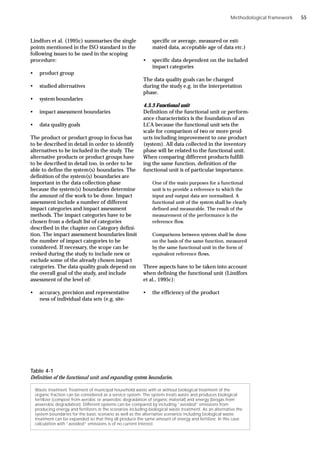
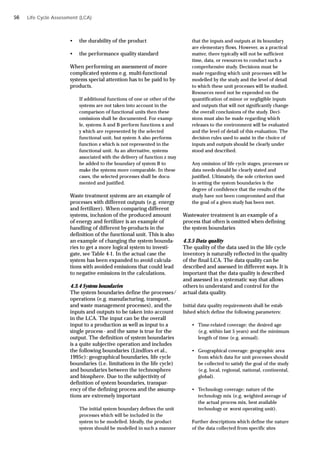
  • 85.
    Impact categories Table 4-8 Differentmethods for the assessment of human toxicological impacts. Method Effects concerned Criteria/comments Reference Critical volumes Water and air pollution The critical air volume are based on MIK-values BUS (1984)/ (“Maximale Immissions-Konzentration”) or MAK- Habersatter (1991) values (“Maximale Arbeitsplatzkonzentration”). The critical water volume are based on (Swiss) directives for emissions into surface water. The “provisional Human toxicity (not The provisional classification factors for human Heijungs et al. (1992) method” specified) - exposure by toxicity are derived from TCL (acceptable air, water and soil concentration in air), AQG (air quality guideline), TDI (tolerable daily intake) or ADI (acceptable daily intake). The classification factors are expressed by kg body weight/kg substance. The Tellus method Carcinogenic potency Classification factors for carcinogenic potency is Tellus Institute (1992) Non-carcinogenic effects expressed as “isophorone equivalents” and for Combined non-carcinogenic effects as “xylene equivalents”. Classification factors for the combined effects are derived from permissible exposure levels for the two effects. The MUP-method Irritation The method is based on exposure estimated. Jelnes et al. (1994)/ Allergenic reactions The method cover a screening LCA with Schmidt et al. (1994b) Organotoxicity qualitative results. Genotoxicity Carcinogenicity Neurotoxicity Teratogenicity The “toxicity Guinée & Heijungs potential approach” (1993)/Guinée et al. (1996) The “critical Jolliet (1994a;b) Jolliet & surface-time” Crettaz, 1996) Quantitative approach Acute toxicity (inhalation) Critical volume. The fate analysis include Hauschild et al. (1997b) Acute toxicity (oral intake) evaporation, deposition, and degradation. The human toxicology factors are based on LC50 /LD50 , LCLo /LDLo (Lethal Concentration/ Dose Low) or LOAEL (Lowest Observed Adverse Effect Level) for test animals, or LCLo /LDLo ,, NOAEL (No Observed Adverse Effect Level) or LOAEL for humans with partial fate analysis calculated as the contribution to ozone formation at peak ozone formation based on average of data from three different loca- tions in Europe. POCPs according to differ- ent models are given in Table 4-9. The photochemical ozone creation potential of certain processes can be estimated by summarising the POCPs for the VOCs: POCP (kg ethylene equivalents) = Si POCPi ´ mi A method considering only POCPs for VOCs is not sufficient to describe the impact category. A possible approach can be to divide the category in two subcategories: one category for nitrogen oxides (aggregated as NOx ) and one category for VOC (aggregated with POCP as weighting factor using an appropriate scenario or all the four above mentioned scenarios) as proposed by Lindfors et al. (1995a; 1995c) in the Nordic guideline for life cycle assessment. If the inventory data do not make it possible calculating total POCP based on weighting factors due to lack of information on the composition of the VOCs, it is suggested that the data be aggregated in the following subcategories: 1. Nitrogen oxides NOx 2. Hydrocarbons (HC) or volatile organic compounds (VOCs) 3. Carbon monoxide (CO) 4. Methane (CH4 ). Acidification Acidification is caused by releases of protons in the terrestrial or aquatic ecosystems. In the terrestrial ecosystem the effects are seen 87
  • 86.
    Life Cycle Assessment(LCA) Andersson-Sköld et al. (1992) Heijungs et al. (1992) Compound Maximum Ordinary Swedish High NOx Average for Range difference in background concentration three European concentration during 0-4 days during 0-4days locations Alkanes Methane - - - 0.007 0.000-0.030 Ethane 0.173 0.126 0.121 0.082 0.020-0.300 Propane 0.604 0.503 0.518 0.420 0.160-1.240 n-Butane 0.554 0.467 0.485 0.410 0.150-1.150 i-Butane 0.331 0.411 0.389 0.315 0.190-0.590 n-Pentane 0.612 0.298 0.387 0.408 0.090-1.050 i-Pentane 0.360 0.314 0.345 0.296 0.120-0.680 n-Hexane 0.784 0.452 0.495 0.421 0.100-1.510 2-Methylpentane 0.712 0.529 0.565 0.524 0.190-1.400 3-Methylpentane 0.647 0.409 0.457 0.431 0.110-1.250 2,2-Dimethylbutane - - - 0.251 0.120-0.490 2,3-Dimethylbutane - - - 0.384 0.250-0.650 n-Heptane 0.791 0.518 0.592 0.529 0.130-1.650 2-Methylhexane - - - 0.492 0.110-1.590 3-Methylhexane - - - 0.492 0.110-1.570 n-Octane 0.698 0.461 0.544 0.493 0.120-1.510 2-Methylheptane 0.691 0.457 0.524 0.469 0.120-1.460 n-Nonane 0.633 0.351 0.463 0.469 0.100-1.480 2-Methyloctane 0.669 0.454 0.523 0.505 0.120-1.470 n-Decane 0.719 0.422 0.509 0.464 0.080-1.560 2-Methylnonane 0.719 0.423 0.498 0.448 0.080-1.530 n-Undecane 0.662 0.386 0.476 0.436 0.080-1.440 n-Duodecane 0.576 0.311 0.452 0.412 0.070-1.380 Average - - - 0.398 0.114-1.173 Halogenated hydrocarbons Methylene chloride 0.000 0.000 0.000 0.010 0.000-0.030 Chloroform (CHCl3 ) 0.007 0.004 0.003 - - Methylchloroform 0.007 0.002 0.001 0.001 0.000-0.010 Trichloroethylene 0.086 0.111 0.091 0.066 0.010-0.130 Tetrachloroethylene 0.014 0.014 0.010 0.005 0.000-0.020 Allyl chloride (CH2 CHCH2 Cl) 0.561 0.483 0.667 - - Average - - - 0.021 0.003-0.048 Alcohols Methanol 0.165 0.213 0.178 0.123 0.090-0.210 Ethanol 0.446 0.225 0.317 0.268 0.040-0.890 i-Propanol 0.173 0.203 0.188 - - Butanol 0.655 0.214 0.404 - - i-Butanol 0.388 0.255 0.290 - - Butane-2-diol 0.288 0.066 0.216 - - Average - - - 0.196 0.065-0.550 Aldehydes Formaldehyde 0.424 0.261 0.379 0.421 0.220-0.580 Acetaldehyde 0.532 0.186 0.615 0.527 0.330-1.220 Propionaldehyde 0.655 0.170 0.652 0.603 0.280-1.600 Butyraldehyde 0.640 0.171 0.597 0.568 0.160-1.600 i-Butyraldehyde 0.583 0.300 0.677 0.631 0.380-1.280 Valeraldehyde 0.612 0.321 0.686 0.686 0.000-2.680 Acroleine 1.201 0.832 0.827 - - Benzaldehyde - - - 0.334 (-0.82)-(-0.12) Average - - 0.443 0.079-1.263 Ketones Acetone 0.173 0.124 0.160 0.178 0.100-0.270 Methyl ethyl ketone 0.388 0.178 0.346 0.473 0.170-0.800 Methyl i-butyl ketone 0.676 0.318 0.666 - - Average - - - 0.326 0.135-0.535 88
  • 87.
    Impact categories Esters Dimethylester 0.0580.067 0.046 - - Methyl acrylate - - - 0.025 0.000-0.070 Ethyl acetate 0.295 0.294 0.286 0.218 0.110-0.560 i-Propyl acetate - - - 0.215 0.140-0.360 n-Butyl acetate 0.439 0.320 0.367 0.323 0.140-0.910 i-Butyl acetate 0.288 0.353 0.345 0.332 0.210-0.590 Average - - - 0.223 0.120-0.498 Olefins Ethene 1.000 1.000 1.000 1.000 1.000 Propene 0.734 0.599 1.060 1.030 0.750-1.630 1-Butene 0.799 0.495 0.983 0.959 0.570-1.850 2-Butene 0.784 0.436 1.021 0.992 0.820-1.570 1-Pentene 0.727 0.424 0.833 1.059 0.400-2.880 2-Pentene 0.770 0.381 0.965 0.930 0.650-1.600 2-Methyl-1-butene 0.691 0.181 0.717 0.777 0.520-1.130 2-Methyl-2-butene 0.935 0.453 0.784 0.779 0.610-1.020 3-Methyl-1-butene - - - 0.895 0.600-1.540 Isobutene 0.791 0.580 0.648 0.634 0.580-0.760 Average - - - 0.906 0.650-1.498 Acetylenes Acetylene 0.273 0.368 0.291 0.168 0.100-0.420 Aromatics Benzene 0.317 0.402 0.318 0.189 0.110-0.450 Toluene 0.446 0.470 0.565 0.563 0.410-0.830 o-Xylene 0.424 0.167 0.598 0.666 0.410-0.970 m-Xylene 0.583 0.474 0.884 0.993 0.780-1.350 p-Xylene 0.612 0.472 0.796 0.888 0.630-1.800 Ethylbenzene 0.532 0.504 0.621 0.593 0.350-1.140 1,2,3-Trimethylbenzene 0.698 0.292 0.868 1.170 0.760-1.750 1,2,4-Trimethylbenzene 0.683 0.330 0.938 1.200 0.860-1.760 1,3,5-Trimethylbenzene 0.691 0.330 0.989 1.150 0.740-1.740 o-Ethyltoluene 0.597 0.408 0.637 0.668 0.310-1.300 m-Ethyltoluene 0.626 0.401 0.729 0.794 0.410-1.400 p-Ethyltoluene 0.626 0.443 0.682 0.725 0.360-1.350 n-Propylbenzene 0.511 0.454 0.531 0.492 0.250-1.100 i-Propylbenzene 0.511 0.523 0.594 0.565 0.350-1.050 Average - - - 0.761 0.481-1.258 Other Methylcyclohexane 0.403 0.386 0.392 - - Isoprene 0.532 0.583 0.768 - - Dimethylether 0.288 0.343 0.286 - - Propylene glycole methyl ether 0.770 0.491 0.497 - - Propylene glycole methyl ether acetate 0.309 0.157 0.143 - - Carbonmonoxide 0.036 0.040 0.032 - - Table 4-9 Photochemical ozone creation potentials different organic compounds Andersson-Sköld et al. (1992) Heijungs et al. (1992) Compound Maximum Ordinary Swedish High NOx Average for Range difference in background concentration three European concentration during 0-4 days during 0-4days locations 89
  • 88.
    Life Cycle Assessment(LCA) in softwood forests (e.g. spruce) as ineffi- cient growth and as a final consequence dieback of the forest. These effects are mainly seen in Scandinavia and in the middle/eastern part of Europe. In the aquatic ecosystem the effects are seen as (clear), acid lakes without any wildlife. These effects are mainly seen in Scandinavia. Buildings, constructions, sculptures and other objects worthy of preservation are also damaged by e.g. acid rain. Substances are considered to have an acidifi- cation effect if they result in (Hauschild & Wenzel, 1997d): • Supply or release of hydrogen ions (H+ ) in the environment • Leaching of the corresponding anions from the concerned system The potential effects are strongly dependent on the nature of the receiving ecosystem e.g. nitrogen oxides (NOx ) can be fixed in the ecosystem due to uptake in plants. This problem can be managed by using two scenarios as suggested by Lindfors et al. (1995a). In the two scenarios the acidifica- tion potential from NOx and NH3 are calcu- lated as zero and as the theoretical maxi- mum value respectively. Lindfors et al. (1995c) recommend that the following substances should be considered: SO2 , NOx , NH3 and HCl but also other substances having a proton releasing effect have to be considered (i.e. other sulfur compounds and other acids). The acidification potential (AP) can be estimated as SO2 equivalents or as mole hydrogen (H+ ). The acidification potentials for acidifying substances are given in Table 4-10. The potential acidification effect of a given process can be estimated by summarising the acidification potentials for the actual sub- stances: Acidification potential (SO2 -equivalents) = i APi x mi Eutrophication Eutrophication (or nutrient enrichment) of aquatic and terrestrial ecosystems can be caused by surplus nitrogen, phosphorus and degradable organic substances. Eutrophica- tion can be defined as: enrichment of aquatic ecosystems with nutrients leading to increased production of plankton algae and higher aquatic plants leading to a deteriora- tion of the water quality and a reduction in the value of the utilisation of the aquatic ecosystem. The primary effect of surplus nitrogen and phosphorus in aquatic ecosystems is growth of algae. The secondary effect is decomposi- tion of dead organic material (e.g. algae) and anthropogenic organic substances. The decomposition of organic material is an oxygen consuming process leading to decreasing oxygen saturation and sometimes anaerobic conditions. The anaerobic condi- tions in the sediment at the bottom of lakes or other inland waters may furthermore result in production of hydrogen sulfide (H2 S) which may lead to “bottom up” inci- dents and liberation of toxic hydrogen sulfide to the surrounding water. The possi- ble effects of the emissions leading to eutrophication depend on the receiving waters i.e. some recipients are sensitive to nutrient supply while others are not. The effects of eutrophication of terrestrial ecosystem are seen on changes in function and diversity of species in nutrient poor ecosystems as heaths, dune heaths, raised bogs etc. and they are caused by atmospheric deposition of nitrogen compounds. Lindfors et al. (1995c) present two methods to calculate the eutrophication potential: 1) a separate aggregation method and 2) a scenario-based approach. The separate aggregation method divides the loadings in four subcategories to be calculated sepa- rately: 1. Organic material to water measured as BOD5 2. Total-N to water as kg N 3. Total-P to water as kg P 4. Total-N to air as kg N In the scenario-based approach the eutrophi- cation category is suggested to be divided into two subcategories considering aquatic ecosystems and terrestrial ecosystems, respec- tively. The reason for using the scenario- based approach is to take the conditions of the receiving ecosystems into account, because P is the limiting factor in some circumstances and N is the limiting factor in other. It is assumed that only the limiting factor contributes to the eutrophication and therefore, the aggregation can be done in the following subcategories: 90
  • 89.
    Impact categories Table 4-10 Acidificationpotentials for acidifying substances (Hauschild & Wenzel, 1997d). Substance Formula Reaction Molar weight AP g/mole kg SO2 /kg Sulfur dioxide SO2 SO2 +H2 OÝH2 SO3 Ý2H+ +SO3 2- 64.06 1 Sulfur trioxide SO3 SO3 +H2 OÝH2 SO4 Ý2H+ +SO4 2- 80.06 0.80 Nitrogen dioxide NO2 NO2 +½H2 O+1/4O2 ÝH+ +NO3 H- 46.01 0.70 Nitrogen oxide NO NO+O3 +½H2 OÝH+ +NO3 - +3/4O2 30.01 1.07 Hydrogen chloride HCl HClÝH+ +Cl- 36.46 0.88 Hydrogen nitrate HNO3 HNO3 ÝH+ +NO3 - 63.01 0.51 Hydrogen sulfate H2 SO4 H2 SO4 Ý2H+ +SO4 2+ 98.07 0.65 Hydrogen phosphate H3 PO4 H3 PO4 Ý3H+ +PO4 3- 98.00 0.98 Hydrogen fluoride HF HFÝH+ +F- 20.01 1.60 Hydrogen sulfide H2 S H2 S+3/2O2 +H2 OÝ2H+ +SO3 2- 34.03 1.88 Ammonium NH3 NH3 +2O2 ÝH+ +NO3 - +H2 O 17.03 1.88 Table 4-11 Eutrophication potentials (EP) for different scenarios as O2 - or PO4 -equivalents (Lindfors et al., 1995c). Substance N to air P-limited N-limited N-limited + N Maximum Maximum kg kg O2 /kg kg O2 /kg kg O2 /kg to air kg O2 /kg kg O2 /kg PO4 -eq./kg N to air 20 0 0 20 20 0.42 NOx to air 6 0 0 6 6 0.13 NH3 to air 16 0 0 16 16 0.35 N to water 0 0 20 20 20 0.42 NO3 - to water 0 0 4.4 4.4 4.4 0.1 NH4 + to water 0 0 15 15 15 0.33 P to water 0 140 0 0 140 3.06 PO4 3- 0 46 0 0 46 1 COD 0 1 1 1 1 0.022 Substance Mw g/mole EP(N) kg N/kg EP(P) kg P/kg EP kg NO3 /kg NO3 - 62 0.23 0 1 NO2 46 0.30 0 1.35 NO2 - 46 0.30 0 1.35 NO 30 0.47 0 2.07 NH3 17 0.82 0 3.64 CN- 26 0.54 0 2.38 Total-N 14 1 0 4.43 PO4 3- 95 0 0.33 10.45 P2 O7 2- 174 0 0.35 11.41 Total-P 31 0 1 32.03 Table 4-12 Eutrophication potentials (EP) as total-N, total-P or NO3 -equivalents (Hauschild & Wenzel, 1997e). 91
  • 90.
    Life Cycle Assessment(LCA) 1. Total-N to air (terrestrial effects) 2. Total-P emissions and emission of or- ganic material to water 3. Total-N emissions and emission of organic material into water 4. Total-N emissions and emission of organic material into water and N emissions to air 5. Total-P and -N emissions to air and water and also emission of organic material to water (assuming that both N, P and organic material contribute) The eutrophication potential (EP) can be expressed as O2 - or PO4 -equivalents and is presented in Table 4-11 for a number of substances. Hauschild & Wenzel (1997e) have calculated EP as total-N, total-P and NO3 -equivalents; Table 4-12. The eutrophication potential of a certain process can be estimated by summarising the eutrophication factors for the organic material, P- and N-containing substances: Eutrophication potential (O2 -equivalents) = i eutrophication potentiali x mi The eutrophication can also be expressed as PO4 3- -equivalents. In this approach, no differentiation is made between ecosystems limited by different nutrients (Lindfors et al., 1995c). Work environment The impact category “work environment” covers the same effects as mentioned in the subchapter on human toxicological impacts supplemented by non-chemical effects. The human toxicological effects caused by exposure to biological or chemical sub- stances can be: • Acute toxicological effects • Irritation • Allergenic reactions • Genotoxicity • Carcinogenicity • Neurotoxicity • Teratogenicity In contrast to the assessment of human toxicological effects caused by environmen- tal emissions, assessment of the effects in the work environment requires information on actual concentration levels. Information on concentration levels in the work environ- ment is normally not included in the inven- tory. The non-chemical effects caused by heat, noise, monotonous working conditions e.g. repetitive work can be: • Hearing impairments • Psychological damage • Pain in muscles • Pain in joints Accidents may result in bodily harm or acute toxicological effects caused by accidental leakages etc. The human toxicological effects in the work environment differ from the effects caused by emissions of the same substances from the production to the external environment, resulting in substan- tial effects on a few persons, whereas human toxicological effects in the external environ- ment are characterised by small effects on many persons (Bengtsson & Berglund, 1996). A number of different methods to assess work environment in relation to life cycle assessment have been developed and they have been presented and compared at a workshop arranged by LCANET (Potting et al., 1997): • Chem-methodology (Terwoert, 1994a; b; c) • EDIP-methodology (Rasmussen, 1997) • IVF-methodology (Bengtson & Berglund, 1996) • IVL-methodology (Antonsson & Carlson, 1995) • MUP-methodology (Jelnes et al., 1994; Schmidt et al., 1994b) • PVC-methodology (Christiansen et al., 1993) • STØ-methodology (Bjørnsen et al., 1995; Møller et al., 1995; Rønning et al., 1995; Økstad et al., 1995) 92
  • 91.
    Impact categories Method Effectsconcerned Criteria/comments Reference Chem-methodology Physical The method is based on exposure estimates Terwoert (1994a; b; c) Physiological and effect registration. The method covers Chemical a screening LCA with qualitative results. Biological Risk of accidents EDIP-methodology Physical The method is based on exposure estimates Rasmussen (1997) Chemical and effect registration. The method covers Risk of accidents a detailed LCA with quantitative results. IVF-methodology Physical The method is based on exposure measurements Bengtson & Berglund Physiological and estimates and effect registration. (1996) Psychological Chemical Risk of accidents IVL-methodology Physical The method is based on exposure measurements Antonsson & Carlson Physiological and estimates and effect registration. The method (1995) Psychological covers a screening LCA with qualitative Chemical and quantitative results. Biological Risk of accidents MUP-methodology Physical The method is based on exposure estimates. Jelnes et al. (1994); Chemical The method covers a screening LCA Schmidt et al. (1994b) Risk of accidents with qualitative results, combined with a scoring methodology. PVC-methodology Physical The method is based on exposure estimates. Christiansen et al. (1993) Chemical The method covers a screening LCA Risk of accidents with qualitative results. STØ-methodology Chemical The method is based on exposure estimates. Bjørnsen et al. (1995); The method covers a detailed LCA with Møller et al. (1995); quantitative results. Rønning et al. (1995); Økstad et al. (1995) Table 4-13 Different methods for assessment of work environment. The present methods are described briefly in Table 4-13. International consensus on specific methods for assessing work environment has not yet been reached and development of some of the methods is still in progress. 93
  • 92.
    5. LCA InformationSources The following sections gives an overview of some of the most important sources of information about LCA. The overview is not complete, but is meant as a starting point for companies, institutions and individuals wanting to enter the area of life cycle assess- ment, or to maintain and extend already existing knowledge. The following information sources are described: • Newsletters and Journals • Books, Reports, Proceedings, etc. • LCA Software • Internet Facilities When contemplating ordering information sources from the overview it should be borne in mind, that recent publications generally are of a much higher quality than books and reports from the beginning of the nineties as they supposedly reflect the international development in the area. However, no further assessment of the quality of the information sources is given in the overview. 5.1 Newsletters and Journals with LCA Content A number of journals and newsletters with LCA content have appeared during the last few years. Most publications have other issues as the main content, e.g. ecolabelling, waste management and cleaner technology, but they also feature LCA-news and/or articles on LCA on a regular basis. Newslet- ters and journals must be considered as key information sources to recent developments due to their short production time. A list of journals addressing environmental issues (not only LCA) can be found at the Internet at http://www.lib.kth.se/~lg/ejourn.htm. 5.1.1 Newsletters SETAC-Europe LCA News The newsletter is published bi-monthly and is send to all SETAC-Europe members. The newsletter is free of charge and its possible to be added to the mailing list by contacting SETAC-Europe, Av.E.Mounier 83, box 1, 1200 Brussels, Belgium Tel. +32-2-772.72.81, Fax +32-2-770.53.86 or E-mail 100725.3525@ compuserve.com. Editor is Roland Clift, Centre for Environmental Strategy, Univer- sity of Surrey, Tel. +44 1483 259 047, Fax +44 1483 259 394, E-mail J.Libaert@surrey.ac.uk. SETAC-US LCA News The SETAC-US newsletter highlights envir- onmental topics, SETAC activities, employ- ment opportunities, and meetings of inter- est. A special section is devoted to LCA. The bimonthly newsletter is mailed to SETAC members, but can also be ordered from SETAC, 1010 North 12th Avenue, Pensacola, FL 32501-3370, U.S.A. Tel: +1 904-469-1500, Fax +1 904-469-9778, E-mail: setac@setac.org. The newsletter (Jan 1997 and forward) is also available on the Internet: http://www. setac.org/news.html. APME Communique The newsletter Communique primarily contains information on packaging news from the plastics industry. It is published by the Association of Plastics Manufacturers in Europe (APME) and can be ordered from APME, Av. E. Van Nieuwenhuyse 4, Box 3, B- 1160 Brussels, Belgium Tel. (32-2) 672 82 59 Fax (32-2) 675 39 35 CSA Environmental Update The Canadian Standards Association (CSA) publishes the Environmental Update news- letter three times a year. The newsletter primarily addresses environmental manage- ment and can be ordered from CSA Corpo- rate Communications Fax (416) 747-4292. Ecocycle The newsletter Ecocycle is published bi- annually by Environment Canada and contains information on development of life- cycle management tools and product policy. The newsletter is free of charge and can be ordered at Tel. 1-819-997-3060 or Fax 1-819- 953-6881 or E-mail kbrady@synapse.net. The newsletter is also available through the Internet at http://www.doe.ca/ecocycle. EPA LCA Project Update The EPA LCA Project Update Newsletter is designed to provide information about ongoing EPA LCA-related projects and upcoming activities. The publisher is the US 95
  • 93.
    Environmental Protection Agency(EPA), Office of Research and Development, LCA Research Program. The newsletter is avail- able through the Internet and can also be received in a paper version by sending a request to Keith Weitz at Research Triangle Institute (E-mail: kaw@rti.org or Fax +1-919- 541-7155). ESU-INFO The newsletter is published by The Energy- Materials-Environment Group (ESU - in German Gruppe Energie-Stoffe-Umwelt) at ETH in Switzerland. The newsletter is primarily for costumers of the “Ökoinventare von Energie-systemen”, but also contains information on new publications and projects. Information: Rolf Frischknecht at Institut für Energietechnik at ETH in Zürich at Tel. +01 632 12 83 or E-mail: frischknecht@iet.mavt.ethz.ch Integrated Environmental Management The newsletter primarily gives information and advice on environmental issues for management. Published by Blackwell Scien- tific Publications, Osney Mead, Oxford OX2 0EL, UK. Tel: +44 865 206 206. ISWA Times ISWA TIMES is a quarterly newsletter of the International Solid Waste Association. The newsletter is designed to keep members and other professionals informed of relevant issues, e.g. legislation, environmental audit- ing, and risk analysis. Publisher: ISWA Gen- eral Secretariat, Bremerholm 1, DK-1609 Copenhagen K, Denmark. Tel: +45 3391 4491. Warmer Bulletin Warmer Bulletin is published six times a year, the main content being information on sustainable waste management and resource recovery. The bulletin is published by the World Resource Foundation, Bridge House, High Street, Tonbridge, Kent TN9 1DP, UK. Tel: +44 1732 368 333. E-mail: wrf@gn.apc.org, Internet:http:// www.wrfound.org.uk. 5.1.2 Journals International Journal of Life Cycle Assessment The journal is a forum for scientists develop- ing LCA-methodology, LCA practitioners, environmental managers, governmental agencies and other ecological institutions and bodies. The journal has ISSN 0948-3349. The editor-in-chief is Walter Klöpffer, C.A.U. The journal can be ordered from Ecomed Publishers. Tel. +49-81 91-125-469, Fax +49- 81 91-125-492. Air and Waste The journal is published monthly by the Air and Waste Management Association, One Gateway Center, Third Floor, Pittsburg, PA 15222, USA. Environmental Impact Assessment Review Environmental Impact Assessment Review is a quarterly publication for planners, engin- eers, scientists, policy makers and administra- tors committed to improving the theory and practice of environmental decision making. Lawrence Susskind is senior editor and the journal is published by Elsevier Science Publishing Co., Inc., 655 Avenue of the Americas, New York, NY 10010. Environmental Toxicology and Chemistry (ET&C) ET&C is a monthly publication of SETAC and is distributed for free to members of SETAC. The journal is dedicated to further- ing scientific knowledge and disseminating information environmental toxicology and chemistry, including the application of these sciences to hazard/risk assessment. With SETAC being a main forum for the develop- ment of LCA methodology, the ET&C journal frequently features articles on LCA. The journal can be ordered from SETAC PRESS, 1010 North 12 Avenue, Pensacola, FL 32501-3370, USA. Tel: +1 904 469 1500, Fax: +1 904 469 9778, E-mail: setac@setac. org, Internet: http://www.setac.org. International Journal of Environmentally Con- scious Design & Manufacturing The International Journal of Environmen- tally Conscious Design and Manufacturing aims at providing a medium for the dissemi- nation of accurate information about the impact and the short-term as well as the long- term effects of design and manufacturing on the environment. The journal is published four times a year by ECM Press: PO Box 20959, Albuquerque, NM 87154-0959, USA. At the homepage http://ie.uwindsor.ca/ ecdm/journal it is possible to read abstracts of articles from the Journal. Journal of Cleaner Production The quarterly journal aims to encourage industrial innovation, new and improved products, and the implementation of new, cleaner process technologies as well as governmental policies and educational programs essential for ensuring continuous progress towards sustainability. The ISSN No. is 0959-6526. It can be ordered from Elsevier Science Ltd, The Boulevard, Langford Lane, Kidlington, Oxford OX5 1GB, UK. Fax: +44 Life Cycle Assessment (LCA) 96
  • 94.
    LCA Information Sources (0)1865 843952. Homepage: http://www. elsevier.nl/locate/jclepro. Waste Management & Research The journal is a bi-monthly publication issued under the auspices of ISWA, the International Solid Waste and Public Cleans- ing Association. The journal publish papers on all aspects of solid waste management, but the main focus on the discussion of solutions to problems that arise primarily with municipal and industrial solid wastes. Publisher: Academic Press, 24-28 Oval Road, London NW1 7DX, UK. Homepage: http:// www.hbuk.co.uk/ap/journals/wm.htm. 5.2 Books, Reports, Conference Proceedings, etc. The development and use of LCA has been documented in a large number of reports, books and proceedings from workshops and conferences. Many publications must be considered as “grey” or “yellow” literature, i.e. they have been published without a scientific peer review and without proper identification possibilities, e.g. a ISSN- or ISBN-number. Despite these shortcomings the publications still hold important infor- mation and are included in the overview. The section on books, reports and confer- ence proceedings is divided into the sub- sections “Methodology issues”, “Data sources (paper)”, “Standards”, and “Miscellaneous references”. Please notice that books in either subsection also may contain informa- tion which is relevant in another subsection. The lists of references are in reverse chrono- logical order and with the title of the refer- ence given first. In doing so, we believe that it will be easier to find the documents that are of special relevance to the reader. 5.2.1 Methodology issues The reports listed in this section reflect to a certain extent the historic development of LCA-methodology, starting with the early SETAC report “A technical framework for Life Cycle Assessment” and ending with the most recent methodology suggestions. As outlined in the chapter on the methodo- logical framework no consensus exist on how to treat a number of environmental effects in LCA, but the reports may give a valuable overview of the ideas generated during the development of LCA methodology. It should be noted that a number of other publica- tions addressing methodology issues can be found under the heading “Miscellaneous references”. Environmental Assessment of Industrial Products. Edited by Wenzel H, Hauschild M and Alting L (1997). Volume 1: Tools and Case studies and Volume 2: Scientific Background. Chapman & Hall, London. Towards a methodology for life cycle impact assessment. Udo de Haes HA (ed.) (1996). Society of environmental Toxicology and Chemistry (SETAC) - Europe. Brussels. Miljøvurdering af produkter (Environmental assessment of Products). Wenzel H, Hauschild M, Rasmussen E (1996). Dansk Industri. (In Danish). ISBN 87-7810-542-0. Life cycle assessment and conceptually related programmes. Draft. de Smet B, Hemming C, Baumann H, Cowell S, Pesso C, Sund L, Markovic V, Moilanen T, Postlethwaithe D (1996). Life Cycle Assessment (LCA) - Quo vadis? Schaltegger S (ed.), Braunschweig A, Büchel K, Dinkel F, Frischknecht R, Maillefer C, Ménard M, Peter D, Pohl C, Ros M, Sturm A, Waldeck and Zimmermann P (1996). Swiss Priority Programme Environment of the Swiss National Science Foundation Synthesis. Birkhäuser Verlag AG. Life Cycle Assessment as an Environmental systems analysis tool - with a focus on system boundaries. Finnveden G (1996). Licentiate thesis at Applied Electrochemistry, Depart- ment of Chemical Engineering and Technol- ogy at Royal Institute of Technology, KTH, Stockholm. AFR, Swedish Environmental Protection Agency, Sweden. SETAC EUROPE LCA Screening and Stream- lining Working Group. Final report, Draft 3. Christiansen K (ed.) (1996). Research needs in life cycle assessment for the EU ecolabelling programme. Udo de Haes HA, Bensahel J-F, Clift R, Griesshammer R and Jensen AA (1995). Groupe des Sages. Final report of second phase. Leiden LCA-Nordic Technical Reports No. 1 - 9. Lindfors L-G, Christiansen K, Hoffmann L, Virtanen Y, Juntilla V, Hanssen OJ, Rønning A, Ekvall T and Finnveden G (1995). TemaNord 1995:502. Copenhagen: Nordic Council of Ministers. ISBN 92 9120 608 3, ISSN 0908-6692. 97
  • 95.
    LCA-Nordic Technical ReportNo. 10 and Special Reports No. 1 - 2. Lindfors L-G, Christiansen K, Hoffmann L, Virtanen Y, Juntilla V, Hanssen OJ, Rønning A, Ekvall T and Finnveden G (1995). TemaNord 1995:503. Copenhagen: Nordic Council of Ministers. ISBN 92 9120 609 1, ISSN 0908-6692. Nordic Guidelines on Life-Cycle Assessment. Lindfors L-G, Christiansen K, Hoffmann L, Virtanen Y, Juntilla V, Hanssen OJ., Rønning A, Ekvall T and Finnveden G (1995). Nord 1995:20. Copenhagen: Nordic Council of Ministers. Miljöanpassad produktudveckling (Environmen- tally Sound Product Development). Ryding S-O (1995). Industriförbundet. (In Swedish) Overview of the scientific peer review of the European life cycle inventory for surfactant production. Klöpffer W, Griesshammer R, and Sundström G (1995). Tenside Surf.Det. 32(5):378-83. Life cycle assessment and treatment of solid waste. Proceedings of the international workshop Septem- ber 28-29, Stockholm. Finnveden G, Huppes G (editors) (1995). AFR-report 98, Stockholm. Life cycle assessment. A comparison of three methods for impact analysis and evaluation. Baumann H and Rydberg T. J.Cleaner Prod. 2(1):13-20, 1994. Metoder, vurderingsgrundlag og fremgangsmåde. Livscyklusvurdering af nye materialer (Methods, Assessment and Procedures. Life cycle assessment of new materials). Schmidt A, Christiansen K and Pommer K. (eds.) (1994). dk-TEKNIK, Søborg (In Danish with English summary). Allocation in LCA. Proceedings of the European Workshop on allocation in LCA at CML, Leiden 24-25 February, 1994. Huppes G and Schnei- der F (editors) (1994). CML, Leiden. ISBN 90-5191-078-9 (CML). Integrating impact assessment into LCA. Proceed- ings of the LCA symposium held at the fourth SETAC-Europe Congress 11-14 April 1994. Udo de Haes HA, Jensen AA, Klöpffer W and Lindfors L-G (editors) (1994). SETAC, Brussels. Impact assessment within LCA. Grisel L, Jensen AA, Klöpffer W (1994). Society for the Promotion of LCA Development (SPOLD), Brussels. Guidelines for the application of life cycle assess- Life Cycle Assessment (LCA) ment in the EU ecolabelling programme. Udo de Haes HAU, Bensahel J-F, Clift R, Fussler CR, Griesshammer R and Jensen AA (1994). Groupe des Sages. Final report of the first phase. Leiden A Conceptual Framework For Life-Cycle Impact Assessment. Fava J, Consoli F, Denison R, Dickson K, Mohin T and Vigon B (1993). Workshop Report. SETAC and SETAC Foundation for Environmental Education, Inc., Sandestin, Florida USA, March 1993 Guidelines for Life-Cycle Assessment: a “Code of Practice”. Consoli F, Allen D, Boustead I, de Oude N, Fava J, Franklin R, Jensen AA, Parrish R, Perriman R, Postlethwaite D, Quay B, Séguin J and Vigon B (eds.) (1993). Report of the workshop organised by SETAC in Portugal. Life cycle design guidance manual. Environmen- tal requirements and the product system. Keoleian GA and Menerey D (1993). EPA600/R-92/ 226. USEPA, Cincinnati, Ohio. Weighing up the environmental balance. Anon (1993). APME/PWMI, Brussels, Ecoprofiles of the European polymer industry. Report 7 Principles of plastics recycling. Boustead I (1993). APME/PWMI, Brussels) Life cycle assessment: Inventory, classification, valuation, data bases. Workshop report from the workshop in Leiden 2-3 December 1991. (1992). SETAC-Europe, Brussels. Life-Cycle Assessment Data Quality. Fava J, Jensen AA, Lindfors L, Pomper S, de Smet B, Warren J and Vigon B. Workshop Report. SETAC and SETAC Foundation for Environ- mental Education, Inc., Wintergreen, Vir- ginia, October 1992 Eco-balance methodology for commodity thermo- plastics. Boustead I (1992). Brussels: APME/ PWMI. Product life-cycle assessment: Inventory guidelines and principles. Batelle and Franklin Associates (1992). RREL, EPA/600/R-92/036. Product life cycle assessment - principles and methodology. Lindfors, L.G. (editor). Nord 1992:9. Nordic Council of Ministers, Copen- hagen, 1992. Environmental life cycle assessment of products. Heijungs R, Guinée JB, Huppes G, Lankreijer RM, Udo de Haes HA, Sleeswijk 98
  • 96.
    LCA Information Sources AW,Ansems AMM, Eggels PG, van Duin R, de Goede HP (1992). I Guide; II Back- grounds. CML, Leiden. Resource and environmental profile analysis: A life cycle environmental assessment for products and procedures. Hunt RG, Sellers JD and Franklin WE (1992). Environ Impact Assess Rev 12:245-269. Eco-balance methodology for commodity thermo- plastics. Boustead I (1992). APME/PWMI, Brussels. A Technical Framework for Life-Cycle Assessment. Fava J, Denison R, Jones B, Curran MA, Vigon B, Selke S and Barnum J. SETAC and SETAC Foundation for Environmental Education, Inc., Washington, January 1991 Oekobilanz von Packstoffen Stand 1990. Habersatter, K. Schriftenreihe Umwelt. Nr. 132. BUWAL, Bern, 1991. Methodik für Öekobilanzen auf der basis öeko- logischer Optimierung. Ahbe S, Braunschweig A and Müller-Wenk (1990). Schriftenreihe Umwelt Nr. 133, BUWAL, Bern. 5.2.2 Databases (paper) One of the most prominent problems in LCA is the lack of available data for many raw materials, intermediates, energy tech- nologies and transportation modes. The following section identifies some of the most commonly used data sources, but it should be remembered that many of these are rather old and that they therefore may be of limited value. The limited value is caused by two factors, i.e. the information does not necessarily reflect today’s technological level (some data are collected in the early 80’es), and the procedure for data collection and presenta- tion is most probably not in accordance with the requirements outlined in the SETAC Code of Practice or in the ISO standard. An overview of available life cycle data sources can be found in “Directory of life cycle inventory data sources. Hemming C (1995). SPOLD, Brussels”. This book gives informa- tion on databases in both electronic and book format. For each data source there is a description of the accessibility (price, hard- ware requirements) and the content in terms of both included commodities, fuels and services and data quality (geographical scope, timeframe, original data source, data checking, etc.) For databases in electronic format, please refer to the reference above and to the section on LCA software. European database for corrugated board life cycle studies. FEFCO, Groupement Ondulé, and Kraft Institute (1996). Paris. Ecobalance of Packaging Materials (1996). Schriftenreihe Umwelt 250, BUWAL, Bern. Ecological profile report for the European Alu- minium Industry. Boustead I (1996). Brussels: European Aluminium Association. Eco-profiles of the European plastics industry. Report 9 Polyurethane precursors (TDI, MDI, Polyols) (1996). Boustead I. PWMI, Brussels. Vergleichende ökologische Bewertung von Anstrichstoffen im Baubereich. von Däniken A and Chudacoff M (1995). Schriftenreihe Umwelt Nr. 232, Band 2: Daten. BUWAL, Bern. Eco-profiles of the European plastics industry. Report 8: Polyethylene terephthalate (PET). Boustead I (1995). PWMI, Brussels. Transporters miljöpåverkan i et livscykelperspektiv. Eriksson E, Svensson G, Lövgren G et al. (1995). FoU 126. Stiftelsen Reforsk, Malmö. A life-cycle inventory for the production of petro- chemical intermediates in Europe. Franke M, Berna JL, Cavalli L et al. (1995). Tenside Surf.Det. 32(5):384-96. A life-cycle inventory for the production of oleochemical raw materials. Hirsinger F, Schick K, and Stalmans M (1995). Tenside Surf.Det. 32(5):420-32. A life-cycle inventory for the production of deter- gent-grade alcohols. Hirsinger F, Schick K, and Stalmans M (1995). Tenside Surf.Det. 32(5):398-410. A life-cycle inventory for the production of sulphur and caustic soda in Europe. Postletwaite D, Schul W and Stalmans M (1995).Tenside Surf. Det. 32(5):412-8. European Life Cycle Inventory for Detergent Surfactants Production. Stalmans M, Berenbold H, Berna JL et al (1995). Tenside Surf.Det. 32(2):84-109. Eco-profiles of the European Plastics industry. Report 5: Co-product allocation in chlorine plants. Boustead I (1994). PWMI, Brussels. 99
  • 97.
    Eco-profiles of theEuropean Plastics industry. Report 6: Polyvinyl chloride. Boustead I (1994). PWMI, Brussels. Öekoinventare für Energiesysteme. Frischknecht, R., Hofstetter, P., Knoepfel, I., Ménard, M., Dones, R., and Zollinger, E. (editors) (1994). Bundesamt für Energiewirtschaft, Zürich. Mineral commodities summaries 1993. U.S.Bureau of Mines (1993). U.S. Bureau of Mines, Washington. US Government print- ing office 337_168, 70638. Eco-profiles of the European Plastics industry. Report 2: Olefin feedstock sources. Boustead I (1993). PWMI, Brussels. Eco-profiles of the European plastics industry. Report 3: Polyethylene and polypropylene. Boustead I (1993). PWMI, Brussels. Eco-profiles of the European plastics industry. Report 4: Polystyrene. Boustead I (1993). PWMI, Brussels. World resources 1992-93. World Resources Institute (1992). Oxford University Press, New York Oxford. ISBN 0-19-506231-0. Livscykelanalyser för förpackningsmaterial/ Packaging and the Environment. Tillmann A, Baumann H, Eriksson E. et al. (1991). SOU 1991:77. Miljödepartementet, Stockholm. Oekobilanz von Packstoffen Stand 1990. Habersatter K (1991). Schriftenreihe Um- welt. Nr. 132. BUWAL, Bern. 5.2.3 Standards Standards for Life Cycle Assessment and its applications are still under development. The references given below are to standards on different levels of completion (FDIS = Final Draft International Standard, DIS = Draft International Standard, CD = Commit- tee Draft, WD = Working Draft) and to the name of the Subcommittee (SC) and Workgroup (WG) developing the standard. Please refer to your national standard organisation for further information. ISO standards (drafts) Environmental Labels and Declarations - General Principles (ISO CD 14020). ISO/TC 207/SC3/ WG3. Environmental Labels and Declarations - Envir- onmental Labelling-Self Declared Environmental Claims-Terms and Definitions (ISO DIS 14021). ISO/TC 207/SC3/WG2. Environmental Labels and Declarations - Envir- onmental Labelling-Self Declared Environmental Claims-Symbols (ISO CD 14022). ISO/TC 207/ SC3/WG2. Environmental Labelling-Self Declared Environ- mental Claims-Testing and verification Method- ologies (ISO WD 14023). ISO/TC 207/SC3/ WG2. Environmental Labels and Declarations - Envir- onmental Labelling Type I - Guiding Principles, and procedures (ISO CD-2 14024). ISO/TC 207/SC3/WG1. Environmental Labels and Declarations - Envir- onmental Labelling Type III - Guiding Principles, and procedures (ISO pre-WD 14024). ISO/TC 207/SC3/WG1. Evaluation of Environmental Performance (ISO CD 14031). ISO TC 207/SC4/WGs 1-2. Life Cycle Assessment - Principles and Guidelines (ISO FDIS 14040). ISO TC 207/ SC5/WG1. Life Cycle Assessment - Life Cycle Inventory Analysis (ISO DIS 14041). ISO TC 207/SC5/ WGs 2-3. Life Cycle Assessment - Impact Assessment (ISO CD 14042). ISO TC 207/SC5/WG4. Life Cycle Assessment - Interpretation (ISO CD 14043). ISO TC 207/SC5/WG5. CEN-standards (drafts) Terminology, symbols and criteria for life cycle analysis of packaging. CEN/TC261/SC4/W1 Canadian LCA-standards (final) Life Cycle Assessment, Standard CAN/CSA- Z760, 1994. Life Cycle Review (supporting CAN/CSA-Z760), 1994. Design for Environment, Standard CAN/CSA- Z762, 1995. The Canadian standards can be ordered from: Standards Sales Canadian Standards Association 178 Rexdale Blvd Rexdale (Toronto), Ontario Canada M9W 1R3 tel 416-747-4044, fax 416-747-2475 5.2.4 Applications of LCA This section contain a number of other Life Cycle Assessment (LCA) 100
  • 98.
    LCA Information Sources papersand reports which are of interest with respect to different applications of LCA. Some of the reports also include a descrip- tion of the methodology used. Many reports of similar content and quality are missing in the reference list. The main reason for this is that they are not publicly available. Please refer to the database of LCA actors for more information on LCA projects etc. Projekte mit Bezug zu Ökobilanzen und Lebensweganalysen. Scheibe U, Neitzel H (1997). Fachgebiet III 1.3, Umweltsbundesamt, Berlin. Iterative screening LCA in an Eco-design tool. Fleischer G and Schmidt W-P (1997 ). Int. J. LCA 2(1): 20-24. Miljøvenlige komfurer og ovne. Schmidt A, Christensen BH, Jensen AA (1996). Miljøprojekt Nr. 338. Miljøstyrelsen, København. (In Danish). Overall Business Impact Assessment (OBIA). Taylor AP, Postlethwaite D (1996). Presenta- tion Summaries, SETAC EUROPE 4th Symposium for Case Studies, Brussels, 3 December 1996. Sustainable product development. Hansen OJ, Rønning A and Rydberg T (1995). Final report from the NEP project. Østfold Re- search Foundation, Fredrikstad. Application of life cycle assessments (LCA). Christiansen K, Heijungs R, Rydberg T et al. (eds.) (1995). Report from expert workshop at Hankø, Norway on LCA in Strategic management, product development and improvement, marketing and ecolabelling, governmental policies. Østfold Research Foundation report 07/95. Life cycle screening of food products. Weidema BP, Pedersen RL and Drivsholm T (1995). ATV, Copenhagen. Miljømæssig kortlægning af emballager til øl og læskedrikke. Pommer K, Wesnæs MS (1995). Arbejdsrapport fra Miljøstyrelsen Nr. 62, Copenhagen. (In Danish). Decision support system for environmental sounder purchase of catering materials and products for inflight services. Christiansen K, Hoffmann L (1995). Prepared by Krüger Consult A/S for SAS and Danish Agency of Environmental Protection. Sustainable development by design: Review of life cycle design and related approaches. Keoleian GA, Menerey D (1994). Air and Waste 1994;44: 645-668. Proceedings from the workshop on methods for environmental management and sustainable product development, Hankø, Fredrikstad, 23-24 march 1994. Hanssen OJ (editor) (1994). Østfold Research Foundation, Fredrikstad. Resource and environmental profile analysis of children’s diaper systems. Sauer BJ, Hildebrandt CC, Franklin WE et al. (1994). Environ Toxicol Chemistry 13(6):1003-9. Eco-balance for drink packaging. Schmitz S, Oels H-J, and Tiedemann A (1994). Umweltsbundesamt, Germany. The Phosphate Report. Wilson B and Jones B (1994). Landbank Environmental Research and Consulting, London. Design for Environment. WICE (World Industry Council for the Environment) (1994). Paris. Development of a pollution prevention factors methodology based on a life-cycle assessment: Litographic printing study. Tolle DA, Vigon BW, Becker JR et al. (1994). EPA/600/R-94/ 157. USEPA, Cincinnati, Ohio. Improved environmental performance of products. Halocarbon substitution, packaging development and life cycle assessment. Rydberg T (1994). Chalmers Tekniska Högskola, Gothenburg. Resource and environmental profile analysis of children’s diaper systems. Sauer BJ, Hildebrandt CC, Franklin WE and Hunt RG (1994). Environ Toxicol Chemistry 13(6):1003-1009. Sustainable development by design. Keoleian GA and Menerey D (1994). Review of life cycle design and related approaches. Air and Waste Vol. 44: 645-668. Life cycle assessment of rapeseed oil or rapeseed oil methyl ester as substitute for diesel fuel. Friedrich A, Glante F, Schlüter C et al. (1993). UBA, Berlin. Green products by design. Choices for a cleaner environment. U.S.Congress (1992). OTA-E- 541. OTA, Washington, DC. Integrated substance chain management. VNCI - Association of the Dutch Chemical Industry (1991). Leidschendam. Resource and environmental profile analysis of 101
  • 99.
    high-density polyethylene andbleached paperboard gable milk containers. Sellers VR, Sellers JD, Rolander ST et al. (1990). Franklin Associ- ates, Kansas. 5.3 LCA Software Many institutions and companies have developed software for use in LCA. The obvious reason for this is that large amounts of data have to be stored and processed in any LCA and that computers are the natural tool for this. Some programmes have been developed to perform a “complete” LCA, i.e. both Inventory, Impact Assessment, and some kind of Interpretation is performed, whereas others are only able to perform the Inventory part of the LCA. Most of the developed software tools are commercially available at prices ranging from about 1500 ECUs to more than 10.000 ECUs. Free demo versions are available for many programs, but they are most often of limited value for potential buyers due to limitations in capacity. As the software represents a substantial investment, potential buyers are advised to collect as much infor- mation as possible from the developers and compare this to their own needs. An over- view of commercial software tools is pres- ented in Table 5-1. Some essential issues to consider are discussed in the following. • The database should contain life cycle information on a large amount of raw materials, chemicals, energy scenarios and transportation modes. Consideration should be given to system boundaries (do they describe the same system as you are going to investigate?), representative ness (average or site-specific data), specificity (e.g. number of emissions), and data quality (e.g. age). The database should also have the possibility of storing and using own data as well as a future common data format. Please note that the many software databases are solely based on paper reports which are consid- erably cheaper. • Inventory calculations. How are the life cycle modelling facilities? Is the software able to use different kinds of allocation rules in the calculation? • Impact assessment. Which method(s) are used for impacts assessment?. Are they in accordance with the requirements in the ISO standard?. Do the evaluation met- hods need any transformation before they can be used to investigate a differ- ent geographic scenario? • Interpretation. Can the software help you in the interpretation of the LCA, e.g. by performing a “hot-spot” or sensitivity analysis. Is a statistical module included? • Reporting. Do the reporting facilities meet your needs, e.g. exporting to other programmes for further treatment (word processing, spreadsheet). For a discussion of data quality and data- bases, the following paper is of interest: Life cycle assessment: data quality and databases practitioner survey. Vigon BW and Jensen AA (1995). J.Cleaner Prod. 3(3):135-41. An overview of LCA data sources (both paper and software) tools can be found in: Directory of life cycle inventory data sources. Hemming C (1995). SPOLD, Brussels. Two reports have evaluated some of the commercially available software tools: LCA software review. Rice G (1996). A review of commercial LCA software, with specific emphasis on European industrial applica- tions. University of Surrey. Evaluation of life cycle assessment tools. Menke D, Davis GA and Vigon BW (1996). Environment Canada, Ottawa. This report can be downloaded for free from http:// www. ec.gc.ca/ecocycle. Commercial software programs The thirty-seven software tools for life cycle assessment in the table were identified by Menke et al. (1996). With the rapid develop- ment in this LCA area, new models may have emerged, and some of the listed models may have been released in newer versions. For more specific information on price, data content and methodology please refer to the vendor or the reports mentioned previously. 5.4 Internet addresses The amount of information on the World Wide Web is increasing with an incredible speed. This is also true for information on LCA, and the Internet facilities listed below will in a short time only contain a fraction of all relevant addresses on WWW. Users of Life Cycle Assessment (LCA) 102
  • 100.
    Name Vendor VersionCost, $K Data Location 1. Boustead Boustead 2 24 Europe Phone +44 403 864 561 Fax +44 403 865 284 2. CLEAN EPRI 2 14 U.S. Phone +1 415 960 5918 Fax +1 415 960 5965 3. CUMPAN Univ. of Hohenheim Unknown Unknown Germany 4. EcoAssessor PIRA Unknown Unknown UK 5. EcoManager Franklin Associates, Ltd. 1 10 Europe/U.S. Phone: +1 913 649 2225 Fax +1 913 649 6494 6. ECONTROL Oekoscience Unknown Unknown Switzerland 7. EcoPack2000 Max Bolliger 2.2 5.8 Switzerland 8. EcoPro EMPA 1 Unknown Switzerland Phone +41 71 300101 Fax +41 71 300199 9. EcoSys Sandia/DOE Prototype Unknown U.S. 10. EDIP Inst. for Prod. Devel. Prototype Unknown Denmark Phone +45 4295 2522 11. EMIS Carbotech Unknown Unknown Switzerland 12. EPS IVL 1 Unknown Sweden Fax +46 314 82180 13. GaBi IPTS 2 10 Germany Phone +49 7021 942 660 Fax +49 7021 942 661 14. Heraklit Fraunhofer Inst. Unknown Unknown Germany Phone +49 89 149009 89 Fax +49 89 149009 80 15. IDEA IIASA (A)/VTT (SF) Unknown Unknown Europe Fax +358 (0) 456 6538 16. KCL-ECO Finnish Paper Inst. 1 3.6 Finland Phone +358 9 43 711 Fax +358 9 464 305 17. LCA1 P&G/ETH 1 Not Avail. Europe 18. LCAD Battelle/DOE Prototype < 1 U.S. 19. LCAiT Chalmers Industriteknik 2.0 3.5 Sweden Phone +46 31 772 4237 Fax +46 31 82 7421 20. LCASys Philips/ORIGIN Unknown Unknown Netherlands 21. LIMS Chem Systems 1 25 U.S. +1 914 631 2828 +1 914 631 8851 22. LMS Eco-Inv. Tool Christoph Machner 1 Unknown Austria 23. Oeko-Base II Peter Meier Unknown 5.5 Switzerland Phone +41 1 277 3076 Fax +41 1 277 3088 24. PEMS PIRA 3.1 9.1 Ave. European Phone +44 0 1372 802000 Fax +44 0 1372 802238 LCA Information Sources Table 5-1 List of commercially available life cycle assessment tools (Adopted from Menke et al., 1996) 103
  • 101.
    WWW will quicklybe able to browse for additional information sources, and at the same time the number of links will increase. The following addresses have been chosen because they contain a number of links specifically related to LCA, or because the organisations are central in distributing LCA knowledge. Centre of Environmental Science, CML, Leiden (NL): http://www.leidenuniv.nl/ interfac/cml/lcanet/hp22.htm. EcoSite (UK): http://www.ecosite.co.uk. Life Cycle Assessment (LCA) Name Vendor Version Cost, $K Data Location 25. PIA BMI/TME 1.2 1.4 Europe Phone +31 70 346 4422 Fax +31 70 362 3469 26. PIUSSOECOS PSI AG Unknown Unknown Germany 27. PLA Visionik ApS Unknown Unknown Denmark Fax +45 3313 4240 28. REGIS Sinum Gmbh Unknown Unknown Switzerland Phone +41 51 37 61 29. REPAQ Franklin Associates, Ltd. 2 10 U.S. Phone +1 913 649 2225 Fax +1 913 649 6494 30. SimaPro Pré Consulting 3.1 3 Netherlands Phone +31 33 461 1046 Fax +31 33 465 2853 31. SimaTool Leiden Univ. Prototype Unknown Netherlands 32. Simbox EAWAG Unknown Unknown Switzerland 33. TEAM Ecobalance 1.15 & 2.0 10 Europe/US +1 301 548 1750 +1 301 548 1760 34. TEMIS Oko-Institut 2 0.3 Europe Phone +49 761 473130 Fax +49 761 475437 35. TetraSolver TetraPak Unknown Unknown Europe 36. Umberto IFEU Unknown Unknown Germany +49 40 462033 +49 40 462034 37. Umcon Particip Gmbh Unknown Unknown Germany 38. Öekobilanz von Packstoffen BUWAL EXCEL-files 0.25 Switzerland Environment Canada. http://www.doe.ca/ ecocycle/. SB Young Consulting (CA): http:// www.io.org/~lca. Society of Environmental Toxicology and Chemistry, SETAC (US): http:// www.setac.org/fndt.html. Thomas Gloria, Tufts University (US): http:/ /www.tiac.net/users/tgloria/LCA/lca.html. 104
  • 102.
    Appendix 5.1: Database onLCA Organisations A database has been developed in Access 2.0 by dk-TEKNIK and the information referred to is version 2.0 c Beta. The database is available on EEA homepage: http://www. eea.eu.int Content The database contains information on more than 180 organisations and on more than 410 contact persons working with life cycle assessment. The building of the database is in five parts for each organisations: • Organisation Information • LCA Contact Persons • LCA Publications • LCA Projects • LCA Software Beneath each of the five part are shortly described. Organisation Information Each organisation is given by name and address including phone and fax number, e- mail and homepage address. The type of organisations are in the categories: Aca- demic, Consultancy, Governmental, Industry, Institute and Non Governmental Organisa- tion (NGO). There is a searching facility on name and address of the organisation. For each organisation there is a short de- scription called Organisation Profile. There is information on the type of LCA’s the organisations work with and their experi- ences. In this part the date of the latest updating is noted. LCA Contact Persons This section contains information on the full name, titles, direct phone and fax numbers and e-mail address. For each person there is a short Curriculum Vitae on key qualifica- tions, experiences and memberships relevant for LCA. Furthermore there is a total list of LCA contact persons for each organisation. LCA Publications Publications on LCA by the organisations, during the last five years, are listed in this section. LCA Projects Projects on LCA, which the organisation has participated in, are described by titles, content, possible partners and funders and period for the project. LCA Software In this section LCA software developed or used by the organisation is shortly described. Other user possibilities There is a printing function for each of the five sections and one for all the information in the database. There is a search function on organisation and the list is alphabetic on names. Furthermore each organisation has an internal number and it is possible to go to the previous and the next organisation number and thereby find the wanted organi- sation. Updating There will probably be an updating of the database version 1.0, but at the present time there is no agreement on the updating. Enclosed Screen prints from the database. 105
  • 103.
    Appendix 5.1.1: Screen printsfrom the database Life Cycle Assessment (LCA) 106
  • 104.
  • 105.
    Appendix 5.1.2: Print exampleson organisations Organisation Name: dk-TEKNIK Energy and Environment Address: 15, Gladsaxe Møllevej City: Søborg Postal Code: DK-2860 Country: Denmark Phone Number: +45 3969 6511 Fax Number: +45 3969 6002 E-mail Adress: dkt@dk-teknik.dk Homepage Adress: Coming in 1997/98! Organisation Profile: dk-TEKNIK Energy and Environment were founded in 1918 as an independent, non- profit laboratory and consultancy. dk-TEK- NIK is a technological service institute approved by the Danish Ministry of Business and Industry. dk-TEKNIK offers tailor-made LCA-solutions to its customers, depending on their needs. The solution may include implementation of commercial LCA programmes or develop- ment of specific software, e.g. as specialised spreadsheets. dk-TEKNIK is internationally active in harmonisation and standardisation of LCA. dk-TEKNIK is hosting the Danish Boilers Owners Association and is part of the Danish Centre for Biomass Energy. Main activities are: Energy management and auditing, fuel efficiency, combustion and cleaning technol- ogy, measurements of air quality, air emis- sions, odour and noise, air pollution model- ling, environmental management, environ- mental impact assessment, product life-cycle assessment and ecolabelling. Focus Area: Inventory, streamlined and screening meth- ods, impact assessment, work environment, advanced materials, paper products, building insulation, energy systems, textile products, plastic products, industrial products, con- sumer products, product development, company documentation, ecolabelling criteria, quality function deployment, suppli- ers demand, environmental management, waste management and incineration. This text was updated in April 1997. Contact Name: Allan Astrup Jensen E-mail Adress: Research Director Title: aajensen@dk-teknik.dk Direct Phone No.: +45-3966 2011 ext. 454 Direct Fax No.: +45-3969 6002 Personal CV: Member of the LCANET Board, 1996- Member of EC Groupe des Sages on LCA and Ecolabelling, 1994- Member of ISO TC207/SC5/WG4 on Life cycle impact assessment, 1994-. Member of SPOLD Board, 1992-95. Member of SETAC-Europe LCA Steering Committee, 1991-. Chairman: 1995-. Member of SETAC organising committees for LCA Workshops in Leiden, Holland, December 1991, Sesimbra, Portugal, April 1993, Wintergreen, Virginia, October 1993 and Sandestin February 1995. Member of SETAC-Europe Workgroup on LCA impact assessment. Member of Danish EPA Committee on LCA. Organizing of LCANET workshop on „Inte- Life Cycle Assessment (LCA) 108
  • 106.
    gration of workenvironment in LCA“ in Copenhagen, October 1996. Organizer of LCA sessions at SETAC-Europe annual Congress in 1994 and 1996. Participated in SETAC Life cycle impact assessment workshops in Sandestin, Florida, February 1992. LCA Publications: Schmidt A. (1996). Environmental Guidance to public buyers. Photocopying machines. Information and background. Project for the danish EPA. December 1996. Møller B. Torgius (1996). Environmental Guidance to public buyers. Copying paper. Information and background. Project for the danish EPA. December 1996. Jensen A.A., Møller B.T., Søborg L. and Potting J. (1996) Work Environmental Issues in Life Cycle Assessment, LCANET Summary Report, Draft, Copenhagen. Potting, J., Møller, B.T. and Jensen, A.A. (1996) Work environment and LCA, LCANET Theme Report. Draft, dk-TEKNIK, November. Jensen A.A. and Vigon B.W. (1995) Life cycle assessment: Data Quality and Databases Practitioner Survey. J. Cleaner prod. 3(3): 135-41. Fava J, Jensen A.A., Lindfors L., Pomper S., De Smet B., Warren J., Vigon B., eds. (1994) SETAC, Life-cycle assessment data quality: a conceptual framwork. Workshop report, Wintergreen, October, 1992. Pensacola: SETAC. Grisel L., Jensen A.A., Klöpffer W., Lindfors L-G., eds. (1994) Integrating impact assess- ment into LCA. Brussels: SETAC-Europe. Schmidt, A. and Drabæk, I. In: Midtgaard, U. (editor) (1994). Integrated environmental and occupational assessment of new materi- als - the Danish Materials Technology Pro- gramme (MUP). National Institute of Occu- pational Health, Copenhagen. Udo de Haes H.A., Bensahel J-F, Clift R., Fussler C.R., Griesshammer R., Jensen A.A. (1994) Guidelines for the application of life- cycle assessment in the European Union ecolabelling programme. Leiden: CML, September. Jensen A.A., Hansen L.E., Jensen O.K. and Werther, I. (1993)Textile products. Keyfea- tures 3. Draft version - Restricted use. dk- TEKNIK June. Jensen O.K., Hansen L.E. and Jensen A.A. (1993) Textile products. Impact assessment and criteria for eco-labelling. Draft. dk- TEKNIK for the Danish EPA, December. Schmidt, A., Jelnes, J.E., Hansen, L.E. et al. In: Lindfors, L.G. (editor) (1992) Health Impacts and Life Cycle assessment. Product life cycle assessment - principles and method- ology. Nord 1992:9. Nordic Council of Ministers, Copenhagen. Stranddorf H.K., Schmidt A., Hansen L.E., Jensen A.A., Thorsen M. (1995) Thermal Insulation Products for Walls and Roofs. Stranddorf H.K., Hansen L.E., Schmidt A., Jensen A.A et al. Establishing fo Key Features (and Criteria) Covering Full Life Cycle for Thermal Insulation Products for Walls and Roofs Based on LCA. dk-TEKNIK, Soeborg. LCA Projects: LCA Guidebook for European Environment Agency (EEA) 1996 - 1997. LCA database and a LCA Guidebook Report. dk-TEKNIK. In co-operation with SustainAbility (United Kingdom). LCANET Theme report on Work Environ- ment and LCA. Report on workshop in Copenhagen, October 1996. An Environmental Informative label based on Life-Cycle Assessment. Project for the Danish EPA. 1996-1997. Environmental assessment of selected garments. In co-operation with Danish Technological Institute, Clothing and Textile. A project for the Danish EPA. 1996- LCA Software: The database for the LCA Guidebook is Appendix 5.1.2 109
  • 107.
    developed by dk-TEKNIK.1996-1997 dk-TEKNIK offers tailor-made LCA-solutions to its customers, depending on their needs. The solution may include implementation of commercial LCA programmes or develop- ment of specific software, e.g. as specialised spreadsheets. Organisation Name: SustainAbility Ltd Address: 49-53 Kensington High Street City: London Postal Code: W8 5ED Country: United Kingdom Phone Number: +44 171 937 9996 Fax Number: +44 171 937 7447 E-mail Adress: info@sustainability.co.uk Homepage Adress: - Organisation Profile: SustainAbility Ltd. was formed in 1987 and is an internationally respected, award-winning environmental management and sustainable development consultancy - offering specialist services in corporate environmental policy, strategy, management systems, product life- cycle management, auditing and verification, communications and reporting and training. Throughout, SustainAbility focuses on the „Triple Bottom Line“ of sustainable develop- ment: economic prosperity, environmental quality, and social equity. Focus Area: Applications, business usage, ecolabelling, stakeholders views. This text was updated in March 1997. LCA Publications: Engaging Stakeholders (1996). The second international progress report on company environmental reporting. SustainAbility and UNEP. Who Needs it? Market implications of sustainable Lifestyle (1995). SustainAbility and Dow Europe. Company Environmental Reporting (1994). SustainAbility and UNEP The LCA Sourcebook (1993). A European Business Guide to Life-Cycle Assessment, SustainAbility, SPOLD, and Business in the Environment. ISBN 0-9521904-0-0 Organisation Name: Tauw Milieu bv Address: 11 Handelskade, PO Box 133 City: Deventer Postal Code: NL-7400 AC Country: The Netherlands Phone Number: +31 5700 99911 Fax Number: +31 5700 99666 E-mail Adress: - Homepage Adress: - Organisation Profile: Independent consultancy in the field of environmental research, with approximately 500 people employed. The organisation was founded in 1928. The company houses one of the largest environmental laboratories in the Netherlands. Tauw milieu is a full daugh- ter of the Tauw Holding group, which employs approximately 1000 people. Tauw Milieu has carried out a number of projects in the field of environmental man- agement, like EIA (Environmental Impact Assessment), environmental auditing and LCA. Focus Area: The department for environmental manage- ment has performed LCA´s on a wide variety of subjects, for example catering systems, packaging, copying paper, water treatment techniques, soil sanitation techniques, waste Life Cycle Assessment (LCA) 110
  • 108.
    treatment, etc. Alsoa lot of ecolabelling projects were carried out, both for the Dutch ecolabelling body (e.g. paper products, cat litter, floor coverings and refrigerators) and the EU (e.g. cleaning products, cat litter and paper products). This text was updated in December 1996. LCA Publications: Nijdam D.S. (1996) Ecolabel Converted Paper Products. Feasibility Study. R 3449165.W02/DSN. LCA of zinc roof gutters, review and update (I English, German and Dutch) (1996). Client: The Dutch zinc industry. Product study Dyes „Dyes, How green are they?“ (1994/95) (In Dutch). Client: Minis- try of VROM1, Directorate IBPC (Industry, Building, Products and Consumers). Product study „Dyes and Pigments“ (1990/ 1991) (In Dutch). Client: Ministry of VROM1, Directorate Substances and Risk Control. LCA of water treatment techniques (In Dutch and English) (1995). Client: Norit NV (producer of granular activated carbon). LCA of watersoil remediation techniques (1994) (In Dutch). Client: RIZA2. LCA of gutter systems (1994) (In Dutch). Client: RIZA 2 LCA for a starch product vs polypropene (1993/1994) (In Dutch). Client: Ministry of VROM1, Directorate IBPC. Product study into plastic water bank rein- forcement materials (1994) (In Dutch). Client: Ministry of VROM1, Directorate IBPC. Product study into xerographic paper (LCA and environmental performance indicator case study) (1992/1993) (In Dutch) Recycling Polystyrene Cups Makes Sense! (1992). Kunststof en Rubber 2 [Crockery/ Plastic/Recycling]. In Dutch. Publications on Ecolabeling: First draft LCA floor cleaning products (1996) (In English). Client: The European Commission. First draft LCA sanitary cleaning products (1996) (In English). Client: The European Commission. Feasibility study Ecolabel converted paper products (1996) (In English). Client: The European Commission. Dutch ecolabel for envelopes (1995) (In Dutch). Client: Stichting Milieukeur (Dutch competent body for ecolabelling). Dutch ecolabel for hard surface floors (1995) (In Dutch) Client: Stichting Milieukeur (Dutch competent body for ecolabelling). Dutch ecolabel for paper labels (1994/95) (In Dutch). Client: Stichting Milieukeur (Dutch competent body for ecolabelling). Dutch ecolabel for coffee filters (1994) (In Dutch). Client: Stichting Milieukeur (Dutch competent body for ecolabelling). Dutch ecolabel for listing paper (1994) (In Dutch). Client: Stichting Milieukeur (Dutch competent body for ecolabelling). Dutch ecolabel for files and ringbooks (1994) (In Dutch). Client: Stichting Milieukeur (Dutch competent body for ecolabelling). Dutch ecolabel for copying paper (1993/ 1994) (In Dutch). Client: Stichting Milieukeur (Dutch competent body for ecolabelling). Feasibility study Dutch ecolabel for ovens (1993) (In Dutch). Client: Stichting Milieukeur (Dutch competent body for ecolabelling). Dutch ecolabel for cooling- and freezing apparatus (1993) (In Dutch). Client: Stichting Milieukeur (Dutch competent body for ecolabelling). European ecolabel cat litter, final report (1995) (In Dutch). Client: Stichting Milieukeur (Dutch competent body for ecolabelling). Dutch ecolabel studies for the following product groups (1992) (In Dutch): -refrig- erators; cat litter; showerheads. Client: Ministry of VROM1. LCA Projects: European Ecolabel bed matresses. Client: the Greek ministry of the environment. European Ecolabel toilet cleaning products. Client: The European Commission. Appendix 5.1.2 111
  • 109.
    European Ecolabel floorcleaning products. Client: The European Commission. Dutch Ecolabel offsetpaper. Client: Stichting Milieu (Dutch competent body for ecolabelling). Dutch Ecolabel papertowels. Client: Stichting Milieu (Dutch competent body for ecolabelling). Dutch Ecolabel cotton towel dispensers. Client: Stichting Milieu (Dutch competent body for ecolabelling). LCA of waste treatment systems. Client: A large waste treatment company. Life Cycle Assessment (LCA) 112
  • 110.
    Appendix 5.1.3: Total listof organisations in the database version 1.0 (next 5 pages) 113
  • 111.
    5 sider tabeli separat dokument
  • 112.
    5 sider tabeli separat dokument
  • 113.
    5 sider tabeli separat dokument
  • 114.
    5 sider tabeli separat dokument
  • 115.
    5 sider tabeli separat dokument
  • 116.
    Acknowledgement (LCA Guide) Thisreport has two authors from Sustain- Ability Ltd, and five authors from dk-TEK- NIK. At the start of the project Kim Chri- stiansen and Leif Hoffmann were employed by Krüger Consult A/S. Later, Krüger Con- sult A/S was taken over by COWI Consulting Engineers and Planners A/S. However, after a few months at COWI the two authors moved to Sophus Berendsen A/S and dk- TEKNIK, respectively, and the responsibility of finishing their project parts was trans- ferred to dk-TEKNIK. Torben Bruun Hansen from COWI is thanked for a flexible coope- ration. A number of other people and organisations have helped with this publication at various stages. Their contributions are greatly appreciated: • The web-version of the report was made by Peter Holt Nielsen, and the organisa- tion database programming and layout were made by Peter Bengaard Hansen and Jakob Geertinger, dk-TEKNIK. • Peter Hindle from the Society for Pro- motion of LCA Developments (SPOLD) has actively participated in the project. • The scientific critical review was made by Dennis Postlethwaite, Merseyside, UK. Further, comments to the methodologi- cal chapter were received from Willi Owens, Proctor & Gamble, Cincinnatti, OH, USA. • The draft report was circulated for peer review to the EEA Scientific Committee and the EEA National Focal Points. • The project was wisely coordinated by Ingvar Andersson, EEA. The website version and paper copy was coordinated by Florus Both and Rolf Küchling, EEA. • The final layout of the paper version was made by Folkmann Design & Promotion. • The organisations listed in the database have been contacted, and they have provided corrections and amendments. 119