Life Cycle Assessment in Construction Industry
Presented To:
Dr. Rathish Kumar
Dean, Planning and Development
Dept. of Civil Engineering Presented By:
Mansi Mishra
(22CEM7R13)
Table of contents:
 Background
 Introduction
 Stages of LCA
 Steps of LCA
 Software’s for LCA
 Variants of LCA
 Case study
 Future scope
 Conclusion
Introduction:
• All building results in environmental impacts.
• Emissions related to energy generation and manufacturing
pollute the air we breathe, impact global climate and impact
the health of animals and planes.
• Local environments are changed when land is re-shaped and
vegetation is replaced with construction.
• The challenge of developing truly sustainable or even
regenerative buildings has led to a desire to understand
building and construction from a systems-based perspective.
• Buildings are not static objects, but rather one component
within complex environmental, social and economic systems.
• Life Cycle Assessment (LCA) is a standardized method of
tracking and reporting the environmental impacts of a product
or process throughout its full life cycle (ISO, 2006a).
9/13/2023 3
Source: K. Simonen, life cycle assessment book
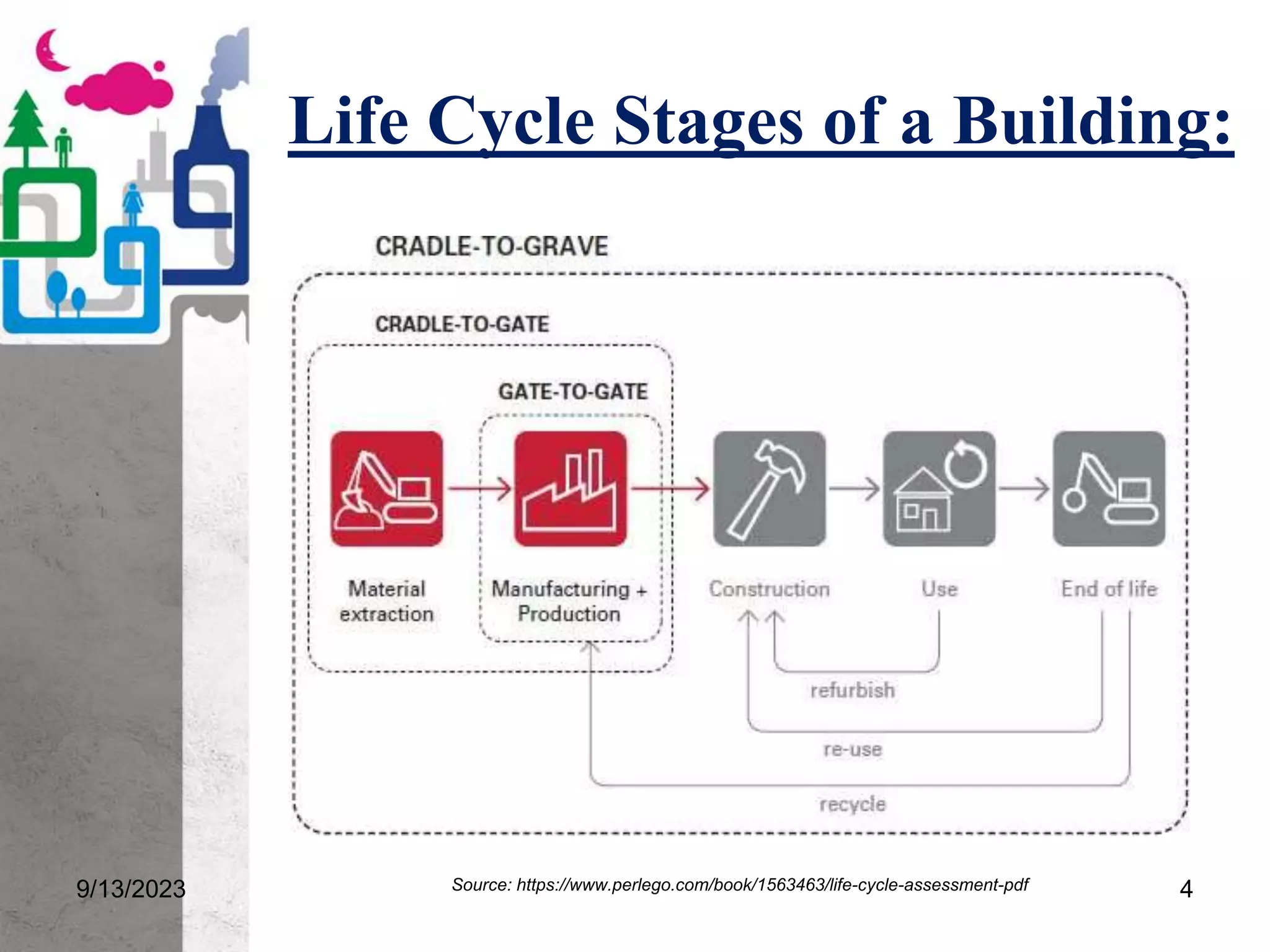
Life Cycle Stages of a Building:
9/13/2023 Source: https://www.perlego.com/book/1563463/life-cycle-assessment-pdf 4
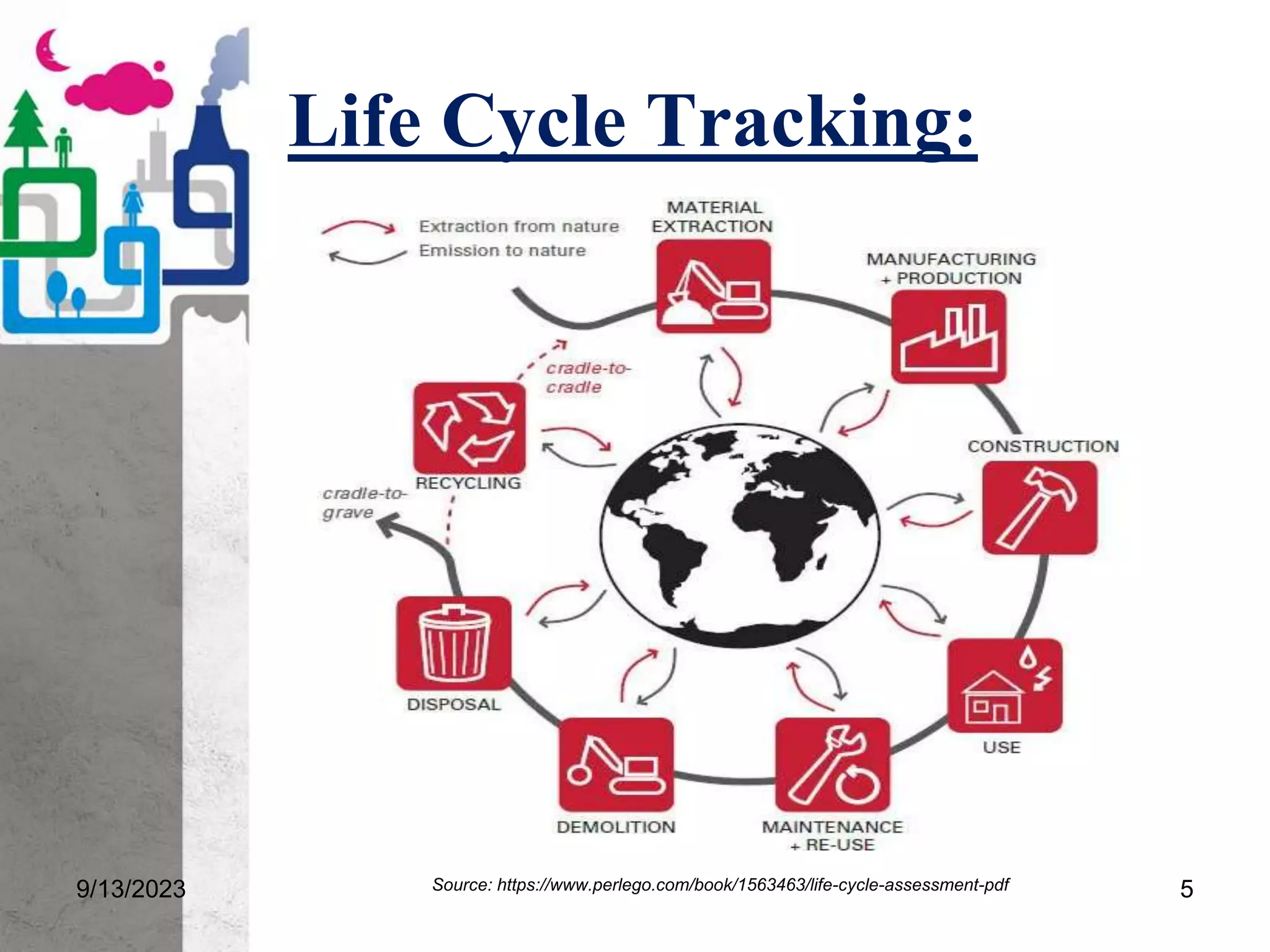
Life Cycle Tracking:
9/13/2023 Source: https://www.perlego.com/book/1563463/life-cycle-assessment-pdf 5
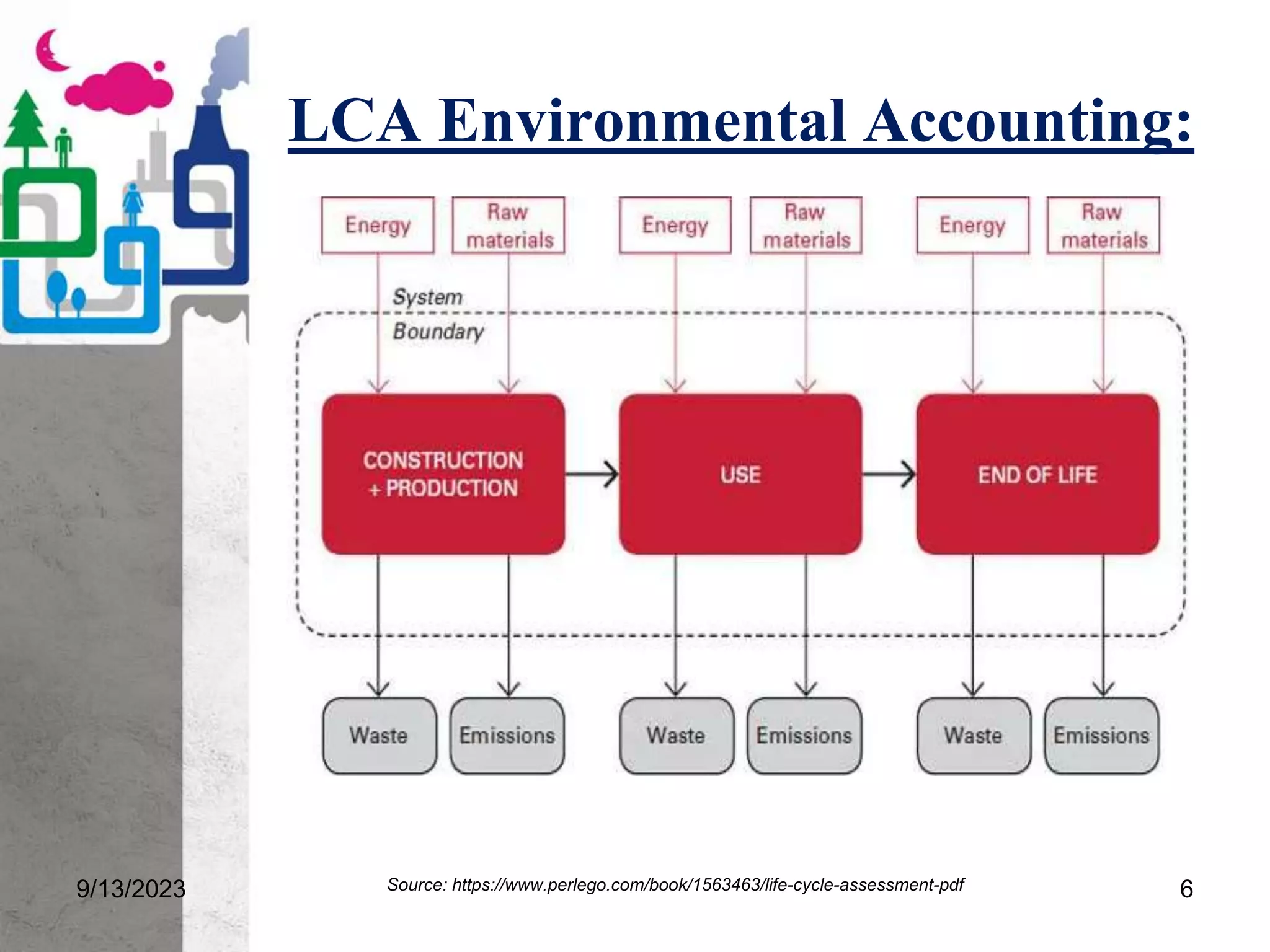
LCA Environmental Accounting:
9/13/2023 Source: https://www.perlego.com/book/1563463/life-cycle-assessment-pdf 6
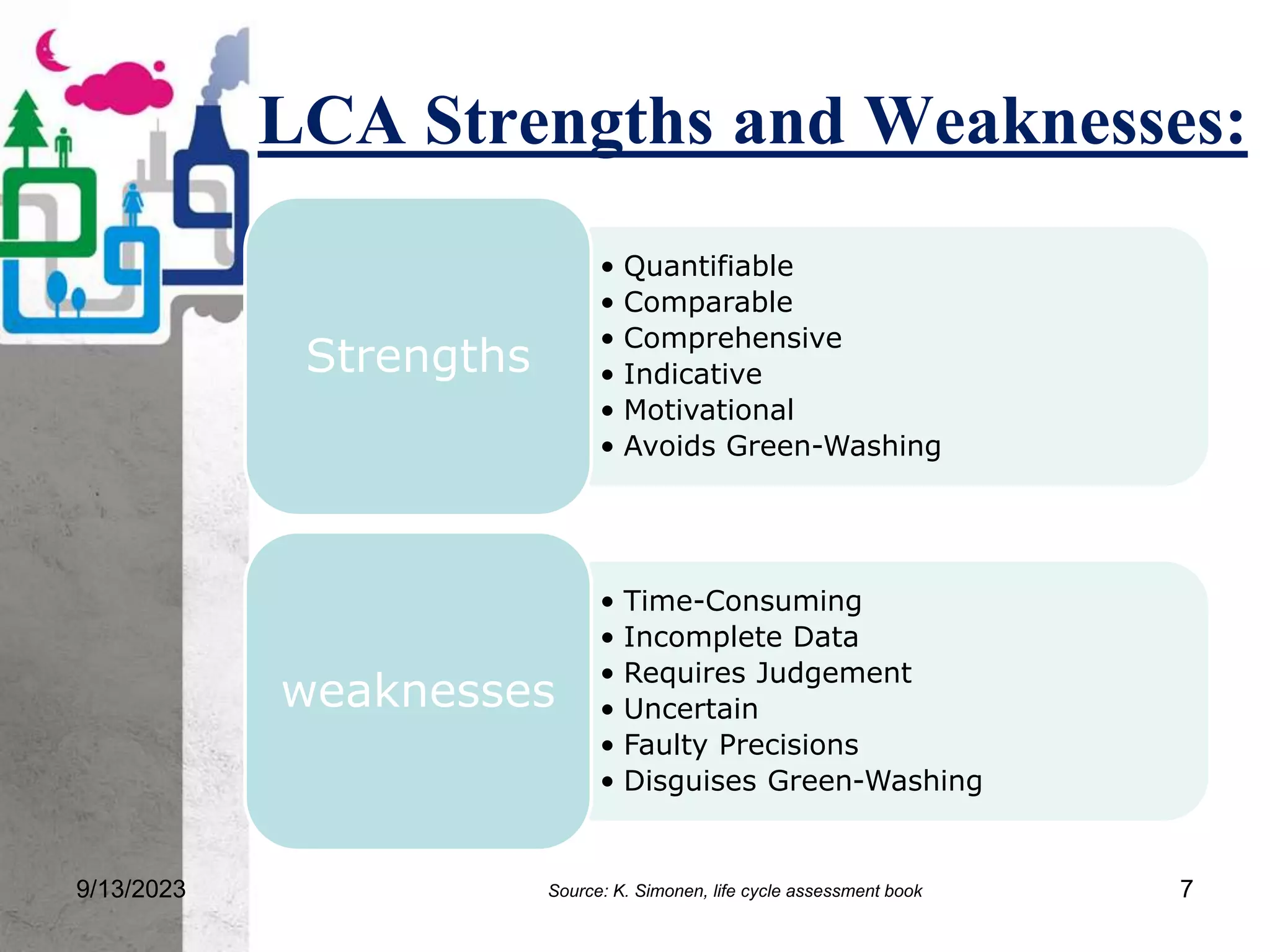
LCA Strengths and Weaknesses:
• Quantifiable
• Comparable
• Comprehensive
• Indicative
• Motivational
• Avoids Green-Washing
Strengths
• Time-Consuming
• Incomplete Data
• Requires Judgement
• Uncertain
• Faulty Precisions
• Disguises Green-Washing
weaknesses
9/13/2023 Source: K. Simonen, life cycle assessment book 7
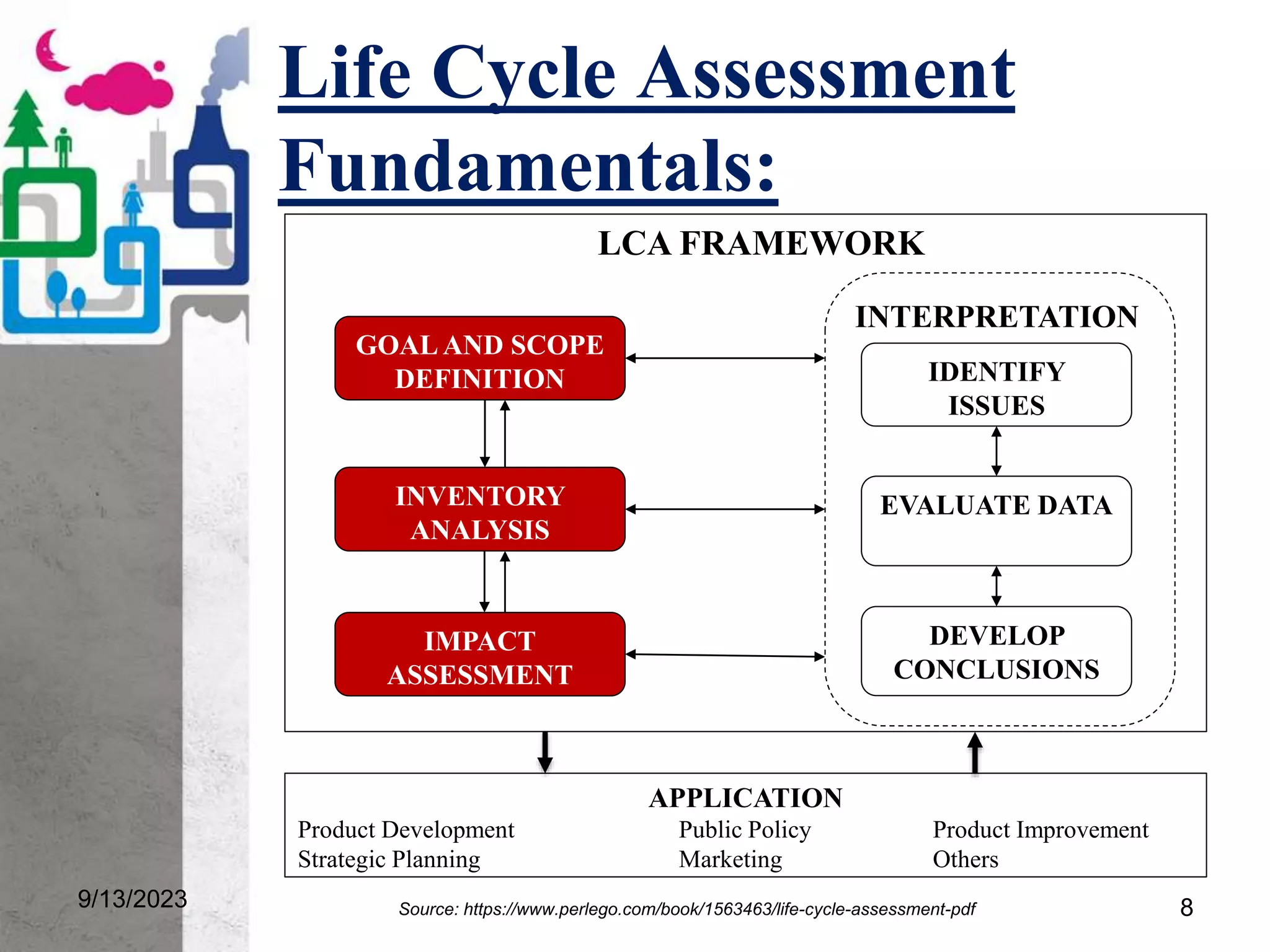
Life Cycle Assessment
Fundamentals:
9/13/2023 8
GOAL AND SCOPE
DEFINITION
INVENTORY
ANALYSIS
IMPACT
ASSESSMENT
INTERPRETATION
IDENTIFY
ISSUES
EVALUATE DATA
DEVELOP
CONCLUSIONS
LCA FRAMEWORK
Source: https://www.perlego.com/book/1563463/life-cycle-assessment-pdf
APPLICATION
Product Development Public Policy Product Improvement
Strategic Planning Marketing Others
Phases of LCA:
• Goal and Scope Definitions
9/13/2023 9
 The LCA Goal:
ISO STANDARDS 14040 AND 14044 (ISO, 2006a, 2006b)
require that the goal of an LCA study be unambiguously
stated and include;
 The intended application (what)
 The reason for carrying out the study (why)
 The intended audience (for whom)
 Whether the results are intended for comparative
assertions intended to be disclosed to the public
(how)
Source: K. Simonen, life cycle assessment book
Cont’d…..
9/13/2023 10
 The LCA Scope:
THE SCOPE OF AN LCA requires the definition of what is included
in and excluded from the analysts and defines the parameters of the
study. ISO standard 14044 has specific requirements as to what
must be included in the scope definition. The following is a summary
of the key items that should be defined in an LCA scope as adapted
from ISO (2006b:7):
 The product to be studied: Establishing function, performance and
unit of analysis (functional unit).
 The system boundary: What is excluded from and included in the
analysis (which unit processes are part of the system studied).
 Methodological choices: Including allocation assumptions and
impact assessment and interpretation methods.
 Analysis details: Sources of the data, data quality requirements
and type of critical review (if any).
Source: K. Simonen, life cycle assessment book
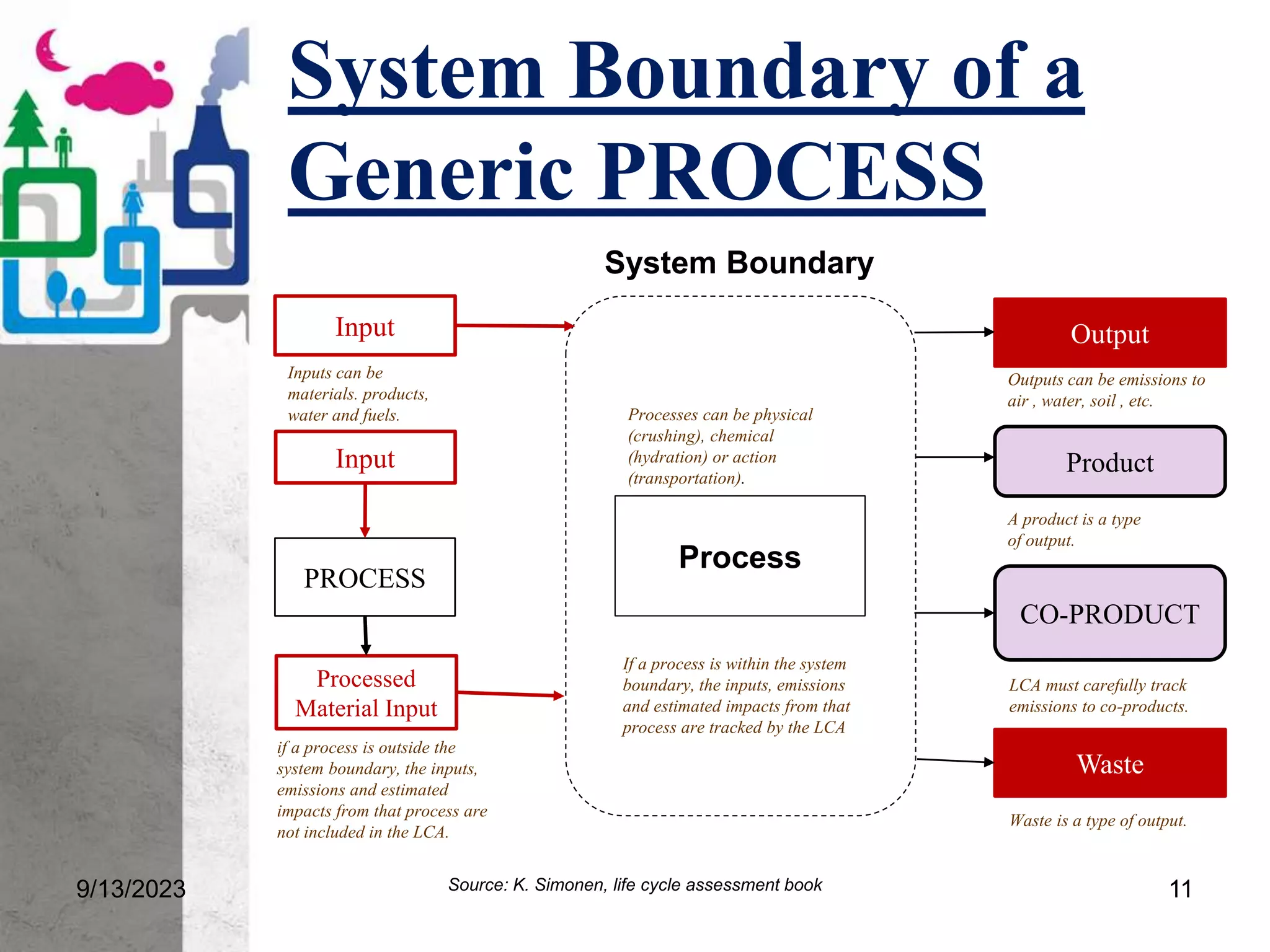
System Boundary of a
Generic PROCESS
9/13/2023 11
System Boundary
Process
Processes can be physical
(crushing), chemical
(hydration) or action
(transportation).
If a process is within the system
boundary, the inputs, emissions
and estimated impacts from that
process are tracked by the LCA
Input
Input
Processed
Material Input
PROCESS
Inputs can be
materials. products,
water and fuels.
if a process is outside the
system boundary, the inputs,
emissions and estimated
impacts from that process are
not included in the LCA.
Output
Waste
CO-PRODUCT
Product
Outputs can be emissions to
air , water, soil , etc.
A product is a type
of output.
LCA must carefully track
emissions to co-products.
Waste is a type of output.
Source: K. Simonen, life cycle assessment book
Cont’d…..
9/13/2023 12
• Inventory Analysis:
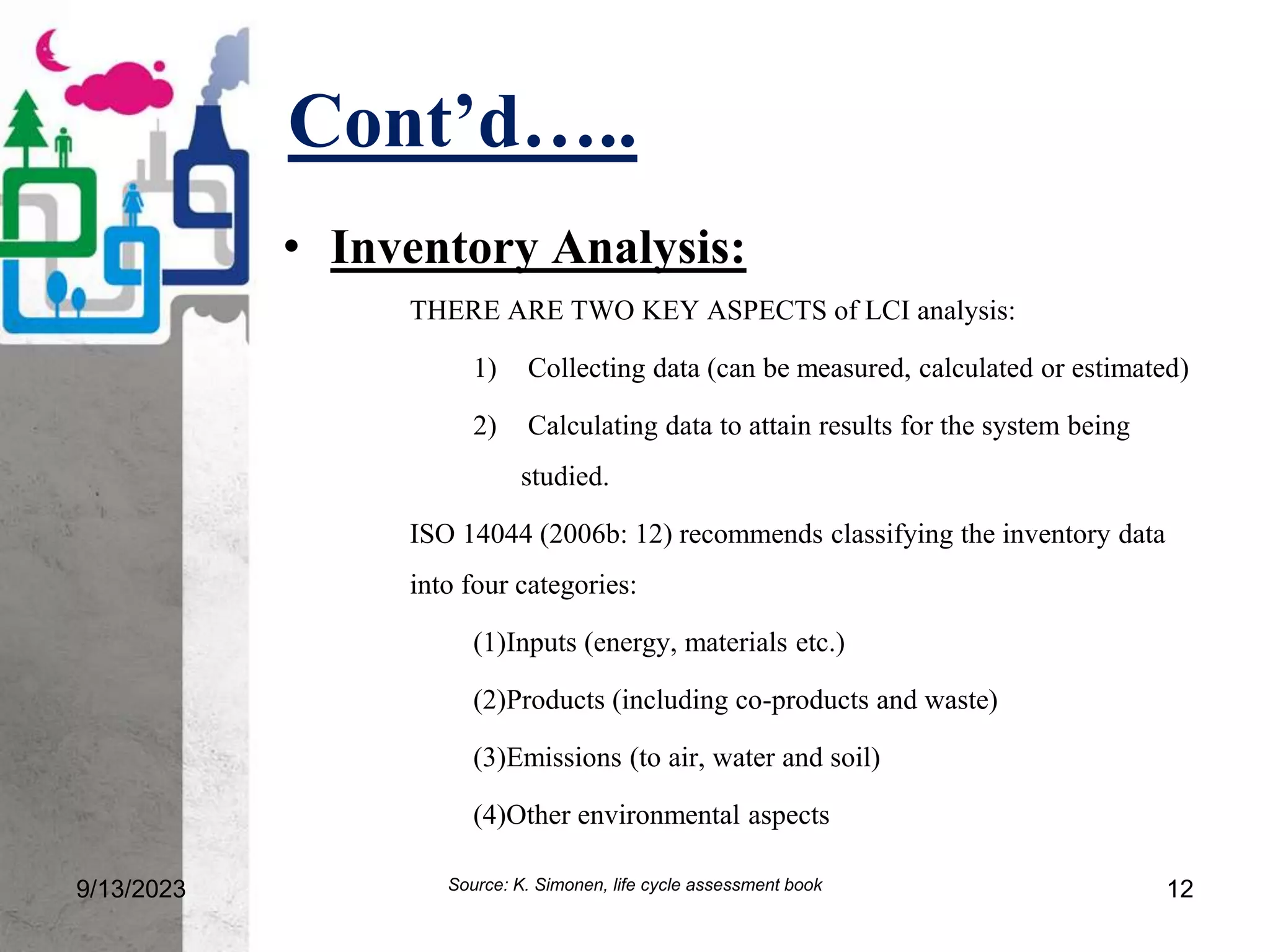
THERE ARE TWO KEY ASPECTS of LCI analysis:
1) Collecting data (can be measured, calculated or estimated)
2) Calculating data to attain results for the system being
studied.
ISO 14044 (2006b: 12) recommends classifying the inventory data
into four categories:
(1)Inputs (energy, materials etc.)
(2)Products (including co-products and waste)
(3)Emissions (to air, water and soil)
(4)Other environmental aspects
Source: K. Simonen, life cycle assessment book
Cont’d…..
9/13/2023 13
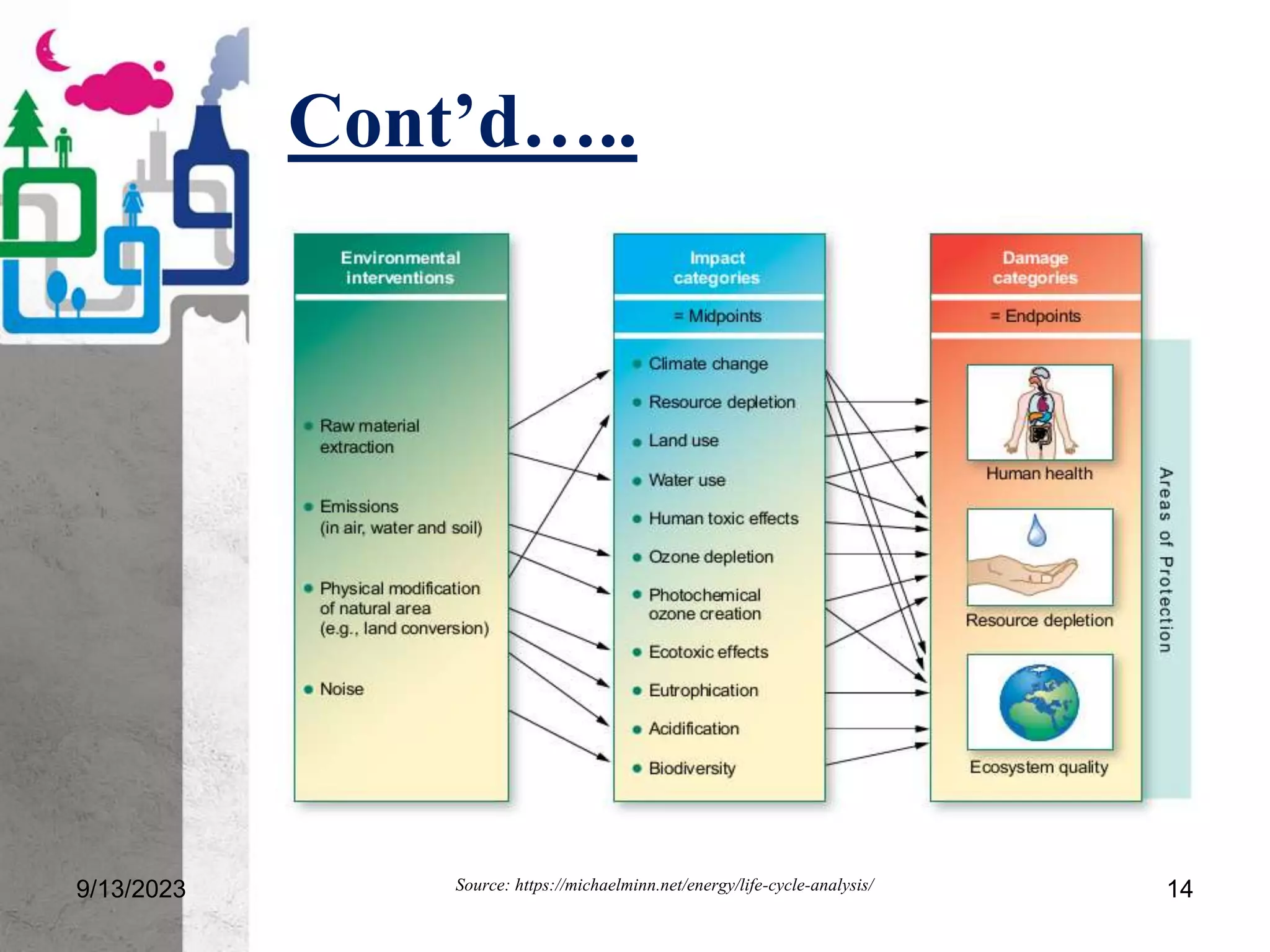
• Impact Assessment:
 Relating resource use and environmental, emissions to estimations of
natural resource, natural environment and human health impacts is
done in the impact assessment stage of an LCA.
 Depending upon the process, hundreds or even thousands of different
emissions may occur and be reported by an inventory analysis.
 In order to translate emissions to impacts one must Identify which
environmental impact categories to study, establish which emissions
influence which impacts and calculate the total relative impacts (ISO,
2006b:16).
 The order of the steps is important.
 The selection of environmental impacts to be studied should be done
prior to knowing results to avoid the temptation of selecting impacts to
study based on preliminary results.
Source: K. Simonen, life cycle assessment book
Cont’d…..
9/13/2023 Source: https://michaelminn.net/energy/life-cycle-analysis/ 14
Cont’d…..
9/13/2023 15
• Interpretation:
 Critical thinking and careful evaluation of the strengths and weaknesses
of the LCA are essential during the interpretation phase in order for the
conclusions, limitations and recommendations resulting from an LCA to
be meaningful.
 Simultaneously with interpreting LCA results, the goal and scope
should also be assessed, and potentially revised, to evaluate if they are
appropriate given the resulting data.
 After computing the LCI and impact assessment, the data should be
analyzed to determine if significant issues have been identified.
 ISO (2006b:26) requires a minimum of three evaluation methods to be
summarized and adapted.
Source: K. Simonen, life cycle assessment book
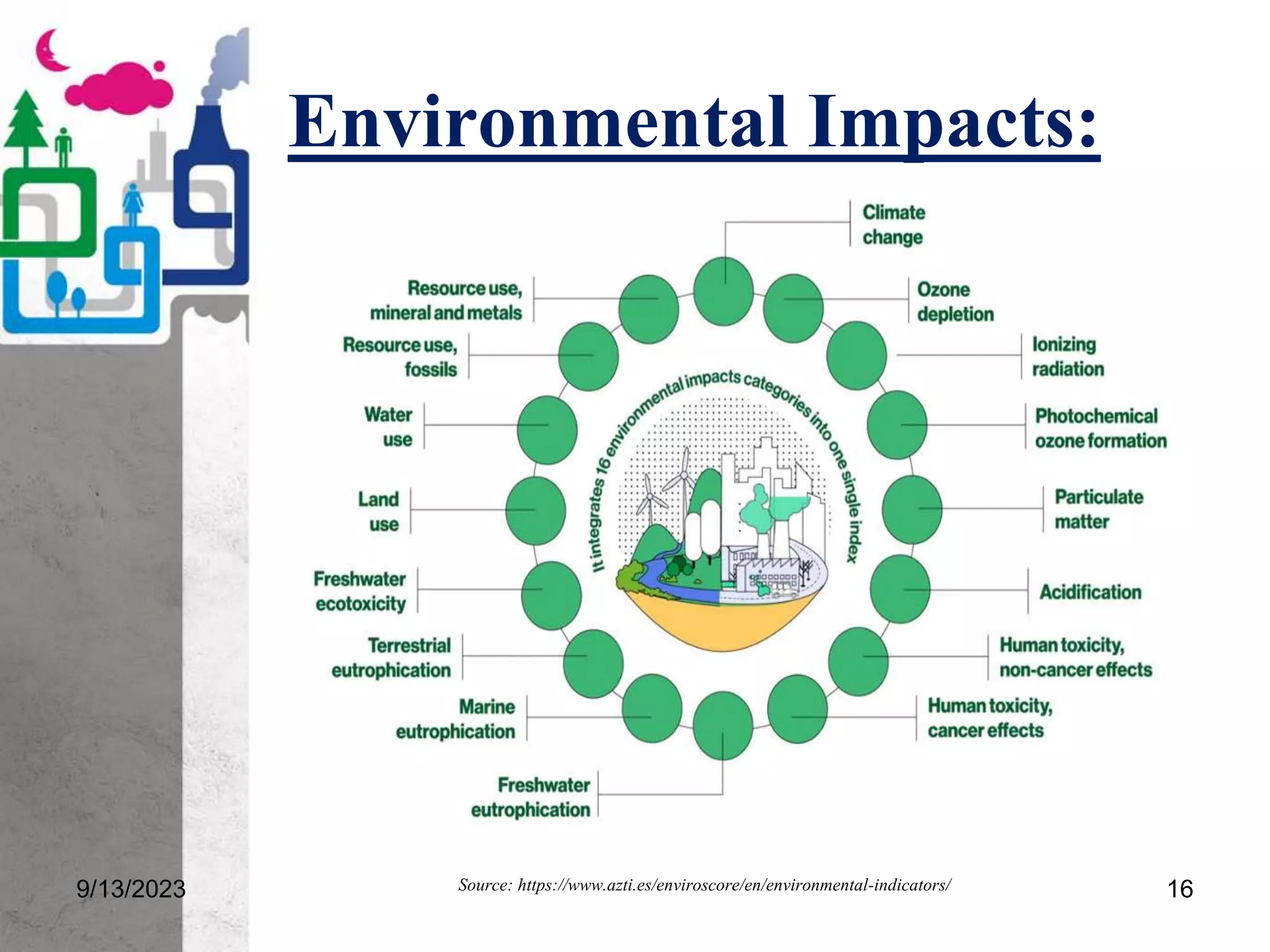
Environmental Impacts:
9/13/2023 Source: https://www.azti.es/enviroscore/en/environmental-indicators/ 16
Cont’d…..
9/13/2023 17
9/13/2023 18
9/13/2023 19
9/13/2023 20
9/13/2023 21
9/13/2023 22
9/13/2023 23
9/13/2023 24
9/13/2023 25

template-1.pptx

  • 1.
    Life Cycle Assessmentin Construction Industry Presented To: Dr. Rathish Kumar Dean, Planning and Development Dept. of Civil Engineering Presented By: Mansi Mishra (22CEM7R13)
  • 2.
    Table of contents: Background  Introduction  Stages of LCA  Steps of LCA  Software’s for LCA  Variants of LCA  Case study  Future scope  Conclusion
  • 3.
    Introduction: • All buildingresults in environmental impacts. • Emissions related to energy generation and manufacturing pollute the air we breathe, impact global climate and impact the health of animals and planes. • Local environments are changed when land is re-shaped and vegetation is replaced with construction. • The challenge of developing truly sustainable or even regenerative buildings has led to a desire to understand building and construction from a systems-based perspective. • Buildings are not static objects, but rather one component within complex environmental, social and economic systems. • Life Cycle Assessment (LCA) is a standardized method of tracking and reporting the environmental impacts of a product or process throughout its full life cycle (ISO, 2006a). 9/13/2023 3 Source: K. Simonen, life cycle assessment book
  • 4.
    Life Cycle Stagesof a Building: 9/13/2023 Source: https://www.perlego.com/book/1563463/life-cycle-assessment-pdf 4
  • 5.
    Life Cycle Tracking: 9/13/2023Source: https://www.perlego.com/book/1563463/life-cycle-assessment-pdf 5
  • 6.
    LCA Environmental Accounting: 9/13/2023Source: https://www.perlego.com/book/1563463/life-cycle-assessment-pdf 6
  • 7.
    LCA Strengths andWeaknesses: • Quantifiable • Comparable • Comprehensive • Indicative • Motivational • Avoids Green-Washing Strengths • Time-Consuming • Incomplete Data • Requires Judgement • Uncertain • Faulty Precisions • Disguises Green-Washing weaknesses 9/13/2023 Source: K. Simonen, life cycle assessment book 7
  • 8.
    Life Cycle Assessment Fundamentals: 9/13/20238 GOAL AND SCOPE DEFINITION INVENTORY ANALYSIS IMPACT ASSESSMENT INTERPRETATION IDENTIFY ISSUES EVALUATE DATA DEVELOP CONCLUSIONS LCA FRAMEWORK Source: https://www.perlego.com/book/1563463/life-cycle-assessment-pdf APPLICATION Product Development Public Policy Product Improvement Strategic Planning Marketing Others
  • 9.
    Phases of LCA: •Goal and Scope Definitions 9/13/2023 9  The LCA Goal: ISO STANDARDS 14040 AND 14044 (ISO, 2006a, 2006b) require that the goal of an LCA study be unambiguously stated and include;  The intended application (what)  The reason for carrying out the study (why)  The intended audience (for whom)  Whether the results are intended for comparative assertions intended to be disclosed to the public (how) Source: K. Simonen, life cycle assessment book
  • 10.
    Cont’d….. 9/13/2023 10  TheLCA Scope: THE SCOPE OF AN LCA requires the definition of what is included in and excluded from the analysts and defines the parameters of the study. ISO standard 14044 has specific requirements as to what must be included in the scope definition. The following is a summary of the key items that should be defined in an LCA scope as adapted from ISO (2006b:7):  The product to be studied: Establishing function, performance and unit of analysis (functional unit).  The system boundary: What is excluded from and included in the analysis (which unit processes are part of the system studied).  Methodological choices: Including allocation assumptions and impact assessment and interpretation methods.  Analysis details: Sources of the data, data quality requirements and type of critical review (if any). Source: K. Simonen, life cycle assessment book
  • 11.
    System Boundary ofa Generic PROCESS 9/13/2023 11 System Boundary Process Processes can be physical (crushing), chemical (hydration) or action (transportation). If a process is within the system boundary, the inputs, emissions and estimated impacts from that process are tracked by the LCA Input Input Processed Material Input PROCESS Inputs can be materials. products, water and fuels. if a process is outside the system boundary, the inputs, emissions and estimated impacts from that process are not included in the LCA. Output Waste CO-PRODUCT Product Outputs can be emissions to air , water, soil , etc. A product is a type of output. LCA must carefully track emissions to co-products. Waste is a type of output. Source: K. Simonen, life cycle assessment book
  • 12.
    Cont’d….. 9/13/2023 12 • InventoryAnalysis: THERE ARE TWO KEY ASPECTS of LCI analysis: 1) Collecting data (can be measured, calculated or estimated) 2) Calculating data to attain results for the system being studied. ISO 14044 (2006b: 12) recommends classifying the inventory data into four categories: (1)Inputs (energy, materials etc.) (2)Products (including co-products and waste) (3)Emissions (to air, water and soil) (4)Other environmental aspects Source: K. Simonen, life cycle assessment book
  • 13.
    Cont’d….. 9/13/2023 13 • ImpactAssessment:  Relating resource use and environmental, emissions to estimations of natural resource, natural environment and human health impacts is done in the impact assessment stage of an LCA.  Depending upon the process, hundreds or even thousands of different emissions may occur and be reported by an inventory analysis.  In order to translate emissions to impacts one must Identify which environmental impact categories to study, establish which emissions influence which impacts and calculate the total relative impacts (ISO, 2006b:16).  The order of the steps is important.  The selection of environmental impacts to be studied should be done prior to knowing results to avoid the temptation of selecting impacts to study based on preliminary results. Source: K. Simonen, life cycle assessment book
  • 14.
  • 15.
    Cont’d….. 9/13/2023 15 • Interpretation: Critical thinking and careful evaluation of the strengths and weaknesses of the LCA are essential during the interpretation phase in order for the conclusions, limitations and recommendations resulting from an LCA to be meaningful.  Simultaneously with interpreting LCA results, the goal and scope should also be assessed, and potentially revised, to evaluate if they are appropriate given the resulting data.  After computing the LCI and impact assessment, the data should be analyzed to determine if significant issues have been identified.  ISO (2006b:26) requires a minimum of three evaluation methods to be summarized and adapted. Source: K. Simonen, life cycle assessment book
  • 16.
    Environmental Impacts: 9/13/2023 Source:https://www.azti.es/enviroscore/en/environmental-indicators/ 16
  • 17.
  • 18.
  • 19.
  • 20.
  • 21.
  • 22.
  • 23.
  • 24.
  • 25.