LiDAR Acquisition
1.

Introduction
1.
2.

2.

Aerial LiDAR
1.
2.
3.

3.

Objective and general setup
static vs. mobile
Registration

Bathymetric/Hydrographic LiDAR
1.
2.

5.

Objective and general setup
Scanning process
Characteristic properties – further information

Terrestrial LiDAR
1.
2.
3.

4.

Laser capturing unit
Signals

Objectives and general setup
Characteristics – further information

Atmospheric LiDAR
Introduction
• LiDAR = Light Detection and Ranging
• Laser-based scanning
– terrain
– bathymetry
– atmospheric properties

• Collection of point set („point cloud“) data
Introduction
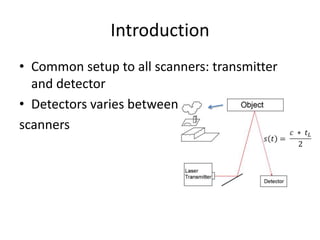
• Common setup to all scanners: transmitter
and detector
• Detectors varies between
scanners
Introduction
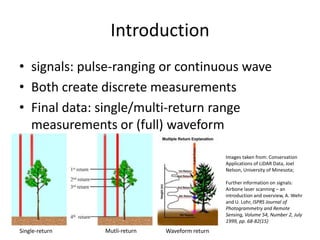
• signals: pulse-ranging or continuous wave
• Both create discrete measurements
• Final data: single/multi-return range
measurements or (full) waveform
Images taken from: Conservation
Applications of LiDAR Data, Joel
Nelson, University of Minesota;
Further information on signals:
Airbone laser scanning – an
introduction and overview, A. Wehr
and U. Lohr, ISPRS Journal of
Photogrammetry and Remote
Sensing, Volume 54, Number 2, July
1999, pp. 68-82(15)

Single-return

Mutli-return

Waveform return
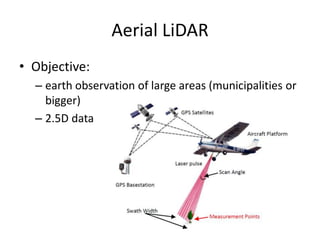
Aerial LiDAR
• Objective:
– earth observation of large areas (municipalities or
bigger)
– 2.5D data
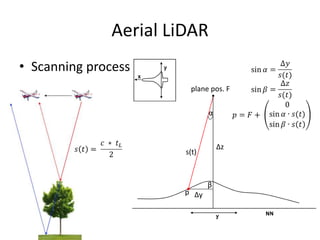
Aerial LiDAR
• Scanning process
plane pos. F
α

Δz

s(t)

p Δy

β
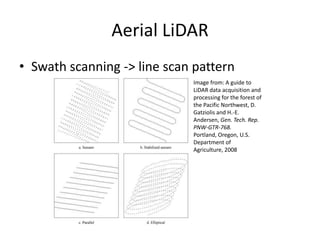
Aerial LiDAR
• Swath scanning -> line scan pattern
Image from: A guide to
LiDAR data acquisition and
processing for the forest of
the Pacific Northwest, D.
Gatziolis and H.-E.
Andersen, Gen. Tech. Rep.
PNW-GTR-768.
Portland, Oregon, U.S.
Department of
Agriculture, 2008
Aerial LiDAR
• Characteristics and Properties:
–
–
–
–
–

Scanning angle
Scanning frequency
Pulse length -> vertical resolution
Footprint diameter
Footprint spacing (non-uniformal horizontal
resolution)
– Returns per pulse

• Beam frequency for topographic scan: 1040 –
1064 nm
Aerial LiDAR
• further information
– continuous wave: “Introduction to continuous-wave
Doppler lidar”, C. Slinger and M. Harris, TechReport
– full-waveform lidar: “From single-pulse to fullwaveform airborne laser scanners: Potential and
Practical Challenges”, W. Wagner et al., Int. Archives of
Photogrammertry and Remote Sensing, Vol. 35, No.
Part B, 2004, pp. 201-206
– full-waveform lidar: “Empirical Comparison of FullWaveform Lidar Algorithms: Range Extraction and
Discrimination Performance”, C.E. Parrish et al.,
Photogrammetric Engineering & Remote Sensing, Vol.
77, No. 8, August 2011, pp. 825-838
Terrestrial LiDAR
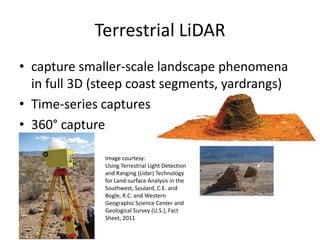
• capture smaller-scale landscape phenomena
in full 3D (steep coast segments, yardrangs)
• Time-series captures
• 360° capture
Image courtesy:
Using Terrestrial Light Detection
and Ranging (Lidar) Technology
for Land-surface Analysis in the
Southwest, Soulard, C.E. and
Bogle, R.C. and Western
Geographic Science Center and
Geological Survey (U.S.), Fact
Sheet, 2011
Terrestrial LiDAR
• static LiDAR: fixed position; semi-automatic
registration; standard in geological field survey
• mobile LiDAR: vehicle-mounted; easier largescale survey; restricted to drivable (urban)
regions
Terrestrial LiDAR
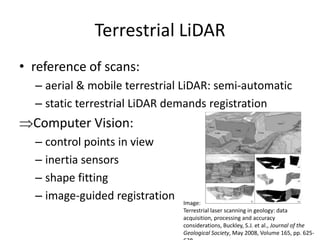
• reference of scans:
– aerial & mobile terrestrial LiDAR: semi-automatic
– static terrestrial LiDAR demands registration

Computer Vision:
– control points in view
– inertia sensors
– shape fitting
– image-guided registration

Image:
Terrestrial laser scanning in geology: data
acquisition, processing and accuracy
considerations, Buckley, S.J. et al., Journal of the
Geological Society, May 2008, Volume 165, pp. 625-
Bathymetric LiDAR
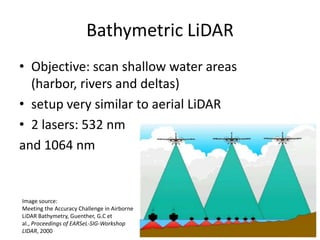
• Objective: scan shallow water areas
(harbor, rivers and deltas)
• setup very similar to aerial LiDAR
• 2 lasers: 532 nm
and 1064 nm

Image source:
Meeting the Accuracy Challenge in Airborne
LiDAR Bathymetry, Guenther, G.C et
al., Proceedings of EARSeL-SIG-Workshop
LIDAR, 2000
Bathymetric LiDAR
• further literature:
– Meeting the Accuracy Challenge in Airborne LiDAR
Bathymetry, Guenther, G.C et al., Proceedings of
EARSeL-SIG-Workshop LIDAR, 2000
– Green, waveform lidar in topo-bathy mapping –
Principles and Applications, Nayegandhi, A., USGS
St. Petersburg/Florida
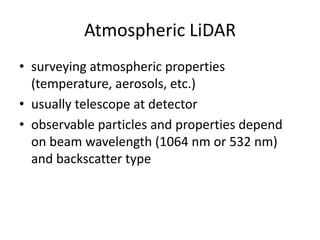
Atmospheric LiDAR
• surveying atmospheric properties
(temperature, aerosols, etc.)
• usually telescope at detector
• observable particles and properties depend
on beam wavelength (1064 nm or 532 nm)
and backscatter type
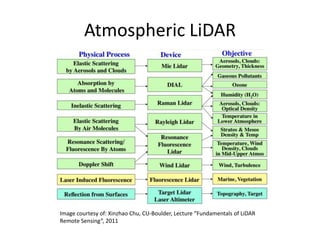
Atmospheric LiDAR

Image courtesy of: Xinzhao Chu, CU-Boulder, Lecture “Fundamentals of LiDAR
Remote Sensing”, 2011

LiDAR acquisition

  • 1.
    LiDAR Acquisition 1. Introduction 1. 2. 2. Aerial LiDAR 1. 2. 3. 3. Objectiveand general setup static vs. mobile Registration Bathymetric/Hydrographic LiDAR 1. 2. 5. Objective and general setup Scanning process Characteristic properties – further information Terrestrial LiDAR 1. 2. 3. 4. Laser capturing unit Signals Objectives and general setup Characteristics – further information Atmospheric LiDAR
  • 2.
    Introduction • LiDAR =Light Detection and Ranging • Laser-based scanning – terrain – bathymetry – atmospheric properties • Collection of point set („point cloud“) data
  • 3.
    Introduction • Common setupto all scanners: transmitter and detector • Detectors varies between scanners
  • 4.
    Introduction • signals: pulse-rangingor continuous wave • Both create discrete measurements • Final data: single/multi-return range measurements or (full) waveform Images taken from: Conservation Applications of LiDAR Data, Joel Nelson, University of Minesota; Further information on signals: Airbone laser scanning – an introduction and overview, A. Wehr and U. Lohr, ISPRS Journal of Photogrammetry and Remote Sensing, Volume 54, Number 2, July 1999, pp. 68-82(15) Single-return Mutli-return Waveform return
  • 5.
    Aerial LiDAR • Objective: –earth observation of large areas (municipalities or bigger) – 2.5D data
  • 6.
    Aerial LiDAR • Scanningprocess plane pos. F α Δz s(t) p Δy β
  • 7.
    Aerial LiDAR • Swathscanning -> line scan pattern Image from: A guide to LiDAR data acquisition and processing for the forest of the Pacific Northwest, D. Gatziolis and H.-E. Andersen, Gen. Tech. Rep. PNW-GTR-768. Portland, Oregon, U.S. Department of Agriculture, 2008
  • 8.
    Aerial LiDAR • Characteristicsand Properties: – – – – – Scanning angle Scanning frequency Pulse length -> vertical resolution Footprint diameter Footprint spacing (non-uniformal horizontal resolution) – Returns per pulse • Beam frequency for topographic scan: 1040 – 1064 nm
  • 9.
    Aerial LiDAR • furtherinformation – continuous wave: “Introduction to continuous-wave Doppler lidar”, C. Slinger and M. Harris, TechReport – full-waveform lidar: “From single-pulse to fullwaveform airborne laser scanners: Potential and Practical Challenges”, W. Wagner et al., Int. Archives of Photogrammertry and Remote Sensing, Vol. 35, No. Part B, 2004, pp. 201-206 – full-waveform lidar: “Empirical Comparison of FullWaveform Lidar Algorithms: Range Extraction and Discrimination Performance”, C.E. Parrish et al., Photogrammetric Engineering & Remote Sensing, Vol. 77, No. 8, August 2011, pp. 825-838
  • 10.
    Terrestrial LiDAR • capturesmaller-scale landscape phenomena in full 3D (steep coast segments, yardrangs) • Time-series captures • 360° capture Image courtesy: Using Terrestrial Light Detection and Ranging (Lidar) Technology for Land-surface Analysis in the Southwest, Soulard, C.E. and Bogle, R.C. and Western Geographic Science Center and Geological Survey (U.S.), Fact Sheet, 2011
  • 11.
    Terrestrial LiDAR • staticLiDAR: fixed position; semi-automatic registration; standard in geological field survey • mobile LiDAR: vehicle-mounted; easier largescale survey; restricted to drivable (urban) regions
  • 12.
    Terrestrial LiDAR • referenceof scans: – aerial & mobile terrestrial LiDAR: semi-automatic – static terrestrial LiDAR demands registration Computer Vision: – control points in view – inertia sensors – shape fitting – image-guided registration Image: Terrestrial laser scanning in geology: data acquisition, processing and accuracy considerations, Buckley, S.J. et al., Journal of the Geological Society, May 2008, Volume 165, pp. 625-
  • 13.
    Bathymetric LiDAR • Objective:scan shallow water areas (harbor, rivers and deltas) • setup very similar to aerial LiDAR • 2 lasers: 532 nm and 1064 nm Image source: Meeting the Accuracy Challenge in Airborne LiDAR Bathymetry, Guenther, G.C et al., Proceedings of EARSeL-SIG-Workshop LIDAR, 2000
  • 14.
    Bathymetric LiDAR • furtherliterature: – Meeting the Accuracy Challenge in Airborne LiDAR Bathymetry, Guenther, G.C et al., Proceedings of EARSeL-SIG-Workshop LIDAR, 2000 – Green, waveform lidar in topo-bathy mapping – Principles and Applications, Nayegandhi, A., USGS St. Petersburg/Florida
  • 15.
    Atmospheric LiDAR • surveyingatmospheric properties (temperature, aerosols, etc.) • usually telescope at detector • observable particles and properties depend on beam wavelength (1064 nm or 532 nm) and backscatter type
  • 16.
    Atmospheric LiDAR Image courtesyof: Xinzhao Chu, CU-Boulder, Lecture “Fundamentals of LiDAR Remote Sensing”, 2011