Remote Sensing Essentials
LiDAR Technique and Applications
Dr. Arun K. Saraf,
Professor
Department of Earth Sciences
1
LIDAR (Light Detection and Ranging)
• Lidar (also know as 3D laser scanning) is not only replacing
conventional sensors, but also creating new methods with
unique properties that could not be achieved before.
• Lidar is extremely useful in atmospheric and environmental
research as well as space exploration.
• It also has wide applications in industry, defense, and
military.
• It has terrestrial, airborne, and mobile applications.
LIDAR (Light Detection and Ranging)
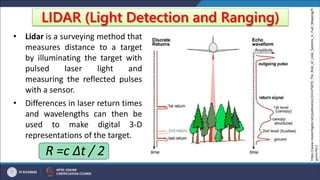
• Lidar is a surveying method that
measures distance to a target
by illuminating the target with
pulsed laser light and
measuring the reflected pulses
with a sensor.
• Differences in laser return times
and wavelengths can then be
used to make digital 3-D
representations of the target.
R =c Δt / 2
https://www.researchgate.net/publication/241475870_The_Role_of_Lidar_Systems_in_Fuel_Mapping/fi
gures?lo=1
How LiDAR works?
Each time the laser is pulsed:
• Laser generates an optical pulse
• Pulse is reflected off an object and returns to the system receiver
• High-speed counter measures the time of flight from the start pulse to
the return pulse
• Time measurement is converted to a distance (the distance to the
target and the position of the airplane is then used to determine the
elevation and location)
• Multiple returns can be measured for each pulse
• Up to 200,000+ pulses/second
• Everything that can be seen from the aircraft is measured
https://en.wikipedia.org/wiki/Lidar#/media/File:LIDAR-scanned-SICK-LMS-animation.gif
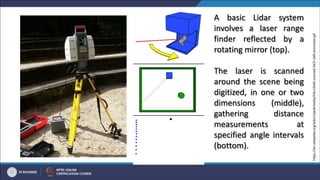
A basic Lidar system
involves a laser range
finder reflected by a
rotating mirror (top).
The laser is scanned
around the scene being
digitized, in one or two
dimensions (middle),
gathering distance
measurements at
specified angle intervals
(bottom).
LIDAR (Light Detection and Ranging)
• Lidar is commonly used to make high-resolution maps, with
applications in geodesy, geomatics, archaeology, geography,
geology, geomorphology, seismology, forestry, atmospheric
physics, laser guidance, airborne laser swath mapping (ALSM),
and laser altimetry.
• The technology is also used in control and navigation for some
autonomous cars.
• It also has wide applications in industry, defense, and military.
• It has terrestrial, airborne, and mobile applications.
https://en.wikipedia.org/wiki/Lidar
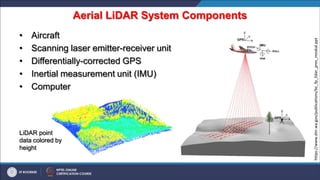
Aerial LiDAR System Components
• Aircraft
• Scanning laser emitter-receiver unit
• Differentially-corrected GPS
• Inertial measurement unit (IMU)
• Computer
LiDAR point
data colored by
height
https://www.dnr.wa.gov/publications/bc_fp_lidar_pres_moskal.ppt
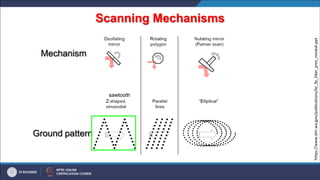
Scanning Mechanisms
Mechanism
Ground pattern
sawtooth
https://www.dnr.wa.gov/publications/bc_fp_lidar_pres_moskal.ppt
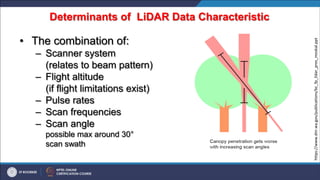
Determinants of LiDAR Data Characteristic
• The combination of:
– Scanner system
(relates to beam pattern)
– Flight altitude
(if flight limitations exist)
– Pulse rates
– Scan frequencies
– Scan angle
possible max around 30°
scan swath
https://www.dnr.wa.gov/publications/bc_fp_lidar_pres_moskal.ppt
LiDAR Data Characteristics
• Raw return data are XYZ points
• High spatial resolution
– Laser footprint on ground ≤ 50 cm
– Typical density is 0.5 to 20+ pulses/m2
– 2 to 3 returns/pulse in forest areas
– Surface/canopy models typically 1 to 5m grid
• Large volume of data
– 5,000 to 60,000+ pulses/hectare
– 10 to100+ thousands of returns/hectare
– 0.4 to 5.4+ MB/hectare
https://www.dnr.wa.gov/publications/bc_fp_lidar_pres_moskal.ppt
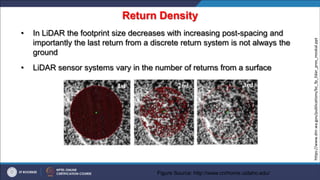
Return Density
• In LiDAR the footprint size decreases with increasing post-spacing and
importantly the last return from a discrete return system is not always the
ground
• LiDAR sensor systems vary in the number of returns from a surface
Figure Source: http://www.cnrhome.uidaho.edu/
https://www.dnr.wa.gov/publications/bc_fp_lidar_pres_moskal.ppt
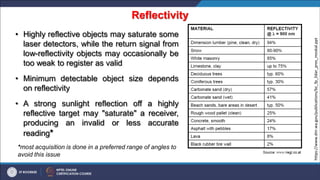
Reflectivity
• Highly reflective objects may saturate some
laser detectors, while the return signal from
low-reflectivity objects may occasionally be
too weak to register as valid
• Minimum detectable object size depends
on reflectivity
• A strong sunlight reflection off a highly
reflective target may "saturate" a receiver,
producing an invalid or less accurate
reading*
*most acquisition is done in a preferred range of angles to
avoid this issue
https://www.dnr.wa.gov/publications/bc_fp_lidar_pres_moskal.ppt
Dust & Vapor
• Laser measurements can be weakened by interacting with dust
and vapor particles, which scatter the laser beam and the signal
returning from the target
• Using last-pulse measurements can reduce or eliminate this
interference
• Systems that are expected to work in such conditions regularly
can be optimized for these environments
https://www.dnr.wa.gov/publications/bc_fp_lidar_pres_moskal.ppt
Background Noise and Radiation
• The laser is not affected by background noise
• Most systems determine baseline radiation levels to
ensure that it does not interfere with measurements
https://www.dnr.wa.gov/publications/bc_fp_lidar_pres_moskal.ppt
Overall Accuracy
• (X,Y,Z) position of each return
– 50-100cm horizontal
– 10-15cm vertical
• Ground surface (bare-earth surface)
– What is the ground (grass, rocks, stumps)?
• Tree heights
– Underestimate tree heights by 0.5 to 2 m
– Error is species dependent
https://www.dnr.wa.gov/publications/bc_fp_lidar_pres_moskal.ppt
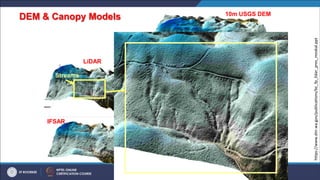
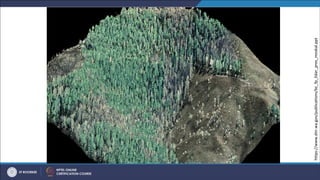
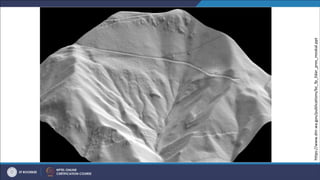
LiDAR
DEM & Canopy Models
IFSAR IFSAR
10m USGS DEM
Streams
Landslide
LiDAR
https://www.dnr.wa.gov/publications/bc_fp_lidar_pres_moskal.ppt
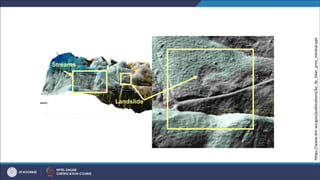
Streams
Landslide
https://www.dnr.wa.gov/publications/bc_fp_lidar_pres_moskal.ppt
LIDAR data products
Digital Ortho-Rectified Imagery
Some LiDAR providers collect digital color or black-and-white ortho-rectified imagery simultaneously with the
collection of point data. Imagery is collected either from digital cameras or digital video cameras and can be
mosaiced. Resolution is typically 1m.
Intensity Return Images
Images may be derived from intensity values returned by each laser pulse. The intensity values can be displayed
as a gray scale image.
LIDAR Derived Products
Topographic LiDAR systems produce surface elevation x, y, z coordinate data points. There are many products that
can be derived from raw point data. Most LiDAR providers can derive these products upon request:
– Digital Elevation Models (DEMs)
– Digital Terrain Models (DTMs) (bald-earth elevation data)
– Triangulated Irregular Networks (TINs)
– Breaklines - a line representing a feature that you wish to preserve in a TIN (example: stream or ridge)
– Contours
– Shaded Relief
– Slope & Aspect
https://www.dnr.wa.gov/publications/bc_fp_lidar_pres_moskal.ppt
Sources of Error
• Acquisition
• Processing
– Strip adjustment
– Selecting ground points
– Thinning
• Interpolation
• Analysis/Visualization
https://www.dnr.wa.gov/publications/bc_fp_lidar_pres_moskal.ppt
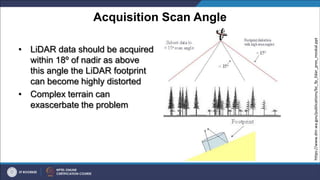
Acquisition Scan Angle
• LiDAR data should be acquired
within 18º of nadir as above
this angle the LiDAR footprint
can become highly distorted
• Complex terrain can
exascerbate the problem
https://www.dnr.wa.gov/publications/bc_fp_lidar_pres_moskal.ppt
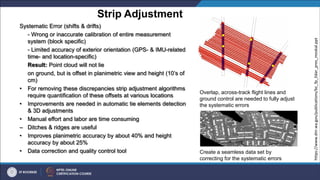
Strip Adjustment
Systematic Error (shifts & drifts)
- Wrong or inaccurate calibration of entire measurement
system (block specific)
- Limited accuracy of exterior orientation (GPS- & IMU-related
time- and location-specific)
Result: Point cloud will not lie
on ground, but is offset in planimetric view and height (10’s of
cm)
• For removing these discrepancies strip adjustment algorithms
require quantification of these offsets at various locations
• Improvements are needed in automatic tie elements detection
& 3D adjustments
• Manual effort and labor are time consuming
– Ditches & ridges are useful
• Improves planimetric accuracy by about 40% and height
accuracy by about 25%
• Data correction and quality control tool
Overlap, across-track flight lines and
ground control are needed to fully adjust
the systematic errors
Create a seamless data set by
correcting for the systematic errors
https://www.dnr.wa.gov/publications/bc_fp_lidar_pres_moskal.ppt
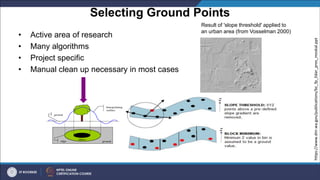
Selecting Ground Points
• Active area of research
• Many algorithms
• Project specific
• Manual clean up necessary in most cases
Result of 'slope threshold' applied to
an urban area (from Vosselman 2000)
https://www.dnr.wa.gov/publications/bc_fp_lidar_pres_moskal.ppt
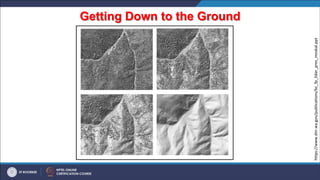
Getting Down to the Ground
https://www.dnr.wa.gov/publications/bc_fp_lidar_pres_moskal.ppt
Filtering
• Post ground point selection filtering is also performed to reduce
the size of the data sets
• This type of filtering should only be applied in even terrain
• Uneven terrain and densely vegetated areas are most
susceptible to removal of critical interpolation points
https://www.dnr.wa.gov/publications/bc_fp_lidar_pres_moskal.ppt
Terrain
• Digital elevation model (DEM), digital terrain model (DTM): “Ground”
• Digital surface model (DSM): “top surface”
• In open terrain, the separation surface between air and bare earth
• DEM is different from measured laser points due to very different
reasons:
1. Filtering: classification of points into terrain and off-terrain
2. Basis for DTM generation, detection of topographic objects
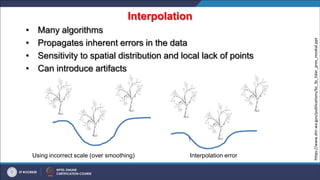
Interpolation
• Many algorithms
• Propagates inherent errors in the data
• Sensitivity to spatial distribution and local lack of points
• Can introduce artifacts
Using incorrect scale (over smoothing) Interpolation error
https://www.dnr.wa.gov/publications/bc_fp_lidar_pres_moskal.ppt
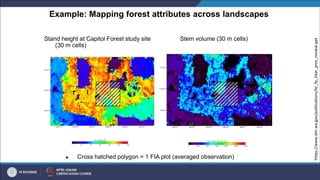
Example: Mapping forest attributes across landscapes
Stand height at Capitol Forest study site
(30 m cells)
Stem volume (30 m cells)
 Cross hatched polygon = 1 FIA plot (averaged observation)
https://www.dnr.wa.gov/publications/bc_fp_lidar_pres_moskal.ppt
Other Considerations
• LiDAR derived DEM are not often hydro-corrected so as
to ensure a continuous downward flow of water (no
Digital Line Graph (DLG) hypsographic and hydrographic
data)
• Water creates a natural void in LiDAR data and manual
addition of breadlines is necessary
• This type of processing is feasible with LiDAR data but it
adds cost
https://www.dnr.wa.gov/publications/bc_fp_lidar_pres_moskal.ppt
https://en.wikipedia.org/wiki/Lidar#/media/File:LIDAR-scanned-SICK-LMS-animation.gif
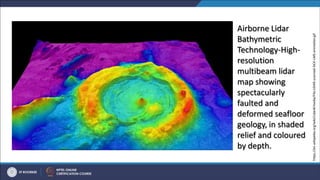
Airborne Lidar
Bathymetric
Technology-High-
resolution
multibeam lidar
map showing
spectacularly
faulted and
deformed seafloor
geology, in shaded
relief and coloured
by depth.
https://en.wikipedia.org/wiki/Lidar#/media/File:LIDAR-scanned-SICK-LMS-animation.gif
Cruise
Automation
self driving
car with five
Velodyne
LiDAR units
on the roof.
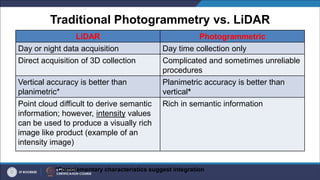
Traditional Photogrammetry vs. LiDAR
LiDAR Photogrammetric
Day or night data acquisition Day time collection only
Direct acquisition of 3D collection Complicated and sometimes unreliable
procedures
Vertical accuracy is better than
planimetric*
Planimetric accuracy is better than
vertical*
Point cloud difficult to derive semantic
information; however, intensity values
can be used to produce a visually rich
image like product (example of an
intensity image)
Rich in semantic information
*Complementary characteristics suggest integration
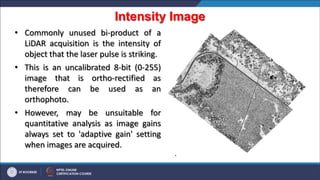
Intensity Image
.
• Commonly unused bi-product of a
LiDAR acquisition is the intensity of
object that the laser pulse is striking.
• This is an uncalibrated 8-bit (0-255)
image that is ortho-rectified as
therefore can be used as an
orthophoto.
• However, may be unsuitable for
quantitative analysis as image gains
always set to 'adaptive gain' setting
when images are acquired.
Further Analysis & Ground Validation
• Once the DTM or DEM is available GIS can be utilized for further
systematic analysis and modeling
• Accuracy assessment should always be attempted (best
approach is to do ground validation)

THANKS

LiDAR Technique and Applications, Remote sensing.pdf

  • 1.
    Remote Sensing Essentials LiDARTechnique and Applications Dr. Arun K. Saraf, Professor Department of Earth Sciences 1
  • 2.
    LIDAR (Light Detectionand Ranging) • Lidar (also know as 3D laser scanning) is not only replacing conventional sensors, but also creating new methods with unique properties that could not be achieved before. • Lidar is extremely useful in atmospheric and environmental research as well as space exploration. • It also has wide applications in industry, defense, and military. • It has terrestrial, airborne, and mobile applications.
  • 3.
    LIDAR (Light Detectionand Ranging) • Lidar is a surveying method that measures distance to a target by illuminating the target with pulsed laser light and measuring the reflected pulses with a sensor. • Differences in laser return times and wavelengths can then be used to make digital 3-D representations of the target. R =c Δt / 2 https://www.researchgate.net/publication/241475870_The_Role_of_Lidar_Systems_in_Fuel_Mapping/fi gures?lo=1
  • 4.
    How LiDAR works? Eachtime the laser is pulsed: • Laser generates an optical pulse • Pulse is reflected off an object and returns to the system receiver • High-speed counter measures the time of flight from the start pulse to the return pulse • Time measurement is converted to a distance (the distance to the target and the position of the airplane is then used to determine the elevation and location) • Multiple returns can be measured for each pulse • Up to 200,000+ pulses/second • Everything that can be seen from the aircraft is measured
  • 5.
    https://en.wikipedia.org/wiki/Lidar#/media/File:LIDAR-scanned-SICK-LMS-animation.gif A basic Lidarsystem involves a laser range finder reflected by a rotating mirror (top). The laser is scanned around the scene being digitized, in one or two dimensions (middle), gathering distance measurements at specified angle intervals (bottom).
  • 6.
    LIDAR (Light Detectionand Ranging) • Lidar is commonly used to make high-resolution maps, with applications in geodesy, geomatics, archaeology, geography, geology, geomorphology, seismology, forestry, atmospheric physics, laser guidance, airborne laser swath mapping (ALSM), and laser altimetry. • The technology is also used in control and navigation for some autonomous cars. • It also has wide applications in industry, defense, and military. • It has terrestrial, airborne, and mobile applications. https://en.wikipedia.org/wiki/Lidar
  • 7.
    Aerial LiDAR SystemComponents • Aircraft • Scanning laser emitter-receiver unit • Differentially-corrected GPS • Inertial measurement unit (IMU) • Computer LiDAR point data colored by height https://www.dnr.wa.gov/publications/bc_fp_lidar_pres_moskal.ppt
  • 8.
  • 9.
    Determinants of LiDARData Characteristic • The combination of: – Scanner system (relates to beam pattern) – Flight altitude (if flight limitations exist) – Pulse rates – Scan frequencies – Scan angle possible max around 30° scan swath https://www.dnr.wa.gov/publications/bc_fp_lidar_pres_moskal.ppt
  • 10.
    LiDAR Data Characteristics •Raw return data are XYZ points • High spatial resolution – Laser footprint on ground ≤ 50 cm – Typical density is 0.5 to 20+ pulses/m2 – 2 to 3 returns/pulse in forest areas – Surface/canopy models typically 1 to 5m grid • Large volume of data – 5,000 to 60,000+ pulses/hectare – 10 to100+ thousands of returns/hectare – 0.4 to 5.4+ MB/hectare https://www.dnr.wa.gov/publications/bc_fp_lidar_pres_moskal.ppt
  • 11.
    Return Density • InLiDAR the footprint size decreases with increasing post-spacing and importantly the last return from a discrete return system is not always the ground • LiDAR sensor systems vary in the number of returns from a surface Figure Source: http://www.cnrhome.uidaho.edu/ https://www.dnr.wa.gov/publications/bc_fp_lidar_pres_moskal.ppt
  • 12.
    Reflectivity • Highly reflectiveobjects may saturate some laser detectors, while the return signal from low-reflectivity objects may occasionally be too weak to register as valid • Minimum detectable object size depends on reflectivity • A strong sunlight reflection off a highly reflective target may "saturate" a receiver, producing an invalid or less accurate reading* *most acquisition is done in a preferred range of angles to avoid this issue https://www.dnr.wa.gov/publications/bc_fp_lidar_pres_moskal.ppt
  • 13.
    Dust & Vapor •Laser measurements can be weakened by interacting with dust and vapor particles, which scatter the laser beam and the signal returning from the target • Using last-pulse measurements can reduce or eliminate this interference • Systems that are expected to work in such conditions regularly can be optimized for these environments https://www.dnr.wa.gov/publications/bc_fp_lidar_pres_moskal.ppt
  • 14.
    Background Noise andRadiation • The laser is not affected by background noise • Most systems determine baseline radiation levels to ensure that it does not interfere with measurements https://www.dnr.wa.gov/publications/bc_fp_lidar_pres_moskal.ppt
  • 15.
    Overall Accuracy • (X,Y,Z)position of each return – 50-100cm horizontal – 10-15cm vertical • Ground surface (bare-earth surface) – What is the ground (grass, rocks, stumps)? • Tree heights – Underestimate tree heights by 0.5 to 2 m – Error is species dependent https://www.dnr.wa.gov/publications/bc_fp_lidar_pres_moskal.ppt
  • 16.
    LiDAR DEM & CanopyModels IFSAR IFSAR 10m USGS DEM Streams Landslide LiDAR https://www.dnr.wa.gov/publications/bc_fp_lidar_pres_moskal.ppt
  • 17.
  • 18.
    LIDAR data products DigitalOrtho-Rectified Imagery Some LiDAR providers collect digital color or black-and-white ortho-rectified imagery simultaneously with the collection of point data. Imagery is collected either from digital cameras or digital video cameras and can be mosaiced. Resolution is typically 1m. Intensity Return Images Images may be derived from intensity values returned by each laser pulse. The intensity values can be displayed as a gray scale image. LIDAR Derived Products Topographic LiDAR systems produce surface elevation x, y, z coordinate data points. There are many products that can be derived from raw point data. Most LiDAR providers can derive these products upon request: – Digital Elevation Models (DEMs) – Digital Terrain Models (DTMs) (bald-earth elevation data) – Triangulated Irregular Networks (TINs) – Breaklines - a line representing a feature that you wish to preserve in a TIN (example: stream or ridge) – Contours – Shaded Relief – Slope & Aspect https://www.dnr.wa.gov/publications/bc_fp_lidar_pres_moskal.ppt
  • 19.
  • 20.
  • 21.
    Sources of Error •Acquisition • Processing – Strip adjustment – Selecting ground points – Thinning • Interpolation • Analysis/Visualization https://www.dnr.wa.gov/publications/bc_fp_lidar_pres_moskal.ppt
  • 22.
    Acquisition Scan Angle •LiDAR data should be acquired within 18º of nadir as above this angle the LiDAR footprint can become highly distorted • Complex terrain can exascerbate the problem https://www.dnr.wa.gov/publications/bc_fp_lidar_pres_moskal.ppt
  • 23.
    Strip Adjustment Systematic Error(shifts & drifts) - Wrong or inaccurate calibration of entire measurement system (block specific) - Limited accuracy of exterior orientation (GPS- & IMU-related time- and location-specific) Result: Point cloud will not lie on ground, but is offset in planimetric view and height (10’s of cm) • For removing these discrepancies strip adjustment algorithms require quantification of these offsets at various locations • Improvements are needed in automatic tie elements detection & 3D adjustments • Manual effort and labor are time consuming – Ditches & ridges are useful • Improves planimetric accuracy by about 40% and height accuracy by about 25% • Data correction and quality control tool Overlap, across-track flight lines and ground control are needed to fully adjust the systematic errors Create a seamless data set by correcting for the systematic errors https://www.dnr.wa.gov/publications/bc_fp_lidar_pres_moskal.ppt
  • 24.
    Selecting Ground Points •Active area of research • Many algorithms • Project specific • Manual clean up necessary in most cases Result of 'slope threshold' applied to an urban area (from Vosselman 2000) https://www.dnr.wa.gov/publications/bc_fp_lidar_pres_moskal.ppt
  • 25.
    Getting Down tothe Ground https://www.dnr.wa.gov/publications/bc_fp_lidar_pres_moskal.ppt
  • 26.
    Filtering • Post groundpoint selection filtering is also performed to reduce the size of the data sets • This type of filtering should only be applied in even terrain • Uneven terrain and densely vegetated areas are most susceptible to removal of critical interpolation points https://www.dnr.wa.gov/publications/bc_fp_lidar_pres_moskal.ppt
  • 27.
    Terrain • Digital elevationmodel (DEM), digital terrain model (DTM): “Ground” • Digital surface model (DSM): “top surface” • In open terrain, the separation surface between air and bare earth • DEM is different from measured laser points due to very different reasons: 1. Filtering: classification of points into terrain and off-terrain 2. Basis for DTM generation, detection of topographic objects
  • 28.
    Interpolation • Many algorithms •Propagates inherent errors in the data • Sensitivity to spatial distribution and local lack of points • Can introduce artifacts Using incorrect scale (over smoothing) Interpolation error https://www.dnr.wa.gov/publications/bc_fp_lidar_pres_moskal.ppt
  • 29.
    Example: Mapping forestattributes across landscapes Stand height at Capitol Forest study site (30 m cells) Stem volume (30 m cells)  Cross hatched polygon = 1 FIA plot (averaged observation) https://www.dnr.wa.gov/publications/bc_fp_lidar_pres_moskal.ppt
  • 30.
    Other Considerations • LiDARderived DEM are not often hydro-corrected so as to ensure a continuous downward flow of water (no Digital Line Graph (DLG) hypsographic and hydrographic data) • Water creates a natural void in LiDAR data and manual addition of breadlines is necessary • This type of processing is feasible with LiDAR data but it adds cost https://www.dnr.wa.gov/publications/bc_fp_lidar_pres_moskal.ppt
  • 31.
  • 32.
  • 33.
    Traditional Photogrammetry vs.LiDAR LiDAR Photogrammetric Day or night data acquisition Day time collection only Direct acquisition of 3D collection Complicated and sometimes unreliable procedures Vertical accuracy is better than planimetric* Planimetric accuracy is better than vertical* Point cloud difficult to derive semantic information; however, intensity values can be used to produce a visually rich image like product (example of an intensity image) Rich in semantic information *Complementary characteristics suggest integration
  • 34.
    Intensity Image . • Commonlyunused bi-product of a LiDAR acquisition is the intensity of object that the laser pulse is striking. • This is an uncalibrated 8-bit (0-255) image that is ortho-rectified as therefore can be used as an orthophoto. • However, may be unsuitable for quantitative analysis as image gains always set to 'adaptive gain' setting when images are acquired.
  • 35.
    Further Analysis &Ground Validation • Once the DTM or DEM is available GIS can be utilized for further systematic analysis and modeling • Accuracy assessment should always be attempted (best approach is to do ground validation)
  • 36.