1Challenge the future
Efficient Navigation in Temporal,
Multi-Dimensional Point Sets
Efficiёnte navigatie in tijd-afhankelijke, multi-dimensionale
puntengegevens
Christian Kehl
2Challenge the future
General Introduction
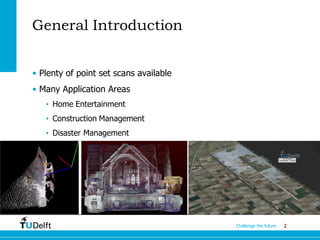
• Plenty of point set scans available
• Many Application Areas
• Home Entertainment
• Construction Management
• Disaster Management
3Challenge the future
General Introduction
• Problem 4D data: technical limitations of rendering system
• user‘s interests hard to find by traversing time-series data sets
• Goal: Visualisation algorithms for supportive user navigation
• Approaches:
• real-time rendered data traversal
• user-centred browsing
• navigation via visual summaries
Rendering & Navigation
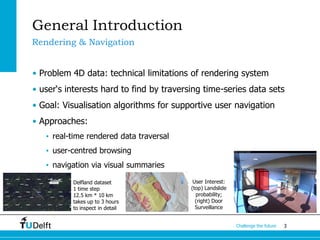
Delfland dataset
1 time step
12.5 km * 10 km
takes up to 3 hours
to inspect in detail
User Interest:
(top) Landslide
probability;
(right) Door
Surveillance
4Challenge the future
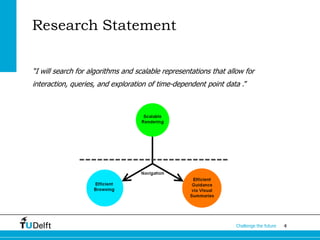
Research Statement
“I will search for algorithms and scalable representations that allow for
interaction, queries, and exploration of time-dependent point data .”
5Challenge the future
Subtopics
1. Scalable Rendering and Visualisation of time-dependent
Point Sets
2. Efficiently Browsing through time-dependent Datasets
3. Navigation by Visual Summaries
6Challenge the future
Scalable Rendering and Visualisation of
time-dependent Point Sets
• Interactive Rendering of large point sets already demanding
• additional, time-related challenges:
• just developing branch, virtually no data sets openly available
=> no available rendering approaches
• Rendering of multiple time steps faces technical challenges
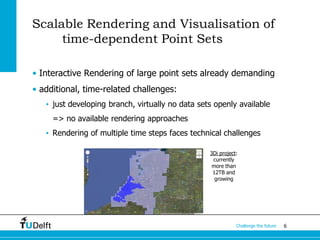
3Di project:
currently
more than
12TB and
growing
7Challenge the future
Scalable Rendering and Visualisation of
time-dependent Point Sets
• Goal: efficient rendering system
• displays massive point sets
• multiple time steps at the same time
• exploits visual and technical limitations
• Contribution:
• time-dependent LoD technique by continuous refinement
• temporal caching of point sets
8Challenge the future
Subtopics
1. Scalable Rendering and Visualisation of time-dependent
Point Sets
2. Efficiently Browsing through time-dependent Datasets
3. Navigation by Visual Summaries
9Challenge the future
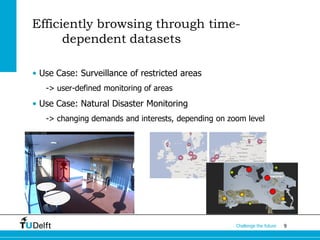
Efficiently browsing through time-
dependent datasets
• Use Case: Surveillance of restricted areas
-> user-defined monitoring of areas
• Use Case: Natural Disaster Monitoring
-> changing demands and interests, depending on zoom level
10Challenge the future
Efficiently browsing through
time-dependent datasets
Problems:
• browse while only showing user-specific interest
• remove/hide redundant data
• selection and interactive exploration of temporal data
• handling varying user interests according to user viewpoint
11Challenge the future
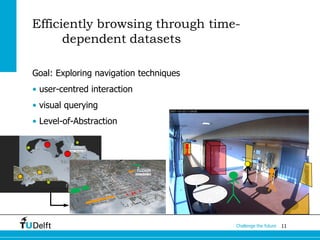
Efficiently browsing through time-
dependent datasets
Goal: Exploring navigation techniques
• user-centred interaction
• visual querying
• Level-of-Abstraction
12Challenge the future
Subtopics
1. Scalable Rendering and Visualisation of time-dependent
Point Sets
2. Efficiently Browsing through time-dependent Datasets
3. Navigation by Visual Summaries
13Challenge the future
Navigation by Visual Summaries
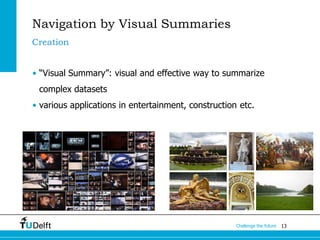
• “Visual Summary”: visual and effective way to summarize
complex datasets
• various applications in entertainment, construction etc.
Creation
14Challenge the future
Navigation by Visual Summaries
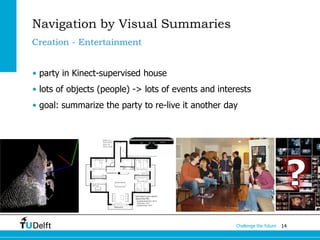
• party in Kinect-supervised house
• lots of objects (people) -> lots of events and interests
• goal: summarize the party to re-live it another day
Creation - Entertainment
15Challenge the future
Navigation by Visual Summaries
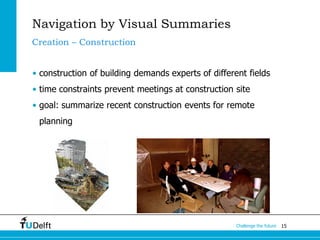
• construction of building demands experts of different fields
• time constraints prevent meetings at construction site
• goal: summarize recent construction events for remote
planning
Creation – Construction
16Challenge the future
Navigation by Visual Summaries
Problems:
• suitable representations
• spatio-temporal incoherence
• events wide-spread in space and time across the dataset
• suitable guidance to important events in the dataset
18Challenge the future
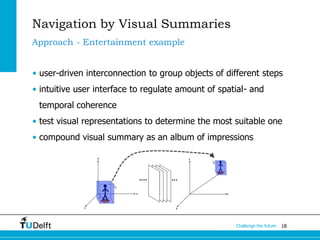
Navigation by Visual Summaries
• user-driven interconnection to group objects of different steps
• intuitive user interface to regulate amount of spatial- and
temporal coherence
• test visual representations to determine the most suitable one
• compound visual summary as an album of impressions
Approach - Entertainment example
19Challenge the future
Navigation by Visual Summaries
• focus on Guidance along events
• visual 4D tour
• 4D scene capture as interactive representation of a summary
Approach – Construction Example
20Challenge the future
Conclusion
• focus: Visually navigating efficiently in time-dependent, multi-
dimensional, scanned data
• applications:
• Efficient Visual Surveillance
• Disaster Assessment with dynamically changing user interests
• Home Entertainment: Re-live a 3D-recorded party another day
• Visually guide construction processes
21Challenge the future
Conclusion
• Necessary techniques:
• Real-time Rendering of Datasets
• Efficient Browsing through Datasets according to user interests
• Visual Summaries and their use as Guidance Method in Datasets
22Challenge the future
The following 3 months
• finish paper “Interactive Rendering of Large-Scale, Geospatial
Data“ (PROM-4 Scientific Writing)
• generate artificial, temporal test dataset
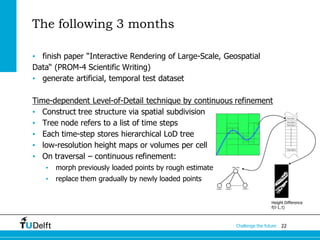
Time-dependent Level-of-Detail technique by continuous refinement
• Construct tree structure via spatial subdivision
• Tree node refers to a list of time steps
• Each time-step stores hierarchical LoD tree
• low-resolution height maps or volumes per cell
• On traversal – continuous refinement:
• morph previously loaded points by rough estimate
• replace them gradually by newly loaded points
Height Difference
f(t-1, t)

Efficient Navigation in Temporal, Multi-Dimensional Point Sets (April 2013)

  • 1.
    1Challenge the future EfficientNavigation in Temporal, Multi-Dimensional Point Sets Efficiёnte navigatie in tijd-afhankelijke, multi-dimensionale puntengegevens Christian Kehl
  • 2.
    2Challenge the future GeneralIntroduction • Plenty of point set scans available • Many Application Areas • Home Entertainment • Construction Management • Disaster Management
  • 3.
    3Challenge the future GeneralIntroduction • Problem 4D data: technical limitations of rendering system • user‘s interests hard to find by traversing time-series data sets • Goal: Visualisation algorithms for supportive user navigation • Approaches: • real-time rendered data traversal • user-centred browsing • navigation via visual summaries Rendering & Navigation Delfland dataset 1 time step 12.5 km * 10 km takes up to 3 hours to inspect in detail User Interest: (top) Landslide probability; (right) Door Surveillance
  • 4.
    4Challenge the future ResearchStatement “I will search for algorithms and scalable representations that allow for interaction, queries, and exploration of time-dependent point data .”
  • 5.
    5Challenge the future Subtopics 1.Scalable Rendering and Visualisation of time-dependent Point Sets 2. Efficiently Browsing through time-dependent Datasets 3. Navigation by Visual Summaries
  • 6.
    6Challenge the future ScalableRendering and Visualisation of time-dependent Point Sets • Interactive Rendering of large point sets already demanding • additional, time-related challenges: • just developing branch, virtually no data sets openly available => no available rendering approaches • Rendering of multiple time steps faces technical challenges 3Di project: currently more than 12TB and growing
  • 7.
    7Challenge the future ScalableRendering and Visualisation of time-dependent Point Sets • Goal: efficient rendering system • displays massive point sets • multiple time steps at the same time • exploits visual and technical limitations • Contribution: • time-dependent LoD technique by continuous refinement • temporal caching of point sets
  • 8.
    8Challenge the future Subtopics 1.Scalable Rendering and Visualisation of time-dependent Point Sets 2. Efficiently Browsing through time-dependent Datasets 3. Navigation by Visual Summaries
  • 9.
    9Challenge the future Efficientlybrowsing through time- dependent datasets • Use Case: Surveillance of restricted areas -> user-defined monitoring of areas • Use Case: Natural Disaster Monitoring -> changing demands and interests, depending on zoom level
  • 10.
    10Challenge the future Efficientlybrowsing through time-dependent datasets Problems: • browse while only showing user-specific interest • remove/hide redundant data • selection and interactive exploration of temporal data • handling varying user interests according to user viewpoint
  • 11.
    11Challenge the future Efficientlybrowsing through time- dependent datasets Goal: Exploring navigation techniques • user-centred interaction • visual querying • Level-of-Abstraction
  • 12.
    12Challenge the future Subtopics 1.Scalable Rendering and Visualisation of time-dependent Point Sets 2. Efficiently Browsing through time-dependent Datasets 3. Navigation by Visual Summaries
  • 13.
    13Challenge the future Navigationby Visual Summaries • “Visual Summary”: visual and effective way to summarize complex datasets • various applications in entertainment, construction etc. Creation
  • 14.
    14Challenge the future Navigationby Visual Summaries • party in Kinect-supervised house • lots of objects (people) -> lots of events and interests • goal: summarize the party to re-live it another day Creation - Entertainment
  • 15.
    15Challenge the future Navigationby Visual Summaries • construction of building demands experts of different fields • time constraints prevent meetings at construction site • goal: summarize recent construction events for remote planning Creation – Construction
  • 16.
    16Challenge the future Navigationby Visual Summaries Problems: • suitable representations • spatio-temporal incoherence • events wide-spread in space and time across the dataset • suitable guidance to important events in the dataset
  • 17.
    18Challenge the future Navigationby Visual Summaries • user-driven interconnection to group objects of different steps • intuitive user interface to regulate amount of spatial- and temporal coherence • test visual representations to determine the most suitable one • compound visual summary as an album of impressions Approach - Entertainment example
  • 18.
    19Challenge the future Navigationby Visual Summaries • focus on Guidance along events • visual 4D tour • 4D scene capture as interactive representation of a summary Approach – Construction Example
  • 19.
    20Challenge the future Conclusion •focus: Visually navigating efficiently in time-dependent, multi- dimensional, scanned data • applications: • Efficient Visual Surveillance • Disaster Assessment with dynamically changing user interests • Home Entertainment: Re-live a 3D-recorded party another day • Visually guide construction processes
  • 20.
    21Challenge the future Conclusion •Necessary techniques: • Real-time Rendering of Datasets • Efficient Browsing through Datasets according to user interests • Visual Summaries and their use as Guidance Method in Datasets
  • 21.
    22Challenge the future Thefollowing 3 months • finish paper “Interactive Rendering of Large-Scale, Geospatial Data“ (PROM-4 Scientific Writing) • generate artificial, temporal test dataset Time-dependent Level-of-Detail technique by continuous refinement • Construct tree structure via spatial subdivision • Tree node refers to a list of time steps • Each time-step stores hierarchical LoD tree • low-resolution height maps or volumes per cell • On traversal – continuous refinement: • morph previously loaded points by rough estimate • replace them gradually by newly loaded points Height Difference f(t-1, t)