LIBTwinSVM
A Library for Twin Support Vector Machines
Amir Mir
Software Engineering Research Group
EEMCS Faculty
Delft University of Technology
November 13, 2019
Contents
Bio
Background
Introduction
Main features
Design
Implementation
API
Benchmarks
Challenges and Problems
Summary
2 / 34
Bio
Jan. 2019: Received a Master’s degree in Computer Engineering
(Specialization in Artificial Intelligence).
3 / 34
Bio
Jan. 2019: Received a Master’s degree in Computer Engineering
(Specialization in Artificial Intelligence).
Worked as a Research Assistant at IranDoc Institution from Jul.
2017 until Sep. 2019.
3 / 34
Bio
Jan. 2019: Received a Master’s degree in Computer Engineering
(Specialization in Artificial Intelligence).
Worked as a Research Assistant at IranDoc Institution from Jul.
2017 until Sep. 2019.
Research interests: Machine Learning and its application in
Software Engineering.
3 / 34
Background
Support Vector Machine (SVM)
Introduced by Vapnik and Cortes 1
in 1995.
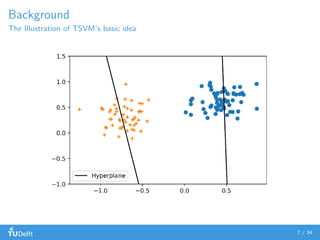
Finds an optimal separating hyperplane.
1
C. Cortes and V. Vapnik (1995). “Support-vector networks”. In: Machine learning 20.3, pp. 273–297. issn: 0885-6125
4 / 34
Background
Support Vector Machine (SVM)
Introduced by Vapnik and Cortes 1
in 1995.
Finds an optimal separating hyperplane.
SVM’s optimization problem
min
w
1
2
w 2
s.t. yi (wT
xi + b) ≥ 1,∀i
(1)
1
C. Cortes and V. Vapnik (1995). “Support-vector networks”. In: Machine learning 20.3, pp. 273–297. issn: 0885-6125
4 / 34
Background
The Illustration of SVM’s basic idea
5 / 34
Background
Twin Support Vector Machine (TSVM)
Inspired by SVM, TSVM2
was proposed in 2007.
Two non-parallel hyperplanes.
2
R Khemchandani, S. Chandra, et al. (2007). “Twin support vector machines for pattern classification”. In: IEEE
Transactions on pattern analysis and machine intelligence 29.5, pp. 905–910
6 / 34
Background
Twin Support Vector Machine (TSVM)
Inspired by SVM, TSVM2
was proposed in 2007.
Two non-parallel hyperplanes.
TSVM’s optimization problems
min
w1,b1
1
2
Aw1 + e1b1
2
+ c1eT
2 ξ
s.t. − (Bw1 + e2b1) + ξ ≥ e2 ,ξ ≥ 0
(2)
min
w2,b2
1
2
Bw2 + e2b2
2
+ c2eT
1 η
s.t. (Aw2 + e1b2) + η ≥ e1 ,η ≥ 0
(3)
2
R Khemchandani, S. Chandra, et al. (2007). “Twin support vector machines for pattern classification”. In: IEEE
Transactions on pattern analysis and machine intelligence 29.5, pp. 905–910
6 / 34
Background
The Illustration of TSVM’s basic idea
7 / 34
Existing Software Packages
SVMs:
3
A. M. Mir and J. A. Nasiri (2019). “LightTwinSVM: A Simple and Fast Implementation of Standard Twin Support
Vector Machine Classifier”. In: Journal of Open Source Software 4, p. 1252
8 / 34
Existing Software Packages
SVMs:
LIBLINEAR: supports linear SVMs.
3
A. M. Mir and J. A. Nasiri (2019). “LightTwinSVM: A Simple and Fast Implementation of Standard Twin Support
Vector Machine Classifier”. In: Journal of Open Source Software 4, p. 1252
8 / 34
Existing Software Packages
SVMs:
LIBLINEAR: supports linear SVMs.
LIBSVM: supports non-linear SVMs.
3
A. M. Mir and J. A. Nasiri (2019). “LightTwinSVM: A Simple and Fast Implementation of Standard Twin Support
Vector Machine Classifier”. In: Journal of Open Source Software 4, p. 1252
8 / 34
Existing Software Packages
SVMs:
LIBLINEAR: supports linear SVMs.
LIBSVM: supports non-linear SVMs.
ThunderSVM: provides GPU implementation of SVMs.
3
A. M. Mir and J. A. Nasiri (2019). “LightTwinSVM: A Simple and Fast Implementation of Standard Twin Support
Vector Machine Classifier”. In: Journal of Open Source Software 4, p. 1252
8 / 34
Existing Software Packages
SVMs:
LIBLINEAR: supports linear SVMs.
LIBSVM: supports non-linear SVMs.
ThunderSVM: provides GPU implementation of SVMs.
TSVMs:
LightTwinSVM:3
supports linear and non-linear TSVM classifier.
3
A. M. Mir and J. A. Nasiri (2019). “LightTwinSVM: A Simple and Fast Implementation of Standard Twin Support
Vector Machine Classifier”. In: Journal of Open Source Software 4, p. 1252
8 / 34
An Intro to LIBTwinSVM Library
A free, efficient and open-source library for Twin Support Vector
Machines (TSVMs).
It can be used for solving classification tasks.
9 / 34
An Intro to LIBTwinSVM Library
A free, efficient and open-source library for Twin Support Vector
Machines (TSVMs).
It can be used for solving classification tasks.
9 / 34
Contributors of the LIBTwinSVM project
10 / 34
The main goals of the LIBTwinSVM project
Simplicity and ease of use.
11 / 34
The main goals of the LIBTwinSVM project
Simplicity and ease of use.
A Python application programming interface (API).
11 / 34
The main goals of the LIBTwinSVM project
Simplicity and ease of use.
A Python application programming interface (API).
Fast running time.
11 / 34
The main goals of the LIBTwinSVM project
Simplicity and ease of use.
A Python application programming interface (API).
Fast running time.
Providing quite a number of useful features.
11 / 34
Main features of the LIBTwinSVM Library
A simple and user-friendly Graphical User Interface (GUI).
4
M. A. Kumar and M. Gopal (2009). “Least squares twin support vector machines for pattern classification”. In: Expert
Systems with Applications 36.4, pp. 7535–7543
5
X. Peng, D. Chen, and L. Kong (2014). “A clipping dual coordinate descent algorithm for solving support vector
machines”. In: Knowledge-Based Systems 71, pp. 266–278
12 / 34
Main features of the LIBTwinSVM Library
A simple and user-friendly Graphical User Interface (GUI).
Supports both standard TSVM and its Least Squares
extension4
.
4
M. A. Kumar and M. Gopal (2009). “Least squares twin support vector machines for pattern classification”. In: Expert
Systems with Applications 36.4, pp. 7535–7543
5
X. Peng, D. Chen, and L. Kong (2014). “A clipping dual coordinate descent algorithm for solving support vector
machines”. In: Knowledge-Based Systems 71, pp. 266–278
12 / 34
Main features of the LIBTwinSVM Library
A simple and user-friendly Graphical User Interface (GUI).
Supports both standard TSVM and its Least Squares
extension4
.
A fast optimizer (ClipDCD5
) in C++.
4
M. A. Kumar and M. Gopal (2009). “Least squares twin support vector machines for pattern classification”. In: Expert
Systems with Applications 36.4, pp. 7535–7543
5
X. Peng, D. Chen, and L. Kong (2014). “A clipping dual coordinate descent algorithm for solving support vector
machines”. In: Knowledge-Based Systems 71, pp. 266–278
12 / 34
Main features of the LIBTwinSVM Library
A simple and user-friendly Graphical User Interface (GUI).
Supports both standard TSVM and its Least Squares
extension4
.
A fast optimizer (ClipDCD5
) in C++.
Supports Linear, Radial Basis Function (RBF), and Rectangular
kernels.
4
M. A. Kumar and M. Gopal (2009). “Least squares twin support vector machines for pattern classification”. In: Expert
Systems with Applications 36.4, pp. 7535–7543
5
X. Peng, D. Chen, and L. Kong (2014). “A clipping dual coordinate descent algorithm for solving support vector
machines”. In: Knowledge-Based Systems 71, pp. 266–278
12 / 34
Main features of the LIBTwinSVM Library
A simple and user-friendly Graphical User Interface (GUI).
Supports both standard TSVM and its Least Squares
extension4
.
A fast optimizer (ClipDCD5
) in C++.
Supports Linear, Radial Basis Function (RBF), and Rectangular
kernels.
Supports popular multi-class classification approaches such as
One-vs-All and One-vs-One.
4
M. A. Kumar and M. Gopal (2009). “Least squares twin support vector machines for pattern classification”. In: Expert
Systems with Applications 36.4, pp. 7535–7543
5
X. Peng, D. Chen, and L. Kong (2014). “A clipping dual coordinate descent algorithm for solving support vector
machines”. In: Knowledge-Based Systems 71, pp. 266–278
12 / 34
Main features of the LIBTwinSVM Library
A simple and user-friendly Graphical User Interface (GUI).
Supports both standard TSVM and its Least Squares
extension4
.
A fast optimizer (ClipDCD5
) in C++.
Supports Linear, Radial Basis Function (RBF), and Rectangular
kernels.
Supports popular multi-class classification approaches such as
One-vs-All and One-vs-One.
Scikit-learn-compatible estimators.
4
M. A. Kumar and M. Gopal (2009). “Least squares twin support vector machines for pattern classification”. In: Expert
Systems with Applications 36.4, pp. 7535–7543
5
X. Peng, D. Chen, and L. Kong (2014). “A clipping dual coordinate descent algorithm for solving support vector
machines”. In: Knowledge-Based Systems 71, pp. 266–278
12 / 34
Main features of the LIBTwinSVM Library
A simple and user-friendly Graphical User Interface (GUI).
Supports both standard TSVM and its Least Squares
extension4
.
A fast optimizer (ClipDCD5
) in C++.
Supports Linear, Radial Basis Function (RBF), and Rectangular
kernels.
Supports popular multi-class classification approaches such as
One-vs-All and One-vs-One.
Scikit-learn-compatible estimators.
A visualization tool to show the decision boundaries of TSVMs.
4
M. A. Kumar and M. Gopal (2009). “Least squares twin support vector machines for pattern classification”. In: Expert
Systems with Applications 36.4, pp. 7535–7543
5
X. Peng, D. Chen, and L. Kong (2014). “A clipping dual coordinate descent algorithm for solving support vector
machines”. In: Knowledge-Based Systems 71, pp. 266–278
12 / 34
Main features of the LIBTwinSVM Library
A simple and user-friendly Graphical User Interface (GUI).
Supports both standard TSVM and its Least Squares
extension4
.
A fast optimizer (ClipDCD5
) in C++.
Supports Linear, Radial Basis Function (RBF), and Rectangular
kernels.
Supports popular multi-class classification approaches such as
One-vs-All and One-vs-One.
Scikit-learn-compatible estimators.
A visualization tool to show the decision boundaries of TSVMs.
It can saves the best-fitted model on the disk and also can load
pre-trained models.
4
M. A. Kumar and M. Gopal (2009). “Least squares twin support vector machines for pattern classification”. In: Expert
Systems with Applications 36.4, pp. 7535–7543
5
X. Peng, D. Chen, and L. Kong (2014). “A clipping dual coordinate descent algorithm for solving support vector
machines”. In: Knowledge-Based Systems 71, pp. 266–278
12 / 34
Main features of the LIBTwinSVM Library
The GUI application
13 / 34
Main features of the LIBTwinSVM Library
The visualization feature
14 / 34
Design
Main components of the LIBTwinSVM library
15 / 34
Design
Core components
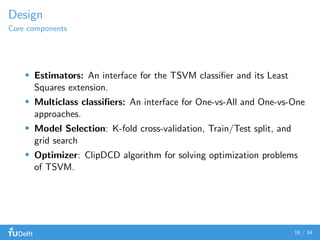
Estimators: An interface for the TSVM classifier and its Least
Squares extension.
16 / 34
Design
Core components
Estimators: An interface for the TSVM classifier and its Least
Squares extension.
Multiclass classifiers: An interface for One-vs-All and One-vs-One
approaches.
16 / 34
Design
Core components
Estimators: An interface for the TSVM classifier and its Least
Squares extension.
Multiclass classifiers: An interface for One-vs-All and One-vs-One
approaches.
Model Selection: K-fold cross-validation, Train/Test split, and
grid search
16 / 34
Design
Core components
Estimators: An interface for the TSVM classifier and its Least
Squares extension.
Multiclass classifiers: An interface for One-vs-All and One-vs-One
approaches.
Model Selection: K-fold cross-validation, Train/Test split, and
grid search
Optimizer: ClipDCD algorithm for solving optimization problems
of TSVM.
16 / 34
Implementation
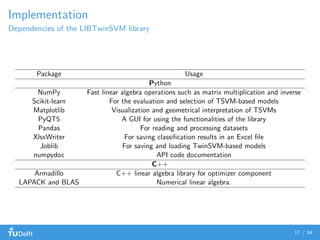
Dependencies of the LIBTwinSVM library
Package Usage
Python
NumPy Fast linear algebra operations such as matrix multiplication and inverse
Scikit-learn For the evaluation and selection of TSVM-based models
Matplotlib Visualization and geometrical interpretation of TSVMs
PyQT5 A GUI for using the functionalities of the library
Pandas For reading and processing datasets
XlsxWriter For saving classification results in an Excel file
Joblib For saving and loading TwinSVM-based models
numpydoc API code documentation
C++
Armadillo C++ linear algebra library for optimizer component
LAPACK and BLAS Numerical linear algebra.
17 / 34
Implementation
Optimizer component
It is the performance-critical part of the library.
6
https://cvxopt.org/
18 / 34
Implementation
Optimizer component
It is the performance-critical part of the library.
We could use CVXOPT6
package.
6
https://cvxopt.org/
18 / 34
Implementation
Optimizer component
It is the performance-critical part of the library.
We could use CVXOPT6
package.
Instead, clipDCD algorithm is implemented in C++.
6
https://cvxopt.org/
18 / 34
Implementation
Optimizer component
It is the performance-critical part of the library.
We could use CVXOPT6
package.
Instead, clipDCD algorithm is implemented in C++.
Cython was used for generating Python extension module.
6
https://cvxopt.org/
18 / 34
Implementation
Optimizer component
It is the performance-critical part of the library.
We could use CVXOPT6
package.
Instead, clipDCD algorithm is implemented in C++.
Cython was used for generating Python extension module.
The implementation caches major computation with the space cost
of O(n).
6
https://cvxopt.org/
18 / 34
Implementation
Optimizer component
It is the performance-critical part of the library.
We could use CVXOPT6
package.
Instead, clipDCD algorithm is implemented in C++.
Cython was used for generating Python extension module.
The implementation caches major computation with the space cost
of O(n).
Memory copies are avoided.
6
https://cvxopt.org/
18 / 34
API
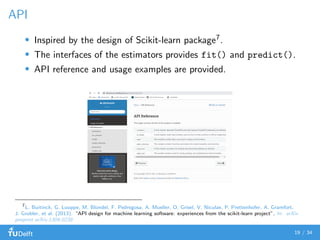
Inspired by the design of Scikit-learn package7
.
7
L. Buitinck, G. Louppe, M. Blondel, F. Pedregosa, A. Mueller, O. Grisel, V. Niculae, P. Prettenhofer, A. Gramfort,
J. Grobler, et al. (2013). “API design for machine learning software: experiences from the scikit-learn project”. In: arXiv
preprint arXiv:1309.0238
19 / 34
API
Inspired by the design of Scikit-learn package7
.
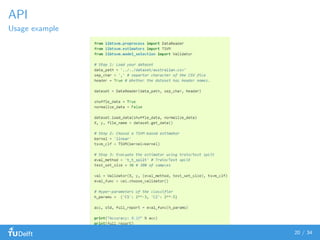
The interfaces of the estimators provides fit() and predict().
7
L. Buitinck, G. Louppe, M. Blondel, F. Pedregosa, A. Mueller, O. Grisel, V. Niculae, P. Prettenhofer, A. Gramfort,
J. Grobler, et al. (2013). “API design for machine learning software: experiences from the scikit-learn project”. In: arXiv
preprint arXiv:1309.0238
19 / 34
API
Inspired by the design of Scikit-learn package7
.
The interfaces of the estimators provides fit() and predict().
API reference and usage examples are provided.
7
L. Buitinck, G. Louppe, M. Blondel, F. Pedregosa, A. Mueller, O. Grisel, V. Niculae, P. Prettenhofer, A. Gramfort,
J. Grobler, et al. (2013). “API design for machine learning software: experiences from the scikit-learn project”. In: arXiv
preprint arXiv:1309.0238
19 / 34
API
Usage example
20 / 34
Benchmarks
Classification performance
Experiment details:
The datasets were obtained from UCI8
repository.
8
https://archive.ics.uci.edu/ml/index.php
21 / 34
Benchmarks
Classification performance
Experiment details:
The datasets were obtained from UCI8
repository.
All the datasets were normalized in the range [0,1].
8
https://archive.ics.uci.edu/ml/index.php
21 / 34
Benchmarks
Classification performance
Experiment details:
The datasets were obtained from UCI8
repository.
All the datasets were normalized in the range [0,1].
5-fold cross-validation was used for the evaluation.
8
https://archive.ics.uci.edu/ml/index.php
21 / 34
Benchmarks
Classification performance
Experiment details:
The datasets were obtained from UCI8
repository.
All the datasets were normalized in the range [0,1].
5-fold cross-validation was used for the evaluation.
The grid search was used to find the optimal value of
hyper-parameters.
8
https://archive.ics.uci.edu/ml/index.php
21 / 34
Benchmarks
Classification performance
22 / 34
Benchmarks
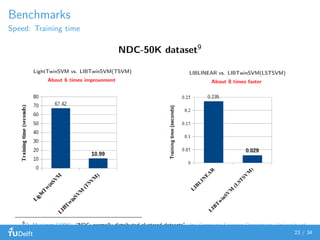
Speed: Training time
NDC-50K dataset9
LightTwinSVM vs. LIBTwinSVM(TSVM)
About 6 times improvement
9
D. Musicant (1998). “NDC: normally distributed clustered datasets”. In: Computer Sciences Department, University of
Wisconsin, Madison 23 / 34
Benchmarks
Speed: Training time
NDC-50K dataset9
LightTwinSVM vs. LIBTwinSVM(TSVM)
About 6 times improvement
LIBLINEAR vs. LIBTwinSVM(LSTSVM)
About 8 times faster
9
D. Musicant (1998). “NDC: normally distributed clustered datasets”. In: Computer Sciences Department, University of
Wisconsin, Madison 23 / 34
Benchmarks
Speed: Prediction time
NDC-50K dataset
LightTwinSVM vs. LIBTwinSVM(TSVM)
About 42 times improvement
24 / 34
Benchmarks
Speed: Prediction time
NDC-50K dataset
LightTwinSVM vs. LIBTwinSVM(TSVM)
About 42 times improvement
LIBLINEAR vs. LIBTwinSVM(LSTSVM)
About 18 times faster
24 / 34
Benchmarks
Memory consumption
Procedure for measuring the peak memory consumption:
Loading a dataset.
Training an estimator using fit() method.
The Linux time command for measuring the usage.
25 / 34
Benchmarks
Memory consumption
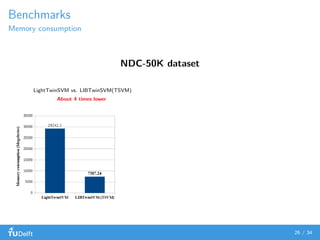
NDC-50K dataset
LightTwinSVM vs. LIBTwinSVM(TSVM)
About 4 times lower
26 / 34
Benchmarks
Memory consumption
NDC-50K dataset
LightTwinSVM vs. LIBTwinSVM(TSVM)
About 4 times lower
LIBLINEAR vs. LIBTwinSVM(LSTSVM)
About 45 percent lower
26 / 34
Solved Problems
The efficiency of the optimizer component
Created a C++ extension module.
27 / 34
Solved Problems
The efficiency of the optimizer component
Created a C++ extension module.
Used a caching technique.
27 / 34
Solved Problems
The efficiency of the optimizer component
Created a C++ extension module.
Used a caching technique.
A NumPy array to an Armadillo matrix without memory copy.
27 / 34
Solved Problems
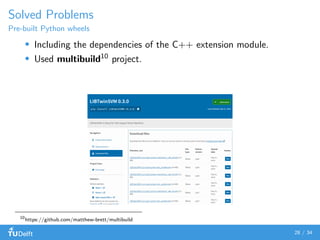
Pre-built Python wheels
Including the dependencies of the C++ extension module.
10
https://github.com/matthew-brett/multibuild
28 / 34
Solved Problems
Pre-built Python wheels
Including the dependencies of the C++ extension module.
Used multibuild10
project.
10
https://github.com/matthew-brett/multibuild
28 / 34
Solved Problems
Pre-built Python wheels
Including the dependencies of the C++ extension module.
Used multibuild10
project.
Employed Travis CI and AppVeyor for generating the wheels.
10
https://github.com/matthew-brett/multibuild
28 / 34
Solved problems
Very high memory consumption
Optimized the fit() of the TSVM classifier by changing the order of
the computation.
Previous approach
1 Compute the matrix of the
first optimization problem.
2 Compute the matrix of the
second optimization problem.
3 Solve the first optimization
problem.
4 Solve the second optimization
problem.
29 / 34
Solved problems
Very high memory consumption
Optimized the fit() of the TSVM classifier by changing the order of
the computation.
Previous approach
1 Compute the matrix of the
first optimization problem.
2 Compute the matrix of the
second optimization problem.
3 Solve the first optimization
problem.
4 Solve the second optimization
problem.
Current approach
1 Compute the matrix of the
first optimization problem.
2 Solve the first optimization
problem.
3 Free the matrix of the first
optimization problem from the
memory.
4 Compute the matrix of the
second optimization problem.
5 Solve the second optimization
problem. 29 / 34
Open problems
Support for GPUs.
30 / 34
Open problems
Support for GPUs.
The parallelization of the optimizer component.
30 / 34
Open problems
Support for GPUs.
The parallelization of the optimizer component.
Support for sparse datasets.
30 / 34
Summary
TSVM employs two non-parallel hyperplanes for classification.
31 / 34
Summary
TSVM employs two non-parallel hyperplanes for classification.
The main goal of the project: Simplicity and Ease of Use.
31 / 34
Summary
TSVM employs two non-parallel hyperplanes for classification.
The main goal of the project: Simplicity and Ease of Use.
The library provides a GUI app and a Python API.
31 / 34
Summary
TSVM employs two non-parallel hyperplanes for classification.
The main goal of the project: Simplicity and Ease of Use.
The library provides a GUI app and a Python API.
The experimental results are comparable or even better.
31 / 34
Summary
TSVM employs two non-parallel hyperplanes for classification.
The main goal of the project: Simplicity and Ease of Use.
The library provides a GUI app and a Python API.
The experimental results are comparable or even better.
There are open problems to improve the library.
31 / 34
Quote
32 / 34
Quote
“We have to stop optimizing for programmers and start
optimizing for users.”
Jeff Atwood
32 / 34
Questions
33 / 34
References
Buitinck, L., G. Louppe, M. Blondel, F. Pedregosa, A. Mueller, O. Grisel, V. Niculae,
P. Prettenhofer, A. Gramfort, J. Grobler, et al. (2013). “API design for machine learning
software: experiences from the scikit-learn project”. In: arXiv preprint arXiv:1309.0238.
Cortes, C. and V. Vapnik (1995). “Support-vector networks”. In: Machine learning 20.3,
pp. 273–297. issn: 0885-6125.
Khemchandani, R, S. Chandra, et al. (2007). “Twin support vector machines for pattern
classification”. In: IEEE Transactions on pattern analysis and machine intelligence 29.5,
pp. 905–910.
Kumar, M. A. and M. Gopal (2009). “Least squares twin support vector machines for
pattern classification”. In: Expert Systems with Applications 36.4, pp. 7535–7543.
Mir, A. M. and J. A. Nasiri (2019). “LightTwinSVM: A Simple and Fast Implementation of
Standard Twin Support Vector Machine Classifier”. In: Journal of Open Source Software
4, p. 1252.
Musicant, D. (1998). “NDC: normally distributed clustered datasets”. In: Computer Sciences
Department, University of Wisconsin, Madison.
Peng, X., D. Chen, and L. Kong (2014). “A clipping dual coordinate descent algorithm for
solving support vector machines”. In: Knowledge-Based Systems 71, pp. 266–278.
34 / 34

LIBTwinSVM: A Library for Twin Support Vector Machine

  • 1.
    LIBTwinSVM A Library forTwin Support Vector Machines Amir Mir Software Engineering Research Group EEMCS Faculty Delft University of Technology November 13, 2019
  • 2.
  • 3.
    Bio Jan. 2019: Receiveda Master’s degree in Computer Engineering (Specialization in Artificial Intelligence). 3 / 34
  • 4.
    Bio Jan. 2019: Receiveda Master’s degree in Computer Engineering (Specialization in Artificial Intelligence). Worked as a Research Assistant at IranDoc Institution from Jul. 2017 until Sep. 2019. 3 / 34
  • 5.
    Bio Jan. 2019: Receiveda Master’s degree in Computer Engineering (Specialization in Artificial Intelligence). Worked as a Research Assistant at IranDoc Institution from Jul. 2017 until Sep. 2019. Research interests: Machine Learning and its application in Software Engineering. 3 / 34
  • 6.
    Background Support Vector Machine(SVM) Introduced by Vapnik and Cortes 1 in 1995. Finds an optimal separating hyperplane. 1 C. Cortes and V. Vapnik (1995). “Support-vector networks”. In: Machine learning 20.3, pp. 273–297. issn: 0885-6125 4 / 34
  • 7.
    Background Support Vector Machine(SVM) Introduced by Vapnik and Cortes 1 in 1995. Finds an optimal separating hyperplane. SVM’s optimization problem min w 1 2 w 2 s.t. yi (wT xi + b) ≥ 1,∀i (1) 1 C. Cortes and V. Vapnik (1995). “Support-vector networks”. In: Machine learning 20.3, pp. 273–297. issn: 0885-6125 4 / 34
  • 8.
    Background The Illustration ofSVM’s basic idea 5 / 34
  • 9.
    Background Twin Support VectorMachine (TSVM) Inspired by SVM, TSVM2 was proposed in 2007. Two non-parallel hyperplanes. 2 R Khemchandani, S. Chandra, et al. (2007). “Twin support vector machines for pattern classification”. In: IEEE Transactions on pattern analysis and machine intelligence 29.5, pp. 905–910 6 / 34
  • 10.
    Background Twin Support VectorMachine (TSVM) Inspired by SVM, TSVM2 was proposed in 2007. Two non-parallel hyperplanes. TSVM’s optimization problems min w1,b1 1 2 Aw1 + e1b1 2 + c1eT 2 ξ s.t. − (Bw1 + e2b1) + ξ ≥ e2 ,ξ ≥ 0 (2) min w2,b2 1 2 Bw2 + e2b2 2 + c2eT 1 η s.t. (Aw2 + e1b2) + η ≥ e1 ,η ≥ 0 (3) 2 R Khemchandani, S. Chandra, et al. (2007). “Twin support vector machines for pattern classification”. In: IEEE Transactions on pattern analysis and machine intelligence 29.5, pp. 905–910 6 / 34
  • 11.
    Background The Illustration ofTSVM’s basic idea 7 / 34
  • 12.
    Existing Software Packages SVMs: 3 A.M. Mir and J. A. Nasiri (2019). “LightTwinSVM: A Simple and Fast Implementation of Standard Twin Support Vector Machine Classifier”. In: Journal of Open Source Software 4, p. 1252 8 / 34
  • 13.
    Existing Software Packages SVMs: LIBLINEAR:supports linear SVMs. 3 A. M. Mir and J. A. Nasiri (2019). “LightTwinSVM: A Simple and Fast Implementation of Standard Twin Support Vector Machine Classifier”. In: Journal of Open Source Software 4, p. 1252 8 / 34
  • 14.
    Existing Software Packages SVMs: LIBLINEAR:supports linear SVMs. LIBSVM: supports non-linear SVMs. 3 A. M. Mir and J. A. Nasiri (2019). “LightTwinSVM: A Simple and Fast Implementation of Standard Twin Support Vector Machine Classifier”. In: Journal of Open Source Software 4, p. 1252 8 / 34
  • 15.
    Existing Software Packages SVMs: LIBLINEAR:supports linear SVMs. LIBSVM: supports non-linear SVMs. ThunderSVM: provides GPU implementation of SVMs. 3 A. M. Mir and J. A. Nasiri (2019). “LightTwinSVM: A Simple and Fast Implementation of Standard Twin Support Vector Machine Classifier”. In: Journal of Open Source Software 4, p. 1252 8 / 34
  • 16.
    Existing Software Packages SVMs: LIBLINEAR:supports linear SVMs. LIBSVM: supports non-linear SVMs. ThunderSVM: provides GPU implementation of SVMs. TSVMs: LightTwinSVM:3 supports linear and non-linear TSVM classifier. 3 A. M. Mir and J. A. Nasiri (2019). “LightTwinSVM: A Simple and Fast Implementation of Standard Twin Support Vector Machine Classifier”. In: Journal of Open Source Software 4, p. 1252 8 / 34
  • 17.
    An Intro toLIBTwinSVM Library A free, efficient and open-source library for Twin Support Vector Machines (TSVMs). It can be used for solving classification tasks. 9 / 34
  • 18.
    An Intro toLIBTwinSVM Library A free, efficient and open-source library for Twin Support Vector Machines (TSVMs). It can be used for solving classification tasks. 9 / 34
  • 19.
    Contributors of theLIBTwinSVM project 10 / 34
  • 20.
    The main goalsof the LIBTwinSVM project Simplicity and ease of use. 11 / 34
  • 21.
    The main goalsof the LIBTwinSVM project Simplicity and ease of use. A Python application programming interface (API). 11 / 34
  • 22.
    The main goalsof the LIBTwinSVM project Simplicity and ease of use. A Python application programming interface (API). Fast running time. 11 / 34
  • 23.
    The main goalsof the LIBTwinSVM project Simplicity and ease of use. A Python application programming interface (API). Fast running time. Providing quite a number of useful features. 11 / 34
  • 24.
    Main features ofthe LIBTwinSVM Library A simple and user-friendly Graphical User Interface (GUI). 4 M. A. Kumar and M. Gopal (2009). “Least squares twin support vector machines for pattern classification”. In: Expert Systems with Applications 36.4, pp. 7535–7543 5 X. Peng, D. Chen, and L. Kong (2014). “A clipping dual coordinate descent algorithm for solving support vector machines”. In: Knowledge-Based Systems 71, pp. 266–278 12 / 34
  • 25.
    Main features ofthe LIBTwinSVM Library A simple and user-friendly Graphical User Interface (GUI). Supports both standard TSVM and its Least Squares extension4 . 4 M. A. Kumar and M. Gopal (2009). “Least squares twin support vector machines for pattern classification”. In: Expert Systems with Applications 36.4, pp. 7535–7543 5 X. Peng, D. Chen, and L. Kong (2014). “A clipping dual coordinate descent algorithm for solving support vector machines”. In: Knowledge-Based Systems 71, pp. 266–278 12 / 34
  • 26.
    Main features ofthe LIBTwinSVM Library A simple and user-friendly Graphical User Interface (GUI). Supports both standard TSVM and its Least Squares extension4 . A fast optimizer (ClipDCD5 ) in C++. 4 M. A. Kumar and M. Gopal (2009). “Least squares twin support vector machines for pattern classification”. In: Expert Systems with Applications 36.4, pp. 7535–7543 5 X. Peng, D. Chen, and L. Kong (2014). “A clipping dual coordinate descent algorithm for solving support vector machines”. In: Knowledge-Based Systems 71, pp. 266–278 12 / 34
  • 27.
    Main features ofthe LIBTwinSVM Library A simple and user-friendly Graphical User Interface (GUI). Supports both standard TSVM and its Least Squares extension4 . A fast optimizer (ClipDCD5 ) in C++. Supports Linear, Radial Basis Function (RBF), and Rectangular kernels. 4 M. A. Kumar and M. Gopal (2009). “Least squares twin support vector machines for pattern classification”. In: Expert Systems with Applications 36.4, pp. 7535–7543 5 X. Peng, D. Chen, and L. Kong (2014). “A clipping dual coordinate descent algorithm for solving support vector machines”. In: Knowledge-Based Systems 71, pp. 266–278 12 / 34
  • 28.
    Main features ofthe LIBTwinSVM Library A simple and user-friendly Graphical User Interface (GUI). Supports both standard TSVM and its Least Squares extension4 . A fast optimizer (ClipDCD5 ) in C++. Supports Linear, Radial Basis Function (RBF), and Rectangular kernels. Supports popular multi-class classification approaches such as One-vs-All and One-vs-One. 4 M. A. Kumar and M. Gopal (2009). “Least squares twin support vector machines for pattern classification”. In: Expert Systems with Applications 36.4, pp. 7535–7543 5 X. Peng, D. Chen, and L. Kong (2014). “A clipping dual coordinate descent algorithm for solving support vector machines”. In: Knowledge-Based Systems 71, pp. 266–278 12 / 34
  • 29.
    Main features ofthe LIBTwinSVM Library A simple and user-friendly Graphical User Interface (GUI). Supports both standard TSVM and its Least Squares extension4 . A fast optimizer (ClipDCD5 ) in C++. Supports Linear, Radial Basis Function (RBF), and Rectangular kernels. Supports popular multi-class classification approaches such as One-vs-All and One-vs-One. Scikit-learn-compatible estimators. 4 M. A. Kumar and M. Gopal (2009). “Least squares twin support vector machines for pattern classification”. In: Expert Systems with Applications 36.4, pp. 7535–7543 5 X. Peng, D. Chen, and L. Kong (2014). “A clipping dual coordinate descent algorithm for solving support vector machines”. In: Knowledge-Based Systems 71, pp. 266–278 12 / 34
  • 30.
    Main features ofthe LIBTwinSVM Library A simple and user-friendly Graphical User Interface (GUI). Supports both standard TSVM and its Least Squares extension4 . A fast optimizer (ClipDCD5 ) in C++. Supports Linear, Radial Basis Function (RBF), and Rectangular kernels. Supports popular multi-class classification approaches such as One-vs-All and One-vs-One. Scikit-learn-compatible estimators. A visualization tool to show the decision boundaries of TSVMs. 4 M. A. Kumar and M. Gopal (2009). “Least squares twin support vector machines for pattern classification”. In: Expert Systems with Applications 36.4, pp. 7535–7543 5 X. Peng, D. Chen, and L. Kong (2014). “A clipping dual coordinate descent algorithm for solving support vector machines”. In: Knowledge-Based Systems 71, pp. 266–278 12 / 34
  • 31.
    Main features ofthe LIBTwinSVM Library A simple and user-friendly Graphical User Interface (GUI). Supports both standard TSVM and its Least Squares extension4 . A fast optimizer (ClipDCD5 ) in C++. Supports Linear, Radial Basis Function (RBF), and Rectangular kernels. Supports popular multi-class classification approaches such as One-vs-All and One-vs-One. Scikit-learn-compatible estimators. A visualization tool to show the decision boundaries of TSVMs. It can saves the best-fitted model on the disk and also can load pre-trained models. 4 M. A. Kumar and M. Gopal (2009). “Least squares twin support vector machines for pattern classification”. In: Expert Systems with Applications 36.4, pp. 7535–7543 5 X. Peng, D. Chen, and L. Kong (2014). “A clipping dual coordinate descent algorithm for solving support vector machines”. In: Knowledge-Based Systems 71, pp. 266–278 12 / 34
  • 32.
    Main features ofthe LIBTwinSVM Library The GUI application 13 / 34
  • 33.
    Main features ofthe LIBTwinSVM Library The visualization feature 14 / 34
  • 34.
    Design Main components ofthe LIBTwinSVM library 15 / 34
  • 35.
    Design Core components Estimators: Aninterface for the TSVM classifier and its Least Squares extension. 16 / 34
  • 36.
    Design Core components Estimators: Aninterface for the TSVM classifier and its Least Squares extension. Multiclass classifiers: An interface for One-vs-All and One-vs-One approaches. 16 / 34
  • 37.
    Design Core components Estimators: Aninterface for the TSVM classifier and its Least Squares extension. Multiclass classifiers: An interface for One-vs-All and One-vs-One approaches. Model Selection: K-fold cross-validation, Train/Test split, and grid search 16 / 34
  • 38.
    Design Core components Estimators: Aninterface for the TSVM classifier and its Least Squares extension. Multiclass classifiers: An interface for One-vs-All and One-vs-One approaches. Model Selection: K-fold cross-validation, Train/Test split, and grid search Optimizer: ClipDCD algorithm for solving optimization problems of TSVM. 16 / 34
  • 39.
    Implementation Dependencies of theLIBTwinSVM library Package Usage Python NumPy Fast linear algebra operations such as matrix multiplication and inverse Scikit-learn For the evaluation and selection of TSVM-based models Matplotlib Visualization and geometrical interpretation of TSVMs PyQT5 A GUI for using the functionalities of the library Pandas For reading and processing datasets XlsxWriter For saving classification results in an Excel file Joblib For saving and loading TwinSVM-based models numpydoc API code documentation C++ Armadillo C++ linear algebra library for optimizer component LAPACK and BLAS Numerical linear algebra. 17 / 34
  • 40.
    Implementation Optimizer component It isthe performance-critical part of the library. 6 https://cvxopt.org/ 18 / 34
  • 41.
    Implementation Optimizer component It isthe performance-critical part of the library. We could use CVXOPT6 package. 6 https://cvxopt.org/ 18 / 34
  • 42.
    Implementation Optimizer component It isthe performance-critical part of the library. We could use CVXOPT6 package. Instead, clipDCD algorithm is implemented in C++. 6 https://cvxopt.org/ 18 / 34
  • 43.
    Implementation Optimizer component It isthe performance-critical part of the library. We could use CVXOPT6 package. Instead, clipDCD algorithm is implemented in C++. Cython was used for generating Python extension module. 6 https://cvxopt.org/ 18 / 34
  • 44.
    Implementation Optimizer component It isthe performance-critical part of the library. We could use CVXOPT6 package. Instead, clipDCD algorithm is implemented in C++. Cython was used for generating Python extension module. The implementation caches major computation with the space cost of O(n). 6 https://cvxopt.org/ 18 / 34
  • 45.
    Implementation Optimizer component It isthe performance-critical part of the library. We could use CVXOPT6 package. Instead, clipDCD algorithm is implemented in C++. Cython was used for generating Python extension module. The implementation caches major computation with the space cost of O(n). Memory copies are avoided. 6 https://cvxopt.org/ 18 / 34
  • 46.
    API Inspired by thedesign of Scikit-learn package7 . 7 L. Buitinck, G. Louppe, M. Blondel, F. Pedregosa, A. Mueller, O. Grisel, V. Niculae, P. Prettenhofer, A. Gramfort, J. Grobler, et al. (2013). “API design for machine learning software: experiences from the scikit-learn project”. In: arXiv preprint arXiv:1309.0238 19 / 34
  • 47.
    API Inspired by thedesign of Scikit-learn package7 . The interfaces of the estimators provides fit() and predict(). 7 L. Buitinck, G. Louppe, M. Blondel, F. Pedregosa, A. Mueller, O. Grisel, V. Niculae, P. Prettenhofer, A. Gramfort, J. Grobler, et al. (2013). “API design for machine learning software: experiences from the scikit-learn project”. In: arXiv preprint arXiv:1309.0238 19 / 34
  • 48.
    API Inspired by thedesign of Scikit-learn package7 . The interfaces of the estimators provides fit() and predict(). API reference and usage examples are provided. 7 L. Buitinck, G. Louppe, M. Blondel, F. Pedregosa, A. Mueller, O. Grisel, V. Niculae, P. Prettenhofer, A. Gramfort, J. Grobler, et al. (2013). “API design for machine learning software: experiences from the scikit-learn project”. In: arXiv preprint arXiv:1309.0238 19 / 34
  • 49.
  • 50.
    Benchmarks Classification performance Experiment details: Thedatasets were obtained from UCI8 repository. 8 https://archive.ics.uci.edu/ml/index.php 21 / 34
  • 51.
    Benchmarks Classification performance Experiment details: Thedatasets were obtained from UCI8 repository. All the datasets were normalized in the range [0,1]. 8 https://archive.ics.uci.edu/ml/index.php 21 / 34
  • 52.
    Benchmarks Classification performance Experiment details: Thedatasets were obtained from UCI8 repository. All the datasets were normalized in the range [0,1]. 5-fold cross-validation was used for the evaluation. 8 https://archive.ics.uci.edu/ml/index.php 21 / 34
  • 53.
    Benchmarks Classification performance Experiment details: Thedatasets were obtained from UCI8 repository. All the datasets were normalized in the range [0,1]. 5-fold cross-validation was used for the evaluation. The grid search was used to find the optimal value of hyper-parameters. 8 https://archive.ics.uci.edu/ml/index.php 21 / 34
  • 54.
  • 55.
    Benchmarks Speed: Training time NDC-50Kdataset9 LightTwinSVM vs. LIBTwinSVM(TSVM) About 6 times improvement 9 D. Musicant (1998). “NDC: normally distributed clustered datasets”. In: Computer Sciences Department, University of Wisconsin, Madison 23 / 34
  • 56.
    Benchmarks Speed: Training time NDC-50Kdataset9 LightTwinSVM vs. LIBTwinSVM(TSVM) About 6 times improvement LIBLINEAR vs. LIBTwinSVM(LSTSVM) About 8 times faster 9 D. Musicant (1998). “NDC: normally distributed clustered datasets”. In: Computer Sciences Department, University of Wisconsin, Madison 23 / 34
  • 57.
    Benchmarks Speed: Prediction time NDC-50Kdataset LightTwinSVM vs. LIBTwinSVM(TSVM) About 42 times improvement 24 / 34
  • 58.
    Benchmarks Speed: Prediction time NDC-50Kdataset LightTwinSVM vs. LIBTwinSVM(TSVM) About 42 times improvement LIBLINEAR vs. LIBTwinSVM(LSTSVM) About 18 times faster 24 / 34
  • 59.
    Benchmarks Memory consumption Procedure formeasuring the peak memory consumption: Loading a dataset. Training an estimator using fit() method. The Linux time command for measuring the usage. 25 / 34
  • 60.
    Benchmarks Memory consumption NDC-50K dataset LightTwinSVMvs. LIBTwinSVM(TSVM) About 4 times lower 26 / 34
  • 61.
    Benchmarks Memory consumption NDC-50K dataset LightTwinSVMvs. LIBTwinSVM(TSVM) About 4 times lower LIBLINEAR vs. LIBTwinSVM(LSTSVM) About 45 percent lower 26 / 34
  • 62.
    Solved Problems The efficiencyof the optimizer component Created a C++ extension module. 27 / 34
  • 63.
    Solved Problems The efficiencyof the optimizer component Created a C++ extension module. Used a caching technique. 27 / 34
  • 64.
    Solved Problems The efficiencyof the optimizer component Created a C++ extension module. Used a caching technique. A NumPy array to an Armadillo matrix without memory copy. 27 / 34
  • 65.
    Solved Problems Pre-built Pythonwheels Including the dependencies of the C++ extension module. 10 https://github.com/matthew-brett/multibuild 28 / 34
  • 66.
    Solved Problems Pre-built Pythonwheels Including the dependencies of the C++ extension module. Used multibuild10 project. 10 https://github.com/matthew-brett/multibuild 28 / 34
  • 67.
    Solved Problems Pre-built Pythonwheels Including the dependencies of the C++ extension module. Used multibuild10 project. Employed Travis CI and AppVeyor for generating the wheels. 10 https://github.com/matthew-brett/multibuild 28 / 34
  • 68.
    Solved problems Very highmemory consumption Optimized the fit() of the TSVM classifier by changing the order of the computation. Previous approach 1 Compute the matrix of the first optimization problem. 2 Compute the matrix of the second optimization problem. 3 Solve the first optimization problem. 4 Solve the second optimization problem. 29 / 34
  • 69.
    Solved problems Very highmemory consumption Optimized the fit() of the TSVM classifier by changing the order of the computation. Previous approach 1 Compute the matrix of the first optimization problem. 2 Compute the matrix of the second optimization problem. 3 Solve the first optimization problem. 4 Solve the second optimization problem. Current approach 1 Compute the matrix of the first optimization problem. 2 Solve the first optimization problem. 3 Free the matrix of the first optimization problem from the memory. 4 Compute the matrix of the second optimization problem. 5 Solve the second optimization problem. 29 / 34
  • 70.
  • 71.
    Open problems Support forGPUs. The parallelization of the optimizer component. 30 / 34
  • 72.
    Open problems Support forGPUs. The parallelization of the optimizer component. Support for sparse datasets. 30 / 34
  • 73.
    Summary TSVM employs twonon-parallel hyperplanes for classification. 31 / 34
  • 74.
    Summary TSVM employs twonon-parallel hyperplanes for classification. The main goal of the project: Simplicity and Ease of Use. 31 / 34
  • 75.
    Summary TSVM employs twonon-parallel hyperplanes for classification. The main goal of the project: Simplicity and Ease of Use. The library provides a GUI app and a Python API. 31 / 34
  • 76.
    Summary TSVM employs twonon-parallel hyperplanes for classification. The main goal of the project: Simplicity and Ease of Use. The library provides a GUI app and a Python API. The experimental results are comparable or even better. 31 / 34
  • 77.
    Summary TSVM employs twonon-parallel hyperplanes for classification. The main goal of the project: Simplicity and Ease of Use. The library provides a GUI app and a Python API. The experimental results are comparable or even better. There are open problems to improve the library. 31 / 34
  • 78.
  • 79.
    Quote “We have tostop optimizing for programmers and start optimizing for users.” Jeff Atwood 32 / 34
  • 80.
  • 81.
    References Buitinck, L., G.Louppe, M. Blondel, F. Pedregosa, A. Mueller, O. Grisel, V. Niculae, P. Prettenhofer, A. Gramfort, J. Grobler, et al. (2013). “API design for machine learning software: experiences from the scikit-learn project”. In: arXiv preprint arXiv:1309.0238. Cortes, C. and V. Vapnik (1995). “Support-vector networks”. In: Machine learning 20.3, pp. 273–297. issn: 0885-6125. Khemchandani, R, S. Chandra, et al. (2007). “Twin support vector machines for pattern classification”. In: IEEE Transactions on pattern analysis and machine intelligence 29.5, pp. 905–910. Kumar, M. A. and M. Gopal (2009). “Least squares twin support vector machines for pattern classification”. In: Expert Systems with Applications 36.4, pp. 7535–7543. Mir, A. M. and J. A. Nasiri (2019). “LightTwinSVM: A Simple and Fast Implementation of Standard Twin Support Vector Machine Classifier”. In: Journal of Open Source Software 4, p. 1252. Musicant, D. (1998). “NDC: normally distributed clustered datasets”. In: Computer Sciences Department, University of Wisconsin, Madison. Peng, X., D. Chen, and L. Kong (2014). “A clipping dual coordinate descent algorithm for solving support vector machines”. In: Knowledge-Based Systems 71, pp. 266–278. 34 / 34