WRITING SEMINAR:
RESEARCH STRATEGIES USING
LIBRARY RESOURCES
Professor Kelly Kobiela
Systems Librarian
Heterick Memorial Library
WELCOME TO THE LIBRARY
 Professor Kelly Kobiela, k-kobiela@onu.edu
 Reference Email, reference@onu.edu
 Reference librarians on duty:
 Monday – Friday
 8:00 AM – 4:30 PM
 Monday – Wednesday
 6:00 PM – 9:00 PM
 One-on-one sessions available by appointment, or
fee free to stop by or send us an email.
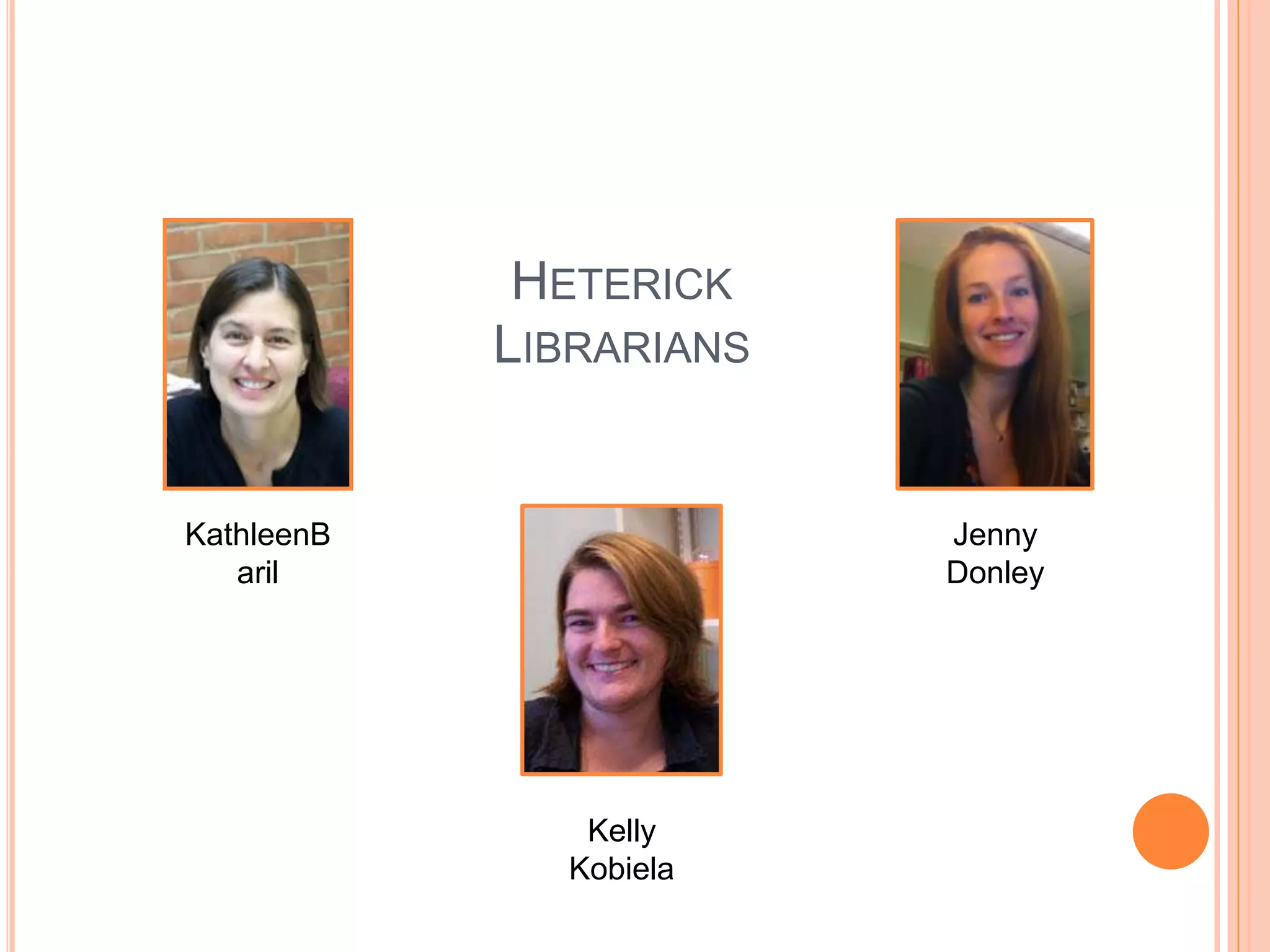
HETERICK
LIBRARIANS
KathleenB
aril
Jenny
Donley
Kelly
Kobiela
WHAT THE LIBRARY OFFERS:
 ~400,000 items in POLAR, the ONU library catalog
 ~20,000,000 items in OhioLink
 260 Databases
 400+ print periodicals
 Tens of thousands of electronic journal titles
 Juvenile, Young Adult, and Graphic Novel
collections
 DVDs, CDs, streaming audiovisuals, and streaming
music
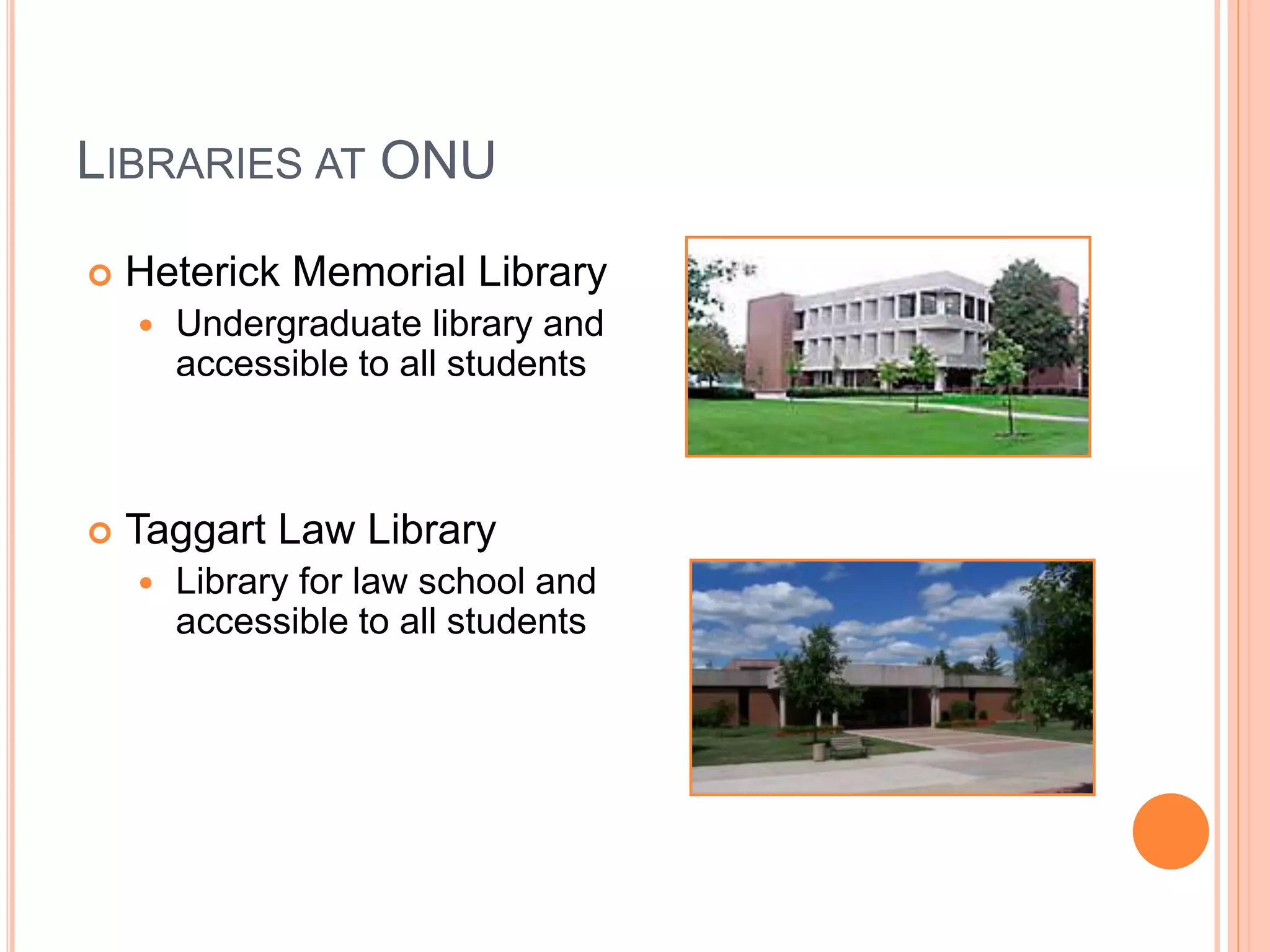
LIBRARIES AT ONU
 Heterick Memorial Library
 Undergraduate library and
accessible to all students
 Taggart Law Library
 Library for law school and
accessible to all students
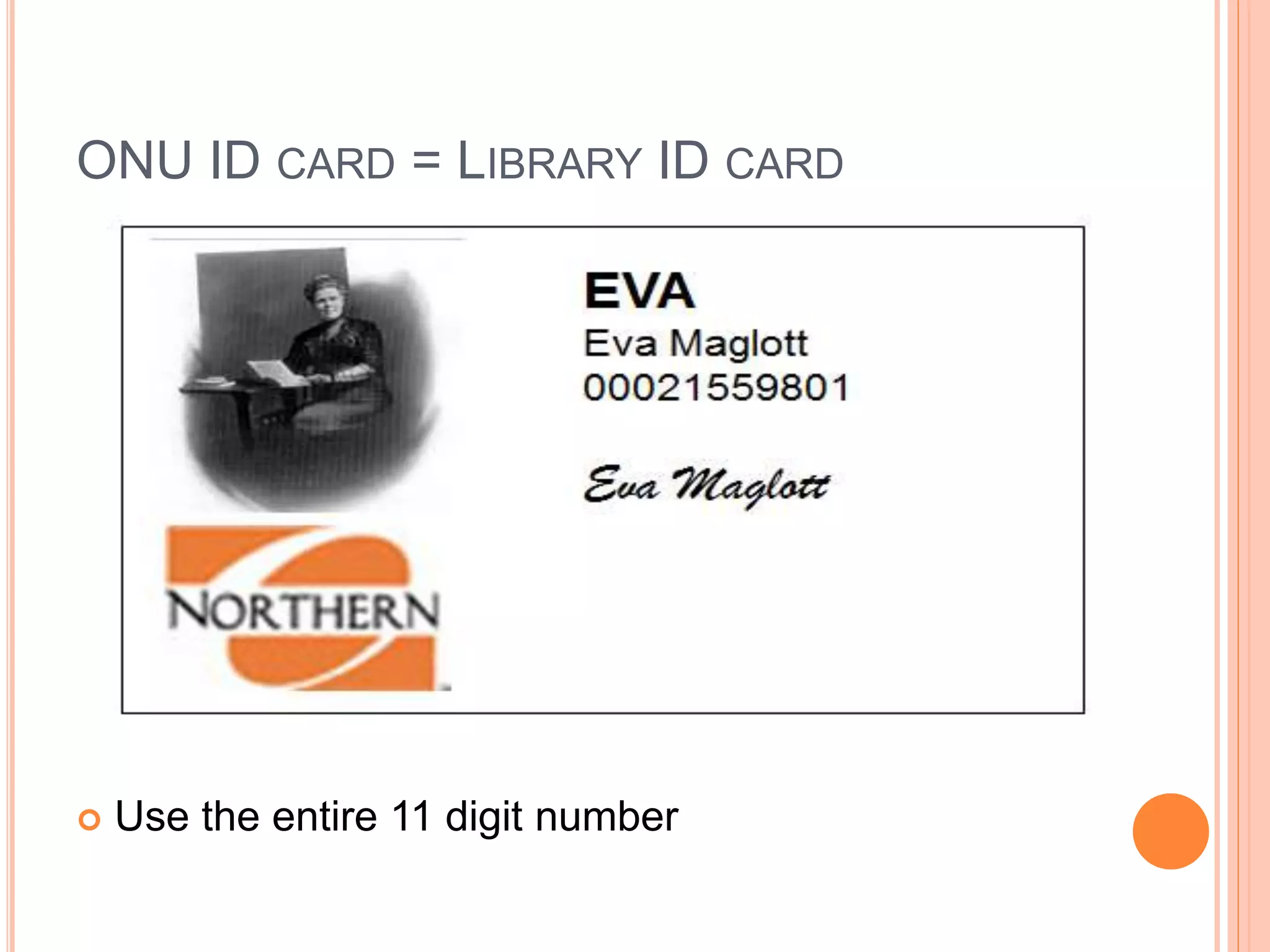
ONU ID CARD = LIBRARY ID CARD
 Use the entire 11 digit number
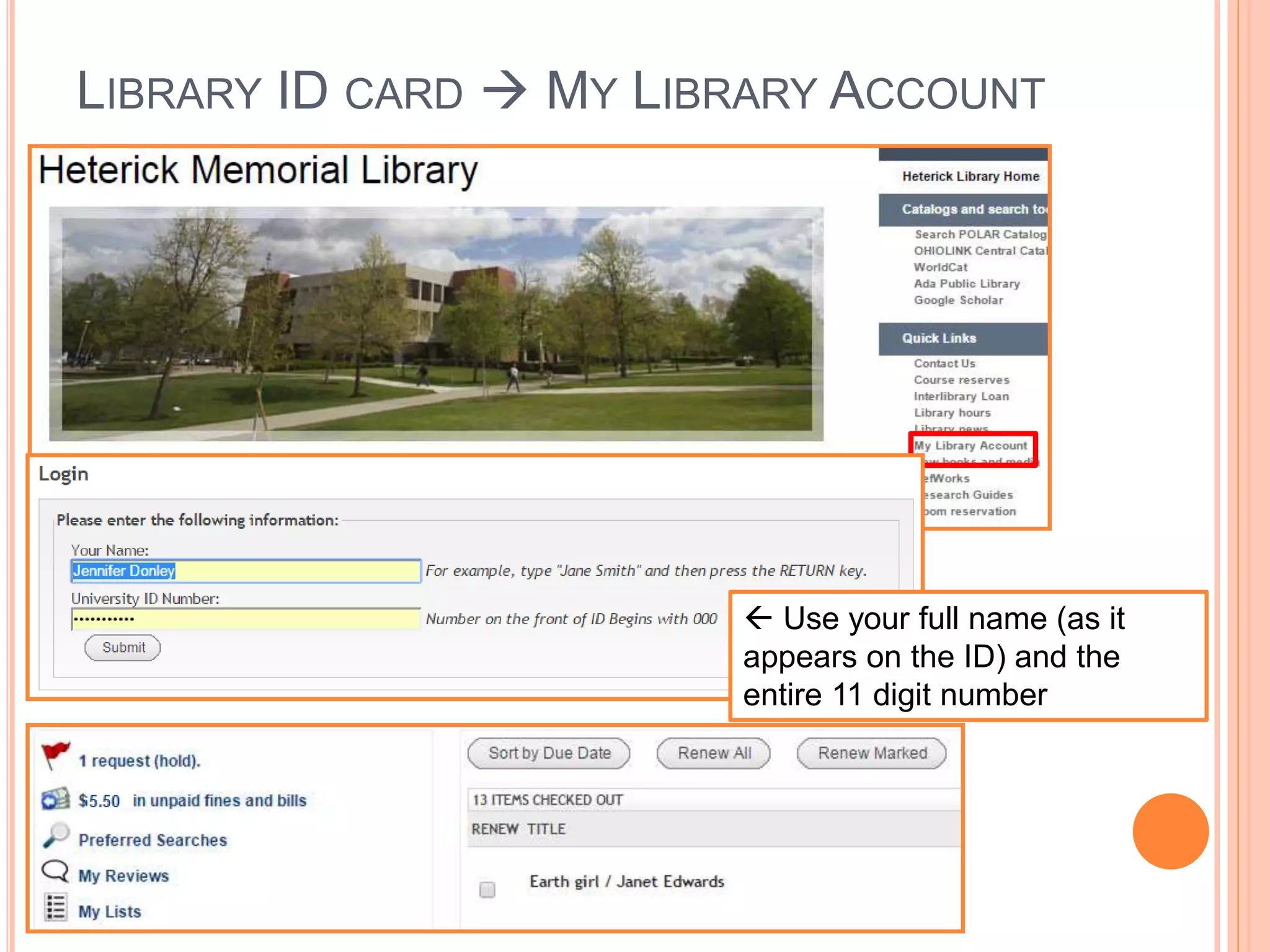
LIBRARY ID CARD  MY LIBRARY ACCOUNT
 Use your full name (as it
appears on the ID) and the
entire 11 digit number
WHAT THESE SESSIONS ARE ALL ABOUT
 Constructing/developing a research strategy for
finding resources
 Finding available resources in the library’s catalog
and databases
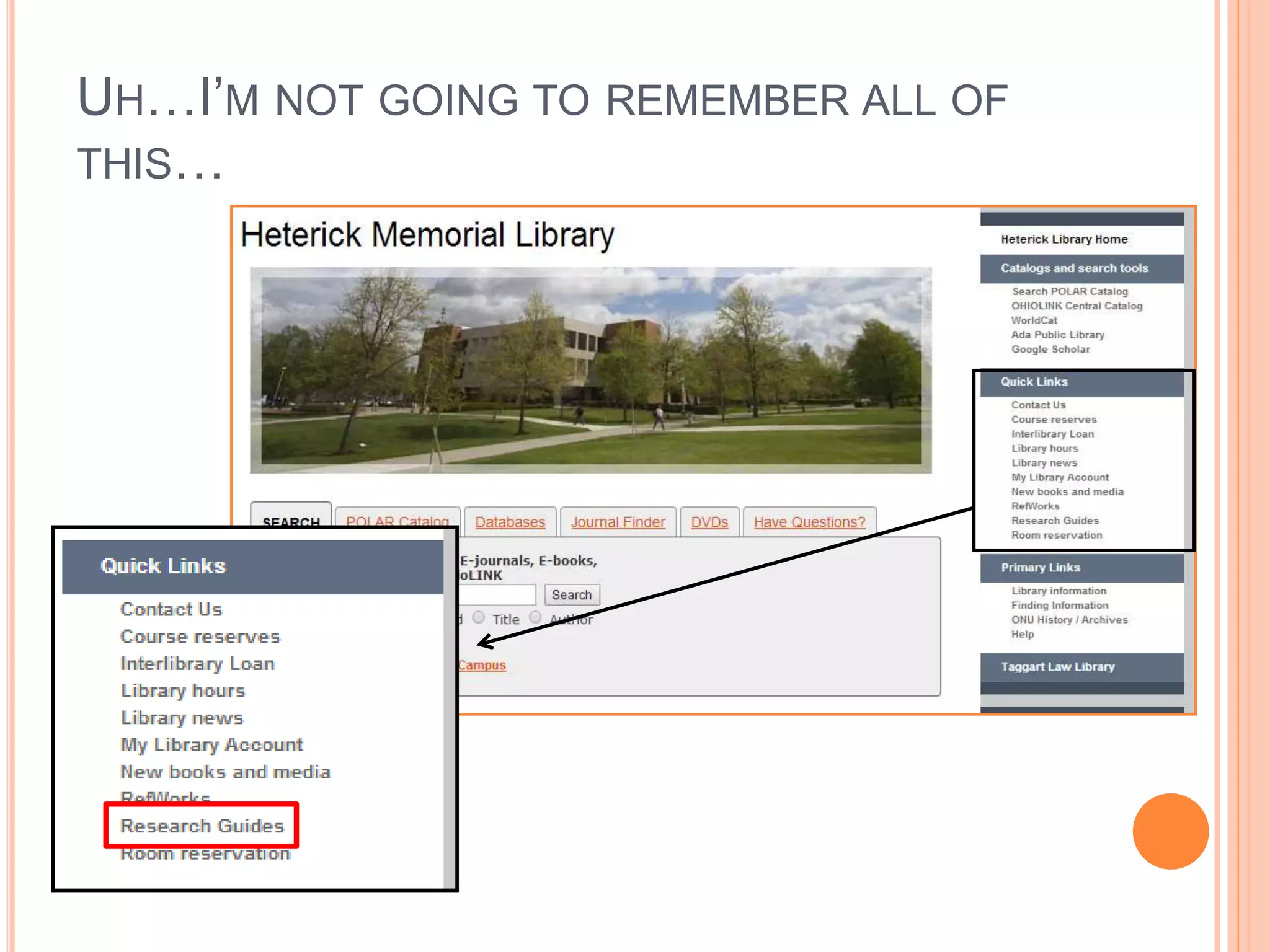
UH…I’M NOT GOING TO REMEMBER ALL OF
THIS…
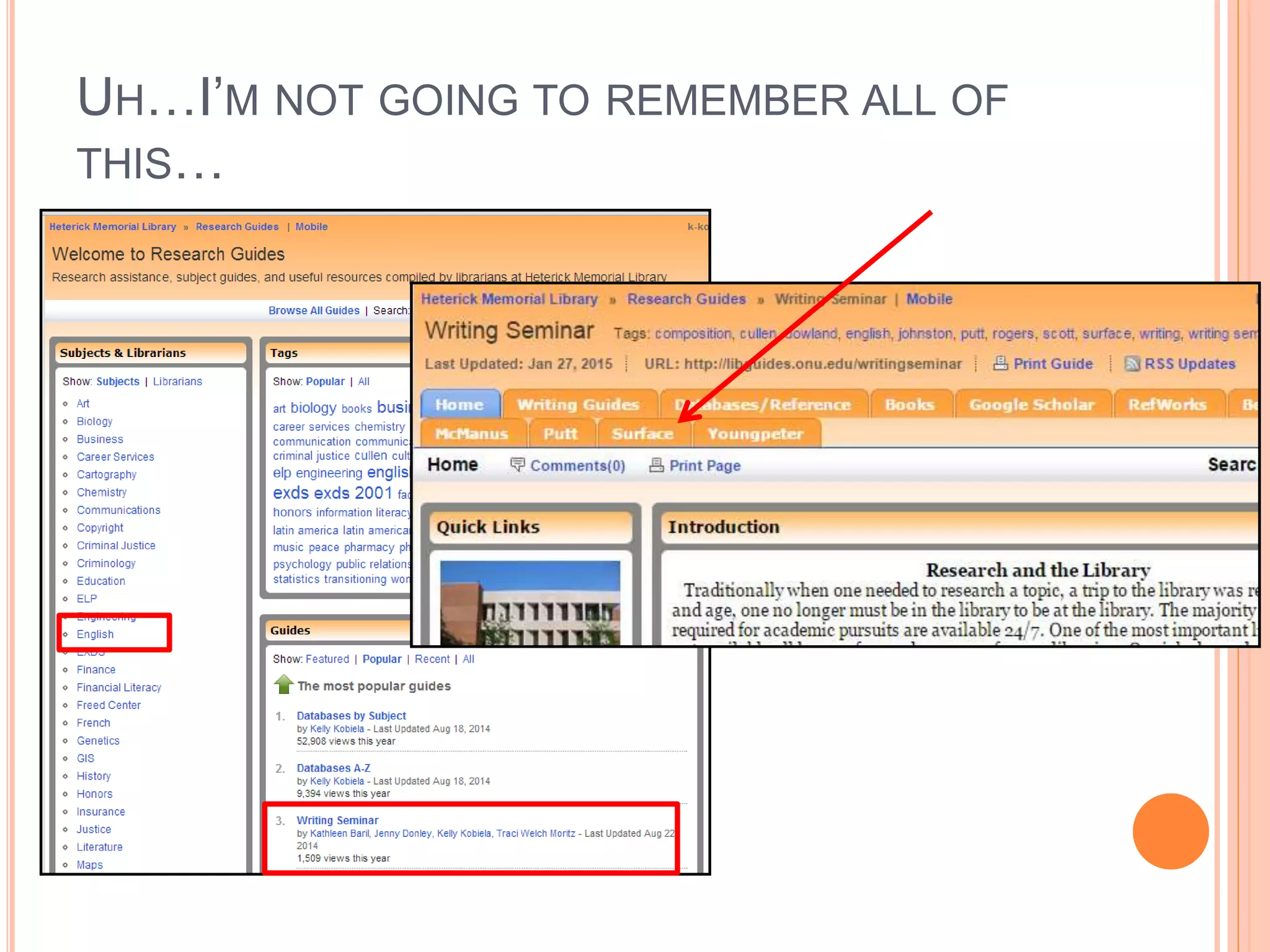
UH…I’M NOT GOING TO REMEMBER ALL OF
THIS…
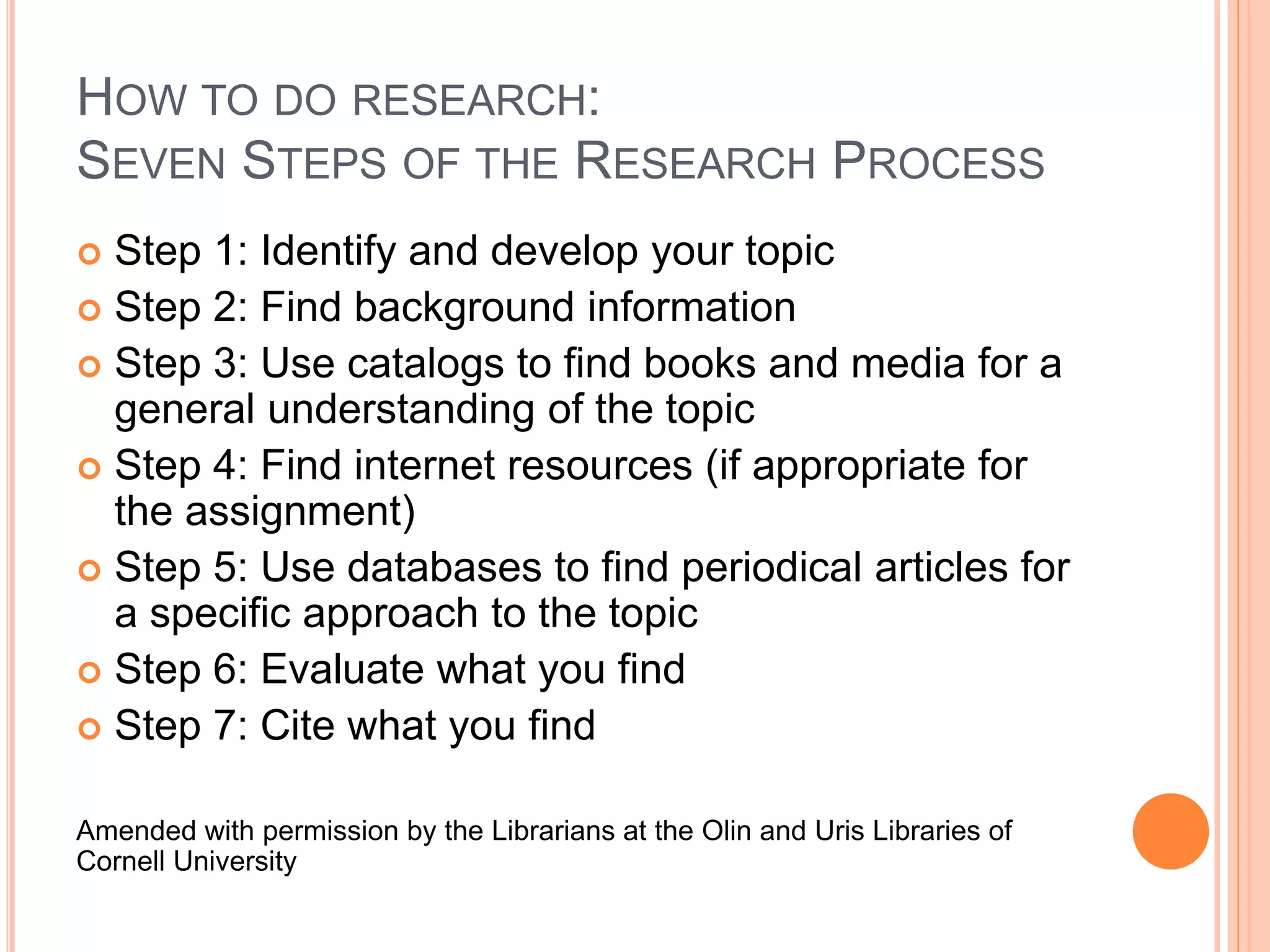
HOW TO DO RESEARCH:
SEVEN STEPS OF THE RESEARCH PROCESS
 Step 1: Identify and develop your topic
 Step 2: Find background information
 Step 3: Use catalogs to find books and media for a
general understanding of the topic
 Step 4: Find internet resources (if appropriate for
the assignment)
 Step 5: Use databases to find periodical articles for
a specific approach to the topic
 Step 6: Evaluate what you find
 Step 7: Cite what you find
Amended with permission by the Librarians at the Olin and Uris Libraries of
Cornell University
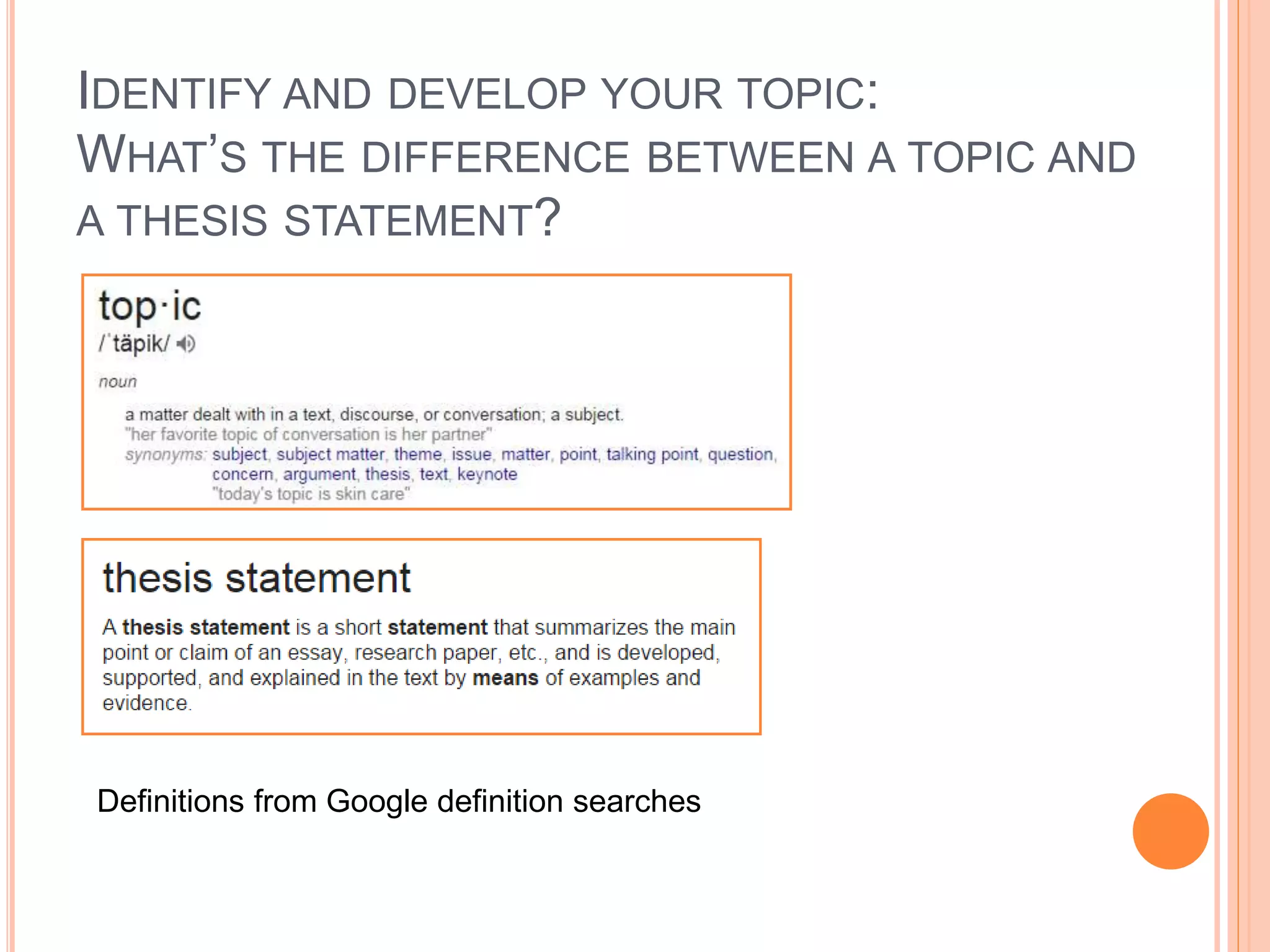
IDENTIFY AND DEVELOP YOUR TOPIC:
WHAT’S THE DIFFERENCE BETWEEN A TOPIC AND
A THESIS STATEMENT?
Definitions from Google definition searches
IDENTIFY AND DEVELOP YOUR TOPIC:
ANNOTATED BIBLIOGRAPHY
 An annotated bibliography is a list of sources that
includes a summary and/or evaluation of the source
 What an annotated bibliography does:
 Allows you to see what is out there
 Helps you narrow your topic and discard any irrelevant
materials
 Aids in developing the thesis
 Makes you a better scholar
IDENTIFY AND DEVELOP YOUR TOPIC:
HOW TO START YOUR RESEARCH
 State your topic as a question
 Identify main concepts or keywords
 Test the topic to figure out how others might refer to it –
look for keywords and synonyms and related terms for the
information sought:
 Subject headings in catalogs
 Built-in thesauri in many databases
 Reference sources
 Textbooks, lecture notes, readings
 Internet
 Librarians, instructors
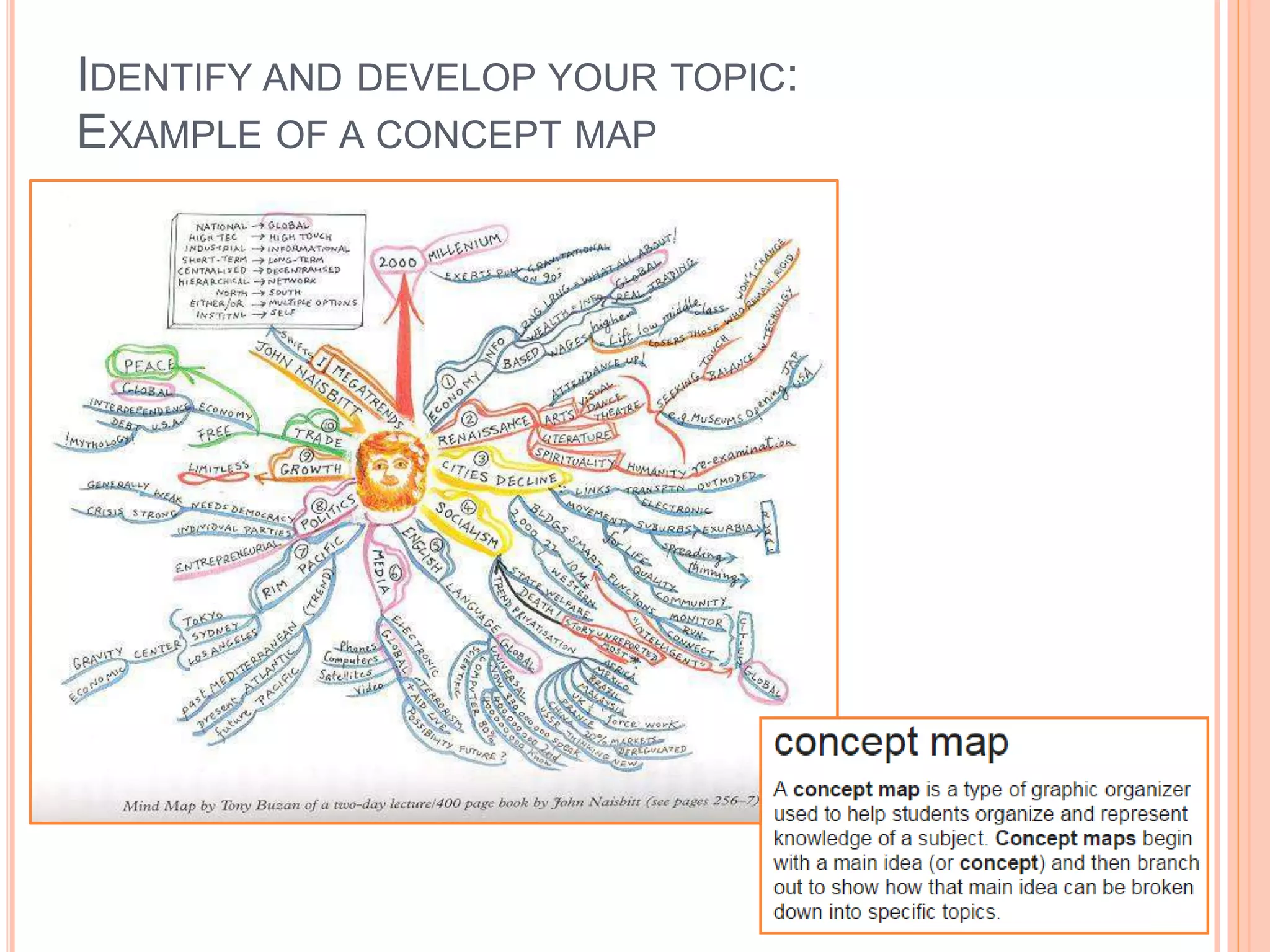
IDENTIFY AND DEVELOP YOUR TOPIC:
EXAMPLE OF A CONCEPT MAP
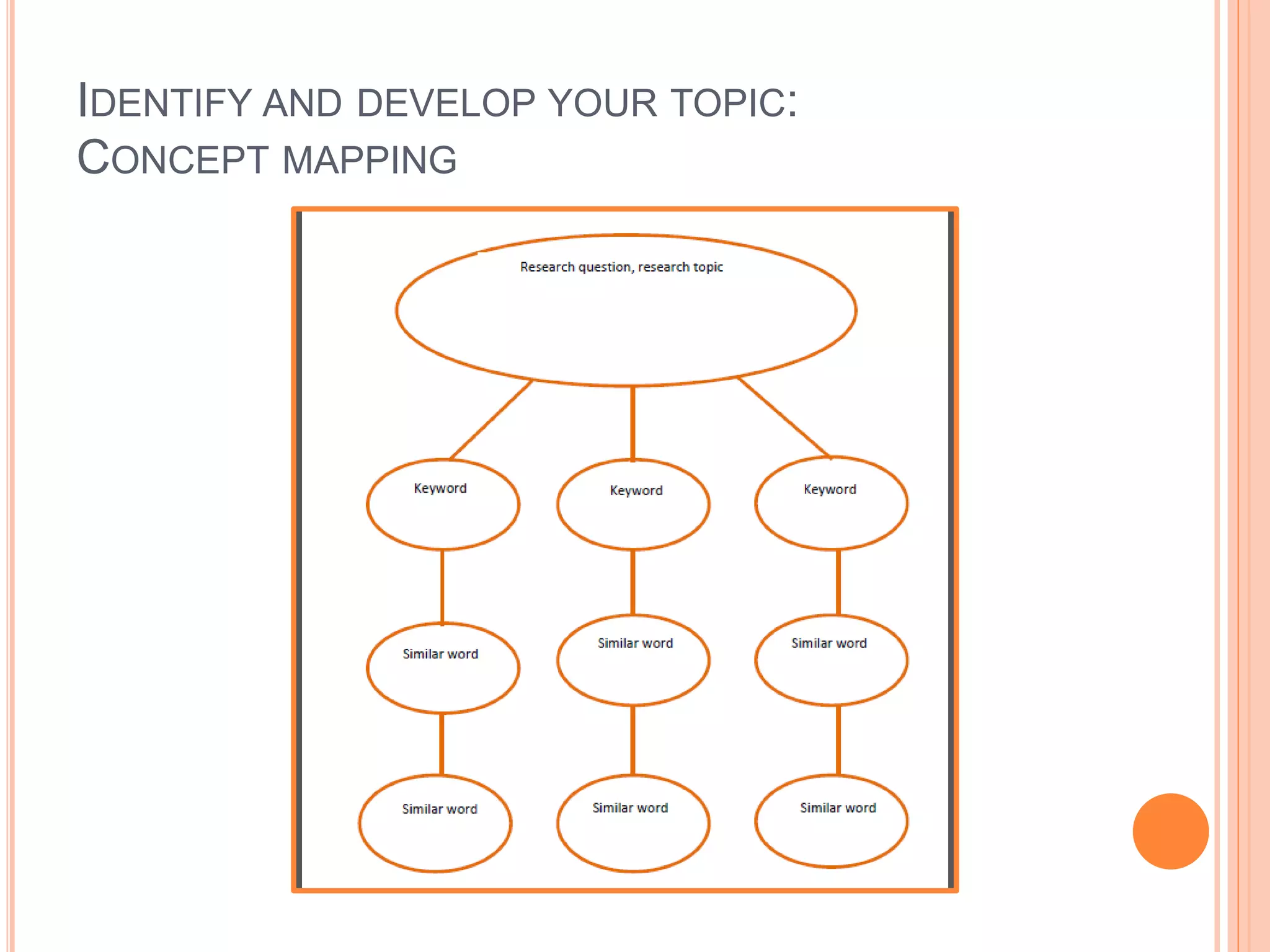
IDENTIFY AND DEVELOP YOUR TOPIC:
CONCEPT MAPPING
FIND BACKGROUND INFORMATION:
BACKGROUND RESEARCH
 The library catalog is full of resources that can help.
 Background research can include reference books
and encyclopedias as well as general books and
internet resources. (Steps 3 & 4 cover general
books and internet searches.)
 Look at the Databases tab in the Writing Seminar
research guide for a list of electronic reference
sources.
USE CATALOGS TO FIND BOOKS AND MEDIA:
POLAR CATALOG
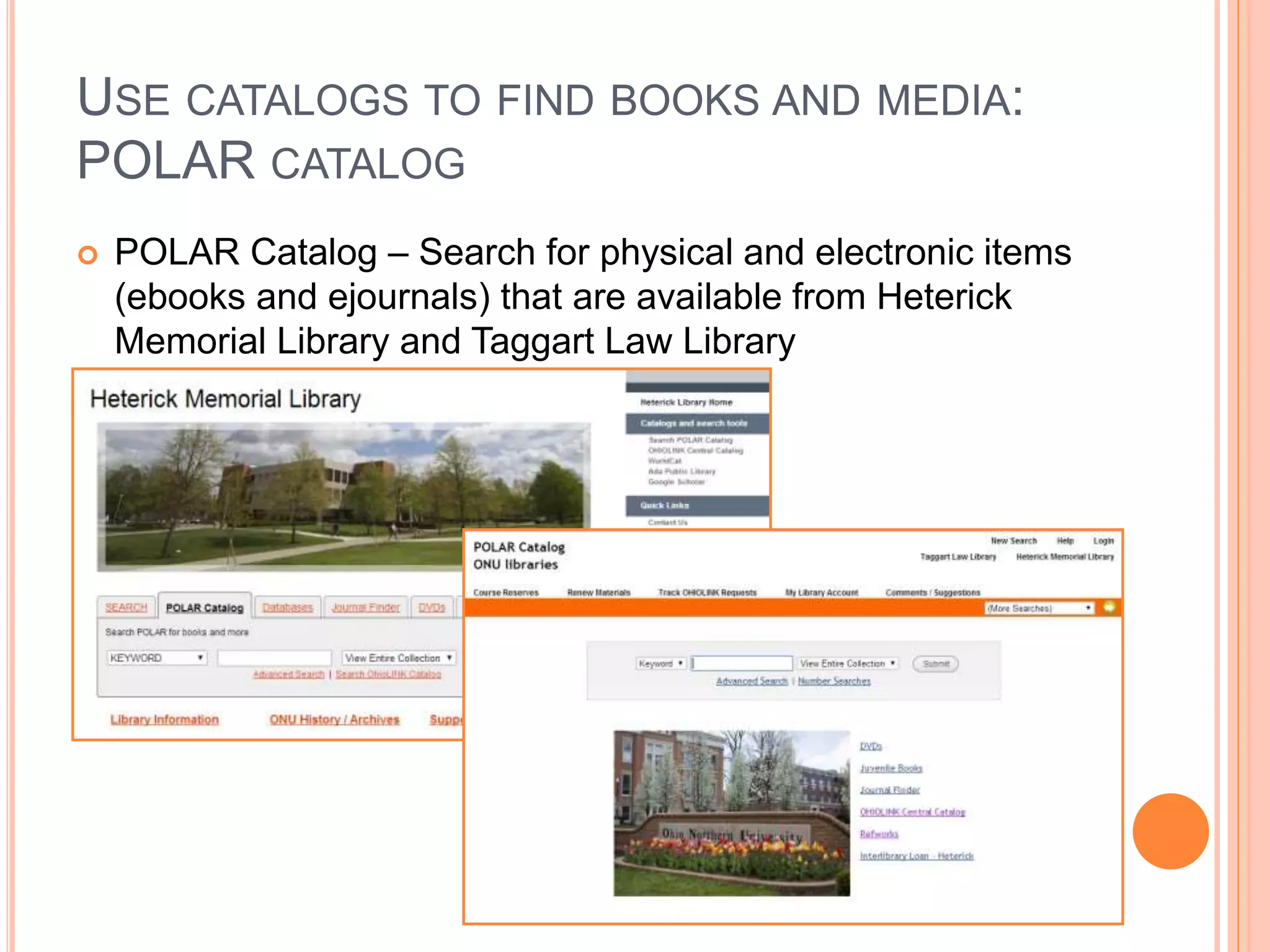
 POLAR Catalog – Search for physical and electronic items
(ebooks and ejournals) that are available from Heterick
Memorial Library and Taggart Law Library
USE CATALOGS TO FIND BOOKS AND MEDIA:
POLAR CATALOG: KEYWORD SEARCH
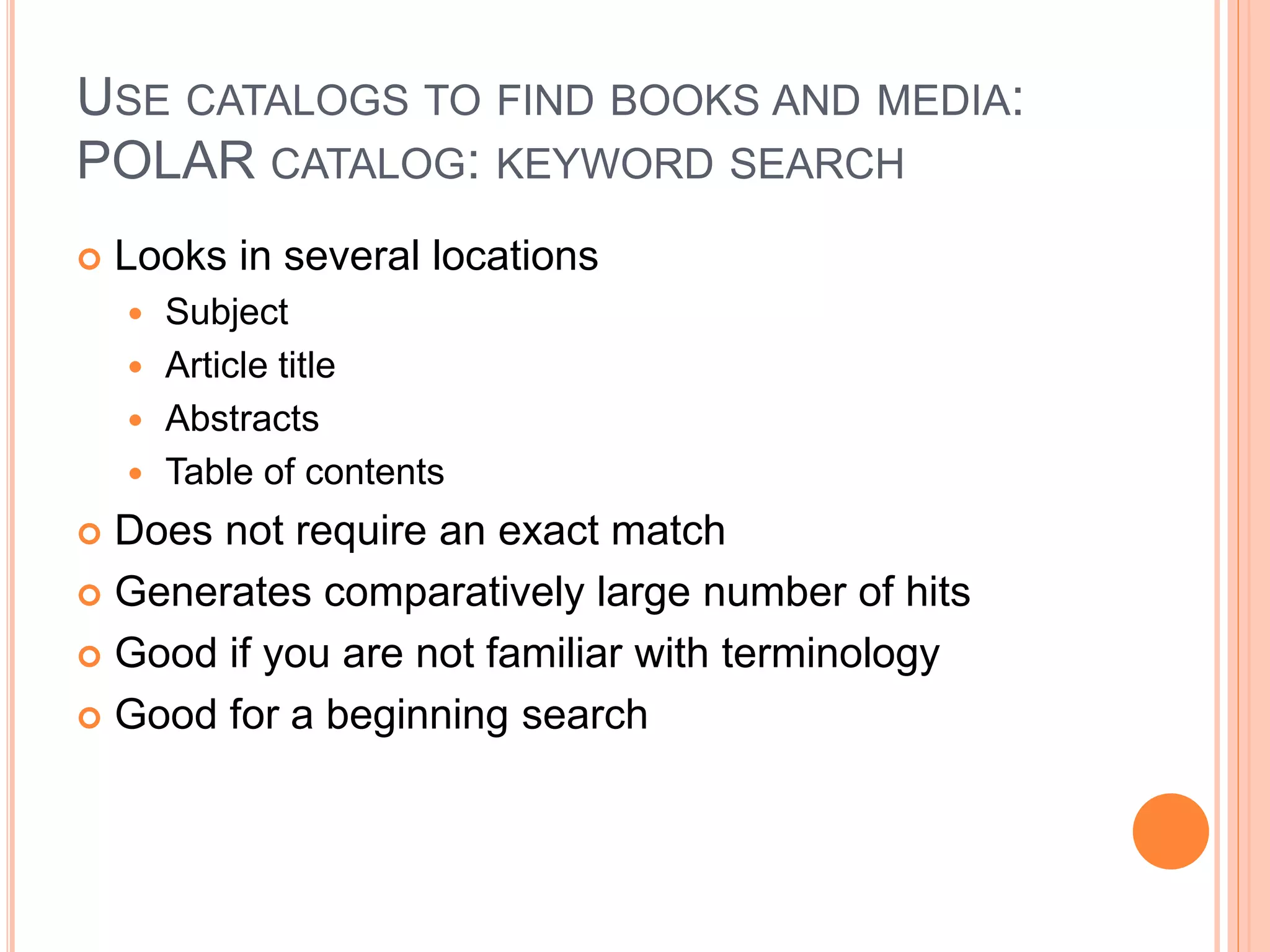
 Looks in several locations
 Subject
 Article title
 Abstracts
 Table of contents
 Does not require an exact match
 Generates comparatively large number of hits
 Good if you are not familiar with terminology
 Good for a beginning search
USE CATALOGS TO FIND BOOKS AND MEDIA:
POLAR CATALOG: SUBJECT SEARCH
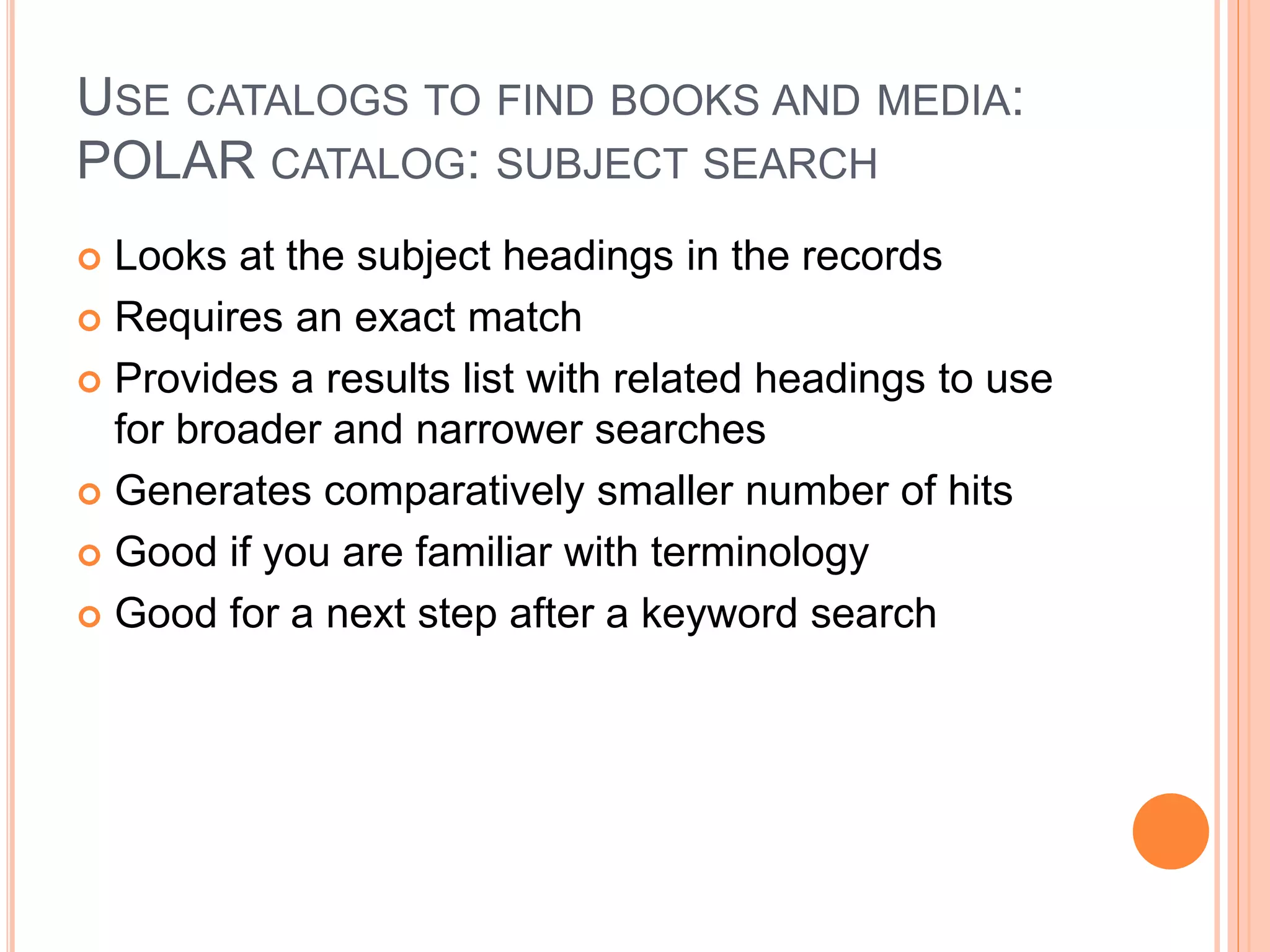
 Looks at the subject headings in the records
 Requires an exact match
 Provides a results list with related headings to use
for broader and narrower searches
 Generates comparatively smaller number of hits
 Good if you are familiar with terminology
 Good for a next step after a keyword search
USE CATALOGS TO FIND BOOKS AND MEDIA:
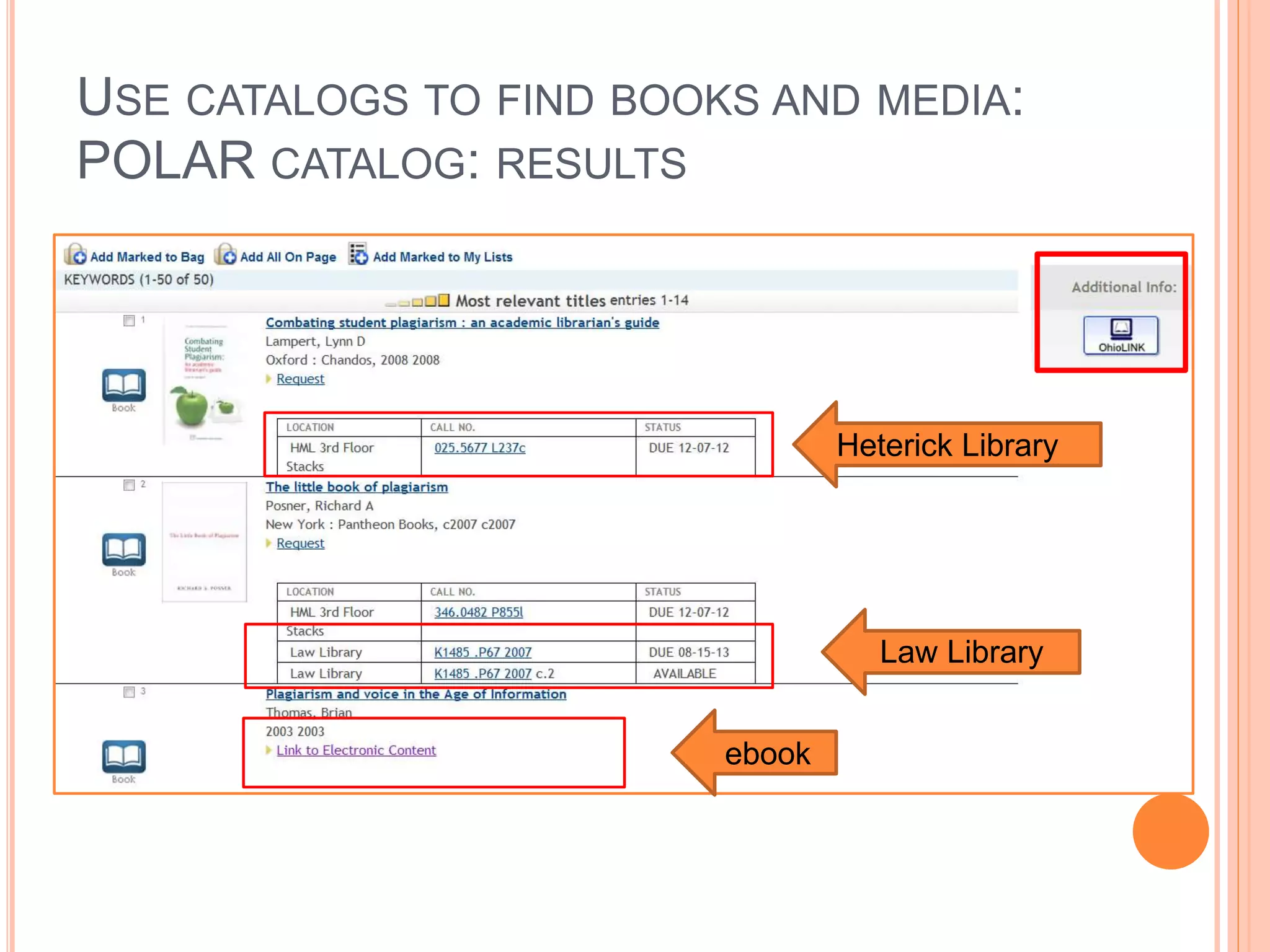
POLAR CATALOG: RESULTS
ebook
Law Library
Heterick Library
USE CATALOGS TO FIND BOOKS AND MEDIA:
OHIOLINK CATALOG
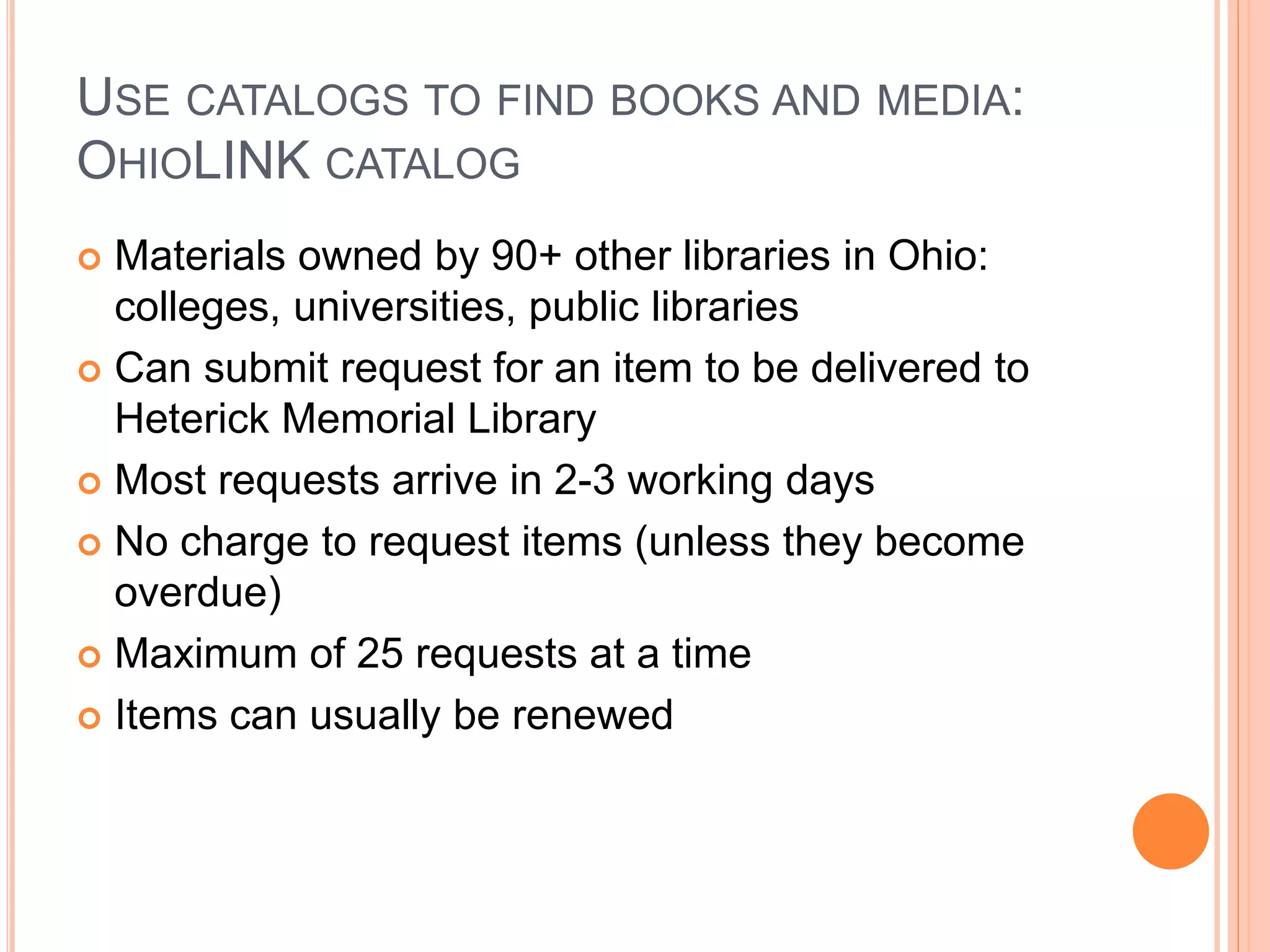
 Materials owned by 90+ other libraries in Ohio:
colleges, universities, public libraries
 Can submit request for an item to be delivered to
Heterick Memorial Library
 Most requests arrive in 2-3 working days
 No charge to request items (unless they become
overdue)
 Maximum of 25 requests at a time
 Items can usually be renewed
USE CATALOGS TO FIND BOOKS AND MEDIA:
OHIOLINK CATALOG
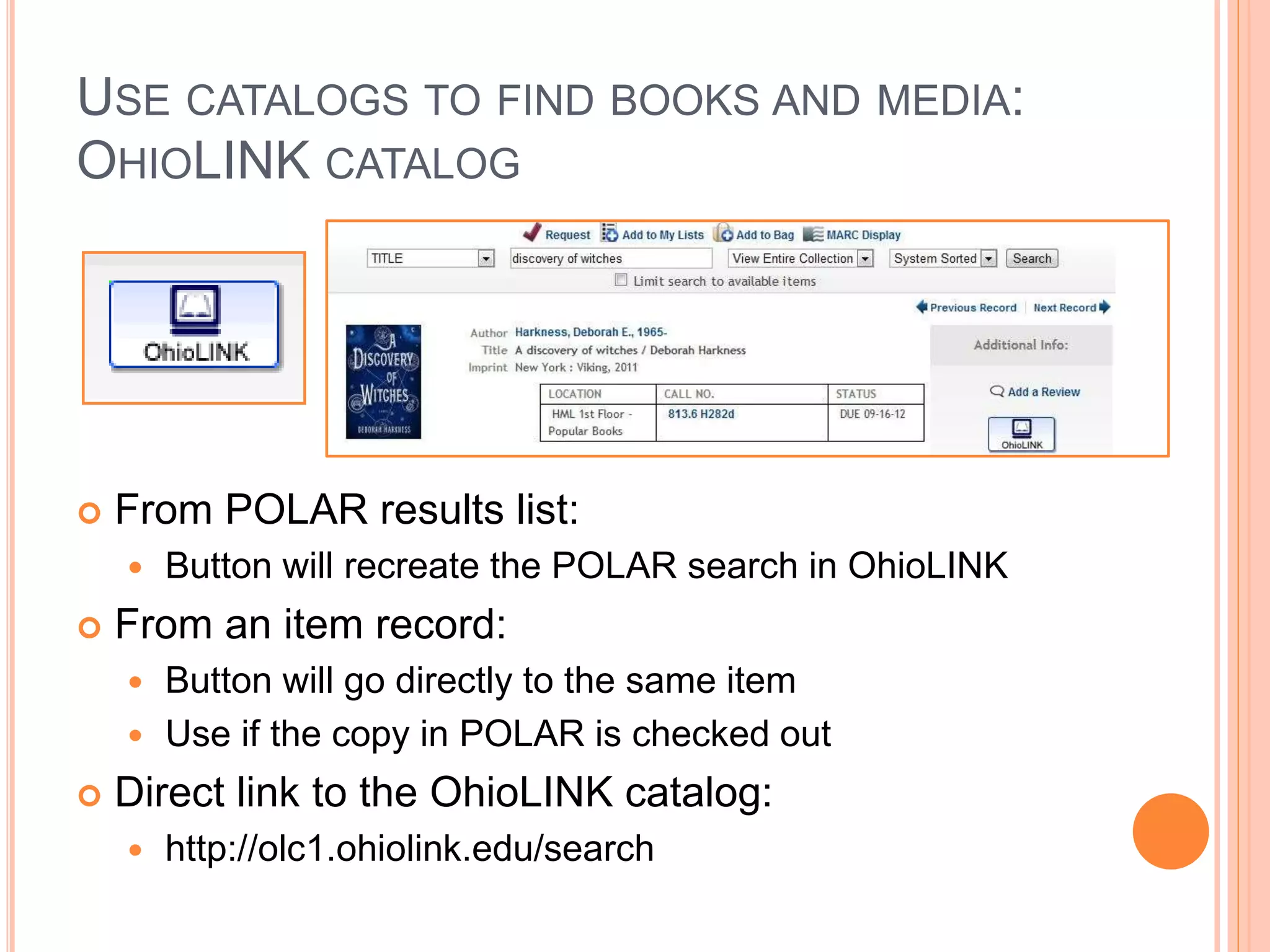
 From POLAR results list:
 Button will recreate the POLAR search in OhioLINK
 From an item record:
 Button will go directly to the same item
 Use if the copy in POLAR is checked out
 Direct link to the OhioLINK catalog:
 http://olc1.ohiolink.edu/search
USE CATALOGS TO FIND BOOKS AND MEDIA: OHIOLINK
CATALOG
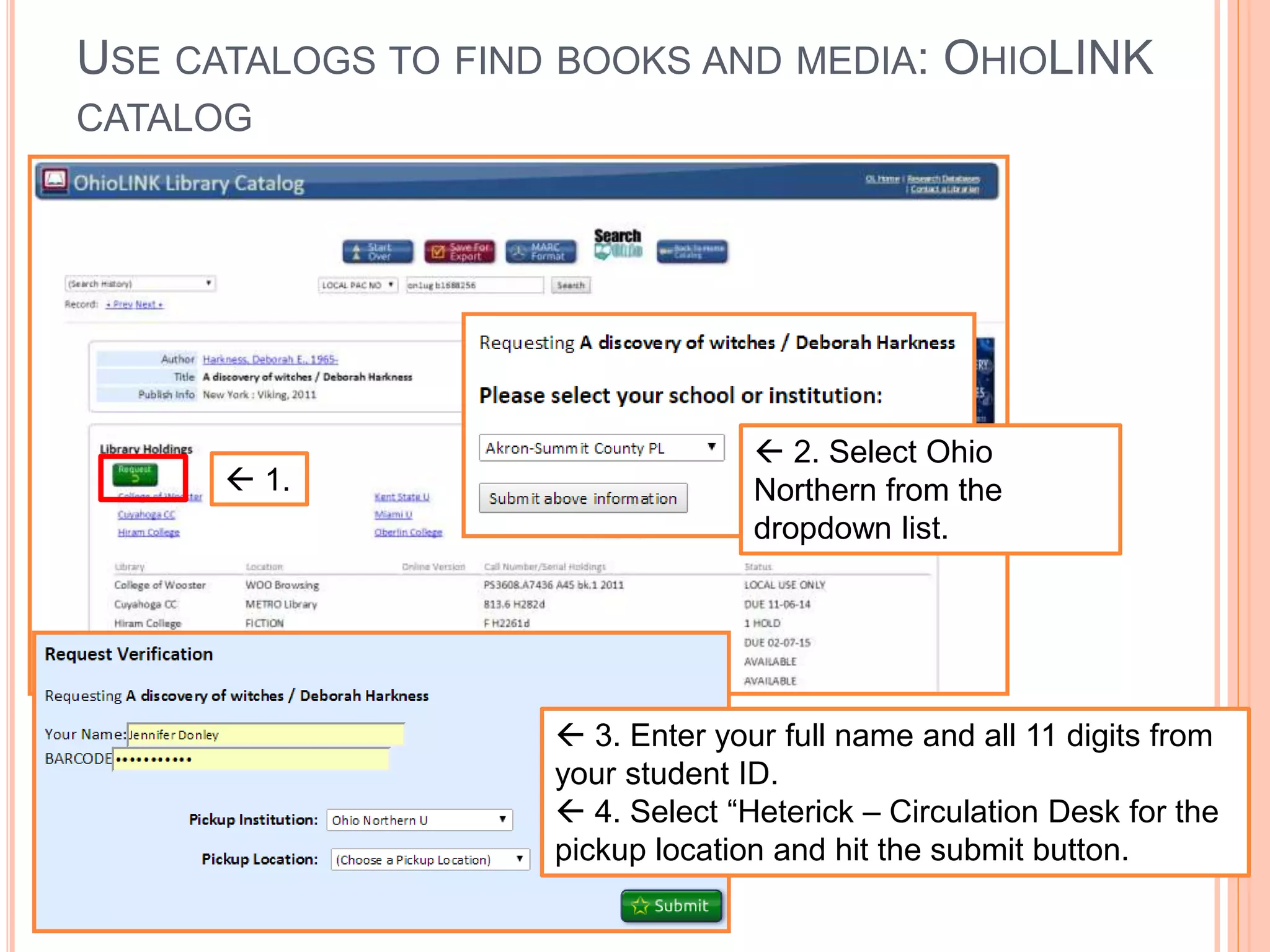
 1.
 2. Select Ohio
Northern from the
dropdown list.
 3. Enter your full name and all 11 digits from
your student ID.
 4. Select “Heterick – Circulation Desk for the
pickup location and hit the submit button.
USE CATALOGS TO FIND BOOKS AND MEDIA:
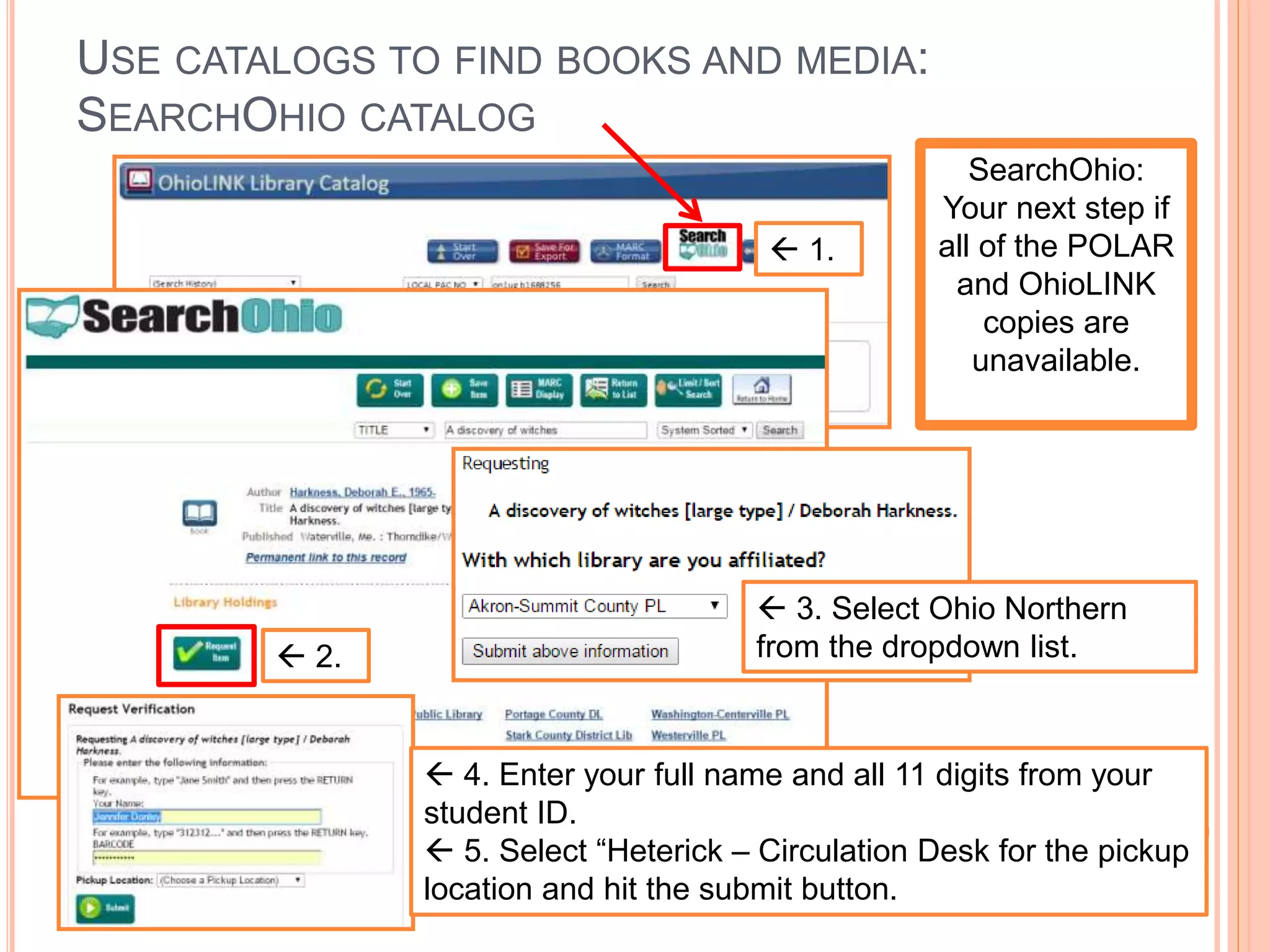
SEARCHOHIO CATALOG
 1.
SearchOhio:
Your next step if
all of the POLAR
and OhioLINK
copies are
unavailable.
 2.
 3. Select Ohio Northern
from the dropdown list.
 4. Enter your full name and all 11 digits from your
student ID.
 5. Select “Heterick – Circulation Desk for the pickup
location and hit the submit button.
FINDING INTERNET RESOURCES
(IF APPROPRIATE FOR THE ASSIGNMENT)
 Helpful for identifying additional keywords and
subjects for your concept map
 Google
 Wikipedia
 Does the information located satisfy the research
need?
 Is the information factual and unbiased?
 Refer to the CRAAP Test for critically analyzing web
sources
FINDING INTERNET RESOURCES:
CRITICALLY ANALYZING WEB SOURCES USING THE
CRAAP TEST
 Currency
 Timeliness of the information
 Relevance/Coverage
 Depth and importance of the information
 Authority
 Source of the information
 Accuracy
 Reliability of the information
 Purpose/Objectivity
 Possible bias present in the information
BUT I FOUND THIS GREAT WEBSITE…
Critically analyzing web sources
 What? is the page/site about
 Who? created and maintains this site
 Where? is the information coming from
 Why? is the information presented on the web
 When? was the page created or last updated
 How? accurate or credible is the page
From the University of Wisconsin Library, worksheet for evaluating web
sites
WEB RESEARCH VS. LIBRARY DATABASES
Internet
 Material from numerous
sources, individuals,
government, etc.
 Search engines must work
with material prepared
without regard for specific
software
 Quality of material varies
 Generally do not access for-
profit information
 Content often anonymous
and undated
Databases
 Usually created by a single
publisher
 Content pre-arranged for
easy searching
 Quality-controlled by editorial
staff
 Most are available only to
subscribers
 Sources are usually identified
and dated
 Databases often focus on a
specific subject or discipline,
but some cover several areas
USE DATABASES TO FIND PERIODICAL ARTICLES:
OVERVIEW OF DATABASES
 What is the basic definition of a library database?
 A library database is an electronic (online) catalog or index
 Library databases contain information about published items
 Library databases are searchable
 The library subscribes to many databases so the ONU community has
access to these resources. When you’re searching a database, you
are not searching “the web.”
 What types of items are indexed by library databases?
 Articles in Journals/Magazines/Newspapers
 Reference Information (i.e. entries from Encyclopedias, Dictionaries,
etc.)
 Books & other documents
Source: http://web.calstatela.edu/library/whatisadatabase.htm
USE DATABASES TO FIND PERIODICAL ARTICLES:
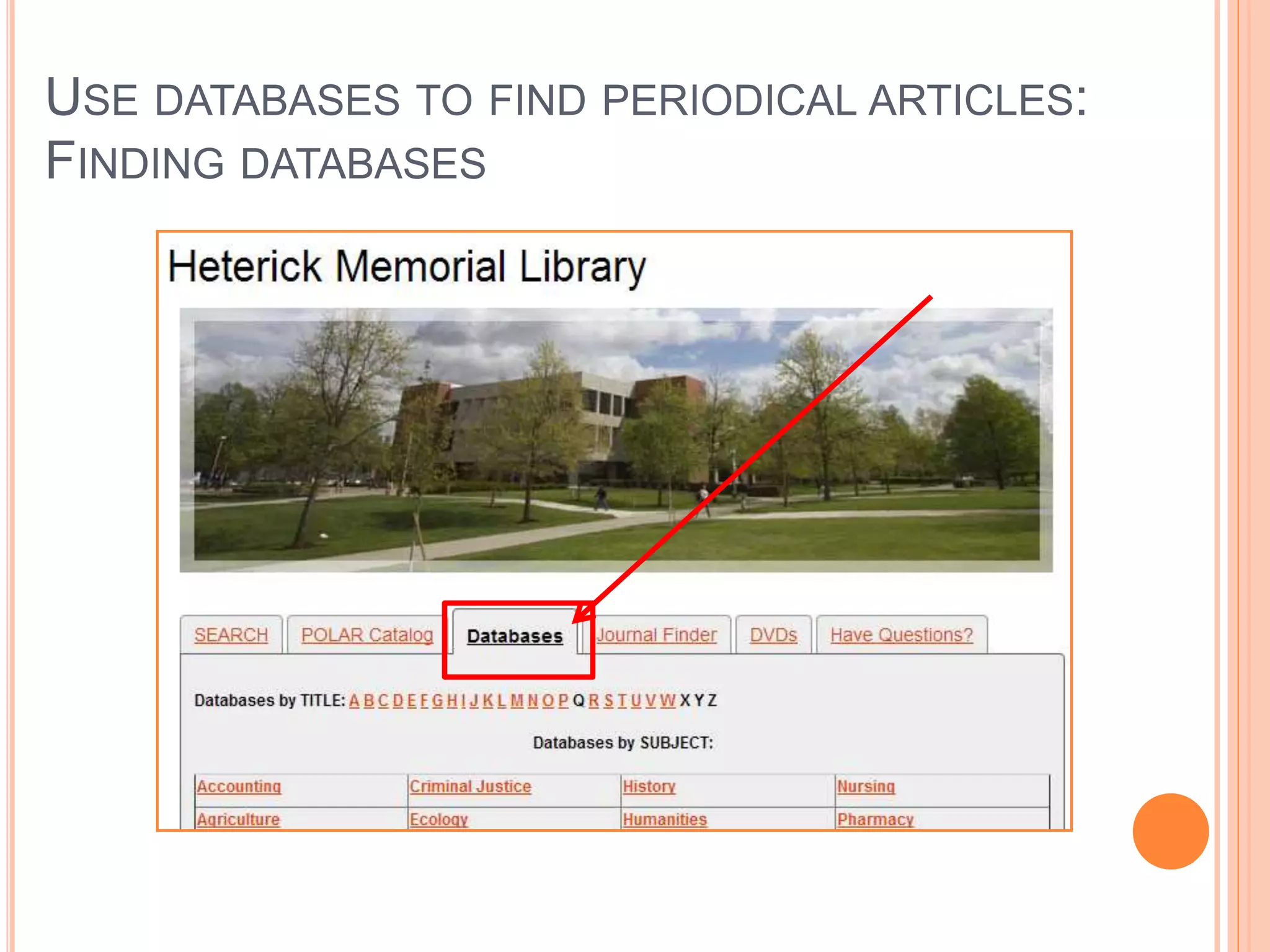
FINDING DATABASES
USE DATABASES TO FIND PERIODICAL ARTICLES:
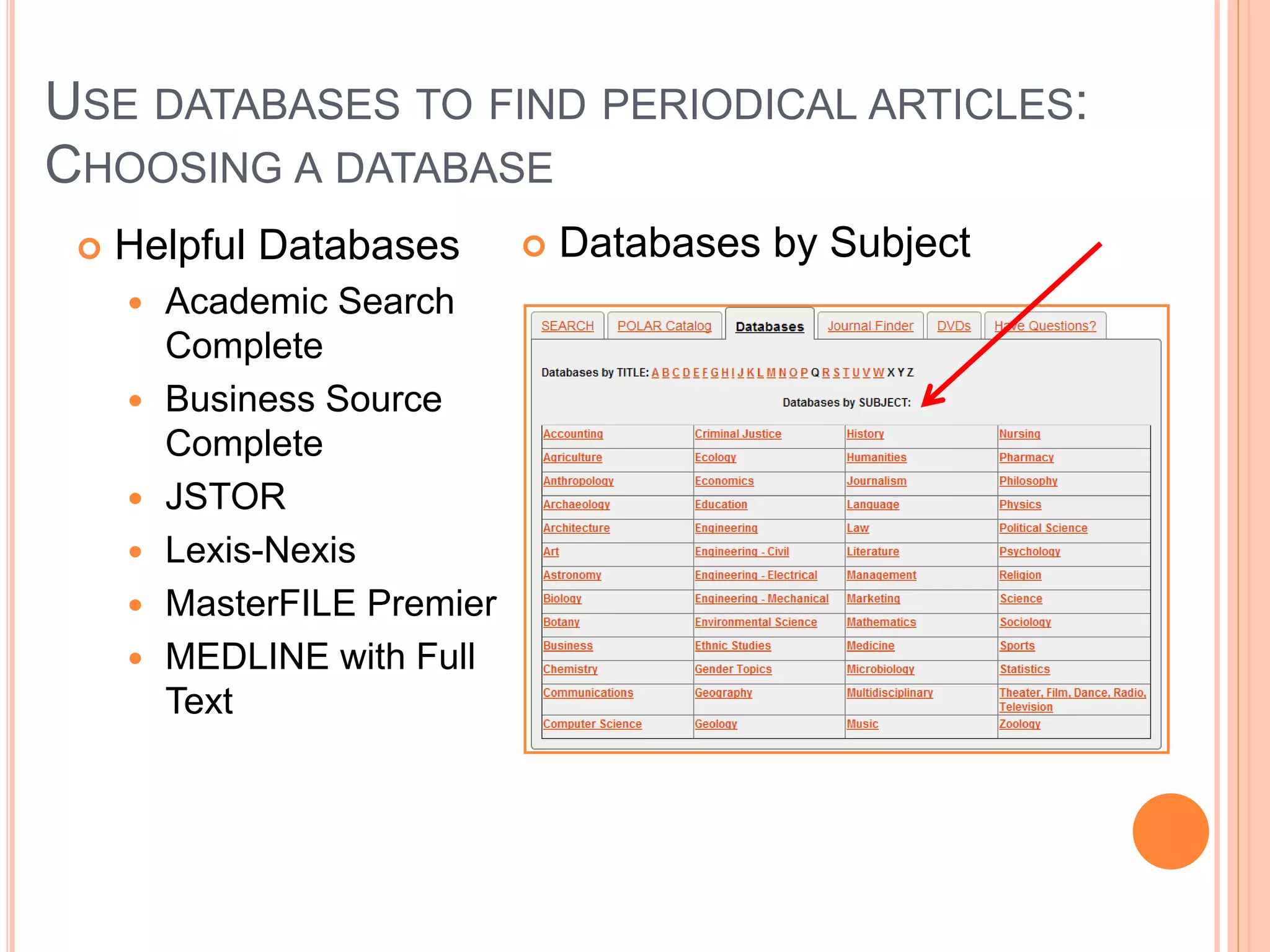
CHOOSING A DATABASE
 Helpful Databases
 Academic Search
Complete
 Business Source
Complete
 JSTOR
 Lexis-Nexis
 MasterFILE Premier
 MEDLINE with Full
Text
 Databases by Subject
USE DATABASES TO FIND PERIODICAL ARTICLES:
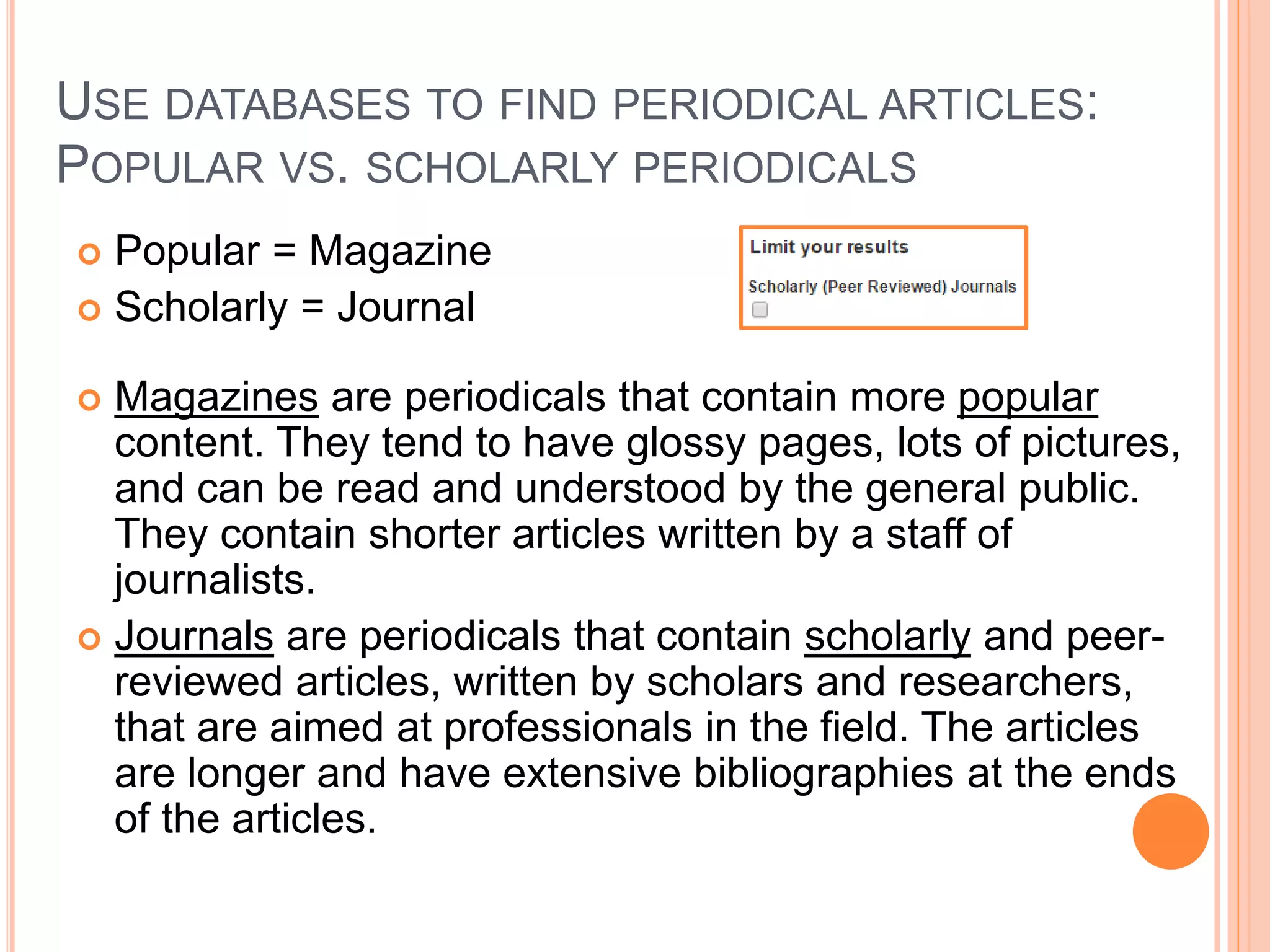
POPULAR VS. SCHOLARLY PERIODICALS
 Popular = Magazine
 Scholarly = Journal
 Magazines are periodicals that contain more popular
content. They tend to have glossy pages, lots of pictures,
and can be read and understood by the general public.
They contain shorter articles written by a staff of
journalists.
 Journals are periodicals that contain scholarly and peer-
reviewed articles, written by scholars and researchers,
that are aimed at professionals in the field. The articles
are longer and have extensive bibliographies at the ends
of the articles.
USE DATABASES TO FIND PERIODICAL ARTICLES:
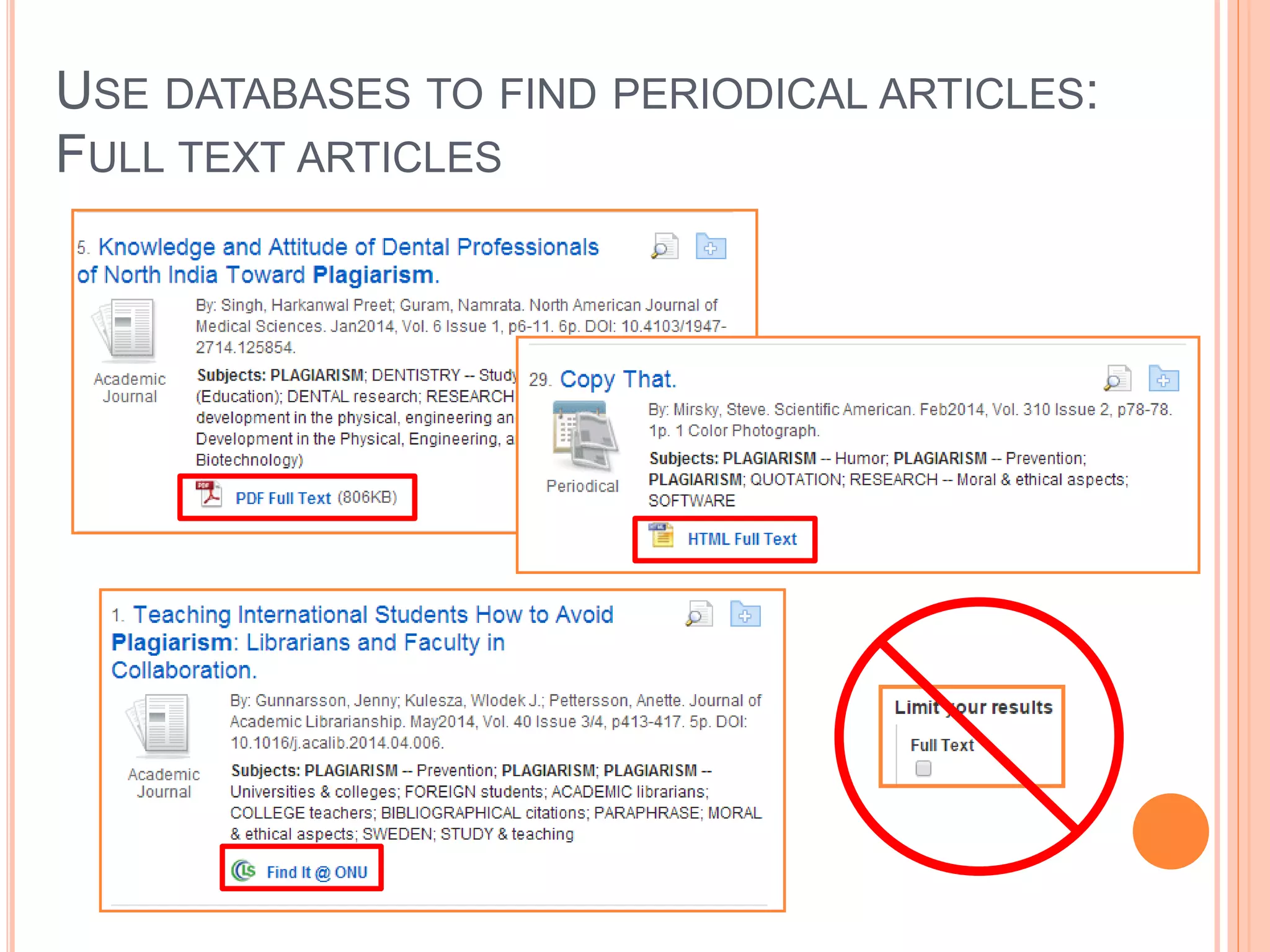
FULL TEXT ARTICLES
USE DATABASES TO FIND PERIODICAL ARTICLES:
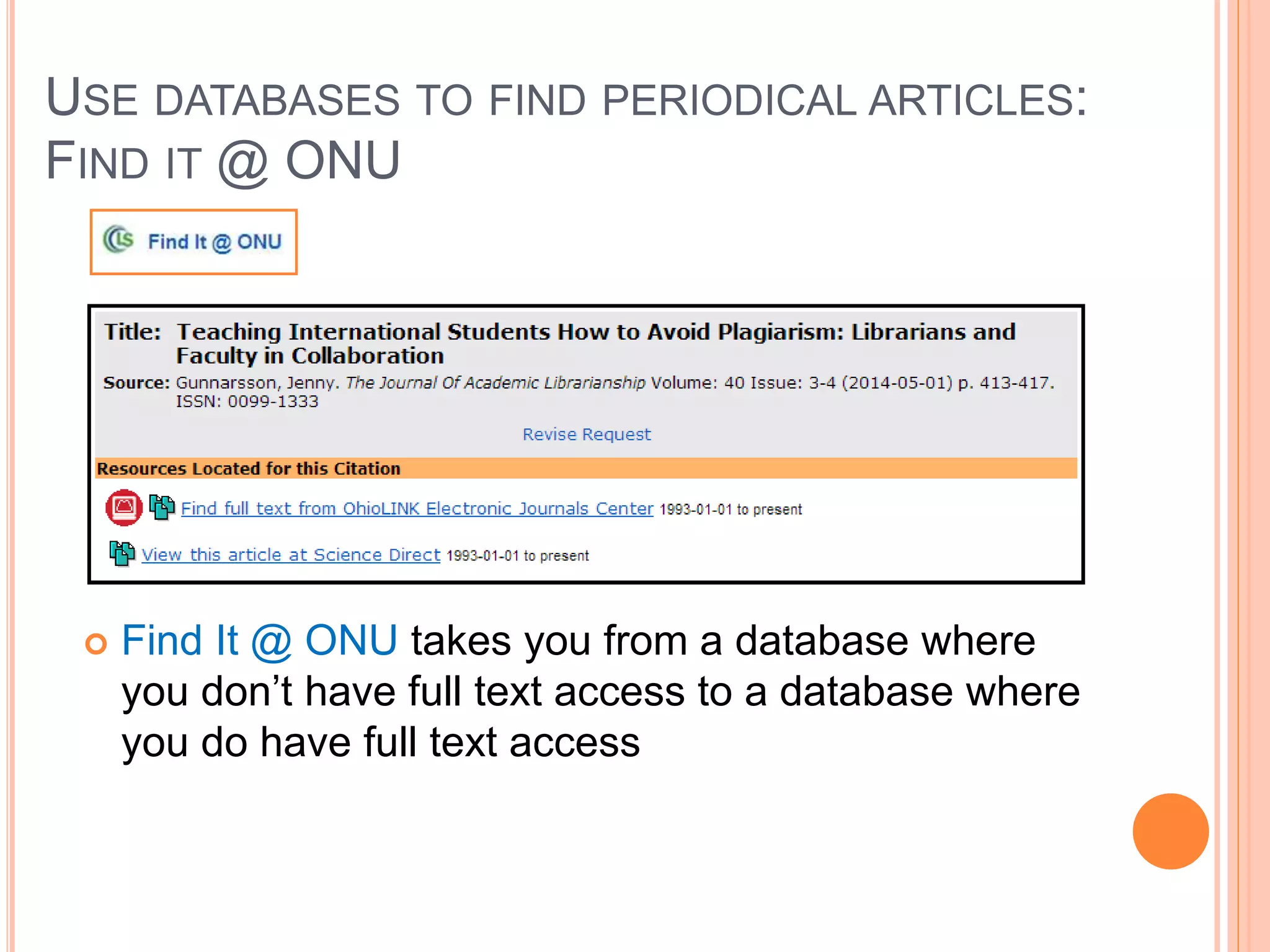
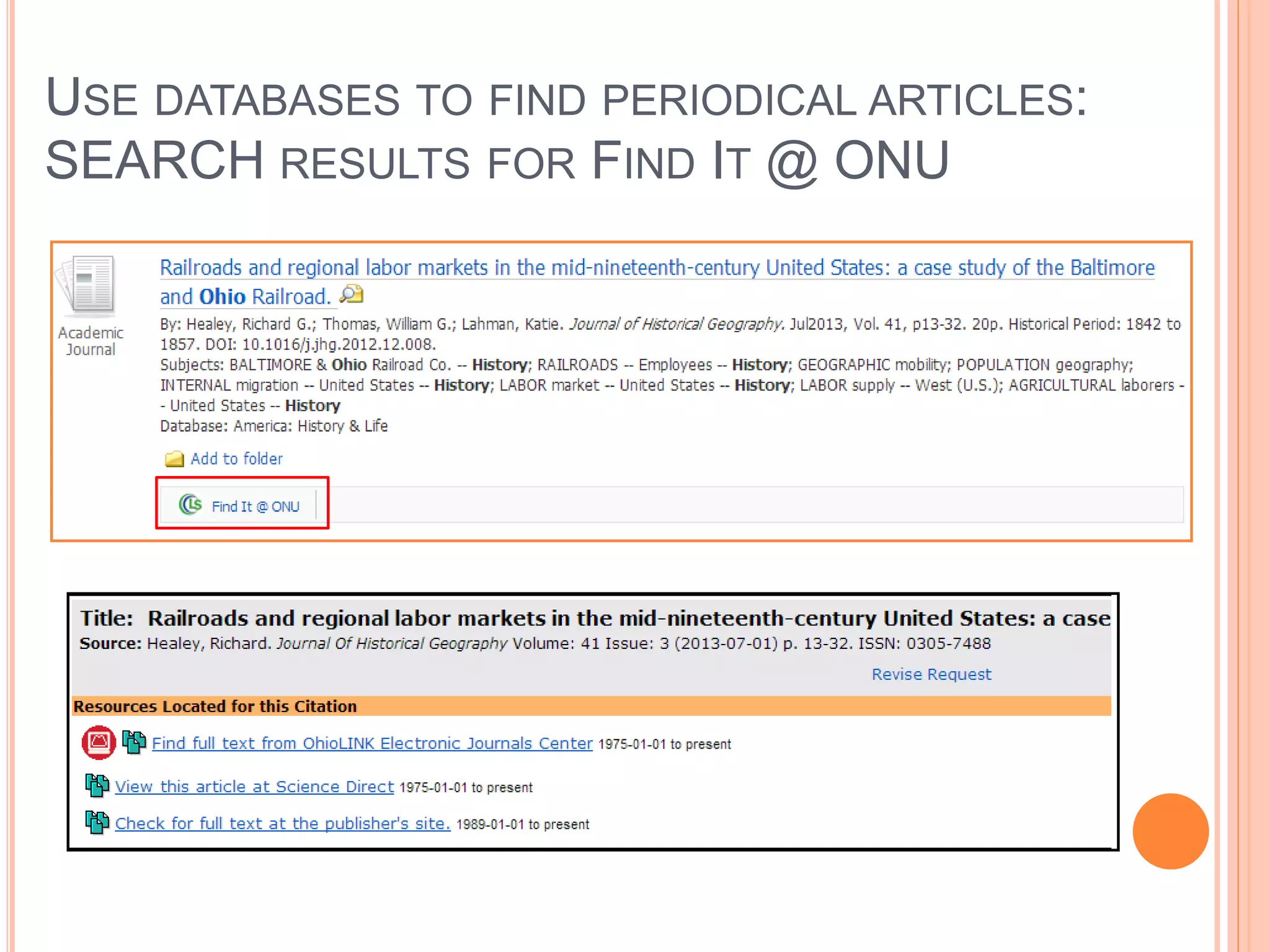
FIND IT @ ONU
 Find It @ ONU takes you from a database where
you don’t have full text access to a database where
you do have full text access
USE DATABASES TO FIND PERIODICAL ARTICLES:
SEARCH DISCOVERY LAYER
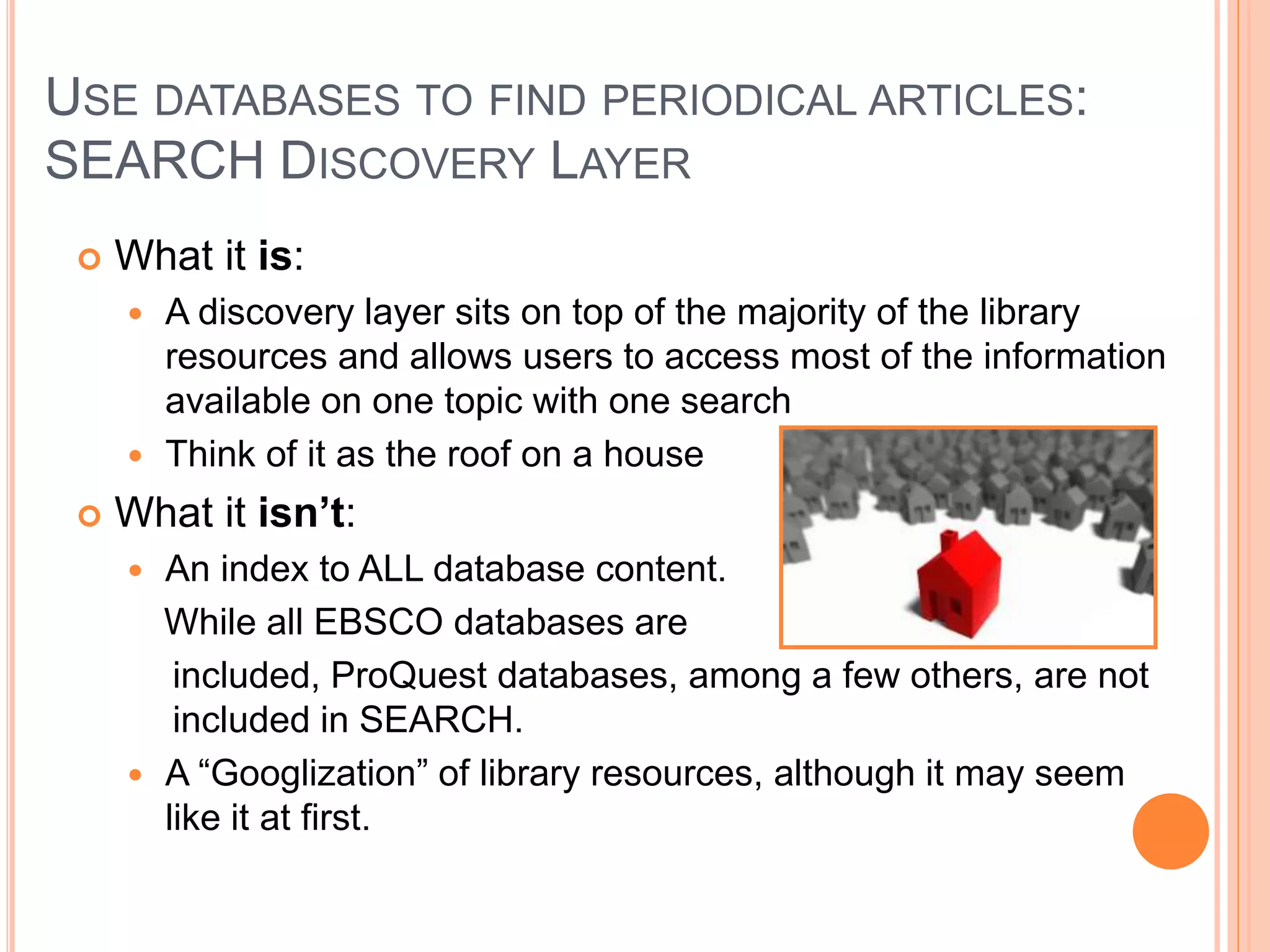
 What it is:
 A discovery layer sits on top of the majority of the library
resources and allows users to access most of the information
available on one topic with one search
 Think of it as the roof on a house
 What it isn’t:
 An index to ALL database content.
While all EBSCO databases are
included, ProQuest databases, among a few others, are not
included in SEARCH.
 A “Googlization” of library resources, although it may seem
like it at first.
USE DATABASES TO FIND PERIODICAL ARTICLES:
SEARCH DISCOVERY LAYER
 What it includes:
 POLAR
 Article-level searching for all EBSCO databases
 Article-level searching for a variety of other databases:
JSTOR, Hoover’s, AccessPharmacy, etc.
 Title-level searching for most other databases: IEEE,
CIAO, Proquest Nursing & Allied Health
 OhioLINK Central Catalog
USE DATABASES TO FIND PERIODICAL ARTICLES:
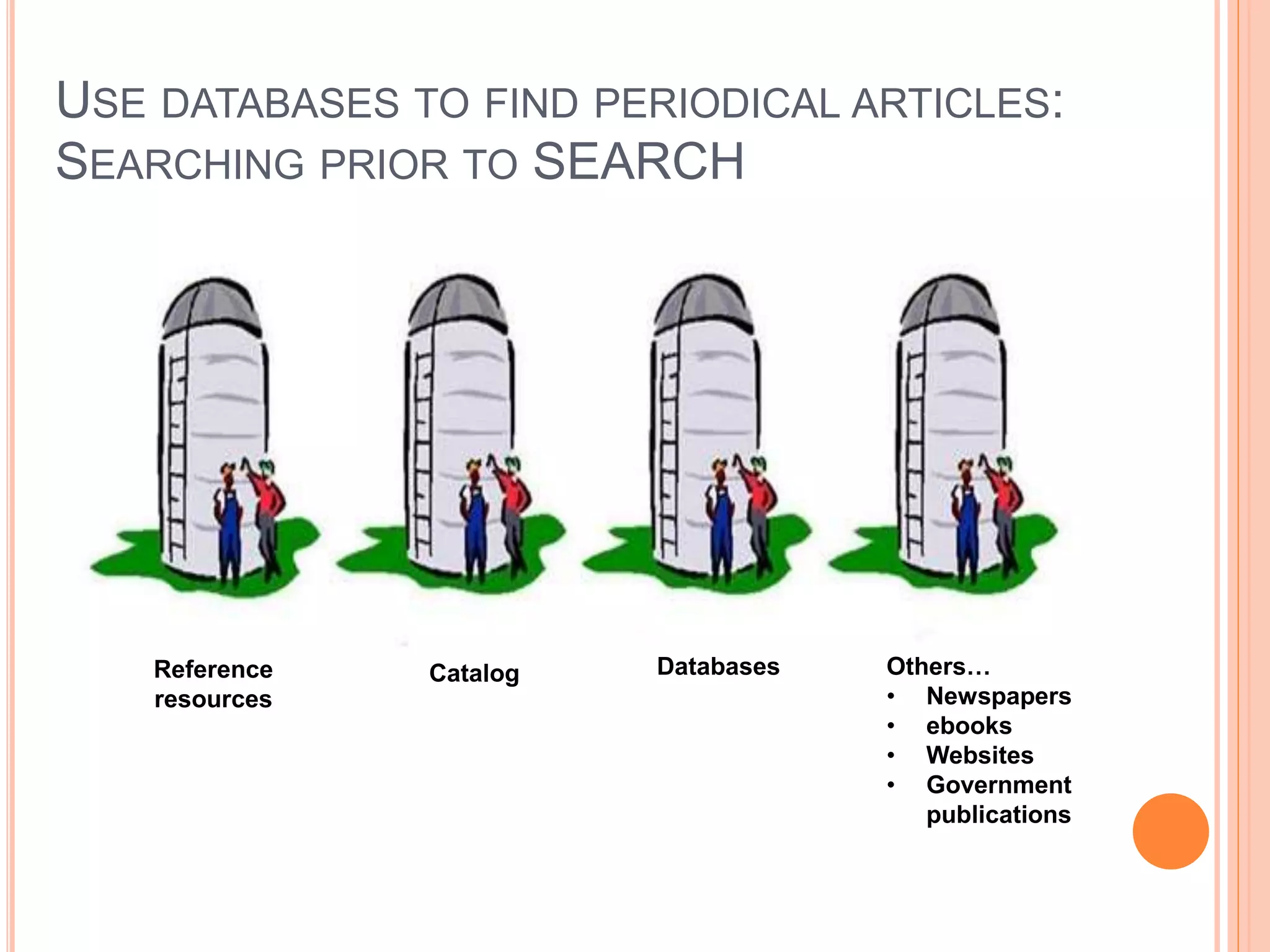
SEARCHING PRIOR TO SEARCH
Reference
resources
Databases Others…
• Newspapers
• ebooks
• Websites
• Government
publications
Catalog
USE DATABASES TO FIND PERIODICAL ARTICLES:
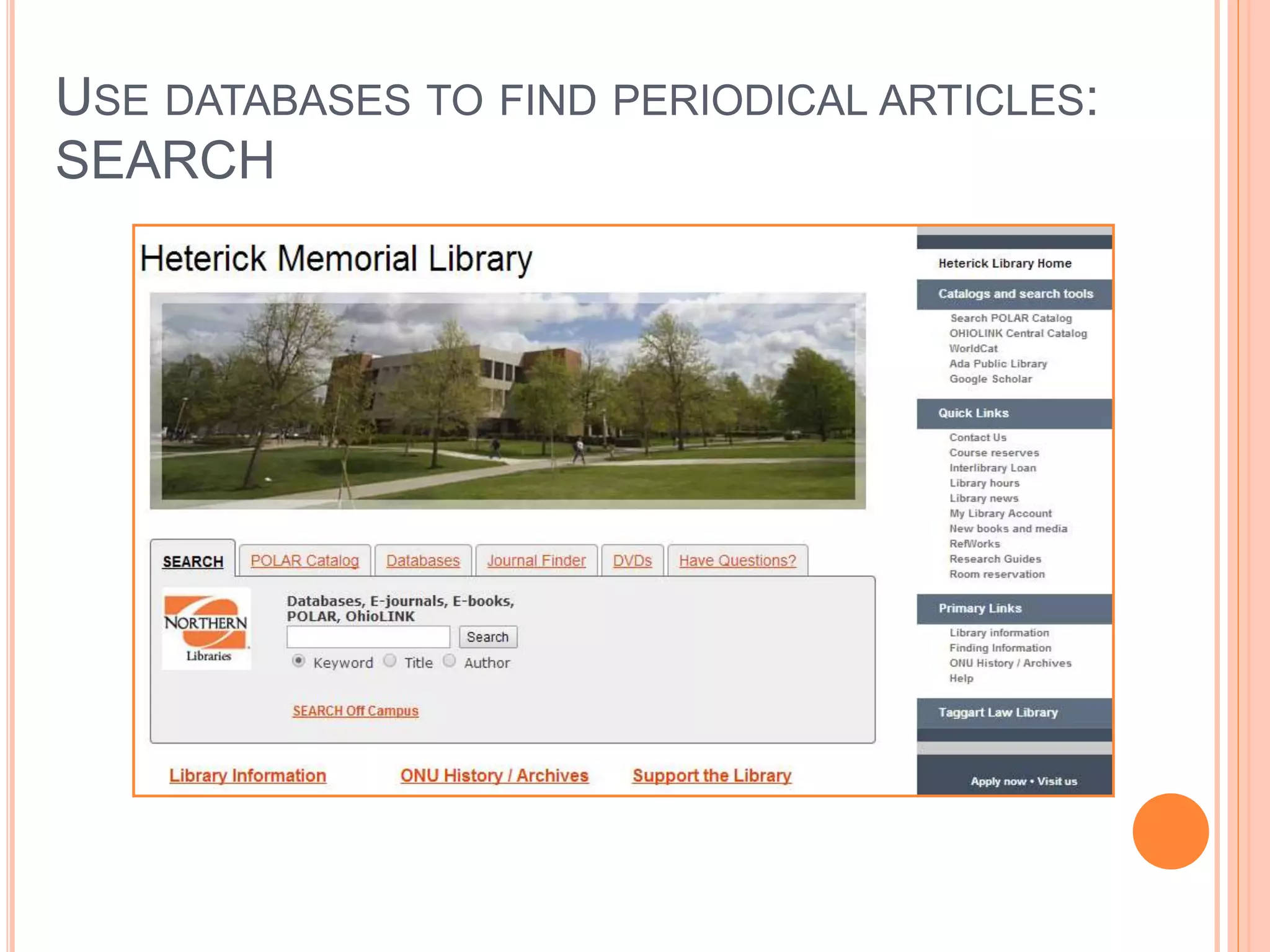
SEARCH
USE DATABASES TO FIND PERIODICAL ARTICLES:
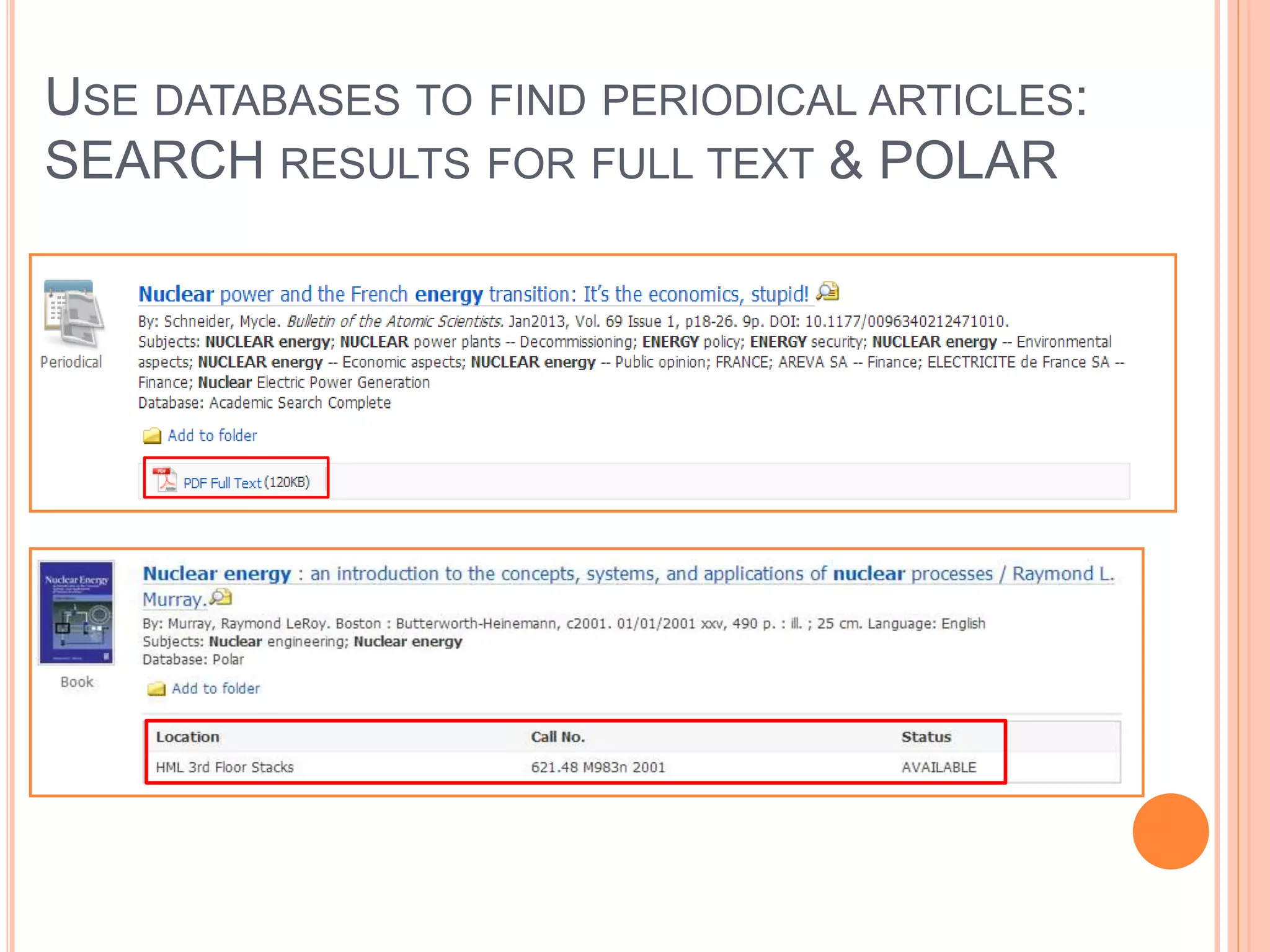
SEARCH RESULTS FOR FULL TEXT & POLAR
USE DATABASES TO FIND PERIODICAL ARTICLES:
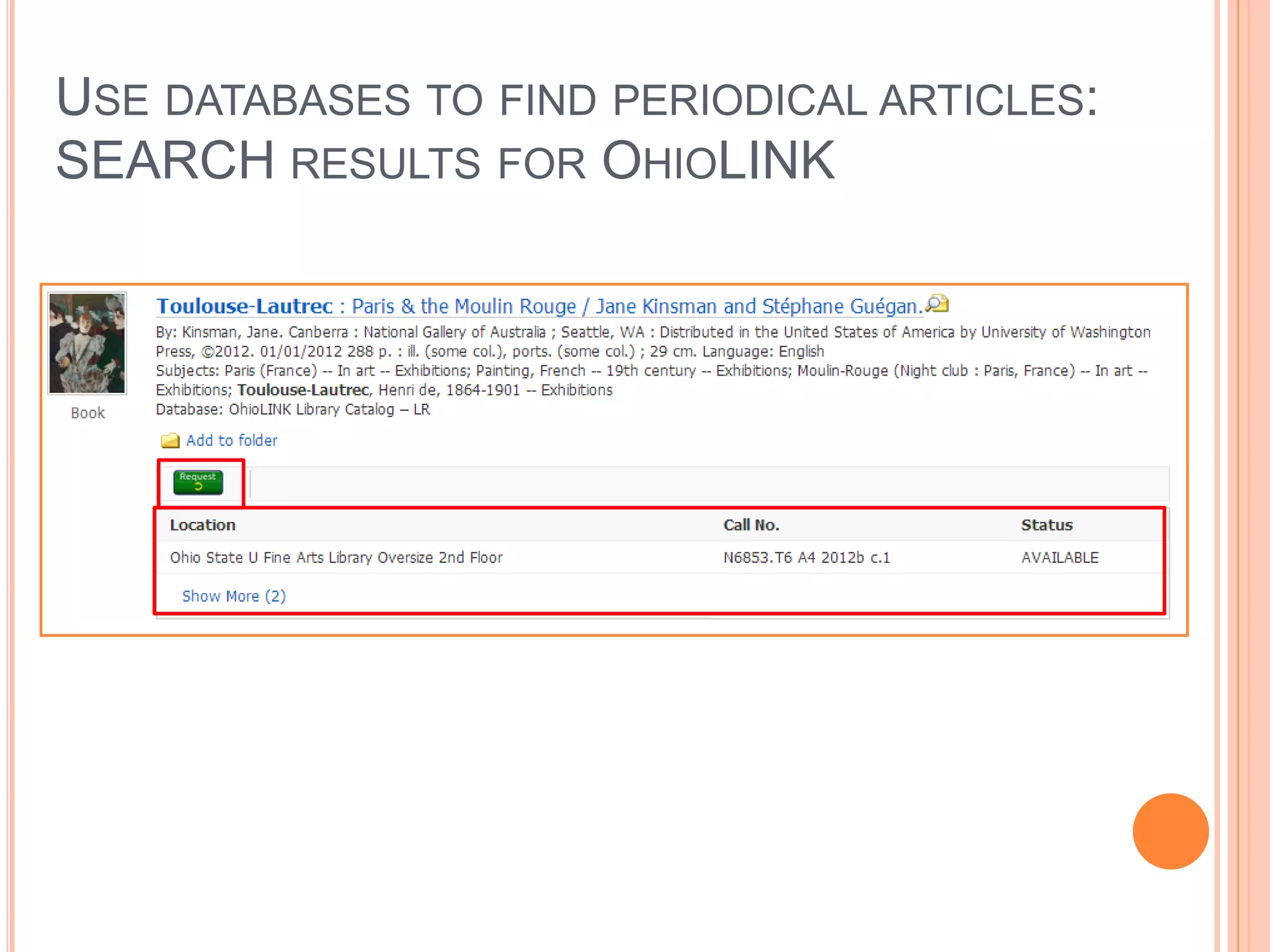
SEARCH RESULTS FOR OHIOLINK
USE DATABASES TO FIND PERIODICAL ARTICLES:
SEARCH RESULTS FOR FIND IT @ ONU
USE DATABASES TO FIND PERIODICAL ARTICLES:
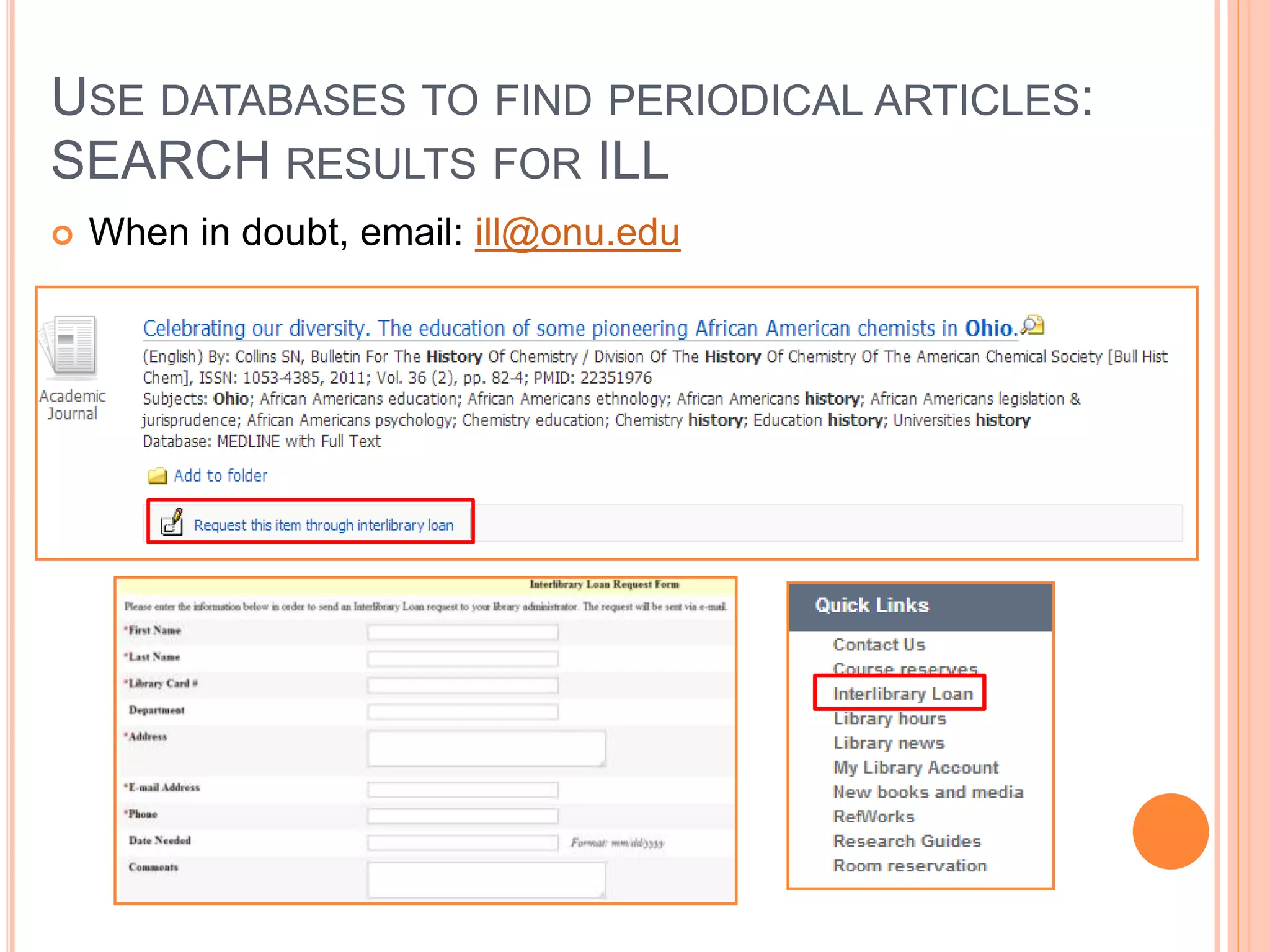
SEARCH RESULTS FOR ILL
 When in doubt, email: ill@onu.edu
USE DATABASES TO FIND PERIODICAL ARTICLES:
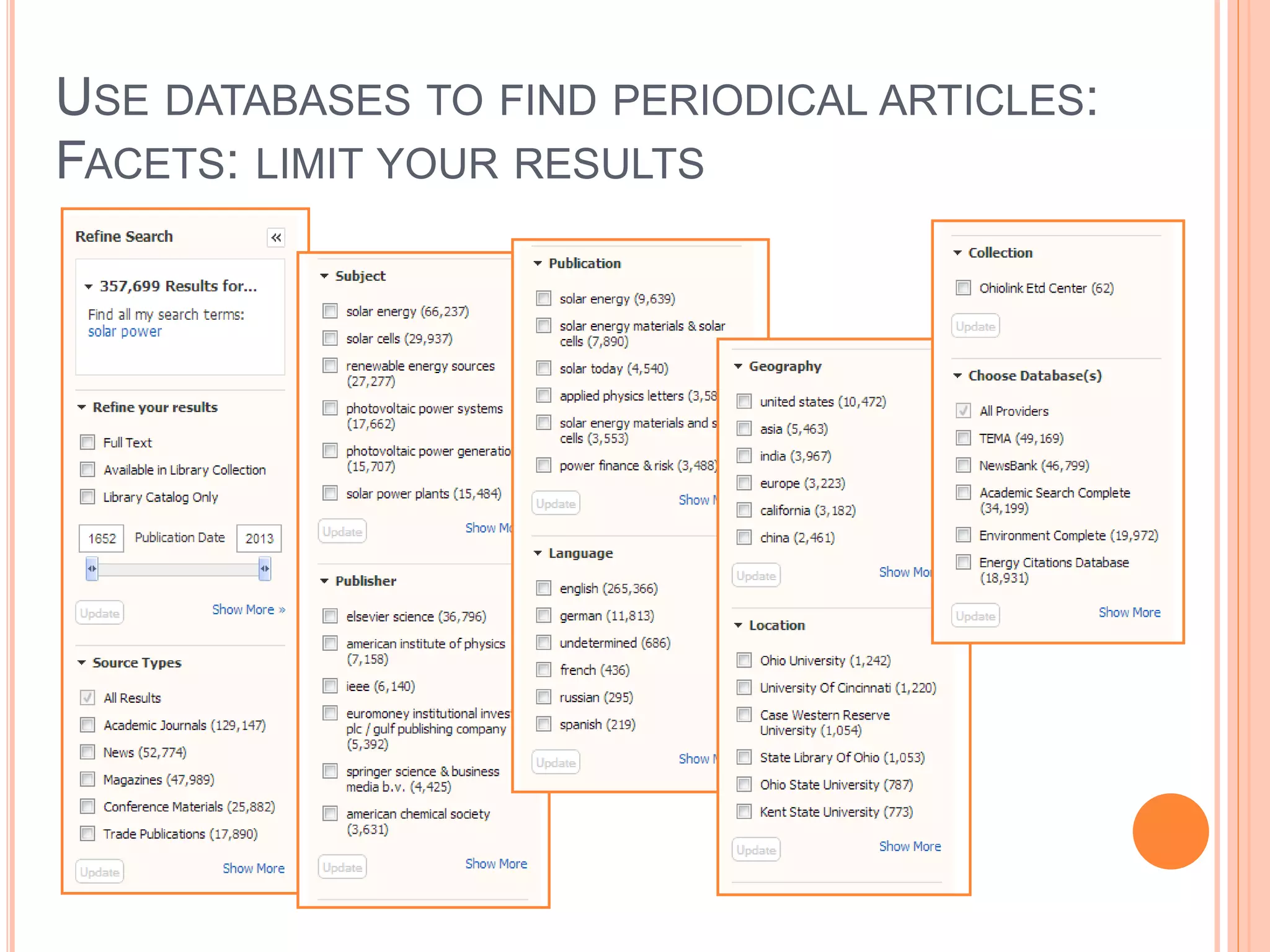
FACETS: LIMIT YOUR RESULTS
CITE WHAT YOU FIND:
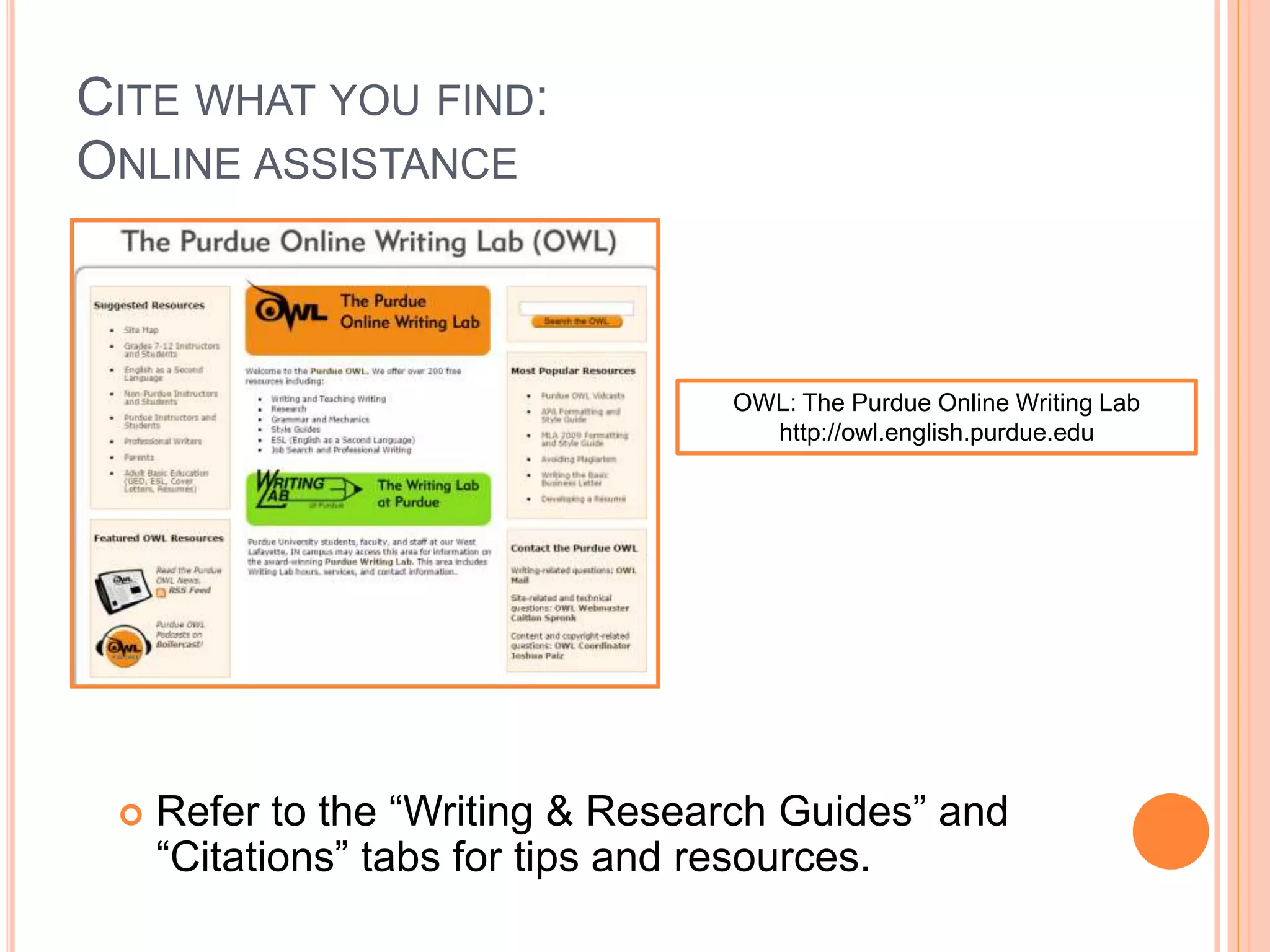
ONLINE ASSISTANCE
 Refer to the “Writing & Research Guides” and
“Citations” tabs for tips and resources.
OWL: The Purdue Online Writing Lab
http://owl.english.purdue.edu
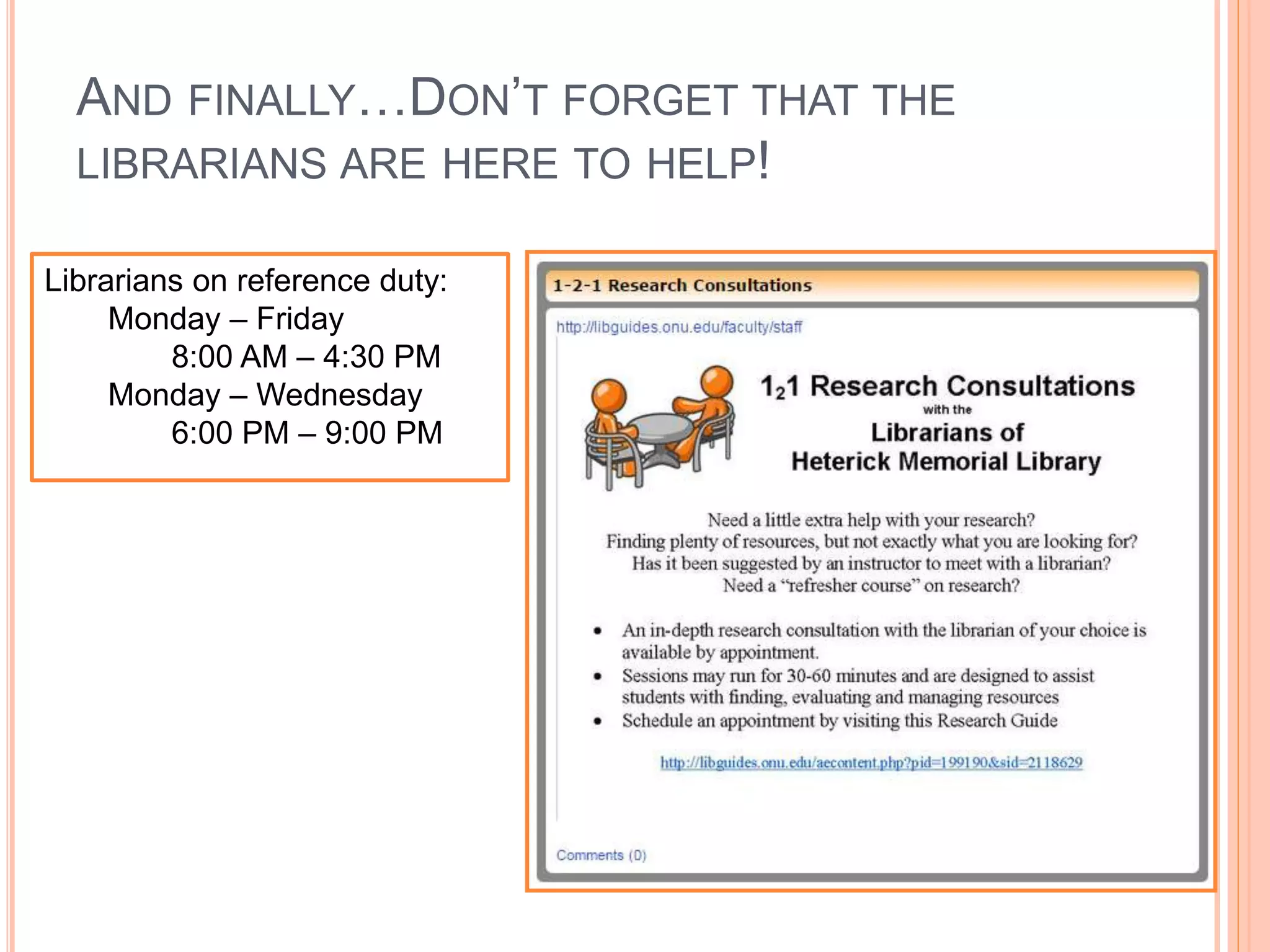
AND FINALLY…DON’T FORGET THAT THE
LIBRARIANS ARE HERE TO HELP!
Librarians on reference duty:
Monday – Friday
8:00 AM – 4:30 PM
Monday – Wednesday
6:00 PM – 9:00 PM

SurfaceSpring2015

  • 1.
    WRITING SEMINAR: RESEARCH STRATEGIESUSING LIBRARY RESOURCES Professor Kelly Kobiela Systems Librarian Heterick Memorial Library
  • 2.
    WELCOME TO THELIBRARY  Professor Kelly Kobiela, k-kobiela@onu.edu  Reference Email, reference@onu.edu  Reference librarians on duty:  Monday – Friday  8:00 AM – 4:30 PM  Monday – Wednesday  6:00 PM – 9:00 PM  One-on-one sessions available by appointment, or fee free to stop by or send us an email.
  • 3.
  • 4.
    WHAT THE LIBRARYOFFERS:  ~400,000 items in POLAR, the ONU library catalog  ~20,000,000 items in OhioLink  260 Databases  400+ print periodicals  Tens of thousands of electronic journal titles  Juvenile, Young Adult, and Graphic Novel collections  DVDs, CDs, streaming audiovisuals, and streaming music
  • 5.
    LIBRARIES AT ONU Heterick Memorial Library  Undergraduate library and accessible to all students  Taggart Law Library  Library for law school and accessible to all students
  • 6.
    ONU ID CARD= LIBRARY ID CARD  Use the entire 11 digit number
  • 7.
    LIBRARY ID CARD MY LIBRARY ACCOUNT  Use your full name (as it appears on the ID) and the entire 11 digit number
  • 8.
    WHAT THESE SESSIONSARE ALL ABOUT  Constructing/developing a research strategy for finding resources  Finding available resources in the library’s catalog and databases
  • 9.
    UH…I’M NOT GOINGTO REMEMBER ALL OF THIS…
  • 10.
    UH…I’M NOT GOINGTO REMEMBER ALL OF THIS…
  • 11.
    HOW TO DORESEARCH: SEVEN STEPS OF THE RESEARCH PROCESS  Step 1: Identify and develop your topic  Step 2: Find background information  Step 3: Use catalogs to find books and media for a general understanding of the topic  Step 4: Find internet resources (if appropriate for the assignment)  Step 5: Use databases to find periodical articles for a specific approach to the topic  Step 6: Evaluate what you find  Step 7: Cite what you find Amended with permission by the Librarians at the Olin and Uris Libraries of Cornell University
  • 12.
    IDENTIFY AND DEVELOPYOUR TOPIC: WHAT’S THE DIFFERENCE BETWEEN A TOPIC AND A THESIS STATEMENT? Definitions from Google definition searches
  • 13.
    IDENTIFY AND DEVELOPYOUR TOPIC: ANNOTATED BIBLIOGRAPHY  An annotated bibliography is a list of sources that includes a summary and/or evaluation of the source  What an annotated bibliography does:  Allows you to see what is out there  Helps you narrow your topic and discard any irrelevant materials  Aids in developing the thesis  Makes you a better scholar
  • 14.
    IDENTIFY AND DEVELOPYOUR TOPIC: HOW TO START YOUR RESEARCH  State your topic as a question  Identify main concepts or keywords  Test the topic to figure out how others might refer to it – look for keywords and synonyms and related terms for the information sought:  Subject headings in catalogs  Built-in thesauri in many databases  Reference sources  Textbooks, lecture notes, readings  Internet  Librarians, instructors
  • 15.
    IDENTIFY AND DEVELOPYOUR TOPIC: EXAMPLE OF A CONCEPT MAP
  • 16.
    IDENTIFY AND DEVELOPYOUR TOPIC: CONCEPT MAPPING
  • 17.
    FIND BACKGROUND INFORMATION: BACKGROUNDRESEARCH  The library catalog is full of resources that can help.  Background research can include reference books and encyclopedias as well as general books and internet resources. (Steps 3 & 4 cover general books and internet searches.)  Look at the Databases tab in the Writing Seminar research guide for a list of electronic reference sources.
  • 18.
    USE CATALOGS TOFIND BOOKS AND MEDIA: POLAR CATALOG  POLAR Catalog – Search for physical and electronic items (ebooks and ejournals) that are available from Heterick Memorial Library and Taggart Law Library
  • 19.
    USE CATALOGS TOFIND BOOKS AND MEDIA: POLAR CATALOG: KEYWORD SEARCH  Looks in several locations  Subject  Article title  Abstracts  Table of contents  Does not require an exact match  Generates comparatively large number of hits  Good if you are not familiar with terminology  Good for a beginning search
  • 20.
    USE CATALOGS TOFIND BOOKS AND MEDIA: POLAR CATALOG: SUBJECT SEARCH  Looks at the subject headings in the records  Requires an exact match  Provides a results list with related headings to use for broader and narrower searches  Generates comparatively smaller number of hits  Good if you are familiar with terminology  Good for a next step after a keyword search
  • 21.
    USE CATALOGS TOFIND BOOKS AND MEDIA: POLAR CATALOG: RESULTS ebook Law Library Heterick Library
  • 22.
    USE CATALOGS TOFIND BOOKS AND MEDIA: OHIOLINK CATALOG  Materials owned by 90+ other libraries in Ohio: colleges, universities, public libraries  Can submit request for an item to be delivered to Heterick Memorial Library  Most requests arrive in 2-3 working days  No charge to request items (unless they become overdue)  Maximum of 25 requests at a time  Items can usually be renewed
  • 23.
    USE CATALOGS TOFIND BOOKS AND MEDIA: OHIOLINK CATALOG  From POLAR results list:  Button will recreate the POLAR search in OhioLINK  From an item record:  Button will go directly to the same item  Use if the copy in POLAR is checked out  Direct link to the OhioLINK catalog:  http://olc1.ohiolink.edu/search
  • 24.
    USE CATALOGS TOFIND BOOKS AND MEDIA: OHIOLINK CATALOG  1.  2. Select Ohio Northern from the dropdown list.  3. Enter your full name and all 11 digits from your student ID.  4. Select “Heterick – Circulation Desk for the pickup location and hit the submit button.
  • 25.
    USE CATALOGS TOFIND BOOKS AND MEDIA: SEARCHOHIO CATALOG  1. SearchOhio: Your next step if all of the POLAR and OhioLINK copies are unavailable.  2.  3. Select Ohio Northern from the dropdown list.  4. Enter your full name and all 11 digits from your student ID.  5. Select “Heterick – Circulation Desk for the pickup location and hit the submit button.
  • 26.
    FINDING INTERNET RESOURCES (IFAPPROPRIATE FOR THE ASSIGNMENT)  Helpful for identifying additional keywords and subjects for your concept map  Google  Wikipedia  Does the information located satisfy the research need?  Is the information factual and unbiased?  Refer to the CRAAP Test for critically analyzing web sources
  • 27.
    FINDING INTERNET RESOURCES: CRITICALLYANALYZING WEB SOURCES USING THE CRAAP TEST  Currency  Timeliness of the information  Relevance/Coverage  Depth and importance of the information  Authority  Source of the information  Accuracy  Reliability of the information  Purpose/Objectivity  Possible bias present in the information
  • 28.
    BUT I FOUNDTHIS GREAT WEBSITE… Critically analyzing web sources  What? is the page/site about  Who? created and maintains this site  Where? is the information coming from  Why? is the information presented on the web  When? was the page created or last updated  How? accurate or credible is the page From the University of Wisconsin Library, worksheet for evaluating web sites
  • 29.
    WEB RESEARCH VS.LIBRARY DATABASES Internet  Material from numerous sources, individuals, government, etc.  Search engines must work with material prepared without regard for specific software  Quality of material varies  Generally do not access for- profit information  Content often anonymous and undated Databases  Usually created by a single publisher  Content pre-arranged for easy searching  Quality-controlled by editorial staff  Most are available only to subscribers  Sources are usually identified and dated  Databases often focus on a specific subject or discipline, but some cover several areas
  • 30.
    USE DATABASES TOFIND PERIODICAL ARTICLES: OVERVIEW OF DATABASES  What is the basic definition of a library database?  A library database is an electronic (online) catalog or index  Library databases contain information about published items  Library databases are searchable  The library subscribes to many databases so the ONU community has access to these resources. When you’re searching a database, you are not searching “the web.”  What types of items are indexed by library databases?  Articles in Journals/Magazines/Newspapers  Reference Information (i.e. entries from Encyclopedias, Dictionaries, etc.)  Books & other documents Source: http://web.calstatela.edu/library/whatisadatabase.htm
  • 31.
    USE DATABASES TOFIND PERIODICAL ARTICLES: FINDING DATABASES
  • 32.
    USE DATABASES TOFIND PERIODICAL ARTICLES: CHOOSING A DATABASE  Helpful Databases  Academic Search Complete  Business Source Complete  JSTOR  Lexis-Nexis  MasterFILE Premier  MEDLINE with Full Text  Databases by Subject
  • 33.
    USE DATABASES TOFIND PERIODICAL ARTICLES: POPULAR VS. SCHOLARLY PERIODICALS  Popular = Magazine  Scholarly = Journal  Magazines are periodicals that contain more popular content. They tend to have glossy pages, lots of pictures, and can be read and understood by the general public. They contain shorter articles written by a staff of journalists.  Journals are periodicals that contain scholarly and peer- reviewed articles, written by scholars and researchers, that are aimed at professionals in the field. The articles are longer and have extensive bibliographies at the ends of the articles.
  • 34.
    USE DATABASES TOFIND PERIODICAL ARTICLES: FULL TEXT ARTICLES
  • 35.
    USE DATABASES TOFIND PERIODICAL ARTICLES: FIND IT @ ONU  Find It @ ONU takes you from a database where you don’t have full text access to a database where you do have full text access
  • 36.
    USE DATABASES TOFIND PERIODICAL ARTICLES: SEARCH DISCOVERY LAYER  What it is:  A discovery layer sits on top of the majority of the library resources and allows users to access most of the information available on one topic with one search  Think of it as the roof on a house  What it isn’t:  An index to ALL database content. While all EBSCO databases are included, ProQuest databases, among a few others, are not included in SEARCH.  A “Googlization” of library resources, although it may seem like it at first.
  • 37.
    USE DATABASES TOFIND PERIODICAL ARTICLES: SEARCH DISCOVERY LAYER  What it includes:  POLAR  Article-level searching for all EBSCO databases  Article-level searching for a variety of other databases: JSTOR, Hoover’s, AccessPharmacy, etc.  Title-level searching for most other databases: IEEE, CIAO, Proquest Nursing & Allied Health  OhioLINK Central Catalog
  • 38.
    USE DATABASES TOFIND PERIODICAL ARTICLES: SEARCHING PRIOR TO SEARCH Reference resources Databases Others… • Newspapers • ebooks • Websites • Government publications Catalog
  • 39.
    USE DATABASES TOFIND PERIODICAL ARTICLES: SEARCH
  • 40.
    USE DATABASES TOFIND PERIODICAL ARTICLES: SEARCH RESULTS FOR FULL TEXT & POLAR
  • 41.
    USE DATABASES TOFIND PERIODICAL ARTICLES: SEARCH RESULTS FOR OHIOLINK
  • 42.
    USE DATABASES TOFIND PERIODICAL ARTICLES: SEARCH RESULTS FOR FIND IT @ ONU
  • 43.
    USE DATABASES TOFIND PERIODICAL ARTICLES: SEARCH RESULTS FOR ILL  When in doubt, email: ill@onu.edu
  • 44.
    USE DATABASES TOFIND PERIODICAL ARTICLES: FACETS: LIMIT YOUR RESULTS
  • 45.
    CITE WHAT YOUFIND: ONLINE ASSISTANCE  Refer to the “Writing & Research Guides” and “Citations” tabs for tips and resources. OWL: The Purdue Online Writing Lab http://owl.english.purdue.edu
  • 46.
    AND FINALLY…DON’T FORGETTHAT THE LIBRARIANS ARE HERE TO HELP! Librarians on reference duty: Monday – Friday 8:00 AM – 4:30 PM Monday – Wednesday 6:00 PM – 9:00 PM