Astronomy Libraries - Your Gateway to Information


  Uta Grothkopf
  ESO Library
  esolib@eso.org
Overview


• Librarians and what they can do for you


• ADS and arXiv: tips and tricks


• Electronic journals, Open Access


• Problems with e-publications


• Cooperation between librarians and astronomers
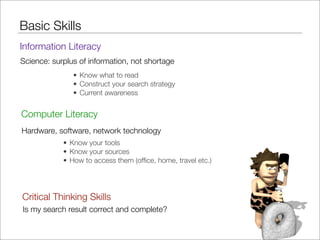
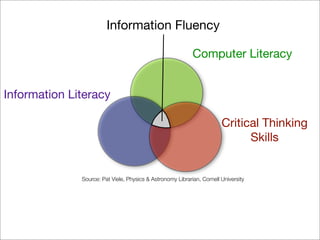
Basic Skills
Information Literacy
Science: surplus of information, not shortage
               • Know what to read
               • Construct your search strategy
               • Current awareness


Computer Literacy
Hardware, software, network technology
            • Know your tools
            • Know your sources
            • How to access them (office, home, travel etc.)


Critical Thinking Skills
Is my search result correct and complete?
Information Fluency

                                                            Computer Literacy


Information Literacy

                                                                        Critical Thinking
                                                                              Skills


              Source: Pat Viele, Physics & Astronomy Librarian, Cornell University
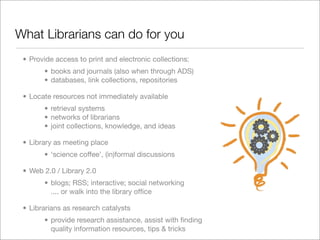
What Librarians can do for you
 • Provide access to print and electronic collections:
       • books and journals (also when through ADS)
       • databases, link collections, repositories

 • Locate resources not immediately available
       • retrieval systems
       • networks of librarians
       • joint collections, knowledge, and ideas

 • Library as meeting place
       • ‘science coffee’, (in)formal discussions

 • Web 2.0 / Library 2.0
       • blogs; RSS; interactive; social networking
         .... or walk into the library office

 • Librarians as research catalysts
       • provide research assistance, assist with finding
         quality information resources, tips & tricks
The 2 Big Ones in Astronomy


•   NASA ADS (Astrophysics Data System)       •   arXiv.org e-Print archive

       ‣   www.adsabs.harvard.edu/                     ‣   arXiv.org (astro-ph)

       ‣   published literature + preprints            ‣   preprints (various versions)

       ‣   from publishers + authors                   ‣   posted by authors

       ‣   myADS notification service                   ‣   e-mail listings, RSS
NASA                        ADS
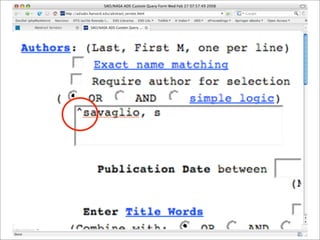
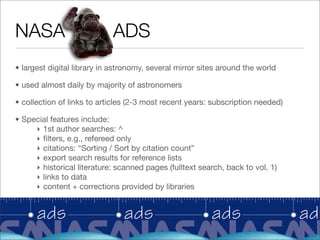
• largest digital library in astronomy, several mirror sites around the world

• used almost daily by majority of astronomers

• collection of links to articles (2-3 most recent years: subscription needed)

• Special features include:
     ‣ 1st author searches: ^
NASA                        ADS
• largest digital library in astronomy, several mirror sites around the world

• used almost daily by majority of astronomers

• collection of links to articles (2-3 most recent years: subscription needed)

• Special features include:
     ‣ 1st author searches: ^
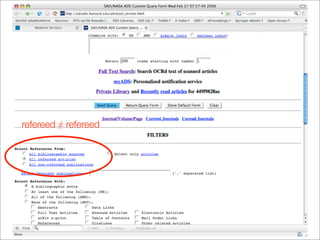
     ‣ filters, e.g., refereed only
refereed ≠ refereed
NASA                        ADS
• largest digital library in astronomy, several mirror sites around the world

• used almost daily by majority of astronomers

• collection of links to articles (2-3 most recent years: subscription needed)

• Special features include:
     ‣ 1st author searches: ^
     ‣ filters, e.g., refereed only
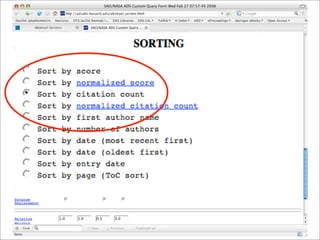
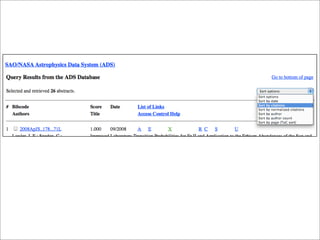
     ‣ citations: “Sorting / Sort by citation count”
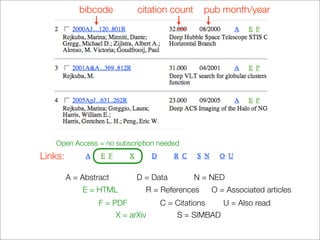
bibcode          citation count     pub month/year


    Open Access = no subscription needed
Links:

         A = Abstract        D = Data         N = NED
             E = HTML          R = References    O = Associated articles
                  F = PDF          C = Citations  U = Also read
                       X = arXiv       S = SIMBAD
NASA                        ADS
• largest digital library in astronomy, several mirror sites around the world

• used almost daily by majority of astronomers

• collection of links to articles (2-3 most recent years: subscription needed)

• Special features include:
     ‣ 1st author searches: ^
     ‣ filters, e.g., refereed only
     ‣ citations: “Sorting / Sort by citation count”
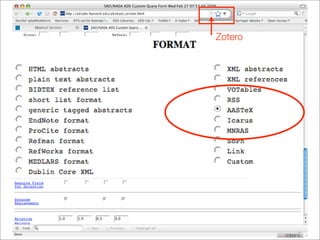
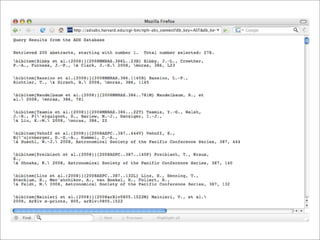
     ‣ export search results for reference lists
Zotero
NASA                        ADS
• largest digital library in astronomy, several mirror sites around the world

• used almost daily by majority of astronomers

• collection of links to articles (2-3 most recent years: subscription needed)

• Special features include:
     ‣ 1st author searches: ^
     ‣ filters, e.g., refereed only
     ‣ citations: “Sorting / Sort by citation count”
     ‣ export search results for reference lists
     ‣ historical literature: scanned pages (fulltext search, back to vol. 1)
     ‣ links to data
     ‣ content + corrections provided by libraries
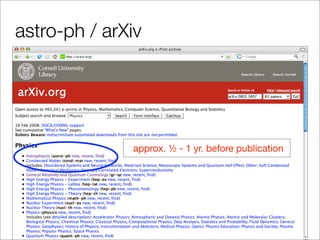
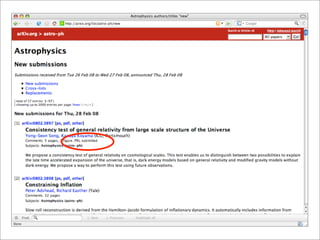
astro-ph / arXiv


              approx. ½ - 1 yr. before publication
astro-ph / arXiv
• citing arXiv papers:      arXiv:YYMM.NNNv# [category]
                            arXiv:0803.1234v1 [astro-ph]

      ‣ scientists still cite published version (e.g., in CV)
        --> journal still has a meaning (impact, reputation...)


• Schwarz & Kennicutt (2004): astro-ph --> citations 2x
• Position on arXiv --> citations?

      J.P. Dietrich:
      ‣ The importance of being first: position dependent citation rates on arXiv:astro-ph [2008PASP..
        120..224D]
      ‣ Disentangling visibility and self-promotion bias in the arXiv:astro-ph positional citation effect
        [2008PASP..120..801D]
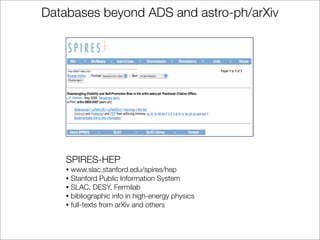
Databases beyond ADS and astro-ph/arXiv


    SPIRES-HEP
    • www.slac.stanford.edu/spires/hep
    • Stanford Public Information System
    • SLAC, DESY, Fermilab
    • bibliographic info in high-energy physics
    • full-texts from arXiv and others
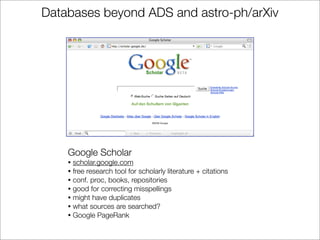
Databases beyond ADS and astro-ph/arXiv


    Google Scholar
    • scholar.google.com
    • free research tool for scholarly literature + citations
    • conf. proc, books, repositories
    • good for correcting misspellings
    • might have duplicates
    • what sources are searched?
    • Google PageRank
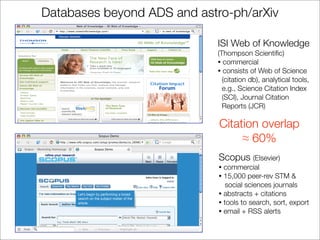
Databases beyond ADS and astro-ph/arXiv

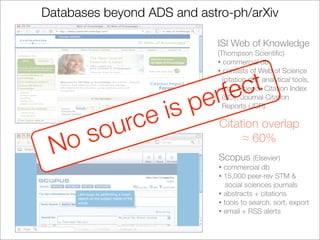
                             ISI Web of Knowledge
                             (Thompson Scientific)
                             • commercial
                             • consists of Web of Science
                               (citation db), analytical tools,
                               e.g., Science Citation Index
                               (SCI), Journal Citation
                               Reports (JCR)

                             Citation overlap
                                  ≈ 60%
                             Scopus (Elsevier)
                             • commercial
                             • 15,000 peer-rev STM &
                                social sciences journals
                             • abstracts + citations
                             • tools to search, sort, export
                             • email + RSS alerts
Databases beyond ADS and astro-ph/arXiv

                             ISI Web of Knowledge
                             (Thompson Scientific)
                             • commercial db
                             • consists of Web of Science


                            rfe ct
                               (citation db), analytical tools,


                          e
                               e.g., Science Citation Index


                    is p       (SCI), Journal Citation


           rce
                               Reports (JCR)


       sou                   Citation overlap

 No                               ≈ 60%
                             Scopus (Elsevier)
                             • commercial db
                             • 15,000 peer-rev STM &
                                social sciences journals
                             • abstracts + citations
                             • tools to search, sort, export
                             • email + RSS alerts
Journals
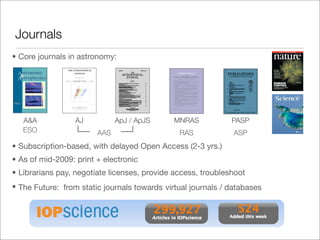
• Core journals in astronomy:


   A&A            AJ          ApJ / ApJS      MNRAS           PASP
   ESO                  AAS                    RAS             ASP
• Subscription-based, with delayed Open Access (2-3 yrs.)
• As of mid-2009: print + electronic
• Librarians pay, negotiate licenses, provide access, troubleshoot
• The Future: from static journals towards virtual journals / databases
Open Access

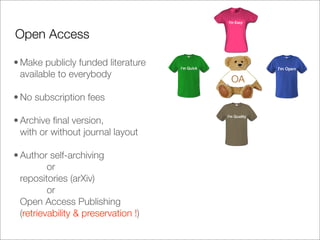
• Make publicly funded literature
  available to everybody
                                      OA
• No subscription fees

• Archive final version,
  with or without journal layout

• Author self-archiving
          or
  repositories (arXiv)
          or
  Open Access Publishing
  (retrievability & preservation !)
Open Access


Grothkopf & Erdmann:
Open Access — State of the Art

IAU Information Bulletin July 2008
www.iau.org/science/publications/iau/information_bulletin/


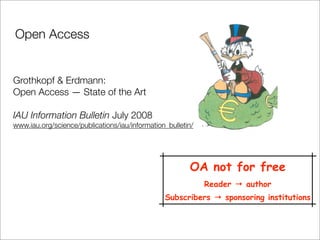
                                                        OA not for free
                                                             Reader → author
                                                Subscribers → sponsoring institutions
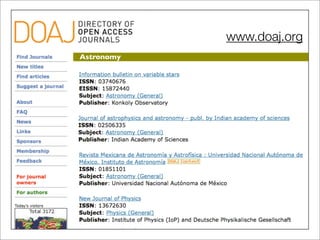
www.doaj.org
Astronomy
Problems with Online Documents
• Long-term access
      ‣ Archiving: what, where, who?
      ‣ Preservation: perpetual access, migration to newer formats, metadata,
        ownership of content, embedded links (inside and outside)

• Completeness of digitized material
      ‣ errata, news, advertisements, columns, letters, front matter,
        legible figures and graphs, obituaries....

• Deleted items
      ‣ Journals: plagiarized articles
      ‣ Wikipedia: ceased projects
      ‣ Mailing lists, blogs: comments and contributions

• Broken links
      ‣ URL → URN / DOI
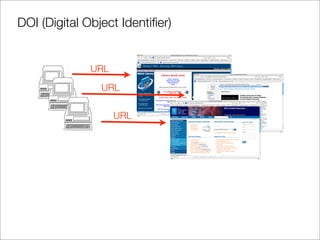
DOI (Digital Object Identifier)


              URL
                URL

                    URL
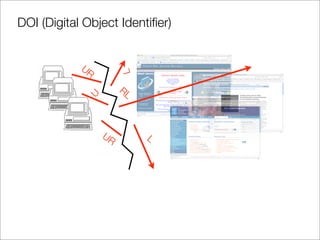
DOI (Digital Object Identifier)


            UR


                      L
             U        RL


                 UR        L
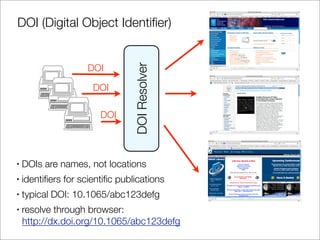
DOI (Digital Object Identifier)


                     DOI


                                 DOI Resolver
                      DOI

                        DOI


•   DOIs are names, not locations
•   identifiers for scientific publications
•   typical DOI: 10.1065/abc123defg
•   resolve through browser:
    http://dx.doi.org/10.1065/abc123defg
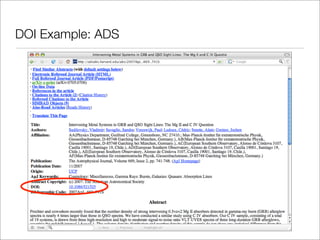
DOI Example: ADS
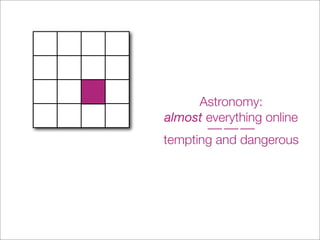
Astronomy:
almost everything online
       
tempting and dangerous
Information not easy to find

• Special supplements
     ‣ e.g., (color) plates
• Radio astronomy
     ‣ historical literature
     ‣ recent literature in engineering journals

• Observatory publications ( > 3 yrs.)
• Books, conference proceedings ( > 5 yrs.)
• Non-English literature
Cooperations of Librarians and Astronomers

            International Astronomical Union (IAU)
                Commission 5: Documentation and Astronomical Data
                  Working Group Libraries
                  www.eso.org/libraries/IAU-WGLib/


            Library and Information Services in Astronomy (LISA)
                www.eso.org/libraries/lisa.html
Library and Information Services in Astronomy
• Series of conferences:     LISA I:     Washington, DC, USA, 1988
                             LISA II:    Garching, Germany, 1995
                             LISA III:   Tenerife, Canary Islands, Spain, 1998
                             LISA IV:    Prague, Czech Republic, 2002
                             LISA V:     Cambridge, MA, USA, 2006
                             LISA VI:    to be held in Pune, India, 2010

• Participants: librarians, publishers, computer specialists, astronomers
  from around the world

• Topics covered reflect the changes in library services and information access

• Forum for exchange of experiences and information about emerging fields of
  interest in astronomy libraries

Astronomy libraries - your gateway to information

  • 1.
    Astronomy Libraries -Your Gateway to Information Uta Grothkopf ESO Library esolib@eso.org
  • 2.
    Overview • Librarians andwhat they can do for you • ADS and arXiv: tips and tricks • Electronic journals, Open Access • Problems with e-publications • Cooperation between librarians and astronomers
  • 3.
    Basic Skills Information Literacy Science:surplus of information, not shortage • Know what to read • Construct your search strategy • Current awareness Computer Literacy Hardware, software, network technology • Know your tools • Know your sources • How to access them (office, home, travel etc.) Critical Thinking Skills Is my search result correct and complete?
  • 4.
    Information Fluency Computer Literacy Information Literacy Critical Thinking Skills Source: Pat Viele, Physics & Astronomy Librarian, Cornell University
  • 5.
    What Librarians cando for you • Provide access to print and electronic collections: • books and journals (also when through ADS) • databases, link collections, repositories • Locate resources not immediately available • retrieval systems • networks of librarians • joint collections, knowledge, and ideas • Library as meeting place • ‘science coffee’, (in)formal discussions • Web 2.0 / Library 2.0 • blogs; RSS; interactive; social networking .... or walk into the library office • Librarians as research catalysts • provide research assistance, assist with finding quality information resources, tips & tricks
  • 6.
    The 2 BigOnes in Astronomy • NASA ADS (Astrophysics Data System) • arXiv.org e-Print archive ‣ www.adsabs.harvard.edu/ ‣ arXiv.org (astro-ph) ‣ published literature + preprints ‣ preprints (various versions) ‣ from publishers + authors ‣ posted by authors ‣ myADS notification service ‣ e-mail listings, RSS
  • 7.
    NASA ADS • largest digital library in astronomy, several mirror sites around the world • used almost daily by majority of astronomers • collection of links to articles (2-3 most recent years: subscription needed) • Special features include: ‣ 1st author searches: ^
  • 9.
    NASA ADS • largest digital library in astronomy, several mirror sites around the world • used almost daily by majority of astronomers • collection of links to articles (2-3 most recent years: subscription needed) • Special features include: ‣ 1st author searches: ^ ‣ filters, e.g., refereed only
  • 10.
  • 11.
    NASA ADS • largest digital library in astronomy, several mirror sites around the world • used almost daily by majority of astronomers • collection of links to articles (2-3 most recent years: subscription needed) • Special features include: ‣ 1st author searches: ^ ‣ filters, e.g., refereed only ‣ citations: “Sorting / Sort by citation count”
  • 14.
    bibcode citation count pub month/year Open Access = no subscription needed Links: A = Abstract D = Data N = NED E = HTML R = References O = Associated articles F = PDF C = Citations U = Also read X = arXiv S = SIMBAD
  • 15.
    NASA ADS • largest digital library in astronomy, several mirror sites around the world • used almost daily by majority of astronomers • collection of links to articles (2-3 most recent years: subscription needed) • Special features include: ‣ 1st author searches: ^ ‣ filters, e.g., refereed only ‣ citations: “Sorting / Sort by citation count” ‣ export search results for reference lists
  • 16.
  • 18.
    NASA ADS • largest digital library in astronomy, several mirror sites around the world • used almost daily by majority of astronomers • collection of links to articles (2-3 most recent years: subscription needed) • Special features include: ‣ 1st author searches: ^ ‣ filters, e.g., refereed only ‣ citations: “Sorting / Sort by citation count” ‣ export search results for reference lists ‣ historical literature: scanned pages (fulltext search, back to vol. 1) ‣ links to data ‣ content + corrections provided by libraries
  • 19.
    astro-ph / arXiv approx. ½ - 1 yr. before publication
  • 21.
    astro-ph / arXiv •citing arXiv papers: arXiv:YYMM.NNNv# [category] arXiv:0803.1234v1 [astro-ph] ‣ scientists still cite published version (e.g., in CV) --> journal still has a meaning (impact, reputation...) • Schwarz & Kennicutt (2004): astro-ph --> citations 2x • Position on arXiv --> citations? J.P. Dietrich: ‣ The importance of being first: position dependent citation rates on arXiv:astro-ph [2008PASP.. 120..224D] ‣ Disentangling visibility and self-promotion bias in the arXiv:astro-ph positional citation effect [2008PASP..120..801D]
  • 22.
    Databases beyond ADSand astro-ph/arXiv SPIRES-HEP • www.slac.stanford.edu/spires/hep • Stanford Public Information System • SLAC, DESY, Fermilab • bibliographic info in high-energy physics • full-texts from arXiv and others
  • 23.
    Databases beyond ADSand astro-ph/arXiv Google Scholar • scholar.google.com • free research tool for scholarly literature + citations • conf. proc, books, repositories • good for correcting misspellings • might have duplicates • what sources are searched? • Google PageRank
  • 24.
    Databases beyond ADSand astro-ph/arXiv ISI Web of Knowledge (Thompson Scientific) • commercial • consists of Web of Science (citation db), analytical tools, e.g., Science Citation Index (SCI), Journal Citation Reports (JCR) Citation overlap ≈ 60% Scopus (Elsevier) • commercial • 15,000 peer-rev STM & social sciences journals • abstracts + citations • tools to search, sort, export • email + RSS alerts
  • 25.
    Databases beyond ADSand astro-ph/arXiv ISI Web of Knowledge (Thompson Scientific) • commercial db • consists of Web of Science rfe ct (citation db), analytical tools, e e.g., Science Citation Index is p (SCI), Journal Citation rce Reports (JCR) sou Citation overlap No ≈ 60% Scopus (Elsevier) • commercial db • 15,000 peer-rev STM & social sciences journals • abstracts + citations • tools to search, sort, export • email + RSS alerts
  • 26.
    Journals • Core journalsin astronomy: A&A AJ ApJ / ApJS MNRAS PASP ESO AAS RAS ASP • Subscription-based, with delayed Open Access (2-3 yrs.) • As of mid-2009: print + electronic • Librarians pay, negotiate licenses, provide access, troubleshoot • The Future: from static journals towards virtual journals / databases
  • 27.
    Open Access • Makepublicly funded literature available to everybody OA • No subscription fees • Archive final version, with or without journal layout • Author self-archiving or repositories (arXiv) or Open Access Publishing (retrievability & preservation !)
  • 28.
    Open Access Grothkopf &Erdmann: Open Access — State of the Art IAU Information Bulletin July 2008 www.iau.org/science/publications/iau/information_bulletin/ OA not for free Reader → author Subscribers → sponsoring institutions
  • 29.
  • 30.
    Problems with OnlineDocuments • Long-term access ‣ Archiving: what, where, who? ‣ Preservation: perpetual access, migration to newer formats, metadata, ownership of content, embedded links (inside and outside) • Completeness of digitized material ‣ errata, news, advertisements, columns, letters, front matter, legible figures and graphs, obituaries.... • Deleted items ‣ Journals: plagiarized articles ‣ Wikipedia: ceased projects ‣ Mailing lists, blogs: comments and contributions • Broken links ‣ URL → URN / DOI
  • 31.
    DOI (Digital ObjectIdentifier) URL URL URL
  • 32.
    DOI (Digital ObjectIdentifier) UR L U RL UR L
  • 33.
    DOI (Digital ObjectIdentifier) DOI DOI Resolver DOI DOI • DOIs are names, not locations • identifiers for scientific publications • typical DOI: 10.1065/abc123defg • resolve through browser: http://dx.doi.org/10.1065/abc123defg
  • 34.
  • 35.
    Astronomy: almost everything online  tempting and dangerous
  • 36.
    Information not easyto find • Special supplements ‣ e.g., (color) plates • Radio astronomy ‣ historical literature ‣ recent literature in engineering journals • Observatory publications ( > 3 yrs.) • Books, conference proceedings ( > 5 yrs.) • Non-English literature
  • 38.
    Cooperations of Librariansand Astronomers International Astronomical Union (IAU) Commission 5: Documentation and Astronomical Data Working Group Libraries www.eso.org/libraries/IAU-WGLib/ Library and Information Services in Astronomy (LISA) www.eso.org/libraries/lisa.html
  • 39.
    Library and InformationServices in Astronomy • Series of conferences: LISA I: Washington, DC, USA, 1988 LISA II: Garching, Germany, 1995 LISA III: Tenerife, Canary Islands, Spain, 1998 LISA IV: Prague, Czech Republic, 2002 LISA V: Cambridge, MA, USA, 2006 LISA VI: to be held in Pune, India, 2010 • Participants: librarians, publishers, computer specialists, astronomers from around the world • Topics covered reflect the changes in library services and information access • Forum for exchange of experiences and information about emerging fields of interest in astronomy libraries