Library Advocacy:
The Un-quiet Zone

Advocacy for Library Friends
What We’ll Learn Together Today
• Why Be an Advocate
• What Advocacy Is All About
• What Are The Basics
  – Organizing
  – Message
  – Determining Strategy
  – Implementation
What We’ll Learn Together Today
• Developing an Effective Message
• Case Studies
  – Jervis Public Library
  – White Plains Public Library
  – The Relationship with Your Electeds
• Building Your Friends Group
Giving Credit Where It Is Due
• Wellstone Action
  – Founded in memory of Paul Wellstone, MN
    Senator who believed in the power of
    grassroots advocacy and action
• ALA’s Library Advocate’s Handbook
• Experience gathered working as an
  advocate for over 30 years
Some Advocates We’ve Known
              • John Brown
                – Leading Abolitionist
                – Anti-Slavery Advocate
Some Advocates We’ve Known
              • Eleanor Roosevelt
                – First Lady
                – Human Rights
                  Advocate
Some Advocates We’ve Known
              • Eunice Kennedy
                Shriver
                – Founder of the Special
                  Olympics
                – Disabilities Advocate
Some Advocates We’ve Known
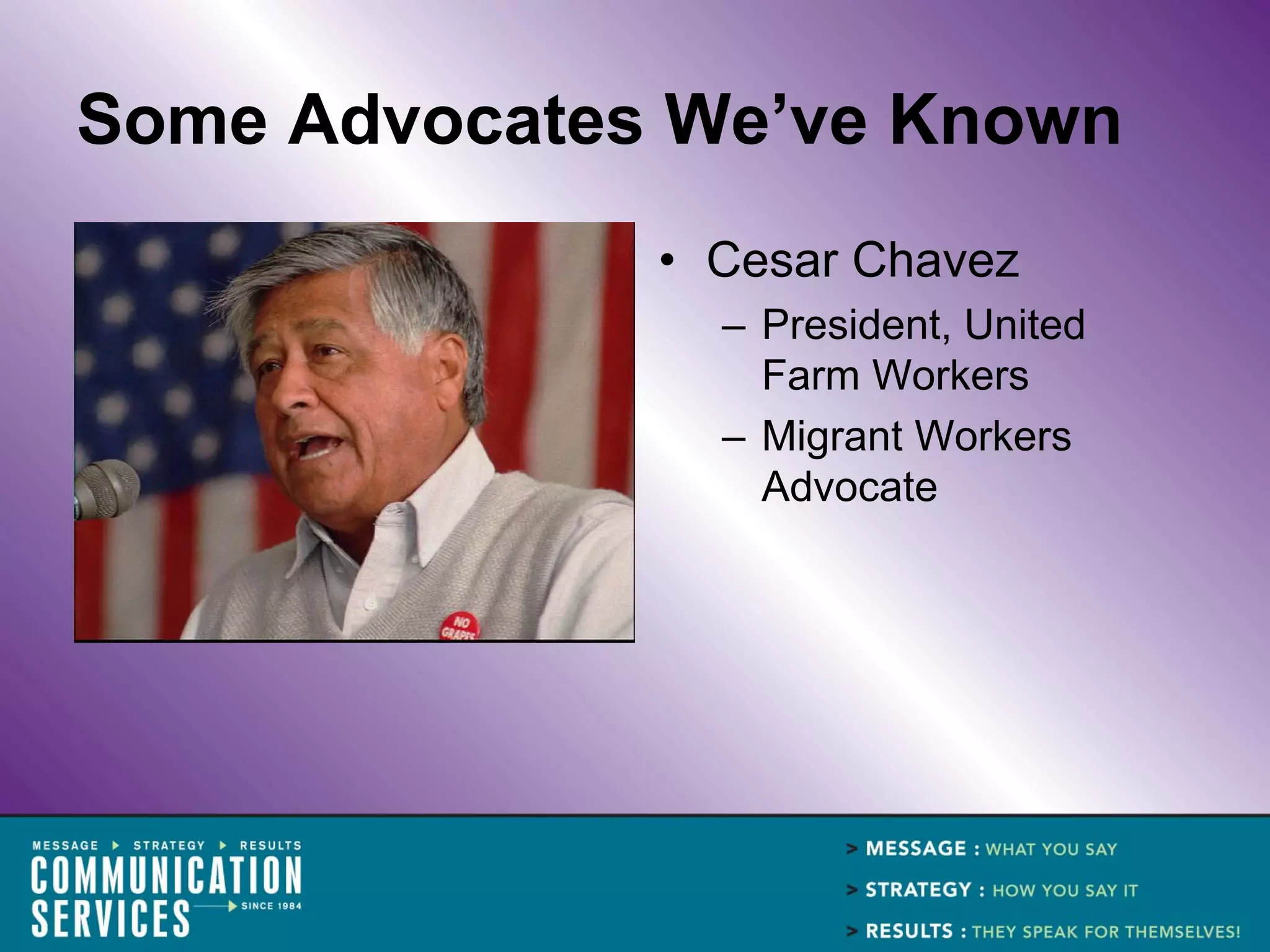
              • Cesar Chavez
                – President, United
                  Farm Workers
                – Migrant Workers
                  Advocate
Some Advocates We’ve Known
              • Marian Wright
                Edelman
                – President, Children’s
                  Defense Fund
                – Children’s Rights
                  Advocate
Some Advocates We’ve Known
              • Dr. Martin Luther
                King, Jr.
                – President, Southern
                  Christian Leadership
                  Council
                – Civil Rights Advocate
Some Advocates We’ve Known
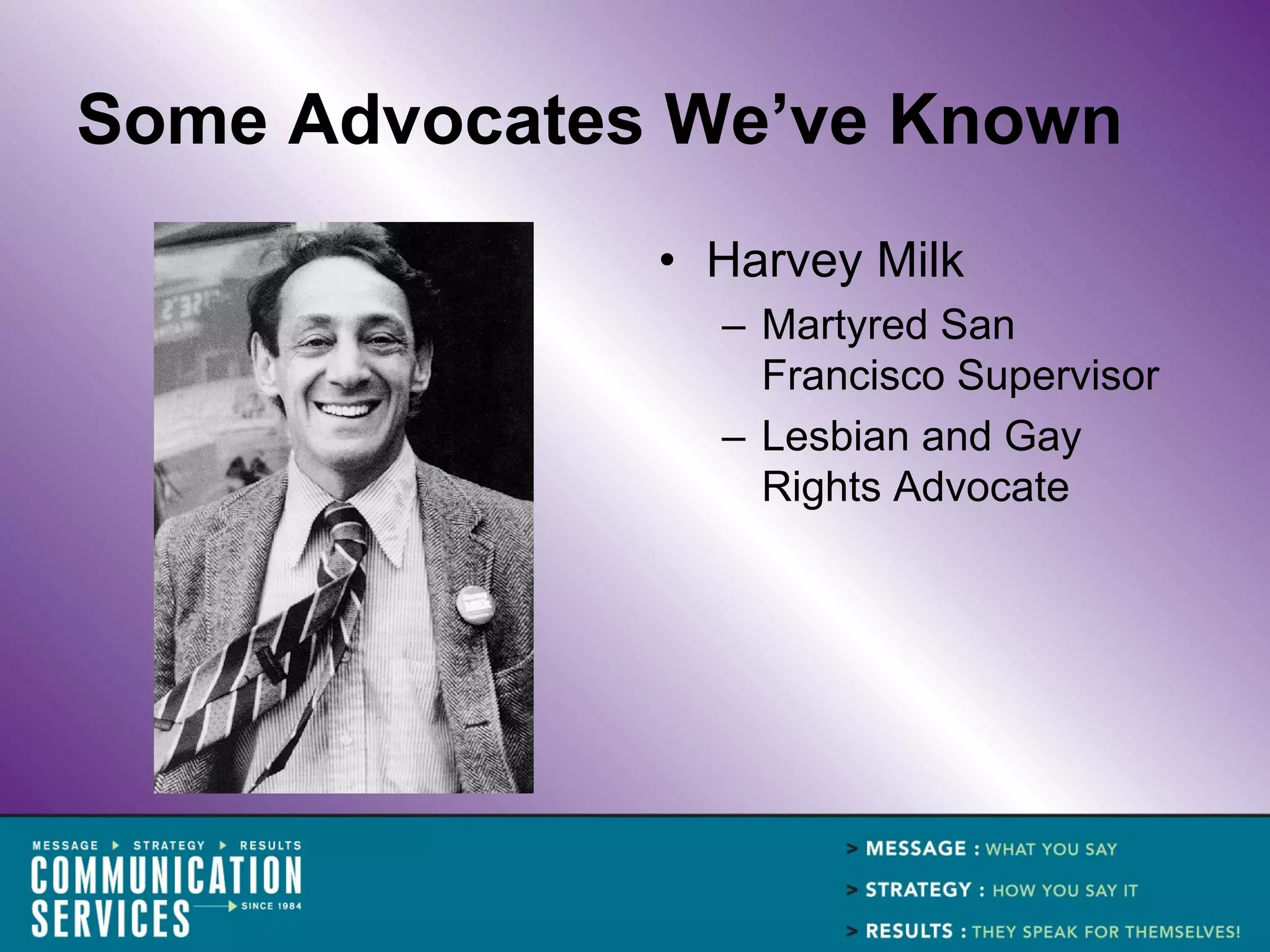
              • Harvey Milk
                – Martyred San
                  Francisco Supervisor
                – Lesbian and Gay
                  Rights Advocate
Some Advocates We’ve Known
              • Ted Kennedy
                – U.S. Senator
                – Health Care Reform
                  Advocate
Some advocates We’ve Yet to Meet


     Any of these
    people could be
         you!
Why Be An Advocate?
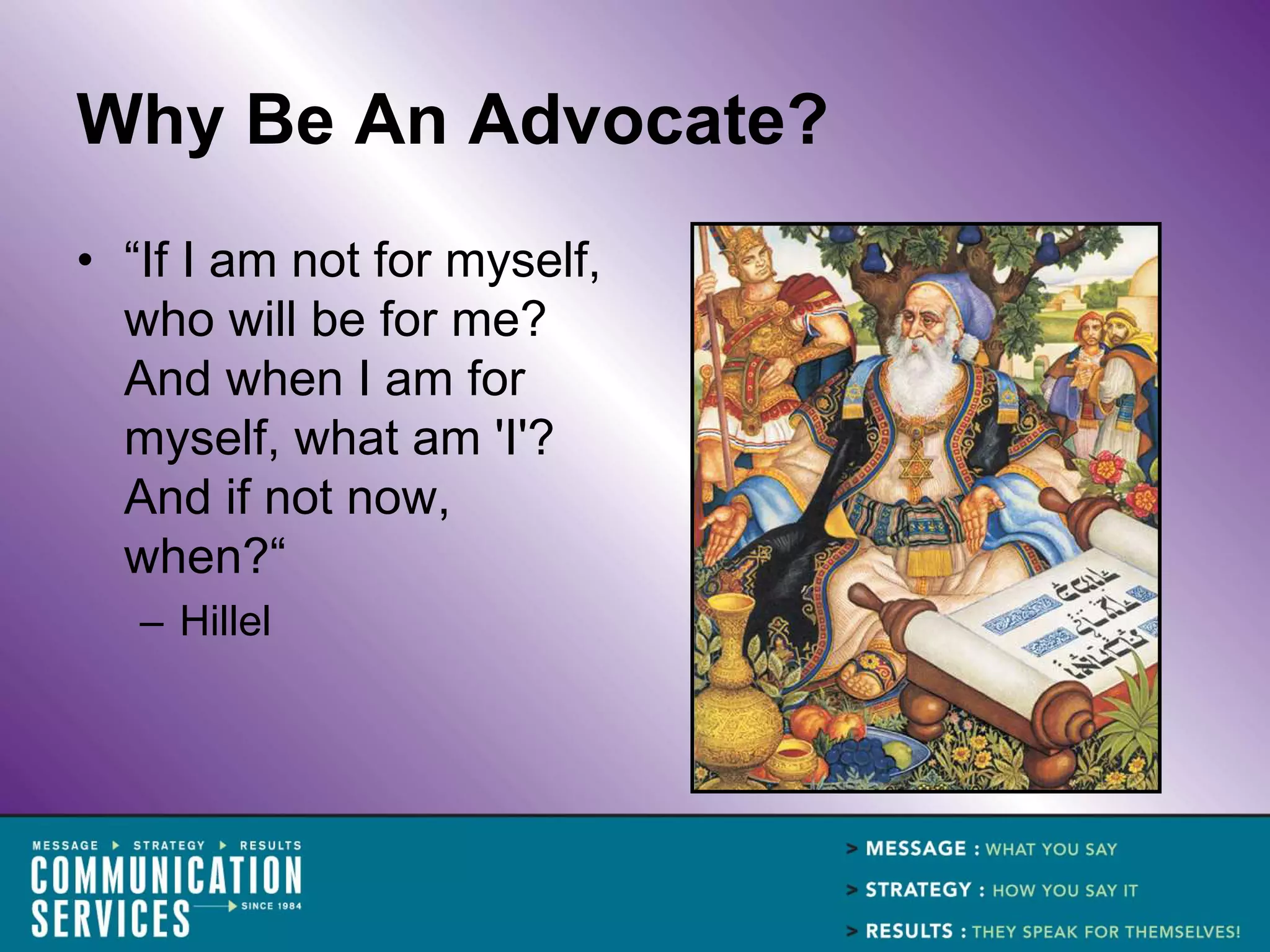
• “If I am not for myself,
  who will be for me?
  And when I am for
  myself, what am 'I'?
  And if not now,
  when?“
   – Hillel
Why Be An Advocate
• If we don’t stand up for libraries, who will?
• If we do stand up for libraries
  – Our staff will
  – Our trustees will
  – Our patrons will
  – Our community leaders will
  – Our elected officials possibly will (if we make it
    politically safe for them)
Why Be An Advocate?
• Stand up for what you believe in
  – Frame the debate and determine the message
• Express your passion about libraries
• Become a leader
• Organize supporters
  – Allow them to express their passion as well
• Develop strategies
• Execute and analyze
What Is Advocacy All About?
• Taking action to impact an issue
  – Why you want to take action?
  – What do you want to accomplish?
  – How can you be best prepared?
  – What resources will you need?
  – Who will lead?
What Is Advocacy All About?
• Advocacy comes alive as a campaign
  – Effective message that moves people to
    action
  – Series of tactics based on message and
    resources
  – Clear attainable goal
    • Internal goal
    • External goal
Advocacy as Program
• Develop a core advocacy group
• Develop advocacy programs where the
  public can come and learn
• Make sure you have something for folks
  “to do”
• Always be on the look out for new board
  members and leadership
Lobbying as an Advocacy Tactic
• Lobbying is a specific form of advocacy
• Ask an elected official to take a stand and
  vote a certain way
  – It’s what Lobby Day is all about
• Lobbying is narrowly defined
  – Regulated by law
• Advocacy is broadly defined
  – No legal constraints
Key Components of
an Advocacy Campaign
• Strong leadership       • Determine targets to
  – Coordinate with the     pressure
    Library board         • Organize people
• Clear goals             • Determine tactics
  – Written plan
                          • Use media
• Strong, clear             – Traditional
  message                   – New
  – Core message same
    as library’s
                          • Celebrate
Strong Leadership
• Essential to have someone in charge
  – Campaigns require planning, focus, discipline
    and organization
  – Coordinating with Library
• Decisions need to be made quickly and
  decisively
• Everyone has a role to play
Clear Goals
• Articulate vision
  – Have a clear understanding of what you’re
    trying to accomplish
  – Can not be all things to all people
  – May not be able to talk about other important
    issues
• Written plan drives strategy and tactics
• Define victory
Strong, clear message
• Clear, concise
• You define it
  – Don’t let opposition define your message
• Internal message
  – What you use to engage and motivate your base
• External message
  – What you communicate in various ways to your
    intended targets—policy makers, elected, etc.
Determine targets
• Who are you trying to impact
  – Policy makers
  – Decision makers
  – Elected Officials
• Helps determine where you have or where
  you need to build supporters
Organize people
• Organize People
  – Excite your base with your message
  – Gain their commitment to act
  – Give them specific things to do
  – Constantly reach out and bring in new people
Determine tactics
• Personal visits with targets
• Letters, faxes, e-mails, postcards and phone
  calls to targets
• Rallies and demonstrations
• Direct action strategies
   – Book In: Pile up books in front of a legislators’ office
     to show value of one visit
• Political theater
   – Bread and Puppet
Determine tactics
• Remember, balance resources with tactics
• The more personal the tactic, the greater
  the impact
  – In-district visit has more of an impact than use
    of generic postcards
Things to remember
• Coordinate efforts and message with the
  Library
• Define victory by having realistic goals
  – Celebrate small victories
• Need strong leadership
• Won’t be all things to all people
• Match resources to campaign
Focus: Developing Your Message

• Can have great goals, innovative tactics,
  know who to target
• But without clear, compelling message you
  won’t be able to celebrate!
Focus: Developing Your Message

• Your message is the core argument
• Must be the foundation upon which all
  organizing is based
• Bold, clear, concise
• People should feel their self-interests are
  connected to the interests of the campaign
• Talk directly to people in plain language
Focus: Developing Your Message

• Message based in values should be succinct,
  compelling and understandable
• Paul Wellstone:
  – “People respond according to their sense of right and
    wrong. They respond to a leadership of values.”
• Never assume people will see the inherent logic
  of our view and support us
  – Have to give them a reason to support us before
    asking for their support
Why Friends Groups Can Develop Compelling
Messages on Behalf of their Library

• Because it can be grounded in the experiences
  and circumstances of its intended audience(s)
• Because it can easily be based on values
  shared by both the advocacy effort and its
  audience(s)
• Because libraries are credible, you can use their
  facts and figures to back up your assertions and
  support your message
• Friends are seen as trustworthy people
What Makes a Message Good?
• Connecting a person’s interests and
  values
  – Start with what a person already knows and
    thinks and then move them to where you want
    them to be
• Like being in a good conversation where a
  person knows values are shared and
  walks away empowered
What Makes a Message Good?
• Empowering people to participate and act
• Take away a good feeling from being a
  part of the campaign
  – Emotional hook
• Want to inspire people to take action
  – Depends on whether message leaves people
    feeling hopeful, energized and that their
    contribution will make a difference
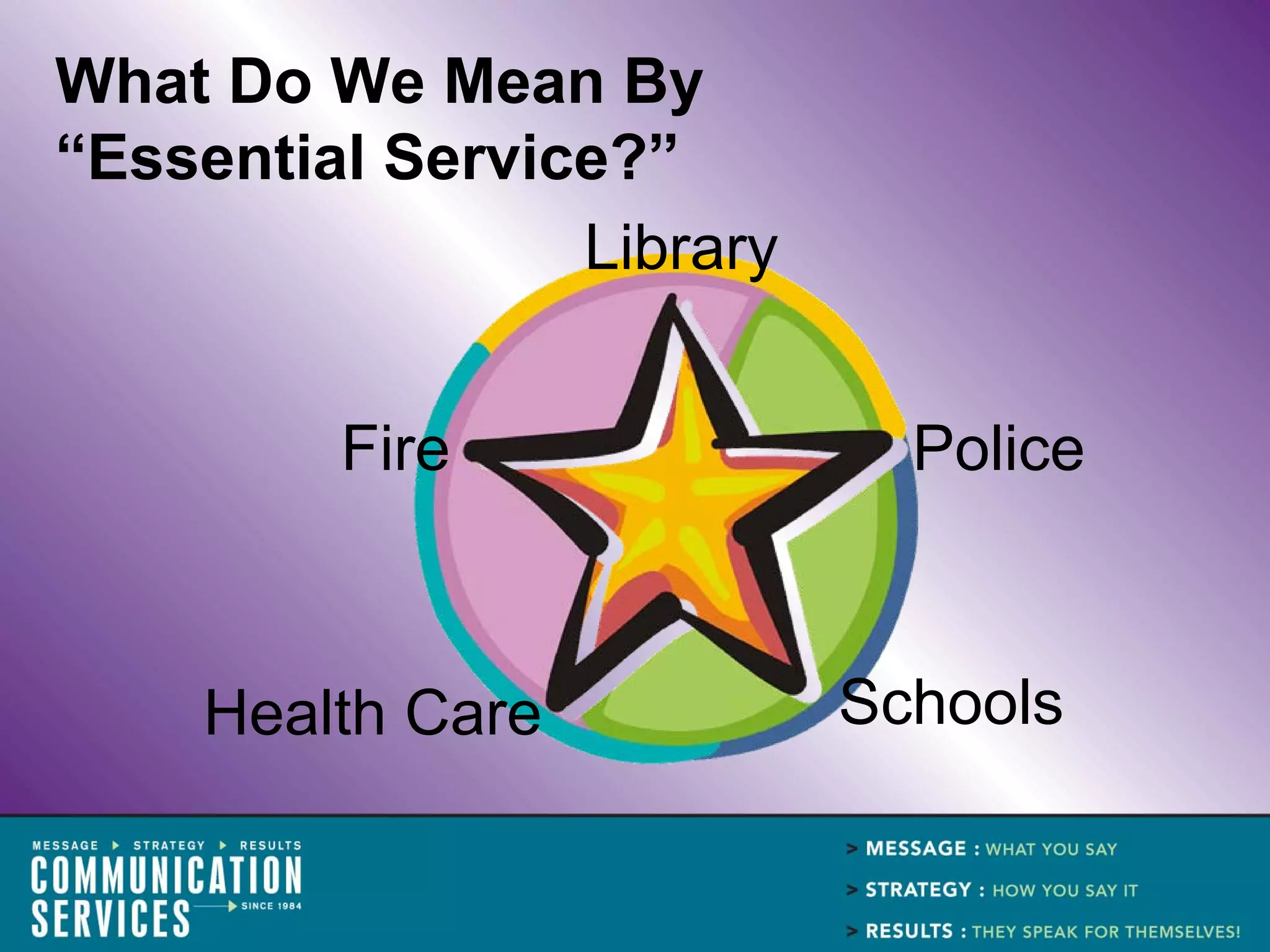
What Do We Mean By
“Essential Service?”
                 Library


         Fire                Police


    Health Care            Schools
We Impact People’s Lives
But, Libraries Help People Find Jobs
• Less than 44% of top 100 US retailers accept in-
  store applications
  – People come to the library, use public computers,
    apply for jobs
• An overwhelming majority of NY’s libraries are
  helping people search for jobs and access public
  assistance
  – 1/09 NYLA survey found that over 80% of NY’s
    libraries had helped a patron apply for a job online
We Help People Save Money
 • Borrowing from
   collections saves
   people money
      – Americans visited 1.3
        billion times, check out
        2.1 billion items


www.masslib.org/LibraryValue.html
We Put Hard-Earned Tax Dollars
To Good Use
• Libraries demonstrate a great public
  service return on investment
• ROI calculator at the MHLS site
  – www.midhudson.org/admin/eco_impact.htm
• Using it we’ve found
  – Jervis in Rome, NY has a $1:$6 PSROI
  – Pawling Library has a $1:$5.68 PSROI
  – Hudson Area Library has a $1:$8 PSROI
We Put Hard-Earned Tax Dollars
To Good Use
• Not just hardware, also expertise
  – Google gives patron 50,000 responses
  – Librarian give patrons help in finding the one
    answer they need
• Most effective use of all public services
• Serve 2/3 of the public using less than
  2% of all tax dollars
Focus: Developing Your Message

• Message Box
What we are saying   What they are saying
about ourselves      about themselves

What we are saying   What they are saying
about them           about us
Message Box
What Library Says             What the anti-tax
About Itself                  people say about
                              themselves
Our library is an essential   We know what the
service                       community needs—no new
                              taxes for anything
• Jobs and opportunity
•Lifelong learning
•Quality of Life
•Community Empowerment
Message Box
Library on Anti-Tax                   Anti-Tax on Library
Anti-library=anti-family,             Waste of taxpayer
anti-children, anti-senior            money
• library fosters community           • Why should I pay if I don’t
• library provides great              use it
dividends on tax dollars
• library provides opportunity
for all Library’s response: Library is an essential community service. X% of
          the community are patrons. We help people search for new jobs. We
              teach people how to use computers and apply for jobs online.
Case Study: Jervis Public Library
Association Library, chartered to serve the City of Rome, service pop. 34,950


  • Jervis was functioning with a budget that
    equaled its 2001 budget in terms of real
    dollars
  • Cuts from City of Rome and Oneida
    County
  • Needed to make up for budget shortfalls
    as well as solidify position in community to
    stave off further threats
Case Study: Jervis Public Library

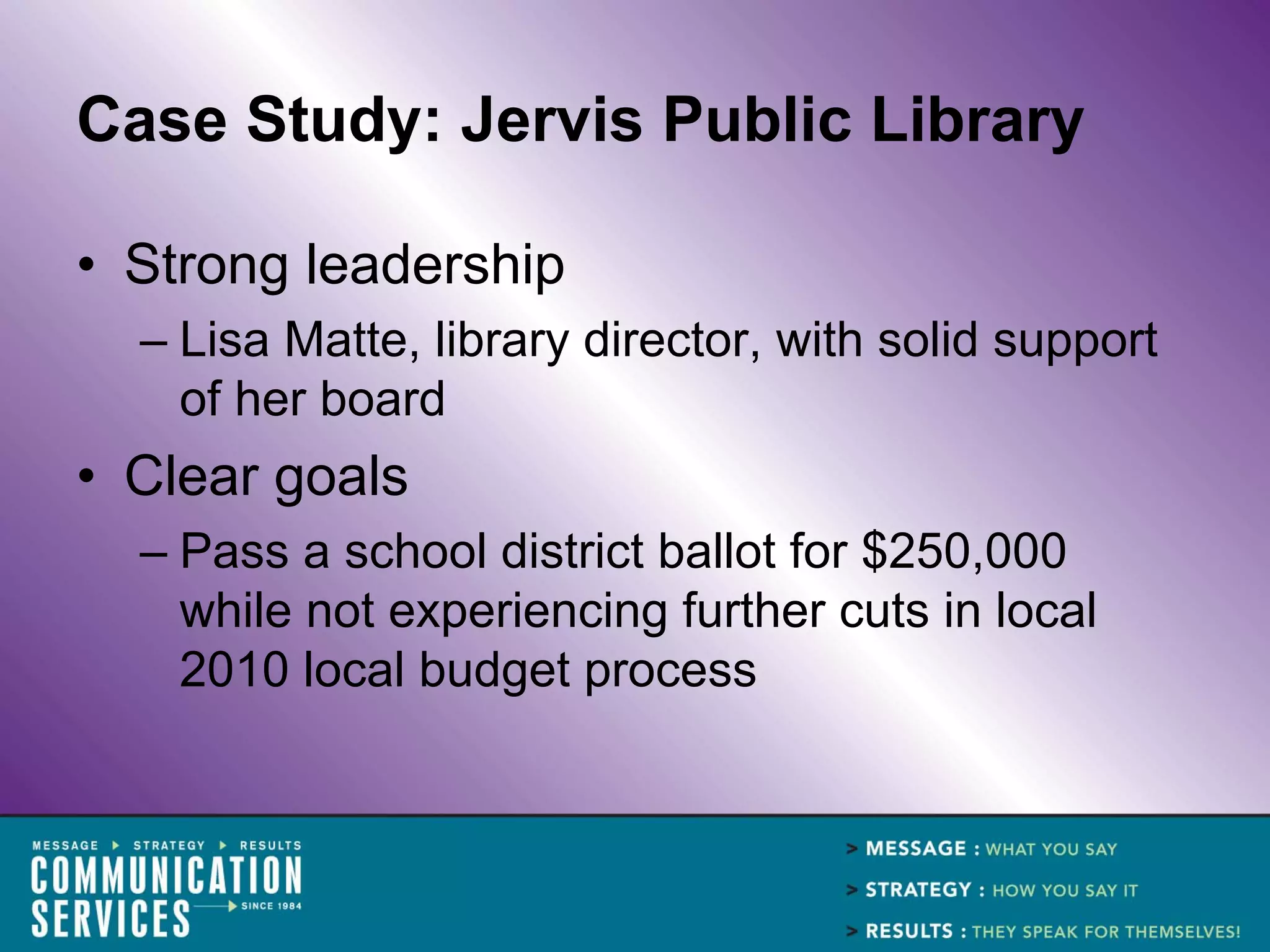
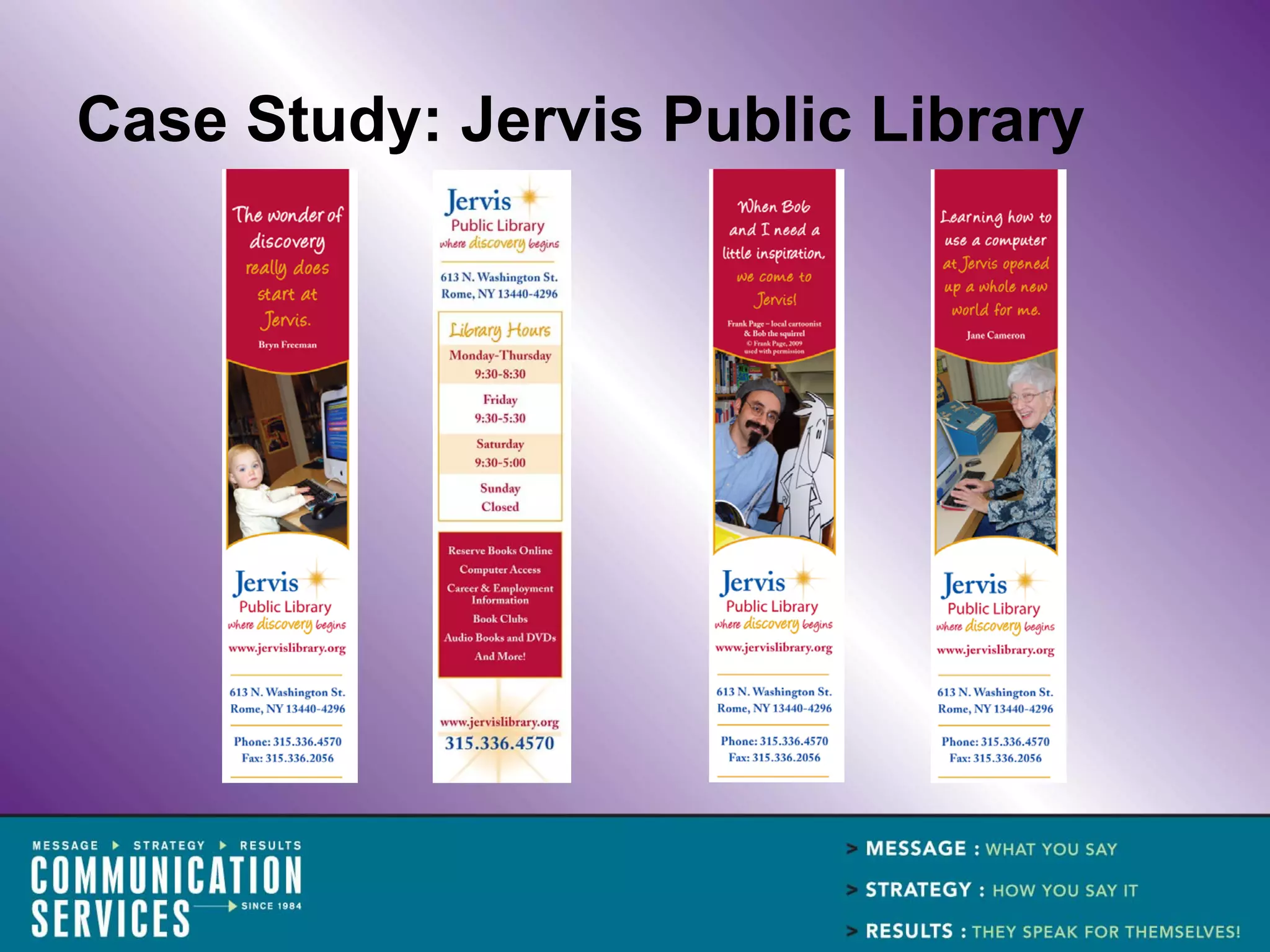
 • Rebrand based on community values
 • Advocacy campaign based on clear
   message that the library is grounded in the
   experiences of its patrons/voters
 • School District Ballot in 2009
 • Impact local budget process
Case Study: Jervis Public Library

• Strong leadership
  – Lisa Matte, library director, with solid support
    of her board
• Clear goals
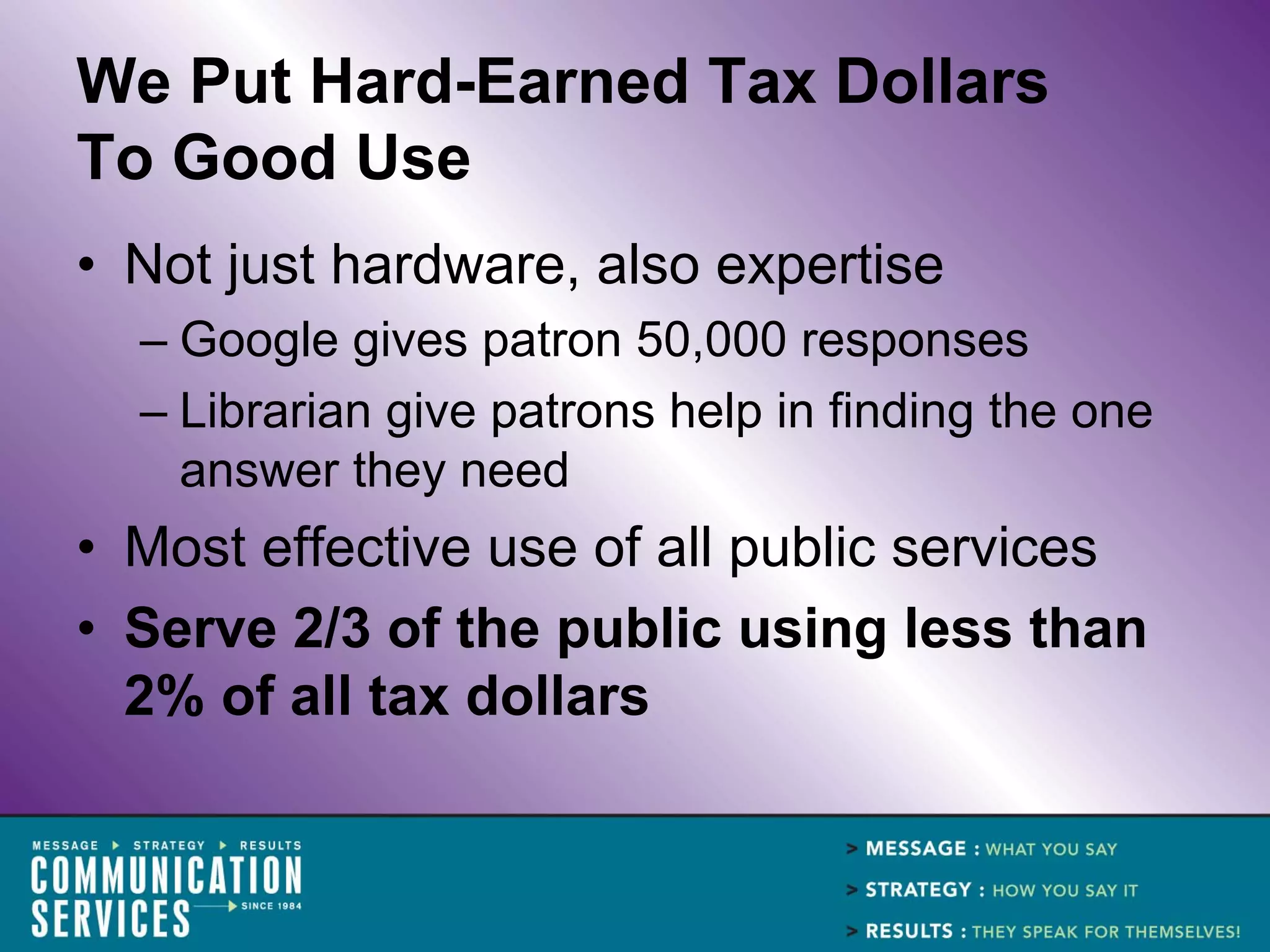
  – Pass a school district ballot for $250,000
    while not experiencing further cuts in local
    2010 local budget process
Case Study: Jervis Public Library

• Strong, clear message
  – Jervis is essential to the vitality of our
    community and to our families
• Determine targets to pressure
  – Voters
  – County Executive and Legislators
  – Mayor and City Council
Case Study: Jervis Public Library

• Organize people
  – Board and volunteers
  – Supporters
• Determine tactics
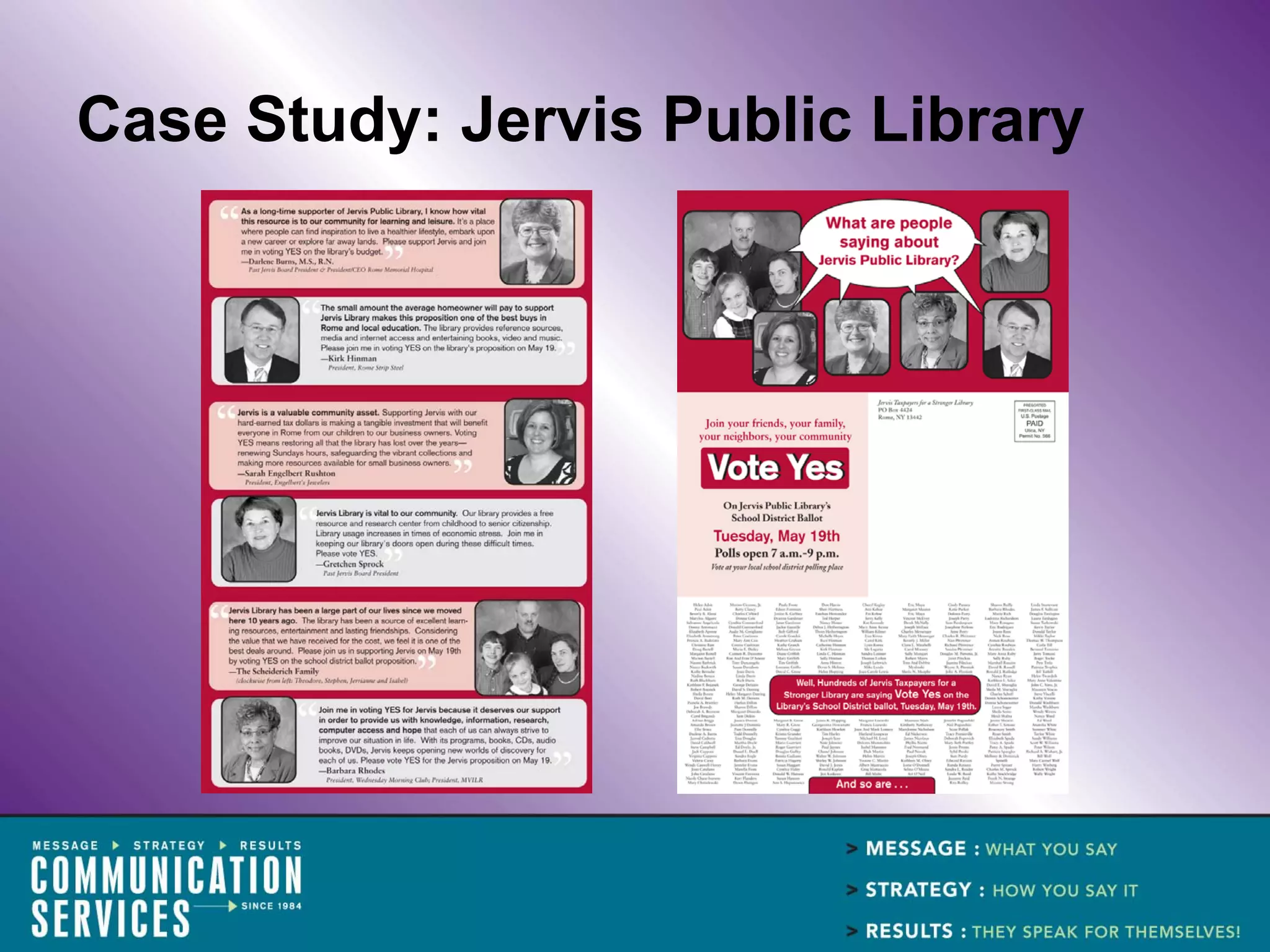
  – Targeted mail to targeted voters
  – Phone banking to identify voters
  – Targeted mail to electeds based on identified
    voters
Case Study: Jervis Public Library

• Use media
  – Traditional
     • Strategy was to keep it out of the daily paper
     • Letters to the Editor only in the last week
  – New
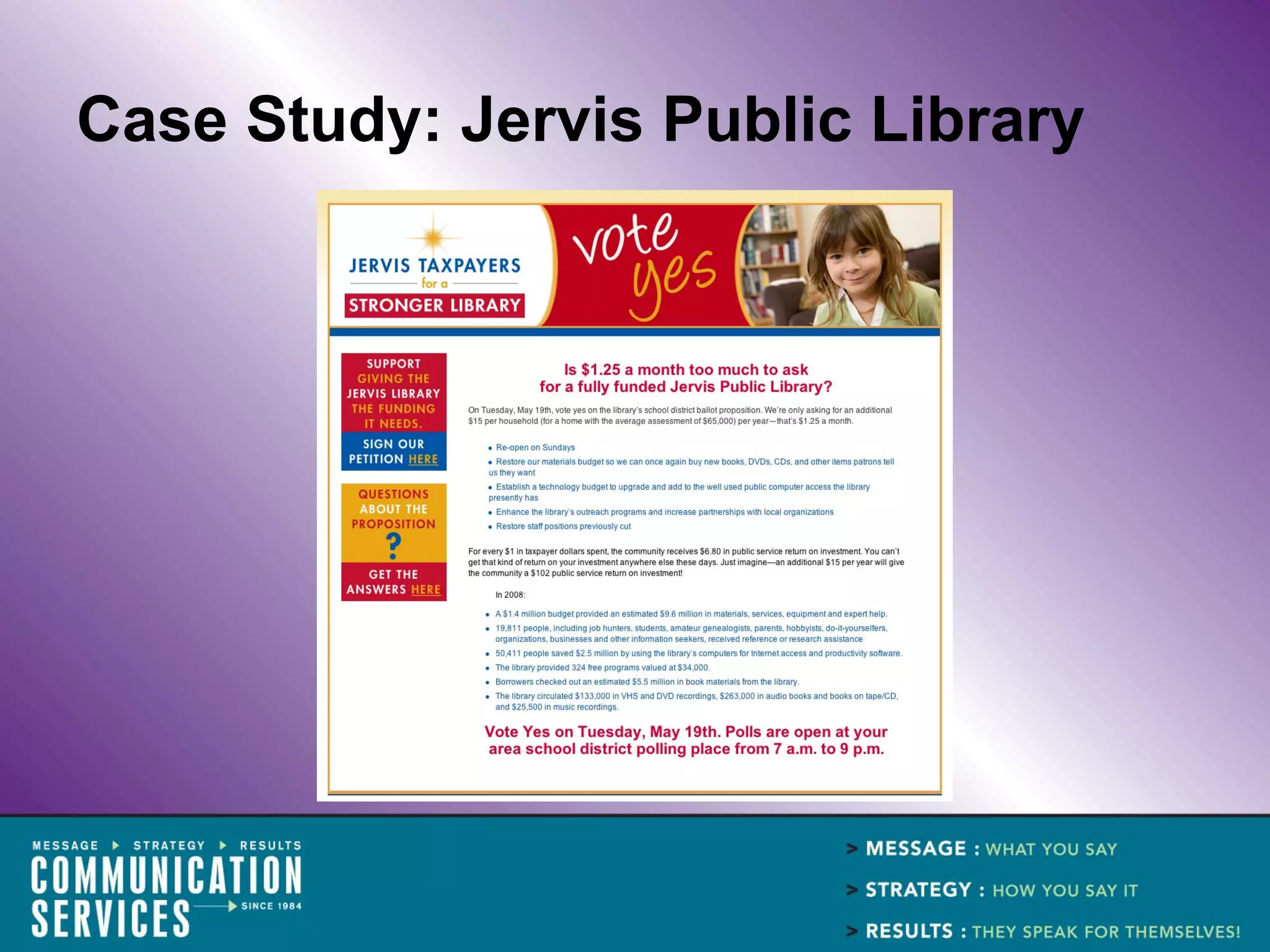
     • Online petition through
       www.voteyesforourlibrary.org
• Celebrate
Case Study: Jervis Public Library

 • Focus Groups
 • Brand essence: Growing Potential
 • New logo
Case Study: Jervis Public Library

• Phone banking
  – Based on past voter turn out for school
    budget votes, determined had to identify at
    least 1,600 yes voters
  – Two rounds of voter ID
  – One rounds of GOTV calls
• Tracked voters
• Identified 1,718 yes voters
Case Study: Jervis Public Library
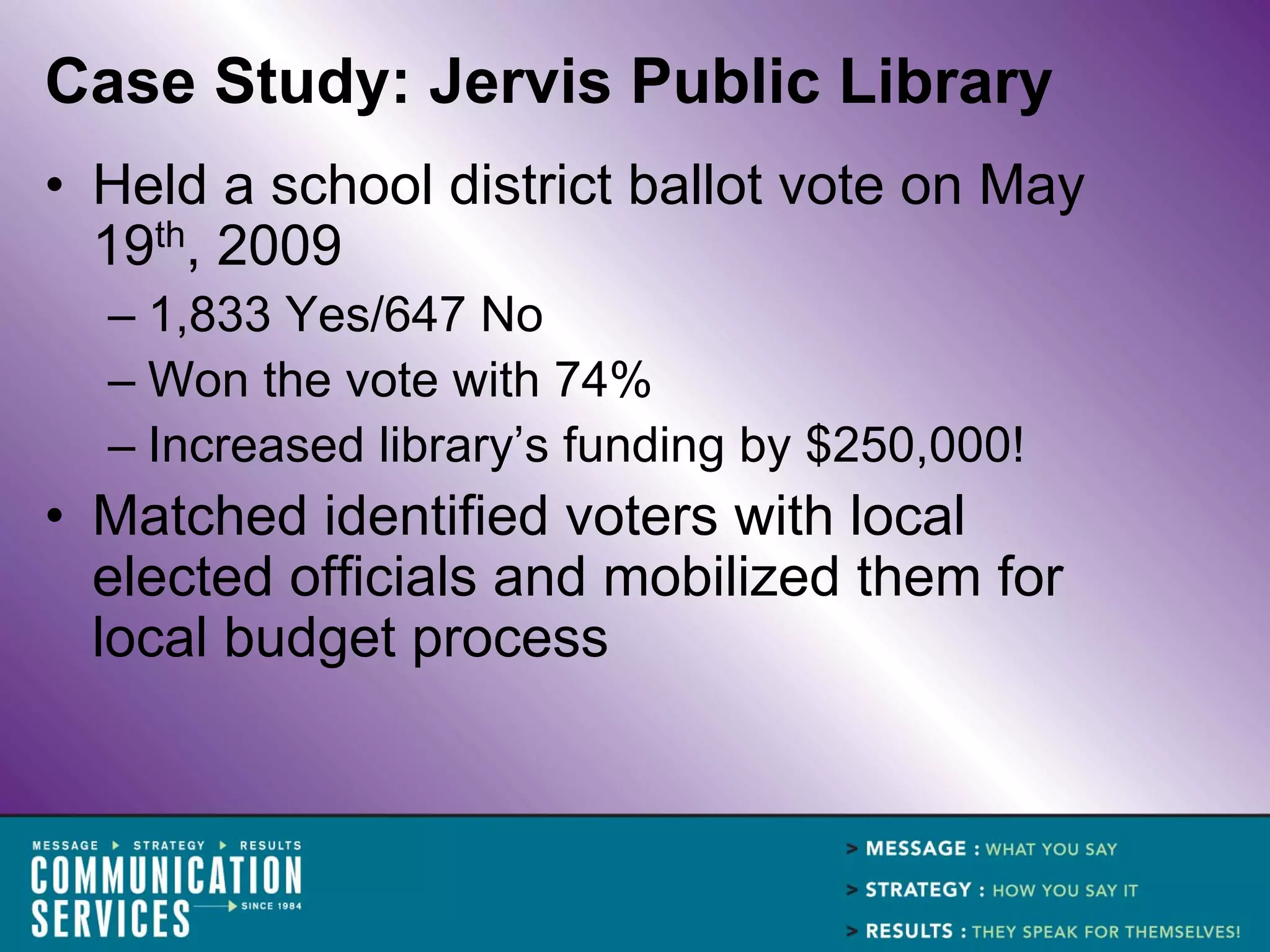
• Held a school district ballot vote on May
  19th, 2009
  – 1,833 Yes/647 No
  – Won the vote with 74%
  – Increased library’s funding by $250,000!
• Matched identified voters with local
  elected officials and mobilized them for
  local budget process
Case Study: Jervis Public Library


    Personalized
        Postcard
           Sheets
   Tied it in with
Vote Yes website
Case Study: Jervis Public Library

• Meetings with City and County Elected
  officials
• Heard that folks were getting postcards
• City and County funding has been
  maintained
Case Study:
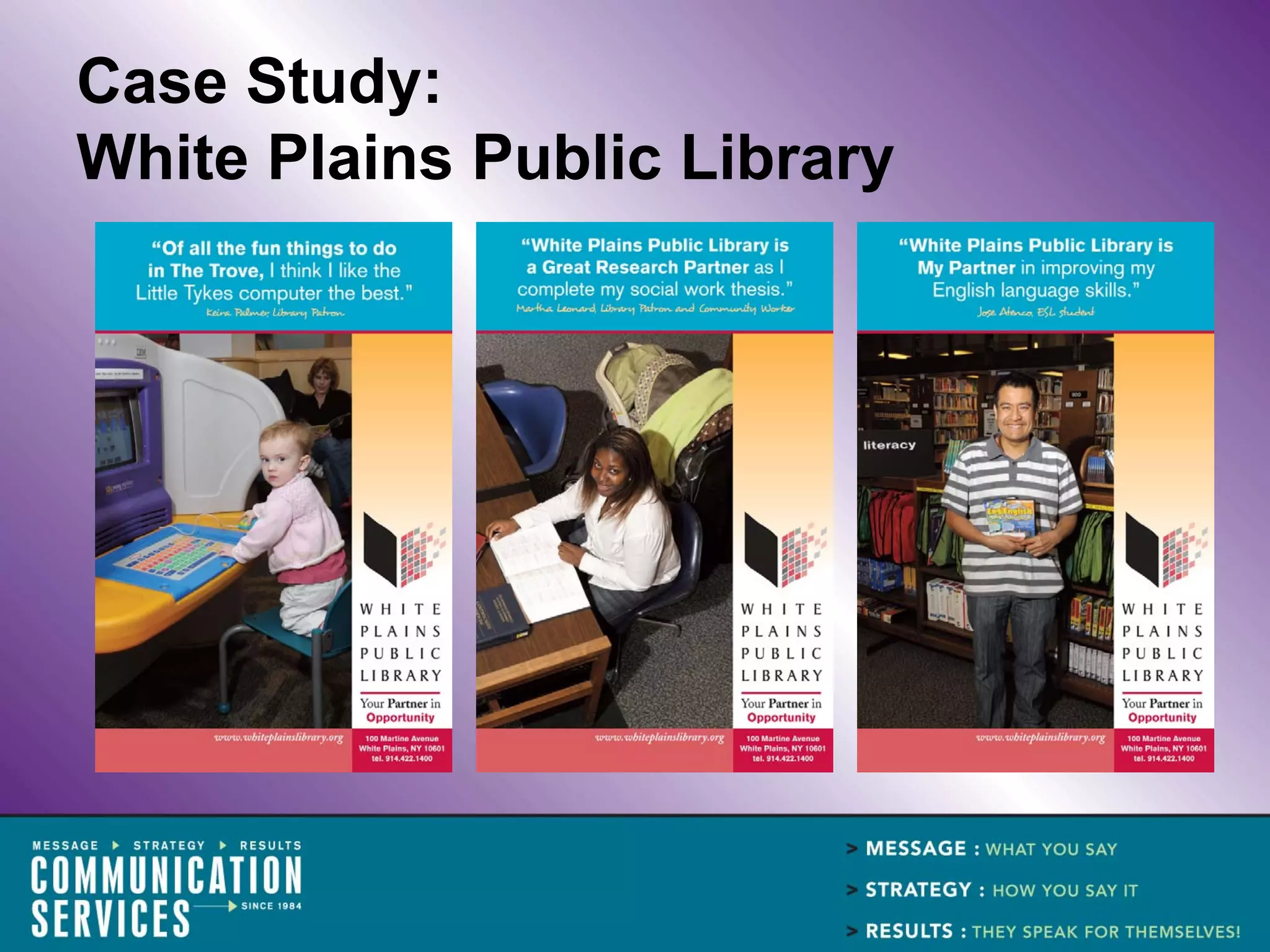
White Plains Public Library
• Municipal library serving a large, diverse
  urban/suburban population
• Cut $500,000 in 2010 budget
• City Hall was looking to make even more
  cuts for 2011
Case Study:
White Plains Public Library
• Rebranded the library based on series of
  focus groups
Case Study:
White Plains Public Library
Case Study:
White Plains Public Library
• Need to get the message to the Mayor and
  the Common Council to protect the
  library’s funding from any further cuts
• The Westchester Library System
  purchased Communication Services’ Local
  Library Online Advocacy System tailored
  just for the system
Case Study:
White Plains Public Library
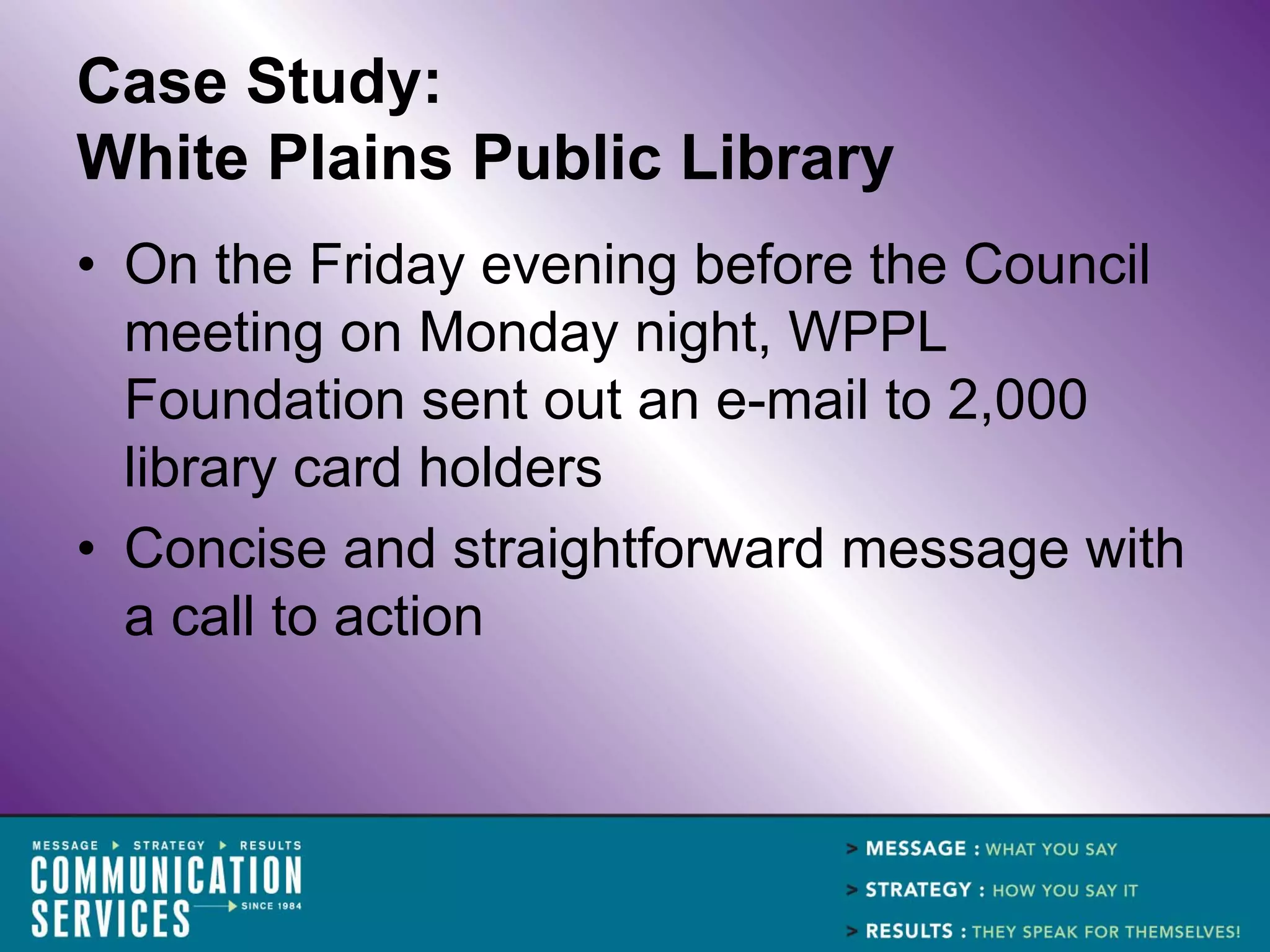
• On the Friday evening before the Council
  meeting on Monday night, WPPL
  Foundation sent out an e-mail to 2,000
  library card holders
• Concise and straightforward message with
  a call to action
Case Study:
White Plains Public Library
Case Study:
White Plains Public Library
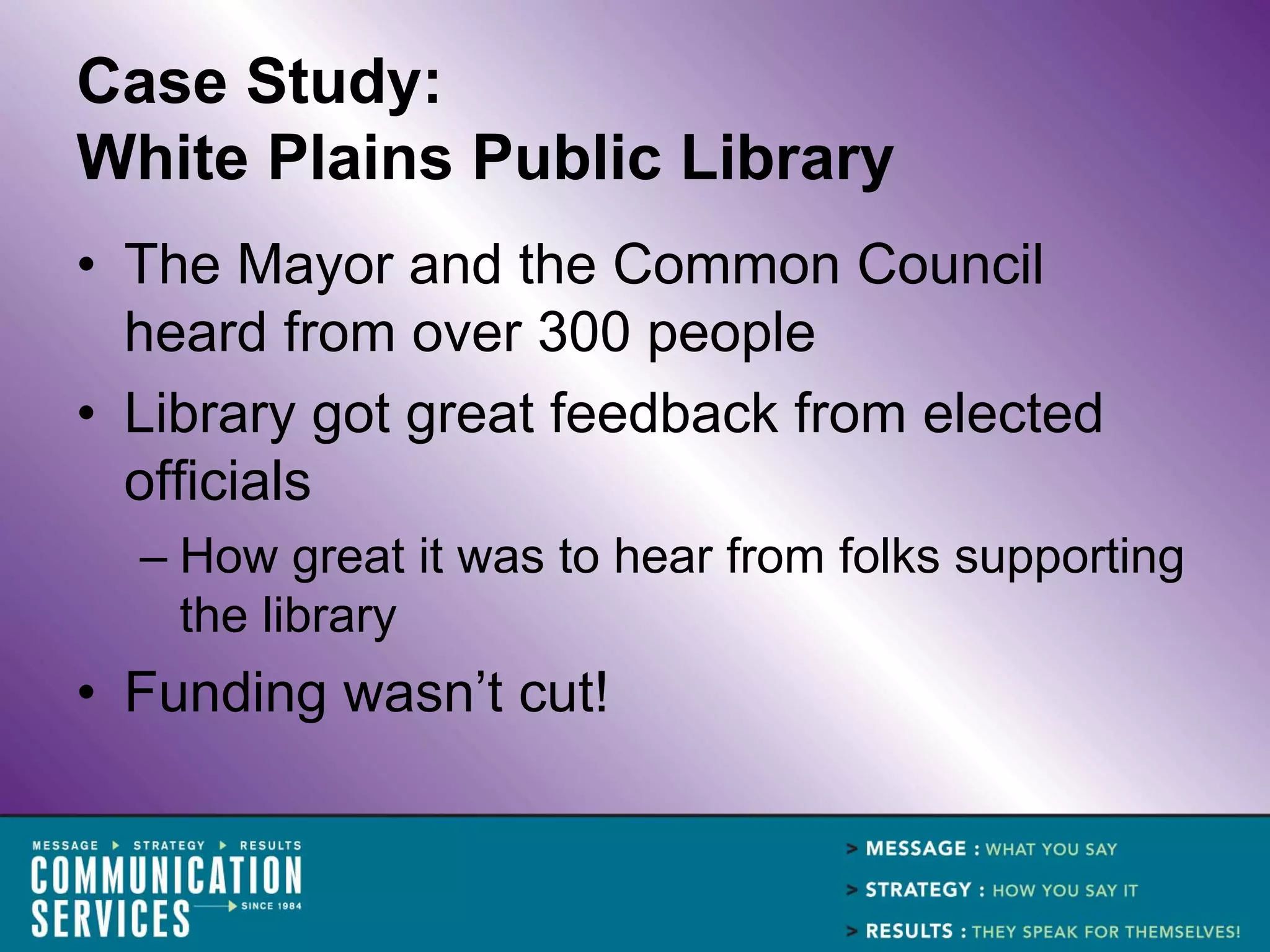
• The Mayor and the Common Council
  heard from over 300 people
• Library got great feedback from elected
  officials
  – How great it was to hear from folks supporting
    the library
• Funding wasn’t cut!
Your and Your Elected Officials
           • The next steps
             – Building relationships with
               elected officials and community
               leaders
             – Understanding your job
             – Understanding their job
             – Making the library a political+
             – Mobilizing your constituency
             – Getting your message out
Key Points
• Taxpayers use your library and get one of
  the best returns on investment in public
  service
• Let your electeds know who you are and
  what the library does
• Local, state, national
• Having support from opinion
  leaders/community groups will help
The Relationship
• Your job is to educate them on your library and
  how they can help you
• Build relationships
• Go to Town Board meetings
• Make sure they know who you are
  – But in a nice way. Don’t be obnoxious. You’ll stand
    out.
• Develop contact lists
  – Snail and e-mail, phone, etc.
No Matter What Level
• Remember what Tip O’Neill said:
                  “ALL POLITICS
                      IS LOCAL!”
Take Tip’s Tip to Heart
• Bring the library home to your electeds
  – Personal stories about their constituents and
    how library has made a difference
  – Brainstorm with staff, board and stakeholders
    to develop
  – Ask patrons why they feel the library is an
    essential service
  – Personalize the benefits
Them Know What People
Say About Your Library
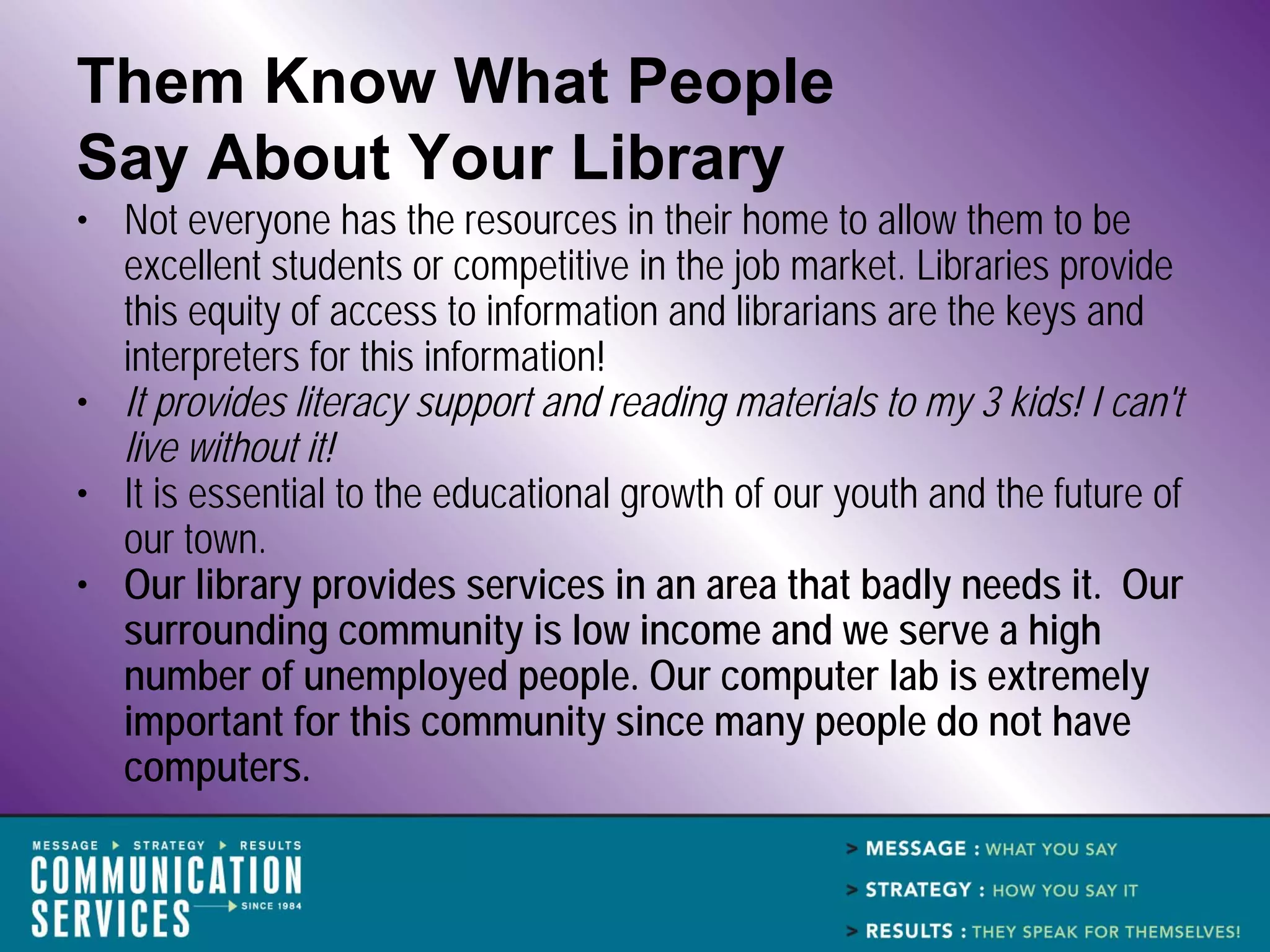
• Not everyone has the resources in their home to allow them to be
  excellent students or competitive in the job market. Libraries provide
  this equity of access to information and librarians are the keys and
  interpreters for this information!
• It provides literacy support and reading materials to my 3 kids! I can't
  live without it!
• It is essential to the educational growth of our youth and the future of
  our town.
• Our library provides services in an area that badly needs it. Our
  surrounding community is low income and we serve a high
  number of unemployed people. Our computer lab is extremely
  important for this community since many people do not have
  computers.
You and Your Electeds
•   Schedule a meeting
•   Have a clear agenda
•   Know who will do the talking
•   Have specific talking points developed
•   10-15 minutes max
•   Be prepared to meet with staff
    – May be more effective
You and Your Electeds
•   Ask, Ask, Ask—persistence pays off
•   If answer is no, ask another question
•   Let them know who supports the library
•   Remember—they’re public servants too
•   Follow up with a letter
•   Keep the relationship going
    – Provide library events s/he would want to come to
    – Make the library a political+
Wrap Up
• Advocacy is key to     • All types of
  our success              campaigns
  – Plan                    – Vote
  – Develop compelling      – Issue
    message              • Use new tools as they
  – Organize               are developed
  – Target
                         • Nurture the
  – Tactics
                           relationship between
• Coordinate with          you and your electeds
  Library Board

Library advocacy for friends

  • 1.
    Library Advocacy: The Un-quietZone Advocacy for Library Friends
  • 2.
    What We’ll LearnTogether Today • Why Be an Advocate • What Advocacy Is All About • What Are The Basics – Organizing – Message – Determining Strategy – Implementation
  • 3.
    What We’ll LearnTogether Today • Developing an Effective Message • Case Studies – Jervis Public Library – White Plains Public Library – The Relationship with Your Electeds • Building Your Friends Group
  • 4.
    Giving Credit WhereIt Is Due • Wellstone Action – Founded in memory of Paul Wellstone, MN Senator who believed in the power of grassroots advocacy and action • ALA’s Library Advocate’s Handbook • Experience gathered working as an advocate for over 30 years
  • 5.
    Some Advocates We’veKnown • John Brown – Leading Abolitionist – Anti-Slavery Advocate
  • 6.
    Some Advocates We’veKnown • Eleanor Roosevelt – First Lady – Human Rights Advocate
  • 7.
    Some Advocates We’veKnown • Eunice Kennedy Shriver – Founder of the Special Olympics – Disabilities Advocate
  • 8.
    Some Advocates We’veKnown • Cesar Chavez – President, United Farm Workers – Migrant Workers Advocate
  • 9.
    Some Advocates We’veKnown • Marian Wright Edelman – President, Children’s Defense Fund – Children’s Rights Advocate
  • 10.
    Some Advocates We’veKnown • Dr. Martin Luther King, Jr. – President, Southern Christian Leadership Council – Civil Rights Advocate
  • 11.
    Some Advocates We’veKnown • Harvey Milk – Martyred San Francisco Supervisor – Lesbian and Gay Rights Advocate
  • 12.
    Some Advocates We’veKnown • Ted Kennedy – U.S. Senator – Health Care Reform Advocate
  • 13.
    Some advocates We’veYet to Meet Any of these people could be you!
  • 14.
    Why Be AnAdvocate? • “If I am not for myself, who will be for me? And when I am for myself, what am 'I'? And if not now, when?“ – Hillel
  • 15.
    Why Be AnAdvocate • If we don’t stand up for libraries, who will? • If we do stand up for libraries – Our staff will – Our trustees will – Our patrons will – Our community leaders will – Our elected officials possibly will (if we make it politically safe for them)
  • 16.
    Why Be AnAdvocate? • Stand up for what you believe in – Frame the debate and determine the message • Express your passion about libraries • Become a leader • Organize supporters – Allow them to express their passion as well • Develop strategies • Execute and analyze
  • 17.
    What Is AdvocacyAll About? • Taking action to impact an issue – Why you want to take action? – What do you want to accomplish? – How can you be best prepared? – What resources will you need? – Who will lead?
  • 18.
    What Is AdvocacyAll About? • Advocacy comes alive as a campaign – Effective message that moves people to action – Series of tactics based on message and resources – Clear attainable goal • Internal goal • External goal
  • 19.
    Advocacy as Program •Develop a core advocacy group • Develop advocacy programs where the public can come and learn • Make sure you have something for folks “to do” • Always be on the look out for new board members and leadership
  • 20.
    Lobbying as anAdvocacy Tactic • Lobbying is a specific form of advocacy • Ask an elected official to take a stand and vote a certain way – It’s what Lobby Day is all about • Lobbying is narrowly defined – Regulated by law • Advocacy is broadly defined – No legal constraints
  • 21.
    Key Components of anAdvocacy Campaign • Strong leadership • Determine targets to – Coordinate with the pressure Library board • Organize people • Clear goals • Determine tactics – Written plan • Use media • Strong, clear – Traditional message – New – Core message same as library’s • Celebrate
  • 22.
    Strong Leadership • Essentialto have someone in charge – Campaigns require planning, focus, discipline and organization – Coordinating with Library • Decisions need to be made quickly and decisively • Everyone has a role to play
  • 23.
    Clear Goals • Articulatevision – Have a clear understanding of what you’re trying to accomplish – Can not be all things to all people – May not be able to talk about other important issues • Written plan drives strategy and tactics • Define victory
  • 24.
    Strong, clear message •Clear, concise • You define it – Don’t let opposition define your message • Internal message – What you use to engage and motivate your base • External message – What you communicate in various ways to your intended targets—policy makers, elected, etc.
  • 25.
    Determine targets • Whoare you trying to impact – Policy makers – Decision makers – Elected Officials • Helps determine where you have or where you need to build supporters
  • 26.
    Organize people • OrganizePeople – Excite your base with your message – Gain their commitment to act – Give them specific things to do – Constantly reach out and bring in new people
  • 27.
    Determine tactics • Personalvisits with targets • Letters, faxes, e-mails, postcards and phone calls to targets • Rallies and demonstrations • Direct action strategies – Book In: Pile up books in front of a legislators’ office to show value of one visit • Political theater – Bread and Puppet
  • 28.
    Determine tactics • Remember,balance resources with tactics • The more personal the tactic, the greater the impact – In-district visit has more of an impact than use of generic postcards
  • 29.
    Things to remember •Coordinate efforts and message with the Library • Define victory by having realistic goals – Celebrate small victories • Need strong leadership • Won’t be all things to all people • Match resources to campaign
  • 30.
    Focus: Developing YourMessage • Can have great goals, innovative tactics, know who to target • But without clear, compelling message you won’t be able to celebrate!
  • 31.
    Focus: Developing YourMessage • Your message is the core argument • Must be the foundation upon which all organizing is based • Bold, clear, concise • People should feel their self-interests are connected to the interests of the campaign • Talk directly to people in plain language
  • 32.
    Focus: Developing YourMessage • Message based in values should be succinct, compelling and understandable • Paul Wellstone: – “People respond according to their sense of right and wrong. They respond to a leadership of values.” • Never assume people will see the inherent logic of our view and support us – Have to give them a reason to support us before asking for their support
  • 33.
    Why Friends GroupsCan Develop Compelling Messages on Behalf of their Library • Because it can be grounded in the experiences and circumstances of its intended audience(s) • Because it can easily be based on values shared by both the advocacy effort and its audience(s) • Because libraries are credible, you can use their facts and figures to back up your assertions and support your message • Friends are seen as trustworthy people
  • 34.
    What Makes aMessage Good? • Connecting a person’s interests and values – Start with what a person already knows and thinks and then move them to where you want them to be • Like being in a good conversation where a person knows values are shared and walks away empowered
  • 35.
    What Makes aMessage Good? • Empowering people to participate and act • Take away a good feeling from being a part of the campaign – Emotional hook • Want to inspire people to take action – Depends on whether message leaves people feeling hopeful, energized and that their contribution will make a difference
  • 36.
    What Do WeMean By “Essential Service?” Library Fire Police Health Care Schools
  • 37.
  • 38.
    But, Libraries HelpPeople Find Jobs • Less than 44% of top 100 US retailers accept in- store applications – People come to the library, use public computers, apply for jobs • An overwhelming majority of NY’s libraries are helping people search for jobs and access public assistance – 1/09 NYLA survey found that over 80% of NY’s libraries had helped a patron apply for a job online
  • 39.
    We Help PeopleSave Money • Borrowing from collections saves people money – Americans visited 1.3 billion times, check out 2.1 billion items www.masslib.org/LibraryValue.html
  • 40.
    We Put Hard-EarnedTax Dollars To Good Use • Libraries demonstrate a great public service return on investment • ROI calculator at the MHLS site – www.midhudson.org/admin/eco_impact.htm • Using it we’ve found – Jervis in Rome, NY has a $1:$6 PSROI – Pawling Library has a $1:$5.68 PSROI – Hudson Area Library has a $1:$8 PSROI
  • 41.
    We Put Hard-EarnedTax Dollars To Good Use • Not just hardware, also expertise – Google gives patron 50,000 responses – Librarian give patrons help in finding the one answer they need • Most effective use of all public services • Serve 2/3 of the public using less than 2% of all tax dollars
  • 42.
    Focus: Developing YourMessage • Message Box What we are saying What they are saying about ourselves about themselves What we are saying What they are saying about them about us
  • 43.
    Message Box What LibrarySays What the anti-tax About Itself people say about themselves Our library is an essential We know what the service community needs—no new taxes for anything • Jobs and opportunity •Lifelong learning •Quality of Life •Community Empowerment
  • 44.
    Message Box Library onAnti-Tax Anti-Tax on Library Anti-library=anti-family, Waste of taxpayer anti-children, anti-senior money • library fosters community • Why should I pay if I don’t • library provides great use it dividends on tax dollars • library provides opportunity for all Library’s response: Library is an essential community service. X% of the community are patrons. We help people search for new jobs. We teach people how to use computers and apply for jobs online.
  • 45.
    Case Study: JervisPublic Library Association Library, chartered to serve the City of Rome, service pop. 34,950 • Jervis was functioning with a budget that equaled its 2001 budget in terms of real dollars • Cuts from City of Rome and Oneida County • Needed to make up for budget shortfalls as well as solidify position in community to stave off further threats
  • 46.
    Case Study: JervisPublic Library • Rebrand based on community values • Advocacy campaign based on clear message that the library is grounded in the experiences of its patrons/voters • School District Ballot in 2009 • Impact local budget process
  • 47.
    Case Study: JervisPublic Library • Strong leadership – Lisa Matte, library director, with solid support of her board • Clear goals – Pass a school district ballot for $250,000 while not experiencing further cuts in local 2010 local budget process
  • 48.
    Case Study: JervisPublic Library • Strong, clear message – Jervis is essential to the vitality of our community and to our families • Determine targets to pressure – Voters – County Executive and Legislators – Mayor and City Council
  • 49.
    Case Study: JervisPublic Library • Organize people – Board and volunteers – Supporters • Determine tactics – Targeted mail to targeted voters – Phone banking to identify voters – Targeted mail to electeds based on identified voters
  • 50.
    Case Study: JervisPublic Library • Use media – Traditional • Strategy was to keep it out of the daily paper • Letters to the Editor only in the last week – New • Online petition through www.voteyesforourlibrary.org • Celebrate
  • 51.
    Case Study: JervisPublic Library • Focus Groups • Brand essence: Growing Potential • New logo
  • 52.
    Case Study: JervisPublic Library
  • 53.
    Case Study: JervisPublic Library
  • 54.
    Case Study: JervisPublic Library
  • 55.
    Case Study: JervisPublic Library
  • 56.
    Case Study: JervisPublic Library
  • 57.
    Case Study: JervisPublic Library
  • 58.
    Case Study: JervisPublic Library
  • 59.
    Case Study: JervisPublic Library
  • 60.
    Case Study: JervisPublic Library
  • 61.
    Case Study: JervisPublic Library • Phone banking – Based on past voter turn out for school budget votes, determined had to identify at least 1,600 yes voters – Two rounds of voter ID – One rounds of GOTV calls • Tracked voters • Identified 1,718 yes voters
  • 62.
    Case Study: JervisPublic Library • Held a school district ballot vote on May 19th, 2009 – 1,833 Yes/647 No – Won the vote with 74% – Increased library’s funding by $250,000! • Matched identified voters with local elected officials and mobilized them for local budget process
  • 63.
    Case Study: JervisPublic Library Personalized Postcard Sheets Tied it in with Vote Yes website
  • 64.
    Case Study: JervisPublic Library • Meetings with City and County Elected officials • Heard that folks were getting postcards • City and County funding has been maintained
  • 65.
    Case Study: White PlainsPublic Library • Municipal library serving a large, diverse urban/suburban population • Cut $500,000 in 2010 budget • City Hall was looking to make even more cuts for 2011
  • 66.
    Case Study: White PlainsPublic Library • Rebranded the library based on series of focus groups
  • 67.
  • 68.
    Case Study: White PlainsPublic Library • Need to get the message to the Mayor and the Common Council to protect the library’s funding from any further cuts • The Westchester Library System purchased Communication Services’ Local Library Online Advocacy System tailored just for the system
  • 69.
    Case Study: White PlainsPublic Library • On the Friday evening before the Council meeting on Monday night, WPPL Foundation sent out an e-mail to 2,000 library card holders • Concise and straightforward message with a call to action
  • 70.
  • 71.
    Case Study: White PlainsPublic Library • The Mayor and the Common Council heard from over 300 people • Library got great feedback from elected officials – How great it was to hear from folks supporting the library • Funding wasn’t cut!
  • 72.
    Your and YourElected Officials • The next steps – Building relationships with elected officials and community leaders – Understanding your job – Understanding their job – Making the library a political+ – Mobilizing your constituency – Getting your message out
  • 73.
    Key Points • Taxpayersuse your library and get one of the best returns on investment in public service • Let your electeds know who you are and what the library does • Local, state, national • Having support from opinion leaders/community groups will help
  • 74.
    The Relationship • Yourjob is to educate them on your library and how they can help you • Build relationships • Go to Town Board meetings • Make sure they know who you are – But in a nice way. Don’t be obnoxious. You’ll stand out. • Develop contact lists – Snail and e-mail, phone, etc.
  • 75.
    No Matter WhatLevel • Remember what Tip O’Neill said: “ALL POLITICS IS LOCAL!”
  • 76.
    Take Tip’s Tipto Heart • Bring the library home to your electeds – Personal stories about their constituents and how library has made a difference – Brainstorm with staff, board and stakeholders to develop – Ask patrons why they feel the library is an essential service – Personalize the benefits
  • 77.
    Them Know WhatPeople Say About Your Library • Not everyone has the resources in their home to allow them to be excellent students or competitive in the job market. Libraries provide this equity of access to information and librarians are the keys and interpreters for this information! • It provides literacy support and reading materials to my 3 kids! I can't live without it! • It is essential to the educational growth of our youth and the future of our town. • Our library provides services in an area that badly needs it. Our surrounding community is low income and we serve a high number of unemployed people. Our computer lab is extremely important for this community since many people do not have computers.
  • 78.
    You and YourElecteds • Schedule a meeting • Have a clear agenda • Know who will do the talking • Have specific talking points developed • 10-15 minutes max • Be prepared to meet with staff – May be more effective
  • 79.
    You and YourElecteds • Ask, Ask, Ask—persistence pays off • If answer is no, ask another question • Let them know who supports the library • Remember—they’re public servants too • Follow up with a letter • Keep the relationship going – Provide library events s/he would want to come to – Make the library a political+
  • 80.
    Wrap Up • Advocacyis key to • All types of our success campaigns – Plan – Vote – Develop compelling – Issue message • Use new tools as they – Organize are developed – Target • Nurture the – Tactics relationship between • Coordinate with you and your electeds Library Board