











Library Advocacy Whose Job Is It Anyway?MILE May 2011Michael Scott, SELS/SELCOMLA Legislative Chair Ann Walker Smalley, MetronetMEMO Legislative Co-chair
What is Advocacy?“Active support of a cause or course of action.”
vs. Lobbying“Lobbying is the intention of influencing decisions made by legislators and government officials.” A lobbyist is a person who tries to influence legislation on behalf of a special interest.   A regulated activity.
Why Advocate for Libraries?Make the case about the value of all types of librariesBuild community support for librariesStay in front of funders, users, othersAvoid a crisis because no one knows your valueNo one else is going to do itOther reasons?
FederalStateLocalAdvocate in the right venue
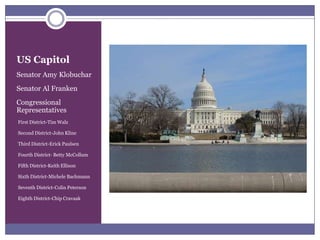
US CapitolSenator Amy KlobucharSenator Al FrankenCongressional RepresentativesFirst District-Tim Walz
Second District-John Kline
Third District-Erick Paulsen
Fourth District- Betty McCollum
Fifth District-Keith Ellison
Sixth District-Michele Bachmann
Seventh District-Colin Peterson
Eighth District-Chip CravaakFederal Legislative IssuesWho Lobbies for LibrariesIMLSLSTAESEACopyrightNet NeutralityPatriot Act/PrivacyMoreALA Washington OfficeNational Library Legislative Day-May 10You via calls, letters, emailsNational Library Issues
Minnesota State Capitolhttp://www.leg.state.mn.us/
How many  members are in the Minnesota House of Representatives?134
IssuesMore IssuesFunding for library systemsMulticounty MultitypeRegional Public Library System Support (RBLSS)Minitex/ELM/MnLink/MDL
Telecommunications Library Legacy FundingLibrary Accessibility & Improvement GrantsLibrary Maintenance of EffortIssues they ariseFilteringIntellectual FreedomState Level Library Advocacy
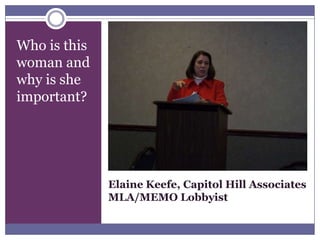
Elaine Keefe, Capitol Hill AssociatesMLA/MEMO LobbyistWho is this woman and why is she important?
Library directorsLibrary staffFriendsBoardsMLA/MEMOMultitype DirectorsRPLS DirectorsYouCallsEmailsLettersVisitsWho Advocates for State Issues?
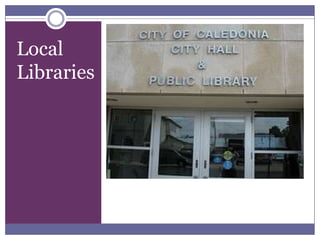
Local Libraries
Some Issues	Who AdvocatesLibrary FundingCityCountySchool DistrictAcademic AdministrationLibrary BuildingsPrivacyIntellectual FreedomLibrary DirectorLibrary BoardLibrary usersFriendsStudents, faculty,staffLocal Library Advocacy
Maintenance of effortWhat is MOE?
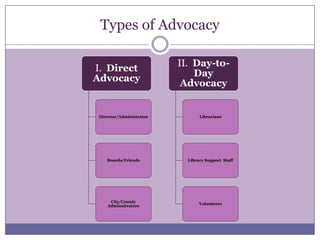
Types of Advocacy
Direct AdvocacyPositioning the library within the city/county, college/university, or school/school district
Focus on legislators/elected officials/decision-makers Frontline/Day-to-Day AdvocacyEvery library staff person is a frontline advocateArticulate the value of their respective libraries and their value to their communities.Improve the quality of resources and services in their library environment.
We allmust advocate for the value of our libraries Allof usmust also be able to articulate our value as library employees Who’s Job Is It?
Library usersFaculty, staff, teachers…FamilyFriendsCommunityeveryoneYou are the face of the library
We can help
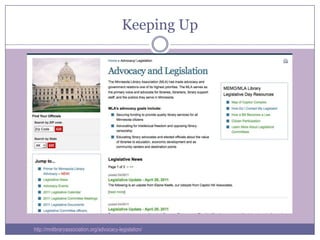
Keeping Uphttp://mnlibraryassociation.org/advocacy-legislation/
The listsrv for keeping up with Minnesota Library LegislationWhat is MnLibLegBonusWho knows what the latest message said?
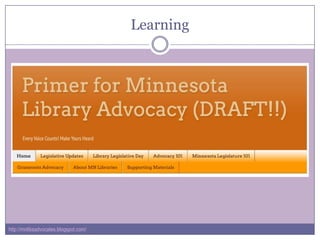
Learninghttp://mnlibsadvocates.blogspot.com/
Speaker of the Minnesota House of RepresentativesWho is Kurt Zellers?
Taking Parthttp://mnlibraryassociation.org/committees-subunits/legislative-committee/
In the House?Do you know who represents you?In the Senate?
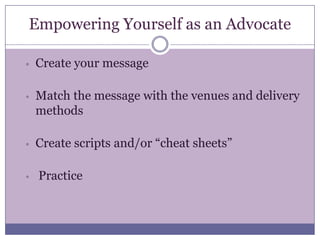
Empowering Yourself as an Advocate Create your message
Match the message with the venues and delivery methods
Create scripts and/or “cheat sheets”
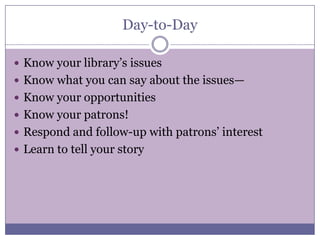
 PracticeDay-to-Day  Know your library’s issuesKnow what you can say about the issues—Know your opportunitiesKnow your patrons!Respond and follow-up with patrons’ interestLearn to tell your story
Prepare to Meet a Powerbroker	Make appointmentDefine meeting goalsHave a lead spokespersonDetermine the messageHave data that supports your messagePrepare information packet
At the MeetingIntroduce those presentHave spokesperson provide brief summary of why you are hereExplain your library messageAsk powerbroker to share their views & willingness to helpQ &A
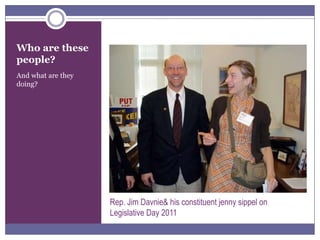
Who are these people?And what are they doing?Rep. Jim Davnie & his constituent jenny sippel on Legislative Day 2011
After the MeetingProvide any promised follow-upWrite thank you notesThanks are important. It is not always about asking!
Other Ways to Advocate	LettersCallsEmailsInvitations to library events
The key is to Do It AndDo It OftenYou know this
Michelle L. FischbachWho is President of the Minnesota Senate?
Weak Excuses“My library (public, school, college/university, special) doesn’t allow me to lobby.”“I’m shy.”“I don’t know what to say.”

Mile advocacy may 2011

Editor's Notes

  • #44 Keep it short. Be succinct. According to  Wikipedia, an adult's attention span is eight seconds, so be sure to give just enough information (and more importantly perhaps the right information) so that after only hearing a sentence or two, someone knows what you do - and if it's a pitch, what you need. 2. Have a hook. As Mel Pircheskyadvises, "The objective of the first ten or fifteen seconds is to have your prospective investors want to listen to the next forty-five or fifty seconds differently, more intently than they would have otherwise."3. Pitch yourself, not your ideas. As Chris Dixon writes, "The reality is ideas don't matter that much. First of all, in almost all startups, the idea changes - often dramatically - over time. Secondly, ideas are relatively abundant." Instead of talking about ideas, highlight what you've done - the concrete accomplishments or skills - rather than some intangible concept or a future goal.4. Don't forget the pitch. It's easy to get so caught up in the details of who you are that you neglect to mention what you need. What amount of financing are you seeking, for example? 5. Don't overwhelm with technical or statistical terminology. While being able to tout one or two amazing and memorable phrases or figures can be useful, don't fill your elevator speech with numbers or jargon.6. Practice. Rehearse your elevator pitch so that when the opportunity to give it comes, you can deliver it smoothly.7. Use the same tactics for print. You can hone your elevator skills by practicing them in writing. BabakNivi describes the email elevator pitch here. 8. Revise. As your startup moves through various stages, be sure to update and refresh your pitch. 9. Be involved in the startup community before you pitch. Business Insider suggests "Engaging in online discussions, writing insightful blog posts, and participating in the relatively small startup community can earn you a 'strong presence' that gets you noticed by potential investors." Building relationships with investors before pitching to them will help your success.10. Listen. When seeking to build strong networks, remember it can be just as important to listen as it is to talk.