1

The Leverage Buy – out
Deal of
Tata & Tetley
Introduction


In the summer of 2000, Indian corporate fraternity witnessed path
breaking achievement



New chapter in Indian corporate history



Tata Tea acquired the UK heavyweight brand “Tetley” for ₤271
million (USD 450 million)
Introduction


Acquisition made Tata Tea 2nd biggest tea company in the world



Tata Tea went through a metamorphosis



Mr. Ratan Tata said, “It is a great signal for global industry by Indian
Industry. It is a momentous occasion as an Indian company has
been able to acquire a brand and an overseas company”
Introduction


First ever leveraged buy-out by an Indian company



Price differences



Financing mechanism of LBO
The Tale of Tata Tea


Tata Tea was incorporated in 1962 as “Tata Finlay Ltd”



Commenced business in 1963



Tata Tea set up factory in Munnar in collaboration with Tata Finlay
& company



Expanded its business



In 1975, acquired Sterling Tea from James Finlay & company for Rs.
115 million



Bought stake in James Finlay & Company in joint venture



In 1983, the company was renamed “Tata Tea Ltd”
The Tale of Tata Tea
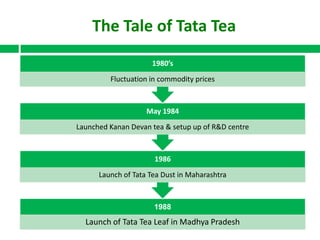
1980’s
Fluctuation in commodity prices

May 1984
Launched Kanan Devan tea & setup up of R&D centre

1986
Launch of Tata Tea Dust in Maharashtra

1988

Launch of Tata Tea Leaf in Madhya Pradesh
The Tale of Tata Tea
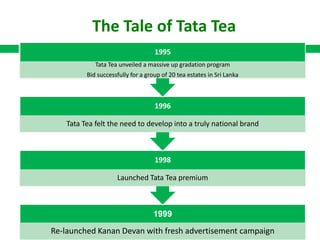
1995
Tata Tea unveiled a massive up gradation program
Bid successfully for a group of 20 tea estates in Sri Lanka

1996
Tata Tea felt the need to develop into a truly national brand

1998
Launched Tata Tea premium

1999

Re-launched Kanan Devan with fresh advertisement campaign
The Tale of Tata Tea


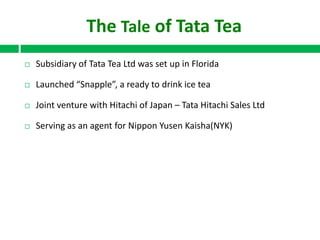
Subsidiary of Tata Tea Ltd was set up in Florida



Launched “Snapple”, a ready to drink ice tea



Joint venture with Hitachi of Japan – Tata Hitachi Sales Ltd



Serving as an agent for Nippon Yusen Kaisha(NYK)
De-mystifying LBO


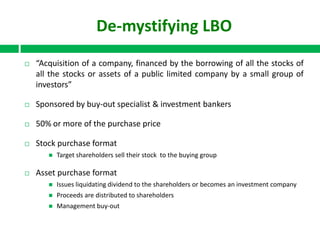
“Acquisition of a company, financed by the borrowing of all the stocks of
all the stocks or assets of a public limited company by a small group of
investors”



Sponsored by buy-out specialist & investment bankers



50% or more of the purchase price



Stock purchase format




Target shareholders sell their stock to the buying group

Asset purchase format


Issues liquidating dividend to the shareholders or becomes an investment company



Proceeds are distributed to shareholders



Management buy-out
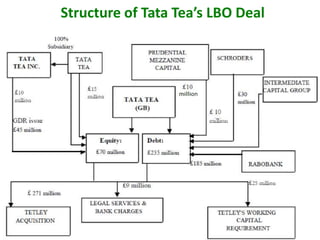
Structure of Tata Tea’s LBO Deal
10
De-mystifying LBO


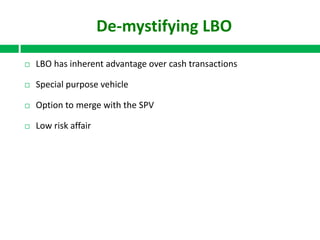
LBO has inherent advantage over cash transactions



Special purpose vehicle



Option to merge with the SPV



Low risk affair
De-mystifying LBO


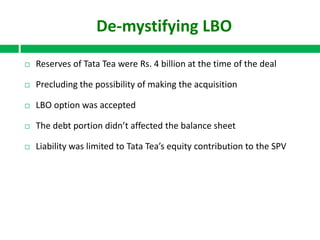
Reserves of Tata Tea were Rs. 4 billion at the time of the deal



Precluding the possibility of making the acquisition



LBO option was accepted



The debt portion didn’t affected the balance sheet



Liability was limited to Tata Tea’s equity contribution to the SPV
Tata Tea & Tetley acquisition

Tata Tea & Tetley acquisition

  • 1.
    1 The Leverage Buy– out Deal of Tata & Tetley
  • 2.
    Introduction  In the summerof 2000, Indian corporate fraternity witnessed path breaking achievement  New chapter in Indian corporate history  Tata Tea acquired the UK heavyweight brand “Tetley” for ₤271 million (USD 450 million)
  • 3.
    Introduction  Acquisition made TataTea 2nd biggest tea company in the world  Tata Tea went through a metamorphosis  Mr. Ratan Tata said, “It is a great signal for global industry by Indian Industry. It is a momentous occasion as an Indian company has been able to acquire a brand and an overseas company”
  • 4.
    Introduction  First ever leveragedbuy-out by an Indian company  Price differences  Financing mechanism of LBO
  • 5.
    The Tale ofTata Tea  Tata Tea was incorporated in 1962 as “Tata Finlay Ltd”  Commenced business in 1963  Tata Tea set up factory in Munnar in collaboration with Tata Finlay & company  Expanded its business  In 1975, acquired Sterling Tea from James Finlay & company for Rs. 115 million  Bought stake in James Finlay & Company in joint venture  In 1983, the company was renamed “Tata Tea Ltd”
  • 6.
    The Tale ofTata Tea 1980’s Fluctuation in commodity prices May 1984 Launched Kanan Devan tea & setup up of R&D centre 1986 Launch of Tata Tea Dust in Maharashtra 1988 Launch of Tata Tea Leaf in Madhya Pradesh
  • 7.
    The Tale ofTata Tea 1995 Tata Tea unveiled a massive up gradation program Bid successfully for a group of 20 tea estates in Sri Lanka 1996 Tata Tea felt the need to develop into a truly national brand 1998 Launched Tata Tea premium 1999 Re-launched Kanan Devan with fresh advertisement campaign
  • 8.
    The Tale ofTata Tea  Subsidiary of Tata Tea Ltd was set up in Florida  Launched “Snapple”, a ready to drink ice tea  Joint venture with Hitachi of Japan – Tata Hitachi Sales Ltd  Serving as an agent for Nippon Yusen Kaisha(NYK)
  • 9.
    De-mystifying LBO  “Acquisition ofa company, financed by the borrowing of all the stocks of all the stocks or assets of a public limited company by a small group of investors”  Sponsored by buy-out specialist & investment bankers  50% or more of the purchase price  Stock purchase format   Target shareholders sell their stock to the buying group Asset purchase format  Issues liquidating dividend to the shareholders or becomes an investment company  Proceeds are distributed to shareholders  Management buy-out
  • 10.
    Structure of TataTea’s LBO Deal 10
  • 11.
    De-mystifying LBO  LBO hasinherent advantage over cash transactions  Special purpose vehicle  Option to merge with the SPV  Low risk affair
  • 12.
    De-mystifying LBO  Reserves ofTata Tea were Rs. 4 billion at the time of the deal  Precluding the possibility of making the acquisition  LBO option was accepted  The debt portion didn’t affected the balance sheet  Liability was limited to Tata Tea’s equity contribution to the SPV