NOT FDIC INSURED • MAY LOSE VALUE • NO BANK GUARANTEE
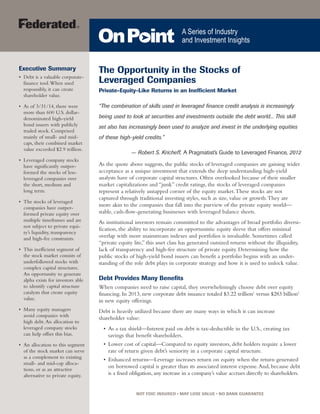
“The combination of skills used in leveraged finance credit analysis is increasingly
being used to look at securities and investments outside the debt world... This skill
set also has increasingly been used to analyze and invest in the underlying equities
of these high-yield credits.”
— Robert S. Kricheff, A Pragmatist’s Guide to Leveraged Finance, 2012
As the quote above suggests, the public stocks of leveraged companies are gaining wider
acceptance as a unique investment that extends the deep understanding high-yield
analysts have of corporate capital structures. Often overlooked because of their smaller
market capitalizations and “junk” credit ratings, the stocks of leveraged companies
represent a relatively untapped corner of the equity market.These stocks are not
captured through traditional investing styles, such as size, value or growth.They are
more akin to the companies that fall into the purview of the private equity world—
stable, cash-flow-generating businesses with leveraged balance sheets.
As institutional investors remain committed to the advantages of broad portfolio diversi-
fication, the ability to incorporate an opportunistic equity sleeve that offers minimal
overlap with more mainstream indexes and portfolios is invaluable. Sometimes called
“private equity lite,” this asset class has generated outsized returns without the illiquidity,
lack of transparency and high-fee structure of private equity. Determining how the
public stocks of high-yield bond issuers can benefit a portfolio begins with an under-
standing of the role debt plays in corporate strategy and how it is used to unlock value.
Debt Provides Many Benefits
When companies need to raise capital, they overwhelmingly choose debt over equity
financing. In 2013, new corporate debt issuance totaled $3.22 trillion1
versus $283 billion2
in new equity offerings.
Debt is heavily utilized because there are many ways in which it can increase
shareholder value:
• As a tax shield—Interest paid on debt is tax-deductible in the U.S., creating tax
savings that benefit shareholders.
• Lower cost of capital—Compared to equity investors, debt holders require a lower
rate of return given debt’s seniority in a corporate capital structure.
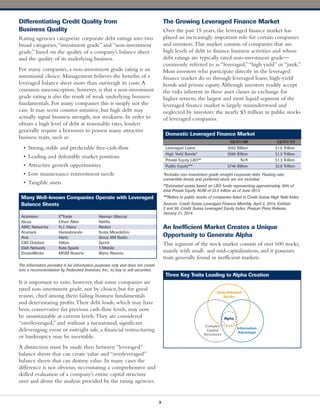
• Enhanced returns—Leverage increases return on equity when the return generated
on borrowed capital is greater than its associated interest expense.And, because debt
is a fixed obligation, any increase in a company’s value accrues directly to shareholders.
Executive Summary
• Debt is a valuable corporate-
finance tool.When used
responsibly, it can create
shareholder value.
• As of 3/31/14, there were
more than 600 U.S. dollar-
denominated high-yield
bond issuers with publicly
traded stock. Comprised
mainly of small- and mid-
caps, their combined market
value exceeded $2.9 trillion.
• Leveraged company stocks
have significantly outper-
formed the stocks of less-
leveraged companies over
the short, medium and
long term.
• The stocks of leveraged
companies have outper-
formed private equity over
multiple timeframes and are
not subject to private equi-
ty’s liquidity, transparency
and high-fee constraints.
• This inefficient segment of
the stock market consists of
underfollowed stocks with
complex capital structures.
An opportunity to generate
alpha exists for investors able
to identify capital structure
catalysts that create equity
value.
• Many equity managers
avoid companies with
high debt.An allocation to
leveraged company stocks
can help offset this bias.
• An allocation to this segment
of the stock market can serve
as a complement to existing
small- and mid-cap alloca-
tions, or as an attractive
alternative to private equity.
The Opportunity in the Stocks of
Leveraged Companies
Private-Equity-Like Returns in an Inefficient Market
e e eratd d A Series of Industry
and Investment Insights
• Greater flexibility—Debt issuance is less costly and more
convenient than equity issuance. It does not require
board approval, does not dilute control or earnings, and
is not subject to the whims of the equity market.
• Operational discipline—Large, recurring interest and
maturity commitments, along with debt covenants
that monitor performance, force management to more
efficiently manage operations and free-cash-flow.
• Positive “signaling”—A secondary stock offering typi-
cally results in the decline of a company’s stock price,
yet a new debt issuance does not.This phenomenon
may be explained by “signaling,” a theory that manage-
ment unintentionally conveys a pessimistic outlook or
valuation by issuing equity and an optimistic outlook
or valuation by issuing debt.
Nonetheless, debt can be a two-edged sword. Costs associ-
ated with increased leverage include higher interest rates,
more restrictive covenants and increased earnings volatility,
all of which can lead to financial distress.At excessive levels,
financial flexibility can be reduced and relationships with
suppliers, customers and employees can be adversely
affected.And at the extreme, bankruptcy can occur, which
usually destroys all equity value.
Clearly, a trade-off exists.When debt levels are low, benefits
dominate and equity value is created. But when debt levels
are too high, costs dominate and equity value is destroyed.
As part of its financial policy, a company weighs these costs
and benefits to determine an optimal capital structure that
maximizes shareholder value.
Debt Has a Broad Range of Uses
Corporations have long employed debt as a means to
support a broad range of strategic and growth initiatives.
As of 12/31/13, approximately 85% of all companies within
the Russell 3000 carried debt on their balance sheets.
Although different companies borrow for different reasons,
they generally fall into three broad categories:
• Growth—It is common for firms to utilize debt as a
catalyst for growth.A firm can grow internally, which
may require additional capital for expansion or working
capital needs, or grow externally, through acquisitions.
• Leveraged recapitalization—A company may decide to
alter its capital structure’s mix of debt and equity by
essentially replacing equity with debt. Common reasons
for a leveraged recapitalization include utilizing the
benefits provided by debt, a return of capital to share-
holders in the form of a dividend or share repurchases,
or as a takeover defense mechanism.
• Leveraged Buyout (LBO)—A third party, such as a
private-equity fund, may fund the acquisition of a target
company by using the company’s assets as collateral and
leveraging its balance sheet.
Source: Federated Investors.
This example is for illustrative purpose only and does not reflect the actual earnings and income generation of a real company.
How Leverage Enhances Equity Returns
Income Generation Multiple Expansion
Unlevered Levered Unlevered Levered
Unlevered Earnings $100 $ 100 Unlevered Earnings $100 $100 $100 $100
Interest Expense - $25 Multiple 6.0 ➔ 6.5 6.0 ➔ 6.5
Levered Earnings $100 $75 Enterprise Value $600 $650 $600 $650
Debt - $400 Less Debt - - $400 $400
Equity $600 $200 Equity Value $600 $650 $200 $250
Enterprise Value $600 $600 Increase in Equity Value $50 $50
Return on Equity 17% 38% Return to Equity Holders 8% 25%
($100/$600) ($75/$200) ($50/$600) ($50/$200)
Weighing Costs/Benefits of Debt Is Essential to
Creating an Optimal Capital Structure
Value of Value of Benefits Costs
Leveraged = Unleveraged + of - of
Firm Firm Leverage Leverage
2
Information
Advantage
Underfollowed
Stocks
Complex
Capital
Structures
Alpha
Differentiating Credit Quality from
Business Quality
Rating agencies categorize corporate debt ratings into two
broad categories,“investment grade” and “non-investment
grade,” based on the quality of a company’s balance sheet
and the quality of its underlying business.
For many companies, a non-investment grade rating is an
intentional choice. Management believes the benefits of a
leveraged balance sheet more than outweigh its costs.A
common misconception, however, is that a non-investment
grade rating is also the result of weak underlying business
fundamentals. For many companies this is simply not the
case. It may seem counter-intuitive, but high debt may
actually signal business strength, not weakness. In order to
obtain a high level of debt at reasonable rates, lenders
generally require a borrower to possess many attractive
business traits, such as:
• Strong, stable and predictable free-cash-flow
• Leading and defensible market positions
• Attractive growth opportunities
• Low maintenance reinvestment needs
• Tangible assets
It is important to note, however, that some companies are
rated non-investment grade, not by choice, but for good
reason, chief among them failing business fundamentals
and deteriorating profits.Their debt loads, which may have
been conservative for previous cash-flow levels, may now
be unsustainable at current levels.They are considered
“overleveraged,” and without a turnaround, significant
deleveraging event or outright sale, a financial restructuring
or bankruptcy may be inevitable.
A distinction must be made then between “leveraged”
balance sheets that can create value and “overleveraged”
balance sheets that can destroy value. In many cases the
difference is not obvious, necessitating a comprehensive and
skilled evaluation of a company’s entire capital structure
over and above the analysis provided by the rating agencies.
Many Well-known Companies Operate with Leveraged
Balance Sheets
Activision E*Trade Neiman Marcus
Alcoa Ethan Allen Netflix
AMC Networks H.J. Heinz Revlon
Aramark Hanesbrands Scots MiracleGro
Avis Hertz Sirius XM Radio
CBS Outdoor Hilton Sprint
Dish Network Kate Spade T-Mobile
DreamWorks MGM Resorts Wynn Resorts
The Growing Leveraged Finance Market
Over the past 15 years, the leveraged finance market has
played an increasingly important role for certain companies
and investors.This market consists of companies that use
high levels of debt to finance business activities and whose
debt ratings are typically rated non-investment grade—
commonly referred to as “leveraged,”“high yield” or “junk.”
Most investors who participate directly in the leveraged
finance market do so through leveraged loans, high-yield
bonds and private equity.Although investors readily accept
the risks inherent in these asset classes in exchange for
higher returns, the largest and most liquid segment of the
leveraged finance market is largely misunderstood and
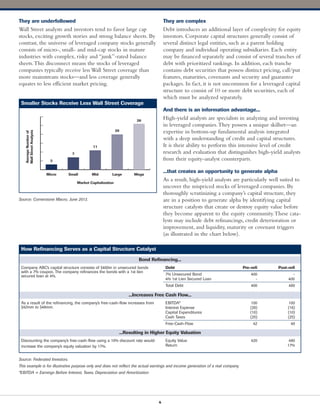
neglected by investors: the nearly $3 trillion in public stocks
of leveraged companies.
*Includes non-investment grade straight corporate debt. Floating rate,
convertible bonds and preferred stock are not included.
**Estimated assets based on LBO funds representing approximately 39% of
total Private Equity AUM of $3.5 trillion as of June 2013.
***Refers to public stocks of companies listed in Credit Suisse High Yield Index.
Sources: Credit Suisse Leveraged Finance Monthly, April 2, 2014, Exhibits
2 and 99; Credit Suisse Leveraged Equity Index; Prequin Press Release,
January 21, 2014.
Domestic Leveraged Finance Market
12/31/98 12/31/13
Leveraged Loans $552 Billion $1.5 Trillion
High Yield Bonds* $580 Billion $1.3 Trillion
Private Equity LBO** N/A $1.3 Trillion
Public Equity*** $746 Billion $2.8 Trillion
An Inefficient Market Creates a Unique
Opportunity to Generate Alpha
This segment of the stock market consists of over 600 stocks,
mainly with small- and mid-capitalizations, and it possesses
traits generally found in inefficient markets.
Three Key Traits Leading to Alpha Creation
3
The information provided is for information purposes only and does not consti-
tute a recommendation by Federated Investors, Inc., to buy or sell securities.
Bond Refinancing...
...Increases Free Cash Flow...
...Resulting in Higher Equity Valuation
They are underfollowed
Wall Street analysts and investors tend to favor large cap
stocks, exciting growth stories and strong balance sheets. By
contrast, the universe of leveraged company stocks generally
consists of micro-, small- and mid-cap stocks in mature
industries with complex, risky and “junk”-rated balance
sheets.This disconnect means the stocks of leveraged
companies typically receive less Wall Street coverage than
more mainstream stocks—and less coverage generally
equates to less efficient market pricing.
They are complex
Debt introduces an additional layer of complexity for equity
investors. Corporate capital structures generally consist of
several distinct legal entities, such as a parent holding
company and individual operating subsidiaries. Each entity
may be financed separately and consist of several tranches of
debt with prioritized rankings. In addition, each tranche
contains debt securities that possess distinct pricing, call/put
features, maturities, covenants and security and guarantee
packages. In fact, it is not uncommon for a leveraged capital
structure to consist of 10 or more debt securities, each of
which must be analyzed separately.
And there is an information advantage...
High-yield analysts are specialists in analyzing and investing
in leveraged companies.They possess a unique skillset—an
expertise in bottom-up fundamental analysis integrated
with a deep understanding of credit and capital structures.
It is their ability to perform this intensive level of credit
research and evaluation that distinguishes high-yield analysts
from their equity-analyst counterparts.
...that creates an opportunity to generate alpha
As a result, high-yield analysts are particularly well suited to
uncover the mispriced stocks of leveraged companies. By
thoroughly scrutinizing a company’s capital structure, they
are in a position to generate alpha by identifying capital
structure catalysts that create or destroy equity value before
they become apparent to the equity community.These cata-
lysts may include debt refinancings, credit deterioration or
improvement, and liquidity, maturity or covenant triggers
(as illustrated in the chart below).
Source: Cornerstone Macro, June 2013.
AverageNumberof
WallStreetAnalysts
Market Capitalization
MegaLargeMidSmallMicro
20
11
26
7
3
Smaller Stocks Receive Less Wall Street Coverage
Source: Federated Investors.
This example is for illustrative purpose only and does not reflect the actual earnings and income generation of a real company.
*EBITDA = Earnings Before Interest, Taxes, Depreciation and Amortization
How Refinancing Serves as a Capital Structure Catalyst
Company ABC’s capital structure consists of $400m in unsecured bonds
with a 7% coupon. The company refinances the bonds with a 1st lien
secured loan at 4%.
As a result of the refinancing, the company’s free-cash-flow increases from
$42mm to $49mm.
Discounting the company’s free-cash-flow using a 10% discount rate would
increase the company’s equity valuation by 17%.
Debt Pre-refi Post-refi
7% Unsecured Bond 400 -
4% 1st Lien Secured Loan - 400
Total Debt 400 400
EBITDA* 100 100
Interest Expense (28) (16)
Capital Expenditures (10) (10)
Cash Taxes (20) (25)
Free-Cash-Flow 42 49
Equity Value 420 490
Return 17%
4
AnnualizedReturns(%)
Mid-Caps
Period
5
10
15
20
25
30
35
40
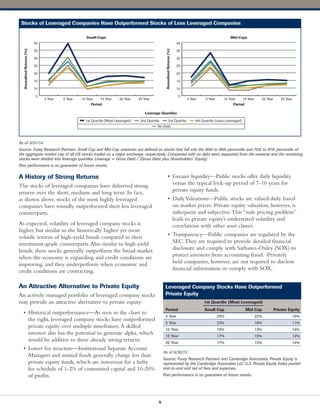
25 Year20 Year15 Year10 Year5 Year3 Year
AnnualizedReturns(%)
Small-Caps
Leverage Quartiles
Period
5
10
15
20
25
30
35
40
25 Year20 Year15 Year10 Year5 Year3 Year
-1st Quartile (Most Leveraged) - 2nd Quartile - 3rd Quartile - 4th Quartile (Least Leveraged)
- No Debt
A History of Strong Returns
The stocks of leveraged companies have delivered strong
returns over the short, medium and long term. In fact,
as shown above, stocks of the most highly leveraged
companies have soundly outperformed their less leveraged
counterparts.
As expected, volatility of leveraged company stocks is
higher, but similar to the historically higher yet more
volatile returns of high-yield bonds compared to their
investment-grade counterparts.Also similar to high-yield
bonds, these stocks generally outperform the broad market
when the economy is expanding and credit conditions are
improving, and they underperform when economic and
credit conditions are contracting.
An Attractive Alternative to Private Equity
An actively managed portfolio of leveraged company stocks
may provide an attractive alternative to private equity:
• Historical outperformance—As seen in the chart to
the right, leveraged company stocks have outperformed
private equity over multiple timeframes.A skilled
investor also has the potential to generate alpha, which
would be additive to these already strong returns.
• Lower fee structure—Institutional Separate Account
Managers and mutual funds generally charge less than
private equity funds, which are notorious for a hefty
fee schedule of 1-2% of committed capital and 10-20%
of profits.
Stocks of Leveraged Companies Have Outperformed Stocks of Less Leveraged Companies
As of 3/31/14
Source: Furey Research Partners. Small Cap and Mid Cap universes are defined as stocks that fall into the 90th to 99th percentile and 75th to 97th percentile of
the aggregate market cap of all US stocks traded on a major exchange, respectively. Companies with no debt were separated from the universe and the remaining
stocks were divided into leverage quartiles. Leverage = Gross Debt / (Gross Debt plus Shareholders’ Equity).
Past performance is no guarantee of future results.
As of 9/30/13
Source: Furey Research Partners and Cambridge Associates. Private Equity is
represented by the Cambridge Associates LLC U.S. Private Equity Index pooled
end-to-end and net of fees and expenses.
Past performance is no guarantee of future results.
• Greater liquidity—Public stocks offer daily liquidity
versus the typical lock-up period of 7-10 years for
private equity funds.
• DailyValuations—Public stocks are valued daily based
on market prices. Private equity valuation, however, is
infrequent and subjective.This “stale pricing problem”
leads to private equity’s understated volatility and
correlations with other asset classes.
• Transparency—Public companies are regulated by the
SEC.They are required to provide detailed financial
disclosure and comply with Sarbanes-Oxley (SOX) to
protect investors from accounting fraud. Privately
held companies, however, are not required to disclose
financial information or comply with SOX.
Leveraged Company Stocks Have Outperformed
Private Equity
1st Quartile (Most Leveraged)
Period Small Cap Mid Cap Private Equity
3 Year 25% 22% 16%
5 Year 22% 18% 11%
10 Year 15% 13% 14%
15 Year 17% 15% 12%
20 Year 17% 15% 14%
5
Leveraged equity is subject to the same risks as general equity securities. The value of equity securities will fluctuate and, as a result, share prices may decline
suddenly or over a sustained period of time. In addition, equity securities issued by corporations that issued non-investment grade rated debt (i.e. leveraged
equity securities) may be more volatile than non-leveraged equity securities.
Bond prices are sensitive to changes in interest rates and a rise in interest rates can cause a decline in their prices.
High-yield, lower-rated securities generally entail greater market, credit/default and liquidity risks, and may be more volatile than investment grade securities.
Diversification does not assure a profit nor protect against loss.
Alpha measures a fund's risk-adjusted performance. It represents the difference between a fund's actual returns and its expected performance, given its level of
risk as measured by beta. A positive value for alpha implies that the fund has performed better than would have been expected given its volatility. The higher the
alpha, the better the fund's risk-adjusted performance.
Views are as of 3/31/14 and are subject to change based on market conditions and other factors. These views should not be construed as a recommendation for
any specific security or sector.
1
Dealogic Loans Review, Full Year 2013 Final Results, page 9 and Dealogic DCM Review, Full Year 2013 Final Results, January 2014, page 9;
2
Dealogic ECM Review, Full Year 2013 Review, January 2013, page 7
G42080-42 (5/14) Federated is a registered trademark of Federated Investors, Inc.
Federated Investment Counseling 2014 ©Federated Investors, Inc.
A Compelling Case for Leveraged Company Stocks
Finding alpha is one of the great challenges for institutional investors.The stocks of leveraged companies make a
compelling case as an attractive solution: a long history of outperformance, a unique opportunity to generate alpha
and diversification.A portfolio of such stocks can complement existing small- and mid-cap allocations or serve as
a solid alternative to private equity.

white paper final

  • 1.
    NOT FDIC INSURED• MAY LOSE VALUE • NO BANK GUARANTEE “The combination of skills used in leveraged finance credit analysis is increasingly being used to look at securities and investments outside the debt world... This skill set also has increasingly been used to analyze and invest in the underlying equities of these high-yield credits.” — Robert S. Kricheff, A Pragmatist’s Guide to Leveraged Finance, 2012 As the quote above suggests, the public stocks of leveraged companies are gaining wider acceptance as a unique investment that extends the deep understanding high-yield analysts have of corporate capital structures. Often overlooked because of their smaller market capitalizations and “junk” credit ratings, the stocks of leveraged companies represent a relatively untapped corner of the equity market.These stocks are not captured through traditional investing styles, such as size, value or growth.They are more akin to the companies that fall into the purview of the private equity world— stable, cash-flow-generating businesses with leveraged balance sheets. As institutional investors remain committed to the advantages of broad portfolio diversi- fication, the ability to incorporate an opportunistic equity sleeve that offers minimal overlap with more mainstream indexes and portfolios is invaluable. Sometimes called “private equity lite,” this asset class has generated outsized returns without the illiquidity, lack of transparency and high-fee structure of private equity. Determining how the public stocks of high-yield bond issuers can benefit a portfolio begins with an under- standing of the role debt plays in corporate strategy and how it is used to unlock value. Debt Provides Many Benefits When companies need to raise capital, they overwhelmingly choose debt over equity financing. In 2013, new corporate debt issuance totaled $3.22 trillion1 versus $283 billion2 in new equity offerings. Debt is heavily utilized because there are many ways in which it can increase shareholder value: • As a tax shield—Interest paid on debt is tax-deductible in the U.S., creating tax savings that benefit shareholders. • Lower cost of capital—Compared to equity investors, debt holders require a lower rate of return given debt’s seniority in a corporate capital structure. • Enhanced returns—Leverage increases return on equity when the return generated on borrowed capital is greater than its associated interest expense.And, because debt is a fixed obligation, any increase in a company’s value accrues directly to shareholders. Executive Summary • Debt is a valuable corporate- finance tool.When used responsibly, it can create shareholder value. • As of 3/31/14, there were more than 600 U.S. dollar- denominated high-yield bond issuers with publicly traded stock. Comprised mainly of small- and mid- caps, their combined market value exceeded $2.9 trillion. • Leveraged company stocks have significantly outper- formed the stocks of less- leveraged companies over the short, medium and long term. • The stocks of leveraged companies have outper- formed private equity over multiple timeframes and are not subject to private equi- ty’s liquidity, transparency and high-fee constraints. • This inefficient segment of the stock market consists of underfollowed stocks with complex capital structures. An opportunity to generate alpha exists for investors able to identify capital structure catalysts that create equity value. • Many equity managers avoid companies with high debt.An allocation to leveraged company stocks can help offset this bias. • An allocation to this segment of the stock market can serve as a complement to existing small- and mid-cap alloca- tions, or as an attractive alternative to private equity. The Opportunity in the Stocks of Leveraged Companies Private-Equity-Like Returns in an Inefficient Market e e eratd d A Series of Industry and Investment Insights
  • 2.
    • Greater flexibility—Debtissuance is less costly and more convenient than equity issuance. It does not require board approval, does not dilute control or earnings, and is not subject to the whims of the equity market. • Operational discipline—Large, recurring interest and maturity commitments, along with debt covenants that monitor performance, force management to more efficiently manage operations and free-cash-flow. • Positive “signaling”—A secondary stock offering typi- cally results in the decline of a company’s stock price, yet a new debt issuance does not.This phenomenon may be explained by “signaling,” a theory that manage- ment unintentionally conveys a pessimistic outlook or valuation by issuing equity and an optimistic outlook or valuation by issuing debt. Nonetheless, debt can be a two-edged sword. Costs associ- ated with increased leverage include higher interest rates, more restrictive covenants and increased earnings volatility, all of which can lead to financial distress.At excessive levels, financial flexibility can be reduced and relationships with suppliers, customers and employees can be adversely affected.And at the extreme, bankruptcy can occur, which usually destroys all equity value. Clearly, a trade-off exists.When debt levels are low, benefits dominate and equity value is created. But when debt levels are too high, costs dominate and equity value is destroyed. As part of its financial policy, a company weighs these costs and benefits to determine an optimal capital structure that maximizes shareholder value. Debt Has a Broad Range of Uses Corporations have long employed debt as a means to support a broad range of strategic and growth initiatives. As of 12/31/13, approximately 85% of all companies within the Russell 3000 carried debt on their balance sheets. Although different companies borrow for different reasons, they generally fall into three broad categories: • Growth—It is common for firms to utilize debt as a catalyst for growth.A firm can grow internally, which may require additional capital for expansion or working capital needs, or grow externally, through acquisitions. • Leveraged recapitalization—A company may decide to alter its capital structure’s mix of debt and equity by essentially replacing equity with debt. Common reasons for a leveraged recapitalization include utilizing the benefits provided by debt, a return of capital to share- holders in the form of a dividend or share repurchases, or as a takeover defense mechanism. • Leveraged Buyout (LBO)—A third party, such as a private-equity fund, may fund the acquisition of a target company by using the company’s assets as collateral and leveraging its balance sheet. Source: Federated Investors. This example is for illustrative purpose only and does not reflect the actual earnings and income generation of a real company. How Leverage Enhances Equity Returns Income Generation Multiple Expansion Unlevered Levered Unlevered Levered Unlevered Earnings $100 $ 100 Unlevered Earnings $100 $100 $100 $100 Interest Expense - $25 Multiple 6.0 ➔ 6.5 6.0 ➔ 6.5 Levered Earnings $100 $75 Enterprise Value $600 $650 $600 $650 Debt - $400 Less Debt - - $400 $400 Equity $600 $200 Equity Value $600 $650 $200 $250 Enterprise Value $600 $600 Increase in Equity Value $50 $50 Return on Equity 17% 38% Return to Equity Holders 8% 25% ($100/$600) ($75/$200) ($50/$600) ($50/$200) Weighing Costs/Benefits of Debt Is Essential to Creating an Optimal Capital Structure Value of Value of Benefits Costs Leveraged = Unleveraged + of - of Firm Firm Leverage Leverage 2
  • 3.
    Information Advantage Underfollowed Stocks Complex Capital Structures Alpha Differentiating Credit Qualityfrom Business Quality Rating agencies categorize corporate debt ratings into two broad categories,“investment grade” and “non-investment grade,” based on the quality of a company’s balance sheet and the quality of its underlying business. For many companies, a non-investment grade rating is an intentional choice. Management believes the benefits of a leveraged balance sheet more than outweigh its costs.A common misconception, however, is that a non-investment grade rating is also the result of weak underlying business fundamentals. For many companies this is simply not the case. It may seem counter-intuitive, but high debt may actually signal business strength, not weakness. In order to obtain a high level of debt at reasonable rates, lenders generally require a borrower to possess many attractive business traits, such as: • Strong, stable and predictable free-cash-flow • Leading and defensible market positions • Attractive growth opportunities • Low maintenance reinvestment needs • Tangible assets It is important to note, however, that some companies are rated non-investment grade, not by choice, but for good reason, chief among them failing business fundamentals and deteriorating profits.Their debt loads, which may have been conservative for previous cash-flow levels, may now be unsustainable at current levels.They are considered “overleveraged,” and without a turnaround, significant deleveraging event or outright sale, a financial restructuring or bankruptcy may be inevitable. A distinction must be made then between “leveraged” balance sheets that can create value and “overleveraged” balance sheets that can destroy value. In many cases the difference is not obvious, necessitating a comprehensive and skilled evaluation of a company’s entire capital structure over and above the analysis provided by the rating agencies. Many Well-known Companies Operate with Leveraged Balance Sheets Activision E*Trade Neiman Marcus Alcoa Ethan Allen Netflix AMC Networks H.J. Heinz Revlon Aramark Hanesbrands Scots MiracleGro Avis Hertz Sirius XM Radio CBS Outdoor Hilton Sprint Dish Network Kate Spade T-Mobile DreamWorks MGM Resorts Wynn Resorts The Growing Leveraged Finance Market Over the past 15 years, the leveraged finance market has played an increasingly important role for certain companies and investors.This market consists of companies that use high levels of debt to finance business activities and whose debt ratings are typically rated non-investment grade— commonly referred to as “leveraged,”“high yield” or “junk.” Most investors who participate directly in the leveraged finance market do so through leveraged loans, high-yield bonds and private equity.Although investors readily accept the risks inherent in these asset classes in exchange for higher returns, the largest and most liquid segment of the leveraged finance market is largely misunderstood and neglected by investors: the nearly $3 trillion in public stocks of leveraged companies. *Includes non-investment grade straight corporate debt. Floating rate, convertible bonds and preferred stock are not included. **Estimated assets based on LBO funds representing approximately 39% of total Private Equity AUM of $3.5 trillion as of June 2013. ***Refers to public stocks of companies listed in Credit Suisse High Yield Index. Sources: Credit Suisse Leveraged Finance Monthly, April 2, 2014, Exhibits 2 and 99; Credit Suisse Leveraged Equity Index; Prequin Press Release, January 21, 2014. Domestic Leveraged Finance Market 12/31/98 12/31/13 Leveraged Loans $552 Billion $1.5 Trillion High Yield Bonds* $580 Billion $1.3 Trillion Private Equity LBO** N/A $1.3 Trillion Public Equity*** $746 Billion $2.8 Trillion An Inefficient Market Creates a Unique Opportunity to Generate Alpha This segment of the stock market consists of over 600 stocks, mainly with small- and mid-capitalizations, and it possesses traits generally found in inefficient markets. Three Key Traits Leading to Alpha Creation 3 The information provided is for information purposes only and does not consti- tute a recommendation by Federated Investors, Inc., to buy or sell securities.
  • 4.
    Bond Refinancing... ...Increases FreeCash Flow... ...Resulting in Higher Equity Valuation They are underfollowed Wall Street analysts and investors tend to favor large cap stocks, exciting growth stories and strong balance sheets. By contrast, the universe of leveraged company stocks generally consists of micro-, small- and mid-cap stocks in mature industries with complex, risky and “junk”-rated balance sheets.This disconnect means the stocks of leveraged companies typically receive less Wall Street coverage than more mainstream stocks—and less coverage generally equates to less efficient market pricing. They are complex Debt introduces an additional layer of complexity for equity investors. Corporate capital structures generally consist of several distinct legal entities, such as a parent holding company and individual operating subsidiaries. Each entity may be financed separately and consist of several tranches of debt with prioritized rankings. In addition, each tranche contains debt securities that possess distinct pricing, call/put features, maturities, covenants and security and guarantee packages. In fact, it is not uncommon for a leveraged capital structure to consist of 10 or more debt securities, each of which must be analyzed separately. And there is an information advantage... High-yield analysts are specialists in analyzing and investing in leveraged companies.They possess a unique skillset—an expertise in bottom-up fundamental analysis integrated with a deep understanding of credit and capital structures. It is their ability to perform this intensive level of credit research and evaluation that distinguishes high-yield analysts from their equity-analyst counterparts. ...that creates an opportunity to generate alpha As a result, high-yield analysts are particularly well suited to uncover the mispriced stocks of leveraged companies. By thoroughly scrutinizing a company’s capital structure, they are in a position to generate alpha by identifying capital structure catalysts that create or destroy equity value before they become apparent to the equity community.These cata- lysts may include debt refinancings, credit deterioration or improvement, and liquidity, maturity or covenant triggers (as illustrated in the chart below). Source: Cornerstone Macro, June 2013. AverageNumberof WallStreetAnalysts Market Capitalization MegaLargeMidSmallMicro 20 11 26 7 3 Smaller Stocks Receive Less Wall Street Coverage Source: Federated Investors. This example is for illustrative purpose only and does not reflect the actual earnings and income generation of a real company. *EBITDA = Earnings Before Interest, Taxes, Depreciation and Amortization How Refinancing Serves as a Capital Structure Catalyst Company ABC’s capital structure consists of $400m in unsecured bonds with a 7% coupon. The company refinances the bonds with a 1st lien secured loan at 4%. As a result of the refinancing, the company’s free-cash-flow increases from $42mm to $49mm. Discounting the company’s free-cash-flow using a 10% discount rate would increase the company’s equity valuation by 17%. Debt Pre-refi Post-refi 7% Unsecured Bond 400 - 4% 1st Lien Secured Loan - 400 Total Debt 400 400 EBITDA* 100 100 Interest Expense (28) (16) Capital Expenditures (10) (10) Cash Taxes (20) (25) Free-Cash-Flow 42 49 Equity Value 420 490 Return 17% 4
  • 5.
    AnnualizedReturns(%) Mid-Caps Period 5 10 15 20 25 30 35 40 25 Year20 Year15Year10 Year5 Year3 Year AnnualizedReturns(%) Small-Caps Leverage Quartiles Period 5 10 15 20 25 30 35 40 25 Year20 Year15 Year10 Year5 Year3 Year -1st Quartile (Most Leveraged) - 2nd Quartile - 3rd Quartile - 4th Quartile (Least Leveraged) - No Debt A History of Strong Returns The stocks of leveraged companies have delivered strong returns over the short, medium and long term. In fact, as shown above, stocks of the most highly leveraged companies have soundly outperformed their less leveraged counterparts. As expected, volatility of leveraged company stocks is higher, but similar to the historically higher yet more volatile returns of high-yield bonds compared to their investment-grade counterparts.Also similar to high-yield bonds, these stocks generally outperform the broad market when the economy is expanding and credit conditions are improving, and they underperform when economic and credit conditions are contracting. An Attractive Alternative to Private Equity An actively managed portfolio of leveraged company stocks may provide an attractive alternative to private equity: • Historical outperformance—As seen in the chart to the right, leveraged company stocks have outperformed private equity over multiple timeframes.A skilled investor also has the potential to generate alpha, which would be additive to these already strong returns. • Lower fee structure—Institutional Separate Account Managers and mutual funds generally charge less than private equity funds, which are notorious for a hefty fee schedule of 1-2% of committed capital and 10-20% of profits. Stocks of Leveraged Companies Have Outperformed Stocks of Less Leveraged Companies As of 3/31/14 Source: Furey Research Partners. Small Cap and Mid Cap universes are defined as stocks that fall into the 90th to 99th percentile and 75th to 97th percentile of the aggregate market cap of all US stocks traded on a major exchange, respectively. Companies with no debt were separated from the universe and the remaining stocks were divided into leverage quartiles. Leverage = Gross Debt / (Gross Debt plus Shareholders’ Equity). Past performance is no guarantee of future results. As of 9/30/13 Source: Furey Research Partners and Cambridge Associates. Private Equity is represented by the Cambridge Associates LLC U.S. Private Equity Index pooled end-to-end and net of fees and expenses. Past performance is no guarantee of future results. • Greater liquidity—Public stocks offer daily liquidity versus the typical lock-up period of 7-10 years for private equity funds. • DailyValuations—Public stocks are valued daily based on market prices. Private equity valuation, however, is infrequent and subjective.This “stale pricing problem” leads to private equity’s understated volatility and correlations with other asset classes. • Transparency—Public companies are regulated by the SEC.They are required to provide detailed financial disclosure and comply with Sarbanes-Oxley (SOX) to protect investors from accounting fraud. Privately held companies, however, are not required to disclose financial information or comply with SOX. Leveraged Company Stocks Have Outperformed Private Equity 1st Quartile (Most Leveraged) Period Small Cap Mid Cap Private Equity 3 Year 25% 22% 16% 5 Year 22% 18% 11% 10 Year 15% 13% 14% 15 Year 17% 15% 12% 20 Year 17% 15% 14% 5
  • 6.
    Leveraged equity issubject to the same risks as general equity securities. The value of equity securities will fluctuate and, as a result, share prices may decline suddenly or over a sustained period of time. In addition, equity securities issued by corporations that issued non-investment grade rated debt (i.e. leveraged equity securities) may be more volatile than non-leveraged equity securities. Bond prices are sensitive to changes in interest rates and a rise in interest rates can cause a decline in their prices. High-yield, lower-rated securities generally entail greater market, credit/default and liquidity risks, and may be more volatile than investment grade securities. Diversification does not assure a profit nor protect against loss. Alpha measures a fund's risk-adjusted performance. It represents the difference between a fund's actual returns and its expected performance, given its level of risk as measured by beta. A positive value for alpha implies that the fund has performed better than would have been expected given its volatility. The higher the alpha, the better the fund's risk-adjusted performance. Views are as of 3/31/14 and are subject to change based on market conditions and other factors. These views should not be construed as a recommendation for any specific security or sector. 1 Dealogic Loans Review, Full Year 2013 Final Results, page 9 and Dealogic DCM Review, Full Year 2013 Final Results, January 2014, page 9; 2 Dealogic ECM Review, Full Year 2013 Review, January 2013, page 7 G42080-42 (5/14) Federated is a registered trademark of Federated Investors, Inc. Federated Investment Counseling 2014 ©Federated Investors, Inc. A Compelling Case for Leveraged Company Stocks Finding alpha is one of the great challenges for institutional investors.The stocks of leveraged companies make a compelling case as an attractive solution: a long history of outperformance, a unique opportunity to generate alpha and diversification.A portfolio of such stocks can complement existing small- and mid-cap allocations or serve as a solid alternative to private equity.