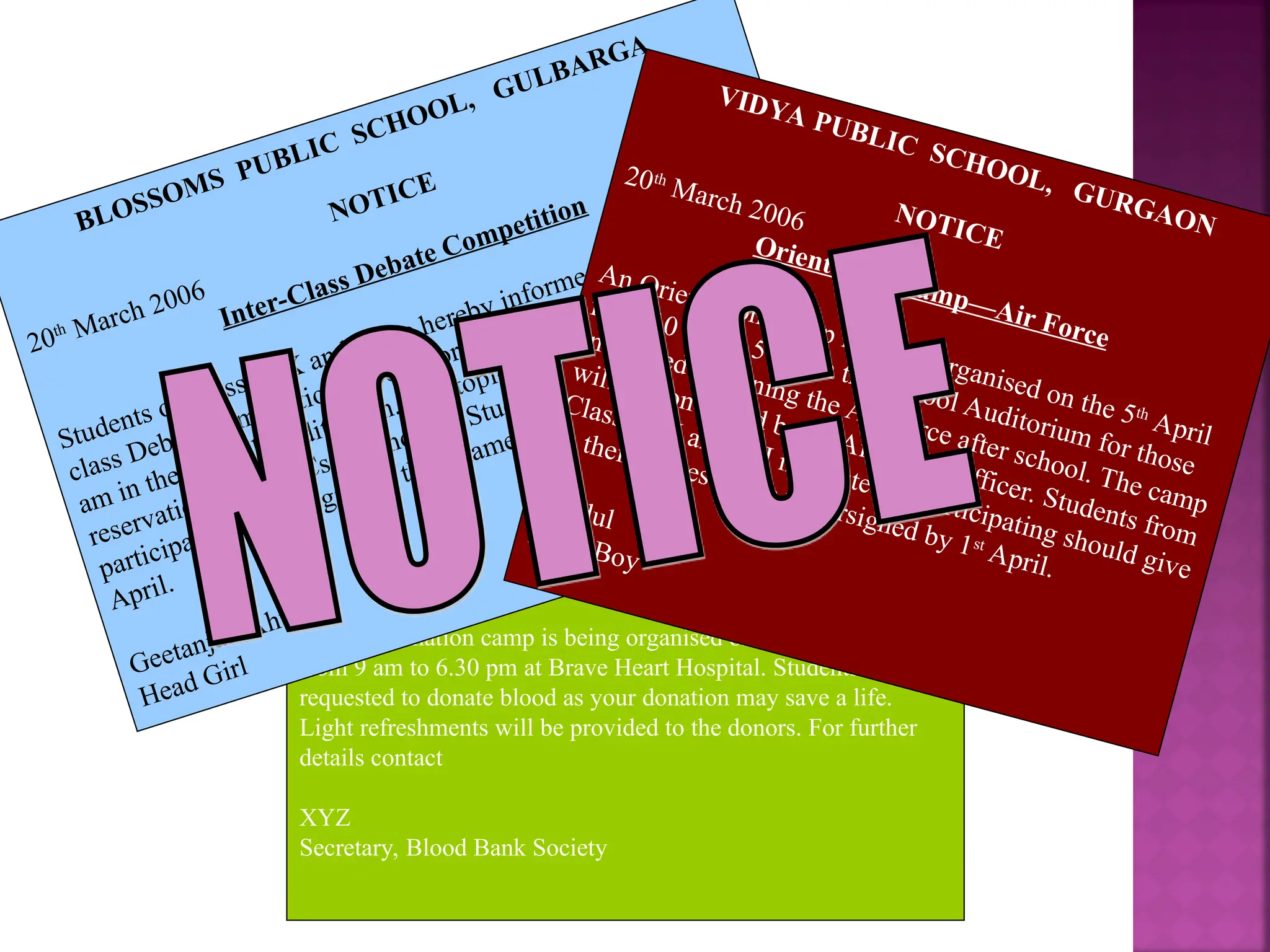
Blood Bank Society, Allahabad
NOTICE
27th
March 2006
Blood Donation Camp
A blood donation camp is being organised on the 4th
April 2006
from 9 am to 6.30 pm at Brave Heart Hospital. Students are
requested to donate blood as your donation may save a life.
Light refreshments will be provided to the donors. For further
details contact
XYZ
Secretary, Blood Bank Society
BLOSSOMS PUBLIC SCHOOL, GULBARGA
NOTICE
20th March 2006
Inter-Class Debate Competition
Students of Classes IX and X are hereby informed that an Inter-
class Debate competition is being organised on the 5th April at 10
am in the School Auditorium. The topic is ‘There should be
reservations for OBCs in schools’. Students interested in
participating should give in their names to the undersigned by 1st
April.
Geetanjali Ahuja
Head Girl
VIDYA PUBLIC SCHOOL, GURGAON
NOTICE
20th
March 2006
Orientation Camp—Air Force
An Orientation Camp is being organised on the 5th
April
from 10 am to 5 pm in the School Auditorium for those
interested in joining the Air Force after school. The camp
will be conducted by an Air Force Officer. Students from
Classes XI and XII interested in participating should give
in their names to the undersigned by 1st
April.
Mridul
Head Boy
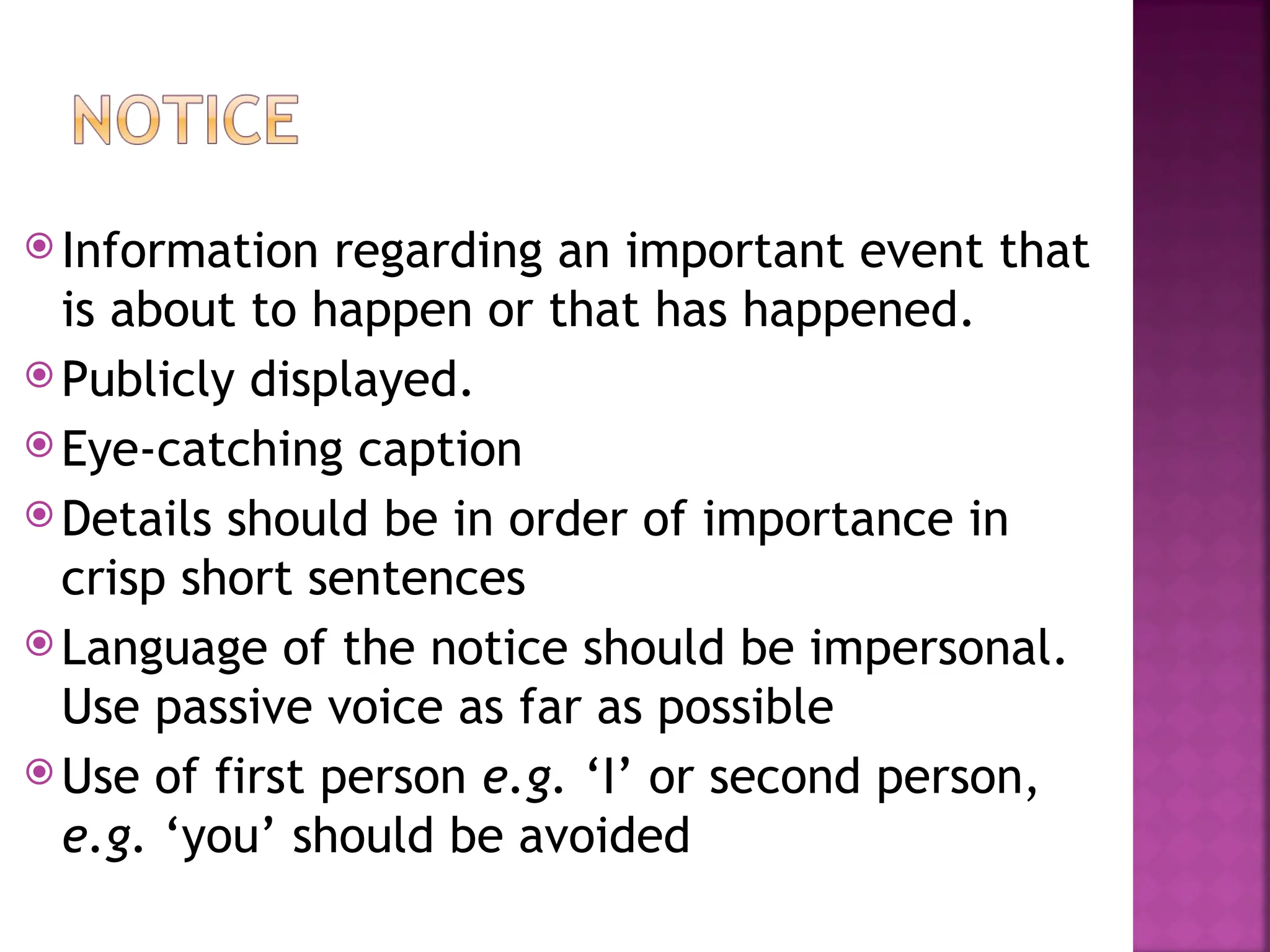
 Information regarding an important event that
is about to happen or that has happened.
 Publicly displayed.
 Eye-catching caption
 Details should be in order of importance in
crisp short sentences
 Language of the notice should be impersonal.
Use passive voice as far as possible
 Use of first person e.g. ‘I’ or second person,
e.g. ‘you’ should be avoided
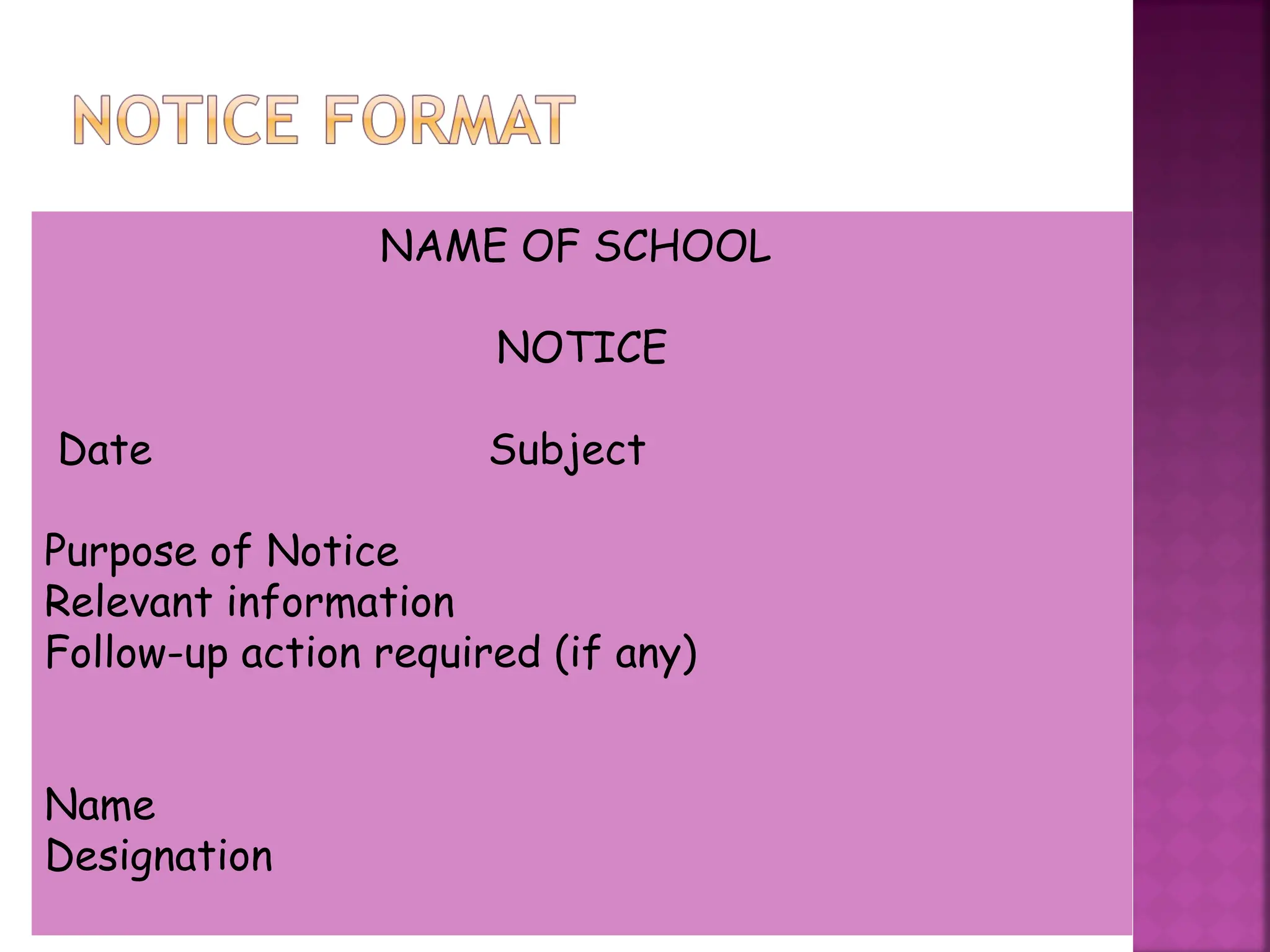
NAME OF SCHOOL
NOTICE
Date Subject
Purpose of Notice
Relevant information
Follow-up action required (if any)
Name
Designation
YOUTH AGAINST DRUGS
DRUGS: A SURE ROAD TO DEATH DRUGS: A SURE ROAD TO DEATH
Drug Abuse Among Youth ---- a growing menace
WHY students take to drugs:
Peer Pressure
Easy availability
Films/ TV advertisements glorify drug abuse
EFFECTS of drug abuse:
Indulge in crime to procure drugs
Loss of health
Death
WHAT can be done to remove this problem:
Increasing awareness through awareness campaigns
Strict action against drug peddlers
Increased counselling for students
DRUGS: A SURE ROAD TO DEATH DRUGS: A SURE ROAD TO DEATH
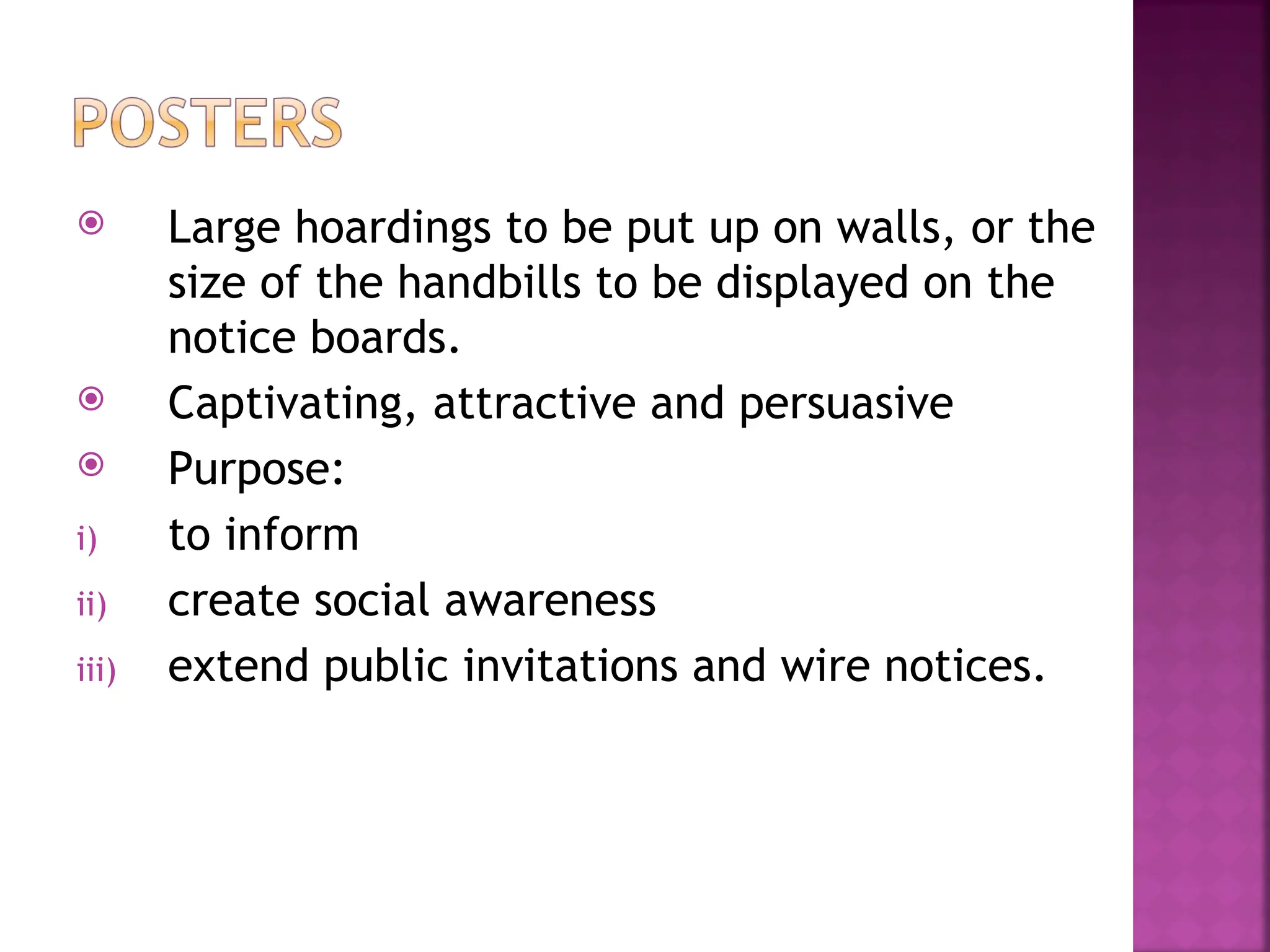
 Large hoardings to be put up on walls, or the
size of the handbills to be displayed on the
notice boards.
 Captivating, attractive and persuasive
 Purpose:
i) to inform
ii) create social awareness
iii) extend public invitations and wire notices.
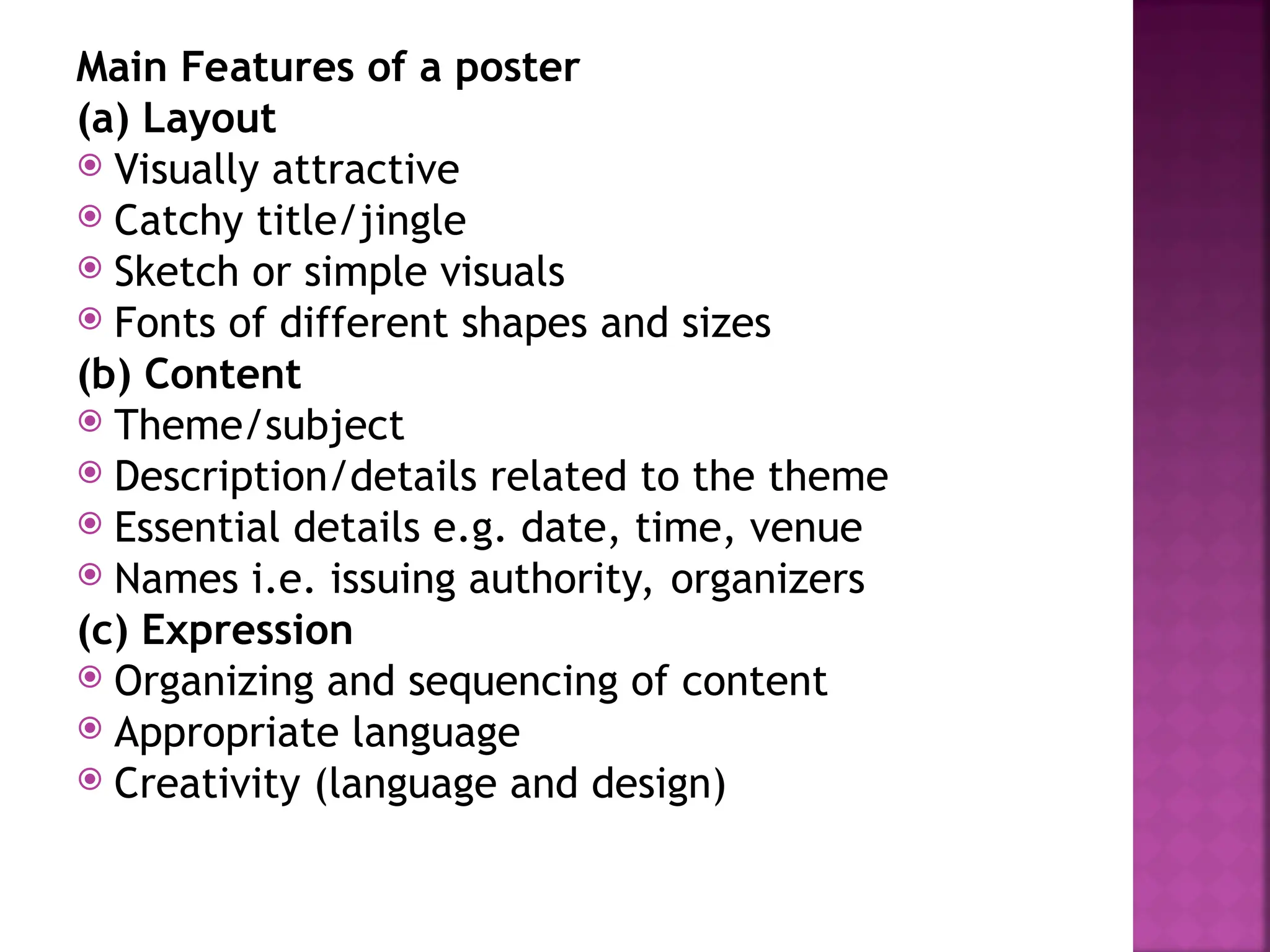
Main Features of a poster
(a) Layout
 Visually attractive
 Catchy title/jingle
 Sketch or simple visuals
 Fonts of different shapes and sizes
(b) Content
 Theme/subject
 Description/details related to the theme
 Essential details e.g. date, time, venue
 Names i.e. issuing authority, organizers
(c) Expression
 Organizing and sequencing of content
 Appropriate language
 Creativity (language and design)
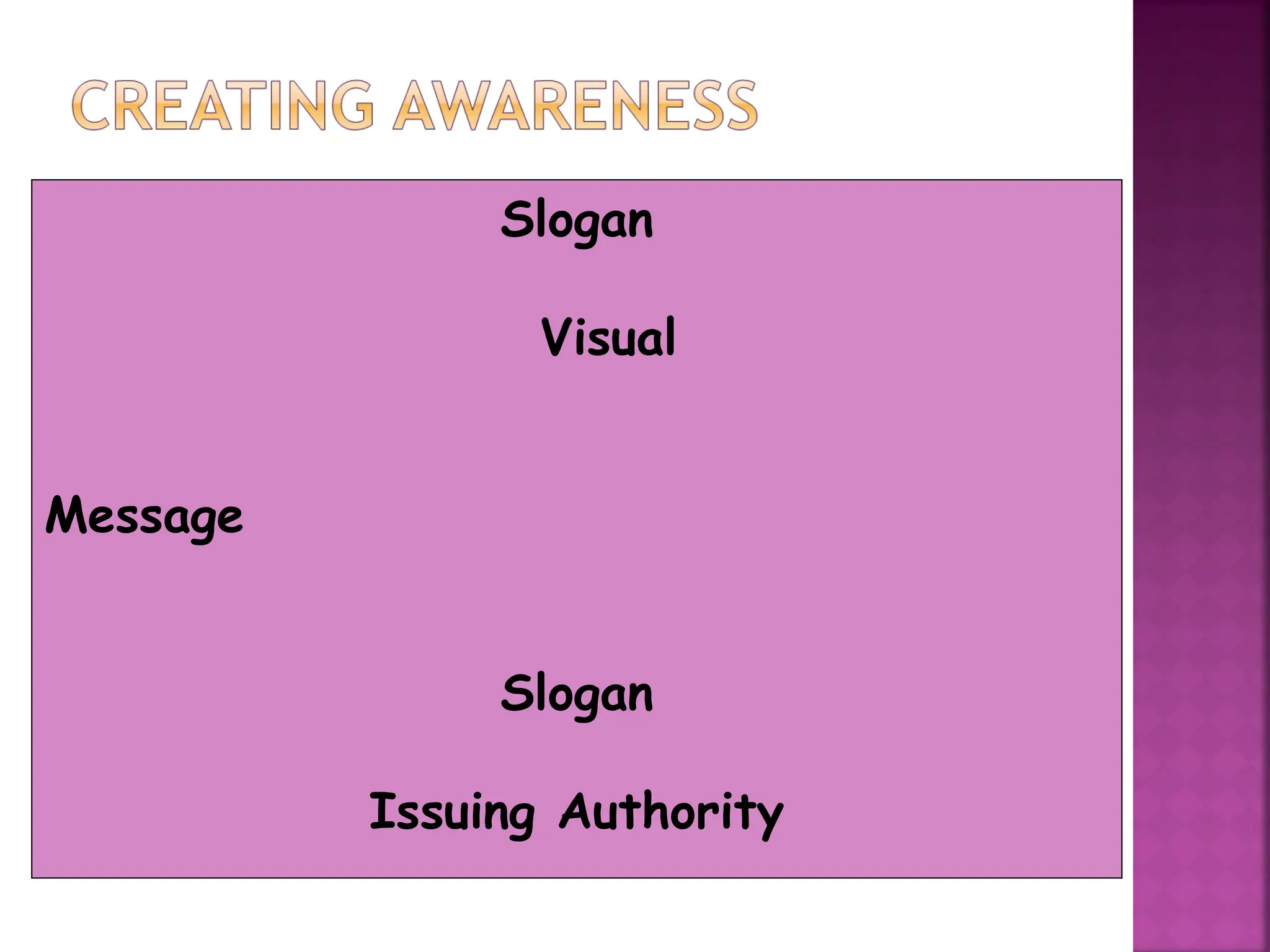
Slogan
Visual
Message
Slogan
Issuing Authority
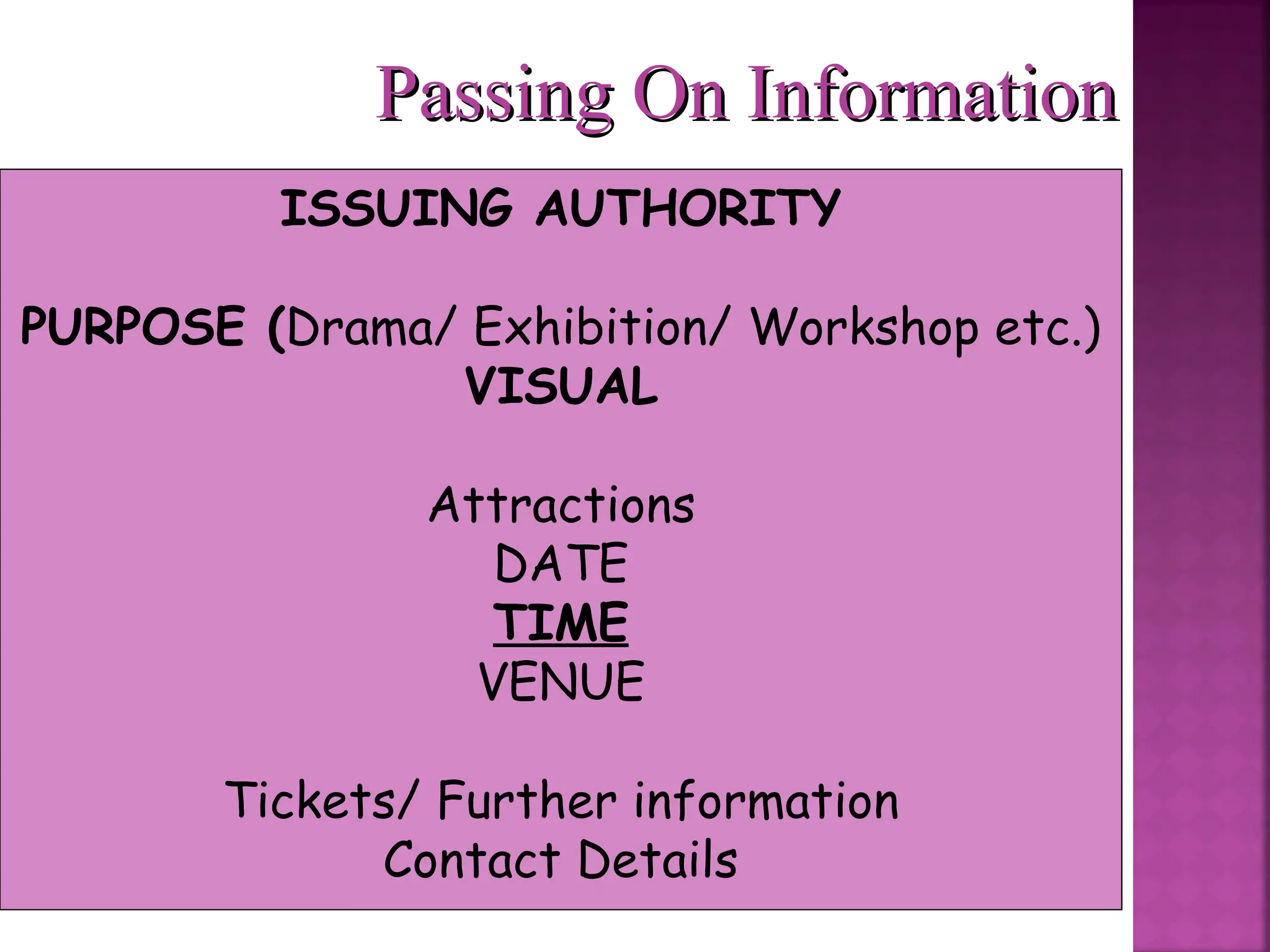
ISSUING AUTHORITY
PURPOSE (Drama/ Exhibition/ Workshop etc.)
VISUAL
Attractions
DATE
TIME
VENUE
Tickets/ Further information
Contact Details
Passing On Information
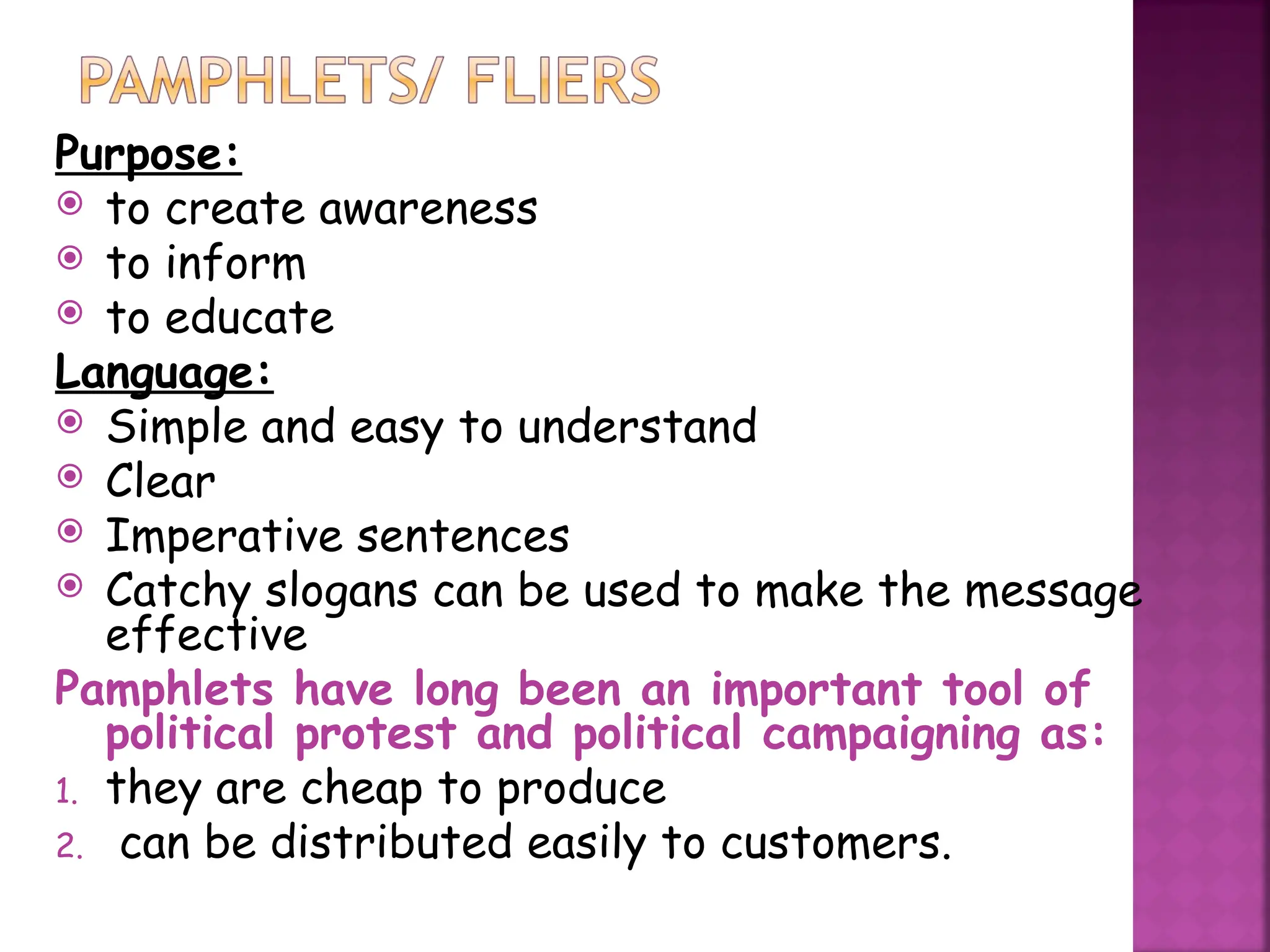
Purpose:
 to create awareness
 to inform
 to educate
Language:
 Simple and easy to understand
 Clear
 Imperative sentences
 Catchy slogans can be used to make the message
effective
Pamphlets have long been an important tool of
political protest and political campaigning as:
1. they are cheap to produce
2. can be distributed easily to customers.
The Editor
Hindustan Times
Kasturba Gandhi Marg
New Delhi
Sir
Ref: The Menace of Telemarketing
With reference to Vir Sanghvi’s write-up, Sorry, Wrong
Number (Hindustan Times November 4), it is becoming
evident that most mobile phone users are not interested
in receiving calls from telemarketers.
Though the National Do Not Call mechanism is a well
thought-out measure, the process of registration and
maintaining the huge database will cost millions of
rupees and man-hours. When people are against
receiving unwanted calls, why should there be such a
huge expenditure on a wasteful exercise? The best action
would be to ban all telemarketing calls. For those who
wish to receive such calls, let them get registered as
‘Open to call’.
Yours faithfully
Mahesh Kapasi
The Principal
National Fashion Institute
C.R.Das Road
Nasik
Subject: Information regarding Fashion Technology Course
Sir,
With reference to your advertisement in the Hindustan Times
dated 12th August 2004, I would request the following information
about the Fashion Technology Correspondence Course offered
by your institute.
•Duration of the course
•Fee structure and terms of payment
•Recognition by a Board/ University
•Employment prospects after completion of course.
I would like to add that I passed the AISSCE of the CBSE in the
Science Stream this year with 85% marks and am interested in
pursuing a career in Fashion Technology.
Hoping for an early reply.
Yours truly,
Sangeeta Jain
SANGEETA JAIN
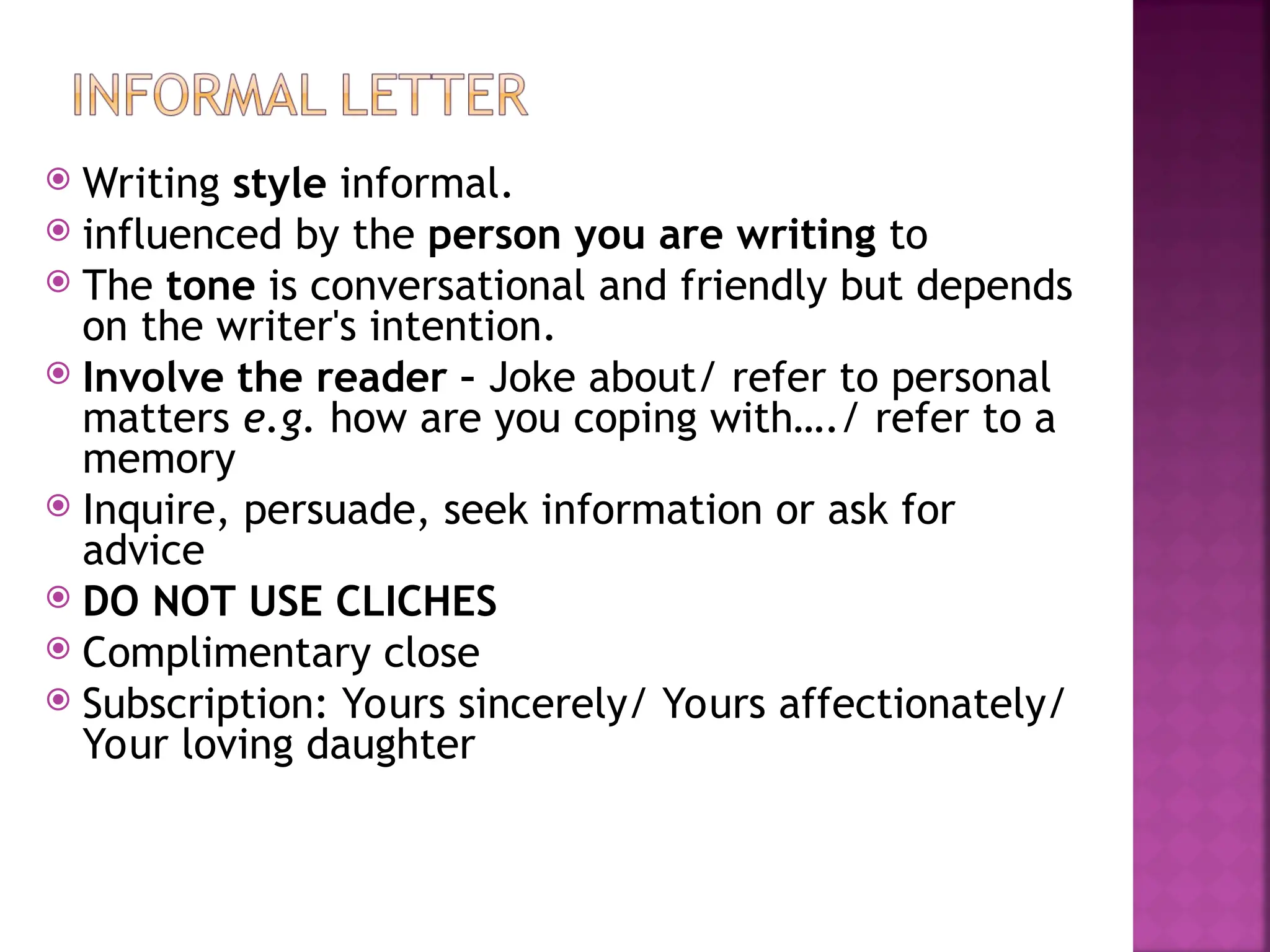
 Writing style informal.
 influenced by the person you are writing to
 The tone is conversational and friendly but depends
on the writer's intention.
 Involve the reader – Joke about/ refer to personal
matters e.g. how are you coping with…./ refer to a
memory
 Inquire, persuade, seek information or ask for
advice
 DO NOT USE CLICHES
 Complimentary close
 Subscription: Yours sincerely/ Yours affectionately/
Your loving daughter
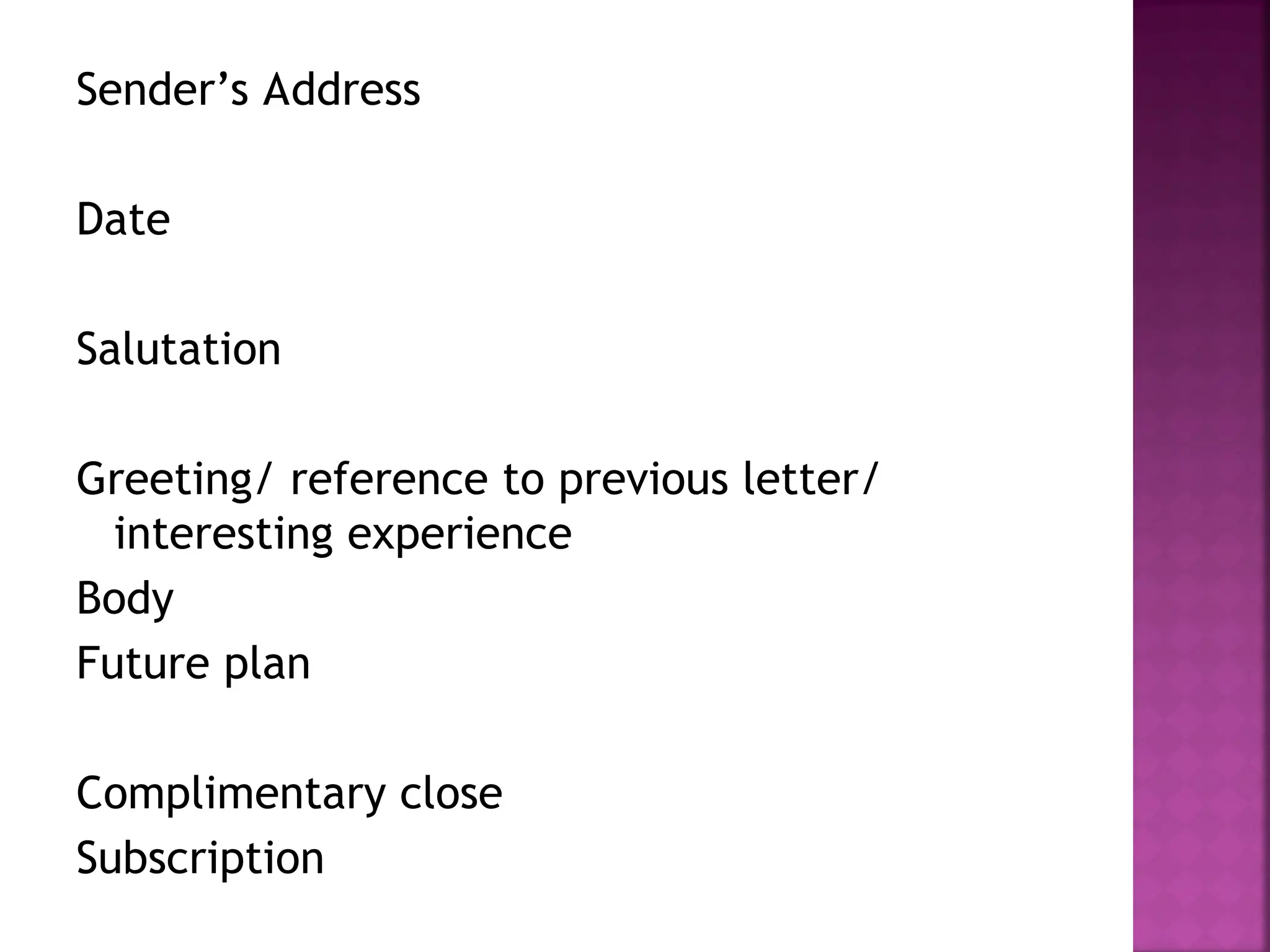
Sender’s Address
Date
Salutation
Greeting/ reference to previous letter/
interesting experience
Body
Future plan
Complimentary close
Subscription
With reference to Sukhadeo Thorat’s article
Learning curves (October 15), HRD Minister
Arjun Singh highlighted the sad state of higher
education at a meeting with the VCs of univer-
sities.
There must be a consensus that the government
should not act as an estate agent to acquire land
for private institutions. This scheme has been
tried in the past while setting up medical institu-
tions and it has not worked in the majority of
cases. Considering the exorbitant amount these
institutions charge, they should also acquire their
land and pay remunerative prices to the owners
rather than come with a begging bowl to the
government.
S Kamat
Goa
The Editor
Hindustan Times
Kasturba Gandhi Marg
New Delhi
Sir
Ref: The Menace of Telemarketing
With reference to Vir Sanghvi’s write-up, Sorry, Wrong
Number (Hindustan Times November 4), it is becoming
evident that most mobile phone users are not interested
in receiving calls from telemarketers.
Though the National Do Not Call mechanism is a well
thought-out measure, the process of registration and
maintaining the huge database will cost millions of
rupees and man-hours. When people are against
receiving unwanted calls, why should there be such a
huge expenditure on a wasteful exercise? The best action
would be to ban all telemarketing calls. For those who
wish to receive such calls, let them get registered as
‘Open to call’.
Yours faithfully
Mahesh Kapasi
Karan Thapar’s article, Spare a thought for Pratap
Naik (HT October 14) is thought-provoking. The case
is an example of injustice, inhumanity and shame to
the nation. The mental agony undergone by Pratap
Naik and his family, the harsh ordeal that took a
decade to resolve was heart-rending. A genuine case
of justice delayed being justice denied.
Yours truly
Harish Benjwal
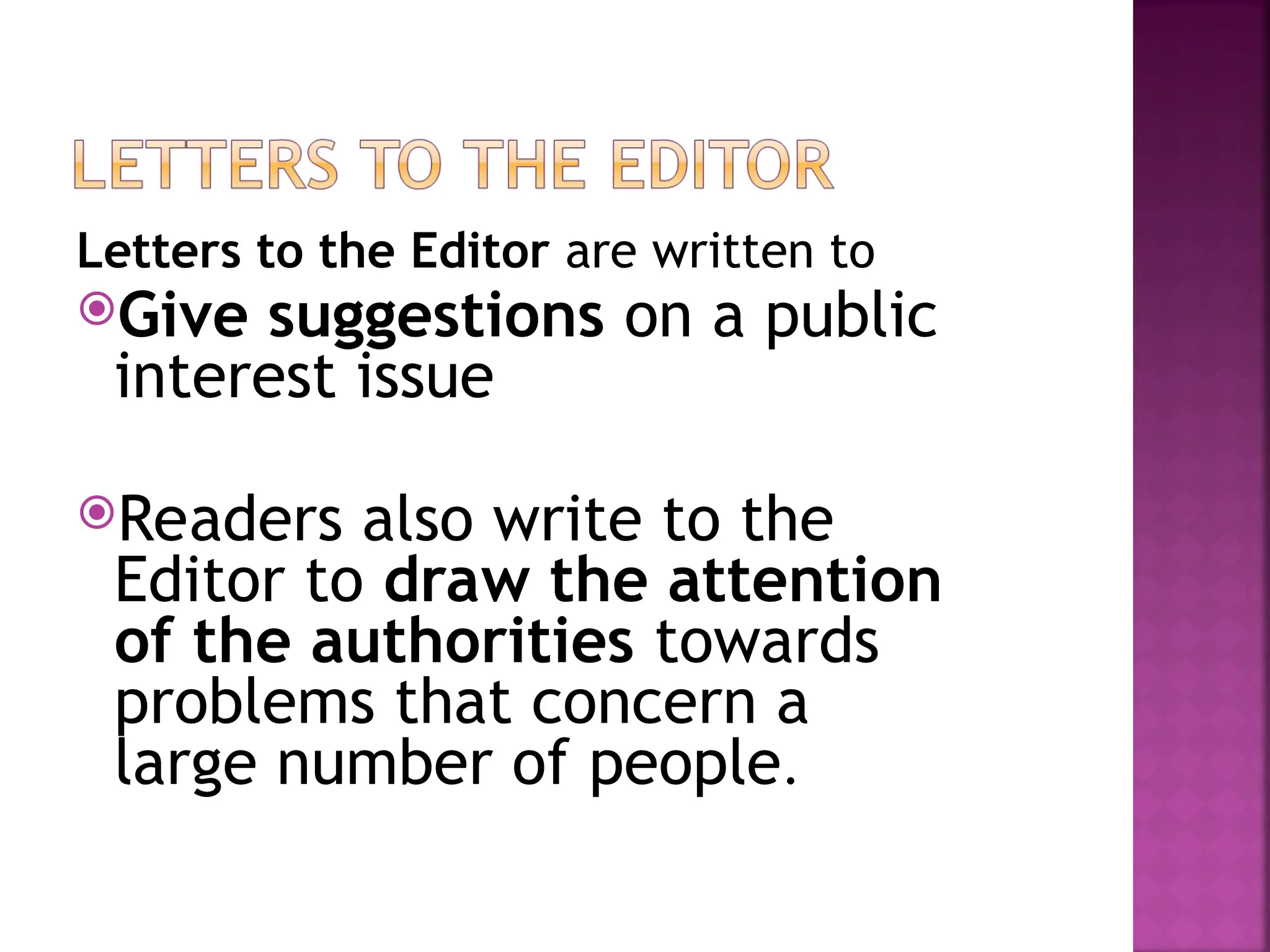
Letters to the Editor are written to
Give suggestions on a public
interest issue
Readers also write to the
Editor to draw the attention
of the authorities towards
problems that concern a
large number of people.
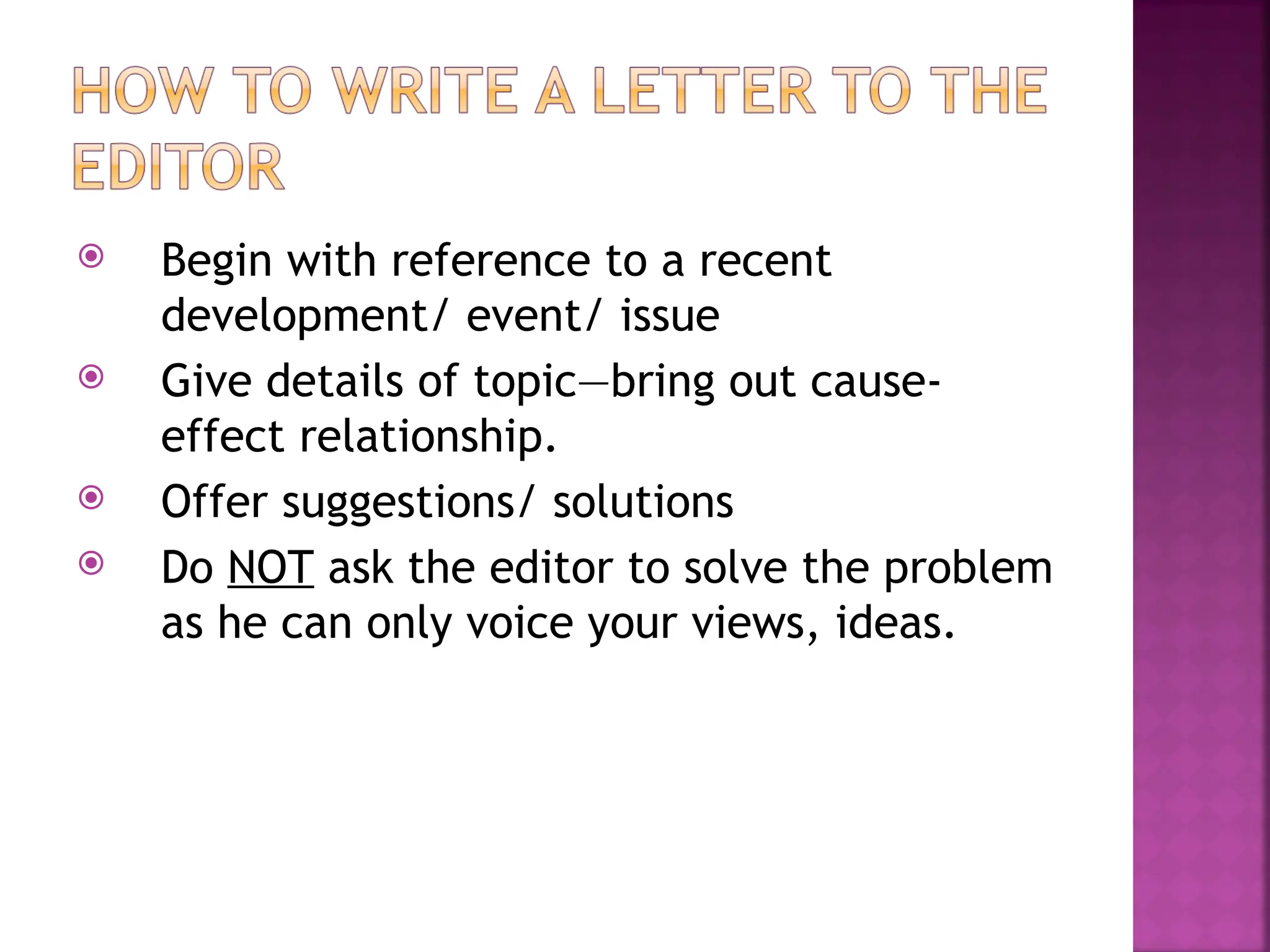
 Begin with reference to a recent
development/ event/ issue
 Give details of topic—bring out cause-
effect relationship.
 Offer suggestions/ solutions
 Do NOT ask the editor to solve the problem
as he can only voice your views, ideas.
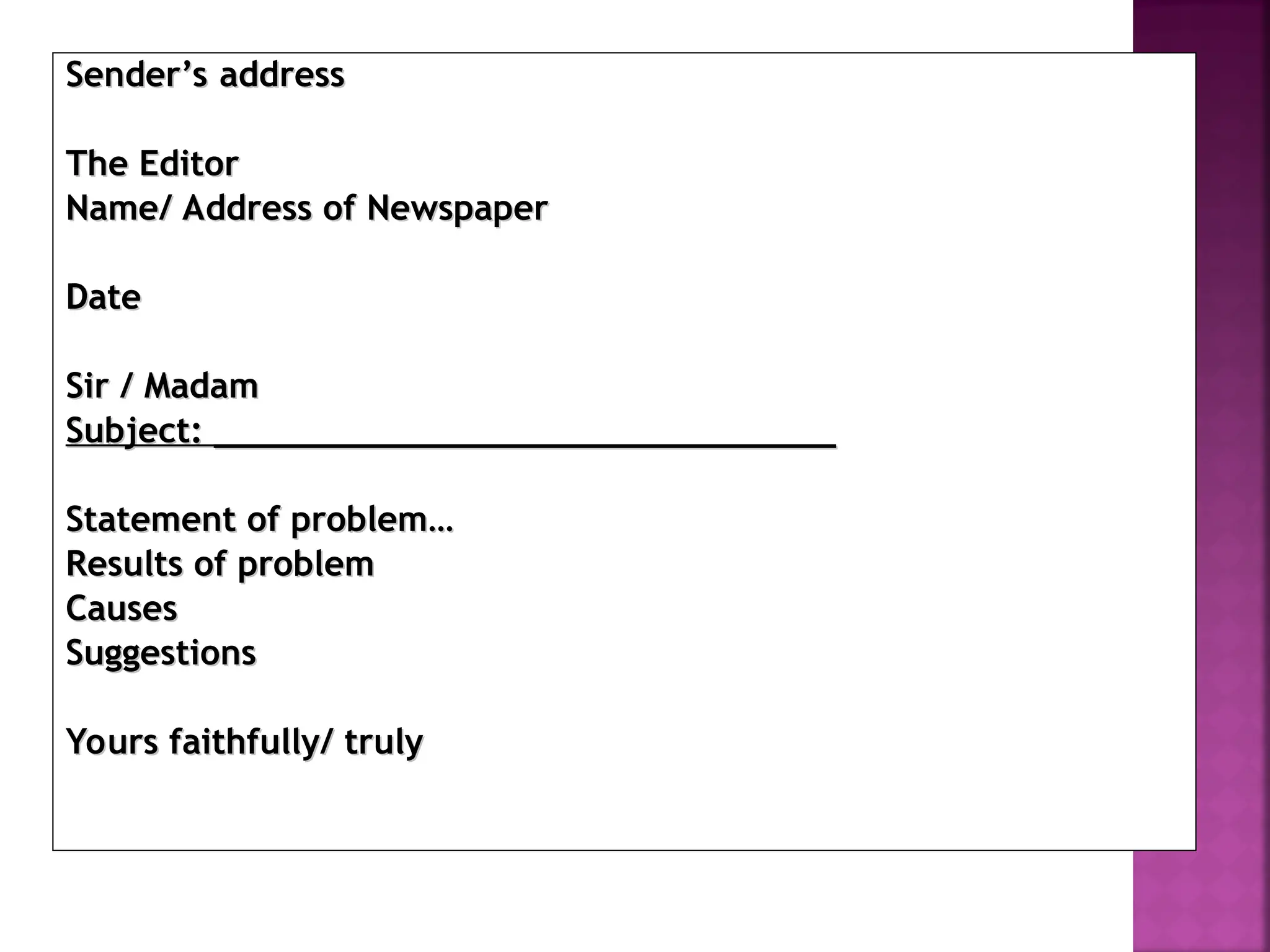
Sender’s address
Sender’s address
The Editor
The Editor
Name/ Address of Newspaper
Date
Date
Sir / Madam
Sir / Madam
Subject:
Subject: ______________________________
______________________________
Statement of problem…
Results of problem
Results of problem
Causes
Causes
Suggestions
Suggestions
Yours faithfully/ truly
Miles to go
T.K. RAJALAKSHMI
e report of the third National Family Health Survey
NFHS-3), released in the second week of October,
s immense significance for policymakers in health,
utrition, education and gender issues. The NFHS-3
2005-06) is significant in that it has gone beyond
he parameters set by the two preceding surveys,
in 1998-99 and 1992-93. And for the first time,
Between the Lines
AG Noorani
The sting operation has come to stay in India. Tehelka’s
expose on March 13, 2001, led to the resignations of the
then defence minister, George Fernandes and the former
BJP president, Bangaru Laxman. In December 2005, 11
MPs were caught on camera by Aaj Tak taking cash for
asking questions in Parliament. They were forced to resign.
Now, a television channel has rendered a service to the
probity of the criminal justice system by its expose of
two lawyers in the BMW hit-and-run case: R.K. Anand
for the defence and I.U. Khan, the prosecutor who has
resigned since then.
Tsunami
--Priyanka Gupta XII C
A tsunami is a series of gigantic
waves that occur in the ocean
or other large bodies of water.
Formed when a large amount
of water is rapidly displaced,
tsunamis are often caused by
an earthquake, a landslide, an
exploding volcano, or even a
meteorite impact.
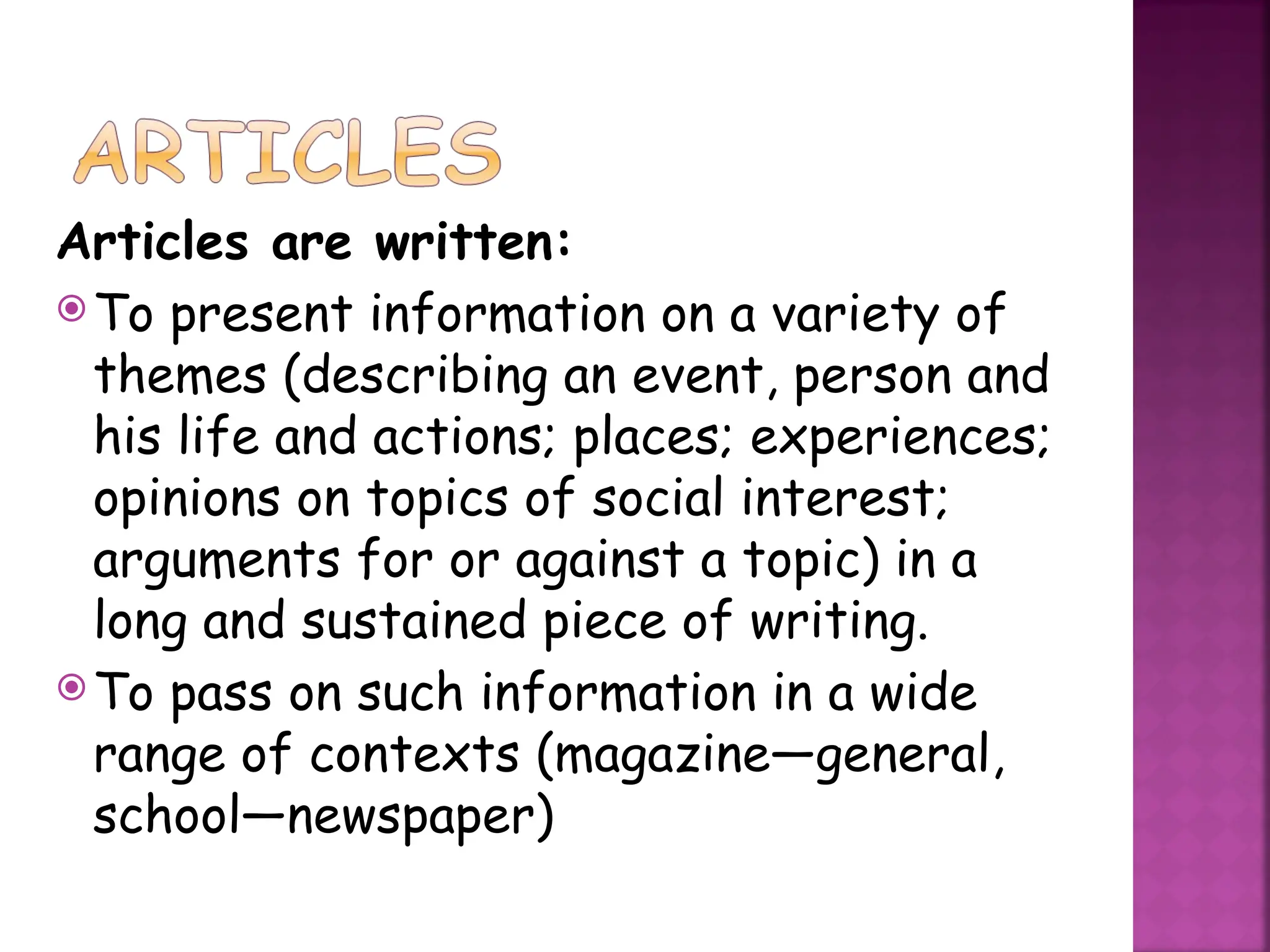
Articles are written:
To present information on a variety of
themes (describing an event, person and
his life and actions; places; experiences;
opinions on topics of social interest;
arguments for or against a topic) in a
long and sustained piece of writing.
To pass on such information in a wide
range of contexts (magazine—general,
school—newspaper)
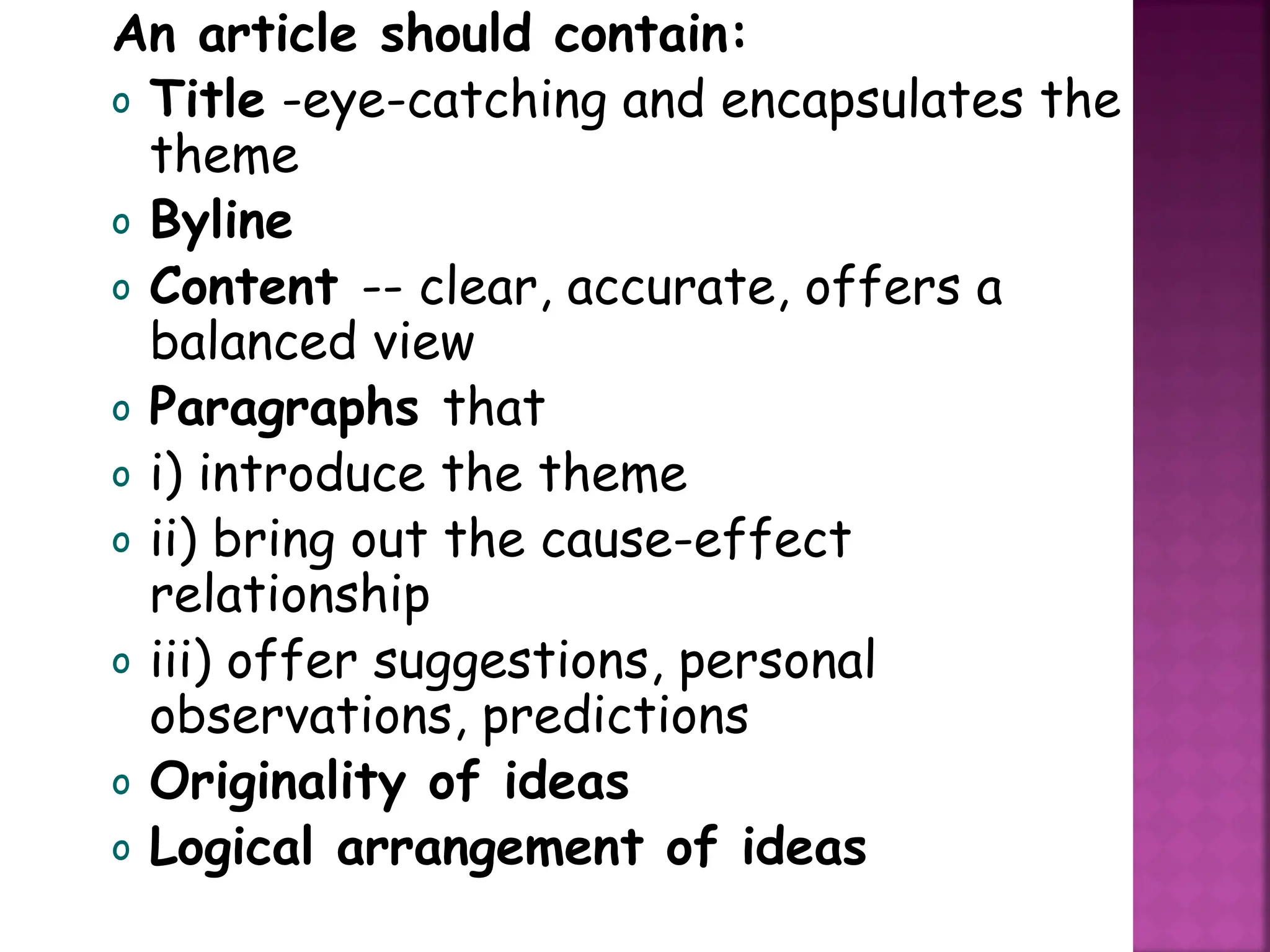
An article should contain:
o Title -eye-catching and encapsulates the
theme
o Byline
o Content -- clear, accurate, offers a
balanced view
o Paragraphs that
o i) introduce the theme
o ii) bring out the cause-effect
relationship
o iii) offer suggestions, personal
observations, predictions
o Originality of ideas
o Logical arrangement of ideas
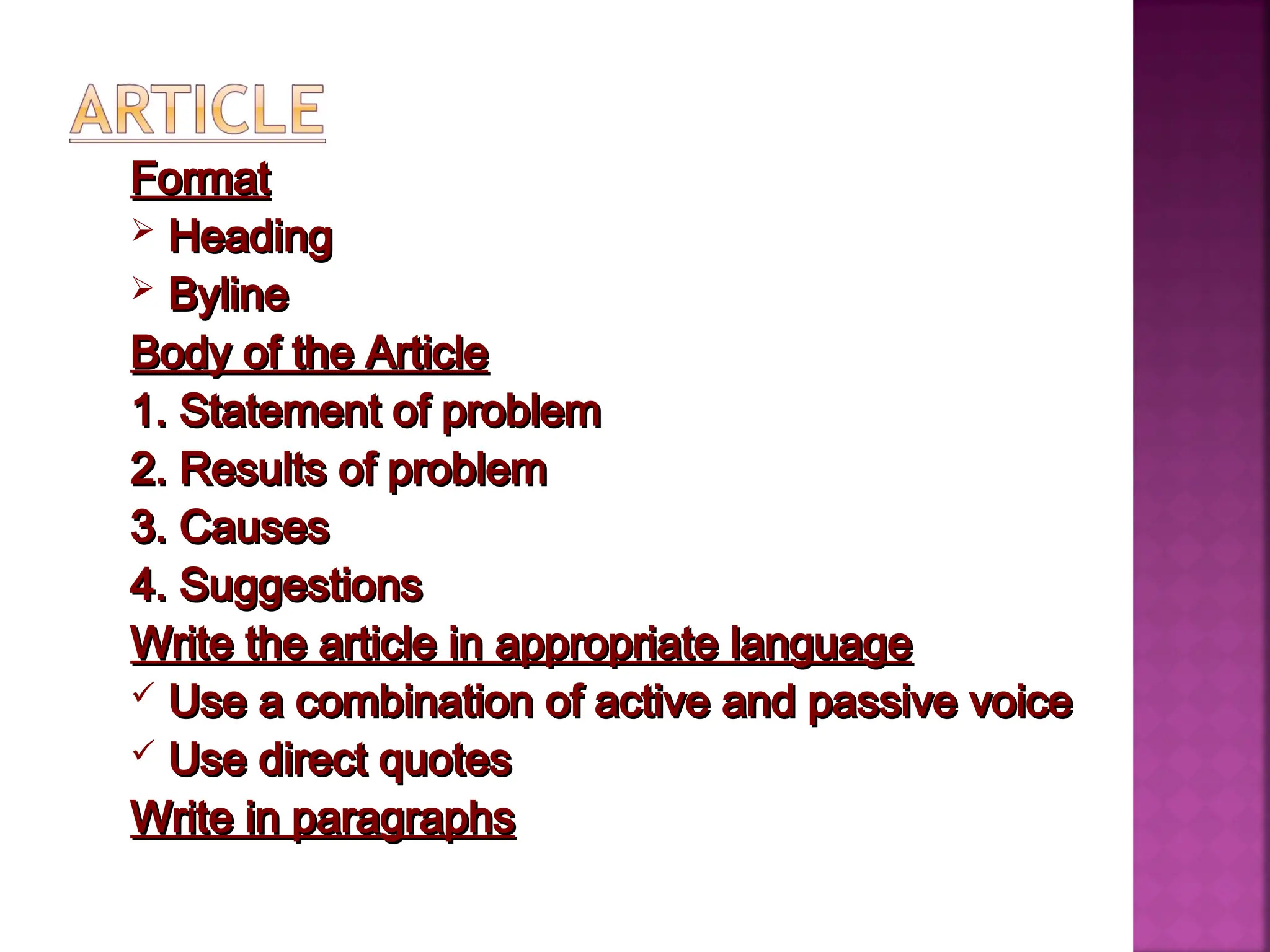
Format
Format
 Heading
Heading
 Byline
Byline
Body of the Article
Body of the Article
1. Statement of problem
2. Results of problem
3. Causes
3. Causes
4. Suggestions
4. Suggestions
Write the article in appropriate language
 Use a combination of active and passive voice
Use a combination of active and passive voice
 Use direct quotes
Use direct quotes
Write in paragraphs
Write in paragraphs
Format
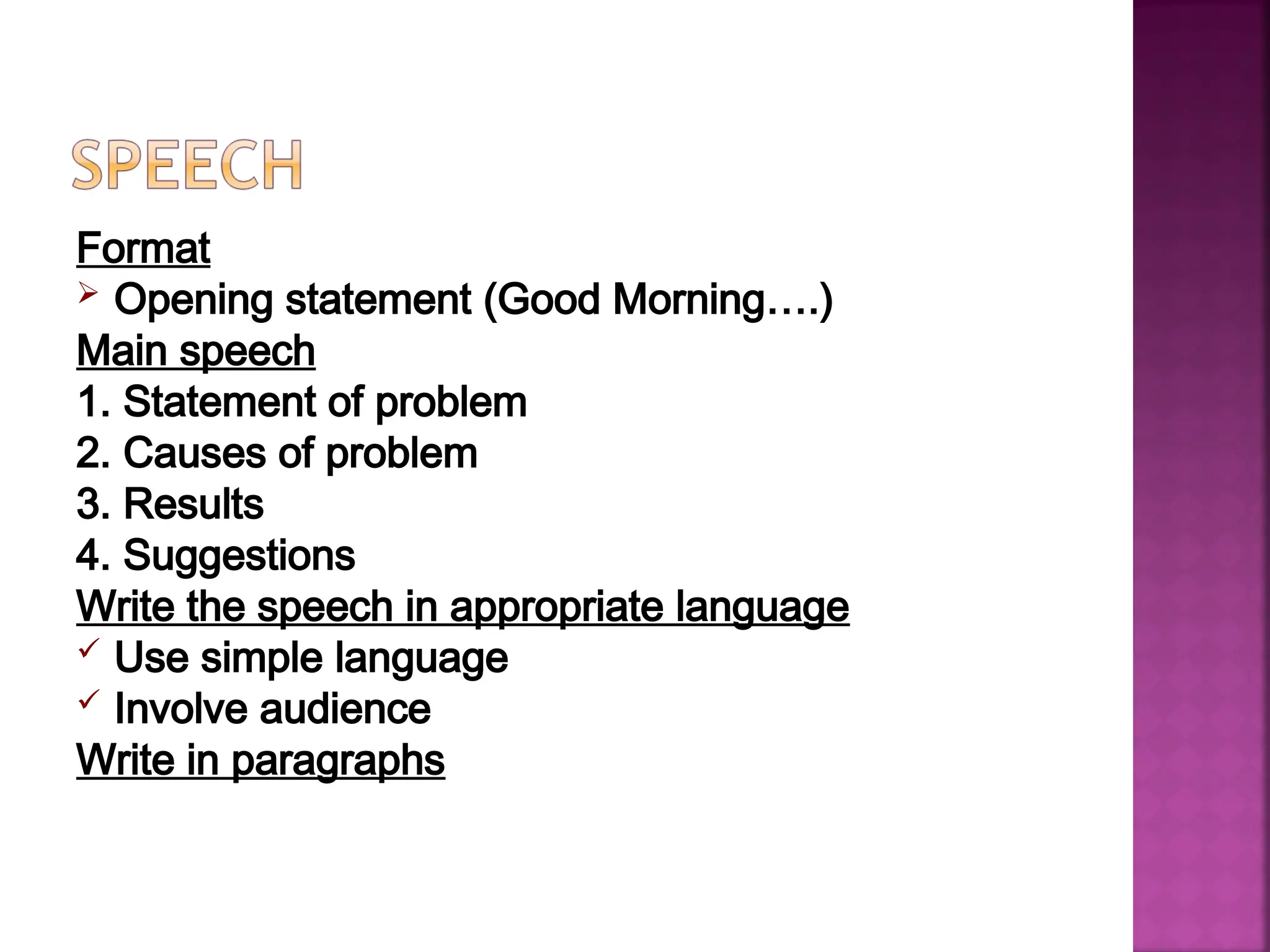
 Opening statement (Good Morning….)
Main speech
1. Statement of problem
2. Causes of problem
3. Results
4. Suggestions
Write the speech in appropriate language
 Use simple language
 Involve audience
Write in paragraphs
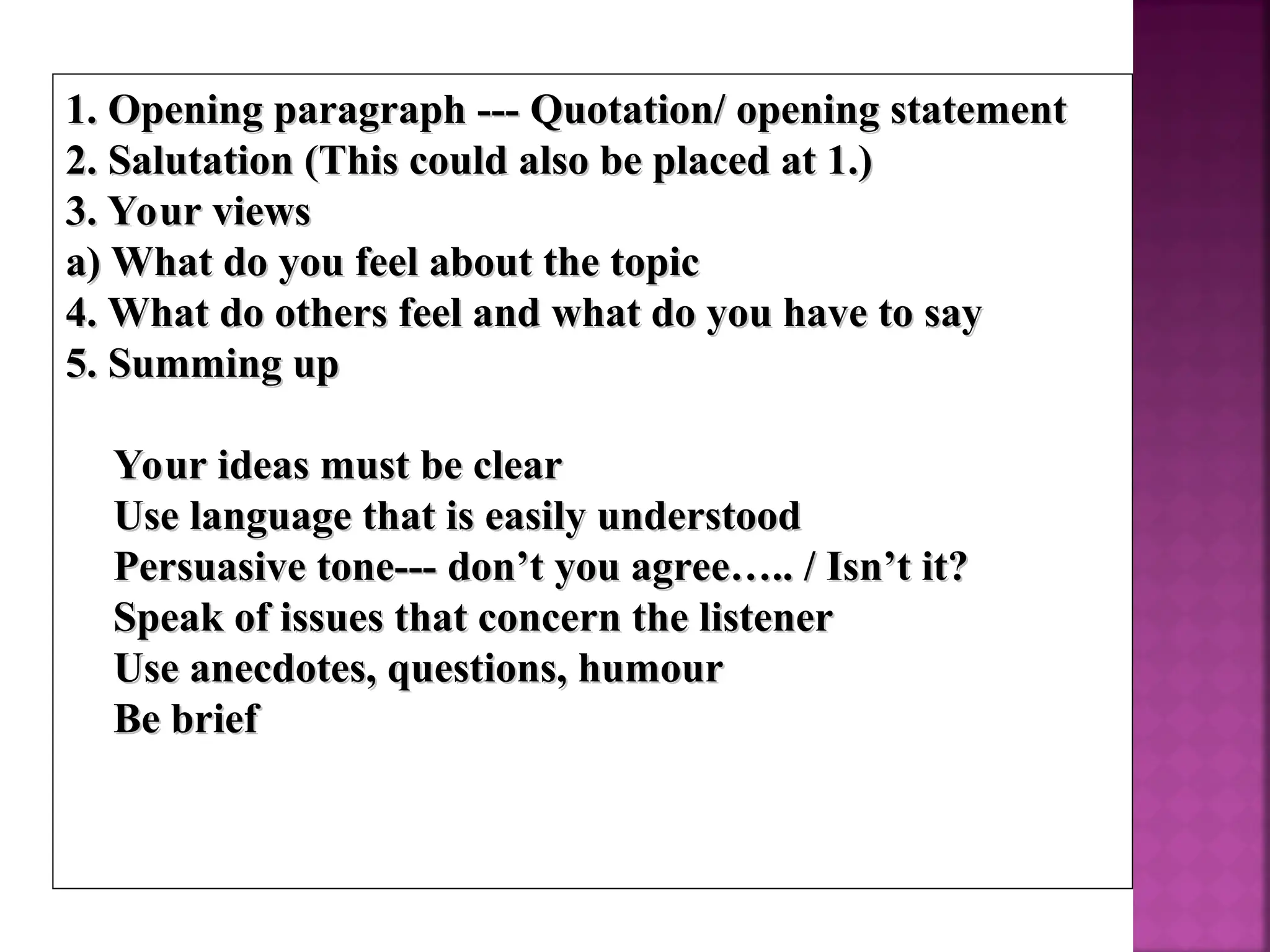
1. Opening paragraph --- Quotation/ opening statement
2. Salutation (This could also be placed at 1.)
3. Your views
3. Your views
a) What do you feel about the topic
4. What do others feel and what do you have to say
5. Summing up
5. Summing up
 Your ideas must be clear
Your ideas must be clear
 Use language that is easily understood
Use language that is easily understood
 Persuasive tone--- don’t you agree….. / Isn’t it?
Persuasive tone--- don’t you agree….. / Isn’t it?
 Speak of issues that concern the listener
Speak of issues that concern the listener
 Use anecdotes, questions, humour
Use anecdotes, questions, humour
 Be brief
Be brief
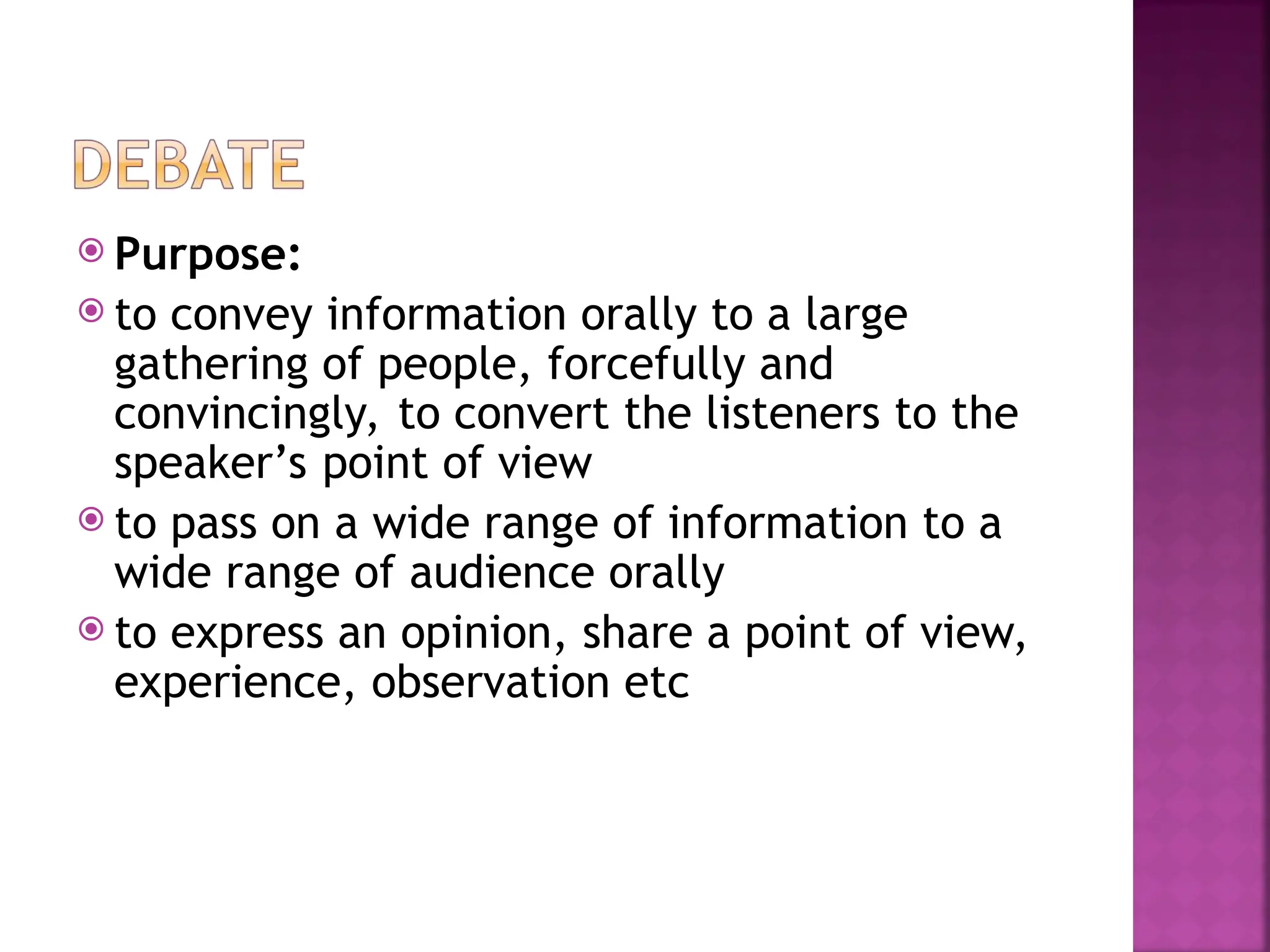
 Purpose:
 to convey information orally to a large
gathering of people, forcefully and
convincingly, to convert the listeners to the
speaker’s point of view
 to pass on a wide range of information to a
wide range of audience orally
 to express an opinion, share a point of view,
experience, observation etc
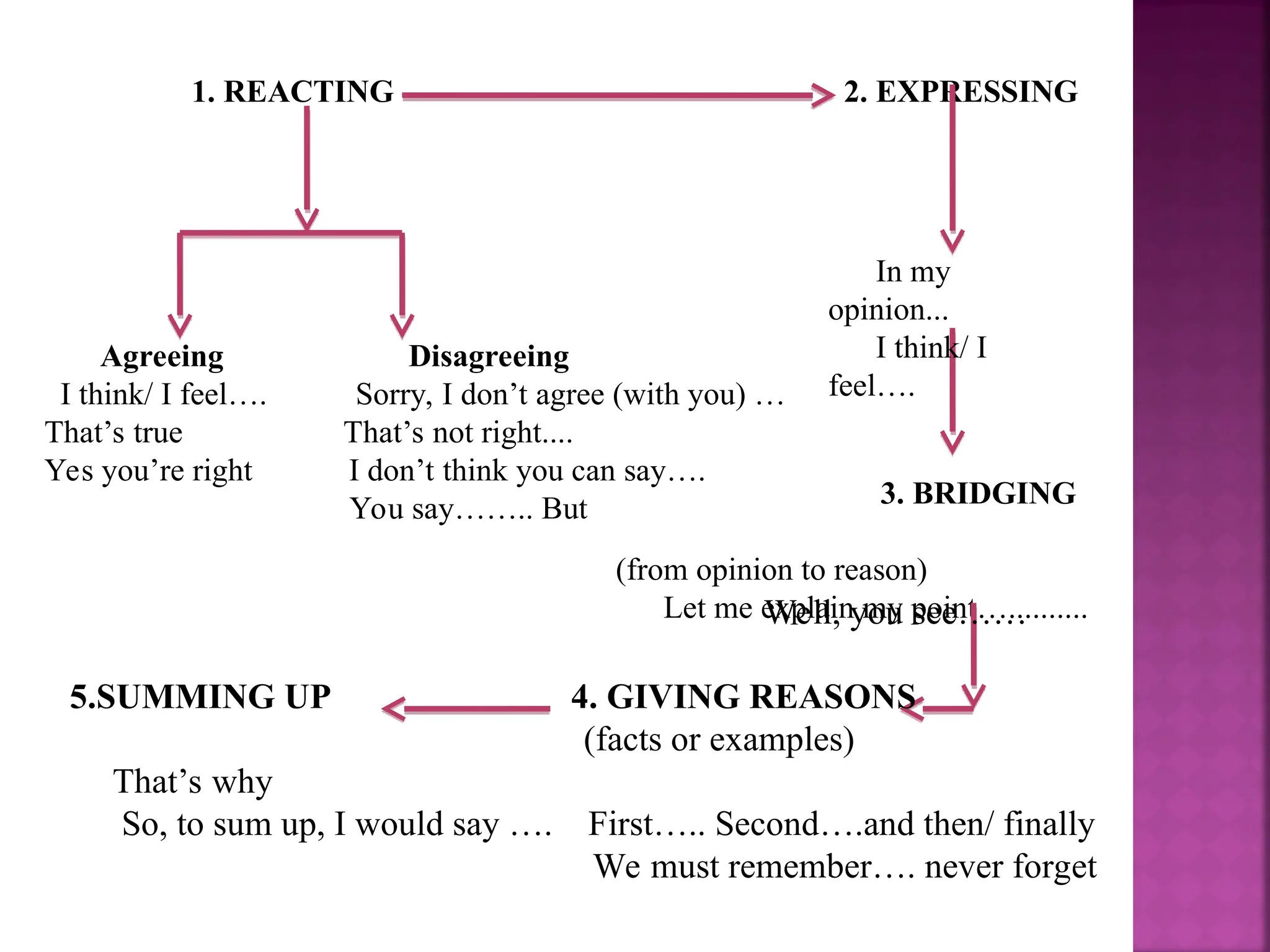
1. REACTING 2. EXPRESSING
Agreeing Disagreeing
I think/ I feel…. Sorry, I don’t agree (with you) …
That’s true That’s not right....
Yes you’re right I don’t think you can say….
You say…….. But
In my
opinion...
I think/ I
feel….
3. BRIDGING
(from opinion to reason)
Let me explain my point…..........
5.SUMMING UP 4. GIVING REASONS
(facts or examples)
That’s why
So, to sum up, I would say …. First….. Second….and then/ finally
We must remember…. never forget
Well, you see……
 Opening statement/ Quotation
 Respected Chairperson, Members of the
Jury, Teachers and my dear friends
 I strongly support/ reject/ oppose the
motion ….
 First reason for/ against
 Second reason for/ against
 My worthy opponent has just pointed out
…… But I feel
 Friends, don’t you agree with me when I
say …….
 Although my opponent may feel ……
 Summing up
 Includes only relevant points and
information.
 Usually written in third person and
indirect speech.
 Passive voice is used.
 Language is formal, neutral and
figurative.
 Past indefinite, past continuous and
past perfect tenses are used.
 Personal pronouns are to be avoided
 ‘Journalese’ or journalistic vocabulary
is used
Headline
States topic in a strong, short phrase or
statement.
Is catchy
Brief – leave out articles, prepositions, etc
where possible, use abbreviations/ shortened
word-forms wherever possible
By-line
By whom the news is written.
In case no name is mentioned write by our
Special Correspondent/ by our Staff Reporter.
Lead Paragraph
 Who? What? Where? When? Why?
 Day, date, and time when event happened
 Name/names of person(s)/ event(s) etc news is
about.
 The place where incident happened
 Details of incident
 Reasons why incident happened
Paragraph 2
 Eye-witness accounts.
Paragraph 3
 Future course of action being planned
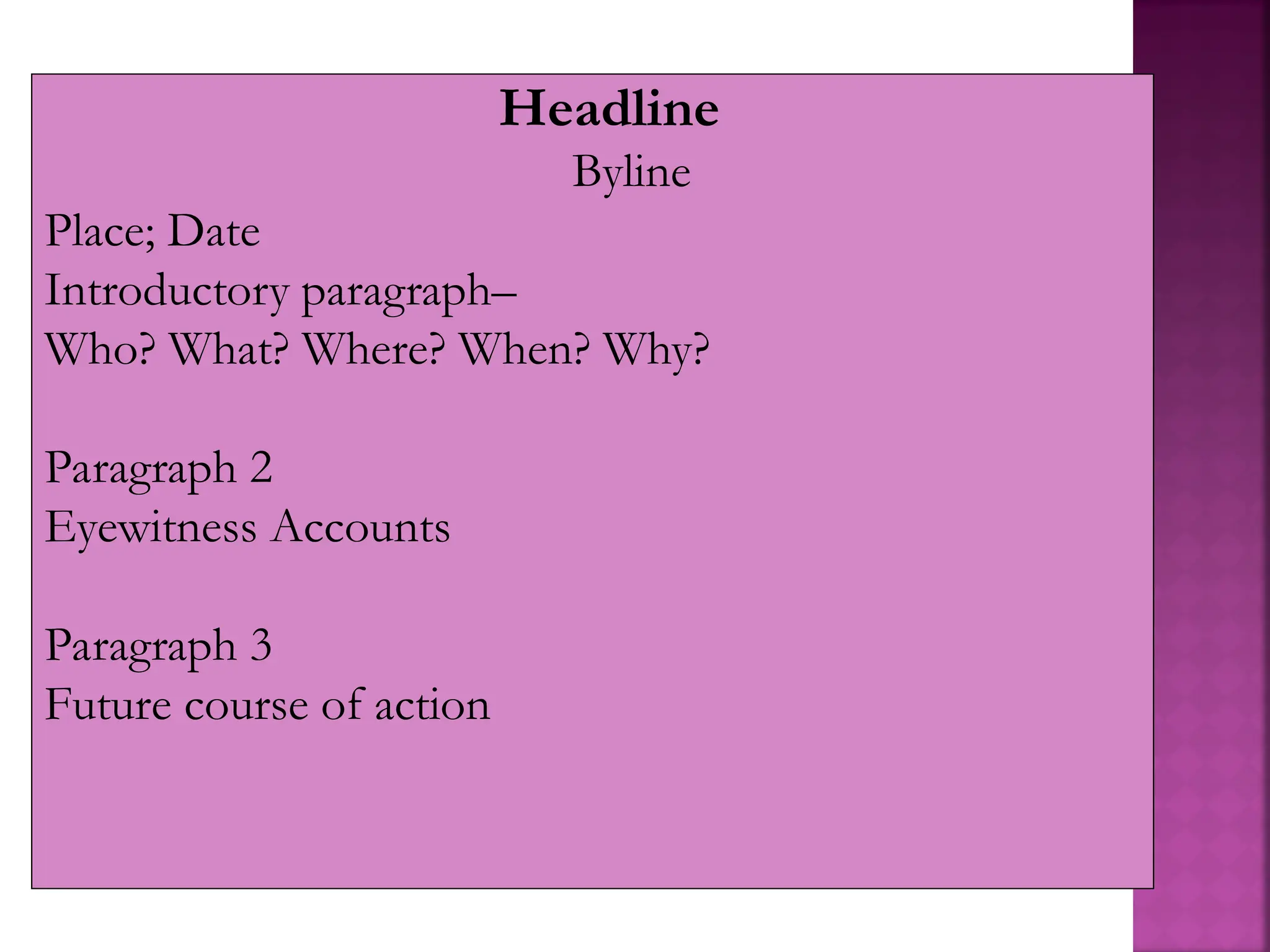
Headline
Byline
Place; Date
Introductory paragraph–
Who? What? Where? When? Why?
Paragraph 2
Eyewitness Accounts
Paragraph 3
Future course of action

WRITING SKILLS for uneducated ,illiterate ,nigga people

  • 2.
    Blood Bank Society,Allahabad NOTICE 27th March 2006 Blood Donation Camp A blood donation camp is being organised on the 4th April 2006 from 9 am to 6.30 pm at Brave Heart Hospital. Students are requested to donate blood as your donation may save a life. Light refreshments will be provided to the donors. For further details contact XYZ Secretary, Blood Bank Society BLOSSOMS PUBLIC SCHOOL, GULBARGA NOTICE 20th March 2006 Inter-Class Debate Competition Students of Classes IX and X are hereby informed that an Inter- class Debate competition is being organised on the 5th April at 10 am in the School Auditorium. The topic is ‘There should be reservations for OBCs in schools’. Students interested in participating should give in their names to the undersigned by 1st April. Geetanjali Ahuja Head Girl VIDYA PUBLIC SCHOOL, GURGAON NOTICE 20th March 2006 Orientation Camp—Air Force An Orientation Camp is being organised on the 5th April from 10 am to 5 pm in the School Auditorium for those interested in joining the Air Force after school. The camp will be conducted by an Air Force Officer. Students from Classes XI and XII interested in participating should give in their names to the undersigned by 1st April. Mridul Head Boy
  • 3.
     Information regardingan important event that is about to happen or that has happened.  Publicly displayed.  Eye-catching caption  Details should be in order of importance in crisp short sentences  Language of the notice should be impersonal. Use passive voice as far as possible  Use of first person e.g. ‘I’ or second person, e.g. ‘you’ should be avoided
  • 4.
    NAME OF SCHOOL NOTICE DateSubject Purpose of Notice Relevant information Follow-up action required (if any) Name Designation
  • 5.
    YOUTH AGAINST DRUGS DRUGS:A SURE ROAD TO DEATH DRUGS: A SURE ROAD TO DEATH Drug Abuse Among Youth ---- a growing menace WHY students take to drugs: Peer Pressure Easy availability Films/ TV advertisements glorify drug abuse EFFECTS of drug abuse: Indulge in crime to procure drugs Loss of health Death WHAT can be done to remove this problem: Increasing awareness through awareness campaigns Strict action against drug peddlers Increased counselling for students DRUGS: A SURE ROAD TO DEATH DRUGS: A SURE ROAD TO DEATH
  • 6.
     Large hoardingsto be put up on walls, or the size of the handbills to be displayed on the notice boards.  Captivating, attractive and persuasive  Purpose: i) to inform ii) create social awareness iii) extend public invitations and wire notices.
  • 7.
    Main Features ofa poster (a) Layout  Visually attractive  Catchy title/jingle  Sketch or simple visuals  Fonts of different shapes and sizes (b) Content  Theme/subject  Description/details related to the theme  Essential details e.g. date, time, venue  Names i.e. issuing authority, organizers (c) Expression  Organizing and sequencing of content  Appropriate language  Creativity (language and design)
  • 8.
  • 9.
    ISSUING AUTHORITY PURPOSE (Drama/Exhibition/ Workshop etc.) VISUAL Attractions DATE TIME VENUE Tickets/ Further information Contact Details Passing On Information Passing On Information
  • 10.
    Purpose:  to createawareness  to inform  to educate Language:  Simple and easy to understand  Clear  Imperative sentences  Catchy slogans can be used to make the message effective Pamphlets have long been an important tool of political protest and political campaigning as: 1. they are cheap to produce 2. can be distributed easily to customers.
  • 11.
    The Editor Hindustan Times KasturbaGandhi Marg New Delhi Sir Ref: The Menace of Telemarketing With reference to Vir Sanghvi’s write-up, Sorry, Wrong Number (Hindustan Times November 4), it is becoming evident that most mobile phone users are not interested in receiving calls from telemarketers. Though the National Do Not Call mechanism is a well thought-out measure, the process of registration and maintaining the huge database will cost millions of rupees and man-hours. When people are against receiving unwanted calls, why should there be such a huge expenditure on a wasteful exercise? The best action would be to ban all telemarketing calls. For those who wish to receive such calls, let them get registered as ‘Open to call’. Yours faithfully Mahesh Kapasi The Principal National Fashion Institute C.R.Das Road Nasik Subject: Information regarding Fashion Technology Course Sir, With reference to your advertisement in the Hindustan Times dated 12th August 2004, I would request the following information about the Fashion Technology Correspondence Course offered by your institute. •Duration of the course •Fee structure and terms of payment •Recognition by a Board/ University •Employment prospects after completion of course. I would like to add that I passed the AISSCE of the CBSE in the Science Stream this year with 85% marks and am interested in pursuing a career in Fashion Technology. Hoping for an early reply. Yours truly, Sangeeta Jain SANGEETA JAIN
  • 12.
     Writing styleinformal.  influenced by the person you are writing to  The tone is conversational and friendly but depends on the writer's intention.  Involve the reader – Joke about/ refer to personal matters e.g. how are you coping with…./ refer to a memory  Inquire, persuade, seek information or ask for advice  DO NOT USE CLICHES  Complimentary close  Subscription: Yours sincerely/ Yours affectionately/ Your loving daughter
  • 13.
    Sender’s Address Date Salutation Greeting/ referenceto previous letter/ interesting experience Body Future plan Complimentary close Subscription
  • 14.
    With reference toSukhadeo Thorat’s article Learning curves (October 15), HRD Minister Arjun Singh highlighted the sad state of higher education at a meeting with the VCs of univer- sities. There must be a consensus that the government should not act as an estate agent to acquire land for private institutions. This scheme has been tried in the past while setting up medical institu- tions and it has not worked in the majority of cases. Considering the exorbitant amount these institutions charge, they should also acquire their land and pay remunerative prices to the owners rather than come with a begging bowl to the government. S Kamat Goa The Editor Hindustan Times Kasturba Gandhi Marg New Delhi Sir Ref: The Menace of Telemarketing With reference to Vir Sanghvi’s write-up, Sorry, Wrong Number (Hindustan Times November 4), it is becoming evident that most mobile phone users are not interested in receiving calls from telemarketers. Though the National Do Not Call mechanism is a well thought-out measure, the process of registration and maintaining the huge database will cost millions of rupees and man-hours. When people are against receiving unwanted calls, why should there be such a huge expenditure on a wasteful exercise? The best action would be to ban all telemarketing calls. For those who wish to receive such calls, let them get registered as ‘Open to call’. Yours faithfully Mahesh Kapasi Karan Thapar’s article, Spare a thought for Pratap Naik (HT October 14) is thought-provoking. The case is an example of injustice, inhumanity and shame to the nation. The mental agony undergone by Pratap Naik and his family, the harsh ordeal that took a decade to resolve was heart-rending. A genuine case of justice delayed being justice denied. Yours truly Harish Benjwal
  • 15.
    Letters to theEditor are written to Give suggestions on a public interest issue Readers also write to the Editor to draw the attention of the authorities towards problems that concern a large number of people.
  • 16.
     Begin withreference to a recent development/ event/ issue  Give details of topic—bring out cause- effect relationship.  Offer suggestions/ solutions  Do NOT ask the editor to solve the problem as he can only voice your views, ideas.
  • 17.
    Sender’s address Sender’s address TheEditor The Editor Name/ Address of Newspaper Name/ Address of Newspaper Date Date Sir / Madam Sir / Madam Subject: Subject: ______________________________ ______________________________ Statement of problem… Statement of problem… Results of problem Results of problem Causes Causes Suggestions Suggestions Yours faithfully/ truly Yours faithfully/ truly
  • 18.
    Miles to go T.K.RAJALAKSHMI e report of the third National Family Health Survey NFHS-3), released in the second week of October, s immense significance for policymakers in health, utrition, education and gender issues. The NFHS-3 2005-06) is significant in that it has gone beyond he parameters set by the two preceding surveys, in 1998-99 and 1992-93. And for the first time, Between the Lines AG Noorani The sting operation has come to stay in India. Tehelka’s expose on March 13, 2001, led to the resignations of the then defence minister, George Fernandes and the former BJP president, Bangaru Laxman. In December 2005, 11 MPs were caught on camera by Aaj Tak taking cash for asking questions in Parliament. They were forced to resign. Now, a television channel has rendered a service to the probity of the criminal justice system by its expose of two lawyers in the BMW hit-and-run case: R.K. Anand for the defence and I.U. Khan, the prosecutor who has resigned since then. Tsunami --Priyanka Gupta XII C A tsunami is a series of gigantic waves that occur in the ocean or other large bodies of water. Formed when a large amount of water is rapidly displaced, tsunamis are often caused by an earthquake, a landslide, an exploding volcano, or even a meteorite impact.
  • 19.
    Articles are written: Topresent information on a variety of themes (describing an event, person and his life and actions; places; experiences; opinions on topics of social interest; arguments for or against a topic) in a long and sustained piece of writing. To pass on such information in a wide range of contexts (magazine—general, school—newspaper)
  • 20.
    An article shouldcontain: o Title -eye-catching and encapsulates the theme o Byline o Content -- clear, accurate, offers a balanced view o Paragraphs that o i) introduce the theme o ii) bring out the cause-effect relationship o iii) offer suggestions, personal observations, predictions o Originality of ideas o Logical arrangement of ideas
  • 21.
    Format Format  Heading Heading  Byline Byline Bodyof the Article Body of the Article 1. Statement of problem 1. Statement of problem 2. Results of problem 2. Results of problem 3. Causes 3. Causes 4. Suggestions 4. Suggestions Write the article in appropriate language Write the article in appropriate language  Use a combination of active and passive voice Use a combination of active and passive voice  Use direct quotes Use direct quotes Write in paragraphs Write in paragraphs
  • 23.
    Format  Opening statement(Good Morning….) Main speech 1. Statement of problem 2. Causes of problem 3. Results 4. Suggestions Write the speech in appropriate language  Use simple language  Involve audience Write in paragraphs
  • 24.
    1. Opening paragraph--- Quotation/ opening statement 1. Opening paragraph --- Quotation/ opening statement 2. Salutation (This could also be placed at 1.) 2. Salutation (This could also be placed at 1.) 3. Your views 3. Your views a) What do you feel about the topic a) What do you feel about the topic 4. What do others feel and what do you have to say 4. What do others feel and what do you have to say 5. Summing up 5. Summing up  Your ideas must be clear Your ideas must be clear  Use language that is easily understood Use language that is easily understood  Persuasive tone--- don’t you agree….. / Isn’t it? Persuasive tone--- don’t you agree….. / Isn’t it?  Speak of issues that concern the listener Speak of issues that concern the listener  Use anecdotes, questions, humour Use anecdotes, questions, humour  Be brief Be brief
  • 25.
     Purpose:  toconvey information orally to a large gathering of people, forcefully and convincingly, to convert the listeners to the speaker’s point of view  to pass on a wide range of information to a wide range of audience orally  to express an opinion, share a point of view, experience, observation etc
  • 26.
    1. REACTING 2.EXPRESSING Agreeing Disagreeing I think/ I feel…. Sorry, I don’t agree (with you) … That’s true That’s not right.... Yes you’re right I don’t think you can say…. You say…….. But In my opinion... I think/ I feel…. 3. BRIDGING (from opinion to reason) Let me explain my point….......... 5.SUMMING UP 4. GIVING REASONS (facts or examples) That’s why So, to sum up, I would say …. First….. Second….and then/ finally We must remember…. never forget Well, you see……
  • 27.
     Opening statement/Quotation  Respected Chairperson, Members of the Jury, Teachers and my dear friends  I strongly support/ reject/ oppose the motion ….  First reason for/ against  Second reason for/ against  My worthy opponent has just pointed out …… But I feel  Friends, don’t you agree with me when I say …….  Although my opponent may feel ……  Summing up
  • 29.
     Includes onlyrelevant points and information.  Usually written in third person and indirect speech.  Passive voice is used.  Language is formal, neutral and figurative.  Past indefinite, past continuous and past perfect tenses are used.  Personal pronouns are to be avoided  ‘Journalese’ or journalistic vocabulary is used
  • 30.
    Headline States topic ina strong, short phrase or statement. Is catchy Brief – leave out articles, prepositions, etc where possible, use abbreviations/ shortened word-forms wherever possible By-line By whom the news is written. In case no name is mentioned write by our Special Correspondent/ by our Staff Reporter.
  • 31.
    Lead Paragraph  Who?What? Where? When? Why?  Day, date, and time when event happened  Name/names of person(s)/ event(s) etc news is about.  The place where incident happened  Details of incident  Reasons why incident happened Paragraph 2  Eye-witness accounts. Paragraph 3  Future course of action being planned
  • 32.
    Headline Byline Place; Date Introductory paragraph– Who?What? Where? When? Why? Paragraph 2 Eyewitness Accounts Paragraph 3 Future course of action