Marketing and Promoting Your Student Media Presented by Dr. Kay L. Colley Assistant Professor and Student Media Director  Texas Wesleyan University
What do you currently do to market your student publications? Advertise within your publications Cross-promote with other student publications Host events or contests Foster word-of-mouth marketing Subscribe to social media Collaborate with other campus organizations Attend recruiting events Attend job fairs on campus
How do you determine which of these or other choices will work for you? The Big Question:
How to create  “The plan” Use the public relations campaign strategy of ROPE Create an integrated marketing communication campaign  Combine the tools from public relations and marketing  Ultimate goal: To increase awareness or visibility of your student media in the campus community
What is ROPE? R esearch O bjectives P rogramming Evaluation
SWOT Analysis Research tools Primary Secondary Qualitative  Quantitative How do I choose? Research
Research—what we have Rambler focus group findings from Spring 2009 (qualitative, primary) nGenera focus group findings from Fall 2009 (qualitative, secondary) Institutional research report on student demographics (qualitative/quantitative, secondary)
Research—what we want Rambler e-mail survey of students (quantitative, primary) Content analysis of Fall 2009 newspapers (qualitative, primary) Content analysis of website (qualitative, primary) Focus groups—student, faculty, staff—website (qualitative, primary)
Why do research? Gives us a benchmark Tells us what people think, in their own words Tells us why people think what they think Gives us ideas of how we can improve
Analyzing the Research Where do you start? Remember, every research project is undertaken to get specific information. If you haven’t made that clear from the beginning, you’ll have a hard time making sense of the research.
Objectives Specific and quantifiable for measurement/evaluation Support your overall goal Can be impact and output objectives Should be no more than 8 objectives
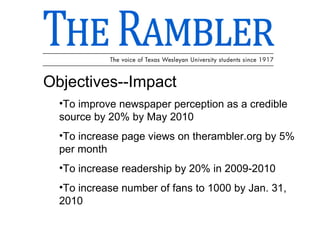
Objectives--Impact To improve newspaper perception as a credible source by 20% by May 2010 To increase page views on therambler.org by 5% per month To increase readership by 20% in 2009-2010 To increase number of fans to 1000 by Jan. 31, 2010
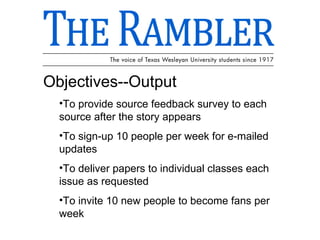
Objectives--Output To provide source feedback survey to each source after the story appears To sign-up 10 people per week for e-mailed updates To deliver papers to individual classes each issue as requested To invite 10 new people to become fans per week
Programming Start with a laundry list of everything you could do  Narrow and focus based on your objectives and budget Make sure your programming supports your objectives
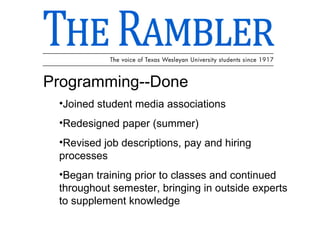
Programming--Done Joined student media associations Redesigned paper (summer) Revised job descriptions, pay and hiring processes Began training prior to classes and continued throughout semester, bringing in outside experts to supplement knowledge
Programming--Done Returned to beat system of coverage and announced beat reporter via email to departments Redesigned rate card and invoices and had professionally printed Launched new website  Launched social media sites Launched video log, using students throughout campus as hosts
Programming--Done Met with President’s Office to have newspapers sent to Board of Trustees Met with offices across campus to collaborate on coverage Met with faculty members in developmental English to provide newspapers directly to class Advertised website every issue Cross promotions arranged with athletics Source survey sent to every person who is a source to help understand veracity and credibility
Programming—In Process Signage—for new location and racks Racks—purchase of new racks that are branded Contests—focused on Facebook to increase student involvement Cross promotions—Music department, theatre department
Evaluation The other side of the research coin Focused on results of objectives Should be undertaken throughout the campaign Can take many forms, depending on your programming and objectives
Evaluation Objective To improve newspaper perception as a credible source by 20% by May 2010 Evaluation Campus-wide, benchmark survey administered at end of Fall; mid-Spring; May 2010 Conduct focus group in early Spring to determine actions
Evaluation Objective To increase page views on therambler.org by 5% per month Evaluation Review page view counts on a weekly basis
Evaluation Source survey—how would you evaluate this? What about those focus groups and surveys that you did in the research phase? What about the content analysis of the newspaper? How would you evaluate that, or would you?
What can you take home with you? Marketing and public relations campaigns allow you to gain more credibility on campus, more funding from advertisers, and more good students as recruits Taking the time to plan and put on paper a marketing and public relations strategy will give you the strategic direction you need to succeed
Feel free to contact me at: Dr. Kay L. Colley [email_address] 817-531-6525 Twitter: @kaycolley Blog:  http://kaycolley.blogspot.com Student Media Director for

Tipa Presentation 2010

  • 1.
    Marketing and PromotingYour Student Media Presented by Dr. Kay L. Colley Assistant Professor and Student Media Director Texas Wesleyan University
  • 2.
    What do youcurrently do to market your student publications? Advertise within your publications Cross-promote with other student publications Host events or contests Foster word-of-mouth marketing Subscribe to social media Collaborate with other campus organizations Attend recruiting events Attend job fairs on campus
  • 3.
    How do youdetermine which of these or other choices will work for you? The Big Question:
  • 4.
    How to create “The plan” Use the public relations campaign strategy of ROPE Create an integrated marketing communication campaign Combine the tools from public relations and marketing Ultimate goal: To increase awareness or visibility of your student media in the campus community
  • 5.
    What is ROPE?R esearch O bjectives P rogramming Evaluation
  • 6.
    SWOT Analysis Researchtools Primary Secondary Qualitative Quantitative How do I choose? Research
  • 7.
    Research—what we haveRambler focus group findings from Spring 2009 (qualitative, primary) nGenera focus group findings from Fall 2009 (qualitative, secondary) Institutional research report on student demographics (qualitative/quantitative, secondary)
  • 8.
    Research—what we wantRambler e-mail survey of students (quantitative, primary) Content analysis of Fall 2009 newspapers (qualitative, primary) Content analysis of website (qualitative, primary) Focus groups—student, faculty, staff—website (qualitative, primary)
  • 9.
    Why do research?Gives us a benchmark Tells us what people think, in their own words Tells us why people think what they think Gives us ideas of how we can improve
  • 10.
    Analyzing the ResearchWhere do you start? Remember, every research project is undertaken to get specific information. If you haven’t made that clear from the beginning, you’ll have a hard time making sense of the research.
  • 11.
    Objectives Specific andquantifiable for measurement/evaluation Support your overall goal Can be impact and output objectives Should be no more than 8 objectives
  • 12.
    Objectives--Impact To improvenewspaper perception as a credible source by 20% by May 2010 To increase page views on therambler.org by 5% per month To increase readership by 20% in 2009-2010 To increase number of fans to 1000 by Jan. 31, 2010
  • 13.
    Objectives--Output To providesource feedback survey to each source after the story appears To sign-up 10 people per week for e-mailed updates To deliver papers to individual classes each issue as requested To invite 10 new people to become fans per week
  • 14.
    Programming Start witha laundry list of everything you could do Narrow and focus based on your objectives and budget Make sure your programming supports your objectives
  • 15.
    Programming--Done Joined studentmedia associations Redesigned paper (summer) Revised job descriptions, pay and hiring processes Began training prior to classes and continued throughout semester, bringing in outside experts to supplement knowledge
  • 16.
    Programming--Done Returned tobeat system of coverage and announced beat reporter via email to departments Redesigned rate card and invoices and had professionally printed Launched new website Launched social media sites Launched video log, using students throughout campus as hosts
  • 17.
    Programming--Done Met withPresident’s Office to have newspapers sent to Board of Trustees Met with offices across campus to collaborate on coverage Met with faculty members in developmental English to provide newspapers directly to class Advertised website every issue Cross promotions arranged with athletics Source survey sent to every person who is a source to help understand veracity and credibility
  • 18.
    Programming—In Process Signage—fornew location and racks Racks—purchase of new racks that are branded Contests—focused on Facebook to increase student involvement Cross promotions—Music department, theatre department
  • 19.
    Evaluation The otherside of the research coin Focused on results of objectives Should be undertaken throughout the campaign Can take many forms, depending on your programming and objectives
  • 20.
    Evaluation Objective Toimprove newspaper perception as a credible source by 20% by May 2010 Evaluation Campus-wide, benchmark survey administered at end of Fall; mid-Spring; May 2010 Conduct focus group in early Spring to determine actions
  • 21.
    Evaluation Objective Toincrease page views on therambler.org by 5% per month Evaluation Review page view counts on a weekly basis
  • 22.
    Evaluation Source survey—howwould you evaluate this? What about those focus groups and surveys that you did in the research phase? What about the content analysis of the newspaper? How would you evaluate that, or would you?
  • 23.
    What can youtake home with you? Marketing and public relations campaigns allow you to gain more credibility on campus, more funding from advertisers, and more good students as recruits Taking the time to plan and put on paper a marketing and public relations strategy will give you the strategic direction you need to succeed
  • 24.
    Feel free tocontact me at: Dr. Kay L. Colley [email_address] 817-531-6525 Twitter: @kaycolley Blog: http://kaycolley.blogspot.com Student Media Director for