DESCRIPTION
DESCRIPTION
It gives information of what a person, an object, a
place , or a situation is like. It appeals to the readers
senses; it makes the reader see, hear, taste, smell, or
feel the subject.
A descriptive paragraph has concrete and specific
details, which are carefully chosen by a writer to
paint a picture in the mind of the reader. Literary
analyses, descriptive essays, business plans, lab
reports, and research papers are some examples of
writing genres that use descriptive paragraphs.
Example:
The tarsier has soft, grayish fur. It has bat-like ears and
a long, rat-like tail.It only stands about 100
millimeters. It feeds on insects like crickets, beetles,
and termites; and on small animals, too, like lizards,
frogs, and small birds. Also, it is capable of turning its
head 180 degrees and jumpingbackward with
accuracy.
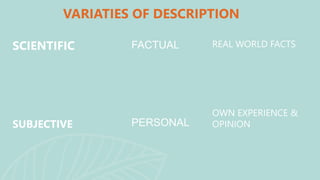
VARIATIES OF DESCRIPTION
SCIENTIFIC
SUBJECTIVE
FACTUAL
PERSONAL
REAL WORLD FACTS
OWN EXPERIENCE &
OPINION
THE TERM COULD BE EMPHASIZED BY THE
FOLLOWING:
1. Characteristics or features
2. Feature
3. Effect
4. Origin
THE
IMPORTANCE OF
DEFINITION
1.Clarity: Definitions help to clarify the meaning
of a term or concept, making it easier for people
to understand and communicate about it.
2.Consistency: Definitions provide a standard or
benchmark for understanding and using a term
or concept, ensuring that people use it
consistently across different contexts.
3.Avoiding misunderstandings: Without a clear
definition, different people can interpret a term
or concept differently, leading to
misunderstandings and confusion.
4.Precision: Definitions help to make language
more precise and specific, allowing people to
convey more detailed and accurate information.
ELEMENTS OF
DEFINITION
1.Term or Concept: The term or concept being defined
is the central focus of the definition.
2 Class or Category: It is often useful to place the term
or concept being defined within a broader class or
category.
3.Characteristics: The definition should include a
description of the key characteristics or attributes of the
term or concept being defined.
4.Examples: Including examples can help to illustrate
the meaning of the term or concept and make it easier
for the reader to understand and remember.
4.Exclusions: In some cases, it may be helpful to
specify what the term or concept does not include, to
avoid confusion or misinterpretation.
5.Origins: Sometimes, including information about the
origin or history of a term or concept can provide
valuable context and deepen the reader's
understanding.
6.Context: Definitions can be influenced by context, so
it is important to consider the context in which the
term or concept is being used and provide relevant
information that can help the reader understand its
meaning in that context.
EXAMPLE OF
DEFINITION
The concept of "social justice" refers to
the idea that every individual should
have equal access to opportunities,
resources, and privileges within
society, regardless of their
background, identity, or status.

DECRIPTION-6.pptx

  • 1.
  • 2.
    DESCRIPTION It gives informationof what a person, an object, a place , or a situation is like. It appeals to the readers senses; it makes the reader see, hear, taste, smell, or feel the subject. A descriptive paragraph has concrete and specific details, which are carefully chosen by a writer to paint a picture in the mind of the reader. Literary analyses, descriptive essays, business plans, lab reports, and research papers are some examples of writing genres that use descriptive paragraphs.
  • 3.
    Example: The tarsier hassoft, grayish fur. It has bat-like ears and a long, rat-like tail.It only stands about 100 millimeters. It feeds on insects like crickets, beetles, and termites; and on small animals, too, like lizards, frogs, and small birds. Also, it is capable of turning its head 180 degrees and jumpingbackward with accuracy.
  • 4.
  • 5.
    THE TERM COULDBE EMPHASIZED BY THE FOLLOWING: 1. Characteristics or features 2. Feature 3. Effect 4. Origin
  • 6.
  • 7.
    1.Clarity: Definitions helpto clarify the meaning of a term or concept, making it easier for people to understand and communicate about it. 2.Consistency: Definitions provide a standard or benchmark for understanding and using a term or concept, ensuring that people use it consistently across different contexts. 3.Avoiding misunderstandings: Without a clear definition, different people can interpret a term or concept differently, leading to misunderstandings and confusion. 4.Precision: Definitions help to make language more precise and specific, allowing people to convey more detailed and accurate information.
  • 8.
  • 9.
    1.Term or Concept:The term or concept being defined is the central focus of the definition. 2 Class or Category: It is often useful to place the term or concept being defined within a broader class or category. 3.Characteristics: The definition should include a description of the key characteristics or attributes of the term or concept being defined. 4.Examples: Including examples can help to illustrate the meaning of the term or concept and make it easier for the reader to understand and remember.
  • 10.
    4.Exclusions: In somecases, it may be helpful to specify what the term or concept does not include, to avoid confusion or misinterpretation. 5.Origins: Sometimes, including information about the origin or history of a term or concept can provide valuable context and deepen the reader's understanding. 6.Context: Definitions can be influenced by context, so it is important to consider the context in which the term or concept is being used and provide relevant information that can help the reader understand its meaning in that context.
  • 11.
  • 12.
    The concept of"social justice" refers to the idea that every individual should have equal access to opportunities, resources, and privileges within society, regardless of their background, identity, or status.