PURPOSEFUL WRITING IN THE
DISCIPLINES AND FOR PROFESSION
LEARNING
OBJECTIVES
At the end of the lesson, students are expected to:
1. Explain how one’s purpose is a crucial
consideration in academic and professional
writing;
2. Identify the unique features of and
requirements in composing texts that are
useful across disciplines; and
3. Identify the unique features and requirements
in composing professional correspondence; and
4. Compose texts useful across disciplines; and
5. Compose professional correspondence.
FEATURESOF
TEXTSACROSS
DISCIPLINES
BOOK REVIEW OR
ARTICLE CRITIQUE
LITERATURE REVIEW
RESEARCH REPORT
PROJECT PROPOSAL
POSITION PAPER
Whatisa book
revieworarticle
critique?
A book/article review looks at the quality,
meaning, and significance of a work of
literature. It is a reaction paper – focusing
on purpose, content, and authority – in
which strengths and weaknesses of the
material are analyzed.
It should examine what the author has
tried to do, evaluate how well the author
has succeeded, and presents evidence to
support this evaluation.
The length of a review may vary from
a single paragraph to a complete essay
which uses personal preference of the
writer. The writer does three (3) things
in preparing a book review: describes,
analyses, and evaluates.
Moreover, the review conveys an
opinion with supporting evidence.
BOOKREVIEW /ARTICLECRITIQUE
The first step is to READ the book/article.
Allow yourself enough TIME to be able to thoroughly read and evaluate the
book/article.
Read ACTIVELY and CRITICALLY!
Engage with the text
Highlight and Underline passages
Write in the margins
Make predictions (and test them)
Ask questions (and answer them)
Book/ArticleReview
Typical book/article reviews consist of two parts:
Summary & Analysis
Occasionally a professor will want additional info.
Bibliographical Material
Personal Opinion
Career/Ministry Application
There is no standard, discipline-specific way to write a
book/article review.
Often a professor will provide guidelines and format.
Otherwise, you may create your own outline.
Book/ArticleReview
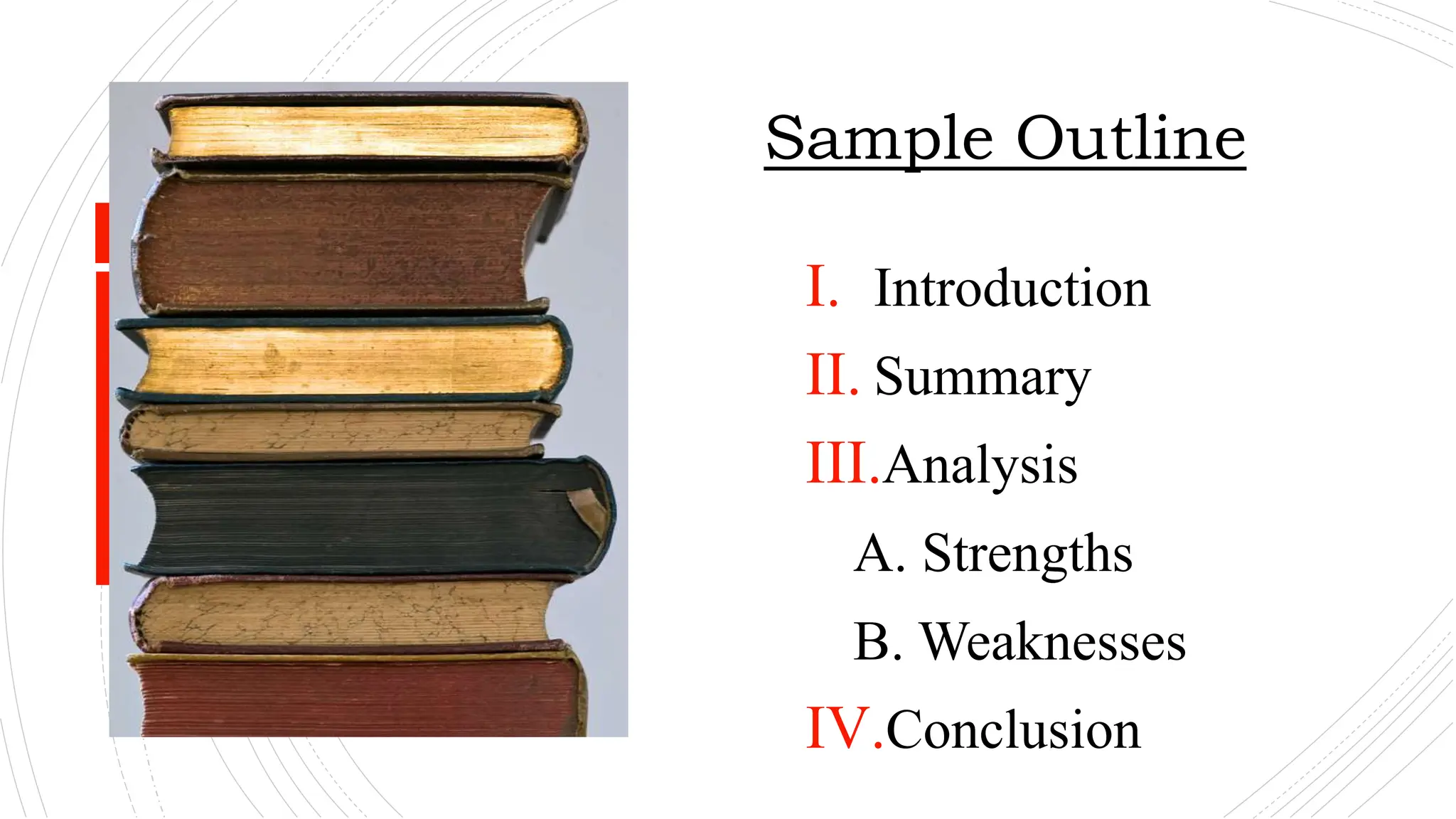
I. Introduction
II. Summary
III.Analysis
A. Strengths
B. Weaknesses
IV.Conclusion
Sample Outline
Summary
A summary is a brief, concisely written synopsis of the
book/article.
A summary restates the author’s main point, purpose, intent, and
supporting details in your own words.
Summaries are written to help you gain a better grasp of the
original, as well as show that you have read and understand the
assigned material.
Analysis
An analysis is a detailed evaluation of the thesis (arguments) presented
by the author.
Relate the strengths and weaknesses of the book/article.
What is good and what is bad?
What did the author do well? Not well?
This does not communicate if you liked it or not.
SAMPLE BOOK/ARTICLE REVIEW
LITERATURE
REVIEW
 A literature review is a critical analysis and
summary of published research and scholarly
articles, books, and other sources related to a
specific research topic or question.
 The purpose of a literature review is to provide a
comprehensive overview of the existing research
on a topic, to identify gaps and inconsistencies in
the literature, and to inform the development of
a research project or proposal.
LITERATURE
REVIEW
 A literature review typically involves a
systematic search and selection of relevant
sources, followed by a careful reading and
evaluation of each source's content and
methodology. The review may include a
synthesis of the findings from the selected
sources, as well as an assessment of the quality
and credibility of the research. The literature
review is often a key component of research
papers, theses, and dissertations in academic
and scientific disciplines.
Introduction:
•An introductory paragraph that explains what your working
topic and thesis is
•A forecast of key topics or texts that will appear in the review
•Potentially, a description of how you found sources and how
you analyzed them for inclusion and discussion in the review
(more often found in published, standalone literature reviews
than in lit review sections in an article or research paper)
PARTS OF A LITERATURE REVIEW
Conclusion:
•Summarize the key findings you have taken from the literature and
emphasize their significance
•Connect it back to your primary research question
Body:
•Summarize and synthesize: Give an overview of the main points of
each
source and combine them into a coherent whole
•Analyze and interpret: Don’t just paraphrase other researchers – add
your own interpretations where possible, discussing the significance
of findings in relation to the literature as a whole
•Critically Evaluate: Mention the strengths and weaknesses of your
sources
•Write in well-structured paragraphs: Use transition words and topic
sentence to draw connections, comparisons, and contrasts.
Topic: The effects of social media on mental health in adolescents
Introduction: Social media has become an integral part of daily life for many people,
including adolescents. While social media offers many benefits, such as the ability to
connect with others and access to information, it has also been linked to negative
effects on mental health, particularly in adolescents. This literature review examines
the current research on the effects of social media on mental health in adolescents.
Methodology: A comprehensive search was conducted using electronic databases
such as PubMed, PsychINFO, and Google Scholar. The search terms used included
"social media", "mental health", "adolescents", and related terms. The inclusion criteria
for studies were: (1) published in peer-reviewed journals, (2) focused on the effects of
social media on mental health in adolescents, (3) conducted on human participants,
and (4) written in English. A total of 30 studies were included in the review.
EXAMPLE
Findings: The review found that social media use was associated with a range of
negative effects on mental health in adolescents, including increased symptoms of
anxiety, depression, and loneliness. Excessive use of social media, especially at
night, was linked to poor sleep quality, which is a risk factor for mental health
problems. Social media was also found to contribute to feelings of social
comparison and low self-esteem in adolescents, which may further exacerbate
mental health issues.
Discussion: The findings of this literature review suggest that social media use
can have negative effects on mental health in adolescents. Future research should
aim to better understand the underlying mechanisms of these effects and to
identify interventions that can help mitigate the negative impact of social media on
mental health in this population.
Conclusion: Overall, this literature review highlights the importance of addressing
the potential negative effects of social media use on mental health in adolescents.
It also underscores the need for further research in this area to inform
interventions and policies aimed at promoting healthy social media use among
RESEARCH
REPORT
Research report is choosing and making
a topic which interests the writer’s
most. In writing a research report, a
writer assembles the sources of his data
and synthesizes them.
It also presents evidence, puts it into
shape, gives conclusions and
recommendations.
The components of a research report are as follows:
Exampleof
Research
Report
PROJECT
PROPOSAL
A project proposal is a document that is
written for problem solving, service provision,
event planning, or equipment selling. Generally,
proposals are used to convince the reader to
do what the proposal suggests, such as buying
goods or services, funding a project, or
implementing a program.
Thekeycomponents orsections should include thefollowing:
Exampleof
ProjectProposal
POSITIONPAPER
Is a written document that
presents an individual or
organization's stance or perspective
on a particular issue or topic.
It aims to persuade the reader to
support the writer's position by
providing evidence-based
arguments and supporting facts.
 Position papers are often used in advocacy,
political, or policy-making contexts, as they
provide a clear and concise statement of an
individual or organization's position on a
particular issue. They are commonly
written by advocacy groups, government
agencies, or interest groups to influence
policy decisions or public opinion.
 Position papers can also be used in
academic settings, such as in a debate or
class assignment, to present and defend a
particular position on a topic.
PURPOSEFUL-WRITING-LATEST(literature review)

PURPOSEFUL-WRITING-LATEST(literature review)

  • 1.
    PURPOSEFUL WRITING INTHE DISCIPLINES AND FOR PROFESSION
  • 2.
    LEARNING OBJECTIVES At the endof the lesson, students are expected to: 1. Explain how one’s purpose is a crucial consideration in academic and professional writing; 2. Identify the unique features of and requirements in composing texts that are useful across disciplines; and 3. Identify the unique features and requirements in composing professional correspondence; and 4. Compose texts useful across disciplines; and 5. Compose professional correspondence.
  • 3.
    FEATURESOF TEXTSACROSS DISCIPLINES BOOK REVIEW OR ARTICLECRITIQUE LITERATURE REVIEW RESEARCH REPORT PROJECT PROPOSAL POSITION PAPER
  • 4.
    Whatisa book revieworarticle critique? A book/articlereview looks at the quality, meaning, and significance of a work of literature. It is a reaction paper – focusing on purpose, content, and authority – in which strengths and weaknesses of the material are analyzed. It should examine what the author has tried to do, evaluate how well the author has succeeded, and presents evidence to support this evaluation.
  • 5.
    The length ofa review may vary from a single paragraph to a complete essay which uses personal preference of the writer. The writer does three (3) things in preparing a book review: describes, analyses, and evaluates. Moreover, the review conveys an opinion with supporting evidence.
  • 6.
    BOOKREVIEW /ARTICLECRITIQUE The firststep is to READ the book/article. Allow yourself enough TIME to be able to thoroughly read and evaluate the book/article. Read ACTIVELY and CRITICALLY! Engage with the text Highlight and Underline passages Write in the margins Make predictions (and test them) Ask questions (and answer them)
  • 7.
    Book/ArticleReview Typical book/article reviewsconsist of two parts: Summary & Analysis Occasionally a professor will want additional info. Bibliographical Material Personal Opinion Career/Ministry Application There is no standard, discipline-specific way to write a book/article review. Often a professor will provide guidelines and format. Otherwise, you may create your own outline.
  • 8.
    Book/ArticleReview I. Introduction II. Summary III.Analysis A.Strengths B. Weaknesses IV.Conclusion Sample Outline
  • 9.
    Summary A summary isa brief, concisely written synopsis of the book/article. A summary restates the author’s main point, purpose, intent, and supporting details in your own words. Summaries are written to help you gain a better grasp of the original, as well as show that you have read and understand the assigned material.
  • 10.
    Analysis An analysis isa detailed evaluation of the thesis (arguments) presented by the author. Relate the strengths and weaknesses of the book/article. What is good and what is bad? What did the author do well? Not well? This does not communicate if you liked it or not.
  • 11.
  • 12.
    LITERATURE REVIEW  A literaturereview is a critical analysis and summary of published research and scholarly articles, books, and other sources related to a specific research topic or question.  The purpose of a literature review is to provide a comprehensive overview of the existing research on a topic, to identify gaps and inconsistencies in the literature, and to inform the development of a research project or proposal.
  • 13.
    LITERATURE REVIEW  A literaturereview typically involves a systematic search and selection of relevant sources, followed by a careful reading and evaluation of each source's content and methodology. The review may include a synthesis of the findings from the selected sources, as well as an assessment of the quality and credibility of the research. The literature review is often a key component of research papers, theses, and dissertations in academic and scientific disciplines.
  • 14.
    Introduction: •An introductory paragraphthat explains what your working topic and thesis is •A forecast of key topics or texts that will appear in the review •Potentially, a description of how you found sources and how you analyzed them for inclusion and discussion in the review (more often found in published, standalone literature reviews than in lit review sections in an article or research paper) PARTS OF A LITERATURE REVIEW
  • 15.
    Conclusion: •Summarize the keyfindings you have taken from the literature and emphasize their significance •Connect it back to your primary research question Body: •Summarize and synthesize: Give an overview of the main points of each source and combine them into a coherent whole •Analyze and interpret: Don’t just paraphrase other researchers – add your own interpretations where possible, discussing the significance of findings in relation to the literature as a whole •Critically Evaluate: Mention the strengths and weaknesses of your sources •Write in well-structured paragraphs: Use transition words and topic sentence to draw connections, comparisons, and contrasts.
  • 16.
    Topic: The effectsof social media on mental health in adolescents Introduction: Social media has become an integral part of daily life for many people, including adolescents. While social media offers many benefits, such as the ability to connect with others and access to information, it has also been linked to negative effects on mental health, particularly in adolescents. This literature review examines the current research on the effects of social media on mental health in adolescents. Methodology: A comprehensive search was conducted using electronic databases such as PubMed, PsychINFO, and Google Scholar. The search terms used included "social media", "mental health", "adolescents", and related terms. The inclusion criteria for studies were: (1) published in peer-reviewed journals, (2) focused on the effects of social media on mental health in adolescents, (3) conducted on human participants, and (4) written in English. A total of 30 studies were included in the review. EXAMPLE
  • 17.
    Findings: The reviewfound that social media use was associated with a range of negative effects on mental health in adolescents, including increased symptoms of anxiety, depression, and loneliness. Excessive use of social media, especially at night, was linked to poor sleep quality, which is a risk factor for mental health problems. Social media was also found to contribute to feelings of social comparison and low self-esteem in adolescents, which may further exacerbate mental health issues. Discussion: The findings of this literature review suggest that social media use can have negative effects on mental health in adolescents. Future research should aim to better understand the underlying mechanisms of these effects and to identify interventions that can help mitigate the negative impact of social media on mental health in this population. Conclusion: Overall, this literature review highlights the importance of addressing the potential negative effects of social media use on mental health in adolescents. It also underscores the need for further research in this area to inform interventions and policies aimed at promoting healthy social media use among
  • 18.
    RESEARCH REPORT Research report ischoosing and making a topic which interests the writer’s most. In writing a research report, a writer assembles the sources of his data and synthesizes them. It also presents evidence, puts it into shape, gives conclusions and recommendations.
  • 20.
    The components ofa research report are as follows:
  • 22.
  • 23.
    PROJECT PROPOSAL A project proposalis a document that is written for problem solving, service provision, event planning, or equipment selling. Generally, proposals are used to convince the reader to do what the proposal suggests, such as buying goods or services, funding a project, or implementing a program.
  • 24.
  • 26.
  • 28.
    POSITIONPAPER Is a writtendocument that presents an individual or organization's stance or perspective on a particular issue or topic. It aims to persuade the reader to support the writer's position by providing evidence-based arguments and supporting facts.
  • 29.
     Position papersare often used in advocacy, political, or policy-making contexts, as they provide a clear and concise statement of an individual or organization's position on a particular issue. They are commonly written by advocacy groups, government agencies, or interest groups to influence policy decisions or public opinion.  Position papers can also be used in academic settings, such as in a debate or class assignment, to present and defend a particular position on a topic.

Editor's Notes

  • #5 The book review or article critique is the most commonly given as class requirement. These two follow a specific format but both are written to provide an analysis of a text read.
  • #16 sample : https://www.montana.edu/stock/ecns305/course-project/litreviewsample.pdf
  • #21 sample
  • #24 Proposals in the professional world are used for internal (within an organization) and external (from one organization to another) purposes. They are ways of generating income for companies or seeking funding for projects. This is provided to the sponsor of the project for approval.
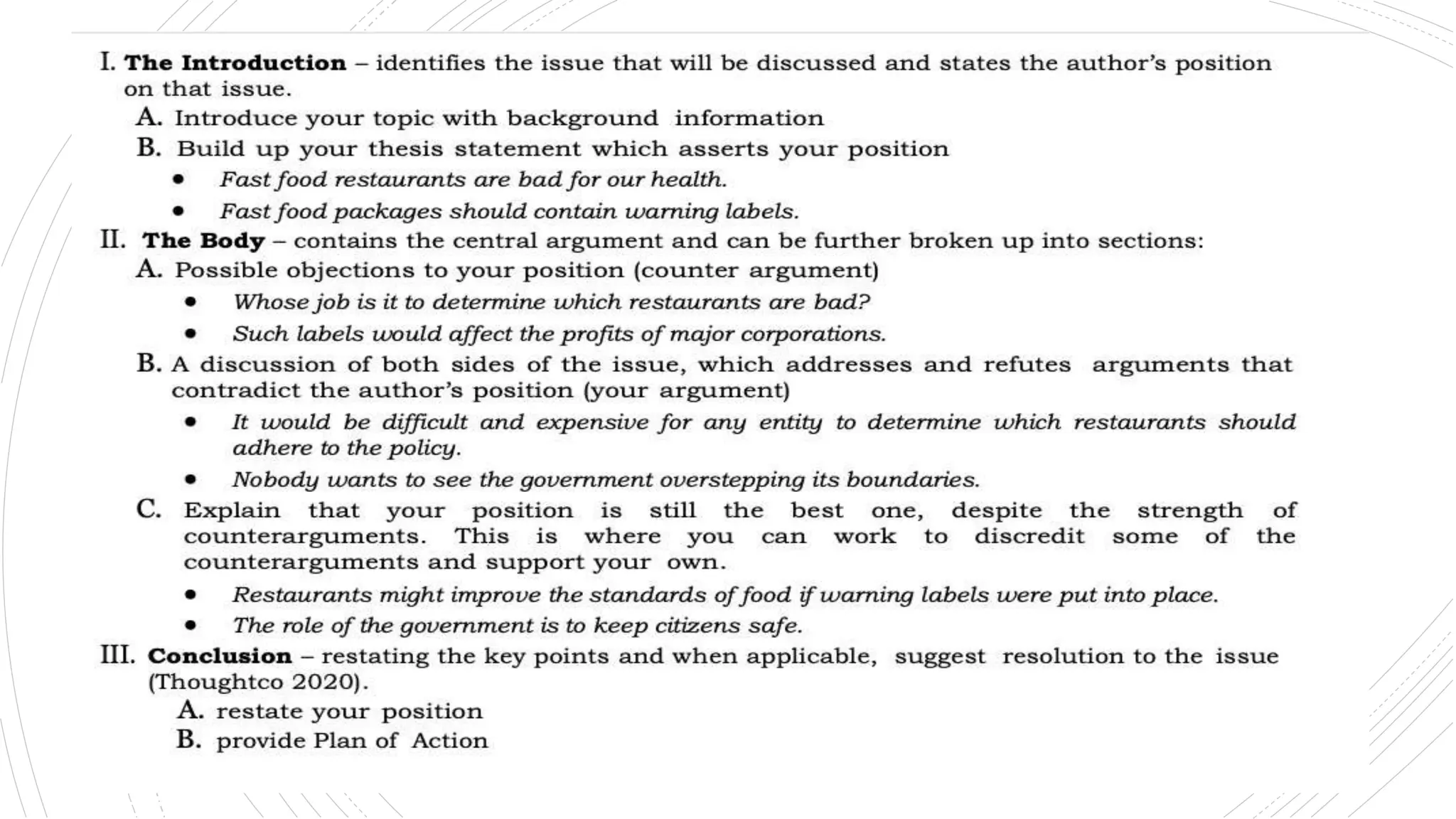
  • #29 A position paper typically includes an introduction that defines the issue and provides background information, followed by the writer's position statement, which presents the writer's position on the issue. The paper then presents a series of supporting arguments that justify the writer's position, backed up by evidence, data, and relevant examples. In addition, a position paper may address potential counter-arguments and refute them by providing alternative viewpoints or counter-evidence.