 Also called Zarathustraism, Mazdaism
and Magianism.
 One of the oldest monotheistic religion.
 Dualistic religion founded by the Persian
prophet Zoroaster also known as
Zarathushtra in the late 7th or early 6th
centuries. (Iran)
 Zoroastrianism became the state religion of
various Persian empires, until the 7th Century
CE.
 The creator Ahura Mazda is all good,
and no evil originates from him.
Omniscient (knows everything)
Omnipotent (all powerful)
Omnipresent (is everywhere)
Impossible for humans to conceive
Unchanging
The Creator of life
The Source of all goodness and
happiness
 Communication between Ahura Mazda and
humans is by a number of Attributes, called
Amesha Spentas or Bounteous Immortals.
(these Immortals are sometimes described as
concepts, and are sometimes personified.)
 Also called Amshaspends or Spenta Mainyu.
 Impersonal emanations and abstractions of various qualities
of Ahura Mazda. Zoroastrians were to emulate and embrace
what they represented.
 Vohu Manah
 Asha Vahishta
 Khshathra Vairya
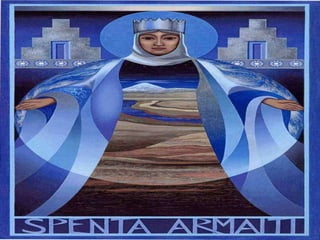
 Spenta Armaiti
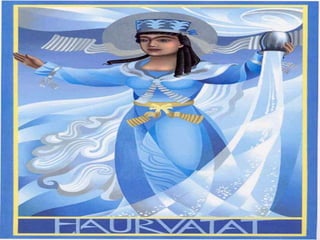
 Haurvatat
 Ameretat
“Good Mind”. good thought, ruling the
realm of animals
 He is an angel who, as the embodiment of wisdom,
calms anger.
 Zoroastrian astrology, medicine, as well as the sanity of
the community depended on the actions of this angel.
 Vohu Manah is also associated with animals,
particularly cattle.
“ Highest Truth” or
“Highest Existence”
• Asha or arta - Avestan language (Vedic
language) term for a concept of ultimate Truth.
• Asha is order: universal order, moral order and
social order.
• He symbolizes truth and righteousness, as well
as embraces the unchanging aim of creation.
• This is represented as Fire.
• The opposite of Avestan aša is druj, "lie.“
• Fire is the symbol of Asha and righteousness,
because it will be fire that purifies the world and
separates the good from the wicked.
• Artavahisht guides the world away from evil
and directs it towards the truth. He is the
guardian of the fires and the mountains.
'Desirable Dominion'
 The sovereign and divine power of Azura
Mazda and is the Good Kingdom, the perfect
kingdom followers are encouraged to build
through righteous behavior.
 Khshathra is particularly associated with
metals, the wealth of earthly kingdoms which
can be acquired through hard work.
• The final judgment will involve molten
metal, from which the righteous will
emerged unharmed and pure and the
wicked will be burned.
• He enforces peace by using his
weapons.
• His attributes are the helmet, the shield
and the spear.
'Holy Devotion'
 She is the connection between a devout man
and Ahura Mazda. She is also associated with
the earth and agriculture.
 social welfare of humanity, animals, and
plants.
'Perfection or Health'.
 The goddess Haurvatat reflects the
mental and physical well-being of the
individual.
 Water represents Haurvatat in this
world.
 she brings prosperity and health.
'Immortality'.
 The goddess Ameretat personifies
the destination of those who have
vanquished evil.
 Plants represent Ameretat in this
world.
 Haurvatat and Ameretat are always mentioned
as a pair.
 They are perfection and immortality.
 It is through the perfection of ourselves that
leads to immortality, while wickedness robs a
person of it.
 They are associated with water and plant life,
respectively
Good powers in general and include such
figures as Haoma, Atar, Mithra, Sraosha, and
Rashnu.
• Daevas are false or evil beings
created by Angra Mainya.
• To honor them as deities is false
religion, and Zoroastrians are ordered
to always fight and resist them.
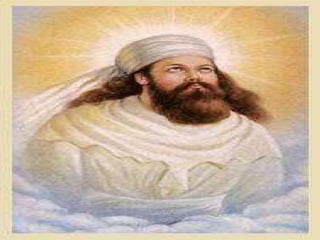
Zoroaster.
• Zoroastrians usually pray in the presence
of some form of fire (which can be
considered evident in any source of light).
• Fire is considered a medium through
which spiritual insight and wisdom is
gained, and water is considered the
source of that wisdom.
Purification is strongly emphasised in
Zoroastrian rituals. Zoroastrians focus
on keeping their minds, bodies and
environments pure in the quest to
defeat evil (Angra Mainyu).
Fire
Temple
Both water and fire are considered life-
sustaining, and both water and fire are
represented within the precinct of a fire
temple.
Holy Book of the
Zoroastrian.
 This includes the original words of their
founder Zarathushtra, preserved in a series of five
hymns, called the Gathas.
1.Worship to one God.
2.Understanding of righteousness or cosmic order.
3.Promotional of social justice.
4.Individual choice between Good and Evil.
 Dualism in Zoroastrianism is the
existence of, yet complete separation
of, good and evil. This is recognised in
two interconnecting ways:
1. Cosmically (opposing forces within
the universe)
2. Morally (opposing forces within the
mind)
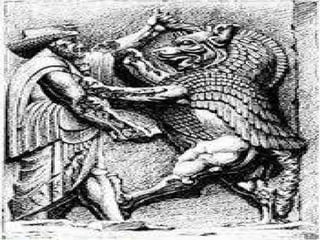
The ongoing battle between Good
(Ahura Mazda) and Evil (Angra
Mainyu) within the universe.
 It is important to understand that Angra
Mainyu is not God's equal opposite, rather
that Angra Mainyu is the destructive
energy that opposes God's creative energy.
 This creative energy is called Spenta
Mainyu.
 With cosmic dualism we have life and death, day and night,
good and evil. One cannot be understood without the other.
Life is a mixture of these two opposing forces.
 God created a pure world through his creative energy, which
Angra Mainyu continues to attack, making it impure. Aging,
sickness, famine, natural disasters, death and so on are
attributed to this.
 The resulting cosmic conflict involves the entire universe,
including humanity who is required to choose which to follow.
Evil, and the Spirit of Evil, will be completely destroyed at the
end of time. Dualism will come to an end and Goodness will
be all in all.
free will
 In Zoroastrian tradition, life is a temporary
state in which a mortal is expected to actively
participate in the continuing battle between
truth and falsehood.
 Moral dualism refers to the opposition of
good and evil in the mind of mankind.
 God's gift to man was free will; therefore man has
the choice to follow the path of Evil (druj - deceit) or
the path of Righteousness (asha - truth).
frashokereti
Angra Mainyu
Saoshyant
Saoshyant (savior)
Zoroastrian burial rites center on exposure of the
dead. After death, a dog is brought before the corpse
The rite is repeated five times a day. After the first one,
fire is brought into the room where it is kept burning
until three days after the removal of the corpse to the
Tower of Silence. The removal must be done during the
daytime.
Humata, Hukhta, Huveshta
Members can pray at home instead of going to a temple
if they wish.
Zoroastrians do not generally accept converts.
Many Zoroastrians actively discourage and do not
recognize inter-faith marriages.
They do not proselytize.
Prior to being born, the urvan (soul) of an individual is still united with its
fravashi (guardian spirit), and which have existed since Mazda created the
universe.
During life, the fravashi acts as a guardian and protector. On the fourth day
after death, the soul is reunited with its fravashi, in which the experiences
of life in the material world are collected for the continuing battle in the
spiritual world. For the most part, Zoroastrianism does not have a notion of
reincarnation, at least not until the final renovation of the world.
In Zoroastrian scripture and tradition, a corpse is a host for decay, i.e., of druj.
scripture enjoins the safe disposal of the dead in a manner such that a
corpse does not pollute the good creation.
asiannn-140722050120-phpapp02.docx

asiannn-140722050120-phpapp02.docx

  • 6.
     Also calledZarathustraism, Mazdaism and Magianism.  One of the oldest monotheistic religion.  Dualistic religion founded by the Persian prophet Zoroaster also known as Zarathushtra in the late 7th or early 6th centuries. (Iran)  Zoroastrianism became the state religion of various Persian empires, until the 7th Century CE.
  • 12.
     The creatorAhura Mazda is all good, and no evil originates from him.
  • 13.
    Omniscient (knows everything) Omnipotent(all powerful) Omnipresent (is everywhere) Impossible for humans to conceive Unchanging The Creator of life The Source of all goodness and happiness
  • 15.
     Communication betweenAhura Mazda and humans is by a number of Attributes, called Amesha Spentas or Bounteous Immortals. (these Immortals are sometimes described as concepts, and are sometimes personified.)
  • 16.
     Also calledAmshaspends or Spenta Mainyu.  Impersonal emanations and abstractions of various qualities of Ahura Mazda. Zoroastrians were to emulate and embrace what they represented.  Vohu Manah  Asha Vahishta  Khshathra Vairya  Spenta Armaiti  Haurvatat  Ameretat
  • 17.
    “Good Mind”. goodthought, ruling the realm of animals  He is an angel who, as the embodiment of wisdom, calms anger.  Zoroastrian astrology, medicine, as well as the sanity of the community depended on the actions of this angel.  Vohu Manah is also associated with animals, particularly cattle.
  • 19.
    “ Highest Truth”or “Highest Existence” • Asha or arta - Avestan language (Vedic language) term for a concept of ultimate Truth. • Asha is order: universal order, moral order and social order. • He symbolizes truth and righteousness, as well as embraces the unchanging aim of creation.
  • 20.
    • This isrepresented as Fire. • The opposite of Avestan aša is druj, "lie.“ • Fire is the symbol of Asha and righteousness, because it will be fire that purifies the world and separates the good from the wicked. • Artavahisht guides the world away from evil and directs it towards the truth. He is the guardian of the fires and the mountains.
  • 22.
    'Desirable Dominion'  Thesovereign and divine power of Azura Mazda and is the Good Kingdom, the perfect kingdom followers are encouraged to build through righteous behavior.  Khshathra is particularly associated with metals, the wealth of earthly kingdoms which can be acquired through hard work.
  • 23.
    • The finaljudgment will involve molten metal, from which the righteous will emerged unharmed and pure and the wicked will be burned. • He enforces peace by using his weapons. • His attributes are the helmet, the shield and the spear.
  • 25.
    'Holy Devotion'  Sheis the connection between a devout man and Ahura Mazda. She is also associated with the earth and agriculture.  social welfare of humanity, animals, and plants.
  • 27.
    'Perfection or Health'. The goddess Haurvatat reflects the mental and physical well-being of the individual.  Water represents Haurvatat in this world.  she brings prosperity and health.
  • 29.
    'Immortality'.  The goddessAmeretat personifies the destination of those who have vanquished evil.  Plants represent Ameretat in this world.
  • 31.
     Haurvatat andAmeretat are always mentioned as a pair.  They are perfection and immortality.  It is through the perfection of ourselves that leads to immortality, while wickedness robs a person of it.  They are associated with water and plant life, respectively
  • 34.
    Good powers ingeneral and include such figures as Haoma, Atar, Mithra, Sraosha, and Rashnu.
  • 35.
    • Daevas arefalse or evil beings created by Angra Mainya. • To honor them as deities is false religion, and Zoroastrians are ordered to always fight and resist them.
  • 36.
  • 39.
    • Zoroastrians usuallypray in the presence of some form of fire (which can be considered evident in any source of light). • Fire is considered a medium through which spiritual insight and wisdom is gained, and water is considered the source of that wisdom.
  • 41.
    Purification is stronglyemphasised in Zoroastrian rituals. Zoroastrians focus on keeping their minds, bodies and environments pure in the quest to defeat evil (Angra Mainyu).
  • 43.
  • 44.
    Both water andfire are considered life- sustaining, and both water and fire are represented within the precinct of a fire temple.
  • 49.
    Holy Book ofthe Zoroastrian.
  • 50.
     This includesthe original words of their founder Zarathushtra, preserved in a series of five hymns, called the Gathas.
  • 52.
    1.Worship to oneGod. 2.Understanding of righteousness or cosmic order. 3.Promotional of social justice. 4.Individual choice between Good and Evil.
  • 54.
     Dualism inZoroastrianism is the existence of, yet complete separation of, good and evil. This is recognised in two interconnecting ways: 1. Cosmically (opposing forces within the universe) 2. Morally (opposing forces within the mind)
  • 55.
    The ongoing battlebetween Good (Ahura Mazda) and Evil (Angra Mainyu) within the universe.
  • 57.
     It isimportant to understand that Angra Mainyu is not God's equal opposite, rather that Angra Mainyu is the destructive energy that opposes God's creative energy.  This creative energy is called Spenta Mainyu.
  • 59.
     With cosmicdualism we have life and death, day and night, good and evil. One cannot be understood without the other. Life is a mixture of these two opposing forces.  God created a pure world through his creative energy, which Angra Mainyu continues to attack, making it impure. Aging, sickness, famine, natural disasters, death and so on are attributed to this.  The resulting cosmic conflict involves the entire universe, including humanity who is required to choose which to follow. Evil, and the Spirit of Evil, will be completely destroyed at the end of time. Dualism will come to an end and Goodness will be all in all.
  • 60.
  • 61.
     In Zoroastriantradition, life is a temporary state in which a mortal is expected to actively participate in the continuing battle between truth and falsehood.
  • 62.
     Moral dualismrefers to the opposition of good and evil in the mind of mankind.  God's gift to man was free will; therefore man has the choice to follow the path of Evil (druj - deceit) or the path of Righteousness (asha - truth).
  • 64.
  • 65.
  • 67.
    Zoroastrian burial ritescenter on exposure of the dead. After death, a dog is brought before the corpse The rite is repeated five times a day. After the first one, fire is brought into the room where it is kept burning until three days after the removal of the corpse to the Tower of Silence. The removal must be done during the daytime.
  • 68.
  • 69.
    Members can prayat home instead of going to a temple if they wish. Zoroastrians do not generally accept converts. Many Zoroastrians actively discourage and do not recognize inter-faith marriages. They do not proselytize.
  • 70.
    Prior to beingborn, the urvan (soul) of an individual is still united with its fravashi (guardian spirit), and which have existed since Mazda created the universe. During life, the fravashi acts as a guardian and protector. On the fourth day after death, the soul is reunited with its fravashi, in which the experiences of life in the material world are collected for the continuing battle in the spiritual world. For the most part, Zoroastrianism does not have a notion of reincarnation, at least not until the final renovation of the world. In Zoroastrian scripture and tradition, a corpse is a host for decay, i.e., of druj. scripture enjoins the safe disposal of the dead in a manner such that a corpse does not pollute the good creation.