Remedial Instruction
for Reading
MR. JAKE B. DOLORICON
Mindanao State University
Main Campus
Bataraza Extension
M i n d a n a o S t a t e U n i v e r s i t y – M a i n C a m p u s B a t a r a z a E x t e n s i o n
In the Philippines, the problem of students in reading is not a new issue. In fact, certain
studies reveal that the reading problems of Filipino students seemed to be perennial
(Alayon, 2014; Habagat & Rizon, 2012; Lalunio, 1994; Miguel, 2007;
Montalban, 2010; Umali, 2016).
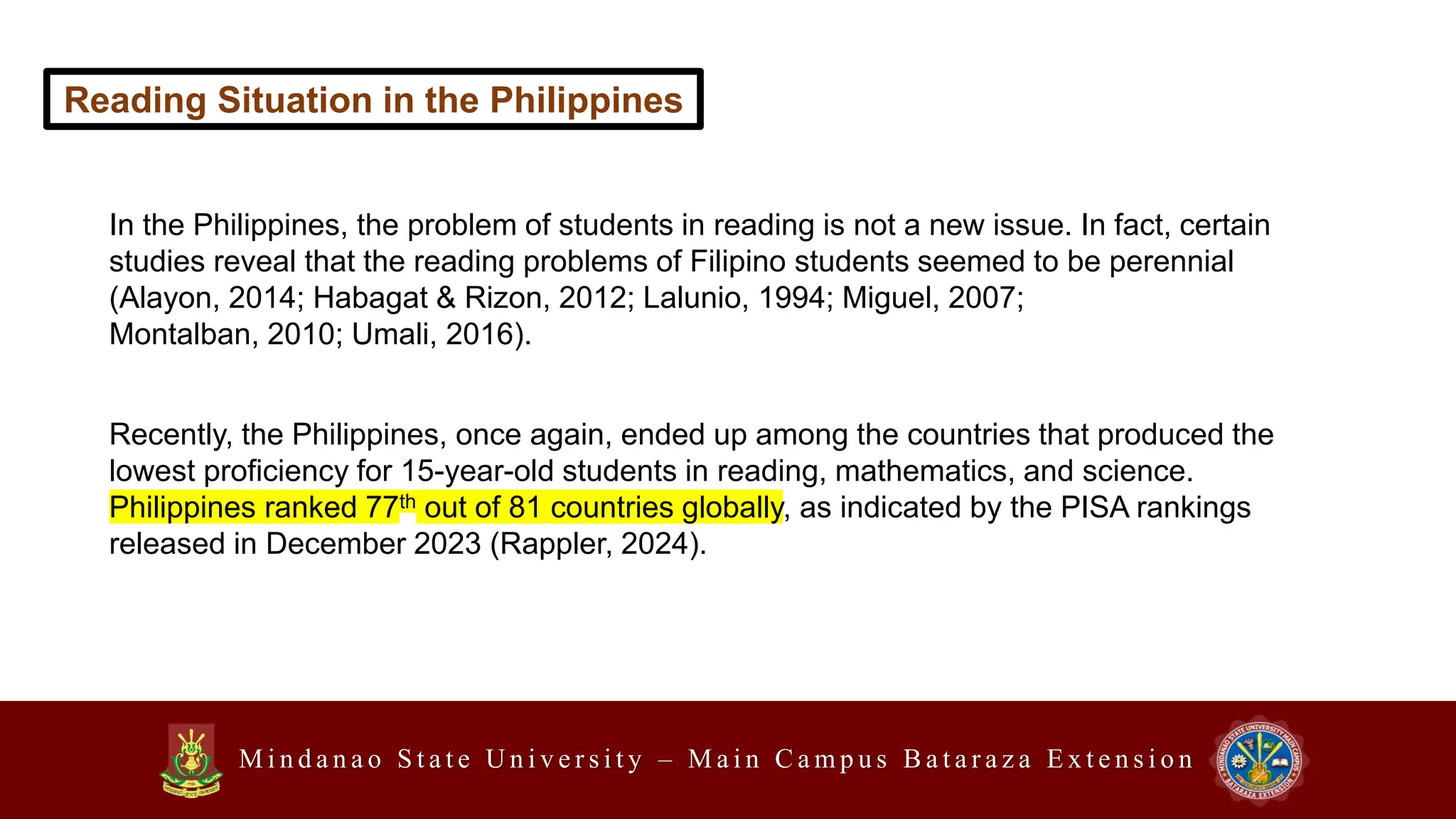
Reading Situation in the Philippines
Recently, the Philippines, once again, ended up among the countries that produced the
lowest proficiency for 15-year-old students in reading, mathematics, and science.
Philippines ranked 77th out of 81 countries globally, as indicated by the PISA rankings
released in December 2023 (Rappler, 2024).
M i n d a n a o S t a t e U n i v e r s i t y – M a i n C a m p u s B a t a r a z a E x t e n s i o n
Only 1 public school passed the PISA 2022 Assessment recently released in 2024 which
is the Benigno National High School in NCR.
Reading Situation in the Philippines
Due to such problems, reading and literacy instruction have always been the top priority
in all Philippine curricula.
• Catch-up Fridays
• End of the School Year (EOSY)
M i n d a n a o S t a t e U n i v e r s i t y – M a i n C a m p u s B a t a r a z a E x t e n s i o n
In other country, remedial reading teaching is considered a separate professional job.
Remedial reading teacher needs a serious, systematic and meticulous
groundwork in order to become one.
Issues in the Reading Remediation in PH
However, remedial reading teaching as a separate profession is barely recognizable in
the Philippine education. Accordingly, there is no budget allocation for this.
Remedial reading teachers to possess graduate degrees especially in literacy education
in order to preserve and to enhance their professional integrity.
M i n d a n a o S t a t e U n i v e r s i t y – M a i n C a m p u s B a t a r a z a E x t e n s i o n
In fact, the usual practice in local schools is that the classroom teachers are the ones who
are also the remedial reading teachers.
Hence, being a remedial reading teacher is considered an extra workload for teachers
and is not compensated for doing the roles and responsibilities entrusted to them.
Issues in the Reading Remediation in PH
M i n d a n a o S t a t e U n i v e r s i t y – M a i n C a m p u s B a t a r a z a E x t e n s i o n
Nevertheless, this is the natural consequence for those developing countries. Teachers in
developing countries are expected to possess a vast number of knowledge and skills in
addressing the problems in reading.
This is the reason why teachers, especially English language teachers in primary and
secondary schools, should be knowledge in remedial reading instruction.
Issues in the Reading Remediation in PH
M i n d a n a o S t a t e U n i v e r s i t y – M a i n C a m p u s B a t a r a z a E x t e n s i o n
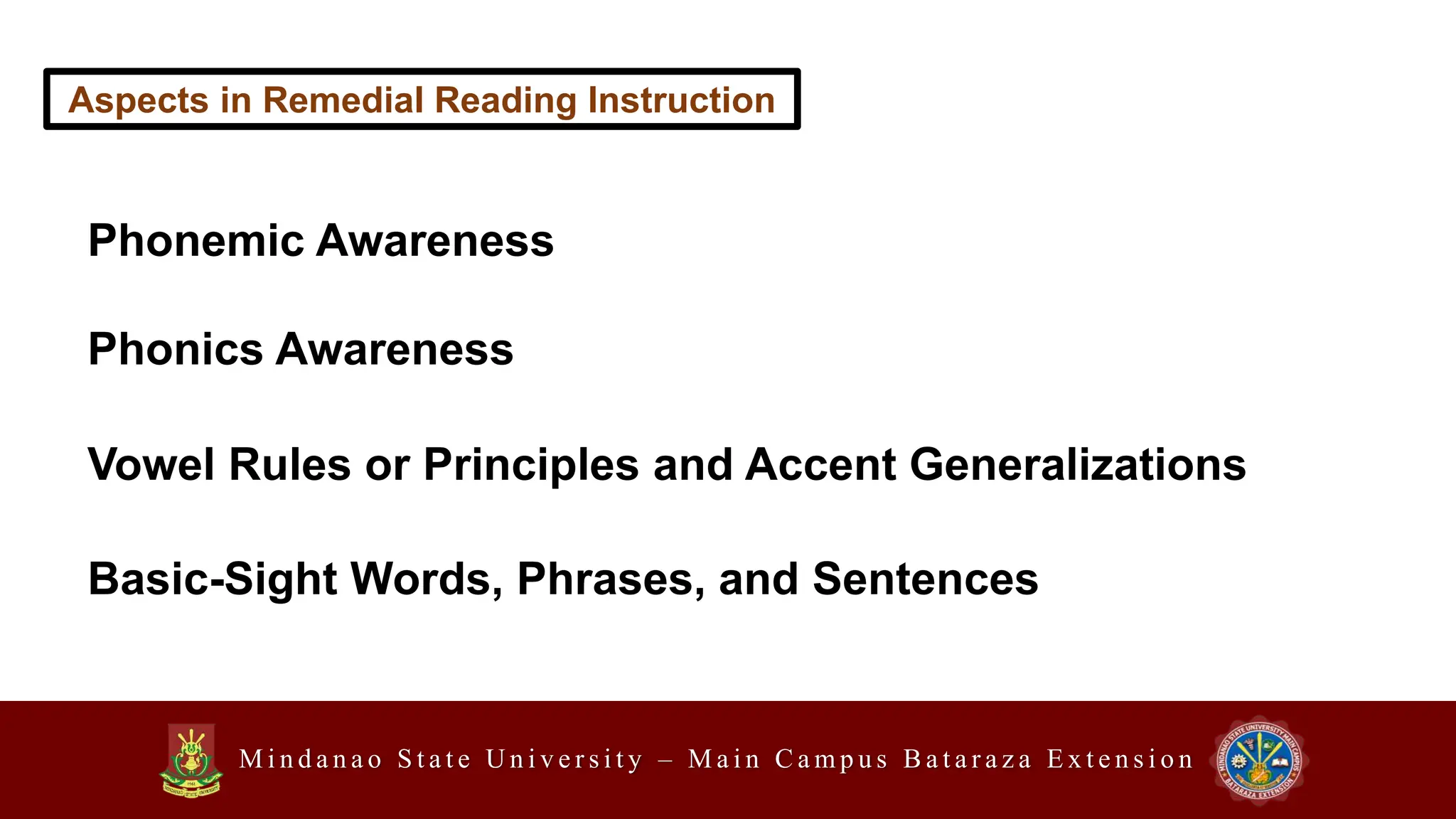
Phonemic Awareness
Aspects in Remedial Reading Instruction
Phonics Awareness
Vowel Rules or Principles and Accent Generalizations
Basic-Sight Words, Phrases, and Sentences
M i n d a n a o S t a t e U n i v e r s i t y – M a i n C a m p u s B a t a r a z a E x t e n s i o n
Syllabication Principles
Aspects in Remedial Reading Instruction
Morphology
Remedial Vocabulary Instruction
Elements of an Effective
Reading Remediation Program
To Improve Reading Skills in
Struggling Readers
Mindanao State University
Main Campus
Bataraza Extension
M i n d a n a o S t a t e U n i v e r s i t y – M a i n C a m p u s B a t a r a z a E x t e n s i o n
1. Teach All Skills Directly
Always explicitly teach the student exactly what they need to know. Never leave it to
chance for a student to discover essential elements on his own. Direct instruction
prevents situations where the student does not learn simply because they inadvertently
missed essential information or skills
Direct instruction is particularly critical in remediation as these students previously failed
to acquire necessary skills. Direct instruction helps insure the student learns all necessary
skills.
M i n d a n a o S t a t e U n i v e r s i t y – M a i n C a m p u s B a t a r a z a E x t e n s i o n
2. Teach in a Systematic Manner
Present information in a deliberate, pre-planned carefully controlled manner. This step-by-
step instruction allows the student time to practice and master individual skills before
additional information and complexities are taught. Start simple. Introduce new skills and
knowledge a bit at a time, adding complexity as the student learns.
M i n d a n a o S t a t e U n i v e r s i t y – M a i n C a m p u s B a t a r a z a E x t e n s i o n
3. Always Provide Immediate Correction
Do not allow the student to learn or practice skills incorrectly. Immediate correction is
especially critical in remediation. Correction is necessary to help the student extinguish
incorrect approaches and develop necessary skills.
It is always easier to learn the correct way than to try and unlearn incorrect habits.
M i n d a n a o S t a t e U n i v e r s i t y – M a i n C a m p u s B a t a r a z a E x t e n s i o n
4. Develop Phonemic Awareness
Directly develop phonemic awareness skills. Although some children and adults have a
definite natural phonological weakness, phonemic awareness (PA) can be taught and
learned. The scientific evidence proves that PA instruction has a significant positive effect
on both reading and spelling. Directly teach students how to hear, recognize and
manipulate sounds within words.
M i n d a n a o S t a t e U n i v e r s i t y – M a i n C a m p u s B a t a r a z a E x t e n s i o n
5. Develop Directional Tracking
It is essential the student develops and engrains proper directional tracking where they
process letters in order from left to right. It is especially important to directly teach and
emphasize proper directional tracking to remedial readers. Many struggling readers make
frequent tracking errors. They try to look at all the letters at once or hop around searching
for words or portions of words they recognize. Overcoming these incorrect strategies
requires direct work on proper tracking skills.
Physical pointing, with either the finger or other pointer, is a highly effective way to directly
teach this critical skill. The multisensory benefits of having the student physically move
their finger or pointer (kinetic motion) develops and engrains this essential subskill.
Especially in remediation, you need to ensure the student processes all the letters in a
word in order from left to right.
M i n d a n a o S t a t e U n i v e r s i t y – M a i n C a m p u s B a t a r a z a E x t e n s i o n
6. Teach Smooth Blending
The skill of smoothly blending individual sounds together into words is critical. The
student needs to learn how to say the sounds smoothly without pausing between the
sounds. The instructor needs to always demonstrate the correct blending technique of not
pausing between the sounds. Choppy/segmented sounding out makes it very difficult for
some students to push the sounds back together into a word.
M i n d a n a o S t a t e U n i v e r s i t y – M a i n C a m p u s B a t a r a z a E x t e n s i o n
7. Teach the COMPLETE Phonetic Code
Directly teach the complete phonetic code. All necessary phonograms need to be directly
and systematically taught. The phonograms are the alphabetic letters or groups of letters
that symbolize the smallest speech sounds of English. The student must have knowledge
of the direct print to sound relationship. Although it is best to start with the simple and
most frequently encountered sounds, it is not adequate to stop there. It is essential to
teach the complete code necessary to master our phonemic based written English
language.
• Sounds written with more than one letter (/th/ /sh/ /ch/ /oy/..)
• Multiple Sounds of the vowel (o=/o/, /oa/ and /u/)
• the numerous vowel-combinations or diphthongs (ee, ea, oa, oi, ai, ou…)
M i n d a n a o S t a t e U n i v e r s i t y – M a i n C a m p u s B a t a r a z a E x t e n s i o n
8. Ensure Phonologic Processing - Avoid
Sight/Whole Word Reading
It is important to avoid teaching a sight word approach where the student learns to “read”
by trying to recognize what whole words “look like”. Many students who struggle with
reading have adopted this incorrect ‘whole word’ visual word recognition strategy.
Remediation must focus on eliminating this detrimental habit of trying to visually
recognize the entire word.
A ‘whole word’ approach to reading fails because there are too many words and words
are too similar to learn by overall visual appearance.
M i n d a n a o S t a t e U n i v e r s i t y – M a i n C a m p u s B a t a r a z a E x t e n s i o n
9. Guided Oral Reading
Guided reading is reading out loud to an adult, or other proficient reader, with feedback.
This is NOT independent silent reading. The key part is ‘guided’. Correction and
instruction helps the student learn and improve skills. The validated research shows
guided out loud reading has significant beneficial impact on word recognition, fluency and
comprehension across a range of grade levels.
M i n d a n a o S t a t e U n i v e r s i t y – M a i n C a m p u s B a t a r a z a E x t e n s i o n
ASSIGNMENT
Read and summarize in 1 whole sheet of paper the
remaining elements stipulated in the website:
https://www.righttrackreading.com/elementsremed.html
Deadline of Submission: February 14, 2024
Phonemic Awareness
Mindanao State University
Main Campus
Bataraza Extension
M i n d a n a o S t a t e U n i v e r s i t y – M a i n C a m p u s B a t a r a z a E x t e n s i o n
Phonics Awareness VS Phonemic Awareness
Phonics and phonemic awareness belong in the same umbrella of linguistics segment
The simplest distinction between the two of them is, phonemic awareness only involves
the ears, but phonics involves both the ears and eyes.
M i n d a n a o S t a t e U n i v e r s i t y – M a i n C a m p u s B a t a r a z a E x t e n s i o n
Phonics Awareness VS Phonemic Awareness
Phonemic Awareness - involves understanding and manipulating the sounds in spoken
words (phonemes). It's about hearing and playing with the sounds in words, such as
identifying beginning sounds, blending sounds together to make a word, segmenting a
word into its sounds, and manipulating sounds within words.
Phonics - involves learning the relationship between sounds (phonemes) and their
corresponding letters or groups of letters (graphemes). It's about teaching how to connect
the sounds of spoken English with letters or groups of letters and how to blend those
sounds together to form recognizable words.
M i n d a n a o S t a t e U n i v e r s i t y – M a i n C a m p u s B a t a r a z a E x t e n s i o n
Many children do not realize that the words they hear
break apart into smaller chunks of sound. Hearing the
individual sounds within a word is difficult because
spoken language is so seamless.
Children vary greatly in their natural ability to hear the
sounds within words. Some individuals have a definite
natural phonological weakness.
M i n d a n a o S t a t e U n i v e r s i t y – M a i n C a m p u s B a t a r a z a E x t e n s i o n
Why is Phonemic Awareness important?
Phonemic awareness is important because it is critical to reading and
spelling success. A child’s phonemic awareness is a powerful predictor of
the likelihood of reading and spelling success. Children who can not
distinguish and manipulate the sounds within spoken words have difficulty
recognizing and learning the necessary print=sound relationship that is
critical to proficient reading and spelling success. If a child has poor
phonemic awareness it is difficult for them to discover the necessary link
between print and sound.
The 44 Phonemes in English
Mindanao State University
Main Campus
Bataraza Extension
M i n d a n a o S t a t e U n i v e r s i t y – M a i n C a m p u s B a t a r a z a E x t e n s i o n
ASSIGNMENT
Video-record yourself producing the 44 Phonemes of
the English language.
Make a google drive and upload your videos there.
Skills in Teaching
Phonemic Awareness
Mindanao State University
Main Campus
Bataraza Extension
M i n d a n a o S t a t e U n i v e r s i t y – M a i n C a m p u s B a t a r a z a E x t e n s i o n
Isolation of Initial Sound
Isolate and distinguish individual sounds
(the word fish starts with /f/, the word Sam starts with
/s/, or the word ‘cat’ ends with /t/)
M i n d a n a o S t a t e U n i v e r s i t y – M a i n C a m p u s B a t a r a z a E x t e n s i o n
Phoneme Blending Onset and Rime
The onset is the part of a single-syllable word before the
vowel. The rime is the part of a word including the vowel
and the letters that follows.
/t/ /op/ (top)
/s/ /at/ (sat)
M i n d a n a o S t a t e U n i v e r s i t y – M a i n C a m p u s B a t a r a z a E x t e n s i o n
Phoneme Blending All Phonemes
Sound out every individual phoneme in the word then let
the students guess the word
/p/ /i/ /g/ What is the word? (pig)
M i n d a n a o S t a t e U n i v e r s i t y – M a i n C a m p u s B a t a r a z a E x t e n s i o n
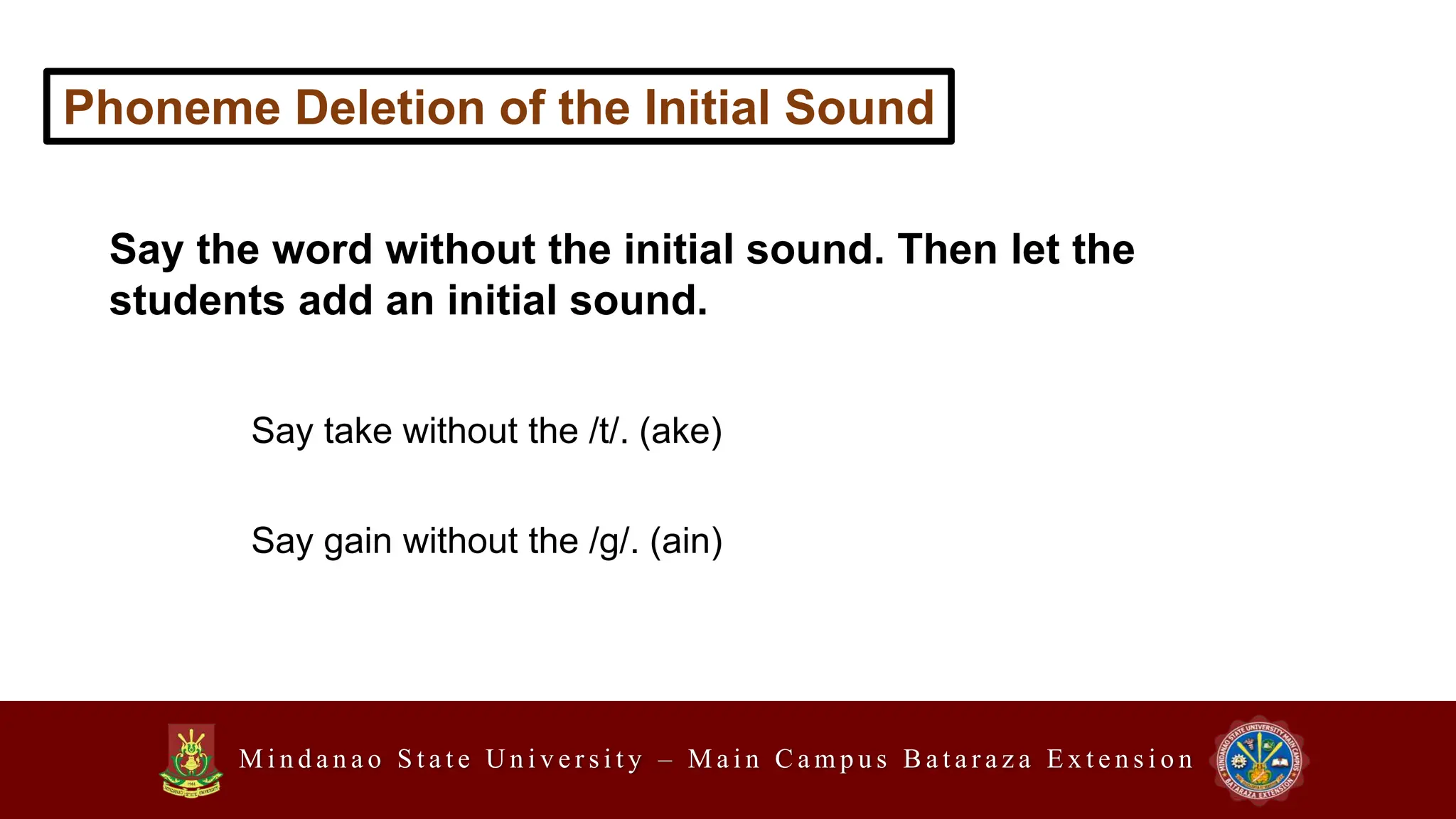
Phoneme Deletion of the Initial Sound
Say the word without the initial sound. Then let the
students add an initial sound.
Say take without the /t/. (ake)
Say gain without the /g/. (ain)
M i n d a n a o S t a t e U n i v e r s i t y – M a i n C a m p u s B a t a r a z a E x t e n s i o n
Phoneme Deletion of the Final Sound
Say the word without the final sound. Then let the students
add a final sound.
Say big without the /g/. (bi)
M i n d a n a o S t a t e U n i v e r s i t y – M a i n C a m p u s B a t a r a z a E x t e n s i o n
Identification of Initial Sounds
Say different words with the same initial sound then let the
students identify the initial sound.
(the words ‘bat’, ‘boy’, and ‘Billy’ all start with the /b/ sound
whereas ‘tall’ and ‘toy’ start with the /t/ sound)
M i n d a n a o S t a t e U n i v e r s i t y – M a i n C a m p u s B a t a r a z a E x t e n s i o n
Categorize Similar Sounds
Categorize words that have similar sounds especially with
those that rhyme with each other.
(cat, mat, fat, and sat all rhyme)
M i n d a n a o S t a t e U n i v e r s i t y – M a i n C a m p u s B a t a r a z a E x t e n s i o n
Identify the Odd One Out
Let the students identify the word that sounds differently
among the group of words
(in the group of words ‘bug’, ‘rug’, ‘run’ and
‘hug’, the word ‘run’ is different)
THANK YOU!
Mindanao State University
Main Campus
Bataraza Extension

Lesson-2.-Remedial-Instruction-in-Reading-Phonemic-Awareness.pptx

  • 1.
    Remedial Instruction for Reading MR.JAKE B. DOLORICON Mindanao State University Main Campus Bataraza Extension
  • 2.
    M i nd a n a o S t a t e U n i v e r s i t y – M a i n C a m p u s B a t a r a z a E x t e n s i o n In the Philippines, the problem of students in reading is not a new issue. In fact, certain studies reveal that the reading problems of Filipino students seemed to be perennial (Alayon, 2014; Habagat & Rizon, 2012; Lalunio, 1994; Miguel, 2007; Montalban, 2010; Umali, 2016). Reading Situation in the Philippines Recently, the Philippines, once again, ended up among the countries that produced the lowest proficiency for 15-year-old students in reading, mathematics, and science. Philippines ranked 77th out of 81 countries globally, as indicated by the PISA rankings released in December 2023 (Rappler, 2024).
  • 3.
    M i nd a n a o S t a t e U n i v e r s i t y – M a i n C a m p u s B a t a r a z a E x t e n s i o n Only 1 public school passed the PISA 2022 Assessment recently released in 2024 which is the Benigno National High School in NCR. Reading Situation in the Philippines Due to such problems, reading and literacy instruction have always been the top priority in all Philippine curricula. • Catch-up Fridays • End of the School Year (EOSY)
  • 4.
    M i nd a n a o S t a t e U n i v e r s i t y – M a i n C a m p u s B a t a r a z a E x t e n s i o n In other country, remedial reading teaching is considered a separate professional job. Remedial reading teacher needs a serious, systematic and meticulous groundwork in order to become one. Issues in the Reading Remediation in PH However, remedial reading teaching as a separate profession is barely recognizable in the Philippine education. Accordingly, there is no budget allocation for this. Remedial reading teachers to possess graduate degrees especially in literacy education in order to preserve and to enhance their professional integrity.
  • 5.
    M i nd a n a o S t a t e U n i v e r s i t y – M a i n C a m p u s B a t a r a z a E x t e n s i o n In fact, the usual practice in local schools is that the classroom teachers are the ones who are also the remedial reading teachers. Hence, being a remedial reading teacher is considered an extra workload for teachers and is not compensated for doing the roles and responsibilities entrusted to them. Issues in the Reading Remediation in PH
  • 6.
    M i nd a n a o S t a t e U n i v e r s i t y – M a i n C a m p u s B a t a r a z a E x t e n s i o n Nevertheless, this is the natural consequence for those developing countries. Teachers in developing countries are expected to possess a vast number of knowledge and skills in addressing the problems in reading. This is the reason why teachers, especially English language teachers in primary and secondary schools, should be knowledge in remedial reading instruction. Issues in the Reading Remediation in PH
  • 7.
    M i nd a n a o S t a t e U n i v e r s i t y – M a i n C a m p u s B a t a r a z a E x t e n s i o n Phonemic Awareness Aspects in Remedial Reading Instruction Phonics Awareness Vowel Rules or Principles and Accent Generalizations Basic-Sight Words, Phrases, and Sentences
  • 8.
    M i nd a n a o S t a t e U n i v e r s i t y – M a i n C a m p u s B a t a r a z a E x t e n s i o n Syllabication Principles Aspects in Remedial Reading Instruction Morphology Remedial Vocabulary Instruction
  • 9.
    Elements of anEffective Reading Remediation Program To Improve Reading Skills in Struggling Readers Mindanao State University Main Campus Bataraza Extension
  • 10.
    M i nd a n a o S t a t e U n i v e r s i t y – M a i n C a m p u s B a t a r a z a E x t e n s i o n 1. Teach All Skills Directly Always explicitly teach the student exactly what they need to know. Never leave it to chance for a student to discover essential elements on his own. Direct instruction prevents situations where the student does not learn simply because they inadvertently missed essential information or skills Direct instruction is particularly critical in remediation as these students previously failed to acquire necessary skills. Direct instruction helps insure the student learns all necessary skills.
  • 11.
    M i nd a n a o S t a t e U n i v e r s i t y – M a i n C a m p u s B a t a r a z a E x t e n s i o n 2. Teach in a Systematic Manner Present information in a deliberate, pre-planned carefully controlled manner. This step-by- step instruction allows the student time to practice and master individual skills before additional information and complexities are taught. Start simple. Introduce new skills and knowledge a bit at a time, adding complexity as the student learns.
  • 12.
    M i nd a n a o S t a t e U n i v e r s i t y – M a i n C a m p u s B a t a r a z a E x t e n s i o n 3. Always Provide Immediate Correction Do not allow the student to learn or practice skills incorrectly. Immediate correction is especially critical in remediation. Correction is necessary to help the student extinguish incorrect approaches and develop necessary skills. It is always easier to learn the correct way than to try and unlearn incorrect habits.
  • 13.
    M i nd a n a o S t a t e U n i v e r s i t y – M a i n C a m p u s B a t a r a z a E x t e n s i o n 4. Develop Phonemic Awareness Directly develop phonemic awareness skills. Although some children and adults have a definite natural phonological weakness, phonemic awareness (PA) can be taught and learned. The scientific evidence proves that PA instruction has a significant positive effect on both reading and spelling. Directly teach students how to hear, recognize and manipulate sounds within words.
  • 14.
    M i nd a n a o S t a t e U n i v e r s i t y – M a i n C a m p u s B a t a r a z a E x t e n s i o n 5. Develop Directional Tracking It is essential the student develops and engrains proper directional tracking where they process letters in order from left to right. It is especially important to directly teach and emphasize proper directional tracking to remedial readers. Many struggling readers make frequent tracking errors. They try to look at all the letters at once or hop around searching for words or portions of words they recognize. Overcoming these incorrect strategies requires direct work on proper tracking skills. Physical pointing, with either the finger or other pointer, is a highly effective way to directly teach this critical skill. The multisensory benefits of having the student physically move their finger or pointer (kinetic motion) develops and engrains this essential subskill. Especially in remediation, you need to ensure the student processes all the letters in a word in order from left to right.
  • 15.
    M i nd a n a o S t a t e U n i v e r s i t y – M a i n C a m p u s B a t a r a z a E x t e n s i o n 6. Teach Smooth Blending The skill of smoothly blending individual sounds together into words is critical. The student needs to learn how to say the sounds smoothly without pausing between the sounds. The instructor needs to always demonstrate the correct blending technique of not pausing between the sounds. Choppy/segmented sounding out makes it very difficult for some students to push the sounds back together into a word.
  • 16.
    M i nd a n a o S t a t e U n i v e r s i t y – M a i n C a m p u s B a t a r a z a E x t e n s i o n 7. Teach the COMPLETE Phonetic Code Directly teach the complete phonetic code. All necessary phonograms need to be directly and systematically taught. The phonograms are the alphabetic letters or groups of letters that symbolize the smallest speech sounds of English. The student must have knowledge of the direct print to sound relationship. Although it is best to start with the simple and most frequently encountered sounds, it is not adequate to stop there. It is essential to teach the complete code necessary to master our phonemic based written English language. • Sounds written with more than one letter (/th/ /sh/ /ch/ /oy/..) • Multiple Sounds of the vowel (o=/o/, /oa/ and /u/) • the numerous vowel-combinations or diphthongs (ee, ea, oa, oi, ai, ou…)
  • 17.
    M i nd a n a o S t a t e U n i v e r s i t y – M a i n C a m p u s B a t a r a z a E x t e n s i o n 8. Ensure Phonologic Processing - Avoid Sight/Whole Word Reading It is important to avoid teaching a sight word approach where the student learns to “read” by trying to recognize what whole words “look like”. Many students who struggle with reading have adopted this incorrect ‘whole word’ visual word recognition strategy. Remediation must focus on eliminating this detrimental habit of trying to visually recognize the entire word. A ‘whole word’ approach to reading fails because there are too many words and words are too similar to learn by overall visual appearance.
  • 18.
    M i nd a n a o S t a t e U n i v e r s i t y – M a i n C a m p u s B a t a r a z a E x t e n s i o n 9. Guided Oral Reading Guided reading is reading out loud to an adult, or other proficient reader, with feedback. This is NOT independent silent reading. The key part is ‘guided’. Correction and instruction helps the student learn and improve skills. The validated research shows guided out loud reading has significant beneficial impact on word recognition, fluency and comprehension across a range of grade levels.
  • 19.
    M i nd a n a o S t a t e U n i v e r s i t y – M a i n C a m p u s B a t a r a z a E x t e n s i o n ASSIGNMENT Read and summarize in 1 whole sheet of paper the remaining elements stipulated in the website: https://www.righttrackreading.com/elementsremed.html Deadline of Submission: February 14, 2024
  • 20.
    Phonemic Awareness Mindanao StateUniversity Main Campus Bataraza Extension
  • 21.
    M i nd a n a o S t a t e U n i v e r s i t y – M a i n C a m p u s B a t a r a z a E x t e n s i o n Phonics Awareness VS Phonemic Awareness Phonics and phonemic awareness belong in the same umbrella of linguistics segment The simplest distinction between the two of them is, phonemic awareness only involves the ears, but phonics involves both the ears and eyes.
  • 22.
    M i nd a n a o S t a t e U n i v e r s i t y – M a i n C a m p u s B a t a r a z a E x t e n s i o n Phonics Awareness VS Phonemic Awareness Phonemic Awareness - involves understanding and manipulating the sounds in spoken words (phonemes). It's about hearing and playing with the sounds in words, such as identifying beginning sounds, blending sounds together to make a word, segmenting a word into its sounds, and manipulating sounds within words. Phonics - involves learning the relationship between sounds (phonemes) and their corresponding letters or groups of letters (graphemes). It's about teaching how to connect the sounds of spoken English with letters or groups of letters and how to blend those sounds together to form recognizable words.
  • 23.
    M i nd a n a o S t a t e U n i v e r s i t y – M a i n C a m p u s B a t a r a z a E x t e n s i o n
  • 24.
    M i nd a n a o S t a t e U n i v e r s i t y – M a i n C a m p u s B a t a r a z a E x t e n s i o n
  • 25.
    M i nd a n a o S t a t e U n i v e r s i t y – M a i n C a m p u s B a t a r a z a E x t e n s i o n Many children do not realize that the words they hear break apart into smaller chunks of sound. Hearing the individual sounds within a word is difficult because spoken language is so seamless. Children vary greatly in their natural ability to hear the sounds within words. Some individuals have a definite natural phonological weakness.
  • 26.
    M i nd a n a o S t a t e U n i v e r s i t y – M a i n C a m p u s B a t a r a z a E x t e n s i o n Why is Phonemic Awareness important? Phonemic awareness is important because it is critical to reading and spelling success. A child’s phonemic awareness is a powerful predictor of the likelihood of reading and spelling success. Children who can not distinguish and manipulate the sounds within spoken words have difficulty recognizing and learning the necessary print=sound relationship that is critical to proficient reading and spelling success. If a child has poor phonemic awareness it is difficult for them to discover the necessary link between print and sound.
  • 27.
    The 44 Phonemesin English Mindanao State University Main Campus Bataraza Extension
  • 28.
    M i nd a n a o S t a t e U n i v e r s i t y – M a i n C a m p u s B a t a r a z a E x t e n s i o n ASSIGNMENT Video-record yourself producing the 44 Phonemes of the English language. Make a google drive and upload your videos there.
  • 29.
    Skills in Teaching PhonemicAwareness Mindanao State University Main Campus Bataraza Extension
  • 30.
    M i nd a n a o S t a t e U n i v e r s i t y – M a i n C a m p u s B a t a r a z a E x t e n s i o n Isolation of Initial Sound Isolate and distinguish individual sounds (the word fish starts with /f/, the word Sam starts with /s/, or the word ‘cat’ ends with /t/)
  • 31.
    M i nd a n a o S t a t e U n i v e r s i t y – M a i n C a m p u s B a t a r a z a E x t e n s i o n Phoneme Blending Onset and Rime The onset is the part of a single-syllable word before the vowel. The rime is the part of a word including the vowel and the letters that follows. /t/ /op/ (top) /s/ /at/ (sat)
  • 32.
    M i nd a n a o S t a t e U n i v e r s i t y – M a i n C a m p u s B a t a r a z a E x t e n s i o n Phoneme Blending All Phonemes Sound out every individual phoneme in the word then let the students guess the word /p/ /i/ /g/ What is the word? (pig)
  • 33.
    M i nd a n a o S t a t e U n i v e r s i t y – M a i n C a m p u s B a t a r a z a E x t e n s i o n Phoneme Deletion of the Initial Sound Say the word without the initial sound. Then let the students add an initial sound. Say take without the /t/. (ake) Say gain without the /g/. (ain)
  • 34.
    M i nd a n a o S t a t e U n i v e r s i t y – M a i n C a m p u s B a t a r a z a E x t e n s i o n Phoneme Deletion of the Final Sound Say the word without the final sound. Then let the students add a final sound. Say big without the /g/. (bi)
  • 35.
    M i nd a n a o S t a t e U n i v e r s i t y – M a i n C a m p u s B a t a r a z a E x t e n s i o n Identification of Initial Sounds Say different words with the same initial sound then let the students identify the initial sound. (the words ‘bat’, ‘boy’, and ‘Billy’ all start with the /b/ sound whereas ‘tall’ and ‘toy’ start with the /t/ sound)
  • 36.
    M i nd a n a o S t a t e U n i v e r s i t y – M a i n C a m p u s B a t a r a z a E x t e n s i o n Categorize Similar Sounds Categorize words that have similar sounds especially with those that rhyme with each other. (cat, mat, fat, and sat all rhyme)
  • 37.
    M i nd a n a o S t a t e U n i v e r s i t y – M a i n C a m p u s B a t a r a z a E x t e n s i o n Identify the Odd One Out Let the students identify the word that sounds differently among the group of words (in the group of words ‘bug’, ‘rug’, ‘run’ and ‘hug’, the word ‘run’ is different)
  • 38.
    THANK YOU! Mindanao StateUniversity Main Campus Bataraza Extension

Editor's Notes

  • #26 This is especially true in those words that have relatively uncommon phoneme such as diphthongs.