Reading Interventions for
Struggling Readers
Session Objectives
1. Explain the importance of reading
interventions strategies in teaching
reading.
2. Identify the different reading
intervention strategies for
struggling readers applicable to
online, modular and in-person
learning.
3. Design a school reading intervention
plan based on the needs of learners. This Photo by Unknown Author is licensed under CC BY-NC
Reading print is not a natural biologic process
and is a complex process, which requires looking at
man-made, arbitrary black letters and words, and
matching that written code with our spoken
language.
Most problems with reading have nothing to do
with intelligence or ability, but rather incorrect
processing. Teachers can help learners understand
that difficulties in reading are often caused by
weaknesses in phonologic processing and other
fundamental skills.
Response to intervention (RTI) has altered how
educators serve learners with reading difficulties. Its
impact is most evident at the primary level, where
the focus is on limiting referrals to special education
by preventing reading difficulties (Legere, & Conca,
2010).
Activity 1: Buzz Group
Think and share your insights and ideas on the
following:
1. List down the best reading interventions you have
used in your classes.
2. What is the importance of implementing reading
interventions in your class?
Think and give your answer to these questions.
1. Do we need to make intervention plan before we
conduct an intervention?
2. Is assessment prerequisite before we conduct
reading intervention?
3. How can we attain effective remediation plan for the
learners?
4. Is communication important between the teachers,
parents and the learners for the success of reading
remediation?
5. Do we need to identify the strength , weaknesses
and type of learners we have in making
interventions?
What is remedial reading?
Remedial reading is a supplemental reading
program that consists of re-reading unfamiliar
text until a satisfactory level of fluency is reached.
Remedial reading is a strategy that implements
assisted reading, reading while listening, and
paired reading.
What is the importance of remedial reading?
The goal of Remedial Reading is to
dramatically reduce the number of learners who
have extreme difficulty learning to read and write.
Remedial Reading is a highly effective short-term
intervention of tutoring struggling readers in both
an individualized and small group setting.
What should a teacher do prior to reading
remediation?
Before beginning an intensive reading
remediation program, teacher needs to help the
learner understand the remediation program. To that
end, teacher may explain the effective remediation
plan to the learner.
What are remediation strategies?
Remediation strategies are one type of
intervention. Effective remediation involves
assessing the learner's needs, providing
intervention and evaluating learner outcomes.
Successful remediation programs adjust the
instruction based on the learner's response to the
intervention.
Remediation
In remediation, teacher tries to correct a
deficit rather than teach learners to cope with the
deficit. Through remediation activities or lessons,
teacher helps a learner improves his skills through
direct instruction. Remedial instruction is focused
on the specific concepts with which the learner
struggles.
Reteaching
Reteaching is one method of remediation.
Teacher presents the information to the learner
again.
Some learners may require alternative
teaching strategies for remediation. These
strategies are often based on learners’ individual
learning styles.
Alternative Instructional
Strategies
Task analysis is the process of breaking a
skill into smaller components.
Task Analysis
Learners may require additional practice
to master skills. This is another form of
remediation.
Additional Practice
Tutoring is another popular remediation
method for struggling learners. Tutoring is
typically one child with one teacher.
One-on-One Tutoring
Seven Strategies to Use with
Struggling Readers in In -Person
Remediation Setting
1. Scaffolding is breaking up the learning into chunks
and providing a tool, or structure, with each chunk.
When scaffolding reading, for example, you might
preview the text and discuss key vocabulary or chunk the
text and then read and discuss as you go.
Seven Strategies to Use with Struggling Readers
in In-Person Remediation Class
2. Be inclusive. It is crucial to encourage as much
success as possible when children are learning to read.
The teacher should take as many steps necessary,
discreetly and sensitively, to enable the struggling
reader to participate in classroom discussions about
stories.
3. Allow Preparation of Oral Reading. Oral reading is
often a struggling reader’s greatest fear, as it publicizes
his/her weakness. To enable learners to achieve
success, allow time to practice with a voice recorder,
teacher or buddy until they are confident to present it.
4. Explore children's interest. Include a range of
reading materials in your classroom for independent
reading.
5. Use Cloze activities. This alters the process of reading
from identifying printed words to using meaning for
making sense. Leave the first few lines of the text intact
and blank out one of the words.
6. Use environmental print. Learners who are able to
read a pharmacy sign , walking down the street will
often find difficulty when presented with the same word
on a sheet of paper.
7. Use shared reading. Great method for boosting the
confidence of struggling readers. As the teacher
activates knowledge, the readers are beginning to
identify potential vocabulary that may be used in the
text.
Strategies in Teaching Reading
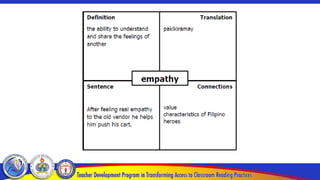
Vocabulary: The Use of Frayer Model
• A graphic organizer with four sections use for
vocabulary building.
• Involves definition of target vocabulary and
application of knowledge by generating examples
and non-examples, using in a sentence,
providing translation (ESL), citing connections,
giving characteristics, and/or drawing a picture
to illustrate the meaning of the word.
When to use it?
• Develop understanding of key concepts and vocabulary.
• Draw on prior knowledge to make connections among
concepts.
• Compare attributes and examples.
• Think critically to find relationships between concepts and
to develop deeper understanding of word meanings.
• Make visual connections and personal associations.
How to use it?
1. Select key vocabulary
2. Provide graphic organizer
3. Model the process
4. Divide the class into learner pairs
5. Let learners share their ideas
6. Create study helps
buhawi
Reading Fluency: Partner Reading
It involves peer mediated instruction wherein
a higher-level reader provides assistance to a
partner with lower reading level.
Delivery
• Three times a week for at least 20 minutes per
session
• Train peer tutors in giving feedback
• Establish a routine
• Plan seating arrangement and placement of
reading materials
• Categorize reading selections where learners can
choose reading materials
Teacher Preparation
• Determine learners' reading levels.
• List learners from highest to lowest based from
their reading abilities.
• Divide the list in half.
• Place the first learner (highest) on the first list
with the first learner (lowest).
• Continue until all learners have been partnered.
Example of Partner Reading Pairs
High Performing
Readers (HP)
Low Performing
Readers (LP) Pairs
1st HP 1st
LP A
2nd HP 2nd
LP B
3rd HP 3rd
LP C
4th HP 4th
LP D
• The reader from the first list (HP) will be called
Partner 1 while that from the second list (LP)
will be called Partner 2.
• Prepare correction cards.
• Partner 1 always begins the reading, while
Partner 2 follows along.
1. Partner 1 (HP), reads the first paragraph. Partner
2 (LP) follows along.
2. Partner 2 (LP) reads the same paragraph.
3. After both partners read one paragraph, Partner 2
(LP) retells sequentially what happened in that
paragraph.
Directions for Implementation
4. Partner 1 (HP) should praise Partner 2 when s/he
retells sequentially what happened in that
paragraph.
5. The pairs will repeat steps 1-4 until the passage
is complete.
Directions for Implementation
6. Partners should refer to the correction card
when mistake is made.
6.1 If a learner reads a word incorrectly, skips
a word, or does not say a word within 4
seconds, his/her partner says, “Check it!”
6.2. Then his/her partner will point to the word
and say, “Yes, that word is_____. What word?”
The learner repeats the word. Then the partner
says, “Please reread the sentence.”
6.3. Alternatively, if the learner does not know
the word, the partner says, “That word is _____.
What word?” The learner says the word. Then
the partner says, “Please reread the sentence.”
7. Partner 1 and Partner 2 can also make flashcards
of all words that Partner 2 does not know. If after
reading there are a few extra minutes available,
Partner 1 can take five of the cards and review
them with Partner 2.
6.4. The learner is always asked to repeat the
word and reread the sentence.
Reading Fluency and Vocabulary: Boom!
Strategy
It is an engaging and playful strategy which
is fun and fast-paced game. The objective of the
game is for the learner to read as many sight
words on the cards/sticks as s/he can.
Delivery
• Implementation should be three times a week
for at least 20 minutes per session.
• Conducted by dividing the class into small
groups of learners while the teacher acts as a
facilitator who first shows the learners how to
play the game and provides corrective feedback
as needed.
A routine which includes the following should be
developed:
• identifying sight words list
• writing sight words on wooden sticks or printing
them on cards
• choosing storage containers for the sticks or
cards
• establishing a routine for learners to adopt so
that they know the step-by-step requirements
for engaging in Boom!
• planning the seating arrangement and where
the materials will be located
• periodically replace some of the Boom! sticks or
cards with rewards
• connect it to writing, for independent readers
Teacher Preparation
1. Write high frequency (sight) words on wooden
craft sticks or print them on cards (one word per
stick/card)
2. On some sticks/cards write the word “BOOM!”
3. Tie each group of sticks/cards and place them
in a container.
Directions for Implementation:
The teacher should provide these directions for
learners:
1. Learners sit in a circle.
2. One learner shuffles the sticks/cards.
3. Learners take turns picking a stick/card and
reading the word fluently.
4. If the learner reads the word correctly s/he
keeps the stick/card.
5. If the learner reads the word incorrectly s/he
returns the stick/card in the stack/deck and
the stack of sticks/ deck of cards is shuffled.
6. When a learner chooses a Boom! stick/card
s/he must say, “Boom!” and put all of
his/her word sticks/cards back into the
stack/deck.
7. After all the sight words are read or after the
given time the player with the most
sticks/cards wins.
Reading Remediation Strategies
for Modular Distance Learning
1. VISUALIZING Printed Materials
Image source: https://sl.bing.net/eLL2vxR721A
https://sl.bing.net/fW8mjyvRKfc
2. Activating Prior Knowledge
Before reading, teach the learners to activate
prior knowledge by making a list about what they
already know about a topic, creating a KWL chart,
doing a turn and talk, brainstorming, or simply
taking a moment to think silently.
Make recorded videos or send videos.
3. Model
Image source: https://images.ap.goo.gl/oA9izWuKU5PQtbSj7
https://ph.pinterest.com/pin/450008187780357454/
4. Re-Reading - Give a set of words for them to read at
home
Setting a purpose for reading helps keep
learners focused and engaged while reading and
gives them a mission so that comprehension can be
reinforced.
5. Setting a Purpose
Good readers use
context clues to help
them understand the
meaning of an
unfamiliar and
challenging word.
6. Context Clues
Image source: https://images.app.goo.gl/ eTK6PAyy7r22odxx8
Evaluating is
a reading strategy that is
conducted during and
after reading. This involves
encouraging the reader to
form opinions, make
judgments.
https://www.scribd.com/presentation/697738864/Chapter-5-
Reading-Comprehension-of-Fictional-Passages
7. Evaluating – To check learners'
comprehension
Two valid and reliable procedures that can
be used to monitor a learner's growth in reading
are: Oral reading and Maze reading. These tools
are generally used with learners who have an
established language base and are beginning to
read text-based materials.
8. Monitor – to know what is appropriate for
their level
Teachers meet those parents who can really
help do the teaching to their children and they
provide basic inputs or information on the basic
skills in teaching and assessing their children in
reading.
9. Training Parents To Be Para-Teachers
Reading Remediation
Strategies
for Online Distance Learning
Focus on the Basics
Learners need the time to work at their
pace, especially with fundamental reading
skills. Reading remediation that focuses on the
basics ensures that learners have a solid
foundation where they can grow their reading
skills as they learn.
Get Creative to Get Students Engaged
Remediation specialist Jen Burch has
discovered that less is more when using technology
in reading remediation. “I’ve found that the less
technology I use, the better. Learners seem to be
more engaged when I show them something I am
writing on a whiteboard instead of sharing
presentation through a screen,” says Burch.
Encourage students to use multiple areas
of the brain
Throughout in-person education, teachers use
different strategies to appeal to different kinds of
learners. In online remediation settings, educators
can still use various tactics to help learners engage
multiple areas of the brain to better understand
language concepts.
Adjust Expectations for Yourself and Your
Students
Successful reading remediation is a result
of realistic expectations set by both learners
and teachers.
What are examples of reading interventions?
Examples of reading interventions include
scaffolding, or providing supports for learners,
small-group instruction, use of technology,
explicit phonics instruction, and offering
choices of reading materials.
What is the best intervention for struggling
readers?
The most commonly used strategy to
improve reading fluency is the reading and
rereading of familiar texts. Opportunities to
read aloud, with guidance from teachers,
peers or parents, are also associated with the
development of fluent reading.
Eleven Reading Intervention
Strategies That Work
#1 Read as much as possible!
#2 Read aloud to model good reading.
#3: Mix It Up With Learners Choice
and Teacher Assigned Reading
There is value in both learner choice and
teacher choice when it comes to reading, and
they should definitely be both in good reading
instruction.
#4: Use Real Books Along With Reading Passages
and Textbooks
Reading passages and textbooks are great
because they allow focused practice in the skills
you are learning, at just the right level.
#5: Independent Reading and
Instructional Reading Level
There are 3 types of reading levels:
independent reading level, instructional
reading level, and frustrational reading level.
#6: Make Every Child Feel Successful
When learners feel defeated, their
motivation plummets. When learners feel
successful, their motivation skyrockets.
#7: Break It Into Shorter Chunks
Sometimes learners have a hard time staying
focused during long lessons.
#8: Rewards For Effort And Completions
Give rewards or
incentives
for effort and
completion, rather
than for achievement
https://katelynslearningstudio.com/reading-
intervention-strategies
#9: Routines
Learners thrive on
routine. They love knowing
what’s coming and being able
to participate smoothly in it.
#10: Games
The idea of playing a
game is so engaging and
motivating!
This Photo by Unknown Author is licensed under CC BY-SA
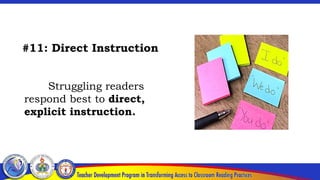
#11: Direct Instruction
Struggling readers
respond best to direct,
explicit instruction.
Application
Directions: Design a School Reading Intervention
Plan that will effectively address the needs of your
struggling readers. Use the sample template.
School Reading Intervention Plan Template
Action Plan Template Source: SDO Gapan City (2022). Teacher Development Program in Transforming Access to Classroom Reading Practices. NEAP
III Approved PD. Region III.
Output Presentation
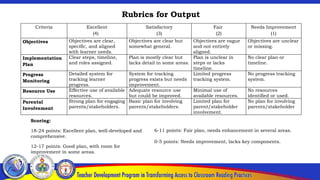
Rubrics for Output
Criteria Excellent
(4)
Satisfactory
(3)
Fair
(2)
Needs Improvement
(1)
Objectives Objectives are clear,
specific, and aligned
with learner needs.
Objectives are clear but
somewhat general.
Objectives are vague
and not entirely
aligned.
Objectives are unclear
or missing.
Implementation
Plan
Clear steps, timeline,
and roles assigned.
Plan is mostly clear but
lacks detail in some areas.
Plan is unclear in
steps or lacks
timeline.
No clear plan or
timeline.
Progress
Monitoring
Detailed system for
tracking learner
progress.
System for tracking
progress exists but needs
improvement.
Limited progress
tracking system.
No progress tracking
system.
Resource Use Effective use of available
resources.
Adequate resource use
but could be improved.
Minimal use of
available resources.
No resources
identified or used.
Parental
Involvement
Strong plan for engaging
parents/stakeholders.
Basic plan for involving
parents/stakeholders.
Limited plan for
parent/stakeholder
involvement.
No plan for involving
parents/stakeholder
Scoring:
18-24 points: Excellent plan, well-developed and
comprehensive.
12-17 points: Good plan, with room for
improvement in some areas.
6-11 points: Fair plan, needs enhancement in several areas.
0-5 points: Needs improvement, lacks key components.
“Reading is the mother of all learning”.
“Every child is capable of learning how to
read”
We, teachers, as collaborators of learning,
must be influential to our learners in
developing genuine love for reading.
References:
Seehorn, A. (2011). What Are Remediation Activities? | Synonym.
Synonym.com. https://classroom.synonym.com/remediation-activities
8065079.html
Osewalt, G. (n.d.). Remedial Instruction or Compensatory Approach | What’s
the Difference? Www.understood.org.https://www.understood.org/en/
articles /whats-the-difference-between-remedial-instruction-and-a
compensatory-approach
Reading Remediation (Grades 3-12) Canada | Evoke Learning. (2024,
September 5). Evoke Learning. https://www.evokelearning.ca/reading
remediation/reading-remediation-for-students-grades-1-12
References:
Four Remedial Reading Strategies for Elementary Students: Creative Ideas.
(2011, January 19). Www.brighthubeducation.com. https://www.bright
hubeducation.com/special-ed-learning-disorders/103576-four-remedial
reading-teaching-strategies/
Schlauch, K. (2014, May 10). 10 Reasons Why Reading is a Skill Every Child
Should Develop. Www.libertychristianschoolmd.com. https://www.liberty
christianschoolmd.com/blog/10-reasons-why-reading-is-a-skill-every
child-should-develop
8 Tips to Help Students Build Better Reading Skills | Waterford.org. (2017, April
12). Waterford.org. https://www.waterford.org/resources/tips-to-help
students-build-better-reading-skills/
Thank you!
PPT and Session Guide Writer:
Luzviminda G. Sese
Master Teacher I, Gapan South Central School
SDO Gapan City, DepEd Region III
PPT Template Designer/Layout Editor:
Emmanuel DG. Castro
Teacher III, HGNHS
SDO Gapan City, Region III

NEAP Approved Session 8_Reading Interventions.pptx

  • 1.
  • 2.
    Session Objectives 1. Explainthe importance of reading interventions strategies in teaching reading. 2. Identify the different reading intervention strategies for struggling readers applicable to online, modular and in-person learning. 3. Design a school reading intervention plan based on the needs of learners. This Photo by Unknown Author is licensed under CC BY-NC
  • 3.
    Reading print isnot a natural biologic process and is a complex process, which requires looking at man-made, arbitrary black letters and words, and matching that written code with our spoken language.
  • 4.
    Most problems withreading have nothing to do with intelligence or ability, but rather incorrect processing. Teachers can help learners understand that difficulties in reading are often caused by weaknesses in phonologic processing and other fundamental skills.
  • 5.
    Response to intervention(RTI) has altered how educators serve learners with reading difficulties. Its impact is most evident at the primary level, where the focus is on limiting referrals to special education by preventing reading difficulties (Legere, & Conca, 2010).
  • 6.
    Activity 1: BuzzGroup Think and share your insights and ideas on the following: 1. List down the best reading interventions you have used in your classes. 2. What is the importance of implementing reading interventions in your class?
  • 7.
    Think and giveyour answer to these questions. 1. Do we need to make intervention plan before we conduct an intervention? 2. Is assessment prerequisite before we conduct reading intervention? 3. How can we attain effective remediation plan for the learners?
  • 8.
    4. Is communicationimportant between the teachers, parents and the learners for the success of reading remediation? 5. Do we need to identify the strength , weaknesses and type of learners we have in making interventions?
  • 9.
    What is remedialreading? Remedial reading is a supplemental reading program that consists of re-reading unfamiliar text until a satisfactory level of fluency is reached. Remedial reading is a strategy that implements assisted reading, reading while listening, and paired reading.
  • 10.
    What is theimportance of remedial reading? The goal of Remedial Reading is to dramatically reduce the number of learners who have extreme difficulty learning to read and write. Remedial Reading is a highly effective short-term intervention of tutoring struggling readers in both an individualized and small group setting.
  • 11.
    What should ateacher do prior to reading remediation? Before beginning an intensive reading remediation program, teacher needs to help the learner understand the remediation program. To that end, teacher may explain the effective remediation plan to the learner.
  • 12.
    What are remediationstrategies? Remediation strategies are one type of intervention. Effective remediation involves assessing the learner's needs, providing intervention and evaluating learner outcomes. Successful remediation programs adjust the instruction based on the learner's response to the intervention.
  • 13.
    Remediation In remediation, teachertries to correct a deficit rather than teach learners to cope with the deficit. Through remediation activities or lessons, teacher helps a learner improves his skills through direct instruction. Remedial instruction is focused on the specific concepts with which the learner struggles.
  • 14.
    Reteaching Reteaching is onemethod of remediation. Teacher presents the information to the learner again.
  • 15.
    Some learners mayrequire alternative teaching strategies for remediation. These strategies are often based on learners’ individual learning styles. Alternative Instructional Strategies
  • 16.
    Task analysis isthe process of breaking a skill into smaller components. Task Analysis
  • 17.
    Learners may requireadditional practice to master skills. This is another form of remediation. Additional Practice
  • 18.
    Tutoring is anotherpopular remediation method for struggling learners. Tutoring is typically one child with one teacher. One-on-One Tutoring
  • 19.
    Seven Strategies toUse with Struggling Readers in In -Person Remediation Setting
  • 20.
    1. Scaffolding isbreaking up the learning into chunks and providing a tool, or structure, with each chunk. When scaffolding reading, for example, you might preview the text and discuss key vocabulary or chunk the text and then read and discuss as you go. Seven Strategies to Use with Struggling Readers in In-Person Remediation Class
  • 21.
    2. Be inclusive.It is crucial to encourage as much success as possible when children are learning to read. The teacher should take as many steps necessary, discreetly and sensitively, to enable the struggling reader to participate in classroom discussions about stories. 3. Allow Preparation of Oral Reading. Oral reading is often a struggling reader’s greatest fear, as it publicizes his/her weakness. To enable learners to achieve success, allow time to practice with a voice recorder, teacher or buddy until they are confident to present it.
  • 22.
    4. Explore children'sinterest. Include a range of reading materials in your classroom for independent reading. 5. Use Cloze activities. This alters the process of reading from identifying printed words to using meaning for making sense. Leave the first few lines of the text intact and blank out one of the words.
  • 23.
    6. Use environmentalprint. Learners who are able to read a pharmacy sign , walking down the street will often find difficulty when presented with the same word on a sheet of paper. 7. Use shared reading. Great method for boosting the confidence of struggling readers. As the teacher activates knowledge, the readers are beginning to identify potential vocabulary that may be used in the text.
  • 24.
  • 25.
    Vocabulary: The Useof Frayer Model • A graphic organizer with four sections use for vocabulary building. • Involves definition of target vocabulary and application of knowledge by generating examples and non-examples, using in a sentence, providing translation (ESL), citing connections, giving characteristics, and/or drawing a picture to illustrate the meaning of the word.
  • 26.
    When to useit? • Develop understanding of key concepts and vocabulary. • Draw on prior knowledge to make connections among concepts. • Compare attributes and examples. • Think critically to find relationships between concepts and to develop deeper understanding of word meanings. • Make visual connections and personal associations.
  • 27.
    How to useit? 1. Select key vocabulary 2. Provide graphic organizer 3. Model the process 4. Divide the class into learner pairs 5. Let learners share their ideas 6. Create study helps
  • 31.
  • 33.
    Reading Fluency: PartnerReading It involves peer mediated instruction wherein a higher-level reader provides assistance to a partner with lower reading level.
  • 34.
    Delivery • Three timesa week for at least 20 minutes per session • Train peer tutors in giving feedback • Establish a routine • Plan seating arrangement and placement of reading materials • Categorize reading selections where learners can choose reading materials
  • 35.
    Teacher Preparation • Determinelearners' reading levels. • List learners from highest to lowest based from their reading abilities. • Divide the list in half. • Place the first learner (highest) on the first list with the first learner (lowest). • Continue until all learners have been partnered.
  • 36.
    Example of PartnerReading Pairs High Performing Readers (HP) Low Performing Readers (LP) Pairs 1st HP 1st LP A 2nd HP 2nd LP B 3rd HP 3rd LP C 4th HP 4th LP D
  • 37.
    • The readerfrom the first list (HP) will be called Partner 1 while that from the second list (LP) will be called Partner 2. • Prepare correction cards. • Partner 1 always begins the reading, while Partner 2 follows along.
  • 38.
    1. Partner 1(HP), reads the first paragraph. Partner 2 (LP) follows along. 2. Partner 2 (LP) reads the same paragraph. 3. After both partners read one paragraph, Partner 2 (LP) retells sequentially what happened in that paragraph. Directions for Implementation
  • 39.
    4. Partner 1(HP) should praise Partner 2 when s/he retells sequentially what happened in that paragraph. 5. The pairs will repeat steps 1-4 until the passage is complete. Directions for Implementation
  • 40.
    6. Partners shouldrefer to the correction card when mistake is made. 6.1 If a learner reads a word incorrectly, skips a word, or does not say a word within 4 seconds, his/her partner says, “Check it!”
  • 41.
    6.2. Then his/herpartner will point to the word and say, “Yes, that word is_____. What word?” The learner repeats the word. Then the partner says, “Please reread the sentence.” 6.3. Alternatively, if the learner does not know the word, the partner says, “That word is _____. What word?” The learner says the word. Then the partner says, “Please reread the sentence.”
  • 42.
    7. Partner 1and Partner 2 can also make flashcards of all words that Partner 2 does not know. If after reading there are a few extra minutes available, Partner 1 can take five of the cards and review them with Partner 2. 6.4. The learner is always asked to repeat the word and reread the sentence.
  • 43.
    Reading Fluency andVocabulary: Boom! Strategy It is an engaging and playful strategy which is fun and fast-paced game. The objective of the game is for the learner to read as many sight words on the cards/sticks as s/he can.
  • 44.
    Delivery • Implementation shouldbe three times a week for at least 20 minutes per session. • Conducted by dividing the class into small groups of learners while the teacher acts as a facilitator who first shows the learners how to play the game and provides corrective feedback as needed.
  • 45.
    A routine whichincludes the following should be developed: • identifying sight words list • writing sight words on wooden sticks or printing them on cards • choosing storage containers for the sticks or cards
  • 46.
    • establishing aroutine for learners to adopt so that they know the step-by-step requirements for engaging in Boom! • planning the seating arrangement and where the materials will be located • periodically replace some of the Boom! sticks or cards with rewards • connect it to writing, for independent readers
  • 47.
    Teacher Preparation 1. Writehigh frequency (sight) words on wooden craft sticks or print them on cards (one word per stick/card) 2. On some sticks/cards write the word “BOOM!” 3. Tie each group of sticks/cards and place them in a container.
  • 48.
    Directions for Implementation: Theteacher should provide these directions for learners: 1. Learners sit in a circle. 2. One learner shuffles the sticks/cards. 3. Learners take turns picking a stick/card and reading the word fluently.
  • 49.
    4. If thelearner reads the word correctly s/he keeps the stick/card. 5. If the learner reads the word incorrectly s/he returns the stick/card in the stack/deck and the stack of sticks/ deck of cards is shuffled.
  • 50.
    6. When alearner chooses a Boom! stick/card s/he must say, “Boom!” and put all of his/her word sticks/cards back into the stack/deck. 7. After all the sight words are read or after the given time the player with the most sticks/cards wins.
  • 51.
    Reading Remediation Strategies forModular Distance Learning
  • 52.
    1. VISUALIZING PrintedMaterials Image source: https://sl.bing.net/eLL2vxR721A https://sl.bing.net/fW8mjyvRKfc
  • 53.
    2. Activating PriorKnowledge Before reading, teach the learners to activate prior knowledge by making a list about what they already know about a topic, creating a KWL chart, doing a turn and talk, brainstorming, or simply taking a moment to think silently. Make recorded videos or send videos. 3. Model
  • 54.
  • 55.
    Setting a purposefor reading helps keep learners focused and engaged while reading and gives them a mission so that comprehension can be reinforced. 5. Setting a Purpose
  • 56.
    Good readers use contextclues to help them understand the meaning of an unfamiliar and challenging word. 6. Context Clues Image source: https://images.app.goo.gl/ eTK6PAyy7r22odxx8
  • 57.
    Evaluating is a readingstrategy that is conducted during and after reading. This involves encouraging the reader to form opinions, make judgments. https://www.scribd.com/presentation/697738864/Chapter-5- Reading-Comprehension-of-Fictional-Passages 7. Evaluating – To check learners' comprehension
  • 58.
    Two valid andreliable procedures that can be used to monitor a learner's growth in reading are: Oral reading and Maze reading. These tools are generally used with learners who have an established language base and are beginning to read text-based materials. 8. Monitor – to know what is appropriate for their level
  • 59.
    Teachers meet thoseparents who can really help do the teaching to their children and they provide basic inputs or information on the basic skills in teaching and assessing their children in reading. 9. Training Parents To Be Para-Teachers
  • 60.
  • 61.
    Focus on theBasics Learners need the time to work at their pace, especially with fundamental reading skills. Reading remediation that focuses on the basics ensures that learners have a solid foundation where they can grow their reading skills as they learn.
  • 62.
    Get Creative toGet Students Engaged Remediation specialist Jen Burch has discovered that less is more when using technology in reading remediation. “I’ve found that the less technology I use, the better. Learners seem to be more engaged when I show them something I am writing on a whiteboard instead of sharing presentation through a screen,” says Burch.
  • 63.
    Encourage students touse multiple areas of the brain Throughout in-person education, teachers use different strategies to appeal to different kinds of learners. In online remediation settings, educators can still use various tactics to help learners engage multiple areas of the brain to better understand language concepts.
  • 64.
    Adjust Expectations forYourself and Your Students Successful reading remediation is a result of realistic expectations set by both learners and teachers.
  • 65.
    What are examplesof reading interventions? Examples of reading interventions include scaffolding, or providing supports for learners, small-group instruction, use of technology, explicit phonics instruction, and offering choices of reading materials.
  • 66.
    What is thebest intervention for struggling readers? The most commonly used strategy to improve reading fluency is the reading and rereading of familiar texts. Opportunities to read aloud, with guidance from teachers, peers or parents, are also associated with the development of fluent reading.
  • 67.
    Eleven Reading Intervention StrategiesThat Work #1 Read as much as possible! #2 Read aloud to model good reading.
  • 68.
    #3: Mix ItUp With Learners Choice and Teacher Assigned Reading There is value in both learner choice and teacher choice when it comes to reading, and they should definitely be both in good reading instruction.
  • 69.
    #4: Use RealBooks Along With Reading Passages and Textbooks Reading passages and textbooks are great because they allow focused practice in the skills you are learning, at just the right level.
  • 70.
    #5: Independent Readingand Instructional Reading Level There are 3 types of reading levels: independent reading level, instructional reading level, and frustrational reading level.
  • 71.
    #6: Make EveryChild Feel Successful When learners feel defeated, their motivation plummets. When learners feel successful, their motivation skyrockets.
  • 72.
    #7: Break ItInto Shorter Chunks Sometimes learners have a hard time staying focused during long lessons.
  • 73.
    #8: Rewards ForEffort And Completions Give rewards or incentives for effort and completion, rather than for achievement https://katelynslearningstudio.com/reading- intervention-strategies
  • 74.
    #9: Routines Learners thriveon routine. They love knowing what’s coming and being able to participate smoothly in it.
  • 75.
    #10: Games The ideaof playing a game is so engaging and motivating! This Photo by Unknown Author is licensed under CC BY-SA
  • 76.
    #11: Direct Instruction Strugglingreaders respond best to direct, explicit instruction.
  • 77.
    Application Directions: Design aSchool Reading Intervention Plan that will effectively address the needs of your struggling readers. Use the sample template.
  • 78.
    School Reading InterventionPlan Template Action Plan Template Source: SDO Gapan City (2022). Teacher Development Program in Transforming Access to Classroom Reading Practices. NEAP III Approved PD. Region III.
  • 79.
  • 80.
    Rubrics for Output CriteriaExcellent (4) Satisfactory (3) Fair (2) Needs Improvement (1) Objectives Objectives are clear, specific, and aligned with learner needs. Objectives are clear but somewhat general. Objectives are vague and not entirely aligned. Objectives are unclear or missing. Implementation Plan Clear steps, timeline, and roles assigned. Plan is mostly clear but lacks detail in some areas. Plan is unclear in steps or lacks timeline. No clear plan or timeline. Progress Monitoring Detailed system for tracking learner progress. System for tracking progress exists but needs improvement. Limited progress tracking system. No progress tracking system. Resource Use Effective use of available resources. Adequate resource use but could be improved. Minimal use of available resources. No resources identified or used. Parental Involvement Strong plan for engaging parents/stakeholders. Basic plan for involving parents/stakeholders. Limited plan for parent/stakeholder involvement. No plan for involving parents/stakeholder Scoring: 18-24 points: Excellent plan, well-developed and comprehensive. 12-17 points: Good plan, with room for improvement in some areas. 6-11 points: Fair plan, needs enhancement in several areas. 0-5 points: Needs improvement, lacks key components.
  • 81.
    “Reading is themother of all learning”. “Every child is capable of learning how to read” We, teachers, as collaborators of learning, must be influential to our learners in developing genuine love for reading.
  • 82.
    References: Seehorn, A. (2011).What Are Remediation Activities? | Synonym. Synonym.com. https://classroom.synonym.com/remediation-activities 8065079.html Osewalt, G. (n.d.). Remedial Instruction or Compensatory Approach | What’s the Difference? Www.understood.org.https://www.understood.org/en/ articles /whats-the-difference-between-remedial-instruction-and-a compensatory-approach Reading Remediation (Grades 3-12) Canada | Evoke Learning. (2024, September 5). Evoke Learning. https://www.evokelearning.ca/reading remediation/reading-remediation-for-students-grades-1-12
  • 83.
    References: Four Remedial ReadingStrategies for Elementary Students: Creative Ideas. (2011, January 19). Www.brighthubeducation.com. https://www.bright hubeducation.com/special-ed-learning-disorders/103576-four-remedial reading-teaching-strategies/ Schlauch, K. (2014, May 10). 10 Reasons Why Reading is a Skill Every Child Should Develop. Www.libertychristianschoolmd.com. https://www.liberty christianschoolmd.com/blog/10-reasons-why-reading-is-a-skill-every child-should-develop 8 Tips to Help Students Build Better Reading Skills | Waterford.org. (2017, April 12). Waterford.org. https://www.waterford.org/resources/tips-to-help students-build-better-reading-skills/
  • 84.
  • 85.
    PPT and SessionGuide Writer: Luzviminda G. Sese Master Teacher I, Gapan South Central School SDO Gapan City, DepEd Region III PPT Template Designer/Layout Editor: Emmanuel DG. Castro Teacher III, HGNHS SDO Gapan City, Region III

Editor's Notes

  • #4  Explain:Many very intelligent people face difficulty reading. Problems with reading likely occur because proficient phonologic processors are not being used.
  • #13 Explain : Remediation strategies include reteaching, using alternative instructional strategies, task analysis, additional practice and one-on-one tutoring.
  • #44 Explain:The groupings should be based on the reading levels of the students.
  • #68 Explain:Letting students choose their own books gives independence and ownership of their reading. It increases motivation because they get to pick what they actually want to read. They can read about their interests, at levels they feel comfortable reading.
  • #69 Explain:They often come with comprehension questions and pre-designed activities that coordinate perfectly.
  • #74 Explain: When they know exactly what they need to do each time, there will be less time lost in explaining directions and they will feel confident in knowing what they need to be doing.