Unit: 4
Life Skills
Lesson:1
Decision Making Skill
Presented by: Kasis
Shahi.
Introduction:
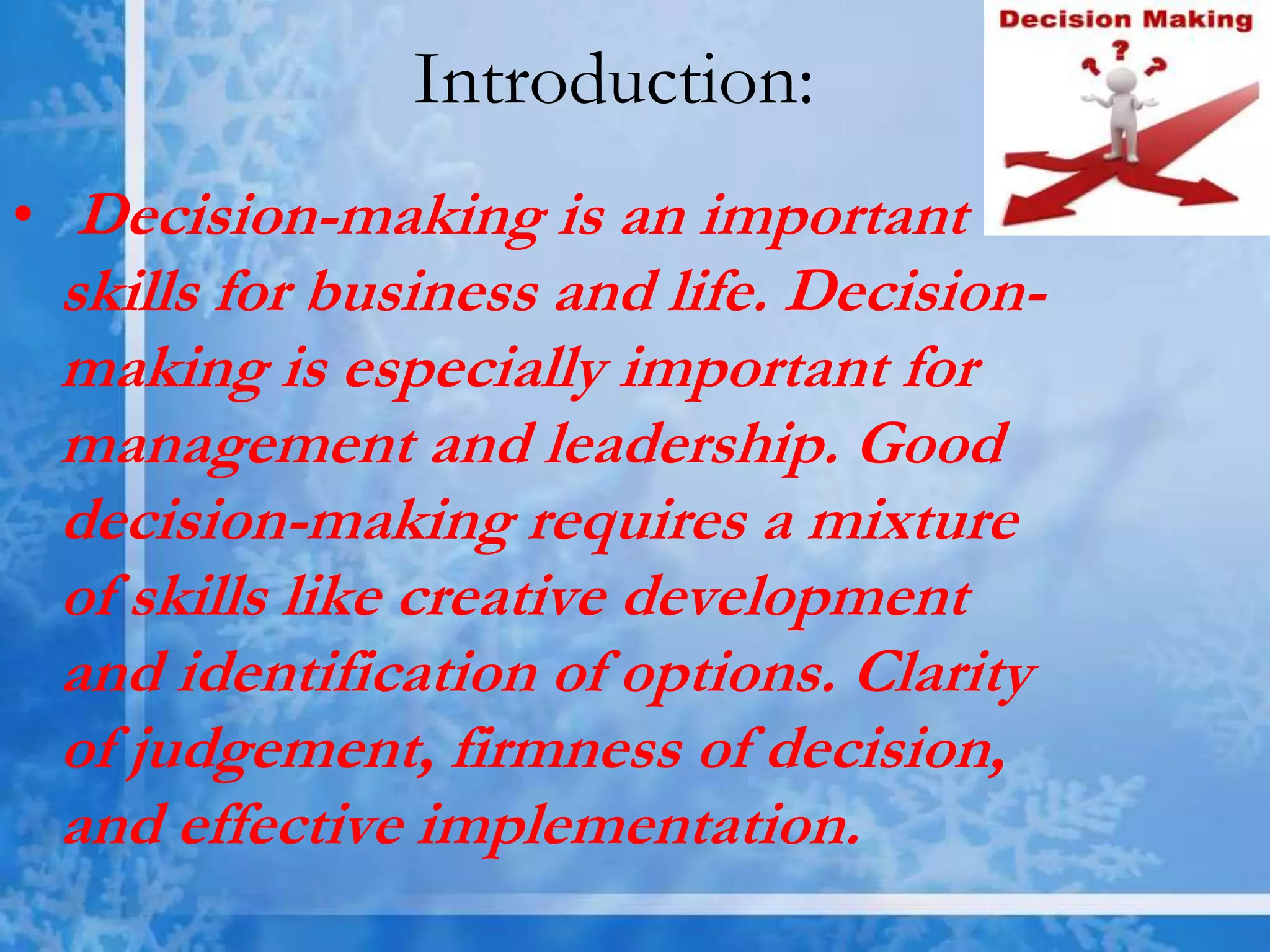
• Decision-making is an important
skills for business and life. Decision-
making is especially important for
management and leadership. Good
decision-making requires a mixture
of skills like creative development
and identification of options. Clarity
of judgement, firmness of decision,
and effective implementation.
Decision is the selection is the best
alternative from among the varieties of
alternatives. A correct decision opens the
door for reaching destination individuals. It is
wise to do analysis over the matter before
taking decision over it. Process Is an
important medium through which individuals
can be motivated for decision-making task. A
decision is resulted by different process like,
experience, positive and negative impact,
necessity relation building and responsibility.
The available information should be
incorporated while taking decision.
Indeed, decision-making skill is a leadership
skill. It is good to take decision according to time
and necessity. The decision taken merely by
individual aspiration and feeling may prove to
be wrong. Hence , inclusive or common decision
may increase the possibility of effectiveness,
accuracy and reliability. The decision in
planning of large group, organization, and
agency may bring impact of a large number of
people. Therefore , The decision taken by group
discussion with positive perspective becomes
acceptable for all and eventually it becomes
beneficial to all.
1. Define and clarify the issue.
2. Gather all the facts and understand
their causes.
3. Think about or brainstorm possible
options and solutions.
4. Consider and compare the ‘pros and
cons’ of each option-consult others if
necessary where there are several
options.
5. Select the best option-avoid
vagueness and weak compromises in
trying to please everyone.
6. Explain your decision to these
involved and affected , and follow
up to ensure proper and effective
implementation.
• In the context, for the development of decision
making skill there should be utilization and
mobilization of the following process:
• A. Analysis of the possible Risk Factors
Analysis skills include the ability of collecting
information about the possible risk
Factors systematically and analyzing
Them to establish facts. These Skills
Help in clarifying the nature of the
Risk factors before deciding action
and recognizing inconsistencies in reasoning.
These skills are required by the
entrepreneur to run their business
smoothly. Analytical skill makes it
possible to project the possible
difficulties and challenges while
taking decision. It always alerts the
people to be away from the possible
risk beforehand.
B. Search for the Possible
Alternatives.
To develop roadmap in relation to moving forward
from the decision we need to search for possible
alternatives. In order to search for possible alternative,
find a new perspective that you have not thought of
before. Brainstorming or rapid nothing of alternatives is
a good process. Once you have listed or mapped
alternatives, be open to their possibilities. After listing
possible alternatives, evaluate them without prejudice.
During the analysis process of the possible alternatives
both of the optimistic and pessimistic possibilities are
identified.
• It also demonstrates the forthcoming possible
risk factors in business. It helps to search for
alternatives while performing tasks. It also helps
to find out the feasibility and alternative way for
reaching right decision.
• C. Selection of Priority
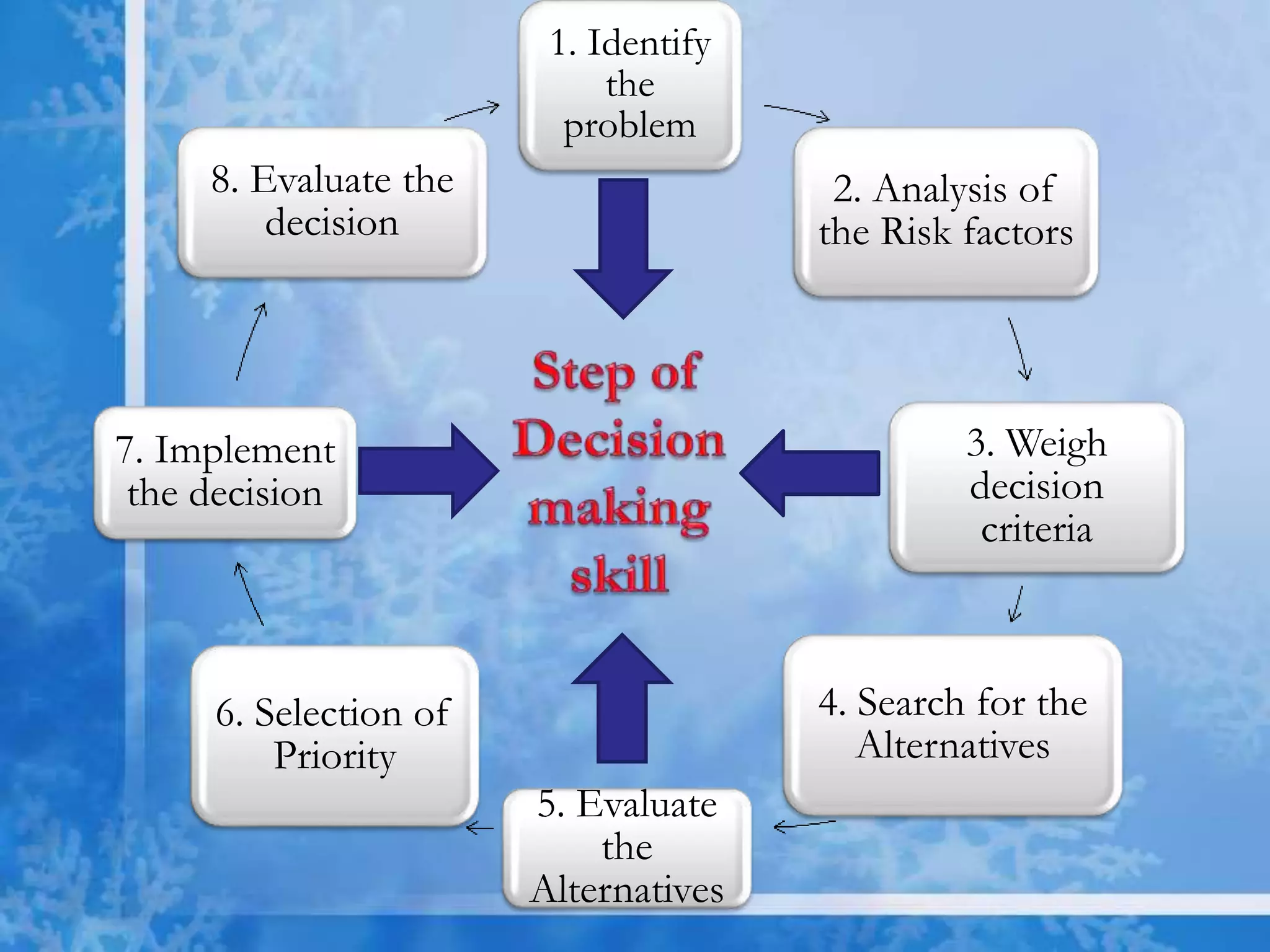
First let’s see the step of decision making skill.
1. Identify
the
problem
2. Analysis of
the Risk factors
3. Weigh
decision
criteria
4. Search for the
Alternatives
5. Evaluate
the
Alternatives
6. Selection of
Priority
7. Implement
the decision
8. Evaluate the
decision
• The best thing to do in decision-making is
to determine the priority of work. Therefore,
the works which need to be done earlier, and
the work which can be done later can be
categorized. The decision-making process
based on a nature of job, expected
achievement and demand is called selection
of priority. The process of selection of
priority can determine the order of the work
to be done. The best method for setting
priority is the A-B-C-D-E method in which
“A” stands for “very important”, something
you must do. There can be serious negative
consequences if you don’t do it.
• “B” stands for important. This is not as
important as your “A” task. There are only
minor negative consequences if it is not
completed. “C” stands for things that are
“nice to do”, but which are not as important
as “A or B” tasks. “D” stands for “delegate”.
You can assign this task to someone else
who can do the job instead of you. “E”
stands for “eliminate, whenever possible”.
When you use this method, the order of
work is determined so that assigned work
can be accomplished in time.
Anyone interested can answer:
1: For decision making which is better?
An individual effort or
a group effort
why give the reason too.
Answer:
For best decision, group effort is essential.
Through discussion, questioning, and
collaboration, group members can
identify good solutions for any task. It can
take up to better scope of information.
Lesson1 decision making skill

Lesson1 decision making skill

  • 1.
    Unit: 4 Life Skills Lesson:1 DecisionMaking Skill Presented by: Kasis Shahi.
  • 2.
    Introduction: • Decision-making isan important skills for business and life. Decision- making is especially important for management and leadership. Good decision-making requires a mixture of skills like creative development and identification of options. Clarity of judgement, firmness of decision, and effective implementation.
  • 3.
    Decision is theselection is the best alternative from among the varieties of alternatives. A correct decision opens the door for reaching destination individuals. It is wise to do analysis over the matter before taking decision over it. Process Is an important medium through which individuals can be motivated for decision-making task. A decision is resulted by different process like, experience, positive and negative impact, necessity relation building and responsibility. The available information should be incorporated while taking decision.
  • 4.
    Indeed, decision-making skillis a leadership skill. It is good to take decision according to time and necessity. The decision taken merely by individual aspiration and feeling may prove to be wrong. Hence , inclusive or common decision may increase the possibility of effectiveness, accuracy and reliability. The decision in planning of large group, organization, and agency may bring impact of a large number of people. Therefore , The decision taken by group discussion with positive perspective becomes acceptable for all and eventually it becomes beneficial to all.
  • 5.
    1. Define andclarify the issue. 2. Gather all the facts and understand their causes. 3. Think about or brainstorm possible options and solutions. 4. Consider and compare the ‘pros and cons’ of each option-consult others if necessary where there are several options.
  • 6.
    5. Select thebest option-avoid vagueness and weak compromises in trying to please everyone. 6. Explain your decision to these involved and affected , and follow up to ensure proper and effective implementation.
  • 7.
    • In thecontext, for the development of decision making skill there should be utilization and mobilization of the following process: • A. Analysis of the possible Risk Factors Analysis skills include the ability of collecting information about the possible risk Factors systematically and analyzing Them to establish facts. These Skills Help in clarifying the nature of the Risk factors before deciding action and recognizing inconsistencies in reasoning.
  • 8.
    These skills arerequired by the entrepreneur to run their business smoothly. Analytical skill makes it possible to project the possible difficulties and challenges while taking decision. It always alerts the people to be away from the possible risk beforehand.
  • 9.
    B. Search forthe Possible Alternatives. To develop roadmap in relation to moving forward from the decision we need to search for possible alternatives. In order to search for possible alternative, find a new perspective that you have not thought of before. Brainstorming or rapid nothing of alternatives is a good process. Once you have listed or mapped alternatives, be open to their possibilities. After listing possible alternatives, evaluate them without prejudice. During the analysis process of the possible alternatives both of the optimistic and pessimistic possibilities are identified.
  • 10.
    • It alsodemonstrates the forthcoming possible risk factors in business. It helps to search for alternatives while performing tasks. It also helps to find out the feasibility and alternative way for reaching right decision. • C. Selection of Priority First let’s see the step of decision making skill.
  • 11.
    1. Identify the problem 2. Analysisof the Risk factors 3. Weigh decision criteria 4. Search for the Alternatives 5. Evaluate the Alternatives 6. Selection of Priority 7. Implement the decision 8. Evaluate the decision
  • 12.
    • The bestthing to do in decision-making is to determine the priority of work. Therefore, the works which need to be done earlier, and the work which can be done later can be categorized. The decision-making process based on a nature of job, expected achievement and demand is called selection of priority. The process of selection of priority can determine the order of the work to be done. The best method for setting priority is the A-B-C-D-E method in which “A” stands for “very important”, something you must do. There can be serious negative consequences if you don’t do it.
  • 13.
    • “B” standsfor important. This is not as important as your “A” task. There are only minor negative consequences if it is not completed. “C” stands for things that are “nice to do”, but which are not as important as “A or B” tasks. “D” stands for “delegate”. You can assign this task to someone else who can do the job instead of you. “E” stands for “eliminate, whenever possible”. When you use this method, the order of work is determined so that assigned work can be accomplished in time.
  • 14.
    Anyone interested cananswer: 1: For decision making which is better? An individual effort or a group effort why give the reason too. Answer: For best decision, group effort is essential. Through discussion, questioning, and collaboration, group members can identify good solutions for any task. It can take up to better scope of information.