Instructor’s Page
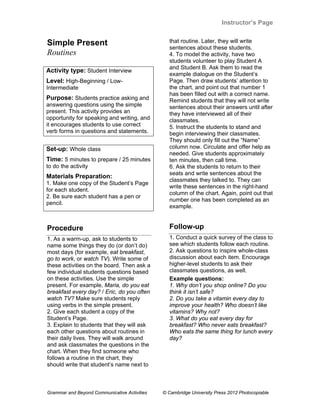
Simple Present
Routines
Activity type: Student Interview
Level: High-Beginning / Low-
Intermediate
Purpose: Students practice asking and
answering questions using the simple
present. This activity provides an
opportunity for speaking and writing, and
it encourages students to use correct
verb forms in questions and statements.
Set-up: Whole class
Time: 5 minutes to prepare / 25 minutes
to do the activity
Materials Preparation:
1. Make one copy of the Student’s Page
for each student.
2. Be sure each student has a pen or
pencil.
Procedure
1. As a warm-up, ask to students to
name some things they do (or don’t do)
most days (for example, eat breakfast,
go to work, or watch TV). Write some of
these activities on the board. Then ask a
few individual students questions based
on these activities. Use the simple
present. For example, Maria, do you eat
breakfast every day? / Eric, do you often
watch TV? Make sure students reply
using verbs in the simple present.
2. Give each student a copy of the
Student’s Page.
3. Explain to students that they will ask
each other questions about routines in
their daily lives. They will walk around
and ask classmates the questions in the
chart. When they find someone who
follows a routine in the chart, they
should write that student’s name next to
that routine. Later, they will write
sentences about these students.
4. To model the activity, have two
students volunteer to play Student A
and Student B. Ask them to read the
example dialogue on the Student’s
Page. Then draw students’ attention to
the chart, and point out that number 1
has been filled out with a correct name.
Remind students that they will not write
sentences about their answers until after
they have interviewed all of their
classmates.
5. Instruct the students to stand and
begin interviewing their classmates.
They should only fill out the “Name”
column now. Circulate and offer help as
needed. Give students approximately
ten minutes, then call time.
6. Ask the students to return to their
seats and write sentences about the
classmates they talked to. They can
write these sentences in the right-hand
column of the chart. Again, point out that
number one has been completed as an
example.
Follow-up
1. Conduct a quick survey of the class to
see which students follow each routine.
2. Ask questions to inspire whole-class
discussion about each item. Encourage
higher-level students to ask their
classmates questions, as well.
Example questions:
1. Why don’t you shop online? Do you
think it isn’t safe?
2. Do you take a vitamin every day to
improve your health? Who doesn’t like
vitamins? Why not?
3. What do you eat every day for
breakfast? Who never eats breakfast?
Who eats the same thing for lunch every
day?
Grammar and Beyond Communicative Activities © Cambridge University Press 2012 Photocopiable
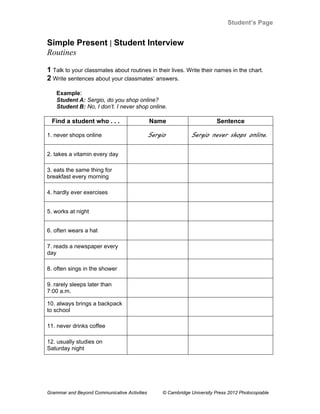
Student’s Page
Simple Present | Student Interview
Routines
1 Talk to your classmates about routines in their lives. Write their names in the chart.
2 Write sentences about your classmates’ answers.
Example:
Student A: Sergio, do you shop online?
Student B: No, I don’t. I never shop online.
Find a student who . . . Name Sentence
1. never shops online Sergio Sergio never shops online.
2. takes a vitamin every day
3. eats the same thing for
breakfast every morning
4. hardly ever exercises
5. works at night
6. often wears a hat
7. reads a newspaper every
day
8. often sings in the shower
9. rarely sleeps later than
7:00 a.m.
10. always brings a backpack
to school
11. never drinks coffee
12. usually studies on
Saturday night
Grammar and Beyond Communicative Activities © Cambridge University Press 2012 Photocopiable

Communicative activity hi-beg_intermediate-simple_present

  • 1.
    Instructor’s Page Simple Present Routines Activitytype: Student Interview Level: High-Beginning / Low- Intermediate Purpose: Students practice asking and answering questions using the simple present. This activity provides an opportunity for speaking and writing, and it encourages students to use correct verb forms in questions and statements. Set-up: Whole class Time: 5 minutes to prepare / 25 minutes to do the activity Materials Preparation: 1. Make one copy of the Student’s Page for each student. 2. Be sure each student has a pen or pencil. Procedure 1. As a warm-up, ask to students to name some things they do (or don’t do) most days (for example, eat breakfast, go to work, or watch TV). Write some of these activities on the board. Then ask a few individual students questions based on these activities. Use the simple present. For example, Maria, do you eat breakfast every day? / Eric, do you often watch TV? Make sure students reply using verbs in the simple present. 2. Give each student a copy of the Student’s Page. 3. Explain to students that they will ask each other questions about routines in their daily lives. They will walk around and ask classmates the questions in the chart. When they find someone who follows a routine in the chart, they should write that student’s name next to that routine. Later, they will write sentences about these students. 4. To model the activity, have two students volunteer to play Student A and Student B. Ask them to read the example dialogue on the Student’s Page. Then draw students’ attention to the chart, and point out that number 1 has been filled out with a correct name. Remind students that they will not write sentences about their answers until after they have interviewed all of their classmates. 5. Instruct the students to stand and begin interviewing their classmates. They should only fill out the “Name” column now. Circulate and offer help as needed. Give students approximately ten minutes, then call time. 6. Ask the students to return to their seats and write sentences about the classmates they talked to. They can write these sentences in the right-hand column of the chart. Again, point out that number one has been completed as an example. Follow-up 1. Conduct a quick survey of the class to see which students follow each routine. 2. Ask questions to inspire whole-class discussion about each item. Encourage higher-level students to ask their classmates questions, as well. Example questions: 1. Why don’t you shop online? Do you think it isn’t safe? 2. Do you take a vitamin every day to improve your health? Who doesn’t like vitamins? Why not? 3. What do you eat every day for breakfast? Who never eats breakfast? Who eats the same thing for lunch every day? Grammar and Beyond Communicative Activities © Cambridge University Press 2012 Photocopiable
  • 2.
    Student’s Page Simple Present| Student Interview Routines 1 Talk to your classmates about routines in their lives. Write their names in the chart. 2 Write sentences about your classmates’ answers. Example: Student A: Sergio, do you shop online? Student B: No, I don’t. I never shop online. Find a student who . . . Name Sentence 1. never shops online Sergio Sergio never shops online. 2. takes a vitamin every day 3. eats the same thing for breakfast every morning 4. hardly ever exercises 5. works at night 6. often wears a hat 7. reads a newspaper every day 8. often sings in the shower 9. rarely sleeps later than 7:00 a.m. 10. always brings a backpack to school 11. never drinks coffee 12. usually studies on Saturday night Grammar and Beyond Communicative Activities © Cambridge University Press 2012 Photocopiable