I.S.F.D LENGUAS VIVAS BARILOCHE –
PRÁCTICA DOCENTE II
ENTREGA DE PLANIFICACIÓN
ALUMNO PRACTICANTE: Santiago Cazenave
Institución educativa: Escuela Secundaria N°1 “Esteban Dufaur”
Año y sección: 1°1°
Nivel lingüístico del curso: Beginners
Cantidad de alumnos: 30
Tipo de Planificación: Clase
Unidad Temática: Daily Routines
Clase Nº: 5
Duración de la clase: 60 minutes
Fecha de la clase: 5 de Junio de 2024
Fecha de entrega de la planificación: 30 de Mayo de 2024
Learning Aims:
During this lesson, learners will be able to
 Consolidate vocabulary related to daily routines like activities, parts of the day
and days of the week.
 Use new vocabulary through the “find someone who” activity and the “broken
telephone”.
 Practice talking about their routine and that of others using the present simple in
the third person.
 Ask and answer questions to their classmates related to their routines using the
short answer “yes, I do” or “no, I don’t”.
 Develop their interpersonal intelligence by interacting with their classmates and
learning about their daily activities.
 Develop their listening and speaking skills through the game “Broken Telephone”
and the main activity of the lesson.
 Develop their writing skills by describing the activities of their classmates and
sharing them with the class.
Language Focus:
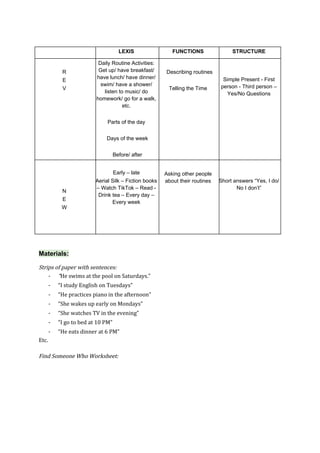
LEXIS FUNCTIONS STRUCTURE
R
E
V
Daily Routine Activities:
Get up/ have breakfast/
have lunch/ have dinner/
swim/ have a shower/
listen to music/ do
homework/ go for a walk,
etc.
Parts of the day
Days of the week
Before/ after
Describing routines
Telling the Time
Simple Present - First
person - Third person –
Yes/No Questions
N
E
W
Early – late
Aerial Silk – Fiction books
– Watch TikTok – Read -
Drink tea – Every day –
Every week
Asking other people
about their routines Short answers “Yes, I do/
No I don’t”
Materials:
Strips of paper with sentences:
- “He swims at the pool on Saturdays.”
- “I study English on Tuesdays”
- “He practices piano in the afternoon”
- “She wakes up early on Mondays”
- “She watches TV in the evening”
- “I go to bed at 10 PM”
- “He eats dinner at 6 PM”
Etc.
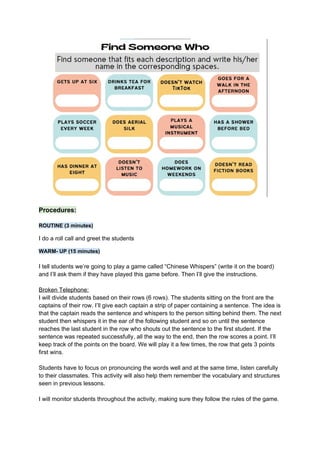
Find Someone Who Worksheet:
Procedures:
ROUTINE (3 minutes)
I do a roll call and greet the students
WARM- UP (15 minutes)
I tell students we’re going to play a game called “Chinese Whispers” (write it on the board)
and I’ll ask them if they have played this game before. Then I’ll give the instructions.
Broken Telephone:
I will divide students based on their rows (6 rows). The students sitting on the front are the
captains of their row. I’ll give each captain a strip of paper containing a sentence. The idea is
that the captain reads the sentence and whispers to the person sitting behind them. The next
student then whispers it in the ear of the following student and so on until the sentence
reaches the last student in the row who shouts out the sentence to the first student. If the
sentence was repeated successfully, all the way to the end, then the row scores a point. I’ll
keep track of the points on the board. We will play it a few times, the row that gets 3 points
first wins.
Students have to focus on pronouncing the words well and at the same time, listen carefully
to their classmates. This activity will also help them remember the vocabulary and structures
seen in previous lessons.
I will monitor students throughout the activity, making sure they follow the rules of the game.
PRESENTATION (7 minutes)
After congratulating the winning team/s I will address some students and ask them personal
questions that they have to answer with “yes”, I do” or “no, I don’t” which are the short
answers in the present simple (I will write these answers on the board and use them as a
guide). The questions will be something like “do you drink coffee for breakfast?”, “do you
watch TV at night?”, “do you go to bed before 10?”, “do you play basketball?”, etc. until
students get used to the short answers.
DEVELOPMENT (PRACTICE and PRODUCTION) 25 minutes
I’ll give every student a “find someone who” sheet and give the instructions for the activity.
Students will go around the classroom asking questions to their classmates to find someone
who fulfils each statement (they are Yes/No questions, so that means the questions will
always begin with the word “do you + verb in infinitive form”). When they find someone, they
must write their name on the card.
I will make 4 types of worksheets with different verbs, times and forms so that not all
students have to ask the same questions. I will illustrate the activity myself using one of the
first questions as an example and copying the card on the board:
I will move next to the teacher or a student and ask, “do you get up at six?” (eliciting the
answer “yes I do/no I don’t”). If the answer is negative, I will keep searching until I find
someone who does. Then I will write her/his name on the box.
Before the activity starts, I will set some rules: Students have to use English during the
activity, and it’s not allowed to shout or run. students have walk calmly and talk in an
appropriate tone with their classmates. My role will be to make sure students are using the
structures for questions and short answers correctly, helping them with unfamiliar vocabulary
and controlling they follow the rules.
CLOSURE (10 minutes)
For the closing activity, students have to write 3 sentences about what their classmates do
or don’t do and share their findings with the rest of the class. We will compare the answers
to find similarities and differences between the students. I will write some example
sentences on the board: “Mariano gets up at six” “Donny doesn’t watch TikTok” “Jaz goes for
a walk in the afternoon”.
These sentences have to be written in the 3rd person, so I will monitor students use the
structure appropriately and correct any errors that may arise.

PDSec - Lesson Plan V - Cazenave, Santiago.docx

  • 1.
    I.S.F.D LENGUAS VIVASBARILOCHE – PRÁCTICA DOCENTE II ENTREGA DE PLANIFICACIÓN ALUMNO PRACTICANTE: Santiago Cazenave Institución educativa: Escuela Secundaria N°1 “Esteban Dufaur” Año y sección: 1°1° Nivel lingüístico del curso: Beginners Cantidad de alumnos: 30 Tipo de Planificación: Clase Unidad Temática: Daily Routines Clase Nº: 5 Duración de la clase: 60 minutes Fecha de la clase: 5 de Junio de 2024 Fecha de entrega de la planificación: 30 de Mayo de 2024 Learning Aims: During this lesson, learners will be able to  Consolidate vocabulary related to daily routines like activities, parts of the day and days of the week.  Use new vocabulary through the “find someone who” activity and the “broken telephone”.  Practice talking about their routine and that of others using the present simple in the third person.  Ask and answer questions to their classmates related to their routines using the short answer “yes, I do” or “no, I don’t”.  Develop their interpersonal intelligence by interacting with their classmates and learning about their daily activities.  Develop their listening and speaking skills through the game “Broken Telephone” and the main activity of the lesson.  Develop their writing skills by describing the activities of their classmates and sharing them with the class. Language Focus:
  • 2.
    LEXIS FUNCTIONS STRUCTURE R E V DailyRoutine Activities: Get up/ have breakfast/ have lunch/ have dinner/ swim/ have a shower/ listen to music/ do homework/ go for a walk, etc. Parts of the day Days of the week Before/ after Describing routines Telling the Time Simple Present - First person - Third person – Yes/No Questions N E W Early – late Aerial Silk – Fiction books – Watch TikTok – Read - Drink tea – Every day – Every week Asking other people about their routines Short answers “Yes, I do/ No I don’t” Materials: Strips of paper with sentences: - “He swims at the pool on Saturdays.” - “I study English on Tuesdays” - “He practices piano in the afternoon” - “She wakes up early on Mondays” - “She watches TV in the evening” - “I go to bed at 10 PM” - “He eats dinner at 6 PM” Etc. Find Someone Who Worksheet:
  • 3.
    Procedures: ROUTINE (3 minutes) Ido a roll call and greet the students WARM- UP (15 minutes) I tell students we’re going to play a game called “Chinese Whispers” (write it on the board) and I’ll ask them if they have played this game before. Then I’ll give the instructions. Broken Telephone: I will divide students based on their rows (6 rows). The students sitting on the front are the captains of their row. I’ll give each captain a strip of paper containing a sentence. The idea is that the captain reads the sentence and whispers to the person sitting behind them. The next student then whispers it in the ear of the following student and so on until the sentence reaches the last student in the row who shouts out the sentence to the first student. If the sentence was repeated successfully, all the way to the end, then the row scores a point. I’ll keep track of the points on the board. We will play it a few times, the row that gets 3 points first wins. Students have to focus on pronouncing the words well and at the same time, listen carefully to their classmates. This activity will also help them remember the vocabulary and structures seen in previous lessons. I will monitor students throughout the activity, making sure they follow the rules of the game.
  • 4.
    PRESENTATION (7 minutes) Aftercongratulating the winning team/s I will address some students and ask them personal questions that they have to answer with “yes”, I do” or “no, I don’t” which are the short answers in the present simple (I will write these answers on the board and use them as a guide). The questions will be something like “do you drink coffee for breakfast?”, “do you watch TV at night?”, “do you go to bed before 10?”, “do you play basketball?”, etc. until students get used to the short answers. DEVELOPMENT (PRACTICE and PRODUCTION) 25 minutes I’ll give every student a “find someone who” sheet and give the instructions for the activity. Students will go around the classroom asking questions to their classmates to find someone who fulfils each statement (they are Yes/No questions, so that means the questions will always begin with the word “do you + verb in infinitive form”). When they find someone, they must write their name on the card. I will make 4 types of worksheets with different verbs, times and forms so that not all students have to ask the same questions. I will illustrate the activity myself using one of the first questions as an example and copying the card on the board: I will move next to the teacher or a student and ask, “do you get up at six?” (eliciting the answer “yes I do/no I don’t”). If the answer is negative, I will keep searching until I find someone who does. Then I will write her/his name on the box. Before the activity starts, I will set some rules: Students have to use English during the activity, and it’s not allowed to shout or run. students have walk calmly and talk in an appropriate tone with their classmates. My role will be to make sure students are using the structures for questions and short answers correctly, helping them with unfamiliar vocabulary and controlling they follow the rules. CLOSURE (10 minutes) For the closing activity, students have to write 3 sentences about what their classmates do or don’t do and share their findings with the rest of the class. We will compare the answers to find similarities and differences between the students. I will write some example sentences on the board: “Mariano gets up at six” “Donny doesn’t watch TikTok” “Jaz goes for a walk in the afternoon”. These sentences have to be written in the 3rd person, so I will monitor students use the structure appropriately and correct any errors that may arise.