i 
Mathematics 
Learner’s Material 
Unit 3 
Department of Education 
Republic of the Philippines 
3 
This instructional material was collaboratively developed and reviewed by educators from public and private schools, colleges, and/or universities. We encourage teachers and other education stakeholders to email their feedback, comments, and recommendations to the Department of Education at action@deped.gov.ph. 
We value your feedback and recommendations.
ii 
Mathematics – Grade 3 
Learner’s Material 
First Edition, 2014 
Republic Act 8293, section 176 states that: No copyright shall subsist in any work of the Government of the Philippines. However, prior approval of the government agency or office wherein the work is created shall be necessary for exploitation of such work for profit. Such agency or office may, among other things, impose as a condition the payment of royalties. 
Borrowed materials (i.e., songs, stories, poems, pictures, photos, brand names, trademarks, etc.) included in this book are owned by their respective copyright holders. Every effort has been exerted to locate and seek permission to use these materials from their respective copyright owners. The publisher and authors do not represent nor claim ownership over them. 
Published by the Department of Education 
Secretary: Br. Armin A. Luistro FSC 
Undersecretary: Dina S. Ocampo, Ph.D. 
Department of Education-Instructional Materials Council Secretariat 
(DepEd-IMCS) 
Office Address: 5th Floor Mabini Building, DepEd Complex 
Meralco Avenue, Pasig City 
Philippines 1600 
Telefax: (02) 634-1054 or 634-1072 
E-mail Address: imcsetd@yahoo.com
iii 
Table of Contents 
Lesson 55 
Odd and Even Numbers 
1 
Lesson 56 
Fractions Equal to One and Greater than One 
4 
Lesson 57 
Reading and Writing Fractions Greater 
than One 
9 
Lesson 58 
Representing Fractions using Regions, Sets, and Number Lines 
12 
Lesson 59 
Visualizing Dissimilar Fractions 
17 
Lesson 60 
Comparing Dissimilar Fractions 
22 
Lesson 61 
Arranging Dissimilar Fractions 
28 
Lesson 62 
Equivalent Fractions 
33 
Lesson 63 
Point, Line, Line Segment, and Ray 
38 
Lesson 64 
Congruent Line Segments 
44 
Lesson 65 
Perpendicular, Parallel, and Intersecting Lines 
47 
Lesson 66 
Symmetry in the Environment and in Design 
52 
Lesson 67 
Line of Symmetry in a Given Symmetrical Figure 
55 
Lesson 68 
Completing a Symmetric Figure 
60 
Lesson 69 
Tessellating a Plane Figure 
63 
Lesson 70 
Determining the Missing Term in a Pattern 
67 
Lesson 71 
Finding the Missing Value in a Number Sentence 
72
1 
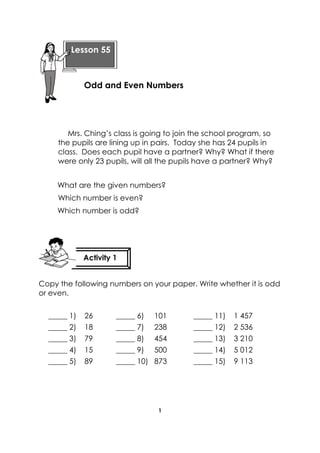
Mrs. Ching’s class is going to join the school program, so the pupils are lining up in pairs. Today she has 24 pupils in class. Does each pupil have a partner? Why? What if there were only 23 pupils, will all the pupils have a partner? Why? 
What are the given numbers? 
Which number is even? 
Which number is odd? 
Copy the following numbers on your paper. Write whether it is odd or even. 
_____ 1) 26 _____ 6) 101 _____ 11) 1 457 
_____ 2) 18 _____ 7) 238 _____ 12) 2 536 
_____ 3) 79 _____ 8) 454 _____ 13) 3 210 
_____ 4) 15 _____ 9) 500 _____ 14) 5 012 
_____ 5) 89 _____ 10) 873 _____ 15) 9 113 
Lesson 55 
Odd and Even Numbers 
Activity 1
2 
What number am I? Write your answer on your paper. 
1) I am an odd number less than 80 but greater than 77. 
2) I am an odd number greater than 122 but less than 125. 
3) I am the largest odd number less than 600. 
4) I am an even number greater than 1 396 but less than 1 400. 
5) I am an even number greater than 2 202 but less than 2 205. 
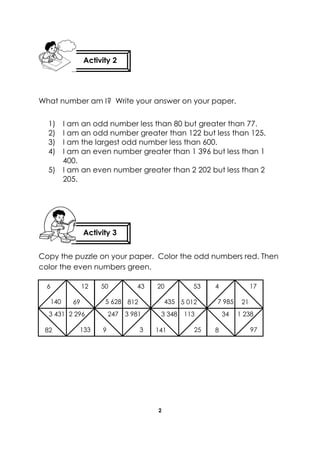
Copy the puzzle on your paper. Color the odd numbers red. Then color the even numbers green. 
Activity 2 
Activity 3 
6 
12 
140 
69 
3 431 
2 296 
133 
82 
50 
43 
5 628 
812 
247 
3 981 
3 
9 
20 
53 
435 
5 012 
3 348 
113 
25 
141 
4 
17 
7 985 
21 
34 
1 238 
97 
8
3 
Guessing Game 
Answer the questions in your notebook. 
1. I am an even number more than 15 but less than 17. 
2. I am an odd number between 4 191 and 4 195. 
3. I am the sum of the greatest odd one digit number and the greatest even one digit number. 
4. What is the sum of even numbers less than 30? 
5. What kind of number is the sum of two even numbers? 
6. What kind of number is the sum of two odd numbers? 
7. What kind of number is the sum of an odd number and an even number? 
8. I am an odd number between 1 008 and 1 013. 
9. The sum of 2 consecutive even numbers is 26. What are the numbers? 
10. I am the greatest 3-digit number that has all of the following characteristics: I am an odd number. The sum of my digits is 21. Each digit is different. 
Activity 4
4 
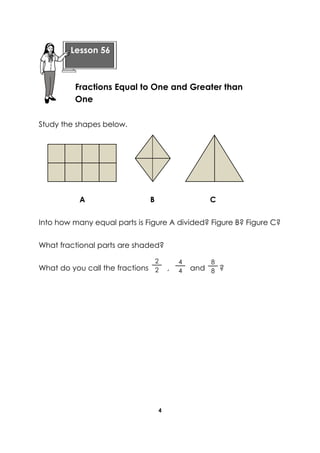
Study the shapes below. 
A B C 
Into how many equal parts is Figure A divided? Figure B? Figure C? 
What fractional parts are shaded? 
What do you call the fractions , and ? 
4 
4 
2 
2 
8 
8 
Lesson 56 
Fractions Equal to One and Greater than One
5 
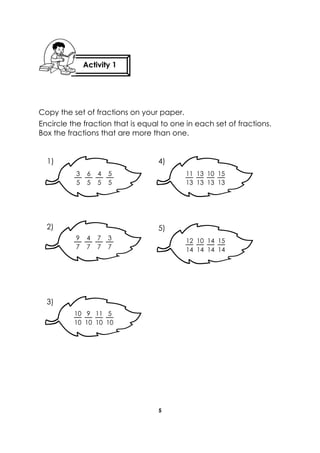
Copy the set of fractions on your paper. 
Encircle the fraction that is equal to one in each set of fractions. Box the fractions that are more than one. 
11 
13 
10 
13 
13 
13 
15 
13 
3 
5 
4 
5 
6 
5 
5 
5 
9 
7 
7 
7 
4 
7 
3 
7 
12 
14 
14 
14 
10 
14 
15 
14 
10 
10 
11 
10 
9 
10 
5 
10 
1) 
4) 
5) 
2) 
3) 
Activity 1
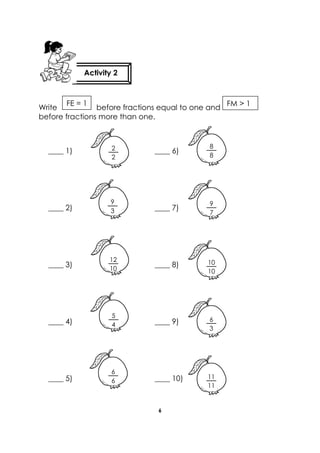
6 
before fractions equal to one and 
Write before fractions more than one. 
____ 1) ____ 6) 
____ 2) ____ 7) 
____ 3) ____ 8) 
____ 4) ____ 9) 
____ 5) ____ 10) 
FM > 1 
2 
2 
9 
3 
8 
8 
9 
7 
10 
10 
12 
10 
5 
4 
6 
6 
11 
11 
6 
3 
Activity 2 
FE = 1
7 
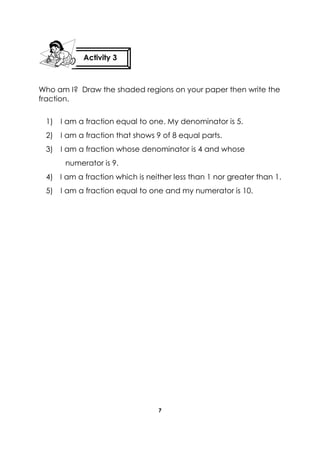
Who am I? Draw the shaded regions on your paper then write the fraction. 
1) I am a fraction equal to one. My denominator is 5. 
2) I am a fraction that shows 9 of 8 equal parts. 
3) I am a fraction whose denominator is 4 and whose numerator is 9. 
4) I am a fraction which is neither less than 1 nor greater than 1. 
5) I am a fraction equal to one and my numerator is 10. 
Activity 3
8 
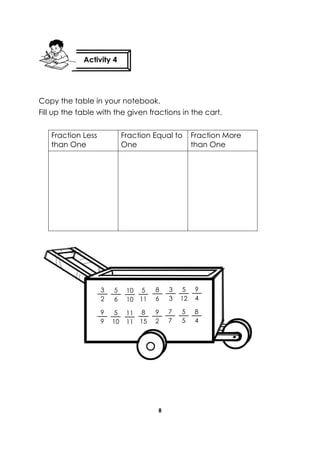
Copy the table in your notebook. 
Fill up the table with the given fractions in the cart. 
Fraction Less than One 
Fraction Equal to One 
Fraction More than One 
Activity 4 
3 
2 
5 
6 
10 
10 
5 
11 
8 
6 
3 
3 
5 
12 
9 
4 
9 
9 
5 
10 
11 
11 
8 
15 
9 
2 
7 
7 
5 
5 
8 
4
9 
Study the problem. 
Jojo cut a whole bibingka into 8 equal parts. He gave 2 pieces to each of his 3 brothers and ate the rest. What part did each one get? 
Into how many parts did Jojo cut the bibingka? 
What do you call each part? 
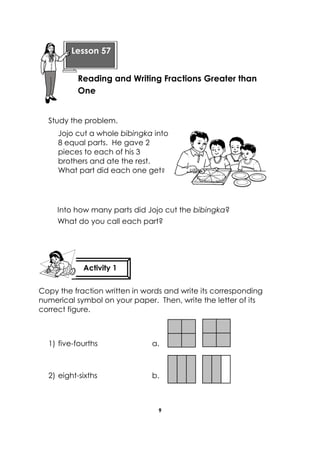
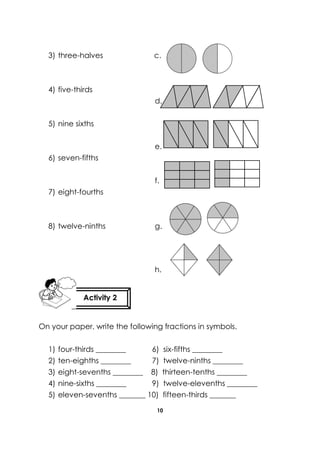
Copy the fraction written in words and write its corresponding numerical symbol on your paper. Then, write the letter of its correct figure. 
1) five-fourths a. 
2) eight-sixths b. 
Lesson 57 
Activity 1 
Reading and Writing Fractions Greater than One 
Lesson 57
10 
3) three-halves c. 
4) five-thirds 
d. 
5) nine sixths 
e. 
6) seven-fifths 
f. 
7) eight-fourths 
8) twelve-ninths g. 
h. 
On your paper, write the following fractions in symbols. 
1) four-thirds ________ 6) six-fifths ________ 
2) ten-eighths ________ 7) twelve-ninths ________ 
3) eight-sevenths ________ 8) thirteen-tenths ________ 
4) nine-sixths ________ 9) twelve-elevenths ________ 
5) eleven-sevenths _______ 10) fifteen-thirds _______ 
Activity 2
11 
On your paper, write the following fractions in words. 
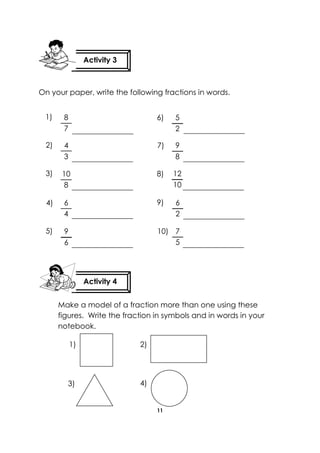
Make a model of a fraction more than one using these figures. Write the fraction in symbols and in words in your notebook. 
Activity 3 
Activity 4 
5 
2 
9 
8 
12 
10 
7 
5 
6 
2 
8 
7 
6 
4 
9 
6 
10 
8 
1) 
2) 
3) 
4) 
5) 
6) 
7) 
8) 
9) 
10) 
4 
3 
4) 
3) 
2) 
1)
12 
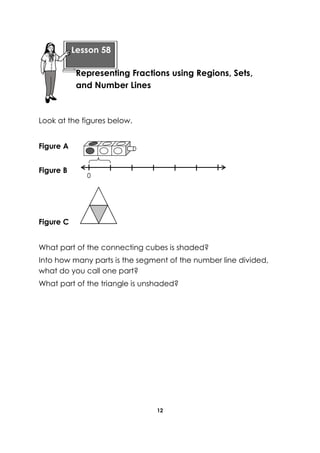
Look at the figures below. 
Figure A 
Figure B 
Figure C 
What part of the connecting cubes is shaded? 
Into how many parts is the segment of the number line divided, what do you call one part? 
What part of the triangle is unshaded? 
Lesson 58 
Representing Fractions using Regions, Sets, and Number Lines 
0
13 
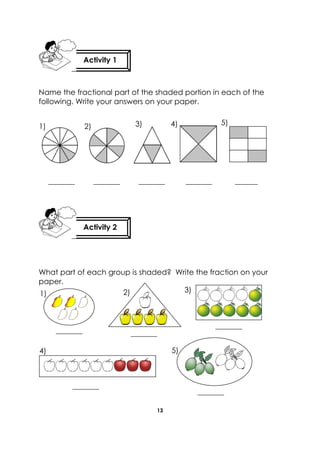
Name the fractional part of the shaded portion in each of the following. Write your answers on your paper. 
_______ _______ _______ _______ ______ 
What part of each group is shaded? Write the fraction on your paper. 
Activity 2 
Activity 1 
1) 
2) 
3) 
4) 
5) 
1) 
2) 
4) 
5) 
_________ 
_________ 
_________ 
_________ 
3) 
_________
14 
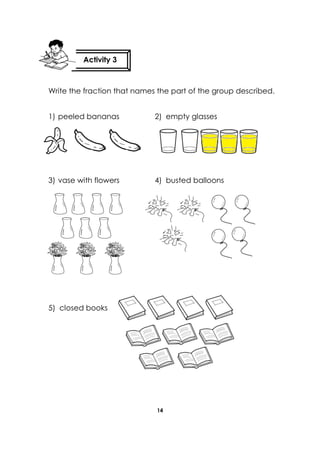
Write the fraction that names the part of the group described. 
1) peeled bananas 2) empty glasses 
3) vase with flowers 4) busted balloons 
5) closed books 
Activity 3
15 
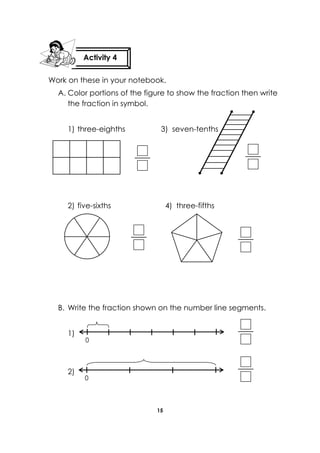
Work on these in your notebook. 
A. Color portions of the figure to show the fraction then write the fraction in symbol. 
1) three-eighths 3) seven-tenths 
2) five-sixths 4) three-fifths 
B. Write the fraction shown on the number line segments. 
1) 
2) 
Activity 4 
0 
0
16 
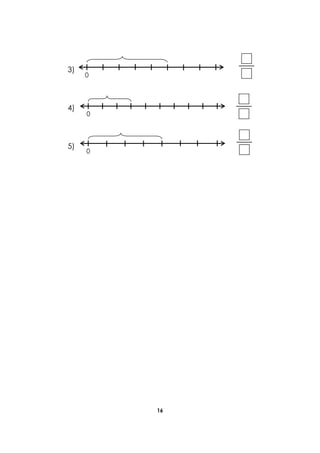
3) 
4) 
5) 
0 
0 
0
17 
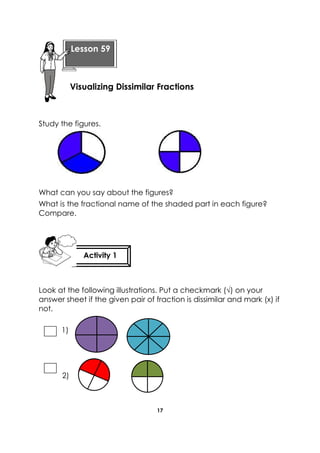
Study the figures. 
What can you say about the figures? 
What is the fractional name of the shaded part in each figure? Compare. 
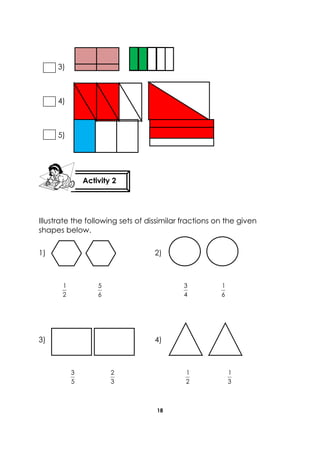
Look at the following illustrations. Put a checkmark (√) on your answer sheet if the given pair of fraction is dissimilar and mark (x) if not. 
1) 
2) 
Lesson 59 
Visualizing Dissimilar Fractions 
Activity 1
18 
3) 
4) 
5) 
Illustrate the following sets of dissimilar fractions on the given 
shapes below. 
1) 2) 
2 
1 
6 
5 
4 
3 
6 
1 
3) 4) 
5 
3 
3 
2 
2 
1 
3 
1 
Activity 2
19 
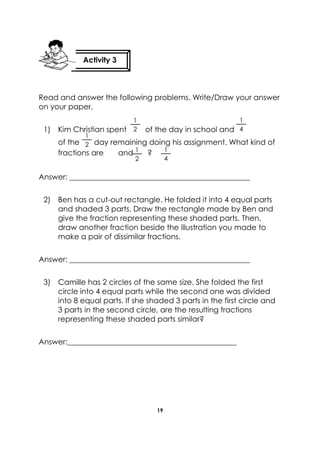
Read and answer the following problems. Write/Draw your answer on your paper. 
1) Kim Christian spent of the day in school and 
of the day remaining doing his assignment. What kind of fractions are and ? 
Answer: ________________________________________________ 
2) Ben has a cut-out rectangle. He folded it into 4 equal parts and shaded 3 parts. Draw the rectangle made by Ben and give the fraction representing these shaded parts. Then, draw another fraction beside the illustration you made to make a pair of dissimilar fractions. 
Answer: ________________________________________________ 
3) Camille has 2 circles of the same size. She folded the first circle into 4 equal parts while the second one was divided into 8 equal parts. If she shaded 3 parts in the first circle and 3 parts in the second circle, are the resulting fractions representing these shaded parts similar? 
Answer:_____________________________________________ 
Activity 3 
1 
4 
1 
4 
1 
2 
1 
2 
1 
2
20 
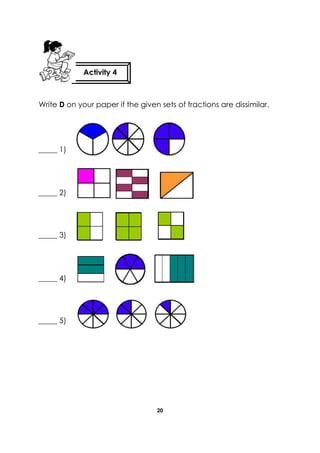
Write D on your paper if the given sets of fractions are dissimilar. 
Activity 4 
_____ 1) 
_____ 2) 
_____ 3) 
_____ 4) 
_____ 5)
21 
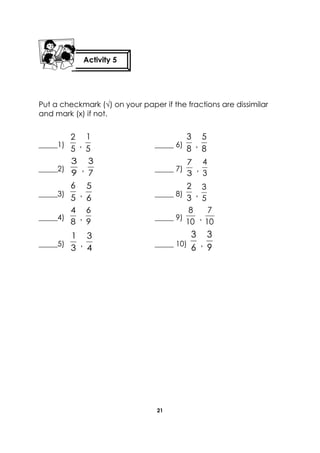
Put a checkmark (√) on your paper if the fractions are dissimilar 
and mark (x) if not. 
_____1) 
5 
2 
, 5 
1 
_____ 6) 
8 
3 
, 8 
5 
_____2) 
9 
3 
, 
7 
3 
_____ 7) 
3 
7 
, 
3 
4 
_____3) 5 
6 
, 6 
5 
_____ 8) 
3 
2 
, 
5 
3 
_____4) 
8 
4 
, 
9 
6 
_____ 9) 
10 
8 
, 
10 
7 
_____5) 
3 
1 
, 4 
3 
_____ 10) 6 
3 
, 9 
3 
Activity 5
22 
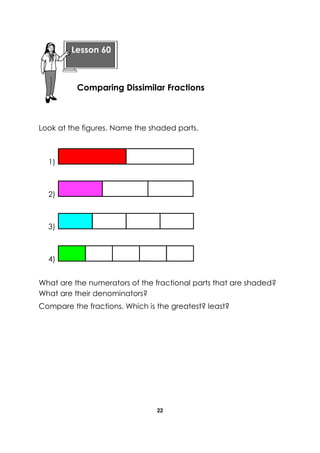
Look at the figures. Name the shaded parts. 
1) 
2) 
3) 
4) 
What are the numerators of the fractional parts that are shaded? What are their denominators? 
Compare the fractions. Which is the greatest? least? 
Lesson 60 
Comparing Dissimilar Fractions
23 
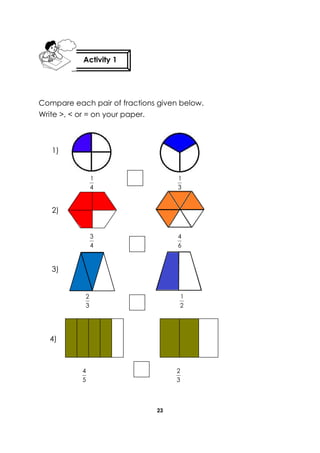
Compare each pair of fractions given below. 
Write >, < or = on your paper. 
4 
1 
3 
1 
4 
3 
6 
4 
3 
2 
2 
1 
5 
4 
3 
2 
Activity 1 
1) 
4) 
3) 
2)
24 
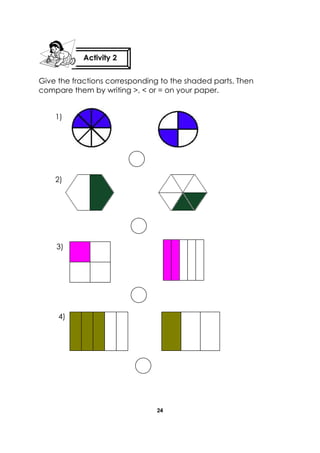
Give the fractions corresponding to the shaded parts. Then compare them by writing >, < or = on your paper. 
Activity 2 
1) 
2) 
3) 
4)
25 
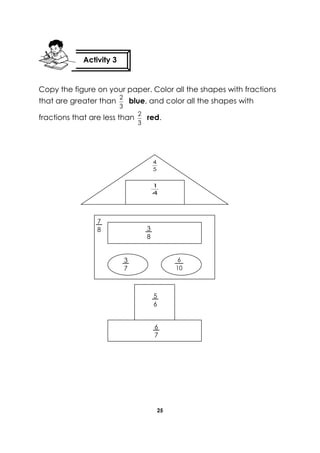
Copy the figure on your paper. Color all the shapes with fractions 
that are greater than 
3 
2 blue, and color all the shapes with 
fractions that are less than 
3 
2 
red. 
Activity 3 
4 
1 
5 
4 
3 
8 
7 
8 
6 
7 
5 
6 
6 
1 0 
3 
7
26 
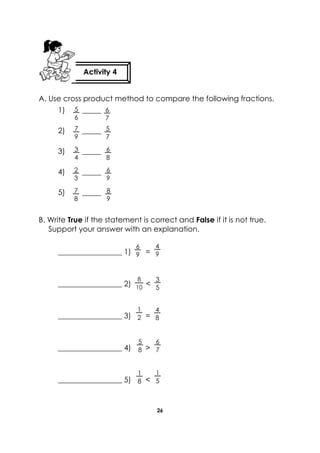
A. Use cross product method to compare the following fractions. 
1) _____ 
2) _____ 
3) _____ 
4) _____ 
5) _____ 
B. Write True if the statement is correct and False if it is not true. Support your answer with an explanation. 
_________________ 1) = 
_________________ 2) < 
_________________ 3) = 
_________________ 4) > 
_________________ 5) < 
Activity 4 
6 
7 
8 
9 
6 
9 
7 
8 
2 
3 
6 
8 
3 
4 
5 
7 
7 
9 
5 
6 
6 
9 
4 
9 
1 
2 
3 
5 
8 
10 
4 
8 
1 
5 
5 
8 
1 
8 
6 
7
27 
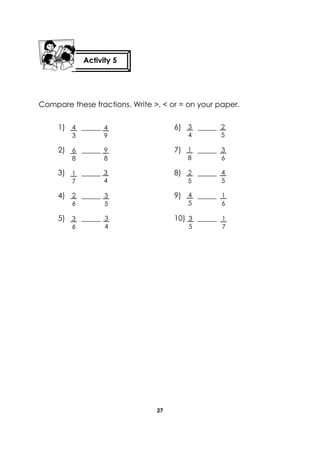
Compare these fractions. Write >, < or = on your paper. 
1) _____ 6) _____ 
2) _____ 7) _____ 
3) _____ 8) _____ 
4) _____ 9) _____ 
5) _____ 10) _____ 
Activity 5 
3 
6 
2 
6 
1 
7 
6 
8 
4 
3 
4 
9 
9 
8 
3 
5 
3 
4 
3 
4 
1 
8 
2 
5 
4 
5 
3 
5 
3 
4 
4 
5 
1 
7 
2 
5 
1 
6 
3 
6
28 
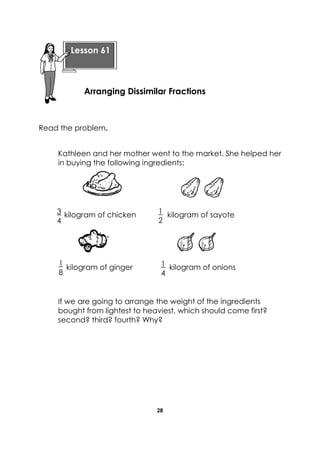
Read the problem. 
Kathleen and her mother went to the market. She helped her in buying the following ingredients: 
kilogram of chicken kilogram of sayote 
kilogram of ginger kilogram of onions 
If we are going to arrange the weight of the ingredients bought from lightest to heaviest, which should come first? second? third? fourth? Why? 
Lesson 61 
Arranging Dissimilar Fractions 
3 
4 
1 
4 
1 
8 
1 
2
29 
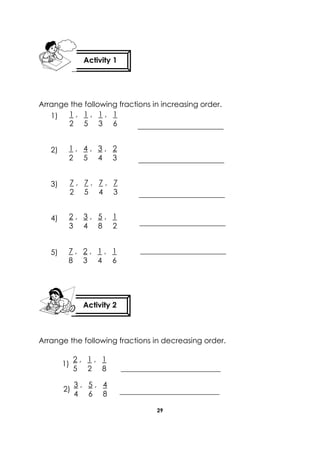
Arrange the following fractions in increasing order. 
1) 
2) 
3) 
4) 
5) 
Arrange the following fractions in decreasing order. 
Activity 1 
Activity 2 
1 , 1 , 1 , 1 
2 5 3 6 
1 , 4 , 3 , 2 
2 5 4 3 
7 , 7 , 7 , 7 
2 5 4 3 
2 , 3 , 5 , 1 
3 4 8 2 
7 , 2 , 1 , 1 
8 3 4 6 
2 , 1 , 1 
5 2 8 
3 , 5 , 4 
4 6 8 
1) 
2)
30 
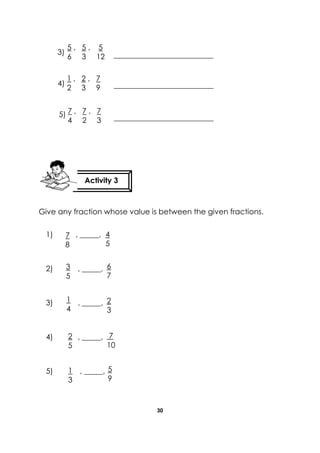
Give any fraction whose value is between the given fractions. 
1) , _____, 
2) , _____, 
3) , _____, 
4) , _____, 
5) , _____, 
Activity 3 
5 , 5 , 5 
6 3 12 
1 , 2 , 7 
2 3 9 
7 , 7 , 7 
4 2 3 
3) 
4) 
5) 
7 
8 
4 
5 
3 
5 
6 
7 
1 
4 
2 
3 
2 
5 
7 
10 
1 
3 
5 
9
31 
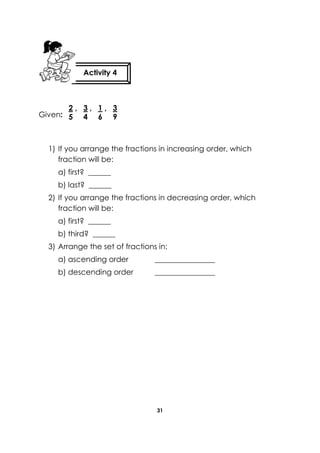
Given: 
1) If you arrange the fractions in increasing order, which fraction will be: 
a) first? ______ 
b) last? ______ 
2) If you arrange the fractions in decreasing order, which fraction will be: 
a) first? ______ 
b) third? ______ 
3) Arrange the set of fractions in: 
a) ascending order ________________ 
b) descending order ________________ 
Activity 4 
2 , 3 , 1 , 3 
5 4 6 9
32 
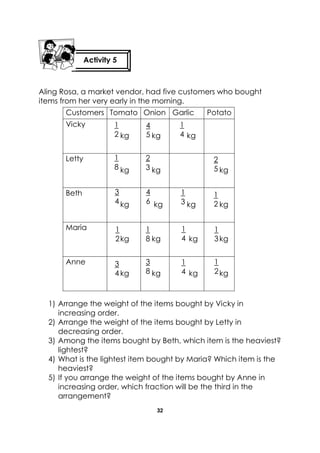
Aling Rosa, a market vendor, had five customers who bought items from her very early in the morning. 
Customers 
Tomato 
Onion 
Garlic 
Potato 
Vicky 
kg 
kg 
kg 
Letty 
kg 
kg 
kg 
Beth 
kg 
kg 
kg 
kg 
Maria 
kg 
kg 
kg 
kg 
Anne 
kg 
kg 
kg 
kg 
1) Arrange the weight of the items bought by Vicky in increasing order. 
2) Arrange the weight of the items bought by Letty in decreasing order. 
3) Among the items bought by Beth, which item is the heaviest? lightest? 
4) What is the lightest item bought by Maria? Which item is the heaviest? 
5) If you arrange the weight of the items bought by Anne in increasing order, which fraction will be the third in the arrangement? 
Activity 5 
1 
2 
4 
5 
1 
8 
1 
4 
2 
3 
2 
5 
3 
4 
4 
6 
1 
3 
1 
2 
1 
2 
1 
8 
1 
3 
1 
4 
1 
2 
3 
4 
3 
8 
1 
4
33 
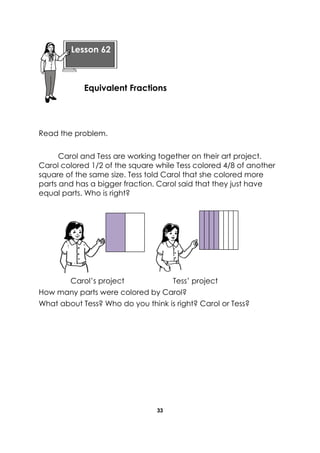
Read the problem. 
Carol and Tess are working together on their art project. Carol colored 1/2 of the square while Tess colored 4/8 of another square of the same size. Tess told Carol that she colored more parts and has a bigger fraction. Carol said that they just have equal parts. Who is right? 
Carol’s project Tess’ project 
How many parts were colored by Carol? 
What about Tess? Who do you think is right? Carol or Tess? 
Lesson 62 
Equivalent Fractions
34 
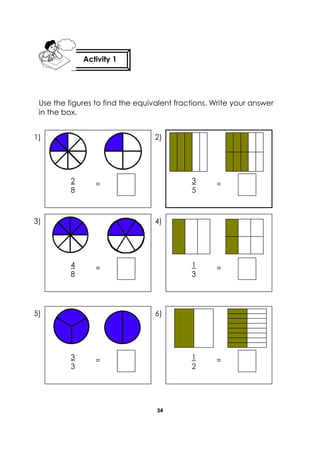
Use the figures to find the equivalent fractions. Write your answer 
in the box. 
Activity 1 
2 
8 
= 
3 
3 
= 
1 
3 
= 
1 
2 
= 
4 
8 
= 
6) 
4) 
5) 
3) 
1) 2) 
3 
5 
=
35 
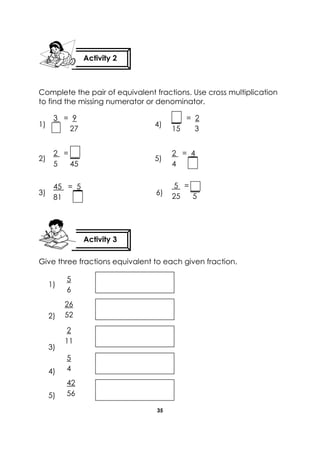
Complete the pair of equivalent fractions. Use cross multiplication to find the missing numerator or denominator. 
1) 4) 
2) 5) 
3) 6) 
Give three fractions equivalent to each given fraction. 
1) 
2) 
3) 
4) 
5) 
Activity 2 
Activity 3 
5 
6 
26 
52 
42 
56 
2 
11 
5 
4 
3 = 9 
27 
2 = 
5 45 
2 = 4 
4 
= 2 
15 3 
45 = 5 
81 
5 = 
25 5
36 
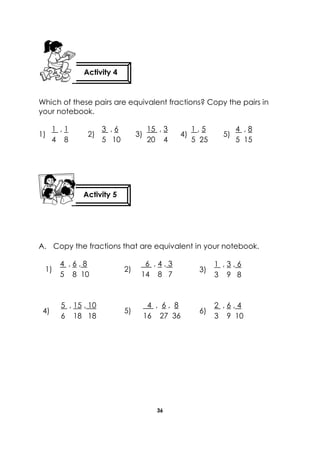
Which of these pairs are equivalent fractions? Copy the pairs in your notebook. 
1) 2) 3) 4) 5) 
A. Copy the fractions that are equivalent in your notebook. 
Activity 4 
Activity 5 
1 , 1 
4 8 
3 , 6 
5 10 
15 , 3 
20 4 
1 , 5 
5 25 
4 , 8 
5 15 
4 , 6 , 8 
5 8 10 
1) 
5 , 15 , 10 
6 18 18 
4) 
4 , 6 , 8 
16 27 36 
5) 
6 , 4 , 3 
14 8 7 
2) 
1 , 3 , 6 
3 9 8 
3) 
2 , 6 , 4 
3 9 10 
6)
37 
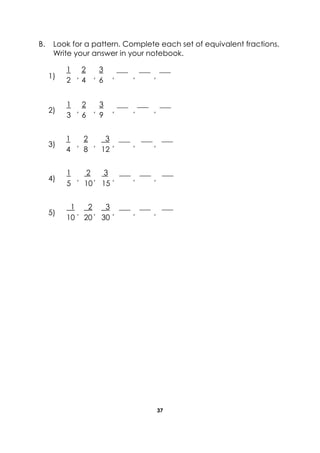
B. Look for a pattern. Complete each set of equivalent fractions. Write your answer in your notebook. 
1) , , , , , 
2) , , , , , 
3) , , , , , 
4) , , , , , 
5) , , , , , 
1 
2 
3 
6 
2 
4 
___ 
___ 
___ 
1 
3 
2 
6 
3 
9 
___ 
___ 
___ 
1 
4 
2 
8 
3 
12 
___ 
___ 
___ 
1 
5 
2 
10 
3 
15 
___ 
___ 
___ 
1 
10 
2 
20 
3 
30 
___ 
___ 
___
38 
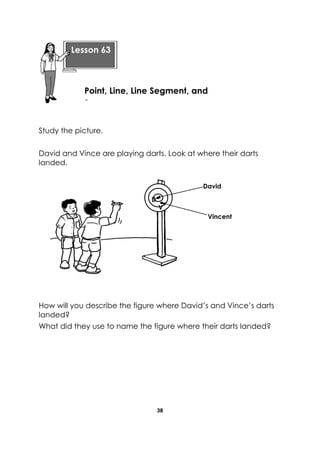
Study the picture. 
David and Vince are playing darts. Look at where their darts landed. 
How will you describe the figure where David’s and Vince’s darts landed? 
What did they use to name the figure where their darts landed? 
Lesson 63 
Point, Line, Line Segment, and Ray 
D 
V 
Vincent 
David
39 
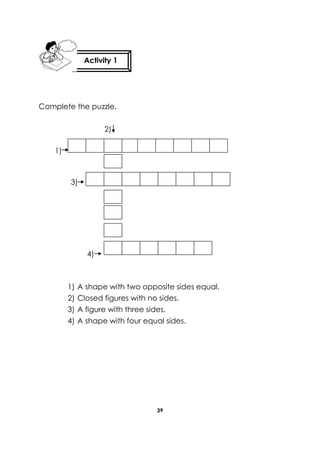
Complete the puzzle. 
2) 
1) 
3) 
4) 
1) A shape with two opposite sides equal. 
2) Closed figures with no sides. 
3) A figure with three sides. 
4) A shape with four equal sides. 
Activity 1
40 
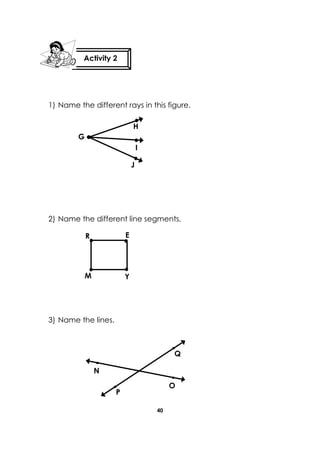
1) Name the different rays in this figure. 
2) Name the different line segments. 
3) Name the lines. 
Activity 2 
E 
R 
M 
Y 
J 
G 
H 
I 
N 
O 
P 
Q
41 
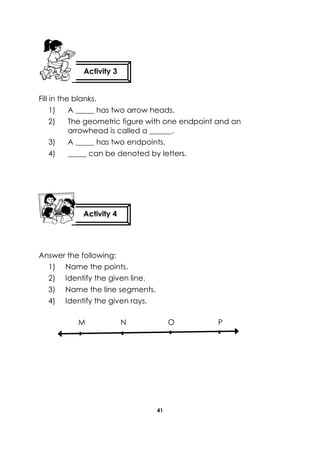
Fill in the blanks. 
1) A _____ has two arrow heads. 
2) The geometric figure with one endpoint and an arrowhead is called a ______. 
3) A _____ has two endpoints. 
4) _____ can be denoted by letters. 
Answer the following: 
1) Name the points. 
2) Identify the given line. 
3) Name the line segments. 
4) Identify the given rays. 
M N O P 
Activity 3 
Activity 4
42 
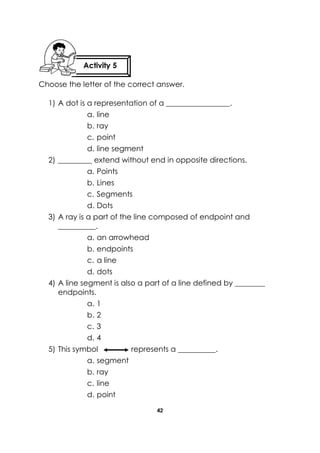
Choose the letter of the correct answer. 
1) A dot is a representation of a _________________. 
a. line 
b. ray 
c. point 
d. line segment 
2) _________ extend without end in opposite directions. 
a. Points 
b. Lines 
c. Segments 
d. Dots 
3) A ray is a part of the line composed of endpoint and __________. 
a. an arrowhead 
b. endpoints 
c. a line 
d. dots 
4) A line segment is also a part of a line defined by ________ endpoints. 
a. 1 
b. 2 
c. 3 
d. 4 
5) This symbol represents a __________. 
a. segment 
b. ray 
c. line 
d. point 
Activity 5
43 
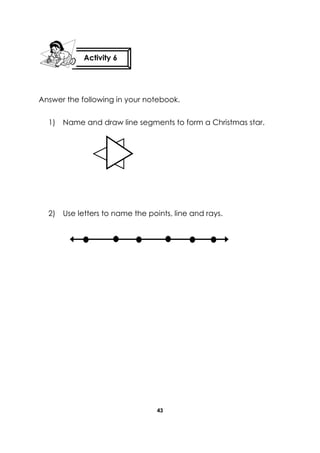
Answer the following in your notebook. 
1) Name and draw line segments to form a Christmas star. 
2) Use letters to name the points, line and rays. 
Activity 6
44 
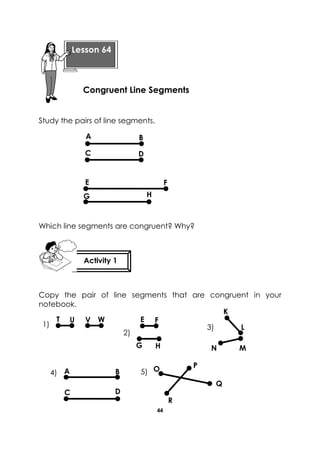
Study the pairs of line segments. 
Which line segments are congruent? Why? 
Copy the pair of line segments that are congruent in your notebook. 
Lesson 64 
Congruent Line Segments 
Activity 1 
A 
D 
C 
B 
E 
G 
F 
H 
K 
L 
V 
W 
U 
T 
H 
G 
F 
E 
N 
M 
1) 
2) 
3) 
C 
A 
B 
D 
O 
P 
Q 
R 
4) 
5)
45 
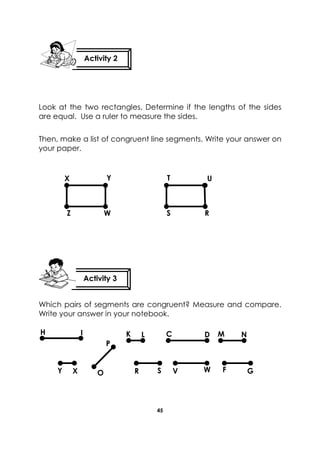
Look at the two rectangles. Determine if the lengths of the sides are equal. Use a ruler to measure the sides. 
Then, make a list of congruent line segments. Write your answer on your paper. 
Which pairs of segments are congruent? Measure and compare. Write your answer in your notebook. 
Activity 2 
Activity 3 
R 
W 
T 
U 
S 
Z 
Y 
X 
H 
I 
G 
F 
W 
V 
S 
R 
N 
M 
D 
CD 
K 
L 
Y 
O 
X 
P
46 
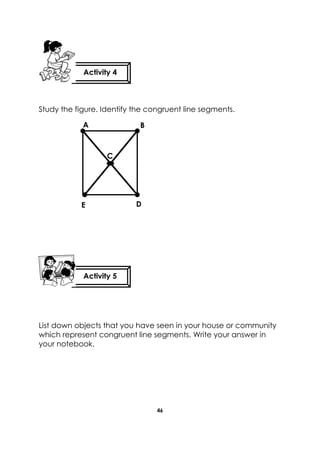
Study the figure. Identify the congruent line segments. 
List down objects that you have seen in your house or community which represent congruent line segments. Write your answer in your notebook. 
Activity 4 
Activity 5 
A 
E 
D 
C 
B
47 
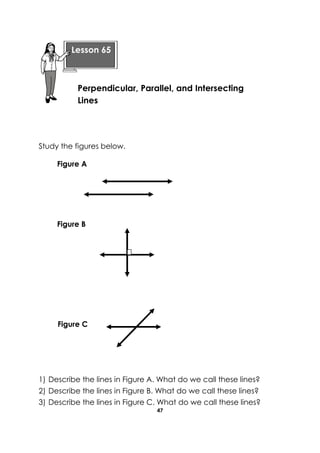
Study the figures below. 
1) Describe the lines in Figure A. What do we call these lines? 
2) Describe the lines in Figure B. What do we call these lines? 
3) Describe the lines in Figure C. What do we call these lines? 
Lesson 65 
Perpendicular, Parallel, and Intersecting Lines 
Figure A 
Figure B 
Figure C
48 
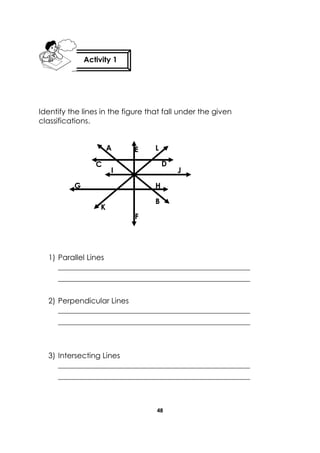
Identify the lines in the figure that fall under the given classifications. 
1) Parallel Lines ___________________________________________________ 
___________________________________________________ 
2) Perpendicular Lines ___________________________________________________ 
___________________________________________________ 
3) Intersecting Lines ___________________________________________________ 
___________________________________________________ 
Activity 1 
C 
D 
F 
E 
HD 
B 
A 
KD 
JD 
I 
G 
LD
49 
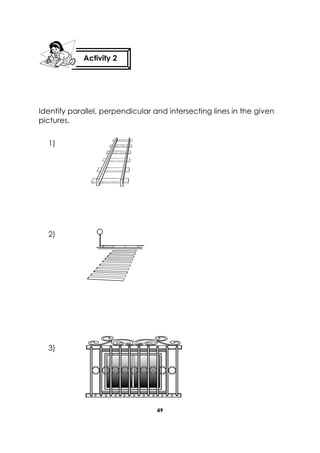
Identify parallel, perpendicular and intersecting lines in the given pictures. 
1) 
2) 
3) 
Activity 2
50 
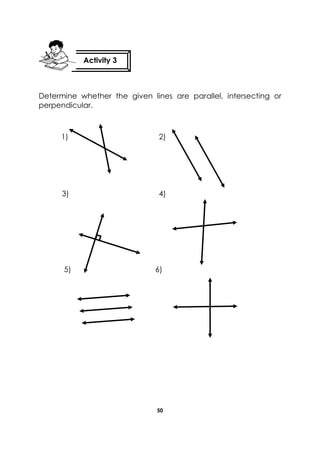
Determine whether the given lines are parallel, intersecting or perpendicular. 
1) 2) 
3) 4) 
5) 6) 
Activity 3
51 
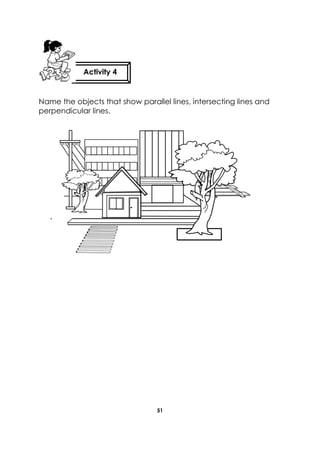
Name the objects that show parallel lines, intersecting lines and perpendicular lines. 
Activity 4
52 
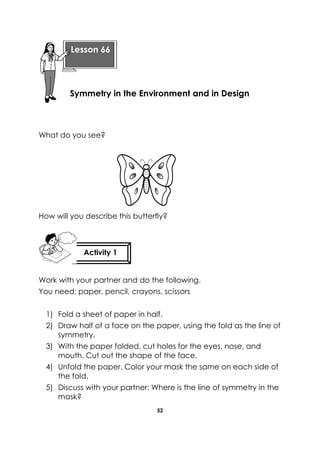
What do you see? 
How will you describe this butterfly? 
Work with your partner and do the following. 
You need: paper, pencil, crayons, scissors 
1) Fold a sheet of paper in half. 2) Draw half of a face on the paper, using the fold as the line of symmetry. 3) With the paper folded, cut holes for the eyes, nose, and mouth. Cut out the shape of the face. 4) Unfold the paper. Color your mask the same on each side of the fold. 5) Discuss with your partner: Where is the line of symmetry in the mask? 
Lesson 66 
Symmetry in the Environment and in Design 
Activity 1
53 
Work with your partner and do the following. 
You need: paper, pencil, crayons 
1) Fold the paper in half length-wise. 
2) Then write your name with a dark marker or crayons in large cursive letters on the fold. 
3) Then turn the paper over so that you can trace your name on the other side of the paper. 
4) When you unfold the paper, your name should make a symmetrical design, with the fold line being the line of symmetry. 
5) After you have your names drawn, look at the design and try to make some kind of creature out of it by coloring it and adding other lines. 
Draw your own picture showing symmetry in your notebook. 
You need: paper, pencil, crayons 
Activity 2 
Activity 3
54 
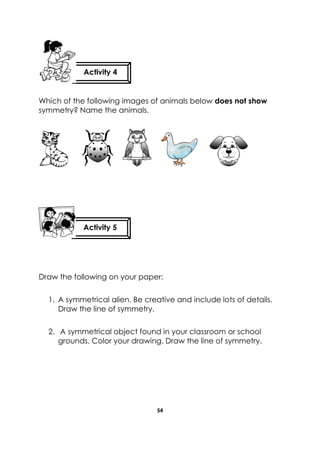
Which of the following images of animals below does not show symmetry? Name the animals. 
Draw the following on your paper: 1. A symmetrical alien. Be creative and include lots of details. Draw the line of symmetry. 2. A symmetrical object found in your classroom or school grounds. Color your drawing. Draw the line of symmetry. 
Activity 4 
Activity 5
55 
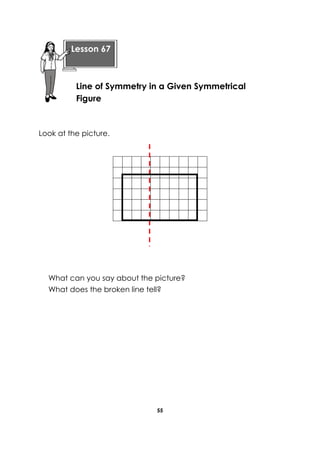
Look at the picture. 
What can you say about the picture? 
What does the broken line tell? 
Lesson 67 
Line of Symmetry in a Given Symmetrical Figure
56 
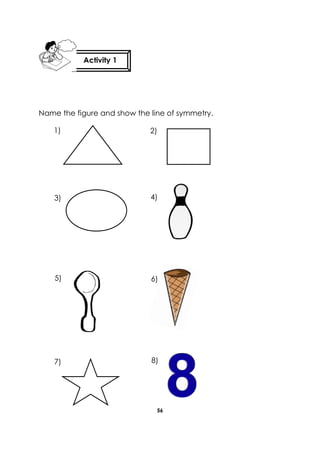
Name the figure and show the line of symmetry. 
Activity 1 
1) 2) 
3) 
5) 
7) 
4) 
6) 
8)
57 
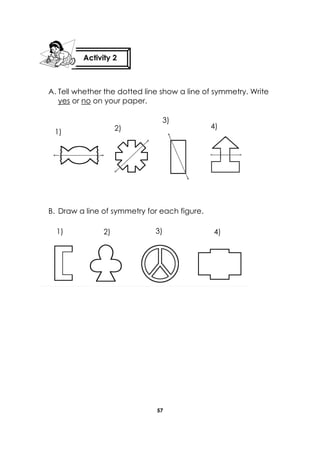
A. Tell whether the dotted line show a line of symmetry. Write yes or no on your paper. 
B. Draw a line of symmetry for each figure. 
Activity 2 
1) 
2) 
3) 
4) 
1) 
2) 
3) 
4)
58 
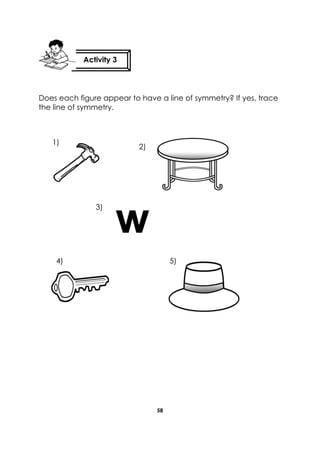
Does each figure appear to have a line of symmetry? If yes, trace the line of symmetry. 
Activity 3 
w 
1) 
2) 
3) 
4) 
5)
59 
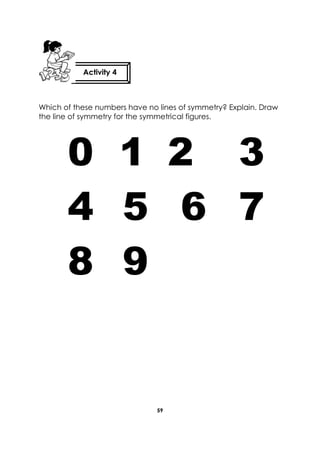
Which of these numbers have no lines of symmetry? Explain. Draw the line of symmetry for the symmetrical figures. 
0 1 2 3 4 5 6 7 8 9 
Activity 4
60 
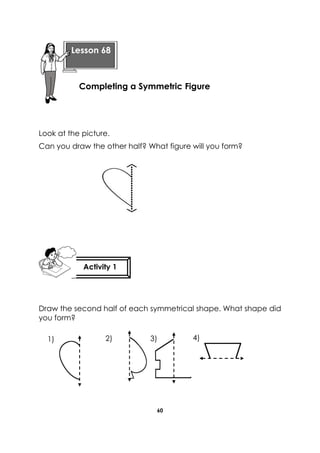
Look at the picture. 
Can you draw the other half? What figure will you form? 
Draw the second half of each symmetrical shape. What shape did 
you form? 
Lesson 68 
Completing a Symmetric Figure 
Activity 1 
1) 2) 3) 4)
61 
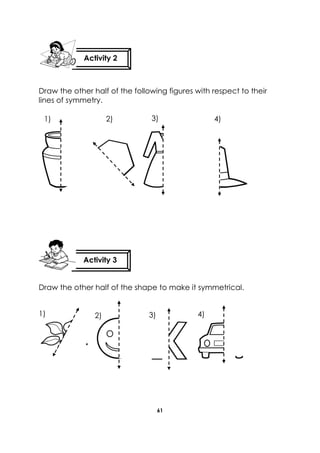
Draw the other half of the following figures with respect to their lines of symmetry. 
Draw the other half of the shape to make it symmetrical. 
Activity 2 
Activity 3 
1) 
2) 
3) 
4) 
1) 
2) 
3) 
4)
62 
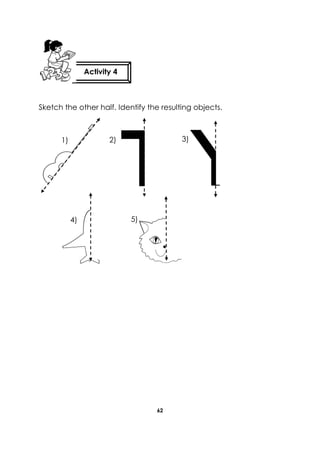
Sketch the other half. Identify the resulting objects. 
Activity 4 
1) 
2) 
3) 
4) 
5)
63 
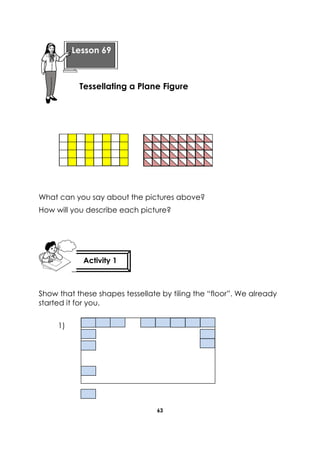
What can you say about the pictures above? 
How will you describe each picture? 
Show that these shapes tessellate by tiling the “floor”. We already started it for you. 
1) 
Lesson 69 
Tessellating a Plane Figure 
Activity 1
64 
2) 
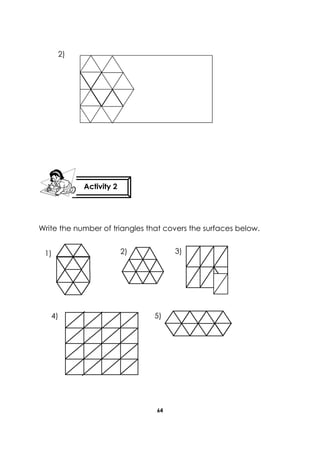
Write the number of triangles that covers the surfaces below. 
Activity 2 
1) 2) 3) 
4) 5)
65 
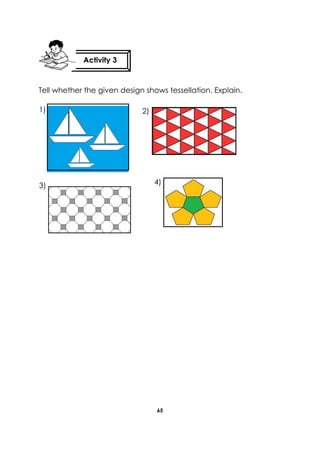
Tell whether the given design shows tessellation. Explain. 
Activity 3 
3) 
1) 
2) 
4)
66 
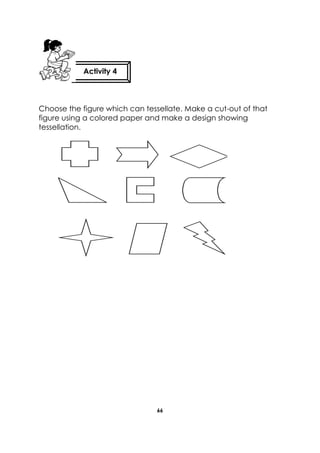
Choose the figure which can tessellate. Make a cut-out of that figure using a colored paper and make a design showing tessellation. 
Activity 4
67 
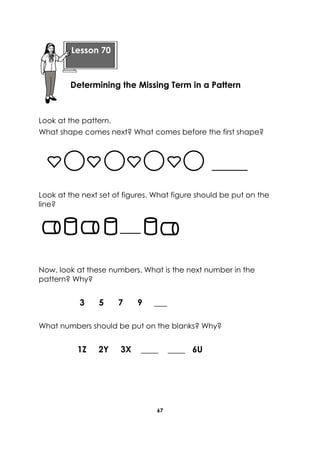
Look at the pattern. 
What shape comes next? What comes before the first shape? 
Look at the next set of figures. What figure should be put on the line? 
Now, look at these numbers. What is the next number in the pattern? Why? 
3 5 7 9 ___ 
What numbers should be put on the blanks? Why? 
1Z 2Y 3X ____ ____ 6U 
Lesson 70 
Determining the Missing Term in a Pattern
68 
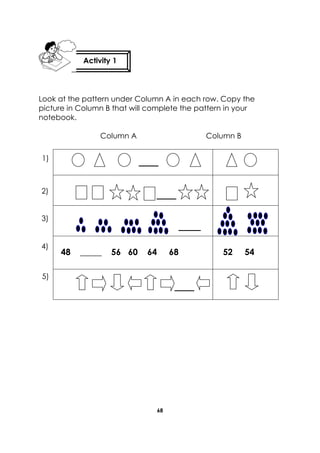
Look at the pattern under Column A in each row. Copy the picture in Column B that will complete the pattern in your notebook. 
Column A Column B 
48 _____ 56 60 64 68 
52 54 
Activity 1 
1) 
2) 
3) 
4) 
5)
69 
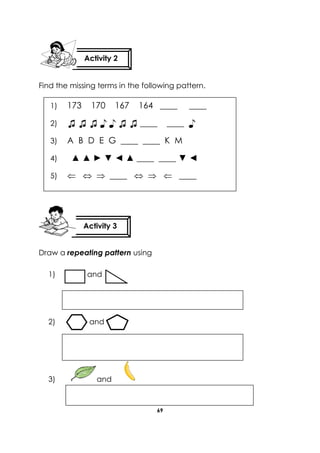
Find the missing terms in the following pattern. 
Draw a repeating pattern using 
1) and 
2) and 
3) and 
Activity 2 
Activity 3 
1) 173 170 167 164 ____ ____ 
2) ♫ ♫ ♫ ♪ ♪ ♫ ♫ ____ ____ ♪ 
3) A B D E G ____ ____ K M 
4) ▲ ▲ ► ▼ ◄ ▲ ____ ____ ▼ ◄ 
5)    ____    ____ 
6) 
7)
70 
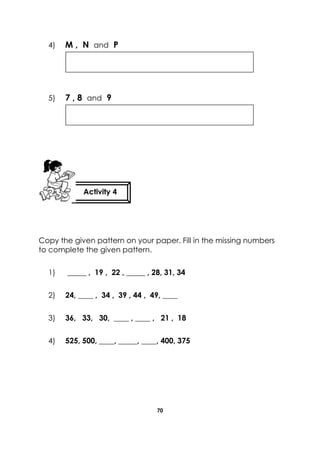
4) M , N and P 
5) 7 , 8 and 9 
Copy the given pattern on your paper. Fill in the missing numbers to complete the given pattern. 
1) _____ , 19 , 22 , _____ , 28, 31, 34 
2) 24, ____ , 34 , 39 , 44 , 49, ____ 
3) 36, 33, 30, ____ , ____ , 21 , 18 
4) 525, 500, ____, _____, ____, 400, 375 
Activity 4
71 
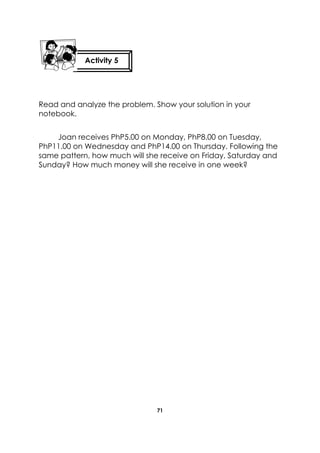
Read and analyze the problem. Show your solution in your notebook. 
Joan receives PhP5.00 on Monday, PhP8.00 on Tuesday, PhP11.00 on Wednesday and PhP14.00 on Thursday. Following the same pattern, how much will she receive on Friday, Saturday and Sunday? How much money will she receive in one week? 
Activity 5
72 
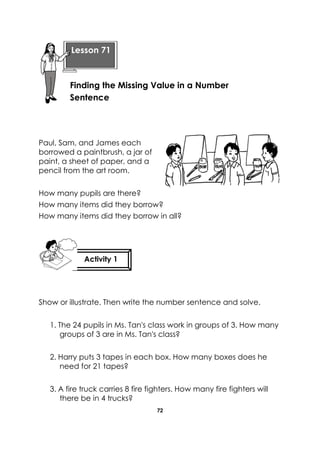
Paul, Sam, and James each borrowed a paintbrush, a jar of paint, a sheet of paper, and a pencil from the art room. 
How many pupils are there? 
How many items did they borrow? 
How many items did they borrow in all? 
Show or illustrate. Then write the number sentence and solve. 
1. The 24 pupils in Ms. Tan's class work in groups of 3. How many groups of 3 are in Ms. Tan's class? 
2. Harry puts 3 tapes in each box. How many boxes does he need for 21 tapes? 
3. A fire truck carries 8 fire fighters. How many fire fighters will there be in 4 trucks? 
Lesson 71 
Finding the Missing Value in a Number Sentence 
Activity 1
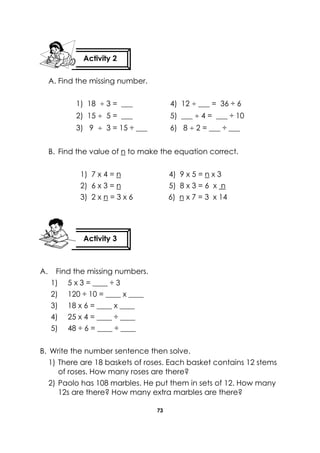
73 
A. Find the missing number. 
1) 18 
3 = ___ 4) 12 
___ = 36 ÷ 6 
2) 15 
5 = ___ 5) ___ 
4 = ___ ÷ 10 
3) 9 
3 = 15 ÷ ___ 6) 8 
2 = ___ ÷ ___ 
B. Find the value of n to make the equation correct. 
1) 7 x 4 = n 4) 9 x 5 = n x 3 
2) 6 x 3 = n 5) 8 x 3 = 6 x n 
3) 2 x n = 3 x 6 6) n x 7 = 3 x 14 
A. Find the missing numbers. 
1) 5 x 3 = ____ ÷ 3 
2) 120 ÷ 10 = ____ x ____ 
3) 18 x 6 = ____ x ____ 
4) 25 x 4 = ____ ÷ ____ 
5) 48 ÷ 6 = ____ ÷ ____ 
B. Write the number sentence then solve. 
1) There are 18 baskets of roses. Each basket contains 12 stems of roses. How many roses are there? 
2) Paolo has 108 marbles. He put them in sets of 12. How many 12s are there? How many extra marbles are there? 
Activity 2 
Activity 3
74 
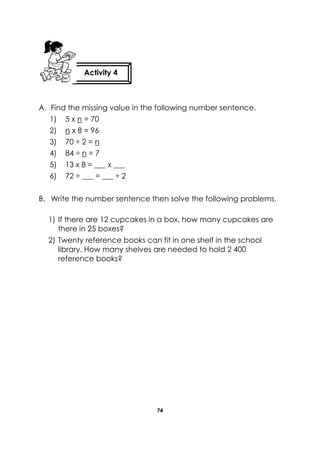
A. Find the missing value in the following number sentence. 
1) 5 x n = 70 
2) n x 8 = 96 
3) 70 ÷ 2 = n 
4) 84 ÷ n = 7 
5) 13 x 8 = ___ x ___ 
6) 72 ÷ ___ = ___ ÷ 2 
B. Write the number sentence then solve the following problems. 
1) If there are 12 cupcakes in a box, how many cupcakes are there in 25 boxes? 
2) Twenty reference books can fit in one shelf in the school library. How many shelves are needed to hold 2 400 reference books? 
Activity 4
75 
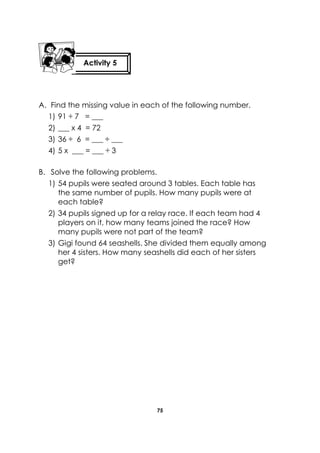
A. Find the missing value in each of the following number. 
1) 91 ÷ 7 = ___ 
2) ___ x 4 = 72 
3) 36 ÷ 6 = ___ ÷ ___ 
4) 5 x ___ = ___ ÷ 3 
B. Solve the following problems. 
1) 54 pupils were seated around 3 tables. Each table has the same number of pupils. How many pupils were at each table? 
2) 34 pupils signed up for a relay race. If each team had 4 players on it, how many teams joined the race? How many pupils were not part of the team? 
3) Gigi found 64 seashells. She divided them equally among her 4 sisters. How many seashells did each of her sisters get? 
Activity 5

3 math lm q3

  • 1.
    i Mathematics Learner’sMaterial Unit 3 Department of Education Republic of the Philippines 3 This instructional material was collaboratively developed and reviewed by educators from public and private schools, colleges, and/or universities. We encourage teachers and other education stakeholders to email their feedback, comments, and recommendations to the Department of Education at action@deped.gov.ph. We value your feedback and recommendations.
  • 2.
    ii Mathematics –Grade 3 Learner’s Material First Edition, 2014 Republic Act 8293, section 176 states that: No copyright shall subsist in any work of the Government of the Philippines. However, prior approval of the government agency or office wherein the work is created shall be necessary for exploitation of such work for profit. Such agency or office may, among other things, impose as a condition the payment of royalties. Borrowed materials (i.e., songs, stories, poems, pictures, photos, brand names, trademarks, etc.) included in this book are owned by their respective copyright holders. Every effort has been exerted to locate and seek permission to use these materials from their respective copyright owners. The publisher and authors do not represent nor claim ownership over them. Published by the Department of Education Secretary: Br. Armin A. Luistro FSC Undersecretary: Dina S. Ocampo, Ph.D. Department of Education-Instructional Materials Council Secretariat (DepEd-IMCS) Office Address: 5th Floor Mabini Building, DepEd Complex Meralco Avenue, Pasig City Philippines 1600 Telefax: (02) 634-1054 or 634-1072 E-mail Address: imcsetd@yahoo.com
  • 3.
    iii Table ofContents Lesson 55 Odd and Even Numbers 1 Lesson 56 Fractions Equal to One and Greater than One 4 Lesson 57 Reading and Writing Fractions Greater than One 9 Lesson 58 Representing Fractions using Regions, Sets, and Number Lines 12 Lesson 59 Visualizing Dissimilar Fractions 17 Lesson 60 Comparing Dissimilar Fractions 22 Lesson 61 Arranging Dissimilar Fractions 28 Lesson 62 Equivalent Fractions 33 Lesson 63 Point, Line, Line Segment, and Ray 38 Lesson 64 Congruent Line Segments 44 Lesson 65 Perpendicular, Parallel, and Intersecting Lines 47 Lesson 66 Symmetry in the Environment and in Design 52 Lesson 67 Line of Symmetry in a Given Symmetrical Figure 55 Lesson 68 Completing a Symmetric Figure 60 Lesson 69 Tessellating a Plane Figure 63 Lesson 70 Determining the Missing Term in a Pattern 67 Lesson 71 Finding the Missing Value in a Number Sentence 72
  • 4.
    1 Mrs. Ching’sclass is going to join the school program, so the pupils are lining up in pairs. Today she has 24 pupils in class. Does each pupil have a partner? Why? What if there were only 23 pupils, will all the pupils have a partner? Why? What are the given numbers? Which number is even? Which number is odd? Copy the following numbers on your paper. Write whether it is odd or even. _____ 1) 26 _____ 6) 101 _____ 11) 1 457 _____ 2) 18 _____ 7) 238 _____ 12) 2 536 _____ 3) 79 _____ 8) 454 _____ 13) 3 210 _____ 4) 15 _____ 9) 500 _____ 14) 5 012 _____ 5) 89 _____ 10) 873 _____ 15) 9 113 Lesson 55 Odd and Even Numbers Activity 1
  • 5.
    2 What numberam I? Write your answer on your paper. 1) I am an odd number less than 80 but greater than 77. 2) I am an odd number greater than 122 but less than 125. 3) I am the largest odd number less than 600. 4) I am an even number greater than 1 396 but less than 1 400. 5) I am an even number greater than 2 202 but less than 2 205. Copy the puzzle on your paper. Color the odd numbers red. Then color the even numbers green. Activity 2 Activity 3 6 12 140 69 3 431 2 296 133 82 50 43 5 628 812 247 3 981 3 9 20 53 435 5 012 3 348 113 25 141 4 17 7 985 21 34 1 238 97 8
  • 6.
    3 Guessing Game Answer the questions in your notebook. 1. I am an even number more than 15 but less than 17. 2. I am an odd number between 4 191 and 4 195. 3. I am the sum of the greatest odd one digit number and the greatest even one digit number. 4. What is the sum of even numbers less than 30? 5. What kind of number is the sum of two even numbers? 6. What kind of number is the sum of two odd numbers? 7. What kind of number is the sum of an odd number and an even number? 8. I am an odd number between 1 008 and 1 013. 9. The sum of 2 consecutive even numbers is 26. What are the numbers? 10. I am the greatest 3-digit number that has all of the following characteristics: I am an odd number. The sum of my digits is 21. Each digit is different. Activity 4
  • 7.
    4 Study theshapes below. A B C Into how many equal parts is Figure A divided? Figure B? Figure C? What fractional parts are shaded? What do you call the fractions , and ? 4 4 2 2 8 8 Lesson 56 Fractions Equal to One and Greater than One
  • 8.
    5 Copy theset of fractions on your paper. Encircle the fraction that is equal to one in each set of fractions. Box the fractions that are more than one. 11 13 10 13 13 13 15 13 3 5 4 5 6 5 5 5 9 7 7 7 4 7 3 7 12 14 14 14 10 14 15 14 10 10 11 10 9 10 5 10 1) 4) 5) 2) 3) Activity 1
  • 9.
    6 before fractionsequal to one and Write before fractions more than one. ____ 1) ____ 6) ____ 2) ____ 7) ____ 3) ____ 8) ____ 4) ____ 9) ____ 5) ____ 10) FM > 1 2 2 9 3 8 8 9 7 10 10 12 10 5 4 6 6 11 11 6 3 Activity 2 FE = 1
  • 10.
    7 Who amI? Draw the shaded regions on your paper then write the fraction. 1) I am a fraction equal to one. My denominator is 5. 2) I am a fraction that shows 9 of 8 equal parts. 3) I am a fraction whose denominator is 4 and whose numerator is 9. 4) I am a fraction which is neither less than 1 nor greater than 1. 5) I am a fraction equal to one and my numerator is 10. Activity 3
  • 11.
    8 Copy thetable in your notebook. Fill up the table with the given fractions in the cart. Fraction Less than One Fraction Equal to One Fraction More than One Activity 4 3 2 5 6 10 10 5 11 8 6 3 3 5 12 9 4 9 9 5 10 11 11 8 15 9 2 7 7 5 5 8 4
  • 12.
    9 Study theproblem. Jojo cut a whole bibingka into 8 equal parts. He gave 2 pieces to each of his 3 brothers and ate the rest. What part did each one get? Into how many parts did Jojo cut the bibingka? What do you call each part? Copy the fraction written in words and write its corresponding numerical symbol on your paper. Then, write the letter of its correct figure. 1) five-fourths a. 2) eight-sixths b. Lesson 57 Activity 1 Reading and Writing Fractions Greater than One Lesson 57
  • 13.
    10 3) three-halvesc. 4) five-thirds d. 5) nine sixths e. 6) seven-fifths f. 7) eight-fourths 8) twelve-ninths g. h. On your paper, write the following fractions in symbols. 1) four-thirds ________ 6) six-fifths ________ 2) ten-eighths ________ 7) twelve-ninths ________ 3) eight-sevenths ________ 8) thirteen-tenths ________ 4) nine-sixths ________ 9) twelve-elevenths ________ 5) eleven-sevenths _______ 10) fifteen-thirds _______ Activity 2
  • 14.
    11 On yourpaper, write the following fractions in words. Make a model of a fraction more than one using these figures. Write the fraction in symbols and in words in your notebook. Activity 3 Activity 4 5 2 9 8 12 10 7 5 6 2 8 7 6 4 9 6 10 8 1) 2) 3) 4) 5) 6) 7) 8) 9) 10) 4 3 4) 3) 2) 1)
  • 15.
    12 Look atthe figures below. Figure A Figure B Figure C What part of the connecting cubes is shaded? Into how many parts is the segment of the number line divided, what do you call one part? What part of the triangle is unshaded? Lesson 58 Representing Fractions using Regions, Sets, and Number Lines 0
  • 16.
    13 Name thefractional part of the shaded portion in each of the following. Write your answers on your paper. _______ _______ _______ _______ ______ What part of each group is shaded? Write the fraction on your paper. Activity 2 Activity 1 1) 2) 3) 4) 5) 1) 2) 4) 5) _________ _________ _________ _________ 3) _________
  • 17.
    14 Write thefraction that names the part of the group described. 1) peeled bananas 2) empty glasses 3) vase with flowers 4) busted balloons 5) closed books Activity 3
  • 18.
    15 Work onthese in your notebook. A. Color portions of the figure to show the fraction then write the fraction in symbol. 1) three-eighths 3) seven-tenths 2) five-sixths 4) three-fifths B. Write the fraction shown on the number line segments. 1) 2) Activity 4 0 0
  • 19.
    16 3) 4) 5) 0 0 0
  • 20.
    17 Study thefigures. What can you say about the figures? What is the fractional name of the shaded part in each figure? Compare. Look at the following illustrations. Put a checkmark (√) on your answer sheet if the given pair of fraction is dissimilar and mark (x) if not. 1) 2) Lesson 59 Visualizing Dissimilar Fractions Activity 1
  • 21.
    18 3) 4) 5) Illustrate the following sets of dissimilar fractions on the given shapes below. 1) 2) 2 1 6 5 4 3 6 1 3) 4) 5 3 3 2 2 1 3 1 Activity 2
  • 22.
    19 Read andanswer the following problems. Write/Draw your answer on your paper. 1) Kim Christian spent of the day in school and of the day remaining doing his assignment. What kind of fractions are and ? Answer: ________________________________________________ 2) Ben has a cut-out rectangle. He folded it into 4 equal parts and shaded 3 parts. Draw the rectangle made by Ben and give the fraction representing these shaded parts. Then, draw another fraction beside the illustration you made to make a pair of dissimilar fractions. Answer: ________________________________________________ 3) Camille has 2 circles of the same size. She folded the first circle into 4 equal parts while the second one was divided into 8 equal parts. If she shaded 3 parts in the first circle and 3 parts in the second circle, are the resulting fractions representing these shaded parts similar? Answer:_____________________________________________ Activity 3 1 4 1 4 1 2 1 2 1 2
  • 23.
    20 Write Don your paper if the given sets of fractions are dissimilar. Activity 4 _____ 1) _____ 2) _____ 3) _____ 4) _____ 5)
  • 24.
    21 Put acheckmark (√) on your paper if the fractions are dissimilar and mark (x) if not. _____1) 5 2 , 5 1 _____ 6) 8 3 , 8 5 _____2) 9 3 , 7 3 _____ 7) 3 7 , 3 4 _____3) 5 6 , 6 5 _____ 8) 3 2 , 5 3 _____4) 8 4 , 9 6 _____ 9) 10 8 , 10 7 _____5) 3 1 , 4 3 _____ 10) 6 3 , 9 3 Activity 5
  • 25.
    22 Look atthe figures. Name the shaded parts. 1) 2) 3) 4) What are the numerators of the fractional parts that are shaded? What are their denominators? Compare the fractions. Which is the greatest? least? Lesson 60 Comparing Dissimilar Fractions
  • 26.
    23 Compare eachpair of fractions given below. Write >, < or = on your paper. 4 1 3 1 4 3 6 4 3 2 2 1 5 4 3 2 Activity 1 1) 4) 3) 2)
  • 27.
    24 Give thefractions corresponding to the shaded parts. Then compare them by writing >, < or = on your paper. Activity 2 1) 2) 3) 4)
  • 28.
    25 Copy thefigure on your paper. Color all the shapes with fractions that are greater than 3 2 blue, and color all the shapes with fractions that are less than 3 2 red. Activity 3 4 1 5 4 3 8 7 8 6 7 5 6 6 1 0 3 7
  • 29.
    26 A. Usecross product method to compare the following fractions. 1) _____ 2) _____ 3) _____ 4) _____ 5) _____ B. Write True if the statement is correct and False if it is not true. Support your answer with an explanation. _________________ 1) = _________________ 2) < _________________ 3) = _________________ 4) > _________________ 5) < Activity 4 6 7 8 9 6 9 7 8 2 3 6 8 3 4 5 7 7 9 5 6 6 9 4 9 1 2 3 5 8 10 4 8 1 5 5 8 1 8 6 7
  • 30.
    27 Compare thesefractions. Write >, < or = on your paper. 1) _____ 6) _____ 2) _____ 7) _____ 3) _____ 8) _____ 4) _____ 9) _____ 5) _____ 10) _____ Activity 5 3 6 2 6 1 7 6 8 4 3 4 9 9 8 3 5 3 4 3 4 1 8 2 5 4 5 3 5 3 4 4 5 1 7 2 5 1 6 3 6
  • 31.
    28 Read theproblem. Kathleen and her mother went to the market. She helped her in buying the following ingredients: kilogram of chicken kilogram of sayote kilogram of ginger kilogram of onions If we are going to arrange the weight of the ingredients bought from lightest to heaviest, which should come first? second? third? fourth? Why? Lesson 61 Arranging Dissimilar Fractions 3 4 1 4 1 8 1 2
  • 32.
    29 Arrange thefollowing fractions in increasing order. 1) 2) 3) 4) 5) Arrange the following fractions in decreasing order. Activity 1 Activity 2 1 , 1 , 1 , 1 2 5 3 6 1 , 4 , 3 , 2 2 5 4 3 7 , 7 , 7 , 7 2 5 4 3 2 , 3 , 5 , 1 3 4 8 2 7 , 2 , 1 , 1 8 3 4 6 2 , 1 , 1 5 2 8 3 , 5 , 4 4 6 8 1) 2)
  • 33.
    30 Give anyfraction whose value is between the given fractions. 1) , _____, 2) , _____, 3) , _____, 4) , _____, 5) , _____, Activity 3 5 , 5 , 5 6 3 12 1 , 2 , 7 2 3 9 7 , 7 , 7 4 2 3 3) 4) 5) 7 8 4 5 3 5 6 7 1 4 2 3 2 5 7 10 1 3 5 9
  • 34.
    31 Given: 1)If you arrange the fractions in increasing order, which fraction will be: a) first? ______ b) last? ______ 2) If you arrange the fractions in decreasing order, which fraction will be: a) first? ______ b) third? ______ 3) Arrange the set of fractions in: a) ascending order ________________ b) descending order ________________ Activity 4 2 , 3 , 1 , 3 5 4 6 9
  • 35.
    32 Aling Rosa,a market vendor, had five customers who bought items from her very early in the morning. Customers Tomato Onion Garlic Potato Vicky kg kg kg Letty kg kg kg Beth kg kg kg kg Maria kg kg kg kg Anne kg kg kg kg 1) Arrange the weight of the items bought by Vicky in increasing order. 2) Arrange the weight of the items bought by Letty in decreasing order. 3) Among the items bought by Beth, which item is the heaviest? lightest? 4) What is the lightest item bought by Maria? Which item is the heaviest? 5) If you arrange the weight of the items bought by Anne in increasing order, which fraction will be the third in the arrangement? Activity 5 1 2 4 5 1 8 1 4 2 3 2 5 3 4 4 6 1 3 1 2 1 2 1 8 1 3 1 4 1 2 3 4 3 8 1 4
  • 36.
    33 Read theproblem. Carol and Tess are working together on their art project. Carol colored 1/2 of the square while Tess colored 4/8 of another square of the same size. Tess told Carol that she colored more parts and has a bigger fraction. Carol said that they just have equal parts. Who is right? Carol’s project Tess’ project How many parts were colored by Carol? What about Tess? Who do you think is right? Carol or Tess? Lesson 62 Equivalent Fractions
  • 37.
    34 Use thefigures to find the equivalent fractions. Write your answer in the box. Activity 1 2 8 = 3 3 = 1 3 = 1 2 = 4 8 = 6) 4) 5) 3) 1) 2) 3 5 =
  • 38.
    35 Complete thepair of equivalent fractions. Use cross multiplication to find the missing numerator or denominator. 1) 4) 2) 5) 3) 6) Give three fractions equivalent to each given fraction. 1) 2) 3) 4) 5) Activity 2 Activity 3 5 6 26 52 42 56 2 11 5 4 3 = 9 27 2 = 5 45 2 = 4 4 = 2 15 3 45 = 5 81 5 = 25 5
  • 39.
    36 Which ofthese pairs are equivalent fractions? Copy the pairs in your notebook. 1) 2) 3) 4) 5) A. Copy the fractions that are equivalent in your notebook. Activity 4 Activity 5 1 , 1 4 8 3 , 6 5 10 15 , 3 20 4 1 , 5 5 25 4 , 8 5 15 4 , 6 , 8 5 8 10 1) 5 , 15 , 10 6 18 18 4) 4 , 6 , 8 16 27 36 5) 6 , 4 , 3 14 8 7 2) 1 , 3 , 6 3 9 8 3) 2 , 6 , 4 3 9 10 6)
  • 40.
    37 B. Lookfor a pattern. Complete each set of equivalent fractions. Write your answer in your notebook. 1) , , , , , 2) , , , , , 3) , , , , , 4) , , , , , 5) , , , , , 1 2 3 6 2 4 ___ ___ ___ 1 3 2 6 3 9 ___ ___ ___ 1 4 2 8 3 12 ___ ___ ___ 1 5 2 10 3 15 ___ ___ ___ 1 10 2 20 3 30 ___ ___ ___
  • 41.
    38 Study thepicture. David and Vince are playing darts. Look at where their darts landed. How will you describe the figure where David’s and Vince’s darts landed? What did they use to name the figure where their darts landed? Lesson 63 Point, Line, Line Segment, and Ray D V Vincent David
  • 42.
    39 Complete thepuzzle. 2) 1) 3) 4) 1) A shape with two opposite sides equal. 2) Closed figures with no sides. 3) A figure with three sides. 4) A shape with four equal sides. Activity 1
  • 43.
    40 1) Namethe different rays in this figure. 2) Name the different line segments. 3) Name the lines. Activity 2 E R M Y J G H I N O P Q
  • 44.
    41 Fill inthe blanks. 1) A _____ has two arrow heads. 2) The geometric figure with one endpoint and an arrowhead is called a ______. 3) A _____ has two endpoints. 4) _____ can be denoted by letters. Answer the following: 1) Name the points. 2) Identify the given line. 3) Name the line segments. 4) Identify the given rays. M N O P Activity 3 Activity 4
  • 45.
    42 Choose theletter of the correct answer. 1) A dot is a representation of a _________________. a. line b. ray c. point d. line segment 2) _________ extend without end in opposite directions. a. Points b. Lines c. Segments d. Dots 3) A ray is a part of the line composed of endpoint and __________. a. an arrowhead b. endpoints c. a line d. dots 4) A line segment is also a part of a line defined by ________ endpoints. a. 1 b. 2 c. 3 d. 4 5) This symbol represents a __________. a. segment b. ray c. line d. point Activity 5
  • 46.
    43 Answer thefollowing in your notebook. 1) Name and draw line segments to form a Christmas star. 2) Use letters to name the points, line and rays. Activity 6
  • 47.
    44 Study thepairs of line segments. Which line segments are congruent? Why? Copy the pair of line segments that are congruent in your notebook. Lesson 64 Congruent Line Segments Activity 1 A D C B E G F H K L V W U T H G F E N M 1) 2) 3) C A B D O P Q R 4) 5)
  • 48.
    45 Look atthe two rectangles. Determine if the lengths of the sides are equal. Use a ruler to measure the sides. Then, make a list of congruent line segments. Write your answer on your paper. Which pairs of segments are congruent? Measure and compare. Write your answer in your notebook. Activity 2 Activity 3 R W T U S Z Y X H I G F W V S R N M D CD K L Y O X P
  • 49.
    46 Study thefigure. Identify the congruent line segments. List down objects that you have seen in your house or community which represent congruent line segments. Write your answer in your notebook. Activity 4 Activity 5 A E D C B
  • 50.
    47 Study thefigures below. 1) Describe the lines in Figure A. What do we call these lines? 2) Describe the lines in Figure B. What do we call these lines? 3) Describe the lines in Figure C. What do we call these lines? Lesson 65 Perpendicular, Parallel, and Intersecting Lines Figure A Figure B Figure C
  • 51.
    48 Identify thelines in the figure that fall under the given classifications. 1) Parallel Lines ___________________________________________________ ___________________________________________________ 2) Perpendicular Lines ___________________________________________________ ___________________________________________________ 3) Intersecting Lines ___________________________________________________ ___________________________________________________ Activity 1 C D F E HD B A KD JD I G LD
  • 52.
    49 Identify parallel,perpendicular and intersecting lines in the given pictures. 1) 2) 3) Activity 2
  • 53.
    50 Determine whetherthe given lines are parallel, intersecting or perpendicular. 1) 2) 3) 4) 5) 6) Activity 3
  • 54.
    51 Name theobjects that show parallel lines, intersecting lines and perpendicular lines. Activity 4
  • 55.
    52 What doyou see? How will you describe this butterfly? Work with your partner and do the following. You need: paper, pencil, crayons, scissors 1) Fold a sheet of paper in half. 2) Draw half of a face on the paper, using the fold as the line of symmetry. 3) With the paper folded, cut holes for the eyes, nose, and mouth. Cut out the shape of the face. 4) Unfold the paper. Color your mask the same on each side of the fold. 5) Discuss with your partner: Where is the line of symmetry in the mask? Lesson 66 Symmetry in the Environment and in Design Activity 1
  • 56.
    53 Work withyour partner and do the following. You need: paper, pencil, crayons 1) Fold the paper in half length-wise. 2) Then write your name with a dark marker or crayons in large cursive letters on the fold. 3) Then turn the paper over so that you can trace your name on the other side of the paper. 4) When you unfold the paper, your name should make a symmetrical design, with the fold line being the line of symmetry. 5) After you have your names drawn, look at the design and try to make some kind of creature out of it by coloring it and adding other lines. Draw your own picture showing symmetry in your notebook. You need: paper, pencil, crayons Activity 2 Activity 3
  • 57.
    54 Which ofthe following images of animals below does not show symmetry? Name the animals. Draw the following on your paper: 1. A symmetrical alien. Be creative and include lots of details. Draw the line of symmetry. 2. A symmetrical object found in your classroom or school grounds. Color your drawing. Draw the line of symmetry. Activity 4 Activity 5
  • 58.
    55 Look atthe picture. What can you say about the picture? What does the broken line tell? Lesson 67 Line of Symmetry in a Given Symmetrical Figure
  • 59.
    56 Name thefigure and show the line of symmetry. Activity 1 1) 2) 3) 5) 7) 4) 6) 8)
  • 60.
    57 A. Tellwhether the dotted line show a line of symmetry. Write yes or no on your paper. B. Draw a line of symmetry for each figure. Activity 2 1) 2) 3) 4) 1) 2) 3) 4)
  • 61.
    58 Does eachfigure appear to have a line of symmetry? If yes, trace the line of symmetry. Activity 3 w 1) 2) 3) 4) 5)
  • 62.
    59 Which ofthese numbers have no lines of symmetry? Explain. Draw the line of symmetry for the symmetrical figures. 0 1 2 3 4 5 6 7 8 9 Activity 4
  • 63.
    60 Look atthe picture. Can you draw the other half? What figure will you form? Draw the second half of each symmetrical shape. What shape did you form? Lesson 68 Completing a Symmetric Figure Activity 1 1) 2) 3) 4)
  • 64.
    61 Draw theother half of the following figures with respect to their lines of symmetry. Draw the other half of the shape to make it symmetrical. Activity 2 Activity 3 1) 2) 3) 4) 1) 2) 3) 4)
  • 65.
    62 Sketch theother half. Identify the resulting objects. Activity 4 1) 2) 3) 4) 5)
  • 66.
    63 What canyou say about the pictures above? How will you describe each picture? Show that these shapes tessellate by tiling the “floor”. We already started it for you. 1) Lesson 69 Tessellating a Plane Figure Activity 1
  • 67.
    64 2) Writethe number of triangles that covers the surfaces below. Activity 2 1) 2) 3) 4) 5)
  • 68.
    65 Tell whetherthe given design shows tessellation. Explain. Activity 3 3) 1) 2) 4)
  • 69.
    66 Choose thefigure which can tessellate. Make a cut-out of that figure using a colored paper and make a design showing tessellation. Activity 4
  • 70.
    67 Look atthe pattern. What shape comes next? What comes before the first shape? Look at the next set of figures. What figure should be put on the line? Now, look at these numbers. What is the next number in the pattern? Why? 3 5 7 9 ___ What numbers should be put on the blanks? Why? 1Z 2Y 3X ____ ____ 6U Lesson 70 Determining the Missing Term in a Pattern
  • 71.
    68 Look atthe pattern under Column A in each row. Copy the picture in Column B that will complete the pattern in your notebook. Column A Column B 48 _____ 56 60 64 68 52 54 Activity 1 1) 2) 3) 4) 5)
  • 72.
    69 Find themissing terms in the following pattern. Draw a repeating pattern using 1) and 2) and 3) and Activity 2 Activity 3 1) 173 170 167 164 ____ ____ 2) ♫ ♫ ♫ ♪ ♪ ♫ ♫ ____ ____ ♪ 3) A B D E G ____ ____ K M 4) ▲ ▲ ► ▼ ◄ ▲ ____ ____ ▼ ◄ 5)    ____    ____ 6) 7)
  • 73.
    70 4) M, N and P 5) 7 , 8 and 9 Copy the given pattern on your paper. Fill in the missing numbers to complete the given pattern. 1) _____ , 19 , 22 , _____ , 28, 31, 34 2) 24, ____ , 34 , 39 , 44 , 49, ____ 3) 36, 33, 30, ____ , ____ , 21 , 18 4) 525, 500, ____, _____, ____, 400, 375 Activity 4
  • 74.
    71 Read andanalyze the problem. Show your solution in your notebook. Joan receives PhP5.00 on Monday, PhP8.00 on Tuesday, PhP11.00 on Wednesday and PhP14.00 on Thursday. Following the same pattern, how much will she receive on Friday, Saturday and Sunday? How much money will she receive in one week? Activity 5
  • 75.
    72 Paul, Sam,and James each borrowed a paintbrush, a jar of paint, a sheet of paper, and a pencil from the art room. How many pupils are there? How many items did they borrow? How many items did they borrow in all? Show or illustrate. Then write the number sentence and solve. 1. The 24 pupils in Ms. Tan's class work in groups of 3. How many groups of 3 are in Ms. Tan's class? 2. Harry puts 3 tapes in each box. How many boxes does he need for 21 tapes? 3. A fire truck carries 8 fire fighters. How many fire fighters will there be in 4 trucks? Lesson 71 Finding the Missing Value in a Number Sentence Activity 1
  • 76.
    73 A. Findthe missing number. 1) 18 3 = ___ 4) 12 ___ = 36 ÷ 6 2) 15 5 = ___ 5) ___ 4 = ___ ÷ 10 3) 9 3 = 15 ÷ ___ 6) 8 2 = ___ ÷ ___ B. Find the value of n to make the equation correct. 1) 7 x 4 = n 4) 9 x 5 = n x 3 2) 6 x 3 = n 5) 8 x 3 = 6 x n 3) 2 x n = 3 x 6 6) n x 7 = 3 x 14 A. Find the missing numbers. 1) 5 x 3 = ____ ÷ 3 2) 120 ÷ 10 = ____ x ____ 3) 18 x 6 = ____ x ____ 4) 25 x 4 = ____ ÷ ____ 5) 48 ÷ 6 = ____ ÷ ____ B. Write the number sentence then solve. 1) There are 18 baskets of roses. Each basket contains 12 stems of roses. How many roses are there? 2) Paolo has 108 marbles. He put them in sets of 12. How many 12s are there? How many extra marbles are there? Activity 2 Activity 3
  • 77.
    74 A. Findthe missing value in the following number sentence. 1) 5 x n = 70 2) n x 8 = 96 3) 70 ÷ 2 = n 4) 84 ÷ n = 7 5) 13 x 8 = ___ x ___ 6) 72 ÷ ___ = ___ ÷ 2 B. Write the number sentence then solve the following problems. 1) If there are 12 cupcakes in a box, how many cupcakes are there in 25 boxes? 2) Twenty reference books can fit in one shelf in the school library. How many shelves are needed to hold 2 400 reference books? Activity 4
  • 78.
    75 A. Findthe missing value in each of the following number. 1) 91 ÷ 7 = ___ 2) ___ x 4 = 72 3) 36 ÷ 6 = ___ ÷ ___ 4) 5 x ___ = ___ ÷ 3 B. Solve the following problems. 1) 54 pupils were seated around 3 tables. Each table has the same number of pupils. How many pupils were at each table? 2) 34 pupils signed up for a relay race. If each team had 4 players on it, how many teams joined the race? How many pupils were not part of the team? 3) Gigi found 64 seashells. She divided them equally among her 4 sisters. How many seashells did each of her sisters get? Activity 5