LESSON 9:
COMPUTERS AS INFORMATION AND
COMMUNICATION TECHNOLOGY
DONNA MAE O. ALZAGA
3rd year
Bachelor in Agricultural Technology
major in Agricultural Technology Education
Bicol University
College of Agriculture and Forestry
Guinobatan, Albay
• In the Educational Technology Course I
the role of the computer in education was
well discussed.
• The computer is recognized as the third
revolution in education.
• The first was the
invention of the printing
press; the second, the
introduction of libraries;
and the third, the
invention of the
computer, especially so
with the advent of the
microcomputer in 1975.
Thus emerged computer
technology in education.
• Through computer technology,
educators saw the amplification
of learning along computer
literacy.
• Much like reading, the modern
student can now interact with
computer messages, even
respond to questions or to
computer commands.
• Soon computer
– assisted instruction (CAI)
was introduced using the
principle of individualized
learning through a positive
climate that includes realism
and appeal with drill
exercises that uses color,
music and animation.
• The novelty of CAI has not
waned to this day especially in
the basic education level as this
is offered by computer-equipped
private schools.
• But the evolving pace of innovation in today’s
Information Age is so dynamic that within the
first decade of the 21st century, computer
technology in education has matured to
transform into an educative information and
communication technology (ICT) in education.
THE PERSONAL COMPUTER (PC) AS
THE ICT
• Until the nineties, it was still possible to
distinguish between instructional media and the
educational communication media.
• Instructional media consist of audio-visual aids
that served to enhance and enrich the teaching-
learning process. Examples are the blackboard,
photo, film and video.
• On the other hand, educational
communication media comprise the
media of communication to
audiences including learners using
the print, film, radio, television or
satellite means of communication.
• For example distance
learning were implemented
using correspondence,
radio, television or the
computer satellite system.
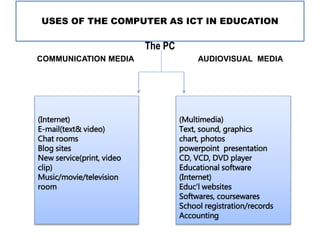
(Internet)
E-mail(text& video)
Chat rooms
Blog sites
New service(print, video
clip)
Music/movie/television
room
USES OF THE COMPUTER AS ICT IN EDUCATION
The PC
COMMUNICATION MEDIA AUDIOVISUAL MEDIA
(Multimedia)
Text, sound, graphics
chart, photos
powerpoint presentation
CD, VCD, DVD player
Educational software
(Internet)
Educ’l websites
Softwares, coursewares
School registration/records
Accounting
• Close to the turn of the
21st century, however,
such a distinction merged
owing to the advent of the
microprocessor, also
known as the personal
computer(PC).
• This is due to the fact that
the PC user at home,
office and school has
before him or her a tool
for both audio-visual
creations and media
communication
To illustrate, let’s examine
the program(capabilities)
normally installed in an
ordinary modern PC:
• Microsoft Office
- program for composing
text, graphics, photos into
letters, articles, reports, etc.
• Power-point – for
preparing lecture
presentations.
• Excel- for
spreadsheets and
similar graphic sheets.
• Internet Explorer-
Access to the Internet.
• Yahoo or Google
- Websites; e-mail, chat
rooms, Blog sites, news
service(print/video),
educational softwares, etc.
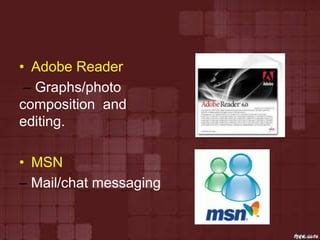
• Adobe Reader
– Graphs/photo
composition and
editing.
• MSN
– Mail/chat messaging
• Windows media
player
– CD, VCD player
• Cyber link Power
– DVD player
• Windows media
player
– Editing film/video
• Game House
– Video games
Lesson 9  educational  technology  10

Lesson 9 educational technology 10

  • 1.
    LESSON 9: COMPUTERS ASINFORMATION AND COMMUNICATION TECHNOLOGY DONNA MAE O. ALZAGA 3rd year Bachelor in Agricultural Technology major in Agricultural Technology Education Bicol University College of Agriculture and Forestry Guinobatan, Albay
  • 2.
    • In theEducational Technology Course I the role of the computer in education was well discussed. • The computer is recognized as the third revolution in education.
  • 3.
    • The firstwas the invention of the printing press; the second, the introduction of libraries; and the third, the invention of the computer, especially so with the advent of the microcomputer in 1975. Thus emerged computer technology in education.
  • 4.
    • Through computertechnology, educators saw the amplification of learning along computer literacy. • Much like reading, the modern student can now interact with computer messages, even respond to questions or to computer commands.
  • 5.
    • Soon computer –assisted instruction (CAI) was introduced using the principle of individualized learning through a positive climate that includes realism and appeal with drill exercises that uses color, music and animation.
  • 6.
    • The noveltyof CAI has not waned to this day especially in the basic education level as this is offered by computer-equipped private schools.
  • 7.
    • But theevolving pace of innovation in today’s Information Age is so dynamic that within the first decade of the 21st century, computer technology in education has matured to transform into an educative information and communication technology (ICT) in education.
  • 8.
    THE PERSONAL COMPUTER(PC) AS THE ICT • Until the nineties, it was still possible to distinguish between instructional media and the educational communication media. • Instructional media consist of audio-visual aids that served to enhance and enrich the teaching- learning process. Examples are the blackboard, photo, film and video.
  • 9.
    • On theother hand, educational communication media comprise the media of communication to audiences including learners using the print, film, radio, television or satellite means of communication.
  • 10.
    • For exampledistance learning were implemented using correspondence, radio, television or the computer satellite system.
  • 11.
    (Internet) E-mail(text& video) Chat rooms Blogsites New service(print, video clip) Music/movie/television room USES OF THE COMPUTER AS ICT IN EDUCATION The PC COMMUNICATION MEDIA AUDIOVISUAL MEDIA (Multimedia) Text, sound, graphics chart, photos powerpoint presentation CD, VCD, DVD player Educational software (Internet) Educ’l websites Softwares, coursewares School registration/records Accounting
  • 12.
    • Close tothe turn of the 21st century, however, such a distinction merged owing to the advent of the microprocessor, also known as the personal computer(PC).
  • 13.
    • This isdue to the fact that the PC user at home, office and school has before him or her a tool for both audio-visual creations and media communication
  • 14.
    To illustrate, let’sexamine the program(capabilities) normally installed in an ordinary modern PC: • Microsoft Office - program for composing text, graphics, photos into letters, articles, reports, etc.
  • 15.
    • Power-point –for preparing lecture presentations.
  • 16.
    • Excel- for spreadsheetsand similar graphic sheets. • Internet Explorer- Access to the Internet.
  • 17.
    • Yahoo orGoogle - Websites; e-mail, chat rooms, Blog sites, news service(print/video), educational softwares, etc.
  • 18.
    • Adobe Reader –Graphs/photo composition and editing. • MSN – Mail/chat messaging
  • 19.
    • Windows media player –CD, VCD player • Cyber link Power – DVD player • Windows media player – Editing film/video • Game House – Video games