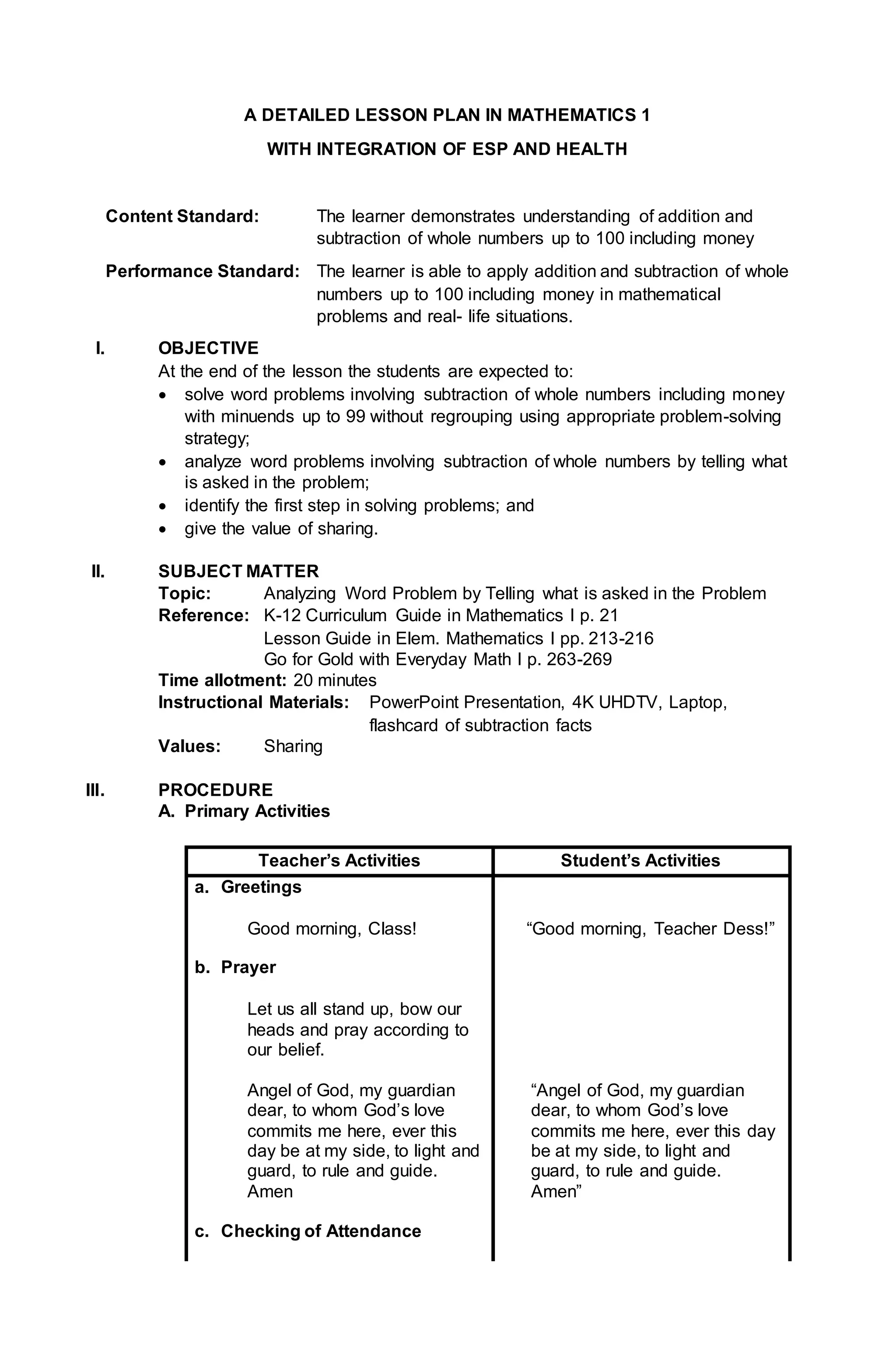
A DETAILED LESSON PLAN IN MATHEMATICS 1
WITH INTEGRATION OF ESP AND HEALTH
Content Standard: The learner demonstrates understanding of addition and
subtraction of whole numbers up to 100 including money
Performance Standard: The learner is able to apply addition and subtraction of whole
numbers up to 100 including money in mathematical
problems and real- life situations.
I. OBJECTIVE
At the end of the lesson the students are expected to:
 solve word problems involving subtraction of whole numbers including money
with minuends up to 99 without regrouping using appropriate problem-solving
strategy;
 analyze word problems involving subtraction of whole numbers by telling what
is asked in the problem;
 identify the first step in solving problems; and
 give the value of sharing.
II. SUBJECT MATTER
Topic: Analyzing Word Problem by Telling what is asked in the Problem
Reference: K-12 Curriculum Guide in Mathematics I p. 21
Lesson Guide in Elem. Mathematics I pp. 213-216
Go for Gold with Everyday Math I p. 263-269
Time allotment: 20 minutes
Instructional Materials: PowerPoint Presentation, 4K UHDTV, Laptop,
flashcard of subtraction facts
Values: Sharing
III. PROCEDURE
A. Primary Activities
Teacher’s Activities Student’s Activities
a. Greetings
Good morning, Class! “Good morning, Teacher Dess!”
b. Prayer
Let us all stand up, bow our
heads and pray according to
our belief.
Angel of God, my guardian
dear, to whom God’s love
commits me here, ever this
day be at my side, to light and
guard, to rule and guide.
Amen
“Angel of God, my guardian
dear, to whom God’s love
commits me here, ever this day
be at my side, to light and
guard, to rule and guide.
Amen”
c. Checking of Attendance
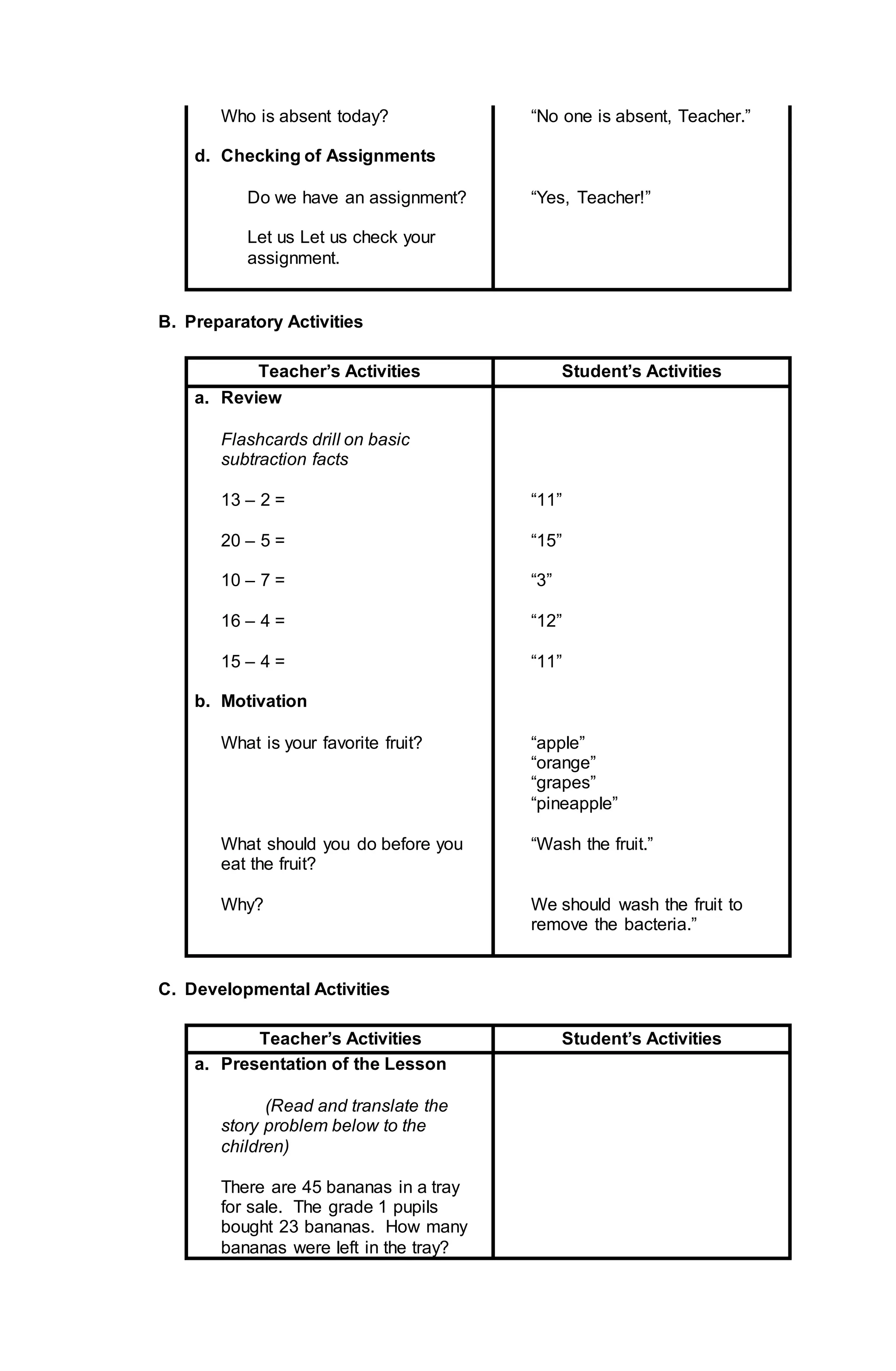
Who is absent today? “No one is absent, Teacher.”
d. Checking of Assignments
Do we have an assignment?
Let us Let us check your
assignment.
“Yes, Teacher!”
B. Preparatory Activities
Teacher’s Activities Student’s Activities
a. Review
Flashcards drill on basic
subtraction facts
13 – 2 =
20 – 5 =
10 – 7 =
16 – 4 =
15 – 4 =
“11”
“15”
“3”
“12”
“11”
b. Motivation
What is your favorite fruit?
What should you do before you
eat the fruit?
Why?
“apple”
“orange”
“grapes”
“pineapple”
“Wash the fruit.”
We should wash the fruit to
remove the bacteria.”
C. Developmental Activities
Teacher’s Activities Student’s Activities
a. Presentation of the Lesson
(Read and translate the
story problem below to the
children)
There are 45 bananas in a tray
for sale. The grade 1 pupils
bought 23 bananas. How many
bananas were left in the tray?
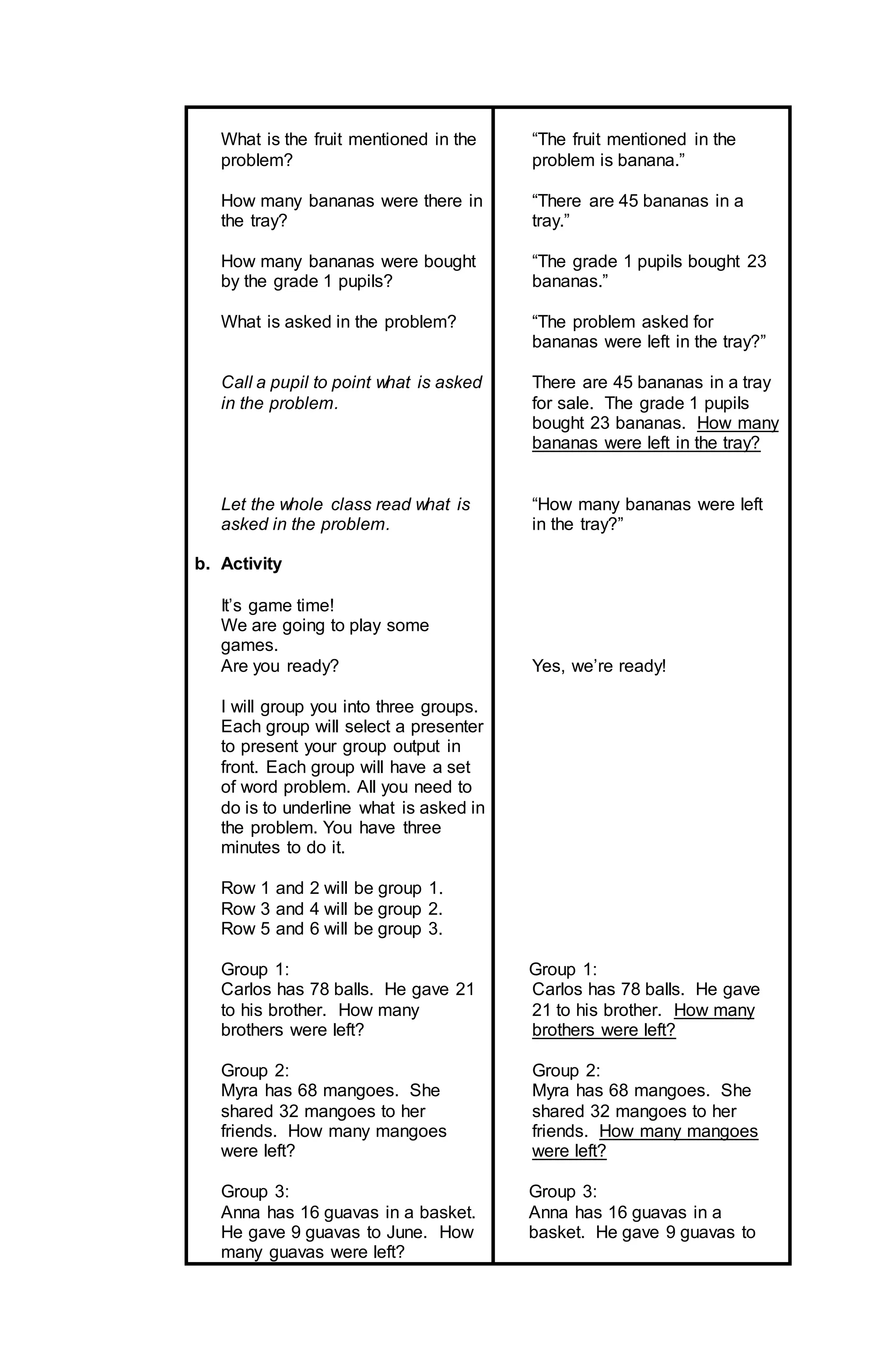
What is the fruit mentioned in the
problem?
How many bananas were there in
the tray?
How many bananas were bought
by the grade 1 pupils?
What is asked in the problem?
Call a pupil to point what is asked
in the problem.
Let the whole class read what is
asked in the problem.
“The fruit mentioned in the
problem is banana.”
“There are 45 bananas in a
tray.”
“The grade 1 pupils bought 23
bananas.”
“The problem asked for
bananas were left in the tray?”
There are 45 bananas in a tray
for sale. The grade 1 pupils
bought 23 bananas. How many
bananas were left in the tray?
“How many bananas were left
in the tray?”
b. Activity
It’s game time!
We are going to play some
games.
Are you ready?
I will group you into three groups.
Each group will select a presenter
to present your group output in
front. Each group will have a set
of word problem. All you need to
do is to underline what is asked in
the problem. You have three
minutes to do it.
Row 1 and 2 will be group 1.
Row 3 and 4 will be group 2.
Row 5 and 6 will be group 3.
Group 1:
Carlos has 78 balls. He gave 21
to his brother. How many
brothers were left?
Group 2:
Myra has 68 mangoes. She
shared 32 mangoes to her
friends. How many mangoes
were left?
Group 3:
Anna has 16 guavas in a basket.
He gave 9 guavas to June. How
many guavas were left?
Yes, we’re ready!
Group 1:
Carlos has 78 balls. He gave
21 to his brother. How many
brothers were left?
Group 2:
Myra has 68 mangoes. She
shared 32 mangoes to her
friends. How many mangoes
were left?
Group 3:
Anna has 16 guavas in a
basket. He gave 9 guavas to
June. How many guavas were
left?
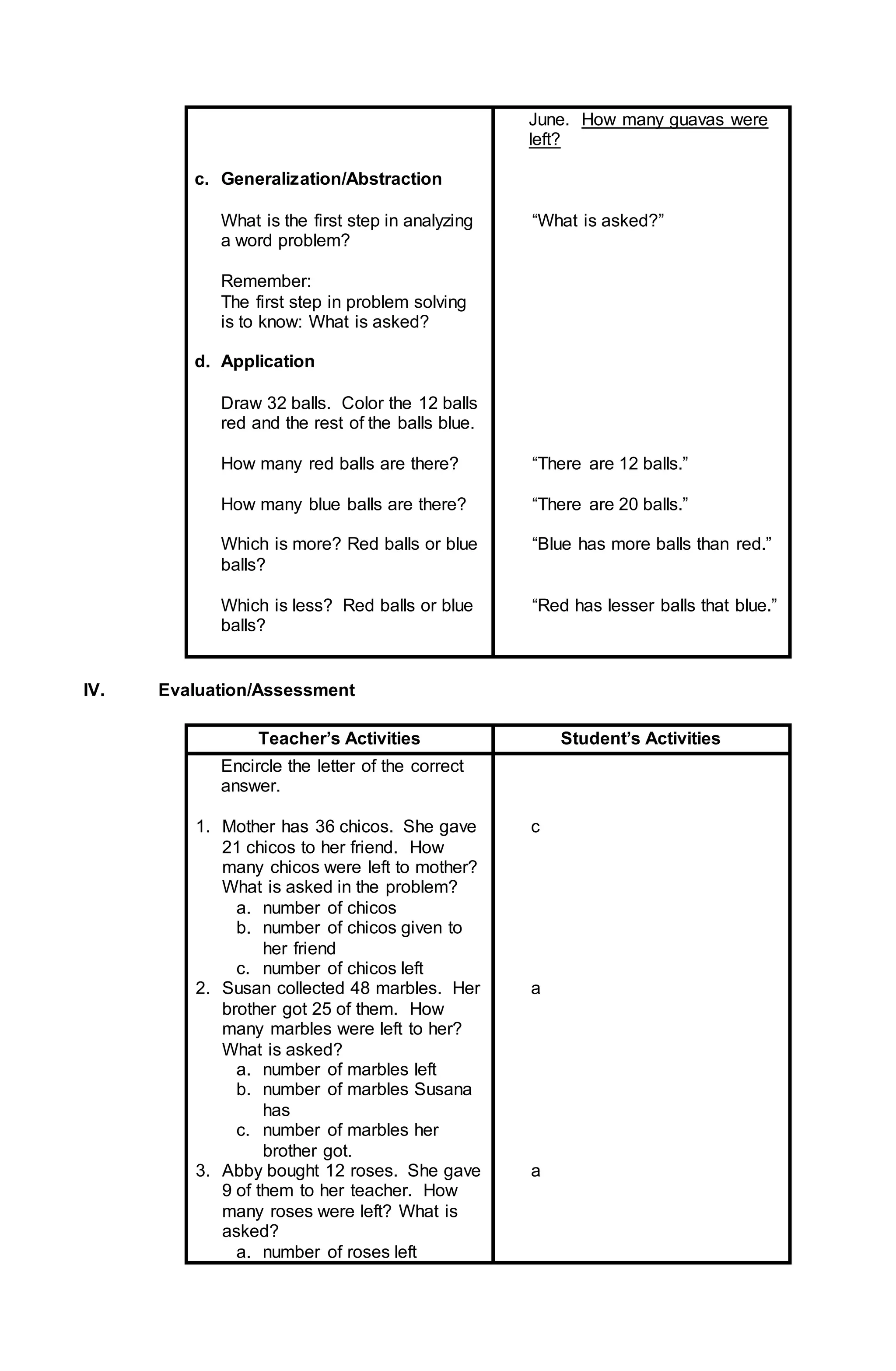
c. Generalization/Abstraction
What is the first step in analyzing
a word problem?
Remember:
The first step in problem solving
is to know: What is asked?
“What is asked?”
d. Application
Draw 32 balls. Color the 12 balls
red and the rest of the balls blue.
How many red balls are there?
How many blue balls are there?
Which is more? Red balls or blue
balls?
Which is less? Red balls or blue
balls?
“There are 12 balls.”
“There are 20 balls.”
“Blue has more balls than red.”
“Red has lesser balls that blue.”
IV. Evaluation/Assessment
Teacher’s Activities Student’s Activities
Encircle the letter of the correct
answer.
1. Mother has 36 chicos. She gave
21 chicos to her friend. How
many chicos were left to mother?
What is asked in the problem?
a. number of chicos
b. number of chicos given to
her friend
c. number of chicos left
2. Susan collected 48 marbles. Her
brother got 25 of them. How
many marbles were left to her?
What is asked?
a. number of marbles left
b. number of marbles Susana
has
c. number of marbles her
brother got.
3. Abby bought 12 roses. She gave
9 of them to her teacher. How
many roses were left? What is
asked?
a. number of roses left
c
a
a
b. number of roses Abby has
c. number of roses given to
teacher
V. Assignment
Know what is asked in this problem.
Aling Nena baked 67 cookies. She gave 45 to her children. How many cookies
were to her?
What is asked? __________________________
Prepared by:
RODESSA MARIE PACANA CANILLAS

A detailed lesson plan in mathematics 1

  • 1.
    A DETAILED LESSONPLAN IN MATHEMATICS 1 WITH INTEGRATION OF ESP AND HEALTH Content Standard: The learner demonstrates understanding of addition and subtraction of whole numbers up to 100 including money Performance Standard: The learner is able to apply addition and subtraction of whole numbers up to 100 including money in mathematical problems and real- life situations. I. OBJECTIVE At the end of the lesson the students are expected to:  solve word problems involving subtraction of whole numbers including money with minuends up to 99 without regrouping using appropriate problem-solving strategy;  analyze word problems involving subtraction of whole numbers by telling what is asked in the problem;  identify the first step in solving problems; and  give the value of sharing. II. SUBJECT MATTER Topic: Analyzing Word Problem by Telling what is asked in the Problem Reference: K-12 Curriculum Guide in Mathematics I p. 21 Lesson Guide in Elem. Mathematics I pp. 213-216 Go for Gold with Everyday Math I p. 263-269 Time allotment: 20 minutes Instructional Materials: PowerPoint Presentation, 4K UHDTV, Laptop, flashcard of subtraction facts Values: Sharing III. PROCEDURE A. Primary Activities Teacher’s Activities Student’s Activities a. Greetings Good morning, Class! “Good morning, Teacher Dess!” b. Prayer Let us all stand up, bow our heads and pray according to our belief. Angel of God, my guardian dear, to whom God’s love commits me here, ever this day be at my side, to light and guard, to rule and guide. Amen “Angel of God, my guardian dear, to whom God’s love commits me here, ever this day be at my side, to light and guard, to rule and guide. Amen” c. Checking of Attendance
  • 2.
    Who is absenttoday? “No one is absent, Teacher.” d. Checking of Assignments Do we have an assignment? Let us Let us check your assignment. “Yes, Teacher!” B. Preparatory Activities Teacher’s Activities Student’s Activities a. Review Flashcards drill on basic subtraction facts 13 – 2 = 20 – 5 = 10 – 7 = 16 – 4 = 15 – 4 = “11” “15” “3” “12” “11” b. Motivation What is your favorite fruit? What should you do before you eat the fruit? Why? “apple” “orange” “grapes” “pineapple” “Wash the fruit.” We should wash the fruit to remove the bacteria.” C. Developmental Activities Teacher’s Activities Student’s Activities a. Presentation of the Lesson (Read and translate the story problem below to the children) There are 45 bananas in a tray for sale. The grade 1 pupils bought 23 bananas. How many bananas were left in the tray?
  • 3.
    What is thefruit mentioned in the problem? How many bananas were there in the tray? How many bananas were bought by the grade 1 pupils? What is asked in the problem? Call a pupil to point what is asked in the problem. Let the whole class read what is asked in the problem. “The fruit mentioned in the problem is banana.” “There are 45 bananas in a tray.” “The grade 1 pupils bought 23 bananas.” “The problem asked for bananas were left in the tray?” There are 45 bananas in a tray for sale. The grade 1 pupils bought 23 bananas. How many bananas were left in the tray? “How many bananas were left in the tray?” b. Activity It’s game time! We are going to play some games. Are you ready? I will group you into three groups. Each group will select a presenter to present your group output in front. Each group will have a set of word problem. All you need to do is to underline what is asked in the problem. You have three minutes to do it. Row 1 and 2 will be group 1. Row 3 and 4 will be group 2. Row 5 and 6 will be group 3. Group 1: Carlos has 78 balls. He gave 21 to his brother. How many brothers were left? Group 2: Myra has 68 mangoes. She shared 32 mangoes to her friends. How many mangoes were left? Group 3: Anna has 16 guavas in a basket. He gave 9 guavas to June. How many guavas were left? Yes, we’re ready! Group 1: Carlos has 78 balls. He gave 21 to his brother. How many brothers were left? Group 2: Myra has 68 mangoes. She shared 32 mangoes to her friends. How many mangoes were left? Group 3: Anna has 16 guavas in a basket. He gave 9 guavas to
  • 4.
    June. How manyguavas were left? c. Generalization/Abstraction What is the first step in analyzing a word problem? Remember: The first step in problem solving is to know: What is asked? “What is asked?” d. Application Draw 32 balls. Color the 12 balls red and the rest of the balls blue. How many red balls are there? How many blue balls are there? Which is more? Red balls or blue balls? Which is less? Red balls or blue balls? “There are 12 balls.” “There are 20 balls.” “Blue has more balls than red.” “Red has lesser balls that blue.” IV. Evaluation/Assessment Teacher’s Activities Student’s Activities Encircle the letter of the correct answer. 1. Mother has 36 chicos. She gave 21 chicos to her friend. How many chicos were left to mother? What is asked in the problem? a. number of chicos b. number of chicos given to her friend c. number of chicos left 2. Susan collected 48 marbles. Her brother got 25 of them. How many marbles were left to her? What is asked? a. number of marbles left b. number of marbles Susana has c. number of marbles her brother got. 3. Abby bought 12 roses. She gave 9 of them to her teacher. How many roses were left? What is asked? a. number of roses left c a a
  • 5.
    b. number ofroses Abby has c. number of roses given to teacher V. Assignment Know what is asked in this problem. Aling Nena baked 67 cookies. She gave 45 to her children. How many cookies were to her? What is asked? __________________________ Prepared by: RODESSA MARIE PACANA CANILLAS