Media & Collective Identity
Study Guide
Key
Facts, figures, statistical information
Theory/Theorist
Media Text
How to structure your essay
Introduction
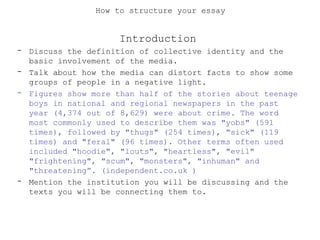
- Discuss the definition of collective identity and the
basic involvement of the media.
- Talk about how the media can distort facts to show some
groups of people in a negative light.
- Figures show more than half of the stories about teenage
boys in national and regional newspapers in the past
year (4,374 out of 8,629) were about crime. The word
most commonly used to describe them was "yobs" (591
times), followed by "thugs" (254 times), "sick" (119
times) and "feral" (96 times). Other terms often used
included "hoodie", "louts", "heartless", "evil"
"frightening", "scum", "monsters", "inhuman" and
"threatening”. (independent.co.uk )
- Mention the institution you will be discussing and the
texts you will be connecting them to.
Historical representations
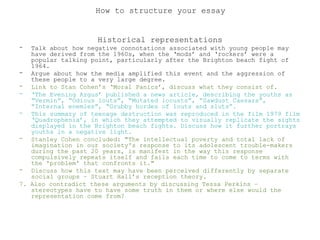
- Talk about how negative connotations associated with young people may
have derived from the 1960s, when the ‘mods’ and ‘rockers’ were a
popular talking point, particularly after the Brighton beach fight of
1964.
- Argue about how the media amplified this event and the aggression of
these people to a very large degree.
- Link to Stan Cohen’s ‘Moral Panics’, discuss what they consist of.
- ‘The Evening Argus’ published a news article, describing the youths as
“Vermin”, “Odious louts”, “Mutated locusts”, “Sawdust Caesars”,
“Internal enemies”, “Grubby hordes of louts and sluts”.
- This summary of teenage destruction was reproduced in the film 1979 film
‘Quadrophenia’, in which they attempted to visually replicate the sights
displayed in the Brighton beach fights. Discuss how it further portrays
youths in a negative light.
- Stanley Cohen concluded: "The intellectual poverty and total lack of
imagination in our society's response to its adolescent trouble-makers
during the past 20 years, is manifest in the way this response
compulsively repeats itself and fails each time to come to terms with
the 'problem' that confronts it."
- Discuss how this text may have been perceived differently by separate
social groups – Stuart Hall’s reception theory.
7. Also contradict these arguments by discussing Tessa Perkins –
stereotypes have to have some truth in them or where else would the
representation come from?
How to structure your essay
Present Day – London Riots
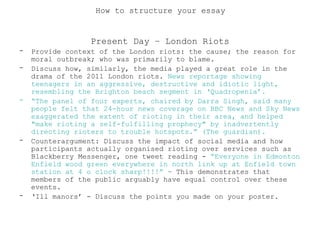
- Provide context of the London riots: the cause; the reason for
moral outbreak; who was primarily to blame.
- Discuss how, similarly, the media played a great role in the
drama of the 2011 London riots. News reportage showing
teenagers in an aggressive, destructive and idiotic light,
resembling the Brighton beach segment in ‘Quadropenia’.
- “The panel of four experts, chaired by Darra Singh, said many
people felt that 24-hour news coverage on BBC News and Sky News
exaggerated the extent of rioting in their area, and helped
"make rioting a self-fulfilling prophecy" by inadvertently
directing rioters to trouble hotspots.” (The guardian).
- Counterargument: Discuss the impact of social media and how
participants actually organised rioting over services such as
Blackberry Messenger, one tweet reading - “Everyone in Edmonton
Enfield wood green everywhere in north link up at Enfield town
station at 4 o clock sharp!!!!” – This demonstrates that
members of the public arguably have equal control over these
events.
- ‘Ill manors’ - Discuss the points you made on your poster.
How to structure your essay
Marxism
• Discuss the basic tenet of Karl Marx’s theory. How in Western
cultures, the economic base consists of essentially capitalist
principles, resulting in an inequality of wealth. These capitalist
values are produced by, what Marx named, the ‘bourgeoisie’ (i.e.
those in powerful positions), which are then directly transmitted
to the proletariat (the working class), through the media. This
process is to justify and prolong the capitalist base, persuading
people that the economic structure is beneficial for everyone so
there is no desperate desire to change.
• Althusser expands on this point by proclaiming that we are subjects
of what we are made to believe. Ideology has been created for us
and we can only consume what we are made to believe, by doing so we
are ultimately subjects of ideology that has already been created
for us. We accept ideology and how its created as we build our
ideas on previous assumptions created on what we have made
ourselves to believe.
Gramsci Hegemony
How to structure your essay
It is vital to consider the following 4 areas:
• How do the contemporary media represent nations, regions and
ethnic / social / collective groups of people in different
ways?
• How does contemporary representation compare to previous time
periods?
• What are the social implications of different media
representations of groups of people?
• To what extent is human identity increasingly ‘mediated’?
Past Exam Paper Questions
2010
1. With reference to any one group of people that you have studied, discuss how
their identity has been ‘mediated’.
2. “Media representations are complex, not simple and straightforward”. How far do
you agree with this statement in relation to the collective group that you have
studied?
2011
• Discuss how one or more groups of people are represented through the media.
• Explain the role played by the media in the construction of collective identity.
2012
1 . Analyse the ways in which at least one group of people is ‘mediated’.
2. Discuss the social implications of media in relation to collective identity. You
may refer to one group of people or more in your area.
2013
1. Explain what is meant by ‘collective identity’ and the role of media in its
construction
2. ”Media representations are just reflections of reality, not constructions or
distortions.” Discuss with reference to one or more group(s) of people.
2014
1. Media and collective identity: how does one affect the other? [50]
2. “Media simply reflect collective identity, the don’t create it.’ How far do you
agree with this statement? Make reference to one or more groups(s) of people in
your answer. [50]

Media & collective identity

  • 1.
    Media & CollectiveIdentity Study Guide
  • 2.
    Key Facts, figures, statisticalinformation Theory/Theorist Media Text
  • 3.
    How to structureyour essay Introduction - Discuss the definition of collective identity and the basic involvement of the media. - Talk about how the media can distort facts to show some groups of people in a negative light. - Figures show more than half of the stories about teenage boys in national and regional newspapers in the past year (4,374 out of 8,629) were about crime. The word most commonly used to describe them was "yobs" (591 times), followed by "thugs" (254 times), "sick" (119 times) and "feral" (96 times). Other terms often used included "hoodie", "louts", "heartless", "evil" "frightening", "scum", "monsters", "inhuman" and "threatening”. (independent.co.uk ) - Mention the institution you will be discussing and the texts you will be connecting them to.
  • 4.
    Historical representations - Talkabout how negative connotations associated with young people may have derived from the 1960s, when the ‘mods’ and ‘rockers’ were a popular talking point, particularly after the Brighton beach fight of 1964. - Argue about how the media amplified this event and the aggression of these people to a very large degree. - Link to Stan Cohen’s ‘Moral Panics’, discuss what they consist of. - ‘The Evening Argus’ published a news article, describing the youths as “Vermin”, “Odious louts”, “Mutated locusts”, “Sawdust Caesars”, “Internal enemies”, “Grubby hordes of louts and sluts”. - This summary of teenage destruction was reproduced in the film 1979 film ‘Quadrophenia’, in which they attempted to visually replicate the sights displayed in the Brighton beach fights. Discuss how it further portrays youths in a negative light. - Stanley Cohen concluded: "The intellectual poverty and total lack of imagination in our society's response to its adolescent trouble-makers during the past 20 years, is manifest in the way this response compulsively repeats itself and fails each time to come to terms with the 'problem' that confronts it." - Discuss how this text may have been perceived differently by separate social groups – Stuart Hall’s reception theory. 7. Also contradict these arguments by discussing Tessa Perkins – stereotypes have to have some truth in them or where else would the representation come from? How to structure your essay
  • 5.
    Present Day –London Riots - Provide context of the London riots: the cause; the reason for moral outbreak; who was primarily to blame. - Discuss how, similarly, the media played a great role in the drama of the 2011 London riots. News reportage showing teenagers in an aggressive, destructive and idiotic light, resembling the Brighton beach segment in ‘Quadropenia’. - “The panel of four experts, chaired by Darra Singh, said many people felt that 24-hour news coverage on BBC News and Sky News exaggerated the extent of rioting in their area, and helped "make rioting a self-fulfilling prophecy" by inadvertently directing rioters to trouble hotspots.” (The guardian). - Counterargument: Discuss the impact of social media and how participants actually organised rioting over services such as Blackberry Messenger, one tweet reading - “Everyone in Edmonton Enfield wood green everywhere in north link up at Enfield town station at 4 o clock sharp!!!!” – This demonstrates that members of the public arguably have equal control over these events. - ‘Ill manors’ - Discuss the points you made on your poster. How to structure your essay
  • 6.
    Marxism • Discuss thebasic tenet of Karl Marx’s theory. How in Western cultures, the economic base consists of essentially capitalist principles, resulting in an inequality of wealth. These capitalist values are produced by, what Marx named, the ‘bourgeoisie’ (i.e. those in powerful positions), which are then directly transmitted to the proletariat (the working class), through the media. This process is to justify and prolong the capitalist base, persuading people that the economic structure is beneficial for everyone so there is no desperate desire to change. • Althusser expands on this point by proclaiming that we are subjects of what we are made to believe. Ideology has been created for us and we can only consume what we are made to believe, by doing so we are ultimately subjects of ideology that has already been created for us. We accept ideology and how its created as we build our ideas on previous assumptions created on what we have made ourselves to believe. Gramsci Hegemony How to structure your essay
  • 7.
    It is vitalto consider the following 4 areas: • How do the contemporary media represent nations, regions and ethnic / social / collective groups of people in different ways? • How does contemporary representation compare to previous time periods? • What are the social implications of different media representations of groups of people? • To what extent is human identity increasingly ‘mediated’?
  • 8.
    Past Exam PaperQuestions 2010 1. With reference to any one group of people that you have studied, discuss how their identity has been ‘mediated’. 2. “Media representations are complex, not simple and straightforward”. How far do you agree with this statement in relation to the collective group that you have studied? 2011 • Discuss how one or more groups of people are represented through the media. • Explain the role played by the media in the construction of collective identity. 2012 1 . Analyse the ways in which at least one group of people is ‘mediated’. 2. Discuss the social implications of media in relation to collective identity. You may refer to one group of people or more in your area. 2013 1. Explain what is meant by ‘collective identity’ and the role of media in its construction 2. ”Media representations are just reflections of reality, not constructions or distortions.” Discuss with reference to one or more group(s) of people. 2014 1. Media and collective identity: how does one affect the other? [50] 2. “Media simply reflect collective identity, the don’t create it.’ How far do you agree with this statement? Make reference to one or more groups(s) of people in your answer. [50]