Mobile App Development
Lesson 5 - Spinners, Adapters & Fragment
Communication
Today’s Lesson
● More UI Components - Tonight Spinners
● string-array resources
● ArrayAdapter
● Fragment to Fragment comunication
Previous Lesson
● Fragments - We create them statically
● String resources
● Multiple Layouts, Multiple Devices = Multiple Layout
XML files (use pre-defined names)
● android:weight should be used with LinearLayout
Android UI - Next Steps
● So far we’ve seen Buttons and TextView components.
The next step is Spinners, Pickers & ListView. Spinners
this week.
● Spinners are what we commonly know elsewhere as
drop-down lists.
● A typical example would be a drop down list containing
a list of countries.
● Spinners can be populated statically or dynamically.
Spinner Population
● If we are putting a known/pre-defined & fixed list of
values into a Spinner (e.g. List of Countries) we can use a
String array. This is static population.
● As previously mentioned Strings in our app should be
defined as String resources (in res/values/strings.xml )
● We can define String arrays in this file as well as just
<string> using the <string-array> tag.
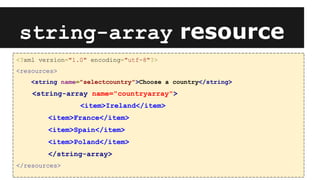
<?xml version="1.0" encoding="utf-8"?>
<resources>
<string name="selectcountry">Choose a country</string>
<string-array name="countryarray">
<item>Ireland</item>
<item>France</item>
<item>Spain</item>
<item>Poland</item>
</string-array>
</resources>
string-array resource
Using string-array
● To use the values in the string-array we just defined
we go back to our XML UI file of our Fragment or
Activity
● As before we can add a UI component by dragging and
dropping it on the UI designer or adding it directly in
the XML file.
● Either way the XML UI tag that results is <Spinner>
● We can link the <Spinner> directly to the string-array
resource via the XML.
Spinner & string-array
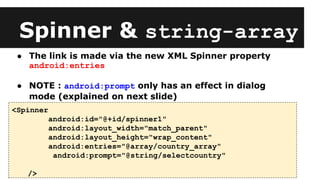
<Spinner
android:id="@+id/spinner1"
android:layout_width="match_parent"
android:layout_height="wrap_content"
android:entries="@array/country_array"
android:prompt="@string/selectcountry"
/>
● The link is made via the new XML Spinner property
android:entries
● NOTE : android:prompt only has an effect in dialog
mode (explained on next slide)
Getting value from Spinner
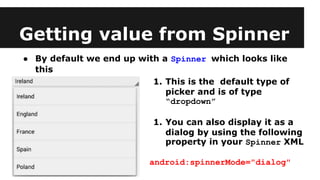
● By default we end up with a Spinner which looks like
this
1. This is the default type of
picker and is of type
“dropdown”
1. You can also display it as a
dialog by using the following
property in your Spinner XML
android:spinnerMode="dialog"
dialog Spinner mode
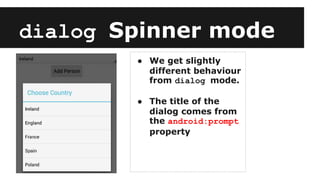
● We get slightly
different behaviour
from dialog mode.
● The title of the
dialog comes from
the android:prompt
property
Getting value from Spinner
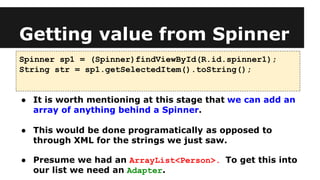
Spinner sp1 = (Spinner)findViewById(R.id.spinner1);
String str = sp1.getSelectedItem().toString();
● It is worth mentioning at this stage that we can add an
array of anything behind a Spinner.
● This would be done programatically as opposed to
through XML for the strings we just saw.
● Presume we had an ArrayList<Person>. To get this into
our list we need an Adapter.
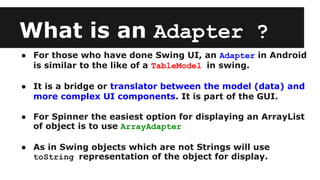
What is an Adapter ?
● For those who have done Swing UI, an Adapter in Android
is similar to the like of a TableModel in swing.
● It is a bridge or translator between the model (data) and
more complex UI components. It is part of the GUI.
● For Spinner the easiest option for displaying an ArrayList
of object is to use ArrayAdapter
● As in Swing objects which are not Strings will use
toString representation of the object for display.
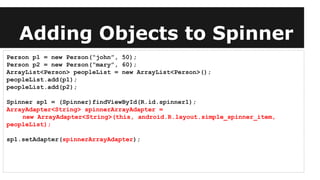
Adding Objects to Spinner
Person p1 = new Person(“john”, 50);
Person p2 = new Person(“mary”, 60);
ArrayList<Person> peopleList = new ArrayList<Person>();
peopleList.add(p1);
peopleList.add(p2);
Spinner sp1 = (Spinner)findViewById(R.id.spinner1);
ArrayAdapter<String> spinnerArrayAdapter =
new ArrayAdapter<String>(this, android.R.layout.simple_spinner_item,
peopleList);
sp1.setAdapter(spinnerArrayAdapter);
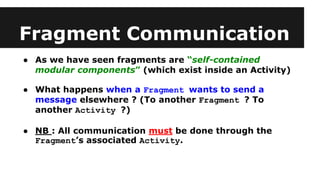
Fragment Communication
● As we have seen fragments are “self-contained
modular components” (which exist inside an Activity)
● What happens when a Fragment wants to send a
message elsewhere ? (To another Fragment ? To
another Activity ?)
● NB : All communication must be done through the
Fragment’s associated Activity.
Fragment communication
● The first step is to allow the Fragment to communicate
“up to” its Activity.
● To do this we define a simple Java interface which
defines what messages (i.e. method calls) the
Fragment can make.
● This interface is usally put inside the Java class of the
Fragment which wants to communicate.
● The content of the interface is entirely up to us.
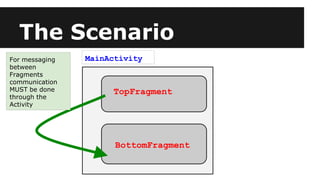
The Scenario
MainActivity
TopFragment
BottomFragment
For messaging
between
Fragments
communication
MUST be done
through the
Activity
Fragment Communication
interface
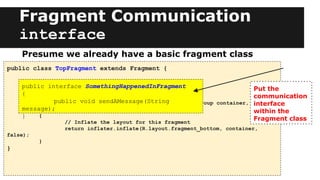
public class TopFragment extends Fragment {
public View onCreateView(LayoutInflater inflater, ViewGroup container,
Bundle savedInstanceState)
{
// Inflate the layout for this fragment
return inflater.inflate(R.layout.fragment_bottom, container,
false);
}
}
Presume we already have a basic fragment class
public interface SomethingHappenedInFragment
{
public void sendAMessage(String
message);
}
Put the
communication
interface
within the
Fragment class
Activity implements Fragment
interface
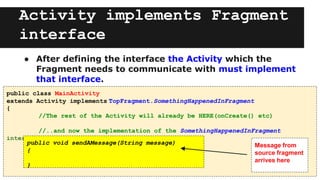
● After defining the interface the Activity which the
Fragment needs to communicate with must implement
that interface.
public class MainActivity
extends Activity implements TopFragment.SomethingHappenedInFragment
{
//The rest of the Activity will already be HERE(onCreate() etc)
//..and now the implementation of the SomethingHappenedInFragment
interface
public void sendAMessage(String message)
{
}
Message from
source fragment
arrives here
Delivering the
message
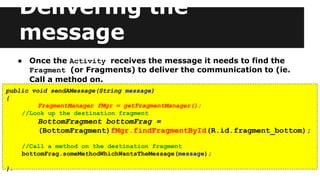
● Once the Activity receives the message it needs to find the
Fragment (or Fragments) to deliver the communication to (ie.
Call a method on.
public void sendAMessage(String message)
{
FragmentManager fMgr = getFragmentManager();
//Look up the destination fragment
BottomFragment bottomFrag =
(BottomFragment)fMgr.findFragmentById(R.id.fragment_bottom);
//Call a method on the destination fragment
bottomFrag.someMethodWhichWantsTheMessage(message);
}.
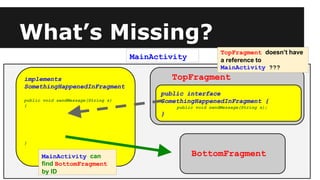
What’s Missing?
MainActivity
TopFragment
BottomFragment
public interface
SomethingHappenedInFragment {
public void sendMessage(String s);
}
implements
SomethingHappenedInFragment
public void sendMessage(String s)
{
}
TopFragment doesn’t have
a reference to
MainActivity ???
MainActivity can
find BottomFragment
by ID
The Final Step
● As part of the lifecycle of Activities and Fragments the
Activity “attaches itself” to its Fragments.
● Last week we saw the Fragment lifecycle method
onCreateView which MUST be implemented to get your
Fragment running.
● Before on onCreateView there is an earlier method in the
Fragment lifecycle called onAttach
● onAttach is called by the Activity which conveniently
passes a reference to itself. We store this reference.
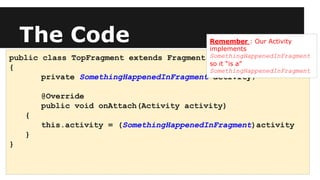
The Code
public class TopFragment extends Fragment
{
private SomethingHappenedInFragment activity;
@Override
public void onAttach(Activity activity)
{
this.activity = (SomethingHappenedInFragment)activity
}
}
Remember : Our Activity
implements
SomethingHappenedInFragment
so it “is a”
SomethingHappenedInFragment

Spinners, Adapters & Fragment Communication

  • 1.
    Mobile App Development Lesson5 - Spinners, Adapters & Fragment Communication
  • 2.
    Today’s Lesson ● MoreUI Components - Tonight Spinners ● string-array resources ● ArrayAdapter ● Fragment to Fragment comunication
  • 3.
    Previous Lesson ● Fragments- We create them statically ● String resources ● Multiple Layouts, Multiple Devices = Multiple Layout XML files (use pre-defined names) ● android:weight should be used with LinearLayout
  • 4.
    Android UI -Next Steps ● So far we’ve seen Buttons and TextView components. The next step is Spinners, Pickers & ListView. Spinners this week. ● Spinners are what we commonly know elsewhere as drop-down lists. ● A typical example would be a drop down list containing a list of countries. ● Spinners can be populated statically or dynamically.
  • 5.
    Spinner Population ● Ifwe are putting a known/pre-defined & fixed list of values into a Spinner (e.g. List of Countries) we can use a String array. This is static population. ● As previously mentioned Strings in our app should be defined as String resources (in res/values/strings.xml ) ● We can define String arrays in this file as well as just <string> using the <string-array> tag.
  • 6.
    <?xml version="1.0" encoding="utf-8"?> <resources> <stringname="selectcountry">Choose a country</string> <string-array name="countryarray"> <item>Ireland</item> <item>France</item> <item>Spain</item> <item>Poland</item> </string-array> </resources> string-array resource
  • 7.
    Using string-array ● Touse the values in the string-array we just defined we go back to our XML UI file of our Fragment or Activity ● As before we can add a UI component by dragging and dropping it on the UI designer or adding it directly in the XML file. ● Either way the XML UI tag that results is <Spinner> ● We can link the <Spinner> directly to the string-array resource via the XML.
  • 8.
    Spinner & string-array <Spinner android:id="@+id/spinner1" android:layout_width="match_parent" android:layout_height="wrap_content" android:entries="@array/country_array" android:prompt="@string/selectcountry" /> ●The link is made via the new XML Spinner property android:entries ● NOTE : android:prompt only has an effect in dialog mode (explained on next slide)
  • 9.
    Getting value fromSpinner ● By default we end up with a Spinner which looks like this 1. This is the default type of picker and is of type “dropdown” 1. You can also display it as a dialog by using the following property in your Spinner XML android:spinnerMode="dialog"
  • 10.
    dialog Spinner mode ●We get slightly different behaviour from dialog mode. ● The title of the dialog comes from the android:prompt property
  • 11.
    Getting value fromSpinner Spinner sp1 = (Spinner)findViewById(R.id.spinner1); String str = sp1.getSelectedItem().toString(); ● It is worth mentioning at this stage that we can add an array of anything behind a Spinner. ● This would be done programatically as opposed to through XML for the strings we just saw. ● Presume we had an ArrayList<Person>. To get this into our list we need an Adapter.
  • 12.
    What is anAdapter ? ● For those who have done Swing UI, an Adapter in Android is similar to the like of a TableModel in swing. ● It is a bridge or translator between the model (data) and more complex UI components. It is part of the GUI. ● For Spinner the easiest option for displaying an ArrayList of object is to use ArrayAdapter ● As in Swing objects which are not Strings will use toString representation of the object for display.
  • 13.
    Adding Objects toSpinner Person p1 = new Person(“john”, 50); Person p2 = new Person(“mary”, 60); ArrayList<Person> peopleList = new ArrayList<Person>(); peopleList.add(p1); peopleList.add(p2); Spinner sp1 = (Spinner)findViewById(R.id.spinner1); ArrayAdapter<String> spinnerArrayAdapter = new ArrayAdapter<String>(this, android.R.layout.simple_spinner_item, peopleList); sp1.setAdapter(spinnerArrayAdapter);
  • 14.
    Fragment Communication ● Aswe have seen fragments are “self-contained modular components” (which exist inside an Activity) ● What happens when a Fragment wants to send a message elsewhere ? (To another Fragment ? To another Activity ?) ● NB : All communication must be done through the Fragment’s associated Activity.
  • 15.
    Fragment communication ● Thefirst step is to allow the Fragment to communicate “up to” its Activity. ● To do this we define a simple Java interface which defines what messages (i.e. method calls) the Fragment can make. ● This interface is usally put inside the Java class of the Fragment which wants to communicate. ● The content of the interface is entirely up to us.
  • 16.
  • 17.
    Fragment Communication interface public classTopFragment extends Fragment { public View onCreateView(LayoutInflater inflater, ViewGroup container, Bundle savedInstanceState) { // Inflate the layout for this fragment return inflater.inflate(R.layout.fragment_bottom, container, false); } } Presume we already have a basic fragment class public interface SomethingHappenedInFragment { public void sendAMessage(String message); } Put the communication interface within the Fragment class
  • 18.
    Activity implements Fragment interface ●After defining the interface the Activity which the Fragment needs to communicate with must implement that interface. public class MainActivity extends Activity implements TopFragment.SomethingHappenedInFragment { //The rest of the Activity will already be HERE(onCreate() etc) //..and now the implementation of the SomethingHappenedInFragment interface public void sendAMessage(String message) { } Message from source fragment arrives here
  • 19.
    Delivering the message ● Oncethe Activity receives the message it needs to find the Fragment (or Fragments) to deliver the communication to (ie. Call a method on. public void sendAMessage(String message) { FragmentManager fMgr = getFragmentManager(); //Look up the destination fragment BottomFragment bottomFrag = (BottomFragment)fMgr.findFragmentById(R.id.fragment_bottom); //Call a method on the destination fragment bottomFrag.someMethodWhichWantsTheMessage(message); }.
  • 20.
    What’s Missing? MainActivity TopFragment BottomFragment public interface SomethingHappenedInFragment{ public void sendMessage(String s); } implements SomethingHappenedInFragment public void sendMessage(String s) { } TopFragment doesn’t have a reference to MainActivity ??? MainActivity can find BottomFragment by ID
  • 21.
    The Final Step ●As part of the lifecycle of Activities and Fragments the Activity “attaches itself” to its Fragments. ● Last week we saw the Fragment lifecycle method onCreateView which MUST be implemented to get your Fragment running. ● Before on onCreateView there is an earlier method in the Fragment lifecycle called onAttach ● onAttach is called by the Activity which conveniently passes a reference to itself. We store this reference.
  • 22.
    The Code public classTopFragment extends Fragment { private SomethingHappenedInFragment activity; @Override public void onAttach(Activity activity) { this.activity = (SomethingHappenedInFragment)activity } } Remember : Our Activity implements SomethingHappenedInFragment so it “is a” SomethingHappenedInFragment