Invention Practice Lesson 3
T od ay’s  Ob jective Review the Invention Process and then have you all work on the process in class and then use these new ideas to begin restricting your topics.
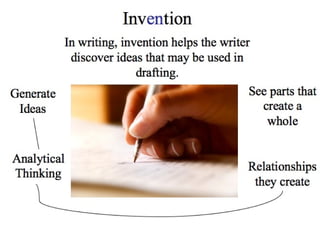
Inv en tion In writing, invention helps the writer discover ideas that may be used in drafting. Generate Ideas Analytical Thinking See parts that create a whole Relationships they create
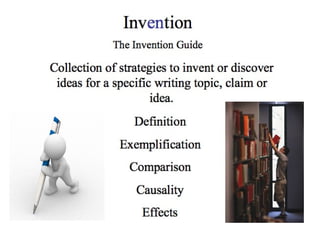
Inv en tion The Invention Guide Collection of strategies to invent or discover ideas for a specific writing topic, claim or idea. Definition Exemplification Comparison Causality Effects
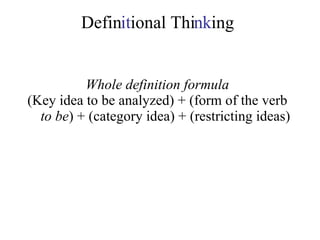
Defin it ional Thi nk ing Whole definition formula (Key idea to be analyzed) + (form of the verb  to be ) + (category idea) + (restricting ideas)
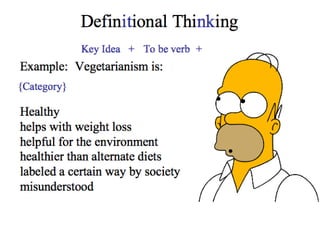
Defin it ional Thi nk ing Example:  Vegetarianism is: Healthy helps with weight loss helpful for the environment healthier than alternate diets labeled a certain way by society misunderstood Key Idea  + To be verb  +  {Category}
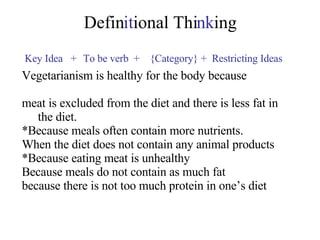
Defin it ional Thi nk ing Vegetarianism is healthy for the body because  meat is excluded from the diet and there is less fat in the diet. *Because meals often contain more nutrients. When the diet does not contain any animal products *Because eating meat is unhealthy Because meals do not contain as much fat because there is not too much protein in one’s diet Key Idea  + To be verb  +  {Category} +  Restricting Ideas
C om parative Thi nk ing Look for ideas or concepts within your notes that can be thought about by comparisons of similarities and/or differences.
C om parative Thi nk ing Help make comparative thinking efficient by creating  focus points , specific points of comparison through which two or more ideas, experiences, or objects can be analyzed.
C om parative Thi nk ing Once you have two halves of comparisons, help your mind to work efficiently by creating “focus points” for the comparison.  Ask yourself, what do I want to learn from comparing X with Y?
C om parative Thi nk ing Vegetarian diets contain more nutrients than meat diets. Focus Point: What are the differences in nutritional value between a vegetarian diet and a diet that includes meat?
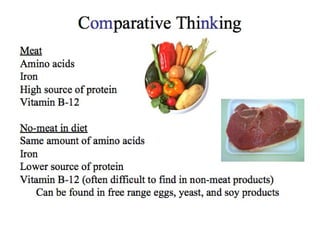
C om parative Thi nk ing Meat Amino acids Iron High source of protein Vitamin B-12 No-meat in diet Same amount of amino acids Iron Lower source of protein Vitamin B-12 (often difficult to find in non-meat products) Can be found in free range eggs, yeast, and soy products
Eff ec tive Thi nk ing Review key ideas for ideas that could be further developed  by analyzing the effects of those ideas.  Use these two questions to generate effects analysis: What has happened because X exists? (2) What is likely to happen in the future because X exists?
Eff ec tive Thi nk ing The analysis of effects requires the mind to take an idea, action, belief, experience, or value and then to consider what will result from any one of those.  Results from the past or any speculation of results in the future
Eff ec tive Thi nk ing What are the effects on someone’s health and well being when their diet is changed to a vegetarian diet? You would then want to research health effects of changing diets.  Seek out future effects, past research done on vegetarians.
Exem pli fication Thi nk ing Create examples that illustrate key words, ideas, or concepts.  These may come directly from the writing prompt or from notes in any other section of the invention guide where  vague ,  abstract , or  general ideas  occur.
Exem pli fication Thi nk ing Vague Idea: American’s eat too much meat Because they are influenced by the society Specific: by the media and corporations Find an example: Evidence about Corporations spending millions of dollars on advertising the meat industry.  How does this affect the American consumer?
 Ca us al Thi nk ing Take a key idea or ideas from your notes and follow it with the word  because  or the phrase  caused by . Causality helps you to discover  why  or  how  some idea, event, value, attitude, belief, or feeling occurs; causality provides reasons for.
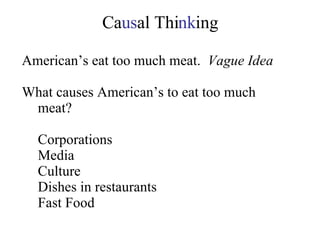
 Ca us al Thi nk ing American’s eat too much meat.  Vague Idea What causes American’s to eat too much meat? Corporations Media Culture Dishes in restaurants Fast Food
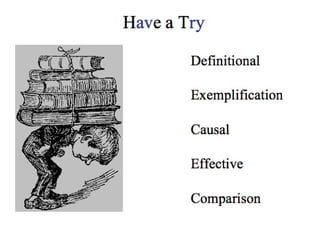
H av e a T ry Definitional Exemplification Causal Effective Comparison
Refin in g T o pics What does the definition of argument imply about our topics?
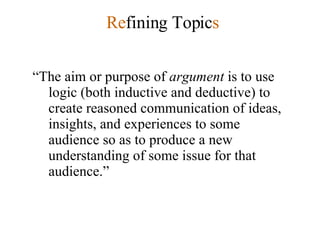
Re fining Topic s “ The aim or purpose of  argument  is to use logic (both inductive and deductive) to create reasoned communication of ideas, insights, and experiences to some audience so as to produce a new understanding of some issue for that audience.”
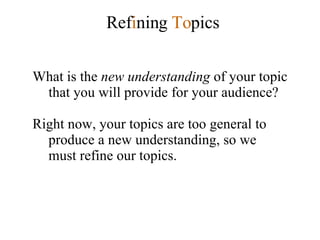
Ref i ning  To pics What is the  new understanding  of your topic that you will provide for your audience?  Right now, your topics are too general to produce a new understanding, so we must refine our topics.
Re fi ning Top i cs Let’s look at page 248 in your text: “Formulating the final topic”
Ref in ing T o pics Topic: Vegetarianism (Too vague)
Ref in ing T o pics Discover new ideas in your invention notes.
 Ca us al Thi nk ing American’s eat too much meat.  Vague Idea What causes American’s to eat too much meat? Corporations Media Culture Dishes in restaurants Fast Food
 Ca us al Thi nk ing American’s eat too much meat.  Vague Idea What causes American’s to eat too much meat? Corporations Media American’s are becoming unhealthy and lazy because of media influences backed by corporations
 Ca us al Thi nk ing My topic can change from Vegetarianism, to an argumentative topic seeking out the effects that corporations and the media have on the unhealthy consumer. Now I am making a move towards argument.
 Ref ini ng To p ics Now look through your notes and find a more specific and argumentative claim that you could ultimately begin to research.
Ho me work Reading:  Chapter 8, pages 246-256 Continue with your Invention Notes and begin looking to refine your topic

Invention Practice

  • 1.
  • 2.
    T od ay’s Ob jective Review the Invention Process and then have you all work on the process in class and then use these new ideas to begin restricting your topics.
  • 3.
    Inv en tionIn writing, invention helps the writer discover ideas that may be used in drafting. Generate Ideas Analytical Thinking See parts that create a whole Relationships they create
  • 4.
    Inv en tionThe Invention Guide Collection of strategies to invent or discover ideas for a specific writing topic, claim or idea. Definition Exemplification Comparison Causality Effects
  • 5.
    Defin it ionalThi nk ing Whole definition formula (Key idea to be analyzed) + (form of the verb to be ) + (category idea) + (restricting ideas)
  • 6.
    Defin it ionalThi nk ing Example: Vegetarianism is: Healthy helps with weight loss helpful for the environment healthier than alternate diets labeled a certain way by society misunderstood Key Idea + To be verb + {Category}
  • 7.
    Defin it ionalThi nk ing Vegetarianism is healthy for the body because meat is excluded from the diet and there is less fat in the diet. *Because meals often contain more nutrients. When the diet does not contain any animal products *Because eating meat is unhealthy Because meals do not contain as much fat because there is not too much protein in one’s diet Key Idea + To be verb + {Category} + Restricting Ideas
  • 8.
    C om parativeThi nk ing Look for ideas or concepts within your notes that can be thought about by comparisons of similarities and/or differences.
  • 9.
    C om parativeThi nk ing Help make comparative thinking efficient by creating focus points , specific points of comparison through which two or more ideas, experiences, or objects can be analyzed.
  • 10.
    C om parativeThi nk ing Once you have two halves of comparisons, help your mind to work efficiently by creating “focus points” for the comparison. Ask yourself, what do I want to learn from comparing X with Y?
  • 11.
    C om parativeThi nk ing Vegetarian diets contain more nutrients than meat diets. Focus Point: What are the differences in nutritional value between a vegetarian diet and a diet that includes meat?
  • 12.
    C om parativeThi nk ing Meat Amino acids Iron High source of protein Vitamin B-12 No-meat in diet Same amount of amino acids Iron Lower source of protein Vitamin B-12 (often difficult to find in non-meat products) Can be found in free range eggs, yeast, and soy products
  • 13.
    Eff ec tiveThi nk ing Review key ideas for ideas that could be further developed by analyzing the effects of those ideas. Use these two questions to generate effects analysis: What has happened because X exists? (2) What is likely to happen in the future because X exists?
  • 14.
    Eff ec tiveThi nk ing The analysis of effects requires the mind to take an idea, action, belief, experience, or value and then to consider what will result from any one of those. Results from the past or any speculation of results in the future
  • 15.
    Eff ec tiveThi nk ing What are the effects on someone’s health and well being when their diet is changed to a vegetarian diet? You would then want to research health effects of changing diets. Seek out future effects, past research done on vegetarians.
  • 16.
    Exem pli ficationThi nk ing Create examples that illustrate key words, ideas, or concepts. These may come directly from the writing prompt or from notes in any other section of the invention guide where vague , abstract , or general ideas occur.
  • 17.
    Exem pli ficationThi nk ing Vague Idea: American’s eat too much meat Because they are influenced by the society Specific: by the media and corporations Find an example: Evidence about Corporations spending millions of dollars on advertising the meat industry. How does this affect the American consumer?
  • 18.
    Ca usal Thi nk ing Take a key idea or ideas from your notes and follow it with the word because or the phrase caused by . Causality helps you to discover why or how some idea, event, value, attitude, belief, or feeling occurs; causality provides reasons for.
  • 19.
    Ca usal Thi nk ing American’s eat too much meat. Vague Idea What causes American’s to eat too much meat? Corporations Media Culture Dishes in restaurants Fast Food
  • 20.
    H av ea T ry Definitional Exemplification Causal Effective Comparison
  • 21.
    Refin in gT o pics What does the definition of argument imply about our topics?
  • 22.
    Re fining Topics “ The aim or purpose of argument is to use logic (both inductive and deductive) to create reasoned communication of ideas, insights, and experiences to some audience so as to produce a new understanding of some issue for that audience.”
  • 23.
    Ref i ning To pics What is the new understanding of your topic that you will provide for your audience? Right now, your topics are too general to produce a new understanding, so we must refine our topics.
  • 24.
    Re fi ningTop i cs Let’s look at page 248 in your text: “Formulating the final topic”
  • 25.
    Ref in ingT o pics Topic: Vegetarianism (Too vague)
  • 26.
    Ref in ingT o pics Discover new ideas in your invention notes.
  • 27.
    Ca usal Thi nk ing American’s eat too much meat. Vague Idea What causes American’s to eat too much meat? Corporations Media Culture Dishes in restaurants Fast Food
  • 28.
    Ca usal Thi nk ing American’s eat too much meat. Vague Idea What causes American’s to eat too much meat? Corporations Media American’s are becoming unhealthy and lazy because of media influences backed by corporations
  • 29.
    Ca usal Thi nk ing My topic can change from Vegetarianism, to an argumentative topic seeking out the effects that corporations and the media have on the unhealthy consumer. Now I am making a move towards argument.
  • 30.
    Ref ining To p ics Now look through your notes and find a more specific and argumentative claim that you could ultimately begin to research.
  • 31.
    Ho me workReading: Chapter 8, pages 246-256 Continue with your Invention Notes and begin looking to refine your topic