How do you feel when
it comes to writing?
From Words to
Sentences
Words
Parts of Speech
Nouns= Names
Adjectives= Characteristics of nouns
Verbs= Actions
Adverbs= How things are done
Prepositions= Describe a relationship between other
words in a sentence
Conjunctions= Connect parts of a sentence
Interjections= Used to exclaim, protest or command.
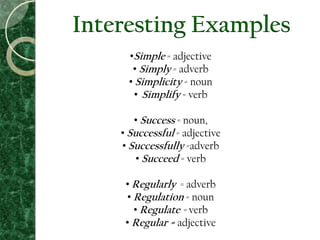
•Simple = adjective
• Simply = adverb
• Simplicity = noun
• Simplify = verb
• Success = noun,
• Successful = adjective
• Successfully =adverb
• Succeed = verb
• Regularly = adverb
• Regulation = noun
• Regulate = verb
• Regular = adjective
Interesting Examples
It is important to know the function
of words in a sentence in order to use
them correctly.
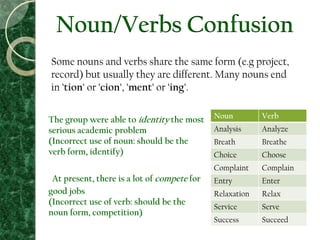
Noun/Verbs Confusion
Some nouns and verbs share the same form (e.g project,
record) but usually they are different. Many nouns end
in 'tion' or 'cion', 'ment' or 'ing'.
The group were able to identity the most
serious academic problem
(Incorrect use of noun: should be the
verb form, identify)
At present, there is a lot of compete for
good jobs
(Incorrect use of verb: should be the
noun form, competition)
Noun Verb
Analysis Analyze
Breath Breathe
Choice Choose
Complaint Complain
Entry Enter
Relaxation Relax
Service Serve
Success Succeed
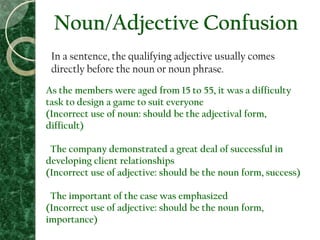
Noun/Adjective Confusion
In a sentence, the qualifying adjective usually comes
directly before the noun or noun phrase.
As the members were aged from 15 to 55, it was a difficulty
task to design a game to suit everyone
(Incorrect use of noun: should be the adjectival form,
difficult)
The company demonstrated a great deal of successful in
developing client relationships
(Incorrect use of adjective: should be the noun form, success)
The important of the case was emphasized
(Incorrect use of adjective: should be the noun form,
importance)
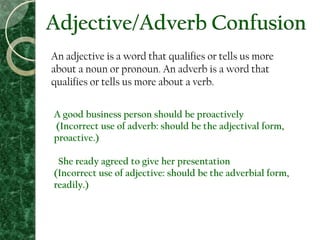
A good business person should be proactively
(Incorrect use of adverb: should be the adjectival form,
proactive.)
She ready agreed to give her presentation
(Incorrect use of adjective: should be the adverbial form,
readily.)
Adjective/Adverb Confusion
An adjective is a word that qualifies or tells us more
about a noun or pronoun. An adverb is a word that
qualifies or tells us more about a verb.
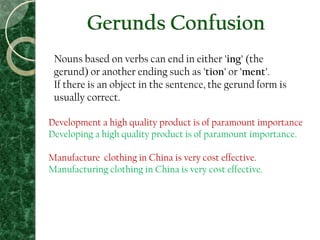
Gerunds Confusion
Nouns based on verbs can end in either 'ing' (the
gerund) or another ending such as 'tion' or 'ment'.
If there is an object in the sentence, the gerund form is
usually correct.
Development a high quality product is of paramount importance
Developing a high quality product is of paramount importance.
Manufacture clothing in China is very cost effective.
Manufacturing clothing in China is very cost effective.
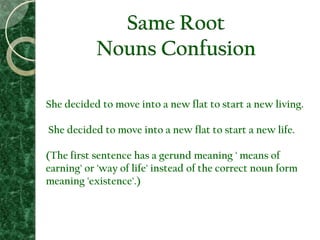
Same Root
Nouns Confusion
She decided to move into a new flat to start a new living.
She decided to move into a new flat to start a new life.
(The first sentence has a gerund meaning ' means of
earning' or 'way of life' instead of the correct noun form
meaning 'existence'.)
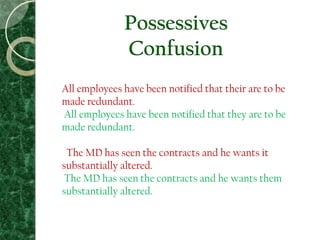
Possessives
Confusion
All employees have been notified that their are to be
made redundant.
All employees have been notified that they are to be
made redundant.
The MD has seen the contracts and he wants it
substantially altered.
The MD has seen the contracts and he wants them
substantially altered.
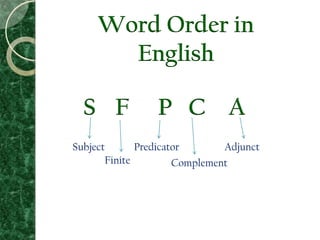
Word Order in
English
S F P C A
Subject
Finite
Predicator
Complement
Adjunct
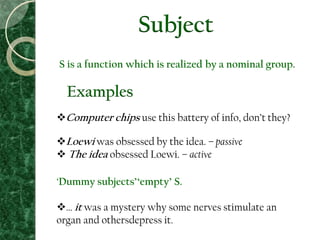
Subject
S is a function which is realized by a nominal group.
Computer chips use this battery of info, don’t they?
Loewi was obsessed by the idea. – passive
 The idea obsessed Loewi. – active
‘Dummy subjects’‘empty’ S.
… it was a mystery why some nerves stimulate an
organ and othersdepress it.
Examples
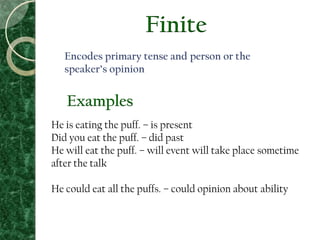
Finite
Encodes primary tense and person or the
speaker’s opinion
He is eating the puff. – is present
Did you eat the puff. – did past
He will eat the puff. – will event will take place sometime
after the talk
He could eat all the puffs. – could opinion about ability
Examples
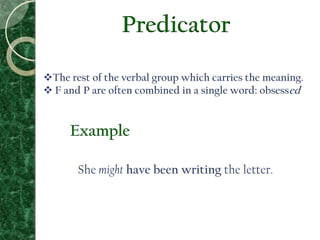
The rest of the verbal group which carries the meaning.
 F and P are often combined in a single word: obsessed
Predicator
Example
She might have been writing the letter.
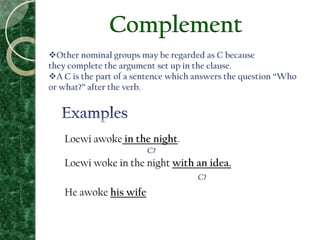
Complement
Other nominal groups may be regarded as C because
they complete the argument set up in the clause.
A C is the part of a sentence which answers the question “Who
or what?” after the verb.
Loewi awoke in the night.
Loewi woke in the night with an idea.
He awoke his wife
C?
C?
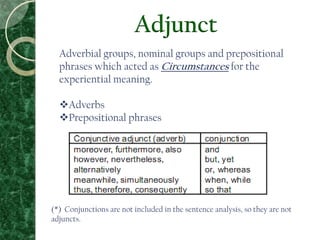
Adjunct
Adverbial groups, nominal groups and prepositional
phrases which acted as Circumstances for the
experiential meaning.
Adverbs
Prepositional phrases
(*) Conjunctions are not included in the sentence analysis, so they are not
adjuncts.
Sentences
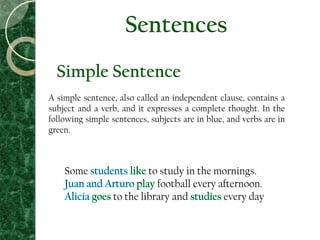
Simple Sentence
A simple sentence, also called an independent clause, contains a
subject and a verb, and it expresses a complete thought. In the
following simple sentences, subjects are in blue, and verbs are in
green.
Some to study in the mornings.
football every afternoon.
to the library and every day
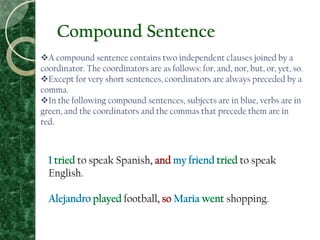
Compound Sentence
A compound sentence contains two independent clauses joined by a
coordinator. The coordinators are as follows: for, and, nor, but, or, yet, so.
Except for very short sentences, coordinators are always preceded by a
comma.
In the following compound sentences, subjects are in blue, verbs are in
green, and the coordinators and the commas that precede them are in
red.
to speak Spanish to speak
English.
football shopping.
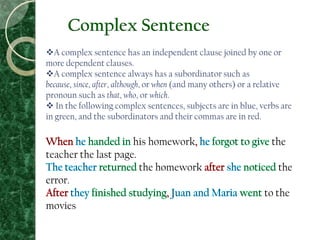
Complex Sentence
A complex sentence has an independent clause joined by one or
more dependent clauses.
A complex sentence always has a subordinator such as
because, since, after, although, or when (and many others) or a relative
pronoun such as that, who, or which.
 In the following complex sentences, subjects are in blue, verbs are
in green, and the subordinators and their commas are in red.
his homework the
teacher the last page.
the homework the
error.
to the
movies
How to Write
Good Sentences
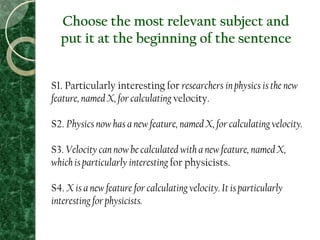
S1. Particularly interesting for researchers in physics is the new
feature, named X, for calculating velocity.
S2. Physics now has a new feature, named X, for calculating velocity.
S3. Velocity can now be calculated with a new feature, named X,
which is particularly interesting for physicists.
S4. X is a new feature for calculating velocity. It is particularly
interesting for physicists.
Choose the most relevant subject and
put it at the beginning of the sentence
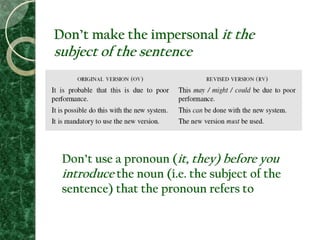
Don’t make the impersonal it the
subject of the sentence
Don’t use a pronoun (it, they) before you
introduce the noun (i.e. the subject of the
sentence) that the pronoun refers to
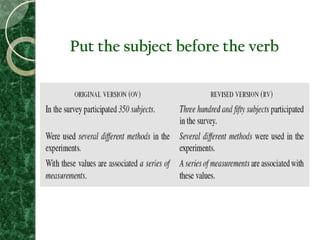
Put the subject before the verb
Keep the subject and verb as close
as possible to each other
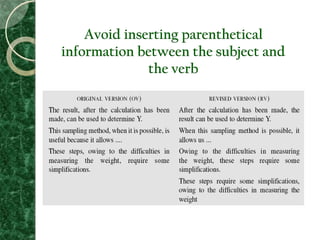
S1. *A gradual decline in germinability and vigor of the resultant
seedling, a higher sensitivity to stresses upon germination, and
possibly a loss of the ability to germinate are recorded in the
literature [5, 8, 19].
S2. *People with a high rate of intelligence, an unusual ability to
resolve problems, a passion for computers, along with good
communication skills are generally employed by such companies.
S3. There is generally a gradual decline in germinability and of the
resultant seedling, followed by a higher sensitivity to stress upon
germination, and possibly a loss of the ability to germinate [5, 8,
19].
S4. Such companies generally employ people with a high rate of ...
Avoid inserting parenthetical
information between the subject and
the verb
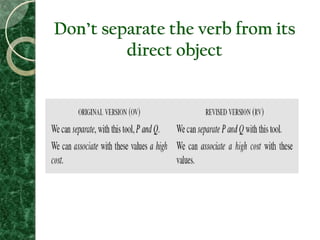
Don’t separate the verb from its
direct object
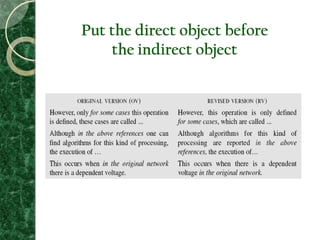
Put the direct object before
the indirect object
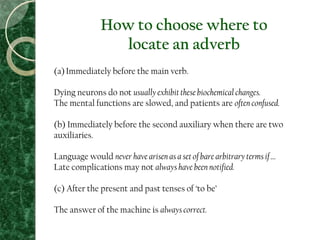
How to choose where to
locate an adverb
(a)Immediately before the main verb.
Dying neurons do not usually exhibit these biochemical changes.
The mental functions are slowed, and patients are often confused.
(b) Immediately before the second auxiliary when there are two
auxiliaries.
Language would never have arisen as a set of bare arbitraryterms if …
Late complications may not always have been notified.
(c) After the present and past tenses of ‘to be’
The answer of the machine is always correct.
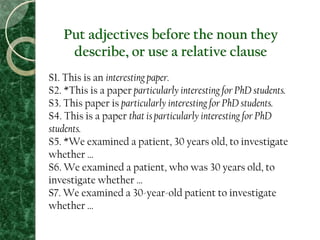
Put adjectives before the noun they
describe, or use a relative clause
S1. This is an interesting paper.
S2. *This is a paper particularly interesting for PhD students.
S3. This paper is particularly interesting for PhD students.
S4. This is a paper that is particularly interesting for PhD
students.
S5. *We examined a patient, 30 years old, to investigate
whether …
S6. We examined a patient, who was 30 years old, to
investigate whether …
S7. We examined a 30-year-old patient to investigate
whether …
Parts of Speech Confusion. Retrieved from:
http://elc.polyu.edu.hk/fyp/html/speech.htm
Zila6350. (2008, December 8). Scribd. Retrieved from Systemic Functional
Grammar-Interpersonal Metafunction:
http://es.scribd.com/doc/8645746/Systemic-Functional-
GrammarInterpersonal-Metafunction
Advanced Composition for Non-Native Speakers of English. (n.d.). Retrieved from
Sentences: Simple, Compound, and Complex: http://eslbee.com/sentences.htm
References

From words to sentences

  • 1.
    How do youfeel when it comes to writing?
  • 3.
  • 4.
    Words Parts of Speech Nouns=Names Adjectives= Characteristics of nouns Verbs= Actions Adverbs= How things are done Prepositions= Describe a relationship between other words in a sentence Conjunctions= Connect parts of a sentence Interjections= Used to exclaim, protest or command.
  • 5.
    •Simple = adjective •Simply = adverb • Simplicity = noun • Simplify = verb • Success = noun, • Successful = adjective • Successfully =adverb • Succeed = verb • Regularly = adverb • Regulation = noun • Regulate = verb • Regular = adjective Interesting Examples
  • 6.
    It is importantto know the function of words in a sentence in order to use them correctly.
  • 7.
    Noun/Verbs Confusion Some nounsand verbs share the same form (e.g project, record) but usually they are different. Many nouns end in 'tion' or 'cion', 'ment' or 'ing'. The group were able to identity the most serious academic problem (Incorrect use of noun: should be the verb form, identify) At present, there is a lot of compete for good jobs (Incorrect use of verb: should be the noun form, competition) Noun Verb Analysis Analyze Breath Breathe Choice Choose Complaint Complain Entry Enter Relaxation Relax Service Serve Success Succeed
  • 8.
    Noun/Adjective Confusion In asentence, the qualifying adjective usually comes directly before the noun or noun phrase. As the members were aged from 15 to 55, it was a difficulty task to design a game to suit everyone (Incorrect use of noun: should be the adjectival form, difficult) The company demonstrated a great deal of successful in developing client relationships (Incorrect use of adjective: should be the noun form, success) The important of the case was emphasized (Incorrect use of adjective: should be the noun form, importance)
  • 9.
    A good businessperson should be proactively (Incorrect use of adverb: should be the adjectival form, proactive.) She ready agreed to give her presentation (Incorrect use of adjective: should be the adverbial form, readily.) Adjective/Adverb Confusion An adjective is a word that qualifies or tells us more about a noun or pronoun. An adverb is a word that qualifies or tells us more about a verb.
  • 10.
    Gerunds Confusion Nouns basedon verbs can end in either 'ing' (the gerund) or another ending such as 'tion' or 'ment'. If there is an object in the sentence, the gerund form is usually correct. Development a high quality product is of paramount importance Developing a high quality product is of paramount importance. Manufacture clothing in China is very cost effective. Manufacturing clothing in China is very cost effective.
  • 11.
    Same Root Nouns Confusion Shedecided to move into a new flat to start a new living. She decided to move into a new flat to start a new life. (The first sentence has a gerund meaning ' means of earning' or 'way of life' instead of the correct noun form meaning 'existence'.)
  • 12.
    Possessives Confusion All employees havebeen notified that their are to be made redundant. All employees have been notified that they are to be made redundant. The MD has seen the contracts and he wants it substantially altered. The MD has seen the contracts and he wants them substantially altered.
  • 14.
    Word Order in English SF P C A Subject Finite Predicator Complement Adjunct
  • 15.
    Subject S is afunction which is realized by a nominal group. Computer chips use this battery of info, don’t they? Loewi was obsessed by the idea. – passive  The idea obsessed Loewi. – active ‘Dummy subjects’‘empty’ S. … it was a mystery why some nerves stimulate an organ and othersdepress it. Examples
  • 16.
    Finite Encodes primary tenseand person or the speaker’s opinion He is eating the puff. – is present Did you eat the puff. – did past He will eat the puff. – will event will take place sometime after the talk He could eat all the puffs. – could opinion about ability Examples
  • 17.
    The rest ofthe verbal group which carries the meaning.  F and P are often combined in a single word: obsessed Predicator Example She might have been writing the letter.
  • 18.
    Complement Other nominal groupsmay be regarded as C because they complete the argument set up in the clause. A C is the part of a sentence which answers the question “Who or what?” after the verb. Loewi awoke in the night. Loewi woke in the night with an idea. He awoke his wife C? C?
  • 19.
    Adjunct Adverbial groups, nominalgroups and prepositional phrases which acted as Circumstances for the experiential meaning. Adverbs Prepositional phrases (*) Conjunctions are not included in the sentence analysis, so they are not adjuncts.
  • 20.
    Sentences Simple Sentence A simplesentence, also called an independent clause, contains a subject and a verb, and it expresses a complete thought. In the following simple sentences, subjects are in blue, and verbs are in green. Some to study in the mornings. football every afternoon. to the library and every day
  • 21.
    Compound Sentence A compoundsentence contains two independent clauses joined by a coordinator. The coordinators are as follows: for, and, nor, but, or, yet, so. Except for very short sentences, coordinators are always preceded by a comma. In the following compound sentences, subjects are in blue, verbs are in green, and the coordinators and the commas that precede them are in red. to speak Spanish to speak English. football shopping.
  • 22.
    Complex Sentence A complexsentence has an independent clause joined by one or more dependent clauses. A complex sentence always has a subordinator such as because, since, after, although, or when (and many others) or a relative pronoun such as that, who, or which.  In the following complex sentences, subjects are in blue, verbs are in green, and the subordinators and their commas are in red. his homework the teacher the last page. the homework the error. to the movies
  • 23.
  • 24.
    S1. Particularly interestingfor researchers in physics is the new feature, named X, for calculating velocity. S2. Physics now has a new feature, named X, for calculating velocity. S3. Velocity can now be calculated with a new feature, named X, which is particularly interesting for physicists. S4. X is a new feature for calculating velocity. It is particularly interesting for physicists. Choose the most relevant subject and put it at the beginning of the sentence
  • 25.
    Don’t make theimpersonal it the subject of the sentence Don’t use a pronoun (it, they) before you introduce the noun (i.e. the subject of the sentence) that the pronoun refers to
  • 26.
    Put the subjectbefore the verb
  • 27.
    Keep the subjectand verb as close as possible to each other S1. *A gradual decline in germinability and vigor of the resultant seedling, a higher sensitivity to stresses upon germination, and possibly a loss of the ability to germinate are recorded in the literature [5, 8, 19]. S2. *People with a high rate of intelligence, an unusual ability to resolve problems, a passion for computers, along with good communication skills are generally employed by such companies. S3. There is generally a gradual decline in germinability and of the resultant seedling, followed by a higher sensitivity to stress upon germination, and possibly a loss of the ability to germinate [5, 8, 19]. S4. Such companies generally employ people with a high rate of ...
  • 28.
    Avoid inserting parenthetical informationbetween the subject and the verb
  • 29.
    Don’t separate theverb from its direct object
  • 30.
    Put the directobject before the indirect object
  • 31.
    How to choosewhere to locate an adverb (a)Immediately before the main verb. Dying neurons do not usually exhibit these biochemical changes. The mental functions are slowed, and patients are often confused. (b) Immediately before the second auxiliary when there are two auxiliaries. Language would never have arisen as a set of bare arbitraryterms if … Late complications may not always have been notified. (c) After the present and past tenses of ‘to be’ The answer of the machine is always correct.
  • 32.
    Put adjectives beforethe noun they describe, or use a relative clause S1. This is an interesting paper. S2. *This is a paper particularly interesting for PhD students. S3. This paper is particularly interesting for PhD students. S4. This is a paper that is particularly interesting for PhD students. S5. *We examined a patient, 30 years old, to investigate whether … S6. We examined a patient, who was 30 years old, to investigate whether … S7. We examined a 30-year-old patient to investigate whether …
  • 33.
    Parts of SpeechConfusion. Retrieved from: http://elc.polyu.edu.hk/fyp/html/speech.htm Zila6350. (2008, December 8). Scribd. Retrieved from Systemic Functional Grammar-Interpersonal Metafunction: http://es.scribd.com/doc/8645746/Systemic-Functional- GrammarInterpersonal-Metafunction Advanced Composition for Non-Native Speakers of English. (n.d.). Retrieved from Sentences: Simple, Compound, and Complex: http://eslbee.com/sentences.htm References