6 - 1
Lecture 2
Quality and Strategy
Quality Assurance in Hospital Management
Institute for Nile States Strategic Studies
and Researches
6 - 2
6 - 3
After this lecture, you should be
able to understand:
◦ Strategy to obtain Quality & its Cost.
◦ Total Quality Management 7 Concepts.
◦ Service Quality Inspection & Recovery.
Lecture Objectives
6 - 4
STRATEGY TO OBTAIN QUALITY &
ITS COST
Objective 1/3
6 - 5
Organization Objective
An operations manager’s objective is
to build a total quality management
system that identifies and satisfies
customer needs
6 - 6
The Flow of Activities
Organizational Practices
Leadership, Mission statement, Effective operating
procedures, Staff support, Training
Yields: What is important and what is to be
accomplished
Quality Principles
Customer focus, Continuous improvement, Benchmarking,
Just-in-time, Tools of TQM
Yields: How to do what is important and to be
accomplished
Employee Fulfillment
Empowerment, Organizational commitment
Yields: Employee attitudes that can accomplish
what is important
Customer Satisfaction
Winning orders, Repeat customers
Yields: An effective organization with
a competitive advantageFigure 6.2
6 - 7
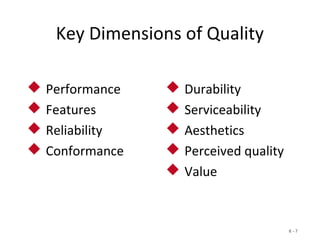
Key Dimensions of Quality
 Performance
 Features
 Reliability
 Conformance
 Durability
 Serviceability
 Aesthetics
 Perceived quality
 Value
6 - 8
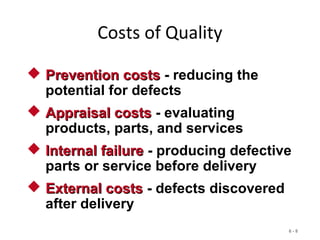
Costs of Quality
 Prevention costsPrevention costs - reducing the
potential for defects
 Appraisal costsAppraisal costs - evaluating
products, parts, and services
 Internal failureInternal failure - producing defective
parts or service before delivery
 External costsExternal costs - defects discovered
after delivery
6 - 9
Costs of Quality
External Failure
Internal Failure
Prevention
Appraisal
Total
Cost
Quality Improvement
Total Cost
6 - 10
TQM 7 CONCEPTS
Objective 2/3
6 - 11
TQM
Encompasses entire organization, from supplier
to customer
Stresses a commitment by management to have
a continuing, companywide drive toward
excellence in all aspects of products and
services that are important to the customer
6 - 12
Seven Concepts of TQM
1. Continuous improvement
2. Six Sigma
3. Employee empowerment
4. Benchmarking
5. Just-in-time (JIT)
6. Taguchi concepts
7. Knowledge of TQM tools
6 - 13
Taguchi Concepts
 Engineering and experimental
design methods to improve product
and process design
 Identify key component and process
variables affecting product variation
 Taguchi Concepts
 Quality robustness
 Quality loss function
 Target-oriented quality
6 - 14
SERVICE QUALITY INSPECTION &
RECOVERY
Objective 3/3
6 - 15
When and Where to Inspect
1. At the supplier’s plant while the supplier is producing
2. At your facility upon receipt of goods/services from the supplier
3. Before costly or irreversible processes
4. During the step-by-step production /service process
5. When production or service is complete
6. Before delivery to your customer
7. At the point of customer contact
But the problem is in the Process variability and worker
fatigue
So empowered employees, and sound processes are
better solutions
6 - 16
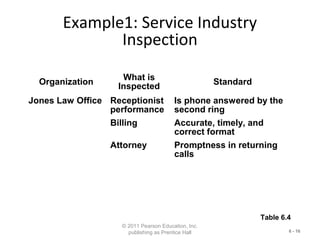
Example1: Service Industry
Inspection
© 2011 Pearson Education, Inc.
publishing as Prentice Hall
Organization
What is
Inspected
Standard
Jones Law Office Receptionist
performance
Billing
Attorney
Is phone answered by the
second ring
Accurate, timely, and
correct format
Promptness in returning
calls
Table 6.4
6 - 17
Example2: Service Industry
Inspection
© 2011 Pearson Education, Inc.
publishing as Prentice Hall
Organization
What is
Inspected
Standard
Hard Rock Hotel Reception
desk
Doorman
Room
Minibar
Use customer’s name
Greet guest in less than 30
seconds
All lights working, spotless
bathroom
Restocked and charges
accurately posted to bill
Table 6.4
6 - 18
Example3: Service Industry
Inspection
Organization
What is
Inspected
Standard
Arnold Palmer
Hospital
Billing
Pharmacy
Lab
Nurses
Admissions
Accurate, timely, and
correct format
Prescription accuracy,
inventory accuracy
Audit for lab-test accuracy
Charts immediately
updated
Data entered correctly and
completely
Table 6.4
6 - 19
Determinants of Service Quality
Reliability Consistency of performance and dependability
Responsiveness Willingness or readiness of employees
Competence Required skills and knowledge
Access Approachability and ease of contact
Courtesy Politeness, respect, consideration, friendliness
Communication Keeping customers informed
Credibility Trustworthiness, believability, honesty
Security Freedom from danger, risk, or doubt
Understanding/
knowing the customer
Understand the customer’s needs
Tangibles Physical evidence of the service
Table 6.5
6 - 20
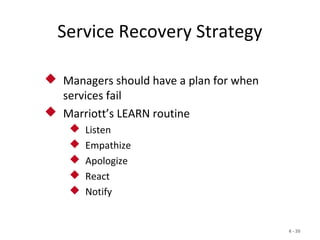
Service Recovery Strategy
 Managers should have a plan for when
services fail
 Marriott’s LEARN routine
 Listen
 Empathize
 Apologize
 React
 Notify

Lesson 2

  • 1.
    6 - 1 Lecture2 Quality and Strategy Quality Assurance in Hospital Management Institute for Nile States Strategic Studies and Researches
  • 2.
  • 3.
    6 - 3 Afterthis lecture, you should be able to understand: ◦ Strategy to obtain Quality & its Cost. ◦ Total Quality Management 7 Concepts. ◦ Service Quality Inspection & Recovery. Lecture Objectives
  • 4.
    6 - 4 STRATEGYTO OBTAIN QUALITY & ITS COST Objective 1/3
  • 5.
    6 - 5 OrganizationObjective An operations manager’s objective is to build a total quality management system that identifies and satisfies customer needs
  • 6.
    6 - 6 TheFlow of Activities Organizational Practices Leadership, Mission statement, Effective operating procedures, Staff support, Training Yields: What is important and what is to be accomplished Quality Principles Customer focus, Continuous improvement, Benchmarking, Just-in-time, Tools of TQM Yields: How to do what is important and to be accomplished Employee Fulfillment Empowerment, Organizational commitment Yields: Employee attitudes that can accomplish what is important Customer Satisfaction Winning orders, Repeat customers Yields: An effective organization with a competitive advantageFigure 6.2
  • 7.
    6 - 7 KeyDimensions of Quality  Performance  Features  Reliability  Conformance  Durability  Serviceability  Aesthetics  Perceived quality  Value
  • 8.
    6 - 8 Costsof Quality  Prevention costsPrevention costs - reducing the potential for defects  Appraisal costsAppraisal costs - evaluating products, parts, and services  Internal failureInternal failure - producing defective parts or service before delivery  External costsExternal costs - defects discovered after delivery
  • 9.
    6 - 9 Costsof Quality External Failure Internal Failure Prevention Appraisal Total Cost Quality Improvement Total Cost
  • 10.
    6 - 10 TQM7 CONCEPTS Objective 2/3
  • 11.
    6 - 11 TQM Encompassesentire organization, from supplier to customer Stresses a commitment by management to have a continuing, companywide drive toward excellence in all aspects of products and services that are important to the customer
  • 12.
    6 - 12 SevenConcepts of TQM 1. Continuous improvement 2. Six Sigma 3. Employee empowerment 4. Benchmarking 5. Just-in-time (JIT) 6. Taguchi concepts 7. Knowledge of TQM tools
  • 13.
    6 - 13 TaguchiConcepts  Engineering and experimental design methods to improve product and process design  Identify key component and process variables affecting product variation  Taguchi Concepts  Quality robustness  Quality loss function  Target-oriented quality
  • 14.
    6 - 14 SERVICEQUALITY INSPECTION & RECOVERY Objective 3/3
  • 15.
    6 - 15 Whenand Where to Inspect 1. At the supplier’s plant while the supplier is producing 2. At your facility upon receipt of goods/services from the supplier 3. Before costly or irreversible processes 4. During the step-by-step production /service process 5. When production or service is complete 6. Before delivery to your customer 7. At the point of customer contact But the problem is in the Process variability and worker fatigue So empowered employees, and sound processes are better solutions
  • 16.
    6 - 16 Example1:Service Industry Inspection © 2011 Pearson Education, Inc. publishing as Prentice Hall Organization What is Inspected Standard Jones Law Office Receptionist performance Billing Attorney Is phone answered by the second ring Accurate, timely, and correct format Promptness in returning calls Table 6.4
  • 17.
    6 - 17 Example2:Service Industry Inspection © 2011 Pearson Education, Inc. publishing as Prentice Hall Organization What is Inspected Standard Hard Rock Hotel Reception desk Doorman Room Minibar Use customer’s name Greet guest in less than 30 seconds All lights working, spotless bathroom Restocked and charges accurately posted to bill Table 6.4
  • 18.
    6 - 18 Example3:Service Industry Inspection Organization What is Inspected Standard Arnold Palmer Hospital Billing Pharmacy Lab Nurses Admissions Accurate, timely, and correct format Prescription accuracy, inventory accuracy Audit for lab-test accuracy Charts immediately updated Data entered correctly and completely Table 6.4
  • 19.
    6 - 19 Determinantsof Service Quality Reliability Consistency of performance and dependability Responsiveness Willingness or readiness of employees Competence Required skills and knowledge Access Approachability and ease of contact Courtesy Politeness, respect, consideration, friendliness Communication Keeping customers informed Credibility Trustworthiness, believability, honesty Security Freedom from danger, risk, or doubt Understanding/ knowing the customer Understand the customer’s needs Tangibles Physical evidence of the service Table 6.5
  • 20.
    6 - 20 ServiceRecovery Strategy  Managers should have a plan for when services fail  Marriott’s LEARN routine  Listen  Empathize  Apologize  React  Notify

Editor's Notes

  • #6 An operations manager’s objective is to build a total quality management system that identifies and satisfies customer needs
  • #7 So to apply the strategy to total quality management system, your organization should follow these activities: Organizational Practices Leadership, Mission statement, Effective operating procedures, Staff support, Training Yields:What is important and what is to beaccomplished Quality Principles Customer focus, Continuous improvement, Benchmarking, Just-in-time, Tools of TQM Yields:How to do what is important and to beaccomplished Employee Fulfillment Empowerment, Organizational commitment Yields:Employee attitudes that can accomplishwhat is important Customer Satisfaction Winning orders, Repeat customers Yields:An effective organization witha competitive advantage
  • #8 Also, to apply the strategy to total quality management system, your organization need to focus on the Key Dimensions of Quality: Performance Features Reliability Conformance Durability Serviceability Aesthetics Perceived quality Value
  • #9 To obtain quality your organization should acknowledge the costs of Quality: Prevention costs - reducing the potential for defects Appraisal costs - evaluating products, parts, and services Internal failure - producing defective parts or service before delivery External costs - defects discovered after delivery
  • #10 This graph shows the relation between total cost of quality and the quality improvement
  • #12 Total Quality Management Encompasses entire organization, from supplier to customer Stresses a commitment by management to have a continuing, companywide drive toward excellence in all aspects of products and services that are important to the customer
  • #13 The seven concepts of TQM are: Continuous improvement: Represents continual improvement of all processes Involves all operations and work centers including suppliers and customers and People, Equipment, Materials, Procedures Six Sigma:It has Two meanings: Statistical definition of a process that is 99.9997% capable, 3.4 defects per million opportunities (DPMO) A program designed to reduce defects, lower costs, and improve customer satisfaction Employee empowerment: Getting employees involved in product and process improvements 85% of quality problems are due to process and material Techniques Build communication networks that include employees Develop open, supportive supervisors Move responsibility to employees Build a high-morale organization Create formal team structures 4. Benchmarking: Selecting best practices to use as a standard for performance Determine what to benchmark Form a benchmark team Identify benchmarking partners Collect and analyze benchmarking information Take action to match or exceed the benchmark 5. Just-in-time (JIT): cuts the cost of quality and improves quality Better quality means less inventory and better, easier-to-employ JIT system Production only when signaled Allows reduced inventory levels as Inventory costs money and hides process and material problems Encourages improved process and product quality 6. Taguchi concepts: Identify key component and process variables affecting product variation 7. Knowledge of TQM tools: Tools for Generating Ideas Check sheets Scatter diagrams Cause-and-effect diagrams Tools to Organize the Data Pareto charts Flowcharts Tools for Identifying Problems Histogram Statistical process control chart
  • #14 Let us take, Taguchi Concepts in more details: Taguchi Concepts are Engineering and experimental design methods to improve product and process design Identify key component and process variables affecting product variation Taguchi Concepts Quality robustness: Remove the effects of adverse conditions Small variations in materials and process do not destroy product quality Quality loss function: costs increase as the product moves away from what the customer wants Costs include customer dissatisfaction, warranty and service, internal scrap and repair, and costs to society Traditional conformance specifications are too simplistic Target-oriented quality
  • #16 Inspection : Involves examining items to see if an item is good or defective The points that are recommended to inspect at are: At the supplier’s plant while the supplier is producing At your facility upon receipt of goods/services from the supplier Before costly or irreversible processes During the step-by-step production /service process When production or service is complete Before delivery to your customer At the point of customer contact But the problem is the Process variability and worker fatigue So empowered employees, and sound processes are better solutions
  • #20 But How to determine while your inspection if the service is high quality or not? Just use the Determinants of Service Quality, which are:
  • #21 Finally after your inspection, you need to recover the inspected problems, so Managers should have a plan for when services fail