Cultural Globalization –  The globalization of McDonald’s Lesson  9
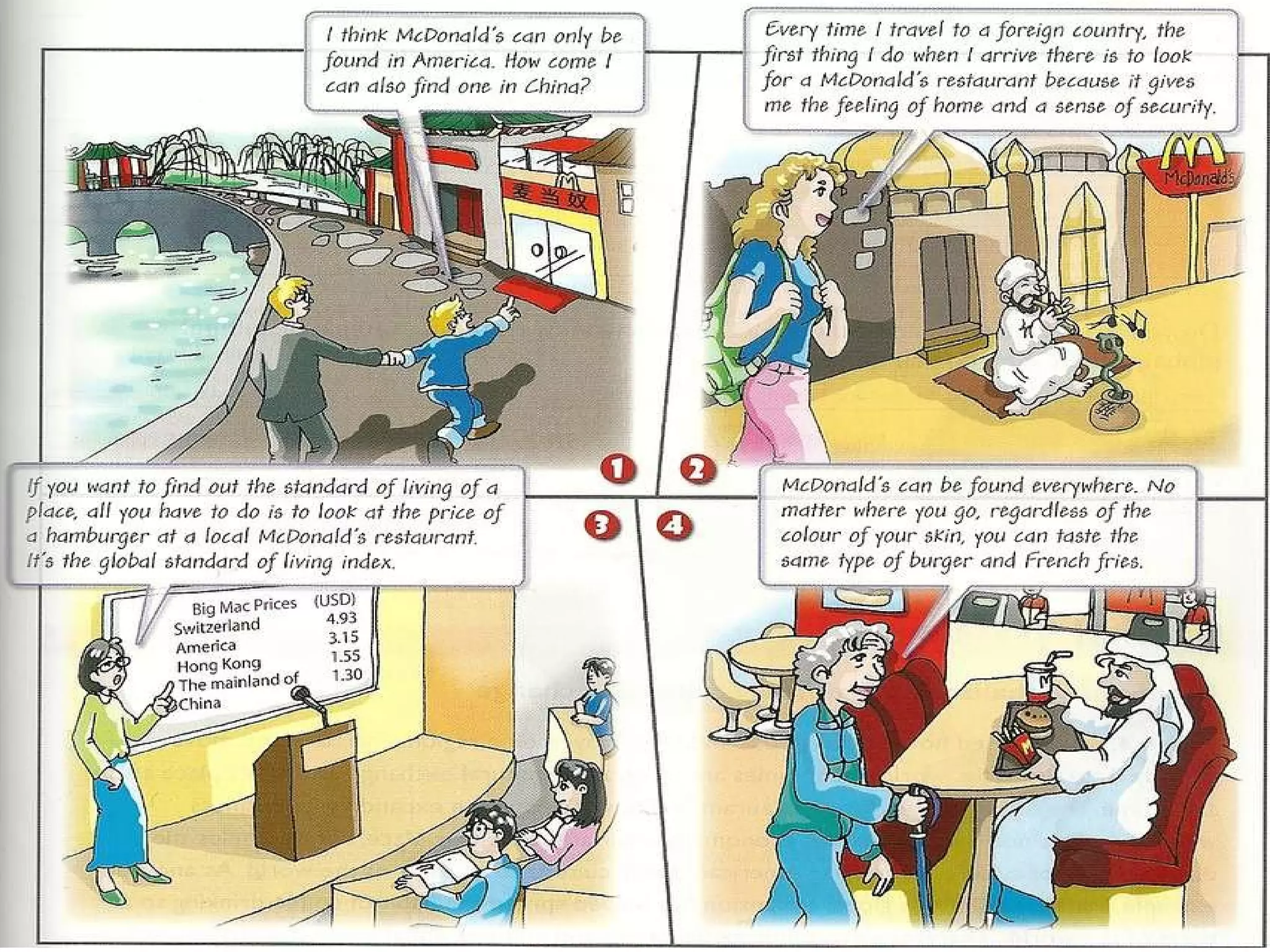
Task 1 – The globalization of McDonald’s  (p.42) McDonald’s can be found on six continents ( 洲 ), with over 30,000 restaurants worldwide. It continues to expand its territory by opening 1,850 new restaurants every year.
The global development of McDonald’s McDonald’s Corporation was founded by Ray Kroc McDonald’s opened a restaurant which is the first branch outside America in Canada Hong Kong’s first McDonald’s opened on Paterson Street, Causeway Bay ( 銅鑼灣百德新街 ) 1955 1967 1975
News reading: “ McDonald’s changes its publicity targets ( 宣傳對象 )” McDonald’s has recently started a new round of publicity programmes ( 宣傳項目 ).  It invites celebrity idols ( 名人 /  偶像 ), such as Wang Lee-hom ( 王力宏 ), Eason Chan, Kelly Chen and Yao Ming, to feature ( 參演 ) in several Cantonese, Putonghua and English commercials with hip hop music.  These commercials ( 廣告 ) are broadcast ( 廣播 ) in Hong Kong, the mainland of China, Taiwan, Singapore and Malaysia.
News reading: “ McDonald’s changes its publicity targets ( 宣傳對象 )” The slogan ( 口號 ) of the current publicity programmes is ‘I’m lovin’ it’, which is the new theme that McDonald’s has been promoting globally since 2003.  It has changed its past marketing strategies which targeted at  children and family consumers .  It tries to create a young and vibrant ( 有活力的 ) image, targeting at  young people , who have extremely high consumption power ( 消費力 ). 27th November, 2004
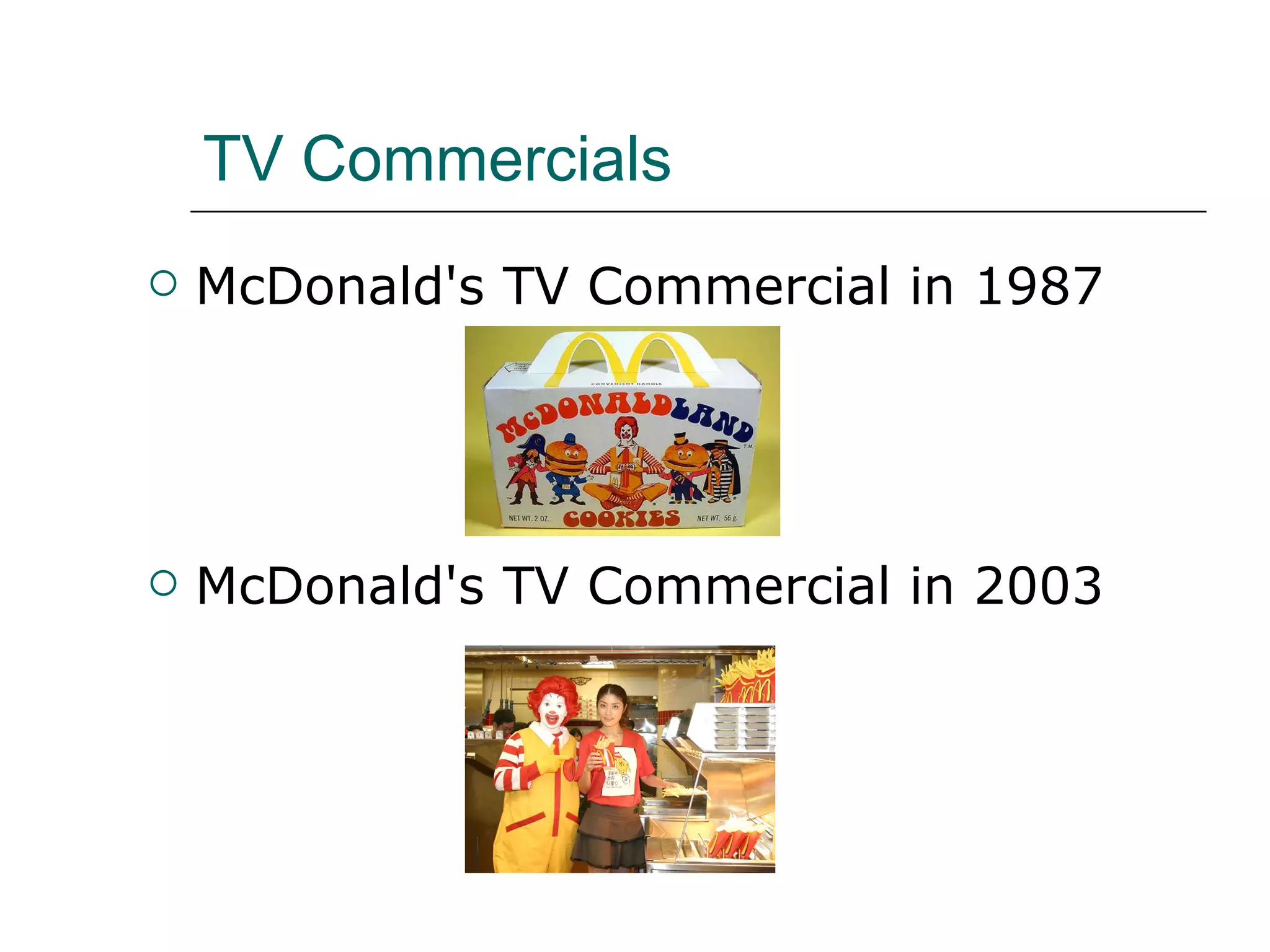
TV Commercials McDonald's TV Commercial in 1987 McDonald's TV Commercial in 2003
 
Discussion
Q.1 According to Unit 4 and the above information, do you think that McDonald’s business is economically globalized? Why do you think so? Yes. This is because McDonald’s restaurants are widely distributed ( 廣泛地分佈 ) around the world. McDonald’s new promotion campaign ( 推廣活動 ) has a global theme ( 全球性的主題 ). This shows that they are targeting the global market, not a single region.
Q2. What are the characteristics of McDonald’s dining culture? (1)  Efficiency in operation ( 有效率的運作 ) :   All dining procedures including food ordering, cooking, picking up food and cleaning tables are done within a short time. (2)  Self-service ( 自助式 ) :  Customers place their order and pick up food at counters. They look for their own seats. Shop assistants provide limited service such as collecting charges, cooking food and cleaning. (3)  Mainly Western food ( 西式食物 ):  Western food such as bread, fries, milkshakes, mostly meat, but few vegetables.
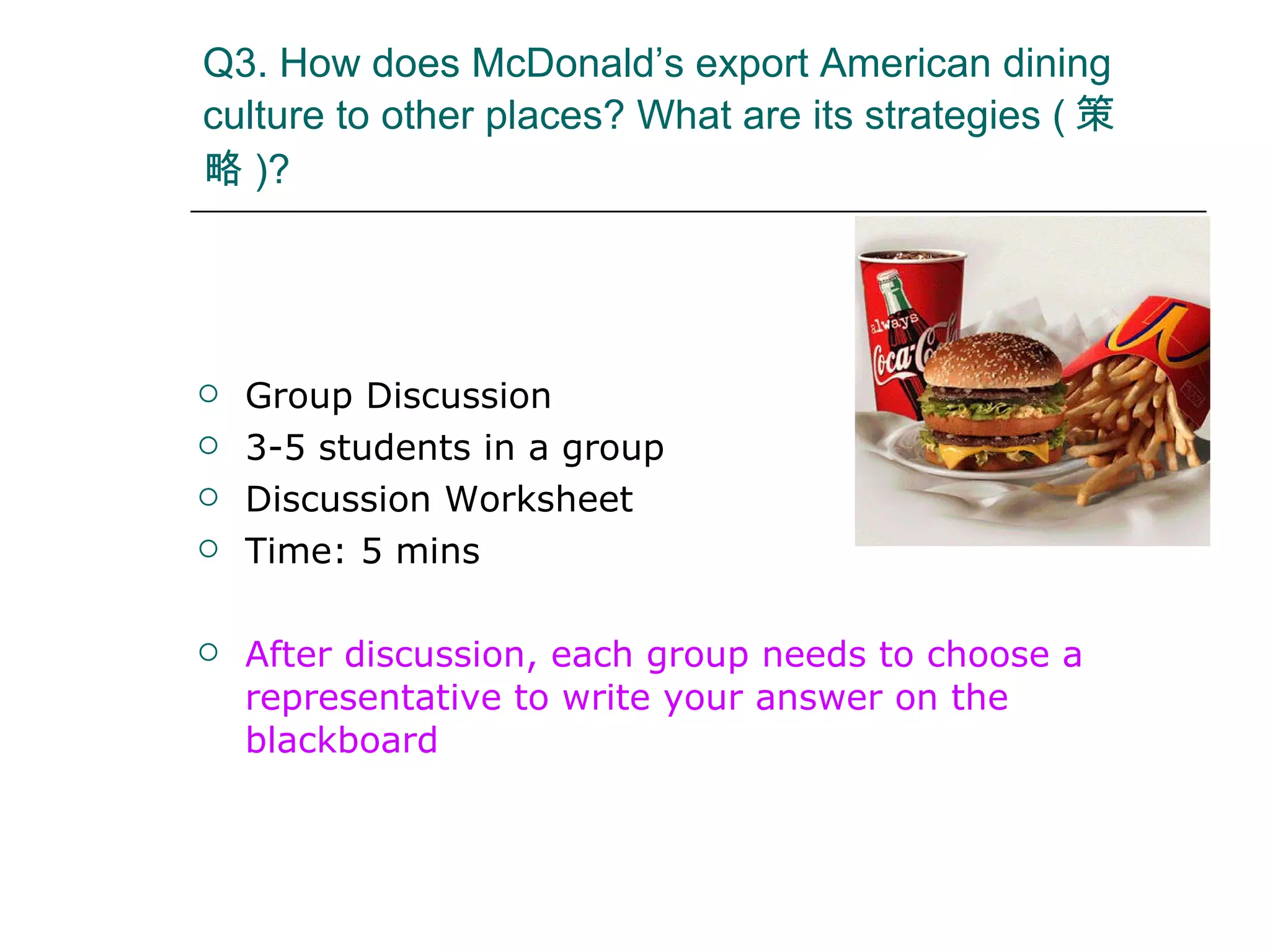
Q3. How does McDonald’s export American dining culture to other places? What are its strategies ( 策略 )? Group Discussion 3-5 students in a group Discussion Worksheet Time: 5 mins After discussion, each group needs to choose a representative to write your answer on the blackboard
Q3. How does McDonald’s export American dining culture to other places? What are its strategies? (1) McDonald’s restaurant has opened branches around the world. (2)  Celebrity ( 名人 ) and internationally renowned figures ( 有聲譽的人物 ) are invited to feature ( 參演 ) in commercials ( 廣告 ).  Commercials in different languages are produced. Appropriate promotional approaches are used for different target customers ( 目標顧客 ) e.g. A young and energetic brand image for the teen market. They change target customer groups constantly ( 經常地 ) e.g. Their promotion target has been changed from families and kids to teenagers. (3) Uses attractive souvenirs ( 紀念品 ) to attract customers.
Conclusion McDonald’s restaurant is a typical ( 典型的 ) example of the globalization of a dining culture. Through global distribution ( 分佈 ) of its branches and targeted promotion, McDonald’s has exported its fast food dining culture to many parts of the world. It global expansion ( 擴張 ) also explains the close relationship between cultural and economic globalization.
Next lesson Continue to discuss Task 1 Q.4 Task 2 (P.45-47)
Vocabulary publicity programmes ( 宣傳項目 ) consumption power ( 消費力 ) standard of living ( 生活水平 ) promotion campaign ( 推廣活動 ) commercials ( 廣告 ) broadcast ( 廣播 )

Lesson 10 - Cultural Globalization (McDonald's)

  • 1.
    Cultural Globalization – The globalization of McDonald’s Lesson 9
  • 2.
    Task 1 –The globalization of McDonald’s (p.42) McDonald’s can be found on six continents ( 洲 ), with over 30,000 restaurants worldwide. It continues to expand its territory by opening 1,850 new restaurants every year.
  • 3.
    The global developmentof McDonald’s McDonald’s Corporation was founded by Ray Kroc McDonald’s opened a restaurant which is the first branch outside America in Canada Hong Kong’s first McDonald’s opened on Paterson Street, Causeway Bay ( 銅鑼灣百德新街 ) 1955 1967 1975
  • 4.
    News reading: “McDonald’s changes its publicity targets ( 宣傳對象 )” McDonald’s has recently started a new round of publicity programmes ( 宣傳項目 ). It invites celebrity idols ( 名人 / 偶像 ), such as Wang Lee-hom ( 王力宏 ), Eason Chan, Kelly Chen and Yao Ming, to feature ( 參演 ) in several Cantonese, Putonghua and English commercials with hip hop music. These commercials ( 廣告 ) are broadcast ( 廣播 ) in Hong Kong, the mainland of China, Taiwan, Singapore and Malaysia.
  • 5.
    News reading: “McDonald’s changes its publicity targets ( 宣傳對象 )” The slogan ( 口號 ) of the current publicity programmes is ‘I’m lovin’ it’, which is the new theme that McDonald’s has been promoting globally since 2003. It has changed its past marketing strategies which targeted at children and family consumers . It tries to create a young and vibrant ( 有活力的 ) image, targeting at young people , who have extremely high consumption power ( 消費力 ). 27th November, 2004
  • 6.
    TV Commercials McDonald'sTV Commercial in 1987 McDonald's TV Commercial in 2003
  • 7.
  • 8.
  • 9.
    Q.1 According toUnit 4 and the above information, do you think that McDonald’s business is economically globalized? Why do you think so? Yes. This is because McDonald’s restaurants are widely distributed ( 廣泛地分佈 ) around the world. McDonald’s new promotion campaign ( 推廣活動 ) has a global theme ( 全球性的主題 ). This shows that they are targeting the global market, not a single region.
  • 10.
    Q2. What arethe characteristics of McDonald’s dining culture? (1) Efficiency in operation ( 有效率的運作 ) : All dining procedures including food ordering, cooking, picking up food and cleaning tables are done within a short time. (2) Self-service ( 自助式 ) : Customers place their order and pick up food at counters. They look for their own seats. Shop assistants provide limited service such as collecting charges, cooking food and cleaning. (3) Mainly Western food ( 西式食物 ): Western food such as bread, fries, milkshakes, mostly meat, but few vegetables.
  • 11.
    Q3. How doesMcDonald’s export American dining culture to other places? What are its strategies ( 策略 )? Group Discussion 3-5 students in a group Discussion Worksheet Time: 5 mins After discussion, each group needs to choose a representative to write your answer on the blackboard
  • 12.
    Q3. How doesMcDonald’s export American dining culture to other places? What are its strategies? (1) McDonald’s restaurant has opened branches around the world. (2) Celebrity ( 名人 ) and internationally renowned figures ( 有聲譽的人物 ) are invited to feature ( 參演 ) in commercials ( 廣告 ). Commercials in different languages are produced. Appropriate promotional approaches are used for different target customers ( 目標顧客 ) e.g. A young and energetic brand image for the teen market. They change target customer groups constantly ( 經常地 ) e.g. Their promotion target has been changed from families and kids to teenagers. (3) Uses attractive souvenirs ( 紀念品 ) to attract customers.
  • 13.
    Conclusion McDonald’s restaurantis a typical ( 典型的 ) example of the globalization of a dining culture. Through global distribution ( 分佈 ) of its branches and targeted promotion, McDonald’s has exported its fast food dining culture to many parts of the world. It global expansion ( 擴張 ) also explains the close relationship between cultural and economic globalization.
  • 14.
    Next lesson Continueto discuss Task 1 Q.4 Task 2 (P.45-47)
  • 15.
    Vocabulary publicity programmes( 宣傳項目 ) consumption power ( 消費力 ) standard of living ( 生活水平 ) promotion campaign ( 推廣活動 ) commercials ( 廣告 ) broadcast ( 廣播 )

Editor's Notes

  • #13 人類把知識錯覺成智慧﹐快樂錯覺成幸福﹐只顧在近代化的道路上狂奔。其結果是﹐人隸屬於現在的「麥當勞世界」﹐淪落到僅僅成為消費者﹐變成了「商品」的奴隸。這當然會加深同化的危機。