Transactions
• A transaction is a logical, atomic unit of work
that contains one or more SQL statements.
• A transaction must be EITHER
– Saved with COMMIT statement
– Rollback together with ROLLBACK statement
• Comply with ACID properties
ACID Properties
• Atomicity
– All tasks of a transaction are performed or none of
them are.
• Consistency
– The transaction takes the database from one
consistent state to another consistent state.
• Isolation
– The effect of a transaction is not visible to other
transactions until the transaction is committed.
ACID Properties
• Durability
– Changes made by committed transactions are
permanent.
– After a transaction completes, the database
ensures through its recovery mechanisms that
changes from the transaction are not lost.
Transactions
• Beginning a Transaction
– A transaction begins when the first executable SQL
statement is encountered
• End a Transaction
– A COMMIT or ROLLBACK statement issued by user
without a SAVEPOINT clause.
– DDL command runs by user.
– A user exits normally.
Transactions
• V$TRANSACTION table is used to view details
of transactions.
SELECT XID, STATUS FROM V$TRANSACTION;
Transaction Control
• Management of changes made by DML statements and
the grouping of DML statements into transactions.
• Data changes made by a transaction are temporary
until the transaction is committed or rolled back.
• Transaction Control involves
– COMMIT
– ROLLBACK
– SAVEPOINT
Transaction Controls
• Active Transactions
– An active transaction has started but not yet
committed or rolled back.
• Before the transaction ends, the state of the data
is as follows:
– Oracle Database has generated undo data
information in the system global area (SGA).
– Changes have been made to the database buffers of
the SGA.
– The rows affected by the data change are locked.
Transaction Control
• COMMIT
– A commit ends the current transaction and makes
permanent all changes performed in the transaction.
COMMIT [WORK] [COMMENT text];
– When a transaction commits, the following actions
occur:
• Oracle Database releases locks held on rows and tables.
• Oracle Database deletes savepoints.
• Oracle Database marks the transaction complete.
Transaction Control
• ROLLBACK
– Undoing any changes that have occurred in the
current UNCOMMITTED transaction.
– All data changes discarded.
ROLLBACK [TO SAVEPOINT] savepoint_name;
Transaction Control
• When ROLLBACK
– All changes made by the current transaction are
undone.
– All locks released.
– All savepoints released.
– Transaction ends
Transaction Control
• When ROLLBACK TO SAVEPOINT
– When SAVEPOINT occurs following thing occurs:
• Oracle Database rolls back only the statements run
after the savepoint.
• Oracle Database preserves the savepoint specified in
the ROLLBACK TO SAVEPOINT statement, but all
subsequent savepoints are lost.
• Oracle Database releases all table and row locks
– The transaction remains active and can be
continued.
Transaction Control
• SAVEPOINT
– The SAVEPOINT statement identifies a point in a
transaction to which you can later roll back.
– To rollback transaction partially , we create
savepoints.
SAVEPOINT savepoint_name
Transaction Control
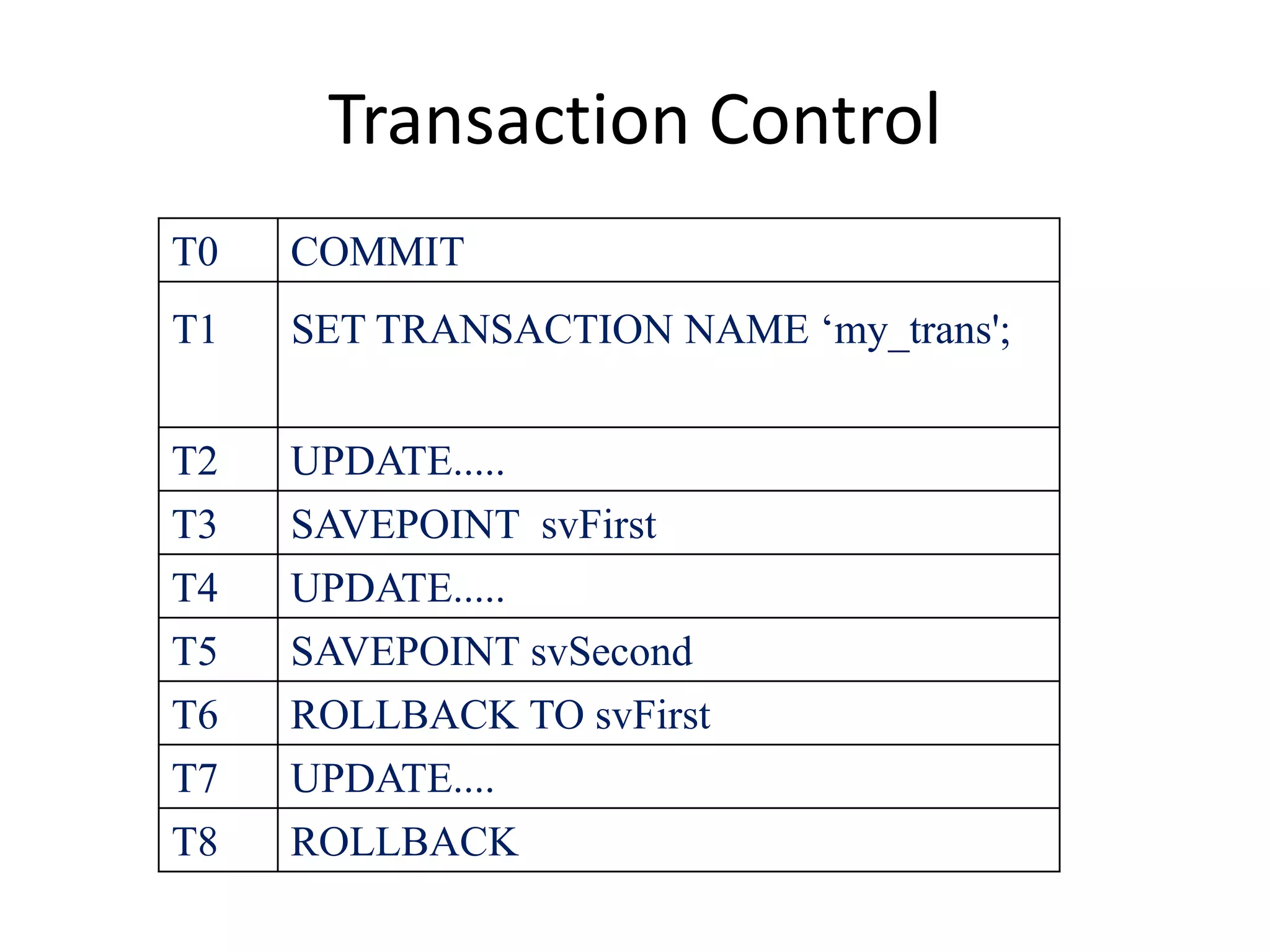
T0 COMMIT
T1 SET TRANSACTION NAME ‘my_trans';
T2 UPDATE.....
T3 SAVEPOINT svFirst
T4 UPDATE.....
T5 SAVEPOINT svSecond
T6 ROLLBACK TO svFirst
T7 UPDATE....
T8 ROLLBACK

8. transactions

  • 1.
  • 2.
    • A transactionis a logical, atomic unit of work that contains one or more SQL statements. • A transaction must be EITHER – Saved with COMMIT statement – Rollback together with ROLLBACK statement • Comply with ACID properties
  • 3.
    ACID Properties • Atomicity –All tasks of a transaction are performed or none of them are. • Consistency – The transaction takes the database from one consistent state to another consistent state. • Isolation – The effect of a transaction is not visible to other transactions until the transaction is committed.
  • 4.
    ACID Properties • Durability –Changes made by committed transactions are permanent. – After a transaction completes, the database ensures through its recovery mechanisms that changes from the transaction are not lost.
  • 5.
    Transactions • Beginning aTransaction – A transaction begins when the first executable SQL statement is encountered • End a Transaction – A COMMIT or ROLLBACK statement issued by user without a SAVEPOINT clause. – DDL command runs by user. – A user exits normally.
  • 6.
    Transactions • V$TRANSACTION tableis used to view details of transactions. SELECT XID, STATUS FROM V$TRANSACTION;
  • 7.
    Transaction Control • Managementof changes made by DML statements and the grouping of DML statements into transactions. • Data changes made by a transaction are temporary until the transaction is committed or rolled back. • Transaction Control involves – COMMIT – ROLLBACK – SAVEPOINT
  • 8.
    Transaction Controls • ActiveTransactions – An active transaction has started but not yet committed or rolled back. • Before the transaction ends, the state of the data is as follows: – Oracle Database has generated undo data information in the system global area (SGA). – Changes have been made to the database buffers of the SGA. – The rows affected by the data change are locked.
  • 9.
    Transaction Control • COMMIT –A commit ends the current transaction and makes permanent all changes performed in the transaction. COMMIT [WORK] [COMMENT text]; – When a transaction commits, the following actions occur: • Oracle Database releases locks held on rows and tables. • Oracle Database deletes savepoints. • Oracle Database marks the transaction complete.
  • 10.
    Transaction Control • ROLLBACK –Undoing any changes that have occurred in the current UNCOMMITTED transaction. – All data changes discarded. ROLLBACK [TO SAVEPOINT] savepoint_name;
  • 11.
    Transaction Control • WhenROLLBACK – All changes made by the current transaction are undone. – All locks released. – All savepoints released. – Transaction ends
  • 12.
    Transaction Control • WhenROLLBACK TO SAVEPOINT – When SAVEPOINT occurs following thing occurs: • Oracle Database rolls back only the statements run after the savepoint. • Oracle Database preserves the savepoint specified in the ROLLBACK TO SAVEPOINT statement, but all subsequent savepoints are lost. • Oracle Database releases all table and row locks – The transaction remains active and can be continued.
  • 13.
    Transaction Control • SAVEPOINT –The SAVEPOINT statement identifies a point in a transaction to which you can later roll back. – To rollback transaction partially , we create savepoints. SAVEPOINT savepoint_name
  • 14.
    Transaction Control T0 COMMIT T1SET TRANSACTION NAME ‘my_trans'; T2 UPDATE..... T3 SAVEPOINT svFirst T4 UPDATE..... T5 SAVEPOINT svSecond T6 ROLLBACK TO svFirst T7 UPDATE.... T8 ROLLBACK