Managing Data in Different Time
Zones
Time Zones
• The hours of the day are measured by the
turning of the earth.
• The time of day at any particular moment
depends on where you are.
• The earth is divided into 24 time zones, one
for each hour of the day.
Time Zones
• Greenwich Mean Time GMT also known as
Coordinated Universal Time or UTC.
• UTC is the time standard against which all
other time zones in the world are referenced.
• All time is measured relative to UTC.
Time Zone Functions
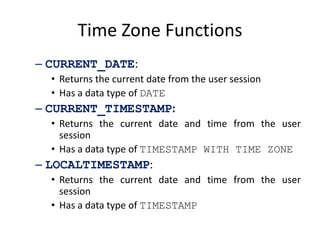
– CURRENT_DATE:
• Returns the current date from the user session
• Has a data type of DATE
– CURRENT_TIMESTAMP:
• Returns the current date and time from the user
session
• Has a data type of TIMESTAMP WITH TIME ZONE
– LOCALTIMESTAMP:
• Returns the current date and time from the user
session
• Has a data type of TIMESTAMP
Time Zone Functions
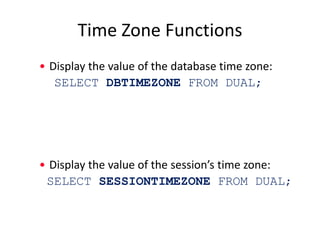
• Display the value of the database time zone:
SELECT DBTIMEZONE FROM DUAL;
• Display the value of the session’s time zone:
SELECT SESSIONTIMEZONE FROM DUAL;
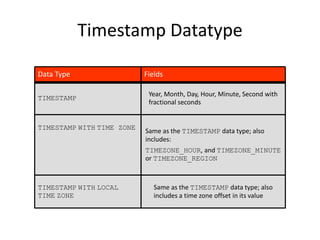
Timestamp Datatype
Same as the TIMESTAMP data type; also
includes a time zone offset in its value
TIMESTAMP WITH LOCAL
TIME ZONE
Same as the TIMESTAMP data type; also
includes:
TIMEZONE_HOUR, and TIMEZONE_MINUTE
or TIMEZONE_REGION
TIMESTAMP WITH TIME ZONE
Year, Month, Day, Hour, Minute, Second with
fractional seconds
TIMESTAMP
FieldsData Type
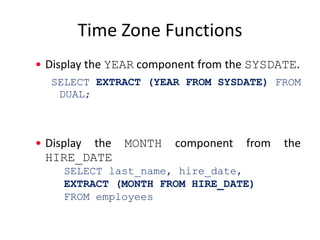
Time Zone Functions
• Display the YEAR component from the SYSDATE.
SELECT EXTRACT (YEAR FROM SYSDATE) FROM
DUAL;
• Display the MONTH component from the
HIRE_DATE
SELECT last_name, hire_date,
EXTRACT (MONTH FROM HIRE_DATE)
FROM employees
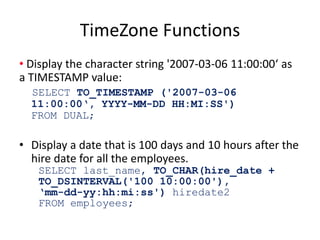
TimeZone Functions
• Display the character string '2007-03-06 11:00:00‘ as
a TIMESTAMP value:
SELECT TO_TIMESTAMP ('2007-03-06
11:00:00‘, YYYY-MM-DD HH:MI:SS')
FROM DUAL;
• Display a date that is 100 days and 10 hours after the
hire date for all the employees.
SELECT last_name, TO_CHAR(hire_date +
TO_DSINTERVAL('100 10:00:00'),
‘mm-dd-yy:hh:mi:ss') hiredate2
FROM employees;
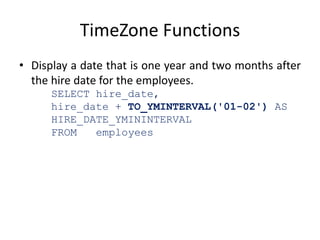
TimeZone Functions
• Display a date that is one year and two months after
the hire date for the employees.
SELECT hire_date,
hire_date + TO_YMINTERVAL('01-02') AS
HIRE_DATE_YMININTERVAL
FROM employees
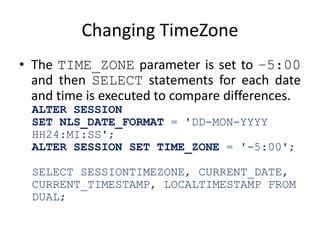
Changing TimeZone
• The TIME_ZONE parameter is set to –5:00
and then SELECT statements for each date
and time is executed to compare differences.
ALTER SESSION
SET NLS_DATE_FORMAT = 'DD-MON-YYYY
HH24:MI:SS';
ALTER SESSION SET TIME_ZONE = '-5:00';
SELECT SESSIONTIMEZONE, CURRENT_DATE,
CURRENT_TIMESTAMP, LOCALTIMESTAMP FROM
DUAL;

10. timestamp

  • 1.
    Managing Data inDifferent Time Zones
  • 2.
    Time Zones • Thehours of the day are measured by the turning of the earth. • The time of day at any particular moment depends on where you are. • The earth is divided into 24 time zones, one for each hour of the day.
  • 3.
    Time Zones • GreenwichMean Time GMT also known as Coordinated Universal Time or UTC. • UTC is the time standard against which all other time zones in the world are referenced. • All time is measured relative to UTC.
  • 4.
    Time Zone Functions –CURRENT_DATE: • Returns the current date from the user session • Has a data type of DATE – CURRENT_TIMESTAMP: • Returns the current date and time from the user session • Has a data type of TIMESTAMP WITH TIME ZONE – LOCALTIMESTAMP: • Returns the current date and time from the user session • Has a data type of TIMESTAMP
  • 5.
    Time Zone Functions •Display the value of the database time zone: SELECT DBTIMEZONE FROM DUAL; • Display the value of the session’s time zone: SELECT SESSIONTIMEZONE FROM DUAL;
  • 6.
    Timestamp Datatype Same asthe TIMESTAMP data type; also includes a time zone offset in its value TIMESTAMP WITH LOCAL TIME ZONE Same as the TIMESTAMP data type; also includes: TIMEZONE_HOUR, and TIMEZONE_MINUTE or TIMEZONE_REGION TIMESTAMP WITH TIME ZONE Year, Month, Day, Hour, Minute, Second with fractional seconds TIMESTAMP FieldsData Type
  • 7.
    Time Zone Functions •Display the YEAR component from the SYSDATE. SELECT EXTRACT (YEAR FROM SYSDATE) FROM DUAL; • Display the MONTH component from the HIRE_DATE SELECT last_name, hire_date, EXTRACT (MONTH FROM HIRE_DATE) FROM employees
  • 8.
    TimeZone Functions • Displaythe character string '2007-03-06 11:00:00‘ as a TIMESTAMP value: SELECT TO_TIMESTAMP ('2007-03-06 11:00:00‘, YYYY-MM-DD HH:MI:SS') FROM DUAL; • Display a date that is 100 days and 10 hours after the hire date for all the employees. SELECT last_name, TO_CHAR(hire_date + TO_DSINTERVAL('100 10:00:00'), ‘mm-dd-yy:hh:mi:ss') hiredate2 FROM employees;
  • 9.
    TimeZone Functions • Displaya date that is one year and two months after the hire date for the employees. SELECT hire_date, hire_date + TO_YMINTERVAL('01-02') AS HIRE_DATE_YMININTERVAL FROM employees
  • 10.
    Changing TimeZone • TheTIME_ZONE parameter is set to –5:00 and then SELECT statements for each date and time is executed to compare differences. ALTER SESSION SET NLS_DATE_FORMAT = 'DD-MON-YYYY HH24:MI:SS'; ALTER SESSION SET TIME_ZONE = '-5:00'; SELECT SESSIONTIMEZONE, CURRENT_DATE, CURRENT_TIMESTAMP, LOCALTIMESTAMP FROM DUAL;