Lesson 1: Coping with Stress in
Middle and Late Adolescence
Gretel T. Ricalde
Misamis University
Oroquieta City
01/28/21
• discuss that understanding stress
and its sources during adolescence
may help in identifying ways to cope
and have a healthy life. (EsP-
PD11/12CS-IE-5.1)
• identify sources of one’s stress and
illustrate the effect of stress on
one’s system. (EsP-PD11/12CS-IE-
5.2), and
• demonstrate personal ways of
coping with stress for healthful
living. (EsP-PD11/12CS-Ie-5.3)
Lesson 1: Coping with Stress in Middle and Late Adolescence 2
At the end of Lesson 1, you are
expected to:
01/28/2
1
Lesson 1: Coping with Stress in Middle and Late Adolescence 3
01/28/21
Lesson 1: Coping with Stress in Middle and Late Adolescence 4
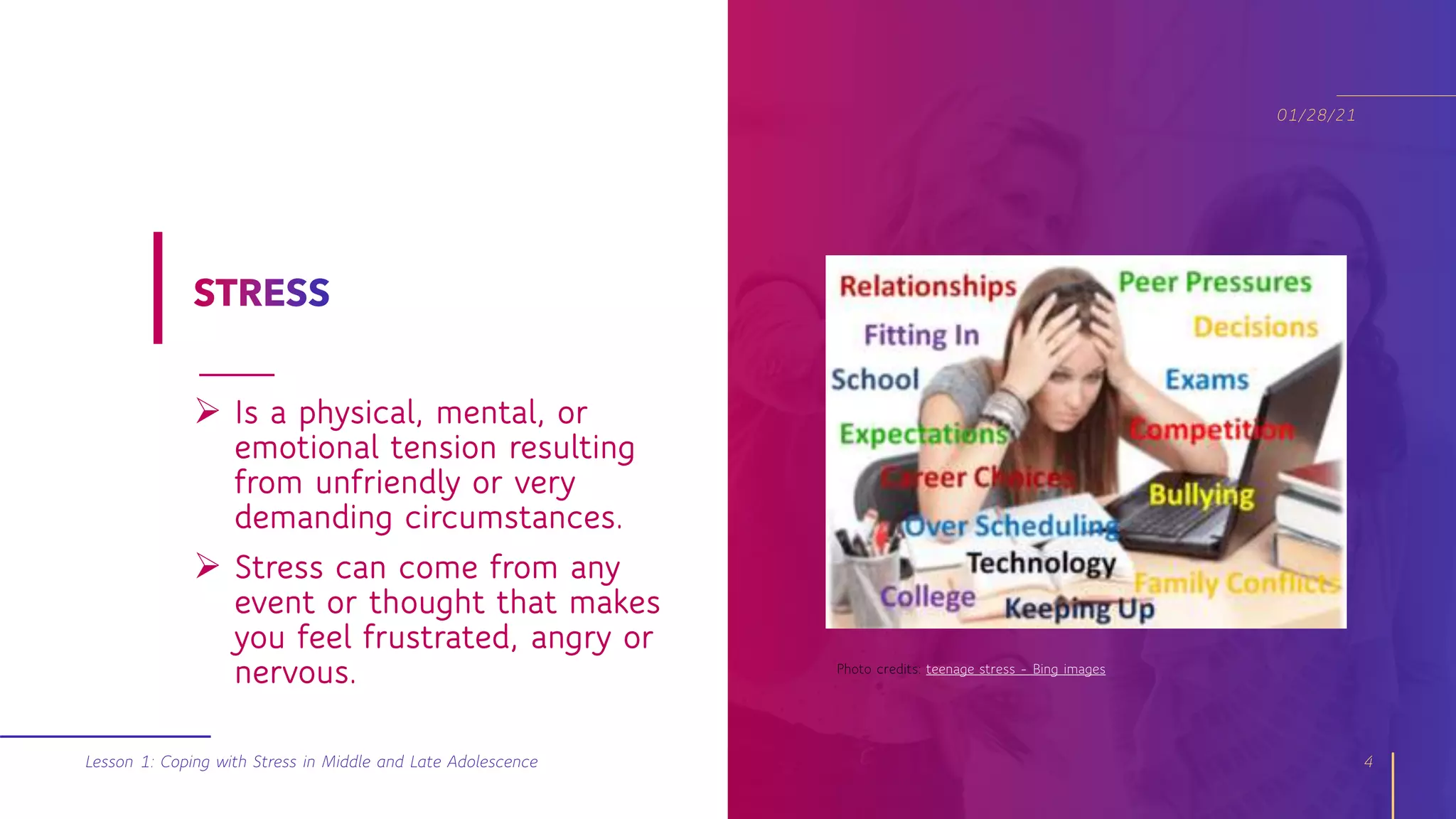
 Is a physical, mental, or
emotional tension resulting
from unfriendly or very
demanding circumstances.
 Stress can come from any
event or thought that makes
you feel frustrated, angry or
nervous.
01/28/21
Photo credits: teenage stress - Bing images
2 TYPES OF STRESS
Eustress
Distress
Lesson 1: Coping with Stress in Middle and Late Adolescence 5
01/28/21
Lesson 1: Coping with Stress in Middle and Late Adolescence 6
 refers to a positive and
healthy response of the body
from a stressor .
 It produces good feelings to
one’s well-being.
01/28/21
Photo credits: happy passing the exam - Bing images
Lesson 1: Coping with Stress in Middle and Late Adolescence 7
 refers to a negative reaction
of the body towards a given
stressor.
 Stressors are the things that
make a person stressed.
01/28/21
Photo credits: Student in Distress Doing Homework - Bing images
STRESS RESPONSE
Lesson 1: Coping with Stress in Middle and Late Adolescence 8
01/28/21
Is the collection of
physiological changes that
happen when you face an
apparent threat from
stressors.
Lesson 1: Coping with Stress in Middle and Late Adolescence 9
01/28/21
Physical symptoms
 like low energy, headaches, stomach upset, muscle pains, chest pains, rapid
heartbeat, insomnia, frequent colds and infections.
Emotional symptoms
 like impatience or irritability, feeling overwhelmed, feeling bad about himself,
restless, frustrated, and moody.
Behavioral symptoms
 like over or under-eating, sleeping too much or too little, social withdrawal
and isolation, reduced work efficiency or productivity, and using cigarette,
alcohol or drugs to relax
Lesson 1: Coping with Stress in Middle and Late Adolescence 10
01/28/21
STRESS MANAGEMENT
Lesson 1: Coping with Stress in Middle and Late Adolescence 11
01/28/21
Is a wide range of
methods and therapies or
treatment aimed at
regulating a person’s level
of stress for a better
everyday functioning.
Lesson 1: Coping with Stress in Middle and Late Adolescence 12
01/28/21
1. Be Optimistic
 Make a list of the things you are
thankful for.
2. Manage your Time
 Organize your daily events
 Learn to prioritize responsibilities
3. Manage your Finances
 Learn how to budget your income
 Distinguish your needs from your wants
4. Learn ways to relax Yourself
 Stay focused
 Listen to music
 Practice meditation, or deep breathing
exercise
Lesson 1: Coping with Stress in Middle and Late Adolescence 13
01/28/21
5. Spend quality time with people who
care.
 Share your feelings with a trusted
friend or family,
 Spend time with optimistic people
6. Take care of your physical health
 Eat well-balanced meals
 Exercise regularly
 Get enough sleep
7. Do something you enjoy
 Read magazine or book
 Sing or watch a favorite movie
8. Express yourself
 Write in a journal
 Create an artwork to express your
feelings
Lesson 1: Coping with Stress in Middle and Late Adolescence 14
01/28/21
 1. Department of Education, Republic of the
Philippines, Personal Development Reader 1st
edition, What is a stress response? by E. Scott
(Quezon City: Sunshine Interlinks Publishing
House Inc., 2016), 33
Lesson 1: Coping with Stress in Middle and Late Adolescence 15
01/28/2
1

Lesson 1 coping with stress in middle and

  • 1.
    Lesson 1: Copingwith Stress in Middle and Late Adolescence Gretel T. Ricalde Misamis University Oroquieta City 01/28/21
  • 2.
    • discuss thatunderstanding stress and its sources during adolescence may help in identifying ways to cope and have a healthy life. (EsP- PD11/12CS-IE-5.1) • identify sources of one’s stress and illustrate the effect of stress on one’s system. (EsP-PD11/12CS-IE- 5.2), and • demonstrate personal ways of coping with stress for healthful living. (EsP-PD11/12CS-Ie-5.3) Lesson 1: Coping with Stress in Middle and Late Adolescence 2 At the end of Lesson 1, you are expected to: 01/28/2 1
  • 3.
    Lesson 1: Copingwith Stress in Middle and Late Adolescence 3 01/28/21
  • 4.
    Lesson 1: Copingwith Stress in Middle and Late Adolescence 4  Is a physical, mental, or emotional tension resulting from unfriendly or very demanding circumstances.  Stress can come from any event or thought that makes you feel frustrated, angry or nervous. 01/28/21 Photo credits: teenage stress - Bing images
  • 5.
    2 TYPES OFSTRESS Eustress Distress Lesson 1: Coping with Stress in Middle and Late Adolescence 5 01/28/21
  • 6.
    Lesson 1: Copingwith Stress in Middle and Late Adolescence 6  refers to a positive and healthy response of the body from a stressor .  It produces good feelings to one’s well-being. 01/28/21 Photo credits: happy passing the exam - Bing images
  • 7.
    Lesson 1: Copingwith Stress in Middle and Late Adolescence 7  refers to a negative reaction of the body towards a given stressor.  Stressors are the things that make a person stressed. 01/28/21 Photo credits: Student in Distress Doing Homework - Bing images
  • 8.
    STRESS RESPONSE Lesson 1:Coping with Stress in Middle and Late Adolescence 8 01/28/21
  • 9.
    Is the collectionof physiological changes that happen when you face an apparent threat from stressors. Lesson 1: Coping with Stress in Middle and Late Adolescence 9 01/28/21
  • 10.
    Physical symptoms  likelow energy, headaches, stomach upset, muscle pains, chest pains, rapid heartbeat, insomnia, frequent colds and infections. Emotional symptoms  like impatience or irritability, feeling overwhelmed, feeling bad about himself, restless, frustrated, and moody. Behavioral symptoms  like over or under-eating, sleeping too much or too little, social withdrawal and isolation, reduced work efficiency or productivity, and using cigarette, alcohol or drugs to relax Lesson 1: Coping with Stress in Middle and Late Adolescence 10 01/28/21
  • 11.
    STRESS MANAGEMENT Lesson 1:Coping with Stress in Middle and Late Adolescence 11 01/28/21
  • 12.
    Is a widerange of methods and therapies or treatment aimed at regulating a person’s level of stress for a better everyday functioning. Lesson 1: Coping with Stress in Middle and Late Adolescence 12 01/28/21
  • 13.
    1. Be Optimistic Make a list of the things you are thankful for. 2. Manage your Time  Organize your daily events  Learn to prioritize responsibilities 3. Manage your Finances  Learn how to budget your income  Distinguish your needs from your wants 4. Learn ways to relax Yourself  Stay focused  Listen to music  Practice meditation, or deep breathing exercise Lesson 1: Coping with Stress in Middle and Late Adolescence 13 01/28/21
  • 14.
    5. Spend qualitytime with people who care.  Share your feelings with a trusted friend or family,  Spend time with optimistic people 6. Take care of your physical health  Eat well-balanced meals  Exercise regularly  Get enough sleep 7. Do something you enjoy  Read magazine or book  Sing or watch a favorite movie 8. Express yourself  Write in a journal  Create an artwork to express your feelings Lesson 1: Coping with Stress in Middle and Late Adolescence 14 01/28/21
  • 15.
     1. Departmentof Education, Republic of the Philippines, Personal Development Reader 1st edition, What is a stress response? by E. Scott (Quezon City: Sunshine Interlinks Publishing House Inc., 2016), 33 Lesson 1: Coping with Stress in Middle and Late Adolescence 15 01/28/2 1

Editor's Notes

  • #2 Stress is the body’s reaction to changes in our life. It affects everyone in diverse ways, either in positive or negative way. In fact, the stress of an exciting life can serve as a right motivator and keep things exciting and interesting. However, if stress level gets too intense, symptoms will be experienced which could really affect our well-being. This lesson will guide you discover your sources of stress and learn a wide variety of stress management techniques to deal with it. In your previous lesson, you learned that as an adolescent, you should prepare yourself for a more challenging adult life by accomplishing various developmental tasks according to developmental stages. Being an adolescent, you should also learn to balance the expectations of the significant persons in your life and your personal aspirations. But before that, let us read the learning competencies about this topic.
  • #5 . It is the body’s response to a threatening situation or change. The manner in which stress affects us depends on how we choose to think about it, and how we respond to it. But do you think that stress is always something negative? Actually, stress can either be negative or positive. There are two kinds of stress – eustress and distress.
  • #6 -
  • #7 Example, a student who studied so hard for the examination then took and got an outstanding grade in it, he may feel happiness and enjoyment. On the other hand,
  • #8 It may alter the mood and emotions, may cause problems in health, and even affect the way a person thinks. For example, when a student failed in his subject he may experience sadness and disappointment.
  • #10 When your stress triggered, series of changes occur within your body; physical, emotional and behavioural changes. Stress is associated with (NEXT SLIDE)
  • #11 2nd: It is also associated with 3rd: Stress has also Indeed, stress can truly affect your body, your thoughts, feelings, and your performance. Being able to recognize common stress symptoms can give you a way on how to manage them.
  • #12 Stress is part of our everyday life. It comes from both the good and bad things that happen to us. If we did not feel any stress, we would not be motivated to do anything, and we would never grow. Too much stress, however, can give negative effect in our mental wellness. It may also put students at higher threat of becoming involved in risk-taking behaviors. So, learning how to prioritize tasks and break them down into manageable steps are important skills to learn for managing stress.
  • #13 Here are some ways to help you cope with stress
  • #15 That concludes my discussion for this session.