Chemical properties of water: Chemical Formula:H 2 O IUPAC Name: Dihydrogen monoxide Water is Amphoteric in nature i.e. it can act as both an acid as well as base. Ex: HCl + H 2 O    H 3 O +  + Cl -  In this reaction water acts as a base . NH 3  + H 2 O    NH 4 +  + OH - In this reaction water acts as a base .
Water is chemically similar to alcohols.  H(OH) ,CnH2n+1(OH)  n=1,2,3,…… If hydrogen in water is substituted by deuterium or tritium then water is called heavy water and super heavy water respectively. Heavy water is used in nuclear power plant to slow down the neutrons while super heavy water is used to determine age of vintage wines.  Water is used as an oxidizing agent in chemical reaction.
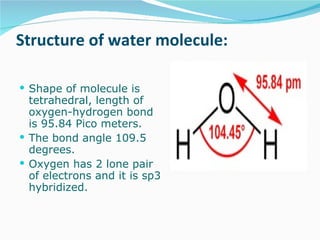
Structure of water molecule:   Shape of molecule is tetrahedral, length of oxygen-hydrogen bond is 95.84 Pico meters. The bond angle 109.5 degrees. Oxygen has 2 lone pair of electrons and it is sp3 hybridized.
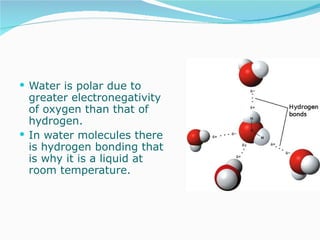
Water is polar due to greater electronegativity of oxygen than that of hydrogen. In water molecules there is hydrogen bonding that is why it is a liquid at room temperature.
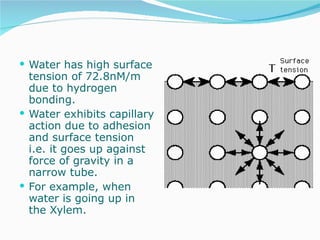
Water has high surface tension of 72.8nM/m due to hydrogen bonding. Water exhibits capillary action due to adhesion and surface tension i.e. it goes up against force of gravity in a narrow tube. For example, when water is going up in the Xylem.
Water   as an universal solvent: Water is good solvent due to its polarity. According to thumb rule ‘Like dissolves like’ it dissolves substances that are polar or there is hydrogen bonding between the molecules of the substance. Various reactions such as biochemical ones take place in aqueous solutions. Substances that dissolve in water are called hydrophilic while those who don’t are called hydrophobic.
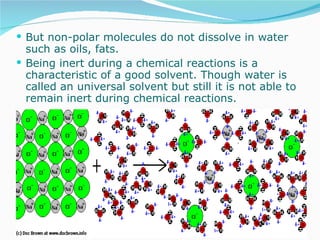
But non-polar molecules do not dissolve in water such as oils, fats. Being inert during a chemical reactions is a characteristic of a good solvent. Though water is called an universal solvent but still it is not able to remain inert during chemical reactions.
Physical properties of water: Water is taste less, colourless and odourless.  Hydrides of other chalcogens except water are gases but water is liquid due to  strong hydrogen bonding. Water has second highest specific heat capacity after ammonia. Therefore it is used as a coolant. Density of water is 1gm/cc at room temperature. Water shows anomalous behavior  due damping of intermolecular vibrations which results in steady hydrogen bonding. At temperature of 0.01 degress C water exists as a gas, liquid, solid. This temperature is called triple-point of water.
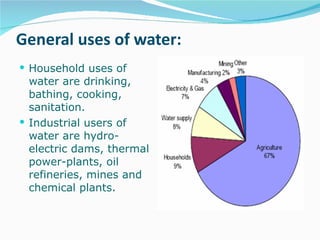
General uses of water: Household uses of water are drinking, bathing, cooking, sanitation. Industrial users of water are hydro-electric dams, thermal power-plants, oil refineries, mines and chemical plants.
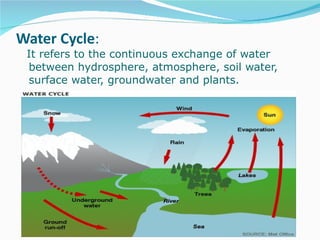
Water Cycle : It refers to the continuous exchange of water between hydrosphere, atmosphere, soil water, surface water, groundwater and plants.
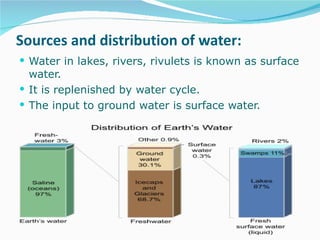
Sources and distribution of water: Water in lakes, rivers, rivulets is known as surface water. It is replenished by water cycle. The input to ground water is surface water.
DISTRIBUTION OF WATER ON EARTH: Ice caps and glaciers - 68.7%, of which Antarctic ice cap - 90%, 9700 years renewal interval Greenland ice cap - 9% Other glaciers - <1%, 1600 years renewal interval Groundwater - 30.1%, 1400 year renewal interval Surface water - 0.3%, of which Freshwater lakes - 87%, 17 years renewal interval swamps - 11% Rivers - 2%, 16 days renewal interval Ground ice and permafrost - 0.86% Atmosphere 0.04%
Class:  9 A Anuj Apte - 9129 Aditya Barve - 9131 Atharva Bhagat - 9139
 

Water

  • 1.
  • 2.
    Chemical properties ofwater: Chemical Formula:H 2 O IUPAC Name: Dihydrogen monoxide Water is Amphoteric in nature i.e. it can act as both an acid as well as base. Ex: HCl + H 2 O  H 3 O + + Cl - In this reaction water acts as a base . NH 3 + H 2 O  NH 4 + + OH - In this reaction water acts as a base .
  • 3.
    Water is chemicallysimilar to alcohols. H(OH) ,CnH2n+1(OH) n=1,2,3,…… If hydrogen in water is substituted by deuterium or tritium then water is called heavy water and super heavy water respectively. Heavy water is used in nuclear power plant to slow down the neutrons while super heavy water is used to determine age of vintage wines. Water is used as an oxidizing agent in chemical reaction.
  • 4.
    Structure of watermolecule: Shape of molecule is tetrahedral, length of oxygen-hydrogen bond is 95.84 Pico meters. The bond angle 109.5 degrees. Oxygen has 2 lone pair of electrons and it is sp3 hybridized.
  • 5.
    Water is polardue to greater electronegativity of oxygen than that of hydrogen. In water molecules there is hydrogen bonding that is why it is a liquid at room temperature.
  • 6.
    Water has highsurface tension of 72.8nM/m due to hydrogen bonding. Water exhibits capillary action due to adhesion and surface tension i.e. it goes up against force of gravity in a narrow tube. For example, when water is going up in the Xylem.
  • 7.
    Water as an universal solvent: Water is good solvent due to its polarity. According to thumb rule ‘Like dissolves like’ it dissolves substances that are polar or there is hydrogen bonding between the molecules of the substance. Various reactions such as biochemical ones take place in aqueous solutions. Substances that dissolve in water are called hydrophilic while those who don’t are called hydrophobic.
  • 8.
    But non-polar moleculesdo not dissolve in water such as oils, fats. Being inert during a chemical reactions is a characteristic of a good solvent. Though water is called an universal solvent but still it is not able to remain inert during chemical reactions.
  • 9.
    Physical properties ofwater: Water is taste less, colourless and odourless. Hydrides of other chalcogens except water are gases but water is liquid due to strong hydrogen bonding. Water has second highest specific heat capacity after ammonia. Therefore it is used as a coolant. Density of water is 1gm/cc at room temperature. Water shows anomalous behavior due damping of intermolecular vibrations which results in steady hydrogen bonding. At temperature of 0.01 degress C water exists as a gas, liquid, solid. This temperature is called triple-point of water.
  • 10.
    General uses ofwater: Household uses of water are drinking, bathing, cooking, sanitation. Industrial users of water are hydro-electric dams, thermal power-plants, oil refineries, mines and chemical plants.
  • 11.
    Water Cycle :It refers to the continuous exchange of water between hydrosphere, atmosphere, soil water, surface water, groundwater and plants.
  • 12.
    Sources and distributionof water: Water in lakes, rivers, rivulets is known as surface water. It is replenished by water cycle. The input to ground water is surface water.
  • 13.
    DISTRIBUTION OF WATERON EARTH: Ice caps and glaciers - 68.7%, of which Antarctic ice cap - 90%, 9700 years renewal interval Greenland ice cap - 9% Other glaciers - <1%, 1600 years renewal interval Groundwater - 30.1%, 1400 year renewal interval Surface water - 0.3%, of which Freshwater lakes - 87%, 17 years renewal interval swamps - 11% Rivers - 2%, 16 days renewal interval Ground ice and permafrost - 0.86% Atmosphere 0.04%
  • 14.
    Class: 9A Anuj Apte - 9129 Aditya Barve - 9131 Atharva Bhagat - 9139
  • 15.