

MSME POLICY IN INDIA
Presented by
Simran Kaur
MBA 2nd year
IGICM
Contents
 Definition of MSME policy
 Evolution of MSME policy
 Importance of MSME sector
 Policy measures in MSME sector
Definition of MSME Policy
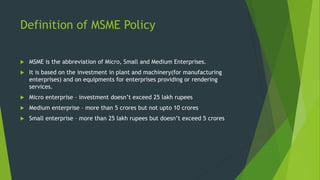
 MSME is the abbreviation of Micro, Small and Medium Enterprises.
 It is based on the investment in plant and machinery(for manufacturing
enterprises) and on equipments for enterprises providing or rendering
services.
 Micro enterprise – investment doesn’t exceed 25 lakh rupees
 Medium enterprise – more than 5 crores but not upto 10 crores
 Small enterprise – more than 25 lakh rupees but doesn’t exceed 5 crores
Evolution of MSME Policy
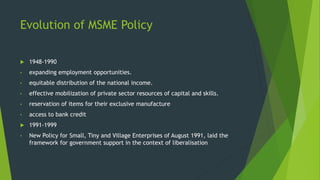
 1948-1990
• expanding employment opportunities.
• equitable distribution of the national income.
• effective mobilization of private sector resources of capital and skills.
• reservation of items for their exclusive manufacture
• access to bank credit
 1991-1999
• New Policy for Small, Tiny and Village Enterprises of August 1991, laid the
framework for government support in the context of liberalisation
Evolution of MSME Policy(contd.)
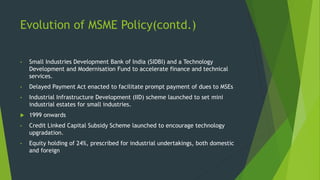
• Small Industries Development Bank of India (SIDBI) and a Technology
Development and Modernisation Fund to accelerate finance and technical
services.
• Delayed Payment Act enacted to facilitate prompt payment of dues to MSEs
• Industrial Infrastructure Development (IID) scheme launched to set mini
industrial estates for small industries.
 1999 onwards
• Credit Linked Capital Subsidy Scheme launched to encourage technology
upgradation.
• Equity holding of 24%, prescribed for industrial undertakings, both domestic
and foreign
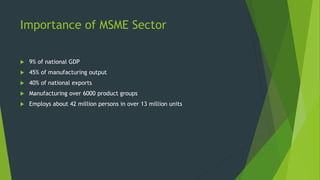
Importance of MSME Sector
 9% of national GDP
 45% of manufacturing output
 40% of national exports
 Manufacturing over 6000 product groups
 Employs about 42 million persons in over 13 million units
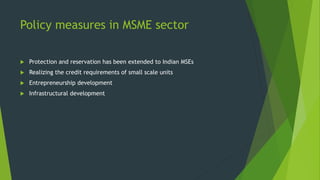
Policy measures in MSME sector
 Protection and reservation has been extended to Indian MSEs
 Realizing the credit requirements of small scale units
 Entrepreneurship development
 Infrastructural development
THANK YOU!!!

Msme policy in india

  • 1.
    MSME POLICY ININDIA Presented by Simran Kaur MBA 2nd year IGICM
  • 2.
    Contents  Definition ofMSME policy  Evolution of MSME policy  Importance of MSME sector  Policy measures in MSME sector
  • 3.
    Definition of MSMEPolicy  MSME is the abbreviation of Micro, Small and Medium Enterprises.  It is based on the investment in plant and machinery(for manufacturing enterprises) and on equipments for enterprises providing or rendering services.  Micro enterprise – investment doesn’t exceed 25 lakh rupees  Medium enterprise – more than 5 crores but not upto 10 crores  Small enterprise – more than 25 lakh rupees but doesn’t exceed 5 crores
  • 4.
    Evolution of MSMEPolicy  1948-1990 • expanding employment opportunities. • equitable distribution of the national income. • effective mobilization of private sector resources of capital and skills. • reservation of items for their exclusive manufacture • access to bank credit  1991-1999 • New Policy for Small, Tiny and Village Enterprises of August 1991, laid the framework for government support in the context of liberalisation
  • 5.
    Evolution of MSMEPolicy(contd.) • Small Industries Development Bank of India (SIDBI) and a Technology Development and Modernisation Fund to accelerate finance and technical services. • Delayed Payment Act enacted to facilitate prompt payment of dues to MSEs • Industrial Infrastructure Development (IID) scheme launched to set mini industrial estates for small industries.  1999 onwards • Credit Linked Capital Subsidy Scheme launched to encourage technology upgradation. • Equity holding of 24%, prescribed for industrial undertakings, both domestic and foreign
  • 6.
    Importance of MSMESector  9% of national GDP  45% of manufacturing output  40% of national exports  Manufacturing over 6000 product groups  Employs about 42 million persons in over 13 million units
  • 7.
    Policy measures inMSME sector  Protection and reservation has been extended to Indian MSEs  Realizing the credit requirements of small scale units  Entrepreneurship development  Infrastructural development
  • 8.