SME Financing
Prepared By
Monirul Hoque Juwel, CITF, CDCS, CECM
SME Credit Policies & Programmes
Master Circular on CMSME Financing
Prudential Regulations for SME Financing
SME Credit Policies & Programmes
Introduction
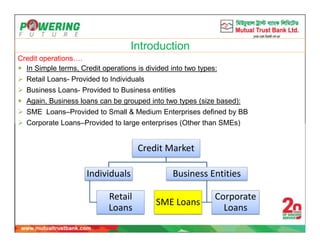
Credit operations….
 In Simple terms, Credit operations is divided into two types:
 Retail Loans- Provided to Individuals
 Business Loans- Provided to Business entities
 Again, Business loans can be grouped into two types (size based):
 SME Loans–Provided to Small & Medium Enterprises defined by BB
 Corporate Loans–Provided to large enterprises (Other than SMEs)
Credit Market
Individuals
Retail
Loans
Business Entities
SME Loans
Corporate
Loans
Programmes for SME Development occupied by BB
SME sector has played a vital role in economic development of a country. BB has
introduced several Programmes to expand SME Enterprises. Such as:
SME loan shall be disbursed to the small, medium and women entrepreneurs.
‘Area Approach Method' as branch wise, region wise & sector wise.
Each bank shall follow a separate business strategy in financing SME loan.
Priority shall be given to small entrepreneurs & credit limit from Tk. 50,000/ to
Tk.50,00,000/-.
Banks shall put highest priority loan application from small and medium women
entrepreneurs.
Bank shall establish a separate ‘Women Entrepreneurs’ Dedicated Desk’ with appoint a
lady officer as chief of dedicated desk.
Banks and financial institutions may sanction up to Tk. 25,00,000 to women
entrepreneurs against personal guarantee.
Each bank fix the interest rate on SME loan. However, bank will ensure disbursement
of refinanced fund to the clients (women entrepreneurs) at Bank rate +5% interest.
Training programs shall be arranged for the entrepreneurs.
Cluster Development Policy
Banks will inform BB after adopting cluster development policy to flourish SME sector.
Objectives of Cluster Development Policy:
To strengthen the existing cluster,
To develop of new clusters in special sector,
To develop & expand sustainable and competitive technology,
To skill develop entrepreneurs,
To develop marketing channels,
To reduce credit risk and
To enhance overall product development.
Strategies for cluster development:
- Identification of the cluster;
- Formation of committee for cluster development;
- Conduct baseline survey & diagnostic study;
- Fixation of action plan;
- Implementation of action plan;
- Review & monitoring.
SME Focuses
- Developing special business segments like Light Engineering, Leather crafts, etc
- Loans to farmers without collateral for regular farming, to meet up seasonal agri
demand and to procure small scale agri machinery
- Agro based farms
- Grocery, telecom and other small scale Shops
- Special attention to Women Entrepreneurs
- Other than these, any productive business enterprise can have SME loan
 SME loans can be Unsecured or Secured depending on the expertise and experience
of the Entrepreneur along with business potential
 Huge numbers of potential SMEs working in Bangladesh, who has strong footage in
business. But many of them do not have enough collaterals or cash security to get
security based loan as per requirement. For them, there is specially designed
products.
 To encourage SME customers, specially designed deposit products
 Also, banks provide Commercial House Building Loan, Commercial Vehicle Loan
under the umbrella of SME Loans
Special programmes for Women Entrepreneurs (WE)
BB has taken some steps and formulated a guideline for the banks to ensure more
institutional financial facilities for women entrepreneurs in SME sector. Such as:
a. At least 15% of total BB refinance fund for SME sector for women entrepreneurs.
b. Interest rate for WE will be Bank rate plus maximum 5%; i.e. not more than 9% p.a.
c. Banks will accept and settle loan applications of SME WE with the highest priority.
d. Banks take initiative to advertise all the facilities for WE in electronic & print media.
e. Banks may provide a max. loan facility of Tk.25,00,000/- against personal guarantee.
f. Banks shall establish special advice and service centre for WE in selected branches
g. Banks ensure service friendly approach towards WE.
a. Identification of the Real Women Entrepreneurs: assistance can be sought from
--BSCIC,
--SME Foundation,
--Handloom/Handicrafts Association,
--Mahila Samity,
--BWCCI,
--WEAB,
--BHWA,
--NASCIB etc.
Monitoring of SME Credit
 To achieve the overall target of SME loan disbursement;
 To achieve sector wise industrialization; such as higher growth of industry and service
sector, increasing the number of WE
 To provide required credit to the small entrepreneurs without any harassment;
 Special monitoring of the banks performance in providing credit to the WE;
 To ensure area approach and cluster-based credit disbursement
 To ensure satisfactory recovery of the disbursed credit to address any liquidity crisis;
 To Prevent Loan Classification
 Return Flow of Funds
 Compliance of Terms and Conditions
 Problem Solving
 Feed Back
 Taking timely corrective measures
Effective SME strategies are taken by Ministry of Industry
Effective SME strategies will be built upon the following six factors, respectively:
1. Access to Finance;
2. Access to Technology and Innovation;
3. Access to Market;
4. Access to education and training;
5. Access to Business Support Services; and
6. Access to information
In order to ensure effective development of SME Sector and entrepreneurs, SME
development strategies have been designed around three elements:
1) Supportive policies and appropriate environment;
2) Sustainable and effective organizations; and
3) Opportunities to provide financial and business support services to prospective
and disadvantaged entrepreneurs.
Implementation Strategies
The following strategies have been set for the development and strengthening of the
country's SME sector in line with the Vision, Mission, Goals and Objectives described in
the SME Policy 2019.
1. Improving business environment and institutional framework;
2. Increasing scope of the SME sector to receive institutional funding facility;
3. Support to increase competitiveness capability and access to SME products market;
4. Support short-term, low cost SME business support services to the start-ups;
5. Develop and expand SME Cluster-based Business Network;
6. Increase use of ICT and other technologies;
7. Expansion of skill developing education and training programs for entrepreneurs;
8. Expanding women entrepreneurship development programs and providing
specialized services;
9. Establishing SME as a backward and forward linkage enterprises to the large
industries and ensure protection of SME products;
10. Establish environment-friendly SME industries and develop better capacity for waste
management;
11. Institutionalize SME statistics and conduct research and development activities.
Implementing Agency & Coordination with other Agencies
1. Ministry of Industries (MoInd)
2. BSCIC
3. SME Foundation
4. BB (Refinance Scheme, JICA. ADB)
5. BIDA
6. BEZA;
7. Investment Promotion Agency (IPA);
8. BITAC;
9. BCSIR;
10.National Productivity Organization (NPO);
11.BIM
12.FBCCI;
13.National Association of Small and Cottage Industries Bangladesh (NASCIB);
14.Bangladesh Agro Processing Association (BAPA);
15.MCCI;
16.DCCI;
17.CCCI;
18.Bangla Craft;
19.Business Initiative Leading Development (BUILD);
20.Women Entrepreneurs Association of Bangladesh (WEAB)
Prudential Regulations for
Small Enterprises (SE) Financing
Minimum Requirements for Small Enterprise Financing
 Pre-Operation
 Separate risk management capacity
 Comprehensive small enterprise credit policy
 Specific product program guide
 Efficient computer based MIS
 Comprehensive recovery procedures
 Imparting sufficient training
 Preparation of standardized set of borrowing and recourse documents
 Operations
 SE financing must be subject to the bank’s risk management process
 Obtaining declaration from the borrower regarding total exposures
 Strengthening internal audit and control function
 Well equipped accounting and computer systems
Prudential Regulations (Cont….)
Regulation–1: Source and Capacity of Repayment and Cash Flow
backed Lending
 Banks shall specifically identify the sources of repayment and asses the
repayment capacity of the borrower on the basis of assets conversion cycle
and expected future cash flows
 The banks must be able to identify the key drivers of their borrowers
businesses, the key risks to their businesses and their risk mitigates.
Regulation–2: Personal Guarantees
 All facilities to SEs shall be backed by the personal guarantees of the owners of the
SEs. In case of limited companies, guarantees of all directors other than nominee
directors shall be obtained.
Prudential Regulations (Cont….)
Regulation–3: Per Party Exposure Limit
 The minimum and maximum exposure of a bank on a single SE shall remain
within the range of Tk. 2 lac and Tk.50 lac respectively subject to the
following:
 In case of working capital finance - Maximum up to 100% of the net
required working capital or 75% of the sum total of inventory and
receivables whichever is lower.
 In case of fixed assets purchase - Maximum up to 90% of the purchase
price.
Prudential Regulations (Cont….)
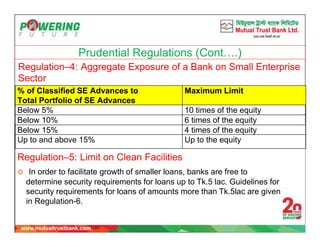
% of Classified SE Advances to
Total Portfolio of SE Advances
Maximum Limit
Below 5% 10 times of the equity
Below 10% 6 times of the equity
Below 15% 4 times of the equity
Up to and above 15% Up to the equity
Regulation–4: Aggregate Exposure of a Bank on Small Enterprise
Sector
Regulation–5: Limit on Clean Facilities
 In order to facilitate growth of smaller loans, banks are free to
determine security requirements for loans up to Tk.5 lac. Guidelines for
security requirements for loans of amounts more than Tk.5lac are given
in Regulation-6.
Prudential Regulations (Cont….)
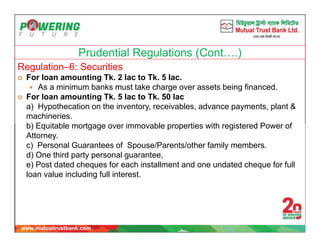
Regulation–6: Securities
 For loan amounting Tk. 2 lac to Tk. 5 lac.
 As a minimum banks must take charge over assets being financed.
 For loan amounting Tk. 5 lac to Tk. 50 lac
a) Hypothecation on the inventory, receivables, advance payments, plant &
machineries.
b) Equitable mortgage over immovable properties with registered Power of
Attorney.
c) Personal Guarantees of Spouse/Parents/other family members.
d) One third party personal guarantee,
e) Post dated cheques for each installment and one undated cheque for full
loan value including full interest.
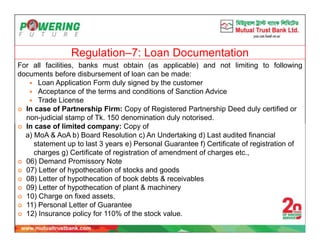
Regulation–7: Loan Documentation
For all facilities, banks must obtain (as applicable) and not limiting to following
documents before disbursement of loan can be made:
 Loan Application Form duly signed by the customer
 Acceptance of the terms and conditions of Sanction Advice
 Trade License
 In case of Partnership Firm: Copy of Registered Partnership Deed duly certified or
non-judicial stamp of Tk. 150 denomination duly notorised.
 In case of limited company: Copy of
a) MoA & AoA b) Board Resolution c) An Undertaking d) Last audited financial
statement up to last 3 years e) Personal Guarantee f) Certificate of registration of
charges g) Certificate of registration of amendment of charges etc.,
 06) Demand Promissory Note
 07) Letter of hypothecation of stocks and goods
 08) Letter of hypothecation of book debts & receivables
 09) Letter of hypothecation of plant & machinery
 10) Charge on fixed assets.
 11) Personal Letter of Guarantee
 12) Insurance policy for 110% of the stock value.
Prudential Regulations (Cont….)
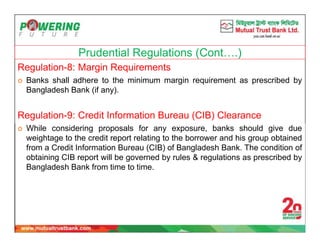
Regulation-8: Margin Requirements
 Banks shall adhere to the minimum margin requirement as prescribed by
Bangladesh Bank (if any).
Regulation-9: Credit Information Bureau (CIB) Clearance
 While considering proposals for any exposure, banks should give due
weightage to the credit report relating to the borrower and his group obtained
from a Credit Information Bureau (CIB) of Bangladesh Bank. The condition of
obtaining CIB report will be governed by rules & regulations as prescribed by
Bangladesh Bank from time to time.
Prudential Regulations (Cont….)
Regulation-10: Minimum Conditions for taking Exposure
 Banks shall, as a matter of rule, obtain a copy of financial statements duly audited by
a practicing Chartered Accountant, relating to the business of every borrower who is a
limited company or where exposure of a bank exceeds Tk.40 lac, for analysis and
record.
 It is recognized that a large number of enterprises other than limited companies (i.e.,
sole proprietorship/ partnership firms etc.) may not have proper books of accounts
including balance sheet, profit & loss account and they may not be able to prepare
current and future cash flows due to lack of sophistication and expertise.
 Each Bank shall develop their own Loan Application Form and ‘Borrowers Basic Fact
Sheet’. Banks shall not approve and/or provide any exposure (including renewal,
enhancement and rescheduling) until and unless the prescribed Loan Application
From is accompanied by a ‘Borrower’s Basic Fact Sheet under the seal and signature
of the borrower.
Prudential Regulations (Cont….)
Regulation-11: Proper Utilization of Loan
 The Bank should ensure that the loans have been properly utilized by the
SEs and for the same purposes for which they were acquired / obtained.
Banks should develop and implement an appropriate system for monitoring
the utilization of loans.
Regulation-12: Restriction on Facilities to related Parties
 Banks shall not take any exposure on a SE in which any of its director,
shareholder, employee or their immediate family members are holding 5% or
more of the share capital of the SE.
Prudential Regulations
Regulation-13: Classification and Provisioning for Assets
 LOANS / ADVANCES
 Banks shall observe the prudential guidelines given in the matter of classification
of their SME asset portfolio and provisioning there-against.
 Loan Classification Criteria for SE Financing
 Submission of Returns
 Timing of Creating Provisions
 Reversal of Provision
 Verification by the Auditors
Policy Development Guidelines (Cont.…)
1. Policy Guidelines
 Product Program Guidelines (PPG)
 Segregation of Duties
 Credit Approval
-Credit Approval Authority
2. Procedural Guidelines
 Approval Process
-De Duplication Check
-Maintenance of Negative Files
• Credit Administration
-Credit Documentation
-Disbursement
-Custodial Duties
-Compliance Requirements
 Risk Management
-Credit Risk
-Third Party Risk
-Fraud Risk
-Liquidity and funding risk
-Political & Economic Risks
-Operational Risk
-Maintenance of Documents & Securities
-Internal Audit
Policy Development Guidelines
 Collection & Remedial Management
-Monitoring
-Recovery
-Collection Objective
-Identification & Allocation of Accounts
-Collection/ Monitoring Steps
-Productivity Tracking
-Agency Arrangement
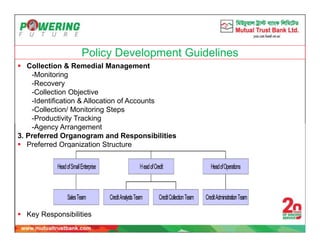
3. Preferred Organogram and Responsibilities
 Preferred Organization Structure
 Key Responsibilities
Master Circular on CMSME Financing
Definitions
 Manufacturing Industry: The branch of manufacture based on the fabrication,
processing, or preparation of products from raw materials and commodities.
 Service Industry: an industry in that part of the economy that creates services rather
than tangible objects.
 Women Entrepreneur (WE): A woman will be termed as a Woman Entrepreneur if
she is the `owner or proprietor of a private or proprietary enterprise’ or `is the director
of a private company’ registered with the `joint stock’ or `shareholding enterprise’ or
owning at least 51% share among the shareholders.
 New Entrepreneur: No loan facility are taken from Bank/ FI as proven by CIB report.
 Priority Sector: 1. Plastic, 2. Foreign worker, 3. Ship building, 4. Ship recycling,
(environment friendly), 5. Tourist, 6. Frozen Fish, 7. Home textile accessories, 8.
Renewable Energy (Solar power, Wind mill), 9. Active & Radio pharmaceutical
integrated industry, 10. Herbal Medicine, 11. Radiation implemented industry, 12.
Polymer production, 13. Hospital & Clinic, 14. Automobile production & repairs, 15.
Handmade & Handicraft,16. Electrical machinery, 17. Tea, 18. Seed industry, 19.
Jewelers, 20. Toy, 21. Cosmetics & Toiletries, 22. Agor Industry, 23. Furniture & 24.
Cement Industry. (According to Industry Policy, 2016)
Definition of CMSME (as per National Industrial Policy, 2016)
Industry/
Enterprise
Industry/
Enterprise
Type
Fixed Assets
(Excluding Land
& Building)
[Million]
Employees Annual
Turnover
[ Million]
Loan
Limit
[Million]
Product
Cottage - Less than 1.00 15 Max - 1.50 Property Loan
Purpose: To purchase/
construct/renovate
house/Flat/commercial
space
Term loan
Purpose: For expansion
of business,
procurement of
machinery and other
fixed assets, seasonal
requirement, any valid
business requirement
Cash Credit
Purpose : For Working
capital requirement
Micro
Manufacturing 1.00 - 7.50 16-30 or less - 10.00
Service Less than 1.00 15 Max - 2.50
Small
Manufacturing 7.50-150.00 31-120 - 200.00
Service 1.00-20.00 16-50 - 50.00
Medium
Manufacturing 150.00 - 500.00
121-300
(Garments
1,000 Max) - 750.00
Service 20.00-300.00 51-120 - 500.00
Business/
Trading
Sector
Micro
Enterprise Less than 1.00 15 Max
20.00
max 5.00
Small
Enterprise 1.00-20.00 16-50
20.00
Min -
200.00
Max 50.00
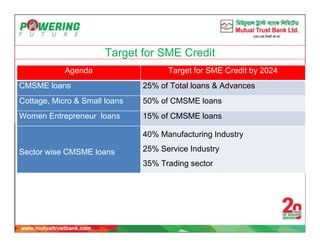
Target for SME Credit
Agenda Target for SME Credit by 2024
CMSME loans 25% of Total loans & Advances
Cottage, Micro & Small loans 50% of CMSME loans
Women Entrepreneur loans 15% of CMSME loans
Sector wise CMSME loans
40% Manufacturing Industry
25% Service Industry
35% Trading sector
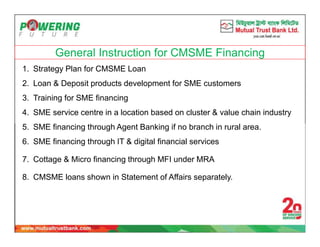
General Instruction for CMSME Financing
1. Strategy Plan for CMSME Loan
2. Loan & Deposit products development for SME customers
3. Training for SME financing
4. SME service centre in a location based on cluster & value chain industry
5. SME financing through Agent Banking if no branch in rural area.
6. SME financing through IT & digital financial services
7. Cottage & Micro financing through MFI under MRA
8. CMSME loans shown in Statement of Affairs separately.
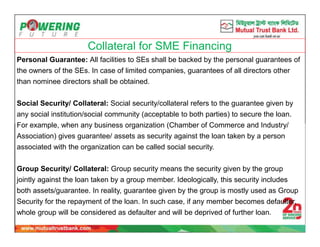
Collateral for SME Financing
Personal Guarantee: All facilities to SEs shall be backed by the personal guarantees of
the owners of the SEs. In case of limited companies, guarantees of all directors other
than nominee directors shall be obtained.
Social Security/ Collateral: Social security/collateral refers to the guarantee given by
any social institution/social community (acceptable to both parties) to secure the loan.
For example, when any business organization (Chamber of Commerce and Industry/
Association) gives guarantee/ assets as security against the loan taken by a person
associated with the organization can be called social security.
Group Security/ Collateral: Group security means the security given by the group
jointly against the loan taken by a group member. Ideologically, this security includes
both assets/guarantee. In reality, guarantee given by the group is mostly used as Group
Security for the repayment of the loan. In such case, if any member becomes defaulter,
whole group will be considered as defaulter and will be deprived of further loan.
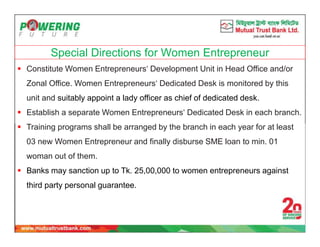
Special Directions for Women Entrepreneur
 Constitute Women Entrepreneurs‘ Development Unit in Head Office and/or
Zonal Office. Women Entrepreneurs‘ Dedicated Desk is monitored by this
unit and suitably appoint a lady officer as chief of dedicated desk.
 Establish a separate Women Entrepreneurs‘ Dedicated Desk in each branch.
 Training programs shall be arranged by the branch in each year for at least
03 new Women Entrepreneur and finally disburse SME loan to min. 01
woman out of them.
 Banks may sanction up to Tk. 25,00,000 to women entrepreneurs against
third party personal guarantee.
Higher Priority Sector for SME Financing
1. Agro-based & agro-processing industry and Agro-tools making industry
2. RMG industry
3. ICT/ Software industry
4. Pharmaceutical industry
5. Leather and leather products industry
6. Light Engineering industry
7. Jute goods and jute mixed goods industry
Matters to consider in Preparation of Credit Proposal
 Scrutiny of information regarding formation of the concern
 Examining required permissions to run the operation
 Gathering knowledge about nature of business
 Involvement of sponsors through observing its constitution
 Observing operation of allied concerns
 Expertise of sponsors and support staffs to run operation of business
 Industry profiling and prospects of business
 Availability of Infrastructure facilities
 Availability of Utility connections
 Availability of required machinery and its spare parts
 Availability of technical persons to run machinery
 Depository relationship with banks
 History of loan facilities availed
 Analyzing financial statements of business
 Marketing aspects including Demand Supply gap scenario of the product of the
borrower company
 Critical examination of collateral documents
Considering the above, assessment of sought credit facilities may be carried out.
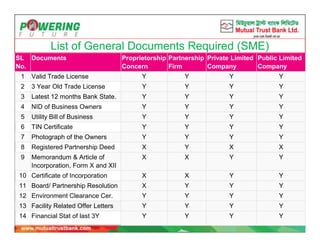
List of General Documents Required (SME)
SL
No.
Documents Proprietorship
Concern
Partnership
Firm
Private Limited
Company
Public Limited
Company
1 Valid Trade License Y Y Y Y
2 3 Year Old Trade License Y Y Y Y
3 Latest 12 months Bank State. Y Y Y Y
4 NID of Business Owners Y Y Y Y
5 Utility Bill of Business Y Y Y Y
6 TIN Certificate Y Y Y Y
7 Photograph of the Owners Y Y Y Y
8 Registered Partnership Deed X Y X X
9 Memorandum & Article of
Incorporation, Form X and XII
X X Y Y
10 Certificate of Incorporation X X Y Y
11 Board/ Partnership Resolution X Y Y Y
12 Environment Clearance Cer. Y Y Y Y
13 Facility Related Offer Letters Y Y Y Y
14 Financial Stat of last 3Y Y Y Y Y
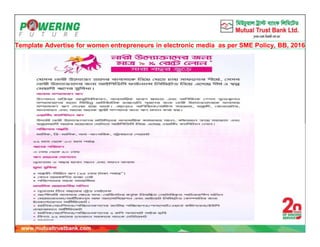
Template Advertise for women entrepreneurs in electronic media as per SME Policy, BB, 2016
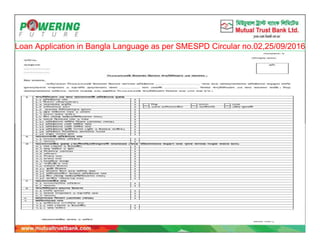
Loan Application in Bangla Language as per SMESPD Circular no.02,25/09/2016
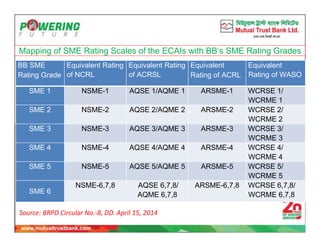
Mapping of SME Rating Scales of the ECAIs with BB’s SME Rating Grades
BB SME
Rating Grade
Equivalent Rating
of NCRL
Equivalent Rating
of ACRSL
Equivalent
Rating of ACRL
Equivalent
Rating of WASO
SME 1 NSME-1 AQSE 1/AQME 1 ARSME-1 WCRSE 1/
WCRME 1
SME 2 NSME-2 AQSE 2/AQME 2 ARSME-2 WCRSE 2/
WCRME 2
SME 3 NSME-3 AQSE 3/AQME 3 ARSME-3 WCRSE 3/
WCRME 3
SME 4 NSME-4 AQSE 4/AQME 4 ARSME-4 WCRSE 4/
WCRME 4
SME 5 NSME-5 AQSE 5/AQME 5 ARSME-5 WCRSE 5/
WCRME 5
SME 6
NSME-6,7,8 AQSE 6,7,8/
AQME 6,7,8
ARSME-6,7,8 WCRSE 6,7,8/
WCRME 6,7,8
Source: BRPD Circular No.-8, DD. April 15, 2014
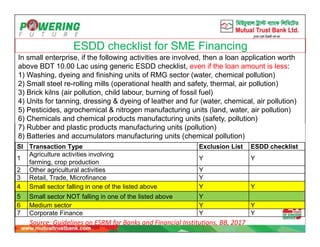
ESDD checklist for SME Financing
In small enterprise, if the following activities are involved, then a loan application worth
above BDT 10.00 Lac using generic ESDD checklist, even if the loan amount is less:
1) Washing, dyeing and finishing units of RMG sector (water, chemical pollution)
2) Small steel re-rolling mills (operational health and safety, thermal, air pollution)
3) Brick kilns (air pollution, child labour, burning of fossil fuel)
4) Units for tanning, dressing & dyeing of leather and fur (water, chemical, air pollution)
5) Pesticides, agrochemical & nitrogen manufacturing units (land, water, air pollution)
6) Chemicals and chemical products manufacturing units (safety, pollution)
7) Rubber and plastic products manufacturing units (pollution)
8) Batteries and accumulators manufacturing units (chemical pollution)
Sl Transaction Type Exclusion List ESDD checklist
1
Agriculture activities involving
farming, crop production
Y Y
2 Other agricultural activities Y
3 Retail, Trade, Microfinance Y
4 Small sector falling in one of the listed above Y Y
5 Small sector NOT falling in one of the listed above Y
6 Medium sector Y Y
7 Corporate Finance Y Y
Source: Guidelines on ESRM for Banks and Financial Institutions, BB, 2017
SME Financing

SME Financing

  • 1.
    SME Financing Prepared By MonirulHoque Juwel, CITF, CDCS, CECM
  • 2.
    SME Credit Policies& Programmes Master Circular on CMSME Financing Prudential Regulations for SME Financing
  • 3.
    SME Credit Policies& Programmes
  • 4.
    Introduction Credit operations….  InSimple terms, Credit operations is divided into two types:  Retail Loans- Provided to Individuals  Business Loans- Provided to Business entities  Again, Business loans can be grouped into two types (size based):  SME Loans–Provided to Small & Medium Enterprises defined by BB  Corporate Loans–Provided to large enterprises (Other than SMEs) Credit Market Individuals Retail Loans Business Entities SME Loans Corporate Loans
  • 5.
    Programmes for SMEDevelopment occupied by BB SME sector has played a vital role in economic development of a country. BB has introduced several Programmes to expand SME Enterprises. Such as: SME loan shall be disbursed to the small, medium and women entrepreneurs. ‘Area Approach Method' as branch wise, region wise & sector wise. Each bank shall follow a separate business strategy in financing SME loan. Priority shall be given to small entrepreneurs & credit limit from Tk. 50,000/ to Tk.50,00,000/-. Banks shall put highest priority loan application from small and medium women entrepreneurs. Bank shall establish a separate ‘Women Entrepreneurs’ Dedicated Desk’ with appoint a lady officer as chief of dedicated desk. Banks and financial institutions may sanction up to Tk. 25,00,000 to women entrepreneurs against personal guarantee. Each bank fix the interest rate on SME loan. However, bank will ensure disbursement of refinanced fund to the clients (women entrepreneurs) at Bank rate +5% interest. Training programs shall be arranged for the entrepreneurs.
  • 6.
    Cluster Development Policy Bankswill inform BB after adopting cluster development policy to flourish SME sector. Objectives of Cluster Development Policy: To strengthen the existing cluster, To develop of new clusters in special sector, To develop & expand sustainable and competitive technology, To skill develop entrepreneurs, To develop marketing channels, To reduce credit risk and To enhance overall product development. Strategies for cluster development: - Identification of the cluster; - Formation of committee for cluster development; - Conduct baseline survey & diagnostic study; - Fixation of action plan; - Implementation of action plan; - Review & monitoring.
  • 7.
    SME Focuses - Developingspecial business segments like Light Engineering, Leather crafts, etc - Loans to farmers without collateral for regular farming, to meet up seasonal agri demand and to procure small scale agri machinery - Agro based farms - Grocery, telecom and other small scale Shops - Special attention to Women Entrepreneurs - Other than these, any productive business enterprise can have SME loan  SME loans can be Unsecured or Secured depending on the expertise and experience of the Entrepreneur along with business potential  Huge numbers of potential SMEs working in Bangladesh, who has strong footage in business. But many of them do not have enough collaterals or cash security to get security based loan as per requirement. For them, there is specially designed products.  To encourage SME customers, specially designed deposit products  Also, banks provide Commercial House Building Loan, Commercial Vehicle Loan under the umbrella of SME Loans
  • 8.
    Special programmes forWomen Entrepreneurs (WE) BB has taken some steps and formulated a guideline for the banks to ensure more institutional financial facilities for women entrepreneurs in SME sector. Such as: a. At least 15% of total BB refinance fund for SME sector for women entrepreneurs. b. Interest rate for WE will be Bank rate plus maximum 5%; i.e. not more than 9% p.a. c. Banks will accept and settle loan applications of SME WE with the highest priority. d. Banks take initiative to advertise all the facilities for WE in electronic & print media. e. Banks may provide a max. loan facility of Tk.25,00,000/- against personal guarantee. f. Banks shall establish special advice and service centre for WE in selected branches g. Banks ensure service friendly approach towards WE. a. Identification of the Real Women Entrepreneurs: assistance can be sought from --BSCIC, --SME Foundation, --Handloom/Handicrafts Association, --Mahila Samity, --BWCCI, --WEAB, --BHWA, --NASCIB etc.
  • 9.
    Monitoring of SMECredit  To achieve the overall target of SME loan disbursement;  To achieve sector wise industrialization; such as higher growth of industry and service sector, increasing the number of WE  To provide required credit to the small entrepreneurs without any harassment;  Special monitoring of the banks performance in providing credit to the WE;  To ensure area approach and cluster-based credit disbursement  To ensure satisfactory recovery of the disbursed credit to address any liquidity crisis;  To Prevent Loan Classification  Return Flow of Funds  Compliance of Terms and Conditions  Problem Solving  Feed Back  Taking timely corrective measures
  • 10.
    Effective SME strategiesare taken by Ministry of Industry Effective SME strategies will be built upon the following six factors, respectively: 1. Access to Finance; 2. Access to Technology and Innovation; 3. Access to Market; 4. Access to education and training; 5. Access to Business Support Services; and 6. Access to information In order to ensure effective development of SME Sector and entrepreneurs, SME development strategies have been designed around three elements: 1) Supportive policies and appropriate environment; 2) Sustainable and effective organizations; and 3) Opportunities to provide financial and business support services to prospective and disadvantaged entrepreneurs.
  • 11.
    Implementation Strategies The followingstrategies have been set for the development and strengthening of the country's SME sector in line with the Vision, Mission, Goals and Objectives described in the SME Policy 2019. 1. Improving business environment and institutional framework; 2. Increasing scope of the SME sector to receive institutional funding facility; 3. Support to increase competitiveness capability and access to SME products market; 4. Support short-term, low cost SME business support services to the start-ups; 5. Develop and expand SME Cluster-based Business Network; 6. Increase use of ICT and other technologies; 7. Expansion of skill developing education and training programs for entrepreneurs; 8. Expanding women entrepreneurship development programs and providing specialized services; 9. Establishing SME as a backward and forward linkage enterprises to the large industries and ensure protection of SME products; 10. Establish environment-friendly SME industries and develop better capacity for waste management; 11. Institutionalize SME statistics and conduct research and development activities.
  • 12.
    Implementing Agency &Coordination with other Agencies 1. Ministry of Industries (MoInd) 2. BSCIC 3. SME Foundation 4. BB (Refinance Scheme, JICA. ADB) 5. BIDA 6. BEZA; 7. Investment Promotion Agency (IPA); 8. BITAC; 9. BCSIR; 10.National Productivity Organization (NPO); 11.BIM 12.FBCCI; 13.National Association of Small and Cottage Industries Bangladesh (NASCIB); 14.Bangladesh Agro Processing Association (BAPA); 15.MCCI; 16.DCCI; 17.CCCI; 18.Bangla Craft; 19.Business Initiative Leading Development (BUILD); 20.Women Entrepreneurs Association of Bangladesh (WEAB)
  • 13.
    Prudential Regulations for SmallEnterprises (SE) Financing
  • 14.
    Minimum Requirements forSmall Enterprise Financing  Pre-Operation  Separate risk management capacity  Comprehensive small enterprise credit policy  Specific product program guide  Efficient computer based MIS  Comprehensive recovery procedures  Imparting sufficient training  Preparation of standardized set of borrowing and recourse documents  Operations  SE financing must be subject to the bank’s risk management process  Obtaining declaration from the borrower regarding total exposures  Strengthening internal audit and control function  Well equipped accounting and computer systems
  • 15.
    Prudential Regulations (Cont….) Regulation–1:Source and Capacity of Repayment and Cash Flow backed Lending  Banks shall specifically identify the sources of repayment and asses the repayment capacity of the borrower on the basis of assets conversion cycle and expected future cash flows  The banks must be able to identify the key drivers of their borrowers businesses, the key risks to their businesses and their risk mitigates. Regulation–2: Personal Guarantees  All facilities to SEs shall be backed by the personal guarantees of the owners of the SEs. In case of limited companies, guarantees of all directors other than nominee directors shall be obtained.
  • 16.
    Prudential Regulations (Cont….) Regulation–3:Per Party Exposure Limit  The minimum and maximum exposure of a bank on a single SE shall remain within the range of Tk. 2 lac and Tk.50 lac respectively subject to the following:  In case of working capital finance - Maximum up to 100% of the net required working capital or 75% of the sum total of inventory and receivables whichever is lower.  In case of fixed assets purchase - Maximum up to 90% of the purchase price.
  • 17.
    Prudential Regulations (Cont….) %of Classified SE Advances to Total Portfolio of SE Advances Maximum Limit Below 5% 10 times of the equity Below 10% 6 times of the equity Below 15% 4 times of the equity Up to and above 15% Up to the equity Regulation–4: Aggregate Exposure of a Bank on Small Enterprise Sector Regulation–5: Limit on Clean Facilities  In order to facilitate growth of smaller loans, banks are free to determine security requirements for loans up to Tk.5 lac. Guidelines for security requirements for loans of amounts more than Tk.5lac are given in Regulation-6.
  • 18.
    Prudential Regulations (Cont….) Regulation–6:Securities  For loan amounting Tk. 2 lac to Tk. 5 lac.  As a minimum banks must take charge over assets being financed.  For loan amounting Tk. 5 lac to Tk. 50 lac a) Hypothecation on the inventory, receivables, advance payments, plant & machineries. b) Equitable mortgage over immovable properties with registered Power of Attorney. c) Personal Guarantees of Spouse/Parents/other family members. d) One third party personal guarantee, e) Post dated cheques for each installment and one undated cheque for full loan value including full interest.
  • 19.
    Regulation–7: Loan Documentation Forall facilities, banks must obtain (as applicable) and not limiting to following documents before disbursement of loan can be made:  Loan Application Form duly signed by the customer  Acceptance of the terms and conditions of Sanction Advice  Trade License  In case of Partnership Firm: Copy of Registered Partnership Deed duly certified or non-judicial stamp of Tk. 150 denomination duly notorised.  In case of limited company: Copy of a) MoA & AoA b) Board Resolution c) An Undertaking d) Last audited financial statement up to last 3 years e) Personal Guarantee f) Certificate of registration of charges g) Certificate of registration of amendment of charges etc.,  06) Demand Promissory Note  07) Letter of hypothecation of stocks and goods  08) Letter of hypothecation of book debts & receivables  09) Letter of hypothecation of plant & machinery  10) Charge on fixed assets.  11) Personal Letter of Guarantee  12) Insurance policy for 110% of the stock value.
  • 20.
    Prudential Regulations (Cont….) Regulation-8:Margin Requirements  Banks shall adhere to the minimum margin requirement as prescribed by Bangladesh Bank (if any). Regulation-9: Credit Information Bureau (CIB) Clearance  While considering proposals for any exposure, banks should give due weightage to the credit report relating to the borrower and his group obtained from a Credit Information Bureau (CIB) of Bangladesh Bank. The condition of obtaining CIB report will be governed by rules & regulations as prescribed by Bangladesh Bank from time to time.
  • 21.
    Prudential Regulations (Cont….) Regulation-10:Minimum Conditions for taking Exposure  Banks shall, as a matter of rule, obtain a copy of financial statements duly audited by a practicing Chartered Accountant, relating to the business of every borrower who is a limited company or where exposure of a bank exceeds Tk.40 lac, for analysis and record.  It is recognized that a large number of enterprises other than limited companies (i.e., sole proprietorship/ partnership firms etc.) may not have proper books of accounts including balance sheet, profit & loss account and they may not be able to prepare current and future cash flows due to lack of sophistication and expertise.  Each Bank shall develop their own Loan Application Form and ‘Borrowers Basic Fact Sheet’. Banks shall not approve and/or provide any exposure (including renewal, enhancement and rescheduling) until and unless the prescribed Loan Application From is accompanied by a ‘Borrower’s Basic Fact Sheet under the seal and signature of the borrower.
  • 22.
    Prudential Regulations (Cont….) Regulation-11:Proper Utilization of Loan  The Bank should ensure that the loans have been properly utilized by the SEs and for the same purposes for which they were acquired / obtained. Banks should develop and implement an appropriate system for monitoring the utilization of loans. Regulation-12: Restriction on Facilities to related Parties  Banks shall not take any exposure on a SE in which any of its director, shareholder, employee or their immediate family members are holding 5% or more of the share capital of the SE.
  • 23.
    Prudential Regulations Regulation-13: Classificationand Provisioning for Assets  LOANS / ADVANCES  Banks shall observe the prudential guidelines given in the matter of classification of their SME asset portfolio and provisioning there-against.  Loan Classification Criteria for SE Financing  Submission of Returns  Timing of Creating Provisions  Reversal of Provision  Verification by the Auditors
  • 24.
    Policy Development Guidelines(Cont.…) 1. Policy Guidelines  Product Program Guidelines (PPG)  Segregation of Duties  Credit Approval -Credit Approval Authority 2. Procedural Guidelines  Approval Process -De Duplication Check -Maintenance of Negative Files • Credit Administration -Credit Documentation -Disbursement -Custodial Duties -Compliance Requirements  Risk Management -Credit Risk -Third Party Risk -Fraud Risk -Liquidity and funding risk -Political & Economic Risks -Operational Risk -Maintenance of Documents & Securities -Internal Audit
  • 25.
    Policy Development Guidelines Collection & Remedial Management -Monitoring -Recovery -Collection Objective -Identification & Allocation of Accounts -Collection/ Monitoring Steps -Productivity Tracking -Agency Arrangement 3. Preferred Organogram and Responsibilities  Preferred Organization Structure  Key Responsibilities
  • 26.
    Master Circular onCMSME Financing
  • 27.
    Definitions  Manufacturing Industry:The branch of manufacture based on the fabrication, processing, or preparation of products from raw materials and commodities.  Service Industry: an industry in that part of the economy that creates services rather than tangible objects.  Women Entrepreneur (WE): A woman will be termed as a Woman Entrepreneur if she is the `owner or proprietor of a private or proprietary enterprise’ or `is the director of a private company’ registered with the `joint stock’ or `shareholding enterprise’ or owning at least 51% share among the shareholders.  New Entrepreneur: No loan facility are taken from Bank/ FI as proven by CIB report.  Priority Sector: 1. Plastic, 2. Foreign worker, 3. Ship building, 4. Ship recycling, (environment friendly), 5. Tourist, 6. Frozen Fish, 7. Home textile accessories, 8. Renewable Energy (Solar power, Wind mill), 9. Active & Radio pharmaceutical integrated industry, 10. Herbal Medicine, 11. Radiation implemented industry, 12. Polymer production, 13. Hospital & Clinic, 14. Automobile production & repairs, 15. Handmade & Handicraft,16. Electrical machinery, 17. Tea, 18. Seed industry, 19. Jewelers, 20. Toy, 21. Cosmetics & Toiletries, 22. Agor Industry, 23. Furniture & 24. Cement Industry. (According to Industry Policy, 2016)
  • 28.
    Definition of CMSME(as per National Industrial Policy, 2016) Industry/ Enterprise Industry/ Enterprise Type Fixed Assets (Excluding Land & Building) [Million] Employees Annual Turnover [ Million] Loan Limit [Million] Product Cottage - Less than 1.00 15 Max - 1.50 Property Loan Purpose: To purchase/ construct/renovate house/Flat/commercial space Term loan Purpose: For expansion of business, procurement of machinery and other fixed assets, seasonal requirement, any valid business requirement Cash Credit Purpose : For Working capital requirement Micro Manufacturing 1.00 - 7.50 16-30 or less - 10.00 Service Less than 1.00 15 Max - 2.50 Small Manufacturing 7.50-150.00 31-120 - 200.00 Service 1.00-20.00 16-50 - 50.00 Medium Manufacturing 150.00 - 500.00 121-300 (Garments 1,000 Max) - 750.00 Service 20.00-300.00 51-120 - 500.00 Business/ Trading Sector Micro Enterprise Less than 1.00 15 Max 20.00 max 5.00 Small Enterprise 1.00-20.00 16-50 20.00 Min - 200.00 Max 50.00
  • 29.
    Target for SMECredit Agenda Target for SME Credit by 2024 CMSME loans 25% of Total loans & Advances Cottage, Micro & Small loans 50% of CMSME loans Women Entrepreneur loans 15% of CMSME loans Sector wise CMSME loans 40% Manufacturing Industry 25% Service Industry 35% Trading sector
  • 30.
    General Instruction forCMSME Financing 1. Strategy Plan for CMSME Loan 2. Loan & Deposit products development for SME customers 3. Training for SME financing 4. SME service centre in a location based on cluster & value chain industry 5. SME financing through Agent Banking if no branch in rural area. 6. SME financing through IT & digital financial services 7. Cottage & Micro financing through MFI under MRA 8. CMSME loans shown in Statement of Affairs separately.
  • 31.
    Collateral for SMEFinancing Personal Guarantee: All facilities to SEs shall be backed by the personal guarantees of the owners of the SEs. In case of limited companies, guarantees of all directors other than nominee directors shall be obtained. Social Security/ Collateral: Social security/collateral refers to the guarantee given by any social institution/social community (acceptable to both parties) to secure the loan. For example, when any business organization (Chamber of Commerce and Industry/ Association) gives guarantee/ assets as security against the loan taken by a person associated with the organization can be called social security. Group Security/ Collateral: Group security means the security given by the group jointly against the loan taken by a group member. Ideologically, this security includes both assets/guarantee. In reality, guarantee given by the group is mostly used as Group Security for the repayment of the loan. In such case, if any member becomes defaulter, whole group will be considered as defaulter and will be deprived of further loan.
  • 32.
    Special Directions forWomen Entrepreneur  Constitute Women Entrepreneurs‘ Development Unit in Head Office and/or Zonal Office. Women Entrepreneurs‘ Dedicated Desk is monitored by this unit and suitably appoint a lady officer as chief of dedicated desk.  Establish a separate Women Entrepreneurs‘ Dedicated Desk in each branch.  Training programs shall be arranged by the branch in each year for at least 03 new Women Entrepreneur and finally disburse SME loan to min. 01 woman out of them.  Banks may sanction up to Tk. 25,00,000 to women entrepreneurs against third party personal guarantee.
  • 33.
    Higher Priority Sectorfor SME Financing 1. Agro-based & agro-processing industry and Agro-tools making industry 2. RMG industry 3. ICT/ Software industry 4. Pharmaceutical industry 5. Leather and leather products industry 6. Light Engineering industry 7. Jute goods and jute mixed goods industry
  • 34.
    Matters to considerin Preparation of Credit Proposal  Scrutiny of information regarding formation of the concern  Examining required permissions to run the operation  Gathering knowledge about nature of business  Involvement of sponsors through observing its constitution  Observing operation of allied concerns  Expertise of sponsors and support staffs to run operation of business  Industry profiling and prospects of business  Availability of Infrastructure facilities  Availability of Utility connections  Availability of required machinery and its spare parts  Availability of technical persons to run machinery  Depository relationship with banks  History of loan facilities availed  Analyzing financial statements of business  Marketing aspects including Demand Supply gap scenario of the product of the borrower company  Critical examination of collateral documents Considering the above, assessment of sought credit facilities may be carried out.
  • 35.
    List of GeneralDocuments Required (SME) SL No. Documents Proprietorship Concern Partnership Firm Private Limited Company Public Limited Company 1 Valid Trade License Y Y Y Y 2 3 Year Old Trade License Y Y Y Y 3 Latest 12 months Bank State. Y Y Y Y 4 NID of Business Owners Y Y Y Y 5 Utility Bill of Business Y Y Y Y 6 TIN Certificate Y Y Y Y 7 Photograph of the Owners Y Y Y Y 8 Registered Partnership Deed X Y X X 9 Memorandum & Article of Incorporation, Form X and XII X X Y Y 10 Certificate of Incorporation X X Y Y 11 Board/ Partnership Resolution X Y Y Y 12 Environment Clearance Cer. Y Y Y Y 13 Facility Related Offer Letters Y Y Y Y 14 Financial Stat of last 3Y Y Y Y Y
  • 36.
    Template Advertise forwomen entrepreneurs in electronic media as per SME Policy, BB, 2016
  • 37.
    Loan Application inBangla Language as per SMESPD Circular no.02,25/09/2016
  • 38.
    Mapping of SMERating Scales of the ECAIs with BB’s SME Rating Grades BB SME Rating Grade Equivalent Rating of NCRL Equivalent Rating of ACRSL Equivalent Rating of ACRL Equivalent Rating of WASO SME 1 NSME-1 AQSE 1/AQME 1 ARSME-1 WCRSE 1/ WCRME 1 SME 2 NSME-2 AQSE 2/AQME 2 ARSME-2 WCRSE 2/ WCRME 2 SME 3 NSME-3 AQSE 3/AQME 3 ARSME-3 WCRSE 3/ WCRME 3 SME 4 NSME-4 AQSE 4/AQME 4 ARSME-4 WCRSE 4/ WCRME 4 SME 5 NSME-5 AQSE 5/AQME 5 ARSME-5 WCRSE 5/ WCRME 5 SME 6 NSME-6,7,8 AQSE 6,7,8/ AQME 6,7,8 ARSME-6,7,8 WCRSE 6,7,8/ WCRME 6,7,8 Source: BRPD Circular No.-8, DD. April 15, 2014
  • 39.
    ESDD checklist forSME Financing In small enterprise, if the following activities are involved, then a loan application worth above BDT 10.00 Lac using generic ESDD checklist, even if the loan amount is less: 1) Washing, dyeing and finishing units of RMG sector (water, chemical pollution) 2) Small steel re-rolling mills (operational health and safety, thermal, air pollution) 3) Brick kilns (air pollution, child labour, burning of fossil fuel) 4) Units for tanning, dressing & dyeing of leather and fur (water, chemical, air pollution) 5) Pesticides, agrochemical & nitrogen manufacturing units (land, water, air pollution) 6) Chemicals and chemical products manufacturing units (safety, pollution) 7) Rubber and plastic products manufacturing units (pollution) 8) Batteries and accumulators manufacturing units (chemical pollution) Sl Transaction Type Exclusion List ESDD checklist 1 Agriculture activities involving farming, crop production Y Y 2 Other agricultural activities Y 3 Retail, Trade, Microfinance Y 4 Small sector falling in one of the listed above Y Y 5 Small sector NOT falling in one of the listed above Y 6 Medium sector Y Y 7 Corporate Finance Y Y Source: Guidelines on ESRM for Banks and Financial Institutions, BB, 2017
  • 40.