Legal Issues in Mobile Security
           Research
           CanSecWest
          March 8, 2012
       Marcia Hofmann, EFF
what we’ll talk about today
✪  Why mobile security research presents unique
legal considerations.

✪  Some of the laws you should be aware of when
you’re doing mobile security research.

✪  Ways to reduce whatever risk your research
might create.
what do I mean by “risk”?
        A couple distinct, separate things.

   (1) The likelihood of becoming an attractive
target for a law suit or prosecution, either with or
                   without basis.

(2) The likelihood that a court might decide that
           you’ve run afoul of the law.
My goal today is not to frighten you or
       discourage your research.

I want to help you spot potentially sticky
situations so that you can call a lawyer early
      to help you safely navigate them.

I also want to help you think proactively
about ways to design your research to avoid
                  trouble.
This is not legal advice.

If you are concerned about the legality of your
    research, you should speak with a lawyer
          about your specific situation.
What makes mobile security research
       legally interesting?
factors
✪ Networked devices that access, store and
  transmit vast amounts of information, lots of
  which is intensely personal
✪ Many different players involved in the space:
  manufacturers, platform providers, software
  developers, carriers, users
✪ Embedded software (tricky © issues)
some legal considerations*
contract law
which contracts?

The documents that set out terms purporting to
regulate how people can access and use a device/
               program/service.

E.g., end-user license agreements, SDK licenses,
           terms of use, carrier contracts
Be sure to check whether more than one
    agreement might apply to your research.

Also see whether other agreements/policies are
 incorporated be reference, and read them, too.
laws that might apply
Violating an agreement could involve:
✪  Breach of contract
  ✪  civil claim
  ✪  monetary damages, if any (compensation for loss)
  ✪  perhaps account terminated

✪  Computer crime laws…?
computer intrusion laws
laws that might apply

Accessing someone else’s computer might involve:
      (1)  Computer Fraud and Abuse Act
              18 U.S.C. § 1030
     (2) Similar state computer crime laws
unauthorized access
The CFAA prohibits, among other things,
“intentionally access[ing] a computer without
 authorization or in excess of authorization, and
 thereby obtain[ing] . . . information from any
 protected computer.”
18 U.S.C. § 1030(a)(2)(C).
Folks have tried to make creative arguments
   for defining “unauthorized” to include
            violating agreements…
           United States v. Drew
        Facebook v. Power Ventures
               Sony v. Hotz
This is especially problematic because the
 CFAA is both a civil and criminal law.
Also, one court recently held that designing
   a tool to avoid IP blocking violated the
                    CFAA.

        Facebook v. Power Ventures
copyright laws
laws that might apply
Accessing and making copies of someone else’s
        copyrighted code might involve:
        (1)  Copyright Act (copying)
          17 U.S.C. §§ 101 et seq.
   (2) Digital Millennium Copyright Act
    (accessing/enabling others to access)
             17 U.S.C. § 1201
Copyright Act
✪  Broadly prohibits infringement of copyrighted
 works.
✪  This includes making copies of code written by
  others.
✪  Stiff penalties (injunctions, statutory damages,
  criminal penalties).
important exception #1: fair use

   It’s OK to use copyrighted material for
  purposes such as research, news reporting,
commentary, criticism, and scholarship under
            certain circumstances.
important exception #1: fair use
      Four-factor balancing test
  ✪ Purpose and character of the use
  ✪ Nature of the copied work
  ✪ Amount and substantiality used
  ✪ Effect on the market
fair use and reverse engineering
If reverse engineering is necessary to gain access
to functional processes and ideas, intermediate
copies are fair use.

Be sure that you’re legitimately in possession of
the software, and don’t use someone else’s code in
your final product unless absolutely necessary.
contracts revisited

Some agreements forbid reverse engineering.

            Can they do that?


         So far, the courts say yes.
important exception #2: Section 117

The owner of a copy of a computer program
  may copy or adapt it as “an essential step
 in the utilization of the computer program
              with a machine[.]”
Digital Millennium Copyright Act
          Two basic prohibitions:
(1) Can’t circumvent technological measures
 that effectively protect or control access to
              copyrighted works
(2) No trafficking in tools that are primarily
   designed, valuable or marketed for (1)
Digital Millennium Copyright Act

  Again, tough civil/criminal penalties.

 (injunctions, statutory damages, criminal
            fines, prison time)
protection/access measures
             CSS
      protocol encryption
   authentication handshakes

    “chain of trust” signing?
       code obfuscation?
     proprietary protocols?
important exceptions

           reverse engineering
          encryption research
            security research
personally identifiable information (PII)
reverse engineering: breakdown
✪  Lawfully obtained the program, and
✪  Circumvention is for the sole purpose of
  identifying and analyzing to achieve program-
  to-program interoperability, and
✪  Information not previously readily available,
 and
✪  Not infringing.
reverse engineering: breakdown

Information learned through reverse engineering
  may be made available to others for the sole
purpose of achieving interoperability, so long as
           doing so isn’t infringing.
encryption research: breakdown
✪  Lawfully obtained the program, and
✪  Circumvention is necessary to conduct the
 research, and
✪  Good faith effort to obtain authorization
 before the circumvention, and
✪  Not infringing.
encryption research: other factors
✪  Was the information disseminated, and if so, in
  a way reasonably to advance the state of
  knowledge, or to facilitate infringement or violate
  other laws?
✪  Is the researcher studying, trained, experienced,
  or employed in the field of encryption research?
✪  Did the researcher give the copyright owner
  notice of the research findings?
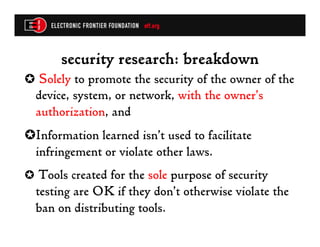
security research: breakdown
✪  Solely to promote the security of the owner of the
  device, system, or network, with the owner’s
  authorization, and
✪ Information learned isn’t used to facilitate
  infringement or violate other laws.
✪  Tools created for the sole purpose of security
  testing are OK if they don’t otherwise violate the
  ban on distributing tools.
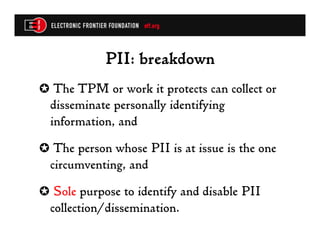
PII: breakdown
✪  The TPM or work it protects can collect or
  disseminate personally identifying
  information, and
✪  The person whose PII is at issue is the one
  circumventing, and
✪  Sole purpose to identify and disable PII
  collection/dissemination.
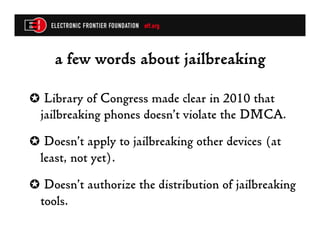
a few words about jailbreaking

✪  Library of Congress made clear in 2010 that
  jailbreaking phones doesn’t violate the DMCA.
✪  Doesn’t apply to jailbreaking other devices (at
  least, not yet).
✪  Doesn’t authorize the distribution of jailbreaking
  tools.
communication laws
laws that might apply
✪  Eavesdropping laws
   ✪  Wiretap Act (18 § U.S.C. 2510 et seq.)
   ✪  State laws

✪  Laws protecting addressing/routing information
   ✪  Pen Register Act (18 U.S.C. § 3121 et seq.)
   ✪  State laws

✪  Laws protecting stored communications
   ✪  Stored Communications Act (18 U.S.C. § 2701 et seq.)
   ✪  State laws
watch out for
✪  Inspecting packets without consent of the
  parties (note one-party vs. all-party consent).
✪  Breaking encryption or descrambling.
✪  These laws are outdated and confusing. It’s
  worth checking in with a lawyer if your research
  involves looking at communications, even just
  routing information.
designing safer research
✪  Identify and read any applicable agreements
 before you begin your research.
✪  Don’t agree, if possible.
✪  Test on your own devices/accounts/data/
 communications.
✪  Get permission to access the device/accounts/
 data/communications.
✪  Make sure that the copy of the software you’re
 studying is legally acquired.
✪  If you make a copy of someone else’s code,
 make sure that you need it to understand how
 the program functions, and don’t copy more
 than you have to.
✪  Avoid making copies of code for a purpose
 other than analyzing how a program works.
✪  Talk to a lawyer before breaking crypto,
 descrambling, or bypassing other security
 measures.

✪  When studying others’ code, consider asking
 permission, even if you don’t think you’ll get it.
questions?

     Marcia Hofmann
Senior Staff Attorney, EFF
      marcia@eff.org

Legal Issues in Mobile Security Research

  • 1.
    Legal Issues inMobile Security Research CanSecWest March 8, 2012 Marcia Hofmann, EFF
  • 2.
    what we’ll talkabout today ✪  Why mobile security research presents unique legal considerations. ✪  Some of the laws you should be aware of when you’re doing mobile security research. ✪  Ways to reduce whatever risk your research might create.
  • 3.
    what do Imean by “risk”? A couple distinct, separate things. (1) The likelihood of becoming an attractive target for a law suit or prosecution, either with or without basis. (2) The likelihood that a court might decide that you’ve run afoul of the law.
  • 4.
    My goal todayis not to frighten you or discourage your research. I want to help you spot potentially sticky situations so that you can call a lawyer early to help you safely navigate them. I also want to help you think proactively about ways to design your research to avoid trouble.
  • 5.
    This is notlegal advice. If you are concerned about the legality of your research, you should speak with a lawyer about your specific situation.
  • 6.
    What makes mobilesecurity research legally interesting?
  • 7.
    factors ✪ Networked devices thataccess, store and transmit vast amounts of information, lots of which is intensely personal ✪ Many different players involved in the space: manufacturers, platform providers, software developers, carriers, users ✪ Embedded software (tricky © issues)
  • 8.
  • 9.
  • 10.
    which contracts? The documentsthat set out terms purporting to regulate how people can access and use a device/ program/service. E.g., end-user license agreements, SDK licenses, terms of use, carrier contracts
  • 11.
    Be sure tocheck whether more than one agreement might apply to your research. Also see whether other agreements/policies are incorporated be reference, and read them, too.
  • 12.
    laws that mightapply Violating an agreement could involve: ✪  Breach of contract ✪  civil claim ✪  monetary damages, if any (compensation for loss) ✪  perhaps account terminated ✪  Computer crime laws…?
  • 13.
  • 14.
    laws that mightapply Accessing someone else’s computer might involve: (1)  Computer Fraud and Abuse Act 18 U.S.C. § 1030 (2) Similar state computer crime laws
  • 15.
    unauthorized access The CFAAprohibits, among other things, “intentionally access[ing] a computer without authorization or in excess of authorization, and thereby obtain[ing] . . . information from any protected computer.” 18 U.S.C. § 1030(a)(2)(C).
  • 16.
    Folks have triedto make creative arguments for defining “unauthorized” to include violating agreements… United States v. Drew Facebook v. Power Ventures Sony v. Hotz
  • 17.
    This is especiallyproblematic because the CFAA is both a civil and criminal law.
  • 18.
    Also, one courtrecently held that designing a tool to avoid IP blocking violated the CFAA. Facebook v. Power Ventures
  • 19.
  • 20.
    laws that mightapply Accessing and making copies of someone else’s copyrighted code might involve: (1)  Copyright Act (copying) 17 U.S.C. §§ 101 et seq. (2) Digital Millennium Copyright Act (accessing/enabling others to access) 17 U.S.C. § 1201
  • 21.
    Copyright Act ✪  Broadlyprohibits infringement of copyrighted works. ✪  This includes making copies of code written by others. ✪  Stiff penalties (injunctions, statutory damages, criminal penalties).
  • 22.
    important exception #1:fair use It’s OK to use copyrighted material for purposes such as research, news reporting, commentary, criticism, and scholarship under certain circumstances.
  • 23.
    important exception #1:fair use Four-factor balancing test ✪ Purpose and character of the use ✪ Nature of the copied work ✪ Amount and substantiality used ✪ Effect on the market
  • 24.
    fair use andreverse engineering If reverse engineering is necessary to gain access to functional processes and ideas, intermediate copies are fair use. Be sure that you’re legitimately in possession of the software, and don’t use someone else’s code in your final product unless absolutely necessary.
  • 25.
    contracts revisited Some agreementsforbid reverse engineering. Can they do that? So far, the courts say yes.
  • 26.
    important exception #2:Section 117 The owner of a copy of a computer program may copy or adapt it as “an essential step in the utilization of the computer program with a machine[.]”
  • 27.
    Digital Millennium CopyrightAct Two basic prohibitions: (1) Can’t circumvent technological measures that effectively protect or control access to copyrighted works (2) No trafficking in tools that are primarily designed, valuable or marketed for (1)
  • 28.
    Digital Millennium CopyrightAct Again, tough civil/criminal penalties. (injunctions, statutory damages, criminal fines, prison time)
  • 29.
    protection/access measures CSS protocol encryption authentication handshakes “chain of trust” signing? code obfuscation? proprietary protocols?
  • 30.
    important exceptions reverse engineering encryption research security research personally identifiable information (PII)
  • 31.
    reverse engineering: breakdown ✪ Lawfully obtained the program, and ✪  Circumvention is for the sole purpose of identifying and analyzing to achieve program- to-program interoperability, and ✪  Information not previously readily available, and ✪  Not infringing.
  • 32.
    reverse engineering: breakdown Informationlearned through reverse engineering may be made available to others for the sole purpose of achieving interoperability, so long as doing so isn’t infringing.
  • 33.
    encryption research: breakdown ✪ Lawfully obtained the program, and ✪  Circumvention is necessary to conduct the research, and ✪  Good faith effort to obtain authorization before the circumvention, and ✪  Not infringing.
  • 34.
    encryption research: otherfactors ✪  Was the information disseminated, and if so, in a way reasonably to advance the state of knowledge, or to facilitate infringement or violate other laws? ✪  Is the researcher studying, trained, experienced, or employed in the field of encryption research? ✪  Did the researcher give the copyright owner notice of the research findings?
  • 35.
    security research: breakdown ✪ Solely to promote the security of the owner of the device, system, or network, with the owner’s authorization, and ✪ Information learned isn’t used to facilitate infringement or violate other laws. ✪  Tools created for the sole purpose of security testing are OK if they don’t otherwise violate the ban on distributing tools.
  • 36.
    PII: breakdown ✪  TheTPM or work it protects can collect or disseminate personally identifying information, and ✪  The person whose PII is at issue is the one circumventing, and ✪  Sole purpose to identify and disable PII collection/dissemination.
  • 37.
    a few wordsabout jailbreaking ✪  Library of Congress made clear in 2010 that jailbreaking phones doesn’t violate the DMCA. ✪  Doesn’t apply to jailbreaking other devices (at least, not yet). ✪  Doesn’t authorize the distribution of jailbreaking tools.
  • 38.
  • 39.
    laws that mightapply ✪  Eavesdropping laws ✪  Wiretap Act (18 § U.S.C. 2510 et seq.) ✪  State laws ✪  Laws protecting addressing/routing information ✪  Pen Register Act (18 U.S.C. § 3121 et seq.) ✪  State laws ✪  Laws protecting stored communications ✪  Stored Communications Act (18 U.S.C. § 2701 et seq.) ✪  State laws
  • 40.
    watch out for ✪ Inspecting packets without consent of the parties (note one-party vs. all-party consent). ✪  Breaking encryption or descrambling. ✪  These laws are outdated and confusing. It’s worth checking in with a lawyer if your research involves looking at communications, even just routing information.
  • 41.
  • 42.
    ✪  Identify andread any applicable agreements before you begin your research. ✪  Don’t agree, if possible. ✪  Test on your own devices/accounts/data/ communications. ✪  Get permission to access the device/accounts/ data/communications.
  • 43.
    ✪  Make surethat the copy of the software you’re studying is legally acquired. ✪  If you make a copy of someone else’s code, make sure that you need it to understand how the program functions, and don’t copy more than you have to. ✪  Avoid making copies of code for a purpose other than analyzing how a program works.
  • 44.
    ✪  Talk toa lawyer before breaking crypto, descrambling, or bypassing other security measures. ✪  When studying others’ code, consider asking permission, even if you don’t think you’ll get it.
  • 45.
    questions? Marcia Hofmann Senior Staff Attorney, EFF marcia@eff.org