Mobile Database Prepared by  Ali M. Alrazgi   Supervisor  Dr. Hassan Najadat
Wireless Characteristics  Mobile Computing Architecture  Mobile Problems . Characteristics of Mobile Environments Data Management Issues
Wireless  Characteristics Data Rates. Range. Interference. Support for packet switching . locality of access  Seamless roaming (Phone ). Wi-Fi , Bluetooth :use unlicensed frequency . Interference
Goal :  Access Information Anywhere, Anytime, and in Any Way. Aliases:   Mobile, Nomadic, Wireless, Pervasive, Invisible Distinction: Fixed wired network: Traditional distributed computing. Fixed wireless network: Wireless computing. Wireless network: Mobile Computing. Applications: Vertical : tracking , point of sales  Horizontal : mail application , filter information provision  new massive markets in conjunction with the Web Mobile Information Appliances - combining personal computing and consumer electronics Mobile and Wireless Computing  & applications
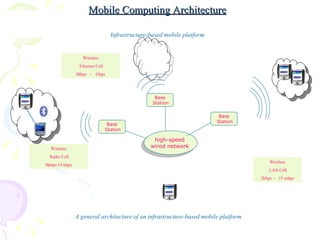
Mobile Computing Architecture Infrastructure-based mobile platform A general architecture of an infrastructure-based mobile platform high-speed  wired network   Base Station Base Station Base Station Wireless LAN Cell 2kbps  -  15 mbps Wireless Radio Cell 9kbps-14 kbps Wireless Ethernet Cell Mbps  -  Gbps
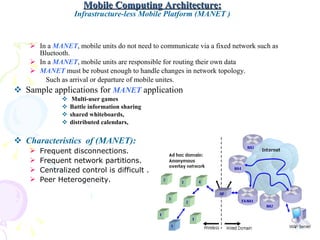
Mobile Ad-Hoc Network (MANET): In a  MANET , mobile units do not need to communicate via a fixed network such as Bluetooth. In a  MANET , mobile units are responsible for routing their own data MANET  must be robust enough to handle changes in network topology.  Such as arrival or departure of mobile unites. Sample applications for  MANET  application Multi-user games Battle information sharing shared whiteboards, distributed calendars,   Characteristics  of (MANET): Frequent disconnections. Frequent network partitions. Centralized control is difficult . Peer Heterogeneity. Mobile Computing Architecture: Infrastructure-less Mobile Platform (MANET )
MANET can fall under Peer-to-Peer  architecture . Peer-to-Peer :   means  that mobile units is simultaneously a client and server . Kinds of Peer-to –Peer : Hybrid P2P Network  : Central server can provide the  information to all peers (Napster) Fully p2p network  :  No central servers  First generation :   routing and querying through broadcasting ,  Causing flooding in the network  . Second generation  :   routing and querying are based on  distributed hash tables Mobile Computing Architecture:
Mobile Problems Software  problems Data management Query & Transaction  processing Security Transaction management Database recovery Hardware problems are more difficult. Limited &  intermittent  of Connectivity . Battery Life . Changes in network topology. Wireless Transmission Speed.
Characteristics of Mobile Environments High communication latency   Latency : Increases the time to service each client request The server can handle fewer clients.  broadcasting data whenever possible  Intermittent wireless connectivity unIntentional :signals cannot reach,  intentional :takeoff of an airplane prerogatives limited battery life Changing client location
Characteristics of Mobile Environments     cont To compensate for high latencies and unreliable connectivity   Caching frequently used data on the mobile device. Increasing data availability and response time Organize data by using the Cluster A client may be unreachable because handoff Proxies for unreachable  (proxy can cache updates intended for the server Proxy automatically forwards these cached updates to their ultimate destination
Data Management  MDB can be distributed under two possible scenarios:   The entire database is distributed mainly among the wired components A base station or fixed host manages its own database query and transaction management  of mobile environments.   The database is distributed among wired and wireless components   Data management responsibility is shared among BS or FH and mobile units.  Additional considerations and variations: Query processing.  Data distribution and replication.  Transaction models. Recovery and backup.  Mobile database design. Location based service.  Division of labor. Security
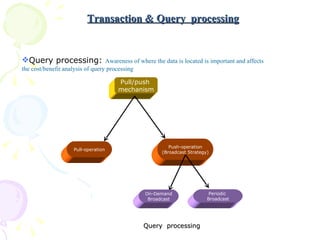
Transaction & Query  processing Query  processing Pull/push  mechanism Pull-operation Push-operation (Broadcast Strategy) On-Demand Broadcast Periodic   Broadcast Query processing:  Awareness of where the data is located is important and affects the cost/benefit analysis of query processing
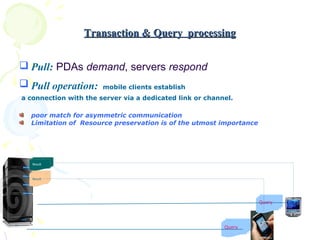
Transaction & Query  processing Pull:  PDAs  demand , servers  respond   Pull operation:   mobile clients establish a connection with the server via a dedicated link or channel. poor match for asymmetric communication Limitation of  Resource preservation is of the utmost importance Query Query Result Result
Transaction & Query  processing Push operation (on-demand broadcast) send queries through dedicated channel, monitors to retrieve result. very large number of request initiated by clients The queries are processed in a group Broadcast is the increase of bandwidth when the client sends the request to the server. The congested channel which that affect on query  performance and power consumption of mobile clients.
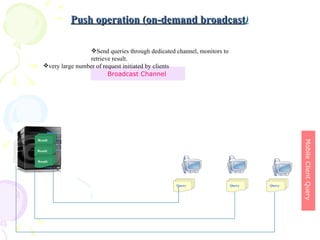
Push operation (on-demand broadcast ) Mobile Client Query  Broadcast Channel  Query  Query  Query  Result   Result Result Send queries through dedicated channel, monitors to retrieve result. very large number of request initiated by clients
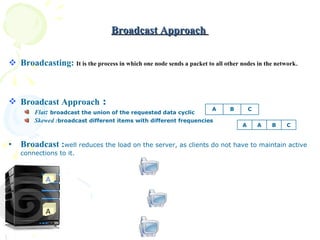
Broadcast Approach  Broadcasting:  It is the process in which one node sends a packet to all other nodes in the network . Broadcast Approach  : Flat :   broadcast the union of the requested data cyclic  Skewed : broadcast different items with different frequencies Broadcast : well reduces the load on the server, as clients do not have to maintain active connections to it. C B A C A A C B A C B A A
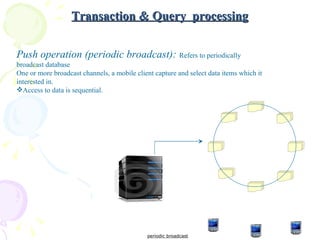
Transaction & Query  processing periodic broadcast Push operation (periodic broadcast):   Refers to periodically broadcast database One or more broadcast channels, a mobile client capture and select data items which it interested in. Access to data is sequential.
Push operation (periodic broadcast) cont Main challenge : minimize query response time (reduce the length of broadcast cycles.) Selection of Data Items to be Broadcast Distribution of Data Items over Multiple Channels (split data) Organization of Data items
Transaction models Transaction models:   A   mobile transaction is executed sequentially through several BS and possibly on multiple data sets depending upon the movement of the MU.   a mobile transaction is expected to be long-lived because of disconnection in mobile units properties of transactions (ACID) : Atomicity Consistency Preservation Isolation Durability
Mobile database design Mobile database design Only the most frequently used data should be stored Minimal the transferred between MU and central-DB Division of labor:   In some cases, the client must function independent of the server.
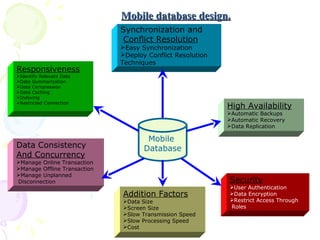
Mobile database design. Synchronization and Conflict Resolution Easy Synchronization  Deploy Conflict Resolution  Techniques Mobile  Database Responsiveness Identify Relevant Data Data Summarization Data Compression Data Caching Indexing Restricted Connection High Availability Automatic Backups Automatic Recovery  Data Replication Security   User Authentication Data Encryption Restrict Access Through Roles Data Consistency  And Concurrency Manage Online Transaction Manage Offline Transaction Manage Unplanned Disconnection Addition Factors Data Size Screen Size Slow Transmission Speed Slow Processing Speed Cost
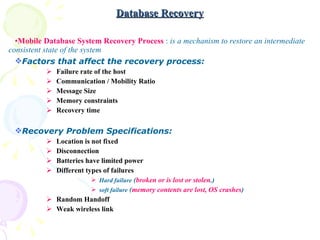
Database Recovery Mobile Database System Recovery Process  :  is a mechanism to restore an intermediate consistent state of the system Factors that affect the recovery process: Failure rate of the host Communication / Mobility Ratio Message Size Memory constraints Recovery time Recovery Problem Specifications: Location is not fixed Disconnection Batteries have limited power Different types of failures Hard failure  ( broken or is lost or stolen .) soft failure  ( memory contents are lost, OS crashes ) Random Handoff Weak wireless link
References Elmasri/Navathe  ‘Mobile Database’ Ch 30 Agustinus Borgy Waluyo , Bala Srinivasana and David Taniar  ‘Research in mobile database query  optimization and processing’ Ruchika Dua and Saurabh Bhandari  ‘Recovery in Mobile Database System’ Weider D .  Yu, Tamseela Amjad, Himani Goel, Tanakom Talawat  ‘An Approach of Mobile Database Design Methodology for Mobile Software Solutions’
Thank you for your attention
Questions ?

Mobile Database ,alrazgi

  • 1.
    Mobile Database Preparedby Ali M. Alrazgi Supervisor Dr. Hassan Najadat
  • 2.
    Wireless Characteristics Mobile Computing Architecture Mobile Problems . Characteristics of Mobile Environments Data Management Issues
  • 3.
    Wireless CharacteristicsData Rates. Range. Interference. Support for packet switching . locality of access Seamless roaming (Phone ). Wi-Fi , Bluetooth :use unlicensed frequency . Interference
  • 4.
    Goal : Access Information Anywhere, Anytime, and in Any Way. Aliases: Mobile, Nomadic, Wireless, Pervasive, Invisible Distinction: Fixed wired network: Traditional distributed computing. Fixed wireless network: Wireless computing. Wireless network: Mobile Computing. Applications: Vertical : tracking , point of sales Horizontal : mail application , filter information provision new massive markets in conjunction with the Web Mobile Information Appliances - combining personal computing and consumer electronics Mobile and Wireless Computing & applications
  • 5.
    Mobile Computing ArchitectureInfrastructure-based mobile platform A general architecture of an infrastructure-based mobile platform high-speed wired network Base Station Base Station Base Station Wireless LAN Cell 2kbps - 15 mbps Wireless Radio Cell 9kbps-14 kbps Wireless Ethernet Cell Mbps - Gbps
  • 6.
    Mobile Ad-Hoc Network(MANET): In a MANET , mobile units do not need to communicate via a fixed network such as Bluetooth. In a MANET , mobile units are responsible for routing their own data MANET must be robust enough to handle changes in network topology. Such as arrival or departure of mobile unites. Sample applications for MANET application Multi-user games Battle information sharing shared whiteboards, distributed calendars, Characteristics of (MANET): Frequent disconnections. Frequent network partitions. Centralized control is difficult . Peer Heterogeneity. Mobile Computing Architecture: Infrastructure-less Mobile Platform (MANET )
  • 7.
    MANET can fallunder Peer-to-Peer architecture . Peer-to-Peer : means that mobile units is simultaneously a client and server . Kinds of Peer-to –Peer : Hybrid P2P Network : Central server can provide the information to all peers (Napster) Fully p2p network : No central servers First generation : routing and querying through broadcasting , Causing flooding in the network . Second generation : routing and querying are based on distributed hash tables Mobile Computing Architecture:
  • 8.
    Mobile Problems Software problems Data management Query & Transaction processing Security Transaction management Database recovery Hardware problems are more difficult. Limited & intermittent of Connectivity . Battery Life . Changes in network topology. Wireless Transmission Speed.
  • 9.
    Characteristics of MobileEnvironments High communication latency Latency : Increases the time to service each client request The server can handle fewer clients. broadcasting data whenever possible Intermittent wireless connectivity unIntentional :signals cannot reach, intentional :takeoff of an airplane prerogatives limited battery life Changing client location
  • 10.
    Characteristics of MobileEnvironments cont To compensate for high latencies and unreliable connectivity Caching frequently used data on the mobile device. Increasing data availability and response time Organize data by using the Cluster A client may be unreachable because handoff Proxies for unreachable (proxy can cache updates intended for the server Proxy automatically forwards these cached updates to their ultimate destination
  • 11.
    Data Management MDB can be distributed under two possible scenarios: The entire database is distributed mainly among the wired components A base station or fixed host manages its own database query and transaction management of mobile environments. The database is distributed among wired and wireless components Data management responsibility is shared among BS or FH and mobile units. Additional considerations and variations: Query processing. Data distribution and replication. Transaction models. Recovery and backup. Mobile database design. Location based service. Division of labor. Security
  • 12.
    Transaction & Query processing Query processing Pull/push mechanism Pull-operation Push-operation (Broadcast Strategy) On-Demand Broadcast Periodic Broadcast Query processing: Awareness of where the data is located is important and affects the cost/benefit analysis of query processing
  • 13.
    Transaction & Query processing Pull: PDAs demand , servers respond Pull operation: mobile clients establish a connection with the server via a dedicated link or channel. poor match for asymmetric communication Limitation of Resource preservation is of the utmost importance Query Query Result Result
  • 14.
    Transaction & Query processing Push operation (on-demand broadcast) send queries through dedicated channel, monitors to retrieve result. very large number of request initiated by clients The queries are processed in a group Broadcast is the increase of bandwidth when the client sends the request to the server. The congested channel which that affect on query performance and power consumption of mobile clients.
  • 15.
    Push operation (on-demandbroadcast ) Mobile Client Query Broadcast Channel Query Query Query Result Result Result Send queries through dedicated channel, monitors to retrieve result. very large number of request initiated by clients
  • 16.
    Broadcast Approach Broadcasting: It is the process in which one node sends a packet to all other nodes in the network . Broadcast Approach : Flat : broadcast the union of the requested data cyclic Skewed : broadcast different items with different frequencies Broadcast : well reduces the load on the server, as clients do not have to maintain active connections to it. C B A C A A C B A C B A A
  • 17.
    Transaction & Query processing periodic broadcast Push operation (periodic broadcast): Refers to periodically broadcast database One or more broadcast channels, a mobile client capture and select data items which it interested in. Access to data is sequential.
  • 18.
    Push operation (periodicbroadcast) cont Main challenge : minimize query response time (reduce the length of broadcast cycles.) Selection of Data Items to be Broadcast Distribution of Data Items over Multiple Channels (split data) Organization of Data items
  • 19.
    Transaction models Transactionmodels: A mobile transaction is executed sequentially through several BS and possibly on multiple data sets depending upon the movement of the MU. a mobile transaction is expected to be long-lived because of disconnection in mobile units properties of transactions (ACID) : Atomicity Consistency Preservation Isolation Durability
  • 20.
    Mobile database designMobile database design Only the most frequently used data should be stored Minimal the transferred between MU and central-DB Division of labor: In some cases, the client must function independent of the server.
  • 21.
    Mobile database design.Synchronization and Conflict Resolution Easy Synchronization Deploy Conflict Resolution Techniques Mobile Database Responsiveness Identify Relevant Data Data Summarization Data Compression Data Caching Indexing Restricted Connection High Availability Automatic Backups Automatic Recovery Data Replication Security User Authentication Data Encryption Restrict Access Through Roles Data Consistency And Concurrency Manage Online Transaction Manage Offline Transaction Manage Unplanned Disconnection Addition Factors Data Size Screen Size Slow Transmission Speed Slow Processing Speed Cost
  • 22.
    Database Recovery MobileDatabase System Recovery Process : is a mechanism to restore an intermediate consistent state of the system Factors that affect the recovery process: Failure rate of the host Communication / Mobility Ratio Message Size Memory constraints Recovery time Recovery Problem Specifications: Location is not fixed Disconnection Batteries have limited power Different types of failures Hard failure ( broken or is lost or stolen .) soft failure ( memory contents are lost, OS crashes ) Random Handoff Weak wireless link
  • 23.
    References Elmasri/Navathe ‘Mobile Database’ Ch 30 Agustinus Borgy Waluyo , Bala Srinivasana and David Taniar ‘Research in mobile database query optimization and processing’ Ruchika Dua and Saurabh Bhandari ‘Recovery in Mobile Database System’ Weider D . Yu, Tamseela Amjad, Himani Goel, Tanakom Talawat ‘An Approach of Mobile Database Design Methodology for Mobile Software Solutions’
  • 24.
    Thank you foryour attention
  • 25.