Moral and Legal Issues of Computer Ethics
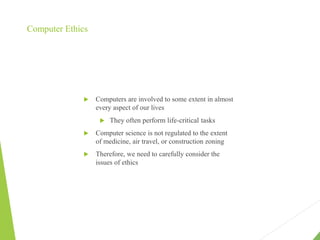
Computer Ethics
 Computers are involved to some extent in almost
every aspect of our lives
 They often perform life-critical tasks
 Computer science is not regulated to the extent
of medicine, air travel, or construction zoning
 Therefore, we need to carefully consider the
issues of ethics
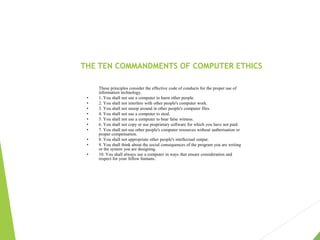
These principles consider the effective code of conducts for the proper use of
information technology.
• 1. You shall not use a computer to harm other people.
• 2. You shall not interfere with other people's computer work.
• 3. You shall not snoop around in other people's computer files.
• 4. You shall not use a computer to steal.
• 5. You shall not use a computer to bear false witness.
• 6. You shall not copy or use proprietary software for which you have not paid.
• 7. You shall not use other people's computer resources without authorisation or
proper compensation.
• 8. You shall not appropriate other people's intellectual output.
• 9. You shall think about the social consequences of the program you are writing
or the system you are designing.
• 10. You shall always use a computer in ways that ensure consideration and
respect for your fellow humans.
THE TEN COMMANDMENTS OF COMPUTER ETHICS
Ethics
 Ethics are standards of moral conduct
 Standards of right and wrong
behavior
 A gauge of personal integrity
 The basis of trust and cooperation
in relationships with others
Ethical Principals
 Ethical principals are tools which are used to
think through difficult situations.
 Three useful ethical principals:
 An act is ethical if all of society benefits from
the act.
 An act is ethical if people are treated as an end
and not as a means to an end.
 An act is ethical if it is fair to all parties
involved.
Computer Ethics
 Computer ethics are morally acceptable use of
computers
 i.e. using computers appropriately
 Standards or guidelines are important in this
industry, because technology changes are
outstripping the legal system’s ability to keep up
Ethics for Computer Professionals
Computer Professionals:
 Are experts in their field,
 Know customers rely on their knowledge, expertise, and
honesty,
 Understand their products (and related risks) affect many
people,
 Follow good professional standards and practices,
 Maintain an expected level of competence and are up-to-date
on current knowledge and technology, and
 Educate the non-computer professional
Computer Ethics
 Four primary issues
 Privacy – responsibility to protect data about
individuals
 Accuracy - responsibility of data collectors to
authenticate information and ensure its accuracy
 Property - who owns information and software
and how can they be sold and exchanged
 Access - responsibility of data collectors to control
access and determine what information a person
has the right to obtain about others and how the
information can be used
Problems with Large Databases
Spreading information without consent
 Some large companies use medical records and
credit records as a factor in important personnel
decisions
Spreading inaccurate information
 Mistakes in one computer file can easily migrate
to others
 Inaccurate data may linger for years
U.S. Federal Privacy Laws
General Federal Privacy Laws:
 Freedom Of Information Act, 1968
 Privacy Act Of 1974
 Electronic Communications Privacy Act Of 1986
 Computer Matching And Privacy Protection Act Of
1988
 Computer Security Act Of 1987
 Federal Internet Privacy Protection Act Of 1997
U.S. Federal Privacy Laws
Privacy Laws Affecting Private Institutions:
 Fair Credit Reporting Act, 1970
 Right To Financial Privacy Act Of 1978
 Privacy Protection Act Of 1980
 Cable Communications Policy Act Of 1984
 Electronic Communications Privacy Act Of 1986
 Video Privacy Protection Act Of 1988
 Consumer Internet Privacy Protection Act Of 1997
 Communications Privacy & Consumer Empowerment Act Of 1997
 Data Privacy Act Of 1997
Private Networks
 Employers may legally monitor electronic mail
1. In 2001, 63% of companies monitored
employee Internet connections including about
two-thirds of the 60 billion electronic messages
sent by 40 million e-mail users.
 Most online services reserve the right to censor
content
 These rights lead to contentious issues over
property rights versus free speech and privacy
The Internet and the Web
 Most people don’t worry about email privacy on the
Web due to illusion of anonymity
 Each e-mail you send results in at least 3 or 4 copies
being stored on different computers.
 Web sites often load files on your computer called
cookies to record times and pages visited and other
personal information
 Spyware - software that tracks your online
movements, mines the information stored on your
computer, or uses your computer for some task you
know nothing about.
General Internet Issues
 Inflammatory interchange of messages
via internet (email, chat rooms, etc.)
 Chain mail
 Virus warning hoaxes
 “Spam” – unsolicited, bulk email
E-Mail Netiquette
 Promptly respond to messages.
 Delete messages after you read them if you don’t
need to save the information.
 Don’t send messages you wouldn’t want others
to read.
 Keep the message short and to the point.
 Don’t type in all capital letters.
 Be careful with sarcasm and humor in your
message.
Internet Content & Free Speech Issues
 Information on internet includes hate, violence,
and information that is harmful for children
 How much of this should be regulated?
 Do filters solve problems or create more?
 Is web site information used for course work
and research reliable?
Information Ownership
Issues
 Illegal software copying (pirating)
 Infringement of copyrights by copying of pictures
or text from web pages
 Plagiarism by copying text from other sources
when original work is expected
Terms
INTELLECTUAL PROPERTY: Intangible
creations protected by law
TRADE SECRET: Intellectual work
or products belonging to a business, not in public domain
COPYRIGHT: Statutory grant
protecting intellectual property from copying by others for
28 years
PATENT: Legal
document granting owner exclusive monopoly on an
invention for 17 years
Copyright Laws
 Software developers (or the companies they work
for) own their programs.
 Software buyers only own the right to use the
software according to the license agreement.
 No copying, reselling, lending, renting, leasing,
or distributing is legal without the software
owner’s permission.
Software Licenses
 There are four types of software licenses:
 Public Domain
 Freeware
 Shareware
 All Rights Reserved
Public Domain License
 Public domain software has no owner and is not
protected by copyright law.
 It was either created with public funds, or the
ownership was forfeited by the creator.
 Can be copied, sold, and/or modified
 Often is of poor quality/unreliable
Freeware License
 Freeware is copyrighted software that is licensed
to be copied and distributed without charge.
 Freeware is free, but it’s still under the owner’s
control.
 Examples:
 Eudora Light
 Netscape
Shareware License
 A shareware software license allows you to use the
software for a trial period, but you must pay a
registration fee to the owner for permanent use.
 Some shareware trials expire on a certain date
 Payment depends on the honor system
 Purchasing (the right to use) the software may also
get you a version with more powerful features and
published documentation.
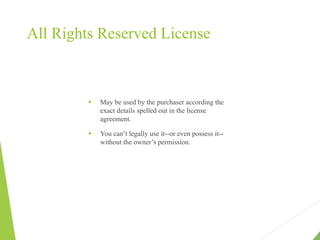
All Rights Reserved License
 May be used by the purchaser according the
exact details spelled out in the license
agreement.
 You can’t legally use it--or even possess it--
without the owner’s permission.
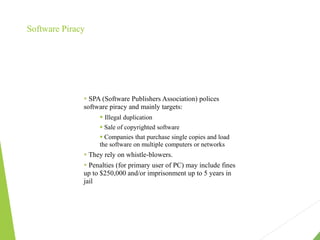
Software Piracy
 SPA (Software Publishers Association) polices
software piracy and mainly targets:
 Illegal duplication
 Sale of copyrighted software
 Companies that purchase single copies and load
the software on multiple computers or networks
 They rely on whistle-blowers.
 Penalties (for primary user of PC) may include fines
up to $250,000 and/or imprisonment up to 5 years in
jail
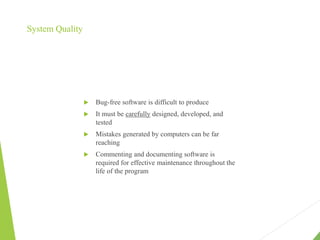
System Quality
 Bug-free software is difficult to produce
 It must be carefully designed, developed, and
tested
 Mistakes generated by computers can be far
reaching
 Commenting and documenting software is
required for effective maintenance throughout the
life of the program
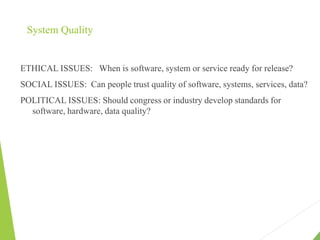
System Quality
ETHICAL ISSUES: When is software, system or service ready for release?
SOCIAL ISSUES: Can people trust quality of software, systems, services, data?
POLITICAL ISSUES: Should congress or industry develop standards for
software, hardware, data quality?
Computer Crime
 Computer criminals -using a computer to commit
an illegal act
 Who are computer criminals?
 Employees – disgruntled or dishonest --the
largest category
 Outside users - customers or suppliers
 “Hackers” and “crackers” - hackers do it “for
fun” but crackers have malicious intent
 Organized crime - tracking illegal enterprises,
forgery, counterfeiting
Types of Computer Crime
 Damage to computers, programs or files
 Viruses - migrate through systems attached to files and
programs
 Worms - continuously self-replicate
 Theft
 Of hardware, software, data, computer time
 Software piracy - unauthorized copies of copyrighted
material
 View/Manipulation
 “Unauthorized entry” and “harmless message” still illegal
Computer Security
 Computer security involves protecting:
 information, hardware and software
 from unauthorized use and damage and
 from sabotage and natural disasters
 Restricting access both to the hardware locations
(physical access) and into the system itself (over the
network) using firewalls
 Implementing a plan to prevent break-ins
 Changing passwords frequently
 Making backup copies
 Using anti-virus software
 Encrypting data to frustrate interception
 Anticipating disasters (disaster recovery plan)
 Hiring trustworthy employees
Measures to Protect Computer
Security
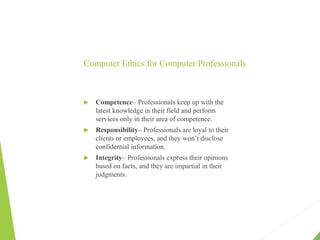
Computer Ethics for Computer Professionals
 Competence– Professionals keep up with the
latest knowledge in their field and perform
services only in their area of competence.
 Responsibility– Professionals are loyal to their
clients or employees, and they won’t disclose
confidential information.
 Integrity– Professionals express their opinions
based on facts, and they are impartial in their
judgments.
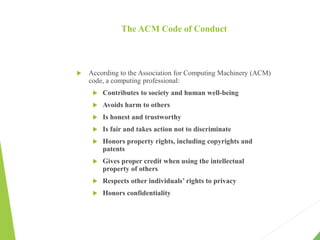
The ACM Code of Conduct
 According to the Association for Computing Machinery (ACM)
code, a computing professional:
 Contributes to society and human well-being
 Avoids harm to others
 Is honest and trustworthy
 Is fair and takes action not to discriminate
 Honors property rights, including copyrights and
patents
 Gives proper credit when using the intellectual
property of others
 Respects other individuals’ rights to privacy
 Honors confidentiality
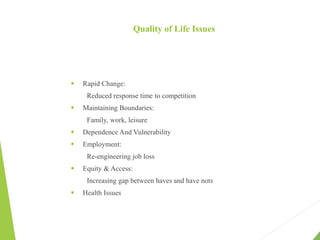
Quality of Life Issues
 Rapid Change:
Reduced response time to competition
 Maintaining Boundaries:
Family, work, leisure
 Dependence And Vulnerability
 Employment:
Re-engineering job loss
 Equity & Access:
Increasing gap between haves and have nots
 Health Issues
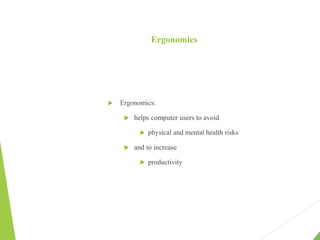
Ergonomics
 Ergonomics:
 helps computer users to avoid
 physical and mental health risks
 and to increase
 productivity
Physical Health Issues
 Avoid eyestrain and headache
1. Take regular breaks every couple of hours
2. Control ambient light and insure adequate monitor
brightness
 Avoid back and neck pain
1. Have adjustable equipment with adequate back
support
2. Keep monitor at, or slightly below eye level
Physical Health Issues
1. Avoid effects of electromagnetic fields (VDT radiation)
 Possible connection to miscarriages and cancers, but no
statistical support yet
 Use caution if pregnant
2. Avoid repetitive strain injury (RSI)
 Injuries from fast, repetitive work
 Carpal tunnel syndrome (CTS) - nerve and tendon damage in
hands and wrists
The Environment
1. Microcomputers are the greatest user of electricity in the
workplace
2. “Green” PCs
 System unit and display - minimize unnecessary energy
consumption and power down when not in use
 Manufacturing - avoids harmful chemicals in production,
focus on chlorofluorocarbons (CFC’s) which some blame for
ozone layer depletion
Personal Responsibility of Users
1. Conserve
 Turn computers off at end of work day
 Use screen savers
2. Recycle
 Most of the paper we use is eligible
 Dispose of old parts via recycling programs –
most computer parts are dangerous in landfills
3. Educate
 Know the facts about ecological issues
THANK YOU

Computer ethics cyber security and technology of it

  • 1.
    Moral and LegalIssues of Computer Ethics
  • 2.
    Computer Ethics  Computersare involved to some extent in almost every aspect of our lives  They often perform life-critical tasks  Computer science is not regulated to the extent of medicine, air travel, or construction zoning  Therefore, we need to carefully consider the issues of ethics
  • 3.
    These principles considerthe effective code of conducts for the proper use of information technology. • 1. You shall not use a computer to harm other people. • 2. You shall not interfere with other people's computer work. • 3. You shall not snoop around in other people's computer files. • 4. You shall not use a computer to steal. • 5. You shall not use a computer to bear false witness. • 6. You shall not copy or use proprietary software for which you have not paid. • 7. You shall not use other people's computer resources without authorisation or proper compensation. • 8. You shall not appropriate other people's intellectual output. • 9. You shall think about the social consequences of the program you are writing or the system you are designing. • 10. You shall always use a computer in ways that ensure consideration and respect for your fellow humans. THE TEN COMMANDMENTS OF COMPUTER ETHICS
  • 4.
    Ethics  Ethics arestandards of moral conduct  Standards of right and wrong behavior  A gauge of personal integrity  The basis of trust and cooperation in relationships with others
  • 5.
    Ethical Principals  Ethicalprincipals are tools which are used to think through difficult situations.  Three useful ethical principals:  An act is ethical if all of society benefits from the act.  An act is ethical if people are treated as an end and not as a means to an end.  An act is ethical if it is fair to all parties involved.
  • 6.
    Computer Ethics  Computerethics are morally acceptable use of computers  i.e. using computers appropriately  Standards or guidelines are important in this industry, because technology changes are outstripping the legal system’s ability to keep up
  • 7.
    Ethics for ComputerProfessionals Computer Professionals:  Are experts in their field,  Know customers rely on their knowledge, expertise, and honesty,  Understand their products (and related risks) affect many people,  Follow good professional standards and practices,  Maintain an expected level of competence and are up-to-date on current knowledge and technology, and  Educate the non-computer professional
  • 8.
    Computer Ethics  Fourprimary issues  Privacy – responsibility to protect data about individuals  Accuracy - responsibility of data collectors to authenticate information and ensure its accuracy  Property - who owns information and software and how can they be sold and exchanged  Access - responsibility of data collectors to control access and determine what information a person has the right to obtain about others and how the information can be used
  • 9.
    Problems with LargeDatabases Spreading information without consent  Some large companies use medical records and credit records as a factor in important personnel decisions Spreading inaccurate information  Mistakes in one computer file can easily migrate to others  Inaccurate data may linger for years
  • 10.
    U.S. Federal PrivacyLaws General Federal Privacy Laws:  Freedom Of Information Act, 1968  Privacy Act Of 1974  Electronic Communications Privacy Act Of 1986  Computer Matching And Privacy Protection Act Of 1988  Computer Security Act Of 1987  Federal Internet Privacy Protection Act Of 1997
  • 11.
    U.S. Federal PrivacyLaws Privacy Laws Affecting Private Institutions:  Fair Credit Reporting Act, 1970  Right To Financial Privacy Act Of 1978  Privacy Protection Act Of 1980  Cable Communications Policy Act Of 1984  Electronic Communications Privacy Act Of 1986  Video Privacy Protection Act Of 1988  Consumer Internet Privacy Protection Act Of 1997  Communications Privacy & Consumer Empowerment Act Of 1997  Data Privacy Act Of 1997
  • 12.
    Private Networks  Employersmay legally monitor electronic mail 1. In 2001, 63% of companies monitored employee Internet connections including about two-thirds of the 60 billion electronic messages sent by 40 million e-mail users.  Most online services reserve the right to censor content  These rights lead to contentious issues over property rights versus free speech and privacy
  • 13.
    The Internet andthe Web  Most people don’t worry about email privacy on the Web due to illusion of anonymity  Each e-mail you send results in at least 3 or 4 copies being stored on different computers.  Web sites often load files on your computer called cookies to record times and pages visited and other personal information  Spyware - software that tracks your online movements, mines the information stored on your computer, or uses your computer for some task you know nothing about.
  • 14.
    General Internet Issues Inflammatory interchange of messages via internet (email, chat rooms, etc.)  Chain mail  Virus warning hoaxes  “Spam” – unsolicited, bulk email
  • 15.
    E-Mail Netiquette  Promptlyrespond to messages.  Delete messages after you read them if you don’t need to save the information.  Don’t send messages you wouldn’t want others to read.  Keep the message short and to the point.  Don’t type in all capital letters.  Be careful with sarcasm and humor in your message.
  • 16.
    Internet Content &Free Speech Issues  Information on internet includes hate, violence, and information that is harmful for children  How much of this should be regulated?  Do filters solve problems or create more?  Is web site information used for course work and research reliable?
  • 17.
    Information Ownership Issues  Illegalsoftware copying (pirating)  Infringement of copyrights by copying of pictures or text from web pages  Plagiarism by copying text from other sources when original work is expected
  • 18.
    Terms INTELLECTUAL PROPERTY: Intangible creationsprotected by law TRADE SECRET: Intellectual work or products belonging to a business, not in public domain COPYRIGHT: Statutory grant protecting intellectual property from copying by others for 28 years PATENT: Legal document granting owner exclusive monopoly on an invention for 17 years
  • 19.
    Copyright Laws  Softwaredevelopers (or the companies they work for) own their programs.  Software buyers only own the right to use the software according to the license agreement.  No copying, reselling, lending, renting, leasing, or distributing is legal without the software owner’s permission.
  • 20.
    Software Licenses  Thereare four types of software licenses:  Public Domain  Freeware  Shareware  All Rights Reserved
  • 21.
    Public Domain License Public domain software has no owner and is not protected by copyright law.  It was either created with public funds, or the ownership was forfeited by the creator.  Can be copied, sold, and/or modified  Often is of poor quality/unreliable
  • 22.
    Freeware License  Freewareis copyrighted software that is licensed to be copied and distributed without charge.  Freeware is free, but it’s still under the owner’s control.  Examples:  Eudora Light  Netscape
  • 23.
    Shareware License  Ashareware software license allows you to use the software for a trial period, but you must pay a registration fee to the owner for permanent use.  Some shareware trials expire on a certain date  Payment depends on the honor system  Purchasing (the right to use) the software may also get you a version with more powerful features and published documentation.
  • 24.
    All Rights ReservedLicense  May be used by the purchaser according the exact details spelled out in the license agreement.  You can’t legally use it--or even possess it-- without the owner’s permission.
  • 25.
    Software Piracy  SPA(Software Publishers Association) polices software piracy and mainly targets:  Illegal duplication  Sale of copyrighted software  Companies that purchase single copies and load the software on multiple computers or networks  They rely on whistle-blowers.  Penalties (for primary user of PC) may include fines up to $250,000 and/or imprisonment up to 5 years in jail
  • 26.
    System Quality  Bug-freesoftware is difficult to produce  It must be carefully designed, developed, and tested  Mistakes generated by computers can be far reaching  Commenting and documenting software is required for effective maintenance throughout the life of the program
  • 27.
    System Quality ETHICAL ISSUES:When is software, system or service ready for release? SOCIAL ISSUES: Can people trust quality of software, systems, services, data? POLITICAL ISSUES: Should congress or industry develop standards for software, hardware, data quality?
  • 28.
    Computer Crime  Computercriminals -using a computer to commit an illegal act  Who are computer criminals?  Employees – disgruntled or dishonest --the largest category  Outside users - customers or suppliers  “Hackers” and “crackers” - hackers do it “for fun” but crackers have malicious intent  Organized crime - tracking illegal enterprises, forgery, counterfeiting
  • 29.
    Types of ComputerCrime  Damage to computers, programs or files  Viruses - migrate through systems attached to files and programs  Worms - continuously self-replicate  Theft  Of hardware, software, data, computer time  Software piracy - unauthorized copies of copyrighted material  View/Manipulation  “Unauthorized entry” and “harmless message” still illegal
  • 30.
    Computer Security  Computersecurity involves protecting:  information, hardware and software  from unauthorized use and damage and  from sabotage and natural disasters
  • 31.
     Restricting accessboth to the hardware locations (physical access) and into the system itself (over the network) using firewalls  Implementing a plan to prevent break-ins  Changing passwords frequently  Making backup copies  Using anti-virus software  Encrypting data to frustrate interception  Anticipating disasters (disaster recovery plan)  Hiring trustworthy employees Measures to Protect Computer Security
  • 32.
    Computer Ethics forComputer Professionals  Competence– Professionals keep up with the latest knowledge in their field and perform services only in their area of competence.  Responsibility– Professionals are loyal to their clients or employees, and they won’t disclose confidential information.  Integrity– Professionals express their opinions based on facts, and they are impartial in their judgments.
  • 33.
    The ACM Codeof Conduct  According to the Association for Computing Machinery (ACM) code, a computing professional:  Contributes to society and human well-being  Avoids harm to others  Is honest and trustworthy  Is fair and takes action not to discriminate  Honors property rights, including copyrights and patents  Gives proper credit when using the intellectual property of others  Respects other individuals’ rights to privacy  Honors confidentiality
  • 34.
    Quality of LifeIssues  Rapid Change: Reduced response time to competition  Maintaining Boundaries: Family, work, leisure  Dependence And Vulnerability  Employment: Re-engineering job loss  Equity & Access: Increasing gap between haves and have nots  Health Issues
  • 35.
    Ergonomics  Ergonomics:  helpscomputer users to avoid  physical and mental health risks  and to increase  productivity
  • 36.
    Physical Health Issues Avoid eyestrain and headache 1. Take regular breaks every couple of hours 2. Control ambient light and insure adequate monitor brightness  Avoid back and neck pain 1. Have adjustable equipment with adequate back support 2. Keep monitor at, or slightly below eye level
  • 37.
    Physical Health Issues 1.Avoid effects of electromagnetic fields (VDT radiation)  Possible connection to miscarriages and cancers, but no statistical support yet  Use caution if pregnant 2. Avoid repetitive strain injury (RSI)  Injuries from fast, repetitive work  Carpal tunnel syndrome (CTS) - nerve and tendon damage in hands and wrists
  • 38.
    The Environment 1. Microcomputersare the greatest user of electricity in the workplace 2. “Green” PCs  System unit and display - minimize unnecessary energy consumption and power down when not in use  Manufacturing - avoids harmful chemicals in production, focus on chlorofluorocarbons (CFC’s) which some blame for ozone layer depletion
  • 39.
    Personal Responsibility ofUsers 1. Conserve  Turn computers off at end of work day  Use screen savers 2. Recycle  Most of the paper we use is eligible  Dispose of old parts via recycling programs – most computer parts are dangerous in landfills 3. Educate  Know the facts about ecological issues
  • 40.