LAPPEENRANTA
UNIVERSITY OF TECHNOLOGY


              Electric Cars
  – Challenge or Opportunity for the
Electricity Distribution Infrastructure?

                                      Jukka Lassila
                     Tero Kaipia, Juha Haakana and Jarmo Partanen
                         Lappeenranta University of Technology


               • Energy Technology                                   ELECTRIFICATION OF MOBILITY
               • Electrical Engineering                             AND THE ELECTRICAL NETWORK
               • Environmental Engineering
                                             1                                        Madrid, Spain
                                                                                November 20th, 2009
LAPPEENRANTA
    UNIVERSITY OF TECHNOLOGY


Target of the studies
• Define method to analyse network effects of electric
  vehicles
• Make network analysis using actual distribution network
  data and load flows (city area and rural area feeders)
• Define best and worst scenarios and define needed
  network reinforcements
• Define network effects to the distribution fees paid by
  the end-customers


                  • Energy Technology
                  • Electrical Engineering
                  • Environmental Engineering
                                                2
LAPPEENRANTA
            UNIVERSITY OF TECHNOLOGY
                                          Input Parameters on Electric Car Network Simulation

National passenger transport survey
National passenger transport survey                                     Area-specific
                                                                        Area-specific
-- Spatial and temporal variations in passenger trips                    additional
                                                                          additional
   Spatial and temporal variations in passenger trips                                                   Charging profile
-- Length of daily trips
                                                                           energy
                                                                           energy
   Length of daily trips
-- Annual length of driving (region dependent)
   Annual length of driving (region dependent)                           __ kWh/day
                                                                         __ kWh/day


                                                                                                Power
-- Length of daily trips according to housing type
   Length of daily trips according to housing type                      (working hours/
                                                                         (working hours/
-- Length of daily trips according to residential area
   Length of daily trips according to residential area                    leisure time)
                                                                           leisure time)
                                                                                                                Hours
-- Length of daily trips according to the month of year
   Length of daily trips according to the month of year
-- Length of trips according to the time of day
   Length of trips according to the time of day
-- Number of cars in households
   Number of cars in households


Properties of electric cars
Properties of electric cars                                    Network simulations and analysis results
                                                               Network simulations and analysis results
-- Energy consumption, kWh/km
   Energy consumption, kWh/km                                  -- Load flow and loss calculations
                                                                  Load flow and loss calculations
-- Capacity of the batteries, kWh
   Capacity of the batteries, kWh                              -- Estimation of reinforcements required
                                                                  Estimation of reinforcements required
-- Charging power, kW
   Charging power, kW
-- Required charging time, h/day (battery properties)
   Required charging time, h/day (battery properties)


Town planning statistics
-- Workplaces according to the area and time of day
   Workplaces according to the area and time of day
-- Residential areas (detached houses, terraced houses,
   Residential areas (detached houses, terraced houses,
   apartment houses)
   apartment houses)                                            Electricity distribution network
                                                                Electricity distribution network
                                                                                                                                                                 MARTINKYLÄ


                                                                -- Network topology and customer information
                                                                   Network topology and customer information
Penetration of electric cars
Penetration of electric cars                                    -- Feeder and hourly-specific actual load curves
                                                                                                                                                                              MASSBY


                                                                   Feeder and hourly-specific actual load curves
                                                                                                                                                                                            KALLBÄCK


                                                                                                                                                                    LANDBO


-- Development of electric car markets
   Development of electric car markets                          -- Network volume
                                                                   Network volume                                                8


                                                                                                                                 7


                                                                -- Replacement value
                                                                   Replacement value                                             6


                                                                                                                                 5


                                                                                                                    Power [MW]
Tariffs and supplier
Tariffs and supplier                                            -- Parameters: loss costs, load growth, lifetime,
                                                                   Parameters: loss costs, load growth, lifetime,
                                                                                                                                 4


                                                                                                                                 3


                                                                   unit price of network components
                                                                   unit price of network components
                                                                                                                                 2


-- Distribution fee
   Distribution fee
                                                                                                                                 1


                                                                                                                                 0
                                                                                                                                     0:00   2:00   4:00   6:00        8:00     10:00    12:00     14:00   16:00   18:00   20:00   22:00

                                                                                                                                                                                  Thursday (hours)


                             • Energy Technology
                             • Electrical Engineering
                             • Environmental Engineering
                                                           3
Case Network
                  LAPPEENRANTA
                  UNIVERSITY OF TECHNOLOGY


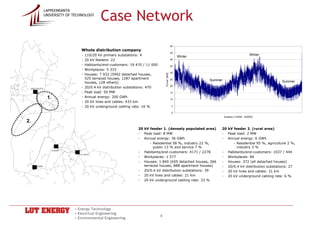
                                     Whole distribution company
                                     -   110/20 kV primary substations: 4                                                        Winter
                                                                                          Winter
                                     -   20 kV feeders: 22
                                     -   Habitants/end-customers: 19 470 / 11 000
                                     -   Workplaces: 5 333
                                     -   Houses: 7 932 (5992 detached houses,
                                         525 terraced houses, 1287 apartment                               Summer
                                         houses, 128 others)                                                                                        Summer

     MARTINKYLÄ                      -   20/0.4 kV distribution substations: 470
                                     -   Peak load: 50 MW
                   1.                -   Annual energy: 200 GWh
                                     -   20 kV lines and cables: 433 km
                                     -   20 kV underground cabling rate: 16 %


2.
                                                                      20 kV feeder 1. (densely populated area)    20 kV feeder 2. (rural area)
                                                                      - Peak load: 8 MW                           - Peak load: 2 MW
                                                                      - Annual energy: 36 GWh                     - Annual energy: 6 GWh
                                                                             - Residential 58 %, industry 22 %,         - Residential 95 %, agriculture 2 %,
                                                                               public 13 % and service 7 %                industry 3 %
                        MASSBY
                                                                      - Habitants/end-customers: 4171 / 2278      - Habitants/end-customers: 1037 / 444
                                   KALLBÄCK
                                                                      - Workplaces: 1 577                         - Workplaces: 84
                                                                      - Houses: 1 840 (659 detached houses, 266   - Houses: 372 (all detached houses)
        LANDBO                                                           terraced houses, 888 apartment houses)   - 20/0.4 kV distribution substations: 27
                                                                      - 20/0.4 kV distribution substations: 39    - 20 kV lines and cables: 31 km
                                                                      - 20 kV lines and cables: 21 km             - 20 kV underground cabling rate: 6 %
                                                                      - 20 kV underground cabling rate: 33 %


                                 • Energy Technology
                                 • Electrical Engineering
                                 • Environmental Engineering
                                                                                    4
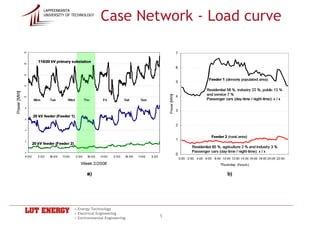
Case Network - Load curve
LAPPEENRANTA
UNIVERSITY OF TECHNOLOGY


              • Energy Technology
              • Electrical Engineering
              • Environmental Engineering
                                            5
Electric Vehicles - Properties
      LAPPEENRANTA
      UNIVERSITY OF TECHNOLOGY


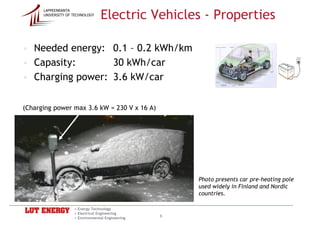
• Needed energy: 0.1 – 0.2 kWh/km
• Capasity:       30 kWh/car
• Charging power: 3.6 kW/car

(Charging power max 3.6 kW = 230 V x 16 A)


                                                      Photo presents car pre-heating pole
                                                      used widely in Finland and Nordic
                                                      countries.

                    • Energy Technology
                    • Electrical Engineering
                    • Environmental Engineering
                                                  6
Case area
        LAPPEENRANTA
        UNIVERSITY OF TECHNOLOGY


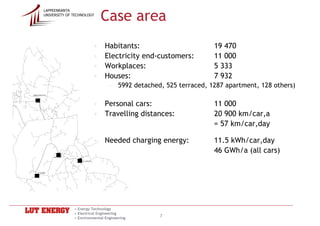
                                    •   Habitants:                       19 470
                                    •   Electricity end-customers:       11 000
                                    •   Workplaces:                      5 333
                                    •   Houses:                          7 932
                                         – 5992 detached, 525 terraced, 1287 apartment, 128 others)
MARTINKYLÄ


                                    • Personal cars:                     11 000
                                    • Travelling distances:              20 900 km/car,a
                                                                         = 57 km/car,day

                                    • Needed charging energy:            11.5 kWh/car,day
                                                                         46 GWh/a (all cars)
             MASSBY

                         KALLBÄCK


   LANDBO


                      • Energy Technology
                      • Electrical Engineering
                      • Environmental Engineering
                                                        7
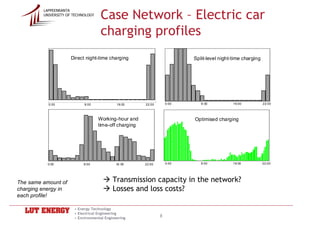
Case Network – Electric car
         LAPPEENRANTA
         UNIVERSITY OF TECHNOLOGY


                                     charging profiles
                     Direct night-time charging                            Split-level night-time charging


           0:00             9:00             16:00      22:00       0:00      9:00           16:00           22:00


                                    Working-hour and                       Optimised charging
                                    time-off charging


           0:00             9:00             16:00      22:00       0:00      9:00           16:00           22:00


The same amount of                         Transmission capacity in the network?
charging energy in                         Losses and loss costs?
each profile!

                       • Energy Technology
                       • Electrical Engineering
                       • Environmental Engineering
                                                                8
Case Network - Losses
                                LAPPEENRANTA
                                UNIVERSITY OF TECHNOLOGY


                   400
                                                      Losses in medium voltage network

                   350
                            Direct night-time charging
                                                                            Working-hour and
                   300
                                                                            time-off charging
                                        Split-level
Load losses [kW]


                   250
                                        night-time
                                        charging
                   200


                   150


                   100

                                                                                 Optimised charging
                   50
                                Present losses

                    0
                         0:00       2:00       4:00        6:00      8:00    10:00   12:00   14:00    16:00   18:00   20:00   22:00


                                              • Energy Technology
                                              • Electrical Engineering
                                              • Environmental Engineering
                                                                                     9
Case Network - Losses
LAPPEENRANTA
UNIVERSITY OF TECHNOLOGY


                                    200

                                    180

                                    160
           Cost of losses [€/day]
                                    140

                                    120

                                    100

                                     80

                                     60

                                     40

                                     20

                                       0
                                           Present losses    Direct night-   Split-level night-   Working-hour   Optimised
                                                            time charging     time charging       and time-off    charging
                                                                                                   charging

     No remarkable differences in charging profiles from loss
     costs point of view in medium voltage network!

                                    • Energy Technology
                                    • Electrical Engineering
                                    • Environmental Engineering
                                                                                  10
LAPPEENRANTA
                                        UNIVERSITY OF TECHNOLOGY     Case Network – Feeder 1 (city area)

                  10                                                           10
                  9                                                             9
                                                                                                           Feeder load with
                  8                                                             8                          electric cars          City area feeder:
                  7                                                             7
                                                                                                                                  - Peak load of the day: 6.6 MW
                  6        E
                           E
                                                                                6
                                                                                                                                  - Minimum load of the day: 4.0 MW
                  5                                                             5
                                                                                4
                  4
                                                                                3
                                                                                                           Present load
Peak power [MW]


                  3                                                                                                               -   Number of electric cars: 2000
                  2                                                             2
                                   Direct night-time charging                   1
                                                                                              Split-level night-time charging     -   Driving distance: 57 km/car,day
                  1
                  0
                                                                                0                                                 -   Energy consumption: 0.2 kWh/km
                                                                                     0    2   4   6    8   10 12 14 16 18 20 22
                       0       2    4     6   8   10 12 14 16 18 20 22                                                            -   Charging energy: 11.5 kWh/car,day
                                                                                                                                        22.9 MWh/day for all cars
                  10                                                            10
                   9                                                             9
                   8                                                             8                                                - Charging power: 3.6 kW/car
                                                                                 7
                   7                                                                                                              - Additional power: 0 – 3.5 MW
                   6                                                             6
                   5                                                             5                                                  (depending on charging method)
                   4                                                             4
                                                                                 3
                   3
                                          Working-hour and                                                                        - Charging energy (E) is equal in each
                   2                                                             2
                                          time-off charging                                           Optimised charging            charging alternative
                   1                                                             1
                   0                                                             0
                       0       2    4     6   8   10 12 14 16 18 20 22                0   2   4   6    8   10 12 14 16 18 20 22


                                                        • Energy Technology
                                                        • Electrical Engineering
                                                        • Environmental Engineering
                                                                                                           11
LAPPEENRANTA
                                      UNIVERSITY OF TECHNOLOGY     Case Network – Feeder 2 (rural area)


                  4.0                                                        4.0
                  3.5                                                        3.5                                                 Rural area feeder:
                  3.0                                                        3.0                                                 - Peak load of the day: 1.25 MW
                                 Direct night-time charging                                 Split-level night-time charging
                  2.5                                                        2.5                                                 - Minimum load of the day: 0.75 MW
                  2.0                                                        2.0
Peak power [MW]


                                                                             1.5
                   1.5                                                                                                           -   Number of electric cars: 750
                                                                             1.0
                  1.0                                                                                                            -   Driving distance: 57 km/car,day
                                                                             0.5
                  0.5                                                                                                            -   Energy consumption: 0.2 kWh/km
                                                                             0.0
                  0.0
                                                                                    0   2    4    6   8   10 12 14 16 18 20 22
                                                                                                                                 -   Charging energy: 11.5 kWh/car,day
                         0   2   4     6   8   10 12 14 16 18 20 22
                                                                                                                                           8.6 MWh/day for all cars
                  4.0                                                         4.0
                  3.5                                                         3.5
                                       Working-hour and                                                                          - Charging power: 3.6 kW/car
                  3.0                                                         3.0
                                       time-off charging                                          Optimised charging             - Additional power: 0 – 1.75 MW
                  2.5                                                         2.5
                  2.0                                                         2.0
                                                                                                                                   (depending on charging method)
                  1.5                                                         1.5
                  1.0                                                         1.0                                                    Charging energy is equal in each
                  0.5                                                         0.5                                                    charging alternative
                  0.0                                                         0.0
                         0   2    4    6   8   10 12 14 16 18 20 22                 0   2     4   6   8   10 12 14 16 18 20 22


                                                      • Energy Technology
                                                      • Electrical Engineering
                                                      • Environmental Engineering
                                                                                                          12
LAPPEENRANTA
                                    UNIVERSITY OF TECHNOLOGY     Case Network – Whole company

                  60                                                        60
                               Direct night-time charging                                 Split-level night-time charging
                  50                                                        50

                  40                                                        40
                                                                                                                               Whole company:
                                                                                                                               - Peak load of the day: 36 MW
                  30                                                        30
                                                                                                                               - Minimum load of the day: 25 MW
                  20                                                        20
Peak power [MW]


                  10                                                        10                                                 -   Number of electric cars: 11 000
                  0                                                          0
                                                                                                                               -   Driving distance: 57 km/car,day
                       0   2   4     6   8   10 12 14 16 18 20 22                 0   2    4    6   8   10 12 14 16 18 20 22   -   Energy consumption: 0.2 kWh/km
                  60                                                                                                           -   Charging energy: 11.5 kWh/car,day
                                                                            60
                                                Working-hour and                                Optimised charging                   126 MWh/day for all cars
                  50                                                        50
                                                time-off charging
                  40                                                        40                                                 - Charging power: 3.6 kW/car
                  30                                                        30                                                 - Additional power: 0 – 24 MW
                  20                                                        20                                                   (depending on charging method)
                  10                                                        10

                   0                                                         0
                       0   2    4    6   8    10 12 14 16 18 20 22                0   2     4   6   8   10 12 14 16 18 20 22


                                             Using intelligent charging system (Optimised charging)
                                             charging can be adjusted fully into low-load moments

                                                    • Energy Technology
                                                    • Electrical Engineering
                                                    • Environmental Engineering
                                                                                                        13
LAPPEENRANTA
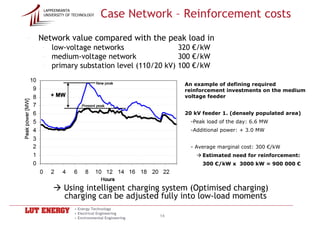
    UNIVERSITY OF TECHNOLOGY   Case Network – Reinforcement costs
- Network value compared with the peak load in
   - low-voltage networks                 320 €/kW
   - medium-voltage network               300 €/kW
   - primary substation level (110/20 kV) 100 €/kW

                                                     An example of defining required
                                                     reinforcement investments on the medium
                                                     voltage feeder


                                                     20 kV feeder 1. (densely populated area)
                                                       -Peak load of the day: 6.6 MW
                                                       -Additional power: + 3.0 MW


                                                       - Average marginal cost: 300 €/kW
                                                           Estimated need for reinforcement:
                                                           300 €/kW x 3000 kW = 900 000 €


             Using intelligent charging system (Optimised charging)
             charging can be adjusted fully into low-load moments
                  • Energy Technology
                  • Electrical Engineering
                  • Environmental Engineering
                                                14
LAPPEENRANTA
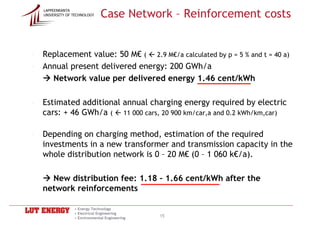
   UNIVERSITY OF TECHNOLOGY   Case Network – Reinforcement costs


- Replacement value: 50 M€ ( 2.9 M€/a calculated by p = 5 % and t = 40 a)
- Annual present delivered energy: 200 GWh/a
    Network value per delivered energy 1.46 cent/kWh

- Estimated additional annual charging energy required by electric
  cars: + 46 GWh/a ( 11 000 cars, 20 900 km/car,a and 0.2 kWh/km,car)

- Depending on charging method, estimation of the required
  investments in a new transformer and transmission capacity in the
  whole distribution network is 0 – 20 M€ (0 – 1 060 k€/a).

     New distribution fee: 1.18 – 1.66 cent/kWh after the
   network reinforcements

                 • Energy Technology
                 • Electrical Engineering
                 • Environmental Engineering
                                               15
Conclusions (1/3)
    LAPPEENRANTA
    UNIVERSITY OF TECHNOLOGY


1. Description of the overall methodology; what background
   information is required and how it is used to determine the need
   for electric car charging energy and power and to analyse the
   network effects.

2. Charging mode has a significant impact on the peak load level on
   the feeder. Without any intelligence included in the system,
   charging of electric cars may increase the peak power even three
   times higher compared with the present load level on the
   medium-voltage feeder. With an intelligent charging system,
   charging can be adjusted to a low-load moment, thereby avoiding
   overlapping of the existing peak load and the additional charging
   load. This may reduce the distribution fees of the electricity end-
   users, because more energy is delivered through the same system
   without a need for reinforcement investments. This is possible
   especially on feeders where the load varies considerably.

                  • Energy Technology
                  • Electrical Engineering
                  • Environmental Engineering
                                                16
Conclusions (2/3)
   LAPPEENRANTA
   UNIVERSITY OF TECHNOLOGY


3. It is possible to cut the transmission/distribution fees charged to
   electricity end-users during the large-scale adoption of electric
   cars, if the charging system is well-planned and enough
   intelligence is included in it. And opposite situation with
   charging system without intelligent control.

4. Load variations of medium-voltage feeders have to be taken
   into account in the analyses. The charging mode used on the city
   area feeder does not provide the desired end result on the rural
   area feeder. An intelligent charging system has to be able to take
   into account to which feeder each electric car is connected and
   where it is charged.


                 • Energy Technology
                 • Electrical Engineering
                 • Environmental Engineering
                                               17
Conclusions (3/3)
        LAPPEENRANTA
        UNIVERSITY OF TECHNOLOGY


    5. Biggest challenges in low-voltage networks. In the worst case
       the triple extra capacity has to be invested (home, work,
       cottage). However in Finland we have a lot of experience of
       transposition of loads (sauna oven, electric space heating, water
       heaters, block heaters).


Jukka Lassila
Lappeenranta University of Technology
jukka.lassila@lut.fi
+358 50 537 3636

                      • Energy Technology
                      • Electrical Engineering
                      • Environmental Engineering
                                                    18

Electrification of Mobility_Finland Lassila

  • 1.
    LAPPEENRANTA UNIVERSITY OF TECHNOLOGY Electric Cars – Challenge or Opportunity for the Electricity Distribution Infrastructure? Jukka Lassila Tero Kaipia, Juha Haakana and Jarmo Partanen Lappeenranta University of Technology • Energy Technology ELECTRIFICATION OF MOBILITY • Electrical Engineering AND THE ELECTRICAL NETWORK • Environmental Engineering 1 Madrid, Spain November 20th, 2009
  • 2.
    LAPPEENRANTA UNIVERSITY OF TECHNOLOGY Target of the studies • Define method to analyse network effects of electric vehicles • Make network analysis using actual distribution network data and load flows (city area and rural area feeders) • Define best and worst scenarios and define needed network reinforcements • Define network effects to the distribution fees paid by the end-customers • Energy Technology • Electrical Engineering • Environmental Engineering 2
  • 3.
    LAPPEENRANTA UNIVERSITY OF TECHNOLOGY Input Parameters on Electric Car Network Simulation National passenger transport survey National passenger transport survey Area-specific Area-specific -- Spatial and temporal variations in passenger trips additional additional Spatial and temporal variations in passenger trips Charging profile -- Length of daily trips energy energy Length of daily trips -- Annual length of driving (region dependent) Annual length of driving (region dependent) __ kWh/day __ kWh/day Power -- Length of daily trips according to housing type Length of daily trips according to housing type (working hours/ (working hours/ -- Length of daily trips according to residential area Length of daily trips according to residential area leisure time) leisure time) Hours -- Length of daily trips according to the month of year Length of daily trips according to the month of year -- Length of trips according to the time of day Length of trips according to the time of day -- Number of cars in households Number of cars in households Properties of electric cars Properties of electric cars Network simulations and analysis results Network simulations and analysis results -- Energy consumption, kWh/km Energy consumption, kWh/km -- Load flow and loss calculations Load flow and loss calculations -- Capacity of the batteries, kWh Capacity of the batteries, kWh -- Estimation of reinforcements required Estimation of reinforcements required -- Charging power, kW Charging power, kW -- Required charging time, h/day (battery properties) Required charging time, h/day (battery properties) Town planning statistics Town planning statistics -- Workplaces according to the area and time of day Workplaces according to the area and time of day -- Residential areas (detached houses, terraced houses, Residential areas (detached houses, terraced houses, apartment houses) apartment houses) Electricity distribution network Electricity distribution network MARTINKYLÄ -- Network topology and customer information Network topology and customer information Penetration of electric cars Penetration of electric cars -- Feeder and hourly-specific actual load curves MASSBY Feeder and hourly-specific actual load curves KALLBÄCK LANDBO -- Development of electric car markets Development of electric car markets -- Network volume Network volume 8 7 -- Replacement value Replacement value 6 5 Power [MW] Tariffs and supplier Tariffs and supplier -- Parameters: loss costs, load growth, lifetime, Parameters: loss costs, load growth, lifetime, 4 3 unit price of network components unit price of network components 2 -- Distribution fee Distribution fee 1 0 0:00 2:00 4:00 6:00 8:00 10:00 12:00 14:00 16:00 18:00 20:00 22:00 Thursday (hours) • Energy Technology • Electrical Engineering • Environmental Engineering 3
  • 4.
    Case Network LAPPEENRANTA UNIVERSITY OF TECHNOLOGY Whole distribution company - 110/20 kV primary substations: 4 Winter Winter - 20 kV feeders: 22 - Habitants/end-customers: 19 470 / 11 000 - Workplaces: 5 333 - Houses: 7 932 (5992 detached houses, 525 terraced houses, 1287 apartment Summer houses, 128 others) Summer MARTINKYLÄ - 20/0.4 kV distribution substations: 470 - Peak load: 50 MW 1. - Annual energy: 200 GWh - 20 kV lines and cables: 433 km - 20 kV underground cabling rate: 16 % 2. 20 kV feeder 1. (densely populated area) 20 kV feeder 2. (rural area) - Peak load: 8 MW - Peak load: 2 MW - Annual energy: 36 GWh - Annual energy: 6 GWh - Residential 58 %, industry 22 %, - Residential 95 %, agriculture 2 %, public 13 % and service 7 % industry 3 % MASSBY - Habitants/end-customers: 4171 / 2278 - Habitants/end-customers: 1037 / 444 KALLBÄCK - Workplaces: 1 577 - Workplaces: 84 - Houses: 1 840 (659 detached houses, 266 - Houses: 372 (all detached houses) LANDBO terraced houses, 888 apartment houses) - 20/0.4 kV distribution substations: 27 - 20/0.4 kV distribution substations: 39 - 20 kV lines and cables: 31 km - 20 kV lines and cables: 21 km - 20 kV underground cabling rate: 6 % - 20 kV underground cabling rate: 33 % • Energy Technology • Electrical Engineering • Environmental Engineering 4
  • 5.
    Case Network -Load curve LAPPEENRANTA UNIVERSITY OF TECHNOLOGY • Energy Technology • Electrical Engineering • Environmental Engineering 5
  • 6.
    Electric Vehicles -Properties LAPPEENRANTA UNIVERSITY OF TECHNOLOGY • Needed energy: 0.1 – 0.2 kWh/km • Capasity: 30 kWh/car • Charging power: 3.6 kW/car (Charging power max 3.6 kW = 230 V x 16 A) Photo presents car pre-heating pole used widely in Finland and Nordic countries. • Energy Technology • Electrical Engineering • Environmental Engineering 6
  • 7.
    Case area LAPPEENRANTA UNIVERSITY OF TECHNOLOGY • Habitants: 19 470 • Electricity end-customers: 11 000 • Workplaces: 5 333 • Houses: 7 932 – 5992 detached, 525 terraced, 1287 apartment, 128 others) MARTINKYLÄ • Personal cars: 11 000 • Travelling distances: 20 900 km/car,a = 57 km/car,day • Needed charging energy: 11.5 kWh/car,day 46 GWh/a (all cars) MASSBY KALLBÄCK LANDBO • Energy Technology • Electrical Engineering • Environmental Engineering 7
  • 8.
    Case Network –Electric car LAPPEENRANTA UNIVERSITY OF TECHNOLOGY charging profiles Direct night-time charging Split-level night-time charging 0:00 9:00 16:00 22:00 0:00 9:00 16:00 22:00 Working-hour and Optimised charging time-off charging 0:00 9:00 16:00 22:00 0:00 9:00 16:00 22:00 The same amount of Transmission capacity in the network? charging energy in Losses and loss costs? each profile! • Energy Technology • Electrical Engineering • Environmental Engineering 8
  • 9.
    Case Network -Losses LAPPEENRANTA UNIVERSITY OF TECHNOLOGY 400 Losses in medium voltage network 350 Direct night-time charging Working-hour and 300 time-off charging Split-level Load losses [kW] 250 night-time charging 200 150 100 Optimised charging 50 Present losses 0 0:00 2:00 4:00 6:00 8:00 10:00 12:00 14:00 16:00 18:00 20:00 22:00 • Energy Technology • Electrical Engineering • Environmental Engineering 9
  • 10.
    Case Network -Losses LAPPEENRANTA UNIVERSITY OF TECHNOLOGY 200 180 160 Cost of losses [€/day] 140 120 100 80 60 40 20 0 Present losses Direct night- Split-level night- Working-hour Optimised time charging time charging and time-off charging charging No remarkable differences in charging profiles from loss costs point of view in medium voltage network! • Energy Technology • Electrical Engineering • Environmental Engineering 10
  • 11.
    LAPPEENRANTA UNIVERSITY OF TECHNOLOGY Case Network – Feeder 1 (city area) 10 10 9 9 Feeder load with 8 8 electric cars City area feeder: 7 7 - Peak load of the day: 6.6 MW 6 E E 6 - Minimum load of the day: 4.0 MW 5 5 4 4 3 Present load Peak power [MW] 3 - Number of electric cars: 2000 2 2 Direct night-time charging 1 Split-level night-time charging - Driving distance: 57 km/car,day 1 0 0 - Energy consumption: 0.2 kWh/km 0 2 4 6 8 10 12 14 16 18 20 22 0 2 4 6 8 10 12 14 16 18 20 22 - Charging energy: 11.5 kWh/car,day 22.9 MWh/day for all cars 10 10 9 9 8 8 - Charging power: 3.6 kW/car 7 7 - Additional power: 0 – 3.5 MW 6 6 5 5 (depending on charging method) 4 4 3 3 Working-hour and - Charging energy (E) is equal in each 2 2 time-off charging Optimised charging charging alternative 1 1 0 0 0 2 4 6 8 10 12 14 16 18 20 22 0 2 4 6 8 10 12 14 16 18 20 22 • Energy Technology • Electrical Engineering • Environmental Engineering 11
  • 12.
    LAPPEENRANTA UNIVERSITY OF TECHNOLOGY Case Network – Feeder 2 (rural area) 4.0 4.0 3.5 3.5 Rural area feeder: 3.0 3.0 - Peak load of the day: 1.25 MW Direct night-time charging Split-level night-time charging 2.5 2.5 - Minimum load of the day: 0.75 MW 2.0 2.0 Peak power [MW] 1.5 1.5 - Number of electric cars: 750 1.0 1.0 - Driving distance: 57 km/car,day 0.5 0.5 - Energy consumption: 0.2 kWh/km 0.0 0.0 0 2 4 6 8 10 12 14 16 18 20 22 - Charging energy: 11.5 kWh/car,day 0 2 4 6 8 10 12 14 16 18 20 22 8.6 MWh/day for all cars 4.0 4.0 3.5 3.5 Working-hour and - Charging power: 3.6 kW/car 3.0 3.0 time-off charging Optimised charging - Additional power: 0 – 1.75 MW 2.5 2.5 2.0 2.0 (depending on charging method) 1.5 1.5 1.0 1.0 Charging energy is equal in each 0.5 0.5 charging alternative 0.0 0.0 0 2 4 6 8 10 12 14 16 18 20 22 0 2 4 6 8 10 12 14 16 18 20 22 • Energy Technology • Electrical Engineering • Environmental Engineering 12
  • 13.
    LAPPEENRANTA UNIVERSITY OF TECHNOLOGY Case Network – Whole company 60 60 Direct night-time charging Split-level night-time charging 50 50 40 40 Whole company: - Peak load of the day: 36 MW 30 30 - Minimum load of the day: 25 MW 20 20 Peak power [MW] 10 10 - Number of electric cars: 11 000 0 0 - Driving distance: 57 km/car,day 0 2 4 6 8 10 12 14 16 18 20 22 0 2 4 6 8 10 12 14 16 18 20 22 - Energy consumption: 0.2 kWh/km 60 - Charging energy: 11.5 kWh/car,day 60 Working-hour and Optimised charging 126 MWh/day for all cars 50 50 time-off charging 40 40 - Charging power: 3.6 kW/car 30 30 - Additional power: 0 – 24 MW 20 20 (depending on charging method) 10 10 0 0 0 2 4 6 8 10 12 14 16 18 20 22 0 2 4 6 8 10 12 14 16 18 20 22 Using intelligent charging system (Optimised charging) charging can be adjusted fully into low-load moments • Energy Technology • Electrical Engineering • Environmental Engineering 13
  • 14.
    LAPPEENRANTA UNIVERSITY OF TECHNOLOGY Case Network – Reinforcement costs - Network value compared with the peak load in - low-voltage networks 320 €/kW - medium-voltage network 300 €/kW - primary substation level (110/20 kV) 100 €/kW An example of defining required reinforcement investments on the medium voltage feeder 20 kV feeder 1. (densely populated area) -Peak load of the day: 6.6 MW -Additional power: + 3.0 MW - Average marginal cost: 300 €/kW Estimated need for reinforcement: 300 €/kW x 3000 kW = 900 000 € Using intelligent charging system (Optimised charging) charging can be adjusted fully into low-load moments • Energy Technology • Electrical Engineering • Environmental Engineering 14
  • 15.
    LAPPEENRANTA UNIVERSITY OF TECHNOLOGY Case Network – Reinforcement costs - Replacement value: 50 M€ ( 2.9 M€/a calculated by p = 5 % and t = 40 a) - Annual present delivered energy: 200 GWh/a Network value per delivered energy 1.46 cent/kWh - Estimated additional annual charging energy required by electric cars: + 46 GWh/a ( 11 000 cars, 20 900 km/car,a and 0.2 kWh/km,car) - Depending on charging method, estimation of the required investments in a new transformer and transmission capacity in the whole distribution network is 0 – 20 M€ (0 – 1 060 k€/a). New distribution fee: 1.18 – 1.66 cent/kWh after the network reinforcements • Energy Technology • Electrical Engineering • Environmental Engineering 15
  • 16.
    Conclusions (1/3) LAPPEENRANTA UNIVERSITY OF TECHNOLOGY 1. Description of the overall methodology; what background information is required and how it is used to determine the need for electric car charging energy and power and to analyse the network effects. 2. Charging mode has a significant impact on the peak load level on the feeder. Without any intelligence included in the system, charging of electric cars may increase the peak power even three times higher compared with the present load level on the medium-voltage feeder. With an intelligent charging system, charging can be adjusted to a low-load moment, thereby avoiding overlapping of the existing peak load and the additional charging load. This may reduce the distribution fees of the electricity end- users, because more energy is delivered through the same system without a need for reinforcement investments. This is possible especially on feeders where the load varies considerably. • Energy Technology • Electrical Engineering • Environmental Engineering 16
  • 17.
    Conclusions (2/3) LAPPEENRANTA UNIVERSITY OF TECHNOLOGY 3. It is possible to cut the transmission/distribution fees charged to electricity end-users during the large-scale adoption of electric cars, if the charging system is well-planned and enough intelligence is included in it. And opposite situation with charging system without intelligent control. 4. Load variations of medium-voltage feeders have to be taken into account in the analyses. The charging mode used on the city area feeder does not provide the desired end result on the rural area feeder. An intelligent charging system has to be able to take into account to which feeder each electric car is connected and where it is charged. • Energy Technology • Electrical Engineering • Environmental Engineering 17
  • 18.
    Conclusions (3/3) LAPPEENRANTA UNIVERSITY OF TECHNOLOGY 5. Biggest challenges in low-voltage networks. In the worst case the triple extra capacity has to be invested (home, work, cottage). However in Finland we have a lot of experience of transposition of loads (sauna oven, electric space heating, water heaters, block heaters). Jukka Lassila Lappeenranta University of Technology jukka.lassila@lut.fi +358 50 537 3636 • Energy Technology • Electrical Engineering • Environmental Engineering 18