Cambridgeshire Renewables Infrastructure Framework:
 How can Cambridgeshire secure £6billion of low carbon energy
 infrastructure by 2031?
 Smartlife Centre 15th November 2011


 Duncan Price, Director, Camco


Cambridgeshire Renewables Infrastructure Framework
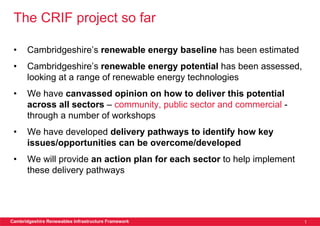
The CRIF project so far

 •     Cambridgeshire’s renewable energy baseline has been estimated
 •     Cambridgeshire’s renewable energy potential has been assessed,
       looking at a range of renewable energy technologies
 •     We have canvassed opinion on how to deliver this potential
       across all sectors – community, public sector and commercial -
       through a number of workshops
 •     We have developed delivery pathways to identify how key
       issues/opportunities can be overcome/developed
 •     We will provide an action plan for each sector to help implement
       these delivery pathways


Cambridgeshire Renewables Infrastructure Framework                        1
Cambridgeshire’s challenging carbon objectives


         What is Cambridgeshire's potential?


Cambridgeshire Renewables Infrastructure Framework   2
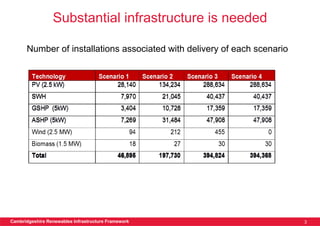
Substantial infrastructure is needed

      Number of installations associated with delivery of each scenario


Cambridgeshire Renewables Infrastructure Framework                        3
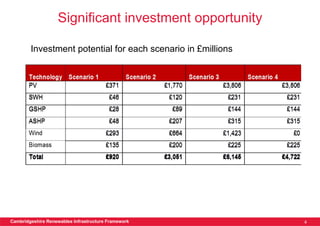
Significant investment opportunity

        Investment potential for each scenario in £millions


Cambridgeshire Renewables Infrastructure Framework            4
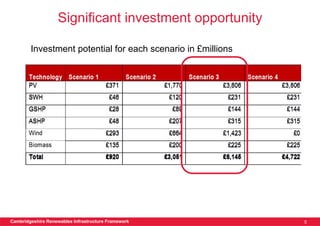
Significant investment opportunity

        Investment potential for each scenario in £millions


Cambridgeshire Renewables Infrastructure Framework            5
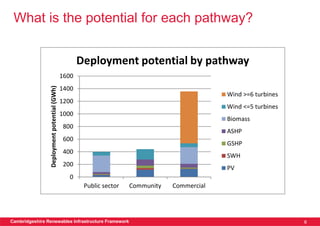
What is the potential for each pathway?


                                                    Deployment potential by pathway
                                             1600
                                             1400
                Deployment potential (GWh)


                                                                                              Wind >=6 turbines
                                             1200
                                                                                              Wind <=5 turbines
                                             1000
                                                                                              Biomass
                                             800
                                                                                              ASHP
                                             600
                                                                                              GSHP
                                             400
                                                                                              SWH
                                             200
                                                                                              PV
                                               0
                                                     Public sector   Community   Commercial


Cambridgeshire Renewables Infrastructure Framework                                                                6
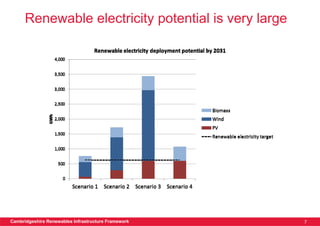
Renewable electricity potential is very large


Cambridgeshire Renewables Infrastructure Framework    7
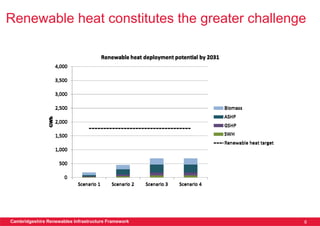
Renewable heat constitutes the greater challenge


Cambridgeshire Renewables Infrastructure Framework   8
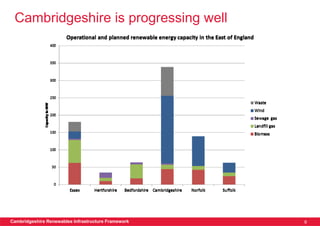
Cambridgeshire is progressing well


Cambridgeshire Renewables Infrastructure Framework   9
Modelling renewable energy deployment potential
                                                                                            Scenario 4
                                           Scenario 1       Scenario 2      Scenario 3      (high without
                           Inputs          (low)            (medium)        (high)          wind)
                           Discount rate   9%               7%              6%              6%
                                                                            DECC - 'high    DECC - 'high
                           Energy price    DECC - 'low'     DECC - 'high'   high' energy    high' energy
                           [1]
                                           energy prices    energy prices   prices          prices
                                                                            current rates   current rates
                                                                            (FIT/ RHI       (FIT/ RHI
                                                                            designed to     designed to
                                                                            give fixed      give fixed
                                                                            return & will   return & will
                           Financial       lower than                       adjust to       adjust to
                           incentives      current tariff                   energy          energy
                           (FIT/RHI)       rates            current rates   prices)         prices)
                           Project
                           deployment
                           rate
                           (wind/biomas                                                     30% (0% for
                           s/EfW)          8%               15%             30%             wind)

                           Green policy
                           support (for
                           building
                           integrated
                           technologies)   Low              Medium          High            High


Cambridgeshire Renewables Infrastructure Framework                                                          10
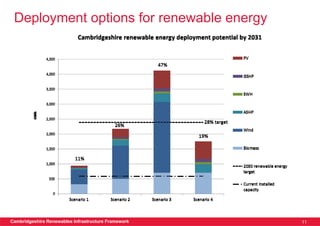
Deployment options for renewable energy


Cambridgeshire Renewables Infrastructure Framework   11
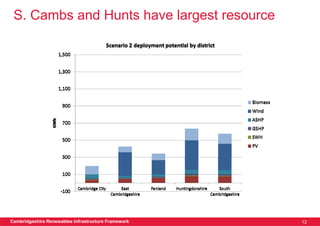
S. Cambs and Hunts have largest resource


Cambridgeshire Renewables Infrastructure Framework   12
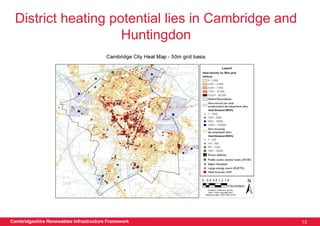
District heating potential lies in Cambridge and
                    Huntingdon


Cambridgeshire Renewables Infrastructure Framework   13
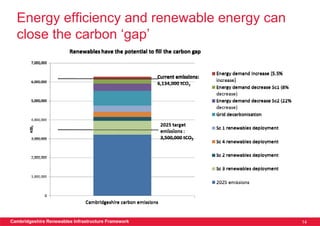
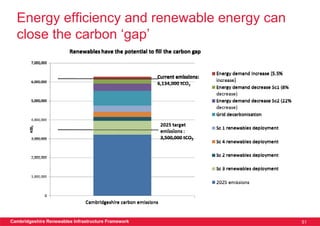
Energy efficiency and renewable energy can
  close the carbon ‘gap’


Cambridgeshire Renewables Infrastructure Framework   14
Conclusions

 •     Cambridgeshire is doing well – especially renewable electricity
 •     There is potential for more – solar, biomass, heat pumps, wind
 •     All technologies are needed – heat and electricity
 •     Somewhere between medium & high scenarios delivers by 2031
 •     Also closes carbon gap to meet pro-rata 4th carbon budget
 •     Significant investment potential – up to £6.1 billion for high
       scenario


Cambridgeshire Renewables Infrastructure Framework                       15
Thanks

    Duncan Price

       Renewable energy delivery pathways
    Director
    Camco

     t: +44 (0)20 7121 6150
    m: +44 (0)7769 692 610
    e: duncan.price@camcoglobal.com


    172 Tottenham Court Road London
    W1T 7NS United Kingdom

    www.camcoglobal.com

Cambridgeshire Renewables Infrastructure Framework            16
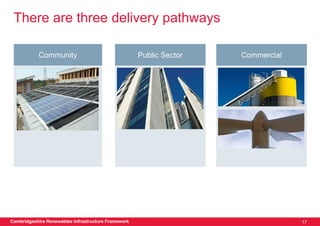
There are three delivery pathways

           Community                                 Public Sector   Commercial


Cambridgeshire Renewables Infrastructure Framework                                17
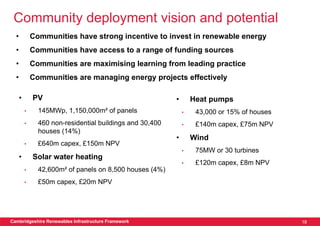
Community deployment vision and potential
  •           Communities have strong incentive to invest in renewable energy
  •           Communities have access to a range of funding sources
  •           Communities are maximising learning from leading practice
  •           Communities are managing energy projects effectively

      •       PV                                           •       Heat pumps
          •     145MWp, 1,150,000m² of panels                  •    43,000 or 15% of houses
          •     460 non-residential buildings and 30,400       •    £140m capex, £75m NPV
                houses (14%)
                                                           •       Wind
          •     £640m capex, £150m NPV
                                                               •    75MW or 30 turbines
      •       Solar water heating
                                                               •    £120m capex, £8m NPV
          •     42,600m² of panels on 8,500 houses (4%)
          •     £50m capex, £20m NPV


Cambridgeshire Renewables Infrastructure Framework                                            18
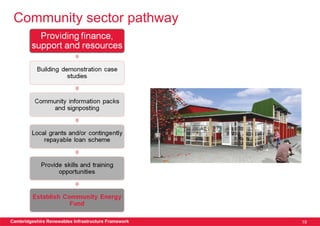
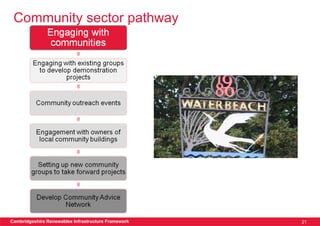
Community sector pathway


Cambridgeshire Renewables Infrastructure Framework   19
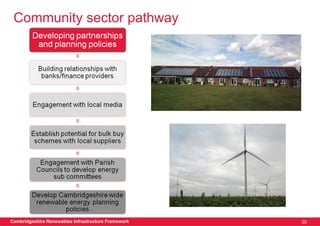
Community sector pathway


Cambridgeshire Renewables Infrastructure Framework   20
Community sector pathway


Cambridgeshire Renewables Infrastructure Framework   21
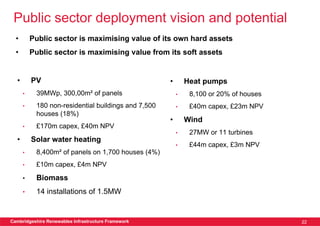
Public sector deployment vision and potential
  •       Public sector is maximising value of its own hard assets
  •       Public sector is maximising value from its soft assets


  •       PV                                         •       Heat pumps
      •    39MWp, 300,00m² of panels                     •    8,100 or 20% of houses
      •    180 non-residential buildings and 7,500       •    £40m capex, £23m NPV
           houses (18%)
                                                     •       Wind
      •    £170m capex, £40m NPV
                                                         •    27MW or 11 turbines
  •       Solar water heating
                                                         •    £44m capex, £3m NPV
      •    8,400m² of panels on 1,700 houses (4%)
      •    £10m capex, £4m NPV
      •    Biomass
      •    14 installations of 1.5MW


Cambridgeshire Renewables Infrastructure Framework                                     22
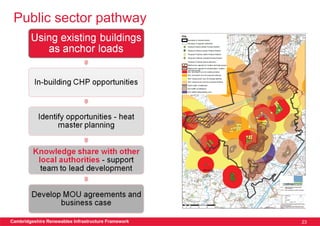
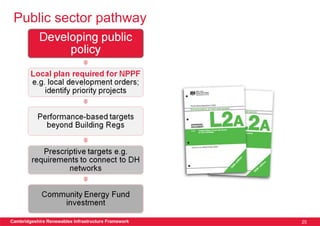
Public sector pathway


Cambridgeshire Renewables Infrastructure Framework   23
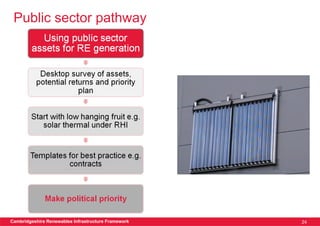
Public sector pathway


Cambridgeshire Renewables Infrastructure Framework   24
Public sector pathway


Cambridgeshire Renewables Infrastructure Framework   25
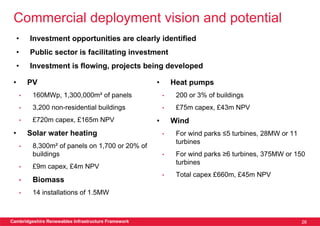
Commercial deployment vision and potential
     •       Investment opportunities are clearly identified
     •       Public sector is facilitating investment
     •       Investment is flowing, projects being developed

 •           PV                                      •       Heat pumps
         •    160MWp, 1,300,000m² of panels              •    200 or 3% of buildings
         •    3,200 non-residential buildings            •    £75m capex, £43m NPV
         •    £720m capex, £165m NPV                 •       Wind
 •           Solar water heating                         •    For wind parks ≤5 turbines, 28MW or 11
                                                              turbines
         •    8,300m² of panels on 1,700 or 20% of
              buildings                                  •    For wind parks ≥6 turbines, 375MW or 150
                                                              turbines
         •    £9m capex, £4m NPV
                                                         •    Total capex £660m, £45m NPV
         •    Biomass
         •    14 installations of 1.5MW


Cambridgeshire Renewables Infrastructure Framework                                                     26
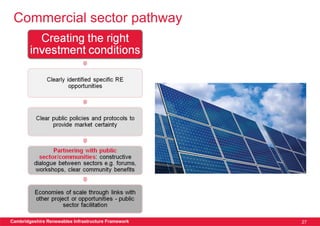
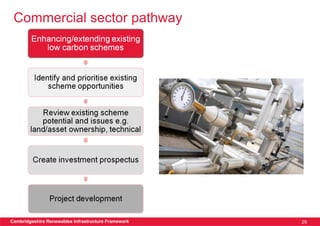
Commercial sector pathway


Cambridgeshire Renewables Infrastructure Framework   27
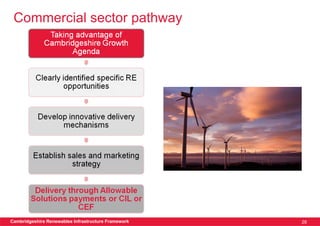
Commercial sector pathway


Cambridgeshire Renewables Infrastructure Framework   28
Commercial sector pathway


Cambridgeshire Renewables Infrastructure Framework   29
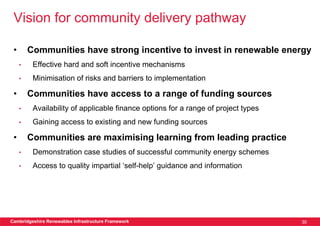
Vision for community delivery pathway

 •       Communities have strong incentive to invest in renewable energy
     •    Effective hard and soft incentive mechanisms
     •    Minimisation of risks and barriers to implementation

 •       Communities have access to a range of funding sources
     •    Availability of applicable finance options for a range of project types
     •    Gaining access to existing and new funding sources

 •       Communities are maximising learning from leading practice
     •    Demonstration case studies of successful community energy schemes
     •    Access to quality impartial ‘self-help’ guidance and information


Cambridgeshire Renewables Infrastructure Framework                                  30
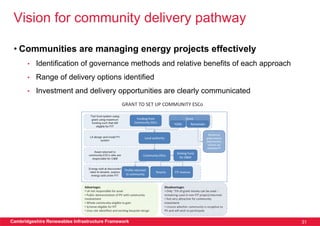
Vision for community delivery pathway

 • Communities are managing energy projects effectively
       •   Identification of governance methods and relative benefits of each approach
       •   Range of delivery options identified
       •   Investment and delivery opportunities are clearly communicated


Cambridgeshire Renewables Infrastructure Framework                                       31
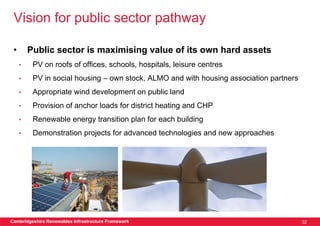
Vision for public sector pathway

 •       Public sector is maximising value of its own hard assets
     •    PV on roofs of offices, schools, hospitals, leisure centres
     •    PV in social housing – own stock, ALMO and with housing association partners
     •    Appropriate wind development on public land
     •    Provision of anchor loads for district heating and CHP
     •    Renewable energy transition plan for each building
     •    Demonstration projects for advanced technologies and new approaches


Cambridgeshire Renewables Infrastructure Framework                                       32
Vision for public sector pathway

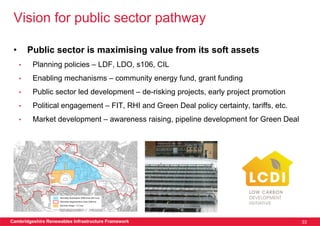
 •       Public sector is maximising value from its soft assets
     •    Planning policies – LDF, LDO, s106, CIL
     •    Enabling mechanisms – community energy fund, grant funding
     •    Public sector led development – de-risking projects, early project promotion
     •    Political engagement – FIT, RHI and Green Deal policy certainty, tariffs, etc.
     •    Market development – awareness raising, pipeline development for Green Deal


Cambridgeshire Renewables Infrastructure Framework                                         33
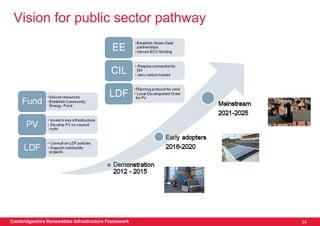
Vision for public sector pathway


Cambridgeshire Renewables Infrastructure Framework   34
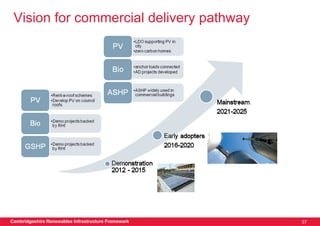
Vision for commercial delivery pathway

 •       Investment opportunities are clearly identified
     •    Technical, economic and deployment potential based on WP1
     •    Benefits of growth agenda are articulated
     •    Preconditions are clearly understood by public and private sector + community


 •       Public sector is facilitating investment
     •    Establishing clear public policies and protocols to provide market certainty
     •    Engaging in constructive dialogue with community
     •    Using its own assets to lever wider opportunities


Cambridgeshire Renewables Infrastructure Framework                                        35
Vision for commercial delivery pathway

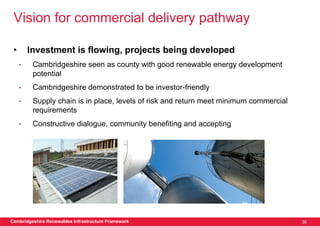
 •       Investment is flowing, projects being developed
     •    Cambridgeshire seen as county with good renewable energy development
          potential
     •    Cambridgeshire demonstrated to be investor-friendly
     •    Supply chain is in place, levels of risk and return meet minimum commercial
          requirements
     •    Constructive dialogue, community benefiting and accepting


Cambridgeshire Renewables Infrastructure Framework                                      36
Vision for commercial delivery pathway


Cambridgeshire Renewables Infrastructure Framework   37
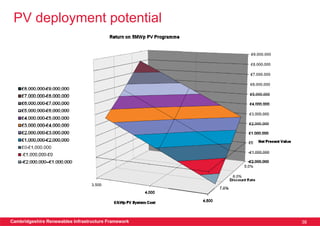
PV deployment potential


Cambridgeshire Renewables Infrastructure Framework   38
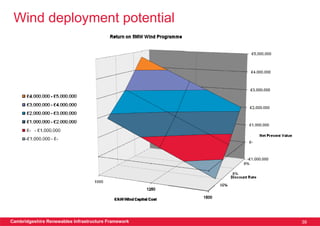
Wind deployment potential


Cambridgeshire Renewables Infrastructure Framework   39
Cambridgeshire’s challenging carbon objectives


                                           Case studies


Cambridgeshire Renewables Infrastructure Framework        40
Case study: public sector

 •       Sustainable Parish Energy Partnership, South Cambs
     •    Network of local voluntary groups; project secured by SCDC
     •    Objective to reduce energy bills, tackle climate change, build a sustainable future
     •    Organises events and initiatives e.g. energy shows, home energy thermal image
          surveys, working with local businesses, community energy generating projects
     •    Part-time Parish Energy Project Officer organises programme and provides
          support
     •    No direct costs, application forms, contracts or binding targets to parish councils
     •    How can we build on this to create more community energy projects?


Cambridgeshire Renewables Infrastructure Framework                                              41
Case study: public sector

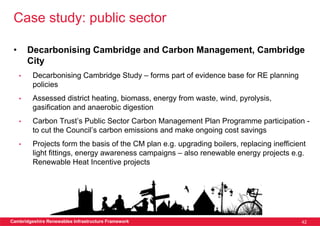
 •       Decarbonising Cambridge and Carbon Management, Cambridge
         City
     •    Decarbonising Cambridge Study – forms part of evidence base for RE planning
          policies
     •    Assessed district heating, biomass, energy from waste, wind, pyrolysis,
          gasification and anaerobic digestion
     •    Carbon Trust’s Public Sector Carbon Management Plan Programme participation -
          to cut the Council’s carbon emissions and make ongoing cost savings
     •    Projects form the basis of the CM plan e.g. upgrading boilers, replacing inefficient
          light fittings, energy awareness campaigns – also renewable energy projects e.g.
          Renewable Heat Incentive projects


Cambridgeshire Renewables Infrastructure Framework                                          42
Case study: public sector

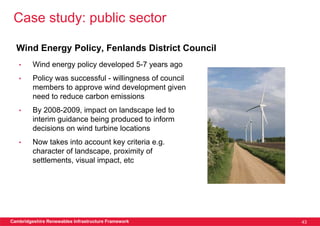
  Wind Energy Policy, Fenlands District Council
   •     Wind energy policy developed 5-7 years ago
   •     Policy was successful - willingness of council
         members to approve wind development given
         need to reduce carbon emissions
   •     By 2008-2009, impact on landscape led to
         interim guidance being produced to inform
         decisions on wind turbine locations
   •     Now takes into account key criteria e.g.
         character of landscape, proximity of
         settlements, visual impact, etc


Cambridgeshire Renewables Infrastructure Framework        43
Case study: public sector

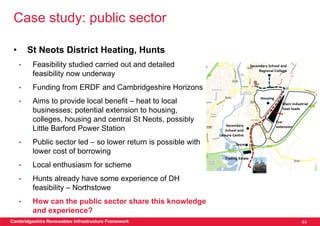
 •       St Neots District Heating, Hunts
     •    Feasibility studied carried out and detailed
          feasibility now underway
     •    Funding from ERDF and Cambridgeshire Horizons
     •    Aims to provide local benefit – heat to local
          businesses; potential extension to housing,
          colleges, housing and central St Neots, possibly
          Little Barford Power Station
     •    Public sector led – so lower return is possible with
          lower cost of borrowing
     •    Local enthusiasm for scheme
     •    Hunts already have some experience of DH
          feasibility – Northstowe
     •    How can the public sector share this knowledge
          and experience?
Cambridgeshire Renewables Infrastructure Framework               44
Case study: commercial sector
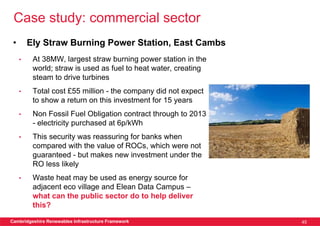
 •       Ely Straw Burning Power Station, East Cambs
     •    At 38MW, largest straw burning power station in the
          world; straw is used as fuel to heat water, creating
          steam to drive turbines
     •    Total cost £55 million - the company did not expect
          to show a return on this investment for 15 years
     •    Non Fossil Fuel Obligation contract through to 2013
          - electricity purchased at 6p/kWh
     •    This security was reassuring for banks when
          compared with the value of ROCs, which were not
          guaranteed - but makes new investment under the
          RO less likely
     •    Waste heat may be used as energy source for
          adjacent eco village and Elean Data Campus –
          what can the public sector do to help deliver
          this?

Cambridgeshire Renewables Infrastructure Framework               45
Case study: commercial/community partnership

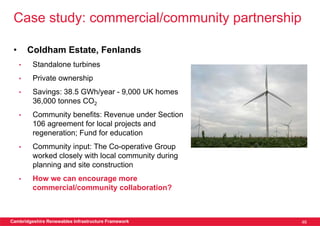
 •       Coldham Estate, Fenlands
     •    Standalone turbines
     •    Private ownership
     •    Savings: 38.5 GWh/year - 9,000 UK homes
          36,000 tonnes CO2
     •    Community benefits: Revenue under Section
          106 agreement for local projects and
          regeneration; Fund for education
     •    Community input: The Co-operative Group
          worked closely with local community during
          planning and site construction
     •    How we can encourage more
          commercial/community collaboration?


Cambridgeshire Renewables Infrastructure Framework     46
Case study: community

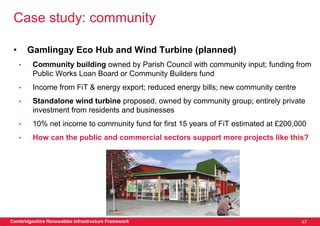
 •       Gamlingay Eco Hub and Wind Turbine (planned)
     •    Community building owned by Parish Council with community input; funding from
          Public Works Loan Board or Community Builders fund
     •    Income from FiT & energy export; reduced energy bills; new community centre
     •    Standalone wind turbine proposed, owned by community group; entirely private
          investment from residents and businesses
     •    10% net income to community fund for first 15 years of FiT estimated at £200,000
     •    How can the public and commercial sectors support more projects like this?


Cambridgeshire Renewables Infrastructure Framework                                      47
Case study: community

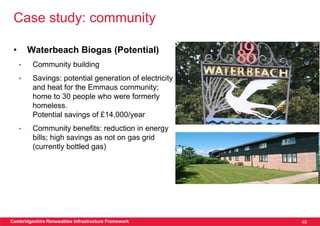
 •       Waterbeach Biogas (Potential)
     •    Community building
     •    Savings: potential generation of electricity
          and heat for the Emmaus community;
          home to 30 people who were formerly
          homeless.
          Potential savings of £14,000/year
     •    Community benefits: reduction in energy
          bills; high savings as not on gas grid
          (currently bottled gas)


Cambridgeshire Renewables Infrastructure Framework       48
Case study: community

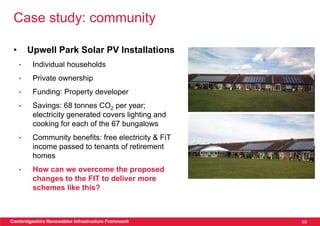
 •       Upwell Park Solar PV Installations
     •    Individual households
     •    Private ownership
     •    Funding: Property developer
     •    Savings: 68 tonnes CO2 per year;
          electricity generated covers lighting and
          cooking for each of the 67 bungalows
     •    Community benefits: free electricity & FiT
          income passed to tenants of retirement
          homes
     •    How can we overcome the proposed
          changes to the FIT to deliver more
          schemes like this?


Cambridgeshire Renewables Infrastructure Framework     49
Cambridgeshire’s challenging carbon objectives


                       The scale of the challenge


Cambridgeshire Renewables Infrastructure Framework   50
Energy efficiency and renewable energy can
  close the carbon ‘gap’


Cambridgeshire Renewables Infrastructure Framework   51
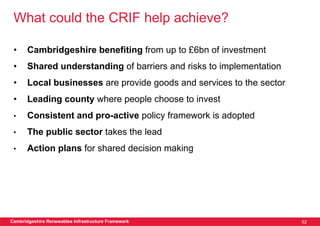
What could the CRIF help achieve?

 •     Cambridgeshire benefiting from up to £6bn of investment
 •     Shared understanding of barriers and risks to implementation
 •     Local businesses are provide goods and services to the sector
 •     Leading county where people choose to invest
 •     Consistent and pro-active policy framework is adopted
 •     The public sector takes the lead
 •     Action plans for shared decision making


Cambridgeshire Renewables Infrastructure Framework                     52
Cambridgeshire’s challenging carbon objectives


                                            Action plans


Cambridgeshire Renewables Infrastructure Framework         53
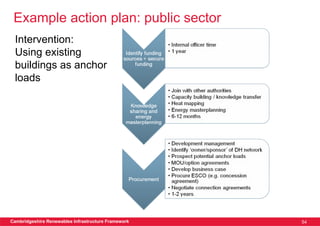
Example action plan: public sector
 Intervention:
 Using existing
 buildings as anchor
 loads


Cambridgeshire Renewables Infrastructure Framework   54
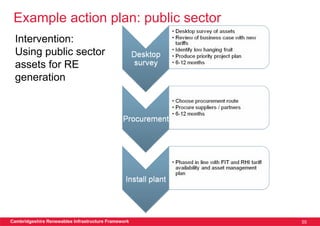
Example action plan: public sector
 Intervention:
 Using public sector
 assets for RE
 generation


Cambridgeshire Renewables Infrastructure Framework   55
Thanks

    Duncan Price
    Director
    Camco

     t: +44 (0)20 7121 6150
    m: +44 (0)7769 692 610
    e: duncan.price@camcoglobal.com


    172 Tottenham Court Road London
    W1T 7NS United Kingdom

    www.camcoglobal.com

Cambridgeshire Renewables Infrastructure Framework            56

Camco Presentation_CRIF Event_15th Nov

  • 1.
    Cambridgeshire Renewables InfrastructureFramework: How can Cambridgeshire secure £6billion of low carbon energy infrastructure by 2031? Smartlife Centre 15th November 2011 Duncan Price, Director, Camco Cambridgeshire Renewables Infrastructure Framework
  • 2.
    The CRIF projectso far • Cambridgeshire’s renewable energy baseline has been estimated • Cambridgeshire’s renewable energy potential has been assessed, looking at a range of renewable energy technologies • We have canvassed opinion on how to deliver this potential across all sectors – community, public sector and commercial - through a number of workshops • We have developed delivery pathways to identify how key issues/opportunities can be overcome/developed • We will provide an action plan for each sector to help implement these delivery pathways Cambridgeshire Renewables Infrastructure Framework 1
  • 3.
    Cambridgeshire’s challenging carbonobjectives What is Cambridgeshire's potential? Cambridgeshire Renewables Infrastructure Framework 2
  • 4.
    Substantial infrastructure isneeded Number of installations associated with delivery of each scenario Cambridgeshire Renewables Infrastructure Framework 3
  • 5.
    Significant investment opportunity Investment potential for each scenario in £millions Cambridgeshire Renewables Infrastructure Framework 4
  • 6.
    Significant investment opportunity Investment potential for each scenario in £millions Cambridgeshire Renewables Infrastructure Framework 5
  • 7.
    What is thepotential for each pathway? Deployment potential by pathway 1600 1400 Deployment potential (GWh) Wind >=6 turbines 1200 Wind <=5 turbines 1000 Biomass 800 ASHP 600 GSHP 400 SWH 200 PV 0 Public sector Community Commercial Cambridgeshire Renewables Infrastructure Framework 6
  • 8.
    Renewable electricity potentialis very large Cambridgeshire Renewables Infrastructure Framework 7
  • 9.
    Renewable heat constitutesthe greater challenge Cambridgeshire Renewables Infrastructure Framework 8
  • 10.
    Cambridgeshire is progressingwell Cambridgeshire Renewables Infrastructure Framework 9
  • 11.
    Modelling renewable energydeployment potential Scenario 4 Scenario 1 Scenario 2 Scenario 3 (high without Inputs (low) (medium) (high) wind) Discount rate 9% 7% 6% 6% DECC - 'high DECC - 'high Energy price DECC - 'low' DECC - 'high' high' energy high' energy [1] energy prices energy prices prices prices current rates current rates (FIT/ RHI (FIT/ RHI designed to designed to give fixed give fixed return & will return & will Financial lower than adjust to adjust to incentives current tariff energy energy (FIT/RHI) rates current rates prices) prices) Project deployment rate (wind/biomas 30% (0% for s/EfW) 8% 15% 30% wind) Green policy support (for building integrated technologies) Low Medium High High Cambridgeshire Renewables Infrastructure Framework 10
  • 12.
    Deployment options forrenewable energy Cambridgeshire Renewables Infrastructure Framework 11
  • 13.
    S. Cambs andHunts have largest resource Cambridgeshire Renewables Infrastructure Framework 12
  • 14.
    District heating potentiallies in Cambridge and Huntingdon Cambridgeshire Renewables Infrastructure Framework 13
  • 15.
    Energy efficiency andrenewable energy can close the carbon ‘gap’ Cambridgeshire Renewables Infrastructure Framework 14
  • 16.
    Conclusions • Cambridgeshire is doing well – especially renewable electricity • There is potential for more – solar, biomass, heat pumps, wind • All technologies are needed – heat and electricity • Somewhere between medium & high scenarios delivers by 2031 • Also closes carbon gap to meet pro-rata 4th carbon budget • Significant investment potential – up to £6.1 billion for high scenario Cambridgeshire Renewables Infrastructure Framework 15
  • 17.
    Thanks Duncan Price Renewable energy delivery pathways Director Camco t: +44 (0)20 7121 6150 m: +44 (0)7769 692 610 e: duncan.price@camcoglobal.com 172 Tottenham Court Road London W1T 7NS United Kingdom www.camcoglobal.com Cambridgeshire Renewables Infrastructure Framework 16
  • 18.
    There are threedelivery pathways Community Public Sector Commercial Cambridgeshire Renewables Infrastructure Framework 17
  • 19.
    Community deployment visionand potential • Communities have strong incentive to invest in renewable energy • Communities have access to a range of funding sources • Communities are maximising learning from leading practice • Communities are managing energy projects effectively • PV • Heat pumps • 145MWp, 1,150,000m² of panels • 43,000 or 15% of houses • 460 non-residential buildings and 30,400 • £140m capex, £75m NPV houses (14%) • Wind • £640m capex, £150m NPV • 75MW or 30 turbines • Solar water heating • £120m capex, £8m NPV • 42,600m² of panels on 8,500 houses (4%) • £50m capex, £20m NPV Cambridgeshire Renewables Infrastructure Framework 18
  • 20.
    Community sector pathway CambridgeshireRenewables Infrastructure Framework 19
  • 21.
    Community sector pathway CambridgeshireRenewables Infrastructure Framework 20
  • 22.
    Community sector pathway CambridgeshireRenewables Infrastructure Framework 21
  • 23.
    Public sector deploymentvision and potential • Public sector is maximising value of its own hard assets • Public sector is maximising value from its soft assets • PV • Heat pumps • 39MWp, 300,00m² of panels • 8,100 or 20% of houses • 180 non-residential buildings and 7,500 • £40m capex, £23m NPV houses (18%) • Wind • £170m capex, £40m NPV • 27MW or 11 turbines • Solar water heating • £44m capex, £3m NPV • 8,400m² of panels on 1,700 houses (4%) • £10m capex, £4m NPV • Biomass • 14 installations of 1.5MW Cambridgeshire Renewables Infrastructure Framework 22
  • 24.
    Public sector pathway CambridgeshireRenewables Infrastructure Framework 23
  • 25.
    Public sector pathway CambridgeshireRenewables Infrastructure Framework 24
  • 26.
    Public sector pathway CambridgeshireRenewables Infrastructure Framework 25
  • 27.
    Commercial deployment visionand potential • Investment opportunities are clearly identified • Public sector is facilitating investment • Investment is flowing, projects being developed • PV • Heat pumps • 160MWp, 1,300,000m² of panels • 200 or 3% of buildings • 3,200 non-residential buildings • £75m capex, £43m NPV • £720m capex, £165m NPV • Wind • Solar water heating • For wind parks ≤5 turbines, 28MW or 11 turbines • 8,300m² of panels on 1,700 or 20% of buildings • For wind parks ≥6 turbines, 375MW or 150 turbines • £9m capex, £4m NPV • Total capex £660m, £45m NPV • Biomass • 14 installations of 1.5MW Cambridgeshire Renewables Infrastructure Framework 26
  • 28.
    Commercial sector pathway CambridgeshireRenewables Infrastructure Framework 27
  • 29.
    Commercial sector pathway CambridgeshireRenewables Infrastructure Framework 28
  • 30.
    Commercial sector pathway CambridgeshireRenewables Infrastructure Framework 29
  • 31.
    Vision for communitydelivery pathway • Communities have strong incentive to invest in renewable energy • Effective hard and soft incentive mechanisms • Minimisation of risks and barriers to implementation • Communities have access to a range of funding sources • Availability of applicable finance options for a range of project types • Gaining access to existing and new funding sources • Communities are maximising learning from leading practice • Demonstration case studies of successful community energy schemes • Access to quality impartial ‘self-help’ guidance and information Cambridgeshire Renewables Infrastructure Framework 30
  • 32.
    Vision for communitydelivery pathway • Communities are managing energy projects effectively • Identification of governance methods and relative benefits of each approach • Range of delivery options identified • Investment and delivery opportunities are clearly communicated Cambridgeshire Renewables Infrastructure Framework 31
  • 33.
    Vision for publicsector pathway • Public sector is maximising value of its own hard assets • PV on roofs of offices, schools, hospitals, leisure centres • PV in social housing – own stock, ALMO and with housing association partners • Appropriate wind development on public land • Provision of anchor loads for district heating and CHP • Renewable energy transition plan for each building • Demonstration projects for advanced technologies and new approaches Cambridgeshire Renewables Infrastructure Framework 32
  • 34.
    Vision for publicsector pathway • Public sector is maximising value from its soft assets • Planning policies – LDF, LDO, s106, CIL • Enabling mechanisms – community energy fund, grant funding • Public sector led development – de-risking projects, early project promotion • Political engagement – FIT, RHI and Green Deal policy certainty, tariffs, etc. • Market development – awareness raising, pipeline development for Green Deal Cambridgeshire Renewables Infrastructure Framework 33
  • 35.
    Vision for publicsector pathway Cambridgeshire Renewables Infrastructure Framework 34
  • 36.
    Vision for commercialdelivery pathway • Investment opportunities are clearly identified • Technical, economic and deployment potential based on WP1 • Benefits of growth agenda are articulated • Preconditions are clearly understood by public and private sector + community • Public sector is facilitating investment • Establishing clear public policies and protocols to provide market certainty • Engaging in constructive dialogue with community • Using its own assets to lever wider opportunities Cambridgeshire Renewables Infrastructure Framework 35
  • 37.
    Vision for commercialdelivery pathway • Investment is flowing, projects being developed • Cambridgeshire seen as county with good renewable energy development potential • Cambridgeshire demonstrated to be investor-friendly • Supply chain is in place, levels of risk and return meet minimum commercial requirements • Constructive dialogue, community benefiting and accepting Cambridgeshire Renewables Infrastructure Framework 36
  • 38.
    Vision for commercialdelivery pathway Cambridgeshire Renewables Infrastructure Framework 37
  • 39.
    PV deployment potential CambridgeshireRenewables Infrastructure Framework 38
  • 40.
    Wind deployment potential CambridgeshireRenewables Infrastructure Framework 39
  • 41.
    Cambridgeshire’s challenging carbonobjectives Case studies Cambridgeshire Renewables Infrastructure Framework 40
  • 42.
    Case study: publicsector • Sustainable Parish Energy Partnership, South Cambs • Network of local voluntary groups; project secured by SCDC • Objective to reduce energy bills, tackle climate change, build a sustainable future • Organises events and initiatives e.g. energy shows, home energy thermal image surveys, working with local businesses, community energy generating projects • Part-time Parish Energy Project Officer organises programme and provides support • No direct costs, application forms, contracts or binding targets to parish councils • How can we build on this to create more community energy projects? Cambridgeshire Renewables Infrastructure Framework 41
  • 43.
    Case study: publicsector • Decarbonising Cambridge and Carbon Management, Cambridge City • Decarbonising Cambridge Study – forms part of evidence base for RE planning policies • Assessed district heating, biomass, energy from waste, wind, pyrolysis, gasification and anaerobic digestion • Carbon Trust’s Public Sector Carbon Management Plan Programme participation - to cut the Council’s carbon emissions and make ongoing cost savings • Projects form the basis of the CM plan e.g. upgrading boilers, replacing inefficient light fittings, energy awareness campaigns – also renewable energy projects e.g. Renewable Heat Incentive projects Cambridgeshire Renewables Infrastructure Framework 42
  • 44.
    Case study: publicsector Wind Energy Policy, Fenlands District Council • Wind energy policy developed 5-7 years ago • Policy was successful - willingness of council members to approve wind development given need to reduce carbon emissions • By 2008-2009, impact on landscape led to interim guidance being produced to inform decisions on wind turbine locations • Now takes into account key criteria e.g. character of landscape, proximity of settlements, visual impact, etc Cambridgeshire Renewables Infrastructure Framework 43
  • 45.
    Case study: publicsector • St Neots District Heating, Hunts • Feasibility studied carried out and detailed feasibility now underway • Funding from ERDF and Cambridgeshire Horizons • Aims to provide local benefit – heat to local businesses; potential extension to housing, colleges, housing and central St Neots, possibly Little Barford Power Station • Public sector led – so lower return is possible with lower cost of borrowing • Local enthusiasm for scheme • Hunts already have some experience of DH feasibility – Northstowe • How can the public sector share this knowledge and experience? Cambridgeshire Renewables Infrastructure Framework 44
  • 46.
    Case study: commercialsector • Ely Straw Burning Power Station, East Cambs • At 38MW, largest straw burning power station in the world; straw is used as fuel to heat water, creating steam to drive turbines • Total cost £55 million - the company did not expect to show a return on this investment for 15 years • Non Fossil Fuel Obligation contract through to 2013 - electricity purchased at 6p/kWh • This security was reassuring for banks when compared with the value of ROCs, which were not guaranteed - but makes new investment under the RO less likely • Waste heat may be used as energy source for adjacent eco village and Elean Data Campus – what can the public sector do to help deliver this? Cambridgeshire Renewables Infrastructure Framework 45
  • 47.
    Case study: commercial/communitypartnership • Coldham Estate, Fenlands • Standalone turbines • Private ownership • Savings: 38.5 GWh/year - 9,000 UK homes 36,000 tonnes CO2 • Community benefits: Revenue under Section 106 agreement for local projects and regeneration; Fund for education • Community input: The Co-operative Group worked closely with local community during planning and site construction • How we can encourage more commercial/community collaboration? Cambridgeshire Renewables Infrastructure Framework 46
  • 48.
    Case study: community • Gamlingay Eco Hub and Wind Turbine (planned) • Community building owned by Parish Council with community input; funding from Public Works Loan Board or Community Builders fund • Income from FiT & energy export; reduced energy bills; new community centre • Standalone wind turbine proposed, owned by community group; entirely private investment from residents and businesses • 10% net income to community fund for first 15 years of FiT estimated at £200,000 • How can the public and commercial sectors support more projects like this? Cambridgeshire Renewables Infrastructure Framework 47
  • 49.
    Case study: community • Waterbeach Biogas (Potential) • Community building • Savings: potential generation of electricity and heat for the Emmaus community; home to 30 people who were formerly homeless. Potential savings of £14,000/year • Community benefits: reduction in energy bills; high savings as not on gas grid (currently bottled gas) Cambridgeshire Renewables Infrastructure Framework 48
  • 50.
    Case study: community • Upwell Park Solar PV Installations • Individual households • Private ownership • Funding: Property developer • Savings: 68 tonnes CO2 per year; electricity generated covers lighting and cooking for each of the 67 bungalows • Community benefits: free electricity & FiT income passed to tenants of retirement homes • How can we overcome the proposed changes to the FIT to deliver more schemes like this? Cambridgeshire Renewables Infrastructure Framework 49
  • 51.
    Cambridgeshire’s challenging carbonobjectives The scale of the challenge Cambridgeshire Renewables Infrastructure Framework 50
  • 52.
    Energy efficiency andrenewable energy can close the carbon ‘gap’ Cambridgeshire Renewables Infrastructure Framework 51
  • 53.
    What could theCRIF help achieve? • Cambridgeshire benefiting from up to £6bn of investment • Shared understanding of barriers and risks to implementation • Local businesses are provide goods and services to the sector • Leading county where people choose to invest • Consistent and pro-active policy framework is adopted • The public sector takes the lead • Action plans for shared decision making Cambridgeshire Renewables Infrastructure Framework 52
  • 54.
    Cambridgeshire’s challenging carbonobjectives Action plans Cambridgeshire Renewables Infrastructure Framework 53
  • 55.
    Example action plan:public sector Intervention: Using existing buildings as anchor loads Cambridgeshire Renewables Infrastructure Framework 54
  • 56.
    Example action plan:public sector Intervention: Using public sector assets for RE generation Cambridgeshire Renewables Infrastructure Framework 55
  • 57.
    Thanks Duncan Price Director Camco t: +44 (0)20 7121 6150 m: +44 (0)7769 692 610 e: duncan.price@camcoglobal.com 172 Tottenham Court Road London W1T 7NS United Kingdom www.camcoglobal.com Cambridgeshire Renewables Infrastructure Framework 56