Cambridgeshire Renewables Infrastructure Framework


 Shire Hall 19th December 2011


 Duncan Price, Director


Cambridgeshire Renewables Infrastructure Framework
Background

 •     DECC study of renewable energy potential in the East of England
 •     CRIF work looks in more detail at Cambridegshire
 •     Moving beyond technical potential to economic and deployment
       considerations
 •     Consideration of three primary delivery pathways
 •     Forms part of the evidence base for public policy formation


Cambridgeshire Renewables Infrastructure Framework                       1
Cambridgeshire’s challenging carbon objectives


         What is Cambridgeshire's potential?


Cambridgeshire Renewables Infrastructure Framework   2
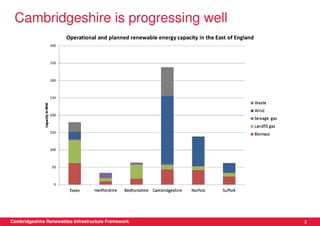
Cambridgeshire is progressing well


Cambridgeshire Renewables Infrastructure Framework   3
Modelling renewable energy deployment potential
                                                                                            Scenario 4
                                           Scenario 1       Scenario 2      Scenario 3      (high without
                           Inputs          (low)            (medium)        (high)          wind)
                           Discount rate   9%               7%              6%              6%
                                                                            DECC - 'high    DECC - 'high
                           Energy price    DECC - 'low'     DECC - 'high'   high' energy    high' energy
                           [1]
                                           energy prices    energy prices   prices          prices
                                                                            current rates   current rates
                                                                            (FIT/ RHI       (FIT/ RHI
                                                                            designed to     designed to
                                                                            give fixed      give fixed
                                                                            return & will   return & will
                           Financial       lower than                       adjust to       adjust to
                           incentives      current tariff                   energy          energy
                           (FIT/RHI)       rates            current rates   prices)         prices)
                           Project
                           deployment
                           rate
                           (wind/biomas                                                     30% (0% for
                           s/EfW)          8%               15%             30%             wind)

                           Green policy
                           support (for
                           building
                           integrated
                           technologies)   Low              Medium          High            High


Cambridgeshire Renewables Infrastructure Framework                                                          4
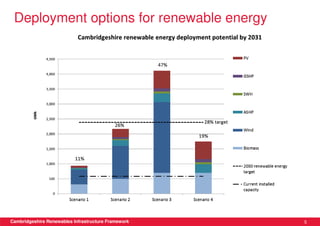
Deployment options for renewable energy


Cambridgeshire Renewables Infrastructure Framework   5
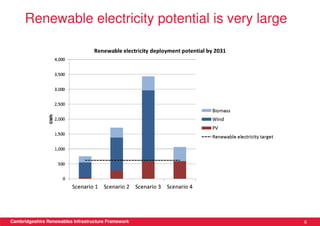
Renewable electricity potential is very large


Cambridgeshire Renewables Infrastructure Framework    6
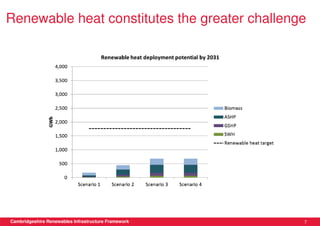
Renewable heat constitutes the greater challenge


Cambridgeshire Renewables Infrastructure Framework   7
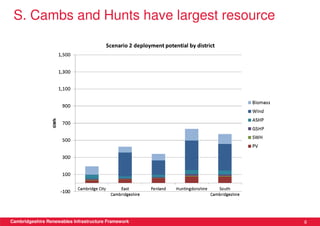
S. Cambs and Hunts have largest resource


Cambridgeshire Renewables Infrastructure Framework   8
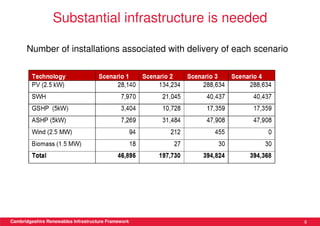
Substantial infrastructure is needed

      Number of installations associated with delivery of each scenario


Cambridgeshire Renewables Infrastructure Framework                        9
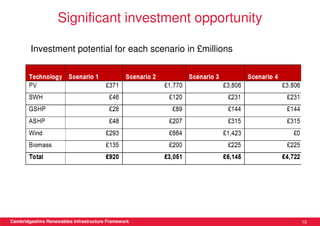
Significant investment opportunity

        Investment potential for each scenario in £millions


Cambridgeshire Renewables Infrastructure Framework            10
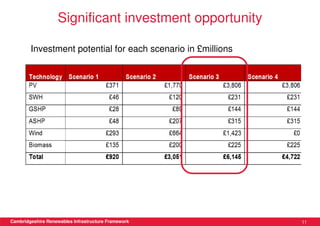
Significant investment opportunity

        Investment potential for each scenario in £millions


Cambridgeshire Renewables Infrastructure Framework            11
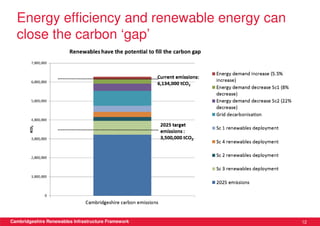
Energy efficiency and renewable energy can
  close the carbon ‘gap’


Cambridgeshire Renewables Infrastructure Framework   12
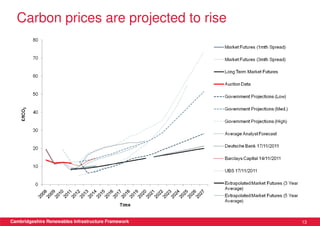
Carbon prices are projected to rise


Cambridgeshire Renewables Infrastructure Framework   13
Conclusions: deployment potential

 •     Cambridgeshire has experience of delivering renewable energy
 •     There needs to be more – solar, biomass, heat pumps, wind
 •     All technologies are needed – heat and electricity
 •     Somewhere between medium & high scenarios delivers UK legal
       renewable energy and carbon targets by 2031
 •     Significant investment potential – up to £6.1 billion for high scenario
 •     Local jobs, affordable energy, hub of expertise


Cambridgeshire Renewables Infrastructure Framework                               14
Thanks

    Duncan Price

       Renewable energy delivery pathways
    Director
    Camco

     t: +44 (0)20 7121 6150
    m: +44 (0)7769 692 610
    e: duncan.price@camcoglobal.com


    172 Tottenham Court Road London
    W1T 7NS United Kingdom

    www.camcoglobal.com

Cambridgeshire Renewables Infrastructure Framework            15
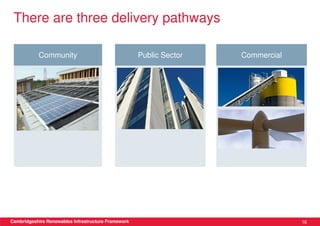
There are three delivery pathways

           Community                                 Public Sector   Commercial


Cambridgeshire Renewables Infrastructure Framework                                16
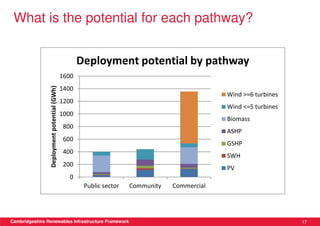
What is the potential for each pathway?


                                                     Deployment potential by pathway
                                              1600
                 Deployment potential (GWh)


                                              1400
                                                                                               Wind >=6 turbines
                                              1200
                                                                                               Wind <=5 turbines
                                              1000
                                                                                               Biomass
                                              800
                                                                                               ASHP
                                              600
                                                                                               GSHP
                                              400
                                                                                               SWH
                                              200
                                                                                               PV
                                                0
                                                      Public sector   Community   Commercial


Cambridgeshire Renewables Infrastructure Framework                                                                 17
Community pathway
     Deployment potential
 •       PV                                          •       Heat pumps
     •    145MWp, 1,150,000m² of panels                  •    43,000 or 15% of houses
     •    460 non-residential buildings and 30,400       •    £140m capex, £75m NPV
          houses (14%)
                                                     •       Wind
     •    £640m capex, £150m NPV
                                                         •    75MW or 30 turbines
 •       Solar water heating
                                                         •    £120m capex, £8m NPV
     •    42,600m² of panels on 8,500 houses (4%)
     •    £50m capex, £20m NPV


Cambridgeshire Renewables Infrastructure Framework                                      18
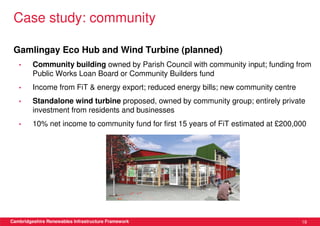
Case study: community

 Gamlingay Eco Hub and Wind Turbine (planned)
   •     Community building owned by Parish Council with community input; funding from
         Public Works Loan Board or Community Builders fund
   •     Income from FiT & energy export; reduced energy bills; new community centre
   •     Standalone wind turbine proposed, owned by community group; entirely private
         investment from residents and businesses
   •     10% net income to community fund for first 15 years of FiT estimated at £200,000


Cambridgeshire Renewables Infrastructure Framework                                     19
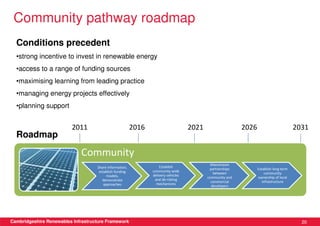
Community pathway roadmap
  Conditions precedent
  •strong incentive to invest in renewable energy
  •access to a range of funding sources
  •maximising learning from leading practice
  •managing energy projects effectively
  •planning support


                         2011                            2016                       2021                   2026                         2031
  Roadmap

                             Community
                                                                                             Mainstream
                                    Share information,              Establish
                                                                                            partnerships          Establish long term
                                     establish funding          community-wide
                                                                                              between                  community
                                          models,               delivery vehicles
                                                                                           community and          ownership of local
                                       demonstrate               and de-risking
                                                                                             commercial              infrastructure
                                        approaches                mechanisms
                                                                                             developers


Cambridgeshire Renewables Infrastructure Framework                                                                                        20
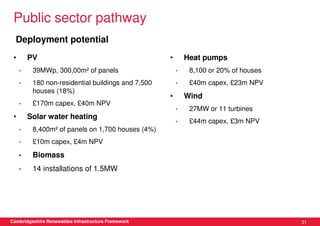
Public sector pathway
  Deployment potential
 •       PV                                          •       Heat pumps
     •    39MWp, 300,00m² of panels                      •    8,100 or 20% of houses
     •    180 non-residential buildings and 7,500        •    £40m capex, £23m NPV
          houses (18%)
                                                     •       Wind
     •    £170m capex, £40m NPV
                                                         •    27MW or 11 turbines
 •       Solar water heating
                                                         •    £44m capex, £3m NPV
     •    8,400m² of panels on 1,700 houses (4%)
     •    £10m capex, £4m NPV
     •    Biomass
     •    14 installations of 1.5MW


Cambridgeshire Renewables Infrastructure Framework                                     21
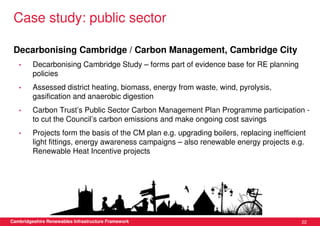
Case study: public sector

 Decarbonising Cambridge / Carbon Management, Cambridge City
   •     Decarbonising Cambridge Study – forms part of evidence base for RE planning
         policies
   •     Assessed district heating, biomass, energy from waste, wind, pyrolysis,
         gasification and anaerobic digestion
   •     Carbon Trust’s Public Sector Carbon Management Plan Programme participation -
         to cut the Council’s carbon emissions and make ongoing cost savings
   •     Projects form the basis of the CM plan e.g. upgrading boilers, replacing inefficient
         light fittings, energy awareness campaigns – also renewable energy projects e.g.
         Renewable Heat Incentive projects


Cambridgeshire Renewables Infrastructure Framework                                         22
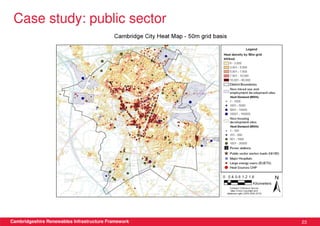
Case study: public sector


Cambridgeshire Renewables Infrastructure Framework   23
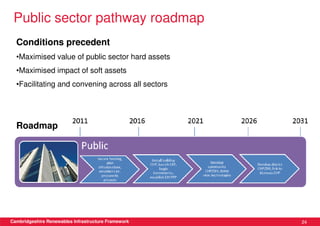
Public sector pathway roadmap
  Conditions precedent
  •Maximised value of public sector hard assets
  •Maximised impact of soft assets
  •Facilitating and convening across all sectors


  Roadmap


Cambridgeshire Renewables Infrastructure Framework   24
Commercial pathway
     Deployment potential
 •       PV                                          •       Heat pumps
     •    160MWp, 1,300,000m² of panels                  •    200 or 3% of buildings
     •    3,200 non-residential buildings                •    £75m capex, £43m NPV
     •    £720m capex, £165m NPV                     •       Wind
 •       Solar water heating                             •    For wind parks ≤5 turbines, 28MW or 11
                                                              turbines
     •    8,300m² of panels on 1,700 or 20% of
          buildings                                      •    For wind parks ≥6 turbines, 375MW or 150
                                                              turbines
     •    £9m capex, £4m NPV
                                                         •    Total capex £660m, £45m NPV
     •    Biomass
     •    14 installations of 1.5MW


Cambridgeshire Renewables Infrastructure Framework                                                     25
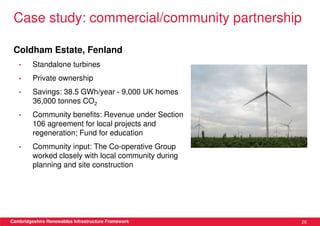
Case study: commercial/community partnership

 Coldham Estate, Fenland
   •     Standalone turbines
   •     Private ownership
   •     Savings: 38.5 GWh/year - 9,000 UK homes
         36,000 tonnes CO2
   •     Community benefits: Revenue under Section
         106 agreement for local projects and
         regeneration; Fund for education
   •     Community input: The Co-operative Group
         worked closely with local community during
         planning and site construction


Cambridgeshire Renewables Infrastructure Framework    26
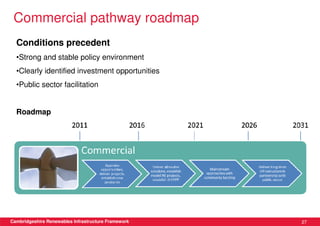
Commercial pathway roadmap
  Conditions precedent
  •Strong and stable policy environment
  •Clearly identified investment opportunities
  •Public sector facilitation


  Roadmap


Cambridgeshire Renewables Infrastructure Framework   27
Conclusions

 •     The economic prize is £3-6bn investment in Cambridgeshire
 •     Deployment potential is spread across three pathways
 •     Conditions precedent must be met
 •     There are good practice examples to follow
 •     The role of the public sector is key:
       Leadership
       Policy support
       Project development through own assets


Cambridgeshire Renewables Infrastructure Framework                 28
Thanks

    Duncan Price
    Director
    Camco

     t: +44 (0)20 7121 6150
    m: +44 (0)7769 692 610
    e: duncan.price@camcoglobal.com


    172 Tottenham Court Road London
    W1T 7NS United Kingdom

    www.camcoglobal.com

Cambridgeshire Renewables Infrastructure Framework            29

CRIF Final Presentation, Camco

  • 1.
    Cambridgeshire Renewables InfrastructureFramework Shire Hall 19th December 2011 Duncan Price, Director Cambridgeshire Renewables Infrastructure Framework
  • 2.
    Background • DECC study of renewable energy potential in the East of England • CRIF work looks in more detail at Cambridegshire • Moving beyond technical potential to economic and deployment considerations • Consideration of three primary delivery pathways • Forms part of the evidence base for public policy formation Cambridgeshire Renewables Infrastructure Framework 1
  • 3.
    Cambridgeshire’s challenging carbonobjectives What is Cambridgeshire's potential? Cambridgeshire Renewables Infrastructure Framework 2
  • 4.
    Cambridgeshire is progressingwell Cambridgeshire Renewables Infrastructure Framework 3
  • 5.
    Modelling renewable energydeployment potential Scenario 4 Scenario 1 Scenario 2 Scenario 3 (high without Inputs (low) (medium) (high) wind) Discount rate 9% 7% 6% 6% DECC - 'high DECC - 'high Energy price DECC - 'low' DECC - 'high' high' energy high' energy [1] energy prices energy prices prices prices current rates current rates (FIT/ RHI (FIT/ RHI designed to designed to give fixed give fixed return & will return & will Financial lower than adjust to adjust to incentives current tariff energy energy (FIT/RHI) rates current rates prices) prices) Project deployment rate (wind/biomas 30% (0% for s/EfW) 8% 15% 30% wind) Green policy support (for building integrated technologies) Low Medium High High Cambridgeshire Renewables Infrastructure Framework 4
  • 6.
    Deployment options forrenewable energy Cambridgeshire Renewables Infrastructure Framework 5
  • 7.
    Renewable electricity potentialis very large Cambridgeshire Renewables Infrastructure Framework 6
  • 8.
    Renewable heat constitutesthe greater challenge Cambridgeshire Renewables Infrastructure Framework 7
  • 9.
    S. Cambs andHunts have largest resource Cambridgeshire Renewables Infrastructure Framework 8
  • 10.
    Substantial infrastructure isneeded Number of installations associated with delivery of each scenario Cambridgeshire Renewables Infrastructure Framework 9
  • 11.
    Significant investment opportunity Investment potential for each scenario in £millions Cambridgeshire Renewables Infrastructure Framework 10
  • 12.
    Significant investment opportunity Investment potential for each scenario in £millions Cambridgeshire Renewables Infrastructure Framework 11
  • 13.
    Energy efficiency andrenewable energy can close the carbon ‘gap’ Cambridgeshire Renewables Infrastructure Framework 12
  • 14.
    Carbon prices areprojected to rise Cambridgeshire Renewables Infrastructure Framework 13
  • 15.
    Conclusions: deployment potential • Cambridgeshire has experience of delivering renewable energy • There needs to be more – solar, biomass, heat pumps, wind • All technologies are needed – heat and electricity • Somewhere between medium & high scenarios delivers UK legal renewable energy and carbon targets by 2031 • Significant investment potential – up to £6.1 billion for high scenario • Local jobs, affordable energy, hub of expertise Cambridgeshire Renewables Infrastructure Framework 14
  • 16.
    Thanks Duncan Price Renewable energy delivery pathways Director Camco t: +44 (0)20 7121 6150 m: +44 (0)7769 692 610 e: duncan.price@camcoglobal.com 172 Tottenham Court Road London W1T 7NS United Kingdom www.camcoglobal.com Cambridgeshire Renewables Infrastructure Framework 15
  • 17.
    There are threedelivery pathways Community Public Sector Commercial Cambridgeshire Renewables Infrastructure Framework 16
  • 18.
    What is thepotential for each pathway? Deployment potential by pathway 1600 Deployment potential (GWh) 1400 Wind >=6 turbines 1200 Wind <=5 turbines 1000 Biomass 800 ASHP 600 GSHP 400 SWH 200 PV 0 Public sector Community Commercial Cambridgeshire Renewables Infrastructure Framework 17
  • 19.
    Community pathway Deployment potential • PV • Heat pumps • 145MWp, 1,150,000m² of panels • 43,000 or 15% of houses • 460 non-residential buildings and 30,400 • £140m capex, £75m NPV houses (14%) • Wind • £640m capex, £150m NPV • 75MW or 30 turbines • Solar water heating • £120m capex, £8m NPV • 42,600m² of panels on 8,500 houses (4%) • £50m capex, £20m NPV Cambridgeshire Renewables Infrastructure Framework 18
  • 20.
    Case study: community Gamlingay Eco Hub and Wind Turbine (planned) • Community building owned by Parish Council with community input; funding from Public Works Loan Board or Community Builders fund • Income from FiT & energy export; reduced energy bills; new community centre • Standalone wind turbine proposed, owned by community group; entirely private investment from residents and businesses • 10% net income to community fund for first 15 years of FiT estimated at £200,000 Cambridgeshire Renewables Infrastructure Framework 19
  • 21.
    Community pathway roadmap Conditions precedent •strong incentive to invest in renewable energy •access to a range of funding sources •maximising learning from leading practice •managing energy projects effectively •planning support 2011 2016 2021 2026 2031 Roadmap Community Mainstream Share information, Establish partnerships Establish long term establish funding community-wide between community models, delivery vehicles community and ownership of local demonstrate and de-risking commercial infrastructure approaches mechanisms developers Cambridgeshire Renewables Infrastructure Framework 20
  • 22.
    Public sector pathway Deployment potential • PV • Heat pumps • 39MWp, 300,00m² of panels • 8,100 or 20% of houses • 180 non-residential buildings and 7,500 • £40m capex, £23m NPV houses (18%) • Wind • £170m capex, £40m NPV • 27MW or 11 turbines • Solar water heating • £44m capex, £3m NPV • 8,400m² of panels on 1,700 houses (4%) • £10m capex, £4m NPV • Biomass • 14 installations of 1.5MW Cambridgeshire Renewables Infrastructure Framework 21
  • 23.
    Case study: publicsector Decarbonising Cambridge / Carbon Management, Cambridge City • Decarbonising Cambridge Study – forms part of evidence base for RE planning policies • Assessed district heating, biomass, energy from waste, wind, pyrolysis, gasification and anaerobic digestion • Carbon Trust’s Public Sector Carbon Management Plan Programme participation - to cut the Council’s carbon emissions and make ongoing cost savings • Projects form the basis of the CM plan e.g. upgrading boilers, replacing inefficient light fittings, energy awareness campaigns – also renewable energy projects e.g. Renewable Heat Incentive projects Cambridgeshire Renewables Infrastructure Framework 22
  • 24.
    Case study: publicsector Cambridgeshire Renewables Infrastructure Framework 23
  • 25.
    Public sector pathwayroadmap Conditions precedent •Maximised value of public sector hard assets •Maximised impact of soft assets •Facilitating and convening across all sectors Roadmap Cambridgeshire Renewables Infrastructure Framework 24
  • 26.
    Commercial pathway Deployment potential • PV • Heat pumps • 160MWp, 1,300,000m² of panels • 200 or 3% of buildings • 3,200 non-residential buildings • £75m capex, £43m NPV • £720m capex, £165m NPV • Wind • Solar water heating • For wind parks ≤5 turbines, 28MW or 11 turbines • 8,300m² of panels on 1,700 or 20% of buildings • For wind parks ≥6 turbines, 375MW or 150 turbines • £9m capex, £4m NPV • Total capex £660m, £45m NPV • Biomass • 14 installations of 1.5MW Cambridgeshire Renewables Infrastructure Framework 25
  • 27.
    Case study: commercial/communitypartnership Coldham Estate, Fenland • Standalone turbines • Private ownership • Savings: 38.5 GWh/year - 9,000 UK homes 36,000 tonnes CO2 • Community benefits: Revenue under Section 106 agreement for local projects and regeneration; Fund for education • Community input: The Co-operative Group worked closely with local community during planning and site construction Cambridgeshire Renewables Infrastructure Framework 26
  • 28.
    Commercial pathway roadmap Conditions precedent •Strong and stable policy environment •Clearly identified investment opportunities •Public sector facilitation Roadmap Cambridgeshire Renewables Infrastructure Framework 27
  • 29.
    Conclusions • The economic prize is £3-6bn investment in Cambridgeshire • Deployment potential is spread across three pathways • Conditions precedent must be met • There are good practice examples to follow • The role of the public sector is key: Leadership Policy support Project development through own assets Cambridgeshire Renewables Infrastructure Framework 28
  • 30.
    Thanks Duncan Price Director Camco t: +44 (0)20 7121 6150 m: +44 (0)7769 692 610 e: duncan.price@camcoglobal.com 172 Tottenham Court Road London W1T 7NS United Kingdom www.camcoglobal.com Cambridgeshire Renewables Infrastructure Framework 29